Anita Mathias: Dreaming Beneath the Spires

Anita Mathias's Blog on Faith and Art

  • Home
  • My Books
  • Meditations
  • Essays
  • Contact
  • About Me

Quit Worrying about your Savings Plan: Jesus

By Anita Mathias

 Image credit

Jesus was a spectacularly loving person, caring and reaching out right through his crucifixion— so when he speaks about money, we’d be wise to listen up.

We’d be wise to listen because his desire, the reason he said he came, was for the fullest human flourishing, that we may have LIFE in abundance.

We’d be wise to listen because he only speaks in kindness.

* * *

I am re-reading the Sermon on the Mount. There has been a Christian conspiracy down the ages to quietly ignore parts of it.

But I bet Jesus meant it when he said “Do not store up for yourselves treasures on earth, but rather store up for yourself treasures in heaven.” He’s consistent in this advice: Do not labour for food which perishes, but for food which endures to eternal life.

* * *

The standard financial advice is to keep 6 months salary in cash at all times, (and to have 10 times your final salary in cash or stocks by the time you retire).

In other words, save enough to ensure that you can live without needing to trust God, without needing to lean on his ingenious ideas, and without needing to see his miracles and deliverances.

There is no kindness nor God-wisdom in this advice, but a lot of self-imposed deprivation, of harsh treatment of the present.

Six months salary in cash at all times; ten times final salary squirrelled away–think of how much fun and adventure and experience and opportunities for kindness and generosity and hospitality we miss out on with this sterile focus on saving enough money so that we will never have to rely on God’s kindness or generosity. So that we can, completely erroneously, perceive ourselves to be invulnerable.

* * *

There is a popular cliché about work-life balance: Nobody on his deathbed ever said, ‘I wish I had spent more time at the office’.  What is more likely is that nobody ever said on his deathbed, “I wish I had more money.”

But we may well wish we’d travelled more, seen more theatre, more film, read more books, taken more friends out to dinner, been more generous to our children, instead of working so darn hard, saving so much.

Stop worrying about saving for the future. And do not waste today worrying about the future.

This radical statement is, in fact, a sacred command. Do not worry about tomorrow Jesus says, setting us free, great liberator that he is.

* * *

The effects of  2008 world-wide credit crunch, and the subsequent contraction of economies are lingering. It’s probably a safe bet that many of my readers will not be on track to have ten times their final salary by the time they retire.

And neither am I!!

But, truthfully, I am not worried.

(If I received a cheque in the mail for ten years salary, I would bank most of it. But, in its absence, I would not deprive myself of travel or generosity or what is necessary for the flourishing of my work, or my family’s flourishing because I do not have 3-6 months salary in the bank and my retirement is not properly funded. I would not, however, go into debt, or put more on my credit card than I can pay in full this month for anything, except food.)

* * *

And that is why the Gospel is good news to the poor. Guys, do not worry, Jesus says, soaring into sublimity. The God who cares for the sparrows and lilies will care for you. Seek God today, and let Him worry about tomorrow.

It is splendid advice, and, with God’s help, I intend to follow it.

* * *

I once read some research that tracked people’s thoughts through the day. The top things women thought about were 1) their hair!! 2) money. How much they have, how to save, what to buy, how to get bargains, how much money others have, how they got it. Women thought more about money and their hair than sex, the study observed. Men, on the other hand…

However, why not gradually shift our focus in the direction Jesus suggests–to focus on alternative eternal treasures—and fill our bodies with light? In Matthew 13, in a slew of metaphors, living in God’s kingdom is consistently referred to as treasure: the treasure in a field, the pearl of great price worth selling everything to buy.

Why not slowly develop the habit of eating Scripture, this treasure hidden from the busy? Develop the habit of Scripture meditation, an acquired taste in our fast-fast world of distraction. Start small, start with a short time, and increase it as the appetite grows for time with Jesus in quiet eternal realms which stretch and expand.

* * *

Scripture meditation yields great rewards. Paul Meier M.D. found in his study of the psychological and mental health and spiritual lives of evangelical seminary students that students who practiced almost daily Scripture meditation for three years or longer were significantly healthier and happier than students who did not meditate on Scripture daily.

Or as Jesus might have said, their whole body was full of light.

* * *

For what we focus on determines the course of our lives. If our eye is good (“good eye” opthalmos haplos in Greek, refers to generosity) our whole body is full of light. If on, the other hand, our eye is bad, (evil eye, Greek ophthalos poneros, refers to stinginess or greediness) our whole body is full of darkness.

When I think of the most generous people I know, there is a lightness and loveliness to them. And when I think of the most stingy, money-focused people I know—who cannot part with money, cannot force themselves to be generous, who will manipulate others into helping them, but rarely help others—there is a kind of darkness in their lives. The English word miser comes from the Latin miser, “unhappy, wretched, pitiable, in distress.” The focus on money clouds their hearts and lives in darkness.

Whoa, Jesus, so many things you say are literally true!!


Filed Under: Matthew Tagged With: focus, generosity, giving, matthew 6, money, not worrying, saving

In which Christ Lures us to Secret Prayer, and Promises us a Reward for it.

By Anita Mathias

 “Come you apart from them and be secret,” Christ calls out to us. (Matt. 6 1-18)

We live in a world governed by “the rules,” described by Brene Brown in Daring Greatly: For women, “be naturally beautiful, thin, and perfect at everything, especially motherhood. Be sweet, stay quiet; be perfect moms and wives; don’t own your power.”

For men: “stop feeling, start earning, climb the way to the top, or die trying. Winning, emotional control, risk-taking, dominance, self-reliance, primacy of work, pursuit of status.”

And in the microcosm of church, do these rules still apply? Sure. Men who are wealthy, successful, dominant are feted, and elected as elders, never mind when they last opened their Bibles, or settled down for a time of prayer. For women, being fit, pretty, well-presented, and a perfect mom and housekeeper has become a subset of spirituality in a way the medieval mystics would not have recognized.

But we also uneasily respect those rare birds in our churches: the prayer warriors, the Bible mavens, the mission freaks. They may not be entirely accepted by the cool Christians to whom Sunday morning services are a respite from a week of getting and spending and managing, but we respect them in the way fifth century Christians respected St. Simon Stylites who spent 37 years on a pillar to escape worldly distractions.

But Jesus does not permit us to use our devotion to him as yet another means of gaining status and attention. He advises: Don’t publicly donate or serve on every board to gain a reputation for philanthropy. You might get the respect shallow people accord the rich if you do so, but not the unspecified (but undoubtedly marvellous) reward which your Father will give you. Give generously, but so secretly that your left hand does not know what your right hand is doing. Give for your Father’s reward, which will be wonderful, whether it be the success you crave, the wealth you need, the family closeness you want, or health, or, best of all, peace.

* * *

Similarly, with prayer.  We might hold sway in prayer meetings, with long prayers whose secret, perhaps unconscious, objective includes impressing people with our soft heart, our passion for Christ, our theological understanding–or even to gossip through the tidbits we drop in, or subtly manipulate people by the things we pray for them. And people may be impressed by our long prayers. And that is all the reward we get. Pretty paltry, huh?

But what if we waste time with God, and–instead of earning, organizing, working, networking, promoting ourselves–spend time in prayer so secretly that no one knows, and no one will guess?

We get God’s reward.

Again, unspecified, but I think it will be really, really cool. It will be the right reward for us, and for our lives. He might crown our efforts with success. Grant us health like Caleb, who claimed he was as strong and vigorous at 85 as at 40 (Joshua 14:11).

He might bless our family with love. Deliver us from evil. Make our plans succeed. Guide us.

* * *

When Roy and I were newly-wed and newly committed to Christ, we joined a Christian “young marrieds” group.

Some of those people have soared the heights—were named by Christianity Today as young pastors to watch, became passionate career missionaries. Others just chugged along, same old, same old…

I noticed the same in Christian friends I’ve known for decades. A few have taken enormous spiritual strides, becoming people of wisdom and spiritual wealth with which to bless others; others remained apparently stagnant.

What makes the difference between a passionate Christian and an average one? I used to think it was whether one actually obeyed the “rhema” word of God–when God highlights certain passages of scripture to your spirit, or clearly speaks to you. And that’s part of it.

But the other thing which makes Christians sweet, rather than sour, and a pleasure to be with, like cool spring water on a hot day, is their hidden life of prayer.

Prayer running through the day like a quiet, underground river, guarding your heart, keeping you calm, giving you guidance.

Walking with Christ, an invisible friend, a secret sharer, who will  at crucial times whisper, “This is the way; walk in it.”

And this guidance and direction makes all the difference between one life and another, between a blessed life and another.

* * *

The rewards of prayer include a quieter spirit, a more loving spirit, being saved from sin, God’s blessing, God’s guidance. These  we can guess at.

But perhaps, once it’s all over, and the last curtain falls, we will see all the difference our secret life of prayer made to our actual life amid the hurly-burly. We will see all the blessings that came as a result of our secret life of prayer which we were unaware of; all the things we were saved from; all the times life-changing guidance welled up within our spirits–and how grateful we will be that we cultivated the habit of prayer that grew to be so sweet and necessary that we would have done it for its own sake.

But, in fact, God, who is infinitely generous, had rewarded us for our secret times with him in myriad ways we never guessed at on earth, but now see clearly.

Filed Under: In which I play in the fields of prayer, Matthew Tagged With: blog through the Bible project, giving, God's rewards, Matthew, Prayer, secrecy

“Do not Resist Evil;” One Way to Heal after Experiencing Evil

By Anita Mathias

Image Credit

You have heard that it was said, ‘Eye for eye, and tooth for tooth.’ But I tell you, do not resist an evil person. If anyone slaps you on the right cheek, turn to them the other cheek also.  And if anyone wants to take your shirt, hand over your coat as well.  If anyone forces you to go one mile, go with them two miles. (Matthew 5 38-41).

Oh Jesus, how costly your words are.

Recently, when I’ve suffered actual or perceived injustice or annoyance, and have taken up the matter with Jesus, I’ve heard him say, “Let him.” “Let her.”

“Just don’t get entangled with evil, with resistance, with revenge. Let them do what they want to do. I am the ultimate score-keeer, the umpire, who will provide you another coat, and strength to walk the third mile on your own business after you’ve marched two miles carrying the Roman soldier’s gear.”

* * *

If we do not “let them,” if we plot revenge, if we put our emotional hooks in our enemy’s flesh, mentally dragging them behind us everywhere, we get embroiled in an endless tit-for-tat world of malice.

The principle of an eye for an eye, applied in the Code of Hammurabi, Judaism and Islam was neat, merciless, and there an end. But in our more sophisticated societies, what constitutes an eye for an eye is not so easily calculated. People extract revenge in all sorts of ways: gossip, slander, blocking, passive aggression, malice, and pettiness.

Sad for the victim, and sad too for the perpetrator—whose character becomes smaller and meaner and shrivels, becoming increasingly cut off from the waterfall of the grace and power of God. Once we put those who have wronged us on a mental blacklist, unconsciously ready to get even given a chance, we are no longer quite so open to God’s guidance; the presence of the Holy Spirit no longer pulses in our souls.

But what are we to do when we suffer injustice? Because we well might. The enemy of our souls stalks this world, twisting, corrupting, darkening. However, he plays against the Grandmaster who will, of course, ultimately win.

* * *

Let tell you a story of my initial failure and ultimate success in one of my encounters with evil. And about one way I have stumbled on to heal after experiencing evil.

Several years ago, I was wronged, unfairly treated, and humiliated. Because this happened at an extremely vulnerable point in my life, it precipitated an episode of “great sadness.”

A couple of years after that incident, through an unexpected turn of events, I got to “whistle-blow,”—I publicly pointed out a severe dereliction of duty on the part of the person who had unfairly treated me. They resigned from their relatively well-paid sinecurish job.

Quits, huh? This person furiously said to me, “Well, you’ve got your pound of flesh now, haven’t you?” And I childishly replied, “No, what you did to me was far worse.”

But yes, I had got my pound of flesh, plus. However, each time I remembered how I had been treated, my heart burned with indignation at the injustice and shaming. I wanted to do something about it, all over again.  Though, I had already done something. As they said, I had had my pound of flesh. (And eating anger probably did add some pounds of flesh to my frame.)

We will never feel quits, never, because the memory of past wrongs feels fresh again. And at the “re-injury,” we again want to get even, though heck, we’ve already done so in so many petty soul-corrupting ways, damaging our souls, damaging our communion with Jesus, and with his sweet spirit.

* * *

And so for our protection, Jesus tells us not to even try to get even. But we are not to sit all tensed up saying, “I will not take revenge. I will not think of a pink elephant.”

There are other ways for the soul to  heal. One is do good to those who have injured you. And what when our soul cannot yet stretch to that sublimity? When we cannot bring ourselves to do our enemies a good turn?

I am reading Brene Brown’s Daring Greatly.  She quotes psychologist James Pennebaker who says that the act of not discussing a traumatic event or confiding it to another person could be more damaging than the actual event. Conversely, when people shared their stories and experiences, their physical health improved.

In his book Writing to Heal, Pennebaker says, “The act of writing about traumatic experience for as little as 15 or 20 minutes a day for three or four days can produce measurable changes in physical and mental health. Emotional writing can also affect people’s sleep habits, work efficiency, and how they connect with others.”

So then, I write my three morning pages about this particular episode which still made me feel outraged when I thought about it.

* * *

And as I write, I see it wholly, not just all the infuriating bits, but the whole chain of events, including my culpability.

In scripture, a turning point is often marked by the phrase, “But God.”  And unexpectedly, God steps in. As I was able to see those disturbing events more clearly, I was also able to see the good God brought out of them.

He showed me that his loving kindness had been extended to me, though other people may have behaved out of insecurity,  competitiveness, jealousy, malice or in a good old-fashioned power struggle. Augustine writes in his Confessions that his teachers acted towards him in malice or indifference, but God was working too, turning it to good.

I then had been leading and spear-heading something I shouldn’t have been because I was overwhelmed and beside myself in my personal life. I need to get my house in order, literally. I needed to get my business profitable. I need to stabilize my emotions. I needed more sleep, more rest. I needed to write, which I wasn’t doing at all. I needed the desert, which I so chafed against. I needed an Elijah experience of sleeping, eating and resting. I needed to see God in the wilderness like Hagar did. And I needed to emerge from it, strong, leaning on my beloved.

And through my enforced sojourn in the desert, forced on me by these people, I developed my latent entrepreneurial gifts. I established our family business, freeing me to focus on writing. I had time to establish my blog, slowly writing my way to a blogging style which speaks to people. I learnt soaking prayer. I became convinced of the deep love of God for me. My soul healed. And I cut all ties with those toxic people!

God was in the situation, the Grandmaster, putting me in a corner, to rest, to heal, to gather strength for the destiny he had in mind for me. The people who put me in the corner were also pawns in the grandmaster’s hand. Nothing happened to me but what He permitted; nothing, but what He turned to goodness and blessing for me.

Nothing, nothing, happens to you but what God has permitted. Nothing, nothing happens to you that God is unable to turn to good.

Do not resist an evil person. Do not get emotionally entangled with them. If they force you to march a mile, march it. If they take your cloak, shrug it off; let him have it. And then march free, your eyes on your Father, who can give you the cloak you need, the strength you need, whose eyes are on you, who can do anything, for whom nothing is too wonderful.

And Jesus, please give me the grace, if and when necessary, to live my own words—and Yours.


Over to you:

Have you experienced evil? How have you healed after that experience?


Filed Under: In which I decide to follow Jesus, Matthew Tagged With: blog through the bible, brene brown, healing through expressive writing, James Pennebaker, loving enemies, Matthew, morning pages, sermon on the mount

A City Set on a Hill cannot be Hidden: Focus on Working, not Networking

By Anita Mathias

The-City-on-a-Hill

So you are going to build a city.

Dig its foundations deep. Pour the concrete. Design your buildings. It’s your city: Put in whatever you like—the Alhambra, the Hagia Sophia, the Sagrada Familia, the Parthenon.  Throw in Notre Dame and Westminster Abbey.

Decorate your buildings as you wish—with the mosaics from Ravenna, or from the Topkapi Palacein Istanbul.

It’s your city. Put in the Pre-Raphaelites, the Impressionists, Botticelli and Raphael. Have your floors inlaid marble from Florence. Have indoor fountains and reflecting pools where goldfish glide.

Throw in chandeliers and floor to ceiling windows. Let your city be full of light.

You are building your city on a hill. It cannot be hidden.

* * *

You will, in moments of lesser faith, read blogs on how to hustle, how to promote your city, how to network, make connections, build a platform.

Oh builder of cities, beware. All these things steal time and focus away from learning the art and craft of city building.

Instead, seek God for the perfect blueprint for your city. Seek his inspiration for each tower and spire, each inlaid marble floor, each wall hung with Persian carpets, and each Tiffany lamp through which light glows.

Unless love runs through your city, and the desire to meet people’s needs for beauty, joy, peace, wisdom or rest, all the promotion and hustling you do will be futile. Nobody will long linger there, buy property there, and stroll through the boulevards under shady lime trees, hand in hand with their lovers.

* * *

There is a kind of networking which is sheer joy—if you connect with people whose work you love, if you praise them honestly, interact with their work whole-heartedly, then you make friends, and this whole city-building business become more joyful.

However, flattering people for their attention; making connections for the good things these connections might bring you; befriending people to use them to promote your work—how can one ask God to bless such endeavours? Oh woman of God, flee these things.

There is a sort of hustling and self-promotion that is practical atheism.  We act as if there is no God who can help people notice our city on a hill. We act as if God does not delight in good work and want people to enjoy it. We act as if God cannot even now give us twelve legions of those who will enjoy our work if we ask him. We forget the power of prayer.

And the worst thing about excessive self-promotion and connection-making? It devours the time and energy that should go into making your rare and beautiful city, set on a hill. So beautiful that at night, when the lights are switched on, and coloured fountains play, people cannot but look up and marvel; their feet itch, they yearn to walk up and explore.

And in spring, they will delight in walking through its gardens of cherry blossoms, and will sit under their shade, and look at the fields of daffodils, stretching as far as the eye can see.

* * *

Besides, the connections which matter will arise organically. Other builders of cities on hills will notice yours, and ask you managed that 150 metre spire without visible support, and you will talk about flying buttresses. And you will ask them what pigments they used for those impossibly large stained glass windows which flood their cathedrals with rainbowed light, and they will tell you.

* * *

God delights in your creativity. Build your city under his eye, as your worship to him, seeking his wisdom, in alignment with his stream of thoughts which outnumber the grains of sand on the seashore.

Let him smile, and say it is very good.

And as for the audience you’d love to have?

Remember, a city on a hill cannot be hidden. It glimmers during the day, and its light shines through the land at night.

Filed Under: Applying my heart unto wisdom, In which I explore writing and blogging and creativity, Matthew, Writing and Blogging Tagged With: blog through the bible, blogging, Creativity, Matthew, sermon the mount, worship, writing

The Will of God Always Leads Us to a Larger Place

By Anita Mathias

Picture

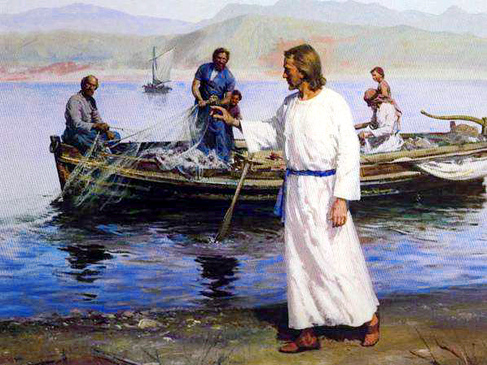
As Jesus was walking beside the Sea of Galilee, he saw two brothers, Simon called Peter and his brother Andrew. They were casting a net into the lake, for they were fishermen.  “Come, follow me,” Jesus said, “and I will make you fishers of men.” At once they left their nets and followed him. (Matthew 4 18-20) 

So the fishers of fish become halieis anthropon, ἁλιεῖς ἀνθρώπων, fishers of men. The will of God always leads us to a larger place, to an enlarged territory.

Because God’s desire is always for the fullest human flourishing. “The glory of God is man fully alive,” a lovely line credited to St. Irenaeus

And once we have surrendered our lives to him, he keeps moving us, onward and upward to the place where we can both use all our gifts and be a blessing to others. And in general, he takes the moving car of who we are; our gifts, abilities and experience, and steers it higher, stronger, faster.

So Jesus takes physically strong, entrepreneurial fisherman inured to hard work, team work, hardship, disappointment, nights at sea, and gives them the task of fishing men into an eternal kingdom. He applies their natural gifts to eternal, supernatural purposes.

Of course, just as we don’t give our children just one birthday present, once in their lives, so God continually gives us new gifts, abilities, capabilities, insight and new wisdom. But the vocation to which he calls us will be true to who we are, and to our interests and gifts.

* * *

Retreat to advance

In the short run, however, Peter and Andrew, James and John became downwardly mobile. No longer independent businessmen, but vagabonds, with no place to rest their head, dependent on charity.

Their old selves had to be broken, to be reformed like a beautiful mosaic.

John Wimber, founder of the Vineyard Movement, flourished in the music industry. However, on becoming a Christian, he found it incompatible with discipleship. So he left, and found work in a factory. An old colleague came to see him, asking for John Wimber’s office. He found Wimber covered with oil, inside a oil-barrel he was scrubbing out. The musician thought Wimber had gone mad!! (Recounted by Carol Wimber in The Way it Was.)

It required this brokenness for Wimber to be willing to hear when God said, “John, I have seen your work. Now let me show you mine.” And to be open to going with the flow of God’s  eccentric purposes.

And later to be a willing instrument when the Holy Spirit songs kept coming, no longer pop songs popular for a year, but spirit-given songs sung for decades, or longer.

* * *

However, it takes a period of brokenness and withdrawal for a gift to be repurposed, for fishermen to become fishers of men.

He needs our surrender before He can use us to bless others.

And when it happens, it feels like hell.

* * *

I was blocked in 2006 when a literary agent wanted me to make changes in my manuscript. Words dripped like crystallising treacle; I was blocked.

So I took a break, decided to put the kids in private school, founded a small publishing company to pay for that. When Roy could come aboard full time in 2010, and I could “retire,” I felt I no longer knew how to write. I had barely read for 4 years. I had lost writerly confidence.

When I started again, after hearing God suggest blogging, my writing was different. I was singing a new song.

I was more interested in speaking to my readers and blessing them than in a career (though, of course, I still want one) I was more interested in what I said, than in how I said it, which was huge for the girl who had been enamoured with style. I desperate to cut perfectionism off at the neck, and just get my work out there. Ship it! I was writing for the health of my soul, and as an offered gift to my readers, rather than for the glory of a career.

It takes a period of brokenness for the Great Artist to put your gifts together into a glorious mosaic, all hammered gold and gold enamelling, all tesserae and shimmering glass.

* * *

When I first wanted to offer my life to God, I went off to work with Mother Teresa, aged 17. (Having skipped years at school, winning “double promotions,” I was done with Grade 12 by the time I was 16.) I assumed because Jesus said, “Whatever you have done to the least of these…” that surely God’s will for me, and for every Christian was to work with the poor!

However, I am a dreamy and impractical person, and if I were a medieval woman when this was a plausible career choice, I would have become a mystic!

I was no good at Mother Teresa’s, with its packed-like-sardines community life; loud constant, vocal prayer, and lots of practical work. I languished and wilted; I got all sorts of things wrong; life felt like a series of hammer blows to my heart.

But writing–I have always written easily and reasonably well. It has generally been my joy.

Can writing be the way I am to serve God? Can writing be my worship? For years, I didn’t really believe something so lovely could be true

But now I do.

“The place God calls you to is the place where your deep gladness and the world’s deep hunger meet.” (Frederick, Buechner, Wishful Thinking)

Because God is good, pouring perfume can be an act of worship, and so can writing (no longer for fame or money, though few are averse to these things!) but as an act of worship, of pure devotion.

“Child, you have written for ambition,” he says. “Come write for me, as your worship of me.

And I will make you… Ah, wait and see.”

Filed Under: In which I decide to follow Jesus, Matthew Tagged With: Following Christ, John Wimber, Peter and Andrew, vocation

Nothing and No One is Beyond Redemption

By Anita Mathias

Madonna and Child - Sandro Botticelli


Matthew 1: 1-17

I begin reading Matthew again, and again notice that though the Messiah could have chosen to come from nice, safe, unremarkable, pious humans, he instead chosen as his ancestors those who have messed up and blown it—and had their transgressions recorded in the holiest of books!

Amazing: the Redeemer, the most beautiful human I know of, came from generations of the unredeemed, sinners who’ve spectacularly messed up.

All generational sins and curses are broken in him–and for us who are grafted into him, and live in him, he provides newness, freedom from the sins of our past, and our family’s past.

The Holy One comes from the unholy, proving NOTHING we have done, no matter how we have blown it, wasted our time, our lives, our talents, destroyed our relationships, nothing is beyond redemption.

* * *

Those repeated generational lies on the part of Abraham and Isaac, “She is my sister,”–not beyond redemption. The little bit of Do-It-Yourself assistance Abraham provided the promises of God in fathering Ishmael with Hagar–not beyond redemption.

Or Rebecca helping God out in doing what he had promised, by the gross and heart-breaking deception of Isaac. Jacob, the deceiver, the scheming grabber of the main chance, becomes the father of the twelve tribes of Israel.

Judah, who slept with a prostitute, and his daughter-in-law Tamar who incestuously slept with him disguised as one. Rahab, the good prostitute who sheltered the spies.

Redeemed, all redeemed, chosen as ancestors of GOD become flesh. Sexual sins, sins of manipulation, anger, fear and lack of faith—none of these preclude redemption.

* * *

Goodness came out of all these lives. Sweetness from what was very messed up.

And King David with his eight wives and ten concubines, who could not resist the beautiful woman he saw bathing, and indulged his desire, his weakness, his lust—his adultery leading to murder of Uriah, the righteous Hittite.

And—oh sing redemption’s song!–out of his weakness, out of his sin, his lust, his adultery, his taking of Uriah’s one lamb, the murder and adultery he so bitterly regretted– out of that came the wisest man who ever lived. Out of that came the Messiah.

And Solomon, with his 700 wives and 300 concubines, who was given wisdom, knowledge, wealth, possessions and honour (2 Chron 1:12) and the honour of building a glorious temple to the Lord.

And out of all the wicked kings of Judah, whose actions lost the Kingdom and led their people into captivity, the Messiah came.

* * *

Because the father-heart of God cannot help himself. We are his children, the work of his hands, he cannot help redeeming us, as we– come on, ‘fess up—if we can, when we can, give our children a leg up in the rat-race of life.  Whether they are eminently deserving—or not.

* * *

And what a comfort that is, that nothing I have done is beyond redemption.

That I can place all the silliness–things done stupidly, impulsively, hot-headedly, selfishly, maliciously, sinfully!—place them in his hands,

His kind hands which work fast and skilfully,

Redeeming, working all the foolishness and weakness into a new beautiful story for my life.

One by one, I bring to him my sins and failures, the times I have messed up, sins in my marriage, my parenting, my friendships, my church relationships, all these wobbles, bring it to him who amazingly, incredibly, died for me, and they are redeemed, washed in the blood of the lamb. Washed whiter than snow, repurposed.

Oh, take it all lovely Redeemer, take my life, past and present, work on it with your strong brilliant hands; make something beautiful out of it.


Filed Under: In which I am Amazed by Grace, In which I'm amazed by the goodness of God, Matthew Tagged With: Creativity, redemption, the goodness of God

When People Mess up the Story of your Life, but God Edits it Beautifully

By Anita Mathias

The Flight into Egypt and the Triumph of the Innocents (William Holman Hunt)

I read Matthew 2 as I blog through the Bible, and realize how much sheer misery and hassle and stress Joseph and Mary and Jesus had to endure for no sin or mistake of their own—but purely because of their destiny, purely because of other people’s jealousy. [Read more…]

Filed Under: Matthew Tagged With: blog through the bible, Matthew, Trust

“I Don’t” Lists Make Possible “I Do” Lists. You Must Revise Your Life.

By Anita Mathias

raphael saint john baptist preaching NG6480 fm

John the Baptist Preaching (Raphael)

Two fiery, uncompromising men—John the Baptist and Jesus– invite us into the Kingdom of God, the Kingdom within us (Luke 17:21).

And their message is remarkably similar:“Repent for the Kingdom of heaven is near. Make straight paths for the Lord,” John says.

The first words Jesus speaks to people (as opposed to the Devil) in the Gospel of Matthew are “Repent, for the kingdom of heaven is near.” (Matthew 3:2)

“Repent – Μετανοειτε, metanoia. The verb μετανοεω  metanoia, which means turn around, turn your direction 180 degrees.

“The word may be derived from μετα meta after, and ανοια, anoia madness, which intimates that the whole life of a sinner is no other than a continued course of madness and folly: and if these are evidences of insanity: to live in a constant opposition to all the dictates of true wisdom; to wage war with his own best interests in time and eternity; to provoke and insult the living God; and, by habitual sin, to prepare himself only for a state of misery–every sinner exhibits them plentifully. It was from this notion of the word, that the Latins termed repentance resipiscentia, a growing wise again; or, according to Tertullian, restoring the mind to itself.” (Clarke’s Commentary on the Bible)

* * *

Prayer formulas have been devised to cover the essential elements of prayer, TRIP—thanksgiving, repentance, intercession or praise, or ACTS—Adoration, Contrition, Thanksgiving and Supplication.

I actually enjoy the daily discipline of repentance. It’s like moulting and shedding the baggage of sin and silliness.  It feels like going through low, narrow golden gates into the presence of God, shedding the encumbrances of stupidity, submitting my mind which can so easily wander from the path of wisdom to an inrush, a golden shower, of divine wisdom.

* * *

 Some Christian make straight paths for the Lord by creating “I Don’t Lists” to free time to seek God instead of being “crazy-busy.” Check out Shauna Niequist’s or Mary DeMuth’s or Ann Lamott’s.

These lists, which can seem prideful, have humility at their heart. You recognise your limitations, you recognise that you are not going to be able to do what God has called you to do if you try to do everything. You realise that, like most people, you can, at most, do one or two things well, and so you focus.

* * *

Here is my list, formulated through trial and error, through doing the opposite, and wearing myself out.

What I Don’t Do

1)   I barely cook. I have never learned to. I am an hit-or-miss cook. And a messy one. Fortunately, for me, too, my husband Roy is an excellent cook.

2)   I don’t clean. At all. We do have a splendid cleaner, and have weekly four hour cleans.

3)   I don’t enter stores!! Roy buys groceries. I buy clothes, books, and everything else I need online. And I shop on a definitely-needed basis (except for books), refusing to look at catalogues or websites unless I am looking for something definite. No frivolous shopping any more. I strictly limit the new clothes I buy, and try to wear out or give away the clothes I have before buying more.

4)   I don’t volunteer at my children’s schools. At all. I did some when Zoe was little for the joy it gave her, but I did not enjoy the experience, and would rather relate to my kids one-on-one.

5)   I don’t do gyms any more, but use exercise as a secret spring within my body to give me energy when I am mentally tired, or physically sluggish. So I walk or run or lift hand weights or do yoga for quick energy when I am tired between writing sessions.

6)   I don’t take meals round for people. I did do that for several women who were ill or had babies, but the sight of the husband lolling with the remote control while we rushed there with their dinner was too galling. Men are not genetically incapable of boiling spaghetti, grating cheese and chopping  a salad, and women should not impose on the good will of other women by asking for meals to be brought around in an age of grocery stores with healthy cooked meals and delivery services. Rant over.

6B I resent the trivia churches decide is women’s work. I resist calls on women to serve coffee at church breakfasts, hot cross buns at Easter and mulled wine at Christmas. Men can heft a decanter of coffee or mulled wine as well as I –or better. Flowers, altar linen, laying out the elements—nah!!

7) I don’t “do” Christmas. I treat it as a time for rest.

What I Do Do

1) I do pray every day.

Now, don’t be impressed. Without it (and often, in spite of it) I lose my way, get depressed, forget my priorities, get angry about silly things (notice my rant about meals), waste my time, waste my life.

Experiment with prayer to find how long works for you. Works? Gives you a sense of peace, joy, strength, love and energy. For me, with a monkey mind which takes a while to settle, I like to spend at least 30 minutes resting, “soaking” in God’s presence.

2) I pretty much read or listen to my Bible every day. It is sharper than a double-edged sword, and many small tweaks in my daily life spring from my daily Bible reading. For instance, last term, a friend was getting on my nerves, and the Book of James helped me bite back my urge to confide my annoyance in other friends, and listening to 1 John on repeat helped me to see the good in her, and consider how I could act lovingly towards her.

3 I write every day, aiming for at least an hour,

4 I read every day

5 I exercise pretty much every day as much for mental health as well as for physical health.

6 And I nap almost every day. That’s how I manage to wake up early.

7 We have a sit-down family dinner seven days a week, and family lunches at weekends.

7B I spend time with friends twice or three times a week

8 I garden every day when the weather is good, less frequently in bad weather.

Gosh, how much I had to cut to get this into place, and how much more there is to cut. Anne Lamott again: Every single day I try to figure out something I no longer agree to do. You get to change your mind—your parents may have accidentally forgotten to mention this to you. I cross one thing off the list of projects I mean to get done that day.  Am working now on limiting Facebook and Twitter.

How about you? What’s on your “I Don’t list”, and on your “I Do list?”

Blog Through the Bible: Matt 3-4

Jan 2, Matt 1-2 God Comes to Those Who Dare to be Different: Do Not Be Afraid


Filed Under: Matthew

  • « Previous Page
  • 1
  • …
  • 3
  • 4
  • 5
  • 6
  • 7
  • …
  • 20
  • Next Page »

Sign Up and Get a Free eBook!

Sign up to be emailed my blog posts (one a week) and get the ebook of "Holy Ground," my account of working with Mother Teresa.

Join 544 Other Readers

My Books

Rosaries, Reading, Secrets: A Catholic Childhood in India

Rosaries, Reading Secrets, B&N
USA

UK

Wandering Between Two Worlds: Essays on Faith and Art

Wandering Between Two Worlds
USA

UK

Francesco, Artist of Florence: The Man Who Gave Too Much

Francesco, Artist of Florence
US

UK

The Story of Dirk Willems

The Story of Dirk Willems
US

UK

My Latest Meditation

Anita Mathias: About Me

Anita Mathias

Read my blog on Facebook

Follow me on Twitter

Follow @anitamathias1

Recent Posts

  • God’s Complete Forgiveness 
  • Using God’s Gift of Our Talents: A Path to Joy and Abundance
  • The Kingdom of God is Here Already, Yet Not Yet Here
  • All Those Who Exalt Themselves Will Be Humbled & the Humble Will Be Exalted
  • Christ’s Great Golden Triad to Guide Our Actions and Decisions
  • How Jesus Dealt With Hostility and Enemies
  • Do Not Be Afraid, but Do Be Prudent
  • For Scoundrels, Scallywags, and Rascals—Christ Came
  • How to Lead an Extremely Significant Life
  • Don’t Walk Away From Jesus, but if You Do, He Still Looks at You and Loves You
Premier Digital Awards 2015 - Finalist - Blogger of the year
Runner Up Christian Media Awards 2014 - Tweeter of the year

Categories

What I’m Reading


Wolf Hall
Hilary Mantel

Wolf Hall --  Amazon.com
Amazon.com

Amazon.co.uk

Silence and Honey Cakes:
The Wisdom Of The Desert
Rowan Williams

Silence and Honey Cakes --  Amazon.com
Amazon.com

Amazon.co.uk

The Long Loneliness:
The Autobiography of the Legendary Catholic Social Activist
Dorothy Day

The Long Loneliness --  Amazon.com
Amazon.com

Amazon.co.uk

Country Girl
Edna O'Brien

Country Girl  - Amazon.com
Amazon.com

Amazon.co.uk

Archive by month

My Latest Five Podcast Meditations

INSTAGRAM

anita.mathias

My memoir: Rosaries, Reading, Secrets https://amzn.to/42xgL9t
Oxford, England. Writer, memoirist, podcaster, blogger, Biblical meditation teacher, mum

Well, hello friends! Breaking radio silence to let Well, hello friends! Breaking radio silence to let you know that I have taped a meditation for you on Christ’s famous Parable of the Talents in Matthew 25. https://anitamathias.com/2025/11/05/using-gods-gift-of-our-talents-a-path-to-joy-and-abundance/
Here you are, click the play button in the blog post for a brief meditation, and some moments of peace, and, perhaps, inspiration in your day 🙂
Hi Friends, I have taped a meditation; do listen a Hi Friends, I have taped a meditation; do listen at this link: https://anitamathias.com/2025/04/08/the-kingdom-of-god-is-here-already-yet-not-yet-here-2/
It’s on the Kingdom of God, of which Christ so often spoke, which is here already—a mysterious, shimmering internal palace in which, in lightning flashes, we experience peace and joy, and yet, of course, not yet fully here. We sense the rainbowed presence of Christ in the song which pulses through creation. Christ strolls into our rooms with his wisdom and guidance, and things change. Our prayers are answered; we are healed; our hearts are strangely warmed. Sometimes.
And yet, we also experience evil within & all around us. Our own sin which can shatter our peace and the trajectory of our lives. And the sins of the world—its greed, dishonesty and environmental destruction.
But in this broken world, we still experience the glory of creation; “coincidences” which accelerate once we start praying, and shalom which envelops us like sudden sunshine. The portals into this Kingdom include repentance, gratitude, meditative breathing, and absolute surrender.
The Kingdom of God is here already. We can experience its beauty, peace and joy today through the presence of the Holy Spirit. But yet, since, in the Apostle Paul’s words, we do not struggle only “against flesh and blood, but against the rulers, against the unseen powers of this dark world and against the spiritual forces of evil,” its fullness still lingers…
Our daughter Zoe was ordained into the Church of E Our daughter Zoe was ordained into the Church of England in June. I have been on a social media break… but … better late than never. Enjoy!
First picture has my sister, Shalini, who kindly flew in from the US. Our lovely cousins Anthony and Sarah flank Zoe in the next picture.
The Bishop of London, Sarah Mullaly, ordained Zoe. You can see her praying that Zoe will be filled with the Holy Spirit!!
And here’s a meditation I’ve recorded, which you might enjoy. The link is also in my profile
https://anitamathias.com/2024/11/07/all-those-who-exalt-themselves-will-be-humbled-the-humble-will-be-exalted/
I have taped a meditation on Jesus statement in Ma I have taped a meditation on Jesus statement in Matthew 23, “For those who exalt themselves will be humbled, and those who humble themselves will be exalted.”
Do listen here. https://anitamathias.com/2024/11/07/all-those-who-exalt-themselves-will-be-humbled-the-humble-will-be-exalted/
Link also in bio.
And so, Jesus states a law of life. Those who broadcast their amazingness will be humbled, since God dislikes—scorns that, as much as people do.  For to trumpet our success, wealth, brilliance, giftedness or popularity is to get distracted from our life’s purpose into worthless activity. Those who love power, who are sure they know best, and who must be the best, will eventually be humbled by God and life. For their focus has shifted from loving God, doing good work, and being a blessing to their family, friends, and the world towards impressing others, being enviable, perhaps famous. These things are houses built on sand, which will crumble when hammered by the waves of old age, infirmity or adversity. 
God resists the proud, Scripture tells us—those who crave the admiration and power which is His alone. So how do we resist pride? We slow down, so that we realise (and repent) when sheer pride sparks our allergies to people, our enmities, our determination to have our own way, or our grandiose ego-driven goals, and ambitions. Once we stop chasing limelight, a great quietness steals over our lives. We no longer need the drug of continual achievement, or to share images of glittering travel, parties, prizes or friends. We just enjoy them quietly. My life is for itself & not for a spectacle, Emerson wrote. And, as Jesus advises, we quit sharp-elbowing ourselves to sit with the shiniest people, but are content to hang out with ordinary people; and then, as Jesus said, we will inevitably, eventually, be summoned higher to the sparkling conversation we craved. 
One day, every knee will bow before the gentle lamb who was slain, now seated on the throne. We will all be silent before him. Let us live gently then, our eyes on Christ, continually asking for his power, his Spirit, and his direction, moving, dancing, in the direction that we sense him move.
Link to new podcast in Bio https://anitamathias.co Link to new podcast in Bio https://anitamathias.com/2024/02/20/how-jesus-dealt-with-hostility-and-enemies/
3 days before his death, Jesus rampages through the commercialised temple, overturning the tables of moneychangers. Who gave you the authority to do these things? his outraged adversaries ask. And Jesus shows us how to answer hostile questions. Slow down. Breathe. Quick arrow prayers!
Your enemies have no power over your life that your Father has not permitted them. Ask your Father for wisdom, remembering: Questions do not need to be answered. Are these questioners worthy of the treasures of your heart? Or would that be feeding pearls to hungry pigs, who might instead devour you?
Questions can contain pitfalls, traps, nooses. Jesus directly answered just three of the 183 questions he was asked, refusing to answer some; answering others with a good question.
But how do we get the inner calm and wisdom to recognise
and sidestep entrapping questions? Long before the day of
testing, practice slow, easy breathing, and tune in to the frequency of the Father. There’s no record of Jesus running, rushing, getting stressed, or lacking peace. He never spoke on his own, he told us, without checking in with the Father. So, no foolish, ill-judged statements. Breathing in the wisdom of the Father beside and within him, he, unintimidated, traps the trappers.
Wisdom begins with training ourselves to slow down and ask
the Father for guidance. Then our calm minds, made perceptive, will help us recognise danger and trick questions, even those coated in flattery, and sidestep them or refuse to answer.
We practice tuning in to heavenly wisdom by practising–asking God questions, and then listening for his answers about the best way to do simple things…organise a home or write. Then, we build upwards, asking for wisdom in more complex things.
Listening for the voice of God before we speak, and asking for a filling of the Spirit, which Jesus calls streams of living water within us, will give us wisdom to know what to say, which, frequently, is nothing at all. It will quieten us with the silence of God, which sings through the world, through sun and stars, sky and flowers.
Especially for @ samheckt Some very imperfect pi Especially for @ samheckt 
Some very imperfect pictures of my labradoodle Merry, and golden retriever Pippi.
And since, I’m on social media, if you are the meditating type, here’s a scriptural meditation on not being afraid, while being prudent. https://anitamathias.com/2024/01/03/do-not-be-afraid-but-do-be-prudent/
A new podcast. Link in bio https://anitamathias.c A new podcast. Link in bio
https://anitamathias.com/2024/01/03/do-not-be-afraid-but-do-be-prudent/
Do Not Be Afraid, but Do Be Prudent
“Do not be afraid,” a dream-angel tells Joseph, to marry Mary, who’s pregnant, though a virgin, for in our magical, God-invaded world, the Spirit has placed God in her. Call the baby Jesus, or The Lord saves, for he will drag people free from the chokehold of their sins.
And Joseph is not afraid. And the angel was right, for a star rose, signalling a new King of the Jews. Astrologers followed it, threatening King Herod, whose chief priests recounted Micah’s 600-year-old prophecy: the Messiah would be born in Bethlehem, as Jesus had just been, while his parents from Nazareth registered for Augustus Caesar’s census of the entire Roman world. 
The Magi worshipped the baby, offering gold. And shepherds came, told by an angel of joy: that the Messiah, a saviour from all that oppresses, had just been born.
Then, suddenly, the dream-angel warned: Flee with the child to Egypt. For Herod plans to kill this baby, forever-King.
Do not be afraid, but still flee? Become a refugee? But lightning-bolt coincidences verified the angel’s first words: The magi with gold for the flight. Shepherds
telling of angels singing of coming inner peace. Joseph flees.
What’s the difference between fear and prudence? Fear is being frozen or panicked by imaginary what-ifs. It tenses our bodies; strains health, sleep and relationships; makes us stingy with ourselves & others; leads to overwork, & time wasted doing pointless things for fear of people’s opinions.
Prudence is wisdom-using our experience & spiritual discernment as we battle the demonic forces of this dark world, in Paul’s phrase.It’s fighting with divinely powerful weapons: truth, righteousness, faith, Scripture & prayer, while surrendering our thoughts to Christ. 
So let’s act prudently, wisely & bravely, silencing fear, while remaining alert to God’s guidance, delivered through inner peace or intuitions of danger and wrongness, our spiritual senses tuned to the Spirit’s “No,” his “Slow,” his “Go,” as cautious as a serpent, protected, while being as gentle as a lamb among wolves.
Link to post with podcast link in Bio or https://a Link to post with podcast link in Bio or https://anitamathias.com/2023/09/22/dont-walk-away-from-jesus-but-if-you-do-he-still-looks-at-you-and-loves-you/
Jesus came from a Kingdom of voluntary gentleness, in which
Christ, the Lion of Judah, stands at the centre of the throne in the guise of a lamb, looking as if it had been slain. No wonder his disciples struggled with his counter-cultural values. Oh, and we too!
The mother of the Apostles James and John, asks Jesus for a favour—that once He became King, her sons got the most important, prestigious seats at court, on his right and left. And the other ten, who would have liked the fame, glory, power,limelight and honour themselves are indignant and threatened.
Oh-oh, Jesus says. Who gets five talents, who gets one,
who gets great wealth and success, who doesn’t–that the
Father controls. Don’t waste your one precious and fleeting
life seeking to lord it over others or boss them around.
But, in his wry kindness, he offers the ambitious twelve
and us something better than the second or third place.
He tells us how to actually be the most important person to
others at work, in our friend group, social circle, or church:Use your talents, gifts, and energy to bless others.
And we instinctively know Jesus is right. The greatest people in our lives are the kind people who invested in us, guided us and whose wise, radiant words are engraved on our hearts.
Wanting to sit with the cleverest, most successful, most famous people is the path of restlessness and discontent. The competition is vast. But seek to see people, to listen intently, to be kind, to empathise, and doors fling wide open for you, you rare thing!
The greatest person is the one who serves, Jesus says. Serves by using the one, two, or five talents God has given us to bless others, by finding a place where our deep gladness and the world’s deep hunger meet. By writing which is a blessing, hospitality, walking with a sad friend, tidying a house.
And that is the only greatness worth having. That you yourself,your life and your work are a blessing to others. That the love and wisdom God pours into you lives in people’s hearts and minds, a blessing
https://anitamathias.com/.../dont-walk-away-from-j https://anitamathias.com/.../dont-walk-away-from-jesus.../
Sharing this podcast I recorded last week. LINK IN BIO
So Jesus makes a beautiful offer to the earnest, moral young man who came to him, seeking a spiritual life. Remarkably, the young man claims that he has kept all the commandments from his youth, including the command to love one’s neighbour as oneself, a statement Jesus does not challenge.
The challenge Jesus does offers him, however, the man cannot accept—to sell his vast possessions, give the money to the poor, and follow Jesus encumbered.
He leaves, grieving, and Jesus looks at him, loves him, and famously observes that it’s easier for a camel to squeeze through the eye of a needle than for a rich person to live in the world of wonders which is living under Christ’s kingship, guidance and protection. 
He reassures his dismayed disciples, however, that with God even the treasure-burdened can squeeze into God’s kingdom, “for with God, all things are possible.”
Following him would quite literally mean walking into a world of daily wonders, and immensely rich conversation, walking through Israel, Lebanon, Syria, and Jordan, quite impossible to do with suitcases and backpacks laden with treasure. 
For what would we reject God’s specific, internally heard whisper or directive, a micro-call? That is the idol which currently grips and possesses us. 
Not all of us have great riches, nor is money everyone’s greatest temptation—it can be success, fame, universal esteem, you name it…
But, since with God all things are possible, even those who waver in their pursuit of God can still experience him in fits and snatches, find our spirits singing on a walk or during worship in church, or find our hearts strangely warmed by Scripture, and, sometimes, even “see” Christ stand before us. 
For Christ looks at us, Christ loves us, and says, “With God, all things are possible,” even we, the flawed, entering his beautiful Kingdom.
Follow on Instagram

© 2026 Dreaming Beneath the Spires · All Rights Reserved. · Cookie Policy · Privacy Policy