Anita Mathias: Dreaming Beneath the Spires

Anita Mathias's Blog on Faith and Art

  • Home
  • My Books
  • Meditations
  • Essays
  • Contact
  • About Me

The Secret of Accessing God’s Power in our Daily Lives

By Anita Mathias

2-phoenix

The phoenix, which rose out of the ashes of his old body, is a symbol of Christ in traditional iconography.

It could also be a symbol of the power of prayer. Numerous times in my life, when I have been stuck, prayer–-intense, deep, desperate prayer–-has changed my circumstances. Has reversed the plot.

It is, in fact, a pattern seen throughout the Old Testament. God’s people sin; they descend into despair. And then we read the magical words, Nehemiah–or whoever–prayed to the Lord God of Heaven and Earth. 

And things turn around!!
                                                                                                                                  * * *

Hitting rock bottom–when we find ourselves utterly unable to continue in our own power– can precipitate change. We’ve done the self-reliance bit. We’ve failed. Over to you, Lord!

Turning to God in our desperation because we have no other resources somehow  accelerates his intervention in our lives, and,   paradoxically, releases a flood of grace and power.

John Wimber, founder of the Vineyard, describes a night in his Detroit hotel room when he was exhausted and depressed from continual travel. And he hears God tell him, “John, I’ve seen YOUR ministry (and frankly I’m not that impressed) but now I would like to show you MINE!”

From his failure and brokenness sprung a new reliance on Christ, and “signs and wonders” and the founding of the Vineyard, which revived the English church too, via David Pytches of St. Andrew’s, Chorleywood.

                  * * *

Dick Woodward, the pastor emeritus of Williamsburg Community Chapel, my old church in America, attributes a sea-change in his ministry to a moment when he hit rock bottom. His wife was bed-bound, and he was looking after 4 children, simultaneously changing two in nappies, when the phone rang. A long-winded parishioner.

When he finally got off, he cried out, “Lord, I can’t.” And he felt God say, “I have been waiting a long time to hear you say that. Let me tell you a remarkable secret. I can.”

From that sprang a worldwide teaching ministry, as Woodward learnt to live in the vine, in the waterfall of God’s power. He calls this the four spiritual secrets.

I’m not, but He is.
And I am in Him, and He is in me.

I can’t, but He can.

And I am in Him, and He is in me.

I don’t want to, but He wants to.

And I am in Him, and He is in me.

I didn’t, but He did.
Because I was in Him and He was in me.

* * *

I think of Hudson Taylor’s Spiritual Secret, which was essentially the same: do not strive for faithfulness, lean on the faithful one.

 I am reading an interesting book called They Found the Secret. The reason spiritual secrets remain secret is that they cannot be grasped by the mind or intelligence, but only by the heart.

And, like the fairy godmother of fairy tales who appeared when the need was desperate, we only crack the secret of accessing God’s power when we are desperate to do so.  When our ability to do life on our own has failed us.

* * *

 I struggled to surrender my writing to God in my thirties when my children were little.

Ironically, I now realise that that was the best time to surrender my writing to God because working with stress and feeling things are against you is the worst way to write, and my writing would have gone better if I was relaxed and had surrendered it to God, and worked as God provided time…

I would surrender it, and then, sort of take it back, fretting about the distractions of my life, my low energy, and the lack of domestic help from my husband. Not the best frame of mind for creative work.

And then when I started a business, writing became impossible, and for four years, I did not write at all!!

* * *

Now surrendering my writing to God or not is not an issue.

I don’t know any way to write other than peacefully in the waterfall of God, trusting him for strength and energy, trusting God for words.

The LORD said to him, “Who gave man his mouth? Who makes him deaf or mute? Who gives him sight or makes him blind? Is it not I, the LORD ? Now go; I will help you speak and will teach you what to say.” Exodus 4.

And, through my blog, my writing is reaching vastly more people than ever before.

* * *

How to work enabled by God’s power?

Here’s what works for me:

1 Repent. If anything you are doing is a major roadblock to experiencing the flow of God’s love and power in your life—and such a thing may quickly come to mind—repent.

2 Ask him for his power and grace to flow through you.

Visualizing myself in the river, a molecule in the vine of God, helps.

3 Total surrender. All I have is yours, and all you have is mine (John 17:10) Jesus said. Giving God our day, accepting what comes as from his hands, somehow helps us to access all that He has, his riches.
 

Filed Under: In which I just keep Trusting the Lord, In which I Pursue Personal Transformation or Sanctification, In which I resolve to live by faith Tagged With: Accessing God's power, Dick Woodward, Four Spiritual Secrets, John Wimber, The Power of Helplessness, the secrets of the vine, trusting God

On Absolute Surrender. Killing “Isaac” for God’s Fullest Blessing.

By Anita Mathias

The angel of the Lord called to Abraham from heaven a second time 16 and said, “I swear by myself, declares the Lord, that because you have done this and have not withheld your son, your only son, 17 I will surely bless you and make your descendants as numerous as the stars in the sky and as the sand on the seashore. Your descendants will take possession of the cities of their enemies, 18 and through your offspring all nations on earth will be blessed   because you have obeyed me.” (Gen 22 15-18)

I loved Rabindranath Tagore’s Geetanjali as a teenager (and see no contradiction between his lovely poems, and Christian thought. He could just as easily have been a Judeo-Christian poet).  Here’s a beautiful Tagore poem on the blessings of surrendering everything to God.

I had gone a begging from door to door in the village path, when your  golden chariot appeared in the distance like a gorgeous dream, and I wondered who was this King of all kings!

My hopes rose high, and I thought my evil days were at an end. I stood waiting for alms to be given unasked and for wealth to be scattered on all sides in the dust.

The chariot stopped where I stood. Your glance fell on me, and you came down with a smile. I felt that the luck of my life had come at last. Then all of a sudden you held out your right hand, saying, “What have you to give me?”

Ah, what a kingly jest was it to open your palm to a beggar to beg! I was confused and stood undecided, and then from my wallet I slowly took out the least little grain of corn and gave it to you.

How great was my surprise when at the day’s end, I emptied my bag on the floor only to find a least little grain of gold among the poor heap!

I bitterly wept and wished that I had the heart to give you my all!

* * * 

Ah, in my own life, surrendering things to Jesus has indeed been magic. Peace has come; worry has diminished; the burden of having to achieve is lightening.

I have an amazingly productive friend, Paul, a writer, in full-time Christian ministry. For him, surrendering to Jesus was not without pain, but became addictive, a lightening of the load. He told me how, once he had done it, he would find himself at the bus-stop, thinking about areas of his life which he still “owned” and saying ‘Take that, too, Jesus. Take that.” I do something similar now, and find joy in it.

* * *

For me, surrendering is a freedom from worry. In big things and  little things. For instance, we bought a motor home from Sussex, 3.5 hours away. When we got it inspected, we paid someone to go and check it out, but gave in to laziness and did not join the mechanic. We were recently told that there is damp in the motor home, which has been there for a while.

I am sad, and could worry, could freak out, but God provided the money to buy the camper van through blessing our work, so it seems ungrateful and foolish for us to be worrying about it. So I am just releasing it to him, and praying that it lasts 10 years as I want it to, and if not, that he provides us another one.

Or another example: Zoe, our older daughter, is studying Theology at Oxford. And, now, ungrateful me, I am focusing on the best university for our bright younger daughter, Irene, 16, who has a year to go before University admissions. Nah, my heart cannot bear the weight of that intensity and worry. I need to release it to God, and know that his love for Irene will remain in full flood, wherever she goes to her first choice University, as is very likely. Or not.

* * *

I went on a retreat to the Harnhill Centre for a Christian Healing, and received excellent prayer ministry. While there, I read Desert Harvest, the autobiography of the founder of the Harnhill Centre, an Anglican clergyman, Arthur Dodds.

Arthur Dodds reached a turning point in his ministry after attending a John Wimber Signs and Wonders Conference. As did Peter Lawrence, the vicar-husband of a woman on staff. As did David Pytches of St. Andrew’s, Chorleywood, and John and Ele Mumford (leaders of the UK Vineyard, and parents of Mumford and Sons).

John Wimber breathed the Spirit into England and Canada, through the Toronto Airport Fellowship (now Catch the Fire) and he didn’t even live in these countries.

* * *

One of the striking aspects of Wimber’s life was his absolute surrender to God. I’m spare change in his pocket; he can spend me any way he wants, he’d say. His surrender was cemented by his period of manual labour, cleaning out oil drums, after surrendering his career as a highly successful and well-respected musician.

When I consider how fruitful Wimber’s life was, how marked by miracles, it increases my desire to give Jesus everything. To surrender it to him, and to see his magic unfold.

Heck, it’s his already, of course. As is everything I own. Like Job, our possessions, our family, our health, our mental health, our livelihood can all vanish.

What surrender does is a voluntary placing in God’s hands of what is already his–like small children buying you a present with your own money.

For me, it would mean putting my blog, my writing, my career, my health, my future, my finances, my home, my garden, my possessions,my friendships, my marriage, my husband, my children and their future into his hands, to take what He gives me, and give what he takes from me cheerfully.

That was Mother Teresa’s definition of holiness. “Holiness is giving what he takes from us, and taking what he gives us with a big smile.”

I have so often failed in this. Been angry at what was taken from me through my own errors, or other people’s uncaring or malicious actions. Sulky at what was given me, when I wanted an entirely different life.

Absolute surrender would deal with the sulkiness when what we want is taken, or when we are not given what we want, or are given what we do not want.

* * *

How do we get to absolute surrender? We can do it all at once as Wimber did, and Oswald Chambers did as detailed in David MacCasland’s Abandoned to God.

Or we can do in increments, as my friend Paul appeared to have done. Step by step, handing him the things we fret about about, our worries and ambitions. “Bless our plans, oh Lord. Make them succeed. And if they do not, it will in no way diminish our love for you.” I hope I can say that. Yes, I believe I can.

And in that surrender is blessing and fruitfulness. Isaac was Abraham’s son until he was surrendered to God. And then, in the act of surrender, Isaac became God’s son and the spiritual and actual ancestor of the Judeo-Christian peoples. The surrender enlarged Abraham’s destiny, and Isaac’s. What a good bargain surrendering to God was! For Abraham. As it will be for you and me.


Filed Under: In which I surrender all Tagged With: abraham, Absolute Surrender, Arthur Dodds, Fruitfulness, Harnhill Centre, In which I surrender all, Isaac, John Wimber

The Will of God Always Leads Us to a Larger Place

By Anita Mathias

Picture

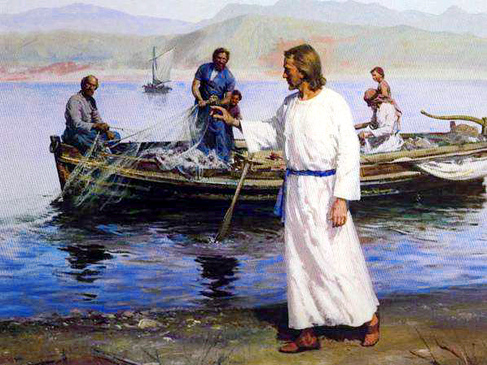
As Jesus was walking beside the Sea of Galilee, he saw two brothers, Simon called Peter and his brother Andrew. They were casting a net into the lake, for they were fishermen.  “Come, follow me,” Jesus said, “and I will make you fishers of men.” At once they left their nets and followed him. (Matthew 4 18-20) 

So the fishers of fish become halieis anthropon, ἁλιεῖς ἀνθρώπων, fishers of men. The will of God always leads us to a larger place, to an enlarged territory.

Because God’s desire is always for the fullest human flourishing. “The glory of God is man fully alive,” a lovely line credited to St. Irenaeus

And once we have surrendered our lives to him, he keeps moving us, onward and upward to the place where we can both use all our gifts and be a blessing to others. And in general, he takes the moving car of who we are; our gifts, abilities and experience, and steers it higher, stronger, faster.

So Jesus takes physically strong, entrepreneurial fisherman inured to hard work, team work, hardship, disappointment, nights at sea, and gives them the task of fishing men into an eternal kingdom. He applies their natural gifts to eternal, supernatural purposes.

Of course, just as we don’t give our children just one birthday present, once in their lives, so God continually gives us new gifts, abilities, capabilities, insight and new wisdom. But the vocation to which he calls us will be true to who we are, and to our interests and gifts.

* * *

Retreat to advance

In the short run, however, Peter and Andrew, James and John became downwardly mobile. No longer independent businessmen, but vagabonds, with no place to rest their head, dependent on charity.

Their old selves had to be broken, to be reformed like a beautiful mosaic.

John Wimber, founder of the Vineyard Movement, flourished in the music industry. However, on becoming a Christian, he found it incompatible with discipleship. So he left, and found work in a factory. An old colleague came to see him, asking for John Wimber’s office. He found Wimber covered with oil, inside a oil-barrel he was scrubbing out. The musician thought Wimber had gone mad!! (Recounted by Carol Wimber in The Way it Was.)

It required this brokenness for Wimber to be willing to hear when God said, “John, I have seen your work. Now let me show you mine.” And to be open to going with the flow of God’s  eccentric purposes.

And later to be a willing instrument when the Holy Spirit songs kept coming, no longer pop songs popular for a year, but spirit-given songs sung for decades, or longer.

* * *

However, it takes a period of brokenness and withdrawal for a gift to be repurposed, for fishermen to become fishers of men.

He needs our surrender before He can use us to bless others.

And when it happens, it feels like hell.

* * *

I was blocked in 2006 when a literary agent wanted me to make changes in my manuscript. Words dripped like crystallising treacle; I was blocked.

So I took a break, decided to put the kids in private school, founded a small publishing company to pay for that. When Roy could come aboard full time in 2010, and I could “retire,” I felt I no longer knew how to write. I had barely read for 4 years. I had lost writerly confidence.

When I started again, after hearing God suggest blogging, my writing was different. I was singing a new song.

I was more interested in speaking to my readers and blessing them than in a career (though, of course, I still want one) I was more interested in what I said, than in how I said it, which was huge for the girl who had been enamoured with style. I desperate to cut perfectionism off at the neck, and just get my work out there. Ship it! I was writing for the health of my soul, and as an offered gift to my readers, rather than for the glory of a career.

It takes a period of brokenness for the Great Artist to put your gifts together into a glorious mosaic, all hammered gold and gold enamelling, all tesserae and shimmering glass.

* * *

When I first wanted to offer my life to God, I went off to work with Mother Teresa, aged 17. (Having skipped years at school, winning “double promotions,” I was done with Grade 12 by the time I was 16.) I assumed because Jesus said, “Whatever you have done to the least of these…” that surely God’s will for me, and for every Christian was to work with the poor!

However, I am a dreamy and impractical person, and if I were a medieval woman when this was a plausible career choice, I would have become a mystic!

I was no good at Mother Teresa’s, with its packed-like-sardines community life; loud constant, vocal prayer, and lots of practical work. I languished and wilted; I got all sorts of things wrong; life felt like a series of hammer blows to my heart.

But writing–I have always written easily and reasonably well. It has generally been my joy.

Can writing be the way I am to serve God? Can writing be my worship? For years, I didn’t really believe something so lovely could be true

But now I do.

“The place God calls you to is the place where your deep gladness and the world’s deep hunger meet.” (Frederick, Buechner, Wishful Thinking)

Because God is good, pouring perfume can be an act of worship, and so can writing (no longer for fame or money, though few are averse to these things!) but as an act of worship, of pure devotion.

“Child, you have written for ambition,” he says. “Come write for me, as your worship of me.

And I will make you… Ah, wait and see.”

Filed Under: In which I decide to follow Jesus, Matthew Tagged With: Following Christ, John Wimber, Peter and Andrew, vocation

Loose Change in God’s pocket; a puppet on a string, or? What’s your metaphor for your relationship with God?

By Anita Mathias

I was listening to a Vineyard CD of Songs of Surrender, and reflected on how I have been indirectly blessed by John Wimber, a man I’ve never met. Through Vineyard music; through his wife Carol’s moving biography of him The Way it Was; through the Toronto Blessing, which was launched in a Vineyard church, now called “Catch the Fire,” where my daughter Zoe is currently at the School for Ministry; and through ministries launched after a meeting with Wimber, like Harnhill Christian Centre.

John Wimber used to say, “I am just loose change in God’s pocket. He can spend me as he pleases.”

* * *

 This summer, I heard Heidi Baker say, “I am a puppet in God’s hands. He can move me which way he pleases.”

And it’s interesting that these two people who have expressed such absolute surrender have also had amazing fruitful ministries, affecting thousands.

When I read of music inspired by God like the Messiah, or poetry or prose almost dictated by God, I long to be “in the vine,” surrendered to him, living in him, so that nothing in me presents an obstacle to the free flow of his grace, power and ideas. So that the channels, the pipeline of communication between God and me remain clear.

* * *

 However, my heart does not quite echo these expressions of total surrender like the Methodist Covenant Prayer.

We do not have exactly the same relationship with any two human beings. There is a slightly different level of trust, familiarity, relaxation, and commonality of interests.

So too, I guess no two of us have exactly the same relationship with God. “A puppet on a string,” “spare change in God’s pockets to spend as he wills” does not quite express my relationship with God.

I believe I would accept God’s dealings with me, whatever…

But I use other metaphors to express my relationship with God—dancing with the Lord; standing in the waterfall or river of God,  an eagle waiting on the edge of its nest for the mounting winds of the spirit before it glides effortlessly into the winds of the storm.

How about you? Which metaphors best express your relationship with God?

Filed Under: random Tagged With: Absolute Surrender, Heidi Baker, John Wimber, relationship with God

On the Goodness and Mercy of God. On the writing of “Isn’t He?” by John Wimber

By Anita Mathias

Here’s a wonderful story from Carol Wimber’s book, “The Way it Was.”

“Right away the Jesus Songs started coming, like a stream of sweet water. I call them airport songs because God gave them to John on his way to or from the airport. “Isn’t He?” (which keeps food on my table from the royalties) was another song written on the way to the airport on a scrap of paper.

It came the same way, all at once, words and music, but it came in a flood of gratitude for the goodness and mercy of Jesus.

John was on his way to pick up an uninvited visitor who had called the house and informed our son, Tim, that he was waiting for John to pick him up. Well, poor Tim! John was a “kill the messenger” guy. He jumped all over Tim. “Why didn’t you tell him I didn’t know he was coming?” “Because I didn’t know that, Dad,” answered a bewildered Tim. “But I’m tired, and I just got home, and it’s raining. I don’t want to go out again, Tim. Why didn’t you explain it to him?” “Dad, I just answered the phone, and said Hello. The man said you were supposed to be there to pick him up, and I said, “Oh,” and the man asked me to tell you when you came home. I said I would.”

John left for the hour and a half drive to the airport, and he felt miserable. Not about having to go out when he was tired, but because of the way he had treated Tim. He wept over it, and told Jesus how wrong, and how sorry he was, and was just planning how he would apologise to Tim, when the car was flooded with the love of God. Overwhelmed with God’s mercy, his head and heart filled with the words and music:

Isn’t he beautiful? Beautiful, isn’t he?
Prince of Peace, Son of God, isn’t he?
Isn’t he wonderful? Wonderful, isn’t he?
Counselor, Almighty God, isn’t he? Isn’t he? Isn’t he?

He taught us that sweet Jesus song the next Sunday. It is amazing how fast the Holy Spirit-given songs go around the world. They fly on the wings of the wind.”

I love this story. I love the way God sometimes responds to me with poetry and insight and blogposts when I have blown it, am feeling crushed, and full of shame. That’s when he reveals himself and his love most clearly, and blesses me with new insight into himself.
Gerard Manley Hopkins describes this
“Father and Fondler of heart thou hast wrung,
Hast thy dark descending, and most art merciful then
.”
Or as Francis Thompson puts it,
But (when so sad thou canst not sadder)
Cry–and upon thy so sore loss
Shall shine the traffic of Jacob’s ladder
Pitched betwixt Heaven and Charing Cross.
And lo, Christ walking on the water,
Not of Genesareth, but Thames!

Filed Under: In which I'm amazed by the goodness of God Tagged With: "The Way it Was" by Carol Wimber, John Wimber, Spirit-given creativity, The Mercy of God

Sign Up and Get a Free eBook!

Sign up to be emailed my blog posts (one a week) and get the ebook of "Holy Ground," my account of working with Mother Teresa.

Join 544 Other Readers

My Books

Rosaries, Reading, Secrets: A Catholic Childhood in India

Rosaries, Reading Secrets, B&N
USA

UK

Wandering Between Two Worlds: Essays on Faith and Art

Wandering Between Two Worlds
USA

UK

Francesco, Artist of Florence: The Man Who Gave Too Much

Francesco, Artist of Florence
US

UK

The Story of Dirk Willems

The Story of Dirk Willems
US

UK

My Latest Meditation

Anita Mathias: About Me

Anita Mathias

Read my blog on Facebook

Follow me on Twitter

Follow @anitamathias1

Recent Posts

  • God’s Complete Forgiveness 
  • Using God’s Gift of Our Talents: A Path to Joy and Abundance
  • The Kingdom of God is Here Already, Yet Not Yet Here
  • All Those Who Exalt Themselves Will Be Humbled & the Humble Will Be Exalted
  • Christ’s Great Golden Triad to Guide Our Actions and Decisions
  • How Jesus Dealt With Hostility and Enemies
  • Do Not Be Afraid, but Do Be Prudent
  • For Scoundrels, Scallywags, and Rascals—Christ Came
  • How to Lead an Extremely Significant Life
  • Don’t Walk Away From Jesus, but if You Do, He Still Looks at You and Loves You
Premier Digital Awards 2015 - Finalist - Blogger of the year
Runner Up Christian Media Awards 2014 - Tweeter of the year

Categories

What I’m Reading


Wolf Hall
Hilary Mantel

Wolf Hall --  Amazon.com
Amazon.com

Amazon.co.uk

Silence and Honey Cakes:
The Wisdom Of The Desert
Rowan Williams

Silence and Honey Cakes --  Amazon.com
Amazon.com

Amazon.co.uk

The Long Loneliness:
The Autobiography of the Legendary Catholic Social Activist
Dorothy Day

The Long Loneliness --  Amazon.com
Amazon.com

Amazon.co.uk

Country Girl
Edna O'Brien

Country Girl  - Amazon.com
Amazon.com

Amazon.co.uk

Archive by month

My Latest Five Podcast Meditations

INSTAGRAM

anita.mathias

My memoir: Rosaries, Reading, Secrets https://amzn.to/42xgL9t
Oxford, England. Writer, memoirist, podcaster, blogger, Biblical meditation teacher, mum

Well, hello friends! Breaking radio silence to let Well, hello friends! Breaking radio silence to let you know that I have taped a meditation for you on Christ’s famous Parable of the Talents in Matthew 25. https://anitamathias.com/2025/11/05/using-gods-gift-of-our-talents-a-path-to-joy-and-abundance/
Here you are, click the play button in the blog post for a brief meditation, and some moments of peace, and, perhaps, inspiration in your day 🙂
Hi Friends, I have taped a meditation; do listen a Hi Friends, I have taped a meditation; do listen at this link: https://anitamathias.com/2025/04/08/the-kingdom-of-god-is-here-already-yet-not-yet-here-2/
It’s on the Kingdom of God, of which Christ so often spoke, which is here already—a mysterious, shimmering internal palace in which, in lightning flashes, we experience peace and joy, and yet, of course, not yet fully here. We sense the rainbowed presence of Christ in the song which pulses through creation. Christ strolls into our rooms with his wisdom and guidance, and things change. Our prayers are answered; we are healed; our hearts are strangely warmed. Sometimes.
And yet, we also experience evil within & all around us. Our own sin which can shatter our peace and the trajectory of our lives. And the sins of the world—its greed, dishonesty and environmental destruction.
But in this broken world, we still experience the glory of creation; “coincidences” which accelerate once we start praying, and shalom which envelops us like sudden sunshine. The portals into this Kingdom include repentance, gratitude, meditative breathing, and absolute surrender.
The Kingdom of God is here already. We can experience its beauty, peace and joy today through the presence of the Holy Spirit. But yet, since, in the Apostle Paul’s words, we do not struggle only “against flesh and blood, but against the rulers, against the unseen powers of this dark world and against the spiritual forces of evil,” its fullness still lingers…
Our daughter Zoe was ordained into the Church of E Our daughter Zoe was ordained into the Church of England in June. I have been on a social media break… but … better late than never. Enjoy!
First picture has my sister, Shalini, who kindly flew in from the US. Our lovely cousins Anthony and Sarah flank Zoe in the next picture.
The Bishop of London, Sarah Mullaly, ordained Zoe. You can see her praying that Zoe will be filled with the Holy Spirit!!
And here’s a meditation I’ve recorded, which you might enjoy. The link is also in my profile
https://anitamathias.com/2024/11/07/all-those-who-exalt-themselves-will-be-humbled-the-humble-will-be-exalted/
I have taped a meditation on Jesus statement in Ma I have taped a meditation on Jesus statement in Matthew 23, “For those who exalt themselves will be humbled, and those who humble themselves will be exalted.”
Do listen here. https://anitamathias.com/2024/11/07/all-those-who-exalt-themselves-will-be-humbled-the-humble-will-be-exalted/
Link also in bio.
And so, Jesus states a law of life. Those who broadcast their amazingness will be humbled, since God dislikes—scorns that, as much as people do.  For to trumpet our success, wealth, brilliance, giftedness or popularity is to get distracted from our life’s purpose into worthless activity. Those who love power, who are sure they know best, and who must be the best, will eventually be humbled by God and life. For their focus has shifted from loving God, doing good work, and being a blessing to their family, friends, and the world towards impressing others, being enviable, perhaps famous. These things are houses built on sand, which will crumble when hammered by the waves of old age, infirmity or adversity. 
God resists the proud, Scripture tells us—those who crave the admiration and power which is His alone. So how do we resist pride? We slow down, so that we realise (and repent) when sheer pride sparks our allergies to people, our enmities, our determination to have our own way, or our grandiose ego-driven goals, and ambitions. Once we stop chasing limelight, a great quietness steals over our lives. We no longer need the drug of continual achievement, or to share images of glittering travel, parties, prizes or friends. We just enjoy them quietly. My life is for itself & not for a spectacle, Emerson wrote. And, as Jesus advises, we quit sharp-elbowing ourselves to sit with the shiniest people, but are content to hang out with ordinary people; and then, as Jesus said, we will inevitably, eventually, be summoned higher to the sparkling conversation we craved. 
One day, every knee will bow before the gentle lamb who was slain, now seated on the throne. We will all be silent before him. Let us live gently then, our eyes on Christ, continually asking for his power, his Spirit, and his direction, moving, dancing, in the direction that we sense him move.
Link to new podcast in Bio https://anitamathias.co Link to new podcast in Bio https://anitamathias.com/2024/02/20/how-jesus-dealt-with-hostility-and-enemies/
3 days before his death, Jesus rampages through the commercialised temple, overturning the tables of moneychangers. Who gave you the authority to do these things? his outraged adversaries ask. And Jesus shows us how to answer hostile questions. Slow down. Breathe. Quick arrow prayers!
Your enemies have no power over your life that your Father has not permitted them. Ask your Father for wisdom, remembering: Questions do not need to be answered. Are these questioners worthy of the treasures of your heart? Or would that be feeding pearls to hungry pigs, who might instead devour you?
Questions can contain pitfalls, traps, nooses. Jesus directly answered just three of the 183 questions he was asked, refusing to answer some; answering others with a good question.
But how do we get the inner calm and wisdom to recognise
and sidestep entrapping questions? Long before the day of
testing, practice slow, easy breathing, and tune in to the frequency of the Father. There’s no record of Jesus running, rushing, getting stressed, or lacking peace. He never spoke on his own, he told us, without checking in with the Father. So, no foolish, ill-judged statements. Breathing in the wisdom of the Father beside and within him, he, unintimidated, traps the trappers.
Wisdom begins with training ourselves to slow down and ask
the Father for guidance. Then our calm minds, made perceptive, will help us recognise danger and trick questions, even those coated in flattery, and sidestep them or refuse to answer.
We practice tuning in to heavenly wisdom by practising–asking God questions, and then listening for his answers about the best way to do simple things…organise a home or write. Then, we build upwards, asking for wisdom in more complex things.
Listening for the voice of God before we speak, and asking for a filling of the Spirit, which Jesus calls streams of living water within us, will give us wisdom to know what to say, which, frequently, is nothing at all. It will quieten us with the silence of God, which sings through the world, through sun and stars, sky and flowers.
Especially for @ samheckt Some very imperfect pi Especially for @ samheckt 
Some very imperfect pictures of my labradoodle Merry, and golden retriever Pippi.
And since, I’m on social media, if you are the meditating type, here’s a scriptural meditation on not being afraid, while being prudent. https://anitamathias.com/2024/01/03/do-not-be-afraid-but-do-be-prudent/
A new podcast. Link in bio https://anitamathias.c A new podcast. Link in bio
https://anitamathias.com/2024/01/03/do-not-be-afraid-but-do-be-prudent/
Do Not Be Afraid, but Do Be Prudent
“Do not be afraid,” a dream-angel tells Joseph, to marry Mary, who’s pregnant, though a virgin, for in our magical, God-invaded world, the Spirit has placed God in her. Call the baby Jesus, or The Lord saves, for he will drag people free from the chokehold of their sins.
And Joseph is not afraid. And the angel was right, for a star rose, signalling a new King of the Jews. Astrologers followed it, threatening King Herod, whose chief priests recounted Micah’s 600-year-old prophecy: the Messiah would be born in Bethlehem, as Jesus had just been, while his parents from Nazareth registered for Augustus Caesar’s census of the entire Roman world. 
The Magi worshipped the baby, offering gold. And shepherds came, told by an angel of joy: that the Messiah, a saviour from all that oppresses, had just been born.
Then, suddenly, the dream-angel warned: Flee with the child to Egypt. For Herod plans to kill this baby, forever-King.
Do not be afraid, but still flee? Become a refugee? But lightning-bolt coincidences verified the angel’s first words: The magi with gold for the flight. Shepherds
telling of angels singing of coming inner peace. Joseph flees.
What’s the difference between fear and prudence? Fear is being frozen or panicked by imaginary what-ifs. It tenses our bodies; strains health, sleep and relationships; makes us stingy with ourselves & others; leads to overwork, & time wasted doing pointless things for fear of people’s opinions.
Prudence is wisdom-using our experience & spiritual discernment as we battle the demonic forces of this dark world, in Paul’s phrase.It’s fighting with divinely powerful weapons: truth, righteousness, faith, Scripture & prayer, while surrendering our thoughts to Christ. 
So let’s act prudently, wisely & bravely, silencing fear, while remaining alert to God’s guidance, delivered through inner peace or intuitions of danger and wrongness, our spiritual senses tuned to the Spirit’s “No,” his “Slow,” his “Go,” as cautious as a serpent, protected, while being as gentle as a lamb among wolves.
Link to post with podcast link in Bio or https://a Link to post with podcast link in Bio or https://anitamathias.com/2023/09/22/dont-walk-away-from-jesus-but-if-you-do-he-still-looks-at-you-and-loves-you/
Jesus came from a Kingdom of voluntary gentleness, in which
Christ, the Lion of Judah, stands at the centre of the throne in the guise of a lamb, looking as if it had been slain. No wonder his disciples struggled with his counter-cultural values. Oh, and we too!
The mother of the Apostles James and John, asks Jesus for a favour—that once He became King, her sons got the most important, prestigious seats at court, on his right and left. And the other ten, who would have liked the fame, glory, power,limelight and honour themselves are indignant and threatened.
Oh-oh, Jesus says. Who gets five talents, who gets one,
who gets great wealth and success, who doesn’t–that the
Father controls. Don’t waste your one precious and fleeting
life seeking to lord it over others or boss them around.
But, in his wry kindness, he offers the ambitious twelve
and us something better than the second or third place.
He tells us how to actually be the most important person to
others at work, in our friend group, social circle, or church:Use your talents, gifts, and energy to bless others.
And we instinctively know Jesus is right. The greatest people in our lives are the kind people who invested in us, guided us and whose wise, radiant words are engraved on our hearts.
Wanting to sit with the cleverest, most successful, most famous people is the path of restlessness and discontent. The competition is vast. But seek to see people, to listen intently, to be kind, to empathise, and doors fling wide open for you, you rare thing!
The greatest person is the one who serves, Jesus says. Serves by using the one, two, or five talents God has given us to bless others, by finding a place where our deep gladness and the world’s deep hunger meet. By writing which is a blessing, hospitality, walking with a sad friend, tidying a house.
And that is the only greatness worth having. That you yourself,your life and your work are a blessing to others. That the love and wisdom God pours into you lives in people’s hearts and minds, a blessing
https://anitamathias.com/.../dont-walk-away-from-j https://anitamathias.com/.../dont-walk-away-from-jesus.../
Sharing this podcast I recorded last week. LINK IN BIO
So Jesus makes a beautiful offer to the earnest, moral young man who came to him, seeking a spiritual life. Remarkably, the young man claims that he has kept all the commandments from his youth, including the command to love one’s neighbour as oneself, a statement Jesus does not challenge.
The challenge Jesus does offers him, however, the man cannot accept—to sell his vast possessions, give the money to the poor, and follow Jesus encumbered.
He leaves, grieving, and Jesus looks at him, loves him, and famously observes that it’s easier for a camel to squeeze through the eye of a needle than for a rich person to live in the world of wonders which is living under Christ’s kingship, guidance and protection. 
He reassures his dismayed disciples, however, that with God even the treasure-burdened can squeeze into God’s kingdom, “for with God, all things are possible.”
Following him would quite literally mean walking into a world of daily wonders, and immensely rich conversation, walking through Israel, Lebanon, Syria, and Jordan, quite impossible to do with suitcases and backpacks laden with treasure. 
For what would we reject God’s specific, internally heard whisper or directive, a micro-call? That is the idol which currently grips and possesses us. 
Not all of us have great riches, nor is money everyone’s greatest temptation—it can be success, fame, universal esteem, you name it…
But, since with God all things are possible, even those who waver in their pursuit of God can still experience him in fits and snatches, find our spirits singing on a walk or during worship in church, or find our hearts strangely warmed by Scripture, and, sometimes, even “see” Christ stand before us. 
For Christ looks at us, Christ loves us, and says, “With God, all things are possible,” even we, the flawed, entering his beautiful Kingdom.
Follow on Instagram

© 2026 Dreaming Beneath the Spires · All Rights Reserved. · Cookie Policy · Privacy Policy