
Anita Mathias: Dreaming Beneath the Spires

Anita Mathias's Blog on Faith and Art

  • Home
  • My Books
  • Meditations
  • Essays
  • Contact
  • About Me

Gratitude: A Secret to Happiness

By Anita Mathias

  Georgia O’Keefe

All of us have a negativity bias which makes us more apt to remember one mean comment about our writing, our children, our appearance, or our characters, than dozens of positive ones. It’s true, isn’t it? More disquietingly, I’ve read, in Andrew Solomon’s brilliant The Noonday Demon that the myelin sheath around our nerves wears down as we age, so that, if we live long enough, almost all of us will suffer from depression. And that’s not a happy prospect!

* * *

I want to live with peace in my soul. I want to live with joy, mindfulness, and gratitude, “in the light of his glory and grace.” That phrase is precious to me. I say it to myself, often, when I feel stressed, and my heart and mind race with a hundred thoughts and emotions, and then I remember to pivot, “to turn my eyes on Jesus” once again, “to look full in his wonderful face, until the things of earth grow strangely dim, in the light of his glory and grace,” and sanity and good sense return.

One way of pivoting into the presence of Jesus, and living in the light of his glory and grace, is the practice of gratitude. I do this quite deliberately. When I find myself stressed, or distracted, or discombobulated, I like to do what in mindfulness practice is called a three minute breathing space which, astonishingly, often serves to bring peace and clarity. Another practice I use is “the ten finger gratitude exercise” of Mark Williams, author of Mindfulness: count ten blessings or reasons for gratitude on my fingers. Often, my mood and perspective has shifted, and I am calmer before I got to ten!

For years, I have told one of my daughters who had trouble falling asleep to count a hundred blessings to help her sleep, and I often do myself…both the little unnoticed ones—that by God’s grace, I have never been in an accident, or broken a bone, and have rarely experienced physical pain, and have reasonably good health. I count my favourite gorgeous paintings, and books, and poems, and places, and people. That changes my mood before I get to a hundred.

* * *

Gratitude is the most important ingredient of happiness. Rick Steves who writes wonderful travel guides (and who, a couple of decades ago, converted me to his “Europe by the Backdoor” philosophy, enjoying Europe as many Europeans do, picnic meals in great parks, camper-vanning and campgrounds) writes of a loud disgruntled American eating an expensive meal in an expensive restaurant in a resort which cost five times what Steves recommends spending, loudly grumbling about his life and his taxes; berating his wife, thoroughly miserable through it all. I have often seen that traveller, bringing their internal unhappiness and spoilt-brattiness to exquisite surroundings. On occasion, though rarely, I have been that traveller.

What does it profit you if your business makes, say, a million pounds and you do not have sunshine in your soul? What does it profit you if you seen every beautiful sight in this green planet and have no love in your heart? What does the beautiful home, and garden, and all the beautiful art you seen, and experiences you have had, matter if you do not savour them, at the time, and in memory? Achieving the success of their wildest dreams will not make a person happy unless they are continually grateful for it. I know enough successful, wealthy people to know that this is true.

* * *

Some people are naturally more cheerful, sanguine, optimistic and grateful than others. It has to do with an internal, largely genetic, set-point for happiness which psychologists say is virtually impossible to shift. Some people are just more optimistic and sanguine than others, and luckily, I am naturally Micawberish. But gratitude is also a practice, which we learn by practising–and there is nothing more happy-making to practice.

The magic practice of gratitude can change our memories and perceptions of the past. Hold the picture frame of your dark and traumatic memories to the light. Look for the gold, and there was gold there, for God was there. Look for the light and transformation which flowed from the trauma, or still can flow from it. Thank God for the flashes of brightness and goodness in those dark picture frames… for even in them, God was present, and his story for your life was being written.

Gratitude is the most important ingredient of happiness. And it’s learnt by practice. During daylight, I practise by looking out and thanking God for the ever-changing panorama of the sky, the clouds floating across it. I thank God for the stars so bright in the countryside where I live. I thank God for the people who love me, for the animals who love me, my Golden Retriever, Pippi, and my labradoodle, Merry; for the continuous beauty of nature, so like a Constable painting so often in the Oxford countryside where I live that it takes my breath away. I thank God for the beautiful countries and art I have seen, and the books and poetry I have read, an internal treasure bank, and the leisure to have enjoyed them. I thank God for my love for Scripture, and for knowing Jesus. I thank God for the continuous presence of the Father, the Son, the Spirit, and ministering angels, so that, at present, I can freely choose “the desert,” for I need to get some work done. See, just typing a paragraph like this changes your mood.

Try to count five or ten blessing when you are sad, or stressed, or out of sorts. See if changes your mood. It’s almost magical–though the real magic of the spiritual life is not in our practices, but in the great magician himself, in Jesus.

 And on occasion, you may need another route out of sadness and general malaise. Sometimes you may need a change of scene, the sea. “The cure for anything is salt water — sweat, tears, or the sea.” Isak Dinesen

Sometimes, you may just need a hot bubble bath and a good long nap!

http://https://youtu.be/3Zl9puhwiyw

P.S. My practice of gratitude begins with mindfulness of the sky and the weather after I watched this astonishing video by Benedictine monk, David Steindl-Rast. Do watch it. His narration in his gentle German accent somehow makes it more memorable. Here is the text:

A Good Day, Brother David Steindl-Rast

 You think this is just
another day in your life?

It’s not just another day;
it’s the one day that
is given to you…

today

It’s given to you. It’s a gift.

It’s the only gift that you
have right now, and the
one appropriate response
is gratefulness.

If you do nothing else but to
cultivate that response to the great
gift that this unique day is,

if you learn to respond
as if it were the first day
of your life,

and the very last day,

then you will have spent
this day very well.

Begin by opening your
eyes and be surprised that you
have eyes you can open,

that incredible array of colors

that is constantly offered to
us for pure enjoyment.

Look at the sky.

We so rarely look at the sky.
We so rarely note how different
it is from moment to
moment
 with clouds coming
and going.

We just think of the weather, and
even of the weather we don’t think
of all the many nuances of weather.

We just think of good weather
and bad weather.

This day right now has
unique weather, maybe a
kind that will never exactly
in that form come again.

That formation of clouds in the sky will
never be the same that it is right now.

Open your eyes. Look at that.

Look at the faces 
of people whom you meet.

Each one has an incredible
story 
behind their face, a story
that you could never fully fathom,
not only their own story,
but the story of their ancestors.

We all go back so far.

And in this present
moment 
on this day, all the
people you meet, all that life
from generations and from so
many places all over the world,
flows together and meets you
here like a life-giving
water, if you only open your
heart and drink.

Open your heart
to the incredible gifts that
civilization gives to us.

You flip a switch
and there is
electric light.

You turn a faucet and
there is warm water and cold water—
and drinkable water.

It’s a gift that millions and millions
in the world will never experience.

So these are just a few of
an enormous number
of gifts to which you can
open your heart.

And so I wish for you that
you would open your heart
to all these blessings and let
them flow through you,
that everyone whom you will meet
on this day will be blessed by you;
just by your eyes,
by your smile, by your touch—
just by your presence.

Let the gratefulness overflow
into blessing all around you,

and then it will really be
a good day.



Filed Under: In which I am Amazed by Grace, In which I explore the Spiritual Life, In which I'm amazed by the goodness of God, The Power of Gratitude

In which God Creates Beauty from My Mistakes

By Anita Mathias

a-winter-garden

In this season of hibernation, I think… and my remembrance of things past is not unaccompanied by regret.

Mists of sadness rise. I will not enter them for they might drag me into a quagmire.

No, I will not re-read past chapters. Today’s chapter is being written—Jesus dictating, me writing. Or sometimes, me writing fast, impulsively, selfishly, and Jesus overwriting it with gold-dust, producing beauty from ashes.

* * *

But what can be done with regrets for time past?

I reach for another alliterative word…redemption.

I take my regrets, shattered shards of what could have been beautiful, were I wiser, smarter, holier,

And I pour the iridescent fragments of these regrets into the great outstretched hands of God.

* * *

I think of David. He sees a beautiful married woman bathe on a rooftop, sleeps with her, has her husband killed when she falls pregnant, and then marries her.

The prophet Nathan confronts him with a story which helps him see the shamefulness of it all.

David repents, but sin has consequences, that’s the deep magic from the dawn of time. The unnamed baby dies.

But there is also redemption…the deeper magic from before the dawn of time

Bathsheba conceives again…and that child is Solomon, the wisest man who ever lived, the reputed author of Proverbs and Ecclesiastes.

From that union stained by lust and murder came forth exquisite Psalms and wise Proverbs.

* * *

We undervalue what is precious; we overvalue what is trivial; we waste our time; we squander our energies; we damage treasured relationships; oh yes, and for all these things, we pay the price, yes we do– the inexorably fair law of sowing and reaping.

Fair and merciless.

But a deep hidden mercy runs through this world, like subterranean gold, like purple amethyst, yellow citrine, and smoky quartz hidden in the dead, fossilised trees in Arizona’s petrified forest, trees which fell two hundred million years ago.

Gradually, each cells of bark and wood is replaced with minerals of every colour, as God shapes my shabby paragraphs into the frame, the outline of a glory story.

* * *

God takes the fragments of my faltering hopes, my missed chances, my foolishness,

And says, “Child, from this, even from this, from this glimmering pile of your mistakes, see what I am fashioning.”

And like a medieval craftsman making stained glass, he fashions glory, stained glass, from glinting heaps of errors.

And I see what he is creating from sins and folly, the stuff I never intended.

It is the life I now have, bursting with potential for joy and beauty and worship. It is good. It is very good.

And through tear-stained eyes, I bow my head in worship.


Filed Under: In which I am Amazed by Grace, In which I just keep Trusting the Lord, In which I'm amazed by the goodness of God, Theodicy Tagged With: David, fossilized trees, redemption, Stained glass

In which our Sehnsucht, Restless Longings, are Really a Longing for God Himself

By Anita Mathias

The sky and sea soon turn red, St. Paul's Bay, Malta

Image: My Photograph of St. Paul’s Bay in Malta

So  we are looking forward to our half-term holiday—to sleeping in, no stress, family movies…and especially to getting away.

* * *

The funny thing is, we had all that—sleeping in, staying up late, family movies, luscious meals, creaking family dinner tables, and travel– last summer (when we squeezed in an epic drive through Belgium, Germany, Austria and Slovenia in our motorhome) and for 24 days over the Christmas holidays (home, and Florence).

And towards the end of each holiday, I was actually looking forward for school. For a routine. For those rascally girls to get to bed at a half-decent hour, and not sleep in. For predictable silent undisturbed hours to sink into reading and writing.

* * *

After weeks of them being home 24/7, I look forward to school. After weeks of school, I want them home.

You know why? It’s because both are good. It’s all good.

Life is good because it’s a gift from God.

* * *

I am going away later this month, and am really looking forward to sunlight and movement and seeing beautiful things. Sometimes, I have had very exciting, dream holidays, full of doing and seeing and learning—Istanbul, Copenhagen, Stockholm, Helsinki, and after an intense week or so there, I am surprised by a yearning to be home, to spend a day in my pyjamas, reading or playing around with words.

What? I had so yearned to see these magical places. On my first trip to Paris, I heard an American say on the phone in a rich resonant voice, “I am travel weary. I am homesick.” Travel-weary and homesick in Paris? I thought. Yeah, it’s all too possible.

Life is a gift from God. That’s why at home, we can think of glorious art, architecture, history, gardens, mountains, forests, and the ocean and yearn to be there. And that’s why, in the middle of Rome or Athens or Madrid, I have had a sudden longing to go nowhere, do nothing, just sit with green tea, God, a book, and a laptop.

* * *

“Thou hast made us for thyself, Oh Lord, and our hearts are restless until they find their rest in you,” St. Augustine wrote.

This restlessness in our hearts is meant to lead us to the one who stills all restlessness.

German has a word for this restlessness, this indefinable longing: Sehnsucht.

C.S. Lewis describes sehnsucht as the “inconsolable longing” in the human heart for “we know not what.” That unnameable something, desire for which pierces us like a rapier at the smell of bonfire, the sound of wild ducks flying overhead, the title of The Well at the World’s End, the opening lines of “Kubla Khan“, the morning cobwebs in late summer, or the noise of falling waves. (Pilgrim’s Regress, C. S. Lewis).

* * *

The restlessness in your heart is a God-yearning. Don’t confuse it with what you think you desire— finishing and publishing a beautiful book, having a successful blog, travel, stimulating friendships, the holiday cottage by the sea…

“The books or the music in which we thought the beauty was located will betray us if we trust to them,” C. S. Lewis says in The Weight of Glory. “These things—the beauty, the memory of our own past—are good images of what we really desire; but if they are mistaken for the thing itself, they turn into dumb idols, breaking the hearts of their worshippers. For they are not the thing itself; they are only the scent of a flower we have not found, the echo of a tune we have not heard, news from a country we have never yet visited.”

* * *

 So listen to your restlessness. Listen to your longings. You are longing for more than Alaska, or Antarctica or the Amazon (places I would rather like to see before I die). You are longing for more than to write a beautiful book (something else I would like to do before I die).

You are really yearning for the infinite sea of God. For the ocean of God to pour into your spirit, and for your spirit to pour into the ocean of God, now and in eternity.

You are yearning to abide and dwell in Him, and to be filled with his spirit, which Jesus says is possible in this life.

The things of this world for which you think you yearn are just signposts to the things which will truly satisfy your soul.

This world, this life, which lies, “before us like a land of dreams, so various, so beautiful, so new,” is a gift, a love-gift from God.

Its loveliness is designed to delight, but not entirely satisfy our hearts.

Only the Giver can do that.

* * *

The Weight of Glory by C.S. Lewis on Amazon.com and on Amazon.co.uk

Pilgrim’s Regress by C.S. Lewis on Amazon.com and on Amazon.co.uk

Filed Under: In which I'm amazed by the goodness of God Tagged With: C. S. Lewis, Pilgrim's Regress, sehnsucht, the goodness of God, The Weight of Glory

Where Good Stories are to be Found

By Anita Mathias

aboriginal
Image Credit


My tender-hearted children hated sad stories. Neither would let me read Oscar Wilde’s exquisite short stories to them, or even Hans Christian Andersen’s because they were too sad.

When I recommended a book or movie, they wanted to know if it was sad, and especially if it had a sad ending.

But there is no story without sadness, I keep telling them. It’s an old creative writing maxim: No story without conflict.

* * *

Who needs the stress and emotional trauma of conflict with others? And who needs internal conflict—when the self is at war with itself, knowing what is good to do, but doing the very things it hates, punishing itself by over-eating, or over-working, or under-sleeping? By psycho-somatic illness?

But without this internal conflict–this struggle against our very selves: to corral ourselves to rise early, work hard, stay focused, self-educate, eat healthily, exercise, read, write–our lives would be flaccid and formless, with the structure of obstacles, both within and without, to overcome.

And, as Donald Miller writes in A Thousand Miles in a Million Years, dealing with these obstacles head-on (losing 150 pounds in his case, and tracking down the father who abandoned him) gives our lives a shapely story.

Because stories and blogs come out of sadness, and struggle, and failure, and eventual triumph over Resistance.

* * *

And ironically, each failure, and sadness and step backwards gives us more of a story than our successes.

Where are stories found? Not in quiet times, not in scripture study, not in money you gave away, not in fasts, not in the meals you took around, or your turn in the coffee rota, these good, shiny things, which, anyway, by the strictest Scriptural injunction we are commanded to keep secret.

Where are our stories found?

In the places where you learn about yourself, and you learn about God, and you learn about shame and grace and self-forgiveness and God’s forgiveness in the crucible of failure.

When your daughter says, “I don’t want to play scrabble today, Mum, because you get snooty about my words,” and you say “Oh no, of course I won’t get snooty about your words!” and then you do indeed get so snooty!

When the house could so do with some loving up, and indeed, so could those who dwell in it, and you’ve resolved to do both, but words are flowing, and you dance in the flow.

When you had solemnly resolved on that run today and yoga, and weights—you know, flexibility, strength, cardio-vascular, the three elements of fitness!–but an idea presents itself, and you want to explore it, express it,

And the word count may be good at the end of the day, but your Pilgrim’s Progress….well, it hasn’t progressed.

And you wonder why today joy doesn’t throb,

Or peace flow like a river.

And you remember: He who loves his blog more than me is not worthy of me.

She who loves her writing more than me is not worthy of me.

And all you can say is Kyrie Eleison.
Lord, have mercy.


And you kneel down and repent

Till peace flows again.

And you say, “Lord, I am not worthy of you.
But say but the Word
and I shall be healed.”

And he says the Word.

The word like manna,
The word like honey
Coursing through your brain.

And you, the unworthy, are healed

And, again, sing.

* * *
And, besides, you have a story!

Filed Under: In which I explore writing and blogging and creativity, In which I Pursue Personal Transformation or Sanctification, In which I'm amazed by the goodness of God, Writing and Blogging Tagged With: failure, Stories, the goodness of God

Christ says, “I will let nothing be wasted.”

By Anita Mathias


 “Let nothing be wasted”

“Nothing, Lord?”

“Nothing.”

* * *

Not the weary years,

Not the silent tears,

None of the loneliness

Which caused that deep, echoing silence

in which we could hear you?


None of our failures

Which silenced the insistent voices

Of those who might otherwise have found a use for us.

We were nobody and nothing

And in the vast silence which surrounded us,

We heard your signature sound:

A whisper.


And the bad days we planted which became bad weeks,

Bad years, wasted to bickering, quarrelling, and anger?

Even them?


“ I will let nothing be wasted.”

* * *

The wise learn wisdom from your Word,

The stupid learn it from experience.

I was stupid, Lord.

* * *

The years I wasted in depression,

Ingratitude, bitterness, jealousy, hatred…

Will I still be as fruitful

as if I had spent them in praise and thankfulness,

hidden in the holy places of the Most High?


“I will let nothing be wasted.”

* * *

And when I overworked so much that I burned out,

And still tried to read, being too exhausted too read,

Those wasted hours and years?

Nothing was wasted.


And I got terrified and perfectionistic,

And revised pieces of work a hundred times,

And have not finished my big book

NOTHING IS WASTED.

* * *

The friendships, Lord.

I expected too much, held on too hard,

Was too impatient, too possessive.

Nothing is wasted.


Oh and how many people I could have loved,

How many could I have got to know

But I–I read and wrote and worried

That I wasn’t reading and writing more.


I and my sweet Roy.

We could have been so happy.

Everything was, is, given us.

But how we have fought!

Nothing is wasted.


And those sweet, adorable little girls

And me adoring them, and wanting to write too

And writing often won.

I was there. With them and with you.

I was there.

Nothing was wasted.


And worry, anxiety…

That my in-laws would land up for months on end,

Would stay forever,

Would run our lives, ruin them,

All the eventualities you averted!

But how long did fear rule me,

Instead of trust!!


And why did I not get it, Lord,

That love is all that matters

That I can trust you in everything

That you mean good when men mean evil

Why did I not learn to trust you instead of worrying?

* * *

Mess, Lord!
I sweep it up,

Shards, tesserae, beach glass,

Broken vases, fragmented shells, beads.

Take and receive, oh Lord:

The mess I have made of the jewels

You have lavished upon me, again and again.

* * *

Nothing is wasted, He says.

I take what you give me:

broken jewellery, broken crystal, broken children’s crafts,

kid’s toys, never assembled, parts missing,

birthday presents never used, now just clutter,

broken pottery, broken dreams, broken body,

And my hands work instantly, busily.

They mould, they shape, join, and paste,

And from what you thought was a Psyche heap

of broken baubles they create

Such a form as Grecian goldsmiths make

Of hammered gold and gold enamelling

To keep a drowsy Emperor awake,

Or set upon a golden bough to sing

To lords and ladies of Byzantium.


Filed Under: In which I'm amazed by the goodness of God Tagged With: redemption, restoring the years the locusts have eaten

Nothing and No One is Beyond Redemption

By Anita Mathias

Madonna and Child - Sandro Botticelli


Matthew 1: 1-17

I begin reading Matthew again, and again notice that though the Messiah could have chosen to come from nice, safe, unremarkable, pious humans, he instead chosen as his ancestors those who have messed up and blown it—and had their transgressions recorded in the holiest of books!

Amazing: the Redeemer, the most beautiful human I know of, came from generations of the unredeemed, sinners who’ve spectacularly messed up.

All generational sins and curses are broken in him–and for us who are grafted into him, and live in him, he provides newness, freedom from the sins of our past, and our family’s past.

The Holy One comes from the unholy, proving NOTHING we have done, no matter how we have blown it, wasted our time, our lives, our talents, destroyed our relationships, nothing is beyond redemption.

* * *

Those repeated generational lies on the part of Abraham and Isaac, “She is my sister,”–not beyond redemption. The little bit of Do-It-Yourself assistance Abraham provided the promises of God in fathering Ishmael with Hagar–not beyond redemption.

Or Rebecca helping God out in doing what he had promised, by the gross and heart-breaking deception of Isaac. Jacob, the deceiver, the scheming grabber of the main chance, becomes the father of the twelve tribes of Israel.

Judah, who slept with a prostitute, and his daughter-in-law Tamar who incestuously slept with him disguised as one. Rahab, the good prostitute who sheltered the spies.

Redeemed, all redeemed, chosen as ancestors of GOD become flesh. Sexual sins, sins of manipulation, anger, fear and lack of faith—none of these preclude redemption.

* * *

Goodness came out of all these lives. Sweetness from what was very messed up.

And King David with his eight wives and ten concubines, who could not resist the beautiful woman he saw bathing, and indulged his desire, his weakness, his lust—his adultery leading to murder of Uriah, the righteous Hittite.

And—oh sing redemption’s song!–out of his weakness, out of his sin, his lust, his adultery, his taking of Uriah’s one lamb, the murder and adultery he so bitterly regretted– out of that came the wisest man who ever lived. Out of that came the Messiah.

And Solomon, with his 700 wives and 300 concubines, who was given wisdom, knowledge, wealth, possessions and honour (2 Chron 1:12) and the honour of building a glorious temple to the Lord.

And out of all the wicked kings of Judah, whose actions lost the Kingdom and led their people into captivity, the Messiah came.

* * *

Because the father-heart of God cannot help himself. We are his children, the work of his hands, he cannot help redeeming us, as we– come on, ‘fess up—if we can, when we can, give our children a leg up in the rat-race of life.  Whether they are eminently deserving—or not.

* * *

And what a comfort that is, that nothing I have done is beyond redemption.

That I can place all the silliness–things done stupidly, impulsively, hot-headedly, selfishly, maliciously, sinfully!—place them in his hands,

His kind hands which work fast and skilfully,

Redeeming, working all the foolishness and weakness into a new beautiful story for my life.

One by one, I bring to him my sins and failures, the times I have messed up, sins in my marriage, my parenting, my friendships, my church relationships, all these wobbles, bring it to him who amazingly, incredibly, died for me, and they are redeemed, washed in the blood of the lamb. Washed whiter than snow, repurposed.

Oh, take it all lovely Redeemer, take my life, past and present, work on it with your strong brilliant hands; make something beautiful out of it.


Filed Under: In which I am Amazed by Grace, In which I'm amazed by the goodness of God, Matthew Tagged With: Creativity, redemption, the goodness of God

My Train Wreck into Grace

By Anita Mathias

File:Hunt Light of the World.jpg

Sometimes, when my tongue runs away with me, and I use my words to express anger rather than bestow grace, and those words steal life and strength and peace rather than lavish them, I see the red flag of Jesus, and am stopped dead in my tracks.

But sometimes, I don’t stop, and don’t listen to Jesus, and feel that I am out of control, a train rushing on…

I might eat whatever is quick and easy or delicious, rather than whatever is a blessing to my body.

Or my marriage might enter a vicious spiral of criticism, resentment, judgement and anger,

And there we go, rushing on, rushing on, knowing that no good can come from expressing runaway emotions, knowing that what one sows, one reaps…

On and on, we rush, speaking carelessly, heading for a train wreck, smashing past the level crossing, towards the other train.

And that’s when I understand grace and the mystery of the cross

What I sow I should reap, right? But that was before Jesus came.

* * *

Our train hurtles on, and Jesus sees that we are going to crash.

He steps in.

And our train still hurtles headlong; we are out of control.

And He absorbs the crash in himself.

And we crash into grace; we crash into Jesus.

I am redeemed.

My marriage is redeemed

Because of the grace Jesus died to bring me.

Because of grace.

* * *

He keeps me on track, he keeps my marriage on track,

Keeping me on the rails

Because he absorbed the impact at Calvary,

Of all this foolish, headlong sin.

Oh, I trust grace

I trust mercy.

* * *

If the world were governed by dreary cause and effect,

And a woman could reap only what she sows,

Lord, who would stand?

But you stand between us and destruction,

For this we revere you.


For it’s not a mere mechanical world of crime and punishment.

It is a world of miracles.

It is the world of Jesus where he lives.


It is a world where Jesus stands in front of us,

Absorbs the impact of our bullet trains

Speeding at a million miles an hour towards self-destruction

Is smashed,

Rises,

And in that resurrection is hope that I, who live in him, shall also rise.

* * *

 Lord, sharpen my eyesight

Help me to see your red flags in time,

To repent in time


And when I do not,

When I crash,

Let me crash into grace!

The seventy times seventh chance,

The four hundred and ninetieth chance,

The infinite chances you lavish on me in the land of the living,

Because you love me!

Filed Under: In Which I am again Amazed by Jesus, In which I am Amazed by Grace, In which I'm amazed by the goodness of God Tagged With: grace

The Worst Evangelism Question Ever, or, When we See Him Face to Face

By Anita Mathias

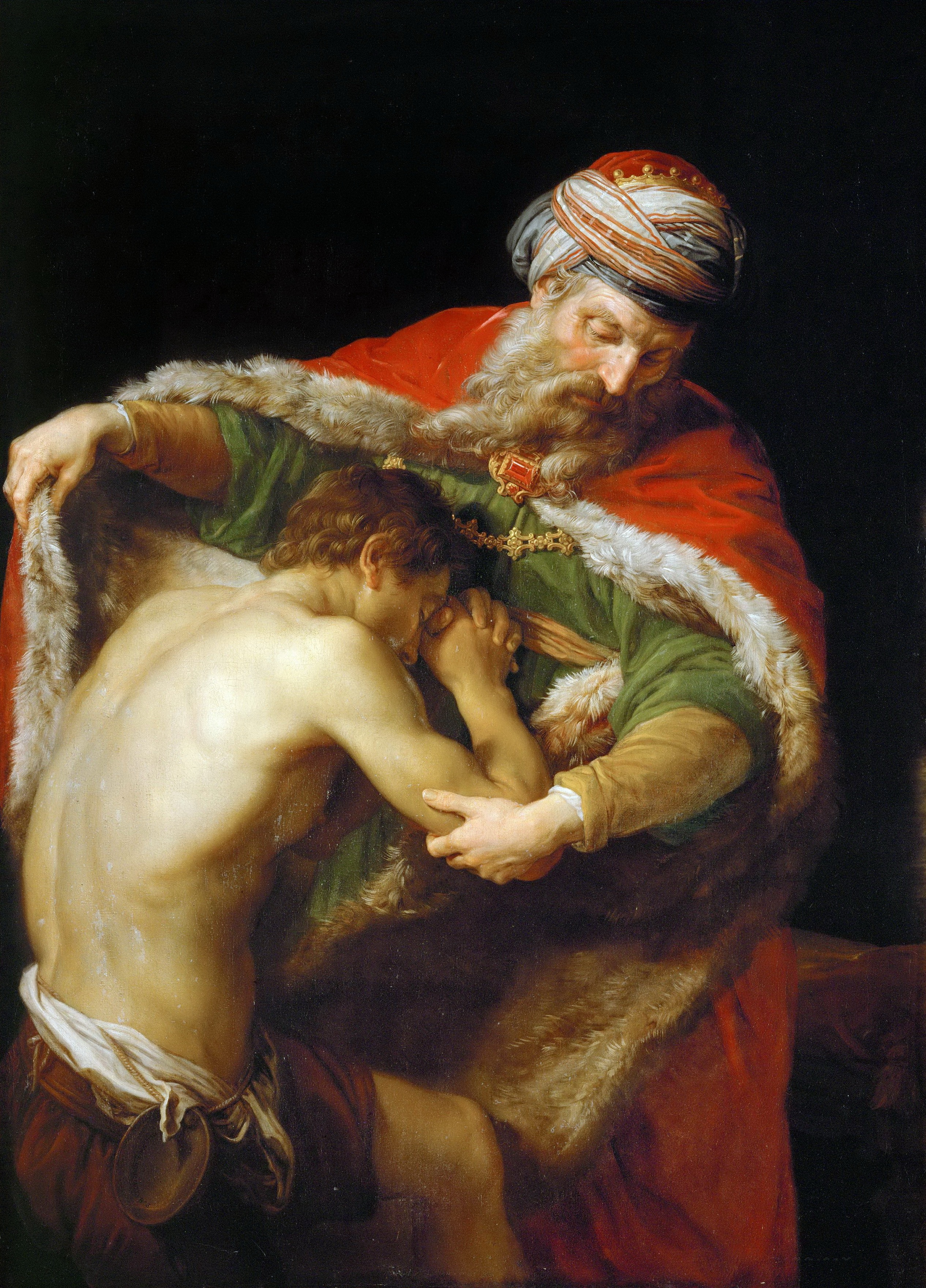
File:Pompeo Batoni 003.jpg

 Pompeo Batoni: The Prodigal Son
The worst evangelism question ever in my opinion is:

 “If God were to ask you, “Why should I let you into my Heaven?” what would you say?”

The lovely pastor of our first little church in Williamsburg,  Virginia, was all gung-ho about Evangelism Explosion.  When we were new, he visited us with a man he was training, and popped the Evangelism Explosion question, “If God were to ask you, ‘Why should I let you into My Heaven?’ what would you say?”

I said, “I know the correct answer, but to be honest, that isn’t what I am going to say.”

Now, 19 years later and even more confident, I would snort and say, “No way is God going to ask silly questions on that emotional and glorious occasion.”

* * *

Because you see, in the Parable of the Prodigal Son, Jesus has told us what it’s going to be like when we meet his lovely father.

“But while he was still a long way off, his father saw him and was filled with compassion for him; he ran to his son, threw his arms around him and kissed him.”

And because I am God’s prodigal daughter–unbelievably, but definitely, because he is so incredibly good and kind–I believe he will be filled with compassion for me, run to me, throw his arms around me, and kiss me.

And I will say, head bowed, through heartfelt tears, ‘Father, I have sinned against heaven and against you. I am no longer worthy to be called your daughter.’

And seeing the holiness of his face, and his sheer goodness and loveliness, everything I have ever done will come crashing in, and I will hang my head, overcome and ashamed.

And he will say, “Quick! Bring the best robe and put it on her. Put a ring on her finger and sandals on her feet. 23 Bring the fattened calf for there are no calories or cholesterol in heaven. Let’s have a feast and celebrate. 24 For this daughter of mine was dead and is alive again; she was lost and is found.”

* * *

And if this amazing Father could possibly ask that silly imaginary question, “Why should I let you into my heaven?” I would say,

“Because you are my father, and I am your daughter, and your home is mine.”

“Because I have messed up and repented, messed up and repented, again and again, but through it all, through it all, oh I have loved you–oh so very much.”

And he will say “Come,” because that is his nature.

Filed Under: In which I am Amazed by Grace, In which I am amazed by the love of the Father, In which I'm amazed by the goodness of God Tagged With: evangelism explosion, grace, heaven, prodigal son

  • 1
  • 2
  • 3
  • Next Page »

Sign Up and Get a Free eBook!

Sign up to be emailed my blog posts (one a week) and get the ebook of "Holy Ground," my account of working with Mother Teresa.

Join 544 Other Readers

My Books

Rosaries, Reading, Secrets: A Catholic Childhood in India

Rosaries, Reading Secrets, B&N
USA

UK

Wandering Between Two Worlds: Essays on Faith and Art

Wandering Between Two Worlds
USA

UK

Francesco, Artist of Florence: The Man Who Gave Too Much

Francesco, Artist of Florence
US

UK

The Story of Dirk Willems

The Story of Dirk Willems
US

UK

My Latest Meditation

Anita Mathias: About Me

Anita Mathias

Read my blog on Facebook

Follow me on Twitter

Follow @anitamathias1

Recent Posts

  • God’s Complete Forgiveness 
  • Using God’s Gift of Our Talents: A Path to Joy and Abundance
  • The Kingdom of God is Here Already, Yet Not Yet Here
  • All Those Who Exalt Themselves Will Be Humbled & the Humble Will Be Exalted
  • Christ’s Great Golden Triad to Guide Our Actions and Decisions
  • How Jesus Dealt With Hostility and Enemies
  • Do Not Be Afraid, but Do Be Prudent
  • For Scoundrels, Scallywags, and Rascals—Christ Came
  • How to Lead an Extremely Significant Life
  • Don’t Walk Away From Jesus, but if You Do, He Still Looks at You and Loves You
Premier Digital Awards 2015 - Finalist - Blogger of the year
Runner Up Christian Media Awards 2014 - Tweeter of the year

Categories

What I’m Reading


Wolf Hall
Hilary Mantel

Wolf Hall --  Amazon.com
Amazon.com

Amazon.co.uk

Silence and Honey Cakes:
The Wisdom Of The Desert
Rowan Williams

Silence and Honey Cakes --  Amazon.com
Amazon.com

Amazon.co.uk

The Long Loneliness:
The Autobiography of the Legendary Catholic Social Activist
Dorothy Day

The Long Loneliness --  Amazon.com
Amazon.com

Amazon.co.uk

Country Girl
Edna O'Brien

Country Girl  - Amazon.com
Amazon.com

Amazon.co.uk

Archive by month

My Latest Five Podcast Meditations

INSTAGRAM

anita.mathias

My memoir: Rosaries, Reading, Secrets https://amzn.to/42xgL9t
Oxford, England. Writer, memoirist, podcaster, blogger, Biblical meditation teacher, mum

Well, hello friends! Breaking radio silence to let Well, hello friends! Breaking radio silence to let you know that I have taped a meditation for you on Christ’s famous Parable of the Talents in Matthew 25. https://anitamathias.com/2025/11/05/using-gods-gift-of-our-talents-a-path-to-joy-and-abundance/
Here you are, click the play button in the blog post for a brief meditation, and some moments of peace, and, perhaps, inspiration in your day 🙂
Hi Friends, I have taped a meditation; do listen a Hi Friends, I have taped a meditation; do listen at this link: https://anitamathias.com/2025/04/08/the-kingdom-of-god-is-here-already-yet-not-yet-here-2/
It’s on the Kingdom of God, of which Christ so often spoke, which is here already—a mysterious, shimmering internal palace in which, in lightning flashes, we experience peace and joy, and yet, of course, not yet fully here. We sense the rainbowed presence of Christ in the song which pulses through creation. Christ strolls into our rooms with his wisdom and guidance, and things change. Our prayers are answered; we are healed; our hearts are strangely warmed. Sometimes.
And yet, we also experience evil within & all around us. Our own sin which can shatter our peace and the trajectory of our lives. And the sins of the world—its greed, dishonesty and environmental destruction.
But in this broken world, we still experience the glory of creation; “coincidences” which accelerate once we start praying, and shalom which envelops us like sudden sunshine. The portals into this Kingdom include repentance, gratitude, meditative breathing, and absolute surrender.
The Kingdom of God is here already. We can experience its beauty, peace and joy today through the presence of the Holy Spirit. But yet, since, in the Apostle Paul’s words, we do not struggle only “against flesh and blood, but against the rulers, against the unseen powers of this dark world and against the spiritual forces of evil,” its fullness still lingers…
Our daughter Zoe was ordained into the Church of E Our daughter Zoe was ordained into the Church of England in June. I have been on a social media break… but … better late than never. Enjoy!
First picture has my sister, Shalini, who kindly flew in from the US. Our lovely cousins Anthony and Sarah flank Zoe in the next picture.
The Bishop of London, Sarah Mullaly, ordained Zoe. You can see her praying that Zoe will be filled with the Holy Spirit!!
And here’s a meditation I’ve recorded, which you might enjoy. The link is also in my profile
https://anitamathias.com/2024/11/07/all-those-who-exalt-themselves-will-be-humbled-the-humble-will-be-exalted/
I have taped a meditation on Jesus statement in Ma I have taped a meditation on Jesus statement in Matthew 23, “For those who exalt themselves will be humbled, and those who humble themselves will be exalted.”
Do listen here. https://anitamathias.com/2024/11/07/all-those-who-exalt-themselves-will-be-humbled-the-humble-will-be-exalted/
Link also in bio.
And so, Jesus states a law of life. Those who broadcast their amazingness will be humbled, since God dislikes—scorns that, as much as people do.  For to trumpet our success, wealth, brilliance, giftedness or popularity is to get distracted from our life’s purpose into worthless activity. Those who love power, who are sure they know best, and who must be the best, will eventually be humbled by God and life. For their focus has shifted from loving God, doing good work, and being a blessing to their family, friends, and the world towards impressing others, being enviable, perhaps famous. These things are houses built on sand, which will crumble when hammered by the waves of old age, infirmity or adversity. 
God resists the proud, Scripture tells us—those who crave the admiration and power which is His alone. So how do we resist pride? We slow down, so that we realise (and repent) when sheer pride sparks our allergies to people, our enmities, our determination to have our own way, or our grandiose ego-driven goals, and ambitions. Once we stop chasing limelight, a great quietness steals over our lives. We no longer need the drug of continual achievement, or to share images of glittering travel, parties, prizes or friends. We just enjoy them quietly. My life is for itself & not for a spectacle, Emerson wrote. And, as Jesus advises, we quit sharp-elbowing ourselves to sit with the shiniest people, but are content to hang out with ordinary people; and then, as Jesus said, we will inevitably, eventually, be summoned higher to the sparkling conversation we craved. 
One day, every knee will bow before the gentle lamb who was slain, now seated on the throne. We will all be silent before him. Let us live gently then, our eyes on Christ, continually asking for his power, his Spirit, and his direction, moving, dancing, in the direction that we sense him move.
Link to new podcast in Bio https://anitamathias.co Link to new podcast in Bio https://anitamathias.com/2024/02/20/how-jesus-dealt-with-hostility-and-enemies/
3 days before his death, Jesus rampages through the commercialised temple, overturning the tables of moneychangers. Who gave you the authority to do these things? his outraged adversaries ask. And Jesus shows us how to answer hostile questions. Slow down. Breathe. Quick arrow prayers!
Your enemies have no power over your life that your Father has not permitted them. Ask your Father for wisdom, remembering: Questions do not need to be answered. Are these questioners worthy of the treasures of your heart? Or would that be feeding pearls to hungry pigs, who might instead devour you?
Questions can contain pitfalls, traps, nooses. Jesus directly answered just three of the 183 questions he was asked, refusing to answer some; answering others with a good question.
But how do we get the inner calm and wisdom to recognise
and sidestep entrapping questions? Long before the day of
testing, practice slow, easy breathing, and tune in to the frequency of the Father. There’s no record of Jesus running, rushing, getting stressed, or lacking peace. He never spoke on his own, he told us, without checking in with the Father. So, no foolish, ill-judged statements. Breathing in the wisdom of the Father beside and within him, he, unintimidated, traps the trappers.
Wisdom begins with training ourselves to slow down and ask
the Father for guidance. Then our calm minds, made perceptive, will help us recognise danger and trick questions, even those coated in flattery, and sidestep them or refuse to answer.
We practice tuning in to heavenly wisdom by practising–asking God questions, and then listening for his answers about the best way to do simple things…organise a home or write. Then, we build upwards, asking for wisdom in more complex things.
Listening for the voice of God before we speak, and asking for a filling of the Spirit, which Jesus calls streams of living water within us, will give us wisdom to know what to say, which, frequently, is nothing at all. It will quieten us with the silence of God, which sings through the world, through sun and stars, sky and flowers.
Especially for @ samheckt Some very imperfect pi Especially for @ samheckt 
Some very imperfect pictures of my labradoodle Merry, and golden retriever Pippi.
And since, I’m on social media, if you are the meditating type, here’s a scriptural meditation on not being afraid, while being prudent. https://anitamathias.com/2024/01/03/do-not-be-afraid-but-do-be-prudent/
A new podcast. Link in bio https://anitamathias.c A new podcast. Link in bio
https://anitamathias.com/2024/01/03/do-not-be-afraid-but-do-be-prudent/
Do Not Be Afraid, but Do Be Prudent
“Do not be afraid,” a dream-angel tells Joseph, to marry Mary, who’s pregnant, though a virgin, for in our magical, God-invaded world, the Spirit has placed God in her. Call the baby Jesus, or The Lord saves, for he will drag people free from the chokehold of their sins.
And Joseph is not afraid. And the angel was right, for a star rose, signalling a new King of the Jews. Astrologers followed it, threatening King Herod, whose chief priests recounted Micah’s 600-year-old prophecy: the Messiah would be born in Bethlehem, as Jesus had just been, while his parents from Nazareth registered for Augustus Caesar’s census of the entire Roman world. 
The Magi worshipped the baby, offering gold. And shepherds came, told by an angel of joy: that the Messiah, a saviour from all that oppresses, had just been born.
Then, suddenly, the dream-angel warned: Flee with the child to Egypt. For Herod plans to kill this baby, forever-King.
Do not be afraid, but still flee? Become a refugee? But lightning-bolt coincidences verified the angel’s first words: The magi with gold for the flight. Shepherds
telling of angels singing of coming inner peace. Joseph flees.
What’s the difference between fear and prudence? Fear is being frozen or panicked by imaginary what-ifs. It tenses our bodies; strains health, sleep and relationships; makes us stingy with ourselves & others; leads to overwork, & time wasted doing pointless things for fear of people’s opinions.
Prudence is wisdom-using our experience & spiritual discernment as we battle the demonic forces of this dark world, in Paul’s phrase.It’s fighting with divinely powerful weapons: truth, righteousness, faith, Scripture & prayer, while surrendering our thoughts to Christ. 
So let’s act prudently, wisely & bravely, silencing fear, while remaining alert to God’s guidance, delivered through inner peace or intuitions of danger and wrongness, our spiritual senses tuned to the Spirit’s “No,” his “Slow,” his “Go,” as cautious as a serpent, protected, while being as gentle as a lamb among wolves.
Link to post with podcast link in Bio or https://a Link to post with podcast link in Bio or https://anitamathias.com/2023/09/22/dont-walk-away-from-jesus-but-if-you-do-he-still-looks-at-you-and-loves-you/
Jesus came from a Kingdom of voluntary gentleness, in which
Christ, the Lion of Judah, stands at the centre of the throne in the guise of a lamb, looking as if it had been slain. No wonder his disciples struggled with his counter-cultural values. Oh, and we too!
The mother of the Apostles James and John, asks Jesus for a favour—that once He became King, her sons got the most important, prestigious seats at court, on his right and left. And the other ten, who would have liked the fame, glory, power,limelight and honour themselves are indignant and threatened.
Oh-oh, Jesus says. Who gets five talents, who gets one,
who gets great wealth and success, who doesn’t–that the
Father controls. Don’t waste your one precious and fleeting
life seeking to lord it over others or boss them around.
But, in his wry kindness, he offers the ambitious twelve
and us something better than the second or third place.
He tells us how to actually be the most important person to
others at work, in our friend group, social circle, or church:Use your talents, gifts, and energy to bless others.
And we instinctively know Jesus is right. The greatest people in our lives are the kind people who invested in us, guided us and whose wise, radiant words are engraved on our hearts.
Wanting to sit with the cleverest, most successful, most famous people is the path of restlessness and discontent. The competition is vast. But seek to see people, to listen intently, to be kind, to empathise, and doors fling wide open for you, you rare thing!
The greatest person is the one who serves, Jesus says. Serves by using the one, two, or five talents God has given us to bless others, by finding a place where our deep gladness and the world’s deep hunger meet. By writing which is a blessing, hospitality, walking with a sad friend, tidying a house.
And that is the only greatness worth having. That you yourself,your life and your work are a blessing to others. That the love and wisdom God pours into you lives in people’s hearts and minds, a blessing
https://anitamathias.com/.../dont-walk-away-from-j https://anitamathias.com/.../dont-walk-away-from-jesus.../
Sharing this podcast I recorded last week. LINK IN BIO
So Jesus makes a beautiful offer to the earnest, moral young man who came to him, seeking a spiritual life. Remarkably, the young man claims that he has kept all the commandments from his youth, including the command to love one’s neighbour as oneself, a statement Jesus does not challenge.
The challenge Jesus does offers him, however, the man cannot accept—to sell his vast possessions, give the money to the poor, and follow Jesus encumbered.
He leaves, grieving, and Jesus looks at him, loves him, and famously observes that it’s easier for a camel to squeeze through the eye of a needle than for a rich person to live in the world of wonders which is living under Christ’s kingship, guidance and protection. 
He reassures his dismayed disciples, however, that with God even the treasure-burdened can squeeze into God’s kingdom, “for with God, all things are possible.”
Following him would quite literally mean walking into a world of daily wonders, and immensely rich conversation, walking through Israel, Lebanon, Syria, and Jordan, quite impossible to do with suitcases and backpacks laden with treasure. 
For what would we reject God’s specific, internally heard whisper or directive, a micro-call? That is the idol which currently grips and possesses us. 
Not all of us have great riches, nor is money everyone’s greatest temptation—it can be success, fame, universal esteem, you name it…
But, since with God all things are possible, even those who waver in their pursuit of God can still experience him in fits and snatches, find our spirits singing on a walk or during worship in church, or find our hearts strangely warmed by Scripture, and, sometimes, even “see” Christ stand before us. 
For Christ looks at us, Christ loves us, and says, “With God, all things are possible,” even we, the flawed, entering his beautiful Kingdom.
Follow on Instagram

© 2026 Dreaming Beneath the Spires · All Rights Reserved. · Cookie Policy · Privacy Policy