Anita Mathias: Dreaming Beneath the Spires

Anita Mathias's Blog on Faith and Art

  • Home
  • My Books
  • Meditations
  • Essays
  • Contact
  • About Me

On the Benefits of Writing Down Our Prayers

By Anita Mathias

writingWe are listening to A Praying Life by Paul Miller, a wonderful book on prayer in the car. (I was, incidentally disciplined by the author for almost five years, as he mentions in the book).

Anyway, Miller tells us that he often prays aloud. Jesus did so in his High Priestly Prayer in John 17, and his anguished prayers at Gethsemane. (However, Jesus also encourages us to pray in the privacy of our rooms so that our prayers don’t impress people (rather than God)…and thereby lose us the secret reward God gives those who pray.)

“Praying out loud can be helpful because it keeps you from getting lost in your head. It makes your thoughts concrete,” Miller writes. “When I confess a sin aloud, it feels more real. I’m surprised by how concrete the sin feels. I’ve even thought, ‘Oh I guess that was really wrong.’ On the way to a social event, I will pray aloud in the car that I won’t fall into lust or people pleasing. My prayers become more serious.”

* * *

However, when I find it hard to focus on prayer, what helps me is not praying out loud (I live with two daughters, one husband, one Golden Retriever, and one Labradoodle, and don’t want to startle any of them) but writing out my prayers.

When I pray my thoughts meander in the natural way of thoughts. Writing out my prayers helps me redirect my thoughts to the subject I was praying about so that I can saturate that worry in prayer, make sure I have heard God on it, and am acting in accordance with his directives. (This is particularly important for unanswered prayers so one senses the story God is writing in our lives).

I like to put my worries into the petri dish of prayer, so to say, bathing them in prayer, and continuing to “pray until something happens.” Written prayers help me “worry the bone of a prayer,” until light and clarity emerges as to what God might be doing in the things I am praying about, and what he wants me to do.

(Interestingly, though, Miller says prayer should be like human conversation between friends, meandering, free-flowing, playful. So if, in the middle of praying-worrying about how I am writing less than I want to, I start praying-worrying that I am exercising a bit less than I want to, and then that the room I am praying in is a tad messier than I want it to be…Miller would suggest praying about the latest worries that have popped up their groundhog heads instead of dragging prayer back to the first worry. Confess. Ask for help. Ask for strategy. And who knows? Perhaps the solution to the first worry—disappointing productivity–lies in the next two: not enough exercise, not enough tidying up!! Yes, indeed!)

* * *

The Circle Maker by Mark Batterson is another prayer-changing, hope-refilling book on prayer. Just as Jesus does, Batterson encourages us to pray about anything. Wild dreams, wild-goose dreams, dreams we are afraid to vocalize, dreams we can only keep alive because the Creator of the Universe can do and create anything… The dreams that we are embarrassed to say aloud, we can write down. And in the process of writing them down, they feel a little bit more real. “Dreaming is a form of prayer and prayer is a form of dreaming,” as Batterson says.

I have often found that wild-goose dreams I have prayed for have uncannily come to pass. In that way, our prayers can be prophetic, and, in the areas we have saturated in prayer, the transcript of our lives resembles the transcript of our prayers, to quote Batterson again.

* * *

We often don’t know our own hearts and minds and spirits. That is why people go to therapy!! Expressive writing is a form of therapy. So too is prayer journaling.

In the process of putting it down, in stark black and white, clarity comes about what I really want—which women socialized to be nice and obliging often don’t know!!

The actions and emotions of my own heart that I am less than proud about get unveiled and gradually repented of. The hurts and slights, the slings and arrows of interpersonal relationships which could metastasize into a cancer of unforgiveness if brooded over are released and forgiven…

Write out your confusion and lack of clarity. The areas of your life where you are not sure what God is doing, or the direction in which your life is veering. I often feel I know very little about my own life, the plot God is writing in and through it, the direction in which he is bending it, and what he wants me to do… Prayer helps me to understand the story that God is writing in my life a little better, and written prayer clarifies and focuses my heart-prayer.


I’m Recommending:

The Circle Maker: Praying Circles Around Your Biggest Dreams and Greatest Fears on Amazon.co.uk and on Amazon.com.

A Praying Life: Connecting with God in a Distracting World by Paul Miller on Amazon.co.uk and on Amazon.com.




Filed Under: In which I play in the fields of prayer Tagged With: A Praying Life, Expressive Writing, Mark Batterson, Paul Miller, Prayer, The CircleMaker, writing down our prayers

Analysing my Experience of Prayer over the Last 19 Years

By Anita Mathias

alone on a lakeSo I come to my time of prayer, and I am dry and distracted. My thoughts are whirling; I cannot hear God speak, and I have nothing to say. My spirit feels numb. Prayer?

It’s as if you are having coffee with a friend you haven’t seen for a while, and you are so out of touch with her life, and she with yours, that you don’t know what to ask, don’t know what to tell, don’t know what to talk about. The conversation is leaden; you want to escape.

Keeping in touch is a sure way to better conversation, whether with God or a friend.

I pick up my pen. Since my mind cannot focus on ethereal prayer, I will write my prayers. Write my worries, my plans, and my fears. Check in with Jesus about each of them. That pathway into prayer–writing my prayers–never fails.

* * *

I write. I think. I pray. I sink, absorbed, into the quietness.

I had come to prayer so distracted, so out of touch with God, with nothing to say, my thoughts and emotions whirling restlessly.

But I had forced myself into the boat of prayer, and Christ and I together had pushed far away from shore.

It got quiet. It got peaceful. Long, still sheets of water everywhere. Slowly, a fish plopped up. A worry.

My writing?

I take that worry to God.

I don’t hear anything.

I ask the question again. So Lord, will I have a writing career, of sorts? And wait.

Slowly, clarity emerges.

I go back to my origin story. The clear call of God to write one day in 1983. A call which, for too long a time in my life, I have not been faithful to.

I will return to that. I will be faithful to my call. I will leave success and failure to him. I will keep writing. I will keep reading. I will study the craft as time permits. I will get better, that is certain. He will use my words to reach others, of that too I feel certain. I will run in my lane and leave the results of my race to him.

* * *

Other fish poke their heads out of the temporarily still sea. Our family business, and how to make it grow? My daughters’ future.

Ideas come, reassurance. Some questions remain question marks, of course. Not every answer is given in every session of prayer, but they are now question marks bathed in golden light.

I grow still and quiet. We have rowed so far from shore.

I had 36 minutes free, and so I set a timer.

When the timer goes, it is a wrench.

I have been in another country.

Without being too fanciful, I have felt the heavens part; I have felt grace rain down. I have felt the Spirit. Something has shifted in my soul. Its molecules have changed, its water become wine. I feel an expansive peace. Something of God’s life, of God’s love for me has entered into and enlarged my soul.

* * *

I have been mostly disciplined in prayer since a dark patch of disappointment in late 1996. I had been led on by an editor of a leading publishing company, who I had thought had given me a verbal assurance that he would publish my book. I had a leading agent, I thought–though we hadn’t signed.

The book I wrote was a disappointment to both of them, and, if I look at it now, will, almost certainly, be a disappointment to me. But it was written through pregnancy and early motherhood…in blood.

When, after revisions, it was still turned down, I flung myself facedown on the carpet  and thought, “I want to die.”

* * *

“I am sick,” I then said to myself. I am spiritually sick. And Jesus said he was the Physician. I need him.

And having a wee bit of a practical streak, I thought: How much prayer and Bible study do I need to have the life of God course through my soul? And that is a question Scripture is silent on. It can only be answered by trial and error, and the answer can vary. On busy days, Martin Luther said he needed three hours of prayer (rather than his usual two). I needed to find my own answer.

So I set a stopwatch, prayed and read my Bible until I was bored, and then stopped. I was not at peace, but I was growing distracted. I was discovering my baseline for prayer, just as when I began the discipline of exercise, I walked until I was tired, wrote down my distance and speed, and then began to increase both (and am still increasing them, oh yes!)

When I was 17, I wanted to become a nun, and I did for a while, joining Mother Teresa. This was the discipline of prayer there: you didn’t prolong prayer, because you found it sweet, otherwise you would soon burn out. And you do not cut it short, because you were bored, otherwise, you would quit before you got quiet, got still, repented, heard God, tasted the sweetness of it all.

The next day I set a timer for the time I had spent, and just a minute more, and went on, adding a minute a day, dividing my quiet time between prayer and Bible study. I stopped at 90 minutes–45 minutes for prayer, 45 minutes for Bible study (though, in fact, now that the girls are older, I often end up spending even longer than that in spiritual disciplines! My soul needs it!)

Over the years, I found peace. I found serenity. I got to know Jesus a whole lot better. In prayer, God suggested ways to move from Williamsburg, Virginia, where I wasn’t particularly happy, to Oxford, where I am happy. In prayer, I “heard of” a business idea which changed our lives. In prayer, I “heard” God suggest blogging, which I so love. I prayed for my dream house with a very specific wishlist, and I stumbled on an ad, and God revealed ways to just about afford it.

But all these are side effects. My character began to change, molecule by molecule, and that is one of the gratifying side effects of a life of prayer. I became a kinder person, more empathetic.

My life of prayer is not a story of remarkable worldly success. And so I cannot recommend prayer as a way to become rich, become famous, become a great writer. To take up a discipline of prayer for the worldly advantages it might confer is like marrying only for money, or only for sex, and we know all how that works out, don’t we?

T. S. Eliot looking back on the first twenty years of his life as a writer says,

Twenty years largely wasted

Trying to learn to use words, and every attempt

Is a wholly new start, and a different kind of failure.


Yeah, yeah, yeah, that’s how I feel as a writer and as a pray-er.

But then, what Stephen King says about writing is equally true about prayer.

Writing isn’t about making money, getting famous, getting dates, or getting laid, or making friends. It’s about enriching the lives of those who will read your work, and enriching your own as well. It’s about getting up, getting well, and getting over. Getting happy, okay? Getting happy. Writing is magic, the water of life. The water is free. So drink. Drink and be filled up.

Prayer is everything Stephen King says writing is, and more.

It is not a sure way to worldly reward, though it has brought wealth and success to some, according to the plan of God for their lives

However, though material rewards are not guaranteed, as Jesus said, rewards are guaranteed. We pray for the fun of hanging out with Jesus, to get his take on things, to see life with his eyes, to absorb his wisdom. We pray because with the discipline of prayer comes lightness and joy. With the discipline of prayer and obedience comes peace and calm, wisdom and guidance. Water for a parched soul. Sanity. We pray so we can be enlarged by loving something larger than ourselves, and that is the Lord Jesus himself.

We pray because it is our daily bread. Jesus may choose to give some of us nutella too, and I still pray for metaphorical “nutella”, and grilled cheese and homemade blackberry jam, and according to the lane he has marked for me, the work he has given me to do in the world, and the people he has given me to influence, he may well give me some of these things. Or he may not. But tasting Jesus is fun, and joy and wisdom, and for these gifts from the discipline of prayer, I am grateful.


Filed Under: In which I play in the fields of prayer Tagged With: Martin Luther, Mother Teresa, Prayer, rewards of prayer, Stephen King, T.S. Eliot, the discipline of prayer, writing prayers

When Shackles become Wings: On Domesticity, Creativity, and Me

By Anita Mathias

saxifrage_anita_mathias_com

wedding-1-235x300I was married 25 years ago, while in a Ph.D programme in Creative Writing at the State University of New York Binghamton. I had just earned a BA and an MA in English from Somerville College, Oxford, then an MA in Creative Writing from Ohio State University.

My husband probably hoped for a traditional marriage, though he never actually said so. You know–I would do the dishes, and laundry and shopping and cleaning and cooking, and he would have a career. In the early years, I urged him to try a role reversal; to let me have a try at a career and at supporting us (and to accept the consequent drop in our standard of living), but he would have none of it.

For the first decade or so of our marriage, I bitterly resented domesticity. My mother had a full-time cook, a full-time maid, an “ayah,” and a gardener (whereas my husband’s mother had done everything herself.) Had I gone through all this higher education to become a cook/maid, I’d sign? My husband insisted that a cleaner was a waste of money, saying that he could easily whisk through the house and clean it. Well, I’ll credit him with good intentions!

We feminist writers in graduate school used to tell each other, “The dishes can wait; the poem cannot wait.” And too often the dishes waited, for days and days, and the resultant domestic and marital stress affected the poetry too.

I found it impossible to keep up with housekeeping. The further behind we got, the harder it was to catch up. Which caused stress and chaos and unhappiness which affected my creativity far more than if I took the bit between my teeth, and simply did what had to be done.

* * *

Finally, about 18 years into our marriage, Roy did what I had been urging him to from two years into our marriage—took early retirement, and tried to be a house-husband.

Well, well, well, turns out he was only a wee bit better as a house-husband than I was as a housewife!! He promptly got the cleaner and gardener I had so long desired!

But he does do enough housework so that we do not live in mess and chaos.

* * *

And since, it now takes just an hour or two to get to the reasonably orderly tidy household we both crave, rather than an apparently infinite task, I, ironically, often spend an hour or two in housework and gardening.

And I have discovered a strange thing. The days I do not spend an hour or two around my house and garden, weeding, sorting laundry, tidying up, my spirit feels slightly out of sorts. My mind is active, as I read and write; my spirit, not so much. I feel a bit out of touch with God. A bit unaligned with him. A bit overwound. It’s as if I need the downtime of traditional “women’s work” to really pray.

It as if I needed the things I despised—folding laundry, putting things back in the right place, pulling weeds—to be able to think, to pray, to right myself with God, to position myself in God, to surrender my life to God again, to seek his wisdom.

Breathing place, sanity-savers, time for thinking, time ironically for creativity, time for repentance, time for surrender—gifts offered by the mundane tasks of folding clothes, tidying rooms, prettying a garden.

I wish I had embraced it from the start. I would, ironically, have been a more productive writer.

A house, living in a house, doing some of the work living in a house demands—this is the life God has given me, mountaintops and valleys, and as I embrace it, I find that, like saxifrage, tiny alpine plant that splits rocks, creativity blooms in the apparently unpromising nooks and crannies of duty!


Tweetables

Like saxifrage, tiny alpine that splits rocks, creativity blooms in the rocks of duty! NEW from @anitamathias1 Tweet: Like saxifrage, tiny alpine that splits rocks, creativity blooms in the rocks of duty! NEW from @anitamathias1 http://ctt.ec/SRPbg+

It’s as if I need the downtime of traditional “women’s work” to really pray. NEW from @anitamathias1 Tweet: It’s as if I need the downtime of traditional “women’s work” to really pray. NEW from @anitamathias1 http://ctt.ec/5ig55+

Image Credit


Filed Under: Finding God in Domesticity, In which I explore writing and blogging and creativity, In which I play in the fields of prayer, In which I pursue happiness and the bluebird of joy Tagged With: Creativity, domesticity, duty, Prayer

On Liturgy (which I Dislike)  

By Anita Mathias

I was interested to hear the leader on my silent retreat say that different approaches to prayer or the spiritual life are like food. Different people like different things.

Such a simple way of expressing a new thought for me. (I had a mental gradation of superior and less-evolved spiritual practices.)

* * *

 I intensely dislike liturgy. It triggers memories of the boredom-that –made-me-long-to-scream during the Catholic masses of my childhood; the continual looking at my watch; each part, the Kyrie, the Gloria, the Sanctus, the Agnus Dei , being accompanied with precise mental calculations of the number of minutes left before I left church and walked into fresh-aired rosy dawn.

* * *

 For me, liturgy is noise and distraction—more noise and distraction in an already noisy, distracting world. I don’t see the point of repetitively reading out words other men and women have written; (I guess liturgy was written by men.)

I would rather express a halting, impoverished sentiment of my own than a fluent, winged thought someone else has penned. Because that emerged from his heart, not mine. Better a heart-felt stutter than lyricism recited from a printed page.

Also, though I think fast, and talk fast and write fast, and sometimes read fast– I am slow spiritually.

The liturgy has raced on and covered paragraphs while I am still meditating on the first sentence, and applying the airy words and ideas to my own earthbound life. Only connecting.

Nah, not for me.

* * *

 It has its uses though.  I’ve read that the liturgy was composed to provide a way for men and women who were barely literate to rehearse the bases of the faith in every communal encounter with God, and remind the heart of 360 degrees of truth.

And when my heart is bored, sullen, lumpen, or distracted, stray phrases from the liturgy does awaken and tune it. It expands the emotional range of my heart. Reminds it of things it would not have thought of, and rouses slumbering things in it.

And some liturgies are beautiful. I loved the sung liturgy of the Northumbria community. Yeah, sung liturgy is certainly more bearable. Like Gregorian chant. Or Celtic liturgies.

* * *

However, there are people who love liturgy. I have been in small groups with people who wanted to read out pages and pages of Compline. Oh Lord, have mercy on this poor restless woman’s soul. And it’s rude to whip out your iPhone during small group liturgy. Oh yes, it is!

I used to think that the liturgy was for those at a less advanced stage of the spiritual life. Who needed Cyrano de Bergerac to write their love poetry for them.

But no, I realized each heart is tuned in different ways. Different strokes for different folks. Some like turnips; some like chocolate. Me, I love Green and Black’s Chocolate.

And that must explain why something I find so exasperating speaks to other people. Who even love it.

But liturgy or heart-grunts, either way, oh Lord, tune my heart to sing thy praise.

Question

So do you like liturgy? Which spiritual disciplines work for you? And which do not?

Filed Under: In which I explore Spiritual Disciplines, In which I explore the Spiritual Life, In which I play in the fields of prayer Tagged With: Catholic Mass, celtic liturgy, cyrano de bergerec, gregorian chant, liturgy, northumbria community

The Only Form of Multitasking that makes you Cleverer

By Anita Mathias

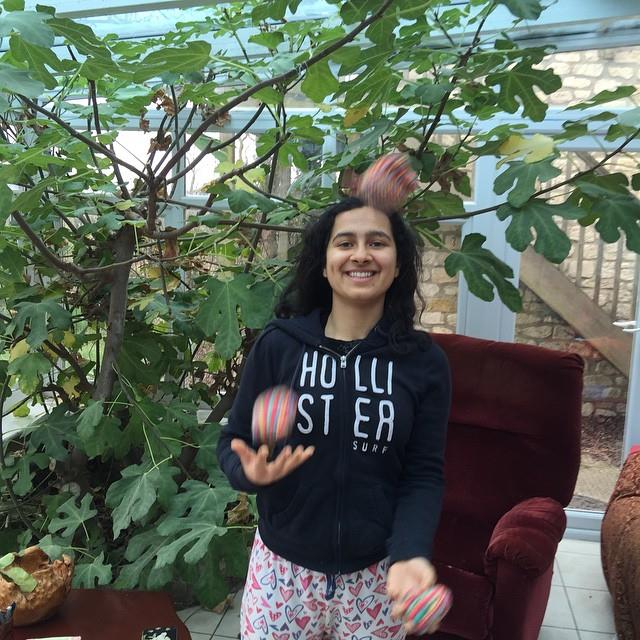
jugglerMy daughter Irene returned from a talk by neuroscientist Baroness Susan Greenfield informing us that multitasking decreases fluid IQ more than smoking marijuana, or losing a night’s sleep does.

My daughter, as intense as I am, walks around the house with her iPad, watching documentaries or TED talks or AsapScience (when she isn’t reading or studying.) Or sometimes—okay, mum, get real–lighter, less relentlessly educational stuff; she is a teenager, after all.

I keep telling her to do one thing at a time. Whatever your hands find to do, do it with all your might.

Delighted to have Baroness Susan Greenfield’s backing, I advised Irene to use the mundane things of life, waiting for food to reheat in the microwave, waiting for the kettle or the eggs to boil, as pathways into prayer.  To ask for God’s wisdom and blessing on the next task, on how to do it best. To do a mid-day course correction if necessary. Repent. Ask God’s blessing, wisdom and guidance on the dreams and visions for which she is striving. Ask him for the big picture blue sky visions for her life, for guidance on her life’s work and for the path she is to tread which will be the precise intersection between her deep gladness and the world’s deep hunger. Thank God for his goodness. Breathe.

She said, “Mum, but praying through the day is multitasking too.”

I guess so. And it’s the only form of multitasking that’s scripturally advised: “Pray continually.”

You tap into the vast resources of a brain greater than yours. And somehow, that great kind brain comes to help you with ideas, wisdom and sometimes concrete external interventions, changing your circumstances from the outside, changing you from within.

And I guess prayer is the only multitasking that makes you cleverer.


Filed Under: In which I play in the fields of prayer Tagged With: multitasking, Prayer, Susan Greenfield

Wriggling towards Shalom

By Anita Mathias

When I find I am stressed, or distressed,  I like to pause there and then instead of going through the day with undefined, subterranean unease.

I take the question to which I do not know the answer–how to be more productive perhaps. How to read more. How to help someone. How to get our business to flourish further–and ask Jesus for the answer. And keep asking the question, sort of saturating the question in prayer.  If any of you lacks wisdom, you should ask God, who gives generously to all without finding fault, and it will be given to you (James 1:15). And I keep asking, and keep asking for God’s answer–his surprising out-of-the-box answers, and eventually, as James promises, guidance, answers and wisdom do come.

  • * * *

Sometimes, I sense a vague fear and unease. Do you? I like to slow down and ask: What is it? What’s bugging me? What is this nebulous dark cloud? Sometimes, the fear, anxiety or annoyance is quite rational, and sometimes not so.

But whether it is a rational fear, or just a vague sense of unease, it does have the same solution.

I mentally put the fear or worry or annoyance into the petri dish of prayer, and invite God’s power to surround, saturate and irradiate it.

I surrender the possible dark outcome I dread to God. Put it in his hands. If it does happen, He will still be there. He will still love me. He will still give me the ability to be happy through it all.

And then I ask him to avert the outcome I dread. Ask him for wisdom for what I am to do today. Ask him for a game plan for the months ahead.

It’s in his hands now, whether things work out just as I prayed for, or just as I dreaded. It’s his worry.

I then just rest in his presence, rest in his love.

It’s not magic, nothing about the spiritual life is …or perhaps everything is!!

But I do get up from the place of prayer so much lighter in my spirit!


Image Credit

Filed Under: In which I play in the fields of prayer, In which I surrender all, The peace that transcends understanding Tagged With: peace, Prayer, Shalom, surrender

Surprised: When Exercise and Prayer Provide Similar Benefits

By Anita Mathias

“I’ve had a good day,” I say to Roy as we drift off to sleep.

“Oh, I thought you said your day wasn’t going well,” he says.

“Well it wasn’t, but then it got all turned around.”

What turned it round? Well, I went on a 3.25 mile walk, walking as fast as I could, and it woke my mind up, and I came back well-exercised and oxygenated, in a great mood, and able to think clearly and concentrate for hours.

* * *

 Another thing that turns my day around is to shut my laptop, set my timer for an hour, lie face down in an attitude of surrender (a position, which incidentally clears my mind and spirit), and simply pray. Or even better, kneel and pray.

Often the things that are bugging me are simmering beneath consciousness. A vague sense of unease that I can’t put one’s finger on. The Psalmist David experienced it when he asked, “Why are you sad, oh my soul?”

So then, cancer is gone for good, yes Jesus? (I believe so, intuitively, in my bones and spirit, partly because of my steadily increasing energy.) How do I combine book writing and blogging? Will I finish my memoir? Will it do well?  Find readers? Little worries like that, small niggles, can create subterranean unease.

What prayer does then is to take them to God. Cancer, life or death, I leave it in God’s hands. It is no longer my worry. My memoir, I leave it in God’s hands. It is no longer my worry. And so with everything.

And then I seek specific guidance on each thing. Cancer-Bancer. I remember to drink my carrot juice and green smoothies, and try to eat a bit more raw. I ask God for specific guidance on how to maintain the blog/book balance which every blogger struggles with.

And then I get up from the place of prayer at peace, my anxieties, insecurities and worries temporarily clarified and surrendered. I now have a clear map for how I am going to tread the steps ahead of me till the end of the day.

And tomorrow? Tomorrow will worry about itself.

* * *

It’s interesting how vigorous exercise and vigorous prayer give much the same results. Exercise gives us good humour, equanimity, endurance, and endorphins.  Intellectual, emotional and physical energy, mental clarity and focus emerge from within the self. With prayer, these are given to us from a source outside ourselves.

Though of course, the intangible benefits of prayer–chatting to our Almighty friend–far transcend those of exercise.

We need both physical fitness (which I am slowly developing) and spiritual fitness. We need to be stretched in our bodies, and stretched in our spirits (as well as stretched in those other dimensions of our being: intellectually, and in our capacity to love–another post for another day).

Filed Under: In which I get serious about health and diet and fitness and exercise (really), In which I play in the fields of prayer Tagged With: Exercise and Prayer, Physical and spiritual fitness

Making a Difference Through Prayer and Writing: In Praise of Julian of Norwich

By Anita Mathias

img-Blessed-Julian-of-Norwich

I read the papers and stress rises. So much injustice! 21 million people enslaved (14 million of them in India), land-grabbing, starvation, destruction of ecosystems, precious species going extinct, the restavek system in Haiti, slavery in Qatar, and the plight of the Palestinians.

My heart sinks.

I am just one girl of limited energy. I could push against one or two of these things, but it would take all my life, and I might barely dent it.

I do have a handful of causes, which I tweet about and financially support. That’s like returning just one starfish to the sea, but it makes a difference to that starfish as Loren Eiseley wrote.

* * *

The path of an activist, of a world-changer, is admirable, but it is a calling. If you embark on it without being called to it by God, and being continuously renewed by him, you risk burning out and becoming embittered. I know I would.

Fortunately there are other ways of making a difference in the world, which are also callings.

“If you want to change the world, pick up your pen and write,” ―Martin Luther.  Tweet: “If you want to change the world, pick up your pen and write,” ―Martin Luther.  From @AnitaMathias1 http://ctt.ec/a5Fgw+

Can so pleasant a thing be a calling?

I see my calling as “a contemplative in the world” and a writer. When I compare it to real heroes like Simon Guillebaud, this seems like a bit of cop-out call, but it is, none the less, the call to which God has mercifully called me.

* * *

julian_ofNorwichI am today thinking of a real contemplative, Julian of Norwich, who was an anchorite. Anchorites were, on request, formally bricked into their cells by the ecclesiastical authorities. Once walled in, they were no longer permitted to leave.

Julian of Norwich lived bricked into a cell attached to Norwich Cathedral. One window looked onto the Tabernacle of the Cathedral; another window faced the outside world. Through this, servants brought food and removed waste, and people from every level of society, including her fellow mystic Margery Kempe came seeking advice.

And that was Julian of Norwich’s way of making a difference in the world. Read, pray, contemplate, write.

It was arduous. My head would feel ready to explode if all I did was read, think and write, if I could not go on longish walks, putter around my house and garden, see friends, go to a small group, go to church. I love contemplation and writing—but in the context of community and of physical movement.

* * *

There were remarkable medieval Christian women, saints, who played their part in the moving and shifting of Empires, Joan of Arc and Catherine of Siena among them.

But Mother Julian, all she did was think and pray and write, think and pray and write.

What could this woman who lived for decades in a single room possibly have to say to the world?

God gave her things to say. Tweet: God gave her things to say. From @AnitaMathias1 http://ctt.ec/6bP7G+

On the 8th May 1373, Julian of Norwich experienced a series of fifteen visions from four in the morning, till noon, with a further one that night.

They were “so compelling and so rich in meaning that Julian understood them to come directly from God and to be messages not just to herself but to all Christians.” She spent the rest of her life writing them, and “conveying her sense of their significance as it was revealed over many years of meditation” (A.C. Spearing).

Her book Revelations of Divine Love resonates 600 years later.

* * *

Here are some of her best-known thoughts, rays of light from a distant past, ancient music which still vibrates.

All shall be well, and all shall be well and all manner of thing shall be well.

And this:

“He showed me a hazel nut, lying in the palm of my hand. I thought, ‘What may this be?’

And it was answered thus, ‘It is all that is made. It lasts and ever shall, for God loves it.”

I saw three properties that God made it, that God loves it, that God keeps it. The Creator, the Keeper, the Lover. For until I am substantially “oned” to him, I may never have full rest nor true bliss. That is to say, until I be so fastened to him that there is nothing that is made between my God and me.”

* * *

Here are other insights of this woman bricked into her cell who did nothing but think and pray and write.

“The greatest honor we can give Almighty God is to live gladly because of the knowledge of his love.” 

“If there is anywhere on earth a lover of God who is always kept safe, I know nothing of it, for it was not shown to me. But this was shown: that in falling and rising again we are always kept in that same precious love.” 

“Our Savior is our true Mother in whom we are endlessly born and out of whom we shall never come.” 

“See that I am God. See that I am in everything. See that I do everything. See that I have never stopped ordering my works, nor ever shall, eternally. See that I lead everything on to the conclusion I ordained for it before time began, by the same power, wisdom and love with which I made it. How can anything be amiss?” 

“And I saw that truly nothing happens by accident or luck, but everything by God’s wise providence. If it seems to be accident or luck from our point of view, our blindness is the cause; for matters that have been in God’s foreseeing wisdom since before time began befall us suddenly, all unawares; and so in our blindness and ignorance we say that this is accident or luck, but to our Lord God it is not so.” 

Interestingly, the dry, crusty, cerebral T. S. Eliot was Dame Julian of Norwich’s most famous reader. He quotes her in his mysterious Four Quartets

Whatever we inherit from the fortunate
We have taken from the defeated
And all shall be well and
All manner of things shall be well
By the purification of the motive
In the ground of our beseeching.

~~~

 TWEETABLES

On making a difference through prayer and writing. In praise of Julian of Norwich. From @anitamathias1 Tweet: On making a difference through prayer and writing. In praise of Julian of Norwich. From @anitamathias1 http://ctt.ec/Dez25+

What could solitary Julian of Norwich have to say to the world? God gave her things to say From @anitamathias1 Tweet: What could solitary Julian of Norwich have to say to the world? God gave her things to say. From @anitamathias1 http://ctt.ec/bm7ap+

And all shall be well, all shall be well, all manner of things shall be well. From @anitamathias1 via Julian of Norwich Tweet: And all shall be well, all shall be well, all manner of things shall be well. From @anitamathias1 via Julian of Norwich http://ctt.ec/FL2Er+

Filed Under: In Which I celebrate Church History and Great Christians, In which I play in the fields of prayer Tagged With: contemplation, Four Quartets, Julian of Norwich, Little Gidding, making a difference through prayer and writing, Margery Kempe, Martin Luther, medieval mystics, Simon Guillebaud, T.S. Eliot

  • 1
  • 2
  • 3
  • …
  • 6
  • Next Page »

Sign Up and Get a Free eBook!

Sign up to be emailed my blog posts (one a week) and get the ebook of "Holy Ground," my account of working with Mother Teresa.

Join 544 Other Readers

My Books

Rosaries, Reading, Secrets: A Catholic Childhood in India

Rosaries, Reading Secrets, B&N
USA

UK

Wandering Between Two Worlds: Essays on Faith and Art

Wandering Between Two Worlds
USA

UK

Francesco, Artist of Florence: The Man Who Gave Too Much

Francesco, Artist of Florence
US

UK

The Story of Dirk Willems

The Story of Dirk Willems
US

UK

My Latest Meditation

Anita Mathias: About Me

Anita Mathias

Read my blog on Facebook

Follow me on Twitter

Follow @anitamathias1

Recent Posts

  • God’s Complete Forgiveness 
  • Using God’s Gift of Our Talents: A Path to Joy and Abundance
  • The Kingdom of God is Here Already, Yet Not Yet Here
  • All Those Who Exalt Themselves Will Be Humbled & the Humble Will Be Exalted
  • Christ’s Great Golden Triad to Guide Our Actions and Decisions
  • How Jesus Dealt With Hostility and Enemies
  • Do Not Be Afraid, but Do Be Prudent
  • For Scoundrels, Scallywags, and Rascals—Christ Came
  • How to Lead an Extremely Significant Life
  • Don’t Walk Away From Jesus, but if You Do, He Still Looks at You and Loves You
Premier Digital Awards 2015 - Finalist - Blogger of the year
Runner Up Christian Media Awards 2014 - Tweeter of the year

Categories

What I’m Reading


Wolf Hall
Hilary Mantel

Wolf Hall --  Amazon.com
Amazon.com

Amazon.co.uk

Silence and Honey Cakes:
The Wisdom Of The Desert
Rowan Williams

Silence and Honey Cakes --  Amazon.com
Amazon.com

Amazon.co.uk

The Long Loneliness:
The Autobiography of the Legendary Catholic Social Activist
Dorothy Day

The Long Loneliness --  Amazon.com
Amazon.com

Amazon.co.uk

Country Girl
Edna O'Brien

Country Girl  - Amazon.com
Amazon.com

Amazon.co.uk

Archive by month

My Latest Five Podcast Meditations

INSTAGRAM

anita.mathias

My memoir: Rosaries, Reading, Secrets https://amzn.to/42xgL9t
Oxford, England. Writer, memoirist, podcaster, blogger, Biblical meditation teacher, mum

Well, hello friends! Breaking radio silence to let Well, hello friends! Breaking radio silence to let you know that I have taped a meditation for you on Christ’s famous Parable of the Talents in Matthew 25. https://anitamathias.com/2025/11/05/using-gods-gift-of-our-talents-a-path-to-joy-and-abundance/
Here you are, click the play button in the blog post for a brief meditation, and some moments of peace, and, perhaps, inspiration in your day 🙂
Hi Friends, I have taped a meditation; do listen a Hi Friends, I have taped a meditation; do listen at this link: https://anitamathias.com/2025/04/08/the-kingdom-of-god-is-here-already-yet-not-yet-here-2/
It’s on the Kingdom of God, of which Christ so often spoke, which is here already—a mysterious, shimmering internal palace in which, in lightning flashes, we experience peace and joy, and yet, of course, not yet fully here. We sense the rainbowed presence of Christ in the song which pulses through creation. Christ strolls into our rooms with his wisdom and guidance, and things change. Our prayers are answered; we are healed; our hearts are strangely warmed. Sometimes.
And yet, we also experience evil within & all around us. Our own sin which can shatter our peace and the trajectory of our lives. And the sins of the world—its greed, dishonesty and environmental destruction.
But in this broken world, we still experience the glory of creation; “coincidences” which accelerate once we start praying, and shalom which envelops us like sudden sunshine. The portals into this Kingdom include repentance, gratitude, meditative breathing, and absolute surrender.
The Kingdom of God is here already. We can experience its beauty, peace and joy today through the presence of the Holy Spirit. But yet, since, in the Apostle Paul’s words, we do not struggle only “against flesh and blood, but against the rulers, against the unseen powers of this dark world and against the spiritual forces of evil,” its fullness still lingers…
Our daughter Zoe was ordained into the Church of E Our daughter Zoe was ordained into the Church of England in June. I have been on a social media break… but … better late than never. Enjoy!
First picture has my sister, Shalini, who kindly flew in from the US. Our lovely cousins Anthony and Sarah flank Zoe in the next picture.
The Bishop of London, Sarah Mullaly, ordained Zoe. You can see her praying that Zoe will be filled with the Holy Spirit!!
And here’s a meditation I’ve recorded, which you might enjoy. The link is also in my profile
https://anitamathias.com/2024/11/07/all-those-who-exalt-themselves-will-be-humbled-the-humble-will-be-exalted/
I have taped a meditation on Jesus statement in Ma I have taped a meditation on Jesus statement in Matthew 23, “For those who exalt themselves will be humbled, and those who humble themselves will be exalted.”
Do listen here. https://anitamathias.com/2024/11/07/all-those-who-exalt-themselves-will-be-humbled-the-humble-will-be-exalted/
Link also in bio.
And so, Jesus states a law of life. Those who broadcast their amazingness will be humbled, since God dislikes—scorns that, as much as people do.  For to trumpet our success, wealth, brilliance, giftedness or popularity is to get distracted from our life’s purpose into worthless activity. Those who love power, who are sure they know best, and who must be the best, will eventually be humbled by God and life. For their focus has shifted from loving God, doing good work, and being a blessing to their family, friends, and the world towards impressing others, being enviable, perhaps famous. These things are houses built on sand, which will crumble when hammered by the waves of old age, infirmity or adversity. 
God resists the proud, Scripture tells us—those who crave the admiration and power which is His alone. So how do we resist pride? We slow down, so that we realise (and repent) when sheer pride sparks our allergies to people, our enmities, our determination to have our own way, or our grandiose ego-driven goals, and ambitions. Once we stop chasing limelight, a great quietness steals over our lives. We no longer need the drug of continual achievement, or to share images of glittering travel, parties, prizes or friends. We just enjoy them quietly. My life is for itself & not for a spectacle, Emerson wrote. And, as Jesus advises, we quit sharp-elbowing ourselves to sit with the shiniest people, but are content to hang out with ordinary people; and then, as Jesus said, we will inevitably, eventually, be summoned higher to the sparkling conversation we craved. 
One day, every knee will bow before the gentle lamb who was slain, now seated on the throne. We will all be silent before him. Let us live gently then, our eyes on Christ, continually asking for his power, his Spirit, and his direction, moving, dancing, in the direction that we sense him move.
Link to new podcast in Bio https://anitamathias.co Link to new podcast in Bio https://anitamathias.com/2024/02/20/how-jesus-dealt-with-hostility-and-enemies/
3 days before his death, Jesus rampages through the commercialised temple, overturning the tables of moneychangers. Who gave you the authority to do these things? his outraged adversaries ask. And Jesus shows us how to answer hostile questions. Slow down. Breathe. Quick arrow prayers!
Your enemies have no power over your life that your Father has not permitted them. Ask your Father for wisdom, remembering: Questions do not need to be answered. Are these questioners worthy of the treasures of your heart? Or would that be feeding pearls to hungry pigs, who might instead devour you?
Questions can contain pitfalls, traps, nooses. Jesus directly answered just three of the 183 questions he was asked, refusing to answer some; answering others with a good question.
But how do we get the inner calm and wisdom to recognise
and sidestep entrapping questions? Long before the day of
testing, practice slow, easy breathing, and tune in to the frequency of the Father. There’s no record of Jesus running, rushing, getting stressed, or lacking peace. He never spoke on his own, he told us, without checking in with the Father. So, no foolish, ill-judged statements. Breathing in the wisdom of the Father beside and within him, he, unintimidated, traps the trappers.
Wisdom begins with training ourselves to slow down and ask
the Father for guidance. Then our calm minds, made perceptive, will help us recognise danger and trick questions, even those coated in flattery, and sidestep them or refuse to answer.
We practice tuning in to heavenly wisdom by practising–asking God questions, and then listening for his answers about the best way to do simple things…organise a home or write. Then, we build upwards, asking for wisdom in more complex things.
Listening for the voice of God before we speak, and asking for a filling of the Spirit, which Jesus calls streams of living water within us, will give us wisdom to know what to say, which, frequently, is nothing at all. It will quieten us with the silence of God, which sings through the world, through sun and stars, sky and flowers.
Especially for @ samheckt Some very imperfect pi Especially for @ samheckt 
Some very imperfect pictures of my labradoodle Merry, and golden retriever Pippi.
And since, I’m on social media, if you are the meditating type, here’s a scriptural meditation on not being afraid, while being prudent. https://anitamathias.com/2024/01/03/do-not-be-afraid-but-do-be-prudent/
A new podcast. Link in bio https://anitamathias.c A new podcast. Link in bio
https://anitamathias.com/2024/01/03/do-not-be-afraid-but-do-be-prudent/
Do Not Be Afraid, but Do Be Prudent
“Do not be afraid,” a dream-angel tells Joseph, to marry Mary, who’s pregnant, though a virgin, for in our magical, God-invaded world, the Spirit has placed God in her. Call the baby Jesus, or The Lord saves, for he will drag people free from the chokehold of their sins.
And Joseph is not afraid. And the angel was right, for a star rose, signalling a new King of the Jews. Astrologers followed it, threatening King Herod, whose chief priests recounted Micah’s 600-year-old prophecy: the Messiah would be born in Bethlehem, as Jesus had just been, while his parents from Nazareth registered for Augustus Caesar’s census of the entire Roman world. 
The Magi worshipped the baby, offering gold. And shepherds came, told by an angel of joy: that the Messiah, a saviour from all that oppresses, had just been born.
Then, suddenly, the dream-angel warned: Flee with the child to Egypt. For Herod plans to kill this baby, forever-King.
Do not be afraid, but still flee? Become a refugee? But lightning-bolt coincidences verified the angel’s first words: The magi with gold for the flight. Shepherds
telling of angels singing of coming inner peace. Joseph flees.
What’s the difference between fear and prudence? Fear is being frozen or panicked by imaginary what-ifs. It tenses our bodies; strains health, sleep and relationships; makes us stingy with ourselves & others; leads to overwork, & time wasted doing pointless things for fear of people’s opinions.
Prudence is wisdom-using our experience & spiritual discernment as we battle the demonic forces of this dark world, in Paul’s phrase.It’s fighting with divinely powerful weapons: truth, righteousness, faith, Scripture & prayer, while surrendering our thoughts to Christ. 
So let’s act prudently, wisely & bravely, silencing fear, while remaining alert to God’s guidance, delivered through inner peace or intuitions of danger and wrongness, our spiritual senses tuned to the Spirit’s “No,” his “Slow,” his “Go,” as cautious as a serpent, protected, while being as gentle as a lamb among wolves.
Link to post with podcast link in Bio or https://a Link to post with podcast link in Bio or https://anitamathias.com/2023/09/22/dont-walk-away-from-jesus-but-if-you-do-he-still-looks-at-you-and-loves-you/
Jesus came from a Kingdom of voluntary gentleness, in which
Christ, the Lion of Judah, stands at the centre of the throne in the guise of a lamb, looking as if it had been slain. No wonder his disciples struggled with his counter-cultural values. Oh, and we too!
The mother of the Apostles James and John, asks Jesus for a favour—that once He became King, her sons got the most important, prestigious seats at court, on his right and left. And the other ten, who would have liked the fame, glory, power,limelight and honour themselves are indignant and threatened.
Oh-oh, Jesus says. Who gets five talents, who gets one,
who gets great wealth and success, who doesn’t–that the
Father controls. Don’t waste your one precious and fleeting
life seeking to lord it over others or boss them around.
But, in his wry kindness, he offers the ambitious twelve
and us something better than the second or third place.
He tells us how to actually be the most important person to
others at work, in our friend group, social circle, or church:Use your talents, gifts, and energy to bless others.
And we instinctively know Jesus is right. The greatest people in our lives are the kind people who invested in us, guided us and whose wise, radiant words are engraved on our hearts.
Wanting to sit with the cleverest, most successful, most famous people is the path of restlessness and discontent. The competition is vast. But seek to see people, to listen intently, to be kind, to empathise, and doors fling wide open for you, you rare thing!
The greatest person is the one who serves, Jesus says. Serves by using the one, two, or five talents God has given us to bless others, by finding a place where our deep gladness and the world’s deep hunger meet. By writing which is a blessing, hospitality, walking with a sad friend, tidying a house.
And that is the only greatness worth having. That you yourself,your life and your work are a blessing to others. That the love and wisdom God pours into you lives in people’s hearts and minds, a blessing
https://anitamathias.com/.../dont-walk-away-from-j https://anitamathias.com/.../dont-walk-away-from-jesus.../
Sharing this podcast I recorded last week. LINK IN BIO
So Jesus makes a beautiful offer to the earnest, moral young man who came to him, seeking a spiritual life. Remarkably, the young man claims that he has kept all the commandments from his youth, including the command to love one’s neighbour as oneself, a statement Jesus does not challenge.
The challenge Jesus does offers him, however, the man cannot accept—to sell his vast possessions, give the money to the poor, and follow Jesus encumbered.
He leaves, grieving, and Jesus looks at him, loves him, and famously observes that it’s easier for a camel to squeeze through the eye of a needle than for a rich person to live in the world of wonders which is living under Christ’s kingship, guidance and protection. 
He reassures his dismayed disciples, however, that with God even the treasure-burdened can squeeze into God’s kingdom, “for with God, all things are possible.”
Following him would quite literally mean walking into a world of daily wonders, and immensely rich conversation, walking through Israel, Lebanon, Syria, and Jordan, quite impossible to do with suitcases and backpacks laden with treasure. 
For what would we reject God’s specific, internally heard whisper or directive, a micro-call? That is the idol which currently grips and possesses us. 
Not all of us have great riches, nor is money everyone’s greatest temptation—it can be success, fame, universal esteem, you name it…
But, since with God all things are possible, even those who waver in their pursuit of God can still experience him in fits and snatches, find our spirits singing on a walk or during worship in church, or find our hearts strangely warmed by Scripture, and, sometimes, even “see” Christ stand before us. 
For Christ looks at us, Christ loves us, and says, “With God, all things are possible,” even we, the flawed, entering his beautiful Kingdom.
Follow on Instagram

© 2026 Dreaming Beneath the Spires · All Rights Reserved. · Cookie Policy · Privacy Policy