Anita Mathias: Dreaming Beneath the Spires

Anita Mathias's Blog on Faith and Art

  • Home
  • My Books
  • Meditations
  • Essays
  • Contact
  • About Me

On Living Life Single-hearted and Double-handed

By Anita Mathias

fdb08b5c8025a778a2e4cc3db7fe567aI had a fascinating conversation over a church lunch with a retired British missionary who had worked in Indonesia for 45 years. He had a boyish smile, and sparkling eyes.

At an age at which most people have two or three major subjects of conversation—their health; their children and grandchildren; or the general decay of the country, and universe–he was sprightly, talking of Skype conversations with people he is mentoring; of reading the Bible in three languages; of hosting Indonesians, and cooking them Indonesian food.

I enjoyed talking to him, and realised that loving Jesus is the best retirement plan. That to arrive at old age with a heart full of love for God, for Jesus, for the Spirit, for Scripture, and for people is the best investment.

I also realised to my shame that I had been single-handed instead of single-hearted in following Jesus. Part of me sought Jesus, and part of my heart was distracted with writing, something in which I have not been particularly successful—yet. The Chinese have a proverb, “He who chases two rabbits catches neither.” Sometimes, when you chase Jesus with one hand, and chase success with the other, God does not bless the latter to help you pursue what is important with both hands, and an undivided heart.

While work you love is certainly an excellent asset for old age, it is not as heart and soul-filling as friendship with Jesus. It does not surpass a relationship with the Father who “takes great delight in you, who quiets you with his love, who rejoices over you with singing.” (Zeph 3:17)

Talking to my new friend, I resolved again to try to be an apprentice of Jesus, to follow Him with my whole heart, to go through the narrow door into the vast starry world beyond with Jesus, and who knows, I may very well find there the other things my distracted heart had wanted.

An apprentice of Jesus, that’s what Dallas Willard calls a Christian, and that apprenticeship is both a life of excitement, and a unique path for each apprentice.

And I realised again that our greatest contribution may well be who we are, not what we do. A wise person, a good person, a person who knows God, a person with a heart full of love and kindness, whom you feel better, and course-corrected after a short conversation with—being such a person is a greater contribution to the world that anything we might do!

“The great paradox of our lives is that while we are often concerned about what we do or still can do, we are most likely to be remembered for who we were. If it was the Spirit who guided our lives, that will not die. Our doing brings success, but our being bears fruit.” Henri Nouwen

Image Credit

Filed Under: In which I decide to follow Jesus Tagged With: following Jesus

Biggest Losers, Grace, and Silver Linings

By Anita Mathias

hs-2010-13-a-640_wallpaper

I read the New York Times’ distressing account of The Biggest Loser show.

Because of their rapid weight loss, the participants’ metabolisms dramatically slowed down, as happens with any diet. Researchers discovered that, six years on, the metabolism of the contestants continued slowing down, and they continued gaining weight disproportionate to their calorie intake, their bodies intensifying efforts to keep them at their highest weight. “The body will fight back for years,” against dramatic weight loss, the researchers discovered.

Following post-diet weight loss, leptin and four other hormones which signal satiety vanish almost completely so one feels ravenous all the time. Similarly, levels of ghrelin, which signal hunger, shoot up.

Becoming overweight is a kind of vicious circle. The more foods you eat that give you a dopamine rush—sugar, chocolate, cakes, cookies, the less sensitive the dopamine receptors in the brain become. Some actually die, according to an amazing book I am reading Spark: The Revolutionary New Science of Exercise and the Brain by Harvard psychiatrist John Ratey.

“It’s like hearing you have a life sentence,” said worship leader, Sean Algaier, who entered the show at 444 pounds, got down to 289 and is now 450.

* * *

 Yup, a life sentence indeed, but a life-sentence to what?

A life sentence to long walks, so that your mobility is never as affected as that of Danny Cahill, the biggest loser of all time on the show, who was 485 pounds. “He began sleeping in a recliner because he was too heavy to sleep lying down. Walking hurt; stairs were agony.” That is no life!

 Working on reasonable fitness is a life sentence to the glory and ecstasy of nature in spring, in summer, in autumn and winter. A life sentence to walks in parks, forests, fells, mountains and by the sea.

A life sentence to discovering forms of exercise which are fun so as to prevent further weight gain, and, perhaps, (inevitably?) to lose some weight. Yoga? Hiking? Running? Weight-lifting? Walking listening to books like David Sedaris, who began walking 25 miles a day, 60,000 steps, which took 9 hours. He listened to audiobooks and podcasts as he did so, which would mean getting through a book a day most days. Not a bad use of time, if you have it, for saturation reading is the quickest way to improve as a writer, and, of course, has its own joys.

A life sentence to meals rich in nutrient dense fruits and vegetables. A life sentence to restricted sugar, chocolate, white flour (and in my case, as a colon cancer survivor, red meat)—addictive stuff which does not bless the body. A life sentence of discovering ethnic foods which are fruit, vegetable, lentil and bean based. A life sentence to learning to eat in a way that blesses your body. Not too bad is it?

A life sentence to having to learn to practice discipline, though you may fail often.

The goodness of God remains constant whether you have an illness which is random or genetic, like MS or MND/ALS or illnesses caused by your own actions as well as by your genes, like obesity or alcoholism. There is grace—silver linings in every cloud.

* * *

We are actors in a great, great story. We do not get to choose our roles. We do not get to choose the plot of the story.

It is our job to act in the story as well as we can, as cheerfully as we can. To see the silver lining in the blackest cloud.

Obesity is not really a completely incurable disease, any more than cancer is. (And anyway, most diseases are not incurable because there is a powerful God who flung the stars into space). I lost 25 pounds in late 2012 after beginning to cut back on sugar and floor and eat more fruit and vegetables, most of which has remained off, though I have more to lose, of course, of course).

Of course, becoming fit and strong is going to be a challenge for me, for life. Challenges may not make our hearts leap with joy, but they make life worth living. Those of us with health problems have a difficult road–a road of humility as we come to terms with our weaknesses; a road of learning discipline, better late than never; a road of dependence as we realise that constant prayer for grace is one way out of the maze.

Yes, our weaknesses may even teach us to pray constantly, which is something well worth learning, even if it takes struggle to learn it.

Filed Under: In which I get serious about health and diet and fitness and exercise (really) Tagged With: Biggest Loser, david sedaris, diets, exercise, fitness, ghrelin, grace, health, John Ratey, leptin, obesity, Spark: The Revolutionary New Science of Exercise and the Brain

On the Surprising Physical and Mental Health Benefits of Forgiveness

By Anita Mathias

WDF_1514184
Image Credit

Because of common grace, secular researchers and psychologists can offer us trenchant insights on the spiritual life.

I have long been interested in forgiveness (particularly HOW we do it) because it is one of the fundamental practices of Christ-followers (Jesus wants us to do it every time we pray!!) and because I do not find it easy. (Does anyone?)

I was fascinated by this article in the Atlantic on the physical and mental health benefits of forgiveness, as well as it in its practical left-brain analysis of how to forgive. Here’s a potted version.

* * *

Everett Worthington, a professor of psychology at Virginia Commonwealth University, researches the psychology of forgiveness (a process which gained personal impetus after his 78 year old mother was burgled, raped, and bludgeoned to death).

Worthington uses the memorable five step REACH method of forgiveness.

First, you “Recall” the incident, including all the hurt.

Then you “Empathize” with the person who wronged you.

Then give them the “Altruistic Gift” of forgiveness, maybe by recalling how good it felt to be forgiven by someone you yourself have wronged.

Next, “Commit” yourself to forgive publicly by telling a friend or the person you’re forgiving.

Finally, “Hold” onto forgiveness. Even when feelings of anger surface, remind yourself that you’ve already forgiven.

* * *

I have found the process very helpful, and now go through it whenever a memory which makes me angry surfaces (and, to be honest, I am surprised by how often such memories do surface!!). Sometimes, by the time I have tried to have empathy with the aggressor, I have understood why they acted as they did, and have already forgiven them!

Holding onto your decision to forgive is crucial. For feelings of anger will surface. It doesn’t mean your previous forgiveness was a failure. It just means you must forgive again to prevent reinjury to yourself, retraumatizing yourself. It’s like a decision to run must be followed up by actual running (alas!).

Worthington says there’s a sizable and immediate mental-health boost as we forgive and release angry memories which surface, and that an eight-hour forgiveness workshop can reduce subjects’ depression and anxiety levels as much as several months of psychotherapy would.

Forgiving people are markedly physically healthier than unforgiving ones, the article says. A 2005 study published in the Journal of Behavioral Medicine found that participants who considered themselves more forgiving had better health across five measures: physical symptoms, the number of medications used, sleep quality, fatigue, and medical complaints. The study authors found that this was because the process of forgiveness tamped down negative emotions and stress.

“The victim relinquishes ideas of revenge, and feels less hostile, angry, or upset about the experience,” the authors wrote.

* * *

In marriage, when the “victims” of a fights respond peacefully, both their blood pressure and their partner’s blood pressure is lower; granting and receiving forgiveness seemingly brought down the tension level of the entire marriage, whether the instigator of the fight had tried to make amends or not. “The power to grant forgiveness (and its benefits) rests with victims,” the authors concluded.

Other research shows that “when study subjects were told to mentally rehearse a hurtful memory in a resentful way, versus an empathetic and forgiving way, they had faster heart rates and larger blood pressure changes. They also showed more tension in their facial muscles.

When someone holds a grudge, their body courses with high levels of cortisol, the stress hormone. When cortisol surges at chronically high levels for long periods of time, Worthington says, it can reduce brain size, sex drive, and digestive ability.”

“Perhaps most surprisingly, though, forgiveness can also help with things that have nothing to do with physical or mental health.

“In a study recently published in Social Psychological and Personality Science, 46 participants were divided into two groups: One set were asked to write about a time when someone wronged them and they forgave the person, and the other group was asked about a time when they did not forgive the offender. Afterward, all of the subjects were led outside to gaze upon a large hill. The “unforgiving” group thought the hill was about 5 degrees steeper than the forgiving group did. Then, all the participants were asked to jump up and down. The forgiving group jumped seven centimetres higher, on average.

The experiments showed how a grudge can weigh a person down—literally—says Ryan Fehr, an author of the study.

“If you’re primed with having a heavy burden, it makes you feel heavy,” he said.”

* * *

Importantly, the article goes on to note that there is a difference between forgiveness and accepting unrepentant behaviour. You release the injury, but do not need to put yourself in a position to be reinjured. As Anne Lammott says, “Forgiveness means it finally becomes unimportant that you hit back; you’re done. It doesn’t mean that you want to have lunch with the person!” A crucial distinction!

Filed Under: In which I forgive Aught against Any (Sigh), random Tagged With: forgiveness, health benefits of forgiveness, mental health benefits of forgiveness

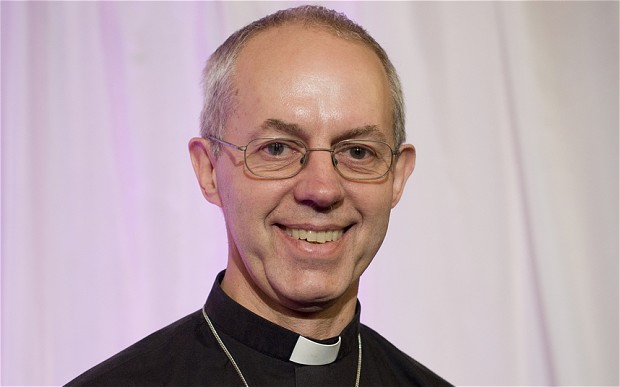
The True Fairy Tale of the Life of Justin Welby, Archbishop of Canterbury

By Anita Mathias

welby-justin_2503598b

He had been “the shyest, most unhappy-looking boy you could imagine,” –so journalist Charles Moore recollects Justin Welby, Archbishop of Canterbury, a fellow-student at Eton, and Trinity College, Cambridge.

The alcoholic father, who had custody of him was, The Telegraph had revealed, a conman, a trickster, and (to Welby’s surprise) German-Jewish, not upper-class English. His childhood was “utterly insecure”. Except when at school at Eton, he never spent more than a week at a place; there were “moonlight flits” to evade rent and creditors. His father did not pay the fees for Welby’s last two years at Eton, a feat in itself!!

And then, at Cambridge, something happened. The Spirit blew; there was a revival of sorts; Nicky Gumbel of Alpha, and Nicky Lee of HTB, both at Trinity, as well as three other Nickys (four of them Etonians!) became Christians. I asked Jesus to be the Lord of my life. The sense that something had changed was instantaneous, Welby said. It felt like the world changing, like someone I’d never known coming into the room and being there. He was “overwhelmed by a sense of God’s love for him,” as Andrew Atherstone writes in his unofficial biography of Welby.

The child of alcoholic parents, whose childhood was deeply insecure, becomes the spiritual leader of 85 million Anglicans.

An unlikely and wonderful true fairy tale.

* * *

And that is why we love fairy tales. Because, not infrequently, not infrequently, our lives and the lives of those we love resemble them. Because a kind author is crafting the story of our lives, “shaping our ends for good, rough hew them how we will.” Because Christianity is a true fairy tale, as Tolkein famously told C. S. Lewis, contributing to his conversion.

For the dark areas of one’s life to turn to the gold of fairy tales is an entirely reasonable expectation when we invite Jesus Christ to control these stuttering areas, ask for his instructions, and then do whatever he tells us.

A challenging marriage, a stalled career, a faltering business, ravaged health, impossible dreams–in the midst of all of these, it is completely rational to have great hope because of the power of God. Each of these can completely turn around once we invite Jesus to be the Lord of that area, and of our lives. He will suggest revisions to the current chapter, and inspire drafts of the next ones. The business, health and career may well turn around and ascend under the new divine management. Or they may crash… and a golden, unexpected next chapter may arise phoenix-like from the ashes.

* * *

Justin Welby changed so utterly that Moore meeting him 40 years later was amazed. Of course, The Telegraph recently revealed that Welby’s biological father was Anthony Montague Browne,   Churchill’s private secretary, who later worked for the Queen, and from whom he evidently received a genetic inheritance of solidity, good judgement and sound nerves. Inherited brain chemistry makes a psychopath or sociopath behave like one; but it can also be a beneficent inheritance, as it was for Welby.

But other factors contributed to the change in Welby that so astonished Moore…the Gospel, the Holy Spirit, dynamic teaching, his own disciplined follow-through, and, crucially, a circle of friends: Nicky Gumbel and the Eton-Oxbridge-Holy Trinity Brompton nexus that has a huge, hidden influence on the Church of England today. (Many influential figures such as Nicky Gumbel, John Stott, David Watson, Michael Green and Welby were converted or discipled by a man called E. J. H. Nash or Bash).

Serendipity or the grace of god… That is how Scott Peck in The Road Less Travelled explains people who have fruitful and creative lives despite distressing childhoods. In Welby’s case, it was both.

* * *

If anyone is in Christ, he is a new creation.

Our inheritance from our family–of intelligence, money, education and upbringing–may not be exactly what we would have chosen.

But once we accept Jesus as our Lord in medieval feudal language, we become part of Christ as he becomes part of us, and now have access to a new inheritance.

This differs from person to person. For some it’s an inheritance of this world, the sort that’s visible, valued and coveted–and for some it’s an inheritance “out of this world.”


Here are some blessings that are part of the inheritance of every children of God:

A friend, Jesus our brother, always walking beside us.

Access to Christ himself, “in whom are hid all the treasures of wisdom and knowledge.”

Guidance from Christ. Access to his wisdom when it comes to solving the problems of our life….whether mundane–how to get the money we need for the fullest, richest, most creative life–or spiritual (stuff which is the essence of life!)

The joy of the Holy Spirit, which resembles being drunk.

The power of the Holy Spirit to help us do difficult things.

Inspiration, though the infilling of the Holy Spirit.

Answered prayer.

The knowledge of the presence of God beside us, and the Holy Spirit within us.

Peace.

Protection from evil.

The promise of wisdom.

Happiness.

Serendipity; a connection-making God.

The forgiveness of our sins: wow!!

Eternal life.

* * *

Bid my brother divide the inheritance with me. The anguished cry of the man in the crowd echoes through the centuries. Inheritances, conniving to get them, families divided by the unfair division of them are a major theme of fiction, Victorian fiction, in particular—and of real life too!!

An inheritance is always a blessing in the Old Testament– “houses filled with all kinds of good things you did not provide, wells you did not dig, and vineyards and olive groves you did not plant.” The mark of a good man was that he would leave an inheritance for his children’s children.

But the spiritual inheritance of the children of God far trumps any worldly inheritance. Read the list again! Who would jeopardise such blessings? And this inheritance that is available to all who would claim it.

“I find who I am in Jesus Christ, not in genetics,” Justin Welby said, reflecting on his “story of redemption and hope from a place of tumultuous difficulty and near despair in several lives…a testimony to the grace and power of Christ to liberate and redeem us, grace and power which is offered to every human being.”

And that is our truest inheritance as Christians, the invitation to live in a true fairy tale of a deep change in our hearts and characters; answered prayer; the surprising, the exciting, the miraculous. A fairy tale with roles in it for anyone who would come play.


Filed Under: In Which I celebrate Church History and Great Christians, In which the Gospel is Good News Tagged With: Andrew Atherstone, Anthony Montague Browne, Archbishop of Canterbury, C. S. Lewis, Charles Moore Telegraph, Conversion, EJH Nash. Bash, Eton, genetic inheritances, Justin Welby, revival at Cambridge, spiritual inheritances, True Fairy Tales

On the Benefits of Writing Down Our Prayers

By Anita Mathias

writingWe are listening to A Praying Life by Paul Miller, a wonderful book on prayer in the car. (I was, incidentally disciplined by the author for almost five years, as he mentions in the book).

Anyway, Miller tells us that he often prays aloud. Jesus did so in his High Priestly Prayer in John 17, and his anguished prayers at Gethsemane. (However, Jesus also encourages us to pray in the privacy of our rooms so that our prayers don’t impress people (rather than God)…and thereby lose us the secret reward God gives those who pray.)

“Praying out loud can be helpful because it keeps you from getting lost in your head. It makes your thoughts concrete,” Miller writes. “When I confess a sin aloud, it feels more real. I’m surprised by how concrete the sin feels. I’ve even thought, ‘Oh I guess that was really wrong.’ On the way to a social event, I will pray aloud in the car that I won’t fall into lust or people pleasing. My prayers become more serious.”

* * *

However, when I find it hard to focus on prayer, what helps me is not praying out loud (I live with two daughters, one husband, one Golden Retriever, and one Labradoodle, and don’t want to startle any of them) but writing out my prayers.

When I pray my thoughts meander in the natural way of thoughts. Writing out my prayers helps me redirect my thoughts to the subject I was praying about so that I can saturate that worry in prayer, make sure I have heard God on it, and am acting in accordance with his directives. (This is particularly important for unanswered prayers so one senses the story God is writing in our lives).

I like to put my worries into the petri dish of prayer, so to say, bathing them in prayer, and continuing to “pray until something happens.” Written prayers help me “worry the bone of a prayer,” until light and clarity emerges as to what God might be doing in the things I am praying about, and what he wants me to do.

(Interestingly, though, Miller says prayer should be like human conversation between friends, meandering, free-flowing, playful. So if, in the middle of praying-worrying about how I am writing less than I want to, I start praying-worrying that I am exercising a bit less than I want to, and then that the room I am praying in is a tad messier than I want it to be…Miller would suggest praying about the latest worries that have popped up their groundhog heads instead of dragging prayer back to the first worry. Confess. Ask for help. Ask for strategy. And who knows? Perhaps the solution to the first worry—disappointing productivity–lies in the next two: not enough exercise, not enough tidying up!! Yes, indeed!)

* * *

The Circle Maker by Mark Batterson is another prayer-changing, hope-refilling book on prayer. Just as Jesus does, Batterson encourages us to pray about anything. Wild dreams, wild-goose dreams, dreams we are afraid to vocalize, dreams we can only keep alive because the Creator of the Universe can do and create anything… The dreams that we are embarrassed to say aloud, we can write down. And in the process of writing them down, they feel a little bit more real. “Dreaming is a form of prayer and prayer is a form of dreaming,” as Batterson says.

I have often found that wild-goose dreams I have prayed for have uncannily come to pass. In that way, our prayers can be prophetic, and, in the areas we have saturated in prayer, the transcript of our lives resembles the transcript of our prayers, to quote Batterson again.

* * *

We often don’t know our own hearts and minds and spirits. That is why people go to therapy!! Expressive writing is a form of therapy. So too is prayer journaling.

In the process of putting it down, in stark black and white, clarity comes about what I really want—which women socialized to be nice and obliging often don’t know!!

The actions and emotions of my own heart that I am less than proud about get unveiled and gradually repented of. The hurts and slights, the slings and arrows of interpersonal relationships which could metastasize into a cancer of unforgiveness if brooded over are released and forgiven…

Write out your confusion and lack of clarity. The areas of your life where you are not sure what God is doing, or the direction in which your life is veering. I often feel I know very little about my own life, the plot God is writing in and through it, the direction in which he is bending it, and what he wants me to do… Prayer helps me to understand the story that God is writing in my life a little better, and written prayer clarifies and focuses my heart-prayer.


I’m Recommending:

The Circle Maker: Praying Circles Around Your Biggest Dreams and Greatest Fears on Amazon.co.uk and on Amazon.com.

A Praying Life: Connecting with God in a Distracting World by Paul Miller on Amazon.co.uk and on Amazon.com.


Filed Under: In which I play in the fields of prayer Tagged With: A Praying Life, Expressive Writing, Mark Batterson, Paul Miller, Prayer, The CircleMaker, writing down our prayers

Sealed Orders

By Anita Mathias

51GJoiyI7UL._SX308_BO1,204,203,200_Sealed Orders
sealed-envelope

I am reading a memoir, Sealed Orders, by the American healer and mystic, Agnes Sanford. Interestingly, I’ve just read A Man Called Peter, by Catherine Marshall, her biography of her husband, Peter Marshall, who felt that he lived under “sealed orders.”
During wartime, commanding officers of ships, or squadrons operated under “sealed orders.” For security, and perhaps because the commander might have been tempted to disobey, he did not open them until he had reached a certain point in his journey.
I like the idea that we operate under “sealed orders.”
While God does give us a rough road map–I knew I was to be a writer, not a medical doctor, say–God does not tell us everything he is going to ask us to do….or ask of us in terms of suffering or challenge at the outset.
If so, we would find it overwhelming, or discouraging. We might never set out.
At each end of the road, at each turn of our journey, we receive “sealed orders” for that stretch of the road.

* * *

It is an exciting concept. God is never done with us. Into our fifties, sixties, seventies, eighties… there are new “sealed orders.” People to bless and influence; things to learn, and things to do and things to endure. Increased efficiency, increased skills, increased wisdom, and perhaps even, mastery of things we have long loved to do. And always the infinite depths and treasures of God to dive into, ever deeper. Always our puzzling, brilliant, invisible friend, Jesus Christ, to get to know better and better…

Filed Under: Applying my heart unto wisdom, In which I chase the wild goose of the Holy Spirit Tagged With: Agnes Sanford, Catherine Marshall, Growing up and growing older, guidance, Peter Marshall, Sealed Orders

Hope for Limping Christians. Changing your Character is both an Act of Will and an Act of Grace

By Anita Mathias

2101-colorful-caterpillar


Neuroscientist James Fallon was (interestingly!) studying the brains of murderous psychopaths, using brain scans of his family as a control group of the healthy. He suddenly noticed the unmistakable brain scan of a psychopath among his family’s scans. Puzzled, certain it has been misfiled, he has the technician break the code. The brain of the psychopath? It was his own.

 I found that I happened to have a series of genetic alleles, “warrior genes,” that had to do with serotonin and were thought to be at risk for aggression, violence, and low emotional and interpersonal empathy, Fallon writes.

Can someone whose brain chemistry predisposes them to aggression and low empathy ever change? Fallon decides to try.

“For myself, I decided to try to treat my wife and other loved ones with more care. Each time I’m about to interact with them, I pause for a moment and asked “what would a good person do here?” My wife started noticing this and after two months said “what has come over you?” When I told her that I was trying   against all odds, overcome my psychopathy, she said she appreciated the effort even though I was not sincere…

 Even though my wife, my sister, and my mother have always been close to me, I don’t treat them all that well. They said, “I give you everything. I give you all this love and you really don’t give it back.” They all said it, and that sure bothered me. So I wanted to see if I could change. I don’t believe it, but I’m going to try.

In order to do that, every time I started to do something, I had to think about it, look at it, and go: No. Don’t do the selfish thing or the self-serving thing. Step-by-step, that’s what I’ve been doing for about a year and a half and they all like it. Their basic response is: We know you don’t really mean it, but we still like it.

I told them, “You’ve got to be kidding me. You accept this? It’s phony!” And they said, “No, it’s okay. If you treat people better it means you care enough to try.”

What Fallon is doing is behaving like a Christian, playing the game of “Let’s Pretend,” which C. S. Lewis says is essential to developing the character of Jesus.

* * *

I was mentored by a Christian who taught himself to love. He writes about it in Love Walked Among Us.

I enjoy being cheap. The amount of money is not crucial—it just feels good to save. I am the same with efficiency. I’ve caught myself spending ten minutes figuring out how to do something more efficiently when the task only takes five minutes.

Paul watched his daughter Ashley play hard; she asked for a Coke at half-time. His reaction was “to point her to the free iced water for players. Cheap and efficient.

 “But then I put myself in Ashley’s shoes,” he continues. “She’s tired. She’s played a hard game, and she wants a soda, not a glass of water. I could do that. I have money in my pocket. I could spend that money.” I even stuck a hand in my pocket and felt my change. “I could walk over to the soda machine several hundred yards away and get a soda for Ashley. Paul, this won’t kill you.” This is truly what went through my mind. I envisoned how Ashley’s face would brighten when I handed her the soda.”

* * *

I find this helpful, this left-brain figuring out how to be kind and thoughtful. If I have said something biting, or am planning to say it, it helps me to ask myself how I would feel if that were said to me. If I am annoyed with someone, I try to imaginatively enter their world, and then, usually, I instantly have more empathy.

The core of following Christ, of being a Christian, is love—love for God, Father, Jesus and Spirit; love for our fellow humans.

And yet, unfairly, love is more difficult for some than for others. I am naturally friendly, warm, empathetic and affectionate, for warm relationships come easily to me. Agape love, on the other hand, does not come easily to me. Does it come easily to anyone? I don’t know.

Someone wrapped in love from childhood, with loving parents, supportive teachers, good friends, and a sunny temperament finds being kind and loving easier. Those who have experienced trauma in their nuclear family, at school, in marriage—for them, behaving like a follower of Christ is more difficult.

  • * * *

In a brilliant chapter, “Nice People or New Men,” in Mere Christianity, C. S. Lewis writes,

“If you have sound nerves and intelligence and health and popularity and a good upbringing, you are likely to be quite satisfied with your character as it is. A certain level of good conduct comes fairly easily to you. You are not one of those wretched creatures who are always being tripped up by sex, or dipsomania, or nervousness, or bad temper. Everyone says you are a nice chap and (between ourselves) you agree with them.

 It is very different for the nasty people, the little, low, timid, warped, thin-blooded, lonely people, or the passionate, sensual, unbalanced people. If they make any attempt at goodness at all, they learn, in double quick time, that they need help. It is Christ or nothing for them.

 But if you are a poor creature, poisoned by a wretched upbringing in some house full of vulgar jealousies and senseless quarrels, saddled, by no choice of your own, with some loathsome sexual perversion, nagged day in and day out by an inferiority complex that makes you snap at your best friends, do not despair.

 He knows all about it. You are one of the poor whom He blessed. He knows what a wretched machine you are trying to drive. Keep on. Do what you can. One day (perhaps in another world, but perhaps far sooner than that) he will fling it on the scrap-heap and give you a new one. And then you may astonish us all, not least yourself: for you have learned your driving in a hard school. (Some of the last will be first and some of the first will be last.)

 It is not like teaching a horse to jump better and better but like turning a horse into a winged creature. Of course, once it has got its wings, it will soar over fences which could never have been jumped and thus beat the natural horse at its own game. But there may be a period, while the wings are just beginning to grow, when it cannot do so: and at that stage the lumps on the shoulders, no one could tell by looking at them that they are going to be wings may even give it an awkward appearance.

* * *

 Some battles are fought where no banners are flying, They are fought within.

 When I was 17, I wanted to join Mother Teresa and become a nun. Not surprisingly, I struggled with the many and varied rules; in its minute control, the convent was a bit like a cult.

And so, each day, I failed, and when I did, I tearfully identified with this Jim Reeves song,


“The chimes of time ring out the news,

Another day is through.

Someone slipped and fell

Was that someone you?

Perhaps you longed for added strength

Your courage to renew

Do not be disheartened

I have news for you.


It is no secret,

What God can do,

What he’s done for others,

He’ll do for you.”

* * *

We do change. After a year of increasing physical exercise, I am so much more energetic that I often barely recognise myself. So too, spiritually and with our characters… After gradual exposure to the sunshine of God’s love, and to the tonic of God’s word, for years, for decades, we do change so that we barely recognise ourselves.

For some relative virtue comes easily. Others fight for gentleness, kindness, and equanimity.

But God sees; he knows.

A caterpillar may look at a hummingbird and envy her flight. Flight may seem impossible to the caterpillar, but one day, one day, after the trauma, darkness, and near-death of the chrysalis, she too shall fly.

Keep looking at Jesus, you who find following him difficult, keep holding his hand as you walk upon the waters; one day, perhaps sooner than you think, he shall take you to the heights.


 Books I’ve referred to

 The Psychopath Inside: A Neuroscientist’s Personal Journey into the Dark Side of the Brain on Amazon.com and on Amazon.co.uk

Love Walked Among Us on Amazon.com and on Amazon.co.uk

 Mere Christianity on Amazon.com and on Amazon.co.uk

You’ll find my account of working with Mother Teresa in Wandering Between Two Worlds, available on Amazon.com

and on Amazon.co.uk


Filed Under: In which I am Amazed by Grace, In which I explore Living as a Christian, In which I resolve to live by faith Tagged With: C.S. Lewis Mere Christianity, Character change, How people change, James Fallon, Love Walked Among Us, Metanoia and metamorphosis, Mother Teresa, Nice Men or New Men, Psychopaths

Leaving “A Little Juice”—One Secret of Persisting in Running, Writing, and Living Well

By Anita Mathias

Eric_Liddell (1)
                                                                                Eric Liddell: When I run, I feel his pleasure.


Haruki Murakami has a strange and wonderful book called “What I Talk about When I Talk about Running.” What he talks about when he talks about running is running, yes, but also writing hard, and living hard, and the art of success, and the freedom of discipline.

In a wonderful Japanese reflection on theodicy he says,

“When I think about it, having the kind of body that easily puts on weight is perhaps a blessing in disguise. In other words, if I don’t want to gain weight, I have to work out hard every day, watch what I eat, and cut down on indulgences. Eventually, your metabolism will greatly improve, and you’ll end up much healthier, not mention stronger. You can even slow down the effects of aging.

 People who naturally keep the weight off don’t need to exercise or watch their diet. Which is why, in many cases, their physical strength deteriorates as they age. If you don’t exercise, your muscles will weaken, as will your bones. Those of us who have a tendency to gain weight should consider ourselves lucky that the red light is so clearly visible. So this physical nuisance should be viewed as a blessing. Of course, it’s not always easy to see things this way.”

“Now, after years of running, my musculature has changed completely,” Murakami reports. He develops the body of a runner, which is apparently so distinctive that New Yorker writer Mark Singer tracked down a genius marathon cheat, Dr. Kip Litton, because he did not have “the classic lean and loose-limbed runner’s physique.”

(And yes, musculature does change, infinitesimally. I started my most recent running programme in January, and bought a body composition Tanita scale which reports that I am slowly gaining muscle, while losing another three pounds, bringing my cumulative weight loss to 25 pounds! I have much more to lose, yes, but yay for more muscle and a better metabolism which, like compound interest, gives back while you sleep.)

* * *

I have had many stabs at running, and have always loved it…but, ironically, my temperament has tripped me up. The standard training programmes recommend training every other day, but I enjoy it so much that I try to run every day, and then injure my feet, ankles or knees! Or develop colds and coughs. And then stop!

This time, in addition to using a high-quality rebounder, and doing some yoga, so as to get stronger and prevent injury, I am using a Couch to 5K programme with bouncy Christian music, and, far from charging ahead, am actually repeating workouts because I like the songs.

Also–which, oddly, I did not do before–I am recording my distance and speed daily, and trying to beat them, thus harnessing my natural competitiveness–against myself. This ensures I run fast enough to get a runner’s high, and have my brain flooded with the exhilaration of endorphins, serotonin, norepinephrine, and dopamine.

The other thing I am doing is not going too far, just under 3 miles. I think this will help me persevere in the long run. I had built up to 4.25 miles 3 years ago, but it was agony—feet, shins, thighs, every muscle in pain. This time, I am building up slowly, so I stick at it for life. I return from my run, and know I could just about do another half mile, but do not. I am leaving some juice in my body for tomorrow.

* * *

Hemingway recommended a similar pacing in one’s writing life. “The best way is always to stop when you are going good and when you know what will happen next. You write until you come to a place where you still have your juice. If you do that every day … you will never be stuck.”

Stopping when you still have juice, before exhaustion or boredom set in, not wringing out the last drop of blood from yourself or others, I am discovering that this is the key to persistence in all long-term disciplines, whether a lifetime of reading, or writing, or prayer, or Bible study, or running!

* * *

I was inspired by reading of Rev. E. H. W. Nash, called Bash, who led an extraordinarily fruitful life after symbolically handing over to Jesus the keys to every room in the house of his life.

So, over several days, I have been handing over the keys, seeking Jesus’s wisdom on my use of time, on my schedule.

I am a night person: I get going slowly, and do most of my reading and writing in the evenings. But is this genetics and internal unchangeable circadian rhythms–or well over thirty years of bad habits?

After much prayer, and some discussion with my spiritual direction about my schedule, I recently felt led by Jesus to stop writing at 9.30 p.m., a time of the evening when, being a night person, there is still a lot of juice left in me. But if I squeeze it all out, I will be up at 1:30 a.m., and wake late and tired, once again missing the beautiful sunrise God has made!! So I have started stopping writing and blogging at 9.30 p.m., which has become the magic hour when I make the Cinderella-switch from Human Doing to Human Being.

That suddenly opens time for other joyous trivial things that I might not have had time for… reading books, most of all; reading my favourite bloggers; sharing my favourite pictures on Instagram; scanning a few tweets. Tidying up a little. Doing some yoga. Maybe eventually weights. Tasting the joy of life. And I sleep better for the period of decompression.

Scripture describes human life as a race we should run to win, and perhaps a trick of living well is to leave a little juice–for the end of the day, for the end of our decades, and so to finish our days and our lives well.

To still be dancing, aged 106, when the evening comes.


Mentions

Haruki Murakami: What I Talk About When I Talk About Running on Amazon.com and on Amazon.co.uk.

Ernest Hemingway on Writing on Amazon.com and on Amazon.co.uk.

Bash: A Study in Spiritual Power on Amazon.co.uk

Filed Under: In which I celebrate discipline, random Tagged With: E HW Nash or Bash, Haruki Murakami, Hemingway, persistence, running, schedules, Tanita scales, The Hemingway hack, What I talk about when I talk about running

  • « Previous Page
  • 1
  • …
  • 8
  • 9
  • 10
  • 11
  • 12
  • …
  • 279
  • Next Page »

Sign Up and Get a Free eBook!

Sign up to be emailed my blog posts (one a week) and get the ebook of "Holy Ground," my account of working with Mother Teresa.

Join 536 Other Readers

My Books

Rosaries, Reading, Secrets: A Catholic Childhood in India

Rosaries, Reading Secrets, B&N
USA

UK

Wandering Between Two Worlds: Essays on Faith and Art

Wandering Between Two Worlds
USA

UK

Francesco, Artist of Florence: The Man Who Gave Too Much

Francesco, Artist of Florence
US

UK

The Story of Dirk Willems

The Story of Dirk Willems
US

UK

My Latest Meditation

Anita Mathias: About Me

Anita Mathias

Read my blog on Facebook

Follow me on Twitter

Follow @anitamathias1

Recent Posts

  • At the Cross, God Forgives Us, Completely
  • Using God’s Gift of Our Talents: A Path to Joy and Abundance
  • The Kingdom of God is Here Already, Yet Not Yet Here
  • All Those Who Exalt Themselves Will Be Humbled & the Humble Will Be Exalted
  • Christ’s Great Golden Triad to Guide Our Actions and Decisions
  • How Jesus Dealt With Hostility and Enemies
  • Do Not Be Afraid, but Do Be Prudent
  • For Scoundrels, Scallywags, and Rascals—Christ Came
  • How to Lead an Extremely Significant Life
  • Don’t Walk Away From Jesus, but if You Do, He Still Looks at You and Loves You
Premier Digital Awards 2015 - Finalist - Blogger of the year
Runner Up Christian Media Awards 2014 - Tweeter of the year

Categories

What I’m Reading


Wolf Hall
Hilary Mantel

Wolf Hall --  Amazon.com
Amazon.com

Amazon.co.uk

Silence and Honey Cakes:
The Wisdom Of The Desert
Rowan Williams

Silence and Honey Cakes --  Amazon.com
Amazon.com

Amazon.co.uk

The Long Loneliness:
The Autobiography of the Legendary Catholic Social Activist
Dorothy Day

The Long Loneliness --  Amazon.com
Amazon.com

Amazon.co.uk

Country Girl
Edna O'Brien

Country Girl  - Amazon.com
Amazon.com

Amazon.co.uk

Archive by month

My Latest Five Podcast Meditations

INSTAGRAM

anita.mathias

My memoir: Rosaries, Reading, Secrets https://amzn.to/42xgL9t
Oxford, England. Writer, memoirist, podcaster, blogger, Biblical meditation teacher, mum

Well, hello friends! Breaking radio silence to let Well, hello friends! Breaking radio silence to let you know that I have taped a meditation for you on Christ’s famous Parable of the Talents in Matthew 25. https://anitamathias.com/2025/11/05/using-gods-gift-of-our-talents-a-path-to-joy-and-abundance/
Here you are, click the play button in the blog post for a brief meditation, and some moments of peace, and, perhaps, inspiration in your day 🙂
Hi Friends, I have taped a meditation; do listen a Hi Friends, I have taped a meditation; do listen at this link: https://anitamathias.com/2025/04/08/the-kingdom-of-god-is-here-already-yet-not-yet-here-2/
It’s on the Kingdom of God, of which Christ so often spoke, which is here already—a mysterious, shimmering internal palace in which, in lightning flashes, we experience peace and joy, and yet, of course, not yet fully here. We sense the rainbowed presence of Christ in the song which pulses through creation. Christ strolls into our rooms with his wisdom and guidance, and things change. Our prayers are answered; we are healed; our hearts are strangely warmed. Sometimes.
And yet, we also experience evil within & all around us. Our own sin which can shatter our peace and the trajectory of our lives. And the sins of the world—its greed, dishonesty and environmental destruction.
But in this broken world, we still experience the glory of creation; “coincidences” which accelerate once we start praying, and shalom which envelops us like sudden sunshine. The portals into this Kingdom include repentance, gratitude, meditative breathing, and absolute surrender.
The Kingdom of God is here already. We can experience its beauty, peace and joy today through the presence of the Holy Spirit. But yet, since, in the Apostle Paul’s words, we do not struggle only “against flesh and blood, but against the rulers, against the unseen powers of this dark world and against the spiritual forces of evil,” its fullness still lingers…
Our daughter Zoe was ordained into the Church of E Our daughter Zoe was ordained into the Church of England in June. I have been on a social media break… but … better late than never. Enjoy!
First picture has my sister, Shalini, who kindly flew in from the US. Our lovely cousins Anthony and Sarah flank Zoe in the next picture.
The Bishop of London, Sarah Mullaly, ordained Zoe. You can see her praying that Zoe will be filled with the Holy Spirit!!
And here’s a meditation I’ve recorded, which you might enjoy. The link is also in my profile
https://anitamathias.com/2024/11/07/all-those-who-exalt-themselves-will-be-humbled-the-humble-will-be-exalted/
I have taped a meditation on Jesus statement in Ma I have taped a meditation on Jesus statement in Matthew 23, “For those who exalt themselves will be humbled, and those who humble themselves will be exalted.”
Do listen here. https://anitamathias.com/2024/11/07/all-those-who-exalt-themselves-will-be-humbled-the-humble-will-be-exalted/
Link also in bio.
And so, Jesus states a law of life. Those who broadcast their amazingness will be humbled, since God dislikes—scorns that, as much as people do.  For to trumpet our success, wealth, brilliance, giftedness or popularity is to get distracted from our life’s purpose into worthless activity. Those who love power, who are sure they know best, and who must be the best, will eventually be humbled by God and life. For their focus has shifted from loving God, doing good work, and being a blessing to their family, friends, and the world towards impressing others, being enviable, perhaps famous. These things are houses built on sand, which will crumble when hammered by the waves of old age, infirmity or adversity. 
God resists the proud, Scripture tells us—those who crave the admiration and power which is His alone. So how do we resist pride? We slow down, so that we realise (and repent) when sheer pride sparks our allergies to people, our enmities, our determination to have our own way, or our grandiose ego-driven goals, and ambitions. Once we stop chasing limelight, a great quietness steals over our lives. We no longer need the drug of continual achievement, or to share images of glittering travel, parties, prizes or friends. We just enjoy them quietly. My life is for itself & not for a spectacle, Emerson wrote. And, as Jesus advises, we quit sharp-elbowing ourselves to sit with the shiniest people, but are content to hang out with ordinary people; and then, as Jesus said, we will inevitably, eventually, be summoned higher to the sparkling conversation we craved. 
One day, every knee will bow before the gentle lamb who was slain, now seated on the throne. We will all be silent before him. Let us live gently then, our eyes on Christ, continually asking for his power, his Spirit, and his direction, moving, dancing, in the direction that we sense him move.
Link to new podcast in Bio https://anitamathias.co Link to new podcast in Bio https://anitamathias.com/2024/02/20/how-jesus-dealt-with-hostility-and-enemies/
3 days before his death, Jesus rampages through the commercialised temple, overturning the tables of moneychangers. Who gave you the authority to do these things? his outraged adversaries ask. And Jesus shows us how to answer hostile questions. Slow down. Breathe. Quick arrow prayers!
Your enemies have no power over your life that your Father has not permitted them. Ask your Father for wisdom, remembering: Questions do not need to be answered. Are these questioners worthy of the treasures of your heart? Or would that be feeding pearls to hungry pigs, who might instead devour you?
Questions can contain pitfalls, traps, nooses. Jesus directly answered just three of the 183 questions he was asked, refusing to answer some; answering others with a good question.
But how do we get the inner calm and wisdom to recognise
and sidestep entrapping questions? Long before the day of
testing, practice slow, easy breathing, and tune in to the frequency of the Father. There’s no record of Jesus running, rushing, getting stressed, or lacking peace. He never spoke on his own, he told us, without checking in with the Father. So, no foolish, ill-judged statements. Breathing in the wisdom of the Father beside and within him, he, unintimidated, traps the trappers.
Wisdom begins with training ourselves to slow down and ask
the Father for guidance. Then our calm minds, made perceptive, will help us recognise danger and trick questions, even those coated in flattery, and sidestep them or refuse to answer.
We practice tuning in to heavenly wisdom by practising–asking God questions, and then listening for his answers about the best way to do simple things…organise a home or write. Then, we build upwards, asking for wisdom in more complex things.
Listening for the voice of God before we speak, and asking for a filling of the Spirit, which Jesus calls streams of living water within us, will give us wisdom to know what to say, which, frequently, is nothing at all. It will quieten us with the silence of God, which sings through the world, through sun and stars, sky and flowers.
Especially for @ samheckt Some very imperfect pi Especially for @ samheckt 
Some very imperfect pictures of my labradoodle Merry, and golden retriever Pippi.
And since, I’m on social media, if you are the meditating type, here’s a scriptural meditation on not being afraid, while being prudent. https://anitamathias.com/2024/01/03/do-not-be-afraid-but-do-be-prudent/
A new podcast. Link in bio https://anitamathias.c A new podcast. Link in bio
https://anitamathias.com/2024/01/03/do-not-be-afraid-but-do-be-prudent/
Do Not Be Afraid, but Do Be Prudent
“Do not be afraid,” a dream-angel tells Joseph, to marry Mary, who’s pregnant, though a virgin, for in our magical, God-invaded world, the Spirit has placed God in her. Call the baby Jesus, or The Lord saves, for he will drag people free from the chokehold of their sins.
And Joseph is not afraid. And the angel was right, for a star rose, signalling a new King of the Jews. Astrologers followed it, threatening King Herod, whose chief priests recounted Micah’s 600-year-old prophecy: the Messiah would be born in Bethlehem, as Jesus had just been, while his parents from Nazareth registered for Augustus Caesar’s census of the entire Roman world. 
The Magi worshipped the baby, offering gold. And shepherds came, told by an angel of joy: that the Messiah, a saviour from all that oppresses, had just been born.
Then, suddenly, the dream-angel warned: Flee with the child to Egypt. For Herod plans to kill this baby, forever-King.
Do not be afraid, but still flee? Become a refugee? But lightning-bolt coincidences verified the angel’s first words: The magi with gold for the flight. Shepherds
telling of angels singing of coming inner peace. Joseph flees.
What’s the difference between fear and prudence? Fear is being frozen or panicked by imaginary what-ifs. It tenses our bodies; strains health, sleep and relationships; makes us stingy with ourselves & others; leads to overwork, & time wasted doing pointless things for fear of people’s opinions.
Prudence is wisdom-using our experience & spiritual discernment as we battle the demonic forces of this dark world, in Paul’s phrase.It’s fighting with divinely powerful weapons: truth, righteousness, faith, Scripture & prayer, while surrendering our thoughts to Christ. 
So let’s act prudently, wisely & bravely, silencing fear, while remaining alert to God’s guidance, delivered through inner peace or intuitions of danger and wrongness, our spiritual senses tuned to the Spirit’s “No,” his “Slow,” his “Go,” as cautious as a serpent, protected, while being as gentle as a lamb among wolves.
Link to post with podcast link in Bio or https://a Link to post with podcast link in Bio or https://anitamathias.com/2023/09/22/dont-walk-away-from-jesus-but-if-you-do-he-still-looks-at-you-and-loves-you/
Jesus came from a Kingdom of voluntary gentleness, in which
Christ, the Lion of Judah, stands at the centre of the throne in the guise of a lamb, looking as if it had been slain. No wonder his disciples struggled with his counter-cultural values. Oh, and we too!
The mother of the Apostles James and John, asks Jesus for a favour—that once He became King, her sons got the most important, prestigious seats at court, on his right and left. And the other ten, who would have liked the fame, glory, power,limelight and honour themselves are indignant and threatened.
Oh-oh, Jesus says. Who gets five talents, who gets one,
who gets great wealth and success, who doesn’t–that the
Father controls. Don’t waste your one precious and fleeting
life seeking to lord it over others or boss them around.
But, in his wry kindness, he offers the ambitious twelve
and us something better than the second or third place.
He tells us how to actually be the most important person to
others at work, in our friend group, social circle, or church:Use your talents, gifts, and energy to bless others.
And we instinctively know Jesus is right. The greatest people in our lives are the kind people who invested in us, guided us and whose wise, radiant words are engraved on our hearts.
Wanting to sit with the cleverest, most successful, most famous people is the path of restlessness and discontent. The competition is vast. But seek to see people, to listen intently, to be kind, to empathise, and doors fling wide open for you, you rare thing!
The greatest person is the one who serves, Jesus says. Serves by using the one, two, or five talents God has given us to bless others, by finding a place where our deep gladness and the world’s deep hunger meet. By writing which is a blessing, hospitality, walking with a sad friend, tidying a house.
And that is the only greatness worth having. That you yourself,your life and your work are a blessing to others. That the love and wisdom God pours into you lives in people’s hearts and minds, a blessing
https://anitamathias.com/.../dont-walk-away-from-j https://anitamathias.com/.../dont-walk-away-from-jesus.../
Sharing this podcast I recorded last week. LINK IN BIO
So Jesus makes a beautiful offer to the earnest, moral young man who came to him, seeking a spiritual life. Remarkably, the young man claims that he has kept all the commandments from his youth, including the command to love one’s neighbour as oneself, a statement Jesus does not challenge.
The challenge Jesus does offers him, however, the man cannot accept—to sell his vast possessions, give the money to the poor, and follow Jesus encumbered.
He leaves, grieving, and Jesus looks at him, loves him, and famously observes that it’s easier for a camel to squeeze through the eye of a needle than for a rich person to live in the world of wonders which is living under Christ’s kingship, guidance and protection. 
He reassures his dismayed disciples, however, that with God even the treasure-burdened can squeeze into God’s kingdom, “for with God, all things are possible.”
Following him would quite literally mean walking into a world of daily wonders, and immensely rich conversation, walking through Israel, Lebanon, Syria, and Jordan, quite impossible to do with suitcases and backpacks laden with treasure. 
For what would we reject God’s specific, internally heard whisper or directive, a micro-call? That is the idol which currently grips and possesses us. 
Not all of us have great riches, nor is money everyone’s greatest temptation—it can be success, fame, universal esteem, you name it…
But, since with God all things are possible, even those who waver in their pursuit of God can still experience him in fits and snatches, find our spirits singing on a walk or during worship in church, or find our hearts strangely warmed by Scripture, and, sometimes, even “see” Christ stand before us. 
For Christ looks at us, Christ loves us, and says, “With God, all things are possible,” even we, the flawed, entering his beautiful Kingdom.
Follow on Instagram

© 2026 Dreaming Beneath the Spires · All Rights Reserved. · Cookie Policy · Privacy Policy