Anita Mathias: Dreaming Beneath the Spires

Anita Mathias's Blog on Faith and Art

  • Home
  • My Books
  • Meditations
  • Essays
  • Contact
  • About Me

Keeping our Small Boat Afloat: Thoughts on Redemption, Giving up Regret, and my Thirty Year Marriage

By Anita Mathias

Our wedding portrait, 30 years ago

I love this verbally rich “worship song” from the young song-writer John Mark Macmillan

He is jealous for me.

Love’s like a hurricane, and I am a tree

Bending beneath the weight of his wind and mercy.

 I don’t have time to maintain these regrets,

When I think about the way,

He loves us.

I love the whole song… different phrases at different times. Today, it’s the phrase, I don’t have time to maintain these regrets…

Like most people, I have regrets… mistakes I’ve made through accepting bad advice, through lack of self-confidence, through sinful or foolish choices, distraction, self-indulgence, anger, not putting first things first… the list could go on.

* * *

Roy and I at Christ Church, Oxford where Irene is doing Medicine. Between Auden and Lewis Carrol!

In Tennyson’s poem “Morte D’Arthur,” Arthur’s beloved Queen Guinevre has an affair with his beloved best friend, Launcelot, and Arthur, loving both, is silent. The adulterous lovers are caught in flagrante delicto by his nephew, Mordred, and there is civil war at the end of which Arthur lays dying.

Tennyson has him say,

                      I have lived my life, and that which I have done

       May He within Himself make pure.

That’s a prayer I often find myself praying, putting all I have done into God’s hands, the beautiful and the ugly, the wise and the foolish, and asking him to bring something beautiful out of even my mistakes and sins. Asking him to redeem them, and miraculously transform them.

For what is planted, after a period underground, inevitably emerges as something different, the undistinguished sunflower seed as glorious sunflowers–so redeem it all, Lord, the folly, the laziness, the wasted time, the wasted years, and because of your great mercy, bring something immeasurably different and far more beautiful from these grubby seeds, that I may go out with a vast “thank you.”

“I think that the dying pray at the last not “please”, but “thank you”, as a guest thanks his host at the door. Falling from airplanes the people are crying thank you, thank you, all down the air.” Annie Dillard.

* * *
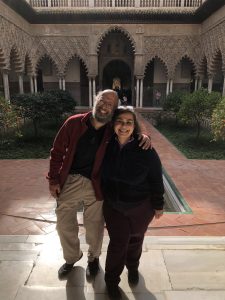
At the Alcazar, Seville, last month

Later this year, I will have been married to Roy for thirty years. Thirty years!! Apparently, only 49 percent of marriages in this country reach this milestone, either through divorce or death, so, God willing, we will be in the happy minority.

The New Yorker writer Tessa Hadley describes long marriages this way: you hold onto your lover through the years, and he changes: a fairy, a dragon, a lion, a beloved man. That is the seminal truth of fairy tales: “What is essential is invisible to the eye, it is only with the heart that one sees rightly,” Saint-Exupery has his  The Little Prince say. Hold on, long enough, and the Beast turns beautiful; the Frog reveals his nobility; Cinderella the Ash-girl, turns regal; Sleeping Beauty comes alive….

* * *

Me, 30 years later!

However, the upcoming anniversary has put me into a reflective mood. I often say, “I wish I had prioritised you more, I wish I had put you first,” and Roy says, “Don’t say sorry; I’m sorry too, but we may have another 30 years, or 40, or more…”

And then I think of redemption. This story runs through scripture: People muck things up, and God redeems them. God not only makes something beautiful out of them, but something more beautiful than things were before the mess, dropped rose or apple seeds blossoming into thousands of roses or apples for decades.

So too in relationships, we sin against each other…inevitably given human selfishness and frailty; we repent, we ask forgiveness, we come together again, and the latter state of our relationship and marriage is stronger than it would have been if we had never blown it, lost our tempers, repented, and come together again to try again to build a relationship built on love and care, and looking out for each other, and trying to put each other first.

Difficult ideals… and undoubtedly, we will again fail, repent, apologise, come together, try again, our marriage under God growing greener, blooming brighter, a sanctuary for ourselves, our children, our old friends, and the new ones God brings our way, like

“a shelter from the wind
 and a refuge from the storm,
like streams of water in the desert
and the shadow of a great rock in a thirsty land.”
(Isaiah 32:2)

* * *

I’m sorry/I forgive you by Libyan artist Arwa Abouon

On our honeymoon, way back in 1989, we took a cruise in a glass-bottomed boat in Florida, through coral reefs. There was an elderly German couple with us, every bit as touchy-feely, and full of lavish public displays of affection. So I, curious, then and now, quite illogically, sweetly asked them, “Are you on your honeymoon too?” “Mein Gott, nein, nein, nein,” the man said. “We’ve been married for forty years!” And then he added kindly, “May you two be as affectionate as you now are when you’ve been married for forty years!” It was a blessing. May it be so. Amen.

I’m sorry/I forgive you by Arwa Abouon

In conclusion, a little, lovely bitter-sweet poem from Robert Bly


KEEPING OUR SMALL BOAT AFLOAT

So many blessings have been given to us
During the first distribution of light, that we are
Admired in a thousand galaxies.

Don’t expect us to appreciate creation or to
Avoid mistakes. Each of us is a latecomer
To the earth, picking up wood for the fire.

Every night another beam of light slips out
From the oyster’s closed eye. So don’t give up hope
that the door of mercy may still be open.

It’s hard to grasp how much generosity
Is involved in letting us go on breathing,
When we contribute nothing valuable.

Each of us deserves to be forgiven, if only for
Our persistence in keeping our small boat afloat
When so many have gone down in the storm.


Books I’ve mentioned which you might enjoy

If you’d like to fine-tune your marriage with insights from neuroscience, try Dr. Sue Johnson’s The Love Secret on Amazon.co.uk or Amazon.com

or her book Hold Me Tight on Amazon.co.uk on Amazon.com .

Annie Dillard’s wonderful, powerful and poetic Pilgrim at Tinker Creek at Amazon.co.uk and Amazon.com

The title poem is from Robert Bly’s enjoyable collection Talking into the Ear of a Donkey on Amazon.co.uk and on Amazon.com

How He Loves by John Mark McMillan on Amazon.co.uk and Amazon.com

Tessa Hadley’s book on long marriages: Late in the Day, on Amazon.co.uk and on Amazon.com

Tennyson’s “Morte D’Arthur” on Amazon.co.uk and Amazon.com

The Little Prince on Amazon.com and on Amazon.co.uk


Filed Under: marriage, There is nothing but love Tagged With: Annie Dillard, EFT, forgiveness, giving up regrets, grace, Happiness, John Mark McMillan, marriage, redemption, Robert Bly, Tennyson, Tessa Hadley, The Little Prince, wedding anniversary

Biggest Losers, Grace, and Silver Linings

By Anita Mathias

hs-2010-13-a-640_wallpaper

I read the New York Times’ distressing account of The Biggest Loser show.

Because of their rapid weight loss, the participants’ metabolisms dramatically slowed down, as happens with any diet. Researchers discovered that, six years on, the metabolism of the contestants continued slowing down, and they continued gaining weight disproportionate to their calorie intake, their bodies intensifying efforts to keep them at their highest weight. “The body will fight back for years,” against dramatic weight loss, the researchers discovered.

Following post-diet weight loss, leptin and four other hormones which signal satiety vanish almost completely so one feels ravenous all the time. Similarly, levels of ghrelin, which signal hunger, shoot up.

Becoming overweight is a kind of vicious circle. The more foods you eat that give you a dopamine rush—sugar, chocolate, cakes, cookies, the less sensitive the dopamine receptors in the brain become. Some actually die, according to an amazing book I am reading Spark: The Revolutionary New Science of Exercise and the Brain by Harvard psychiatrist John Ratey.

“It’s like hearing you have a life sentence,” said worship leader, Sean Algaier, who entered the show at 444 pounds, got down to 289 and is now 450.

* * *

 Yup, a life sentence indeed, but a life-sentence to what?

A life sentence to long walks, so that your mobility is never as affected as that of Danny Cahill, the biggest loser of all time on the show, who was 485 pounds. “He began sleeping in a recliner because he was too heavy to sleep lying down. Walking hurt; stairs were agony.” That is no life!

 Working on reasonable fitness is a life sentence to the glory and ecstasy of nature in spring, in summer, in autumn and winter. A life sentence to walks in parks, forests, fells, mountains and by the sea.

A life sentence to discovering forms of exercise which are fun so as to prevent further weight gain, and, perhaps, (inevitably?) to lose some weight. Yoga? Hiking? Running? Weight-lifting? Walking listening to books like David Sedaris, who began walking 25 miles a day, 60,000 steps, which took 9 hours. He listened to audiobooks and podcasts as he did so, which would mean getting through a book a day most days. Not a bad use of time, if you have it, for saturation reading is the quickest way to improve as a writer, and, of course, has its own joys.

A life sentence to meals rich in nutrient dense fruits and vegetables. A life sentence to restricted sugar, chocolate, white flour (and in my case, as a colon cancer survivor, red meat)—addictive stuff which does not bless the body. A life sentence of discovering ethnic foods which are fruit, vegetable, lentil and bean based. A life sentence to learning to eat in a way that blesses your body. Not too bad is it?

A life sentence to having to learn to practice discipline, though you may fail often.

The goodness of God remains constant whether you have an illness which is random or genetic, like MS or MND/ALS or illnesses caused by your own actions as well as by your genes, like obesity or alcoholism. There is grace—silver linings in every cloud.

* * *

We are actors in a great, great story. We do not get to choose our roles. We do not get to choose the plot of the story.

It is our job to act in the story as well as we can, as cheerfully as we can. To see the silver lining in the blackest cloud.

Obesity is not really a completely incurable disease, any more than cancer is. (And anyway, most diseases are not incurable because there is a powerful God who flung the stars into space). I lost 25 pounds in late 2012 after beginning to cut back on sugar and floor and eat more fruit and vegetables, most of which has remained off, though I have more to lose, of course, of course).

Of course, becoming fit and strong is going to be a challenge for me, for life. Challenges may not make our hearts leap with joy, but they make life worth living. Those of us with health problems have a difficult road–a road of humility as we come to terms with our weaknesses; a road of learning discipline, better late than never; a road of dependence as we realise that constant prayer for grace is one way out of the maze.

Yes, our weaknesses may even teach us to pray constantly, which is something well worth learning, even if it takes struggle to learn it.

Filed Under: In which I get serious about health and diet and fitness and exercise (really) Tagged With: Biggest Loser, david sedaris, diets, exercise, fitness, ghrelin, grace, health, John Ratey, leptin, obesity, Spark: The Revolutionary New Science of Exercise and the Brain

In Which–Fortunately–Our Progress in the Spiritual Life Is Dependent on Grace and the Spirit, Not Our Hard Work

By Anita Mathias


jesus-walking-on-water-benjamin-mcpherson


I often think of this sermon illustration from my time in Williamsburg, VA: You cannot knock on the door of Buckingham Palace, or the White House and enter. You need an invitation, or you will be firmly ushered out (at best!).

God, creator of the cosmos, 70 thousand million million million (70 sextillion) stars in 100 thousand million (100 billion) galaxies is an ontologically different being. As high as the heavens are above the earth is He above us.

If we are to dialogue with him, person to Being, he must take the initiative, enlarge our spiritual senses, and provide revelation. He must lean down to us, condescend to us. Our spiritual adventure with him begins through his grace, and continues through his grace.

* * *

I am tired. It’s a time when spiritual disciplines–my prayer, my Bible Study, my spiritual reading–slip. It helps then to remember that just as I cannot jump to the moon, I cannot hustle my way into intimacy with God. I depend on his mercy to know him.

The spiritual life was never about me scaling the Tower of Babel, reaching up to God by my Bible Study, my prayer, my giving, my fasting, the intensity and teeth-grittedness of my disciplines.

It was always about his father-heart reaching out to me in kindness and in mercy.

I sometimes worry that my spiritual life is growing anaemic—more spiritual blogging than Bible study, more worrying and thinking than prayer.

And then I remember that heck, my spiritual life is not the product of my discipline. Faith is a gift from the God who is looking out for me.

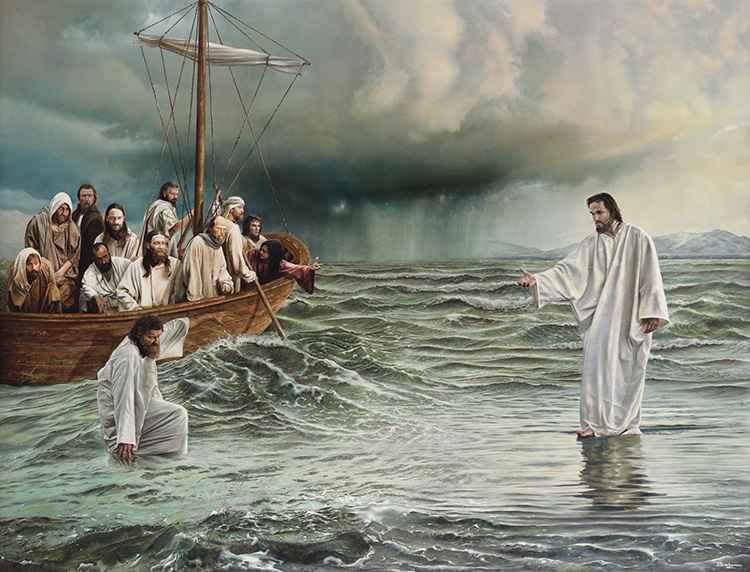
The spiritual life is always about God looking out for the lost sheep, the father on the battlements looking for the prodigal son, Jesus reaching out to me when I look at the wind and waves instead of him–and fear rises, and faith flickers, and I sink beneath the waves.

He reached out to me and gave me the grace to become a Christian. I will trust that outstretched hand for grace to continue, walking on the waters, dancing on the waters, hand in hand with him.

  • * * *

Besides, besides, in just a moment, one’s entire spiritual life can be transformed.

D. L. Moody writes, “I was crying all the time that God would fill me with His Spirit. Well, one day, in the city of New York — oh, what a day! — I cannot describe it, I seldom refer to it; it is almost too sacred an experience to name. Paul had an experience of which he never spoke for fourteen years. I can only say that God revealed Himself to me, and I had such an experience of His love that I had to ask Him to stay His hand. I went to preaching again. The sermons were not different; I did not present any new truths; and yet hundreds were converted. I would not now be placed back where I was before that blessed experience if you should give me all the world.”

Moody’s ministry was transformed in a minute though the filling of the Holy Spirit, though God graciousness.

The spiritual life is not a matter of our striving. It is a matter of waiting with outstretched hands for the power from on high.


Filed Under: In which I am Amazed by Grace Tagged With: grace, The spiritual life

In which Imaginative Literature Stirs the Heart to Conversion (A Guest Post by Holly Ordway)

By Anita Mathias

I am honoured to welcome Dr. Holly Ordway to my blog today.

Displaying NGT in shelf1.JPG

In which Imaginative Literature Stirs the Heart to Conversion

How could a fierce atheist enter into Christian faith? There are many ways for God’s grace to work; my own story is one that highlights the importance of imaginative literature!

When I was firmly an atheist, I dismissed Christianity as superstitious nonsense, and I simply would not have listened to the arguments that ultimately convinced me that the Christian claim is objectively true. Apologetics arguments were (eventually) vitally important, but as I reflected and wrote about my journey, I recognized the importance of imagination as both the catalyst and the foundation of my rational exploration of the faith.

How did that happen?

Let me give you a little glimpse from my memoir of conversion, Not God’s Type: An Atheist Academic Lays Down Her Arms.

From my childhood:

Long before I gave any thought about whether Christianity was true, and long before I considered questions of faith and practice, my imagination was being fed Christianly. I delighted in the stories of King Arthur’s knights and the quest for the Holy Grail, without knowing that the Grail was the cup from the Last Supper. I had no idea that the Chronicles of Narnia had anything to do with Jesus, but images from the stories stuck with me, as bright and vivid in my memory as if I had caught sight of a real landscape, had a real encounter, with more significance than I could quite grasp.

And at some point in my childhood, I found J.R.R. Tolkien’s The Hobbit and The Lord of the Rings, and that changed everything. Not suddenly. Not even immediately. But slowly, surely. Like light from an invisible lamp, God’s grace was beginning to shine out from Tolkien’s works, illuminating my Godless imagination with a Christian vision.

I don’t remember reading The Lord of the Rings and The Hobbit for the first time, only re-reading them again and again… Middle Earth was a world in which there is darkness, but also real light, a light that shines in the darkness and is not extinguished: Galadriel’s light, and the light of the star that Sam sees break through the clouds in Mordor, and the ray of sun that falls on the flower-crowned head of the king’s broken statue at the crossroads… I didn’t know, then, that my imagination had been, as it were, baptized in Middle Earth. But something took root in my reading of Tolkien that would flower many years later.

From my time at college:

The bumper-sticker expressions of Christian affirmation – “I’m not perfect, just forgiven!” “God is my co-pilot!” – and the kitsch art that I saw – a blue-eyed Jesus in drapey robes (polyester?) comforting some repentant hipster, or cuddling impossibly adorable children (none crying or distracted), presented faith as a kind of pious flag-waving. No thanks!

I didn’t know then how to say it, but I was looking for the cosmic Christ, the one by whom all things were made, the risen and glorified Jesus at the right hand of the Father.

The Catholic poet Gerard Manley Hopkins got past my allergic reaction to kitsch because it flowed naturally out of what he saw in the world.

Where his poetry was sweet, it had the sweetness of a perfectly ripe strawberry, or of the very best chocolate, creamy and rich – not the chemical sweetness of a low-fat sugar-free pudding with non-dairy whipped topping.

Where his poetry was bitter, it was bitter with the taste of real misery, the kind that fills up your awareness, squeezes out the memory of better times and draws a blank on tomorrow and tomorrow and tomorrow – not the faux-sadness of “Jesus died for you!” (so cheer up and get with the program already), the faux-compassion that can’t bear to look at a crucifix (so morbid).

Somehow for Hopkins the sweet and the bitter were not opposed; they were part of the same experience of being in the world, and undergirding all of it was something I didn’t understand at all, never having experienced it or known anyone who had: the reality of God, not as an abstract moral figure or as a name dropped to show off one’s piety, but a dynamic awareness of being in relationship with the Trinitarian God, an experienced reality bigger by far than the words used to point to it.

Years later, struggling with questions of meaning, wrestling with despair, I re-read Hopkins. I had no conscious desire to find God; I thought I knew that He did not exist. And yet something was at work in me, just as Hopkins wrote in “The Windhover”: “My heart in hiding / Stirred for a bird. . .” My heart stirred – for what? For something beyond my experience.

Poetry had done its work. I was ready to listen.

Ordway photo

Holly Ordway is Professor of English and Director of the MA in Cultural Apologetics at Houston Baptist University, and the author of Not God’s Type: An Atheist Academic Lays Down Her Arms (Ignatius Press, 2014). She holds a PhD in English literature from the University of Massachusetts Amherst; her academic work focuses on imagination in apologetics, with special attention to the writings of C.S. Lewis, J.R.R. Tolkien, and Charles Williams.

Filed Under: In which I celebrate books and film and art, In which I play in the fields of poetry, In which I proudly introduce my guest posters Tagged With: Apologetics, Conversion narratives, Gerard Manley Hopkins, grace, Holly Ordway, King Arthur, Lewis, Not God's Type, Poetry, Tolkein

When We are Caterpillars in a Ring of Fire, and Need Rescue from Above

By Anita Mathias

Image Credit

I read a striking essay this week.

Two women counsellors listened to my story. I was prayed for very gently. I was encouraged to forgive all the people I felt had done me real or imaginary hurts throughout my life. It took a long time.  Eventually, I came to the last thing, and I couldn’t make a sound. I struggled for words, but they would not come out.  The only way I can describe it is to say it was like labour contractions in the chest, not the stomach.  I struggled to control my breathing, and eventually gasped out, “I forgive.”

 The most amazing inner change occurred instantly. I have never experienced anything like it before or since.  I was aware that a huge burden had been lifted. I realized that forgiveness has its own dynamic…

 Wow! I emailed the author, asking for suggestions of books on inner healing through forgiveness.

But even before the reply arrived, I said to my soul, “Be still. Oh come on, Anita. It’s the end of a long academic year. Where are you going to summon up the energy for inner healing, counsellors, reading one more heavy book?”

* * *

 I was wondering aloud to my husband Roy about why I have a whole lot less energy this month than when I started blogging four years ago.

And then I looked back at the last 12 months. A retreat alone at the Harnhill Centre in Gloucestershire this week last June; a family camper van trip to France, Switzerland and Italy in August, walking in Tuscany with Roy on a pilgrimage with Kim and Penelope Swithinbank in September; a week in a cottage in Cornwall with Roy and Irene in October; a week in Sicily over December with Roy and Irene; a week in the Loire Valley, France, with the family in February, (and returning to find we’d been burgled),  a week in Cambodia with Tearfund in March, a week in Spain on retreat in May (just me).

Whoa! T.S. Eliot has this phrase, “Distracted from distraction by distraction.” I have a horror of living like that. Whereas normally travel increases my mental and emotional energy and my productivity, this year—not so. It has decreased it! Over the last ten years, we’ve evolved a rhythm of working hard for six weeks during the girls’ school term, then travelling over the term breaks and coming back full of bounce. This year, however, had Tuscany, Cambodia, Spain and Cirencester breaks during term which were one-offs (I think!) and too much.

I am going to Helsinki next month, and am not up to any extraordinary spiritual or actual effort until then.

* * *

 Martin Luther and his great friend and fellow renaissance reformer Philip Melanchthon had a debate on the nature of grace. Melanchthon says grace is like one parent helping a wobbly toddler across the room to the other parent.

Luther says ‘No!  We are caterpillars in a ring of fire. Our only hope is that someone from above will rescue us.’

When I am tired, that’s the kind of  grace I need.  No more DIY spirituality. Just help me, Lord!

* * *

 Who, oh Lord could save themselves, their own soul could heal?

I love these words of Matt Redman’s. I hear them sung, and think, “Of course, of course.” To me, they are full of hope.

In my intense thirties, I used to pray: “Lord, I want to be twice as close to you by the end of the year as I am now.” And my game plan? Well, Bible study (45 minutes a day), prayer (45 minutes a day), giving (10% of our income), small groups, church attendance… I even tried to double up, oh yes, I did! Play the Gospels and epistles on CD while doing housework. I jest not!

(And I probably did grow closer to God because of all my striving, but not dramatically so. And, sadly, that’s because I was following the evangelical method of spiritual growth: prayer and Bible study, ever so diligently, but not the ancient, excruciating method outlined by Jesus: Love. “My command is this: Love one another.” Had I done this I would have been pushed into Jesus far sooner.)

The disciplines advocated by Richard Foster in his splendid “Celebration of Discipline”—prayer, study, worship, service, have some value. They make us more disciplined people!

But they cannot change our hearts.

If prayer, spiritual reading, Bible study, church attendance and giving could save us, we would not need God.

We’d be able to save ourselves.

But when Christians self-destruct—destroying their marriages, their ministries and themselves—it’s because of their hearts. Outwardly, we may be blameless—we read our Bibles, and lead and preach and give. Inwardly, there’s ice in our hearts and vitriol in our veins.

* * *

 We cannot change our own hearts.

We cannot make ourselves love our enemies. Heck, we cannot even make ourselves love our family and our friends.

Ha, if forgiveness was a mere act of will, who would heft around the gorilla of grudges and grievances on their backs? We need God’s help to forgive.

We cannot unaided shed the envy that sends its distracting spider tentacles through our hearts; who’d choose that cancer?

We cannot get rid of the spiders of fear than lurk hidden in the recesses of our minds, that crippling rejection-sensitivity. Who wouldn’t want sunlight and bravery?

If self-help could save us, Christians would be the happiest and healthiest people in the world.

* * *

We are caterpillars in a ring of fire, but we often forget this because we are rather clever caterpillars, all bristle and camouflage and colour and potential.

And if the definition of insanity is to do the same thing we did before and hope for a different result, we are insane caterpillars, trying to change ourselves by the strategies which failed every time.

* * *

But remembering that someone can lift us caterpillars out of the ring of fire is the true magic of the spiritual life.

And the theological word for this magic is: Grace.

* * *

Self-effort cannot save me. If it could, I would have attained perfection decades ago.

But what if God watches all our busy-bee effort to save ourselves with a sad smile, knowing he can put on all the lights in our soul, can change its deep structure, accomplishing in a moment what we have toiled at and failed at through all our decades of spiritual effort.

* * *

In future, I am not going to try to save myself before I have asked for just one touch from the King. He may touch me and change me in an instant, or he may decide it’s best I grow strength through many sets and repetitions.

There is a short-cut between heaven and earth, fingers which can lift the caterpillar out of the ring of fire—or, better still, metamorphose her into a butterfly.

Lord, remind that my first course of action should be to ask you to lift me out the ring of fire in every challenge I face.

Come, Holy Spirit.

Filed Under: In which I am Amazed by Grace, In which I explore Spiritual Disciplines, In which I explore the Spiritual Life Tagged With: Caterpillars in a ring of fire, grace, Martin Luther, Melanchthon, RIchard Foster Celebration of Discipline, spiritual growth, T.S. Eliot

A Beautiful Train Wreck into Grace

By Anita Mathias


Waterfall Over Rocks

Sometimes, my tongue runs away with me, and I use my words to express anger and frustration rather than bestow grace and life, and those words steal life and strength rather than lavish them,

And I see the red flag of Jesus at the level crossing of my heart, and am stopped dead in my tracks.

But sometimes, I don’t stop, don’t listen to Jesus, and am out of control, a train rushing on…


I might eat whatever is quick and easy or delicious, rather than whatever is a blessing to my body.

Or my husband and I go on the attack

And there we go, rushing on, rushing on, knowing that no good can come from expressing runaway emotions, knowing that what one sows, one reaps…

On and on, we rush, speaking carelessly, smashing past the level crossing, speeding towards the onrushing train of consequences, heading for a crash.


And that’s when I understand grace.

For what I sow I should reap, right?

But that was before Jesus came.

* * *

My train hurtles on,

I drive recklessly, blinded by anger, negativity and despair

And Jesus sees that I am going to crash.

He steps in.


And still my train hurtles headlong; I am out of control. If I reap the consequences of everything I have sown, terrible things will happen.

But Jesus absorbs the crash in himself.

And I crash into grace; I crash into Jesus.


I am redeemed.

My marriage is redeemed

My mothering is redeemed.

Because of the grace Jesus died to give me.

Because of grace.

* * *

He keeps me on track, keeps my marriage on track,

Keeps me on the rails

Because he absorbed the impact at Calvary,

Of all this foolish, headlong sin.

Oh, I trust grace,

I trust mercy.

* * *

If the world were governed by dreary cause and effect,

And a woman could reap only what she sows,

Lord, who could stand?

But you stand between us and inexorable consequences

For this too we revere you.


For it’s not a mere mechanical world of crime and punishment.

It is a world of miracles.

It is the world of Jesus where he lives.


It is a world where Jesus stands in front of us,

Absorbs the impact of our bullet trains

Speeding at a million miles an hour towards self-destruction

He is smashed,

Rises,

And in that resurrection is hope.

For the risen Jesus now lives in me, restraining me

Helping me die to my wild self, making ever more room for the risen Jesus in me.

Helping me bear “in my body the death of Jesus, so that the life of Jesus may also be revealed in my body,” (2 Cor. 4:10).

* * *

 Lord, sharpen my eyesight

Help me to see your red flags in time,

To repent in time


And when I do not,

When I crash,

Let me crash into grace!

The seventy times seventh chance,

The four hundred and ninetieth chance,

The infinite chances you lavish on me in the land of the living,

Grace for the asking,

The Holy Spirit for the asking,

Because you love me.


Have you experienced the inexplicable grace and goodness of God when you least expected it? 

Filed Under: In which I am Amazed by Grace Tagged With: grace, marriage, Parenting

One Novelist’s Long Journey to Publication: A Guest Post by Rachel Allord

By Anita Mathias

MotherOfMySon_w11254_680

Mother of My Son

When my son was born fourteen years ago, I loved being a stay at home mom. Truly I did. And yet at the same time, something inside of me felt restless, like my creativity was slowly drying up. I figured out how to nurse with one hand and hold a book in the other and, consequently, read a lot of novels the first year of my baby’s life.

In time, I also rediscovered another longstanding yet neglected love of mine: writing.

One evening I caught a news story on TV about a high school girl who gave birth in the bathroom during a school dance, hid the baby somewhere, and then went out to dance again. The birth experience still fresh in my mind, this startling story prompted a lot of what if questions—a great place to start for a writer:

What if the baby hadn’t died?

What if the baby had been adopted?

What if the birth mother—thinking that her baby was dead—unknowingly met the baby’s adoptive mother? What if the two became friends? What if the truth came out? 

And bannered above all other questions was:

Is God’s grace sufficient to remove the guilt of even this sin?

* * *

Head swimming, I naively began to draft out what would become Mother of My Son. While my own baby napped, and while I could have been (should have been?) scrubbing my floors, I poured out my story, and it was so fun, so satisfying, and at the end of about six months I had a…. skeleton. The beginnings of what could be a great story.

After sending out my manuscript to garner a few rejections, I bit the bullet and went to a writer’s conference to “find out what those experts know” where I learned, as far as novel-writing goes (in spite of my English degree) I really had no idea what I was doing. So I went home, reworked scenes, fleshed out characters, asked for honest feedback, prayed for wisdom, got a few articles published, read a ton on the craft, and seriously considered quitting before I was in too deep.

* * *

Ironically, adoption wasn’t even a blink on my radar when I began writing Mother of My Son. But life can be funny. My husband and I encountered secondary infertility and ultimately flew to China to adopt the sweetest baby girl ever. Life was full and wonderful and I set my story aside and didn’t look at it for three years.

But I missed it.

I missed the discovery—what will these half-baked characters of mine do next? I missed creating. Especially now since I was bolstered with experiences to flavor my story, and clarity that only comes with time.

So in the nooks and crannies of motherhood and ministry, I rolled up my sleeves and quietly went back to work, letting our family’s adoption story flavor my work. Mother of My Son is not autobiographical but it does contain a big chunk of my heart. Some of my characters seemed far removed from me, like Amber, who leaves her newborn beside a dumpster. I had not walked in her shoes. So I got really quiet and listened, to her and to women who’d tread similar dark and desperate places. And I prayed and prayed and prayed for understanding and discovered that I was not so far removed from her as I had thought- we’ve all felt desperate at one time or another. We all have things in our past we wish we could undo.

Life carried on. My children grew. I kept writing. I studied my favorite authors. I sought feedback. I quit. A week later I unquit.

And as I plodded on, I realized a hard truth: getting my book published was my goal, not a promise from God. I didn’t want to be consumed with this crazy pipe-dream and get stuck in the what ifs and if only. I didn’t want to miss out on moments of my life while I was pining away for something that might never be. Was I “only” supposed to write for my church, my community, and magazines? And if so, would that be enough?

Yes!

I did not arrive there easily but yes; it would be enough. If that were what God had for my writing and no more, it would be enough. I pressed in harder to the Author of all grace and unclenched my fist. I learned how to hold the dream loosely and move forward.

And then one day, twelve years after starting, after what felt like a hailstorm of no’s, I got a sweet yes. Yes, Pelican Book Group would like to publish my novel.

It’s delightful to have a long time goal realized, to hold my book in my hands, to hear readers say they, too, love my imaginary friends but all things—even good things this side of heaven—come with a flip side. Even happy endings include complications and frustrations and disappointments. This is life on earth after all and the stuff of this life cannot fill us up. God, The Creator who’s created us to create, is our sole soul satisfier.

Dreams clutched too tightly die and beautiful hands are open hands, open to the surprises in store for us, and to receive and pour out grace upon grace.


Rachel Allord

Rachel Allord

Rachel Allord grew up as a pastor’s kid, vowed never to marry a pastor, and has been contentedly married to her husband, a worship pastor, for eighteen years. She holds a B.A. in English education and is privileged to be both a biological and adoptive mother. Her stories and articles have appeared in MomSense, Chicken Soup for the Soul, and various other publications. Mother of My Son, her debut novel, released in May 2013 through Pelican Book Group. She resides in Wisconsin where she avidly consumes coffee, sushi, and novels– preferably at the same time. Connect with her at rachelallord.com.

Here’s a synopsis of Rachel’s novel

Mother of My Son: College student Amber Swansen gives birth alone. In desperation, she abandons the newborn, buries her secret, and attempts to get on with her life. No matter how far she runs, she can’t escape the guilt. Years later and still haunted by her past, Amber meets Beth Dilinger. Friendship blossoms between the two women, but Beth’s son is a constant, painful reminder to Amber of the child she abandoned. When heartache hits, causing Amber to grapple with the answers to life’s deeper questions, Beth stands by her side. Yet just when peace seems to be within Amber’s grasp, the truth of her past and the parentage of Beth’s son comes to light and threatens to shatter not only their worlds, but the life of the teenager they both love.


Filed Under: In which I explore writing and blogging and creativity, In which I proudly introduce my guest posters, Writing and Blogging Tagged With: adoption, grace, persistence, publication, Rachel Allord, surrender, the writer's life, writing

In which Grace is like Manna, Given Day by Day, in our Time of Need, and Just Enough

By Anita Mathias

I have desired some real life fairy tales which haven’t happened.

And there are spiritual fairy tales I have desired. To be able to say: “Some one prayed for me, and the mathematical problem which has baffled me all my adult life: “How to eat less than I burn” was resolved, just like that.”

“I prayed for a baptism in creativity,  and someone laid hands on me, and it was as if the floodgates of heaven opened, and all that grace and inspiration flowed, and I began to write as if God were dictating, and I wrote a book in a weekend.” (Or a week, or a month, or a year!)

“Oh, someone prayed for me, and then grumpiness–oh, it vanished. I became Little Miss Sunshine.”

Ah, brilliant fairy tales!

Haven’t happened to me. And one reason possibly is: oh how insufferable that would make me!

If all our weaknesses were taken away, just like that, we wouldn’t need God, would we?

* * *

I have heard other people testify to these narratives, and who am I to doubt them? Because as far as I know, Jesus never refused anyone who asked him for healing. He seemed unable to keep his hands off them.

But healing comes in many ways. I am in the process of being healed.

And this is the way healing comes to me: Not in blaze, a sudden receiving of sight, but through daily leaning.

I have to ask for it every day. Have to kneel, collect it and eat it every day.

Take eat, this is my body, this is my grace, this is my love, Jesus says.

Like manna. Little flakes like frost on the desert floor (Ex 16:14). They appear each morning and are sufficient for the day (Ex 16:4). He who gathers extra finds he has no more the next day, but needs to come again with humility and dependence.

Manna: grace God gives us in our time of need.

Manna: grace for those who can’t do life without God. Manna to be eaten in your daily quiet times to remind us that man lives by every word from the mouth of God (Matt 4:4).

Eating manna. Eating Jesus. Eating his word.

Eating manna of grace, divine strength, through the day to remind me to bless my body in what I eat and drink, and how I exercise.

Eating manna through the day to remind me to use my words like pearls, carefully, thoughtfully, not foolishly venting, so I feel better and my listener feels worse.

Eating manna when weakened by the winds of emotional temptation—anger, fear, worry.

Eating the manna of faith against worry.

Eating the manna of surrender against anger.

Eating manna when I am tired, so I relax and open my mind to the eternal springs of creativity.

Grace like manna, given to us daily in our deserts. Grace to help us in our time of need. Just enough so that tomorrow we return to God needy and dependent again.


Filed Under: In which I am Amazed by Grace Tagged With: grace, healing, manna

  • 1
  • 2
  • 3
  • Next Page »

Sign Up and Get a Free eBook!

Sign up to be emailed my blog posts (one a week) and get the ebook of "Holy Ground," my account of working with Mother Teresa.

Join 543 Other Readers

My Books

Rosaries, Reading, Secrets: A Catholic Childhood in India

Rosaries, Reading Secrets, B&N
USA

UK

Wandering Between Two Worlds: Essays on Faith and Art

Wandering Between Two Worlds
USA

UK

Francesco, Artist of Florence: The Man Who Gave Too Much

Francesco, Artist of Florence
US

UK

The Story of Dirk Willems

The Story of Dirk Willems
US

UK

My Latest Meditation

Anita Mathias: About Me

Anita Mathias

Read my blog on Facebook

Follow me on Twitter

Follow @anitamathias1

Recent Posts

  • Using God’s Gift of Our Talents: A Path to Joy and Abundance
  • The Kingdom of God is Here Already, Yet Not Yet Here
  • All Those Who Exalt Themselves Will Be Humbled & the Humble Will Be Exalted
  • Christ’s Great Golden Triad to Guide Our Actions and Decisions
  • How Jesus Dealt With Hostility and Enemies
  • Do Not Be Afraid, but Do Be Prudent
  • For Scoundrels, Scallywags, and Rascals—Christ Came
  • How to Lead an Extremely Significant Life
  • Don’t Walk Away From Jesus, but if You Do, He Still Looks at You and Loves You
  • How to Find the Freedom of Forgiveness
Premier Digital Awards 2015 - Finalist - Blogger of the year
Runner Up Christian Media Awards 2014 - Tweeter of the year

Categories

What I’m Reading


Wolf Hall
Hilary Mantel

Wolf Hall --  Amazon.com
Amazon.com

Amazon.co.uk

Silence and Honey Cakes:
The Wisdom Of The Desert
Rowan Williams

Silence and Honey Cakes --  Amazon.com
Amazon.com

Amazon.co.uk

The Long Loneliness:
The Autobiography of the Legendary Catholic Social Activist
Dorothy Day

The Long Loneliness --  Amazon.com
Amazon.com

Amazon.co.uk

Country Girl
Edna O'Brien

Country Girl  - Amazon.com
Amazon.com

Amazon.co.uk

Archive by month

My Latest Five Podcast Meditations

INSTAGRAM

anita.mathias

My memoir: Rosaries, Reading, Secrets https://amzn.to/42xgL9t
Oxford, England. Writer, memoirist, podcaster, blogger, Biblical meditation teacher, mum

Well, hello friends! Breaking radio silence to let Well, hello friends! Breaking radio silence to let you know that I have taped a meditation for you on Christ’s famous Parable of the Talents in Matthew 25. https://anitamathias.com/2025/11/05/using-gods-gift-of-our-talents-a-path-to-joy-and-abundance/
Here you are, click the play button in the blog post for a brief meditation, and some moments of peace, and, perhaps, inspiration in your day 🙂
Hi Friends, I have taped a meditation; do listen a Hi Friends, I have taped a meditation; do listen at this link: https://anitamathias.com/2025/04/08/the-kingdom-of-god-is-here-already-yet-not-yet-here-2/
It’s on the Kingdom of God, of which Christ so often spoke, which is here already—a mysterious, shimmering internal palace in which, in lightning flashes, we experience peace and joy, and yet, of course, not yet fully here. We sense the rainbowed presence of Christ in the song which pulses through creation. Christ strolls into our rooms with his wisdom and guidance, and things change. Our prayers are answered; we are healed; our hearts are strangely warmed. Sometimes.
And yet, we also experience evil within & all around us. Our own sin which can shatter our peace and the trajectory of our lives. And the sins of the world—its greed, dishonesty and environmental destruction.
But in this broken world, we still experience the glory of creation; “coincidences” which accelerate once we start praying, and shalom which envelops us like sudden sunshine. The portals into this Kingdom include repentance, gratitude, meditative breathing, and absolute surrender.
The Kingdom of God is here already. We can experience its beauty, peace and joy today through the presence of the Holy Spirit. But yet, since, in the Apostle Paul’s words, we do not struggle only “against flesh and blood, but against the rulers, against the unseen powers of this dark world and against the spiritual forces of evil,” its fullness still lingers…
Our daughter Zoe was ordained into the Church of E Our daughter Zoe was ordained into the Church of England in June. I have been on a social media break… but … better late than never. Enjoy!
First picture has my sister, Shalini, who kindly flew in from the US. Our lovely cousins Anthony and Sarah flank Zoe in the next picture.
The Bishop of London, Sarah Mullaly, ordained Zoe. You can see her praying that Zoe will be filled with the Holy Spirit!!
And here’s a meditation I’ve recorded, which you might enjoy. The link is also in my profile
https://anitamathias.com/2024/11/07/all-those-who-exalt-themselves-will-be-humbled-the-humble-will-be-exalted/
I have taped a meditation on Jesus statement in Ma I have taped a meditation on Jesus statement in Matthew 23, “For those who exalt themselves will be humbled, and those who humble themselves will be exalted.”
Do listen here. https://anitamathias.com/2024/11/07/all-those-who-exalt-themselves-will-be-humbled-the-humble-will-be-exalted/
Link also in bio.
And so, Jesus states a law of life. Those who broadcast their amazingness will be humbled, since God dislikes—scorns that, as much as people do.  For to trumpet our success, wealth, brilliance, giftedness or popularity is to get distracted from our life’s purpose into worthless activity. Those who love power, who are sure they know best, and who must be the best, will eventually be humbled by God and life. For their focus has shifted from loving God, doing good work, and being a blessing to their family, friends, and the world towards impressing others, being enviable, perhaps famous. These things are houses built on sand, which will crumble when hammered by the waves of old age, infirmity or adversity. 
God resists the proud, Scripture tells us—those who crave the admiration and power which is His alone. So how do we resist pride? We slow down, so that we realise (and repent) when sheer pride sparks our allergies to people, our enmities, our determination to have our own way, or our grandiose ego-driven goals, and ambitions. Once we stop chasing limelight, a great quietness steals over our lives. We no longer need the drug of continual achievement, or to share images of glittering travel, parties, prizes or friends. We just enjoy them quietly. My life is for itself & not for a spectacle, Emerson wrote. And, as Jesus advises, we quit sharp-elbowing ourselves to sit with the shiniest people, but are content to hang out with ordinary people; and then, as Jesus said, we will inevitably, eventually, be summoned higher to the sparkling conversation we craved. 
One day, every knee will bow before the gentle lamb who was slain, now seated on the throne. We will all be silent before him. Let us live gently then, our eyes on Christ, continually asking for his power, his Spirit, and his direction, moving, dancing, in the direction that we sense him move.
Link to new podcast in Bio https://anitamathias.co Link to new podcast in Bio https://anitamathias.com/2024/02/20/how-jesus-dealt-with-hostility-and-enemies/
3 days before his death, Jesus rampages through the commercialised temple, overturning the tables of moneychangers. Who gave you the authority to do these things? his outraged adversaries ask. And Jesus shows us how to answer hostile questions. Slow down. Breathe. Quick arrow prayers!
Your enemies have no power over your life that your Father has not permitted them. Ask your Father for wisdom, remembering: Questions do not need to be answered. Are these questioners worthy of the treasures of your heart? Or would that be feeding pearls to hungry pigs, who might instead devour you?
Questions can contain pitfalls, traps, nooses. Jesus directly answered just three of the 183 questions he was asked, refusing to answer some; answering others with a good question.
But how do we get the inner calm and wisdom to recognise
and sidestep entrapping questions? Long before the day of
testing, practice slow, easy breathing, and tune in to the frequency of the Father. There’s no record of Jesus running, rushing, getting stressed, or lacking peace. He never spoke on his own, he told us, without checking in with the Father. So, no foolish, ill-judged statements. Breathing in the wisdom of the Father beside and within him, he, unintimidated, traps the trappers.
Wisdom begins with training ourselves to slow down and ask
the Father for guidance. Then our calm minds, made perceptive, will help us recognise danger and trick questions, even those coated in flattery, and sidestep them or refuse to answer.
We practice tuning in to heavenly wisdom by practising–asking God questions, and then listening for his answers about the best way to do simple things…organise a home or write. Then, we build upwards, asking for wisdom in more complex things.
Listening for the voice of God before we speak, and asking for a filling of the Spirit, which Jesus calls streams of living water within us, will give us wisdom to know what to say, which, frequently, is nothing at all. It will quieten us with the silence of God, which sings through the world, through sun and stars, sky and flowers.
Especially for @ samheckt Some very imperfect pi Especially for @ samheckt 
Some very imperfect pictures of my labradoodle Merry, and golden retriever Pippi.
And since, I’m on social media, if you are the meditating type, here’s a scriptural meditation on not being afraid, while being prudent. https://anitamathias.com/2024/01/03/do-not-be-afraid-but-do-be-prudent/
A new podcast. Link in bio https://anitamathias.c A new podcast. Link in bio
https://anitamathias.com/2024/01/03/do-not-be-afraid-but-do-be-prudent/
Do Not Be Afraid, but Do Be Prudent
“Do not be afraid,” a dream-angel tells Joseph, to marry Mary, who’s pregnant, though a virgin, for in our magical, God-invaded world, the Spirit has placed God in her. Call the baby Jesus, or The Lord saves, for he will drag people free from the chokehold of their sins.
And Joseph is not afraid. And the angel was right, for a star rose, signalling a new King of the Jews. Astrologers followed it, threatening King Herod, whose chief priests recounted Micah’s 600-year-old prophecy: the Messiah would be born in Bethlehem, as Jesus had just been, while his parents from Nazareth registered for Augustus Caesar’s census of the entire Roman world. 
The Magi worshipped the baby, offering gold. And shepherds came, told by an angel of joy: that the Messiah, a saviour from all that oppresses, had just been born.
Then, suddenly, the dream-angel warned: Flee with the child to Egypt. For Herod plans to kill this baby, forever-King.
Do not be afraid, but still flee? Become a refugee? But lightning-bolt coincidences verified the angel’s first words: The magi with gold for the flight. Shepherds
telling of angels singing of coming inner peace. Joseph flees.
What’s the difference between fear and prudence? Fear is being frozen or panicked by imaginary what-ifs. It tenses our bodies; strains health, sleep and relationships; makes us stingy with ourselves & others; leads to overwork, & time wasted doing pointless things for fear of people’s opinions.
Prudence is wisdom-using our experience & spiritual discernment as we battle the demonic forces of this dark world, in Paul’s phrase.It’s fighting with divinely powerful weapons: truth, righteousness, faith, Scripture & prayer, while surrendering our thoughts to Christ. 
So let’s act prudently, wisely & bravely, silencing fear, while remaining alert to God’s guidance, delivered through inner peace or intuitions of danger and wrongness, our spiritual senses tuned to the Spirit’s “No,” his “Slow,” his “Go,” as cautious as a serpent, protected, while being as gentle as a lamb among wolves.
Link to post with podcast link in Bio or https://a Link to post with podcast link in Bio or https://anitamathias.com/2023/09/22/dont-walk-away-from-jesus-but-if-you-do-he-still-looks-at-you-and-loves-you/
Jesus came from a Kingdom of voluntary gentleness, in which
Christ, the Lion of Judah, stands at the centre of the throne in the guise of a lamb, looking as if it had been slain. No wonder his disciples struggled with his counter-cultural values. Oh, and we too!
The mother of the Apostles James and John, asks Jesus for a favour—that once He became King, her sons got the most important, prestigious seats at court, on his right and left. And the other ten, who would have liked the fame, glory, power,limelight and honour themselves are indignant and threatened.
Oh-oh, Jesus says. Who gets five talents, who gets one,
who gets great wealth and success, who doesn’t–that the
Father controls. Don’t waste your one precious and fleeting
life seeking to lord it over others or boss them around.
But, in his wry kindness, he offers the ambitious twelve
and us something better than the second or third place.
He tells us how to actually be the most important person to
others at work, in our friend group, social circle, or church:Use your talents, gifts, and energy to bless others.
And we instinctively know Jesus is right. The greatest people in our lives are the kind people who invested in us, guided us and whose wise, radiant words are engraved on our hearts.
Wanting to sit with the cleverest, most successful, most famous people is the path of restlessness and discontent. The competition is vast. But seek to see people, to listen intently, to be kind, to empathise, and doors fling wide open for you, you rare thing!
The greatest person is the one who serves, Jesus says. Serves by using the one, two, or five talents God has given us to bless others, by finding a place where our deep gladness and the world’s deep hunger meet. By writing which is a blessing, hospitality, walking with a sad friend, tidying a house.
And that is the only greatness worth having. That you yourself,your life and your work are a blessing to others. That the love and wisdom God pours into you lives in people’s hearts and minds, a blessing
https://anitamathias.com/.../dont-walk-away-from-j https://anitamathias.com/.../dont-walk-away-from-jesus.../
Sharing this podcast I recorded last week. LINK IN BIO
So Jesus makes a beautiful offer to the earnest, moral young man who came to him, seeking a spiritual life. Remarkably, the young man claims that he has kept all the commandments from his youth, including the command to love one’s neighbour as oneself, a statement Jesus does not challenge.
The challenge Jesus does offers him, however, the man cannot accept—to sell his vast possessions, give the money to the poor, and follow Jesus encumbered.
He leaves, grieving, and Jesus looks at him, loves him, and famously observes that it’s easier for a camel to squeeze through the eye of a needle than for a rich person to live in the world of wonders which is living under Christ’s kingship, guidance and protection. 
He reassures his dismayed disciples, however, that with God even the treasure-burdened can squeeze into God’s kingdom, “for with God, all things are possible.”
Following him would quite literally mean walking into a world of daily wonders, and immensely rich conversation, walking through Israel, Lebanon, Syria, and Jordan, quite impossible to do with suitcases and backpacks laden with treasure. 
For what would we reject God’s specific, internally heard whisper or directive, a micro-call? That is the idol which currently grips and possesses us. 
Not all of us have great riches, nor is money everyone’s greatest temptation—it can be success, fame, universal esteem, you name it…
But, since with God all things are possible, even those who waver in their pursuit of God can still experience him in fits and snatches, find our spirits singing on a walk or during worship in church, or find our hearts strangely warmed by Scripture, and, sometimes, even “see” Christ stand before us. 
For Christ looks at us, Christ loves us, and says, “With God, all things are possible,” even we, the flawed, entering his beautiful Kingdom.
Follow on Instagram

© 2025 Dreaming Beneath the Spires · All Rights Reserved. · Cookie Policy · Privacy Policy