Anita Mathias: Dreaming Beneath the Spires

Anita Mathias's Blog on Faith and Art

  • Home
  • My Books
  • Meditations
  • Essays
  • Contact
  • About Me

 On Keys (of the Kingdom), and Knowing Where to Cast one’s Net

By Anita Mathias


So this summer, my husband locked us out of the motorhome, in which lay all three sets of keys, which he had hidden, in case we lost them.

After some colourful and entirely justified language…I contemplated keys. Scraps of metal, smaller than one’s little finger, yet they can unlock homes worth hundreds of thousands of pounds, palaces, super-yachts, safes–and motor homes!

Jesus promises us the keys of the Kingdom. Earthly kingdoms have great variety–the United Kingdom in which I live has mountains, oceans, lakes, palaces, priceless art, golden universities, and storied cities. So too Jesus’s oft-repeated phrase “the Kingdom of God,” means different things to different people. To me, the Kingdom is within me (Luke 17:21). I know I am “in” the Kingdom when I experience peace, joy, love and the awareness of God’s presence and power. For others, it means justice, healings, miracles, shalom, lightning bolts of spiritual power…

And sometimes, it just takes a key, small shifts, for us to enter this Kingdom. Forgiveness, for instance, repentance, persistent prayer, a humble heart, and, always, gratitude.

* * *

In this workaday life of ours, simple shifts can bring disproportionate changes and benefits. For instance, after the crippling pain of sciatica, I worked with a health coach. Losing weight has never been easy, but she suggested that I completely eliminate all starchy carbs (bread, pasta, noodles, wheat, rice, potatoes, oats, grains), and all sugar and chocolate, and limit caffeine and dairy. And I discovered that, for me, entirely cutting out things that are not a blessing to my body is oddly easier than moderation (Moderation kills: Dr. Esselstyn) and weight is coming off, 18 pounds more recently, and I am 40 pounds down from my highest weight. A simple key, a big shift. (I have more to lose, sadly!!)

Similarly, I have always had romantic, yearning feelings about waking up early,  and “awakening the dawn,” but have never been an early riser. My brain lights up around 6 p.m., and I am often alert and clear-headed until midnight—or later. However, I finally followed the gurus’ most common sleep recommendation which is to sleep at the same time and wake at the same time daily, even on weekends, and to keep pushing it back by 1-5 minutes a day until one’s goal time. I am now waking early, and, God willing, will continue waking at even earlier and more magical hours.

I am seeking the keys, the simple secrets of two other changes I want to make …to become a more productive and faster writer, and to write some good words each day (anyone know the secret, please tell me!), and to make time to run an even more organised, decluttered, tidy, super-efficient house. As with the first two keys, there’s probably a simple secret lurking in plain sight. I just haven’t stumbled on it yet

* * *

Luke 5 is an amazing passage. After a hard night of fruitless fishing, Jesus tells Peter, “Put out into deep water, and let down the nets for a catch.”

Peter says he’s “worked hard all night and hadn’t caught anything.” But because Jesus asked, he would let down the nets. He takes the risk. Risking further exhaustion, and looking foolish, and wasting time on a wild fish chase, he goes into deep water again, because Jesus told him to.

And then, “they caught such a large number of fish that their nets began to break.”

 Because of the divine direction.

* * *

I have reached a stage in my life in which it’s almost become second nature to ask Jesus where to cast my nets before I cast them. Almost. When I forget, it leads me into foolish pointless activity, wasted money, wasted time, wasted days, weeks,  months… Oh yes!

I, most memorably, experienced being told exactly where to cast my nets, 12 years ago. I had, the previous year, flung myself into starting a business which I’d always thought would be fun. And it was fun, and exciting, and interesting and I learnt SO much on its steep learning curve, but it was also hard, exhausting work, with no potential for leveraging it, or exponential growth, or passive income.  The only prospect was more of the same.

When I reached rock bottom (which often is a prerequisite for hearing God speak), I read the words from Psalm 81.

“In your distress you called, and I rescued you,

I removed the burden from your shoulders;

your hands were set free from the basket.”

 And I called out to the Lord in my distress, and he lifted the burden from my shoulder, and my hands from the basket, and I was “given” an idea and a business plan, in which a lot of things I had learnt and done in the course of the unsuccessful business, coalesced and which used the knowledge and character and grit and perseverance gained through the business that exhausted me. However, it was far easier, and worked better than I had dreamed of praying for it to, so much so that less than 3 years after I started it,  my husband was able to retire in 2010 from his Professorship in mathematics, and run that small business, which now entirely supports our family.

Would this work every time? Would Jesus tell a fisherman exactly where the fish were every time they asked? Would he tell a Christian investor which stocks to pick?   Tell a Christian medical researchers how to cure cancer with just plants?

He might. We should always ask.

* * *

   However, Jesus’s prime objective for our lives is not easy money, success, or fame. (It’s probably not even health!) Jesus treasures beauty of heart and character, and that is sometimes learned in a hard and bitter school. Grit, perseverance, resilience, patience, endurance, these are sometimes earned and learned when we labour all night and catch nothing, but become physically stronger in the process, and learn not to snap at our fishing mates, or blame them or God for our failure, but instead work past soreness, thereby increasing our strength.

Always ask for the key, always ask where to cast your nets, but be aware that God doesn’t always give us easy answers. He sometimes wants us to use the brains and experience He has given us.

And once we have aced one challenge, God releases us to another, and bigger one. Peter proved he could follow directions, and fish brilliantly when he did the tiring, irrational, pointless thing Jesus advised. He was then released into a nobler call: “I will make you fishes of men.”

The will of God always leads us to a bigger place.



Filed Under: Applying my heart unto wisdom, In which I resolve to revise my life Tagged With: awakening the dawn, Business, guidance, health, keys, keys of the kingdom, The will of God

On Quitting Things…and Breaking Free

By Anita Mathias

I’ve read that Indians catch monkeys by placing a peanut (called “monkey nut” in India) in a bottle. The monkey plunges its slender paw into the bottle, grasps the peanut, tries to withdraw its clenched paw clasping the nut, but cannot. He thrashes around; the noise alerts the homeowner, who captures him, as a pet, as a performing monkey, or simply kills him to stop relentless thefts from fruit trees. The thing is: all the monkey has to do to be free is to let go of the peanut. If he could do that, he could have the whole world…but not the peanut. It’s as easy…and momentarily difficult…as that.

It’s a metaphor for how letting go of the things that consume too much of our time, energy, emotion, and attention, that have us thrashing around like a flustered, bewildered, infuriated monkey…is easier than we think, though, of course, costly.

I’ve been on a journey over the last few months of quitting habits I have had for years. For instance, I had 2 tablets of Nightol (an herbal concoction) to sleep for about ten years. Then I read that while it helps you drift off more rapidly, it affects the REM sleep in which the dreaming necessary for mental, emotional and spiritual health occurs, and in which memory consolidation and creative problem-solving occurs. In which emotions are processed, often resolved, and catharsis occurs. The REM sleep vital to mental health. So I decided to cut all sleeping aids cold turkey. It was hard for a few days, but now I use a meditation and deep breathing tape to help me drift off, and it works just as well, in fact better, and,  my sleep is indeed deeper and more refreshing, as I had hoped.

Similarly, I had used the herb St. John’s Wort, maximum dose, as a mood uplifter for the same ten years. On learning that it affected the depth of sleep, as well as precious REM sleep, I went off it on the first day of holiday in Dubrovnik this Easter, when the sights and stimulation and adventure were enough to distract me from needing the herbal “high.” I missed it for a week or two, but that’s it.

I used to be addicted to chocolate, then cut it down to a bar a week, then to a little Green and Blacks bar a day, 85 calories, which could become two bars. But then, since my present goal is 1200 calories a day, mainly from vegetables, that little bar didn’t bring the most blessing to my body, and kept me dependent on the crutch of sugar, and chocolate, and calories to boost my brain chemistry and mood. So, with the encouragement of a health coach, I cut chocolate, just like that, and used a meditation app when I craved chocolate, and now after several weeks, by the grace of God, I no longer crave it.

Quitting chocolate was followed by quitting sugar. Keeping food charts revealed all the little treats of cookies, cheese cake, ice cream, biscuits, desserts, cake, dried fruit I had been consuming in a course of a week, so I resolved to quit buying them and two months later I hardly ever crave them. (I do have them on social occasions, but just a little because they now adversely affect my emotions and brain), Again, I tried movement, a run, or tidying my room, or guided meditation and deep breathing to snap my brain out of the restlessness of craving sweet things.

The biggest shift, which changed the whole way I eat, was cutting out carbs. Bread, rice, potatoes, noodles, pasta–sayonara. All gone. Bye-bye crisps, and crackers on cheese, and sandwiches, and garlic bread and baked potatoes. This is not necessary for everyone, of course, but the extra weight I was carrying led to sciatica (now 95% gone). Cutting carbs necessarily led to having to eat in a new way… a little fish or meat at each meal, nuts at some, and lots of vegetables and fruit. Basically, Atkins or Keto. It’s time-consuming for us… finding new recipes, and counting those darn calories, but I have lost 19 pounds over the last months, simply by cutting the things that were not a blessing to my body. (I have more to lose, by the way, but am 42 pounds down from where I was six years ago).

The hardest, the hardest thing to cut was caffeine. Dr Fuhrman, who wrote the best book on diet I know Eat to Live, says “More than a cup of coffee can interfere with your health, and your weight loss goals,” and Lisa, my health coach strongly recommended it. I was rarely without a cup of tea near my reading chair and had several cups of cappuccino or coffee a day… how many exactly became clear when I started keeping food charts. It’s almost two months since I reduced that to two cups a day, occasionally lapsing into three, and I am still struggling with that, though less than I used to. But I can still concentrate and read and write, though more slowly and less pleasurably than when caffeine made concentration razor-sharp. But without the caffeine-aided focus and speed, the artificial mountain top, there is less of a descent into the valley of sleepiness, grogginess and lost focus, which leads one craving another cup, and another. The caffeine-induced vicious circle. It is taking me a while to get used to two or three cups of either coffee or tea rather than chain-drinking tea, but God-willing, I will ultimately become a happy peppermint-tea fuelled girl.

Sometimes we define ourselves by things we do… I need carbs, I am addicted to chocolate, I have a sweet tooth, I need… I am… but if these self-definitions, these evil stories, these vicious narratives do not serve us, we must change them. It takes time and effort to write a new story on paper as in life, but we can always begin. It’s murder for a week or so when it comes to sugar or chocolate or carbs, longer when it comes to caffeine, but then we are out of the cave of powerlessness and helplessness, and into the light.

The creative Bob Goff quits something every Thursday. He quit Bible studies, concluding that he had enough knowledge already to follow Christ, and he now actually needed to DO something, and instead has a Bible Doing with a couple of friends, discussing how they can practice what they just learnt. He quit all Boards of which he was a member of… and so on. Quitting dead-weight things is a good habit. This is what I’ve quit over the last few month… herbal sleeping pills, herbal mood uplifts, caffeine, chocolate, sugary treats, bread, noodles, pasta, pizza, rice, potatoes, crisps.

I am still quitting one thing a week. For instance, I am limiting my internet use with the help of the web-blockers, Cold Turkey and Freedom, cutting either the entire web for four hours at a time, or  just the social media and news. I am also decluttering a little.  This has begun to release time for more life-giving things, reading, writing, learning German, gardening, yoga, and a bit of running. Like Bob Goff, I plan to quit one thing, big or small, each week, and as time shows up, add new practices and habits, big or small, that are nourishing and life-giving. Wish me luck!!

P.S. Of course  there has been an element of the chairos time, and the grace of God involved. If breaking free from bad habits were as easy as just stopping it, I would have done so long ago; we all would have. And perhaps, it is. (Though watch this)

But there is also, as the Bible says, an enemy of our souls, and dark forces who adore sin and bondage. For our struggle is not against flesh and blood, but against the rulers, against the authorities, against the powers of this dark world and against the spiritual forces of evil in the heavenly realms. Therefore put on the full armor of God, so that when the day of evil comes, you may be able to stand your ground, and after you have done everything, to stand. Stand firm then, with the belt of truth buckled around your waist, with the breastplate of righteousness in place, and with your feet fitted with the readiness that comes from the gospel of peace. In addition to all this, take up the shield of faith, with which you can extinguish all the flaming arrows of the evil one. Take the helmet of salvation and the sword of the Spirit, which is the word of God.

And pray in the Spirit on all occasions with all kinds of prayers and requests. With this in mind, be alert and always keep on praying.” Ephesians 6 10-18

There is hope for the battle in Jesus, who takes our hands as we walk on the waters of what we once considered impossible. All things are possible if we hold the hand of Jesus, and for just thirty seconds take one step in the right direction. And then, take a deep breath, and still holding onto to the hand of Jesus, take another thirty-second step into the light, towards Jesus, and health, and wholeness, and happiness.

Love, Anita

A couple of favourite and related books I’d like to recommend

Matthew Walker’s brilliant book on better sleep: Why We Sleep: Unlocking the Power of Sleep and Dreams on Amazon.com and Amazon.co.uk

Mindfulness: An Eight-Week Plan for Finding Peace in a Frantic World on Amazon.com and Amazon.co.uk  

(affiliate links 🙂

Filed Under: Habits, Habits Tagged With: Bob Goff, breaking free, coffee, diet, freedom, habits, meditation, quitting things, waking early

How to Enjoy a Big, Spacious, Open-hearted Life

By Anita Mathias

                 Image: UNHCR

“The ability to enjoy a big, spacious, abundant, open-hearted life is directly proportional to your ability to love everyone, especially those who are different from you,” Brian Houston, founder of Hillsong wrote. “We cannot reduce people’s whole lives into one sweeping, judgmental statement.”

I love that sentence… I want that, a big, spacious, open-hearted life. And for that, I have to learn to obey the two commandments that Jesus said were the greatest, and to, somehow or the other, learn to think and act with kindness, not only towards those whom it’s easy to love… but towards those whom it is difficult to love because they are too like me!! and those who are different from me.

And agape love starts with looking, with seeing.

Like everything else in the Christian life, it works by contraries and paradoxes. We become bigger, better, people by really looking at others, really seeing them, really listening, emptying ourselves of ourselves.

* * *

My life and heart have begun to be enlarged and enriched as I talk, whenever possible, to the people of the many races and nationalities and cultures and customs whom I encounter here in Oxford, and when I travel in England and Europe.

When I listen to and meditate on big chunks of Scripture on my headphones as I go on a walk (in The Message, or in German, which I am learning), I can feel myself changing ever so slightly, slowly but surely, becoming a bigger, better, and wiser person. And similarly, I feel my heart and my world-view slowly expanding, sometimes splitting open, as I observe without judgement, and talk to as many different people as I can whose race, culture, stage of life, and backgrounds are  different from my own.

Making a conscious effort to have meaningful conversations with people whose life-experience is very different to my own is an enriching, interesting, and heart-expanding experience. At a recent Christian social event, I decided not to chiefly talk to my friends who were there, but to those who were at a different age/stage than I was, or who, like me, stood out in the lily-white crowd. I had interesting conversations with a doctoral student from Singapore, a postdoc from Malaysia, a black South African, and the nicest Iranian couple who became Christians after the wife saw Jesus in a dream (and who loved my daughter, Irene, because, apparently, she looked like their sweet daughter). I spoke to a mum who had recently lost her young child, to a church member with mental health problems, to my daughters’ friends. It was the most fascinating three hours, and I was so glad I had decided not to just catch up with my friends but to seek out those who were different to me.

* * *

And to live with openness, without judgement or fear, is essential in this world which, inevitably, will be increasingly multi-cultural, increasingly shaped by migration.  Migration is a potent political issue… one which lay behind Angela Merkel’s plummeting approval ratings after her generosity to migrants in 2015.

I have spent roughly a third of my life  in each of three countries: India, England, and the US. And all my friends have wanted roughly the same things: interesting work; a spacious, light-filled house in a safe, quiet location; a good education and opportunities for their children; physical safety, good health and health care, leisure for exercise, to read, watch movies, travel, go to the theatre, whatever; friendship, love. Basically, the stuff on Maslow’s hierarchy of basic needs.

And the migrants among us want, need and seek the same things.

Migration is built into the DNA of all living being. Birds, butterflies, fish, mammals, migrate according to the seasons and the availability of food. At a time when climate change, and the actions of aggressive nations, like China are emptying the seas of sand and fish, and stripping the land of animals and green things, causing increasing desertification and water shortages, and the rising violence which leads to poverty,  it is quite natural to want to move to where one can breathe freely, eat healthily, drink clean water, live in safety, and give your children the chance in life that other people’s children have.

I have been surprised by how vehemently some Christians in the US support Trump’s cruel treatment of migrants. And of course, uneasiness about migration was a major element of Brexit, and is shaping European politics.

But migration is and will probably become an increasing fact of life. As Christ-followers living in affluent countries, with everything we need, we must resist fear that migration will lead to scarcity. Cultural shifts, yes, and perhaps exciting ones. Scarcity no; most economists concur in this.

For our own mental, emotional and spiritual health, we must live with open, non-judgmental eyes, open-hearted interest, and a lack of condemnation and prejudice towards other people. And that openheartedness and generous-spiritedness will immeasurably enrich our lives, giving us a big, spacious, abundant, open-hearted life.

Animosity towards others, whether in the sanctuary of our hearts, or expressed verbally, online, or in our facial expressions or actions towards others, is like a tiny toxin which will slowly but inevitably affect our own mental and emotional health and happiness. We are what we think. Our negative thoughts change our body chemistry on the molecular level as stress hormones like adrenaline build up. Unkind judgements of others, and racial or religious prejudice, are like disease-causing carcinogens affecting our soul and spirit, which, if not checked, will eventually affect our mental, emotional, spiritual and physical health.  And will spill over into a less happy family and society.

Conversely, open-heartedness offers a happier, more peaceful life-experience, and is a pathway to a rich, “big, spacious, abundant life.”

  • * * *

As with any change, it comes through two factors, our own decision and actions, and the grace of God.

“The Baptism in the Holy Spirit is a baptism of love,” Andrew Murray wrote; another favourite sentence. Sometimes, we just need to ask for God’s wise, kind, egalitarian eyes to see the world and people as he sees them, and to change our hearts and make them a bit more like his.

Books referred to which you might enjoy

1 Brian Houston: Live, Love, Lead: Your Best is Yet to Come on Amazon.comand on Amazon.co.uk

2 Andrew Murray: Absolute Surrender on Amazon.com and on Amazon.co.uk

3 Gary Haugen: The Locust Effect: Why the End of Poverty Requires the End of Violence on Amazon.comand on Amazon.co.uk

4 Eugene Peterson: The Message on Amazon.com  and on Amazon.co.uk

Filed Under: Applying my heart unto wisdom Tagged With: Andrew Murray, Brian Houston, Gary Haugen, Mercy, Migration, open-heartedness

Listening to your Body, Listening to your Life

By Anita Mathias

Buttermere, Lake District

God speaks to us, guides us, and shows us his will through the circumstances of our lives.

And sometimes, through our bodies.

“Pain insists upon being attended to. God whispers to us in our pleasures, speaks in our consciences, but shouts in our pains. It is his megaphone to a deaf world,” as C. S. Lewis put it.

And for me, the pain that shrieks most loudly, insistently, in a voice which cannot be ignored is physical pain.

For almost a year, I had a mystery pain, which was first diagnosed as sciatica, and then as moderate-to-severe arthritis, and spondylolisthesis. It made walking unbearable, and led to a series of expensive visits to physiotherapists, osteopaths and masseurs, first NHS and then private. (Interestingly, it lifted, unbelievably, and miraculously, after a spine surgeon, and Oxford Professor of Orthopaedic Surgery… get this… PRAYED for me in church, and prayed for me with absolute faith!!)

But for a year it dominated my life… ruling out running, and affecting my long walks, my sleep, my travel, my exercise, my happiness, and my usually sunny temperament!

* * *

Bassenthwaite, Lake District

“Everyone is a house with four rooms, a physical, a mental, an emotional and a spiritual. Most of us tend to live in one room most of the time but, unless we go into every room every day, even if only to keep it aired, we are not a complete person,” wrote Rumer Godden, (a favourite writer of mine, when I was a teenager).

For most of my life, until my early thirties, the intellectual room predominated… I ignored the physical. Then through my thirties and forties, I probably spent the most time and energy, thought and passion in the spiritual room. But last year, pain shouted, the body first.

* * *

Brothers Water, Lake District

The body first? Yes, for it is the home in which mind, spirit, and heart live. And if pain or dread diseases grounds the body in their imperative way, then the other dimensions of a full human, the spiritual, the intellectual and the spiritual are usually similarly crippled.

So for the first time in my life… I am prioritising health, learning about the best nutrition for my body (food as medicine!!). I am doing my sciatica exercises… and yoga. I am doing some meditation too, which as Jon Kabat-Zinn has shown mysteriously reduces physical pain, perhaps by reducing the flight-or-fight response, perhaps by promoting relaxation.

I am paying more rigorous attention to what I eat, and have shed a total of 46 pounds.

* * *

Crummock Water, Lake District

The impressive mega-church founder, Rick Warren, whose success in ministry and evangelism and writing is matched by his legendary generosity, writes

“If you want to change Your life, start with your body.

For change to happen in any area of your life, whether it’s financial, vocational, educational, mental, or relational, you have to begin with the physical.

Why? Because your body affects your behaviour.  Your muscles affect your moods and your motivation. Your physiology can actually affect your psychology.”

It’s ironic that it took the megaphone of pain, and an inability to exercise without pain, to decide to put the body first!

Jesus talks of the steep and narrow path that leads to life. I love the Lake District which I visited last year, the Himalayas, and especially the Alps. The gasping, sometimes tedious effort on the steep and narrow paths lead to fabulous wild views we could not have seen any other way. The trick is to enjoy each step, each view on the journey.  “Trust what is difficult,” the German poet Rainer Maria Rilke wrote; trust the process, trust that the steep and narrow path will lead to joy.

And so I will continue prioritising changing my body… as a prelude to positively changing all the things that my body affects… my often tired mind, my sometimes cantankerous, and sometimes soaring spirit, and my sometimes cranky and sometimes sanguine emotions!

Wish me luck!

(All photographs taken by me, on my iPhone 6S, in the Lake District, earlier this month).

Some (affiliate) links which helped me, and might help you.

Meditation tapes. I particularly recommend Jon Kabat-Zinn on Amazon.com and on Amazon.co.uk

Mark Williams meditation tapes on Amazon.com  and on Amazon.co.uk

Rick Warren’s Daniel Plan includes the spiritual elements of weight loss, as well as offering a helpful practical plan, which includes exercise. On Amazon.com and on Amazon.co.uk

Weighted blankets have almost magically improved the depth, quality and length of my sleep. I use this one… on Amazon.com and on Amazon.co.uk

My Fitbit HR helps me track my steps, my active hours, my sleep and many other things. On Amazon.com  and on Amazon.co.uk


Filed Under: In which I get serious about health and diet and fitness and exercise (really) Tagged With: dealing with pain, health, jon kabat-zinn, Lake District, meditation, Pain, putting the body first, sciatica, Seeking healing

On the amazing Baptism in the Holy Spirit–and its limits!

By Anita Mathias

John the Baptist’s preaching caused a revival, of sorts. “The whole Judaean countryside and all the people of Jerusalem went out to him.” (Mark 1:5)
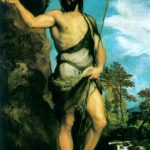
This explosion of popularity did not throw him off course. He did not try to maintain his momentum or his platform. He stayed focused on the Message-giver, and his message was one of utter simplicity: “There is one greater than I. He will baptise you with the Holy Spirit.”

That simple promise of John still speaks to us today, whose experience of the Spirit in our daily lives resembles the occasional sip of champagne rather the wisdom and peace that comes from a steady abiding.

John’s message is one of hope: There is one more powerful than I who will baptise me with the Holy Spirit.

Ever now and then, Christians traditionally take stock of their lives and plan to revise them.

And the best way is with the power of the Spirit, with the power of Jesus, not with the power of our weak and fickle wills.


Let’s take a peek at some of my New Year’s goals, which, sigh, I have made before.

I would like to sleep early, and wake early.

I would like to be more active, and eat healthily, and be physically fit.

I would like to be tidier and more organised.

I would like to be more productive, and finish the book.


I think I omitted an important element in New Year’s resolution making. Instead of focusing on my struggles with discipline in early rising, healthy eating, exercise, housekeeping, and productivity, I should ask for Jesus to baptise me with the Holy Spirit as I tackle discipline, and then do things with the power of the Holy Spirit.

The baptism in the Holy Spirit comes in all the forms and shapes and variety of God himself. For me, it was a seismic, once in a life-time event. But what I rely on more is a daily filling.

A good father does not give the son who asks for bread and fish snakes and scorpions, Jesus says, so if we ask for the Holy Spirit, for help us, he will give it to us. (Luke 11: 11-12). Fresh bread, sufficient for the day. Tomorrow we will be hungry, and we must ask again.

I need to focus on Jesus, clothed in light, who breathed on the disciples, and said, “Receive the Holy Spirit,” and they were transformed. Ask for his interventions in my little struggles with disciplines, things you can’t go over, you can’t go under, you have to go through.

I’d rather read than declutter, but I should declutter significantly because I hope to move… There is one greater than I who will baptise me with the Holy Spirit, and with the power to do what I have to do. Come, Holy Spirit.

I’d rather eat comfort food, and surf the net rather than eat nutritious food and exercise. But there is power, there is one more powerful than I, who will baptise me with his Spirit again, and give me power to do what I must do.  Come, Holy Spirit.

I want to stay up late, reading or surfing. It’s more appealing to sleep in, or read newspapers or magazines or Facebook than to finish my book. But there is power to do the right thing, there is one more powerful than I, who will baptise me with the Spirit, and who will help me.  Come, Holy Spirit.

The place of helplessness is the ironic place of power, because we need to really, truly come to it to lean on the one stronger than ourselves.

* * *

Besides, all these tedious old resolutions are part of the idols of our age. Clean eating. 10,000 steps. The Life-Changing Magic of Tidying Up.  Productivity.

But Jesus said nothing about them in his long great sermons on record, The Sermon on the Mount, and the Upper Room Discourse, or in any of his red letter teachings.

His focus was on the heart and spirit, the secret thoughts and emotions which no one else guesses at. The ways we disobey the teachings of Jesus in our innermost thoughts affect the course of our lives, and our peace and happiness far more than the habits of health and productivity.

If Jesus were to help us make New Year resolutions, he might say, “Stop judging!!  Stay in your own lane. Turn that judging energy into improving the speed and elegance of your own race. Ask me for help in seeing yourself clearly, and when you have seen the beam in your own eyes, ask my help in removing it. When you want to judge others, ask me instead how you can follow me more closely.” He might say, “Do unto your family and friends what you would they do unto you.” He might say “Give,” or “Forgive.  Cut the tangled fishing line of grievances, and see how much lighter you feel.”

And these things my wonderful Jesus might say are infinitely harder than New Year resolutions–Wake earlier. Eat healthily. Write more. Be tidier.  And, as we follow where Jesus leads, step by step in the minutiae of our daily lives…(I love the German word for discipleship, Nachfolge, follow after)…these things fall into place.

* * *

So, will you and I then go to our graves as perfect human beings, without all these weaknesses and limps and thorns in our flesh that keep us humble?

I have two stories…

The powerful, brilliant, spiritually gifted, dynamic St. Paul, he who heard the voice of Jesus, who had a vision of heaven, was beset by an annoying “thorn in the flesh, a messenger of Satan to harass” him. His weakness could have been physical, emotional, or spiritual…  He emphasises, however, that it came from Satan, not God. He is also clear that God could deliver him from it, in an instant, with “one touch from the King.”

Three times he asks God to free him from it, and Christ refuses to. “My grace is sufficient for you, for my power is made perfect in weakness,” Christ replies.

In his neediness, Paul will have to learn to rely on Christ’s power, which he would not need if he was self-powered, Paul-powered.

Paul concludes that he will delight in his weaknesses and hassles which will teach him to rest on Christ’s power, “for when I am weak, then I am strong.”

Sometimes God lets our struggles, difficulties and problems linger, so that we learn to trust him, discover his power, and learn to pray constantly out of necessity. Or merely to keep us humble. To keep us walking, instead of running, and collapsing in burnout.

* * *

And sometimes the weaknesses we lament are just part of our make-up, the way God created us, the shadow side, the necessary adjunct of our strengths. The awkwardness and extreme introversion Donald Miller, whose memoir A Million Miles in a Thousand Years I am listening to on audio in the car, mentions in Blue Like Jazz, his highly original memoir, perhaps provided the necessary space for his independent thinking on faith, love and “how then should we live.”


A last story. All his life, the great Christian and lexicographer Samuel Johnson struggled with sleeping early and waking early. He wanted to wake at 6 a.m., he would have been content to wake at 8 a.m; he often woke up at 2 p.m.

1738: He wrote, “Oh Lord, enable me to redeem the time which I have spent in sloth.”

1757: (19 years later) “Oh mighty God, enable me to shake off sloth and redeem the time misspent in idleness and sin by diligent application of the days yet remaining.”

1759: (2 years later) “Enable me to shake off idleness and sloth.”

1761: “I have resolved until I have resolved that I am afraid to resolve again.”

1764: “My indolence since my last reception of the sacrament has sunk into grossest sluggishness. My purpose is from this time to avoid idleness and to rise early.”

1764: (5 months later) He resolves to rise early, “not later than 6 if I can.”

1765: “I purpose to rise at 8 because, though, I shall not rise early it will be much earlier than I now rise for I often lie until 2.”

1769: “I am not yet in a state to form any resolutions. I purpose and hope to rise early in the morning, by 8, and by degrees, at 6.”

1775: “When I look back upon resolution of improvement and amendments which have, year after year, been made and broken, why do I yet try to resolve again? I try because reformation is necessary and despair is criminal.” He resolves again to rise at 8.

1781: (3 years before his death) “I will not despair, help me, help me, oh my God.” He resolves to rise at 8 or sooner to avoid idleness.”

Johnson spent much of the night in taverns where he enthralled an audience with his encyclopaedic knowledge, and his quick and ready wit. He was the best thing that ever happened to the young Scot James Boswell, who wrote one of classics of English Literature: The Life of Johnson.  Boswell, an early fan-boy, surreptitiously recorded everything that Johnson said, and there was his book.

Sir, a woman’s preaching is like a dog’s walking on his hind legs. It is not done well; but you are surprised to find it done at all, Johnson quipped to Boswell. (Yeah, yeah, perhaps he should have gone to bed a bit earlier after all).

But genetically, Johnson was a night-owl. In trying to rise early, he was fighting against his chronotype, his biology. (I’ve read that night owls may be evolutionary descendants of the Paleolithic  night watchmen who sat at edges of the encampment, protecting the people, telling stories and singing songs to keep themselves awake. Creative, intelligent, resourceful types). Many creative people are night owls, are messy, are sedentary, or fight addictions…. These things are often the shadow side of creativity.

Perhaps Samuel Johnson was just the way God meant him to be, a brilliant night owl who sparkled after the sun set. Perhaps his struggles with early rising taught him humility; taught him a gentleness with others who struggle; taught him his need for God. If not for his late hours as recorded by Boswell, his wit and wisdom and life experience would have long vanished, he would be one of the 99.99% of humanity who are long forgotten, and lie in unvisited graves.

Dr. Jack Miller (who catalogued Johnson’s failures I just quoted in his own great Sonship talks) mocks him, saying he struggled because he did not know the power of the Spirit. But I think every human being goes to his grave with weaknesses, blind spots, and even sins…so that they continually feel the need for God,


God determines our chronotype, lark or owl. God determines our body type, ectomorph, mesomorph or endomorph, and there are limits to how much we can change it. God determines our IQ, our physical attractiveness, our talents. He knows exactly the role he has planned for us to play in this our life—Hamlet, or Ophelia, Lear or Cordelia– though we can decide whether we will play it well, badly, or not at all.

Our weaknesses are as much a part of God’s plan for our lives as our strengths. Both guide us into our vocation, suggest what we should undertake, and what we should not. And sometimes, of course, what we see as our weaknesses are just the shadow side of our strengths. I am a distracted housekeeper because I spend so much time reading. I am not an early riser because I read into the early hours! I carry extra weight because I spend more hours reading than exercising…

So while we try to change, we should also treat ourselves with the affection and amused tenderness that God feels towards us; we should treat ourselves as tenderly and indulgently as we would treat a beloved toddler who announces she’s going to run the London Marathon…tomorrow!

Image Credit: Tolle et Lege, Alighieri Press

PS: Slowly blogging through the Book of Mark!

Filed Under: In which I explore Living as a Christian, In which I Pursue Personal Transformation or Sanctification, In which I resolve to revise my life, Mark Tagged With: C. John Miller, chronotypes, Donald MIller, Gospel of Mark, Jack Miller, John the Baptist, night owls and larks, personal transformation, resolutions, Samuel Johnson, The Baptism in the Holy Spirit, thorns in the flesh

In Praise of Desert and Wilderness Experiences

By Anita Mathias

John the Baptist, his heart and mind and spirit filled with the word of God, pregnant with his calling, does not do what we would today if we sense a calling. He does not go to the cities, to Jerusalem; he does not seek a platform; in fact, he initially does not speak at all.

He goes into silence, into solitude and lets the silence and solitude mould him into the Prophet God wants him to be. He does not seek the audience, the ministry, or the influence; he seeks his God, and God brings it all to him–the ministry, the recognition, the influence, the crowds, the “cross”.

He put first things first: He put God first, and the rest came to him.

* * *

John the Baptist’s season in the desert of preparation for his prophetic calling was a period of extreme simplicity–in his clothing…a garment of camel hair with a leather belt, and in the simple eating, locusts and wild honey (protein and simple carbs) which helped him focus on the most important things…

In solitude, he got to know God, to know his voice, to let the Spirit which had filled him from his mother’s womb (Luke 1:15) strengthen him, so that he wasn’t thrown when crowds seeking baptism flocked to him “from Jerusalem and all Judea and the whole region of the Jordan” including tax collectors and soldiers whom he fearlessly challenged. The time in the desert was necessary for him to gain the strength to stand up to the priests and Levites and Pharisees and Sadducees, whom he scathingly labelled “a brood of vipers” (Matt 3:7) and not hesitate to confront Herod, precipitating his own death (Mark 6 14-29).

The time in the desert made John unique (among those born of women there is no one greater than John, Jesus says, Luke 7:28), for in the desert, he had unusual, totally inspiring company. God was in the desert; the Spirit of God hovered over the desert, there were ministering angels in the desert (Matt 4:11), and eventually the Son of God, Jesus himself came there. John the Baptist, “a voice crying in the wilderness,” sounded unique, he sounded like himself. He sounded like God

Thomas Merton writes, “Many poets are not poets for the same reason that many religious men are not saints: they never succeed in being themselves. They never get around to being the particular poet or the particular monk they are intended to be by God. They never become the man or the artist who is called for by all the circumstances of their individual lives. They waste their years in vain efforts to be some other poet, some other saint…They wear out their minds and bodies in a hopeless endeavour to have somebody else’s experiences or write somebody else’s poems, or possess someone else’s spirituality. There can be an intense egoism in following everybody else. People are in a hurry to magnify themselves by imitating what is popular-and too lazy to think of anything better. Hurry ruins saints as well as artists. They want quick success and they are in such a haste to get it that they cannot take time to be true to themselves. (Thomas Merton, New Seeds of Contemplation).

* * *

“God leads everyone he loves into the desert,” Paul Miller, a friend who mentored and “discipled” me for five years writes in his excellent book, A Praying Life, Moses, David, and Elijah among them.

We all have seasons of quietness, when, if we are to do the work involved in fulfilling our call, we must be alone and silent and quiet. God shapes us in that silence with his word, his spirit, and his love, until we are ready for the next season.

But desert seasons can be unendurably quiet. We can feel like failures while we wait.

However, if we try to short-circuit the desert season necessary for us to be shaped in silence into the kind of people who are able to bear the weight of the call of God, then the desert season gets prolonged, for we are not yet ready for our call.

* * *

For me the call to the desert in my life has been to retreat into silence and obscurity and “do the work: write the book.” I admit I have tried to get out of it by social life, volunteering in church, school and the community; teaching Bible studies, travel, adult education courses, films, theatre, money-making, money-saving, hosting and attending parties, “friendships” or small groups in which I did not add something of value to my friends’ life, or they to mine… But trying to get out of your calling, and out of doing what you have to do because of the sacrifices involved is not really satisfying. Ask Jonah. But God uses and shapes even our mistakes into a beautiful and useful story. Read the Book of Jonah.

By refusing to accept the deserts God calls us into, by filling them with noise, distraction, and busyness, we can prolong the season of preparation for our call. And, more chillingly, we may never do the work God has uniquely called us to do. I suspect many people never really step into their calling and vocation, for they are not willing to accept the sacrifice that preparation for it entails.

* * *

If God calls you into the desert, accept it. Do not numb the occasional loneliness and solitude with “crazy-busy, sugar, alcohol, the internet” (from Brene Brown’s list of the way we numb the pain of living, and then grow too numb to experience its joy). Pray, work, grow. Desert seasons end when you are ready for the next stretch of your call.

And the desert is not really a quiet, empty place. It is full of very important, very powerful, influential, and creative people you simply have to get to know to be happy and creative and fulfil your calling. God is in the desert. The Risen Jesus is in the desert. The wind of the Spirit blows and gusts through the desert. The desert is full of angels, to help you withstand the temptations of the desert–to too much food, to wanting power, to showing off. (Matthew 4 1-10).


It’s a quiet and desert season for me at the moment, empty-nesting, and guess what–I rather like it. With God’s grace, I hope not to short-circuit it, but to meet the one who came to the desert to meet John the Baptist, the one who baptises with the Holy Spirit and with fire.


P. S.  I am reading through the Book of Mark, and hope to share a reflection inspired by that great and short book every Sunday. Join me?

Filed Under: Applying my heart unto wisdom, In which I chase the wild goose of the Holy Spirit, In which I dabble in prophecy and the prophetic, Mark Tagged With: brene brown, calling, desert seasons, John the Baptist, Jonah, obscurity, Paul Miller, Prophetic preparation, Prophets, silence, solitude, the Book of Mark, Thomas Merton, vocation

It’s all God’s money: Thoughts on “the Cattle on a Thousand Hills”

By Anita Mathias

The Staffordshire Horde of Angl0-Saxon gold


One of the hardest things to have wise, sane, healthy thoughts about is money–since money is not mere zeroes on a bank statement, but the fruit of our labour, and our luck; a force which affects almost every area of our lives…our housing, surroundings, health, education, friendships, social life, vacations, leisure, thought-life, trust in God, and openness to His generous nudgings… Jesus says “Mammon,” money, is the biggest competitor to the love of God and the joy of God being the predominant force in our lives. It’s not easy to grasp Jesus’s thoroughly sane and foreign perspective on money. But seeing his life— intense, faith-filled, joyous, and infinitely influential, it’s well worth trying.

* * *

“It’s all God’s money,” I frequently repeat this useful mantra. I can be hard on myself, expecting too much wisdom and good sense of myself (and others!). As I tidy my house, and my eyes fall on books I haven’t read, boxed DVD sets I haven’t yet watched, clothes I have barely worn, furniture that I bought quickly and conveniently, rather than carefully and judiciously, I think “Gosh, that was a waste of money.” Sort of!

The only real waste of money, however, is to fling it into the ocean, or to burn a twenty pound note as a Cambridge undergraduate was filmed doing to torment a homeless man. Otherwise, when it comes to wasted purchases, God’s money flowed through my unwise hands into the department stores,’ and if I donate these things to a charity shop, it can flow into yet someone else’s hands, and I will have been a conduit of God’s blessing.

It’s the same with gym memberships, National Trust memberships, or Royal Horticultural Society memberships I haven’t fully used. It wasn’t “wasted;” the money flowed from me to someone else. It’s what I tell myself when I get what I think is a great deal on a airfare or a vacation rental, and my competitively savvy friends tell me of a better one they found: “‘It’s all God’s money.’ It flowed from me to BA rather than EasyJet. So be it.” And I saved time by not interminably shopping around for killer deals.

Making mistakes is part of being human; only God is all-wise. It’s important to accept our mistakes, our limited wisdom, our Pooh-of-Very-Little-Brainness and move on. I have run a small business since 2006, and notice how often people make mistakes. Our products are not the cheapest. But people buy them. Not everyone has the time or spirit or willingness to hound down the best value; I don’t myself. I am in and out of stores at the speed of light. Just as blessing comes to us because not everyone beelines for the cheapest stuff, or the best value, I am learning to offer grace to myself, and my family when other people or businesses profit from our mistakes.

* * *

A single apple seed can produce tens of thousands of apples. We observe this yearly in our small orchard. That is the normal rate of increase in creation. Jesus, it’s recorded, fed five thousand people from five loaves… each loaf multiplied a thousand times. Abundance–our thoughts, our words, our work, our investments, multiplied many times over–is the normal law of creation.

God owns the cattle on a thousand hills, the Psalmist tells us. Yet in his mercy, he only entrusts a few of these flocks to us. God’s material provision for each of us is sufficient, but not infinite. So we should try to make wise use of whatever gifts–of intellect, talent, opportunity or resources–He may have given us, but lightly. We are all limited beings, of limited intelligence, compared to the creator. So while we endeavour to use our talents and resources well, we also need to forgive ourselves, and offer ourselves grace when, through laziness, weakness, or sheer stupidity, we do not. It’s all God’s money; when I made mistakes through laziness or bad judgement, he used it to bless someone else!

And so we can let it all go, the lost or stolen handbags, wallets, phones, jewellery, the burgled cars, and houses. It’s all God’s money. God willing, those lost things were a blessing to someone else, and, mercifully, the river of God’s goodness does continue flowing, bringing to us newness, and more blessing besides.

* * *

So while we should use due diligence, and give to reputable, time-tested charities like Tearfund, we don’t need to torment ourselves about whether every cent is going to our sponsored child, or designated project, or whether it’s being lost to corruption, governmental or internal, or how wisely it’s being spent, or how effectively altruistic we are being. God uses our values, our backgrounds, our life-experiences, and the things that stir our hearts to direct each of us to support different charities. Choose the charities which resonate with your passions, pick the best ones according to your wisdom, intelligence and values, and then release the money to them. It’s all God’s money, anyway.


I love the Parable of Talents, which is incredibly true. To him who uses his “talents” well, more shall be given.

But ultimately, we are definitely not on earth to maximize our gifts and our talents, to explode our businesses, or invest our money with the Midas touch. God created the world from nothing by his mighty word. Jesus fed five thousand with two fish, drew gold coins from the mouths of other fish, and he can provide for us without all our artful schemes, dreams, and dodges.

We are not on earth to hustle, to multiply our words, our talents, and wealth through judicious application of the Protestant work ethic… because God is ace at multiplying and he can direct us to hidden wealth beneath our feet, like the Roman and Anglo-Saxon hordes of gold continually unearthed in Britain, or to herds of cattle waiting to be lassoed in an overlooked hill. We are on earth to learn to love. To love God, and other people. We are on earth to learn to be kind.

* * *


Image: By David Rowan, Birmingham Museum and Art Gallery (Staffordshire hoard) [CC BY 2.0 (http://creativecommons.org/licenses/by/2.0)], via Wikimedia Commons

Filed Under: Applying my heart unto wisdom, In which I decide to follow Jesus Tagged With: Jesus' view on money, Mammon, money, Parable of Talents

Gratitude: A Secret to Happiness

By Anita Mathias

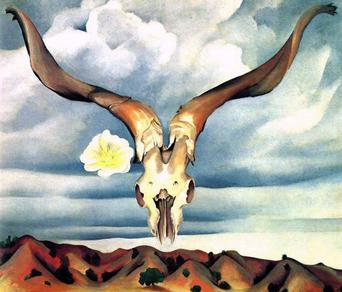
  Georgia O’Keefe

All of us have a negativity bias which makes us more apt to remember one mean comment about our writing, our children, our appearance, or our characters, than dozens of positive ones. It’s true, isn’t it? More disquietingly, I’ve read, in Andrew Solomon’s brilliant The Noonday Demon that the myelin sheath around our nerves wears down as we age, so that, if we live long enough, almost all of us will suffer from depression. And that’s not a happy prospect!

* * *

I want to live with peace in my soul. I want to live with joy, mindfulness, and gratitude, “in the light of his glory and grace.” That phrase is precious to me. I say it to myself, often, when I feel stressed, and my heart and mind race with a hundred thoughts and emotions, and then I remember to pivot, “to turn my eyes on Jesus” once again, “to look full in his wonderful face, until the things of earth grow strangely dim, in the light of his glory and grace,” and sanity and good sense return.

One way of pivoting into the presence of Jesus, and living in the light of his glory and grace, is the practice of gratitude. I do this quite deliberately. When I find myself stressed, or distracted, or discombobulated, I like to do what in mindfulness practice is called a three minute breathing space which, astonishingly, often serves to bring peace and clarity. Another practice I use is “the ten finger gratitude exercise” of Mark Williams, author of Mindfulness: count ten blessings or reasons for gratitude on my fingers. Often, my mood and perspective has shifted, and I am calmer before I got to ten!

For years, I have told one of my daughters who had trouble falling asleep to count a hundred blessings to help her sleep, and I often do myself…both the little unnoticed ones—that by God’s grace, I have never been in an accident, or broken a bone, and have rarely experienced physical pain, and have reasonably good health. I count my favourite gorgeous paintings, and books, and poems, and places, and people. That changes my mood before I get to a hundred.

* * *

Gratitude is the most important ingredient of happiness. Rick Steves who writes wonderful travel guides (and who, a couple of decades ago, converted me to his “Europe by the Backdoor” philosophy, enjoying Europe as many Europeans do, picnic meals in great parks, camper-vanning and campgrounds) writes of a loud disgruntled American eating an expensive meal in an expensive restaurant in a resort which cost five times what Steves recommends spending, loudly grumbling about his life and his taxes; berating his wife, thoroughly miserable through it all. I have often seen that traveller, bringing their internal unhappiness and spoilt-brattiness to exquisite surroundings. On occasion, though rarely, I have been that traveller.

What does it profit you if your business makes, say, a million pounds and you do not have sunshine in your soul? What does it profit you if you seen every beautiful sight in this green planet and have no love in your heart? What does the beautiful home, and garden, and all the beautiful art you seen, and experiences you have had, matter if you do not savour them, at the time, and in memory? Achieving the success of their wildest dreams will not make a person happy unless they are continually grateful for it. I know enough successful, wealthy people to know that this is true.

* * *

Some people are naturally more cheerful, sanguine, optimistic and grateful than others. It has to do with an internal, largely genetic, set-point for happiness which psychologists say is virtually impossible to shift. Some people are just more optimistic and sanguine than others, and luckily, I am naturally Micawberish. But gratitude is also a practice, which we learn by practising–and there is nothing more happy-making to practice.

The magic practice of gratitude can change our memories and perceptions of the past. Hold the picture frame of your dark and traumatic memories to the light. Look for the gold, and there was gold there, for God was there. Look for the light and transformation which flowed from the trauma, or still can flow from it. Thank God for the flashes of brightness and goodness in those dark picture frames… for even in them, God was present, and his story for your life was being written.

Gratitude is the most important ingredient of happiness. And it’s learnt by practice. During daylight, I practise by looking out and thanking God for the ever-changing panorama of the sky, the clouds floating across it. I thank God for the stars so bright in the countryside where I live. I thank God for the people who love me, for the animals who love me, my Golden Retriever, Pippi, and my labradoodle, Merry; for the continuous beauty of nature, so like a Constable painting so often in the Oxford countryside where I live that it takes my breath away. I thank God for the beautiful countries and art I have seen, and the books and poetry I have read, an internal treasure bank, and the leisure to have enjoyed them. I thank God for my love for Scripture, and for knowing Jesus. I thank God for the continuous presence of the Father, the Son, the Spirit, and ministering angels, so that, at present, I can freely choose “the desert,” for I need to get some work done. See, just typing a paragraph like this changes your mood.

Try to count five or ten blessing when you are sad, or stressed, or out of sorts. See if changes your mood. It’s almost magical–though the real magic of the spiritual life is not in our practices, but in the great magician himself, in Jesus.

 And on occasion, you may need another route out of sadness and general malaise. Sometimes you may need a change of scene, the sea. “The cure for anything is salt water — sweat, tears, or the sea.” Isak Dinesen

Sometimes, you may just need a hot bubble bath and a good long nap!

http://https://youtu.be/3Zl9puhwiyw

P.S. My practice of gratitude begins with mindfulness of the sky and the weather after I watched this astonishing video by Benedictine monk, David Steindl-Rast. Do watch it. His narration in his gentle German accent somehow makes it more memorable. Here is the text:

A Good Day, Brother David Steindl-Rast

 You think this is just
another day in your life?

It’s not just another day;
it’s the one day that
is given to you…

today

It’s given to you. It’s a gift.

It’s the only gift that you
have right now, and the
one appropriate response
is gratefulness.

If you do nothing else but to
cultivate that response to the great
gift that this unique day is,

if you learn to respond
as if it were the first day
of your life,

and the very last day,

then you will have spent
this day very well.

Begin by opening your
eyes and be surprised that you
have eyes you can open,

that incredible array of colors

that is constantly offered to
us for pure enjoyment.

Look at the sky.

We so rarely look at the sky.
We so rarely note how different
it is from moment to
moment
 with clouds coming
and going.

We just think of the weather, and
even of the weather we don’t think
of all the many nuances of weather.

We just think of good weather
and bad weather.

This day right now has
unique weather, maybe a
kind that will never exactly
in that form come again.

That formation of clouds in the sky will
never be the same that it is right now.

Open your eyes. Look at that.

Look at the faces 
of people whom you meet.

Each one has an incredible
story 
behind their face, a story
that you could never fully fathom,
not only their own story,
but the story of their ancestors.

We all go back so far.

And in this present
moment 
on this day, all the
people you meet, all that life
from generations and from so
many places all over the world,
flows together and meets you
here like a life-giving
water, if you only open your
heart and drink.

Open your heart
to the incredible gifts that
civilization gives to us.

You flip a switch
and there is
electric light.

You turn a faucet and
there is warm water and cold water—
and drinkable water.

It’s a gift that millions and millions
in the world will never experience.

So these are just a few of
an enormous number
of gifts to which you can
open your heart.

And so I wish for you that
you would open your heart
to all these blessings and let
them flow through you,
that everyone whom you will meet
on this day will be blessed by you;
just by your eyes,
by your smile, by your touch—
just by your presence.

Let the gratefulness overflow
into blessing all around you,

and then it will really be
a good day.


Filed Under: In which I am Amazed by Grace, In which I explore the Spiritual Life, In which I'm amazed by the goodness of God, The Power of Gratitude

  • « Previous Page
  • 1
  • …
  • 6
  • 7
  • 8
  • 9
  • 10
  • …
  • 279
  • Next Page »

Sign Up and Get a Free eBook!

Sign up to be emailed my blog posts (one a week) and get the ebook of "Holy Ground," my account of working with Mother Teresa.

Join 536 Other Readers

My Books

Rosaries, Reading, Secrets: A Catholic Childhood in India

Rosaries, Reading Secrets, B&N
USA

UK

Wandering Between Two Worlds: Essays on Faith and Art

Wandering Between Two Worlds
USA

UK

Francesco, Artist of Florence: The Man Who Gave Too Much

Francesco, Artist of Florence
US

UK

The Story of Dirk Willems

The Story of Dirk Willems
US

UK

My Latest Meditation

Anita Mathias: About Me

Anita Mathias

Read my blog on Facebook

Follow me on Twitter

Follow @anitamathias1

Recent Posts

  • At the Cross, God Forgives Us, Completely
  • Using God’s Gift of Our Talents: A Path to Joy and Abundance
  • The Kingdom of God is Here Already, Yet Not Yet Here
  • All Those Who Exalt Themselves Will Be Humbled & the Humble Will Be Exalted
  • Christ’s Great Golden Triad to Guide Our Actions and Decisions
  • How Jesus Dealt With Hostility and Enemies
  • Do Not Be Afraid, but Do Be Prudent
  • For Scoundrels, Scallywags, and Rascals—Christ Came
  • How to Lead an Extremely Significant Life
  • Don’t Walk Away From Jesus, but if You Do, He Still Looks at You and Loves You
Premier Digital Awards 2015 - Finalist - Blogger of the year
Runner Up Christian Media Awards 2014 - Tweeter of the year

Categories

What I’m Reading


Wolf Hall
Hilary Mantel

Wolf Hall --  Amazon.com
Amazon.com

Amazon.co.uk

Silence and Honey Cakes:
The Wisdom Of The Desert
Rowan Williams

Silence and Honey Cakes --  Amazon.com
Amazon.com

Amazon.co.uk

The Long Loneliness:
The Autobiography of the Legendary Catholic Social Activist
Dorothy Day

The Long Loneliness --  Amazon.com
Amazon.com

Amazon.co.uk

Country Girl
Edna O'Brien

Country Girl  - Amazon.com
Amazon.com

Amazon.co.uk

Archive by month

My Latest Five Podcast Meditations

INSTAGRAM

anita.mathias

My memoir: Rosaries, Reading, Secrets https://amzn.to/42xgL9t
Oxford, England. Writer, memoirist, podcaster, blogger, Biblical meditation teacher, mum

Well, hello friends! Breaking radio silence to let Well, hello friends! Breaking radio silence to let you know that I have taped a meditation for you on Christ’s famous Parable of the Talents in Matthew 25. https://anitamathias.com/2025/11/05/using-gods-gift-of-our-talents-a-path-to-joy-and-abundance/
Here you are, click the play button in the blog post for a brief meditation, and some moments of peace, and, perhaps, inspiration in your day 🙂
Hi Friends, I have taped a meditation; do listen a Hi Friends, I have taped a meditation; do listen at this link: https://anitamathias.com/2025/04/08/the-kingdom-of-god-is-here-already-yet-not-yet-here-2/
It’s on the Kingdom of God, of which Christ so often spoke, which is here already—a mysterious, shimmering internal palace in which, in lightning flashes, we experience peace and joy, and yet, of course, not yet fully here. We sense the rainbowed presence of Christ in the song which pulses through creation. Christ strolls into our rooms with his wisdom and guidance, and things change. Our prayers are answered; we are healed; our hearts are strangely warmed. Sometimes.
And yet, we also experience evil within & all around us. Our own sin which can shatter our peace and the trajectory of our lives. And the sins of the world—its greed, dishonesty and environmental destruction.
But in this broken world, we still experience the glory of creation; “coincidences” which accelerate once we start praying, and shalom which envelops us like sudden sunshine. The portals into this Kingdom include repentance, gratitude, meditative breathing, and absolute surrender.
The Kingdom of God is here already. We can experience its beauty, peace and joy today through the presence of the Holy Spirit. But yet, since, in the Apostle Paul’s words, we do not struggle only “against flesh and blood, but against the rulers, against the unseen powers of this dark world and against the spiritual forces of evil,” its fullness still lingers…
Our daughter Zoe was ordained into the Church of E Our daughter Zoe was ordained into the Church of England in June. I have been on a social media break… but … better late than never. Enjoy!
First picture has my sister, Shalini, who kindly flew in from the US. Our lovely cousins Anthony and Sarah flank Zoe in the next picture.
The Bishop of London, Sarah Mullaly, ordained Zoe. You can see her praying that Zoe will be filled with the Holy Spirit!!
And here’s a meditation I’ve recorded, which you might enjoy. The link is also in my profile
https://anitamathias.com/2024/11/07/all-those-who-exalt-themselves-will-be-humbled-the-humble-will-be-exalted/
I have taped a meditation on Jesus statement in Ma I have taped a meditation on Jesus statement in Matthew 23, “For those who exalt themselves will be humbled, and those who humble themselves will be exalted.”
Do listen here. https://anitamathias.com/2024/11/07/all-those-who-exalt-themselves-will-be-humbled-the-humble-will-be-exalted/
Link also in bio.
And so, Jesus states a law of life. Those who broadcast their amazingness will be humbled, since God dislikes—scorns that, as much as people do.  For to trumpet our success, wealth, brilliance, giftedness or popularity is to get distracted from our life’s purpose into worthless activity. Those who love power, who are sure they know best, and who must be the best, will eventually be humbled by God and life. For their focus has shifted from loving God, doing good work, and being a blessing to their family, friends, and the world towards impressing others, being enviable, perhaps famous. These things are houses built on sand, which will crumble when hammered by the waves of old age, infirmity or adversity. 
God resists the proud, Scripture tells us—those who crave the admiration and power which is His alone. So how do we resist pride? We slow down, so that we realise (and repent) when sheer pride sparks our allergies to people, our enmities, our determination to have our own way, or our grandiose ego-driven goals, and ambitions. Once we stop chasing limelight, a great quietness steals over our lives. We no longer need the drug of continual achievement, or to share images of glittering travel, parties, prizes or friends. We just enjoy them quietly. My life is for itself & not for a spectacle, Emerson wrote. And, as Jesus advises, we quit sharp-elbowing ourselves to sit with the shiniest people, but are content to hang out with ordinary people; and then, as Jesus said, we will inevitably, eventually, be summoned higher to the sparkling conversation we craved. 
One day, every knee will bow before the gentle lamb who was slain, now seated on the throne. We will all be silent before him. Let us live gently then, our eyes on Christ, continually asking for his power, his Spirit, and his direction, moving, dancing, in the direction that we sense him move.
Link to new podcast in Bio https://anitamathias.co Link to new podcast in Bio https://anitamathias.com/2024/02/20/how-jesus-dealt-with-hostility-and-enemies/
3 days before his death, Jesus rampages through the commercialised temple, overturning the tables of moneychangers. Who gave you the authority to do these things? his outraged adversaries ask. And Jesus shows us how to answer hostile questions. Slow down. Breathe. Quick arrow prayers!
Your enemies have no power over your life that your Father has not permitted them. Ask your Father for wisdom, remembering: Questions do not need to be answered. Are these questioners worthy of the treasures of your heart? Or would that be feeding pearls to hungry pigs, who might instead devour you?
Questions can contain pitfalls, traps, nooses. Jesus directly answered just three of the 183 questions he was asked, refusing to answer some; answering others with a good question.
But how do we get the inner calm and wisdom to recognise
and sidestep entrapping questions? Long before the day of
testing, practice slow, easy breathing, and tune in to the frequency of the Father. There’s no record of Jesus running, rushing, getting stressed, or lacking peace. He never spoke on his own, he told us, without checking in with the Father. So, no foolish, ill-judged statements. Breathing in the wisdom of the Father beside and within him, he, unintimidated, traps the trappers.
Wisdom begins with training ourselves to slow down and ask
the Father for guidance. Then our calm minds, made perceptive, will help us recognise danger and trick questions, even those coated in flattery, and sidestep them or refuse to answer.
We practice tuning in to heavenly wisdom by practising–asking God questions, and then listening for his answers about the best way to do simple things…organise a home or write. Then, we build upwards, asking for wisdom in more complex things.
Listening for the voice of God before we speak, and asking for a filling of the Spirit, which Jesus calls streams of living water within us, will give us wisdom to know what to say, which, frequently, is nothing at all. It will quieten us with the silence of God, which sings through the world, through sun and stars, sky and flowers.
Especially for @ samheckt Some very imperfect pi Especially for @ samheckt 
Some very imperfect pictures of my labradoodle Merry, and golden retriever Pippi.
And since, I’m on social media, if you are the meditating type, here’s a scriptural meditation on not being afraid, while being prudent. https://anitamathias.com/2024/01/03/do-not-be-afraid-but-do-be-prudent/
A new podcast. Link in bio https://anitamathias.c A new podcast. Link in bio
https://anitamathias.com/2024/01/03/do-not-be-afraid-but-do-be-prudent/
Do Not Be Afraid, but Do Be Prudent
“Do not be afraid,” a dream-angel tells Joseph, to marry Mary, who’s pregnant, though a virgin, for in our magical, God-invaded world, the Spirit has placed God in her. Call the baby Jesus, or The Lord saves, for he will drag people free from the chokehold of their sins.
And Joseph is not afraid. And the angel was right, for a star rose, signalling a new King of the Jews. Astrologers followed it, threatening King Herod, whose chief priests recounted Micah’s 600-year-old prophecy: the Messiah would be born in Bethlehem, as Jesus had just been, while his parents from Nazareth registered for Augustus Caesar’s census of the entire Roman world. 
The Magi worshipped the baby, offering gold. And shepherds came, told by an angel of joy: that the Messiah, a saviour from all that oppresses, had just been born.
Then, suddenly, the dream-angel warned: Flee with the child to Egypt. For Herod plans to kill this baby, forever-King.
Do not be afraid, but still flee? Become a refugee? But lightning-bolt coincidences verified the angel’s first words: The magi with gold for the flight. Shepherds
telling of angels singing of coming inner peace. Joseph flees.
What’s the difference between fear and prudence? Fear is being frozen or panicked by imaginary what-ifs. It tenses our bodies; strains health, sleep and relationships; makes us stingy with ourselves & others; leads to overwork, & time wasted doing pointless things for fear of people’s opinions.
Prudence is wisdom-using our experience & spiritual discernment as we battle the demonic forces of this dark world, in Paul’s phrase.It’s fighting with divinely powerful weapons: truth, righteousness, faith, Scripture & prayer, while surrendering our thoughts to Christ. 
So let’s act prudently, wisely & bravely, silencing fear, while remaining alert to God’s guidance, delivered through inner peace or intuitions of danger and wrongness, our spiritual senses tuned to the Spirit’s “No,” his “Slow,” his “Go,” as cautious as a serpent, protected, while being as gentle as a lamb among wolves.
Link to post with podcast link in Bio or https://a Link to post with podcast link in Bio or https://anitamathias.com/2023/09/22/dont-walk-away-from-jesus-but-if-you-do-he-still-looks-at-you-and-loves-you/
Jesus came from a Kingdom of voluntary gentleness, in which
Christ, the Lion of Judah, stands at the centre of the throne in the guise of a lamb, looking as if it had been slain. No wonder his disciples struggled with his counter-cultural values. Oh, and we too!
The mother of the Apostles James and John, asks Jesus for a favour—that once He became King, her sons got the most important, prestigious seats at court, on his right and left. And the other ten, who would have liked the fame, glory, power,limelight and honour themselves are indignant and threatened.
Oh-oh, Jesus says. Who gets five talents, who gets one,
who gets great wealth and success, who doesn’t–that the
Father controls. Don’t waste your one precious and fleeting
life seeking to lord it over others or boss them around.
But, in his wry kindness, he offers the ambitious twelve
and us something better than the second or third place.
He tells us how to actually be the most important person to
others at work, in our friend group, social circle, or church:Use your talents, gifts, and energy to bless others.
And we instinctively know Jesus is right. The greatest people in our lives are the kind people who invested in us, guided us and whose wise, radiant words are engraved on our hearts.
Wanting to sit with the cleverest, most successful, most famous people is the path of restlessness and discontent. The competition is vast. But seek to see people, to listen intently, to be kind, to empathise, and doors fling wide open for you, you rare thing!
The greatest person is the one who serves, Jesus says. Serves by using the one, two, or five talents God has given us to bless others, by finding a place where our deep gladness and the world’s deep hunger meet. By writing which is a blessing, hospitality, walking with a sad friend, tidying a house.
And that is the only greatness worth having. That you yourself,your life and your work are a blessing to others. That the love and wisdom God pours into you lives in people’s hearts and minds, a blessing
https://anitamathias.com/.../dont-walk-away-from-j https://anitamathias.com/.../dont-walk-away-from-jesus.../
Sharing this podcast I recorded last week. LINK IN BIO
So Jesus makes a beautiful offer to the earnest, moral young man who came to him, seeking a spiritual life. Remarkably, the young man claims that he has kept all the commandments from his youth, including the command to love one’s neighbour as oneself, a statement Jesus does not challenge.
The challenge Jesus does offers him, however, the man cannot accept—to sell his vast possessions, give the money to the poor, and follow Jesus encumbered.
He leaves, grieving, and Jesus looks at him, loves him, and famously observes that it’s easier for a camel to squeeze through the eye of a needle than for a rich person to live in the world of wonders which is living under Christ’s kingship, guidance and protection. 
He reassures his dismayed disciples, however, that with God even the treasure-burdened can squeeze into God’s kingdom, “for with God, all things are possible.”
Following him would quite literally mean walking into a world of daily wonders, and immensely rich conversation, walking through Israel, Lebanon, Syria, and Jordan, quite impossible to do with suitcases and backpacks laden with treasure. 
For what would we reject God’s specific, internally heard whisper or directive, a micro-call? That is the idol which currently grips and possesses us. 
Not all of us have great riches, nor is money everyone’s greatest temptation—it can be success, fame, universal esteem, you name it…
But, since with God all things are possible, even those who waver in their pursuit of God can still experience him in fits and snatches, find our spirits singing on a walk or during worship in church, or find our hearts strangely warmed by Scripture, and, sometimes, even “see” Christ stand before us. 
For Christ looks at us, Christ loves us, and says, “With God, all things are possible,” even we, the flawed, entering his beautiful Kingdom.
Follow on Instagram

© 2026 Dreaming Beneath the Spires · All Rights Reserved. · Cookie Policy · Privacy Policy