Anita Mathias: Dreaming Beneath the Spires

Anita Mathias's Blog on Faith and Art

  • Home
  • My Books
  • Meditations
  • Essays
  • Contact
  • About Me

On Loving That Which Love You Back

By Anita Mathias

I’m reading Sarah Bessey’s “Miracles and Other Reasonable Things” sent me by her publisher for review.

One thing that struck me was her distinction between self-care and self-comfort in times of sadness, stress and boredom.  Bessey explains that she “numbs out in times of stress; I can use anything from food to wine to books to television to shopping.”

This is self-comfort she explains which FEELS good; self-care, on the other hand, CREATES good in our lives, the lives of our family and friends, and in the world.

I, personally, have used the first and last on the list, but I am learning not to comfort myself with things that will cause future sadness when I am tired, bored, angry, sad, or stressed, but instead to love the things that will love me back.

So chocolate, or comfort eating, or zoning out on social media or online magazines and newspapers will not love me back, but cause future sadness at the weight gain, or wasted time. I am now more regularly rating my hunger on a five point scale, and praying for the bread of the Holy Spirit rather than eat when I am not hungry, but am bored, or stressed, or low-spirited.

The things which will love me back are a long walk, yoga, meditation, decluttering, gardening, reading something challenging and nourishing, prayer, Bible-time, dance, gym-time, hanging out with friends, or with family. Interestingly, none of these cost money, or hardly anything, and they all leave me stronger, mentally, physically, spiritually and emotionally.

And that’s the difference between self-care, and self-comfort. Sugar, and chocolate (or coffee) give the brain a sudden rush of serotonin and stimulation, a certain “change of state,” but a certain descent , the need for more, and weight gain or sleep loss.

The slow steady ways of self-care take a bit longer to change one’s mood, but they leave no regret.

I, like many Christians, often forget that the love we are called to includes loving ourselves just as as much as we love anybody else. That love includes looking after after ourselves as a wise parent would look after a recalcitrant toddler.

Sarah Bessey Miracles and Other Reasonable Things on Amazon.com and on Amazon.co.uk

Filed Under: Applying my heart unto wisdom

“An Autobiography in Five Chapters” and Avoiding Habitual Holes  

By Anita Mathias

 (All images taken on this summer’s memorable trip to Iceland)

Earlier this year, my husband Roy and I took a mindfulness course through the Oxford Mindfulness Centre, a truly mind-expanding experience (a wonderful thing in mid-life, when we can ossify in our thoughts and habits unless we make a conscious effort to change).

The teacher read this poem to us, and it felt like an electric shock.


An Autobiography in Five Chapters (by Portia Nelson)

I

I walk down the street.

There is a deep hole in the sidewalk

I fall in.

I am lost…

I am hopeless.

It isn’t my fault.

It takes forever to find a way out.

II

I walk down the same street.

There is a deep hole in the sidewalk.

I pretend I don’t see it.

I fall in again.

I can’t believe I’m in the same place.

But it isn’t my fault.

It still takes a long time to get out.

III

I walk down the same street.

There is a deep hole in the sidewalk.

I see it is there.

I still fall in… it’s a habit

My eyes are open; I know where I am;

It is my fault.

I get out immediately.

IV

I walk down the same street.

There is a deep hole in the sidewalk.

I walk around it.

V

I walk down another street.

* * *

I thought about mistakes I’ve made, unhelpful habit-patterns, holes I have fallen into–inadvertently, the first time, and then again, without analysing or accepting culpability for my actions, and then repeatedly, out of bad habit.

But there other options exist… I could side-step the hole.

Or go down a different street.

* * *

So, Roy and I began thinking about holes we tumble into, and how to circumvent them. For instance, we left on a 15 day trip to Iceland just after the Meditation course. I love travel, but usually pack an hour or so before we leave. Which means running through the house to run laundry, gather up books, clothes, toiletries and electronics; it’s stressful, and I am frequently still packing when the house-sitters come, and I feel sad that I was not able to tidy up for them as well and hospitably as I would have liked, and I invariably discover I need some toiletries or better walking shoes or eye-masks, but there’s no time to get them.

Well, this time, I started packing a full 10 days in advance, a pomodoro a time. We were renting a camper van, which meant taking more gear, and I decided to buy good hiking layers for Iceland. (We wore 4 or 5 layers in July and August, can you imagine?–because we hiked up to glaciers, took boat trips in glacial lagoons, and it was  chilly!) I also bought a duplicate of almost everything I take in my suitcase or hand luggage when I travel, so that next time packing will be super-easy, with a pre-packed suitcase. (In fact, we are going to Porto soon to celebrate our thirtieth wedding anniversary, and the suitcase is already packed!!) Anyway, I was packed before the house-sitters came, and even got to clean and declutter.

Packing was always a hated and dread task– and I am so happy I have found a non-time-consuming way to do it: buy a duplicate of everything I normally take , and always keep a suitcase packed…

It takes analysis to figure out holes, and how to avoid them. For instance, we booked our trip to Iceland after reading in our guidebooks that while 5-7 days on the Ring Road that circles the country is the minimum, fourteen days are even better. So, we booked fourteen days! We hiked up volcanoes, took boat trips on glacial lagoons among icebergs, walked on iceberg-littered beaches, and among geysers, saw basalt columns, puffins and seals; soaked in hot pools surrounded by mountains; climbed up to more waterfalls than I’ve ever seen in a fortnight, but realised we could easily have seen our personal wish-list in fewer days, if we had read the guidebook, and made a list. (Things like a steep 45 minute walk up a barren Mordor-like landscape to see a volcano’s crater, or climbing behind slippery rocks to get behind a waterfall were not for me, when there were easy-to-access volcanoes and waterfalls). And Iceland is an expensive country to spend an unnecessary day in.  So, though I always read the guidebook on the plane out, and love the serendipity of unplanned travel, I decided I am going to plan an itinerary, ideally before I have even bought the tickets.

I love the poem’s premise: we can avoid habitual mistakes by analysing the holes we can fall into, and, then, take a different road.  Another hole I have fallen into is a form of ghosting. Because I dislike difficult, tense, emotional conversations, I can sever a relationship with, say, a spiritual director, or church, or small group,  or someone who was working for us with an email or by simply stopping showing up.  So, once warm relationships go into limbo, and this is annoying and unsatisfying for the ones ghosted, and leaves me feeling guilty, and without the benefits of maturity that confronting difficult things gives us. I have had to end two relationships this year… one was a warm professional relationship which had definitely come to its natural end. I tried to sever it by email, but he really wanted  a face-to -face, so we had it, and it was a good meeting, and provided a sad but satisfying closure to the relationship which had served us well, but now clearly needed to end. Similarly, I left an activity I was involved in with a frank and mature discussion with the leader, which strengthened our relationship, though leaving was the right thing. And each time we end things well we gain courage and kindness for the next time, which is of great importance, because after all the ending defines the book… Scarlett re-marries Rhett, or doesn’t; Jon Snow occupies the Iron Throne, or doesn’t… Endings define the story!

Other holes I’m avoiding. Because we are self-employed, and our work is portable, my husband Roy and I travel a lot. We are suckers for those super-cheap airfare and hotel deals to Europe, and had 10 short breaks in 2018. And six so far this year, including Cordoba, Berlin, Krakow, Iceland, and New York, for my niece Kristina’s wedding, and soon, God willing, Porto. However, sadly, it can take a while after travel to recover my good habits and work routines.  Also, I gain weight most times I travel (eating out for every meal can do that to you!) which which can take time to lose. So I am now trying to craft a life in which I travel slightly less frequently for energy, freshness, joy and excitement it gives me, but instead pace myself by taking a stimulating break each week. We went to a Pompeii exhibition at the Ashmolean last week, and recently to a story-telling session of The Kalevala with my book group, and a classic movie night at a friend’s house—Pasolini’s Oedipus!! (Alternatively, I could keep travelling, an activity I adore, and simply became more active to walk off the delicious holiday meals. But some change is necessary.)

Life’s more fun, when we keep revising it.


Filed Under: Applying my heart unto wisdom, In which I resolve to revise my life, In which I Travel and Dream Tagged With: An Autobiography in Five Chapters, avoiding holes, Portia Nelson, revising life, the dread task of packing, Travel

Shining Faith in Action: Dirk Willems on the Ice

By Anita Mathias

Each time, I hear or recount the story of Dirk Willems, a Dutch Anabaptist hero of the Reformation, I find myself moved to tears. And so I wrote down his inspiring story in a little book, The Story of Dirk Willems. The opening pages are here. And here is the climactic scene:

When Dirk Willems was arrested in Holland in 1569, he refused to recant the radical reading of Scripture which had set his life ablaze with purpose and joy. The Crown confiscated all his property for its own uses, and he was sentenced to be “executed with fire, until death ensues.” Willems was imprisoned at the Palace in Asperen, until May, when he was to be publicly burnt at the stake.

Autumn passed, and it was winter. Looking out of the prison window one December night, Dirk Willems noticed that the moat around the castle had frozen solid.

His heart beat faster. Had the Lord provided a means of escape? Might the Lord Jesus enable him too to walk on water?

Willems ripped his bedsheet, knotted the rags together, tied one end to the window and slowly climbed down, the cloth supporting his body, grown skeletal on meagre rations in the long months of imprisonment.

He tiptoed onto the ice. And it bore his weight.

The stars shone bright in the frosty night. He skidded across the pond, remembering the nights of his youth, skating with his friends who loved the Lord Jesus on the frozen ponds of Rotterdam. He felt as if he were flying.

The Lord Jesus was rescuing him from his enemies.

* * *

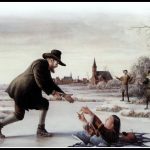
“Stop! I command you in the name of the Duke of Alva: Stop!” he heard the palace guard shout, but using his last reserves of strength, Dirk slid across the ice of the moat, the Hondegat.

Behind him, the guard, “the thief-catcher,” raced across the ice, handcuffs in hand, closing in, closing in.

“Lord Jesus, I ask in your name! Help me. Please,” Dirk prayed as he slid across the ice.

And now he scrambled onto solid ground. He kissed the icy earth.

Delivered by Jesus.

* * *

“Willems, help me! Help me, please.”

Dirk turned round. The ice across which he, grown emaciated in captivity, had slid, lithe as a cat, had cracked beneath the weight of the burly thief-catcher. He could no longer see the guard’s body, just his thrashing hands, one of them gripping handcuffs.  As the man grabbed at the ice, it shattered into a myriad pieces.

The guard was drowning.

As Dirk paused beneath the starry skies, the words of the Lord Jesus, which he had recited to himself, again and again, through hungry days and sleepless nights returned like distant music.

Love your enemies, do good to those who hate you; bless those who curse you; pray for those who persecute you.

 Do not resist evil.

And Paul’s words: Do not be overcome by evil, but overcome evil with good.


“Dirk Willems, help me. Help!” the guard gasped, clutching the ice which splintered as he grabbed it, only his head now visible, and his hand, his hand with the shackles.

Under the silent stars, Dirk halted. Prayed. And then, “I will do it for the love of the Lord Jesus,” he decided in a rush of resolution.

For the love of the Lord Jesus whom he had resolved to obey in all things; for whose sake he had chosen imprisonment rather than pretend to accept Catholic doctrines he did not believe; for the love of Jesus whom he had decided to follow, whether it led to happiness or death, Dirk Willems turned around.

He glided on the ice as far as he dared, and extended his hand to his enemy, the guard. And pulled him to safety.

They stood on solid ice. His voice quavering with cold and emotion, the guard said, “Thank you, Dirk Willems.”

* * *

But the Burgomaster, who stood watching outside the Palace walls, called out across the moat, “Remember the oaths you swore to the Duke of Alva, thief-catcher. You swore to catch criminals and deliver them to justice. I command you in the name of the Duke of Alva, seize the heretic.”

The thief-catcher hesitated. Then muttering, “Forgive me,” he grabbed Willems’s wrist, clapped the handcuffs on him, and dragged him across the drawbridge, back to the castle.

* * *

Willems was now confined to a small, barred room at the top of a tall church tower, his feet cramped in wooden leg stocks. He was tortured. He did not renounce his faith.

On 16 May 1569, he was led out to be burned to death outside Asperen.

* * *

It was a blustery day.  A strong east wind blew the flames away from his chest, after they burnt the flesh on his lower body. His suffering was long and lingering. Willem’s loud cries were heard in the town of Leerdam, towards which the wind blew.

“O my Lord, my God,” he called out, over seventy times.

Finally, unable to watch his torment, the supervising judge wheeled his horse around and commanded the executioner, “Dispatch the man with a quick death.”

* * *

Sometimes we walk through a dark forest by the light of a star which had died ten thousand years ago.

Dirk Willems, fool for Christ, you are one of the “children of God without fault who shine like stars in the sky.”  Your light still blazes five hundred years later.

We, who are amazed at your goodness, salute you.

We are astonished by your love for Scripture: you did not compromise your understanding of it, even though that meant imprisonment and the loss of your property, your freedom, your health, and your life. We are stunned by your integrity.

But, most of all, we are moved by how you helped your enemy, though it meant your certain death.

We are inspired by how you kept your eyes on the Lord Jesus through the long agony of that barbaric burning.

We believe that, as you died, heaven opened, and you saw Christ standing at the right hand of the Father, ready to welcome you.

And we know you are with him, shining, in the great golden cloud of witnesses, the communion of saints which sweetens the earth.

Dirk Willems, this world was not worthy of you. You did not get to write your story, but you lived a beautiful one.

Thank you.

* * *

If you know someone who might like a copy, it’s available on

Amazon.com (Paperback) and Kindle

Amazon.co.uk (Paperback) and on Kindle

If you’d like to support me by buying a paperback or Kindle book and leaving a review, I will, of course, be very grateful 🙂

Filed Under: In Which I celebrate Church History and Great Christians Tagged With: Anabaptists, Dirk Willems, Persecution, Reformation

The Story of Dirk Willems: The Man who Died to Save His Enemy

By Anita Mathias


I am inspired and moved by the story of Dirk Willems, one of the heroes of the Reformation, each time I hear it, and have written a little book on him. I hope you like it.

 Here is the opening section

The Story of Dirk Willems:

The Man who Died to Save His Enemy

The banging shook the old timber-framed house in Asperen, Holland.

“Open in the name of the Duke of Alva,” rough voices yelled. The horses clopped on the cobbled street, their breath rising in impatient clouds.

A slight young man ran down and unbolted the door.

“Are you the Anabaptist Dirk Willems?” the Burgomaster demanded.  The mail-clad soldiers surrounding him glared.

“I am.”

“Do you admit that in 1521 at the age of twenty, contrary to the doctrines of the One Holy Catholic and Apostolic Church, you were re-baptised in Rotterdam, at the house of one Pieter Willems?”

“I was indeed baptised as an adult after I made a public profession of my faith in the Lord Jesus. For according to the example of the Lord, that is the right and proper time to be baptised.”

“Never mind that. Have you taught that Christians should not bear arms, nor take oaths of loyalty to The Most Noble Duke of Alva?”

“I have indeed taught that. For, in the Sermon on the Mount, the Lord commanded us not to resist evil, nor to take oaths. Mindful of the invisible presence of Christ, our word, spoken to another human being, should suffice.”

“Never mind all that. Have you unlawfully permitted people to be baptised in your house?”

“I have.”

“Will you renounce all your heretical beliefs, teachings, and actions?”

“I will not, for I have resolved to obey the commands of the Lord Jesus as closely as I can. For…”

“Never mind all that. Thief-catcher, in the name of the Duke of Alva, arrest this man,” the Burgomaster commanded.

* * *

During the Reformation, Christianity stretched, and shook herself awake, rubbing sleep from her eyes. It was a Renaissance of the Spirit.  Ordinary men and women rediscovered Scripture, reading it for the first time—not in Latin but in their mother tongues—reading hungrily, as if it were news, breaking news, good news.

Martin Luther, then an Augustinian monk, desperately sought spiritual perfection by means of spiritual disciplines, including fasts, which permanently ruined his digestion. If ever a monk got to heaven by his monkery, it was I.  If I had kept on any longer, I should have killed myself with vigils, prayers, and readings, he wrote.

Hoping to distract him from his scrupulosity and tormenting guilt, his Superior, Dr. Johann von Staupitz, promoted him to Professor of Biblical Studies at the University of Wittenberg. Luther immersed himself in the Bible while lecturing through it, and was dazzled by its language. He truly believed that he was dealing with the very words of God. God is in every syllable. No iota is in vain, he wrote.

 As he understood the Book of Romans for the first time—that God accepts us as his beloved children, not because of our good deeds, but because of our faith in Jesus—Luther declared, “Thereupon I felt myself to be reborn and to have gone through open doors into paradise.”


When Martin Luther visited Rome as a pilgrim in 1510, he was appalled by the worldliness, extravagance and cynicism, particularly in the aggressive selling of “indulgences” spearheaded by Johann Tetzel.  Buying indulgences promised reduction of time spent in Purgatory; the money was used to fund the building of St. Peter’s Basilica, as well as the exquisite art of Michelangelo, Bramante, Bernini, and Raphael.

Luther was appalled at Tetzel’s saying, “As soon as a coin in the coffer rings, a soul from purgatory springs.”  Who knows if it is really true? he wondered about this papally-sanctioned doctrine. And with that question, he began, one by one, to question every Catholic doctrine that lacked any Biblical foundation, or was expressly forbidden by Scripture.

In 1517, Luther pinned Ninety-five Theses on a church door in Wittenberg, challenging Catholic practices—the sale of Indulgences, Confession, Purgatory—that he considered unscriptural.

The Ninety-five Theses were wild fire. Within two weeks, they created an uproar throughout Germany; within two months, thanks to Gutenberg’s printing press, they were read and discussed all over Europe.

In Switzerland, the influential reformer Huldrych Zwingli went further than Luther, only accepting those doctrines and practices that had a firm Biblical foundation, and ignoring every Catholic doctrine without it–such as a celibate priesthood, the veneration of saints, the Pope’s power to excommunicate, the damnation of the unbaptised, hellfire and, especially, tithing.

* * *

At the same time, however, there were wilder, dreamier men and women, dubbed the “Radical Reformation.” They dreamed not only of a private, internal reformation, but of communities in which each member obeyed the voice of the Spirit within them, obeyed the indwelling Christ, and obeyed scripture.

They publicly confessed their faith in Christ, repented of their sin, and amended their lives. And then they were baptised. Again. And so, they were scornfully called “Anabaptists,” or “re-baptisers”—a label they rejected since they believed that infant baptism, not being a conscious choice, was no baptism at all. However, the mocking monicker stuck.

The Anabaptists believed that the Holy Spirit still spoke directly, and that God still gave some men and women the gift of prophecy. They were egalitarian, treating both men and women, rich and poor, as equals in their close-knit communities, modelled on those in the Book of Acts. They practised simplicity—in their food, dress and speech.  They were honest, gentle and peaceable; even their harshest critics said so.

Their faith set them ablaze. They resolved to obey the Sermon on the Mount, their “Bible within the Bible,” as precisely as possible. To experience the blessings promised in the Beatitudes to those who choose the way of meekness, mercy, and peace-making. To refuse to quarrel and contend. To love their enemies and pray for their persecutors.

They believed in pacifism, oh yes!—in turning the other cheek, and letting the aggressor seize both coat and cloak. They believed Christians should never bear arms, despite the threat to Reformed communities from the Turks in Austria and Germany, and the Catholic armies in Reformed Northern Europe.

Their Schleithem Confession read: “Therefore there will also unquestionably fall from us the unchristian, devilish weapons of force—such as sword and armour, and all their use either for friends or against enemies—by virtue of the Word of Christ: Resist not him that is evil.”

* * *

They were persecuted–of course, they were. By Catholics; by Lutherans; by Zwinglians, all of whom were offended by the Anabaptists’ desire to re-baptise the baptised. The Anabaptist attempt to create communities of “true Christians” within Christian cities like Zurich provoked outrage. Also, since refusing to bear arms or to take oaths to rulers or magistrates meant self-exclusion from civil or military service, the Anabaptists threatened the established order!

Anabaptism was made a crime, punishable by death, in European country after country. Some Anabaptists were flayed and had their tongues torn out.  Others were drowned with deliberate and ironic cruelty, after the Holy Roman Emperor Ferdinand I sardonically called drowning “the third baptism, and the best antidote to Anabaptism.”  Many Anabaptists were beheaded, tortured to death, or drawn and quartered. Still more were burned at the stake.

* * *

When Dirk Willems was arrested in Holland in 1569, he refused to recant the radical reading of Scripture which had set his life ablaze with purpose and joy. The Crown confiscated all his property for its own uses, and he was sentenced to be “executed with fire, until death ensues.” Willems was imprisoned at the Palace in Asperen, until May, when he was to be publicly burnt at the stake.


Read on on:

Amazon.com (Paperback) and Kindle

Amazon.co.uk (Paperback) and on Kindle


If you’d like to support me by buying a paperback or Kindle book and leaving a review, I will, of course, be terribly grateful 🙂

Filed Under: In Which I celebrate Church History and Great Christians, My Books Tagged With: Anabaptists, Christian history, Church History, Dirk Willems, Luther, Persecution, Reformation, Zwingli

On Checking In Before you Fly

By Anita Mathias

Thingvellir National Park, Iceland

I am (slowly!) learning to slow down, and say, “So, what should I do, God?” or “What should I do, Spirit?” or “What should do I do, Jesus?”

And often enough, clarity comes, out of the box. I do not send the email I was about to. I change the time on my alarm clock. I re-arrange my day or my schedule or my commitments in a joyful, health-giving, and, often enough, productive way. The Spirit generally guides me in the way of subtraction. In the ways of quietness, by still waters.  In returning and in rest you shall be saved, in quietness and in confidence shall be your strength. (Isaiah 30:15). It has ever been so for me.

Does God always answer my frequent question: “What should I do?” Or does my unconscious provide answers? I don’t know, I lean towards the former. But there have definitely been directions in which I thought I heard God lead which have not been fruitful in the way I thought they would have been. But they have been learning experiences, sometimes baptisms of fire!,  which led on to other fruitful things.

It’s a good practice to check in with the Spirit before we act, even if we get it wrong sometimes. We learn by practice in every area of our lives… and our spiritual lives are no different.

Thomas Merton has a beautiful prayer on this subject.

My Lord God,
I have no idea where I am going.
I do not see the road ahead of me.
I cannot know for certain where it will end.
nor do I really know myself,
and the fact that I think I am following your will
does not mean that I am actually doing so.
But I believe that the desire to please you
does in fact please you.
And I hope I have that desire in all that I am doing.
I hope that I will never do anything apart from that desire.

And I know that if I do this you will lead me by the right road,

though I may know nothing about it.
Therefore will I trust you always though
I may seem to be lost and in the shadow of death.
I will not fear, for you are ever with me,
and you will never leave me to face my perils alone.


Filed Under: In which I chase the wild goose of the Holy Spirit, In which I explore the Spiritual Life, In which I try to discern the Voice and Will of God Tagged With: checking with the Spirit, guidance, Isaiah, The Merton Prayer, Thomas Merton

The Spiritual Practice of Bible-Walking

By Anita Mathias

A neglected corner of my garden

I have loved the Bible for most of my life. When I skip time at play in the fields of the Lord, skip time with the Bible—that fresh, startling way of viewing reality—for even a week, I miss it. My life feels a bit flat and wearisome.

I knew the Bible well even as a child in a Catholic boarding school in the Himalayas run by German nuns, and I have learned it better since. Learned it in the way of a scholar—concordances, word studies, study Bibles, commentaries… I have led many Bible studies and been in many more.

However, most people, most women, through the four millennia that we’ve had books of the Bible, have been illiterate, and yet the Word has survived and borne fruit. It’s the WORD, as powerful when spoken and heard as when written.

Over the last few months, since Easter, I have been primarily engaging with the Bible as if I were illiterate, engaging with my ears rather than with my eyes.


The fields just outside our house

This is my new spiritual discipline: prayer walking, or Bible-walking. Four chapters a day (which means I’ll listen to the whole Bible in a year), listened to on my phone (without headphones, for I walk in lonely places), listened to slowly, with a pause to meditate on anything that speaks to me, and to pray it into my life. To repent, to revise my life, to praise, to thank, to expand my mind, to be happy. To learn wisdom from Jesus.

I love this new spiritual practice of prayer-and-Bible-walking.  It is a new way of engaging with the Gospels, through the ears and muscles rather than through the eyes. I am constantly finding new depths and wisdom in a text I have known all my life, and it’s changing the way I think… and even, slowly, the way I live.

Will I do it forever? No, because we are commanded to love God with our minds. The bookish and scholarly are to love God in their bookish, scholarly and boffinly way for that’s how we are made.

But we are quadripartite beings; our emotions, minds, spirits and bodies are all important. And my body is the weakest part of me. And so I need to pray and walk, listen to Scripture and walk, until the Word becomes flesh and muscle and sinew in my body and life as it did in Israel all those centuries ago.
I am building the physical strength I need, even as I build spiritual strength, and the mental and emotional strength that comes from contact with Jesus’s startling mind and with the vast, astonishing love of God.


Links (Affiliate)

People have asked in comments and on FB which apps etc. I use.
Well, I use Audible https://www.audible.co.uk/ or https://www.audible.com/

And I love David Suchet’s narration of the NIV (Amazon.co.uk)  or on Amazon.com. He’s an English actor with the most gorgeous voice.

And, of course, I love Eugene Peterson’s Message. On Amazon.com  and on Amazon.co.uk.

Filed Under: In which I explore Spiritual Disciplines, In which I get serious about health and diet and fitness and exercise (really), In which I play in the fields of Scripture Tagged With: audio Bible, Bible on the hoof, Bible walking, exercise, getting spiritually and physically strong, mind spirit and body, Prayer Walking

Deep peace in times of political turmoil

By Anita Mathias

The Deep Peace of Wild Places (Iceland, August, 2019)

I consciously (though sometimes unsuccessfully) try not to invest emotional energy in politics, just as I try to invest no emotional energy in sports, including the Olympics or the World Cup. Why waste energy on things whose outcome I am unable to influence? (Of course, an individual CAN influence politics, but it takes a calling, and a massive amount of energy, and the time to build a politically-oriented platform… none of which I have.)

British politics is going through a particularly interesting and turbulent week… one of the many particularly interesting and turbulent weeks we’ve had over the last three years.

For all my desire to not be emotionally invested in politics, I had very strong emotions and opinions at the time of the EU Referendum in 2016. I was one of the polarised in this currently polarised country. But over time, I, like many other British citizens, I suspect, found myself mellowing. Many of us began to see the other point of view.

And now, what I now truly believe is best for me, for my family and for the country is the exact opposite of what I thought was the best for the country, and what I really, really wanted to happen three years ago.

And so, I am watching the political circus with a detached interest and, I admit, some amusement. What will happen? You know, I don’t hugely care. I have left it in God’s hands. I own a small business, we export, and for all exporters, Brexit, deal or no-deal, and the consequent weak pound, in the short run, is financially beneficial. However, I travel  frequently, and for frequent travellers, EU membership is great… health insurance when we travel, seamless borders, cheap mobile coverage, cheap airfares, the ability to easily take our Golden Retriever, Pippi, and Labradoodle, Merry, their pet passports with us to Europe…  So I am going to wait and see, without any emotional intensity.

And I wonder, is this what living with trust in God looks like?

Jack Miller of World Harvest Mission, now Serge, used to tell his story

Tom walks down the street and meets Dick, who is smiling delightedly.

Tom, “What are you so happy about?”
Dick, “Well, I’ve met a man who promised to do all my worrying for me for $60,000 a year.”
Tom, “60,000 dollars a year! How are you going to get that?”
Dick, grinning, “That’s HIS worry

None of us learn this level of care-freeness naturally– the carefreeness of the lilies whom Jesus commends, who are relaxed in the natural beauty of creations of God, and so fret not about clothes or whether they are blossoming, flourishing or withering; the carefreeness of the birds who live songfully day by day, and the Father  keeps them alive as long as he wants them to sing… To live carefree, trusting God, takes a constant effort of trust and surrender.

What does living like a lily mean? Jesus said it in the context of clothes. Do not worry about clothes, he says, because you are a child of God, made by him, and who you are, the beauty of your smile and personality, is more important than what you wear. So sally forth as a beloved and unique creation of God, and don’t worry about clothes or how your appearance compares to the other lilies of the field.

What would praying like a lily or like a bird look like? Prayers like this, perhaps…

“I leave Brexit in your hands, and I trust you with it. If it happens and turns out to be financially beneficial for my family and the country, thank you. And if it isn’t, I trust you to lead us to new levels of creativity, ingenuity or simplicity.”

“I place my latent and unused talents in your hands. I will trust you for the time and energy and wisdom to use them well. To have finished the work you have given me to do before I die.”

“I place my body and my health in your hands. Please help me make wise choices so I may be full of energy to serve you and fulfil your call on my life.”

“I place my children, my finances, my creativity, and my future into your hands, and that is a very good place for them to be.”


Difficult prayers need to be re-prayed daily. I try to remember to surrender myself and my day to God every day… and repeat that surrender through the day. When I am stressed, I want to live empty-handed, with all I hold dear in God’s hands. I sometimes take these things back and worry about them myself, instead of letting God do the worrying. Instead of letting go and letting God. But God knows that. He is a Father after all. And then, I just need to take my niggles and worries and put them back in God’s hands… and just keep trusting my Lord.

(P.S. There are times when Christians cannot be passive in politics, but I see Brexit as a political rather than as a moral or Christian issue.  I believe, for instance, that American citizens should add the weight of the snowflake of their voices to a snowball of opinion against the inhumane treatment of migrants from the Americas to the US, just as Dietrich Bonhoeffer and the White Rose group, and Otto and Elise Hampel did the little things they could to oppose the inhumanity of the National Socialist regime during the Second  World War.)

And here’s a song I really like

And what, what if I believed in Your power
And I really lived it
What, what if I believed Christ in me…
I would lay my worries down
See these hills as level ground…

Filed Under: In which I just keep Trusting the Lord, Politics Tagged With: Brexit, deep peace, Deep peace in times of political turmoil, peace, Politics, surrender, Trust

On Returning Home to yourself, and The Things you Love More than Yourself.

By Anita Mathias

So.. I listened to my first TED talk ever today. The amazing meditation course Roy and I took encouraged us to do something emotionally, or intellectually, or spiritually or creatively nourishing at least a couple of times a day, and this was my nourishment for the day (in addition to yoga, meditation, and a bit of writing!)

Why do nourishing things daily? Because in times of stress and busyness, either work-related, or financial, or just life, the nourishing things we love are sacrificed first… and then we slip into “an exhaustion funnel.” It takes us longer and longer to do simple things… and we burn out!

Doing nourishing things a couple of times a day, mini-non-caloric treats, is also something I decided to do after reading an excellent article by Joshua Becker of Becoming Minimalist: How to Craft a Life You Don’t Need to Escape From. We’ve followed a boom and bust circle for years… pushing ourselves too workaholically and then travelling and doing no work at all. It isn’t really sensible, though I love and adore travel: it makes me come alive. In 2018, I see looking at my calendar that we went on 10 short trips the highlights being Dubrovnik, the South of France, and Berlin. This year, we have been on 5 trips already… Cordoba, Krakow, Poland, and Iceland’s Ring Road being highlights, and still have trips we’ve booked to New York City, Porto, Portugal and Malta.

But I need to break the excessive travel habit, because it is disruptive of good routines and good habits, not to mention creative work. And it’s expensive! So we are building in daily “nourishing things” and a weekly day of adventure in Oxford, or London, or the many fascinating surrounding towns–and fewer short breaks in Europe. TED talks and New Yorker articles are on my list of nourishing things.

So in “Success, Failure and the Drive to Keep Creating,” Elizabeth Gilbert talks about how great success, financial, creative, academic, whatever, has this in common with great failure… it divorces you from yourself, takes you into the dark hinterlands of the psyche. And then what you have to do is return home. She defines home as returning to the one thing in the world that you love more than yourself. And then you have to build your house on that rock. For her, home was writing.

What the poet Rilke calls, “the things that will not ever leave you” also form a home–sunrise, sunset, cirrus, cumulus, and cumulonimbus clouds, the ever-changing panorama of nature, the starry night sky, the quiet patience and dignity of animals, the people who love you, and the inalienable love of God. Opportunities to read, to pray, to meditate, to sleep, to walk, to awaken your body with exercise, to love,  to rest and rejoice in the love of God.

As I listed what I love more than myself, I—I am sorry if this sounds goody-goody or pretentious!—realised that the biggest of these was God. I know this because I have often taken decisions  which have cost me money, time, energy, and work and dream setbacks, because I heard God calling me to them. And, of course, building my life on God is both safe… and the great unknown, because God is not a tame lion. I do not know every chapter of the story He will write in my life… but I do know it will be a good one.


Filed Under: Applying my heart unto wisdom

  • « Previous Page
  • 1
  • …
  • 4
  • 5
  • 6
  • 7
  • 8
  • …
  • 279
  • Next Page »

Sign Up and Get a Free eBook!

Sign up to be emailed my blog posts (one a week) and get the ebook of "Holy Ground," my account of working with Mother Teresa.

Join 536 Other Readers

My Books

Rosaries, Reading, Secrets: A Catholic Childhood in India

Rosaries, Reading Secrets, B&N
USA

UK

Wandering Between Two Worlds: Essays on Faith and Art

Wandering Between Two Worlds
USA

UK

Francesco, Artist of Florence: The Man Who Gave Too Much

Francesco, Artist of Florence
US

UK

The Story of Dirk Willems

The Story of Dirk Willems
US

UK

My Latest Meditation

Anita Mathias: About Me

Anita Mathias

Read my blog on Facebook

Follow me on Twitter

Follow @anitamathias1

Recent Posts

  • At the Cross, God Forgives Us, Completely
  • Using God’s Gift of Our Talents: A Path to Joy and Abundance
  • The Kingdom of God is Here Already, Yet Not Yet Here
  • All Those Who Exalt Themselves Will Be Humbled & the Humble Will Be Exalted
  • Christ’s Great Golden Triad to Guide Our Actions and Decisions
  • How Jesus Dealt With Hostility and Enemies
  • Do Not Be Afraid, but Do Be Prudent
  • For Scoundrels, Scallywags, and Rascals—Christ Came
  • How to Lead an Extremely Significant Life
  • Don’t Walk Away From Jesus, but if You Do, He Still Looks at You and Loves You
Premier Digital Awards 2015 - Finalist - Blogger of the year
Runner Up Christian Media Awards 2014 - Tweeter of the year

Categories

What I’m Reading


Wolf Hall
Hilary Mantel

Wolf Hall --  Amazon.com
Amazon.com

Amazon.co.uk

Silence and Honey Cakes:
The Wisdom Of The Desert
Rowan Williams

Silence and Honey Cakes --  Amazon.com
Amazon.com

Amazon.co.uk

The Long Loneliness:
The Autobiography of the Legendary Catholic Social Activist
Dorothy Day

The Long Loneliness --  Amazon.com
Amazon.com

Amazon.co.uk

Country Girl
Edna O'Brien

Country Girl  - Amazon.com
Amazon.com

Amazon.co.uk

Archive by month

My Latest Five Podcast Meditations

INSTAGRAM

anita.mathias

My memoir: Rosaries, Reading, Secrets https://amzn.to/42xgL9t
Oxford, England. Writer, memoirist, podcaster, blogger, Biblical meditation teacher, mum

Well, hello friends! Breaking radio silence to let Well, hello friends! Breaking radio silence to let you know that I have taped a meditation for you on Christ’s famous Parable of the Talents in Matthew 25. https://anitamathias.com/2025/11/05/using-gods-gift-of-our-talents-a-path-to-joy-and-abundance/
Here you are, click the play button in the blog post for a brief meditation, and some moments of peace, and, perhaps, inspiration in your day 🙂
Hi Friends, I have taped a meditation; do listen a Hi Friends, I have taped a meditation; do listen at this link: https://anitamathias.com/2025/04/08/the-kingdom-of-god-is-here-already-yet-not-yet-here-2/
It’s on the Kingdom of God, of which Christ so often spoke, which is here already—a mysterious, shimmering internal palace in which, in lightning flashes, we experience peace and joy, and yet, of course, not yet fully here. We sense the rainbowed presence of Christ in the song which pulses through creation. Christ strolls into our rooms with his wisdom and guidance, and things change. Our prayers are answered; we are healed; our hearts are strangely warmed. Sometimes.
And yet, we also experience evil within & all around us. Our own sin which can shatter our peace and the trajectory of our lives. And the sins of the world—its greed, dishonesty and environmental destruction.
But in this broken world, we still experience the glory of creation; “coincidences” which accelerate once we start praying, and shalom which envelops us like sudden sunshine. The portals into this Kingdom include repentance, gratitude, meditative breathing, and absolute surrender.
The Kingdom of God is here already. We can experience its beauty, peace and joy today through the presence of the Holy Spirit. But yet, since, in the Apostle Paul’s words, we do not struggle only “against flesh and blood, but against the rulers, against the unseen powers of this dark world and against the spiritual forces of evil,” its fullness still lingers…
Our daughter Zoe was ordained into the Church of E Our daughter Zoe was ordained into the Church of England in June. I have been on a social media break… but … better late than never. Enjoy!
First picture has my sister, Shalini, who kindly flew in from the US. Our lovely cousins Anthony and Sarah flank Zoe in the next picture.
The Bishop of London, Sarah Mullaly, ordained Zoe. You can see her praying that Zoe will be filled with the Holy Spirit!!
And here’s a meditation I’ve recorded, which you might enjoy. The link is also in my profile
https://anitamathias.com/2024/11/07/all-those-who-exalt-themselves-will-be-humbled-the-humble-will-be-exalted/
I have taped a meditation on Jesus statement in Ma I have taped a meditation on Jesus statement in Matthew 23, “For those who exalt themselves will be humbled, and those who humble themselves will be exalted.”
Do listen here. https://anitamathias.com/2024/11/07/all-those-who-exalt-themselves-will-be-humbled-the-humble-will-be-exalted/
Link also in bio.
And so, Jesus states a law of life. Those who broadcast their amazingness will be humbled, since God dislikes—scorns that, as much as people do.  For to trumpet our success, wealth, brilliance, giftedness or popularity is to get distracted from our life’s purpose into worthless activity. Those who love power, who are sure they know best, and who must be the best, will eventually be humbled by God and life. For their focus has shifted from loving God, doing good work, and being a blessing to their family, friends, and the world towards impressing others, being enviable, perhaps famous. These things are houses built on sand, which will crumble when hammered by the waves of old age, infirmity or adversity. 
God resists the proud, Scripture tells us—those who crave the admiration and power which is His alone. So how do we resist pride? We slow down, so that we realise (and repent) when sheer pride sparks our allergies to people, our enmities, our determination to have our own way, or our grandiose ego-driven goals, and ambitions. Once we stop chasing limelight, a great quietness steals over our lives. We no longer need the drug of continual achievement, or to share images of glittering travel, parties, prizes or friends. We just enjoy them quietly. My life is for itself & not for a spectacle, Emerson wrote. And, as Jesus advises, we quit sharp-elbowing ourselves to sit with the shiniest people, but are content to hang out with ordinary people; and then, as Jesus said, we will inevitably, eventually, be summoned higher to the sparkling conversation we craved. 
One day, every knee will bow before the gentle lamb who was slain, now seated on the throne. We will all be silent before him. Let us live gently then, our eyes on Christ, continually asking for his power, his Spirit, and his direction, moving, dancing, in the direction that we sense him move.
Link to new podcast in Bio https://anitamathias.co Link to new podcast in Bio https://anitamathias.com/2024/02/20/how-jesus-dealt-with-hostility-and-enemies/
3 days before his death, Jesus rampages through the commercialised temple, overturning the tables of moneychangers. Who gave you the authority to do these things? his outraged adversaries ask. And Jesus shows us how to answer hostile questions. Slow down. Breathe. Quick arrow prayers!
Your enemies have no power over your life that your Father has not permitted them. Ask your Father for wisdom, remembering: Questions do not need to be answered. Are these questioners worthy of the treasures of your heart? Or would that be feeding pearls to hungry pigs, who might instead devour you?
Questions can contain pitfalls, traps, nooses. Jesus directly answered just three of the 183 questions he was asked, refusing to answer some; answering others with a good question.
But how do we get the inner calm and wisdom to recognise
and sidestep entrapping questions? Long before the day of
testing, practice slow, easy breathing, and tune in to the frequency of the Father. There’s no record of Jesus running, rushing, getting stressed, or lacking peace. He never spoke on his own, he told us, without checking in with the Father. So, no foolish, ill-judged statements. Breathing in the wisdom of the Father beside and within him, he, unintimidated, traps the trappers.
Wisdom begins with training ourselves to slow down and ask
the Father for guidance. Then our calm minds, made perceptive, will help us recognise danger and trick questions, even those coated in flattery, and sidestep them or refuse to answer.
We practice tuning in to heavenly wisdom by practising–asking God questions, and then listening for his answers about the best way to do simple things…organise a home or write. Then, we build upwards, asking for wisdom in more complex things.
Listening for the voice of God before we speak, and asking for a filling of the Spirit, which Jesus calls streams of living water within us, will give us wisdom to know what to say, which, frequently, is nothing at all. It will quieten us with the silence of God, which sings through the world, through sun and stars, sky and flowers.
Especially for @ samheckt Some very imperfect pi Especially for @ samheckt 
Some very imperfect pictures of my labradoodle Merry, and golden retriever Pippi.
And since, I’m on social media, if you are the meditating type, here’s a scriptural meditation on not being afraid, while being prudent. https://anitamathias.com/2024/01/03/do-not-be-afraid-but-do-be-prudent/
A new podcast. Link in bio https://anitamathias.c A new podcast. Link in bio
https://anitamathias.com/2024/01/03/do-not-be-afraid-but-do-be-prudent/
Do Not Be Afraid, but Do Be Prudent
“Do not be afraid,” a dream-angel tells Joseph, to marry Mary, who’s pregnant, though a virgin, for in our magical, God-invaded world, the Spirit has placed God in her. Call the baby Jesus, or The Lord saves, for he will drag people free from the chokehold of their sins.
And Joseph is not afraid. And the angel was right, for a star rose, signalling a new King of the Jews. Astrologers followed it, threatening King Herod, whose chief priests recounted Micah’s 600-year-old prophecy: the Messiah would be born in Bethlehem, as Jesus had just been, while his parents from Nazareth registered for Augustus Caesar’s census of the entire Roman world. 
The Magi worshipped the baby, offering gold. And shepherds came, told by an angel of joy: that the Messiah, a saviour from all that oppresses, had just been born.
Then, suddenly, the dream-angel warned: Flee with the child to Egypt. For Herod plans to kill this baby, forever-King.
Do not be afraid, but still flee? Become a refugee? But lightning-bolt coincidences verified the angel’s first words: The magi with gold for the flight. Shepherds
telling of angels singing of coming inner peace. Joseph flees.
What’s the difference between fear and prudence? Fear is being frozen or panicked by imaginary what-ifs. It tenses our bodies; strains health, sleep and relationships; makes us stingy with ourselves & others; leads to overwork, & time wasted doing pointless things for fear of people’s opinions.
Prudence is wisdom-using our experience & spiritual discernment as we battle the demonic forces of this dark world, in Paul’s phrase.It’s fighting with divinely powerful weapons: truth, righteousness, faith, Scripture & prayer, while surrendering our thoughts to Christ. 
So let’s act prudently, wisely & bravely, silencing fear, while remaining alert to God’s guidance, delivered through inner peace or intuitions of danger and wrongness, our spiritual senses tuned to the Spirit’s “No,” his “Slow,” his “Go,” as cautious as a serpent, protected, while being as gentle as a lamb among wolves.
Link to post with podcast link in Bio or https://a Link to post with podcast link in Bio or https://anitamathias.com/2023/09/22/dont-walk-away-from-jesus-but-if-you-do-he-still-looks-at-you-and-loves-you/
Jesus came from a Kingdom of voluntary gentleness, in which
Christ, the Lion of Judah, stands at the centre of the throne in the guise of a lamb, looking as if it had been slain. No wonder his disciples struggled with his counter-cultural values. Oh, and we too!
The mother of the Apostles James and John, asks Jesus for a favour—that once He became King, her sons got the most important, prestigious seats at court, on his right and left. And the other ten, who would have liked the fame, glory, power,limelight and honour themselves are indignant and threatened.
Oh-oh, Jesus says. Who gets five talents, who gets one,
who gets great wealth and success, who doesn’t–that the
Father controls. Don’t waste your one precious and fleeting
life seeking to lord it over others or boss them around.
But, in his wry kindness, he offers the ambitious twelve
and us something better than the second or third place.
He tells us how to actually be the most important person to
others at work, in our friend group, social circle, or church:Use your talents, gifts, and energy to bless others.
And we instinctively know Jesus is right. The greatest people in our lives are the kind people who invested in us, guided us and whose wise, radiant words are engraved on our hearts.
Wanting to sit with the cleverest, most successful, most famous people is the path of restlessness and discontent. The competition is vast. But seek to see people, to listen intently, to be kind, to empathise, and doors fling wide open for you, you rare thing!
The greatest person is the one who serves, Jesus says. Serves by using the one, two, or five talents God has given us to bless others, by finding a place where our deep gladness and the world’s deep hunger meet. By writing which is a blessing, hospitality, walking with a sad friend, tidying a house.
And that is the only greatness worth having. That you yourself,your life and your work are a blessing to others. That the love and wisdom God pours into you lives in people’s hearts and minds, a blessing
https://anitamathias.com/.../dont-walk-away-from-j https://anitamathias.com/.../dont-walk-away-from-jesus.../
Sharing this podcast I recorded last week. LINK IN BIO
So Jesus makes a beautiful offer to the earnest, moral young man who came to him, seeking a spiritual life. Remarkably, the young man claims that he has kept all the commandments from his youth, including the command to love one’s neighbour as oneself, a statement Jesus does not challenge.
The challenge Jesus does offers him, however, the man cannot accept—to sell his vast possessions, give the money to the poor, and follow Jesus encumbered.
He leaves, grieving, and Jesus looks at him, loves him, and famously observes that it’s easier for a camel to squeeze through the eye of a needle than for a rich person to live in the world of wonders which is living under Christ’s kingship, guidance and protection. 
He reassures his dismayed disciples, however, that with God even the treasure-burdened can squeeze into God’s kingdom, “for with God, all things are possible.”
Following him would quite literally mean walking into a world of daily wonders, and immensely rich conversation, walking through Israel, Lebanon, Syria, and Jordan, quite impossible to do with suitcases and backpacks laden with treasure. 
For what would we reject God’s specific, internally heard whisper or directive, a micro-call? That is the idol which currently grips and possesses us. 
Not all of us have great riches, nor is money everyone’s greatest temptation—it can be success, fame, universal esteem, you name it…
But, since with God all things are possible, even those who waver in their pursuit of God can still experience him in fits and snatches, find our spirits singing on a walk or during worship in church, or find our hearts strangely warmed by Scripture, and, sometimes, even “see” Christ stand before us. 
For Christ looks at us, Christ loves us, and says, “With God, all things are possible,” even we, the flawed, entering his beautiful Kingdom.
Follow on Instagram

© 2026 Dreaming Beneath the Spires · All Rights Reserved. · Cookie Policy · Privacy Policy