Anita Mathias: Dreaming Beneath the Spires

Anita Mathias's Blog on Faith and Art

  • Home
  • My Books
  • Meditations
  • Essays
  • Contact
  • About Me

Every Prison has a Door… (and We Usually Have the Key!)  

By Anita Mathias

     From Practice to Mastery Image Credit: https://guitarsquid.com

So, not being a super-disciplined person, I’ve struggled all my adult life with a few things, surprisingly common struggles for those for whom discipline is problematic.

I carry more weight than I should. Okay, I have lost 47 pounds over the last few years as I have changed my diet but I have more to lose. I have romantic ideas of waking with the dawn, but more commonly wake at 7 a.m. I have yet to run a supremely tidy and organised house; probably, half my stuff could be safely given away.  And I have rarely been a productive writer. Keats feared that he might die before his pen had gleaned his teeming brain. Me too, me too!

It recently struck me that each of these struggles which I’ve had for most of  my married life of 30 years, is to achieve something finite. I don’t have an infinite amount of weight to lose. I could lose it in a year or less! I don’t have an infinite amount of things to declutter; I could do it in six months as Marie Kondo says, or in nine months as Joshua Becker of The Minimalist Home says. If I turn in 5 minutes earlier each day… it’s not an infinite number of days before I will be waking up at 5 a.m. And if the tidying/organising, and exercise, and early rising creates time… who knows, I might even finish the books of my heart.

* * *

In what’s perhaps a metaphor, the enslaved Israelites who escaped slavery and Pharaoh wandered in the desert for 40 years. To walk across the Sinai desert should take 10-11 days, guides say. Similarly, many of the things people struggle with for decades could be dealt with in months or a year: weight, messiness, excessive night-owlness, for instance. Two professional women recently told me that they were chronically late. I struggle with that too… but less and less so. But chronic lateness can be cured–by strategies like adding 50% to the estimated driving time (a tip from Greg McKeown’s excellent book Essentialism),  and 50% to your estimated dressing-up time, and aiming to be seated, ready and reading 15 minutes before you leave the house!

These things we struggle with are what Jesus calls the light burden and the easy yoke, difficulties, but with God’s help, not impossibilites. It is possible to be tidy, of course–easy for those who have always been tidy, and hard for those who have never been tidy, but possible for everyone. Shedding unhealthy weight is easier for those who have good eating habits and the physical strength to exercise hard; harder for those of sluggish metabolism, or who are not strong enough to exercise vigorously. But it should be possible for everyone. (I’ve lost 25 pounds over the last 13 months, though a combination of the ketogenic diet and intermittent fasting. I just stopped eating dinner over six weeks ago, and skipping it was surprisingly easy!). Waking early is perhaps possible for everyone, though I have not yet been able to sustain it long-term. And finishing books is possible to everyone God calls to write.  

At our last few holidays, Cordoba, Berlin and Krakow (all this year, 2019, yes, we are travelling too much)  especially in Krakow, Poland, when we were not eating dinner, we were astonished by how free time opened up in the evenings when Roy and I lived with just a suitcase each, in a hotel suite, and how many loose ends of our family business, our lives and work, we were able to tie up after a full day of sight-seeing. We became wistfully determined to simplify our lives at home for the same sense of spaciousness and peace and extra time.

So, at the moment, I am (perhaps foolishly!) barely writing, but focusing on getting my home tidy and decluttered (especially because I want to move in a year or two). I am focusing on diet (keto!) and fitness, believing Rick Warren statement: if you want to change anything the first thing to do is to change your body to provide the energy for other changes. The decluttering, the spiritual peace and serenity from the order, the brisk walks and yoga to get healthy, the weight loss, the waking earlier, will release more writing time within a few days or a week. I hope so. I pray so. I believe so.

But for now, baby steps.

If you can’t fly, then run; if you can’t walk run, then walk; if you can’t walk, then crawl, but by all means keep moving. Martin Luther King, Jr.

Discipline, short-term suffering is painful for the moment, but it eventually yields what Scripture winsomely calls “a harvest of righteousness and peace.”

It’s what my friend Paul Miller, who discipled me for 5 years in the late nineties, called a J-Curve. The seed has to fall into the ground and die for fruitfulness, as Jesus died to provide the Spirit, and as an atoning sacrifice for the sins of the whole world. The death of Jesus involved less than 24 hours of intense physical and emotional suffering, 3 hours of which consisted of immense, unimaginable physical suffering.  However, the fruits of the resurrection of Jesus reverberate on and on in the life of the world, in my life, and perhaps in yours, dear reader.

Jesus strikingly says that we are not worthy of him if we do not take up our cross, and embrace the suffering that a fruitful creative life calls for. In all these things I’ve mentioned, there is a cross, a small death, and much joy at the end of it. The cross I am bearing for the next six months is decluttering my house. It will lead to a resurrection of energy, and focus and time. The cross I am bearing for the next six months to a year is getting stronger and shedding the weight that hinders, which will give me the joy and resurrection of more energy and time. The cross of turning in early rather than surfing the net or desultory reading will add to the joy and productivity of early mornings. The resurrection that these things may bring will reverberate and echo, sweet and magnified, through the rest of my life, and perhaps, if God blesses my writing, though the lives of others too. May it be so Lord, Amen.


Some resources which I found very helpful, and you might too.

Gary Taubes: Why We Get Fat: And What to Do About It on Amazon.com and on Amazon.co.uk

Gretchen Rubin describes reading this book as a lightning bolt moment that changed her eating habits, immediately, effortlessly and permanently. It has been a little bit like that for me.

To quote from Taubes: Carbohydrates are uniquely fattening because they elevate levels of insulin, and insulin signals to our fat cells to store fat, and to our lean cells not to burn it, which inhibits the use of fat for fuel. For a diet to successfully reduce obesity, it has to reduce insulin levels, and restrict carbs.

The Complete Guide to Fasting by Jason Fung on Amazon.com and on Amazon.co.uk.

I found intermittent fasting far easier than I imagined, and I love the mental clarity, the physical energy—and, of course, the weight loss.

The Keto Diet: The Complete Guide by Leanne Vogel on Amazon.com and Amazon.co.uk. More a dietary change than “a diet,” though I’ve never found losing weight as easy as on this.

Marie Kondo: The Life-Changing Magic of Tidying on Amazon.com and on Amazon.co.uk

I have some ambivalence towards her ideas, but I can testify to the huge amount of energy in many areas of my life as I began to donate my surplus stuff

Joshua Becker: The Minimalist Home on Amazon.com

I find his blog Becoming Minimalist motivating, and here it is in a convenient form

Essentialism: The Disciplined Pursuit of Less by Greg McKeown on Amazon.com and on Amazon.co.uk

Strongly recommend. Don’t we all need essentialism?

And if you’d like a Christian perspective on these things, a book by my friend and mentor Paul Miller.

J-Curve: Dying and Rising with Jesus in Everyday Life by Paul Miller. On Amazon.com
and on Amazon.co.uk


Filed Under: In which I celebrate discipline, In which I decide to follow Jesus Tagged With: decluttering, Early Rising, Essentialism, Gary Taubes, Intermittent fasting, Joshua Becker, Keto, Marie Kondo, minimalism, Productivity, The Cross, the easy yoke, The J-Curve, weight loss

The Life-Changing Practice of Meditation

By Anita Mathias

So, a couple of years ago, almost on a whim, my husband Roy and I took an intensive eight week course in Mindfulness at the Oxford Department of Psychiatry! (and at the famous local psychiatric hospital, the Warneford!!)

I didn’t really know what Mindfulness was, but I “knew,” we should do it. You can imagine how annoyed Roy felt!!

As it turned out, it was an amazing course, filled with many new ways of thinking and being. We learned and practiced different meditations such as the body scan, walking meditation, meditations when experiencing difficult things, and mindful movement (i.e. yoga, “yoga is meditation.”) While, unsurprisingly, not many stuck, those that did were life-changing!

I am learning the art of stopping and taking a breath, though the three step breathing space, a four minute meditation. It sometimes feels as if I am too busy, too stressed, too behind, running too late, to stop and take a few minutes to just breathe for heaven’s sake… but doing that settles my mind and then I am so much more effective. In fact, it is a cure for the racing mind, the busy heart, and the slumbering spirit…stop, breathe, calm the mind.

“Sitting meditation” is what I practice most often. Forty minutes, the optimal meditation session, takes you, your mind, body, and spirit to another, generally peaceful and joyful state, and I aim to spend forty minutes a day on meditation, though I do it according to need—sometimes two sets of twenty minutes which some teachers say yields maximum benefits, sometimes four sets of ten minutes which calms me and gives focus before I work, or deal with difficult tasks, thoughts, and emotions.

I found learning meditation so helpful that Roy and I are currently doing a 12 week advanced course in Mindfulness at the Warneford, led by Willem Kuyken, Oxford Professor of Mindfulness; it’s a mind-changing and joyful experience.

So here are some personal benefits I have experienced over the last two years of regular meditation, some of them accidental and unexpected!

1 Better Sleep

I often listen to a guided meditation by Mark Williams or Jon Kabat-Zinn to calm my mind, which usually has a hundred thoughts, questions, and things to resolve. I am calm and sleepy by the end of it and drift off to sleep easily. Meditation for me is a gateway into sleep.

2 Focus and Creativity

I frequently meditate, just for ten minutes, before beginning to write, and it helps focus my mind. It is a brilliant investment of time. I was interested to read that Juval Noah Harari who condensed the history of humanity into Sapiens, 464 bestselling pages meditates for two hours a day, and says he would not have been able to  focus on the important themes and events in the morass of world history without the practice of meditation.

If my mind is scattered and distracted, meditating before I settle down to write helps me focus, an essential skill for creative work in this culture in which the internet, with its invitations to distraction, its gratification of idle curiosity, and its addictive dopamine surges make focus more difficult.

3 Weight Loss

This is possibly an accidental benefit, a synergistic, serendipitous connection… though perhaps not. But since I started meditation in May 2017, I have lost 30 pounds, over two stone.

One day, I realised that my Fitbit showed that my weight had dropped for each week I had been meditating, and hypothesized a connection. Then I worked with a health coach, who suggested  meditating twice a day for 20 minutes (to lower cortisol, the stress hormone which prevents weight loss) and texting her after each session.

I have now pretty much broken the habit of emotional eating and snacking, and though I have more weight to lose, I am hopeful because your trajectory is more important than where you currently are. And I am trying to eat more mindfully, actually savouring food.

4 Relief of chronic pain

I had crippling, life-affecting pain from sciatica for over a year (and, amazingly, was healed from chronic pain after an Oxford Professor of Orthopaedic Surgery PRAYED for me in church!!!).

I worked with a health coach and got Sports Massages, but then she tried removing the pain without placing her hands on me, but simply by meditating with me… and, lo and behold, it worked.

So I used meditation when pain gripped me. It calmed the mind, it relaxed the body, and, astonishingly, pain left while I focused on my breath. The benefits of meditation for chronic pain have been well-documented by Jon Kabat-Zinn, and in this Atlantic article, for instance.

5 A Pathway into Prayer

For me, meditation is a pathway into prayer. Sometimes, my mind is racing, and my emotions feel turbulent, and I know it would take a long time to settle down to prayer. So I do a ten or twenty minute guided meditation until I am calm enough to enter the presence of Jesus.

I used to calm myself and resolve things through prayer, but prayer for me can be work; it’s conversation; it takes energy, and, at night, it uses the mind which I want to simmer down. Meditation, especially the two practices I use most often, Sitting Meditation, and Lying Down Meditation, calms the mind and body, and creates the necessary conditions for fruitful prayer, which for me happens when I actually “see” the face of Jesus, and am in his presence.

6 Problem-Solving.

I love the “Sitting with Difficulties Meditation.”  You get super-calm through breathing, and then face the difficulty…an emotion, task, person or situation. It is a half an hour meditation, and during the course of it, I usually know exactly what I should do about the difficulty, and what the next steps should be. If it is an inter-personal hassle, sometimes I have a better understanding of the person’s behaviour, and more compassion, and forgiveness comes more easily. Sometimes, I just take the difficulty and leave it in God’s hands to do what he wants with it. It functions as a Serenity Prayer, accepting the things I cannot change, and changing the things I can. And it cuts problems down to size. Some annoying situations and random people one can just blow off.

7 Emotional and Mental Health

Meditation helps me calm my emotions, and achieve a (sometimes temporary) serenity from which productivity flows. It gives me space to confront my thoughts and the emotional niggles and dissatisfactions which otherwise would be shoved underground to emerge in a perhaps harmful form.  When under stress, a 20 minute guided meditation is a way of checking out, like taking a small boat out to sea, and when I return, I am so much calmer.

Emotional health is not something I have focused on… In my teens and twenties, I focused on my intellectual life, reading, reading, reading; in my thirties and forties, I began to focus on my interior and spiritual life. A health breakdown, almost five years ago, made me begin to take my physical health seriously. And now, I am also trying to be more cognisant of my emotional life, not just interrogating what I think about people, situations, projects, commitments, holiday destinations, but also what I feel about them, for emotions, the iceberg beneath the surface, control more of our actions and behaviour than we realise. Our intuition and emotions carry a lot of wisdom, for perhaps the heart, the gut, the unconscious is smarter than our thinking mind.

8 Connecting with the Body

Meditation is teaching me to reconnect with the body, and its wisdom and signals. Hey, Anita, your stomach is tightening, your breath is constricting, be careful of this person, this situation, this commitment, this demand. Hey Anita, your heart is beating faster, your mind is racing. Stop. Meditate. Slow down. Slow down.

Thoughts create actual molecules in our bodies, raising levels of stress hormones like cortisol or adrenaline, bonding hormones like oxytocin, or “happy chemicals” like the neurotransmitters serotonin or dopamine. Just as bodily tension or pain stresses the mind, the mind causes psychosomatic physical pain and tension. Meditation calms both mind and body, increasing both physical and mental health and productivity through the power of the mind.

9 Learning to be Present

This is something I am beginning to learn, but the practice of paying attention, though practices like the body scan teaches me to come into my body and just be present… for instance, when I am physically uncomfortable or bored in Yoga class, or in social or group situations. It is so rare in our distracted age to either listen or be listened to with full attention that increasingly people pay therapists big bucks to do just that.  The practice of meditation is helping me learn to be really present, and really listen to people with my full attention, and, of course, when you do that you learn far more than what they saying, for, unless you are dealing with a practised con-person, the eyes, face, and body speak their own language.

How can you learn to meditate?

I went to classes. However, if you need to learn promptly or haven’t the time or finance right now, I’d suggest

Mark Williams’ wonderful book Mindfulness: A Practical Guide to Finding Peace in a Frantic World which has a meditation CD included, on Amazon.co.uk or Amazon.com.

Or Jon Kabat-Zinn’s great and encyclopaedic book Full Catastrophe Living on Amazon.com or Amazon.co.uk

Or Jon Kabat-Zinn’s magisterial meditation CDs on Amazon.com or on Amazon.co.uk


Filed Under: random Tagged With: Chronic Pain, Creativity, Emotional Health, focus, jon kabat-zinn, Mark Williams, meditation, mental health, Mindfulness, peace, Prayer, Productivity, sleep, weight loss

Life by the Inch

By Anita Mathias

One step. That’s what I like best about following Jesus. It’s difficult, it’s carrying your cross, but all we have to focus on is one step… one step forward, one step of biting your tongue, one step of empathy, one step of kindness, one step of self-control, one step of making the right choice. And then another….

If we live life as it’s meant to be lived, one step at a time, one minute at a time, perhaps following the lovely Jesus is not as difficult, as insuperable, as impossible, as it seems on our most tired and dejected days.

One more paragraph written; one day more without sugar, without flour; one day more of early to bed, early to rise; one day more of immersion in the grand themes of Scripture while walking (listen to 4 chapters a day, and you will have listened to the entire Bible in a year), the word becoming muscle and sinew in Ann Voskamp’s words; one more session of the life-changing magic of tidying up; one more try at doing unto others what you would they did to you… tiny, tiny things adding up, stitches in the tapestry of a grace-filled radiant life.

The best thing about following Jesus is how immensely democratic it is… anyone can do it. We cannot all write a bestseller, but we can all pray. We cannot all launch a successful business, but we can all learn how to love our family and our friends (for starters!); we cannot all build things, blogs or companies or charities that change the world, but we can all surrender our lives to Jesus, for this minute, this five minutes, this hour.

Following Jesus is one of the few things for which there are no gatekeepers, no bar, a high IQ is unneeded, physical strength and beauty are not required, connections are unnecessary, all it takes to follow Christ is that ancient sacrifice, a humble and a contrite heart, and doing what he tells you minute by minute.

Easy to write, supremely challenging to do… but challenges, after all, are what make life worth living!

“I do not ask to see the distant scene. One step enough for me,” as John Henry Newman wrote.

Image: Christ Walking on the Waters by Julius Sergius Von Klever. Public Domain.

Filed Under: In which I decide to follow Jesus Tagged With: Following Christ, life by the inch, one step

Keeping our Small Boat Afloat: Thoughts on Redemption, Giving up Regret, and my Thirty Year Marriage

By Anita Mathias

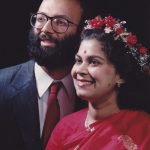
Our wedding portrait, 30 years ago

I love this verbally rich “worship song” from the young song-writer John Mark Macmillan

He is jealous for me.

Love’s like a hurricane, and I am a tree

Bending beneath the weight of his wind and mercy.

 I don’t have time to maintain these regrets,

When I think about the way,

He loves us.

I love the whole song… different phrases at different times. Today, it’s the phrase, I don’t have time to maintain these regrets…

Like most people, I have regrets… mistakes I’ve made through accepting bad advice, through lack of self-confidence, through sinful or foolish choices, distraction, self-indulgence, anger, not putting first things first… the list could go on.

* * *

Roy and I at Christ Church, Oxford where Irene is doing Medicine. Between Auden and Lewis Carrol!

In Tennyson’s poem “Morte D’Arthur,” Arthur’s beloved Queen Guinevre has an affair with his beloved best friend, Launcelot, and Arthur, loving both, is silent. The adulterous lovers are caught in flagrante delicto by his nephew, Mordred, and there is civil war at the end of which Arthur lays dying.

Tennyson has him say,

                      I have lived my life, and that which I have done

       May He within Himself make pure.

That’s a prayer I often find myself praying, putting all I have done into God’s hands, the beautiful and the ugly, the wise and the foolish, and asking him to bring something beautiful out of even my mistakes and sins. Asking him to redeem them, and miraculously transform them.

For what is planted, after a period underground, inevitably emerges as something different, the undistinguished sunflower seed as glorious sunflowers–so redeem it all, Lord, the folly, the laziness, the wasted time, the wasted years, and because of your great mercy, bring something immeasurably different and far more beautiful from these grubby seeds, that I may go out with a vast “thank you.”

“I think that the dying pray at the last not “please”, but “thank you”, as a guest thanks his host at the door. Falling from airplanes the people are crying thank you, thank you, all down the air.” Annie Dillard.

* * *

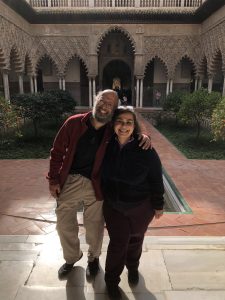
At the Alcazar, Seville, last month

Later this year, I will have been married to Roy for thirty years. Thirty years!! Apparently, only 49 percent of marriages in this country reach this milestone, either through divorce or death, so, God willing, we will be in the happy minority.

The New Yorker writer Tessa Hadley describes long marriages this way: you hold onto your lover through the years, and he changes: a fairy, a dragon, a lion, a beloved man. That is the seminal truth of fairy tales: “What is essential is invisible to the eye, it is only with the heart that one sees rightly,” Saint-Exupery has his  The Little Prince say. Hold on, long enough, and the Beast turns beautiful; the Frog reveals his nobility; Cinderella the Ash-girl, turns regal; Sleeping Beauty comes alive….

* * *

Me, 30 years later!

However, the upcoming anniversary has put me into a reflective mood. I often say, “I wish I had prioritised you more, I wish I had put you first,” and Roy says, “Don’t say sorry; I’m sorry too, but we may have another 30 years, or 40, or more…”

And then I think of redemption. This story runs through scripture: People muck things up, and God redeems them. God not only makes something beautiful out of them, but something more beautiful than things were before the mess, dropped rose or apple seeds blossoming into thousands of roses or apples for decades.

So too in relationships, we sin against each other…inevitably given human selfishness and frailty; we repent, we ask forgiveness, we come together again, and the latter state of our relationship and marriage is stronger than it would have been if we had never blown it, lost our tempers, repented, and come together again to try again to build a relationship built on love and care, and looking out for each other, and trying to put each other first.

Difficult ideals… and undoubtedly, we will again fail, repent, apologise, come together, try again, our marriage under God growing greener, blooming brighter, a sanctuary for ourselves, our children, our old friends, and the new ones God brings our way, like

“a shelter from the wind
 and a refuge from the storm,
like streams of water in the desert
and the shadow of a great rock in a thirsty land.”
(Isaiah 32:2)

* * *

I’m sorry/I forgive you by Libyan artist Arwa Abouon

On our honeymoon, way back in 1989, we took a cruise in a glass-bottomed boat in Florida, through coral reefs. There was an elderly German couple with us, every bit as touchy-feely, and full of lavish public displays of affection. So I, curious, then and now, quite illogically, sweetly asked them, “Are you on your honeymoon too?” “Mein Gott, nein, nein, nein,” the man said. “We’ve been married for forty years!” And then he added kindly, “May you two be as affectionate as you now are when you’ve been married for forty years!” It was a blessing. May it be so. Amen.

I’m sorry/I forgive you by Arwa Abouon

In conclusion, a little, lovely bitter-sweet poem from Robert Bly


KEEPING OUR SMALL BOAT AFLOAT

So many blessings have been given to us
During the first distribution of light, that we are
Admired in a thousand galaxies.

Don’t expect us to appreciate creation or to
Avoid mistakes. Each of us is a latecomer
To the earth, picking up wood for the fire.

Every night another beam of light slips out
From the oyster’s closed eye. So don’t give up hope
that the door of mercy may still be open.

It’s hard to grasp how much generosity
Is involved in letting us go on breathing,
When we contribute nothing valuable.

Each of us deserves to be forgiven, if only for
Our persistence in keeping our small boat afloat
When so many have gone down in the storm.


Books I’ve mentioned which you might enjoy

If you’d like to fine-tune your marriage with insights from neuroscience, try Dr. Sue Johnson’s The Love Secret on Amazon.co.uk or Amazon.com

or her book Hold Me Tight on Amazon.co.uk on Amazon.com .

Annie Dillard’s wonderful, powerful and poetic Pilgrim at Tinker Creek at Amazon.co.uk and Amazon.com

The title poem is from Robert Bly’s enjoyable collection Talking into the Ear of a Donkey on Amazon.co.uk and on Amazon.com

How He Loves by John Mark McMillan on Amazon.co.uk and Amazon.com

Tessa Hadley’s book on long marriages: Late in the Day, on Amazon.co.uk and on Amazon.com

Tennyson’s “Morte D’Arthur” on Amazon.co.uk and Amazon.com

The Little Prince on Amazon.com and on Amazon.co.uk


Filed Under: marriage, There is nothing but love Tagged With: Annie Dillard, EFT, forgiveness, giving up regrets, grace, Happiness, John Mark McMillan, marriage, redemption, Robert Bly, Tennyson, Tessa Hadley, The Little Prince, wedding anniversary

God can Extract Gold from the Griefs of the Past

By Anita Mathias

There is always another one walking beside you T.S. Eliot Wasteland

Emmaus, by Slovenian Jesuit Marco Rupnik from HolyArt.com


So, the new “Great Books” book group I’ve got together (we’re steadily reading chronologically through the Classics!) read the ancient Greek trilogy The Oresteia last week. The plot: Orestes avenges the murder of his father Agamemnon by his mother Clytemnestra by killing her.  And then, the Furies–personified forces of guilt and conscience–hound and oppress him. In the National Theatre production that I watched online, Orestes shuts his ears while they chant and torment.

The scene triggered inchoate half-remembered memories. Memory followed memory in a vicious circle, and I found myself experiencing snatches of what the evil clinical psychologist Henry Harlow (who tortured rhesus monkeys by isolating them for six months to a year in an inverted pyramid from which they could not escape) called the dungeon or pit of despair…

Painful memories from the past re-emerging… It’s not an uncommon experience, I daresay.

* * *

What is the way out? Not by playing the spool of traumatic memory on repeat. But one must notice the memories, not squash them or shove them underground where they might grow, fester and emerge in a more terrible form


This being human is a guest house.
Every morning a new arrival.

A joy, a depression, a meanness,
some momentary awareness comes
as an unexpected visitor.

Welcome and entertain them all!
Even if they’re a crowd of sorrows,
who violently sweep your house
empty of its furniture,
still, treat each guest honourably.
He may be clearing you out
for some new delight.

The dark thought, the shame, the malice,
meet them at the door laughing,
and invite them in.

Be grateful for whoever comes,
because each has been sent
as a guide from beyond. (
Rumi)

* * *

So how did I deal with the traumatic memory that scene triggered, and troubling memories in general? As it happens, there is a whole branch of Charismatic Christian psychology which deals with it, known as the healing of memories. It lets the light in.

You remember that Christ was there when you suffered that trauma. You were wrapped in invisible light. So nothing worse happened.

The past is never dead. It’s not even past, Faulkner famously wrote. That is its curse. The body keeps the score as psychiatrist Bessel van der Kolk writes in his excellent book: The Body Keeps the Score: Brain, Mind, and Body in the Healing of Trauma.  

But… more. God keeps the score. God stores all our tears in a bottle, the Psalmist poetically says. And because the past is not dead, and it is not really past, it can be redeemed. Its trauma and meaning can be changed as God uses the experience, and brings green shoots from the ashes, roses from the rubble.

So what we must do with the past-but-still-alive thing in our bodies and memories is to invite God–for whom all time is brightly alive, for whom past, present and future exist in a single continuum–in. To invite him to bathe the scene in light. To take the sting from the memory. And then to redeem it. To bring good out of it.

Good ? What good?

Whatever good God chooses. Wisdom perhaps. Compassion for those who’ve similarly suffered. Kindness. The ministry of “The Wounded Healer.” Understanding of how we should live. Understanding of how our own sins and weaknesses led to the trauma (if they did). Understanding of others.

The past is present to God, who sees all time in a shimmering, still-active continuum. The old, unhappy, buried things in our lives are merely planted, and God can bring forth exquisitely beautiful things from what we view as dead seeds of pain, trauma, and failure.  For those who love God, everything works out for good, the Apostle Paul famously and puzzlingly says. How? Because God can make it work out for good.

* * *

The escape routes I know from the black hole of painful memories is the tunnel of love which includes the tunnel of forgiveness–self-forgiveness, and forgiveness of others.

“If you, oh Lord, should count our sins, who would survive?” the Psalmist says. Similarly, if we hold onto other people’s sins against us, if the precious ones in our lives keep a record of our sins against them, which relationship would survive? For who hasn’t sinned against those they love? Most importantly, if we hold on to a record of wrongs, we wouldn’t survive in joy, and peace, and creativity. Forgiveness is not easy, it may take repeated attempts and prayer for grace. Eventually, I can testify, by the grace of God, it comes.

* * *

Yes, the tunnel out of dark places, out of negative spirals, is love.

 What is love?

 Because Jesus had this super-brilliant mind, it’s always best to go with his definitions. His short-hand definition of love is what is rightly called, ‘the golden rule’: “Do unto others as you would have them do to you.” Scatter teeny-tiny deeds of kindness along your path, according to your capacity, and nature…

Of course, not every difficult relationship, whether at church, with extended family, and at work, needs to be pursued. Sometimes, we just act with grace and kindness, pray a quick arrow prayer for the person when they come to mind, and let them go, realising that this is not the best relationship in which to invest the limited time we have on earth.

But, in general, we must love one another or die, as the poet W. H. Auden says…. And in transforming a difficult relationship we want to keep, we must bend the other way, in Saint Ignatius’s phrase, maybe overdo the love and care and forgiveness, until loving becomes the norm.   (This, incidentally, is the way to break the grip of vicious circles in our lives… want to wake early, go to bed super-early; want to become tidy… for a while, devote time to becoming super-tidy…).

So, we let it go, let the past go, and instead live in the present, and gently, inexorably, bring light where there was darkness; positivity where there was negativity; plant green seeds of love, gentleness and service, where there was hate, baby step by baby step, into greenness and light.

* * *

 This post was sponsored by holyart.com. Please check them out.


Books Mentioned

The Body Keeps the Score: Brain, Mind, and Body in the Healing of Trauma by Bessel van der Kolk. Excellent resource for those recovering from trauma. On Amazon.com and Amazon.co.uk

Sealed Orders: Agnes Sandford’s wonderful memoir deals with the healing of memories. On Amazon.co.uk and on Amazon.com

The Oresteia on Amazon.co.uk and on Amazon.com.

The Poetry of Rumi on Amazon.com and on Amazon.co.uk


Filed Under: In which I forgive Aught against Any (Sigh), Love: The Most Excellent Way, redemption Tagged With: Bessel van der Kolk, forgiveness, Healing of Memories, Henry Harlow, inner healing, Love, Rumi

Writing and Prayer

By Anita Mathias

“Writing and Prayer” was published in an earlier version as “Learning to Pray,” in The Christian Century, March 22nd, 2000. Reproduced in Religion Online, and many other places.

This is from my book Wandering Between Two Worlds, available  on Amazon.co.uk and Amazon.com and Amazon.in

* * *

Writing and Prayer.  We read about them, write about them, talk about them, agonize about them, resolve to do them, wish we’d done them, more than we actually do them.  In this they resemble other pursuits that people overestimate the intensity, frequency, and duration of–reading, and sex.

Both writing and prayer are archaic, anachronistic, against the grain of modern life, solitary and often heartbreaking, embarked on without the certainty of fruit.   Both demand an expenditure, an apparent waste of time, that’s like a waste of self.  Bill Gates in Time magazine: “In terms of allocation of time resources, religion is not very efficient.  There’s a lot more I could be doing on Sunday morning.”  Of course, of course.  Making art is not the most efficient use of time either when it comes to tangible economic rewards.  It’s working in the darkness with no guarantees of success, publication, or “fame, money, and the love of beautiful people.”  Now or ever.  It’s working with blind faith, stubborn hope, dumb love.


The tiny stunted wings of the flightless cormorant of the Galapagos are useless for flying.  Yet with hazy, ancestral memories of flight, it spends much of its time standing on rocks near the shore spreading its vestigial wings out to dry in the sun, just as flying cormorants do.  Flapping wings with a sense of futility, a foreboding of failure.  That’s how we feel on the brink of something difficult, but exhilarating like writing or prayer.  But if the wind suddenly lifted the bird and it sailed through the skies, effortlessly, beautifully–well, that’s like flight into the realm where the right words in the right order surprise like a free gift; ideas cascade, inevitable as a cataract; and each sentence sings; or in prayer when “so great a sweetness flows in the breast that we must laugh and we must sing, we are blest by everything, everything we look upon is blest.”


In both prayer and writing, these blessed states are partly a free gift, and partly earned: we travail to forge the metal which lightning may strike.  Both take a quiet life, hard work, and sacrifice.  Henry James captures the pain: “If one would do the best he can with his pen, there is one word he must inscribe on his banner, and that word is solitude.”  Though there have, of course, been gregarious writers–I think of Trollope who treasured the social success, the club life, and the friends his writing brought him–and though friendships bring insight, knowledge, self-knowledge, and growth, my own experience echoes T.S. Eliot in “Ash Wednesday,” “Where shall the word be found, where will the word/ Resound? Not here, there is not enough silence.”  Conversations echo in my head, a dissonance drowning out my own thoughts.  Too much extroversion robs me of the inner quiet necessary to view my life sanely, leave alone to revise it.  In fact, my writing and my thinking are inversely proportional to my social life.

“Be still and know that I am God,” echoes an Old Testament imperative.  In the Book of Kings, the Lord appeared to the prophet Elijah, not  in “the great and powerful wind that tore the mountains apart and shattered the rocks,” not in the earthquake, not in the fire, but in “a gentle whisper.”  A whisper, easily drowned in the tumult of an overambitious schedule.  The Quaker writer, Richard Foster, extols the otium sanctum, “holy leisure,” of the Church Fathers.  “If we expect to succeed in the contemplative arts, we must pursue “holy leisure” with a determination that is ruthless to our date books,” he says.

Holy Leisure.  It is indeed the best soil for writing or prayer: a considered, underscheduled and  life with fallow hours, and pruned activities, commitments, friends.  It’s important especially for women, trained to be “nice,” to perfect the difficult art of saying No, resisting the blandishments to busyness, “giving back to the community,” taking your turn, doing your fair share.  Not to do as much as–possibly–you can, but to live with “the broad margin to life,” Thoreau praises, thus making space for the new idea, the transforming insight.  When I look at Vermeer’s paintings, the girl pausing in the midst of quiet work to gaze out of the window and muse, I think: That is how I want to live my life, softly, meditatively, reverently.  Coming to the quietness has a cost, of course, the cost of the loneliness that wrenches you when the quietness you have courted seems more than you can bear.  Precious, costly, and priceless, that holy loneliness, carved out and set apart from the dead wood of lunches, dinner parties, and talk, talk, talk.


We enter the realm of paradoxes.  Though we need solitude to pray, prayer returns to the engagement of love.  The refrain of “The Rime of the Ancient Mariner” long embroidered into samplers declares, “He prayeth well who loveth well/ Both man and bird and beast./  He prayeth best who loveth best/ All things both great and small.”  John, Jesus’ beloved friend, gives us two yardsticks to gauge our spirituality–growing love for God, growing love for the people in our lives.  Real prayer does not so much change God’s mind as it changes us, slowly, almost imperceptibly.  And in the quietness of prayer, we learn the arts of kindness.  Thomas Merton in New Seeds of Contemplation: “It is in deep solitude that I find the gentleness with which I can truly love my brothers.  The more solitary I am, the more affection I have for them.  It is pure affection and filled with reverence for the solitude of others.  Solitude and silence teach me to love my brothers for what they are, not for what they say.”

And though there have been splendid lyric poets like Emily Dickinson who were essentially recluses, drawing inspiration from the certain slant of light on winter afternoons, much of the inexhaustible art like Hamlet, Lear, Madame Bovary, Middlemarch, or Wuthering Heights that shares its wisdom and beauty with you afresh on each encounter, springs from the empathy from which Flaubert declares, “Madame Bovary, c’est moi.”  That’s interesting considering a writer’s actual work, faced with the blank page, is quiet to the point of sensory deprivation.  Just as a foreigner sees the quirks and oddities of a country more clearly than the native, the person who deliberately seeks solitude gains clear-sightedness.  I like that line of Yeats, “And eyes by solitary thought made aquiline.”


Whether one seeks to be an artist or a contemplative, discipline, mundane word, must channel the streams of sweetness that surprise, whether “inspiration,” or the rapturous insights of contemplation.  We’ve heard the metaphor: inspiration, like lightning, strikes where it wills, whom it wills.  But if anything lasting, anything lovely, is to remain after its sudden blazing descent, there is no substitute for the long hours of learning a craft.  This apprenticeship teaches us to tame a torrent of ideas in sinuous, sinewy sentences, in the essay’s narrow room.  (And, as with any craft, and this is one of life’s unfairnesses, there are the naturals who absorb the tricks of the trade rapidly, as if by osmosis, and others, of whom I am one, who learn them slowly, arduously).

In fact, inspiration is a way of seeing, a loving perception of the mystery, the magic, the tiny miracles in daily life that we can train ourselves to acquire.  It takes slowing down.  Consider the subjects that the house-bound Emily Dickinson made poetry of–the fly, the bird, the worm, the snake.  Traveling through the hours lightly, looking, thinking, helps our eyes cultivate the retina of wonder, the ability to “see a world in a grain of sand, and a heaven in a wild flower, hold infinity in the palm of your hand, and eternity in an hour.”

Writing a literary book feels like tunneling through the Himalayas with a spade.  You work in the darkness with no surety that you’ll ever succeed, just wild hope.  You just do it, and do it, and do it, and you probably do it best when you do it without hope of reward–for its own sake.  In “Writing in the Cold,” his brilliant essay on the writing life, the editor Ted Solotaroff suggests that “the turning point in many people’s writing lives was when the intrinsic interest of what they were doing began to take over, and generate a sense of necessity.”  The intrinsic interest rather than ambition, or restlessness for reward: money, praise, “the buzz.”

There’s always the intermittent temptation to abandon being a writer, or being a Christian.   I have, at moments of crushing discouragement, contemplated giving up writing altogether.  But then I know I cannot.  There will always be empty hours.  I cannot imagine living without a passion to fill them, and nothing for me is more interesting.  And so I continue like Macbeth after the first murder that necessitated sequential crimes: “I am steeped in blood so far, that returning were as tedious as going o’er.”  So I work dumbly, doggedly, like a ox plodding in circles, treading grain.  To modify Eliot’s stricture in “The Four Quartets,”  I work and “wait without hope/ For hope would be hope for the wrong thing; work and wait without love/ For love would be love of the wrong thing; there is yet faith/ But the faith and the hope and the love are all in the waiting./  For us there is only the trying.  The rest is not our business,” Eliot concludes.

Writing early drafts feels like groping in the darkness–like reaching for God who is somewhere in the shadows, loving and good, powerful and wise.  And amid the griefs of life–a precious friendship dissolves amid gossip and misunderstandings, the book manuscript I’ve worked on for five years is not viable, when I feel pierced by “the arrow that flies by night,” inexplicable malice, envy, betrayal, the human depravity scripture details–I grope for him, trying to see the meaning, the final draft, when all around me is a mess of manuscript, haphazard, crossed-out, added-to.  And I try to revise myself and my life beyond the first draft, believing that with the help of the sovereign wise artificer, this manuscript of aspirations will eventually become the  finished, completed, perfect book.


While practicing both arts, you yearn for acceleration.  You get fed up of this trying and failing; you want to write well; you want to master your craft.  You want to savor the joy, and the peace that passeth understanding that lured you onwards.  But spiritual growth is slow and gradual.  The good man in the Psalms is compared to “a tree planted by streams of water, which yields its fruit in due season.”  Evolving as an artist is a similarly organic process.  The natural can master her craft more rapidly by a ferocity of hours and will, diligence and discipline, but wisdom comes in its own time.  That’s why it’s hard to think of a writer who has been a child prodigy, a Mozart.

Yet, though nothing but time can turn a sapling into the largest of trees, so that the birds of the air come and perch on its branches, there are organic fertilizers for one’s tender spiritual or artistic life, that will help it grow stronger, lovelier, and, yes, faster. Reading widely and deeply, the old masters as well as new ones; writing carefully and continually for writing is an art one learns by doing; seeking out smart criticism to show you your blind spots; creating time and space to work quietly–these help a writer develop.  A fierce yearning–“God-hunger”–launches spiritual growth.  “You shall seek me, and you shall find me when you seek me with all your heart:” Jeremiah’s words were engraved on a plaque in our dormitory when I was a novice with Mother Teresa at Calcutta.  Yearning and seeking–but also making time to meditate on Scripture, discipline in obeying its wisdom.  Though spiritual maturity will come in its own time, these practices might hasten that day.


And in both arts, like a shadow behind the bright yearning for perfection, is the inevitability of failure.  The Apostle Paul laments this in a poignant, brilliant passage: “I do not understand what I do.  For I have the desire to do what is good, but I cannot carry it out.  For what I do is not the good I want to do; no, the evil I do not want to do–this I keep on doing.

        So I find this law at work: When I want to do good, evil is right there with me.  For in my inner being, I delight in God’s law; but I see another law at work in the members of my body, waging war against the law of my mind and making me a prisoner of the law of sin.  What a wretched man I am! 

        Failure–or, theologically, sin–is the antiphon to our yearning for goodness; to be loving; to be, in the Biblical word, righteous.  But through it all, through the valley of failure,  emerges a faint, pointillist likeness to Christ.  You are changed as you seek to imitate Christ, and more, to be merged with him, to be blood brothers in the ancient sense, and have his sweet life flow through you as sap through a vine, in his metaphor.

When I write, I desire beauty in my inmost being.  I want my sentences to be as iridescent as Nabokov’s, as grave and freighted and precise as Alice Munro’s, as haunting as Keats’ or Hopkins’ or Sylvia Plath’s.  I want to create essays as lovely as a bough quivering with spring blossoms or glistening with icicles.  I do not see this in my drafts.  Wretched woman that I am, what will rescue me from this imperfect work?  Time might, and hard work might, and reading constantly and critically might.


Or perhaps nothing will.  I may never be Nabokov or Rushdie, my favorite prose stylists.  John Gardner claims that more people fail at becoming successful businessmen than at becoming writers.  If so, I must know many of the unsuccessful, for I know many who write hard, and read hard, and long hard for success, but whom success eludes, who have very minor careers at best.  Solotaroff, less encouragingly, looks at the young writers full of bright promise that he published in the “New American Review,” and estimates that one-quarter go on to have reasonably successful careers; one-quarter have marginal ones in the alternative literary community of the little magazines and small presses; and one half simply disappear.

What separates the writer who emerges from the one who disappears?  These help budding talent flower–the time and quiet to write, the stimulation and encouragement of the literary community, the support of family, adequate money and privacy: “500 pounds a year and a room of one’s own”–a concatenation of happy circumstances.  When I read biographies of writers, I am struck by how their development as artists was aided by “luck”–a crucial nurturing friendship with a mentor or a fellow writer in their formative years, the zigzags of life leading to the books, paintings, cities, teachers, friends they needed to blossom.  As the old weary book of Ecclesiastes observes, “The race is not to the swiftest, nor does food come to the wise, or wealth to the brilliant, or favor to the learned, but time and chance happen to them all.”  On the other hand, luck does tend to happen to gifted people who work hard.  And good writing is the best connection, the best “in” to the loop.

And then there’s “talent,” arbitrary, undemocratic thing.  In Christ’s parable of the talents, the master at random gives his three servants one, two, and five talents.  The latter two servants work mightily, but limited by their “raw talent” produce four and ten talents respectively.  If you start out with but two talents–of time, energy, intelligence, literary education, opportunity, flair–all your diligence will probably increase it to no more than four talents.  And it may take ten talents to write a truly beautiful book.  These are facts one accepts, then forgets about; they do not take away from your duty to work, nor from the joy of work.  For there is no exact gauge for literary talent; you do not know how luminous a book you might write till you have written it.

You need luck, you need talent, and you need determination and perseverance which, finally, is crucial.  “The writer’s main task is to persist.  Her most important imperative is to be at work,” Solotaroff says.  Through constant reading, writing, revision, a style is forged.  To finish writing a difficult book, or to mature spiritually until you transcend your oldself as modern saints like Gandhi, or Mother Teresa, or Maximilian Kolbe, takes the stamina of a pilgrim walking across a continent, or a gold miner digging in the almost unendurable heat of the Kolar gold fields of India, his eyes on the prize.


Both writing and prayer require a strenuous attempt at detachment from our distracting world of dollars, demands, the telephone, mail, friends, false friends, and extended family–“the enemies of one’s own household,” Jesus calls them.  The world that is too much with us.  Entering the world of the imagination is like gazing into the enchanted universe of an intertidal pool in which purple sea urchins and emerald sea anemones glow, along with hermit crabs hiding in other creature’s shells, and sea stars, black, white, and orange.  I must tiptoe into this world–leaving behind the nagging Old World of people and their irritations, mess in the house, to-do lists, the jagged edges of life jabbing me–slowly, gingerly, like an immigrant unsure of the language, the customs, the geography of a country.

So spiritual directors suggest rituals to nudge the spirit into the presence of God–reading scripture, or breathing deeply to calm the body and concentrate thought before floating free.  I offer myself absolution for the bumpy hours of easing into the zone, the priming rituals of reading great stylists until my pulse throbs in a complex rhythm I’ve unconsciously absorbed–or mechanically rereading the last few pages I’ve written to reenter the imaginative field of my piece.  And then when ideas race from my neurons to my fingers, when my mind starts connecting all the scattered leaves of my universe, and I begin writing, almost instinctively, the language of literature: metaphor, imagery, alliteration, assonance, poetry, and my sentences sing, a car pulls into the driveway, my husband and daughters are home, and I am back to my old life, blinking like Lazarus, summarily summoned from death’s dark kingdom to the blithe goings-on of the everyday, to the crowd that gapes at him, quite unaware of the shadow world of beauty and terror (if Dante is to believed).  I return shakily, a bit uncertainly, like one roused from a vivid dream, dazzled in the light.


Both writing and prayer are best done in the same place, at the same time.  When I walk up to my familiar writing place–my armchair facing the woods–and see it waiting, quiet and ready, I start feeling calm.  I feel like writing.  An inner voice says, “Hurry up now; it’s time.”  And contrary to romantic myth, a steady, scheduled life helps writers as much as it helps pray-ers.  Flaubert: “It is good to be regular and orderly in your life, so that you may be violent and original in your work.”

So too, the memories of the previous times we have met with God on our habitual holy ground usher us into an expectant quietness.  Merton describes prayer in his accustomed sacred spot: My chief joy is to escape to the attic of the garden house and the little broken window that looks out over the valley.  There in the silence, I love the green grass.  The tortured gestures of the apple trees have become part of my prayer….  So much do I love this solitude that when I walk out along the road to the old barns that stand alone, delight begins to overpower me from head to foot, and peace smiles even in the marrow of my bones.”


Praying is like talking a foreign language.  The nouns and verbs in this holy terra incognita are in a softer, lower timbre–patience, quietness, humility, self-denial, or turning the other cheek.  When I read the New Testament, I’m struck by this “upside-down kingdom,” its reversal of the values of even good people.  Do not repay anyone evil for evil.  Love your enemies; do good to those who hate you. Give secretly so that your right hand does not know what your left hand is doing.  Invite those to your home who cannot invite you back. 

In our world, we trust in our ability to work, network, charm, maneuver.  But “the wisdom of this world is foolishness in God’s sight,” the Apostle Paul says.  In God’s world, the person who trusts in God will be as blessed as “a tree planted by the water that sends out its roots by the stream.  It does not fear when heat comes; its leaves are always green.  It has no worries in a year of drought, and never fails to bear fruit.”  Our world values action, quick success–grabbing our desire from the jaws of hostile fate, battering down doors with our will.  In God’s realm, we work quietly, knowing success will come according to his will, and in his perfect timing.  In the world we know, we blow our own trumpet for fear that no one else will do it for us.  If we try to walk Christ’s way, we do not exalt ourselves, believing Jesus: “For everyone who exalts himself will be humbled, and he who humbles himself will be exalted.”  We wait, feeding off the wise, strong, sweet life of Jesus, God made flesh, metaphorically eating his flesh and drinking his blood.  And when we glimpse the quietness and wisdom of God, and even momentarily take a God’s eye view of our life, our internal chatter of anxiety and annoyance is silenced as our perspective shifts, and our spirit sings in worship.

Humility, an acceptance of unknowing, is a shortcut in both paths.  “If the angel comes, it will be because you have wooed him by your grim resolve to be always a beginner,” Rilke muses.  I have grown as a writer through the humility that rejection brings.  A publisher turns down my work, I do not get the fellowship I applied for, and I realize that my writing is probably not good enough–yet.  In the first humbling, I feel I know nothing about literature or writing, nothing at all.  Then I read with an alert hunger, studying again Speak Memory or Midnight’s Children.  I study the craft of writing; I let books on tape murmur to me at fallow moments in the car, on the treadmill.  I revise my manuscript with renewed rigor, a rekindled passion for beauty.  And through this starting again as a beginner with fresh joy, trying again to say in as few words as possible exactly what I mean; once more reading continually the books that are truly great, I learn, I grow; my writing changes, matures.  Rejection is a disguised friend, freezing me in my onward motion, forcing me to rethink my essay, my vocation.


The support of a community strengthens one in both quests because they are counter-cultural; in fact, senseless judged by the efficient values of the marketplace.  We invest much time in seeking God, without any scientific certainty that he exists, just the knowledge of the heart.   And when with twentieth century rationality, I query: Do I really believe that God invaded human history 2000 years ago; walked our mountains and waters teaching, was crucified for uttering uncompromising truth; it helps me believe when I see Jesus’ great insights proved true, not only in the wrinkles of my own life, but in the lives of other Christians.  That joy comes not from gratifying every clamorous desire, but in silencing the frog chorus, I, I, I, and losing oneself in contemplating Christ and in loving–spouse, children, friends; in seeking righteousness rather than the gratifications of money or success.  In my Christian friends too, I often observe increasing goodness and a slow deepening, as they are transformed from glory to glory, in the Apostle Paul’s phrase.  And though I do believe, deeply, as one does when faith is verified by experience, I am an existentialist Christian when assailed by doubt.  I choose to believe like Puddleglum, the Marshwiggle in The Chronicles of Narnia who says: “I’m on Aslan’s side, even if there isn’t any Aslan to lead it.  I’m going to live as like a Narnian as I can even if there isn’t any Narnia.”  And so I go to my small church most Sundays to pray and worship with other believers, refiring my weary distracted heart with other’s fervor.

Few writers evolve in solitude. At some point, even the martyrs of art–like Emily Dickinson, Keats or Thoreau–met other writers who shared the twin passions of the love of literature and their own ambition.  It is reinforcing to have other writers in our lives to share the glow of that first publication in a literary journal for which we made fifteen dollars, but which meant that our craft had begun to take that miraculous leap from saggy, unpublishable writing to  publishable, published writing.  It strengthens our passion to have people to talk to about books and writing, and esoteric conditions like writer’s block, who understand our anguish when the chapter, the book we worked on for so long miscarries.  Our fellow-travelers bolster our conviction that our vocation, often dismissed as a pleasing hobby, an indulgence–Oh how nice!  You write!  Have you published anything I might have seen?--rather than the disciplined pursuit of an art is significant, worthwhile work for grown-up people.


Thomas Merton connects the two vocations in his essay, “Integrity.”  “Many poets are not poets for the same reason that many religious men are not saints: they never succeed in being themselves.  They never get around to being the particular poet or the particular monk they are intended to be by God.  They never become the man or the artist who is called for by all the circumstances of their lives.

They waste their years in vain efforts to be some other poet, some other saint.  They wear out their minds and bodies in a hopeless endeavor to write somebody else’s poems or possess somebody else’s spirituality.

There can be an intense egoism in following everybody else.  People are in a hurry to magnify themselves by imitating what is popular–and too lazy to think of anything better.

Hurry ruins saints as well as artists.  They want quick success and they are in such haste to get it that they cannot take time to be true to themselves.”


Writers begin as babies or mockingbirds–by imitating.  Partly because of the mimicry involved in the extended process of finding their own voice and subject matter, many writers–consciously or unconsciously–sound like someone else while in their apprenticeship.  The fashionable, with its lures of quick success or fame, tempts.  However, once the writer grows in confidence and begin to tell the truth, she slowly discovers her own quirky, original voice.  A distinctive style begins to shape itself.  She begins to draw, truthfully, on her own ideas, convictions, emotions, family, and biography, unfashionable and squirmy though they may be, not on what has been published or is popular, and so finds the memoir that she alone can write, that is like no other memoir ever written, just as the inner geography of her life in its hills and valleys, heartbreak and delight, is like no other life.  If she dips her pen into the sore of her own grief, her shame, her secrets, she will add electricity to her memoir, or to the more disguised forms of autobiographical writing like poems, novels, or short stories.  Rushdie–“A writer’s injuries are his strengths, and from his wounds will flow his sweetest, most startling dreams.”

And from the molten lava of her own guilt, her hypocrisy, her pangs of despised love, and yes, stabs at virtue, self-forgetting love, longing for transcendence, the writer can mold powerful art–with this six inches of ivory, this postage stamp of earth.  In The Enigma of Arrival, V.S. Naipaul describes how he tried to sound cosmopolitan when he first started to write, while striving to edit out his past in his Asian community in Trinidad, his naivete and clodhopperish inexperience, and the humiliations attendant on his transplantation to the West, not realizing that in his peasant background and behaviors lay his most authentic story.  Later in his masterpiece, A House for Mr. Biswas, he lingers on the things he was most ashamed of.  He writes, “Man and writer were the same person.  But that is a writer’s greatest discovery.  It took time–and how much writing!–to arrive at that synthesis.”


Both writing and prayer are disciplines of little things.  I love this poem by Robert Francis:

Excellence is millimeters and not miles.

From poor to good is great.  From good to best is small.

From almost best to best sometimes not measurable.

The man who leaps the highest leaps perhaps an inch

Above the runner-up.  How glorious that inch

And that split-second longer in the air before the fall.

What are the millimeters from almost best to best?  Spare writing with every unnecessary word shaken off the page.  Details almost invisible to the rapid reader: the imagistic verb, the painterly image, a sentence that sings.  Writing that in Conrad’s phrase, “makes you hear, makes you feel–that is, before all, makes you see.”  So too, it’s in the details of love that spiritual transformation occurs and exhibits itself–not so much in the showy dahlias and cannas, but in violets and bluebells.  The Apostle Paul declares in, probably, the most famous passage in the New Testament: “If I speak in the tongues of men and of angels, but have not love, I am only a resounding gong or a clanging cymbal.”  He explicates the tiny virtues.  “Love is patient, love is kind.  It does not envy, it does not boast, it is not proud.  It is not rude, it is not self-seeking, it is not easily angered, it keeps no record of wrongs.”


A snide definition of a classic: a book which everyone wants to have read, but no one wants to actually read, today, tonight–the Iliad or The Remembrance of Things Past.  We desire the blessings of God–life in its fullness, joy, peace, fruitfulness more than we desire God himself.  We yearn for a book magical, lyrical, perfect, more than for the actual process of rewriting a chapter yet again, the long months and years before the finished book.  And in both quests, the secret of joy is losing yourself in the pleasure of the present, in the play of words, in learning Christ, his quirky values, and imitating him.

How crass this sounds, but in both endeavors, quality springs from quantity!  “If you want to pray better, you should pray more,” Mother Teresa says.  Somerset Maugham writes: “I venture the opinion that you cannot write well unless you write much.”  The more we write–if we do so critically, learning from good teachers, getting insightful feedback, reading, reading, practicing, practicing–the better we write.  As loving-heartedness is the touchstone of the verity of our prayers, the market is the red light in writing.  Rejection slips speak their own language.  Of admonition.  You are not there yet.  Seize the day.  Work as hard as you can.

Both writing and prayer usher us into the heart of mystery.  From where do poems come?  Or from where, indeed, does nature?  Or God?  The faces of the audience at the Geraldine Dodge Poetry Festival at which I sought a total immersion into poetry, were rapt as at a religious service.  For literature partially and temporarily slakes the religious yearning for beauty, order, truth.  Both disciplines are therapeutic in their search for the difficult truth that frees.  Like prayer, the very act of writing calms and focuses us.  Often, the difficulty lies in just settling down and doing it.  As with sex or exercise or good conversation, it can be hard to get going, but once we have, it’s as if we can keep going indefinitely.  Good writing and good prayer, like good sex or good mothering, demand self-forgetfulness, losing ourselves in the other, our subject, our Lord.  And the flow of creativity or prayer can be jammed and dammed by similar barricades–anxiety, hostility, anger, cherishing  untruths, saying too many Noes.


We are lured into both by the dream, the promise of joy.  The cost turns out to be more than we ever imagined: “not less than everything.”  We begin to experience the disappointment, doubt, rejection, agony–and the ultimate triumph of sacrifice–involved in becoming an artist.  And we learn the rending cost of denying ourselves, taking up our cross daily, breaking out of the prison of the self and its incessant needs and demands, choosing small deaths, in a sense, so as to transcend ourselves and have a richer, more fruitful life.  Jesus  understood it: “Unless the grain of wheat falls into the ground and dies, it remains alone.  But if it dies, it yields a mighty harvest.”

When we train ourselves in the scriptural precept to pray constantly, trying to be continually aware of the quiet presence of Christ: a radiance, a luminosity, like the silent, ever-present ghost in old movies, a quietness begins to sink over our beings, the quietness in which creative thought is engendered.  We must persist in both disciplines until they become instinctive, until we convert every thought, desire and frustration into a prayer, turning to God as naturally as a flower turns its face to the sun and the butterflies.  Similarly, the writer must keep writing until this inward work, this daily creation, becomes as necessary as thinking; so essential that a day in which she has not written will seem a day in which she has not fully lived.


A Chinese saying: “From boredom to fascination.”  Though difficult at first, both quests lead to an awareness of joy, shimmering, pulsing through life.  As I mature spiritually and psychologically, my values shift.  Oh dear, they become more old-fashioned–the preciousness of the family I have chosen, my husband and my daughters; the balm of friendships; the durable self-forgetting pleasures in reading, art, nature, gardening.  And writing?  It remains my vocation, my duty and my desire, a precious strand in the tapestry of my life, a beloved pure note in its orchestra, a joyous obligation like those to my husband and children, who have no other wife, no other mother.  And amid life’s richness in the busy season–two daughters, four years old, and four months old; a career; a husband with a career; a house, a garden, a dog, friends, a life–can writing wait?  At times, it will have to.  And in the forge of dreams deferred, other jewels might be crafted:ethos, character, undergirding and lighting the logos, words, and pathos, emotions they evoke–the three elements of great art Aristotle outlines in his Rhetoric.  Writing with wisdom, depth, power.  And now, in the season of duties, as I choose books to read or subjects to write on more for the pleasure that dwelling on them will bring rather than for rewards of glitter or success, I am recovering some of the joy I’d lost in my anxious, striving, ambitious twenties.

Though the gloomy may say that the life of a writer is simply “the exchange of one level of rejection, uncertainty, and disappointment for another,” persisting long enough to learn and master your craft gives you ever more of those moments of enchantment when your whole being is intensely alive; you are lost in the joy of work; sparks flash from your imagination and set the page on fire; and you read over a finished piece, and like God in the garden of Eden, behold what you have written, and–temporarily–decide that it is good.

“Writing and Prayer” was published in an earlier version as “Learning to Pray,” in The Christian Century, March 22nd, 2000. Reproduced in Religion Online, and many other places.

This is from my book Wandering Between Two Worlds, available  on Amazon.co.uk and Amazon.com

and Amazon.in

Filed Under: Writing and Blogging Tagged With: Prayer, writing

For our griefs, failures, tears, Christ’s desire is “Let nothing, nothing be wasted”

By Anita Mathias

So, yesterday, my labradoodle, Merry, who is three quarters poodle, a hunting breed, came home from her walk with Roy, tail wagging, and with a present for me… a beautiful, quite adorable rabbit–perfectly dead.

I screamed! I love rabbits, and we’ve had several as pets over the years. In fact, this was probably a descendant of the ones which got away!

Most domestic dogs no longer have the enzymes to digest raw meat, so, frustratingly, Merry would not eat her rabbit. We left it at the bottom of the garden. As I sat in my conservatory, writing, watching, a red kite appeared overhead, swooped down.  At dusk, the dogs went mad. I saw a shadowy fox disappear, a rabbit in its mouth.

* * *

Nothing, nothing, is wasted. The dead rabbit fed the kites and the foxes, as she had fed on grass enriched by their droppings. The apples which we lacked the diligence to harvest fall, and become next year’s harvest. “We are but dust, and to dust we shall return,” fertilising the soil, which has fed and fertilised us.

“Let nothing be wasted,” Jesus said, after–like a brilliant entrepreneur–he created great abundance out of almost nothing, feeding 5000 from five barley loaves, and two small fish. But, at his request, they gathered the left-over scraps of bread, filling twelve baskets.


If that is his desire for scraps of bread, how much more with our lives! Almost all lives are composed of false starts, dead ends, practice or abandoned projects, and vanished things—friendships, relationships, stuff, languages we once learnt, books we started writing. A room full of half-finished canvases, statues, books and poems… with perhaps a few shining examples, perfectly finished. Many of our lives look like that.

But Jesus wants nothing to be wasted. I have lived my life and that which I have done…may He within himself make pure, Tennyson has the dying Arthur pray that Christ will redeem all things. So, all we can do is give him the little we have, the five loaves and two fish, and the fragments, the twelve baskets of broken pieces. And trust him… to use the false starts in writing to make one true work; the broken or neglected friendships to build true friendships which might last; to use our failures in faith, hope and love to teach us faith, hope and love, and to use all our yesterdays as tuition for a tomorrow in which we shall focus on the only two things  which truly matter in God’s eyes–to love God wholly, with all our mind, all our heart, all our spirit, and all our strength, and to  live in kindness towards ourselves and others, in Jesus’s words “to love our neighbour as we love ourselves.”

I love reading memoirs, and autobiographies, and I am often amazed by how God uses false starts and dead ends to form people’s characters, and life work. Our miseries become our ministry, perhaps even our callings and vocations.  Unless we too have bled, it is difficult to speak or write words which matter to someone struggling with a difficult marriage, a health problem, an eating disorder, debt, or tricky relationships. Reading memoirs, I am struck too by how, in the end, it’s not the all the travel, adventure, success, or wealth which make a beautiful and meaningful life, but just two, perhaps three things…. to love something big–and what could be bigger than God?–and to live in love and kindness towards others. (And if we are very lucky, to create something that “the world will not willingly let die,” in John Milton’s old beautiful phrase.)


Filed Under: redemption Tagged With: redemption

 Finding Golden Hours in Dark Days (and Some Thoughts on Forgiveness)

By Anita Mathias

I love travel, and I’ve had many, many magical trips over the years…Costa Rica, New Zealand, Norway, Slovenia, and several trips to Switzerland, Italy, France and Greece were highlights.

But anyone who travels a lot knows that every trip will not be a slice of heaven. Things can go wrong, tempers can go wrong.

So we once left on holiday two days after my husband had surgery on a polyp. We had tickets to fly, but couldn’t because of the recent surgery, so claimed travel insurance, and drove. He was angsty; I was angsty; it was one of the hottest summers on record (as almost every summer in Europe is nowadays), and we overheated, in every way, argued and got historical, masking our fear. (Would he take chemo? I, the risk-taker, did not; would he, the cautious one, be foolish enough to (in my book)? Irene, our daughter, who is studying Medicine at Oxford University, hissed, “Mum, I will be so mad at you, if you tell him not to take chemo,” and I, “But, of course, I will. Chemotherapy is a demonic, extremely toxic poison. It’s irresponsible, quite insane, to take it if there are alternatives.” So, you see, we were in just the right frame of mind for a peaceful holiday!!

However, when we parked, and got out of the motorhome, there were beautiful palaces like Palais des Papes in Avignon, historic walled cities, magnificent Roman ruins like Pont du Gard, cathedrals, beaches, glorious mountains, walks by gorges, a hike up a volcano, and great food. Magic, self-forgetfulness, joy.

So, how do I assess this holiday, I wondered, as I sorted through my photos each evening. If you looked at the hours and minutes, there was much interest and magic, and the losing track of time which defines happiness for me. There were also heated arguments.


It’s like life. Every day has beautiful things, what the poet Rilke calls, “the things that will never leave you:” sunrise, sunset, cirrus, cumulus, and cumulonimbus clouds, the ever-changing panorama of nature, the quiet patience and dignity of animals, people who love you, and the inalienable love of God. Most days have opportunities to read, to pray, to meditate, to sleep, to walk, to awaken your body with exercise, to love,  to rest and relax, and rejoice in the love of God. When we live fully in each hour, there is much to make us happy, and many things to be thankful for… even though things have gone wrong, there have been hammer-blows to the heart, the breakers and waves have crashed over us, and there is an Evil Being, the enemy of our souls, who prowls, who can possess people, and bend them to his malign will (literally, metaphorically). Hassle we will not escape, for it is in skilfully dealing with it that we grow strong.

But God gives us good and happy hours in the midst of the worst days, and, so, even during the worst days, we need to seize them with gratitude.

* * *

What went wrong in the motorhome that holiday was not just the Damocles sword of pending test results. (We got a call on holiday, but not the call. All was well. Phew!!) It was that we brought unresolved issues on holiday with us.

I recently read an inspiring biography, “My Life: A Guided Tour” by Ken Taylor, translator of The Living Bible; and a bestselling children’s writer, founder of the major Christian publishing company, Tyndale House; the Christian Booksellers Association; pioneer of short-term missions; Life Application Bibles, and the One Year Bible. Almost everything that man touched turned to gold.

He had ten children, and, when they were young, had inadequate housing and not much money. Unsurprisingly, there were tensions, and his wife was critical of him. He describes leaving the house, seething, and being in turmoil all day, walking for hours until his anger was spent. He believed this anger “was hindering his prayers,” but “steady peace and joy with my wife seemed beyond my ability.”

Taylor finally decided that this must not go on. He wanted to get his prayers answered. The solution, which he felt he could not bear to consider, was “simply to forgive Margaret for criticising me. The situation must end, and since Margaret would not solve the problem by no longer criticising me, I would have to take the lead by trying to learn from her criticism, and meanwhile forgiving her for hurting me.”

“It was one of the hardest actions of my life,” he wrote, “to allow myself to admit the fault she had alleged, and concurrently to say in my heart, ‘I forgive you,’ and mean it. But God helped me.”

“The next time a criticism came—a few days later—I flared up internally as before but rushed out and prayed for help to accept and forgive, then I came back quieted a few minutes later. Not many days went by before I realised that the flare-ups took a shorter and shorter time to deal with, and they could finally be handled immediately. A few weeks later, Margaret remarked, “You are different from the way you were,” and I knew the Lord’s grace had prevailed, the spiritual battle of many years was ended, and Satan, who had conquered for so long, was himself conquered.

And when the turmoil ended, the grass could become fresh and green, and flowers could grow and bloom—and they did.”

This is the best account of forgiveness in practice that I know of.

* * *

More and more, I am trying to keep short accounts, to forgive when things happen, or surface in memory, so that I can live happily, and as free as a bird.

Here’s a striking story from missionary, Simon Guillebaud: In Malaysia, monkeys invaded a farmer’s land and destroyed his crops. The damage jeopardized his very livelihood so he needed to act fast. The ingenious solution he devised was to put peanuts in hollowed-out coconuts. He then hid and waited. The monkeys came, scaled the walls, and smelt the peanuts. When they found them in the coconuts, they grabbed them, but now their clenched fists couldn’t pull them out – they couldn’t fit through the narrow apertures if they remained clenched. Neither could the monkeys now scale the walls again without releasing the peanuts, but they didn’t want to, so they were stuck. The farmer then reappeared and shot them one by one. Their freedom was so easily attainable. All they had to do was let go, but they chose to hold on.

If you are holding on to anything, let go.”

Let it go. Let the peanut go. Most of us who live in this world have been cheated, robbed, lied to, lied about, manipulated, taken advantage of… Evil is a real force in the world, though not as strong a force as good.

Just let it go, let the peanut go. That does not mean you have to invite those who have slandered, cheated, or abused you to lunch, or to be your house guests, or best friends. It may not even be safe to be in relationship with them, for evil is real, and there are People of the Lie.


Forgiveness is partly a matter of mental discipline. When the memory of wrongs surfaces, release the darn peanut.  Mentally say, “I forgive you.”  Release the peanut to God, the righteous judge, and leave it in God’s hands. “No one gets away with anything,” John Arnott says in Grace and Forgiveness. Ask God to convert the evil done to you to good. (“You meant it for evil, but God meant it for good,”  Joseph tells his scheming brothers).

To leave the harm done to us in God’s hands, and then ask God to bring good to us and to our family out of the evil done to us is a potent prayer, which sets us free to dance.


Further Reading

Grace and Forgiveness by John Arnott (Amazon.co.uk) and on Amazon.com

My Life: A Guided Tour by Kenneth Taylor on Amazon.co.uk and on Amazon.com

Choose Life: 365 Readings for Radical Disciples by Simon Guillebaud on Amazon.co.uk and Amazon.com

The People of the Lie: M. Scott Peck on Amazon.co.uk and Amazon.com

Image: Creative Commons.

Filed Under: Applying my heart unto wisdom, In which I am Amazed by Grace

  • « Previous Page
  • 1
  • …
  • 5
  • 6
  • 7
  • 8
  • 9
  • …
  • 279
  • Next Page »

Sign Up and Get a Free eBook!

Sign up to be emailed my blog posts (one a week) and get the ebook of "Holy Ground," my account of working with Mother Teresa.

Join 536 Other Readers

My Books

Rosaries, Reading, Secrets: A Catholic Childhood in India

Rosaries, Reading Secrets, B&N
USA

UK

Wandering Between Two Worlds: Essays on Faith and Art

Wandering Between Two Worlds
USA

UK

Francesco, Artist of Florence: The Man Who Gave Too Much

Francesco, Artist of Florence
US

UK

The Story of Dirk Willems

The Story of Dirk Willems
US

UK

My Latest Meditation

Anita Mathias: About Me

Anita Mathias

Read my blog on Facebook

Follow me on Twitter

Follow @anitamathias1

Recent Posts

  • At the Cross, God Forgives Us, Completely
  • Using God’s Gift of Our Talents: A Path to Joy and Abundance
  • The Kingdom of God is Here Already, Yet Not Yet Here
  • All Those Who Exalt Themselves Will Be Humbled & the Humble Will Be Exalted
  • Christ’s Great Golden Triad to Guide Our Actions and Decisions
  • How Jesus Dealt With Hostility and Enemies
  • Do Not Be Afraid, but Do Be Prudent
  • For Scoundrels, Scallywags, and Rascals—Christ Came
  • How to Lead an Extremely Significant Life
  • Don’t Walk Away From Jesus, but if You Do, He Still Looks at You and Loves You
Premier Digital Awards 2015 - Finalist - Blogger of the year
Runner Up Christian Media Awards 2014 - Tweeter of the year

Categories

What I’m Reading


Wolf Hall
Hilary Mantel

Wolf Hall --  Amazon.com
Amazon.com

Amazon.co.uk

Silence and Honey Cakes:
The Wisdom Of The Desert
Rowan Williams

Silence and Honey Cakes --  Amazon.com
Amazon.com

Amazon.co.uk

The Long Loneliness:
The Autobiography of the Legendary Catholic Social Activist
Dorothy Day

The Long Loneliness --  Amazon.com
Amazon.com

Amazon.co.uk

Country Girl
Edna O'Brien

Country Girl  - Amazon.com
Amazon.com

Amazon.co.uk

Archive by month

My Latest Five Podcast Meditations

INSTAGRAM

anita.mathias

My memoir: Rosaries, Reading, Secrets https://amzn.to/42xgL9t
Oxford, England. Writer, memoirist, podcaster, blogger, Biblical meditation teacher, mum

Well, hello friends! Breaking radio silence to let Well, hello friends! Breaking radio silence to let you know that I have taped a meditation for you on Christ’s famous Parable of the Talents in Matthew 25. https://anitamathias.com/2025/11/05/using-gods-gift-of-our-talents-a-path-to-joy-and-abundance/
Here you are, click the play button in the blog post for a brief meditation, and some moments of peace, and, perhaps, inspiration in your day 🙂
Hi Friends, I have taped a meditation; do listen a Hi Friends, I have taped a meditation; do listen at this link: https://anitamathias.com/2025/04/08/the-kingdom-of-god-is-here-already-yet-not-yet-here-2/
It’s on the Kingdom of God, of which Christ so often spoke, which is here already—a mysterious, shimmering internal palace in which, in lightning flashes, we experience peace and joy, and yet, of course, not yet fully here. We sense the rainbowed presence of Christ in the song which pulses through creation. Christ strolls into our rooms with his wisdom and guidance, and things change. Our prayers are answered; we are healed; our hearts are strangely warmed. Sometimes.
And yet, we also experience evil within & all around us. Our own sin which can shatter our peace and the trajectory of our lives. And the sins of the world—its greed, dishonesty and environmental destruction.
But in this broken world, we still experience the glory of creation; “coincidences” which accelerate once we start praying, and shalom which envelops us like sudden sunshine. The portals into this Kingdom include repentance, gratitude, meditative breathing, and absolute surrender.
The Kingdom of God is here already. We can experience its beauty, peace and joy today through the presence of the Holy Spirit. But yet, since, in the Apostle Paul’s words, we do not struggle only “against flesh and blood, but against the rulers, against the unseen powers of this dark world and against the spiritual forces of evil,” its fullness still lingers…
Our daughter Zoe was ordained into the Church of E Our daughter Zoe was ordained into the Church of England in June. I have been on a social media break… but … better late than never. Enjoy!
First picture has my sister, Shalini, who kindly flew in from the US. Our lovely cousins Anthony and Sarah flank Zoe in the next picture.
The Bishop of London, Sarah Mullaly, ordained Zoe. You can see her praying that Zoe will be filled with the Holy Spirit!!
And here’s a meditation I’ve recorded, which you might enjoy. The link is also in my profile
https://anitamathias.com/2024/11/07/all-those-who-exalt-themselves-will-be-humbled-the-humble-will-be-exalted/
I have taped a meditation on Jesus statement in Ma I have taped a meditation on Jesus statement in Matthew 23, “For those who exalt themselves will be humbled, and those who humble themselves will be exalted.”
Do listen here. https://anitamathias.com/2024/11/07/all-those-who-exalt-themselves-will-be-humbled-the-humble-will-be-exalted/
Link also in bio.
And so, Jesus states a law of life. Those who broadcast their amazingness will be humbled, since God dislikes—scorns that, as much as people do.  For to trumpet our success, wealth, brilliance, giftedness or popularity is to get distracted from our life’s purpose into worthless activity. Those who love power, who are sure they know best, and who must be the best, will eventually be humbled by God and life. For their focus has shifted from loving God, doing good work, and being a blessing to their family, friends, and the world towards impressing others, being enviable, perhaps famous. These things are houses built on sand, which will crumble when hammered by the waves of old age, infirmity or adversity. 
God resists the proud, Scripture tells us—those who crave the admiration and power which is His alone. So how do we resist pride? We slow down, so that we realise (and repent) when sheer pride sparks our allergies to people, our enmities, our determination to have our own way, or our grandiose ego-driven goals, and ambitions. Once we stop chasing limelight, a great quietness steals over our lives. We no longer need the drug of continual achievement, or to share images of glittering travel, parties, prizes or friends. We just enjoy them quietly. My life is for itself & not for a spectacle, Emerson wrote. And, as Jesus advises, we quit sharp-elbowing ourselves to sit with the shiniest people, but are content to hang out with ordinary people; and then, as Jesus said, we will inevitably, eventually, be summoned higher to the sparkling conversation we craved. 
One day, every knee will bow before the gentle lamb who was slain, now seated on the throne. We will all be silent before him. Let us live gently then, our eyes on Christ, continually asking for his power, his Spirit, and his direction, moving, dancing, in the direction that we sense him move.
Link to new podcast in Bio https://anitamathias.co Link to new podcast in Bio https://anitamathias.com/2024/02/20/how-jesus-dealt-with-hostility-and-enemies/
3 days before his death, Jesus rampages through the commercialised temple, overturning the tables of moneychangers. Who gave you the authority to do these things? his outraged adversaries ask. And Jesus shows us how to answer hostile questions. Slow down. Breathe. Quick arrow prayers!
Your enemies have no power over your life that your Father has not permitted them. Ask your Father for wisdom, remembering: Questions do not need to be answered. Are these questioners worthy of the treasures of your heart? Or would that be feeding pearls to hungry pigs, who might instead devour you?
Questions can contain pitfalls, traps, nooses. Jesus directly answered just three of the 183 questions he was asked, refusing to answer some; answering others with a good question.
But how do we get the inner calm and wisdom to recognise
and sidestep entrapping questions? Long before the day of
testing, practice slow, easy breathing, and tune in to the frequency of the Father. There’s no record of Jesus running, rushing, getting stressed, or lacking peace. He never spoke on his own, he told us, without checking in with the Father. So, no foolish, ill-judged statements. Breathing in the wisdom of the Father beside and within him, he, unintimidated, traps the trappers.
Wisdom begins with training ourselves to slow down and ask
the Father for guidance. Then our calm minds, made perceptive, will help us recognise danger and trick questions, even those coated in flattery, and sidestep them or refuse to answer.
We practice tuning in to heavenly wisdom by practising–asking God questions, and then listening for his answers about the best way to do simple things…organise a home or write. Then, we build upwards, asking for wisdom in more complex things.
Listening for the voice of God before we speak, and asking for a filling of the Spirit, which Jesus calls streams of living water within us, will give us wisdom to know what to say, which, frequently, is nothing at all. It will quieten us with the silence of God, which sings through the world, through sun and stars, sky and flowers.
Especially for @ samheckt Some very imperfect pi Especially for @ samheckt 
Some very imperfect pictures of my labradoodle Merry, and golden retriever Pippi.
And since, I’m on social media, if you are the meditating type, here’s a scriptural meditation on not being afraid, while being prudent. https://anitamathias.com/2024/01/03/do-not-be-afraid-but-do-be-prudent/
A new podcast. Link in bio https://anitamathias.c A new podcast. Link in bio
https://anitamathias.com/2024/01/03/do-not-be-afraid-but-do-be-prudent/
Do Not Be Afraid, but Do Be Prudent
“Do not be afraid,” a dream-angel tells Joseph, to marry Mary, who’s pregnant, though a virgin, for in our magical, God-invaded world, the Spirit has placed God in her. Call the baby Jesus, or The Lord saves, for he will drag people free from the chokehold of their sins.
And Joseph is not afraid. And the angel was right, for a star rose, signalling a new King of the Jews. Astrologers followed it, threatening King Herod, whose chief priests recounted Micah’s 600-year-old prophecy: the Messiah would be born in Bethlehem, as Jesus had just been, while his parents from Nazareth registered for Augustus Caesar’s census of the entire Roman world. 
The Magi worshipped the baby, offering gold. And shepherds came, told by an angel of joy: that the Messiah, a saviour from all that oppresses, had just been born.
Then, suddenly, the dream-angel warned: Flee with the child to Egypt. For Herod plans to kill this baby, forever-King.
Do not be afraid, but still flee? Become a refugee? But lightning-bolt coincidences verified the angel’s first words: The magi with gold for the flight. Shepherds
telling of angels singing of coming inner peace. Joseph flees.
What’s the difference between fear and prudence? Fear is being frozen or panicked by imaginary what-ifs. It tenses our bodies; strains health, sleep and relationships; makes us stingy with ourselves & others; leads to overwork, & time wasted doing pointless things for fear of people’s opinions.
Prudence is wisdom-using our experience & spiritual discernment as we battle the demonic forces of this dark world, in Paul’s phrase.It’s fighting with divinely powerful weapons: truth, righteousness, faith, Scripture & prayer, while surrendering our thoughts to Christ. 
So let’s act prudently, wisely & bravely, silencing fear, while remaining alert to God’s guidance, delivered through inner peace or intuitions of danger and wrongness, our spiritual senses tuned to the Spirit’s “No,” his “Slow,” his “Go,” as cautious as a serpent, protected, while being as gentle as a lamb among wolves.
Link to post with podcast link in Bio or https://a Link to post with podcast link in Bio or https://anitamathias.com/2023/09/22/dont-walk-away-from-jesus-but-if-you-do-he-still-looks-at-you-and-loves-you/
Jesus came from a Kingdom of voluntary gentleness, in which
Christ, the Lion of Judah, stands at the centre of the throne in the guise of a lamb, looking as if it had been slain. No wonder his disciples struggled with his counter-cultural values. Oh, and we too!
The mother of the Apostles James and John, asks Jesus for a favour—that once He became King, her sons got the most important, prestigious seats at court, on his right and left. And the other ten, who would have liked the fame, glory, power,limelight and honour themselves are indignant and threatened.
Oh-oh, Jesus says. Who gets five talents, who gets one,
who gets great wealth and success, who doesn’t–that the
Father controls. Don’t waste your one precious and fleeting
life seeking to lord it over others or boss them around.
But, in his wry kindness, he offers the ambitious twelve
and us something better than the second or third place.
He tells us how to actually be the most important person to
others at work, in our friend group, social circle, or church:Use your talents, gifts, and energy to bless others.
And we instinctively know Jesus is right. The greatest people in our lives are the kind people who invested in us, guided us and whose wise, radiant words are engraved on our hearts.
Wanting to sit with the cleverest, most successful, most famous people is the path of restlessness and discontent. The competition is vast. But seek to see people, to listen intently, to be kind, to empathise, and doors fling wide open for you, you rare thing!
The greatest person is the one who serves, Jesus says. Serves by using the one, two, or five talents God has given us to bless others, by finding a place where our deep gladness and the world’s deep hunger meet. By writing which is a blessing, hospitality, walking with a sad friend, tidying a house.
And that is the only greatness worth having. That you yourself,your life and your work are a blessing to others. That the love and wisdom God pours into you lives in people’s hearts and minds, a blessing
https://anitamathias.com/.../dont-walk-away-from-j https://anitamathias.com/.../dont-walk-away-from-jesus.../
Sharing this podcast I recorded last week. LINK IN BIO
So Jesus makes a beautiful offer to the earnest, moral young man who came to him, seeking a spiritual life. Remarkably, the young man claims that he has kept all the commandments from his youth, including the command to love one’s neighbour as oneself, a statement Jesus does not challenge.
The challenge Jesus does offers him, however, the man cannot accept—to sell his vast possessions, give the money to the poor, and follow Jesus encumbered.
He leaves, grieving, and Jesus looks at him, loves him, and famously observes that it’s easier for a camel to squeeze through the eye of a needle than for a rich person to live in the world of wonders which is living under Christ’s kingship, guidance and protection. 
He reassures his dismayed disciples, however, that with God even the treasure-burdened can squeeze into God’s kingdom, “for with God, all things are possible.”
Following him would quite literally mean walking into a world of daily wonders, and immensely rich conversation, walking through Israel, Lebanon, Syria, and Jordan, quite impossible to do with suitcases and backpacks laden with treasure. 
For what would we reject God’s specific, internally heard whisper or directive, a micro-call? That is the idol which currently grips and possesses us. 
Not all of us have great riches, nor is money everyone’s greatest temptation—it can be success, fame, universal esteem, you name it…
But, since with God all things are possible, even those who waver in their pursuit of God can still experience him in fits and snatches, find our spirits singing on a walk or during worship in church, or find our hearts strangely warmed by Scripture, and, sometimes, even “see” Christ stand before us. 
For Christ looks at us, Christ loves us, and says, “With God, all things are possible,” even we, the flawed, entering his beautiful Kingdom.
Follow on Instagram

© 2026 Dreaming Beneath the Spires · All Rights Reserved. · Cookie Policy · Privacy Policy