Anita Mathias: Dreaming Beneath the Spires

Anita Mathias's Blog on Faith and Art

  • Home
  • My Books
  • Meditations
  • Essays
  • Contact
  • About Me

Archives for 2013

Has Church Attendance become an Idol for Christians? (A Guest Post by Kelly Youngblood)

By Anita Mathias

I was fascinated by an early version of this piece on Kelly’s blog last year. It’s something I’ve often privately thought, but rarely seen expressed so clearly. So happy to host Kelly Youngblood here to day.

worship

(photo credit: khrawlings)

 Often, the Sunday morning worship service is the Christian’s high point of the week.  It’s considered the most important part of the Christian life.  Church attendance is taken, because denominational headquarters like to see numbers.  A chapter in a book I recently read was about the Sunday morning worship service, as was an an article I also read recently.  This chapter and this article both had a similar feel to it–that the Sunday morning worship service is extremely important in the Christian life and most other events should not interfere with it.  One time, I even heard a sermon about how there is really no excuse for not going to church on Sunday mornings.

Here is a quotation from the book I mentioned.  I’m not listing the title/author because I think it is a good book, and don’t want anyone to think too negatively of it.  If you’d like to know the title, please contact me.   The author writes: “Though the form of worship is not the main focus, this does not mean form is unimportant.  Form matters.  There are basic elements of Christian worship that have been found useful in the development of our relationship with God and others.  Though not all Christian groups engage in all of these elements of worship, many groups use use some or all of these practices consistently in their gatherings.  We will look at each of these briefly in order to explain how they form us spiritually.  I will write the following as if I were writing to my son to explain why worship is worth it.” He then goes on to list and explain these different parts of a worship service:  Greeting; Confession and Forgiveness; Creeds, commandments and the Lord’s Prayer; Scripture and Sermon; Communion or the Lord’s Supper; Singing; Silence; Offering Gifts; Benediction or Sending Forth.

It seems somewhat hollow to me to put so much emphasis and importance on our typical Sunday morning church service, especially when I think of the encounter between Jesus and the Samaritan woman at the well in John 4:
19 The woman said to him, “Sir, I see that you are a prophet.  20 Our ancestors worshiped on this mountain, but you say that the place where people must worship is in Jerusalem.”  21 Jesus said to her, “Woman, believe me, the hour is coming when you will worship the Father neither on this mountain nor in Jerusalem.  22 You worship what you do not know; we worship what we know, for salvation is from the Jews.  23 But the hour is coming, and is now here, when the true worshipers will worship the Father in spirit and truth, for the Father seeks such as these to worship him.  24 God is spirit, and those who worship him must worship in spirit and truth.”  —John 4:19-24 
 
The Samaritan woman points out that two different groups of people have two ideas of the proper location for worship.  Jesus basically tells her it doesn’t really matter where people worship, because worship is not about location, but about those who will worship “in spirit and in truth”.

I am not sure why we call our Sunday morning meeting a “worship service”.  It’s redundant, really.  In Hebrew, the word that we translate as worship is avodah which also means “service”, as in, say, avodah zara, service to idols, or as we would put it, idol worship.  In Greek, the word for service is proskuneo which means worship; fall down and worship, kneel, bow low, fall at another’s feet.  How often do we actually fall down, or kneel, or bow low in a church service?  The last time I ever remember kneeling is when I grew up going to Catholic church.  Now, I am not saying we should necessarily rush to do these things, because to incorporate them for everyone would be to miss the point of Jesus’ message.

 
We should feel freedom in worship, and we should feel free to worship, to serve, as the Holy Spirit guides us.  It may be in a typical worship service.   It may be as you’re on a long drive.  It may be when you are helping out at a soup kitchen or homeless shelter or as you are bandaging a child’s scraped knee or wiping away her tears.  To only think of meeting in a particular place at a particular time with other particular people as worship is to miss Jesus’ point–and perhaps has become avodah zara, idolatry, itself.  Our entire lives should be worship.  And, quite honestly, that’s a lot harder than going to a service once a week.

And really, in a “worship service”, it often feels to me that we are not exactly serving God.  We are often serving ourselves.  The sermon is for us to hear, the songs are for us to sing and to make us feel good, even as we are singing them to God.  And while they should affect us as in how we serve God, sometimes, I think that gets a little bit lost.  We often feel unfulfilled if we don’t like the music or the sermon isn’t good–and the person sitting next to us could think and feel exactly the opposite.  Worship is not the same experience for each and every person.  And so, even though at times I feel a little guilty if I don’t attend church and get perfect attendance (first child perfectionist issue, probably), I really don’t mind missing it.  Sometimes, “church service” happens when we least expect it.

I’m not entirely sure what the answer is, because meeting together is important.  But we live in a flawed world and are flawed people, and so any attempt we make to “do church” the “right” way will end up being flawed, too.  And so, I’m going to continue looking for church and worship in the unusual places, because the Spirit is not bound by our rules.

Kelly Youngblood

Kelly Youngblood

Bio:  Kelly J. Youngblood is a writer who blogs regularly (except when she doesn’t) at Renewing Your Mind.  She likes to write about faith, life, doubt, and the Bible.  When she isn’t writing, she’s a stay-at-home mom of her two sons, ages 6 and 3, who are very rambunctious and wear her out on a daily basis.  In her spare time (ha!), she’s decided to start writing a novel in order to have an outlet for a more creative type of writing.  She has a B.A. in English Literature from the University of New Mexico and has worked in the restaurant industry, the legal field, in churches, and for non-profits.

Over to you: Thoughts? Do you agree with Kelly?

Filed Under: random Tagged With: church attendance, Kelly Youngblood, the Samaritan woman, worship

In which Christ Lures us to Secret Prayer, and Promises us a Reward for it.

By Anita Mathias

 “Come you apart from them and be secret,” Christ calls out to us. (Matt. 6 1-18)

We live in a world governed by “the rules,” described by Brene Brown in Daring Greatly: For women, “be naturally beautiful, thin, and perfect at everything, especially motherhood. Be sweet, stay quiet; be perfect moms and wives; don’t own your power.”

For men: “stop feeling, start earning, climb the way to the top, or die trying. Winning, emotional control, risk-taking, dominance, self-reliance, primacy of work, pursuit of status.”

And in the microcosm of church, do these rules still apply? Sure. Men who are wealthy, successful, dominant are feted, and elected as elders, never mind when they last opened their Bibles, or settled down for a time of prayer. For women, being fit, pretty, well-presented, and a perfect mom and housekeeper has become a subset of spirituality in a way the medieval mystics would not have recognized.

But we also uneasily respect those rare birds in our churches: the prayer warriors, the Bible mavens, the mission freaks. They may not be entirely accepted by the cool Christians to whom Sunday morning services are a respite from a week of getting and spending and managing, but we respect them in the way fifth century Christians respected St. Simon Stylites who spent 37 years on a pillar to escape worldly distractions.

But Jesus does not permit us to use our devotion to him as yet another means of gaining status and attention. He advises: Don’t publicly donate or serve on every board to gain a reputation for philanthropy. You might get the respect shallow people accord the rich if you do so, but not the unspecified (but undoubtedly marvellous) reward which your Father will give you. Give generously, but so secretly that your left hand does not know what your right hand is doing. Give for your Father’s reward, which will be wonderful, whether it be the success you crave, the wealth you need, the family closeness you want, or health, or, best of all, peace.

* * *

Similarly, with prayer.  We might hold sway in prayer meetings, with long prayers whose secret, perhaps unconscious, objective includes impressing people with our soft heart, our passion for Christ, our theological understanding–or even to gossip through the tidbits we drop in, or subtly manipulate people by the things we pray for them. And people may be impressed by our long prayers. And that is all the reward we get. Pretty paltry, huh?

But what if we waste time with God, and–instead of earning, organizing, working, networking, promoting ourselves–spend time in prayer so secretly that no one knows, and no one will guess?

We get God’s reward.

Again, unspecified, but I think it will be really, really cool. It will be the right reward for us, and for our lives. He might crown our efforts with success. Grant us health like Caleb, who claimed he was as strong and vigorous at 85 as at 40 (Joshua 14:11).

He might bless our family with love. Deliver us from evil. Make our plans succeed. Guide us.

* * *

When Roy and I were newly-wed and newly committed to Christ, we joined a Christian “young marrieds” group.

Some of those people have soared the heights—were named by Christianity Today as young pastors to watch, became passionate career missionaries. Others just chugged along, same old, same old…

I noticed the same in Christian friends I’ve known for decades. A few have taken enormous spiritual strides, becoming people of wisdom and spiritual wealth with which to bless others; others remained apparently stagnant.

What makes the difference between a passionate Christian and an average one? I used to think it was whether one actually obeyed the “rhema” word of God–when God highlights certain passages of scripture to your spirit, or clearly speaks to you. And that’s part of it.

But the other thing which makes Christians sweet, rather than sour, and a pleasure to be with, like cool spring water on a hot day, is their hidden life of prayer.

Prayer running through the day like a quiet, underground river, guarding your heart, keeping you calm, giving you guidance.

Walking with Christ, an invisible friend, a secret sharer, who will  at crucial times whisper, “This is the way; walk in it.”

And this guidance and direction makes all the difference between one life and another, between a blessed life and another.

* * *

The rewards of prayer include a quieter spirit, a more loving spirit, being saved from sin, God’s blessing, God’s guidance. These  we can guess at.

But perhaps, once it’s all over, and the last curtain falls, we will see all the difference our secret life of prayer made to our actual life amid the hurly-burly. We will see all the blessings that came as a result of our secret life of prayer which we were unaware of; all the things we were saved from; all the times life-changing guidance welled up within our spirits–and how grateful we will be that we cultivated the habit of prayer that grew to be so sweet and necessary that we would have done it for its own sake.

But, in fact, God, who is infinitely generous, had rewarded us for our secret times with him in myriad ways we never guessed at on earth, but now see clearly.

Filed Under: In which I play in the fields of prayer, Matthew Tagged With: blog through the Bible project, giving, God's rewards, Matthew, Prayer, secrecy

A Shalom Blessing for Me (from Brandy Patterson Walker)

By Anita Mathias

I had an insightful Shalom session with life-coach Brandy Walker, and here’s a poem/blessing she wrote for me at the end of it. Lovely, isn’t it?

A Blessing for You and Your Book

Breathe, sweet Anita, and know that you
Are enough.
Just the way you are. Bright eyes. Kind smile. Warm heart.

The words in your soul are gifts to bless you and the rest of the world.
But
Even if you never shared them
You’d still be enough.

You would still be loved beyond measure,
More than you could ever fathom.

It’s okay to oversleep. To take a break.
To garden! It’s okay to cry.
Your mission is holy,
But it is not you.
You are enough.

So beautiful. So much more than words on a screen.
So much more than your number of your Twitter followers.

May this book be your joy.

May it give you deep pleasure to share your stories and
This marvelous history with all who are blessed to encounter it.
May you be able to let go of the grasping for perfect

And settle into the wonder of creative exploration.

May this book change lives and perspectives
And leave the world a little better than it was before you wrote it.
Even if there is a typo.

Or, especially if there is a typo!
May a little girl fall into its pages and
Dare to dream that she, too, can someday write a book of her own.

Image Credit

Filed Under: In which I explore writing and blogging and creativity, Writing and Blogging

Why I have hope for the Democratic Republic of Congo ( A guest post from Christine Karumba of Tearfund)

By Anita Mathias

Jenny Barthow, Digital Producer at Tearfund recently emailed me about the current staggering level of conflict and violence in the Democratic Republic of Congo. It is the deadliest conflict since the Second World War, yet largely ignored by the media,

I must admit my knowledge of events in the DRC hasn’t hugely moved beyond Barbara Kingsolver’s splendid The Poisonwood Bible, so am honoured to host this spiritual reflection from Christine Karumba, Tearfund’s Deputy Country Director for the Democratic Republic of Congo.

Meme4

‘It was a horrible moment – I could never have imagined this day would arrive.’ This is Alice describing the day that she was raped. About this time last year, two strangers arrived in the field where Alice lives – she thought they were just visitors. As they came closer, she noticed they were carrying clubs. As well as the sense of shame and emotional trauma, Alice still suffers pain in her stomach and hip from the attack.

Alice is just one of nearly 4,000 women known by Tearfund partner Heal Africa to have experienced sexual violence last year in the Democratic Republic of Congo. Fighting between rebels and government forces in the DRC is still causing suffering on a massive scale – particularly to women.

(photo credit: Richard Hanson/ Tearfund)

(photo credit: Richard Hanson/ Tearfund)

I could have been Alice or any of those 4,000 women. I experienced a life-changing moment when, a few years ago, I met another lady who had three times been a victim of rape. She was educated, had opportunities – she went to the same school as the future DRC ambassador to the United States. That’s what brought it home: meeting someone like who was, like me, born and raised in the DRC, with the potential and education I had – but whose life had been devastated by rape.

(photo credit: Richard Hanson/ Tearfund)

(photo credit: Richard Hanson/ Tearfund)

She was the most vulnerable woman I have ever met, she had no food and only the clothes she wore. I sat with her, listened to her, and felt her pain. For me, as a Christian, this was a wake-up call. I decided to stand up for women like her, share love with them and help them to change their lives. That’s why I still live and work in the Democratic Republic of Congo, one of the most dangerous places on earth, because I want to help women like Alice, like the lady I met, to stand on their feet, earn an income and stand up for their own rights.

What I still find astonishing about people in the DRC is how they can still believe in peace and hope even though they don’t see any sign of it. It is challenging for me as someone who is educated, who grew up enjoying one decent meal a day to see people with little education or food achieving so much. People tell me they know something good will happen.

Through my previous work offering counselling and support to victims of rape and people traumatized by the conflict, I’ve found that when people – particularly women – are given opportunities they grab it – they look to the future determined to support their families and send their children to school.

Sometimes it’s hard to see the world like this, how people can believe and achieve great things with very little under such difficult circumstances. But, through my work, I have been forced to see it as they do. Because I have come to understand that the most important thing you can do is give opportunities.

Of course, not everyone begins with this self belief. Often people start off without any hope, believing that they cannot achieve anything on their own. That’s why, through our partners, we encourage people to be part of a group to share common challenges. People receive psychological support from others in the group who care for them, they pray together and support each other as day-by-day the wounds start to heal. It is a real blessing for me to witness this transformation.

I have hope for my country, the Democratic Republic of Congo, because I believe in the hope I see in the people. But we need to pray for more love. Ask God to give the leaders in my country more love in their hearts for others. Selfishness and greed is wreaking a terrible effect on people, on women like Alice. Pray that leaders reflect and ask themselves if they are here to live, love and leave a legacy. What legacy will I leave? We need more leaders in the DRC to embody Christ’s love for others. For the sake of Alice, for the thousands like her, and for everyone suffering in the DRC.

In this article, I used the pseudonym ‘Alice’ to protect the woman’s real identity.

Tearfund has launched an emergency appeal for the DRC to raise urgent funds and awareness. You can read more at www.tearfund.org/DRCongo.

Christine Karumba, Tearfund’s Deputy Country Director for the Democratic Republic of Congo (DRC), was born, lives and works in the DRC.

Christine Karumba (photo credit: Michael Owen/ Tearfund)

Christine Karumba (photo credit: Michael Owen/ Tearfund)

Filed Under: In which I proudly introduce my guest posters Tagged With: conflict, Congo, DRC

What You Know Can Set Someone Free (A Guest Post By Shelly Miller)

By Anita Mathias

I first met Shelly Miller of Redemption’s Beauty through her much-needed Sisterhood of the Sabbath. She’s on my blog today with another necessary challenge. Welcome, Shelly!

(c) Shelly Miller

As I step over the threshold from my garage to the side yard, holding a full trash bag in my hand, the sound of something rustling in the leaves nearby startles me. I’m a bit jumpy this time of the year. I live in a part of the country inhabited by almost every species of snake. Walking barefoot in the summer is an extravagance I don’t allow myself.

As I look from side to side, scan the grass, inspect the flower beds and barbecue, I remember the source of the sound that reverberates. A blush-cheeked skink lives a few feet down the sidewalk, behind a drain pipe, nestled among leaf litter. Though the sight of a giant lizard isn’t less creepy than a snake, I can see his frozen stance like a picture hanging on a brick wall in the crevice. I know he is more afraid of me than I am of him.

rbguestpostmathias1

And I’m the only one who knows about the skink setting up residence in this secret place. I’m the gardener in our family.

It suddenly occurs to me that my son squawks in certainty about hearing a slithering snake, every time he takes the trash out. I just happen to be doing his job on this day and realize it’s not a snake threatening my son’s peace, but a harmless skink.

I wonder how many times I have done this; withheld information that seems trivial when sharing it would be a gift, like a prophetic word. When I offer prayerful, sometimes seemingly insignificant impressions with others, it is an act of the deepest kind of vulnerability and yet reveals the most profoundly courageous truth. God is asking me if I’ll risk looking foolish; if I’ll trust Him for the sake of love.

Perhaps He is asking you too.

There’s no equation where taking risks, braving uncertainty, and opening ourselves up to emotional exposure equals weakness. ~Brene Brown, Daring Greatly

The beautiful paradox: every time I dare to be vulnerable, expose my perceived weakness in sharing what I sense He is saying for someone else, faith grows strong like a shoot stretching tall toward the Son, for both of us.

Recently, I became reacquainted with a girlfriend on Facebook after a fifteen year lull in conversation. She reminded me of a time of barrenness, when she desperately wanted children and worried about not becoming pregnant. She says, “I still tell the story of how you had a prophetic dream that I was pregnant with our first child who is now 14. God is so good! Thanks for sharing that with me so long ago. It proves again the goodness of God and His ever present hand in our lives!”

She just had her sixth child.

Humanity shares a common trait: the desperation to be set free from ourselves, even when we don’t know it. Prophecy is the reminder that we aren’t alone; that your life and mine, they matter and He is listening.

Brene says, “We love seeing raw truth and openness in other people, but we’re afraid to let them see it in us.” And perhaps our sharing what we know, what seems insignificant to us, will transform someone’s perceived situation from a snake to a skink; help them breathe a bit easier when stepping into the unknown. It may even allow a person to release the trash they were holding back.

We are light bearers, holding torches we assumed were lit with the wisdom of our experience, when often we carry flames of truth from His tongue illuminating the mystery of the Kingdom. The Light you carry may set someone free. Share it.

What is worth doing even if you fail? Have you ever pushed away that inkling you perceived as coming from God for someone because of fear? Or perhaps you’ve been the recipient of someone else’s prophetic word in due season. Tell me about it in the comments.

Shelly Miller

Shelly Miller

Shelly Miller is a writer, photographer, clergy wife, mother of two teens, and a leadership coach.  She enjoys writing stories that make people think differently about life and helping women discover their calling. You can read more of her stories on her blog, Redemptions Beauty and in her column at Living the Story. Connect with her on Facebook and Twitter.


Filed Under: In which I chase the wild goose of the Holy Spirit, In which I proudly introduce my guest posters Tagged With: prophecy, prophetic words

And Sarah Snorted. When our Faith Falters, But God’s Goodness Remains Constant

By Anita Mathias

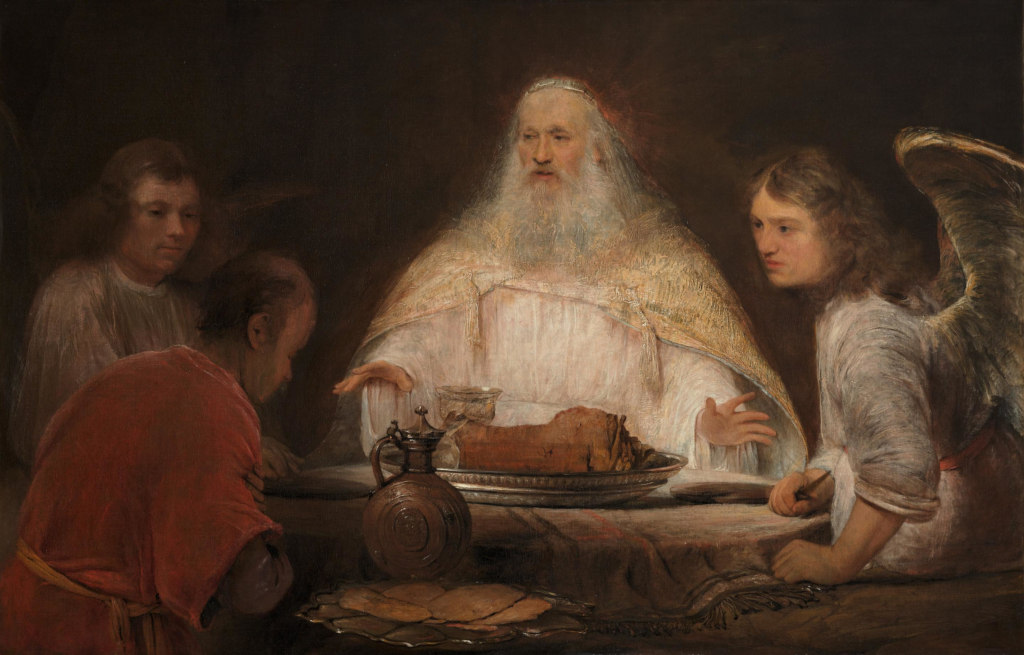
Arent de Gelder: God and the Angels visit Abraham

  Arent de Gelder 1645-1727

Three white-clad men walk out of the desert, out of the shimmering sands. Such is their calm and majesty that Abraham, the Patriarch, “very wealthy in silver and gold, sheep and cattle and camels and male and female donkeys, menservants and maidservants” runs to meet them, bows low to the ground, and offers him his most lavish hospitality: a freshly slaughtered calf, yogurt and milk, and bread from the finest flour,

It is a theophany; Abraham sees the pre-incarnate Christ. Abraham sees God.

“Then one of the men said, “I will surely return to you about this time next year, and Sarah your wife will have a son.” (Gen 18:10)

* * *

And Sarah, listening at the entrance of her tent, out of sight, snorts.

Same old, same old, same old promises. The son, descendants, more of them than the stars in the sky and the grains of sand in the seashore.

Well, God, that sounds wonderfully poetic, but you know, as for me, here, in space and time, well, I could do with just one child. Is that too much to ask? Well, yes, apparently so!

I am weary of these promises. I am weary of hope. “After I am worn out and my lord is old, will I now have this pleasure?” she thinks. (Gen 18:12)

And Sarah snorts!

* * *

 Then the Lord said to Abraham, “Why did Sarah laugh and say, ‘Will I really have a child, now that I am old?’ 14 Is anything too hard for the Lord?” (Gen 18: 13-14)

But perhaps the Lord thought, “Yeah, I am with Sarah. I have tried their hope and faith and patience for long decades. Perhaps too long. I have given them a good life full of richness in the interim. I have blessed them in every other way, but I know their longing, their heartbeat. It is for a son. It is for Isaac.

I waited so long so that they would never doubt that Isaac was mine, and not theirs. Never fail to see my glory in this baby, Isaac. Never doubt Isaac was a miracle baby, my miracle ancestor, pre-figuring when I too would enter human history as a miracle baby, the greatest miracle of all.

But it is now time. Time for their miracle. Time for Isaac.”

“I will return to you at the appointed time next year, and Sarah will have a son.”

 Sarah was afraid, so she lied and said, “I did not laugh.”

But he said, “Yes, you did laugh.” (Gen 18: 14-15)

* * *

Ah, Sarah, how you blew it. Snorting at a theophany! Snorting at Christ and his angels! You’ve lost hope. The snake of bitterness curls around your heart. You no longer have the energy, the courage to hope, and who can blame you?

And then you lie, you lie to the Lord, who sees your heart.

But are you zapped, turned to a pillar of salt, as Lot’s wife was?

No, the Lord understood your longing, your disappointment, your frustration.

And despite your snort of laughter, your spontaneous lie, He reiterated his promise, no longer vague, but definite,  “I will return to you at the appointed time next year, and Sarah will have a son.”

And He did, and you did, and you called him Isaac, which means laughter. Your snort of derisive laughter was redeemed; it became the laughter of joy at your miracle baby.

* * *

 And sometimes, our dreams seem disproportionately enormous, and our faith wavers, and the years pass, but our dreams, the promises we heard God whisper to us, the destiny we are born for, has not come to pass, and when we verbalize our dreams, we almost snort.

And how can you, Lord, bless someone who has so blown it, a sinner, whose faith has wavered?

But you do because you know our frame; you know we are but dust, and so though we do not deserve it, though we have blown it again and again, you come to us; you bring the destiny you have promised us to pass; you give us the child of promise whose name is laughter. You enjoy the pun, artist that you are, transforming the snort of sceptical laughter to laughter like a running brook.


Filed Under: Genesis, In which I resolve to live by faith Tagged With: abraham, blog through the bible, Faith, Genesis, Isaac, Sarah, Theophany

A Richer Palette for Your Prayer Life: Martin Luther’s Advice ( A Guest Post by Gary Hansen, author of “Kneeling with Giants”

By Anita Mathias

I am honoured to host this post from Gary Neal Hansen, author of the marvellous book, Kneeling with Giants, in which he offers practical ways to apprentice ourselves to history’s great pray-ers, Benedict, Luther, Calvin, Ignatius of Loyola and Teresa of Avila, among others. 

background-72245_640Martin Luther, the catalyst of the Protestant Reformation, needed a shave.  And his barber, like the one I had when I had hair, liked to talk. Master Peter the Barber’s question was something like “Dr. Luther tell me: how can I improve my prayer life?”

The sharp blade scraping his neck might have put some pressure on for a clever response, but Luther’s advice was the same as he gave to theologians, ministers and parents: “Pray the Lord’s Prayer.” His full answer came in a lengthy letter, a little book actually, translated as A Simple Way to Pray.

His passion for the Lord’s Prayer knew no bounds.  In a preface to his Small Catechism he wrote that if ministers won’t make good use of it “we deserve not only to be given no food to eat, but also to have the dogs set upon us and to be pelted with horse manure.”

Well, Dr. Luther, tell us how you really feel.

Maybe you are thinking the same thing my students say whenever I teach about Luther’s way of praying: “But I already pray Luther’s way! We say the Lord’s Prayer every Sunday in church.”

For Luther, the Lord’s Prayer is not merely “a prayer” to be recited and be done with.  The Lord’s Prayer is a list of topics that we are invited to pray about; commanded to pray about, actually. It  is an artist’s palette, a full range of colours for our prayer life — more than the monochrome we find when guided by personal interests.

So how does Luther’s method really work? I say a lot about this in Kneeling with Giants but here’s the short version:

I recommend writing out the Lord’s prayer on an index card, no matter how well you know it. Hold it so your thumb is on the first line, and spend a few minutes talking to God about that first topic; then move your thumb to the next line and spend a few minutes on that; and so on.

What might you pray for in these almost too-familiar words?

Praying “Our Father in heaven” you can thank God for adopting you in Christ as a beloved child, and praise the mystery of God who dwells in light inaccessible.

Praying “Hallowed be your name” you can intercede for the Church and the world — God’s name is indeed holy already, but we ask God to help his glory be known.

Praying “Your kingdom come” we ask God to truly reign in our own lives, and in our families, and in our churches, and in all the world. God’s kingdom won’t be complete until he comes again, so here we also pray with the early Christians “Come Lord Jesus!”

Praying “Your will be done on earth as it is in heaven” can lead to confession: we all have ways of resisting God’s expressed will for us. This can also be a great tool for intercession: when praying for a sick friend we can remind God that the Gospels show Christ’s will is for healing.

Praying “Give us today our daily bread” reminds us to ask God for everything, even the food we eat — even if we don’t like to ask things for ourselves, here Jesus commands us to do so.  And we can pray for the millions who do not have even bread to eat.

Praying “Forgive us our sins [or trespasses, or debts] as we forgive those who sin against us” reminds us to keep at the hard work of forgiving others, since we set up our own forgiveness as the standard by which we ask God to abide!

Praying “Save us from the time of trial and deliver us from evil” reminds us that we have struggles, whether inner weaknesses and temptations, or oppressive outer circumstances. We admit that we need God’s help to get through.

Luther did not comment on the familiar conclusion “For the kingdom, the power, and the glory are yours now and forever,” but praying it we acknowledge that God has all the power needed to answer our prayers, and that what we really want in asking is God’s glory.

Luther always had a lot to say, however, about the final word, “Amen!” He said to pray it boldly, expressing the confidence that God has surely heard us and will surely answer.

There is not just one thing to pray for in any line of the Lord’s Prayer. Each clause can lead to praise, thanksgiving, confession, or intercession, as needed at the moment. Luther’s point is to pray all the parts, and let Jesus’ own prayer stretch us to bring God everything — even the things we usually forget to pray about.

You can pray through the whole prayer at a sitting, or follow Luther’s other suggestion and sticking to one line for your whole prayer time.  One clause per day will bring you through the Lord’s Prayer once a week.

Luther is right about one thing: we need something to guide us into a richly-hued conversation with God. That’s why he thought this was Jesus’ very best prayer. As he put it once, “If he, the good and faithful Teacher, had known a better one, he would surely have taught us that too.”

Give it a try. Take a week or two and follow Luther’s advice. I’d love to hear how it goes for you.

  • Which line of the Lord’s Prayer is most important to you — and why?
  • What helps your conversation with God take on more and richer colours?


Gary Neal Hansen

Gary Neal Hansen

Gary Neal Hansen is the Associate Professor of Church History at the University of Dubuque Theological Seminary.  He is the author of Kneeling with Giants: Learning to Pray with History’s Best Teachers (InterVarsity Press: 2012), winner of Christian Resources Together’s “Devotional Book of the Year” in the UK, and Hearts and Minds Books “Best Book of the Year on Spirituality” in the US.  His current book project explores movements in the history of the Church whose ways of being Christian community blossomed into effective mission and service in the world. He lives in Dubuque Iowa, USA with his wife and their two small children. (Blog: GaryNealHansen.com, Facebook page: Gary Neal Hansen, Twitter: @garynealhansen. Links to Kneeling with Giants (Amazon.com) and Kneeling with Giants (Amazon UK).)


Filed Under: In which I play in the fields of prayer, In which I proudly introduce my guest posters Tagged With: gary neal hansen, kneeling with giants, Martin Luther, Prayer, The Lord's Prayer

“Do not Resist Evil;” One Way to Heal after Experiencing Evil

By Anita Mathias

Image Credit

You have heard that it was said, ‘Eye for eye, and tooth for tooth.’ But I tell you, do not resist an evil person. If anyone slaps you on the right cheek, turn to them the other cheek also.  And if anyone wants to take your shirt, hand over your coat as well.  If anyone forces you to go one mile, go with them two miles. (Matthew 5 38-41).

Oh Jesus, how costly your words are.

Recently, when I’ve suffered actual or perceived injustice or annoyance, and have taken up the matter with Jesus, I’ve heard him say, “Let him.” “Let her.”

“Just don’t get entangled with evil, with resistance, with revenge. Let them do what they want to do. I am the ultimate score-keeer, the umpire, who will provide you another coat, and strength to walk the third mile on your own business after you’ve marched two miles carrying the Roman soldier’s gear.”

* * *

If we do not “let them,” if we plot revenge, if we put our emotional hooks in our enemy’s flesh, mentally dragging them behind us everywhere, we get embroiled in an endless tit-for-tat world of malice.

The principle of an eye for an eye, applied in the Code of Hammurabi, Judaism and Islam was neat, merciless, and there an end. But in our more sophisticated societies, what constitutes an eye for an eye is not so easily calculated. People extract revenge in all sorts of ways: gossip, slander, blocking, passive aggression, malice, and pettiness.

Sad for the victim, and sad too for the perpetrator—whose character becomes smaller and meaner and shrivels, becoming increasingly cut off from the waterfall of the grace and power of God. Once we put those who have wronged us on a mental blacklist, unconsciously ready to get even given a chance, we are no longer quite so open to God’s guidance; the presence of the Holy Spirit no longer pulses in our souls.

But what are we to do when we suffer injustice? Because we well might. The enemy of our souls stalks this world, twisting, corrupting, darkening. However, he plays against the Grandmaster who will, of course, ultimately win.

* * *

Let tell you a story of my initial failure and ultimate success in one of my encounters with evil. And about one way I have stumbled on to heal after experiencing evil.

Several years ago, I was wronged, unfairly treated, and humiliated. Because this happened at an extremely vulnerable point in my life, it precipitated an episode of “great sadness.”

A couple of years after that incident, through an unexpected turn of events, I got to “whistle-blow,”—I publicly pointed out a severe dereliction of duty on the part of the person who had unfairly treated me. They resigned from their relatively well-paid sinecurish job.

Quits, huh? This person furiously said to me, “Well, you’ve got your pound of flesh now, haven’t you?” And I childishly replied, “No, what you did to me was far worse.”

But yes, I had got my pound of flesh, plus. However, each time I remembered how I had been treated, my heart burned with indignation at the injustice and shaming. I wanted to do something about it, all over again.  Though, I had already done something. As they said, I had had my pound of flesh. (And eating anger probably did add some pounds of flesh to my frame.)

We will never feel quits, never, because the memory of past wrongs feels fresh again. And at the “re-injury,” we again want to get even, though heck, we’ve already done so in so many petty soul-corrupting ways, damaging our souls, damaging our communion with Jesus, and with his sweet spirit.

* * *

And so for our protection, Jesus tells us not to even try to get even. But we are not to sit all tensed up saying, “I will not take revenge. I will not think of a pink elephant.”

There are other ways for the soul to  heal. One is do good to those who have injured you. And what when our soul cannot yet stretch to that sublimity? When we cannot bring ourselves to do our enemies a good turn?

I am reading Brene Brown’s Daring Greatly.  She quotes psychologist James Pennebaker who says that the act of not discussing a traumatic event or confiding it to another person could be more damaging than the actual event. Conversely, when people shared their stories and experiences, their physical health improved.

In his book Writing to Heal, Pennebaker says, “The act of writing about traumatic experience for as little as 15 or 20 minutes a day for three or four days can produce measurable changes in physical and mental health. Emotional writing can also affect people’s sleep habits, work efficiency, and how they connect with others.”

So then, I write my three morning pages about this particular episode which still made me feel outraged when I thought about it.

* * *

And as I write, I see it wholly, not just all the infuriating bits, but the whole chain of events, including my culpability.

In scripture, a turning point is often marked by the phrase, “But God.”  And unexpectedly, God steps in. As I was able to see those disturbing events more clearly, I was also able to see the good God brought out of them.

He showed me that his loving kindness had been extended to me, though other people may have behaved out of insecurity,  competitiveness, jealousy, malice or in a good old-fashioned power struggle. Augustine writes in his Confessions that his teachers acted towards him in malice or indifference, but God was working too, turning it to good.

I then had been leading and spear-heading something I shouldn’t have been because I was overwhelmed and beside myself in my personal life. I need to get my house in order, literally. I needed to get my business profitable. I need to stabilize my emotions. I needed more sleep, more rest. I needed to write, which I wasn’t doing at all. I needed the desert, which I so chafed against. I needed an Elijah experience of sleeping, eating and resting. I needed to see God in the wilderness like Hagar did. And I needed to emerge from it, strong, leaning on my beloved.

And through my enforced sojourn in the desert, forced on me by these people, I developed my latent entrepreneurial gifts. I established our family business, freeing me to focus on writing. I had time to establish my blog, slowly writing my way to a blogging style which speaks to people. I learnt soaking prayer. I became convinced of the deep love of God for me. My soul healed. And I cut all ties with those toxic people!

God was in the situation, the Grandmaster, putting me in a corner, to rest, to heal, to gather strength for the destiny he had in mind for me. The people who put me in the corner were also pawns in the grandmaster’s hand. Nothing happened to me but what He permitted; nothing, but what He turned to goodness and blessing for me.

Nothing, nothing, happens to you but what God has permitted. Nothing, nothing happens to you that God is unable to turn to good.

Do not resist an evil person. Do not get emotionally entangled with them. If they force you to march a mile, march it. If they take your cloak, shrug it off; let him have it. And then march free, your eyes on your Father, who can give you the cloak you need, the strength you need, whose eyes are on you, who can do anything, for whom nothing is too wonderful.

And Jesus, please give me the grace, if and when necessary, to live my own words—and Yours.


Over to you:

Have you experienced evil? How have you healed after that experience?


Filed Under: In which I decide to follow Jesus, Matthew Tagged With: blog through the bible, brene brown, healing through expressive writing, James Pennebaker, loving enemies, Matthew, morning pages, sermon on the mount

  • « Previous Page
  • 1
  • …
  • 10
  • 11
  • 12
  • 13
  • 14
  • …
  • 27
  • Next Page »

Sign Up and Get a Free eBook!

Sign up to be emailed my blog posts (one a week) and get the ebook of "Holy Ground," my account of working with Mother Teresa.

Join 536 Other Readers

My Books

Rosaries, Reading, Secrets: A Catholic Childhood in India

Rosaries, Reading Secrets, B&N
USA

UK

Wandering Between Two Worlds: Essays on Faith and Art

Wandering Between Two Worlds
USA

UK

Francesco, Artist of Florence: The Man Who Gave Too Much

Francesco, Artist of Florence
US

UK

The Story of Dirk Willems

The Story of Dirk Willems
US

UK

My Latest Meditation

Anita Mathias: About Me

Anita Mathias

Read my blog on Facebook

Follow me on Twitter

Follow @anitamathias1

Recent Posts

  • At the Cross, God Forgives Us Completely
  • Using God’s Gift of Our Talents: A Path to Joy and Abundance
  • The Kingdom of God is Here Already, Yet Not Yet Here
  • All Those Who Exalt Themselves Will Be Humbled & the Humble Will Be Exalted
  • Christ’s Great Golden Triad to Guide Our Actions and Decisions
  • How Jesus Dealt With Hostility and Enemies
  • Do Not Be Afraid, but Do Be Prudent
  • For Scoundrels, Scallywags, and Rascals—Christ Came
  • How to Lead an Extremely Significant Life
  • Don’t Walk Away From Jesus, but if You Do, He Still Looks at You and Loves You
Premier Digital Awards 2015 - Finalist - Blogger of the year
Runner Up Christian Media Awards 2014 - Tweeter of the year

Categories

What I’m Reading


Wolf Hall
Hilary Mantel

Wolf Hall --  Amazon.com
Amazon.com

Amazon.co.uk

Silence and Honey Cakes:
The Wisdom Of The Desert
Rowan Williams

Silence and Honey Cakes --  Amazon.com
Amazon.com

Amazon.co.uk

The Long Loneliness:
The Autobiography of the Legendary Catholic Social Activist
Dorothy Day

The Long Loneliness --  Amazon.com
Amazon.com

Amazon.co.uk

Country Girl
Edna O'Brien

Country Girl  - Amazon.com
Amazon.com

Amazon.co.uk

Archive by month

My Latest Five Podcast Meditations

INSTAGRAM

anita.mathias

My memoir: Rosaries, Reading, Secrets https://amzn.to/42xgL9t
Oxford, England. Writer, memoirist, podcaster, blogger, Biblical meditation teacher, mum

Looking at photos from our week in beautiful Sevil Looking at photos from our week in beautiful Seville and Cordoba over New Year with Irene, who had a week off.
And, ICYMI, here’s my latest meditation on the Gospel of Matthew… I’ve recorded it, should you want a few minutes of peace.
https://anitamathias.com/2026/04/29/gods-complete-forgiveness/
Hello Friends, I'm resumed recording my meditation Hello Friends, I'm resumed recording my meditations on the Gospel of Matthew. Do click on this link to listen. 
https://anitamathias.com/.../29/gods-complete-forgiveness/
Christ is the most influential figure in the history of the world, though his life ended in shame, humiliation and failure. But he so completely turned things round in his great reversal that the cross on which he died when all seemed hopeless is now the most common, and revered, symbol in history.
He emerged from and was anchored in Judaism. And as the sins of the people were laid on the scapegoat who was sent into the wilderness to perish, Christ died as the lamb of God voluntarily bearing the guilt of the wrongdoing of the whole world. He paid the price for our forgiveness with his life-blood--in accordance with the iron law of the physical and moral universe, of sowing and reaping, cause and effect. 
And so, God, who appeared as flames of fire to Moses, can now dwell within us, purifying us, whose hearts have darkness and shards of ice. 
And now that Christ was crucified, died, but rose again, His Spirit, no longer contained within his earthly body, is poured out like living water onto all humans, at our humble request. The Spirit pours the love of God into us; he reminds us of the words of Jesus and slowly writes Christ’s sweet law on our hearts. This transfusion of grace helps us do hard things we previously couldn’t do. Our dance with the Spirit gradually breaks the power of sin over us. It transforms us.
Now we, the forgiven, protected by the blood of Jesus poured out over us, and filled with His Spirit, who sings within us, Abba, Father, are adopted by God as his children in his joyful new covenant. We are cells grafted into the vine of our new family--Father, Son, Spirit—who now live in us as we live in them. As we choose by our thoughts and actions to continue living in the vine of Jesus, their energy pulsing through us makes us fruitful. And now, all our prayers which flow in the river of God’s good purposes are kindly heard. Waves of love and power flood from the cross! 
Thank you!
Well, hello friends! Breaking radio silence to let Well, hello friends! Breaking radio silence to let you know that I have taped a meditation for you on Christ’s famous Parable of the Talents in Matthew 25. https://anitamathias.com/2025/11/05/using-gods-gift-of-our-talents-a-path-to-joy-and-abundance/
Here you are, click the play button in the blog post for a brief meditation, and some moments of peace, and, perhaps, inspiration in your day 🙂
Hi Friends, I have taped a meditation; do listen a Hi Friends, I have taped a meditation; do listen at this link: https://anitamathias.com/2025/04/08/the-kingdom-of-god-is-here-already-yet-not-yet-here-2/
It’s on the Kingdom of God, of which Christ so often spoke, which is here already—a mysterious, shimmering internal palace in which, in lightning flashes, we experience peace and joy, and yet, of course, not yet fully here. We sense the rainbowed presence of Christ in the song which pulses through creation. Christ strolls into our rooms with his wisdom and guidance, and things change. Our prayers are answered; we are healed; our hearts are strangely warmed. Sometimes.
And yet, we also experience evil within & all around us. Our own sin which can shatter our peace and the trajectory of our lives. And the sins of the world—its greed, dishonesty and environmental destruction.
But in this broken world, we still experience the glory of creation; “coincidences” which accelerate once we start praying, and shalom which envelops us like sudden sunshine. The portals into this Kingdom include repentance, gratitude, meditative breathing, and absolute surrender.
The Kingdom of God is here already. We can experience its beauty, peace and joy today through the presence of the Holy Spirit. But yet, since, in the Apostle Paul’s words, we do not struggle only “against flesh and blood, but against the rulers, against the unseen powers of this dark world and against the spiritual forces of evil,” its fullness still lingers…
Our daughter Zoe was ordained into the Church of E Our daughter Zoe was ordained into the Church of England in June. I have been on a social media break… but … better late than never. Enjoy!
First picture has my sister, Shalini, who kindly flew in from the US. Our lovely cousins Anthony and Sarah flank Zoe in the next picture.
The Bishop of London, Sarah Mullaly, ordained Zoe. You can see her praying that Zoe will be filled with the Holy Spirit!!
And here’s a meditation I’ve recorded, which you might enjoy. The link is also in my profile
https://anitamathias.com/2024/11/07/all-those-who-exalt-themselves-will-be-humbled-the-humble-will-be-exalted/
I have taped a meditation on Jesus statement in Ma I have taped a meditation on Jesus statement in Matthew 23, “For those who exalt themselves will be humbled, and those who humble themselves will be exalted.”
Do listen here. https://anitamathias.com/2024/11/07/all-those-who-exalt-themselves-will-be-humbled-the-humble-will-be-exalted/
Link also in bio.
And so, Jesus states a law of life. Those who broadcast their amazingness will be humbled, since God dislikes—scorns that, as much as people do.  For to trumpet our success, wealth, brilliance, giftedness or popularity is to get distracted from our life’s purpose into worthless activity. Those who love power, who are sure they know best, and who must be the best, will eventually be humbled by God and life. For their focus has shifted from loving God, doing good work, and being a blessing to their family, friends, and the world towards impressing others, being enviable, perhaps famous. These things are houses built on sand, which will crumble when hammered by the waves of old age, infirmity or adversity. 
God resists the proud, Scripture tells us—those who crave the admiration and power which is His alone. So how do we resist pride? We slow down, so that we realise (and repent) when sheer pride sparks our allergies to people, our enmities, our determination to have our own way, or our grandiose ego-driven goals, and ambitions. Once we stop chasing limelight, a great quietness steals over our lives. We no longer need the drug of continual achievement, or to share images of glittering travel, parties, prizes or friends. We just enjoy them quietly. My life is for itself & not for a spectacle, Emerson wrote. And, as Jesus advises, we quit sharp-elbowing ourselves to sit with the shiniest people, but are content to hang out with ordinary people; and then, as Jesus said, we will inevitably, eventually, be summoned higher to the sparkling conversation we craved. 
One day, every knee will bow before the gentle lamb who was slain, now seated on the throne. We will all be silent before him. Let us live gently then, our eyes on Christ, continually asking for his power, his Spirit, and his direction, moving, dancing, in the direction that we sense him move.
Link to new podcast in Bio https://anitamathias.co Link to new podcast in Bio https://anitamathias.com/2024/02/20/how-jesus-dealt-with-hostility-and-enemies/
3 days before his death, Jesus rampages through the commercialised temple, overturning the tables of moneychangers. Who gave you the authority to do these things? his outraged adversaries ask. And Jesus shows us how to answer hostile questions. Slow down. Breathe. Quick arrow prayers!
Your enemies have no power over your life that your Father has not permitted them. Ask your Father for wisdom, remembering: Questions do not need to be answered. Are these questioners worthy of the treasures of your heart? Or would that be feeding pearls to hungry pigs, who might instead devour you?
Questions can contain pitfalls, traps, nooses. Jesus directly answered just three of the 183 questions he was asked, refusing to answer some; answering others with a good question.
But how do we get the inner calm and wisdom to recognise
and sidestep entrapping questions? Long before the day of
testing, practice slow, easy breathing, and tune in to the frequency of the Father. There’s no record of Jesus running, rushing, getting stressed, or lacking peace. He never spoke on his own, he told us, without checking in with the Father. So, no foolish, ill-judged statements. Breathing in the wisdom of the Father beside and within him, he, unintimidated, traps the trappers.
Wisdom begins with training ourselves to slow down and ask
the Father for guidance. Then our calm minds, made perceptive, will help us recognise danger and trick questions, even those coated in flattery, and sidestep them or refuse to answer.
We practice tuning in to heavenly wisdom by practising–asking God questions, and then listening for his answers about the best way to do simple things…organise a home or write. Then, we build upwards, asking for wisdom in more complex things.
Listening for the voice of God before we speak, and asking for a filling of the Spirit, which Jesus calls streams of living water within us, will give us wisdom to know what to say, which, frequently, is nothing at all. It will quieten us with the silence of God, which sings through the world, through sun and stars, sky and flowers.
Especially for @ samheckt Some very imperfect pi Especially for @ samheckt 
Some very imperfect pictures of my labradoodle Merry, and golden retriever Pippi.
And since, I’m on social media, if you are the meditating type, here’s a scriptural meditation on not being afraid, while being prudent. https://anitamathias.com/2024/01/03/do-not-be-afraid-but-do-be-prudent/
A new podcast. Link in bio https://anitamathias.c A new podcast. Link in bio
https://anitamathias.com/2024/01/03/do-not-be-afraid-but-do-be-prudent/
Do Not Be Afraid, but Do Be Prudent
“Do not be afraid,” a dream-angel tells Joseph, to marry Mary, who’s pregnant, though a virgin, for in our magical, God-invaded world, the Spirit has placed God in her. Call the baby Jesus, or The Lord saves, for he will drag people free from the chokehold of their sins.
And Joseph is not afraid. And the angel was right, for a star rose, signalling a new King of the Jews. Astrologers followed it, threatening King Herod, whose chief priests recounted Micah’s 600-year-old prophecy: the Messiah would be born in Bethlehem, as Jesus had just been, while his parents from Nazareth registered for Augustus Caesar’s census of the entire Roman world. 
The Magi worshipped the baby, offering gold. And shepherds came, told by an angel of joy: that the Messiah, a saviour from all that oppresses, had just been born.
Then, suddenly, the dream-angel warned: Flee with the child to Egypt. For Herod plans to kill this baby, forever-King.
Do not be afraid, but still flee? Become a refugee? But lightning-bolt coincidences verified the angel’s first words: The magi with gold for the flight. Shepherds
telling of angels singing of coming inner peace. Joseph flees.
What’s the difference between fear and prudence? Fear is being frozen or panicked by imaginary what-ifs. It tenses our bodies; strains health, sleep and relationships; makes us stingy with ourselves & others; leads to overwork, & time wasted doing pointless things for fear of people’s opinions.
Prudence is wisdom-using our experience & spiritual discernment as we battle the demonic forces of this dark world, in Paul’s phrase.It’s fighting with divinely powerful weapons: truth, righteousness, faith, Scripture & prayer, while surrendering our thoughts to Christ. 
So let’s act prudently, wisely & bravely, silencing fear, while remaining alert to God’s guidance, delivered through inner peace or intuitions of danger and wrongness, our spiritual senses tuned to the Spirit’s “No,” his “Slow,” his “Go,” as cautious as a serpent, protected, while being as gentle as a lamb among wolves.
Follow on Instagram

© 2026 Dreaming Beneath the Spires · All Rights Reserved. · Cookie Policy · Privacy Policy