Anita Mathias: Dreaming Beneath the Spires

Anita Mathias's Blog on Faith and Art

  • Home
  • My Books
  • Meditations
  • Essays
  • Contact
  • About Me

Archives for 2013

Playdates with God: Because All the World is a Wonderland: A Guest Post by Laura Boggess

By Anita Mathias

Laura Boggess’s writing and spirituality is as outrageously beautiful as she is. I’ve loved reading about her magical playdates with God on her blog –with some envy, both for the joy and freshness of her spirituality, and for the loveliness of the idea.

I am so excited that Laura is on my blog today, telling us more about how she began and continues with her spiritual practice of playdates with God. Welcome Laura!

rain_and_books_4_blogLast night after dinner the electricity went off. A white sky illuminated the night outside, silhouetting our usual, and I stared at my laptop in the dark…no internet connection… the screen an island of light in the room. Our two boys clamored—wound up by darkness, and excitement pulsed as their daddy lit candles and checked the weather on his iPhone.

We sat in the hush and listened to the wind blow the deck furniture around. It was late—after ten—so I tucked protesting boys in with a candle gently flickering—thinking of Little House on the Prairie and savoring the play of the warm glow on their still young faces.

I returned to the couch in the dark.

We sat in silence, my man and I; listened to driving rain turn to gentle patter, watched the play of lightning on hills in the distance. For once, no hum of air conditioner, no mindless buzz of refrigerator, dishwasher still in silence. All of our daily companions closed their eyes in this gauzy darkness.

There was only the soft ticking of the mantle clock keeping time with the faint strumming of droplets colliding with window glass, only to slide down and lose form in a streaky stream.

We giggled a little at our loss, wondered how did they do it? with no electricity…only talk to spend.  We marveled at work-filled days and talk-filled evenings and fell in to silence.

I closed my eyes in the dark and felt God sitting beside me.

Silence feels good to me. I find it by sitting still. By looking deeper into what is already here.

Always a solitary child, that’s me. I can fall into His arms in the quiet and never desire to leave. All my life this is where I have rested. Safe from jabbing words of others; hidden from the wounding talk.

I know it’s not that way for everyone. And lately, besieged by life and fraught with hope, I’ve been wondering, Is there another way? Because sometimes life doesn’t bend for this slowing down. Sometimes it takes a power outage for me to be still and listen.

God is always the same, yes, this I know. But I have also come to learn that He loves to mix things up. He understands the human tendency to grow stale when patterns are established. He loves surprises. He likes to keep our love fresh and new. This year has been a crazy mixed up year for finding God for me. My years of early morning quiet time suddenly ceased to feel intimate. For the first time in years I found myself falling asleep with my cheek pressed to the dining room floor at 5 a.m. Saturated.

It was time for something new.

I began to step out of my comfort zone. To explore new ways of praying. Once a week I try to do something new with God. I call these my Playdates with God. Funny how, trying this once a week has opened my eyes to finding the new in the old. Like my daily runs. I’ve been running since I was thirteen, but lately…I find God when I run. I feel Him in my legs, in my breath, in the acceleration of my beating heart. He meets me in the sky and the trees and the way the light changes colors on the horizon.

This morning when I ran, the storm was still fresh on the sidewalk. Fallen branches and stray leaves littered the street. The creek was rushing its banks and the smell of muddy water rose dense into the air around me. A handful of black crows perched on the utility wires above me, caw, caw, caw…

As my feet pounded the pavement, I remembered a poem a dear friend sent me. In it, she tells me that I am birdsong, and those words have lifted me on the darkest of days. My heart soars as I imagine music in my stride. And as I go on, I am lifted into its melody, and a new poem takes wing:

I fly away
singing—
flutter my
wings
through misty
windows
in the sky;
dip fingertips
in morning dew-
cups, silky
petals collect
evening honey,
and offer this
sweet frieze to
me in the golden
shimmer of
dawn. I am
free. I am…
birdsong.


I grow when I look for the Holy in the not usual way. God loves for me to seek after Him in wild and beautiful ways. Writing poetry doesn’t seem so crazy a way to pray. Nor does running.

He’s there. He’s in it all.

Where do you find God in your day-to-day life?

Leafwood headshot 023_smlr_autocorr


Laura Boggess is crazy in love with Jesus. And after many years of the try-hard life she is finally learning to accept that He loves her too. A recovering list-maker worn out from trying to earn grace, Laura is now stepping into Christ’s invitation to come to Him like a little child—with open hands, surrendered to grace.

Laura Boggess has an M.A. in clinical psychology and works in a medical rehabilitation hospital—helping patients and their families cope with traumatic diagnoses such as brain injury, spinal cord injury, and stroke. She believes in the healing power of story and often uses storytelling in therapy. She is the author of two books in the Wings of Klaio series, a Christian fiction series for teens. Watch for her new book Playdates with God: Because All the World is a Wonderland, to be released in the spring of 2014.

Laura is active in the women’s ministries at her church and is a regular speaker at churches throughout her region. She is a contributing editor at The High Calling (thehighcalling.org) and blogs at The Wellspring (http://lauraboggess.com). Laura lives in a little valley in West Virginia with her husband, Jeff, and their two sons. She is passionate about sharing Jesus and stories and loves a happy ending.

Filed Under: In which I play in the fields of prayer, In which I proudly introduce my guest posters Tagged With: Intimacy with God, Laura Boggess, Playdates with God, Prayer, running, spirituality

Our Summer Holiday in Switzerland, 2003 and 2013

By Anita Mathias

Switzerland 2013

Switzerland 2013

It’s our second holiday in Switzerland. We last came here 10 years ago, in 2013, when Zoe was 8 and Irene just 4.

It’s amazing coming back to our favourite places like the Lauterbrunnen Valley and the Trummelbach Falls ten years later, doing some of the same things, and reflecting on how much has changed.

We had rented a campervan that time. Now we’ve driven in our own campervan (RV). We left our dog in a kennel that time; now we’ve brought our dog, lovely Jake instead of lovely Trooper, whom we gave away when we left the US.

I was not a blogger then, and did not own a business. It was pre-Facebook and pre-Twitter, and we did not miss being disconnected from the world. I had a few essays out, and an (abortive) book proposal and checked on them at internet cafes, and emailed a few friends.

Now, I have a WiFi hotspot which works anywhere in the world, pretty much, so am as connected as at home–and like it that way, though obviously, I am not spending much time reading blogs, FB statuses, or tweets.

We’ve brought technology with us, laptops, iPads, iPhones, iPods, each to his or her own, because the internet, the world wide flow of knowledge is an extension of ourselves, has become part of the way we think (continually researching areas of curiosity) and the way we do life. We are unapologetic about it!!

We’ve changed; the world has changed; human consciousness has changed. Facebook, Twitter, blogs—all these barely existed ten years ago. They are now part of how I do life.  Just like recording in a journal gets one to slow down, and take it all in, sharing your life in a blog or Facebook enforces a beneficial slowing down, paying attention, and reaching out and connecting which is a universal human impulse. Knowing I am going to write about it, photographing things as I go, enforces a heightened attention and I think that is a good thing.

Ten years ago, we lived in America and were American citizens. Now we live in England, and are British citizens too. Ten years, ago, we blinked at the stressfully high Swiss prices. Now, having living in England for 9 years, we’ve become inured to high prices.

Ten years, ago we had wild lively children, heard long before they were seen. Now we have savvy teenagers. Ten years ago, they would volunteer to cook us a meal at the campground kitchen and it was an grand adventure. Now, they’d rather read.

Ten years ago, we were intimidated by Swiss glares when the children were heard as well as seen, and by general Swiss dourness. Now, bah, the Swiss are just people, and if they frown and glare, I shrug!  (Besides, they definitely seem to have grown nicer, or perhaps I have!)

Internally, I am happier, deeper, more content, more rooted in God. I have learned the secret of the bluebird of happiness. She lives within, that wild thing, and one must burrow within to find her.

A few then-and-now photos:

17-DSCN8428
Jake the Collie, with one eye blue and one brown, has been a photographed by many tourists to Switzerland!

24-three-226-DSCF013227-DSCN826728-DSCF0172_crop


Some photos of the fortified hilltop village Gruyères (from where Gruyère cheese comes from).  The symbol of Gruyères is the stork (gru, in French).

Driving along the winding road, on suddenly sees a fortified village

Driving along the winding road, on suddenly sees a fortified village

Looking out of Gruyères' entrance.

Looking out of Gruyères’ entrance.

25-DSCN8323

The "gru" is everywhere.

The “gru” is everywhere.

DSCF0125_smlr

Medieval feast of St. John the Baptist, re-enacted 2003.

Switzerland has gorgeous scenery.  All but one of these are from the Lauterbrunnen vallley.

11-P1030123 12-P1030403 13-DSCN8397 14-DSCN8408 15-P1030405 19-P1030404 20-DSCF0002


Filed Under: In which I Travel and Dream Tagged With: Gruyeres, Lauterbrunnen, Switzerland

Dreaming in Laon Cathedral, Northern France.

By Anita Mathias

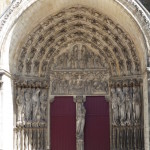
Laon Cathedral (Facade)

Laon Cathedral (Facade)

I’ve long wanted to see Laon Cathedral in Northern France, which featured in the Cathedrals of Europe course I took at Oxford University’s Continuing Education.

It was an enchanted sacred space, with Gregorian chant echoing through it.

Funny, when I am in a Gothic cathedral, I think of it as my soul’s natural home.

Laon Cathedral (Arches above the right aisle)

Laon Cathedral (Arches above the right aisle)

Laon Cathedral (triforium and clerestory)

Laon Cathedral (triforium and clerestory)

Laon Cathedral choir. (Note the floor)

Laon Cathedral choir. (Note the floor)


Laon Cathedral (Medieval stained glass)

Laon Cathedral (Medieval stained glass)

Laon Cathedral (More recent stained glass)

Laon Cathedral (More recent stained glass)


These Gothic cathedrals built during medieval Europe’s building boom were sublime expressions of a community’s devotion.  Entire towns and villages, men, women and children worked together to haul massive slabs of granite uphill, (often in silence, eye-witnesses say) to construct these noble edifices to the glory of God.

The gargoyles outside Laon Cathedral, unusually, memorialize the noble oxen who hefted the granite up the steep hill to the cathedral.

Oxen memorialised at the top of Laon cathedral.

Oxen memorialised at the top of Laon cathedral.

Dragon on the facade of Laon Cathedral..

Dragon on the facade of Laon Cathedral..

An icon of Jesus in Laon has made it a place of pilgrimage. I didn’t particularly care for the icon, but it did express one feature of the Messiah as mentioned in Isaiah, “He had no beauty that we should desire him.”

"The Holy Face" icon, Laon Cathedral.

“The Holy Face” icon, Laon Cathedral.

A few more images of Laon Cathedral

Laon Cathedral (from a nearby cafe)
Bas relief above the main entrance.
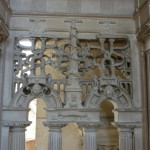
Detail from the top of the pulpit (Laon Cathedral)

Laon Cathedral (main entrance)
Atlas (?) (Laon Cathedral)
Carved railing (Laon Cathedral)


Filed Under: In which I Travel and Dream Tagged With: Gothic Cathedrals, history of Gothic Cathedrals, icons, Laon Cathedral France, Travel

Platinum and Rubies: In which a Story can Change the World (A guest post by Deidra Riggs)

By Anita Mathias

I am delighted that blogger Deidra Riggs is here to grace my space today. Welcome, Deidra!

(c) Deidra Riggs

(c) Deidra Riggs

It happens nearly every time I’m in a crowd. The Jazz Festival downtown, a train platform, a concert or conference in a massive arena. When walking through crowds at the airport in Chicago, or San Antonio, or Denver, or New York, or wherever it is my travels have taken me I hear myself think, “All of these people…all of these thousands of people, and I’ve never met a single one.” If my husband is with me, I say it out loud.

“What?” he asks me, trying to maneuver his roller bag through the sea of feet in pumps and platform shoes and patent-leather Stacy Adams or plain old flip-flops. Everyone. Going somewhere.

“Oh, you know,” I say, “the same old thing. God knows every single person here, and I’ve never seen them before in my life.”
“Yep,” he’ll say. “He does.”

On the trips I take solo, walking through those crowds, I often get an overwhelming sense of just how much love God has for us, and how much He has invested in every single story.

Other times, I find myself at a stoplight in the town where I live. I’m waiting for the light to turn green, wondering what to cook for dinner, when someone walks in front of my car, crossing the street from one corner to the other.

I look at the way she holds her purse, or the way his wallet makes an impression in the back pocket of his Levi’s 501 jeans, or the way she flicks the ashes from her cigarette, or the way the collar of his plaid shirt lies flat against the nape of his neck, and — just like that — I’m knocked off-kilter by the stories I don’t know. I ask God to keep her safe, and hold him close, and shore up their stories before the calendar turns too many pages.

:::

I eat a giant hamburger, and then go back for one-half more because the guy in charge of the grill has outdone himself. Overhead, two airplanes fly in formation, and in the yard two of the young men kick a soccer ball back and forth. It’s a church cook-out, and this group is still getting to know each other. They are young — part of that age group researchers say are leaving the church. I’m all for research. But this is real life, and these are real people with real stories to tell.

We eat grilled jalepeno peppers stuffed with cheese, and jell-o salad with banana slices suspended inside, and we chew on asparagus right from the grill. There are introductions between those who have not yet met, and I wipe up the drink I spilled on the patio. When the last brownie has been eaten, the group moves inside to sit in overstuffed couches beneath the ceiling fan.

Tonight, the plan is for each of us to tell our story. There are ten of us, and we are told we can pass when it’s our turn. No pressure. No obligation. But no one passes. And the sun has dropped below the rooftops of the house across the street when the last story has been told. And I feel as I’ve been given a gift like rubies in a platinum ring and I want to slip it around my finger — the finger with the blood line that runs straight to my heart.

:::

Across the table, my friend is helping me get ready for a speech I have to give. “When a speaker says, ‘Let me tell you a story,’ what happens to the audience?” she asks me. I nod at her. She puts her elbows on the table in front of her, and then she puts the fingers of her left hand into the palm of her right hand.

I get it.

“Stories are so powerful,” I answer. “They draw us right in.”

“Just like Jesus…and all His stories,” my friend answers.

And now I’m nodding because I really do get it.

Be generous with your story, I hear in my heart. Or maybe it’s my soul. It’s that very same place that spills over when I’m in the airport or sitting in my car, waiting for the light to turn green, or under a ceiling fan with a gift of platinum and rubies dancing in my ears.

Your story? It is platinum and rubies. Your story can change the world.

Deidra Riggs is a writer and speaker. She serves as managing editor at TheHighCalling.org, and is a monthly contributor to incourage.me. As president and owner of JumpingTandem, she invites people to the table by producing retreats, conversations, and other events designed to inspire individuals to pursue the dream(s) God has uniquely designed for them. Deidra also facilitates conversations which encourage churches and church leaders to increase their understanding of different races, cultures, and ethnicities. You can connect with Deidra at her blog, deidrariggs.com. Deidra is married to Harry Riggs. They are the parents of two adult children, and the happy renters of an empty nest.

Filed Under: In which I proudly introduce my guest posters

The Jesus Prayer: A Prayer to Pray when you are Struggling

By Anita Mathias

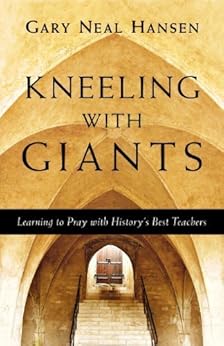
Kneeling with Giants by Gary Hansen
I was so angry with my husband Roy one night recently that I could not sleep. Oh yes, the sun well and truly went down on my anger.

And the hours passed (or I assume they did—I never look the time during sleepless nights, it makes me more stressed) and I was still awake, and still furious.

Normally, when it cannot sleep, I welcome it as a playdate with God. I pray through my life, asking for wisdom and blessing and guidance in every area of my life. I pray over my involvements, activities, and future. I pray for everyone I care about.

Now all I could think was Roy’s terrible wrong-headedness (it was very late at night, remember!) I was too stressed to pray in tongues, which is what I often do late at night.

And I knew I was not repenting, not obeying Jesus’ command to forgive. But at that moment, I had not reached the emotional point of being able to forgive. I was still too outraged.

So how could I pray?

* * *

Turns out there is one prayer you can still pray when you have not reached the point of repentance, when you are still stuck in the quicksand of sin, and are longingly looking at heights, at the stars. One prayer we can always pray when we feel lost is the Jesus prayer,

Lord Jesus Christ, son of God, have mercy on me, a sinner.

Lord Jesus Christ, son of God, have mercy on me, a sinner, repeated again and again in tune with your breathing, until your pulses calm, the prayer prays itself in tune with your heartbeat, and you become the prayer and the prayer becomes you.

* * *

I went to a Festival of Prayer at Ripon Theological College, Oxford, earlier this month, which highlighted contemplative forms of prayer. A treat to find robed Franciscans and Benedictines wandering the campus; I started thinking of The Name of the Rose!

Anyway, I loved my seminar on the Jesus Prayer with Hugh Wybrew. He told us of The Pilgrim’s Tale, discussed more extensively in Gary Neal Hansen’s comprehensive book, Kneeling with Giants (which looks at the prayer practices of Benedict, Luther, Calvin, Ignatius, Teresa of Avila, with an eye to what we can learn from them).

The Pilgrim prayed the Jesus prayer through the day until “his life became so steeped in the Jesus prayer that he prayed it in his sleep. He woke to find his lips forming the words, over and over.”

The prayer was saying itself in his heart, the Spirit was praying it in his heart, the Jesus prayer had become embedded in him, was praying itself through him and in him.

It became “the unceasing, self-activating prayer of the heart,” “a self-igniting flame of prayer.”

* * *

When I come to the Jesus prayer, or, for that matter, to yoga, and begin to pay attention to my breathing, I am astonished at how  short and quick it is, how rushed and intense I have been, though I have not been aware of it.

The Jesus prayer is a way, as Hansen says, of drawing the intellect into the heart, of stilling both mind and body through long slow breaths breathed in tune with the prayer, of approaching God in worship with one’s whole self, mind, spirit and body.

I pray it when I am stressed, when I want to calm down, or as a prelude to prayer. I pray it when I am too anxious or distracted or tired or sleepy to pray coherently

I pray it when I need more of God’s mercy, and that is my deep desire, undeserving, impulsive me, so prone to selfishness, so prone to sloth: Mercy.

And who of us does not stand in need of more of God’s mercy?

Lord Jesus Christ, son of God, have mercy on me a sinner.


Filed Under: In which I play in the fields of prayer Tagged With: gary neal hansen, Jesus Prayer, kneeling with giants, Prayer, The Way of the Pilgrim

Learning to Listen: A Guest Post by Diana Trautwein

By Anita Mathias

I am honoured to host Diana Trautwein. Listen up as she teaches us to listen well!

IMG_2668Many years ago, one of my dearest friends pinpointed a particular problem of mine: I wasn’t really listening when she talked to me.

Oh, I was physically present, with my body turned towards her, ‘hearing’ her words. But I was not truly listening. She told me that I seldom made eye contact and seemed to be constantly distracted by everything else that was going on around us.

Ouch. Her words stung, as the truth so often does.

After a minute or two of denial, I had to admit that she was right on target. I had this habit of trying to multi-task when someone was talking to me.

I too often chose that time to scan the room, or the patio, or the restaurant — wherever the conversation was happening — to be sure I wasn’t missing something important going on around me.

As if the person in front of me was not important enough.

Or, I would busily scan an invisible list in my head, checking off tasks that needed to be done.

As if life is all about how much we can do, accomplish or perform.

Almost always, I found myself so concerned about my own response to whatever I was hearing, that I had little interior space to simply receive the words of another as the gifts they were.

As if my words, my stories, my experiences were of more intrinsic value than the other person’s.

I was there. But. . . I wasn’t. Physical presence? Yes, assuredly. Emotional presence? Not so much.

For most of my life, I have been a busy person, involved in numerous activities and commitments. From family to church to philanthropic groups to running a small business from my home, to attending seminary, to working in the parish setting — I’ve kept my plate full.

My friend’s words came when I was a seminary student, still managing a floral business, and also serving as a pastoral intern at the church we both attended.

I was over-extended, over-tired and emotionally overdrawn. The well was dry.

Listening, really listening, to anyone became increasingly difficult for me to do. Something had to give, priorities needed to be realigned, and I desperately needed to learn what it meant to pay attention to the lives and stories of other people, most especially people near and dear to me.

At about the same time, I began to learn more about the spiritual disciplines and practices of the Christian church, both ancient and contemporary. And it was here that I began to find my way to the center, the center of myself and the center of my faith.

It was here that I began to learn how to listen.

Every single book I read, prayer retreat I attended, or class I took pointed me in the same direction: learning to still myself from the inside out. Let me hasten to add that I still do not do this perfectly — far from it. But I am on the road, learning as I go.

Along the way, I have learned to talk less and to listen more. The practices of centering prayer, lectio divina, breath prayers, the Jesus Prayer, the exercises of St. Ignatius — each of these and all of these help to point me in the direction of stillness, silence and attentiveness.

Over the course of the last twenty years, I have discovered deep reservoirs of grace and compassion that are available to me if I will take the time to dip my toes into the waters of my own baptism. And then those same gospel gifts are passed along through me as I take what I’m learning into conversations, email correspondence and spiritual direction sessions.

Listening became an important part of my own spiritual journey, so much so that I began to prayerfully discern God’s call for me to enter spiritual direction and then to offer it. Last year, I completed three years of study and practice, and now meet monthly with several people. Together, we sit in the presence of the Holy Spirit and listen to how God has been at work in their lives since last we met.

And, by the grace of God, I no longer scan the room, peruse an invisible list of tasks, or assemble a clever response to whatever I’m being told.

Instead, I listen, with my ears, with my eyes and with my heart.

IMG_0829

Diana R.G. Trautwein

Married to her college sweetheart for over 45 years, Diana is always wondering about things. She answers to Mom from their three adult kids and to Nana from their 8 grandkids, ranging in age from 3 to 22. For 17 years, after a mid-life call to ministry, she answered to Pastor Diana in two churches where she served as Associate. Since retiring at the end of 2010, she spends her time working as a spiritual director and writes twice weekly on her own blog, JustWondering, monthly at A Deeper Family, occasionally for Prodigal Magazine, and soon, occasionally for She Loves Magazine. For as long as she can remember, Jesus has been central to her story and the church an extension of her family. Not that either church or family is exactly perfect . . . but then, that’s what makes life interesting, right?

Filed Under: In which I proudly introduce my guest posters Tagged With: Diana Trautwein, Listening

The Meek Shall Inherit the Earth (Part III)

By Anita Mathias


Part III of my extended puzzled meditation on Jesus’s Beatitude “The Meek Inherit the Earth.” Part I is here and Part II here.

Okay, but how do the fiery become meek? 

Being meek, I’m guessing, is a learned trait.  Moses, later known as the meekest man on earth, once, impulsively, killed an Egyptian he saw bullying a Hebrew.

The murder resulted in decades of “slow time,” hanging out in the wilderness in solitude, until he slowed down enough to notice the bush burning in holy ground. And, at the risk of his life, he learnt to obey, becoming someone to whom God spoke “face to face, as a man speaks to his friend.” (Ex 33:11).

We become meek the same way we develop any of the traits Jesus prizes, like agape love.

Firstly, we ask Jesus to change our hearts and create in us a gentle spirit like his.

And secondly, when he sends us “practice papers,” we try to pass them. People may provoke and annoy us. Will we answer with patience and wisdom and leave the issue in the hands of him who judges justly? Or flare up, answer harshness with harshness, defend ourselves and attack?

Jesus, the Meek, Gentle Man who Changed History

Jesus went to his death with the gentleness and dignity which were foretold of him.

He will not storm or rage,

Nor will his voice be heard in the streets. (Matt.12 19-21)

As a sheep before its shearers is dumb,

So he opened not his mouth. (Isaiah 42:2)

The die was cast against him by the time he faced Annas, Caiaphas and Pilate. He was a man caught in a machine. Had he protested, stormed, raged, cried, cursed, denounced, or created a scene, he would have still died.

But had he not behaved with self-possessed meekness and quiet dignity-(so unusual for a tortured, brutalized man standing trial for his life that Pilate awed, and a little afraid, asked him, “Who are you?  Are you a king?”) the death of this innocent Lamb of God who atoned for the sins of the entire world would not have reverberated down the centuries.

The hardened Roman centurion, observing him die, would not have said, “Truly this man was the son of God,” as we say 20 centuries later, as we watch “The Passion of the Christ,” for instance.

And sometimes the meek die with the most toys too.

Here’s a common one from the Book of Untrue Proverbs: He who dies with the most toys wins.

He who dies with the most holiday homes, swimming pools, tennis courts, fancy cars, private planes, boats, jewellery and companies wins.

But read between the lines of their obituaries, and you’ll often find isolation, joyless self-indulgence, depression, paranoia, bizarre eccentricities, addiction, infidelity, divorce, familial breakdown, and lawsuits.

Conversely, however, the blessing of the Lord brings wealth, and he adds no sorrow to it (Proverbs 10:12). Jesus says that it can be our father’s good pleasure to give us the things the pagans run after—(which may take the form of giving us the good sense and opportunity to enjoy things without owning them) and, besides, the beautiful Kingdom.

* * *

I was mentored by a deep Christian woman, Lolly Dunlap, when I lived in America in my thirties.

Now, I didn’t think I was materialistic then, would have hotly refuted the suggestion, and, in fact, looked down on those whom I judged to be materialistic with a touch of disdain.

But oddly, when I chattered to Roy or close friends, you’d hear me say, “Well, when we make some money we will buy a house on the water; or a vacation home in the mountains or by the sea; a boat, a camper van…”

* * *

Well, Lolly was an absolutely unworldly woman, gentle, generous and trusting. She was constantly giving me gifts, her beloved books, poems she had written, beautifully transcribed, or hand-painted capodimonte porcelain roses!

And, to my amusement, I slowly discovered that this God-immersed unworldly women, married to a church-planter passionate about building Christ’s Kingdom, owned all the things I then planned to buy “when I had money!”

She owned a mountain cabin near Shenandoah National Park with 100 acres around it, from which she could see three states. She had a house on the water in Norfolk. She had a boat. She had a camper van, in which she used to go on long holidays in the lake-filled Voyageurs National Park, Canada.

How did she get all this? Her husband, John Dunlap, was a church planter–one of the post war breed of entrepreneurial, visionary American evangelicals–who founded the famous Tab church in Norfolk (which spawned several daughter churches, including the Williamsburg Community Chapel, which I attended), Triple R Ranch, Norfolk Christian Schools, Norfolk Institute of Learning Disabilities, and a long-running very popular radio programme.

They had three children, and were generous givers who lived simply. However, John Dunlap was an insomniac with a gift—repairing clocks. And so he bought antique broken clocks for a song, repaired them, and then traded them. One weekend, he went to a fair in North Carolina, with an antique clock he’d repaired, and traded up, and traded up, and returned with a used camper van. He similarly traded up from a clock to a boat.

Dunlap inherited $10,000 dollars, and used part of it to buy a cabin and a hundred acres near Shenandoah National Park, as well as Triple R Ranch, a Christian camp that has blessed thousands.

Fear not, little flock, for it is your father’s pleasure to give you the kingdom. So do not worry, saying, ‘What shall we eat?’ or ‘What shall we drink?’ or ‘What shall we wear?’ 32 For the pagans run after all these things, and your heavenly Father knows that you need them. 33 But seek first his kingdom and his righteousness, and all these things will be given to you as well, Matthew 6: 31-33.

And so you can die with the Kingdom of God, its righteousness, its shalom and peace (and if it is your father’s pleasure, with the toys which enhance your joy.)

Why is it so hard to believe that the meek inherit the earth?

Because, in the short run, the pushy, the ruthless, the scheming, the manipulative, the deceitful, and those without conscience do seem to win the prize. They apparently get their own way, get away with it.

And this is where practical faith comes in. Christian faith is not mere assent that Christ Jesus was the Son of God, who came to redeem us. That’s just the starting point. Faith is also believing what he taught: that one can walk in gentleness and integrity, and still be given the things the pagans run after (Mt 6:32-33).

Have you—or your children—ever lost something they wanted while they watched more pushy, aggressive or manipulative people get it? I have. But I have not suffered permanent harm because of these out-manoeuvrings, and neither have my children.

* * *

“Manipulate,” literally means taking things into one’s own hands. And then, all you get is what your hands can grab. “God helps those who help themselves” is not in the Bible, contrary to popular opinion; trusting and relying on God, depending on God, however, is a consistent exhortation.

But, in fact, when tempted to take matters into your own hands, to work harder, network harder, hustle harder, it is good sometimes to just stop, and pray for blessing. To re-align yourself with God.

To remember that, ultimately, wealth, power and success are in the hands of God and he gives them to whom he pleases, (I Chron 29:12).  To remember that the earth is the Lord’s and the fullness thereof.

To remember that all things are God’s, and that it is our Father’s good pleasure to give us the things the pagans run after. When the time is right, and as much as is good for us.

The discipline of trusting God rather than taking matters into our own hands, using the weapons of this world is a hard one to learn.

But worth it! The meek might lose battles, but win the war. Lose in the short run, but in the long run, develop some of the gentleness of Jesus. Become the kind of people whom both God and man want to help.

By being meek, we often set the stage for another power to rescue us. It has been so in my experience.  And we experience some of the mysterious blessings of God. “You shall inherit what others have toiled for.” (Psalm 105:44). “To the one who pleases him, God gives wisdom and knowledge and joy, but to the sinner he gives the task of gathering and heaping only to give to the one who pleases the Lord.” (Ecc 2:26).

* * *

How can we know that the meek really do inherit the earth? That it is safe to be meek?

We can only know it experimentally and experientially. We just have to try it and see.

And here, I take a deep breath, for meekness does not come easily to me.

But I want to learn of Jesus who was meek and humble of heart. I know his ways are best, and so I am going to set my face to follow him, and so find rest for my soul.

An excerpt from my ebook and paperback, The Meek Shall Inherit the Earth available on kindle and PB on

Amazon UK

Amazon.com

Filed Under: random

The Earth Belongs to Those who Take Time to Enjoy It

By Anita Mathias

 Part II of my extended meditation on The Meek Shall Inherit the Earth. Here’s Part I.

Do the meek really inherit the earth? 

“The earth,” or την γην, ten gen, to the Jewish mind signified the beloved land, Eretz Israel, the promised, longed-for land of Canaan.  It was used “as a proverbial expression to denote any great blessing, perhaps as the sum of all blessings,” (Barnes’ Notes on the Bible).  So the meek inherit it all, the whole enchilada.

Indeed, some Bible commentaries suggest that meekness contributes to success, even economic success. And I believe this paradox is true!

 The value of meekness, even in regard to worldly property and success in life, is often exhibited in the Scriptures. It is also seen in common life that a meek, patient, mild man is the most prospered. An impatient and quarrelsome man raises up enemies; often loses property in lawsuits; spends his time in disputes and broils rather than in sober, honest industry; and is harassed, vexed, and unsuccessful in all that he does. Barnes’ Notes on the Bible.

“These meek ones are happy, even in this world. Meekness promotes wealth, comfort, and safety, even in this world.” Matthew Henry’s Commentary.

Hmm… Are there other benefits of meekness?

Meekness produces peace. It is proof of true greatness of soul. It comes from a heart too great to be moved by little insults. He that is constantly ruffled; that suffers every little insult or injury to throw him off his guard and to raise a storm of passion within, is at the mercy of every mortal that chooses to disturb him. He is like “the troubled sea that cannot rest, whose waters cast up mire and dirt.” Barnes’ Notes on the Bible

Meekness is essential for marital harmony and long continued friendships. A gentle answer turns away wrath, but a harsh word stirs up anger, Prov. 15:1.  I look back and wonder how many of our marital quarrels could have been averted by a mild answer? How many friendships would I have saved?

And Even Fairy Tales Sing It: The Meek Inherit the Earth

The deep wish, or the deep truth, that the meek inherit the earth is embedded in myth and fairy tale: think of Beauty, Cinderella, Snow White or Psyche.

In Scripture, in fairy tales and in real life, there is a special favour and protection extended to the youngest, who is generally the meekest, the gentlest, the least powerful, the most innocent, and the most in need of protection. Kindness to the meek comes instinctively to most human beings and is encoded in our natures (though not in everyone’s: there are bullies, among Christians as well as non-Christians).

In fact, the Earth belongs to those who have time for it

Isaiah saw the Lord, high and lifted up, while the seraphim flew around him and cried, “Holy, holy, holy is the Lord Almighty; the whole earth is full of his glory.”

 It throbs with it. It sings with it.

And to whom does this glorious earth belong?

Not to those who own hundreds of its acres but lack the time to step out in them.

Not to those who are so preoccupied with acquiring or maintaining their possessions that they have no time to enjoy in the great simple gifts given unasked: sunrise and sunset, maples blazing in autumn, the moon sailing through winter skies, daffodils and bluebells in spring, and late summer evenings, when the world is golden.

The earth belongs to those who have the time to enjoy it.

It’s not necessary to own land to enjoy it; you just need to be out in it, with a quiet heart, not one anxious or distracted.

The earth belongs to those who have time for it: to observe it, admire it, love it, and walk out on it.

The earth belongs to those whose heart is calm and stilled so they are able to slow down and appreciate the beauty of the earth, the ever-changing canvas of the skies, which, day by day, hour by hour, silently proclaims the glory of God.

And, mysteriously, Scripture tells us that the meek will inherit this earth. In a way we do not understand, it will be given to them.

                                                                                     * * *

The meek inherit the earth is one of Jesus’s apparently lunatic propositions like “Give and you shall receive, full measure, pressed down, flowing over.”

What kind of math is this? Addition by subtraction, gaining by losing, cracking yourself open like a grain of wheat to gain a mighty harvest.

It is the mysterious mathematics of the Kingdom of God, in which everything happens because of the X Factor, the secret power of God.

And that is the only way these paradoxes work: that in giving, we receive full measure; and that one might be mild and gentle, and still “inherit the earth.”

Religious people are sometimes accused of checking their brains by the front door. In this case, yes, I guess I am doing it.

I am taking it on faith that the meek inherit the earth because Jesus says they do, and whenever I have experimented with his words I have discovered that he is, indeed, absolutely right.

Read Part III here.

An excerpt from my ebook and paperback The Meek Shall Inherit the Earth available on kindle and paperback on

Amazon UK

Amazon.com


Filed Under: Matthew Tagged With: beatitudes, blog through the bible, Matthew, Nature, the meek shall inherit the earth

  • « Previous Page
  • 1
  • …
  • 8
  • 9
  • 10
  • 11
  • 12
  • …
  • 27
  • Next Page »

Sign Up and Get a Free eBook!

Sign up to be emailed my blog posts (one a week) and get the ebook of "Holy Ground," my account of working with Mother Teresa.

Join 536 Other Readers

My Books

Rosaries, Reading, Secrets: A Catholic Childhood in India

Rosaries, Reading Secrets, B&N
USA

UK

Wandering Between Two Worlds: Essays on Faith and Art

Wandering Between Two Worlds
USA

UK

Francesco, Artist of Florence: The Man Who Gave Too Much

Francesco, Artist of Florence
US

UK

The Story of Dirk Willems

The Story of Dirk Willems
US

UK

My Latest Meditation

Anita Mathias: About Me

Anita Mathias

Read my blog on Facebook

Follow me on Twitter

Follow @anitamathias1

Recent Posts

  • At the Cross, God Forgives Us Completely
  • Using God’s Gift of Our Talents: A Path to Joy and Abundance
  • The Kingdom of God is Here Already, Yet Not Yet Here
  • All Those Who Exalt Themselves Will Be Humbled & the Humble Will Be Exalted
  • Christ’s Great Golden Triad to Guide Our Actions and Decisions
  • How Jesus Dealt With Hostility and Enemies
  • Do Not Be Afraid, but Do Be Prudent
  • For Scoundrels, Scallywags, and Rascals—Christ Came
  • How to Lead an Extremely Significant Life
  • Don’t Walk Away From Jesus, but if You Do, He Still Looks at You and Loves You
Premier Digital Awards 2015 - Finalist - Blogger of the year
Runner Up Christian Media Awards 2014 - Tweeter of the year

Categories

What I’m Reading


Wolf Hall
Hilary Mantel

Wolf Hall --  Amazon.com
Amazon.com

Amazon.co.uk

Silence and Honey Cakes:
The Wisdom Of The Desert
Rowan Williams

Silence and Honey Cakes --  Amazon.com
Amazon.com

Amazon.co.uk

The Long Loneliness:
The Autobiography of the Legendary Catholic Social Activist
Dorothy Day

The Long Loneliness --  Amazon.com
Amazon.com

Amazon.co.uk

Country Girl
Edna O'Brien

Country Girl  - Amazon.com
Amazon.com

Amazon.co.uk

Archive by month

My Latest Five Podcast Meditations

INSTAGRAM

anita.mathias

My memoir: Rosaries, Reading, Secrets https://amzn.to/42xgL9t
Oxford, England. Writer, memoirist, podcaster, blogger, Biblical meditation teacher, mum

Looking at photos from our week in beautiful Sevil Looking at photos from our week in beautiful Seville and Cordoba over New Year with Irene, who had a week off.
And, ICYMI, here’s my latest meditation on the Gospel of Matthew… I’ve recorded it, should you want a few minutes of peace.
https://anitamathias.com/2026/04/29/gods-complete-forgiveness/
Hello Friends, I'm resumed recording my meditation Hello Friends, I'm resumed recording my meditations on the Gospel of Matthew. Do click on this link to listen. 
https://anitamathias.com/.../29/gods-complete-forgiveness/
Christ is the most influential figure in the history of the world, though his life ended in shame, humiliation and failure. But he so completely turned things round in his great reversal that the cross on which he died when all seemed hopeless is now the most common, and revered, symbol in history.
He emerged from and was anchored in Judaism. And as the sins of the people were laid on the scapegoat who was sent into the wilderness to perish, Christ died as the lamb of God voluntarily bearing the guilt of the wrongdoing of the whole world. He paid the price for our forgiveness with his life-blood--in accordance with the iron law of the physical and moral universe, of sowing and reaping, cause and effect. 
And so, God, who appeared as flames of fire to Moses, can now dwell within us, purifying us, whose hearts have darkness and shards of ice. 
And now that Christ was crucified, died, but rose again, His Spirit, no longer contained within his earthly body, is poured out like living water onto all humans, at our humble request. The Spirit pours the love of God into us; he reminds us of the words of Jesus and slowly writes Christ’s sweet law on our hearts. This transfusion of grace helps us do hard things we previously couldn’t do. Our dance with the Spirit gradually breaks the power of sin over us. It transforms us.
Now we, the forgiven, protected by the blood of Jesus poured out over us, and filled with His Spirit, who sings within us, Abba, Father, are adopted by God as his children in his joyful new covenant. We are cells grafted into the vine of our new family--Father, Son, Spirit—who now live in us as we live in them. As we choose by our thoughts and actions to continue living in the vine of Jesus, their energy pulsing through us makes us fruitful. And now, all our prayers which flow in the river of God’s good purposes are kindly heard. Waves of love and power flood from the cross! 
Thank you!
Well, hello friends! Breaking radio silence to let Well, hello friends! Breaking radio silence to let you know that I have taped a meditation for you on Christ’s famous Parable of the Talents in Matthew 25. https://anitamathias.com/2025/11/05/using-gods-gift-of-our-talents-a-path-to-joy-and-abundance/
Here you are, click the play button in the blog post for a brief meditation, and some moments of peace, and, perhaps, inspiration in your day 🙂
Hi Friends, I have taped a meditation; do listen a Hi Friends, I have taped a meditation; do listen at this link: https://anitamathias.com/2025/04/08/the-kingdom-of-god-is-here-already-yet-not-yet-here-2/
It’s on the Kingdom of God, of which Christ so often spoke, which is here already—a mysterious, shimmering internal palace in which, in lightning flashes, we experience peace and joy, and yet, of course, not yet fully here. We sense the rainbowed presence of Christ in the song which pulses through creation. Christ strolls into our rooms with his wisdom and guidance, and things change. Our prayers are answered; we are healed; our hearts are strangely warmed. Sometimes.
And yet, we also experience evil within & all around us. Our own sin which can shatter our peace and the trajectory of our lives. And the sins of the world—its greed, dishonesty and environmental destruction.
But in this broken world, we still experience the glory of creation; “coincidences” which accelerate once we start praying, and shalom which envelops us like sudden sunshine. The portals into this Kingdom include repentance, gratitude, meditative breathing, and absolute surrender.
The Kingdom of God is here already. We can experience its beauty, peace and joy today through the presence of the Holy Spirit. But yet, since, in the Apostle Paul’s words, we do not struggle only “against flesh and blood, but against the rulers, against the unseen powers of this dark world and against the spiritual forces of evil,” its fullness still lingers…
Our daughter Zoe was ordained into the Church of E Our daughter Zoe was ordained into the Church of England in June. I have been on a social media break… but … better late than never. Enjoy!
First picture has my sister, Shalini, who kindly flew in from the US. Our lovely cousins Anthony and Sarah flank Zoe in the next picture.
The Bishop of London, Sarah Mullaly, ordained Zoe. You can see her praying that Zoe will be filled with the Holy Spirit!!
And here’s a meditation I’ve recorded, which you might enjoy. The link is also in my profile
https://anitamathias.com/2024/11/07/all-those-who-exalt-themselves-will-be-humbled-the-humble-will-be-exalted/
I have taped a meditation on Jesus statement in Ma I have taped a meditation on Jesus statement in Matthew 23, “For those who exalt themselves will be humbled, and those who humble themselves will be exalted.”
Do listen here. https://anitamathias.com/2024/11/07/all-those-who-exalt-themselves-will-be-humbled-the-humble-will-be-exalted/
Link also in bio.
And so, Jesus states a law of life. Those who broadcast their amazingness will be humbled, since God dislikes—scorns that, as much as people do.  For to trumpet our success, wealth, brilliance, giftedness or popularity is to get distracted from our life’s purpose into worthless activity. Those who love power, who are sure they know best, and who must be the best, will eventually be humbled by God and life. For their focus has shifted from loving God, doing good work, and being a blessing to their family, friends, and the world towards impressing others, being enviable, perhaps famous. These things are houses built on sand, which will crumble when hammered by the waves of old age, infirmity or adversity. 
God resists the proud, Scripture tells us—those who crave the admiration and power which is His alone. So how do we resist pride? We slow down, so that we realise (and repent) when sheer pride sparks our allergies to people, our enmities, our determination to have our own way, or our grandiose ego-driven goals, and ambitions. Once we stop chasing limelight, a great quietness steals over our lives. We no longer need the drug of continual achievement, or to share images of glittering travel, parties, prizes or friends. We just enjoy them quietly. My life is for itself & not for a spectacle, Emerson wrote. And, as Jesus advises, we quit sharp-elbowing ourselves to sit with the shiniest people, but are content to hang out with ordinary people; and then, as Jesus said, we will inevitably, eventually, be summoned higher to the sparkling conversation we craved. 
One day, every knee will bow before the gentle lamb who was slain, now seated on the throne. We will all be silent before him. Let us live gently then, our eyes on Christ, continually asking for his power, his Spirit, and his direction, moving, dancing, in the direction that we sense him move.
Link to new podcast in Bio https://anitamathias.co Link to new podcast in Bio https://anitamathias.com/2024/02/20/how-jesus-dealt-with-hostility-and-enemies/
3 days before his death, Jesus rampages through the commercialised temple, overturning the tables of moneychangers. Who gave you the authority to do these things? his outraged adversaries ask. And Jesus shows us how to answer hostile questions. Slow down. Breathe. Quick arrow prayers!
Your enemies have no power over your life that your Father has not permitted them. Ask your Father for wisdom, remembering: Questions do not need to be answered. Are these questioners worthy of the treasures of your heart? Or would that be feeding pearls to hungry pigs, who might instead devour you?
Questions can contain pitfalls, traps, nooses. Jesus directly answered just three of the 183 questions he was asked, refusing to answer some; answering others with a good question.
But how do we get the inner calm and wisdom to recognise
and sidestep entrapping questions? Long before the day of
testing, practice slow, easy breathing, and tune in to the frequency of the Father. There’s no record of Jesus running, rushing, getting stressed, or lacking peace. He never spoke on his own, he told us, without checking in with the Father. So, no foolish, ill-judged statements. Breathing in the wisdom of the Father beside and within him, he, unintimidated, traps the trappers.
Wisdom begins with training ourselves to slow down and ask
the Father for guidance. Then our calm minds, made perceptive, will help us recognise danger and trick questions, even those coated in flattery, and sidestep them or refuse to answer.
We practice tuning in to heavenly wisdom by practising–asking God questions, and then listening for his answers about the best way to do simple things…organise a home or write. Then, we build upwards, asking for wisdom in more complex things.
Listening for the voice of God before we speak, and asking for a filling of the Spirit, which Jesus calls streams of living water within us, will give us wisdom to know what to say, which, frequently, is nothing at all. It will quieten us with the silence of God, which sings through the world, through sun and stars, sky and flowers.
Especially for @ samheckt Some very imperfect pi Especially for @ samheckt 
Some very imperfect pictures of my labradoodle Merry, and golden retriever Pippi.
And since, I’m on social media, if you are the meditating type, here’s a scriptural meditation on not being afraid, while being prudent. https://anitamathias.com/2024/01/03/do-not-be-afraid-but-do-be-prudent/
A new podcast. Link in bio https://anitamathias.c A new podcast. Link in bio
https://anitamathias.com/2024/01/03/do-not-be-afraid-but-do-be-prudent/
Do Not Be Afraid, but Do Be Prudent
“Do not be afraid,” a dream-angel tells Joseph, to marry Mary, who’s pregnant, though a virgin, for in our magical, God-invaded world, the Spirit has placed God in her. Call the baby Jesus, or The Lord saves, for he will drag people free from the chokehold of their sins.
And Joseph is not afraid. And the angel was right, for a star rose, signalling a new King of the Jews. Astrologers followed it, threatening King Herod, whose chief priests recounted Micah’s 600-year-old prophecy: the Messiah would be born in Bethlehem, as Jesus had just been, while his parents from Nazareth registered for Augustus Caesar’s census of the entire Roman world. 
The Magi worshipped the baby, offering gold. And shepherds came, told by an angel of joy: that the Messiah, a saviour from all that oppresses, had just been born.
Then, suddenly, the dream-angel warned: Flee with the child to Egypt. For Herod plans to kill this baby, forever-King.
Do not be afraid, but still flee? Become a refugee? But lightning-bolt coincidences verified the angel’s first words: The magi with gold for the flight. Shepherds
telling of angels singing of coming inner peace. Joseph flees.
What’s the difference between fear and prudence? Fear is being frozen or panicked by imaginary what-ifs. It tenses our bodies; strains health, sleep and relationships; makes us stingy with ourselves & others; leads to overwork, & time wasted doing pointless things for fear of people’s opinions.
Prudence is wisdom-using our experience & spiritual discernment as we battle the demonic forces of this dark world, in Paul’s phrase.It’s fighting with divinely powerful weapons: truth, righteousness, faith, Scripture & prayer, while surrendering our thoughts to Christ. 
So let’s act prudently, wisely & bravely, silencing fear, while remaining alert to God’s guidance, delivered through inner peace or intuitions of danger and wrongness, our spiritual senses tuned to the Spirit’s “No,” his “Slow,” his “Go,” as cautious as a serpent, protected, while being as gentle as a lamb among wolves.
Follow on Instagram

© 2026 Dreaming Beneath the Spires · All Rights Reserved. · Cookie Policy · Privacy Policy