
Anita Mathias: Dreaming Beneath the Spires

Anita Mathias's Blog on Faith and Art

  • Home
  • My Books
  • Meditations
  • Essays
  • Contact
  • About Me

At the End of Broken Dreams, an Open Door

By Anita Mathias

images paysages

About 20 years ago, in Williamsburg, Virginia, we used to sing this in church,  “At the end of broken dreams, an open door.”

I sung it because I liked the lyricism, but I had no interest in the open door at the end of broken dreams because then the dreams would have to be broken, right?

* * *

Well, well, well…

My daughters, choosing their own paths, ask me what my goals were when I was their age. I confess–with a wry smile–that my life barely resembles the dreams I had at 21.

Well, hello there, “failure.” Except the word has lost its sting. Sadness has given way to a shrug.

My life hasn’t worked out as I wanted…more dreaming than writing….though I perhaps have some good decades ahead of me.

And had a career worked out as I had wished, there would have been a lot more stress, busyness, pointless work, self-promotion, and exhaustion, and I would have reached middle age substantially more tired. And in worse health!

There are gains to all our losses—and some loss to all our gains. Tweet: There are gains to all our losses—and some loss to all our gains. From @AnitaMathias1 http://ctt.ec/12dfq+

The best thing we can do then is throw up our hands in acceptance and worship. Tweet: The best thing then that we can do is throw up our hands in acceptance and worship. From @AnitaMathias1 http://ctt.ec/p2l5A+ 

Failure. The beautiful thing about achieving failure is that we no longer fear it. Tweet: Failure. The beautiful thing about achieving failure is that we no longer fear it. From @AnitaMathias1 http://ctt.ec/Q6rf1+

Failure is a re-direction. We have been whisked into a different plot. Tweet: Failure is a re-direction. We have been whisked into a different plot. From @AnitaMathias1 http://ctt.ec/dg1ds+

* * *

The dreams of 20-30 years ago are not entirely “broken,” though they have morphed.

I wanted to write as beautifully as the writers I then idolised…Salman Rushdie, Vladimir Nabokov, Toni Morrison, Annie Dillard, Laurie Lee; to write with that beautiful texture, almost music. Yeah, I’d still like to.

However, that kind of writing comes out of immersion in literature, and the way life has happened…I haven’t read enough.

I took four years out of reading and writing to establish a business. At the end of that four years, I faced my broken dreams. My fingers had got stiff. My writing felt like the flightless cormorant of the Galapagos– bland, music-less, poetry-less compared to what it had been just four years ago. The instinct had gone dormant. That intricate lace-like writing which had once won me a National Endowment of the Arts award of $20,000– I couldn’t do it any more. I had lost the knack.

Broken dreams.

Once the business no longer needed my involvement for my husband is now running it, I wondered what I was going to do, how I was going to wriggle back to writing.

And I did perhaps the only thing I really know how to do… I prayed.

* * *

And, four months in limbo, I heard God suggest blogging…

That sounds like a grand way of putting it, but it’s the only accurate way!

My readers when I started were my Facebook friends…but slowly through the miracle of Google and the web and social sharing, they grew. About 10,000 people read my blogs each month, unique monthly visitors Google calls them.

And, ironically, my blogs may touch more people’s hearts, spirits and lives than the exquisite, artful writing I wanted to create. They may influence people for good on a daily basis. May help shape the way people think and perceive; help shape spirits. Blogging has been an unexpected adventure, and an unexpected gift!

* * *

I want to write beautifully, of course I do, and I will keep trying to write well until I die. Keep practising.

But what I am primarily aiming for in blogging is not a lace-maker’s artistry.

I think instead of a leaf, a kite, a raptor, catching the wings of the wind, flying high and higher as the wind lifts it.

I think of recording what God whispers to my heart.

* * *

I am trying to write–if it’s not too grand a word–“prophetically.” I try to hear what God is saying to me, and write it down. Record what I am struggling with…and the answers I have discovered. Answers which may perhaps help someone else up to the next step of the ladder.

And that’s more satisfying, healing, and enriching for my mind, heart, soul, and body than writing the beautiful literary books I wanted to.

Blogging…the open door at the end of broken dreams.

Will I ever write the books I wanted to? I believe so, though they will be different, more products of Spirit than of blood, sweat, toil and tears.

And that’s all to the good, isn’t it?

                                                                                                                                    * * *
Anyway, it’s become second nature now, when I face the rubble of broken dreams, things not turning out as I had expected, to ask, “So what’s the plot, Lord? Where’s the open door in this rubble? Show me the road I am to take.”

You come to a dead end, and there is hope in the deadness. For nothing in this world truly dies; dead seeds reappear as sheaves of wheat. Tweet: For nothing in this world truly dies; dead seeds reappear as sheaves of wheat. From @AnitaMathias1 http://ctt.ec/nV6G9+ Every death has some resurrection in it.

This world whispers of infinity. Pi has been computed to 10 trillion digits. 10 trillion of an infinite number of digits? Is that success or failure? It’s interwoven. There’s some failure in our bright successes, and our failures have ironic gains and golden lessons.

* * *

There are no dead ends. The door which seems closed whispers of windows.

And that window swings open….and you see the stars.


Tweetables

For nothing in this world truly dies; dead seeds reappear as sheaves of wheat.  From @AnitaMathias1  Tweet: For nothing in this world truly dies; dead seeds reappear as sheaves of wheat. From @AnitaMathias1 http://ctt.ec/nV6G9+

The best thing then that we can do is throw up our hands in acceptance and worship. From @AnitaMathias1 Tweet: The best thing then that we can do is throw up our hands in acceptance and worship. From @AnitaMathias1 http://ctt.ec/p2l5A+

The beautiful thing about achieving failure is that we no longer fear it. From @AnitaMathias1 Tweet: Failure. The beautiful thing about achieving failure is that we no longer fear it. From @AnitaMathias1 http://ctt.ec/Q6rf1+

Failure is a re-direction. We have been whisked into a different plot. From @AnitaMathias1 Tweet: Failure is a re-direction. We have been whisked into a different plot. From @AnitaMathias1 http://ctt.ec/dg1ds+

Every death has some resurrection in it. From  “At the end of broken dreams, an open door.” Tweet: Every death has some resurrection in it. From “At the end of broken dreams, an open door.” http://ctt.ec/rPodp+ @AnitaMathias1


Filed Under: In which I am amazed by the love of the Father, In which I bow my knee in praise and worship, Work Tagged With: blogging, broken dreams, failure, grain of wheat dying, literary writing, open doors, redemption, Resurrection, writing prophetically

Oh, Let it All End in Worship  

By Anita Mathias

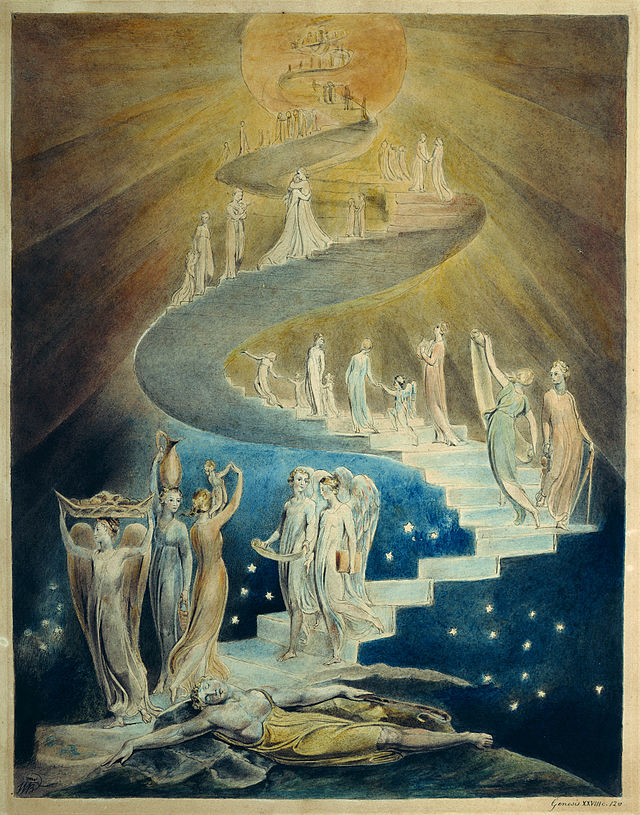
Jacob's Dream, by William Blake

Jacob’s Dream by William Blake

And Jacob worshipped as he leaned on the top of his staff (Gen. 47:31).

 And so it ends, Jacob’s long busy life of intrigue and wrestling.

Ever has he schemed, manipulated and deceived to get the blessings which God intended to give him even before he was born (Gen 25:23).

And his intrigues backfire–disastrously. Quite possibly, they slow down the destiny God had always intended for him. Again and again–as a consequence of his deceitfulness, and his attempts to look after himself–he’s on the road, in flight from Esau, from Laban, from Esau again.

Exploiting Esau’s desperate hunger, he demands his inheritance in exchange for a bowl of lentils. Esau now hates him. Exploiting his blind father, he pretends to be Esau, stealing his blessing. Now Esau’s resolved to murder him and Jacob’s on the road (Gen. 27:41). Never again will he see the mother who adored him.

He flees to a father-in-law fully as deceitful as he was himself. Works seven years to be given a near-sighted bride he never wanted. Has his wages changed seven times. Still, he attempts to look after himself, and does get the better of Laban with his selective breeding. And consequently has to flee again by night. His beloved Rebecca steals her father’s household Gods without Jacob’s knowledge, and dies, falling victim to his rashly invoked curse (Gen 31:32).

As he had deceived his old father, his sons deceive him, breaking his heart with their fabricated account of Joseph’s death. He lives twenty years without his favourite, gifted son. He deceived and was deceived by his three generations of his family. Deceit warps one’s character; the deceivers of the world then practice their evil arts on you without compunction.

On the night before his dreaded meeting with Esau, Jacob wrestles in the darkness with a man by the Jabbok River, who unable to overpower him, casually disables him. Sensing the divine, Jacob declares, “I will not let you go unless you bless me.”

He is blessed.

After that crippling encounter, after he learned his limits, after he sees God, Jacob becomes passive. He gives up his trickiness and scheming, and comes to the end of his life with no more intrigues, no more wrestling. He is now a jellyfish in the stream of God’s will, and God, in painful contorted ways, positions his family smack-dab in the stream of salvation history. Joseph’s son will save his family from famine, will help them become a multitudinous people, and they will return to Canaan with the wealth of the Egyptians.

* * *

 And that long life of wrestling with God and man, all ends well after all. It all ends in worship.

“And Jacob worshipped as he leaned on the top of his staff.”

It ended well because of the mercy of God.

Because what Jacob wanted more than anything was God’s blessing.

Because he had eyes to see the thin veil between the worlds, the ladder between heaven and earth with angels ascending and descending on it. The angels were there all along. It took quiet and spiritual eyes to see them.

Because he had eyes to see that man in the darkness was God. God was there in the darkness for anyone to see; Jacob had the holy night vision to see him.

Because realising that the most precious in life was God’s blessing, he refused to let God go unless he was blessed, even if the cost of that blessing was a limp, a somatic memory of that divine encounter.

God blessed him because Jacob asked him to, because Jacob demanded that he did so, because Jacob would settle for nothing less than God’s blessing, because he physically refused to let him go until he blessed him. As God would have blessed anyone who pursued him with the intensity that Jacob did.

And so it all ends in blessing. It all ends in worship.

* * *

 The irony in Joseph’s story is that God had always intended to bless him. And if he had waited for God, not taking advantage of Esau, not deceiving Isaac, not seizing an advantage over Laban, God would have still blessed him. Almost certainly sooner.

Because God sovereignly chose Jacob seeing in him the toughness, the pertinacity, the God-hunger to be a father of our faith.

He had the character of a man of destiny, a man God could use. Eager, hard-working, imaginative, enterprising, thinking out of the box, with eyes to see the spiritual world, to see angels and God himself as only the seers do.

God honoured Jacob’s numinous sense of God’s sovereignty, his sense that what was really important in life was that one operate under God’s blessing.

* * *

 Oh may it be so for me at the end, after all the excitement and all the grief; the things I succeeded at and the things I failed at; the things I am proud of and the things I cringe at; the relationships which have endured and the relationships which have crumbled; the times I refused to speak to God and the times I spoke to him all the time; when the evening comes and the sun goes down, may I like Jacob, lean on my staff and worship.

Yes, let it all end like this, in worship: I worship you. I worship you because you made me. I worship you because you are infinite, and I love to lose myself in you. I worship you because you are the sea into which I run and sink, tonight and every night, and there I shall find peace, a drop lost in your sea.

Oh at the day’s end, at my life’s end, let it all return to singing

Let it all return to worship.

Whatever may pass, and whatever lies before me
Let me be singing when the evening comes

Filed Under: Genesis, In which I bow my knee in praise and worship Tagged With: blog through the bible, Genesis, Jacob, Trust, worship, Wrestling

Yes, Praise the Lord Anyway. (Even for Loss and Fleas!)

By Anita Mathias

Betsie, Corrie and Nollie Ten Boom : The Righteous Among the Nations

Praise the Lord anyway, because he is creative. He can create diamonds out of mud, coal, rock and the bones of dead creatures. Brute facts are just inert materials in his hands, and from this unpromising argon, krypton, xenon, he can bring forth goodness and beauty.

* * *

I first encountered the idea of praising the Lord for everything as a teenager in India, in Merlin Carothers’ Prison to Praise.

 And for a while, I praised God for things that worked beautifully, and things that, apparently, did not. I had the sunniness and optimism of youth. I want to start living like that again, with thanksgiving in my heart, praising God for everything.

* * *

I have been reading Ann Voskamp’s One Thousand Gifts. Its insights and style (distinctive, quirky, poetic and aphoristic, so much so that it sometimes reads like a pastiche of one-liners) may well make it one of the spiritual classics of our century.

Her central insight was “Eucharisteo precedes the miracles.”  We give thanks in all things before we see the miracle.

                                                              * * *

I trained myself to praise God for everything as a young Charismatic woman.

When I was 19, I was returning by train from Madras, now Chennai, to Jamshedpur, where my parents then lived, a two day journey. On the morning of my journey, I went shopping in Madras’s tantalising second hand book stores, and spent most of my money, and didn’t have enough to buy another suitcase, and so impulsively bought a bucket to put the books in. (Please don’t laugh. I had tried to become a novice with Mother Teresa, and she refused to let her nuns buy suitcases, which she considered unnecessary and wasteful. They travelled with buckets, which she said were more useful. So that’s the inspiration!)

So I scramble into the station, just as the train is leaving, and with my enormous clutter of  luggage, get into the nearest carriage when happens to be third class. The very poorest people, noisy, crowded, and the cleanliness, well…  And I planned to read Vanity Fair over the two day journey, (the book, not the magazine!)

When the ticket collector comes around, I explain, tremulously, that I almost missed the train, so didn’t even get to buy a ticket (an offence!) and please could I buy a second class one instead. He sells me one, and I move, bucket, suitcases and all. Settle into a bunk with Vanity Fair. Get hungry. Reach for my wallet. I’d dropped it somewhere between the third class compartment and the second.

Now, this wasn’t a through ticket. So I have to get off at Asansol, with my melee of possessions, and not a paise to even make a phonecall.

Cold, clammy, stomach-clenching fear. What am I to do?

Well, I have been training myself to praise the Lord, anyway.

I sit up in my bunk, and say, “Lord, if I leave my stuff here, and try and find that compartment, this may vanish too. And there’s no way I am going to get that wallet back. I don’t know what to do. Don’t know how I am getting home. But I guess we’ll figure something out. And anyway, I will praise you.”

And I praise him in blind faith. Really do! And fall asleep peacefully!!

I am awakened by a rough shaking at my shoulder.

The ticket collector hands me my wallet!

“Thank you, thank you, thank you,” I say, effusively, overwhelmed.

What are the odds of recovering a leather wallet left in a third class compartment in India? Apparently very good!

“You should be careful with your things,” he says gruffly and walks away. I look inside. All the cash was there. And I had had a good night’s sleep.

And learned a lesson. Praise the Lord, anyway!

* * *

Did the praise, the acceptance, set in motion an avalanche of divine intervention which got me back my wallet and the rupees to get a ticket home? I believe so. Would I have got it if I had not prayed? Perhaps not.

Does it even make sense to praise God when things are going badly? I truly believe so.

* * *

Here is the most famous example of someone practising praise. Corrie Ten Boom in “The Hiding Place,” describes praising God in Ravensbruck.

“‘Fleas!’ I cried. ‘Betsie, the place is swarming with them!’

“‘Here! And here another one!’ I wailed. ‘Betsie, how can we live in such a place!’

“‘Show us. Show us how.’ It was said so matter of factly it took me a second to realize she was praying. More and more the distinction between prayer and the rest of life seemed to be vanishing for Betsie.

“‘Corrie!’ she said excitedly. ‘He’s given us the answer! Before we asked, as He always does! In the Bible this morning. Where was it? Read that part again!’

‘It was in First Thessalonians,’ I said

“‘Oh yes:’…”Rejoice always, pray constantly, give thanks in all circumstances; for this is the will of God in Christ Jesus.'”

“‘That’s it, Corrie! That’s His answer. “Give thanks in all circumstances!” That’s what we can do. We can start right now to thank God for every single thing about this new barracks!’ I stared at her; then around me at the dark, foul-aired room.

“‘Such as?’ I said.

“‘Such as being assigned here together.’

“I bit my lip. ‘Oh yes, Lord Jesus!’

“‘Such as what you’re holding in your hands.’ I looked down at the Bible.

“‘Yes! Thank You, dear Lord, that there was no inspection when we entered here! Thank You for all these women, here in this room, who will meet You in these pages.’

“‘Yes,’ said Betsie, ‘Thank You for the very crowding here. Since we’re packed so close, that many more will hear!’ She looked at me expectantly. ‘Corrie!’ she prodded.

“‘Oh, all right. Thank You for the jammed, crammed, stuffed, packed suffocating crowds.’

“‘Thank You,’ Betsie went on serenely, ‘for the fleas and for–‘

“The fleas! This was too much. ‘Betsie, there’s no way even God can make me grateful for a flea.’

“‘Give thanks in all circumstances,’ she quoted. It doesn’t say, ‘in pleasant circumstances.’ Fleas are part of this place where God has put us.

“And so we stood between tiers of bunks and gave thanks for fleas. But this time I was sure Betsie was wrong.”

a small light bulb cast a wan yellow circle on the wall, and here an ever larger group of women gathered.

“They were services like no others, these times in Barracks 28.

“At first Betsie and I called these meetings with great timidity. But as night after night went by and no guard ever came near us, we grew bolder. So many now wanted to join us that we held a second service after evening roll call. There on the Lagerstrasse we were under rigid surveillance, guards in their warm wool capes marching constantly up and down. It was the same in the center room of the barracks: half a dozen guards or camp police always present. Yet in the large dormitory room there was almost no supervision at all. We did not understand it.

“One evening, Betsie was waiting for me . Her eyes were twinkling.

“‘You’re looking extraordinarily pleased with yourself,’ I told her.

“‘You know, we’ve never understood why we had so much freedom in the big room,’ she said. ‘Well–I’ve found out.’

“That afternoon, she said, there’d been confusion in her knitting group about sock sizes and they’d asked the supervisor to come and settle it.

“But she wouldn’t. She wouldn’t step through the door and neither would the guards. And you know why?”

“Betsie could not keep the triumph from her voice: ‘Because of the fleas! That’s what she said, “That place is crawling with fleas!'”

“My mind rushed back to our first hour in this place. I remembered Betsie’s bowed head, remembered her thanks to God for creatures I could see no use for.”

* * *

Betsie praised God for the fleas.

But praise did not keep Betsie alive for a Biblical life span. Betsie died in Ravensbruck, at 59 (exhausted by working 11 hour days as a slave labourer for Siemens, “unloading large metal plates from a boxcar and wheeled them in a heavy handcart to a receiving gate”) perhaps 32 years earlier than she might have. (Corrie died in 1983, aged 91).

However, death comes to all. Perhaps Betsie, who even in this life had “crossed over,” so that, as Corrie says, “More and more the distinction between prayer and the rest of life seemed to be vanishing for Betsie,” would not have resented her death three decades too soon had she seen the fruit that came from her death like a grain of wheat. How the inspiration of her story lives, and shall live for hundreds of years, perhaps

Not just the story of fleas which even today encourages us to praise and thank God in blind faith at all times, but even more this truly remarkable story which flowed from her death. Corrie Ten Boom writes in The Hiding Place,

It was at a church service in Munich that I saw the former S.S. man who had stood guard at the shower room door in the processing center at Ravensbruck. 

He was the first of our actual jailers that I had seen since that time.  And suddenly it was all there – the roomful of mocking men, the heaps of clothing, Betsie’s pain-blanched face.

He came up to me as the church was emptying, beaming and bowing.  “How grateful I am for your message, Fraulein.” he said.  “To think that, as you say, He has washed my sins away!”

His hand was thrust out to shake mine.  And I, who had preached so often to the people in Bloemendaal the need to forgive, kept my hand at my side.

Even as the angry, vengeful thoughts boiled through me, I saw the sin of them.  Jesus Christ had died for this man; was I going to ask for more?  “Lord Jesus, I prayed, forgive me and help me to forgive him.”

I tried to smile, I struggled to raise my hand.  I could not.  I felt nothing, not the slightest spark of warmth or charity.  And so again I breathed a silent prayer.  “Jesus, I cannot forgive him.  Give me Your forgiveness.”

As I took his hand, the most incredible thing happened.  From my shoulder along my arm and through my hand a current seemed to pass from me to him, while into my heart sprang a love for this stranger that almost overwhelmed me.

And so I discovered that it is not on our forgiveness any more than on our goodness that the world’s healing hinges, but on His.  When He tells us to love our enemies, He gives, along with the command, the love itself.”


Filed Under: In which I bow my knee in praise and worship Tagged With: Carotthers, Corrie Ten Boom, Fleas, Praise the Lord Anyway

It was like a Church to me: Port Meadow, Oxford, at Sunset

By Anita Mathias

Port Meadow (Oxford) at Sunset.

Port Meadow (Oxford) at Sunset.


3-IMG_0667

Port Meadow (Oxford) at Sunset.

I walked last night on Port Meadow. An extraordinary experience! The blazing ball of sun slowly floated into the Thames, colouring it crimson.

An amazing natural event I have too often missed! Spectacular beauty lavished on anyone who would take a few minutes to observe it.

Wild geese arrived honking, with a beating of wings, settling in to their night homes on the river. Seagulls flew overhead, dropping shells, having eaten the mussel.

Graceful swans with impossibly elongated necks tucked them under their wings, ready to sleep. Baby ducks followed their mothers. Golden retrievers bounded.

There was perfect peace.

The sky stretched huge massive and endless over the flat expanse of Port Meadow. It reminded me of the Big Sky when we drove through Montana.

And I kept thinking:
The Heavens declare the glory of God
The firmament shows forth the work of his hands
Day after day they pour forth speech;
night after night they reveal knowledge.
They have no speech, they use no words;
Yet their voice goes out into all the earth,
their words to the ends of the world. (Psalm 19)

Port Meadow (Oxford) at Sunset.

Port Meadow (Oxford) at Sunset.

And here’s a poem by R. S. Thomas, about a similar experience

The Moor

It was like a church to me.
I entered it on soft foot,
Breath held like a cap in the hand.
It was quiet.
What God there was made himself felt,
Not listened to, in clean colours
That brought a moistening of the eye,
In a movement of the wind over grass.

There were no prayers said. But stillness
Of the heart’s passions — that was praise
Enough; and the mind’s cession
Of its kingdom. I walked on,
Simple and poor, while the air crumbled
And broke on me generously as bread.

Filed Under: In which I bow my knee in praise and worship, In which I Spot God in Nature Tagged With: Nature, Oxford, Port Meadow, Praise, R.S. Thomas, Sunset, The Moor, worship

The Power of Praise, Even in the Animal Kingdom

By Anita Mathias

hoefnagel oprheus charming the animals

“Orpheus Charming the Animals”Jacob Hoefnagel ( credit ) 


I keep learning and forgetting and learning again the spiritual power of praise and gratitude—eucharisteo.

It’s one of those spiritual practices that unleashes disproportionate power—like prayer, or the power of love.

Why it even works in the animal kingdom.

Several feisty horses live in the field behind my garden.  Many villagers bring them apples and carrots, and stroke them. But I have not grown up with horses, and while I enjoy looking at them, and love the placid, gentle, almost bovine look in their eyes, I do not voluntarily pet  them. I consider my small delicate hands, and their long mouths and enormous teeth, and the disproportion alarms me.

Well, as I cross their field on my walks across country footpaths, the horses come up to me, snorting, snuffling me to see if I have brought them crunchy treats. If I have a water bottle, they go for it, assuming it’s a treat for them. They surround me, I freeze, and they come closer, putting their noses into the red hood of my coat, as if it’s a nosebag! Talk about up close and personal!

I have called Roy on my mobile to come and rescue me, the horses trying to get hold of the mobile, and have then just stood there frozen, waiting, snuffled by horses, because if I moved, they followed me.

And then I took to avoiding the field behind our orchard, the natural gateway to field after field with public footpaths through them. Garsington has more public footpaths through fields than any other Oxfordshire village!

* * *

Well, this week, the horses came, majestic and determined, with their characteristic snort. “He sayeth among the trumpets, Ha, Ha.” (Job 39:25.)

I decided not to give way to fear, because they probably smell it. All animals instinctively seek dominance, and to assert a pecking order (the bullying primate behaviour which Frank Schaeffer sees in conservative Christians who insist on male headship and female submission. Okay, digression over 🙂

And so this week, instead of turning around as the horses trot towards me from every corner of the field, or saying, in a somewhat quavery voice any horse worth its salt could hear through, “Nice horse, good horse, let me go,” I decided to genuinely praise the God who made them.

And so I stroked that long, long nose, as long as my arm, and said aloud, gingerly at first, but gaining conviction, “Lord, I praise you for this beautiful horse. I praise you for its tranquil, dreamy eyes. I praise you for its strong body. I praise you for its (oops, over-) friendly temperament.”

And as I stroked, and praised, I genuinely began to calm down, and to see the beauty of that huge, gentle plaintive-eyed horse, and it too  began to calm down, and—hallelujah!!–let me go on my way without following me.

Wow, he had realized that I wasn’t afraid, that I had grown to like him. He had sensed that I was calm, and so did not feel the need to bully me by following me, in his snorty Ha-Ha way.

The music of Orpheus was meant to calm the animals. Well, apparently, so is the music of praise to their creator.

Filed Under: In which I bow my knee in praise and worship, In Which I Count my Blessings, random Tagged With: animals, gratitude, The power of praise

In which I Practise Praying Every Ten Minutes: The Ten Minute Worship Revolution

By Anita Mathias

Irene, delighted with and thankful for the sash of her new dress!


I have attended two conferences organized by John Arnott, on whose beat the hugely influential Toronto Revival was born.  They have influenced the course of my life—deeply introducing me the love of the Father; immersing me in soaking prayer ; and, most recently, introducing me to a ten minute worship timer.
A worship timer?
Carol Arnott was incurably ill, and went to the Community without Walls in Germany, where Rolland Baker was healed of dementia and cerebral malaria.
There Dr. Arne Elsen suggested the 10 minute worship revolution, using a timer or a buzzer which goes off every ten minutes, when you stop everything and worship. He cures five terminally ill patients, mainly cancer patients a week, through this infusion of positivity, joy, thankfulness, worship and praise.
Well, I was interested. I have seen 3-4 people bedbound with ME, who have been cured by stopping spiralling negative thoughts (I am too ill to do this—talking will tire me—walking will exhaust me etc.) and exchanging them with positive self-talk through the Lightning Process (a highly effective neuro-linguistic programming course, which I haven’t been on. Not religious as far as I know. )
So, this every ten-minute worship really should bring an infusion of the positive thinking which is  a neglected aspect of Jesus’ teaching, not to mention joy and praisefulness (both things I have sought) into one’s day to day life.
Zoe and I bought one the day we heard of it. I adore it and have used it every day for the last two weeks.
It’s will probably take 3 weeks to fully get into the habit of it, and for new neural pathways to be created. And I will report on any changes in my temperament and emotional state in about six months.
But the first two weeks (which is about how long it takes to get the hang of it, and to begin reaping the benefits, according to successful users) have been peaceful and happy. I don’t know how I will be able to live without it. If I turn it off for a nap or while having coffee with a friend, and then forget to switch it back, something feels wrong. I am less productive, time seems more lumpy and stolid instead of flowing in a grace-infused stream.
                                                               * * *
 So here’s my experience. I haven’t been using it exclusively to worship, though, increasingly, that is what I am doing every ten minutes.
1) Thankfullness
I usually stop when my ten minute timer goes, and thank God for something. Often something I may not have otherwise thanked God for. New people following my blog on Facebook or Google Friend Connect. The blog’s growth. The success of my children. The sweetness of Roy. The glory of my dog, and ducks and rabbits (okay, I adore animals!!). Blue skies. The orchids in the room. Time to pray. To read. To study the Bible. To write. Gratitude that earning a living is not all-consuming, but leaves us time to be organised and peaceful and quiet.
And my mental state slowly changes through this discipline of praise every ten minutes. Becomes more positive, more ebullient.
2) My Use of Time Significantly Improves
I have never worked full-time, and have worked part-time for about 3 years, teaching at Ohio State University, Binghamton University, and William and Mary, as a Graduate Teaching Assistant, and Adjunct Professor variously.
So my work habits have really been those of a dreamy, dilatory, distractible writer than a professional.
But, my goodness, this timer really helps. So, I am reading articles in the New York Times or the Guardian. But really should be writing. The buzzer goes; I worship. And, if by the time the buzzer goes again, I am still dilly-dallying, well then, I know something is seriously wrong, and settle down to work.
Yeah, you just can’t procrastinate and waste time that much when you are going to pray every ten minutes!!
It keeps me on track—with what I intend to do, what I have done, what I am going to do that day. Sort of gets me back into the river of surrender and discipline.
3) It keeps me positive. Roy, who is used to, and loves, working for hours with intense concentration was appalled at the thought of being interrupted every ten minutes.
However, once, when I was telling him off (very gently, and most justifiably:-), he burst into a huge grin. “Now you will never be annoyed with me for more than ten minutes at a time,” he said. Yeah,  it’s very annoying when you are telling someone off and timer goes off telling you it’s time to worship God, and you have to drop your moaning. And praise God!!
Seriously though, the first few days, my timer often caught me thinking something negative about something or someone, and instead I found something to be thankful for in that person or situation.
The second week, it’s been rarer to be caught out thinking negatively by my timer. It is truly beginning to change the tenor of my emotional life.
4) Impact on Family Life
We have long, leisurely family meals, which last nearly an hour. And the buzzer goes off several times during dinner. And we all go round the table and thank God for one thing we are grateful for.
And of course, consciously expressing gratitude makes you more grateful.
5) Praying in Tongues adds a depth to one’s prayer life, especially in areas in which one may not quite understand why one is stymied, or what or how one should pray. I usually pray in tongues haphazardly, when my heart is full, though I do so most days. Now I have a little slot for it.
6) Prayer to be filled with the Spirit is a prayer which is always answered (Luke 11:13). And to be filled with the Spirit is one of the desires of my heart—both to experience the joy and wisdom of the filling, and to be able to bless people from the overflow of God’s life in me. My timer reminds me to pray for this.
7) Awareness of God’s Presence. Again, using the worship timer helps me to be more aware of the presence of Christ, right here in the room with me, and in his hands a stream of bubbling waters which he offers to anyone who is thirsty and comes to him to drink.
Praying briefly every ten minutes incorporates prayer into the rhythms of my real and emotional life. I find that I am frequently living and working in an ambient state of praise and prayer, coming a tiny step closer to the injunction to pray continuously.
8) Worship is a weaker element of my spiritual life. I need the tides of communal worship to really lift my spirits into self-forgetful worship. I haven’t practised worshiping alone that much. So the worship timer is introducing this neglected dimension into my prayer life.
9) Visualization—Praying every ten minutes is a rich practice. Sometimes, I just relax and visualize. Me dancing with Jesus. Jesus breathing the Holy Spirit on me. (John 20:22). Me dancing in the waterfall of God’s presence and power and creativity.
10) Big Asks—I am using this exercise to be thankful, praiseful and to worship, to just love God and be, rather than for big-wrestling change-my-life kind of prayer. But if I am conscious of a need as my buzzer goes—I am stuck with my writing; worried about a kid, I send up celestial smoke signals, of course. Please help.
Incorporating it into work and exercise—If the buzzer goes off while I am reading or writing, which I often am, I pause, thank, praise, pray, and resume. If it goes off while I am walking and listening to a novel, or an easy theological book, rather than search through all my pockets for my iPhone, pause it, pray, then rewind to get into the flow, I simply multitask, and silently thank God for the book, the glory of the day and the fields around us, while the narrator continues reading me the book.
Yeah, so I am happier, more on track, more peaceful since I started using the ten minute worship timer. I recommend it.
(And here’s the link to Catch the Fire timer I use.)


Filed Under: In which I bow my knee in praise and worship, In which I play in the fields of prayer

Sign Up and Get a Free eBook!

Sign up to be emailed my blog posts (one a week) and get the ebook of "Holy Ground," my account of working with Mother Teresa.

Join 544 Other Readers

My Books

Rosaries, Reading, Secrets: A Catholic Childhood in India

Rosaries, Reading Secrets, B&N
USA

UK

Wandering Between Two Worlds: Essays on Faith and Art

Wandering Between Two Worlds
USA

UK

Francesco, Artist of Florence: The Man Who Gave Too Much

Francesco, Artist of Florence
US

UK

The Story of Dirk Willems

The Story of Dirk Willems
US

UK

My Latest Meditation

Anita Mathias: About Me

Anita Mathias

Read my blog on Facebook

Follow me on Twitter

Follow @anitamathias1

Recent Posts

  • God’s Complete Forgiveness 
  • Using God’s Gift of Our Talents: A Path to Joy and Abundance
  • The Kingdom of God is Here Already, Yet Not Yet Here
  • All Those Who Exalt Themselves Will Be Humbled & the Humble Will Be Exalted
  • Christ’s Great Golden Triad to Guide Our Actions and Decisions
  • How Jesus Dealt With Hostility and Enemies
  • Do Not Be Afraid, but Do Be Prudent
  • For Scoundrels, Scallywags, and Rascals—Christ Came
  • How to Lead an Extremely Significant Life
  • Don’t Walk Away From Jesus, but if You Do, He Still Looks at You and Loves You
Premier Digital Awards 2015 - Finalist - Blogger of the year
Runner Up Christian Media Awards 2014 - Tweeter of the year

Categories

What I’m Reading


Wolf Hall
Hilary Mantel

Wolf Hall --  Amazon.com
Amazon.com

Amazon.co.uk

Silence and Honey Cakes:
The Wisdom Of The Desert
Rowan Williams

Silence and Honey Cakes --  Amazon.com
Amazon.com

Amazon.co.uk

The Long Loneliness:
The Autobiography of the Legendary Catholic Social Activist
Dorothy Day

The Long Loneliness --  Amazon.com
Amazon.com

Amazon.co.uk

Country Girl
Edna O'Brien

Country Girl  - Amazon.com
Amazon.com

Amazon.co.uk

Archive by month

My Latest Five Podcast Meditations

INSTAGRAM

anita.mathias

My memoir: Rosaries, Reading, Secrets https://amzn.to/42xgL9t
Oxford, England. Writer, memoirist, podcaster, blogger, Biblical meditation teacher, mum

Well, hello friends! Breaking radio silence to let Well, hello friends! Breaking radio silence to let you know that I have taped a meditation for you on Christ’s famous Parable of the Talents in Matthew 25. https://anitamathias.com/2025/11/05/using-gods-gift-of-our-talents-a-path-to-joy-and-abundance/
Here you are, click the play button in the blog post for a brief meditation, and some moments of peace, and, perhaps, inspiration in your day 🙂
Hi Friends, I have taped a meditation; do listen a Hi Friends, I have taped a meditation; do listen at this link: https://anitamathias.com/2025/04/08/the-kingdom-of-god-is-here-already-yet-not-yet-here-2/
It’s on the Kingdom of God, of which Christ so often spoke, which is here already—a mysterious, shimmering internal palace in which, in lightning flashes, we experience peace and joy, and yet, of course, not yet fully here. We sense the rainbowed presence of Christ in the song which pulses through creation. Christ strolls into our rooms with his wisdom and guidance, and things change. Our prayers are answered; we are healed; our hearts are strangely warmed. Sometimes.
And yet, we also experience evil within & all around us. Our own sin which can shatter our peace and the trajectory of our lives. And the sins of the world—its greed, dishonesty and environmental destruction.
But in this broken world, we still experience the glory of creation; “coincidences” which accelerate once we start praying, and shalom which envelops us like sudden sunshine. The portals into this Kingdom include repentance, gratitude, meditative breathing, and absolute surrender.
The Kingdom of God is here already. We can experience its beauty, peace and joy today through the presence of the Holy Spirit. But yet, since, in the Apostle Paul’s words, we do not struggle only “against flesh and blood, but against the rulers, against the unseen powers of this dark world and against the spiritual forces of evil,” its fullness still lingers…
Our daughter Zoe was ordained into the Church of E Our daughter Zoe was ordained into the Church of England in June. I have been on a social media break… but … better late than never. Enjoy!
First picture has my sister, Shalini, who kindly flew in from the US. Our lovely cousins Anthony and Sarah flank Zoe in the next picture.
The Bishop of London, Sarah Mullaly, ordained Zoe. You can see her praying that Zoe will be filled with the Holy Spirit!!
And here’s a meditation I’ve recorded, which you might enjoy. The link is also in my profile
https://anitamathias.com/2024/11/07/all-those-who-exalt-themselves-will-be-humbled-the-humble-will-be-exalted/
I have taped a meditation on Jesus statement in Ma I have taped a meditation on Jesus statement in Matthew 23, “For those who exalt themselves will be humbled, and those who humble themselves will be exalted.”
Do listen here. https://anitamathias.com/2024/11/07/all-those-who-exalt-themselves-will-be-humbled-the-humble-will-be-exalted/
Link also in bio.
And so, Jesus states a law of life. Those who broadcast their amazingness will be humbled, since God dislikes—scorns that, as much as people do.  For to trumpet our success, wealth, brilliance, giftedness or popularity is to get distracted from our life’s purpose into worthless activity. Those who love power, who are sure they know best, and who must be the best, will eventually be humbled by God and life. For their focus has shifted from loving God, doing good work, and being a blessing to their family, friends, and the world towards impressing others, being enviable, perhaps famous. These things are houses built on sand, which will crumble when hammered by the waves of old age, infirmity or adversity. 
God resists the proud, Scripture tells us—those who crave the admiration and power which is His alone. So how do we resist pride? We slow down, so that we realise (and repent) when sheer pride sparks our allergies to people, our enmities, our determination to have our own way, or our grandiose ego-driven goals, and ambitions. Once we stop chasing limelight, a great quietness steals over our lives. We no longer need the drug of continual achievement, or to share images of glittering travel, parties, prizes or friends. We just enjoy them quietly. My life is for itself & not for a spectacle, Emerson wrote. And, as Jesus advises, we quit sharp-elbowing ourselves to sit with the shiniest people, but are content to hang out with ordinary people; and then, as Jesus said, we will inevitably, eventually, be summoned higher to the sparkling conversation we craved. 
One day, every knee will bow before the gentle lamb who was slain, now seated on the throne. We will all be silent before him. Let us live gently then, our eyes on Christ, continually asking for his power, his Spirit, and his direction, moving, dancing, in the direction that we sense him move.
Link to new podcast in Bio https://anitamathias.co Link to new podcast in Bio https://anitamathias.com/2024/02/20/how-jesus-dealt-with-hostility-and-enemies/
3 days before his death, Jesus rampages through the commercialised temple, overturning the tables of moneychangers. Who gave you the authority to do these things? his outraged adversaries ask. And Jesus shows us how to answer hostile questions. Slow down. Breathe. Quick arrow prayers!
Your enemies have no power over your life that your Father has not permitted them. Ask your Father for wisdom, remembering: Questions do not need to be answered. Are these questioners worthy of the treasures of your heart? Or would that be feeding pearls to hungry pigs, who might instead devour you?
Questions can contain pitfalls, traps, nooses. Jesus directly answered just three of the 183 questions he was asked, refusing to answer some; answering others with a good question.
But how do we get the inner calm and wisdom to recognise
and sidestep entrapping questions? Long before the day of
testing, practice slow, easy breathing, and tune in to the frequency of the Father. There’s no record of Jesus running, rushing, getting stressed, or lacking peace. He never spoke on his own, he told us, without checking in with the Father. So, no foolish, ill-judged statements. Breathing in the wisdom of the Father beside and within him, he, unintimidated, traps the trappers.
Wisdom begins with training ourselves to slow down and ask
the Father for guidance. Then our calm minds, made perceptive, will help us recognise danger and trick questions, even those coated in flattery, and sidestep them or refuse to answer.
We practice tuning in to heavenly wisdom by practising–asking God questions, and then listening for his answers about the best way to do simple things…organise a home or write. Then, we build upwards, asking for wisdom in more complex things.
Listening for the voice of God before we speak, and asking for a filling of the Spirit, which Jesus calls streams of living water within us, will give us wisdom to know what to say, which, frequently, is nothing at all. It will quieten us with the silence of God, which sings through the world, through sun and stars, sky and flowers.
Especially for @ samheckt Some very imperfect pi Especially for @ samheckt 
Some very imperfect pictures of my labradoodle Merry, and golden retriever Pippi.
And since, I’m on social media, if you are the meditating type, here’s a scriptural meditation on not being afraid, while being prudent. https://anitamathias.com/2024/01/03/do-not-be-afraid-but-do-be-prudent/
A new podcast. Link in bio https://anitamathias.c A new podcast. Link in bio
https://anitamathias.com/2024/01/03/do-not-be-afraid-but-do-be-prudent/
Do Not Be Afraid, but Do Be Prudent
“Do not be afraid,” a dream-angel tells Joseph, to marry Mary, who’s pregnant, though a virgin, for in our magical, God-invaded world, the Spirit has placed God in her. Call the baby Jesus, or The Lord saves, for he will drag people free from the chokehold of their sins.
And Joseph is not afraid. And the angel was right, for a star rose, signalling a new King of the Jews. Astrologers followed it, threatening King Herod, whose chief priests recounted Micah’s 600-year-old prophecy: the Messiah would be born in Bethlehem, as Jesus had just been, while his parents from Nazareth registered for Augustus Caesar’s census of the entire Roman world. 
The Magi worshipped the baby, offering gold. And shepherds came, told by an angel of joy: that the Messiah, a saviour from all that oppresses, had just been born.
Then, suddenly, the dream-angel warned: Flee with the child to Egypt. For Herod plans to kill this baby, forever-King.
Do not be afraid, but still flee? Become a refugee? But lightning-bolt coincidences verified the angel’s first words: The magi with gold for the flight. Shepherds
telling of angels singing of coming inner peace. Joseph flees.
What’s the difference between fear and prudence? Fear is being frozen or panicked by imaginary what-ifs. It tenses our bodies; strains health, sleep and relationships; makes us stingy with ourselves & others; leads to overwork, & time wasted doing pointless things for fear of people’s opinions.
Prudence is wisdom-using our experience & spiritual discernment as we battle the demonic forces of this dark world, in Paul’s phrase.It’s fighting with divinely powerful weapons: truth, righteousness, faith, Scripture & prayer, while surrendering our thoughts to Christ. 
So let’s act prudently, wisely & bravely, silencing fear, while remaining alert to God’s guidance, delivered through inner peace or intuitions of danger and wrongness, our spiritual senses tuned to the Spirit’s “No,” his “Slow,” his “Go,” as cautious as a serpent, protected, while being as gentle as a lamb among wolves.
Link to post with podcast link in Bio or https://a Link to post with podcast link in Bio or https://anitamathias.com/2023/09/22/dont-walk-away-from-jesus-but-if-you-do-he-still-looks-at-you-and-loves-you/
Jesus came from a Kingdom of voluntary gentleness, in which
Christ, the Lion of Judah, stands at the centre of the throne in the guise of a lamb, looking as if it had been slain. No wonder his disciples struggled with his counter-cultural values. Oh, and we too!
The mother of the Apostles James and John, asks Jesus for a favour—that once He became King, her sons got the most important, prestigious seats at court, on his right and left. And the other ten, who would have liked the fame, glory, power,limelight and honour themselves are indignant and threatened.
Oh-oh, Jesus says. Who gets five talents, who gets one,
who gets great wealth and success, who doesn’t–that the
Father controls. Don’t waste your one precious and fleeting
life seeking to lord it over others or boss them around.
But, in his wry kindness, he offers the ambitious twelve
and us something better than the second or third place.
He tells us how to actually be the most important person to
others at work, in our friend group, social circle, or church:Use your talents, gifts, and energy to bless others.
And we instinctively know Jesus is right. The greatest people in our lives are the kind people who invested in us, guided us and whose wise, radiant words are engraved on our hearts.
Wanting to sit with the cleverest, most successful, most famous people is the path of restlessness and discontent. The competition is vast. But seek to see people, to listen intently, to be kind, to empathise, and doors fling wide open for you, you rare thing!
The greatest person is the one who serves, Jesus says. Serves by using the one, two, or five talents God has given us to bless others, by finding a place where our deep gladness and the world’s deep hunger meet. By writing which is a blessing, hospitality, walking with a sad friend, tidying a house.
And that is the only greatness worth having. That you yourself,your life and your work are a blessing to others. That the love and wisdom God pours into you lives in people’s hearts and minds, a blessing
https://anitamathias.com/.../dont-walk-away-from-j https://anitamathias.com/.../dont-walk-away-from-jesus.../
Sharing this podcast I recorded last week. LINK IN BIO
So Jesus makes a beautiful offer to the earnest, moral young man who came to him, seeking a spiritual life. Remarkably, the young man claims that he has kept all the commandments from his youth, including the command to love one’s neighbour as oneself, a statement Jesus does not challenge.
The challenge Jesus does offers him, however, the man cannot accept—to sell his vast possessions, give the money to the poor, and follow Jesus encumbered.
He leaves, grieving, and Jesus looks at him, loves him, and famously observes that it’s easier for a camel to squeeze through the eye of a needle than for a rich person to live in the world of wonders which is living under Christ’s kingship, guidance and protection. 
He reassures his dismayed disciples, however, that with God even the treasure-burdened can squeeze into God’s kingdom, “for with God, all things are possible.”
Following him would quite literally mean walking into a world of daily wonders, and immensely rich conversation, walking through Israel, Lebanon, Syria, and Jordan, quite impossible to do with suitcases and backpacks laden with treasure. 
For what would we reject God’s specific, internally heard whisper or directive, a micro-call? That is the idol which currently grips and possesses us. 
Not all of us have great riches, nor is money everyone’s greatest temptation—it can be success, fame, universal esteem, you name it…
But, since with God all things are possible, even those who waver in their pursuit of God can still experience him in fits and snatches, find our spirits singing on a walk or during worship in church, or find our hearts strangely warmed by Scripture, and, sometimes, even “see” Christ stand before us. 
For Christ looks at us, Christ loves us, and says, “With God, all things are possible,” even we, the flawed, entering his beautiful Kingdom.
Follow on Instagram

© 2026 Dreaming Beneath the Spires · All Rights Reserved. · Cookie Policy · Privacy Policy