Anita Mathias: Dreaming Beneath the Spires

Anita Mathias's Blog on Faith and Art

  • Home
  • My Books
  • Meditations
  • Essays
  • Contact
  • About Me

The Life-Changing Practice of Meditation

By Anita Mathias

So, a couple of years ago, almost on a whim, my husband Roy and I took an intensive eight week course in Mindfulness at the Oxford Department of Psychiatry! (and at the famous local psychiatric hospital, the Warneford!!)

I didn’t really know what Mindfulness was, but I “knew,” we should do it. You can imagine how annoyed Roy felt!!

As it turned out, it was an amazing course, filled with many new ways of thinking and being. We learned and practiced different meditations such as the body scan, walking meditation, meditations when experiencing difficult things, and mindful movement (i.e. yoga, “yoga is meditation.”) While, unsurprisingly, not many stuck, those that did were life-changing!

I am learning the art of stopping and taking a breath, though the three step breathing space, a four minute meditation. It sometimes feels as if I am too busy, too stressed, too behind, running too late, to stop and take a few minutes to just breathe for heaven’s sake… but doing that settles my mind and then I am so much more effective. In fact, it is a cure for the racing mind, the busy heart, and the slumbering spirit…stop, breathe, calm the mind.

“Sitting meditation” is what I practice most often. Forty minutes, the optimal meditation session, takes you, your mind, body, and spirit to another, generally peaceful and joyful state, and I aim to spend forty minutes a day on meditation, though I do it according to need—sometimes two sets of twenty minutes which some teachers say yields maximum benefits, sometimes four sets of ten minutes which calms me and gives focus before I work, or deal with difficult tasks, thoughts, and emotions.

I found learning meditation so helpful that Roy and I are currently doing a 12 week advanced course in Mindfulness at the Warneford, led by Willem Kuyken, Oxford Professor of Mindfulness; it’s a mind-changing and joyful experience.

So here are some personal benefits I have experienced over the last two years of regular meditation, some of them accidental and unexpected!

1 Better Sleep

I often listen to a guided meditation by Mark Williams or Jon Kabat-Zinn to calm my mind, which usually has a hundred thoughts, questions, and things to resolve. I am calm and sleepy by the end of it and drift off to sleep easily. Meditation for me is a gateway into sleep.

2 Focus and Creativity

I frequently meditate, just for ten minutes, before beginning to write, and it helps focus my mind. It is a brilliant investment of time. I was interested to read that Juval Noah Harari who condensed the history of humanity into Sapiens, 464 bestselling pages meditates for two hours a day, and says he would not have been able to  focus on the important themes and events in the morass of world history without the practice of meditation.

If my mind is scattered and distracted, meditating before I settle down to write helps me focus, an essential skill for creative work in this culture in which the internet, with its invitations to distraction, its gratification of idle curiosity, and its addictive dopamine surges make focus more difficult.

3 Weight Loss

This is possibly an accidental benefit, a synergistic, serendipitous connection… though perhaps not. But since I started meditation in May 2017, I have lost 30 pounds, over two stone.

One day, I realised that my Fitbit showed that my weight had dropped for each week I had been meditating, and hypothesized a connection. Then I worked with a health coach, who suggested  meditating twice a day for 20 minutes (to lower cortisol, the stress hormone which prevents weight loss) and texting her after each session.

I have now pretty much broken the habit of emotional eating and snacking, and though I have more weight to lose, I am hopeful because your trajectory is more important than where you currently are. And I am trying to eat more mindfully, actually savouring food.

4 Relief of chronic pain

I had crippling, life-affecting pain from sciatica for over a year (and, amazingly, was healed from chronic pain after an Oxford Professor of Orthopaedic Surgery PRAYED for me in church!!!).

I worked with a health coach and got Sports Massages, but then she tried removing the pain without placing her hands on me, but simply by meditating with me… and, lo and behold, it worked.

So I used meditation when pain gripped me. It calmed the mind, it relaxed the body, and, astonishingly, pain left while I focused on my breath. The benefits of meditation for chronic pain have been well-documented by Jon Kabat-Zinn, and in this Atlantic article, for instance.

5 A Pathway into Prayer

For me, meditation is a pathway into prayer. Sometimes, my mind is racing, and my emotions feel turbulent, and I know it would take a long time to settle down to prayer. So I do a ten or twenty minute guided meditation until I am calm enough to enter the presence of Jesus.

I used to calm myself and resolve things through prayer, but prayer for me can be work; it’s conversation; it takes energy, and, at night, it uses the mind which I want to simmer down. Meditation, especially the two practices I use most often, Sitting Meditation, and Lying Down Meditation, calms the mind and body, and creates the necessary conditions for fruitful prayer, which for me happens when I actually “see” the face of Jesus, and am in his presence.

6 Problem-Solving.

I love the “Sitting with Difficulties Meditation.”  You get super-calm through breathing, and then face the difficulty…an emotion, task, person or situation. It is a half an hour meditation, and during the course of it, I usually know exactly what I should do about the difficulty, and what the next steps should be. If it is an inter-personal hassle, sometimes I have a better understanding of the person’s behaviour, and more compassion, and forgiveness comes more easily. Sometimes, I just take the difficulty and leave it in God’s hands to do what he wants with it. It functions as a Serenity Prayer, accepting the things I cannot change, and changing the things I can. And it cuts problems down to size. Some annoying situations and random people one can just blow off.

7 Emotional and Mental Health

Meditation helps me calm my emotions, and achieve a (sometimes temporary) serenity from which productivity flows. It gives me space to confront my thoughts and the emotional niggles and dissatisfactions which otherwise would be shoved underground to emerge in a perhaps harmful form.  When under stress, a 20 minute guided meditation is a way of checking out, like taking a small boat out to sea, and when I return, I am so much calmer.

Emotional health is not something I have focused on… In my teens and twenties, I focused on my intellectual life, reading, reading, reading; in my thirties and forties, I began to focus on my interior and spiritual life. A health breakdown, almost five years ago, made me begin to take my physical health seriously. And now, I am also trying to be more cognisant of my emotional life, not just interrogating what I think about people, situations, projects, commitments, holiday destinations, but also what I feel about them, for emotions, the iceberg beneath the surface, control more of our actions and behaviour than we realise. Our intuition and emotions carry a lot of wisdom, for perhaps the heart, the gut, the unconscious is smarter than our thinking mind.

8 Connecting with the Body

Meditation is teaching me to reconnect with the body, and its wisdom and signals. Hey, Anita, your stomach is tightening, your breath is constricting, be careful of this person, this situation, this commitment, this demand. Hey Anita, your heart is beating faster, your mind is racing. Stop. Meditate. Slow down. Slow down.

Thoughts create actual molecules in our bodies, raising levels of stress hormones like cortisol or adrenaline, bonding hormones like oxytocin, or “happy chemicals” like the neurotransmitters serotonin or dopamine. Just as bodily tension or pain stresses the mind, the mind causes psychosomatic physical pain and tension. Meditation calms both mind and body, increasing both physical and mental health and productivity through the power of the mind.

9 Learning to be Present

This is something I am beginning to learn, but the practice of paying attention, though practices like the body scan teaches me to come into my body and just be present… for instance, when I am physically uncomfortable or bored in Yoga class, or in social or group situations. It is so rare in our distracted age to either listen or be listened to with full attention that increasingly people pay therapists big bucks to do just that.  The practice of meditation is helping me learn to be really present, and really listen to people with my full attention, and, of course, when you do that you learn far more than what they saying, for, unless you are dealing with a practised con-person, the eyes, face, and body speak their own language.

How can you learn to meditate?

I went to classes. However, if you need to learn promptly or haven’t the time or finance right now, I’d suggest

Mark Williams’ wonderful book Mindfulness: A Practical Guide to Finding Peace in a Frantic World which has a meditation CD included, on Amazon.co.uk or Amazon.com.

Or Jon Kabat-Zinn’s great and encyclopaedic book Full Catastrophe Living on Amazon.com or Amazon.co.uk

Or Jon Kabat-Zinn’s magisterial meditation CDs on Amazon.com or on Amazon.co.uk


Filed Under: random Tagged With: Chronic Pain, Creativity, Emotional Health, focus, jon kabat-zinn, Mark Williams, meditation, mental health, Mindfulness, peace, Prayer, Productivity, sleep, weight loss

One Work Goal for 2105: Focus

By Anita Mathias

rodin-thinker

I enjoy the One Word project. Instead of a resolution, one asks God for a prophetic word as a guide for the year.

My word for 2014 was alignment. I have chosen Joy as the word to return to this year. When I find myself stressed, distressed, angry, worried or simply sad, I am learning to stop what I am doing, and pray until peace and clarity returns, accepting the things I cannot change, changing the things I can…

One word, alas, can be constraining for a woman whose work is words…

* * *

My biggest trauma of 2014 was colon cancer. It was not metastatic, thankfully, but because lymph nodes were involved, I was given an estimate of my chances of being alive in 5 years!!

Anyway, fortunately, the median is not the message as Stephen Jay Gould wrote in this popular essay. He was given 8 months to live aged 40, and lived for 20 years, dying at 60 of an unrelated cancer. He writes

Attitude clearly matters in fighting cancer. We don’t know why (from my old-style materialistic perspective, I suspect that mental states feed back upon the immune system). But match people with the same cancer for age, class, health, socioeconomic status, and, in general, those with positive attitudes, with a strong will and purpose for living, with commitment to struggle, with an active response to aiding their own treatment and not just a passive acceptance of anything doctors say, tend to live longer. A few months later I asked Sir Peter Medawar, my personal scientific guru and a Nobelist in immunology, what the best prescription for success against cancer might be. “A sanguine personality,” he replied. 

And God, the great mathematician, is known to upset human stats. (Consider Janet Walton given 104 billion to 1 odds of bearing healthy sextuplets. Which was exactly what she did.)

However, estimates of your chances of being alive—even decent odds, as in my case–focuses the mind.  “Depend upon it, Sir, when a man knows he is to be hanged in a fortnight, it concentrates his mind wonderfully.” Dr. Johnson wrote.

In the first shock and sadness after the diagnosis, I wandered through the house, looking at the books I had not yet read, but really wanted to; the documentaries I had not watched, but really wanted to; the books I had not written, but really wanted to; thinking of the places to which I had never travelled, but rather wanted to. I did not want to die. I was in love with life.

I was sad.

Then, who knows how, I snapped out of sadness.

* * *

 I had prayed with faith for healing. Why should I proceed as if God was definitely ignore my prayers? That’s crazy behaviour for a believer. God is my Father; why should I hurt his feelings by doubting his goodness.

Fifty springs are little room to look at things in bloom, the poet A. C. Housman wrote. So since, in the Upper Room discourse at the Last Supper, Jesus repeatedly urges us to ask for anything we wish, I asked, playfully, for 50 additional years of life, which would get me to the age at which my great-grandmother Julianna died. (I come from a line of long-lived woman on both sides of the family, thriving into their nineties, often living past a hundred, women who lived on ancestral diets–not the Western diet I have indulged in for the last 30 years.)

And so, while I am steadily changing my diet in the direction of optimum nutrition, and steadily increasing my exercise, I decided to plunge back into work I really wanted to do. Work one loves–a great and mysterious extender of life.

* * *

 I started work on a memoir in 1991—an account of a Catholic childhood in Jamshedpur, a Zoroashtrian company town; rebellious years in a boarding school in Nainital, in the foothills of the Himalayas, run by German and Irish nuns; and then working with Mother Teresa at Calcutta.

However, I shelved it numerous times: to write essays; to teach Creative Writing at The College of William and Mary in Williamsburg; for four years to establish a business; and then for another five years, I barely worked on it while I blogged.

Chapters have met with success. They have won a Fellowship from the National Endowment for the Arts; a Minnesota State Arts Board fellowship; a Jerome Fellowship: have won “Writer of Unusual Promise” awards to writing conferences, have been published in Best Spiritual Writing, Commonweal, London Magazine, Virginia Quarterly Review, and Notre Dame Magazine. I am certain that it will be a good book–though a long one in the first draft (which will definitely need a good editor).

I realized that if I died without finishing it, and publishing it (I am thinking of indie publishing the first longer version) I would feel enormous, almost unbearable sadness and regret, because it took me time and sacrifice to get a good first draft.

But if I died without developing my blog to dizzy heights, so be it. C’est la vie. Blogging has been enormously rewarding in psychological, spiritual, creative, personal growth, social and career ways…a trip to Cambodia, for instance… Who would have guessed? It has brought me nearly 10,000 readers a month, some of whom have become real life friends. The confidence and support a large and steady readership brings cannot be underestimated.

* * *

So I will work on the memoir first, writing 500 words a day. A long memoir averages 120,000 words, which means I could be done with it in less than 8 months; much has already been written, and I already have a first draft. Sounds good, huh?

I will shoot for 500 words rather than 1000, for that will leave time for walking, gardening, housework, prayer, family life, friendships as well as gas in the tank for another day’s writing.

500 words… I might be able to write that in an hour if I focus. Perhaps two hours if I shoot for beautiful words. In a widely shared piece, Bill Gates and Warren Buffet attributed their success to that fact that they knew how to focus.

And that is my work goal for 2015: Focus

I am using an app called Freedom to turn off the internet when I write. I really enjoy the quiet and concentration of being in the zone, and get so much done when the internet is off.

So I will write my 500 words, and then blog–a blog or two or three a week as the Lord gives me strength and energy.

I had a mentor, whose book I edited. He said he would write as the Lord provided time. I thought privately, “One can’t write like that!” But both his books are still read in a world in which bloggers publish books to a three week buzz, books which are often dead in six months, and forgotten in a year.

Apparently relying on the Lord for words and time is a very good work strategy indeed!

Filed Under: goals, In which I celebrate discipline Tagged With: Bill Gates, colon cancer, focus, Goal, Janet Walton, memoir, Stephen Jay Gould, Upper Room Discourse, Warren Buffet

A Pruned Minimalistic Life is More Fruitful

By Anita Mathias

07-DSCN9381

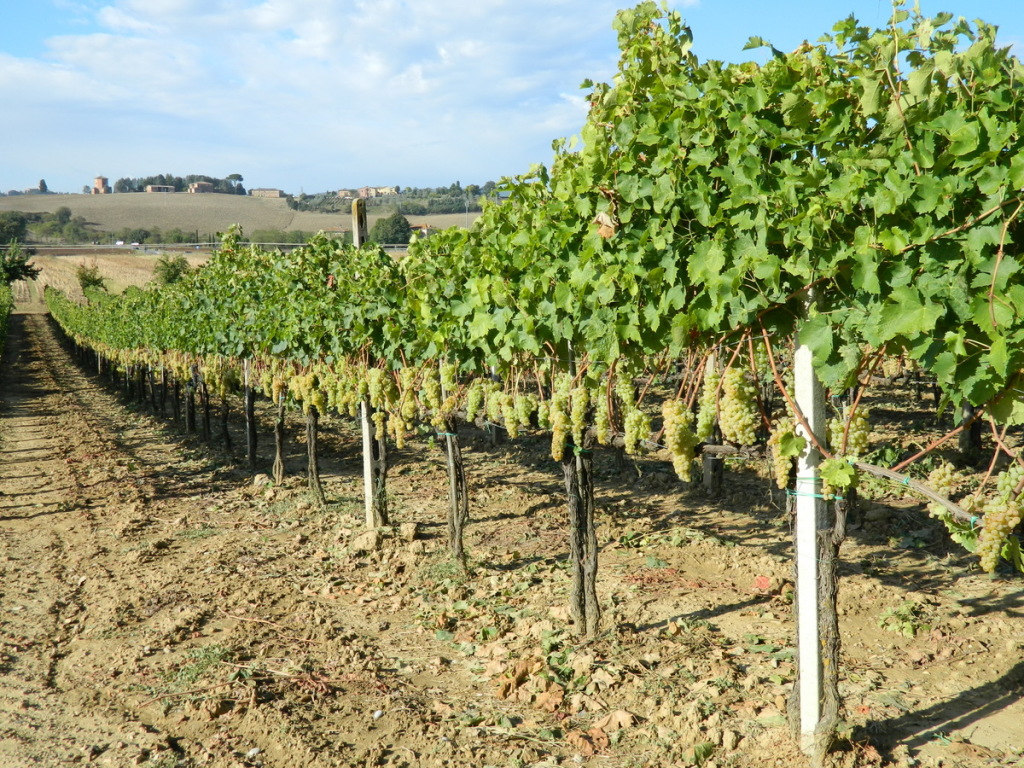
When we were in Tuscany in September, I saw grape vines pruned back drastically to about three feet, and above them, masses of plump abundant grapes, black, green, purple.

Grape vines grow as tall as you let them. We have some growing in our conservatory and the side of our barn, which are 10-15 feet.

These, however, were cut back savagely, sending all the energy upwards, and look at the fruit!

08-DSCN9387

* * *

I wish I had taken in this visual lesson earlier. How much more productive I would have been.

But I have learnt it now.

Cut back the inessentials, so that you can be fruitful in the essentials, the one thing you have been put on earth to do.

Jesus at the end of his life said, “I have done the work you have given me to do.” (John 17:4)

So cut back even the good things; the volunteerism; your social media friendships, so that the work he has given you to do, the fruit you want to produce, gleams more beautifully.

Ask yourself: Is this activity the work God has given me to do? If not, even if it is a good thing–taking a turn at leading the Bible study or serving on church teams and rotas–leave it for someone else, for whom it is perhaps the work God has given her to do.

* * *

Those vines struck me like a dart to the heart. Since then, I’ve been pruning—my possessions (getting rid of at least one thing a day) and my commitments. I have even been pruning relationships with negative friends, who drag me down and depress me, relationships I had not let go because of sentimentality and familiarity.

The fruitful vine is pruned so that it will be even more fruitful. One of those counter-intuitive truths which run like grace-notes through the Gospels.

Filed Under: In which I decide to follow Jesus Tagged With: abundance, focus, Fruitfulness, Gospel of John, minimalism, pruning, the work God has given us to do

Quit Worrying about your Savings Plan: Jesus

By Anita Mathias

 Image credit

Jesus was a spectacularly loving person, caring and reaching out right through his crucifixion— so when he speaks about money, we’d be wise to listen up.

We’d be wise to listen because his desire, the reason he said he came, was for the fullest human flourishing, that we may have LIFE in abundance.

We’d be wise to listen because he only speaks in kindness.

* * *

I am re-reading the Sermon on the Mount. There has been a Christian conspiracy down the ages to quietly ignore parts of it.

But I bet Jesus meant it when he said “Do not store up for yourselves treasures on earth, but rather store up for yourself treasures in heaven.” He’s consistent in this advice: Do not labour for food which perishes, but for food which endures to eternal life.

* * *

The standard financial advice is to keep 6 months salary in cash at all times, (and to have 10 times your final salary in cash or stocks by the time you retire).

In other words, save enough to ensure that you can live without needing to trust God, without needing to lean on his ingenious ideas, and without needing to see his miracles and deliverances.

There is no kindness nor God-wisdom in this advice, but a lot of self-imposed deprivation, of harsh treatment of the present.

Six months salary in cash at all times; ten times final salary squirrelled away–think of how much fun and adventure and experience and opportunities for kindness and generosity and hospitality we miss out on with this sterile focus on saving enough money so that we will never have to rely on God’s kindness or generosity. So that we can, completely erroneously, perceive ourselves to be invulnerable.

* * *

There is a popular cliché about work-life balance: Nobody on his deathbed ever said, ‘I wish I had spent more time at the office’.  What is more likely is that nobody ever said on his deathbed, “I wish I had more money.”

But we may well wish we’d travelled more, seen more theatre, more film, read more books, taken more friends out to dinner, been more generous to our children, instead of working so darn hard, saving so much.

Stop worrying about saving for the future. And do not waste today worrying about the future.

This radical statement is, in fact, a sacred command. Do not worry about tomorrow Jesus says, setting us free, great liberator that he is.

* * *

The effects of  2008 world-wide credit crunch, and the subsequent contraction of economies are lingering. It’s probably a safe bet that many of my readers will not be on track to have ten times their final salary by the time they retire.

And neither am I!!

But, truthfully, I am not worried.

(If I received a cheque in the mail for ten years salary, I would bank most of it. But, in its absence, I would not deprive myself of travel or generosity or what is necessary for the flourishing of my work, or my family’s flourishing because I do not have 3-6 months salary in the bank and my retirement is not properly funded. I would not, however, go into debt, or put more on my credit card than I can pay in full this month for anything, except food.)

* * *

And that is why the Gospel is good news to the poor. Guys, do not worry, Jesus says, soaring into sublimity. The God who cares for the sparrows and lilies will care for you. Seek God today, and let Him worry about tomorrow.

It is splendid advice, and, with God’s help, I intend to follow it.

* * *

I once read some research that tracked people’s thoughts through the day. The top things women thought about were 1) their hair!! 2) money. How much they have, how to save, what to buy, how to get bargains, how much money others have, how they got it. Women thought more about money and their hair than sex, the study observed. Men, on the other hand…

However, why not gradually shift our focus in the direction Jesus suggests–to focus on alternative eternal treasures—and fill our bodies with light? In Matthew 13, in a slew of metaphors, living in God’s kingdom is consistently referred to as treasure: the treasure in a field, the pearl of great price worth selling everything to buy.

Why not slowly develop the habit of eating Scripture, this treasure hidden from the busy? Develop the habit of Scripture meditation, an acquired taste in our fast-fast world of distraction. Start small, start with a short time, and increase it as the appetite grows for time with Jesus in quiet eternal realms which stretch and expand.

* * *

Scripture meditation yields great rewards. Paul Meier M.D. found in his study of the psychological and mental health and spiritual lives of evangelical seminary students that students who practiced almost daily Scripture meditation for three years or longer were significantly healthier and happier than students who did not meditate on Scripture daily.

Or as Jesus might have said, their whole body was full of light.

* * *

For what we focus on determines the course of our lives. If our eye is good (“good eye” opthalmos haplos in Greek, refers to generosity) our whole body is full of light. If on, the other hand, our eye is bad, (evil eye, Greek ophthalos poneros, refers to stinginess or greediness) our whole body is full of darkness.

When I think of the most generous people I know, there is a lightness and loveliness to them. And when I think of the most stingy, money-focused people I know—who cannot part with money, cannot force themselves to be generous, who will manipulate others into helping them, but rarely help others—there is a kind of darkness in their lives. The English word miser comes from the Latin miser, “unhappy, wretched, pitiable, in distress.” The focus on money clouds their hearts and lives in darkness.

Whoa, Jesus, so many things you say are literally true!!


Filed Under: Matthew Tagged With: focus, generosity, giving, matthew 6, money, not worrying, saving

We Must Prune Even the Good for Increased Fruitfulness

By Anita Mathias


07-DSCN9381


Every branch that does bear fruit, the gardener prunes so that it will be even more fruitful. John 15:2. Seems unfair, doesn’t it?

In a contemporary interpretation of the Joseph story in Sun, Stand Still,  Stephen Furtick refers to the pit of into which Joseph was tossed on his journey from being a shepherd boy in Israel to being Viceroy of Egypt as being a necessary removal of the unnecessary from the hard disk of Joseph’s life to make room for an upgrade.

Yes. That is what pruning is. If the good—branches, twigs, leaves– interferes with the best, out it goes.

For  the good is always the enemy of the best.

                                                                                                                          * * *

I have struggled with this all my life, being the sort of woman who is interested in everything, and wants to do everything, remaining in denial that the many was the enemy of focus.
However, more and more I am realizing my life and my time are not my own. That my call to write is synonymous with my call to follow Christ. For He calls me to write. So I must cut what stands in the way of writing.

At New Wine 2008, the wonderful Heidi Baker launched into a hypnotic, half-sung, half-chanted riff at the end of her talk, where she prayed gifts on her audience. “Has God called you to write? she asked. “Then say, I will do whatever it takes for me to become a writer.”

 Can I say it even now? It makes me feel afraid, and stressed.

* * *

I had entered Mother Teresa’s convent and wanted to become a nun when I was 17. I realized it was a mistake after a year, but thought I would look foolish if I left, so dragged on, growing increasingly ill, physically.

While there, I read a book called “Our Father.” A man boards a train going in the wrong direction. He realizes it, but having told everyone that he was disembarking at the last stop, he felt embarrassed to admit that he had boarded the wrong train, and jump off. So he continues travelling in the wrong direction–getting more and more annoyed with the friends who invited him to dinner, exposing him to this hassle.

I left.

If you realise that you are going in the wrong direction, have agreed to something you shouldn’t have, are doing something that is not your call, jump off as fast as you can.

In this phase of pruning, I am jumping off more and more trains I should never have boarded, my French language lessons, gym memberships, prayer ministry, many relationships and friendships, some social events, so that I can more fully focus on the one thing God has called me to do: to write!

Filed Under: In which I explore Productivity and Time Management and Life Management Tagged With: blog through the Bible project, focus, Fruitfulness, Producivity, TIme Management

Sign Up and Get a Free eBook!

Sign up to be emailed my blog posts (one a week) and get the ebook of "Holy Ground," my account of working with Mother Teresa.

Join 543 Other Readers

My Books

Rosaries, Reading, Secrets: A Catholic Childhood in India

Rosaries, Reading Secrets, B&N
USA

UK

Wandering Between Two Worlds: Essays on Faith and Art

Wandering Between Two Worlds
USA

UK

Francesco, Artist of Florence: The Man Who Gave Too Much

Francesco, Artist of Florence
US

UK

The Story of Dirk Willems

The Story of Dirk Willems
US

UK

My Latest Meditation

Anita Mathias: About Me

Anita Mathias

Read my blog on Facebook

Follow me on Twitter

Follow @anitamathias1

Recent Posts

  • Using God’s Gift of Our Talents: A Path to Joy and Abundance
  • The Kingdom of God is Here Already, Yet Not Yet Here
  • All Those Who Exalt Themselves Will Be Humbled & the Humble Will Be Exalted
  • Christ’s Great Golden Triad to Guide Our Actions and Decisions
  • How Jesus Dealt With Hostility and Enemies
  • Do Not Be Afraid, but Do Be Prudent
  • For Scoundrels, Scallywags, and Rascals—Christ Came
  • How to Lead an Extremely Significant Life
  • Don’t Walk Away From Jesus, but if You Do, He Still Looks at You and Loves You
  • How to Find the Freedom of Forgiveness
Premier Digital Awards 2015 - Finalist - Blogger of the year
Runner Up Christian Media Awards 2014 - Tweeter of the year

Categories

What I’m Reading


Wolf Hall
Hilary Mantel

Wolf Hall --  Amazon.com
Amazon.com

Amazon.co.uk

Silence and Honey Cakes:
The Wisdom Of The Desert
Rowan Williams

Silence and Honey Cakes --  Amazon.com
Amazon.com

Amazon.co.uk

The Long Loneliness:
The Autobiography of the Legendary Catholic Social Activist
Dorothy Day

The Long Loneliness --  Amazon.com
Amazon.com

Amazon.co.uk

Country Girl
Edna O'Brien

Country Girl  - Amazon.com
Amazon.com

Amazon.co.uk

Archive by month

My Latest Five Podcast Meditations

INSTAGRAM

anita.mathias

My memoir: Rosaries, Reading, Secrets https://amzn.to/42xgL9t
Oxford, England. Writer, memoirist, podcaster, blogger, Biblical meditation teacher, mum

Well, hello friends! Breaking radio silence to let Well, hello friends! Breaking radio silence to let you know that I have taped a meditation for you on Christ’s famous Parable of the Talents in Matthew 25. https://anitamathias.com/2025/11/05/using-gods-gift-of-our-talents-a-path-to-joy-and-abundance/
Here you are, click the play button in the blog post for a brief meditation, and some moments of peace, and, perhaps, inspiration in your day 🙂
Hi Friends, I have taped a meditation; do listen a Hi Friends, I have taped a meditation; do listen at this link: https://anitamathias.com/2025/04/08/the-kingdom-of-god-is-here-already-yet-not-yet-here-2/
It’s on the Kingdom of God, of which Christ so often spoke, which is here already—a mysterious, shimmering internal palace in which, in lightning flashes, we experience peace and joy, and yet, of course, not yet fully here. We sense the rainbowed presence of Christ in the song which pulses through creation. Christ strolls into our rooms with his wisdom and guidance, and things change. Our prayers are answered; we are healed; our hearts are strangely warmed. Sometimes.
And yet, we also experience evil within & all around us. Our own sin which can shatter our peace and the trajectory of our lives. And the sins of the world—its greed, dishonesty and environmental destruction.
But in this broken world, we still experience the glory of creation; “coincidences” which accelerate once we start praying, and shalom which envelops us like sudden sunshine. The portals into this Kingdom include repentance, gratitude, meditative breathing, and absolute surrender.
The Kingdom of God is here already. We can experience its beauty, peace and joy today through the presence of the Holy Spirit. But yet, since, in the Apostle Paul’s words, we do not struggle only “against flesh and blood, but against the rulers, against the unseen powers of this dark world and against the spiritual forces of evil,” its fullness still lingers…
Our daughter Zoe was ordained into the Church of E Our daughter Zoe was ordained into the Church of England in June. I have been on a social media break… but … better late than never. Enjoy!
First picture has my sister, Shalini, who kindly flew in from the US. Our lovely cousins Anthony and Sarah flank Zoe in the next picture.
The Bishop of London, Sarah Mullaly, ordained Zoe. You can see her praying that Zoe will be filled with the Holy Spirit!!
And here’s a meditation I’ve recorded, which you might enjoy. The link is also in my profile
https://anitamathias.com/2024/11/07/all-those-who-exalt-themselves-will-be-humbled-the-humble-will-be-exalted/
I have taped a meditation on Jesus statement in Ma I have taped a meditation on Jesus statement in Matthew 23, “For those who exalt themselves will be humbled, and those who humble themselves will be exalted.”
Do listen here. https://anitamathias.com/2024/11/07/all-those-who-exalt-themselves-will-be-humbled-the-humble-will-be-exalted/
Link also in bio.
And so, Jesus states a law of life. Those who broadcast their amazingness will be humbled, since God dislikes—scorns that, as much as people do.  For to trumpet our success, wealth, brilliance, giftedness or popularity is to get distracted from our life’s purpose into worthless activity. Those who love power, who are sure they know best, and who must be the best, will eventually be humbled by God and life. For their focus has shifted from loving God, doing good work, and being a blessing to their family, friends, and the world towards impressing others, being enviable, perhaps famous. These things are houses built on sand, which will crumble when hammered by the waves of old age, infirmity or adversity. 
God resists the proud, Scripture tells us—those who crave the admiration and power which is His alone. So how do we resist pride? We slow down, so that we realise (and repent) when sheer pride sparks our allergies to people, our enmities, our determination to have our own way, or our grandiose ego-driven goals, and ambitions. Once we stop chasing limelight, a great quietness steals over our lives. We no longer need the drug of continual achievement, or to share images of glittering travel, parties, prizes or friends. We just enjoy them quietly. My life is for itself & not for a spectacle, Emerson wrote. And, as Jesus advises, we quit sharp-elbowing ourselves to sit with the shiniest people, but are content to hang out with ordinary people; and then, as Jesus said, we will inevitably, eventually, be summoned higher to the sparkling conversation we craved. 
One day, every knee will bow before the gentle lamb who was slain, now seated on the throne. We will all be silent before him. Let us live gently then, our eyes on Christ, continually asking for his power, his Spirit, and his direction, moving, dancing, in the direction that we sense him move.
Link to new podcast in Bio https://anitamathias.co Link to new podcast in Bio https://anitamathias.com/2024/02/20/how-jesus-dealt-with-hostility-and-enemies/
3 days before his death, Jesus rampages through the commercialised temple, overturning the tables of moneychangers. Who gave you the authority to do these things? his outraged adversaries ask. And Jesus shows us how to answer hostile questions. Slow down. Breathe. Quick arrow prayers!
Your enemies have no power over your life that your Father has not permitted them. Ask your Father for wisdom, remembering: Questions do not need to be answered. Are these questioners worthy of the treasures of your heart? Or would that be feeding pearls to hungry pigs, who might instead devour you?
Questions can contain pitfalls, traps, nooses. Jesus directly answered just three of the 183 questions he was asked, refusing to answer some; answering others with a good question.
But how do we get the inner calm and wisdom to recognise
and sidestep entrapping questions? Long before the day of
testing, practice slow, easy breathing, and tune in to the frequency of the Father. There’s no record of Jesus running, rushing, getting stressed, or lacking peace. He never spoke on his own, he told us, without checking in with the Father. So, no foolish, ill-judged statements. Breathing in the wisdom of the Father beside and within him, he, unintimidated, traps the trappers.
Wisdom begins with training ourselves to slow down and ask
the Father for guidance. Then our calm minds, made perceptive, will help us recognise danger and trick questions, even those coated in flattery, and sidestep them or refuse to answer.
We practice tuning in to heavenly wisdom by practising–asking God questions, and then listening for his answers about the best way to do simple things…organise a home or write. Then, we build upwards, asking for wisdom in more complex things.
Listening for the voice of God before we speak, and asking for a filling of the Spirit, which Jesus calls streams of living water within us, will give us wisdom to know what to say, which, frequently, is nothing at all. It will quieten us with the silence of God, which sings through the world, through sun and stars, sky and flowers.
Especially for @ samheckt Some very imperfect pi Especially for @ samheckt 
Some very imperfect pictures of my labradoodle Merry, and golden retriever Pippi.
And since, I’m on social media, if you are the meditating type, here’s a scriptural meditation on not being afraid, while being prudent. https://anitamathias.com/2024/01/03/do-not-be-afraid-but-do-be-prudent/
A new podcast. Link in bio https://anitamathias.c A new podcast. Link in bio
https://anitamathias.com/2024/01/03/do-not-be-afraid-but-do-be-prudent/
Do Not Be Afraid, but Do Be Prudent
“Do not be afraid,” a dream-angel tells Joseph, to marry Mary, who’s pregnant, though a virgin, for in our magical, God-invaded world, the Spirit has placed God in her. Call the baby Jesus, or The Lord saves, for he will drag people free from the chokehold of their sins.
And Joseph is not afraid. And the angel was right, for a star rose, signalling a new King of the Jews. Astrologers followed it, threatening King Herod, whose chief priests recounted Micah’s 600-year-old prophecy: the Messiah would be born in Bethlehem, as Jesus had just been, while his parents from Nazareth registered for Augustus Caesar’s census of the entire Roman world. 
The Magi worshipped the baby, offering gold. And shepherds came, told by an angel of joy: that the Messiah, a saviour from all that oppresses, had just been born.
Then, suddenly, the dream-angel warned: Flee with the child to Egypt. For Herod plans to kill this baby, forever-King.
Do not be afraid, but still flee? Become a refugee? But lightning-bolt coincidences verified the angel’s first words: The magi with gold for the flight. Shepherds
telling of angels singing of coming inner peace. Joseph flees.
What’s the difference between fear and prudence? Fear is being frozen or panicked by imaginary what-ifs. It tenses our bodies; strains health, sleep and relationships; makes us stingy with ourselves & others; leads to overwork, & time wasted doing pointless things for fear of people’s opinions.
Prudence is wisdom-using our experience & spiritual discernment as we battle the demonic forces of this dark world, in Paul’s phrase.It’s fighting with divinely powerful weapons: truth, righteousness, faith, Scripture & prayer, while surrendering our thoughts to Christ. 
So let’s act prudently, wisely & bravely, silencing fear, while remaining alert to God’s guidance, delivered through inner peace or intuitions of danger and wrongness, our spiritual senses tuned to the Spirit’s “No,” his “Slow,” his “Go,” as cautious as a serpent, protected, while being as gentle as a lamb among wolves.
Link to post with podcast link in Bio or https://a Link to post with podcast link in Bio or https://anitamathias.com/2023/09/22/dont-walk-away-from-jesus-but-if-you-do-he-still-looks-at-you-and-loves-you/
Jesus came from a Kingdom of voluntary gentleness, in which
Christ, the Lion of Judah, stands at the centre of the throne in the guise of a lamb, looking as if it had been slain. No wonder his disciples struggled with his counter-cultural values. Oh, and we too!
The mother of the Apostles James and John, asks Jesus for a favour—that once He became King, her sons got the most important, prestigious seats at court, on his right and left. And the other ten, who would have liked the fame, glory, power,limelight and honour themselves are indignant and threatened.
Oh-oh, Jesus says. Who gets five talents, who gets one,
who gets great wealth and success, who doesn’t–that the
Father controls. Don’t waste your one precious and fleeting
life seeking to lord it over others or boss them around.
But, in his wry kindness, he offers the ambitious twelve
and us something better than the second or third place.
He tells us how to actually be the most important person to
others at work, in our friend group, social circle, or church:Use your talents, gifts, and energy to bless others.
And we instinctively know Jesus is right. The greatest people in our lives are the kind people who invested in us, guided us and whose wise, radiant words are engraved on our hearts.
Wanting to sit with the cleverest, most successful, most famous people is the path of restlessness and discontent. The competition is vast. But seek to see people, to listen intently, to be kind, to empathise, and doors fling wide open for you, you rare thing!
The greatest person is the one who serves, Jesus says. Serves by using the one, two, or five talents God has given us to bless others, by finding a place where our deep gladness and the world’s deep hunger meet. By writing which is a blessing, hospitality, walking with a sad friend, tidying a house.
And that is the only greatness worth having. That you yourself,your life and your work are a blessing to others. That the love and wisdom God pours into you lives in people’s hearts and minds, a blessing
https://anitamathias.com/.../dont-walk-away-from-j https://anitamathias.com/.../dont-walk-away-from-jesus.../
Sharing this podcast I recorded last week. LINK IN BIO
So Jesus makes a beautiful offer to the earnest, moral young man who came to him, seeking a spiritual life. Remarkably, the young man claims that he has kept all the commandments from his youth, including the command to love one’s neighbour as oneself, a statement Jesus does not challenge.
The challenge Jesus does offers him, however, the man cannot accept—to sell his vast possessions, give the money to the poor, and follow Jesus encumbered.
He leaves, grieving, and Jesus looks at him, loves him, and famously observes that it’s easier for a camel to squeeze through the eye of a needle than for a rich person to live in the world of wonders which is living under Christ’s kingship, guidance and protection. 
He reassures his dismayed disciples, however, that with God even the treasure-burdened can squeeze into God’s kingdom, “for with God, all things are possible.”
Following him would quite literally mean walking into a world of daily wonders, and immensely rich conversation, walking through Israel, Lebanon, Syria, and Jordan, quite impossible to do with suitcases and backpacks laden with treasure. 
For what would we reject God’s specific, internally heard whisper or directive, a micro-call? That is the idol which currently grips and possesses us. 
Not all of us have great riches, nor is money everyone’s greatest temptation—it can be success, fame, universal esteem, you name it…
But, since with God all things are possible, even those who waver in their pursuit of God can still experience him in fits and snatches, find our spirits singing on a walk or during worship in church, or find our hearts strangely warmed by Scripture, and, sometimes, even “see” Christ stand before us. 
For Christ looks at us, Christ loves us, and says, “With God, all things are possible,” even we, the flawed, entering his beautiful Kingdom.
Follow on Instagram

© 2025 Dreaming Beneath the Spires · All Rights Reserved. · Cookie Policy · Privacy Policy