Anita Mathias: Dreaming Beneath the Spires

Anita Mathias's Blog on Faith and Art

  • Home
  • My Books
  • Meditations
  • Essays
  • Contact
  • About Me

Poor Me and Amazing Me: Which Narrative is Yours?

By Anita Mathias

Sometimes, going through my Facebook newsfeed, I see two narratives: Poor Me and Amazing Me.

Poor Me status updates are largely negative: ill-health, the misadventures of children, looming deadlines, crushing work loads, exhaustion, the intransigence of schools, employers, medical services; the inadequacy of tax-payer money funnelled towards their needs,  the anguish of the entitled!

And then, there are Amazing Me status updates. Amazing Me won a prize; travelled to Antarctica; conjured up this gourmet creation; pulled off this domestic Goddess feat; moved mountains today, oh Amazing Me!

* * *

We started playing these roles in our childhoods. In my childhood, Poor Me would have met with no sympathy. I would have been scolded for whatever led to my Poor Me plight. Why did you allow yourself to gain weight? Get sick? Get writers’ block? Fail? Go, do something about it. Run a mile. Eat vegetables. Write a page.

And I too get impatient with Poor Me, and come up with solutions. (Though I am silent, and my tears flow freely when there are no solutions: an incurable illness like motor neurone disease; an inoperable tumour, or the sudden death of a loved one.)

Amazing Me was the script I was expected to follow in childhood. Amazing me, always winning prizes; Amazing Me, dazzling my teachers; Amazing Me, achieving, achieving, achieving.

* * *

Poor Me and Amazing Me have this in common. They are both symptoms of emptiness. They both want something from other people. Poor Me wants attention—and sympathy. Amazing Me wants attention–and praise. Both their cups are half-empty, the one who proclaims the emptiness of her cup, and the one who declares her cup runneth over, but still wants affirmation from other people.

* * *

In middle age, I am less interested in old scripts. I am not interested in Poor Me. When people Poor You me, I hate it. I want to shake off their sympathy, which feels like a clog on my feet (though in the case of tragedy I can do nothing about, yeah, I will accept sympathy, and cry on your shoulder–if I can).

And when I tend to Amazing Me, on the days I am smart, I remind myself of the eternal fountain always flowing, flowing to fill my empty places.
(credit)

(credit)

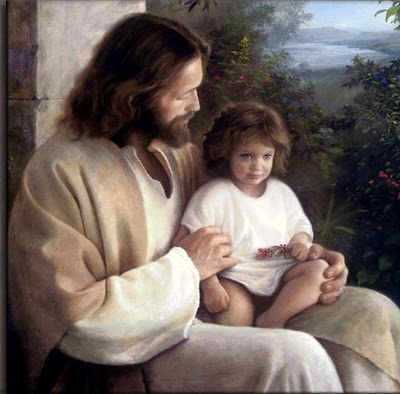
And I tell myself, “Anita, you are indeed Amazing Me because you are a child of God. You are Amazing Me because you can climb into his lap and lean on his shoulder. You are Amazing Me because he sings over you; you are Amazing Me because he protects you; you are Amazing Me because no matter what goes wrong, he comforts you.

You are Amazing Me because when you blow it, he puts his arms around you, and blows his spirit into you, fills you with the water of the Holy Spirit to overflowing. You are Amazing Me because he patches you together again, and you are as good as new.  You are Amazing Me because he will take you to places you never dreamed you’ll go.  You are Amazing Me because he loves you.

Thank you, Kelly, for hosting the first version of this! 


Filed Under: In which I am amazed by the love of the Father Tagged With: facebook, The love of God

In Which We Give All to Get All

By Anita Mathias

jacobs_ladder

(credit)

So Jacob has an amazing vision of a stairway between heaven and earth, and angels ascending and descending on it. And at the top was the Lord, who promises him the land, fruitfulness, blessing, protection, his presence and his favour.

The context?

Jacob is fleeing the brother whom he had effectively disinherited and deprived of the blessings of the first-born through deceit.

Hardly the best place to meet God and be promised his blessings, wouldn’t you say?

But God is gracious and compassionate, full of mercy and abounding in love.

* * *

So after Jacob’s sons Simeon and Levi disgrace and endanger him through slaughtering every male in Shechem and then looting it, Jacob is on the move again, back to the place of blessing.

God suggests that he returns to Bethel and settles there, building an altar.

In preparation, Jacob commands his household, “get rid of the foreign gods you have with you, and purify yourself and change your clothes(Gen 35:2).”

When they do so, and bury all the foreign Gods, and the rings they wore as amulets or charms, God gives them safe conduct. “Then they set out, and the terror of God fell upon the towns all around them so that no one pursued them.”

And at Bethel, God blesses him, and promises him fruitfulness and the land, Eretz Israel.

Getting rid of foreign gods was a precursor of protection and blessing.

* * *

 Why was this so important?

Because we can only be in one place. We are either in the waterfall of God’s goodness and favour, or we are not.

We are either relying on God, or on our own strategies for success, for wealth, or getting our own way, for example. (Nothing wrong with strategies. Strategy is fun–and strategic action is obviously more effective than random action. However, we have to continually ensure that our strategies either originate with God, or have been run by him, and have his approval.)

For the eyes of the LORD range throughout the earth to strengthen those whose hearts are fully committed to him (2 Chron. 16:9).  Somehow being wholly committed to God, wholly in the river of his love, is necessary to being able to wholly access his ideas, and his inspiration, and to experience his undeserved blessings. Selling everything to buy that pearl.

All I have is yours, and all you have is mine, Jesus says. They are correlated. Perhaps all we have needs to be His, for all He has to become ours.

Our lunch must be handed over to Jesus for 5000 men to feed on it.

* * *

How do we reach this level of surrender?

Reaching total surrender to God and totally experiencing his blessings, ideas and provision, like everything else in life, is a matter of one step at a time, one step of obedience at a time. Practice, blow it; get up, practice again.

I have not reached total surrender, alas, though I want to–because I think living in Jesus is a more exciting place to live than following my own whims and strategies.

Here are some areas I am working on: turning to Jesus rather than food when in a low mood; not worrying about my work, but entrusting it to him and asking for his ideas; doing my fair share of house-running stuff.

But the real battleground for me is within. Forgiving and praying blessing on those who injured me. Blessing those I feel envious of, and asking God to bless me indeed, instead of lingering in envy. Not dwelling in the negative, but turning my thoughts and words to the positive. Praising and thanking God when I do not feel like doing so.

Tweak, tweak, tweak, until I am aligned with Jesus, and living in Jesus, with Jesus himself living in me.


Thank you, Adriana, for your hospitality.

Filed Under: Genesis, In which I surrender all Tagged With: Absolute Surrender, blessing, blog through the Bible project, Genesis

Where Good Stories are to be Found

By Anita Mathias

aboriginal
Image Credit


My tender-hearted children hated sad stories. Neither would let me read Oscar Wilde’s exquisite short stories to them, or even Hans Christian Andersen’s because they were too sad.

When I recommended a book or movie, they wanted to know if it was sad, and especially if it had a sad ending.

But there is no story without sadness, I keep telling them. It’s an old creative writing maxim: No story without conflict.

* * *

Who needs the stress and emotional trauma of conflict with others? And who needs internal conflict—when the self is at war with itself, knowing what is good to do, but doing the very things it hates, punishing itself by over-eating, or over-working, or under-sleeping? By psycho-somatic illness?

But without this internal conflict–this struggle against our very selves: to corral ourselves to rise early, work hard, stay focused, self-educate, eat healthily, exercise, read, write–our lives would be flaccid and formless, with the structure of obstacles, both within and without, to overcome.

And, as Donald Miller writes in A Thousand Miles in a Million Years, dealing with these obstacles head-on (losing 150 pounds in his case, and tracking down the father who abandoned him) gives our lives a shapely story.

Because stories and blogs come out of sadness, and struggle, and failure, and eventual triumph over Resistance.

* * *

And ironically, each failure, and sadness and step backwards gives us more of a story than our successes.

Where are stories found? Not in quiet times, not in scripture study, not in money you gave away, not in fasts, not in the meals you took around, or your turn in the coffee rota, these good, shiny things, which, anyway, by the strictest Scriptural injunction we are commanded to keep secret.

Where are our stories found?

In the places where you learn about yourself, and you learn about God, and you learn about shame and grace and self-forgiveness and God’s forgiveness in the crucible of failure.

When your daughter says, “I don’t want to play scrabble today, Mum, because you get snooty about my words,” and you say “Oh no, of course I won’t get snooty about your words!” and then you do indeed get so snooty!

When the house could so do with some loving up, and indeed, so could those who dwell in it, and you’ve resolved to do both, but words are flowing, and you dance in the flow.

When you had solemnly resolved on that run today and yoga, and weights—you know, flexibility, strength, cardio-vascular, the three elements of fitness!–but an idea presents itself, and you want to explore it, express it,

And the word count may be good at the end of the day, but your Pilgrim’s Progress….well, it hasn’t progressed.

And you wonder why today joy doesn’t throb,

Or peace flow like a river.

And you remember: He who loves his blog more than me is not worthy of me.

She who loves her writing more than me is not worthy of me.

And all you can say is Kyrie Eleison.
Lord, have mercy.


And you kneel down and repent

Till peace flows again.

And you say, “Lord, I am not worthy of you.
But say but the Word
and I shall be healed.”

And he says the Word.

The word like manna,
The word like honey
Coursing through your brain.

And you, the unworthy, are healed

And, again, sing.

* * *
And, besides, you have a story!

Filed Under: In which I explore writing and blogging and creativity, In which I Pursue Personal Transformation or Sanctification, In which I'm amazed by the goodness of God, Writing and Blogging Tagged With: failure, Stories, the goodness of God

Ideas as Cats and Other Mysteries of Creativity

By Anita Mathias

 I think of creativity as God’s river or waterfall into which I step. There is a torrent of ideas out there;  I just need to slow down, and step into the deluge.

Ray Bradbury, however, in his wonderful book on writing, Zen in the Art of Writing, refers to ideas as cats.

“I am accustomed to getting up every morning, running to the typewriter,” writing a short story, “and in an hour, I’ve created a world. I don’t have to wait for anyone. I don’t have to criticize anyone. It’s done. All I need is an hour, and I’m ahead of everyone. The rest of the day I can goof off. I’ve already done a thousand words this morning, so if I want to have a two or three-hour lunch, I can have it, because I’ve already beat everyone.

I never put up with anything from my ideas. As soon as things get difficult, I walk away.

That’s the great secret of creativity.

You treat ideas like cats; you make them follow you. If you try to approach a cat and pick it up, hell, it won’t let you do it. You’ve got to say, “Well, to hell with you.”

And the cat says, “Wait a minute. He’s not behaving the way most humans do.” Then the cat follows you out of curiosity: “What’s the matter with you that you don’t love me?”

Well, that’s what an idea is. See? You just say, “Well, hell, I don’t need depression. I don’t need worry. I don’t need to push. The ideas will follow me. When they’re off-guard, and ready to be born, I’ll turn around and grab them.”

(Particularly applicable for blogs, and poems, and stories and essays…)


Filed Under: In which I explore writing and blogging and creativity, Writing and Blogging Tagged With: Creativity, Ideas as Cats, Ray Bradbury, Zen in the Art of Writing

Giving: A Counter-Intuitive Secret to “Getting Ahead”

By Anita Mathias

 Adam Grant

Adam Grant

I often think of a fascinating New York Times Magazine article “Is Giving the Secret to Getting Ahead,” I read a few months ago.

“Giving as the Secret to Getting Ahead,” profiles Adam Grant, 31, the youngest tenured professor at Wharton Business School, and author of “Give and Take: A Revolutionary Approach to Success,” who studies and practices generosity as a way of life and work. (This eccentric post is a sort of précis of the brilliant article, chock-full of direct quotes. Back to regular programming soon)

“For Adam Grant, helping is not the enemy of productivity, a time-sapping diversion from the actual work at hand; it is the mother lode, the motivator that spurs increased productivity and creativity.

“The greatest untapped source of motivation, he argues, is a sense of service to others; focusing on the contribution of our work to other people’s lives has the potential to make us more productive than thinking about helping ourselves.”

“Grant sees an in-box filled with requests not a task to be dispensed with perfunctorily (or worse, avoided); it’s an opportunity to help people, and therefore it’s an opportunity to feel good about yourself and your work.”

“The message sounds terrific: Feel good about your work, and get more of it done, and bask in the appreciation of all the people you help along the way. Nice guys can finish first! ’’ [Read more…]

Filed Under: random Tagged With: Adam Grant, generosity, Give and Take, giving

Images from our Trip to Pisa: The Leaning Tower, Duomo and Baptistery

By Anita Mathias

The world is a book, and those who do not travel read only a page, Saint Augustine.

A guest post from my husband Roy who loves the camera as much as I love words. (Though he’s done the words too, in this case:-)

The Leaning Tower of Pisa,  one of the symbols of Italy, and a much hyped attraction,  did not disappoint us.

Exterior views of  the Leaning Tower, Duomo and Baptistery

These three pristine white buildings are in the center of a large green.

Pisa, Leaning tower and Duomo.

Pisa, Leaning tower and Duomo.

Leaning Tower of Pisa.Pisa Baptistery (not actually leaning!)

Getting closer you see the exterior details:

Pisa Baptistery: Unused back door.

Pisa Baptistery: Unused back door.

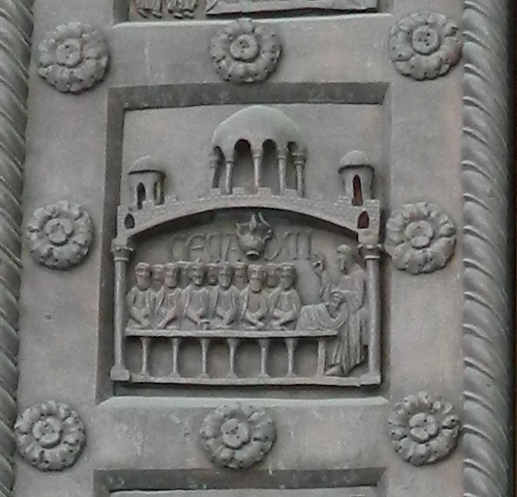
and here is a single panel

Pisa Baptistery: Unused back door. (A single panel)

Pisa Baptistery: Unused back door. (A single panel)


Mosaic of main entrance of Pisa Duomo.

Mosaic of main entrance of Pisa Duomo.

And on either side there are smaller mosaics:

10-DSCN8564

Mosaic of main entrance of Pisa Duomo.

Mosaic of main entrance of Pisa Duomo.

08-DSCN8562


Pisa Duomo: Decorated column

Pisa Duomo: Decorated column

Pisa Duomo, exterior.

An intriguing engraving, Pisa Duomo, exterior.

Interior, Duomo, Pisa

View on entering the Duomo. (Pisa)

View of the main altar,  Duomo, Pisa.

Mosaics above a side altar (Duomo, Pisa)

Mosaics above a side altar (Duomo, Pisa)

Mosaics above a side altar (Duomo, Pisa)

Mosaic above a side altar (Duomo, Pisa)

The mosaic of Christ does not have the typical austere expression:

03-DSCN8554

The columns get in the photographer’s way, but do also produce some interesting views:

31-P1030504

34-P1030573


38-P1030742_crop


Here is a view through the backs of  the aligned pews

33-P1030568


A modern (I assume) lectern.

A modern (I assume) lectern.


Here’s Pisano’s beautiful pulpit from 1310.  It has an interesting story:

The pulpit by Giovanni Pisano was completed by 1310 and survived the Great Fire of the Cathedral of October 25, 1596 . During the restoration work, between 1599 and 1601 , the pulpit was dismantled and its pieces were placed in different places, including the Campo Santo and the warehouses of the ‘ Work of the Primate . It was not reassembled until 1926 , when it was rebuilt in a different location from the original one, and certainly not with the parties in the same order and orientation as was intended by the author, since there is no documentation of how it was the layout of the various elements, including the panels, before dismantling. I do not even know if he had or not a marble staircase.

The four columns “simple” were donated by Mussolini at the time to dictatorial power, because after the reconstruction of some parts (such as scale) were missing. To honor the Duce these columns were placed in plain view, placing the caryatids at the back, less visible, when, it is supposed, would have to be exactly the opposite.  (Google translate’s version of a wikipedi.it article)


The renaissance pulpit.

The renaissance pulpit.

A motif I have not seen before:

04-DSCN8558
Stained glass–He holds the whole world in his hands.


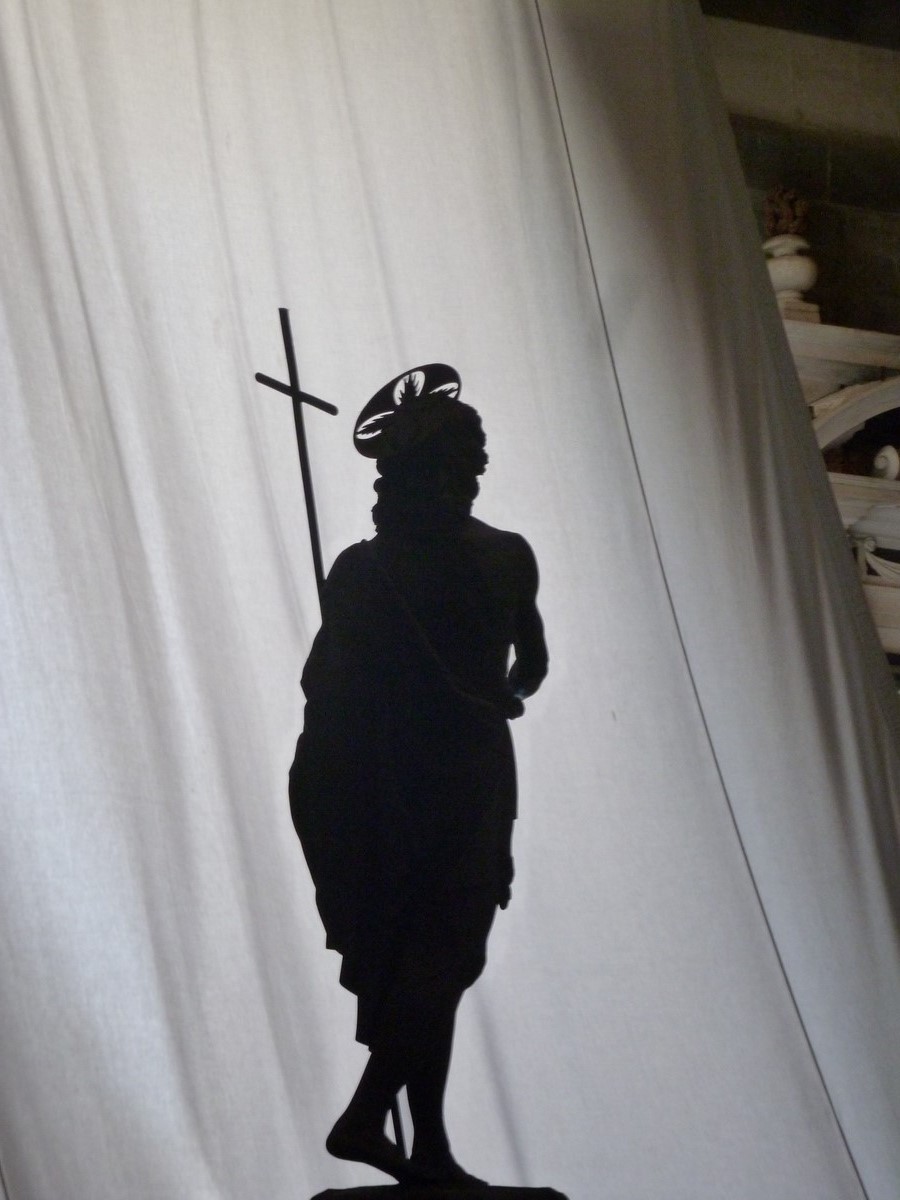
Sculpture of John the Baptist, on the way out of the Duomo.

Sculpture of John the Baptist, on the way out of the Duomo.

The Baptistery

I believe, that in the early christian era, newborns, who had not been baptised were not admitted to the church, hence the baptistery was traditionally a separate building near the church.    The Pisa Baptistery is unusual in that it is circular.  (Typically, they are octagonal.)  Anyway, onthe inside it was not as beautiful as the duomo.


Pisa, Bapistery from an upper gallery.

Pisa, Bapistery from an upper gallery.


A view of out the upper window.

A view of out the upper window.

Playing the Leaning Tower game

It was a beautiful August day and the tourists were doing the same thing

14-DSCN8572


Our daughter Irene, holding up the leaning tower, or pushing it over

27-P1030484


It just takes a finger to support it


29-P1030494or two to pick it up

Picking up the leaning tower of Pisa.

Picking up the leaning tower of Pisa.


Filed Under: In which I Travel and Dream Tagged With: Baptistery, Duomo, Italy, Pisa, tuscany

A Pruned Minimalistic Life is More Fruitful

By Anita Mathias

07-DSCN9381

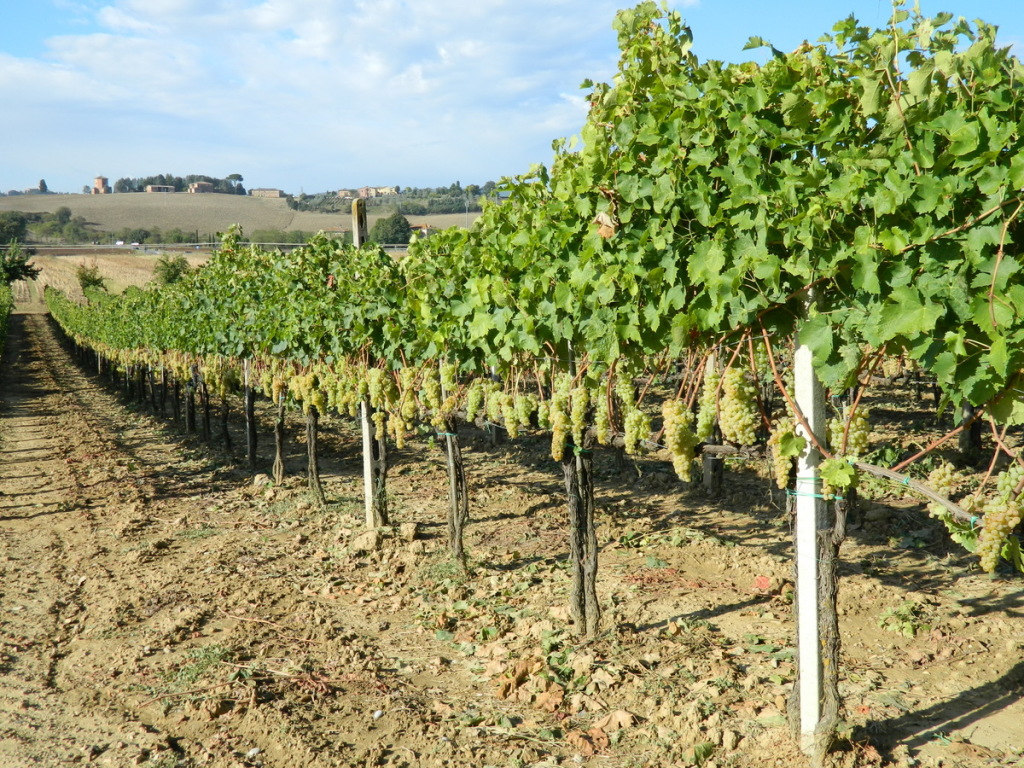
When we were in Tuscany in September, I saw grape vines pruned back drastically to about three feet, and above them, masses of plump abundant grapes, black, green, purple.

Grape vines grow as tall as you let them. We have some growing in our conservatory and the side of our barn, which are 10-15 feet.

These, however, were cut back savagely, sending all the energy upwards, and look at the fruit!

08-DSCN9387

* * *

I wish I had taken in this visual lesson earlier. How much more productive I would have been.

But I have learnt it now.

Cut back the inessentials, so that you can be fruitful in the essentials, the one thing you have been put on earth to do.

Jesus at the end of his life said, “I have done the work you have given me to do.” (John 17:4)

So cut back even the good things; the volunteerism; your social media friendships, so that the work he has given you to do, the fruit you want to produce, gleams more beautifully.

Ask yourself: Is this activity the work God has given me to do? If not, even if it is a good thing–taking a turn at leading the Bible study or serving on church teams and rotas–leave it for someone else, for whom it is perhaps the work God has given her to do.

* * *

Those vines struck me like a dart to the heart. Since then, I’ve been pruning—my possessions (getting rid of at least one thing a day) and my commitments. I have even been pruning relationships with negative friends, who drag me down and depress me, relationships I had not let go because of sentimentality and familiarity.

The fruitful vine is pruned so that it will be even more fruitful. One of those counter-intuitive truths which run like grace-notes through the Gospels.

Filed Under: In which I decide to follow Jesus Tagged With: abundance, focus, Fruitfulness, Gospel of John, minimalism, pruning, the work God has given us to do

In which Scripture is a Mountain, Not a Plateau, but It is All Treasure

By Anita Mathias

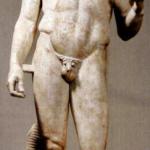
Picture  Michelangelo's David

The Greek Sculpture The Spear Bearer and Michelangelo’s David 

I read Scripture as a mountain with the thirty-nine books of the Old Testament building up to the revelation of Jesus Christ in the Gospels. Acts and the letters of Jesus’s disciples  then grapple with the seismic, big bang revelation of Jesus Christ.

And so our traditional way of reading Scripture, the traditional reading plan, which gives equal weight to every verse and chapter is, ironically, a bit lop-sided. You know…every genealogy, every law, every description of temple worship given equal weight with the Sermon on the Mount and the Upper Room discourse which contains the secrets of the universe.

* * *

However, we need a little bit of Jesus of the Gospels every day, or every week, because our eyes need His corrective vision. Without the continued brain- and heart-washing of the Gospels, we forget what He taught us about how to live.

And so in my reading of the Gospels, I come to Matthew 13, “every scribe who has been instructed about the kingdom of heaven is like the owner of a house who brings out of his storeroom new treasures as well as old.”

* * *

Jesus calls the early revelations of God which culminated in Himself treasure.  And it is treasure because the shimmering brilliance of Jesus’ teaching emerges from it.

Jesus is steeped in the Old Testament and continually quotes it, resisting the temptations of Satan with quotations from Deuteronomy, thereby validating that book. Some of his most memorable sayings, which sound startlingly original are, in fact, quotations from the Old Testament. When he reduces the Law and the Prophets to two commands, he draws on Leviticus 19:18 for “Love your neighbour as yourself” and quotes Psalm 37:11, “the meek inherit the earth”  in the Beatitudes.

* * *

Trying to understand Jesus without understanding the Old Testament is like trying to make sense of Michelangelo’s David without knowing who David the Giant-Killer was, or without knowing how Greco-Roman art inspired artists in the Renaissance (or how the Greek sculpture, “The Spear Bearer,” inspired David.)

Or admiring Raphael’s “School of Athens” without knowing that he depicted Socrates, Plato and Aristotle, Diogenes, and that the surly fellow in boots in the foreground is Michelangelo.

Or reading T.S. Eliot’s beautiful allusive “The Waste Land,” without knowing the title of the long Fire Sermon section is taken from Buddha’s eponymous sermon of the same name in which he advises his followers to give up earthly passion,  or that To Carthage then I came/Burning, burning, burning, is a reference to St. Augustine’s Confessions, when he comes to Carthage, burning with lust. The poem beats upon our pulses, speaks to our ganglia without the scholarship, but knowing its mass of literary allusion only enriches the poem for us.

So of course, the Gospels will speak to one who loves Jesus but has not taken the time to study the Old Testament so as to set him, his quotations, allusions and references in their rich context.

But the Gospels speak more richly and fully when you approach them  with a mind and heart that loves Jesus, but is also steeped in the context of the Old Testament out of which He emerged, and when you understand the 18 Old Testament books which Jesus quoted, and when you understand the old thing to which He continually contrasts the new thing He was doing.

Filed Under: Matthew Tagged With: blog through the Bible project, Matthew, Old Testament, Treasure

  • « Previous Page
  • 1
  • …
  • 33
  • 34
  • 35
  • 36
  • 37
  • …
  • 279
  • Next Page »

Sign Up and Get a Free eBook!

Sign up to be emailed my blog posts (one a week) and get the ebook of "Holy Ground," my account of working with Mother Teresa.

Join 536 Other Readers

My Books

Rosaries, Reading, Secrets: A Catholic Childhood in India

Rosaries, Reading Secrets, B&N
USA

UK

Wandering Between Two Worlds: Essays on Faith and Art

Wandering Between Two Worlds
USA

UK

Francesco, Artist of Florence: The Man Who Gave Too Much

Francesco, Artist of Florence
US

UK

The Story of Dirk Willems

The Story of Dirk Willems
US

UK

My Latest Meditation

Anita Mathias: About Me

Anita Mathias

Read my blog on Facebook

Follow me on Twitter

Follow @anitamathias1

Recent Posts

  • At the Cross, God Forgives Us Completely
  • Using God’s Gift of Our Talents: A Path to Joy and Abundance
  • The Kingdom of God is Here Already, Yet Not Yet Here
  • All Those Who Exalt Themselves Will Be Humbled & the Humble Will Be Exalted
  • Christ’s Great Golden Triad to Guide Our Actions and Decisions
  • How Jesus Dealt With Hostility and Enemies
  • Do Not Be Afraid, but Do Be Prudent
  • For Scoundrels, Scallywags, and Rascals—Christ Came
  • How to Lead an Extremely Significant Life
  • Don’t Walk Away From Jesus, but if You Do, He Still Looks at You and Loves You
Premier Digital Awards 2015 - Finalist - Blogger of the year
Runner Up Christian Media Awards 2014 - Tweeter of the year

Categories

What I’m Reading


Wolf Hall
Hilary Mantel

Wolf Hall --  Amazon.com
Amazon.com

Amazon.co.uk

Silence and Honey Cakes:
The Wisdom Of The Desert
Rowan Williams

Silence and Honey Cakes --  Amazon.com
Amazon.com

Amazon.co.uk

The Long Loneliness:
The Autobiography of the Legendary Catholic Social Activist
Dorothy Day

The Long Loneliness --  Amazon.com
Amazon.com

Amazon.co.uk

Country Girl
Edna O'Brien

Country Girl  - Amazon.com
Amazon.com

Amazon.co.uk

Archive by month

My Latest Five Podcast Meditations

INSTAGRAM

anita.mathias

My memoir: Rosaries, Reading, Secrets https://amzn.to/42xgL9t
Oxford, England. Writer, memoirist, podcaster, blogger, Biblical meditation teacher, mum

Well, hello friends! Breaking radio silence to let Well, hello friends! Breaking radio silence to let you know that I have taped a meditation for you on Christ’s famous Parable of the Talents in Matthew 25. https://anitamathias.com/2025/11/05/using-gods-gift-of-our-talents-a-path-to-joy-and-abundance/
Here you are, click the play button in the blog post for a brief meditation, and some moments of peace, and, perhaps, inspiration in your day 🙂
Hi Friends, I have taped a meditation; do listen a Hi Friends, I have taped a meditation; do listen at this link: https://anitamathias.com/2025/04/08/the-kingdom-of-god-is-here-already-yet-not-yet-here-2/
It’s on the Kingdom of God, of which Christ so often spoke, which is here already—a mysterious, shimmering internal palace in which, in lightning flashes, we experience peace and joy, and yet, of course, not yet fully here. We sense the rainbowed presence of Christ in the song which pulses through creation. Christ strolls into our rooms with his wisdom and guidance, and things change. Our prayers are answered; we are healed; our hearts are strangely warmed. Sometimes.
And yet, we also experience evil within & all around us. Our own sin which can shatter our peace and the trajectory of our lives. And the sins of the world—its greed, dishonesty and environmental destruction.
But in this broken world, we still experience the glory of creation; “coincidences” which accelerate once we start praying, and shalom which envelops us like sudden sunshine. The portals into this Kingdom include repentance, gratitude, meditative breathing, and absolute surrender.
The Kingdom of God is here already. We can experience its beauty, peace and joy today through the presence of the Holy Spirit. But yet, since, in the Apostle Paul’s words, we do not struggle only “against flesh and blood, but against the rulers, against the unseen powers of this dark world and against the spiritual forces of evil,” its fullness still lingers…
Our daughter Zoe was ordained into the Church of E Our daughter Zoe was ordained into the Church of England in June. I have been on a social media break… but … better late than never. Enjoy!
First picture has my sister, Shalini, who kindly flew in from the US. Our lovely cousins Anthony and Sarah flank Zoe in the next picture.
The Bishop of London, Sarah Mullaly, ordained Zoe. You can see her praying that Zoe will be filled with the Holy Spirit!!
And here’s a meditation I’ve recorded, which you might enjoy. The link is also in my profile
https://anitamathias.com/2024/11/07/all-those-who-exalt-themselves-will-be-humbled-the-humble-will-be-exalted/
I have taped a meditation on Jesus statement in Ma I have taped a meditation on Jesus statement in Matthew 23, “For those who exalt themselves will be humbled, and those who humble themselves will be exalted.”
Do listen here. https://anitamathias.com/2024/11/07/all-those-who-exalt-themselves-will-be-humbled-the-humble-will-be-exalted/
Link also in bio.
And so, Jesus states a law of life. Those who broadcast their amazingness will be humbled, since God dislikes—scorns that, as much as people do.  For to trumpet our success, wealth, brilliance, giftedness or popularity is to get distracted from our life’s purpose into worthless activity. Those who love power, who are sure they know best, and who must be the best, will eventually be humbled by God and life. For their focus has shifted from loving God, doing good work, and being a blessing to their family, friends, and the world towards impressing others, being enviable, perhaps famous. These things are houses built on sand, which will crumble when hammered by the waves of old age, infirmity or adversity. 
God resists the proud, Scripture tells us—those who crave the admiration and power which is His alone. So how do we resist pride? We slow down, so that we realise (and repent) when sheer pride sparks our allergies to people, our enmities, our determination to have our own way, or our grandiose ego-driven goals, and ambitions. Once we stop chasing limelight, a great quietness steals over our lives. We no longer need the drug of continual achievement, or to share images of glittering travel, parties, prizes or friends. We just enjoy them quietly. My life is for itself & not for a spectacle, Emerson wrote. And, as Jesus advises, we quit sharp-elbowing ourselves to sit with the shiniest people, but are content to hang out with ordinary people; and then, as Jesus said, we will inevitably, eventually, be summoned higher to the sparkling conversation we craved. 
One day, every knee will bow before the gentle lamb who was slain, now seated on the throne. We will all be silent before him. Let us live gently then, our eyes on Christ, continually asking for his power, his Spirit, and his direction, moving, dancing, in the direction that we sense him move.
Link to new podcast in Bio https://anitamathias.co Link to new podcast in Bio https://anitamathias.com/2024/02/20/how-jesus-dealt-with-hostility-and-enemies/
3 days before his death, Jesus rampages through the commercialised temple, overturning the tables of moneychangers. Who gave you the authority to do these things? his outraged adversaries ask. And Jesus shows us how to answer hostile questions. Slow down. Breathe. Quick arrow prayers!
Your enemies have no power over your life that your Father has not permitted them. Ask your Father for wisdom, remembering: Questions do not need to be answered. Are these questioners worthy of the treasures of your heart? Or would that be feeding pearls to hungry pigs, who might instead devour you?
Questions can contain pitfalls, traps, nooses. Jesus directly answered just three of the 183 questions he was asked, refusing to answer some; answering others with a good question.
But how do we get the inner calm and wisdom to recognise
and sidestep entrapping questions? Long before the day of
testing, practice slow, easy breathing, and tune in to the frequency of the Father. There’s no record of Jesus running, rushing, getting stressed, or lacking peace. He never spoke on his own, he told us, without checking in with the Father. So, no foolish, ill-judged statements. Breathing in the wisdom of the Father beside and within him, he, unintimidated, traps the trappers.
Wisdom begins with training ourselves to slow down and ask
the Father for guidance. Then our calm minds, made perceptive, will help us recognise danger and trick questions, even those coated in flattery, and sidestep them or refuse to answer.
We practice tuning in to heavenly wisdom by practising–asking God questions, and then listening for his answers about the best way to do simple things…organise a home or write. Then, we build upwards, asking for wisdom in more complex things.
Listening for the voice of God before we speak, and asking for a filling of the Spirit, which Jesus calls streams of living water within us, will give us wisdom to know what to say, which, frequently, is nothing at all. It will quieten us with the silence of God, which sings through the world, through sun and stars, sky and flowers.
Especially for @ samheckt Some very imperfect pi Especially for @ samheckt 
Some very imperfect pictures of my labradoodle Merry, and golden retriever Pippi.
And since, I’m on social media, if you are the meditating type, here’s a scriptural meditation on not being afraid, while being prudent. https://anitamathias.com/2024/01/03/do-not-be-afraid-but-do-be-prudent/
A new podcast. Link in bio https://anitamathias.c A new podcast. Link in bio
https://anitamathias.com/2024/01/03/do-not-be-afraid-but-do-be-prudent/
Do Not Be Afraid, but Do Be Prudent
“Do not be afraid,” a dream-angel tells Joseph, to marry Mary, who’s pregnant, though a virgin, for in our magical, God-invaded world, the Spirit has placed God in her. Call the baby Jesus, or The Lord saves, for he will drag people free from the chokehold of their sins.
And Joseph is not afraid. And the angel was right, for a star rose, signalling a new King of the Jews. Astrologers followed it, threatening King Herod, whose chief priests recounted Micah’s 600-year-old prophecy: the Messiah would be born in Bethlehem, as Jesus had just been, while his parents from Nazareth registered for Augustus Caesar’s census of the entire Roman world. 
The Magi worshipped the baby, offering gold. And shepherds came, told by an angel of joy: that the Messiah, a saviour from all that oppresses, had just been born.
Then, suddenly, the dream-angel warned: Flee with the child to Egypt. For Herod plans to kill this baby, forever-King.
Do not be afraid, but still flee? Become a refugee? But lightning-bolt coincidences verified the angel’s first words: The magi with gold for the flight. Shepherds
telling of angels singing of coming inner peace. Joseph flees.
What’s the difference between fear and prudence? Fear is being frozen or panicked by imaginary what-ifs. It tenses our bodies; strains health, sleep and relationships; makes us stingy with ourselves & others; leads to overwork, & time wasted doing pointless things for fear of people’s opinions.
Prudence is wisdom-using our experience & spiritual discernment as we battle the demonic forces of this dark world, in Paul’s phrase.It’s fighting with divinely powerful weapons: truth, righteousness, faith, Scripture & prayer, while surrendering our thoughts to Christ. 
So let’s act prudently, wisely & bravely, silencing fear, while remaining alert to God’s guidance, delivered through inner peace or intuitions of danger and wrongness, our spiritual senses tuned to the Spirit’s “No,” his “Slow,” his “Go,” as cautious as a serpent, protected, while being as gentle as a lamb among wolves.
Link to post with podcast link in Bio or https://a Link to post with podcast link in Bio or https://anitamathias.com/2023/09/22/dont-walk-away-from-jesus-but-if-you-do-he-still-looks-at-you-and-loves-you/
Jesus came from a Kingdom of voluntary gentleness, in which
Christ, the Lion of Judah, stands at the centre of the throne in the guise of a lamb, looking as if it had been slain. No wonder his disciples struggled with his counter-cultural values. Oh, and we too!
The mother of the Apostles James and John, asks Jesus for a favour—that once He became King, her sons got the most important, prestigious seats at court, on his right and left. And the other ten, who would have liked the fame, glory, power,limelight and honour themselves are indignant and threatened.
Oh-oh, Jesus says. Who gets five talents, who gets one,
who gets great wealth and success, who doesn’t–that the
Father controls. Don’t waste your one precious and fleeting
life seeking to lord it over others or boss them around.
But, in his wry kindness, he offers the ambitious twelve
and us something better than the second or third place.
He tells us how to actually be the most important person to
others at work, in our friend group, social circle, or church:Use your talents, gifts, and energy to bless others.
And we instinctively know Jesus is right. The greatest people in our lives are the kind people who invested in us, guided us and whose wise, radiant words are engraved on our hearts.
Wanting to sit with the cleverest, most successful, most famous people is the path of restlessness and discontent. The competition is vast. But seek to see people, to listen intently, to be kind, to empathise, and doors fling wide open for you, you rare thing!
The greatest person is the one who serves, Jesus says. Serves by using the one, two, or five talents God has given us to bless others, by finding a place where our deep gladness and the world’s deep hunger meet. By writing which is a blessing, hospitality, walking with a sad friend, tidying a house.
And that is the only greatness worth having. That you yourself,your life and your work are a blessing to others. That the love and wisdom God pours into you lives in people’s hearts and minds, a blessing
https://anitamathias.com/.../dont-walk-away-from-j https://anitamathias.com/.../dont-walk-away-from-jesus.../
Sharing this podcast I recorded last week. LINK IN BIO
So Jesus makes a beautiful offer to the earnest, moral young man who came to him, seeking a spiritual life. Remarkably, the young man claims that he has kept all the commandments from his youth, including the command to love one’s neighbour as oneself, a statement Jesus does not challenge.
The challenge Jesus does offers him, however, the man cannot accept—to sell his vast possessions, give the money to the poor, and follow Jesus encumbered.
He leaves, grieving, and Jesus looks at him, loves him, and famously observes that it’s easier for a camel to squeeze through the eye of a needle than for a rich person to live in the world of wonders which is living under Christ’s kingship, guidance and protection. 
He reassures his dismayed disciples, however, that with God even the treasure-burdened can squeeze into God’s kingdom, “for with God, all things are possible.”
Following him would quite literally mean walking into a world of daily wonders, and immensely rich conversation, walking through Israel, Lebanon, Syria, and Jordan, quite impossible to do with suitcases and backpacks laden with treasure. 
For what would we reject God’s specific, internally heard whisper or directive, a micro-call? That is the idol which currently grips and possesses us. 
Not all of us have great riches, nor is money everyone’s greatest temptation—it can be success, fame, universal esteem, you name it…
But, since with God all things are possible, even those who waver in their pursuit of God can still experience him in fits and snatches, find our spirits singing on a walk or during worship in church, or find our hearts strangely warmed by Scripture, and, sometimes, even “see” Christ stand before us. 
For Christ looks at us, Christ loves us, and says, “With God, all things are possible,” even we, the flawed, entering his beautiful Kingdom.
Follow on Instagram

© 2026 Dreaming Beneath the Spires · All Rights Reserved. · Cookie Policy · Privacy Policy