Anita Mathias: Dreaming Beneath the Spires

Anita Mathias's Blog on Faith and Art

  • Home
  • My Books
  • Meditations
  • Essays
  • Contact
  • About Me

Archives for 2014

The Ten Habits of the Happy Christian

By Anita Mathias

Irene Mathias, aged 4

1 Seek Happiness

George Mueller considered happiness the normal emotional state of the Christian.

“I saw more clearly than ever, that the first great and primary business to which I ought to attend every day was to have my soul happy in the Lord.  The first thing to be concerned about was not, how much I might serve the Lord, but how I might get my soul into a happy state, and how my inner man might be nourished.

Martin Luther too took happiness very seriously. Note the urgency with which he deals with unhappiness. “First, when I feel that I have become cool and joyless in prayer because of other tasks or thoughts (for the flesh and the devil always impede and obstruct prayer), I take my little psalter, hurry to my room,  and, as time permits, I say quietly to myself and word-for-word the Ten Commandments, the Creed, and, if I have time, some words of Christ or of Paul, or some psalms, just as a child might do.

2 The Kingdom of God is within you.

Happiness mostly depends on one’s thoughts and attitude, on zapping negativity.

Chuck Swindoll memorably writes:

The longer I live, the more I realize the important of one’s attitude. Attitude, to me, is more important than the past, education, money, than circumstances, than failure, than successes, than what other people think or say or do. It is more important than appearance, giftedness or skill. It will make or break a company…a church…a home.

The remarkable thing is we have a choice everyday regarding the attitude we will embrace for that day. We cannot change our past…we cannot change the fact that people will act in a certain way. We cannot change the inevitable. The only thing we can do is play on the one string we have, and that is our attitude. I am convinced that life is 10% what happens to me and 90% of how I react to it. And so it is with you. We are in charge of our attitudes.

And we need to feed the white dog, not the black dog.

3 The Practice of Gratitude contributes greatly to happiness, as does the habit of praising the Lord, anyway.

For continued joy, we all need ways to process our past, seeing what is redemptive in the negative, and give thanks for both the episodes we have seen God redeem, and those we have not yet watched him redeem.

4 Cultivate Cheerfulness

While we all have a set point for happiness determined by genetics and our experiences in utero and in early childhood, anyone can cultivate the habit of cheerfulness. The cheerful heart has a continual feast (Prov 15:15).

Cheerfulness is a decision which becomes a habit, and then a temperament.

I have discovered that going through one’s day giving thanks for the ever-changing tapestry of the skies, and the day’s little goodnesses makes a perfectly ordinary day magical.

5 Temple Maintenance

We are spiritual beings having a physical experience. Exercising, a healthy diet (minus too much sugar, which is toxic and white carbs, which are unnecessary), enough sleep, and tidy, pretty surroundings enhances happiness. I am working on all of these!

6 Acceptance and Serenity

Holiness is “giving what God takes, and taking what he gives with a big smile,” Mother Teresa said. Yeah, happiness too!

The famous Serenity Prayer attributed to Reinhold Neibuhr captures this best

 God grant me the serenity
to accept the things I cannot change;
courage to change the things I can;
and wisdom to know the difference.

Living one day at a time;
Enjoying one moment at a time;
Accepting hardships as the pathway to peace;
Taking, as He did, this sinful world
as it is, not as I would have it;
Trusting that He will make all things right
if I surrender to His Will;
That I may be reasonably happy in this life
and supremely happy with Him
Forever in the next.
Amen.

7 Prayer and Scripture as anchors for one’s life

For me, joy leaks within hours if I have not prayed. Friendship with Christ, a secret friend always with you, is probably the biggest bringer of contentment.

Besides, God promises us a mysterious, unspecified but tempting and tantalizing reward for spending time with him.

With practice, prayer soon becomes a sweet, silent melody flowing through one’s day, a secret stream beneath its surface.

8 Deal with the Joy-Blockers

Unforgiveness is probably the biggest one, consigning us to continued torment.

We need our own strategies for dealing with inevitable failure, guilt and shame—rapid, thorough repentance and seeking God’s forgiveness (and basking in his love) to help us escape continued patterns and vicious circles of sin.

9 Learn to Convert Worry to Prayer

Worry and anxiety is another joy-devourer. I have been trying to develop the habit of instantly praying about my worries—trying to instinctively convert them to prayer, as a sunflower naturally turns towards the sun and butterflies.

I am learning to rapidly chuck my anxieties and uncertainties into his arms. To let my worries become his worries, as in this lovely little Max Lucado story.

10 Relationships

Friendship causes “perhaps half of all the happiness in the world,” says C. S. Lewis in his brilliant essay, The Inner Ring.  Lewis was a bachelor for most of his life, or he would have certainly added a happy marriage and happy parenthood to life’s joys.

What would you add?

Filed Under: In which I pursue happiness and the bluebird of joy Tagged With: Happiness

Which Prophet Are You? On Being Content with Who You Are, and Renouncing Comparisons

By Anita Mathias

Michaelangelo’s rendering of Jeremiah

 I was fretting about my blog yesterday, because I haven’t been writing much.

And I decided there and then, one of those “defining decisions” in Mark Batterson’s phase, that shape a life, that I would never fret about my blog again. That I would instead entrust it to God and work with the power of the Holy Spirit.

Also—and I exhaled a big sigh of relief at this decision—that I would never allow myself to fret, or be jealous, or made anxious by anyone else’s success.

Ah, let me tell you, this resolution is a BIG help when you wade through your Facebook newsfeed of bloggers and writers reading, writing, publishing, connecting, shining,  and you, you are tired, and trying to learn to run, and get organised, and wake early and work long hours–keystone habits you really should have got down in your twenties, keystone habits you try to impress on your girls.

* * *

However, if a spiritual writer wants to bear fruit that will last, as I want to, what she really needs to be able to do is tune in to God’s voice, to hear what the Spirit is saying to the church and to her.  And in this lonely, solitary pursuit, there is no competition.

How foolish for Isaiah to try to be small and jewelly like Habakkuk, or Habakkuk to want to be as sweeping and devastating as Jeremiah. Or for Micah, the down to earth, to want to be wildly, mysteriously prophetic as Ezekiel was–mystic creatures, and wheels within wheels! And Joel, with his promised comforts of restoration and the Holy Spirit, is writing just what he is supposed to write, though he might not diet like Daniel, nor brave the jaws of lions. Each of them, while being sheerly themselves, inspire us, in different ways.

This then is the task before writers—what we once did  instinctively as children. What we once could not help doing. To be ourselves.

* * *

And guess what? Habbukuk who, in three chapters, tells us

 Though the fig tree does not bud

    and there are no grapes on the vines,
though the olive crop fails
and the fields produce no food,
though there are no sheep in the pen
and no cattle in the stalls,
18 yet I will rejoice in the Lord,
I will be joyful in God my Savior.

19 The Sovereign Lord is my strength;
he makes my feet like the feet of a deer,
he enables me to tread on the heights.

 has spoken to people’s hearts just as much as Jeremiah who wrote 52 chapters, but also comforts us in a beautiful image of Christian productivity—sending out your roots to secret streams.

“Cursed is the one who trusts in man,

who draws strength from mere flesh

and whose heart turns away from the Lord.

That person will be like a bush in the wastelands;

they will not see prosperity when it comes.

They will dwell in the parched places of the desert,

in a salt land where no one lives.


“But blessed is the one who trusts in the Lord,

whose confidence is in him.

They will be like a tree planted by the water

that sends out its roots by the stream.

It does not fear when heat comes;

its leaves are always green.

It has no worries in a year of drought

and never fails to bear fruit.”

 Joel who, in three chapters, assures us that the Lord can restore the years the locusts have eaten because, heck, he created everything and so he can– and promises us more, that the Lord will pour out his spirit on all flesh, both men and women speaks as powerfully to us as Ezekiel who writes 48 chapters, and offers a vision of enduring creativity for those who live in the river of God’s blessing.

* * *

Through the process of living, we discover whether we are called to be beautiful miniaturists like Habakkuk, Joel or Micah, or mighty thundering prophetic voices like Isaiah, Jeremiah and Ezekiel–or whether, indeed, our legacy might purely be what we did, not what we said, like the prophets Elijah and Elisha.

To be happy and holy, and God’s writer, however, we must be the writer we are, within the limits of our strength, energy, education, intelligence and personality, and rejoice and be glad in the calling he has chosen for us from all eternity, because he loves us!

Filed Under: Writing and Blogging Tagged With: On Self-Acceptance

A Revelation of Divine Love Changes the Deep Structure of our Being

By Anita Mathias

The longest distance in the world is the eighteen inches from the head to the heart.

Until our personal revelation of the love of God, we limp as Christians, impelled by duty, not desire, not love.

But we really, really change in the deep structure of our being, when we realize what Karl Barth described as the most important insight in the millions of theological words he published—God loves me.

When, as Paul prayed for the Ephesians,  we have “the power, to grasp how wide and long and high and deep is the love of Christ,  and to know this love that surpasses knowledge,” (Eph 3:17-19) it’s transformational. Paul says, mysteriously, that once we know this, we will be “filled to the measure of all the fullness of God.”

I find myself able more able to endure disappointment, sadness, frustration, boredom, uncertainty, the possibility of failure, and the reality of failure (!) when I lean into the certain knowledge of the love of God for me.

* * *

Both I and my younger sister (Ph.D. in Immunology from Notre Dame University, post-doc and Cancer research at Sloan Kettering, now a partner in a Wall Street investment firm specialising in bio-tech) were raised with unrealistically high expectations.  Being amazing was a minimum requirement.

After colliding with the love of God, I frequently remind myself, “Anita, you don’t have to be amazing.” A burden drops off my shoulders. I can just be myself.

* * *

The revelation of the love of God comes in the oddest moments. I sometimes look around a messy room, and realise I am failing in an ideal I set for myself, orderliness, and then instead of feeling self-condemned, I relax into the realisation that God loves me. 

And from that, energy comes to clean the darn thing up.

* * *

I couldn’t blog well if I didn’t know in my bones that God loves me. For a good blog is an honest blog, and you cannot be honest if you fear criticism.

For in blogging, you reveal yourself—and, inevitably, reveal more than you realize. You may even reveal more than you consciously know about yourself. And what you reveal can be read wrong for people don’t read with their eyes alone: they read with their baggage.

And people can read you wrong, can decide they hate or envy you, can use things you’ve written to hurt you, or manipulate you, or wrongly label you. Oh, what an unsafe enterprise honest spiritual blogging is, and who would ever embark upon it if they did not know in their bones that God loved them?

* * *

After colliding with the love of God, I felt worries waft away like autumn leaves in the wind.

I feel relatively at peace about my relative lack of achievement, and hopeful for the future. I barely worry about sickness, money or retirement planning. I quickly convert any worries about my children to prayer. I try to convert my worries about my blog and nascent career to a strategy session in prayer.

* * *

My seminal experience of the knowledge of the love of God rooting itself in my heart and spirit happened in May 2010 during a International Leader’s School of  Ministry led by John Arnott during which I learned soaking prayer. Though at a healing service the previous month, when I had requested healing from adrenal fatigue, the vicar prayed that I receive a revelation of divine love. And just as I had dreamed that night, I felt electricity, honey, surge through my brain, and in retrospect, I see I am different.

* * *

While encountering the love of God has been transformational for me, it’s harder to pinpoint how to experience it.

My best shot:

1)   Pray to. 

“Pray that you may have power, together with all the Lord’s holy people, to grasp how wide and long and high and deep is the love of Christ, 19 and to know this love that surpasses knowledge—that you may be filled to the measure of all the fullness of God.” (Eph 3: 17-19)

And perhaps ask people to pray for you to receive this revelation of the love of God.

2 Hang out with God, just resting with him. Let prayer move beyond lists and agendas to just hanging out with God, soaking in his presence.

Here’s a quote from Brennan Manning, whose experience, interestingly, was like mine.

“My personal experience of the relentless tenderness of God came not from exegetes, theologians and spiritual writers, but from sitting still in the presence of the living Word and beseeching him to help me understand with my head and heart his written Word. Sheer scholarship alone cannot reveal to us the Gospel of grace.” (The Ragamuffin Gospel)

Have you had a revelation of the love of God? What is the best way to experience the love of God, not intellectually, but emotionally, in the depths of your being?

Image Credit 

Filed Under: In which I am amazed by the love of the Father Tagged With: brennan manning, Ephesians, revelation of divine love, soaking prayer, The love of God

In Which I Resolve Not to Be Afraid

By Anita Mathias

16

 So the disciples row for “three or three and a half miles.” (I love these charming details, John striving to remember accurately–and how they make it easier for us to believe in the truth of these memoirs of Jesus.)

It’s dark; the wind is raging; the waters are rough.

And a figure looms out of the darkness, walking on the waters, approaching the boat.

And they cannot see his face; and they do not know his name

And understandably, they are terrified.

* * *

Who is he who comes walking on the waters, in the dark, when the winds rage, and the sea is rough?

The dark figure terrifies, until he speaks his name, “It is I. Do not be afraid.”

And that too is the aspect He sometimes wears. He appears when it is dark, and the winds are strong, and the waters rough. He walks towards us, a dark figure, and we cannot see his face, and we do not know his name, and we are terrified.

But it is Him, nonetheless, and face to face with the stranger in the darkness, we are to remember God’s most consistent command: Do not be afraid.

And so I will not be afraid.

I shall taste the goodness of the Lord in the land of the living.

* * *

The Israelites response to the manna which sustained them was “What is it?” In Hebrew, Manna.

“Tell me your name,” Jacob uncertainly asks the dark figure who disabled him. “Who is it?” the disciples wondered, terrified, as a figure looms out the storm and darkness, approaching them.  Or, “Manna.”

The answer was always, is always, the same. For richer or for poorer, in sickness and in health, in success or in failure, in rich friendship or loneliness.

It is the Lord.

* * *

Everything we have comes from God. He comes to us in spring and summer–and in winter too. In abundance—and in scarcity too. When life is easy—and when it’s excruciatingly hard.

“Yes,” I say to the dark figure walking towards me amidst the roaring winds and stormy sea. “I know it is you. I have trusted you in the past and I trust you now. I know you.”

“And so, however the dice falls, I know nothing shall separate me from your love, and all shall be well, all shall be well, all manner of things shall be well.”

Filed Under: In which I just keep Trusting the Lord, In which I resolve to live by faith Tagged With: Faith, manna, Trust, walking on water

In which Christ says, “I will let nothing be wasted.”

By Anita Mathias


I will “let nothing be wasted” (John 6:12).

“Nothing, Lord?”

“Nothing.”

* * *

Not the weary years,

Not the silent tears,

Not the loneliness

Which caused that deep, echoing silence

in which we could hear you?


None of our failures

Which silenced the insistent voices

Of those who might otherwise have found a use for us?

We were nobody and nothing;

And in the vast silence which surrounded us,

We heard your signature sound:

A whisper.

* * *

And the bad days we planted which became bad weeks,

Bad years, wasted to bickering, quarrelling, and anger?

Even them?


And the times I could have been happy,

But I could not forgive.

And the times I tuned out everyone to write,

Forgetting “there is nothing but love.”


And the times when anger and sadness and self-pity

So exhausted me that I slept, oh ten hours, half the morning.

What good can come from them?


“I will let nothing be wasted.”

* * *

The wise learn wisdom from your Word,

The stupid learn it from experience.

I was stupid, Lord.


“I will let nothing be wasted.”

* * *

And when I overworked and burned out,

And, being too exhausted to read, still tried to read,

Those wasted hours and years?


Nothing was wasted.


And I got terrified and perfectionistic,

And revised pieces of work a hundred times,

And still have not finished my big book.


NOTHING IS WASTED.

* * *

The friendships, Lord.

Oh, how many people I could have loved.

I see their faces on Facebook now, and see how lovely they were.

But I allowed little things to annoy me,

And read and wrote and worried

That I wasn’t reading and writing more

Forgetting there is only love.


The marriage years I wasted to anger,

And fear that I would never write,

Or self-pity at my lack of help.

Will I still be as fruitful

as if I had spent them in praise and thankfulness,

hidden in the holy places of the Most High?


I and my sweet Roy.

We could have been so happy.

Everything was, is, given us.

But how we have fought!


Nothing is wasted.


And those sweet, adorable little girls

And me adoring them, and wanting to write too,

And writing often won.


And why did I not get it, Lord,

That love is all that matters?


I was there.

With them and with you.

I was there.

Nothing was wasted.


From these shards of shattered hearts

I make stained glass

Through which

Light shines.

* * *

I am worried, Lord.

Will I be as good as a writer as I could have been

If I had been disciplined,

Organised, a good housekeeper

Physically fit, an early riser

Not wasted time on anger

Used fragments of time to read?


I see you smile. I know it sounds silly.

I  guess I am asking

“Will I be as good a writer as I might have been

If I were perfect?”


“Anita, to answer your question,

you will be a different writer

than if you had never wasted time

than if you had learned ‘the power of positive thinking”

than if you had learn to forgive

and run a minimalistic tidy house

and, well, had run.


But you will be the writer I intended you

to be from before the creation of the world.

All you lament was in my plan from the beginning of time

Your failures will help you reach a different group

Those of the human race

Who have failed as you have,

And they number more than you imagine.

 “Arise, shine, for your light has come,
See the glory of the Lord all around you.”

* * *

“Mess, Lord!
I sweep it up,

Shards, tesserae, beach glass,

Broken vases, splintered shells, beads.

Take and receive, oh Lord:

The mess I have made of the jewels

You have lavished upon me, again and again.”

* * *

Nothing is wasted, He says.

I take what you give me:

broken jewellery, broken crystal, broken children’s crafts,

kid’s toys–never assembled, parts missing,

broken pottery, broken dreams, broken body,

And my hands work instantly, busily.


They mould, shape, join, paste,

And from what you thought was a Psyche heap

of broken baubles they create

Such a form as Grecian goldsmiths make

Of hammered gold and gold enamelling

To keep a drowsy Emperor awake,

Or set upon a golden bough to sing

To lords and ladies of Byzantium. 


Filed Under: In which I am amazed by the love of the Father

On Training to be a Vicar in the Church of England (A Guest Post by Jules Middleton)

By Anita Mathias

I am excited to host this guest post by my friend, Jules Middleton, an ordinand in the Church of England.

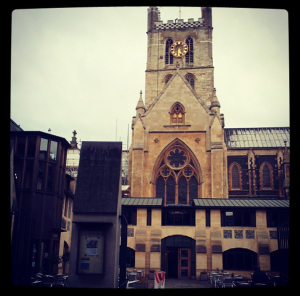
Southwark Cathedral

Southwark Cathedral

Anita has asked me to write about my experiences at Vicar School. I am an Ordinand (ie: hoping to end up as a Vicar in the CofE), studying a 3 year part-time Foundation Degree in Theology for Ministry at SEITE (South East Institute for Theological Education). The college covers four dioceses, including both full and part time students, those doing lay courses (ie: they won’t get ordained at the end); and those hoping for paid jobs like me (stipendiary ministry) or those who will be self supporting (NSM or SSM). We all come from a wide range of churchmanship and traditions and are a very mixed bunch.

* * *

 So, Vicar School – sounds so jolly nice doesn’t it? Almost conjures up images of greying men in tweed and middle-aged women in twin sets in wood panelled rooms, bibles open on our desks listening intently whilst we are taught good exegesis. Of course, the reality is rather different. On my course, we are very mixed: in age, churchmanship and dress – not sure I’ve seen a single twin set actually!

And it’s nice that we are all so different because we can learn so much from each other, but because so many of us are doing different things it can be harder to form strong relationships. For example there are people I only ever see when we’re away on study weekends which is about twice a term. It does get a bit confusing – I am just over half way through my first year and I think I’m just about getting the hang of it all!

So how did I end up here? Well, just getting into Vicar School is a slog in itself. Getting selected for me meant going through the ‘discernment process’ in the Church of England. My husband always jokes that this sounds like a bunch of bearded polo-necked men in a room thinking a lot, and well, there certainly was a lot of thinking involved. It’s a pretty thorough process that I usually describe as like going through intensive therapy. Very worthwhile but hard work and a bit of an emotional roller coaster too. So when I was finally selected and ready to go to college, it felt like the end of a rather long journey when the reality is, it’s actually just the beginning of another hard slog.

So, the course began back in September last year, with a weekend away with the other first years. Literally thrown in at the deep end: a weekend away with a bunch of strangers in surroundings that would be at home in a Harry Potter movie (ever been to Aylesford Priory?) Trouble with the weekends is that they start on a Friday evening and if you’re anything like me, by Friday evening all I am capable of is vegging on the sofa with a glass of red and some trashy telly.

And yet, here I was, all ready for some academic hard stuff. I’ve got to admit I wrote in my journal on that first evening ‘what the **** I doing here?!’ Since then it’s been pretty full on. We’ve had several weekends away, had some fantastic teaching, done our Mission Placement and begun to form friendships too.

I suppose I shouldn’t be surprised at God working through the course to teach me, mould me and guide me, but I am. From the first term’s teaching on church history, which I thought would be massively dull but actually really loved; to getting fed up with more traditional worship styles (I’m a charismatic) and then finding myself weeping uncontrollably during a Eucharist. From reluctantly starting the discipline of the Daily Office and then finding that God speaks to me through it every day; to realising that at heart I am an Anglican. It’s been quite staggering really (especially the Anglican bit…).

I’m also loving how what I am studying is really feeding into my work – I work for my church and it’s amazing how things that seem pretty irrelevant just slot into what I am working on. For instance, I’m currently preparing a report for church on mission and growth, most of which will also feature in an essay I’m doing (rather convenient that one…)

Of course there are still moments when I wonder what on earth God has got me into. Weeks when I have work and college deadlines looming, or when my kids are on school hols and I still have to find time to study, or, as is coming up shortly, planning for the dreaded whole week away at Easter. There have been days when I have wished that I were the kind of person who would be content to be a stay at home mum, when it all seems just too much.

And yet these are the moments when I am reliant on God more than ever. To be honest, without him I think I’d have walked away after the first evening.

So, as I look ahead there is a certain level of mild panic at what the future holds, at where God might send us, but at the same time there is excitement too. I have learned so much already and yet I still have so much to learn. I am loving learning, loving getting back into academic writing, loving the reading (well most of it, not so sure on Kantian ethics….) and the research.

This is a path that whilst being terrifying and unsettling, also feels completely right and where I am meant to be.

Over to you: Have you considered ordination, or been through the selection process or “Vicar School”? Share your story?

Jules Middleton

Jules Middleton

P.S. Jules is asking for your help if you’ve been through the discernment process.

Jules Middleton is a mum and wife, Christian, artist, ordinand and blogger. Her blog Apples of Gold reflects her Christian journey in every day life.

Filed Under: In which I proudly introduce my guest posters Tagged With: Jules Middleton, Ordinand, SEITE, Training to be a Vicar in the Church of England

A Beautiful Train Wreck into Grace

By Anita Mathias


Waterfall Over Rocks

Sometimes, my tongue runs away with me, and I use my words to express anger and frustration rather than bestow grace and life, and those words steal life and strength rather than lavish them,

And I see the red flag of Jesus at the level crossing of my heart, and am stopped dead in my tracks.

But sometimes, I don’t stop, don’t listen to Jesus, and am out of control, a train rushing on…


I might eat whatever is quick and easy or delicious, rather than whatever is a blessing to my body.

Or my husband and I go on the attack

And there we go, rushing on, rushing on, knowing that no good can come from expressing runaway emotions, knowing that what one sows, one reaps…

On and on, we rush, speaking carelessly, smashing past the level crossing, speeding towards the onrushing train of consequences, heading for a crash.


And that’s when I understand grace.

For what I sow I should reap, right?

But that was before Jesus came.

* * *

My train hurtles on,

I drive recklessly, blinded by anger, negativity and despair

And Jesus sees that I am going to crash.

He steps in.


And still my train hurtles headlong; I am out of control. If I reap the consequences of everything I have sown, terrible things will happen.

But Jesus absorbs the crash in himself.

And I crash into grace; I crash into Jesus.


I am redeemed.

My marriage is redeemed

My mothering is redeemed.

Because of the grace Jesus died to give me.

Because of grace.

* * *

He keeps me on track, keeps my marriage on track,

Keeps me on the rails

Because he absorbed the impact at Calvary,

Of all this foolish, headlong sin.

Oh, I trust grace,

I trust mercy.

* * *

If the world were governed by dreary cause and effect,

And a woman could reap only what she sows,

Lord, who could stand?

But you stand between us and inexorable consequences

For this too we revere you.


For it’s not a mere mechanical world of crime and punishment.

It is a world of miracles.

It is the world of Jesus where he lives.


It is a world where Jesus stands in front of us,

Absorbs the impact of our bullet trains

Speeding at a million miles an hour towards self-destruction

He is smashed,

Rises,

And in that resurrection is hope.

For the risen Jesus now lives in me, restraining me

Helping me die to my wild self, making ever more room for the risen Jesus in me.

Helping me bear “in my body the death of Jesus, so that the life of Jesus may also be revealed in my body,” (2 Cor. 4:10).

* * *

 Lord, sharpen my eyesight

Help me to see your red flags in time,

To repent in time


And when I do not,

When I crash,

Let me crash into grace!

The seventy times seventh chance,

The four hundred and ninetieth chance,

The infinite chances you lavish on me in the land of the living,

Grace for the asking,

The Holy Spirit for the asking,

Because you love me.


Have you experienced the inexplicable grace and goodness of God when you least expected it? 

Filed Under: In which I am Amazed by Grace Tagged With: grace, marriage, Parenting

A Little Bit of Theology for Victims of Burglaries (Which, Alas, I Have Just Been)

By Anita Mathias

jewellerySo my grandfather, Piedade Felician Mathias, a distinguished surgeon, had invested his life savings in gold jewellery, because gold in India then, as now, rose faster than anything else.

And my grandmother, trusting and sanguine as I am, left this on her dressing table. The maid vanished–as did the gold.

Everyone wanted my grandfather to report the maid to the Parish Priest, which in the interconnected Catholic town of Mangalore would mean that she would never get married in the church, and would eventually be caught.

He shrugged. My father, remembers him saying in the words of Job “The Lord gives, the Lord takes away, blessed be the name of the Lord.”

* * *

Many years later, when I flew to India, with Roy, my very-new husband, he, carelessly, foolishly, put my 24-carat gold jewellery in an unlocked suitcase—which did not arrive in Bangalore.

I was exasperated. “Roy, who puts jewellery in a suitcase rather than hand luggage? And what kind of person does not lock the suitcase?” I scolded.

“Sshh,” my father said, for he wanted my marriage to work. He told me the story of his father who said with Job “Should we accept good from the hand of the Lord and should we not accept evil?” when he lost his entire life’s savings to date.

I had recommitted my life to following Jesus a little before we married, 24 years ago, so I decided to echo my grandfather in the face of annoying financial loss. However, I put that missing suitcase on my prayer list—“even now”–and continued asking God to find it.

After 90 days, we got our $500 compensation form TWA. And on the 91st day, a phone call. Roy had not bothered with an updated luggage tag, but there was an old one from Johns Hopkins University where he had got his Ph.D. TWA called Johns Hopkins, who gave them our current address in Stanford University, Palo Alto, where Roy was doing a post-doc. And we got the suitcase, 3 months later, and yes, all that pesky precious gold was still in that unlocked suitcase.

We live in a world of magic and miracles. Never forget that.

So we were richer by $500–and one lesson in trust and faith and miracles.

* * *

And my grandfather? Did good come from losing his life’s savings? Well, he no longer invested in gold, but in land, and died with three houses–two in the centre of Mangalore, and  one in Cubbon Road, the posh heart of Bangalore, near the erstwhile Residency, now Raj Bhavan, the Governor’s residence; and the granite Vidhana Soudha, the state legislature–houses that when sold provided part of the down-payment for my first house.

He worked harder as a result of the theft, and realised more deeply that all his wealth came from God–for, unlike my scholarly maternal grandfather, he was a self-made man, who made a fortune through uncanny brilliance.  When his private practice dropped, he’d scold my grandmother, “Josephine, are you giving? Give. You are not giving; that is why I am not getting.”

Home-grown prosperity theology perhaps, but it worked. People got sick; he cured them, they rewarded him lavishly.

* * *

So my theological question really is: Can everything work for good?

There is absolutely no doubt in my mind that it can.

Though at times, this faith has been tested.

One amazing day on holiday in Sweden in August 2011 I felt God speak to me about my blog, and his plans for it.

And the next day, the camper van in which we were holidaying was broken into and we lost both our laptops, including the latest version of the memoir I am working on; another book I was working on which I have consequently abandoned (I hadn’t backed up my laptop for months); Roy’s laptop with precious holiday pictures; a new iPad, which sadly, didn’t even work in Sweden; and a couple of the girls’ iPods.

We did not report visible signs of breaking in, so the insurance did not cover it all.

2000-3000 pounds of loss! How could that work out for good?

* * *

Well, the burglary convinced me that when I felt Jesus next to me on the rocks at Gothenburg, Sweden, and turn and smile at me and tell me about the future of my blog, it was real. This was the consequent spiritual attack and undermining.

I had four more days on holiday, sans laptop, so I prayed for my blog, but could not work on it. And regrouping through strategizing in prayer is far better than working with brute force. For the want of a vision, the people perish.

The lost laptop recalibrated my habits. Though my husband, Roy, a Maths Ph.D with 3 post-docs had retired in 2010, I still did the business accounts, and our personal investing and finances, obsessively. I checked on our business sales daily. I could tell you our net worth to a penny, and moved money around investing everything optimally. I did not believe Roy would do this, so I did it myself, first thing in the morning.

My therapist thought this was a waste of the precious first thing in the morning hour, and so it was. What an uninspiring timewasting way to start one’s day, checking on credit cards and bank statements and sales—necessary when we were running our business with the slimmest of margins, but I continued it though we had been well into profit for nearly 3 years then.

So I turned the finances over to Roy, and it’s a weight off my chest, more brain space for writing and spiritual thought. He does not do money or business as I do—perhaps he does it better, perhaps worse—we argue about this when we are cross!–but we are eating and living. Well.

What good came out of the theft? I berated Roy to our therapist for his fail-safe, highly recommended method of protecting our laptops—throwing a towel over them—and for leaving the girls iPods in full view. And possibly leaving the van unlocked. The therapist said, “Well, he’ll never leave the car or laptops unlocked again.” And indeed he won’t. (Though he did not pay the 1 euro protection fee to the car-guarding people in Sicily this December and 2 of his favourite coats, and my least favourite coat were stolen from the trunk of our locked car!)

And I’ve saved scores of hours probably by no longer checking on our business sales or our personal finances. That hasn’t yet been converted to money—but, God willing, one day it will be.

* * *

Well, I returned from holiday in the Loire Valley at six a.m. yesterday, and walked into a nightmare.

My beloved Chrysler Town and Country mini-van that we had bought in American in 2001 was missing. Irene used to call it “the bupper van,” because I proudly said, “SuperMom in her SuperVan” whenever I drove it.

My front door was wide open. A door had been smashed in, and burglars had entered stealing our large screen TV, the first we’d bought; both my daughters’ laptops (we’d taken ours with us); both their iPods; Irene’s Nintendo Wii that she bought with her own money; my beloved black leather handbag; our silver cutlery set; Irene’s beloved costume jewellery–though all my valuable stuff I had, providentially put in a bank vault a few days before leaving.

The CID have been out, and the forensics unit finger-printing the crime scene,

Okay then, how does one process all this, from a God point of view?

1 God can bring good out of ANYTHING. Ask him to bring good out of your disasters and stand on the ramparts and wait and see what he will do.

The whole of Scripture which I believe is brilliant and inspired—from Adam and Eve’s choices; to Joseph rising from slave to premier; to Christ’s death releasing his very Spirit to live within us—is based on the premise that God can bring good out of evil.

2a We omitted to get contents insurance, foolishly. A false economy. We will now get it.

2B Irene who had a half term’s work on her stolen laptop will learn to back up. She had typed her notes in class; perhaps she will move to writing, then typing them at home, which is a form of revision and more theft-proof.

We will get the girls Macs which are more reliable.

3 Big benefit. Both Roy and I will work a little harder and hopefully smarter to earn money to replace all this stuff –a TV, 2 laptops, a handbag, etc.

I am a big believer in enough. We had enough to pay bills, so were spending more time in getting a bit fitter and a bit healthier, and spiritually stronger. But I guess we will work on making money till we’ve replenished our savings after replacing all this—and work settles the mind and heart.

4 We will practice trusting God. Just as physical fitness is theoretical until put to the test—running 3 miles, say, we do not know whether we really trust God until tested, by financial reverses, say.

Some things we only learn by practising them. Praise God in all circumstances. Rejoice always. In everything give thanks.

Learning and practising these things is no small gain.

5 We are reminded that our life is not really ours, anyway.

Our life is not ours; our body is not ours; our health is not ours, our money is not ours, our blogs are not ours, our time is not ours. God gives us these things, God can take them away.

Our health, our wealth, and our success is in God’s hands. The money to buy all the stuff that was stolen we acquired through God’s blessing on our endeavours. We will continue aligning with him, continue asking him to bless the work of our hands.

6 It’s a great opportunity to practice humour.

I greeted the police with, “Forgive us; our house is not normally this messy.”

And everyone laughed.

We are dealing with this annoyance with ironic humour, a great coping tool.

7 And we will practise being happy in the Lord anyway, because we still dwell in the fountain of God’s goodness and mercy and it still flows.

We will rejoice in the steady goodness of God, because God can bring good out of even this. We will learn rejoicing by practising it.

So what is the proper response of the victim of a burglary?

My children are a bit frustrated with how calmly I am taking it –but it’s this:

Be at peace. Possess your soul in patience. Let nothing disturb thee. Let nothing affright thee, in the words of Saint Teresa of Avila.

Worship the Lord who has given so many good things

Worship the Lord who can turn all things to good.

Be at rest, oh my soul.

P.S. Please pray we recover all our stuff.

Image Credit

Have you ever been the victim of theft or burglary? How did you cope?   

Filed Under: In which I explore the Spiritual Life, In which I just keep Trusting the Lord Tagged With: Faith, Job, surrender, Trust

  • « Previous Page
  • 1
  • …
  • 9
  • 10
  • 11
  • 12
  • 13
  • …
  • 16
  • Next Page »

Sign Up and Get a Free eBook!

Sign up to be emailed my blog posts (one a week) and get the ebook of "Holy Ground," my account of working with Mother Teresa.

Join 536 Other Readers

My Books

Rosaries, Reading, Secrets: A Catholic Childhood in India

Rosaries, Reading Secrets, B&N
USA

UK

Wandering Between Two Worlds: Essays on Faith and Art

Wandering Between Two Worlds
USA

UK

Francesco, Artist of Florence: The Man Who Gave Too Much

Francesco, Artist of Florence
US

UK

The Story of Dirk Willems

The Story of Dirk Willems
US

UK

My Latest Meditation

Anita Mathias: About Me

Anita Mathias

Read my blog on Facebook

Follow me on Twitter

Follow @anitamathias1

Recent Posts

  • At the Cross, God Forgives Us Completely
  • Using God’s Gift of Our Talents: A Path to Joy and Abundance
  • The Kingdom of God is Here Already, Yet Not Yet Here
  • All Those Who Exalt Themselves Will Be Humbled & the Humble Will Be Exalted
  • Christ’s Great Golden Triad to Guide Our Actions and Decisions
  • How Jesus Dealt With Hostility and Enemies
  • Do Not Be Afraid, but Do Be Prudent
  • For Scoundrels, Scallywags, and Rascals—Christ Came
  • How to Lead an Extremely Significant Life
  • Don’t Walk Away From Jesus, but if You Do, He Still Looks at You and Loves You
Premier Digital Awards 2015 - Finalist - Blogger of the year
Runner Up Christian Media Awards 2014 - Tweeter of the year

Categories

What I’m Reading


Wolf Hall
Hilary Mantel

Wolf Hall --  Amazon.com
Amazon.com

Amazon.co.uk

Silence and Honey Cakes:
The Wisdom Of The Desert
Rowan Williams

Silence and Honey Cakes --  Amazon.com
Amazon.com

Amazon.co.uk

The Long Loneliness:
The Autobiography of the Legendary Catholic Social Activist
Dorothy Day

The Long Loneliness --  Amazon.com
Amazon.com

Amazon.co.uk

Country Girl
Edna O'Brien

Country Girl  - Amazon.com
Amazon.com

Amazon.co.uk

Archive by month

My Latest Five Podcast Meditations

INSTAGRAM

anita.mathias

My memoir: Rosaries, Reading, Secrets https://amzn.to/42xgL9t
Oxford, England. Writer, memoirist, podcaster, blogger, Biblical meditation teacher, mum

Looking at photos from our week in beautiful Sevil Looking at photos from our week in beautiful Seville and Cordoba over New Year with Irene, who had a week off.
And, ICYMI, here’s my latest meditation on the Gospel of Matthew… I’ve recorded it, should you want a few minutes of peace.
https://anitamathias.com/2026/04/29/gods-complete-forgiveness/
Hello Friends, I'm resumed recording my meditation Hello Friends, I'm resumed recording my meditations on the Gospel of Matthew. Do click on this link to listen. 
https://anitamathias.com/.../29/gods-complete-forgiveness/
Christ is the most influential figure in the history of the world, though his life ended in shame, humiliation and failure. But he so completely turned things round in his great reversal that the cross on which he died when all seemed hopeless is now the most common, and revered, symbol in history.
He emerged from and was anchored in Judaism. And as the sins of the people were laid on the scapegoat who was sent into the wilderness to perish, Christ died as the lamb of God voluntarily bearing the guilt of the wrongdoing of the whole world. He paid the price for our forgiveness with his life-blood--in accordance with the iron law of the physical and moral universe, of sowing and reaping, cause and effect. 
And so, God, who appeared as flames of fire to Moses, can now dwell within us, purifying us, whose hearts have darkness and shards of ice. 
And now that Christ was crucified, died, but rose again, His Spirit, no longer contained within his earthly body, is poured out like living water onto all humans, at our humble request. The Spirit pours the love of God into us; he reminds us of the words of Jesus and slowly writes Christ’s sweet law on our hearts. This transfusion of grace helps us do hard things we previously couldn’t do. Our dance with the Spirit gradually breaks the power of sin over us. It transforms us.
Now we, the forgiven, protected by the blood of Jesus poured out over us, and filled with His Spirit, who sings within us, Abba, Father, are adopted by God as his children in his joyful new covenant. We are cells grafted into the vine of our new family--Father, Son, Spirit—who now live in us as we live in them. As we choose by our thoughts and actions to continue living in the vine of Jesus, their energy pulsing through us makes us fruitful. And now, all our prayers which flow in the river of God’s good purposes are kindly heard. Waves of love and power flood from the cross! 
Thank you!
Well, hello friends! Breaking radio silence to let Well, hello friends! Breaking radio silence to let you know that I have taped a meditation for you on Christ’s famous Parable of the Talents in Matthew 25. https://anitamathias.com/2025/11/05/using-gods-gift-of-our-talents-a-path-to-joy-and-abundance/
Here you are, click the play button in the blog post for a brief meditation, and some moments of peace, and, perhaps, inspiration in your day 🙂
Hi Friends, I have taped a meditation; do listen a Hi Friends, I have taped a meditation; do listen at this link: https://anitamathias.com/2025/04/08/the-kingdom-of-god-is-here-already-yet-not-yet-here-2/
It’s on the Kingdom of God, of which Christ so often spoke, which is here already—a mysterious, shimmering internal palace in which, in lightning flashes, we experience peace and joy, and yet, of course, not yet fully here. We sense the rainbowed presence of Christ in the song which pulses through creation. Christ strolls into our rooms with his wisdom and guidance, and things change. Our prayers are answered; we are healed; our hearts are strangely warmed. Sometimes.
And yet, we also experience evil within & all around us. Our own sin which can shatter our peace and the trajectory of our lives. And the sins of the world—its greed, dishonesty and environmental destruction.
But in this broken world, we still experience the glory of creation; “coincidences” which accelerate once we start praying, and shalom which envelops us like sudden sunshine. The portals into this Kingdom include repentance, gratitude, meditative breathing, and absolute surrender.
The Kingdom of God is here already. We can experience its beauty, peace and joy today through the presence of the Holy Spirit. But yet, since, in the Apostle Paul’s words, we do not struggle only “against flesh and blood, but against the rulers, against the unseen powers of this dark world and against the spiritual forces of evil,” its fullness still lingers…
Our daughter Zoe was ordained into the Church of E Our daughter Zoe was ordained into the Church of England in June. I have been on a social media break… but … better late than never. Enjoy!
First picture has my sister, Shalini, who kindly flew in from the US. Our lovely cousins Anthony and Sarah flank Zoe in the next picture.
The Bishop of London, Sarah Mullaly, ordained Zoe. You can see her praying that Zoe will be filled with the Holy Spirit!!
And here’s a meditation I’ve recorded, which you might enjoy. The link is also in my profile
https://anitamathias.com/2024/11/07/all-those-who-exalt-themselves-will-be-humbled-the-humble-will-be-exalted/
I have taped a meditation on Jesus statement in Ma I have taped a meditation on Jesus statement in Matthew 23, “For those who exalt themselves will be humbled, and those who humble themselves will be exalted.”
Do listen here. https://anitamathias.com/2024/11/07/all-those-who-exalt-themselves-will-be-humbled-the-humble-will-be-exalted/
Link also in bio.
And so, Jesus states a law of life. Those who broadcast their amazingness will be humbled, since God dislikes—scorns that, as much as people do.  For to trumpet our success, wealth, brilliance, giftedness or popularity is to get distracted from our life’s purpose into worthless activity. Those who love power, who are sure they know best, and who must be the best, will eventually be humbled by God and life. For their focus has shifted from loving God, doing good work, and being a blessing to their family, friends, and the world towards impressing others, being enviable, perhaps famous. These things are houses built on sand, which will crumble when hammered by the waves of old age, infirmity or adversity. 
God resists the proud, Scripture tells us—those who crave the admiration and power which is His alone. So how do we resist pride? We slow down, so that we realise (and repent) when sheer pride sparks our allergies to people, our enmities, our determination to have our own way, or our grandiose ego-driven goals, and ambitions. Once we stop chasing limelight, a great quietness steals over our lives. We no longer need the drug of continual achievement, or to share images of glittering travel, parties, prizes or friends. We just enjoy them quietly. My life is for itself & not for a spectacle, Emerson wrote. And, as Jesus advises, we quit sharp-elbowing ourselves to sit with the shiniest people, but are content to hang out with ordinary people; and then, as Jesus said, we will inevitably, eventually, be summoned higher to the sparkling conversation we craved. 
One day, every knee will bow before the gentle lamb who was slain, now seated on the throne. We will all be silent before him. Let us live gently then, our eyes on Christ, continually asking for his power, his Spirit, and his direction, moving, dancing, in the direction that we sense him move.
Link to new podcast in Bio https://anitamathias.co Link to new podcast in Bio https://anitamathias.com/2024/02/20/how-jesus-dealt-with-hostility-and-enemies/
3 days before his death, Jesus rampages through the commercialised temple, overturning the tables of moneychangers. Who gave you the authority to do these things? his outraged adversaries ask. And Jesus shows us how to answer hostile questions. Slow down. Breathe. Quick arrow prayers!
Your enemies have no power over your life that your Father has not permitted them. Ask your Father for wisdom, remembering: Questions do not need to be answered. Are these questioners worthy of the treasures of your heart? Or would that be feeding pearls to hungry pigs, who might instead devour you?
Questions can contain pitfalls, traps, nooses. Jesus directly answered just three of the 183 questions he was asked, refusing to answer some; answering others with a good question.
But how do we get the inner calm and wisdom to recognise
and sidestep entrapping questions? Long before the day of
testing, practice slow, easy breathing, and tune in to the frequency of the Father. There’s no record of Jesus running, rushing, getting stressed, or lacking peace. He never spoke on his own, he told us, without checking in with the Father. So, no foolish, ill-judged statements. Breathing in the wisdom of the Father beside and within him, he, unintimidated, traps the trappers.
Wisdom begins with training ourselves to slow down and ask
the Father for guidance. Then our calm minds, made perceptive, will help us recognise danger and trick questions, even those coated in flattery, and sidestep them or refuse to answer.
We practice tuning in to heavenly wisdom by practising–asking God questions, and then listening for his answers about the best way to do simple things…organise a home or write. Then, we build upwards, asking for wisdom in more complex things.
Listening for the voice of God before we speak, and asking for a filling of the Spirit, which Jesus calls streams of living water within us, will give us wisdom to know what to say, which, frequently, is nothing at all. It will quieten us with the silence of God, which sings through the world, through sun and stars, sky and flowers.
Especially for @ samheckt Some very imperfect pi Especially for @ samheckt 
Some very imperfect pictures of my labradoodle Merry, and golden retriever Pippi.
And since, I’m on social media, if you are the meditating type, here’s a scriptural meditation on not being afraid, while being prudent. https://anitamathias.com/2024/01/03/do-not-be-afraid-but-do-be-prudent/
A new podcast. Link in bio https://anitamathias.c A new podcast. Link in bio
https://anitamathias.com/2024/01/03/do-not-be-afraid-but-do-be-prudent/
Do Not Be Afraid, but Do Be Prudent
“Do not be afraid,” a dream-angel tells Joseph, to marry Mary, who’s pregnant, though a virgin, for in our magical, God-invaded world, the Spirit has placed God in her. Call the baby Jesus, or The Lord saves, for he will drag people free from the chokehold of their sins.
And Joseph is not afraid. And the angel was right, for a star rose, signalling a new King of the Jews. Astrologers followed it, threatening King Herod, whose chief priests recounted Micah’s 600-year-old prophecy: the Messiah would be born in Bethlehem, as Jesus had just been, while his parents from Nazareth registered for Augustus Caesar’s census of the entire Roman world. 
The Magi worshipped the baby, offering gold. And shepherds came, told by an angel of joy: that the Messiah, a saviour from all that oppresses, had just been born.
Then, suddenly, the dream-angel warned: Flee with the child to Egypt. For Herod plans to kill this baby, forever-King.
Do not be afraid, but still flee? Become a refugee? But lightning-bolt coincidences verified the angel’s first words: The magi with gold for the flight. Shepherds
telling of angels singing of coming inner peace. Joseph flees.
What’s the difference between fear and prudence? Fear is being frozen or panicked by imaginary what-ifs. It tenses our bodies; strains health, sleep and relationships; makes us stingy with ourselves & others; leads to overwork, & time wasted doing pointless things for fear of people’s opinions.
Prudence is wisdom-using our experience & spiritual discernment as we battle the demonic forces of this dark world, in Paul’s phrase.It’s fighting with divinely powerful weapons: truth, righteousness, faith, Scripture & prayer, while surrendering our thoughts to Christ. 
So let’s act prudently, wisely & bravely, silencing fear, while remaining alert to God’s guidance, delivered through inner peace or intuitions of danger and wrongness, our spiritual senses tuned to the Spirit’s “No,” his “Slow,” his “Go,” as cautious as a serpent, protected, while being as gentle as a lamb among wolves.
Follow on Instagram

© 2026 Dreaming Beneath the Spires · All Rights Reserved. · Cookie Policy · Privacy Policy