Anita Mathias: Dreaming Beneath the Spires

Anita Mathias's Blog on Faith and Art

  • Home
  • My Books
  • Meditations
  • Essays
  • Contact
  • About Me

In which Manipulation Backfires (in the long run). Not so seeking God’s Blessing!

By Anita Mathias


I am reading the story of Jacob in Genesis. God tells Rebecca who was pregnant with twins, “The older will serve the younger.”

When we meet the twins in Genesis 26, Esau, “a skilful hunter,” comes in famished, and wants Jacob’s red stew. Jacob, “a quiet man, staying among the tents,” driving an exploitative bargain, demands Esau’s birthright, traditionally a double portion of the inheritance, in exchange for the bowl of lentil stew.

Isaac was “very wealthy. He had many flocks and herds and servants.” (Gen 27:25). So Esau is asked to give his extra third of all this to Jacob for a bowl of aromatic stew. In his impulsivity, he agrees.

* * *

A cruel bargain, but not a deceitful one. What is cruel and deceitful is how Jacob later takes advantage of blind Isaac, and pretends to be Esau to steal his blessing, wearing Esau’s clothes, passing off choice young goats from their flock, skilfully prepared by Rebecca, as game caught and cooked by Esau.

And despite his misgivings, “Your voice is the voice of Jacob,” Isaac blesses Jacob with the blessing he had intended for Esau

“May God gives you of heaven’s dew,

and of earth’s richness—

An abundance of grain and new wine.

Be Lord over your brothers

And may the sons of your mother bow down to you.”

Jacob no sooner leaves than Esau enters, with game he had killed himself, tastily prepared.

“Isaac trembled violently, “Your brother came deceitfully, and took your blessing. I blessed him and indeed he will be blessed.”

Esau “burst out with a loud and bitter cry,” ‘Bless me—me too, my father. Do you have only one blessing, my father? Bless me too my father.’  And Esau wept aloud.”

His father answered him

“Your dwelling will be away from the earth’s riches

And you will serve your brother

But when you grow restless,

You will throw his yoke from off your neck.”

* * *

And then what happened?

* * *

God did not allow this trickery to prosper.

Blessing comes from God. Parental blessings are only prayers to God to bless children. As such, there is power in them. But not magic. If our blessings of our children determined their destinies, the world would be full of Einsteins, Leonardos, Shakespeares, Michael Phelps and Bill Gates.

Furious at his deceit, Esau plans to kill Jacob, and Jacob flees, living in exile for 20 years, as a hired man, serving Laban.

Esau, meanwhile, built up his own wealth, staying home as a rich man’s son. “I have plenty, my brother,” he tells the returning Jacob (Gen 33:9).

And Esau uses family wealth for the bride price of his three wives, whereas Jacob worked as a hired man for fourteen years for his two wives, one of whom he did not love or want.

“Be Lord over your brother and may the sons of your mother bow down to you,” was the blessing Isaac meant to give Esau, and Jacob “stole.”

However, when he returns, it is Jacob who bows to Esau and calls him Lord–always the blessing Isaac had intended for Esau.

“Jacob bowed down to the ground seven times as he approached Esau.” (Gen 33:3). He introduces his children, “They are the children God has graciously given your servant.”

He sends Esau a gift of “two hundred female goats, and twenty male goats, two hundred eyes and twenty rams, thirty female camels with their young, forty cows and ten bulls, and twenty female donkeys and ten male donkeys.” The servants are to say, “They belong to your servant Jacob and are a gift sent to my Lord, Esau.”

Jacob insists, “Please accept the present that was brought to you.  They are to find favour in your eyes, my Lord.” (The Hebrew word berakah means both blessing and gift or present.) “And because Jacob insisted, Esau accepted.”

So, in a sense, Jacob returns the stolen blessing and birth-right and Jacob now bows to Esau, and the wealth he has gained goes to serve his brother, which were the blessings Isaac had intended for Esau.

And Jacob gets the blessing/curse that Isaac sadly gave Esau.  “Your dwelling will be away from the earth’s riches ( he was a hired man for twenty years). And you will serve your brother (which he does with his massive gift). But when you grow restless, you will throw his yoke from off your neck,” as Jacob does by refusing to follow Esau to Seir but instead  settling in Succoth and later in Hebron.

* * *

What were the result of Jacob’s attempts to manipulate Esau’s birthright and blessing away from him?

He had to run away from his home. He never saw his mother again. Deceived, he worked seven years for an older daughter he did not love or want, and another seven years for the beautiful daughter he did. He worked for 20 years as a hired man, frequently cheated (Gen 30:35-36; Gen 31:7). He gave a good portion of his wealth to Esau.

God did not allow his trickery to prosper. Esau got the blessing Isaac mistakenly gave Jacob. He gets earth’s richness and abundance; Jacob bows down to him and calls him Lord. Jacob gets the “blessing” Isaac sadly gave Esau—he lives away from the richness of Canaan for 20 years, his labour serves his brother, and he eventually shakes him off.

* * *

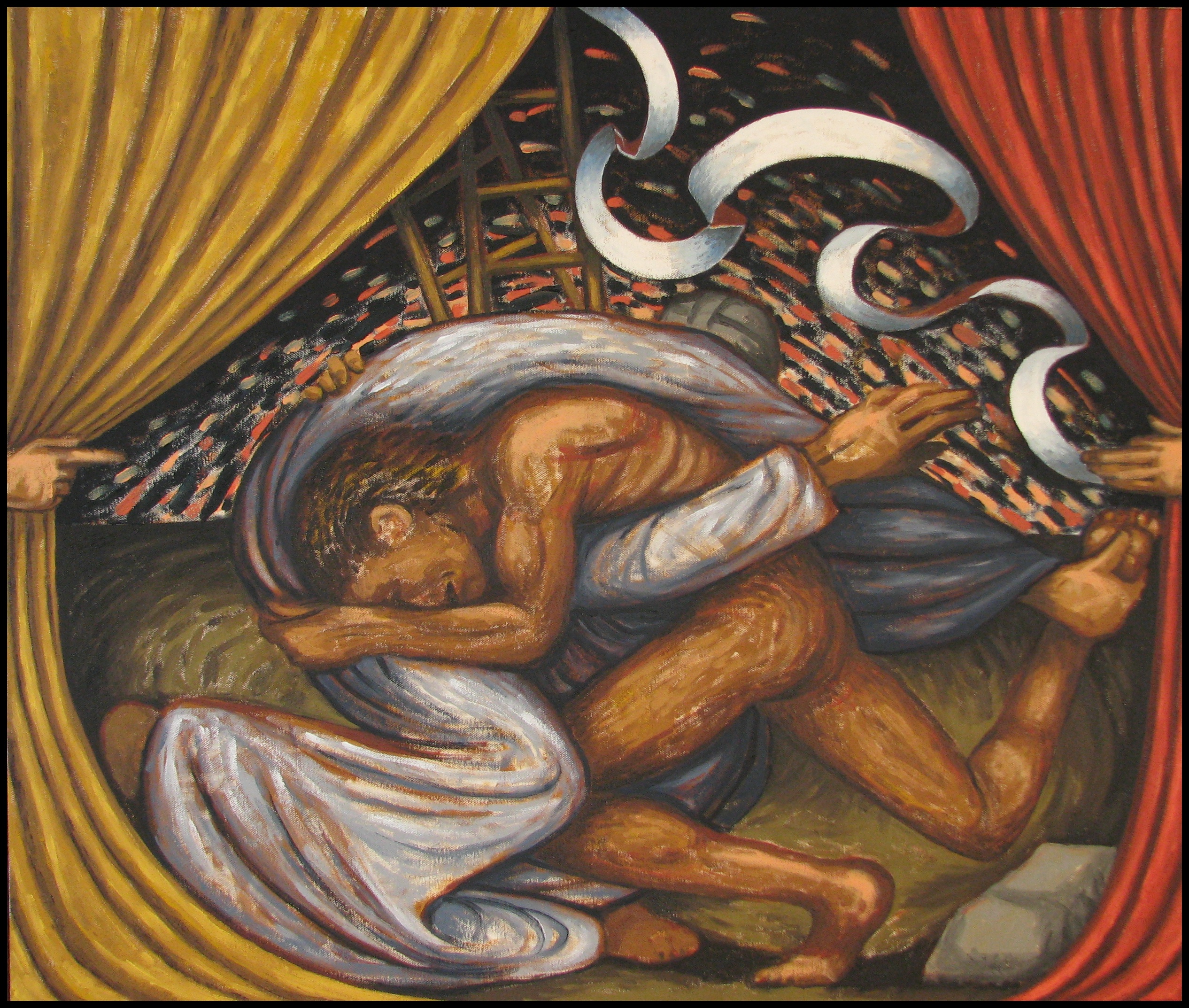
However, just before meeting Esau again, Jacob is blessed by God in a dramatic encounter by the Jabbok River which left him limping and in no doubt that blessing comes from God, not from our intrigues, manipulations or even hard work.

And he enters Canaan, the land of blessing, once he is “broken.” He now limps, leaning on Him who had always intended to bless him, and would have done so far more rapidly, had Jacob not tried to help him out with his own manipulations.

And from that second blessing, the blessing of God, not the stolen one, all subsequent goodness in his life would flow.

* * *


Filed Under: Genesis Tagged With: Blessings, blog through the bible, esau, Genesis, Jacob, Jacob wrestling with the angel

“Surely the Lord is in this place, and I was not aware of it:” How the Best Thing can Spring out of the Worst Thing

By Anita Mathias


So Jacob, running from murderous Esau whom he has cruelly and unscrupulously deceived, rests at Bethel.

And in his dream, he sees a stairway between heaven and earth, with the angels of God ascending and descending on it. And at the top, stood the Lord, who speaks blessing and encouragement.

And Jacob says, “How awesome is this place. This is the house of God; this is the gate of heaven.”

“Surely the Lord is in this place, and I was not aware of it.”

* * *

Jacob is in a fix. He has stolen Esau’s birthright, by taking advantage of his hunger and weak character. And then, taking advantage of Isaac’s blindness, he pretended to be Esau, stealing the blessing Isaac intended for him. He is now running for his life from Esau. He will never see his parents again, never return home.

And in the midst of this self-caused tragedy, God meets him, and blesses him.

* * *

When are we most likely to be unaware of the presence of the Lord?

When we are in the land of suffering.

I am working through Donald Miller’s StoryLine.

Step 1: We plot out our life to date, as if were a movie script, or the outline of a novel or memoir, assigning a positive or negative value to each event.

Step 2. We try to see if something good, something redemptive has come out of all the negative plot turns.

We make two lists for each negative event. Along with the list of catastrophic things, we make a list of the good things which emerged from the event.

* * *

Viktor Frankl, the Austrian psychiatrist, founder of Logotherapy, helped thousands of patients heal as he helped them see the good, positive, and beneficial things which came to them or others because of their greatest sufferings.

In fact, once people see the good which has come out of their sufferings, they no longer view it as suffering.

Donald Miller writes, “I now claim what I used to see as tragedies as honest gifts from God. Still painful, but redeemed.

* * *

Doing the exercise was eye-opening for me. I found myself assigning positive values to the most painful, disappointing and traumatic things that happened to me because I now, in middle age, can see the good which came out of them.

Some of the best things in my life have come out of some of the worst things, out of failure, humiliation, shame, and loneliness.

In fact now, there is nothing I assign a straight negative score to, for each of these “plot turns” has led to so much good.

* * *

Here are some of my plot twists:

1) I was “the naughtiest girl in school” in my first school run by local nuns, and got expelled at 8. Who gets expelled at eight? Apparently, I!

As a result, I went to a boarding school, run by German and Iris nuns in Nainital, in the Himalayas, receiving a rather more cosmopolitan education than I would have got in my small Indian town. Boarding school was a calm and very disciplined environment, with set hours for study and reading. I read hungrily and left relatively well-read, having read hundreds of books.

2) After my undergraduate degree in English at Somerville College, Oxford, I was offered a place for a Ph.D in English at Oxford, contingent on getting a First.

I did not, and was overwhelmed with shame.

Instead, I went on to graduate school in the US, earning an MA, and then some of a Ph.D in English and Creative Writing, before quitting that to get married.

I would never have gone to America on my own, but having lived there 17 years, I am as comfortable with Americans as with Brits; have a sort of Anglo-American sensibility; and, psychologically, live mid-Atlantic, which is an asset in the blogosphere.

3) I was so depressed after the rejection of a manuscript in 1996 that I diagnosed myself as “sick,” and decided I needed a physican. I committed to 90 minutes a day of prayer and Bible study.

That practice has changed who I am, and the course and  events of my life more than anything else.

4) After a painful conflict (about a group I was leading), I withdrew for a few years from active involvement in church life and politics (though not from church services), pouring my energy first into establishing a stable family business, then into blogging.

The redirection of energy, away from leading Bible studies which I did for over ten years into writing , proved a blessing to me. And I left that church, SO toxic for me, for a grown-up, emotionally healthy church.

A few examples of “negative turns” eventually bringing many blessings my life.

It makes me more convinced that God is definitely working through my life, working through its plot, bringing good out of all the plot twists.

That He was there in each plot twist, though I might not have been aware of it.

Filed Under: Genesis Tagged With: blog through the bible, esau, Genesis, good from evil, Jacob, redemption

Re-opening the Ancient Wells which will Save our Lives Right Now

By Anita Mathias

Switzerland 2013

In arid ancient Israel, access to artesian wells made all the difference between prosperity, survival, or famine.

And so when God blessed Isaac so that his crops reaped a hundred-fold return (Gen. 26:12) and he became very wealthy, out of envy, his enemies, the Philistines “stopped up all the wells that Abraham had built, filling them with earth.”

Today, there are almost weekly accounts of the Israeli occupation forces destroying Palestinian wells, farms and orchards. Destroying wells, sources of life, is always a very effective enemy action, leaving aridity and poverty.

* * *

 Barbara Brown Taylor popularised this question: What is saving your life, right now?

Prayer and scripture and communal worship is certainly part of it.

But other things are keeping me alive too: long, slow, contemplative walks out of doors with my beloved collie Jake, my body getting into a rhythm of movement, my mind relaxing, still as a pool, until I am no longer thinking, but just being, and then suddenly a golden carp of thought pops up, unexpected and welcome.

And travel, which is complete relaxation. My mind rests from conscious thought, planning, strategizing, worrying. I shrug off my to-do list, and my uneasy Puritan imperative of ambition and must-achieve. I am just am, and am purely happy and relaxed, wandering the streets of a beautifully preserved medieval town like Troyes, France, which we visited last week, just looking, or wandering aimlessly on the alpine meadows of Switzerland, to which we drove earlier this month.

Blogging is saving my life, in that it pushes me to think, to observe, to express, to strive for beauty.

* * *

 But life has blocked up several life-giving wells for me, as for all of us.

And I am opening up these wells.

Before I married, I was a voracious reader. Reading was my escape from the world, and my greatest source of joy, and I felt I needed to be alone to really disappear into a book leaving the world behind me, and I found that hard while living with other people.

I have been steadily reading less through the 23 years of our marriage, though I have recently re-launched a reading recovery programme—reading 1 page more each day than I did the day before, aiming to hit 45 pages a day, or a book a week. Concurrently, as a back-up plan since I have many books on the go, I aim to finish each book in 1 day less–30 days for book 1; 29 days for book 2, etc. This plan gets anyone to reading a book a week in 23 months.

And with reading, I have lost other sources of joy. As a child, I loved myth and legend and fairy tales and children’s stories. Sadly, I have not read much in these genres as an adult, because, well, I was an adult and thought I should be reading serious, grown-up stuff.

It’s strange that I didn’t realize that children’s stories and fairy tales and myths and legends were invented by adults, who were putting themselves back in touch with the sources of joy and delight. And we can step there with them, if we give ourselves permission to.

On holiday earlier this month in Switzerland, Italy and France, it was as if God switched a switch on in my brain, and children’s stories poured out of me, two and three a day. And writing children fiction–ah bliss, gives me “permission” to read it.

* * *

Poetry was something else I loved to read as a child, and the first genre I wrote in as an adult. My masters in creative writing was in poetry.

But then, making the correct or incorrect assessment that I probably would not have a career as a poet, I gave it up in my late twenties. It is something else I would love to resume, first reading it exhaustively, then writing it.

* * *

Our large garden was a huge source of joy as a child. I have a large garden now, even larger than my childhood garden, but in fact, though I write looking at it, it is hard to recover the habit of working in it consistently.

I would like an extraordinary garden, and would love to make time to work in it every day, for an hour, like I used to. But I have made peace with the fact that when it comes to it, I prefer writing to gardening. So, since it is better to take just a few steps in the direction of one’s dreams than none at all—I am gardening just once every few days for now.

* * *

 What will re-open the wells of life and joy for us?

Examine your life. See what you are doing out of duty and habit which is not life-giving for you. (Too much internet usage? On too many rotas at church? Staying up too late doing nothing much?)

Then begin to shoehorn joy into your life, starting small—in the smallest measurable increments, steadily rebuilding

What is saving your life now? Are there wells of joy which have closed for you? Tell us in the comments.

Filed Under: Genesis, In which I pursue happiness and the bluebird of joy Tagged With: blog through the bible, Gardening, Genesis, Happiness, re-opening ancient wells, reading, Travel

Fail Better: Only Do Not Go Backwards

By Anita Mathias

Image Credit

The aged Abraham sends his servant back to Ur to get a wife for Isaac with these instructions, “Make sure that you do not take my son back there,” Abraham said. “Only do not take my son back there.” (Gen. 24:8).

Straight ahead lay the land of promise, the land to which he had specifically been called. Ur was the land he had been called out of.

Ever tried. Ever failed. No matter. Try again. Fail again. Fail better. 

― Samuel Beckett, Worstward Ho.

Only do not go backwards.

* * *

Failing Better with the Bible

I am reading this Genesis passage because it is my third (and final and God willing successful) attempt at blogging through the Bible. My first, in 2011, failed because I make the mistake of attempting to comment on every passage, not just on what most spoke to me in the readings of the day.

My second attempt, this January, failed because I again tried to keep up with the readings of the day, an impossible, quixotic endeavour. Blogging through the Bible on a standard reading plan of 4 passages a day involves writing 1460 posts a year. Who could write that many? And who could read them?!!

So I am trying again, taking my time, listening to what scripture is saying to me, writing that down, 2-3 posts a week at best. It will be a marathon, but reading scripture is not a sprint. It is a way of spiritual transformation.

* * *

Failing Better with Diet and Weight Loss

Sometimes success consists of just hanging in there, through plateaus. Jon Acuff writes somewhere that the diet that helped him lose 30 pounds was the diet he stuck to. There’s something to that.

But there is also something in learning from your past failures: studying what worked, and what did not work, and devising a plan likely to set you up for success.

Staying in the ring, and failing better and better until you succeed!


I have learned something from each dieting failure, for instance.

1 Weight Watchers. Ugh. Emphasis on calorie restriction kept me focused on food. Also calorie restriction may not work long term: it lowers your metabolism so that when you resume normal eating, you gain it all back!

2 Vegetarianism. Because I love carbs, I didn’t lose as much as I should have on this, and, nutritionally, substituting carbs for meat and dairy and eggs probably had dubious nutritional value.

3 Metabolic Typing Diet. Turned out that I, unusually for Asians, am a “protein type.” (A throwback to my paternal grandmother’s Portuguese grandmother, and the Portuguese on my mother’s side too?) Which means I do not metabolize carbs as easily as protein, more easily gaining weight with carbs than with meat or fish.

4 Atkins/South Beach. Being a protein type, I lose weight on these, but find it hard to get through the first two weeks!!

5 The Weigh Down Diet. The Presbyterian church I attended for a few years in Williamsburg had a Sunday School class on this eccentric diet! It was eat anything you want, as much as you want, when you are hungry, and stop when you are full.

By allowing chocolate, cookies and cheesecake, the diet aims at removing them as objects of lust. Oddly, I lost 10 pounds on this. But, nutritionally, it was nuts!

* * *

However, instead of viewing these discarded diets as failures, I have decided to view them as learning experiences. I have been very slowly losing weight (13 pounds over the last 9 months) through life-style change for life,  designing a diet which includes things I’ve learned from each of my diets

1. I no longer set out to restrict calories as that lowers my metabolism, but, in effect, do so by trying to have a green smoothie and a salad at most meals.

Because of the impressive nutritional and immunological  benefits of largely vegan and vegetarian meals, I am trying  to eat a diet that’s largely fruit and vegetables, with some protein, according to my body’s felt needs.

2. I limit sugar, chocolate and nutritionally empty white flour or white rice.

3. I try to do a 3.5 mile walk every second day, which probably works wonders for my metabolism.

4. From the Weigh-Down Diet, I’ve learned that it’s okay to have   occasional favourite meals, Indian and Chinese takeaway etc., and the occasional sweet treat. Knowing these are permitted on occasion, I do not get discouraged and resume undisciplined eating after one of these treats.

5 Another Weigh-Down Principle: Never use food as a recreational activity or for emotional needs. The risks to health are not worth it.

So I am trying to find appropriate interventions when sad, angry, bored, stressed, which do not involve calories. I am also trying to break a lifelong habit of grazing through the day, and am trying to train myself not to eat between meals unless I am truly hungry. Knowing I am not going to eat until the next meal gives me the same sense of peace and freedom as when I lock myself out of facebook, twitter, email, and newspapers!

Weight loss has been slow with many plateaus, because I am overcoming the engrained bad eating habits of a lifetime, reacquainting myself with what physical hunger feels like, learning not to eat absent-mindedly.  But I am determined, whatever I do, not to go backwards.

* * *

Failing Better with Early Rising

I have, for many years, had a romantic desire to wake at 5 o’clock, and enjoy sunrise and sunset in the same day.

However, I have my most concentrated periods of thinking , writing and reading in the evenings.  So cutting out a beloved productive time by going to sleep at 9 to wake at 5 felt a bit stupid to me, and my attempts to wake at 5 were short-lived.

My latest wake-early attempt began in late May, and I am now waking at 6.40 a.m., pushing it back 15 minutes every 4 days then maintaining it a bit. Should get there.

I have learned from my failures. Telling myself I have to get to bed early stresses my evening, and deprives me of productive time. So I am using bi-phasic sleeping which works very well for me: less than 8 hours at night, but a longish nap in the afternoon between two periods of work. Iris Murdoch in The Good Apprentice calls this getting two days for the price of one!

* * *

In any enterprise, running an orderly house, learning to write, becoming formidably well-read: keep proceeding, even by millimetres in the direction of your dreams, and you will achieve a success you did not dream of in lesser hours.

If you can’t proceed, rest at a plateau; just do not go backwards.

And then try again, though not using the same strategy which just failed (one definition of insanity). Instead, keep what worked, examine what failed, see how to replace it with something better, and try again, failing better until you succeed.

How about you? Are there areas in which you’ve learned from failure, and are now failing better? Or even succeeding?


Filed Under: Genesis Tagged With: blog through the bible, diet, failing better, Genesis, learning from failure, waking early, weight loss

And Sarah Snorted. When our Faith Falters, But God’s Goodness Remains Constant

By Anita Mathias

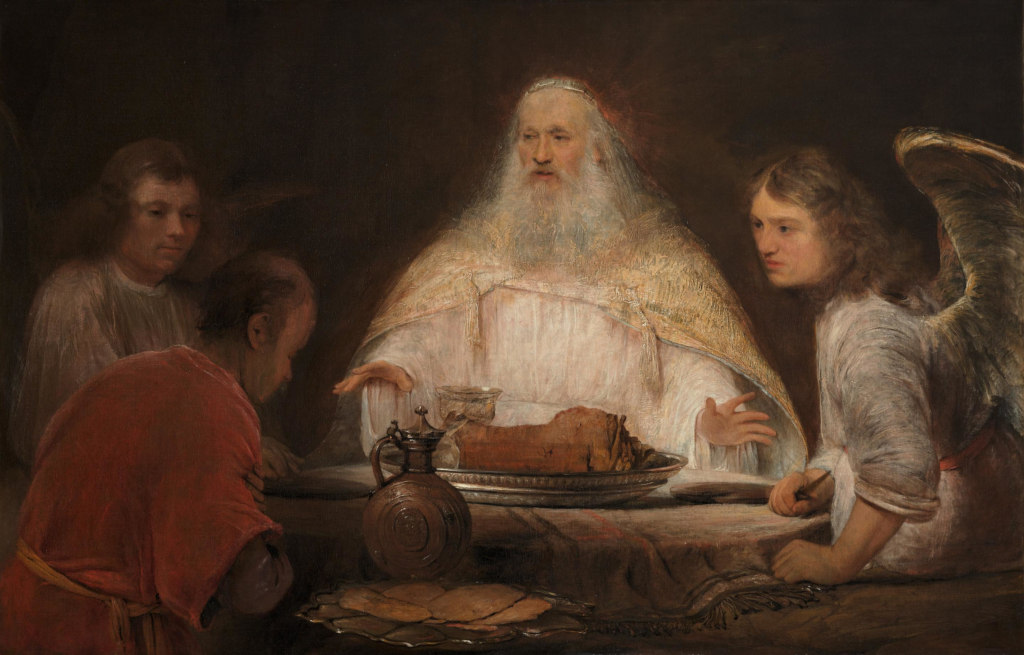
Arent de Gelder: God and the Angels visit Abraham

  Arent de Gelder 1645-1727

Three white-clad men walk out of the desert, out of the shimmering sands. Such is their calm and majesty that Abraham, the Patriarch, “very wealthy in silver and gold, sheep and cattle and camels and male and female donkeys, menservants and maidservants” runs to meet them, bows low to the ground, and offers him his most lavish hospitality: a freshly slaughtered calf, yogurt and milk, and bread from the finest flour,

It is a theophany; Abraham sees the pre-incarnate Christ. Abraham sees God.

“Then one of the men said, “I will surely return to you about this time next year, and Sarah your wife will have a son.” (Gen 18:10)

* * *

And Sarah, listening at the entrance of her tent, out of sight, snorts.

Same old, same old, same old promises. The son, descendants, more of them than the stars in the sky and the grains of sand in the seashore.

Well, God, that sounds wonderfully poetic, but you know, as for me, here, in space and time, well, I could do with just one child. Is that too much to ask? Well, yes, apparently so!

I am weary of these promises. I am weary of hope. “After I am worn out and my lord is old, will I now have this pleasure?” she thinks. (Gen 18:12)

And Sarah snorts!

* * *

 Then the Lord said to Abraham, “Why did Sarah laugh and say, ‘Will I really have a child, now that I am old?’ 14 Is anything too hard for the Lord?” (Gen 18: 13-14)

But perhaps the Lord thought, “Yeah, I am with Sarah. I have tried their hope and faith and patience for long decades. Perhaps too long. I have given them a good life full of richness in the interim. I have blessed them in every other way, but I know their longing, their heartbeat. It is for a son. It is for Isaac.

I waited so long so that they would never doubt that Isaac was mine, and not theirs. Never fail to see my glory in this baby, Isaac. Never doubt Isaac was a miracle baby, my miracle ancestor, pre-figuring when I too would enter human history as a miracle baby, the greatest miracle of all.

But it is now time. Time for their miracle. Time for Isaac.”

“I will return to you at the appointed time next year, and Sarah will have a son.”

 Sarah was afraid, so she lied and said, “I did not laugh.”

But he said, “Yes, you did laugh.” (Gen 18: 14-15)

* * *

Ah, Sarah, how you blew it. Snorting at a theophany! Snorting at Christ and his angels! You’ve lost hope. The snake of bitterness curls around your heart. You no longer have the energy, the courage to hope, and who can blame you?

And then you lie, you lie to the Lord, who sees your heart.

But are you zapped, turned to a pillar of salt, as Lot’s wife was?

No, the Lord understood your longing, your disappointment, your frustration.

And despite your snort of laughter, your spontaneous lie, He reiterated his promise, no longer vague, but definite,  “I will return to you at the appointed time next year, and Sarah will have a son.”

And He did, and you did, and you called him Isaac, which means laughter. Your snort of derisive laughter was redeemed; it became the laughter of joy at your miracle baby.

* * *

 And sometimes, our dreams seem disproportionately enormous, and our faith wavers, and the years pass, but our dreams, the promises we heard God whisper to us, the destiny we are born for, has not come to pass, and when we verbalize our dreams, we almost snort.

And how can you, Lord, bless someone who has so blown it, a sinner, whose faith has wavered?

But you do because you know our frame; you know we are but dust, and so though we do not deserve it, though we have blown it again and again, you come to us; you bring the destiny you have promised us to pass; you give us the child of promise whose name is laughter. You enjoy the pun, artist that you are, transforming the snort of sceptical laughter to laughter like a running brook.


Filed Under: Genesis, In which I resolve to live by faith Tagged With: abraham, blog through the bible, Faith, Genesis, Isaac, Sarah, Theophany

The Secret History of Hagar: When God Invisibly Comforts the Oppressed

By Anita Mathias

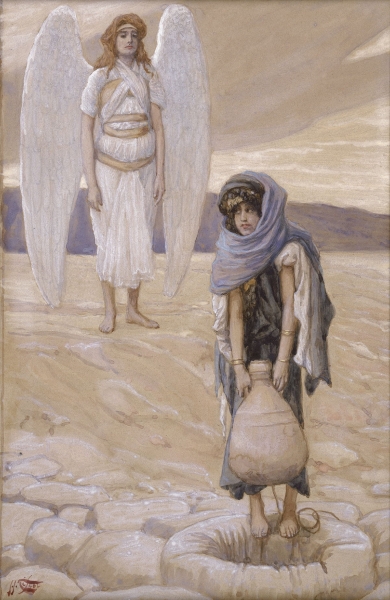
File:Tissot Hagar and the Angel in the Desert.jpg

Image: Tissot, Hagar and the Angel in the Desert


Hagar, Egyptian maidservant of Sarah, has a hard life. Impregnated, basically raped by Abraham, she is bullied and persecuted by a jealous Sarah—so much so that probable death in the desert feels preferable. (Genesis 16)

And in the desert, the runaway slave, with only the clothes on her back, sees the Lord.

And she returns to her mistress, who is “very wealthy in silver and gold, sheep and cattle and male and female donkeys, menservants and maidservants and camels.”

The rich get richer; the poor get poorer. It sure seems as if Sarah has won and Hagar has lost, doesn’t it? Perhaps.

Perhaps not.

* * *

It is Hagar, not Sarah who sees “the Lord who sees me.” It is Hagar He advises. Hagar is promised not only life, but descendants too many to count. She goes back to Sarah, under the Lord’s protection, bearing his promises.

And Sarah knows nothing of this. Her maidservant has returned, that’s all she knows.

“What is essential is invisible to the eye,” Antoine St-Exupery wrote.

Our secret life with the Lord determines our happiness, and the course of our lives. It is, however, invisible.

* * *

I love the Bible, and I love teaching it. Last year, as I led a Bible study I said, “Ask and you shall receive,” “Give and it shall be given you,” nothing radical or reactionary, just word for word  from the Sermon on the Mount. An academic in my group challenged me, “You say that because you live in the West. What about the starving people in Africa?”

And I asked, “Do you think everything Jesus said would not be as true and as valid in Africa as in Oxford, England?”

And an older, wiser woman, who has been to Africa on mission, numerous times, said, “Our African brothers are SO generous, and they have nothing.”

I am silent.

So are the righteous forsaken in Africa?

* * *

I am convinced that the same Gospel, the same promises are true for the world’s poorest as well as the world’s richest, but I am silent, because unlike Heidi Baker, who knows from experience that the same Gospel which is true in Southern California is true in Mozambique, I have not yet worked with the poorest people in Africa (though I have worked with the very poorest in India, with Mother Teresa, full time for 14 months, and hung out a little with the poor in Cambodia).

Hagar, the loser, ran away and came back starving. That’s what Sarah might have thought.

But the truth was that Hagar had been comforted by the pre-incarnate Christ himself, had received his promises, had returned at his command, and under his secret service protection.

We cannot say the Gospel does not work for the poorest because we do not know their secret encounters with God, the way he comforts him, the tenderness with which he looks at them, what he promises them in this life, or beyond. Certainly the way Christ looked at Hagar was so profoundly moving that that became her name for God—“ Lahai Roi. You are the one who sees me.” She is content to return to slavery and abuse because “I have now seen the One who sees me.”

God sees. God knows. At a difficult patch in my thirties, I was mentored by Lolly Dunlap. Discussing something difficult she went through, or I was currently going through, she would say, “God sees. God knows.” And sometimes, as it was with Hagar, that is enough. We are seen by the One who sees us. He has things in hand. He will bring about a kind of justice. The promises to Hagar mirror the promises to Abraham, “I will so increase your descendants that they will be too numerous to count,” (Gen 16:10).

* * *

The apparently forsaken Hagar has seen God, received divine consolation and a divine promise. She returned to abuse, strong in herself. Her eyes had seen God, and were watching God.

It comforts me. There is so much suffering in the world about which I can do little or nothing, so many stranded starfish on the beaches, gasping for the ocean.

Christ comforts us in our afflictions, and sometimes most deeply in our afflictions,

Father and Fondler of Heart Thou has Wrung

Hast thy dark descending and most are merciful then,

Gerard Manley Hopkins writes.

And, perhaps, most probably, just as he has his dark descending of comfort and mercy to Hagar, and to us, so too he descends to all the wretched of the earth.

* * *

At an Oxford party last week, I was talking to a World Vision Jerusalem worker, and mentioned I had been to Israel during the intifada in 1990. He said, “Oh, that was the easy time. The treatment of the Palestinians by the Israelis is profoundly disturbing now. It’s very cruel.” He described it. I was in shock, in tears, in the middle of that 60th birthday party.

Can I do anything about it? Well, yes, a little because I know Someone who can. Lahai Roi, the God who sees: Please comfort those children of Ishmael.

Other situations sadden and disturb me. The treatment of the prisoners in Guantanamo Bay, some of whom have been waterboarded 183 times in one month, and put into inhumane and humiliating stress positions for prolonged hours.

Those in North Korean prisons

The women flogged under Sharia law.

The Indian and Filipina domestic workers in the Gulf, who have their passports confiscated, work long hours, are physically and sexually abused, and are often not paid.

Bonded labourers in India whose debts are transferred from generation to generation at exorbitant interest.

Slaves in Mali or restaveks in Haiti among the 21 million slaves in the world.

The Afghani single women and widows forbidden to work by the Taliban who become almost catatonic in their depression.

Lahai Roi, God who sees, comfort them. Intervene.

While we do need to share our money wisely, (the Biblical suggestion of sharing 10% with priest, widows, orphans and aliens is a good one) and raise awareness, and pray, it is some comfort to me that not a sparrow falls but his eye is on it. Not a human suffers, but his eye is on them. And how he comforts them, what he whispers to them, what promises he makes to them, we do not know.

* * *

Hagar was neither a Christian nor a Jew, but her plight did not escape the eyes of the benevolent one who saw her.  She went back to slavery and abuse apparently unaided, but, in fact, having had a secret encounter, received secret comfort and bearing a secret promise.

And the same God looks on the 21 million languishing in slavery, with the same blazing eyes of love and comfort. He sees. Perhaps he speaks to them in their hearts…

And so we commend the Hagars of this world to his protection, because we cannot do a whole lot more, because as we trust him in our afflictions, we must trust him in theirs, and pray that he will wipe every tear from their eyes, in this world, and in the world to come.

Amen.


Filed Under: Field notes from the Land of Suffering, Genesis Tagged With: abraham, blog through the bible, comfort in afflictions, divine justice, Genesis, hagar, Justice, suffering

A Very Long Pregnancy: Or, How to Live in the Land of Unfulfilled Promises and Deferred Dreams

By Anita Mathias


The Starry Night - Vincent van Gogh

 The early chapters of Abraham’s story make painful reading.

Again and again, through the decades God promises him a child: At the great oak of Moreh at Shechem, when he was 75; at Bethel, when he lets his nephew Lot have the more fertile land; and near the great trees of Mamre at Hebron, where “Abraham believes God, and it was credited to him as righteousness,” and God makes his great covenant with him.

And not just one child.

Abraham is promised descendants more numerous than the stars in the sky, and the sand in the seashore. God promises all the land his eyes can see to Abraham’s offspring.

Which for decades number precisely zero!

* * *

How does Abraham hear God’s great promises? In the same way we do. “The word of the Lord came to him” (Gen 15:4). He heard it in the secret places of his heart, a clear word, a clear certainty and surety.

And meanwhile in the “real” world: nothing happened. 

No pregnancy. Sarah and Abraham just grew older and older. Menopause came and went, and still he heard the insistent promise of descendants, as many as the stars in the sky.

* * *

Are you living in the in-between land of a sensed, longed-for, right destiny deferred? What should you do?

1) Remember God. Keep Believing.

Look up, God seemed to be saying, don’t look down.  Don’t look at your withering body, your declining strength. Look up at the skies, at infinity, which mirrors my power. Look up, for with me anything is possible.

2) Remember the world is full of goodness even while your dream gestates

The dream God has given you is just a sliver of the goodness God showers on you in the land of the living.

Even though Isaac was not born, Abraham had a beautiful wife, and success, which is satisfying: “sheep and cattle and male and female donkeys, menservants and maidservants and camels.” “He had become very wealthy in livestock and in silver and gold.”

While waiting for the sky above you to be filled with the promised stars, never fail daily to taste the goodness of the Lord, and thank him for it. The sea remains full. The palette of the sky changes minute by minute. The world bursts with beauty. People are fun! There is work and food and rest and companionship and friendship.

Never shrink your world to Isaac who will come when the time is right and you are right.

3) Prioritise your dream

The dream God has placed in your heart, and confirmed to you repeatedly in prayer, through the months and years…if you are sure it is of God, then step out in it.

Do what you have to do. Arrange your life in accordance with this dream.

The German poet, Rainer Maria Rilke writes “Ask yourself in the most silent hour of your night: must I write? Dig into yourself for a deep answer. And if this answer rings out in assent, if you meet this solemn question with a strong, simple “I must,” then build your life in accordance with this necessity; your whole life, even into its humblest and most indifferent hour, must become a sign and witness to this impulse. 

 My dream is to write. For me, believing God will mean not looking at my own tiredness, but leaning on him for strength.

Believing God has called me to write, I will need to highly prioritise it, which sadly, I often don’t do.   I will set my face towards my goal.

And this will mean pruning things which are not the work which God has given me to do.

Work on your dreams, believing that you are in the vine, that it sap rushes through you, that God wishes to enlarge your territory.

Work like one flowing in the river of God’s presence and power, relying on the power of the river in you and around you for strength. s

4 Conversely, Just Stand There. Quit Striving. Just Rest.

The work Abraham had to do for Isaac to be born was to believe.

To trust and rest in the goodness of God.

To believe God was powerful and could do what he promised.

To believe God was good and would what he promised

Abraham needed the decades of resting and trusting to be able to do what he had to do—to surrender Isaac to God, so that Isaac was wholly God’s, not Abraham’s at all, so that God could enter human history through this family.

Passive faith, just resting, was what God required of Abraham.

Don’t prematurely grab the ball of the dream out of God’s hands, accuse him of not working on it hard enough and fast enough, and go off and do things in your own power, without checking with him.

Doing things he has never told you to do, things he has never authorised: These are always a bad idea, though they may yield short term apparent fruits, like Ishmael. In the long run, they may delay and damage your dream because you are listening to the voices of fear and your own finite wisdom, instead of listening to God’s infinite wisdom.

How about you? Are you living in the in-between land of dreams deferred? Any survival tips? 


Filed Under: Genesis, In which I play in the fields of Scripture, In which I resolve to live by faith Tagged With: abraham, deferred dreams, dreams, Faith, Genesis, Goals, Isaac

In which God Chose to Let There Be Darkness as Well as Light–and Pronounced Them Both Good

By Anita Mathias

Beautiful~<br /><br /><br />
cupcakemugshot: Let there be light (via Christolakis)
 Image Credit


Now the earth was formless and empty, darkness was over the surface of the deep, and the Spirit of God was hovering over the waters.

And God said, “Let there be light,” and there was light. 4 God saw that the light was good, and he separated the light from the darkness. 5 God called the light “day,” and the darkness he called “night.” 

31 God saw all that he had made, and it was very good. (Gen 1: 2-31)

* * *

Darkness and formlessness were the natural state of things. But God loves order and light.

And with four words God created light out of the darkness and formlessness in which he did not delight.

Dawn, sunrise, sunlight, blazing sunsets.

All good.

And he could have given us a world of these, of sunrise and sunset and sunny days.

But he chose to leave darkness. For rest.

And for his own mysterious purposes.

And God pronounced this world, of light and darkness, of birth and death, of babyhood and old age, of beginnings and ends, very good.

* * *

In that beautiful Last Supper, Jesus sits with John, who adored him, practically draped on him. And on the other side, Judas. Sweet love and bitter hate on either side. And, in front of him, his father, on whom the eyes of his heart were ever fixed.

While they were eating, Jesus took bread, and when he had given thanks, he broke it. (Matt 26:26)

Within a day, he would be dead, and he knew it. And he gave thanks before the brokenness.

For this is the world the Lord has made, there is light, and there is darkness, and God pronounced it very good.

Darkness will turn to light again and again, and one day we will leave this earth we so love, and this life we so love, and be with him who is all “light, and in whom there is no darkness at all.” (1 John 1:5).

* * *

The Spirit of God hovers over the world, insistently hovers, and so we can forth into it knowing that God, the great alchemist can bring good out of everything, all the darkness that sometimes oppresses us.


Filed Under: Genesis Tagged With: blog through the Bible project, darkness, Genesis, Light

  • « Previous Page
  • 1
  • 2
  • 3
  • 4
  • 5
  • …
  • 10
  • Next Page »

Sign Up and Get a Free eBook!

Sign up to be emailed my blog posts (one a week) and get the ebook of "Holy Ground," my account of working with Mother Teresa.

Join 544 Other Readers

My Books

Rosaries, Reading, Secrets: A Catholic Childhood in India

Rosaries, Reading Secrets, B&N
USA

UK

Wandering Between Two Worlds: Essays on Faith and Art

Wandering Between Two Worlds
USA

UK

Francesco, Artist of Florence: The Man Who Gave Too Much

Francesco, Artist of Florence
US

UK

The Story of Dirk Willems

The Story of Dirk Willems
US

UK

My Latest Meditation

Anita Mathias: About Me

Anita Mathias

Read my blog on Facebook

Follow me on Twitter

Follow @anitamathias1

Recent Posts

  • God’s Complete Forgiveness 
  • Using God’s Gift of Our Talents: A Path to Joy and Abundance
  • The Kingdom of God is Here Already, Yet Not Yet Here
  • All Those Who Exalt Themselves Will Be Humbled & the Humble Will Be Exalted
  • Christ’s Great Golden Triad to Guide Our Actions and Decisions
  • How Jesus Dealt With Hostility and Enemies
  • Do Not Be Afraid, but Do Be Prudent
  • For Scoundrels, Scallywags, and Rascals—Christ Came
  • How to Lead an Extremely Significant Life
  • Don’t Walk Away From Jesus, but if You Do, He Still Looks at You and Loves You
Premier Digital Awards 2015 - Finalist - Blogger of the year
Runner Up Christian Media Awards 2014 - Tweeter of the year

Categories

What I’m Reading


Wolf Hall
Hilary Mantel

Wolf Hall --  Amazon.com
Amazon.com

Amazon.co.uk

Silence and Honey Cakes:
The Wisdom Of The Desert
Rowan Williams

Silence and Honey Cakes --  Amazon.com
Amazon.com

Amazon.co.uk

The Long Loneliness:
The Autobiography of the Legendary Catholic Social Activist
Dorothy Day

The Long Loneliness --  Amazon.com
Amazon.com

Amazon.co.uk

Country Girl
Edna O'Brien

Country Girl  - Amazon.com
Amazon.com

Amazon.co.uk

Archive by month

My Latest Five Podcast Meditations

INSTAGRAM

anita.mathias

My memoir: Rosaries, Reading, Secrets https://amzn.to/42xgL9t
Oxford, England. Writer, memoirist, podcaster, blogger, Biblical meditation teacher, mum

Well, hello friends! Breaking radio silence to let Well, hello friends! Breaking radio silence to let you know that I have taped a meditation for you on Christ’s famous Parable of the Talents in Matthew 25. https://anitamathias.com/2025/11/05/using-gods-gift-of-our-talents-a-path-to-joy-and-abundance/
Here you are, click the play button in the blog post for a brief meditation, and some moments of peace, and, perhaps, inspiration in your day 🙂
Hi Friends, I have taped a meditation; do listen a Hi Friends, I have taped a meditation; do listen at this link: https://anitamathias.com/2025/04/08/the-kingdom-of-god-is-here-already-yet-not-yet-here-2/
It’s on the Kingdom of God, of which Christ so often spoke, which is here already—a mysterious, shimmering internal palace in which, in lightning flashes, we experience peace and joy, and yet, of course, not yet fully here. We sense the rainbowed presence of Christ in the song which pulses through creation. Christ strolls into our rooms with his wisdom and guidance, and things change. Our prayers are answered; we are healed; our hearts are strangely warmed. Sometimes.
And yet, we also experience evil within & all around us. Our own sin which can shatter our peace and the trajectory of our lives. And the sins of the world—its greed, dishonesty and environmental destruction.
But in this broken world, we still experience the glory of creation; “coincidences” which accelerate once we start praying, and shalom which envelops us like sudden sunshine. The portals into this Kingdom include repentance, gratitude, meditative breathing, and absolute surrender.
The Kingdom of God is here already. We can experience its beauty, peace and joy today through the presence of the Holy Spirit. But yet, since, in the Apostle Paul’s words, we do not struggle only “against flesh and blood, but against the rulers, against the unseen powers of this dark world and against the spiritual forces of evil,” its fullness still lingers…
Our daughter Zoe was ordained into the Church of E Our daughter Zoe was ordained into the Church of England in June. I have been on a social media break… but … better late than never. Enjoy!
First picture has my sister, Shalini, who kindly flew in from the US. Our lovely cousins Anthony and Sarah flank Zoe in the next picture.
The Bishop of London, Sarah Mullaly, ordained Zoe. You can see her praying that Zoe will be filled with the Holy Spirit!!
And here’s a meditation I’ve recorded, which you might enjoy. The link is also in my profile
https://anitamathias.com/2024/11/07/all-those-who-exalt-themselves-will-be-humbled-the-humble-will-be-exalted/
I have taped a meditation on Jesus statement in Ma I have taped a meditation on Jesus statement in Matthew 23, “For those who exalt themselves will be humbled, and those who humble themselves will be exalted.”
Do listen here. https://anitamathias.com/2024/11/07/all-those-who-exalt-themselves-will-be-humbled-the-humble-will-be-exalted/
Link also in bio.
And so, Jesus states a law of life. Those who broadcast their amazingness will be humbled, since God dislikes—scorns that, as much as people do.  For to trumpet our success, wealth, brilliance, giftedness or popularity is to get distracted from our life’s purpose into worthless activity. Those who love power, who are sure they know best, and who must be the best, will eventually be humbled by God and life. For their focus has shifted from loving God, doing good work, and being a blessing to their family, friends, and the world towards impressing others, being enviable, perhaps famous. These things are houses built on sand, which will crumble when hammered by the waves of old age, infirmity or adversity. 
God resists the proud, Scripture tells us—those who crave the admiration and power which is His alone. So how do we resist pride? We slow down, so that we realise (and repent) when sheer pride sparks our allergies to people, our enmities, our determination to have our own way, or our grandiose ego-driven goals, and ambitions. Once we stop chasing limelight, a great quietness steals over our lives. We no longer need the drug of continual achievement, or to share images of glittering travel, parties, prizes or friends. We just enjoy them quietly. My life is for itself & not for a spectacle, Emerson wrote. And, as Jesus advises, we quit sharp-elbowing ourselves to sit with the shiniest people, but are content to hang out with ordinary people; and then, as Jesus said, we will inevitably, eventually, be summoned higher to the sparkling conversation we craved. 
One day, every knee will bow before the gentle lamb who was slain, now seated on the throne. We will all be silent before him. Let us live gently then, our eyes on Christ, continually asking for his power, his Spirit, and his direction, moving, dancing, in the direction that we sense him move.
Link to new podcast in Bio https://anitamathias.co Link to new podcast in Bio https://anitamathias.com/2024/02/20/how-jesus-dealt-with-hostility-and-enemies/
3 days before his death, Jesus rampages through the commercialised temple, overturning the tables of moneychangers. Who gave you the authority to do these things? his outraged adversaries ask. And Jesus shows us how to answer hostile questions. Slow down. Breathe. Quick arrow prayers!
Your enemies have no power over your life that your Father has not permitted them. Ask your Father for wisdom, remembering: Questions do not need to be answered. Are these questioners worthy of the treasures of your heart? Or would that be feeding pearls to hungry pigs, who might instead devour you?
Questions can contain pitfalls, traps, nooses. Jesus directly answered just three of the 183 questions he was asked, refusing to answer some; answering others with a good question.
But how do we get the inner calm and wisdom to recognise
and sidestep entrapping questions? Long before the day of
testing, practice slow, easy breathing, and tune in to the frequency of the Father. There’s no record of Jesus running, rushing, getting stressed, or lacking peace. He never spoke on his own, he told us, without checking in with the Father. So, no foolish, ill-judged statements. Breathing in the wisdom of the Father beside and within him, he, unintimidated, traps the trappers.
Wisdom begins with training ourselves to slow down and ask
the Father for guidance. Then our calm minds, made perceptive, will help us recognise danger and trick questions, even those coated in flattery, and sidestep them or refuse to answer.
We practice tuning in to heavenly wisdom by practising–asking God questions, and then listening for his answers about the best way to do simple things…organise a home or write. Then, we build upwards, asking for wisdom in more complex things.
Listening for the voice of God before we speak, and asking for a filling of the Spirit, which Jesus calls streams of living water within us, will give us wisdom to know what to say, which, frequently, is nothing at all. It will quieten us with the silence of God, which sings through the world, through sun and stars, sky and flowers.
Especially for @ samheckt Some very imperfect pi Especially for @ samheckt 
Some very imperfect pictures of my labradoodle Merry, and golden retriever Pippi.
And since, I’m on social media, if you are the meditating type, here’s a scriptural meditation on not being afraid, while being prudent. https://anitamathias.com/2024/01/03/do-not-be-afraid-but-do-be-prudent/
A new podcast. Link in bio https://anitamathias.c A new podcast. Link in bio
https://anitamathias.com/2024/01/03/do-not-be-afraid-but-do-be-prudent/
Do Not Be Afraid, but Do Be Prudent
“Do not be afraid,” a dream-angel tells Joseph, to marry Mary, who’s pregnant, though a virgin, for in our magical, God-invaded world, the Spirit has placed God in her. Call the baby Jesus, or The Lord saves, for he will drag people free from the chokehold of their sins.
And Joseph is not afraid. And the angel was right, for a star rose, signalling a new King of the Jews. Astrologers followed it, threatening King Herod, whose chief priests recounted Micah’s 600-year-old prophecy: the Messiah would be born in Bethlehem, as Jesus had just been, while his parents from Nazareth registered for Augustus Caesar’s census of the entire Roman world. 
The Magi worshipped the baby, offering gold. And shepherds came, told by an angel of joy: that the Messiah, a saviour from all that oppresses, had just been born.
Then, suddenly, the dream-angel warned: Flee with the child to Egypt. For Herod plans to kill this baby, forever-King.
Do not be afraid, but still flee? Become a refugee? But lightning-bolt coincidences verified the angel’s first words: The magi with gold for the flight. Shepherds
telling of angels singing of coming inner peace. Joseph flees.
What’s the difference between fear and prudence? Fear is being frozen or panicked by imaginary what-ifs. It tenses our bodies; strains health, sleep and relationships; makes us stingy with ourselves & others; leads to overwork, & time wasted doing pointless things for fear of people’s opinions.
Prudence is wisdom-using our experience & spiritual discernment as we battle the demonic forces of this dark world, in Paul’s phrase.It’s fighting with divinely powerful weapons: truth, righteousness, faith, Scripture & prayer, while surrendering our thoughts to Christ. 
So let’s act prudently, wisely & bravely, silencing fear, while remaining alert to God’s guidance, delivered through inner peace or intuitions of danger and wrongness, our spiritual senses tuned to the Spirit’s “No,” his “Slow,” his “Go,” as cautious as a serpent, protected, while being as gentle as a lamb among wolves.
Link to post with podcast link in Bio or https://a Link to post with podcast link in Bio or https://anitamathias.com/2023/09/22/dont-walk-away-from-jesus-but-if-you-do-he-still-looks-at-you-and-loves-you/
Jesus came from a Kingdom of voluntary gentleness, in which
Christ, the Lion of Judah, stands at the centre of the throne in the guise of a lamb, looking as if it had been slain. No wonder his disciples struggled with his counter-cultural values. Oh, and we too!
The mother of the Apostles James and John, asks Jesus for a favour—that once He became King, her sons got the most important, prestigious seats at court, on his right and left. And the other ten, who would have liked the fame, glory, power,limelight and honour themselves are indignant and threatened.
Oh-oh, Jesus says. Who gets five talents, who gets one,
who gets great wealth and success, who doesn’t–that the
Father controls. Don’t waste your one precious and fleeting
life seeking to lord it over others or boss them around.
But, in his wry kindness, he offers the ambitious twelve
and us something better than the second or third place.
He tells us how to actually be the most important person to
others at work, in our friend group, social circle, or church:Use your talents, gifts, and energy to bless others.
And we instinctively know Jesus is right. The greatest people in our lives are the kind people who invested in us, guided us and whose wise, radiant words are engraved on our hearts.
Wanting to sit with the cleverest, most successful, most famous people is the path of restlessness and discontent. The competition is vast. But seek to see people, to listen intently, to be kind, to empathise, and doors fling wide open for you, you rare thing!
The greatest person is the one who serves, Jesus says. Serves by using the one, two, or five talents God has given us to bless others, by finding a place where our deep gladness and the world’s deep hunger meet. By writing which is a blessing, hospitality, walking with a sad friend, tidying a house.
And that is the only greatness worth having. That you yourself,your life and your work are a blessing to others. That the love and wisdom God pours into you lives in people’s hearts and minds, a blessing
https://anitamathias.com/.../dont-walk-away-from-j https://anitamathias.com/.../dont-walk-away-from-jesus.../
Sharing this podcast I recorded last week. LINK IN BIO
So Jesus makes a beautiful offer to the earnest, moral young man who came to him, seeking a spiritual life. Remarkably, the young man claims that he has kept all the commandments from his youth, including the command to love one’s neighbour as oneself, a statement Jesus does not challenge.
The challenge Jesus does offers him, however, the man cannot accept—to sell his vast possessions, give the money to the poor, and follow Jesus encumbered.
He leaves, grieving, and Jesus looks at him, loves him, and famously observes that it’s easier for a camel to squeeze through the eye of a needle than for a rich person to live in the world of wonders which is living under Christ’s kingship, guidance and protection. 
He reassures his dismayed disciples, however, that with God even the treasure-burdened can squeeze into God’s kingdom, “for with God, all things are possible.”
Following him would quite literally mean walking into a world of daily wonders, and immensely rich conversation, walking through Israel, Lebanon, Syria, and Jordan, quite impossible to do with suitcases and backpacks laden with treasure. 
For what would we reject God’s specific, internally heard whisper or directive, a micro-call? That is the idol which currently grips and possesses us. 
Not all of us have great riches, nor is money everyone’s greatest temptation—it can be success, fame, universal esteem, you name it…
But, since with God all things are possible, even those who waver in their pursuit of God can still experience him in fits and snatches, find our spirits singing on a walk or during worship in church, or find our hearts strangely warmed by Scripture, and, sometimes, even “see” Christ stand before us. 
For Christ looks at us, Christ loves us, and says, “With God, all things are possible,” even we, the flawed, entering his beautiful Kingdom.
Follow on Instagram

© 2026 Dreaming Beneath the Spires · All Rights Reserved. · Cookie Policy · Privacy Policy