Anita Mathias: Dreaming Beneath the Spires

Anita Mathias's Blog on Faith and Art

  • Home
  • My Books
  • Meditations
  • Essays
  • Contact
  • About Me

A Father’s Blessings and Curses; Blog Through the Bible Project

By Anita Mathias

Genesis

Genesis 49

Close to death, Jacob pronounces on each of his sons a blessing that, reflecting something of their past actions tells how their descenants will prosper in the future.
Jacob Blesses His Sons

 1 Then Jacob called for his sons and said: “Gather around so I can tell you what will happen to you in days to come.

 2 “Assemble and listen, sons of Jacob;
   listen to your father Israel.
 3 “Reuben, you are my firstborn,
   my might, the first sign of my strength,
   excelling in honor, excelling in power.
4 Turbulent as the waters, you will no longer excel,
   for you went up onto your father’s bed,
   onto my couch and defiled it.
Though Jacob said nothing at the time, the moral consequences of Reuben’s sin–sleeping with his father’s concubine– was that moral authority and leadership slowly shifted away from him. 
 5 “Simeon and Levi are brothers— 
   their swords[a] are weapons of violence.
6 Let me not enter their council,
   let me not join their assembly,
for they have killed men in their anger
   and hamstrung oxen as they pleased.
7 Cursed be their anger, so fierce,
   and their fury, so cruel!
I will scatter them in Jacob
   and disperse them in Israel.
God’s judgement, voiced by Jacob on his deathbed is slow, but sure. These two tribes are scattered among the other tribes to prevent either tribe from dominating the rest, and bringing destruction on Israel.
 8 “Judah, your brothers will praise you; 
   your hand will be on the neck of your enemies;
   your father’s sons will bow down to you.
9 You are a lion’s cub, Judah;
   you return from the prey, my son.

Like a lion he crouches and lies down,
   like a lioness—who dares to rouse him?
10 The scepter will not depart from Judah,
   nor the ruler’s staff from between his feet,[c]
until he to whom it belongs shall come
   and the obedience of the nations shall be his. 

11 He will tether his donkey to a vine,
   his colt to the choicest branch;
he will wash his garments in wine,
   his robes in the blood of grapes.
12 His eyes will be darker than wine,
   his teeth whiter than milk.

Judah was the fourth son, but Reuben, Simeon and Levi had forfeited the right to leadership because of their moral failings. So leadership is given to Judah, and the double portion of the first born given to Joseph.

For God’s inscrutable reasons, the tribe of Judah was chosen to be the one to whom the Messiah was born. See lion imagery associated with the tribe from the first book of the Bible to the last, when Jesus is referred to as “the lion from the tribe of Judah.”

ESV In these words, Jacob predicts the great empire of David, and the greater Kingdom of Christ, the second David. Messianic expectation in the OT: the way that Abraham’s blessing will come to the Gentiles will be by the ultimate heir of David, reigning and incorporating the Gentiles into his benevolent empire. 

The royal line of Judah culminates with Jesus Christ.


]
 13 “Zebulun will live by the seashore
   and become a haven for ships;
   his border will extend toward Sidon.

 14 “Issachar is a rawboned[f] donkey
   lying down among the sheep pens.[g]
15 When he sees how good is his resting place
   and how pleasant is his land,
he will bend his shoulder to the burden
   and submit to forced labor.

 16 “Dan[h] will provide justice for his people
   as one of the tribes of Israel.
17 Dan will be a snake by the roadside,
   a viper along the path,
that bites the horse’s heels
   so that its rider tumbles backward.
18 “I look for your deliverance, LORD.
Jacob interrupts his pronouncements here by a brief prayer that highlights his concern for his descendants.  Without divine deliverance, they will not survive.

 19 “Gad[i] will be attacked by a band of raiders,
   but he will attack them at their heels.

 20 “Asher’s food will be rich;
   he will provide delicacies fit for a king.

 21 “Naphtali is a doe set free
   that bears beautiful fawns.

22 “Joseph is a fruitful vine,
   a fruitful vine near a spring,
   whose branches climb over a wall.]
23 With bitterness archers attacked him;
   they shot at him with hostility.
24 But his bow remained steady,
   his strong arms stayed[l] limber,
because of the hand of the Mighty One of Jacob,
   because of the Shepherd, the Rock of Israel,
25 because of your father’s God, who helps you,
   because of the Almighty, who blesses you
with blessings of the skies above,
   blessings of the deep springs below,
   blessings of the breast and womb.
26 Your father’s blessings are greater
   than the blessings of the ancient mountains,
   than the bounty of the age-old hills.
Let all these rest on the head of Joseph,
   on the brow of the prince among his brothers.

In spite of his brothers’ hostility towards him, Joseph has survived, sustained by the Mighty One of Jacob. Jacob prays that Joseph’s descendants will experience blessing upon blessing, blessings which will exceed those shown to Abraham and Isaac.

The hand of the mighty one of Israel enabled the bow to stay steady in Joseph’s hand.
 27 “Benjamin is a ravenous wolf;
   in the morning he devours the prey,
   in the evening he divides the plunder.”
 28 All these are the twelve tribes of Israel, and this is what their father said to them when he blessed them, giving each the blessing appropriate to him.
The Death of Jacob
 29 Then he gave them these instructions: “I am about to be gathered to my people. Bury me with my fathers in the cave in the field of Ephron the Hittite, 30 the cave in the field of Machpelah, near Mamre in Canaan, which Abraham bought along with the field as a burial place from Ephron the Hittite. 31 There Abraham and his wife Sarah were buried, there Isaac and his wife Rebekah were buried, and there I buried Leah. 32 The field and the cave in it were bought from the Hittites.[p]”
 33 When Jacob had finished giving instructions to his sons, he drew his feet up into the bed, breathed his last and was gathered to his people.
Jacob does not forget that it was Canaan which was his God-appointed homeland.

]
Filed Under: Genesis

A Father’s Blessings and Curses; Blog Through the Bible Project

By Anita Mathias

Genesis

Genesis 49

Close to death, Jacob pronounces on each of his sons a blessing that, reflecting something of their past actions tells how their descenants will prosper in the future.
Jacob Blesses His Sons

 1 Then Jacob called for his sons and said: “Gather around so I can tell you what will happen to you in days to come.

 2 “Assemble and listen, sons of Jacob;
   listen to your father Israel.
 3 “Reuben, you are my firstborn,
   my might, the first sign of my strength,
   excelling in honor, excelling in power.
4 Turbulent as the waters, you will no longer excel,
   for you went up onto your father’s bed,
   onto my couch and defiled it.
Though Jacob said nothing at the time, the moral consequences of Reuben’s sin–sleeping with his father’s concubine– was that moral authority and leadership slowly shifted away from him. 
 5 “Simeon and Levi are brothers— 
   their swordsc]’>[c]
until he to whom it belongs shall come
   and the obedience of the nations shall be his. 

11 He will tether his donkey to a vine,
   his colt to the choicest branch;
he will wash his garments in wine,
   his robes in the blood of grapes.
12 His eyes will be darker than wine,
   his teeth whiter than milk.

Judah was the fourth son, but Reuben, Simeon and Levi had forfeited the right to leadership because of their moral failings. So leadership is given to Judah, and the double portion of the first born given to Joseph.

For God’s inscrutable reasons, the tribe of Judah was chosen to be the one to whom the Messiah was born. See lion imagery associated with the tribe from the first book of the Bible to the last, when Jesus is referred to as “the lion from the tribe of Judah.”

ESV In these words, Jacob predicts the great empire of David, and the greater Kingdom of Christ, the second David. Messianic expectation in the OT: the way that Abraham’s blessing will come to the Gentiles will be by the ultimate heir of David, reigning and incorporating the Gentiles into his benevolent empire. 

The royal line of Judah culminates with Jesus Christ.


]
 13 “Zebulun will live by the seashore
   and become a haven for ships;
   his border will extend toward Sidon.

 14 “Issachar is a rawbonedg]’>[g]
15 When he sees how good is his resting place
   and how pleasant is his land,
he will bend his shoulder to the burden
   and submit to forced labor.

 16 “Dani]’>[i] will be attacked by a band of raiders,
   but he will attack them at their heels.

 20 “Asher’s food will be rich;
   he will provide delicacies fit for a king.

 21 “Naphtali is a doe set free
   that bears beautiful fawns.

22 “Joseph is a fruitful vine,
   a fruitful vine near a spring,
   whose branches climb over a wall.l]’>[l] limber,
because of the hand of the Mighty One of Jacob,
   because of the Shepherd, the Rock of Israel,
25 because of your father’s God, who helps you,
   because of the Almighty, who blesses you
with blessings of the skies above,
   blessings of the deep springs below,
   blessings of the breast and womb.
26 Your father’s blessings are greater
   than the blessings of the ancient mountains,
   than the bounty of the age-old hills.
Let all these rest on the head of Joseph,
   on the brow of the prince among his brothers.

In spite of his brothers’ hostility towards him, Joseph has survived, sustained by the Mighty One of Jacob. Jacob prays that Joseph’s descendants will experience blessing upon blessing, blessings which will exceed those shown to Abraham and Isaac.

The hand of the mighty one of Israel enabled the bow to stay steady in Joseph’s hand.
 27 “Benjamin is a ravenous wolf;
   in the morning he devours the prey,
   in the evening he divides the plunder.”
 28 All these are the twelve tribes of Israel, and this is what their father said to them when he blessed them, giving each the blessing appropriate to him.
The Death of Jacob
 29 Then he gave them these instructions: “I am about to be gathered to my people. Bury me with my fathers in the cave in the field of Ephron the Hittite, 30 the cave in the field of Machpelah, near Mamre in Canaan, which Abraham bought along with the field as a burial place from Ephron the Hittite. 31 There Abraham and his wife Sarah were buried, there Isaac and his wife Rebekah were buried, and there I buried Leah. 32 The field and the cave in it were bought from the Hittites.j]’>]

Filed Under: Genesis

The Blessing on the Patriarchs Persists, Gen 47, 48, Blog Through the Bible Project

By Anita Mathias

The blessings on the Patriarchs: being fruitful and increasing, and being a blessing to the nations are worked out in the life of Joseph.

Genesis 47

 1 Joseph went and told Pharaoh, “My father and brothers, with their flocks and herds and everything they own, have come from the land of Canaan and are now in Goshen.” 2 He chose five of his brothers and presented them before Pharaoh.
 3 Pharaoh asked the brothers, “What is your occupation?”
   “Your servants are shepherds,” they replied to Pharaoh, “just as our fathers were.” 4 They also said to him, “We have come to live here for a while, because the famine is severe in Canaan and your servants’ flocks have no pasture. So now, please let your servants settle in Goshen.”
 5 Pharaoh said to Joseph, “Your father and your brothers have come to you, 6 and the land of Egypt is before you; settle your father and your brothers in the best part of the land. Let them live in Goshen. And if you know of any among them with special ability, put them in charge of my own livestock.”
 7 Then Joseph brought his father Jacob in and presented him before Pharaoh. After Jacob blessed Pharaoh, 8 Pharaoh asked him, “How old are you?”
 9 And Jacob said to Pharaoh, “The years of my pilgrimage are a hundred and thirty. My years have been few and difficult, and they do not equal the years of the pilgrimage of my fathers.” 10 Then Jacob blessed Pharaoh and went out from his presence.
 11 So Joseph settled his father and his brothers in Egypt and gave them property in the best part of the land, the district of Rameses, as Pharaoh directed. 12Joseph also provided his father and his brothers and all his father’s household with food, according to the number of their children.
Joseph and the Famine
 13 There was no food, however, in the whole region because the famine was severe; both Egypt and Canaan wasted away because of the famine. 14 Joseph collected all the money that was to be found in Egypt and Canaan in payment for the grain they were buying, and he brought it to Pharaoh’s palace. 15 When the money of the people of Egypt and Canaan was gone, all Egypt came to Joseph and said, “Give us food. Why should we die before your eyes? Our money is all gone.”
 16 “Then bring your livestock,” said Joseph. “I will sell you food in exchange for your livestock, since your money is gone.” 17 So they brought their livestock to Joseph, and he gave them food in exchange for their horses, their sheep and goats, their cattle and donkeys. And he brought them through that year with food in exchange for all their livestock.
 18 When that year was over, they came to him the following year and said, “We cannot hide from our lord the fact that since our money is gone and our livestock belongs to you, there is nothing left for our lord except our bodies and our land. 19 Why should we perish before your eyes—we and our land as well? Buy us and our land in exchange for food, and we with our land will be in bondage to Pharaoh. Give us seed so that we may live and not die, and that the land may not become desolate.”
The gradual process of impoverishment of the poor (and improvident? Perhaps they too could have stored grain in the years of plenty.) They lose their money, then the means of making money, then their land, and finally “sell themselves”, and are indentured in perpetual debt.

 20 So Joseph bought all the land in Egypt for Pharaoh. The Egyptians, one and all, sold their fields, because the famine was too severe for them. The land became Pharaoh’s, 21 and Joseph reduced the people to servitude, from one end of Egypt to the other. 22 However, he did not buy the land of the priests, because they received a regular allotment from Pharaoh and had food enough from the allotment Pharaoh gave them. That is why they did not sell their land.
The people are reduced to serfdom.

 23 Joseph said to the people, “Now that I have bought you and your land today for Pharaoh, here is seed for you so you can plant the ground. 24 But when the crop comes in, give a fifth of it to Pharaoh. The other four-fifths you may keep as seed for the fields and as food for yourselves and your households and your children.”
 25 “You have saved our lives,” they said. “May we find favor in the eyes of our lord; we will be in bondage to Pharaoh.”
 26 So Joseph established it as a law concerning land in Egypt—still in force today—that a fifth of the produce belongs to Pharaoh. It was only the land of the priests that did not become Pharaoh’s.
He sets a base rate of taxation as 20 percent, higher than the US, lower than the UK.

 27 Now the Israelites settled in Egypt in the region of Goshen. They acquired property there and were fruitful and increased greatly in number.
While the Egyptians struggle to survive during the famine, Jacob’s family is portrayed as growing and prospering. 
The theme of being fruitful and multiplying is mentioned throughout Genesis, usually in association with divine favour.

 28 Jacob lived in Egypt seventeen years, and the years of his life were a hundred and forty-seven. 29 When the time drew near for Israel to die, he called for his son Joseph and said to him, “If I have found favor in your eyes, put your hand under my thigh and promise that you will show me kindness and faithfulness. Do not bury me in Egypt, 30 but when I rest with my fathers, carry me out of Egypt and bury me where they are buried.”
   “I will do as you say,” he said.

 31 “Swear to me,” he said. Then Joseph swore to him, and Israel worshiped as he leaned on the top of his staff.


Genesis 48
Manasseh and Ephraim

 1 Some time later Joseph was told, “Your father is ill.” So he took his two sons Manasseh and Ephraim along with him. 2 When Jacob was told, “Your son Joseph has come to you,” Israel rallied his strength and sat up on the bed.
Manasseh means God made me to forget. Pray for the grace to forget.

 3 Jacob said to Joseph, “God Almighty[a] appeared to me at Luz in the land of Canaan, and there he blessed me 4 and said to me, ‘I am going to make you fruitful and increase your numbers. I will make you a community of peoples, and I will give this land as an everlasting possession to your descendants after you.’
 5 “Now then, your two sons born to you in Egypt before I came to you here will be reckoned as mine; Ephraim and Manasseh will be mine, just as Reuben and Simeon are mine. 6 Any children born to you after them will be yours; in the territory they inherit they will be reckoned under the names of their brothers. 7 As I was returning from Paddan, to my sorrow Rachel died in the land of Canaan while we were still on the way, a little distance from Ephrath. So I buried her there beside the road to Ephrath” (that is, Bethlehem).
Jacob elevates his grandsons, Ephraim and Manasseh to the status of sons. Thus Joseph is now elevated to the status of first-born, in place of Reuben, who has disgraced himself and is given a double portion of the inheritance
 8 When Israel saw the sons of Joseph, he asked, “Who are these?”
 9 “They are the sons God has given me here,” Joseph said to his father.
   Then Israel said, “Bring them to me so I may bless them.”
 10 Now Israel’s eyes were failing because of old age, and he could hardly see. So Joseph brought his sons close to him, and his father kissed them and embraced them.
 11 Israel said to Joseph, “I never expected to see your face again, and now God has allowed me to see your children too.”
The goodness of God must have seemed astounding to Jacob!

 12 Then Joseph removed them from Israel’s knees and bowed down with his face to the ground. 13 And Joseph took both of them, Ephraim on his right toward Israel’s left hand and Manasseh on his left toward Israel’s right hand, and brought them close to him. 14 But Israel reached out his right hand and put it on Ephraim’s head, though he was the younger, and crossing his arms, he put his left hand on Manasseh’s head, even though Manasseh was the firstborn.
 15 Then he blessed Joseph and said,
   “May the God before whom my fathers
   Abraham and Isaac walked faithfully,
the God who has been my shepherd
   all my life to this day,
16 the Angel who has delivered me from all harm
   —may he bless these boys. 

May they be called by my name
   and the names of my fathers Abraham and Isaac,
and may they increase greatly
   on the earth.”
What a lovely blessing!

 17 When Joseph saw his father placing his right hand on Ephraim’s head he was displeased; so he took hold of his father’s hand to move it from Ephraim’s head to Manasseh’s head. 18 Joseph said to him, “No, my father, this one is the firstborn; put your right hand on his head.”
 19 But his father refused and said, “I know, my son, I know. He too will become a people, and he too will become great. Nevertheless, his younger brother will be greater than he, and his descendants will become a group of nations.” 
Jacob, the younger son, who struggled with this older brother for the birthright and blessing, and preferred Laban’s younger daughter, and his own younger sons, now preferentially blesses Joseph’s younger son. 


20 He blessed them that day and said,
   “In your[c] name will Israel pronounce this blessing:
   ‘May God make you like Ephraim and Manasseh.’”
   So he put Ephraim ahead of Manasseh.
The Ephraimites later become one of Israel’s leading tribes, with Joshua guiding the people into the promised land. 
 21 Then Israel said to Joseph, “I am about to die, but God will be with you and take you[e] back to the land of your[f] fathers. 22 And to you I give one more ridge of land than to your brothers, the ridge I took from the Amorites with my sword and my bow.”

Elevating Joseph to the status of the first-born.

Filed Under: Genesis

The Blessing on the Patriarchs Persists, Gen 47, 48, Blog Through the Bible Project

By Anita Mathias

T

The blessings on the Patriarchs: being fruitful and increasing, and being a blessing to the nations are worked out in the life of Joseph.

Genesis 47

 1 Joseph went and told Pharaoh, “My father and brothers, with their flocks and herds and everything they own, have come from the land of Canaan and are now in Goshen.” 2 He chose five of his brothers and presented them before Pharaoh.
 3 Pharaoh asked the brothers, “What is your occupation?”
   “Your servants are shepherds,” they replied to Pharaoh, “just as our fathers were.” 4 They also said to him, “We have come to live here for a while, because the famine is severe in Canaan and your servants’ flocks have no pasture. So now, please let your servants settle in Goshen.”
 5 Pharaoh said to Joseph, “Your father and your brothers have come to you, 6 and the land of Egypt is before you; settle your father and your brothers in the best part of the land. Let them live in Goshen. And if you know of any among them with special ability, put them in charge of my own livestock.”
 7 Then Joseph brought his father Jacob in and presented him before Pharaoh. After Jacob blessed Pharaoh, 8 Pharaoh asked him, “How old are you?”
 9 And Jacob said to Pharaoh, “The years of my pilgrimage are a hundred and thirty. My years have been few and difficult, and they do not equal the years of the pilgrimage of my fathers.” 10 Then Jacob blessed Pharaoh and went out from his presence.
 11 So Joseph settled his father and his brothers in Egypt and gave them property in the best part of the land, the district of Rameses, as Pharaoh directed. 12Joseph also provided his father and his brothers and all his father’s household with food, according to the number of their children.
Joseph and the Famine
 13 There was no food, however, in the whole region because the famine was severe; both Egypt and Canaan wasted away because of the famine. 14 Joseph collected all the money that was to be found in Egypt and Canaan in payment for the grain they were buying, and he brought it to Pharaoh’s palace. 15 When the money of the people of Egypt and Canaan was gone, all Egypt came to Joseph and said, “Give us food. Why should we die before your eyes? Our money is all gone.”
 16 “Then bring your livestock,” said Joseph. “I will sell you food in exchange for your livestock, since your money is gone.” 17 So they brought their livestock to Joseph, and he gave them food in exchange for their horses, their sheep and goats, their cattle and donkeys. And he brought them through that year with food in exchange for all their livestock.
 18 When that year was over, they came to him the following year and said, “We cannot hide from our lord the fact that since our money is gone and our livestock belongs to you, there is nothing left for our lord except our bodies and our land. 19 Why should we perish before your eyes—we and our land as well? Buy us and our land in exchange for food, and we with our land will be in bondage to Pharaoh. Give us seed so that we may live and not die, and that the land may not become desolate.”
The gradual process of impoverishment of the poor (and improvident? Perhaps they too could have stored grain in the years of plenty.) They lose their money, then the means of making money, then their land, and finally “sell themselves”, and are indentured in perpetual debt.

 20 So Joseph bought all the land in Egypt for Pharaoh. The Egyptians, one and all, sold their fields, because the famine was too severe for them. The land became Pharaoh’s, 21 and Joseph reduced the people to servitude, from one end of Egypt to the other. 22 However, he did not buy the land of the priests, because they received a regular allotment from Pharaoh and had food enough from the allotment Pharaoh gave them. That is why they did not sell their land.
The people are reduced to serfdom.

 23 Joseph said to the people, “Now that I have bought you and your land today for Pharaoh, here is seed for you so you can plant the ground. 24 But when the crop comes in, give a fifth of it to Pharaoh. The other four-fifths you may keep as seed for the fields and as food for yourselves and your households and your children.”
 25 “You have saved our lives,” they said. “May we find favor in the eyes of our lord; we will be in bondage to Pharaoh.”
 26 So Joseph established it as a law concerning land in Egypt—still in force today—that a fifth of the produce belongs to Pharaoh. It was only the land of the priests that did not become Pharaoh’s.
He sets a base rate of taxation as 20 percent, higher than the US, lower than the UK.

 27 Now the Israelites settled in Egypt in the region of Goshen. They acquired property there and were fruitful and increased greatly in number.
While the Egyptians struggle to survive during the famine, Jacob’s family is portrayed as growing and prospering. 
The theme of being fruitful and multiplying is mentioned throughout Genesis, usually in association with divine favour.

 28 Jacob lived in Egypt seventeen years, and the years of his life were a hundred and forty-seven. 29 When the time drew near for Israel to die, he called for his son Joseph and said to him, “If I have found favor in your eyes, put your hand under my thigh and promise that you will show me kindness and faithfulness. Do not bury me in Egypt, 30 but when I rest with my fathers, carry me out of Egypt and bury me where they are buried.”
   “I will do as you say,” he said.

 31 “Swear to me,” he said. Then Joseph swore to him, and Israel worshiped as he leaned on the top of his staff.


Genesis 48
Manasseh and Ephraim

 1 Some time later Joseph was told, “Your father is ill.” So he took his two sons Manasseh and Ephraim along with him. 2 When Jacob was told, “Your son Joseph has come to you,” Israel rallied his strength and sat up on the bed.
Manasseh means God made me to forget. Pray for the grace to forget.

 3 Jacob said to Joseph, “God Almightya]”>[a] appeared to me at Luz in the land of Canaan, and there he blessed me 4 and said to me, ‘I am going to make you fruitful and increase your numbers. I will make you a community of peoples, and I will give this land as an everlasting possession to your descendants after you.’
 5 “Now then, your two sons born to you in Egypt before I came to you here will be reckoned as mine; Ephraim and Manasseh will be mine, just as Reuben and Simeon are mine. 6 Any children born to you after them will be yours; in the territory they inherit they will be reckoned under the names of their brothers. 7 As I was returning from Paddan, to my sorrow Rachel died in the land of Canaan while we were still on the way, a little distance from Ephrath. So I buried her there beside the road to Ephrath” (that is, Bethlehem).
Jacob elevates his grandsons, Ephraim and Manasseh to the status of sons. Thus Joseph is now elevated to the status of first-born, in place of Reuben, who has disgraced himself and is given a double portion of the inheritance
 8 When Israel saw the sons of Joseph, he asked, “Who are these?”
 9 “They are the sons God has given me here,” Joseph said to his father.
   Then Israel said, “Bring them to me so I may bless them.”
 10 Now Israel’s eyes were failing because of old age, and he could hardly see. So Joseph brought his sons close to him, and his father kissed them and embraced them.
 11 Israel said to Joseph, “I never expected to see your face again, and now God has allowed me to see your children too.”
The goodness of God must have seemed astounding to Jacob!

 12 Then Joseph removed them from Israel’s knees and bowed down with his face to the ground. 13 And Joseph took both of them, Ephraim on his right toward Israel’s left hand and Manasseh on his left toward Israel’s right hand, and brought them close to him. 14 But Israel reached out his right hand and put it on Ephraim’s head, though he was the younger, and crossing his arms, he put his left hand on Manasseh’s head, even though Manasseh was the firstborn.
 15 Then he blessed Joseph and said,
   “May the God before whom my fathers
   Abraham and Isaac walked faithfully,
the God who has been my shepherd
   all my life to this day,
16 the Angel who has delivered me from all harm
   —may he bless these boys. 

May they be called by my name
   and the names of my fathers Abraham and Isaac,
and may they increase greatly
   on the earth.”
What a lovely blessing!

 17 When Joseph saw his father placing his right hand on Ephraim’s head he was displeased; so he took hold of his father’s hand to move it from Ephraim’s head to Manasseh’s head. 18 Joseph said to him, “No, my father, this one is the firstborn; put your right hand on his head.”
 19 But his father refused and said, “I know, my son, I know. He too will become a people, and he too will become great. Nevertheless, his younger brother will be greater than he, and his descendants will become a group of nations.” 
Jacob, the younger son, who struggled with this older brother for the birthright and blessing, and preferred Laban’s younger daughter, and his own younger sons, now preferentially blesses Joseph’s younger son. 


20 He blessed them that day and said,
   “In yourc]”>[c] name will Israel pronounce this blessing:
   ‘May God make you like Ephraim and Manasseh.’”
   So he put Ephraim ahead of Manasseh.
The Ephraimites later become one of Israel’s leading tribes, with Joshua guiding the people into the promised land. 
 21 Then Israel said to Joseph, “I am about to die, but God will be with you and take youe]”>[e] back to the land of yourf]”>[f] fathers. 22 And to you I give one more ridge of land than to your brothers, the ridge I took from the Amorites with my sword and my bow.”

Elevating Joseph to the status of the first-born.

Share on site of your choice … Wikio

Filed Under: Genesis

Jacob is reunited with Joseph, Genesis 46

By Anita Mathias

Genesis 46

Jacob Goes to Egypt

 1 So Israel set out with all that was his, and when he reached Beersheba, he offered sacrifices to the God of his father Isaac.

 2 And God spoke to Israel in a vision at night and said, “Jacob! Jacob!”
   “Here I am,” he replied.
 3 “I am God, the God of your father,” he said. “Do not be afraid to go down to Egypt, for I will make you into a great nation there. 4 I will go down to Egypt with you, and I will surely bring you back again. And Joseph’s own hand will close your eyes.”
The Lord speaks to Jacob with his trademark greeting, “Do not be afraid.”
His ability to hear God’s voice–even in the middle of his own sin and scheming–was one of Jacob’s greatest gifts–and this he retains through life.
And God’s kindness to Jacob remains throughout his long life.  

At Beersheba, where Abraham and Isaac had also worshiped the Lord, the Lord reiterates his covenant promises.
God would be with Jacob when he went south to Egypt, as he was with him when he went north to Haran.

 5 Then Jacob left Beersheba, and Israel’s sons took their father Jacob and their children and their wives in the carts that Pharaoh had sent to transport him. 6 So Jacob and all his offspring went to Egypt, taking with them their livestock and the possessions they had acquired in Canaan. 7 Jacob brought with him to Egypt his sons and grandsons and his daughters and granddaughters—all his offspring.
 8 These are the names of the sons of Israel (Jacob and his descendants) who went to Egypt:
   Reuben the firstborn of Jacob.
 9 The sons of Reuben:
   Hanok, Pallu, Hezron and Karmi.
 10 The sons of Simeon:
   Jemuel, Jamin, Ohad, Jakin, Zohar and Shaul the son of a Canaanite woman.
 11 The sons of Levi:
   Gershon, Kohath and Merari.
 12 The sons of Judah:
   Er, Onan, Shelah, Perez and Zerah (but Er and Onan had died in the land of Canaan).
   The sons of Perez:
   Hezron and Hamul.
 13 The sons of Issachar:
   Tola, Puah,[a] Jashub[b] and Shimron.
 14 The sons of Zebulun:
   Sered, Elon and Jahleel.
 15 These were the sons Leah bore to Jacob in Paddan Aram,[c] besides his daughter Dinah. These sons and daughters of his were thirty-three in all.
 16 The sons of Gad:
   Zephon,[d] Haggi, Shuni, Ezbon, Eri, Arodi and Areli.
 17 The sons of Asher:
   Imnah, Ishvah, Ishvi and Beriah.
   Their sister was Serah.
   The sons of Beriah:
   Heber and Malkiel.
 18 These were the children born to Jacob by Zilpah, whom Laban had given to his daughter Leah—sixteen in all.
 19 The sons of Jacob’s wife Rachel:
   Joseph and Benjamin. 20 In Egypt, Manasseh and Ephraim were born to Joseph by Asenath daughter of Potiphera, priest of On.[e]
 21 The sons of Benjamin:
   Bela, Beker, Ashbel, Gera, Naaman, Ehi, Rosh, Muppim, Huppim and Ard.
 22 These were the sons of Rachel who were born to Jacob—fourteen in all.
 23 The son of Dan:
   Hushim.
 24 The sons of Naphtali:
   Jahziel, Guni, Jezer and Shillem.
 25 These were the sons born to Jacob by Bilhah, whom Laban had given to his daughter Rachel—seven in all.
 26 All those who went to Egypt with Jacob—those who were his direct descendants, not counting his sons’ wives—numbered sixty-six persons. 27 With the two sons[f] who had been born to Joseph in Egypt, the members of Jacob’s family, which went to Egypt, were seventy[g] in all.
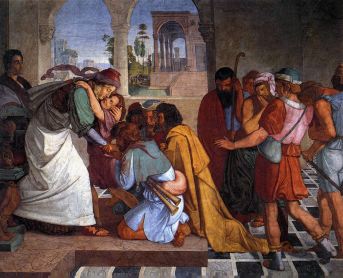
 28 Now Jacob sent Judah ahead of him to Joseph to get directions to Goshen. When they arrived in the region of Goshen, 29 Joseph had his chariot made ready and went to Goshen to meet his father Israel. As soon as Joseph appeared before him, he threw his arms around his father[h] and wept for a long time.
Joseph, the great and soft of heart.
 30 Israel said to Joseph, “Now I am ready to die, since I have seen for myself that you are still alive.”
 31 Then Joseph said to his brothers and to his father’s household, “I will go up and speak to Pharaoh and will say to him, ‘My brothers and my father’s household, who were living in the land of Canaan, have come to me. 32 The men are shepherds; they tend livestock, and they have brought along their flocks and herds and everything they own.’ 33 When Pharaoh calls you in and asks, ‘What is your occupation?’ 34 you should answer, ‘Your servants have tended livestock from our boyhood on, just as our fathers did.’ Then you will be allowed to settle in the region of Goshen, for all shepherds are detestable to the Egyptians.”
Joseph uses his God-given administrative skills to ensure that his family settles safely in Egypt. He decides that Goshen would be the best location for them (thus preventing them assimilating into Egyptian society) and through skilful preparation and diplomacy, he ensures that Pharaoh confirms this choice of territory.

Filed Under: Genesis

Joseph forgives. Reconciliation. Gen 45 and 46. Blog Through the Bible Project

By Anita Mathias

Genesis 45

Joseph Makes Himself Known
 1 Then Joseph could no longer control himself before all his attendants, and he cried out, “Have everyone leave my presence!” So there was no one with Joseph when he made himself known to his brothers. 2 And he wept so loudly that the Egyptians heard him, and Pharaoh’s household heard about it.
 3 Joseph said to his brothers, “I am Joseph! Is my father still living?” But his brothers were not able to answer him, because they were terrified at his presence.
Joseph is a wonderful person–affectionate, caring and loving. He wears his heart on his sleeve, and it is a warm, loving, heart.
 4 Then Joseph said to his brothers, “Come close to me.” When they had done so, he said, “I am your brother Joseph, the one you sold into Egypt! 5 And now, do not be distressed and do not be angry with yourselves for selling me here,
Inexplicable kindness. God has changed his heart in his years of suffering, and his years of exaltation.
because it was to save lives that God sent me ahead of you. 6 For two years now there has been famine in the land, and for the next five years there will be no plowing and reaping. 7 But God sent me ahead of you to preserve for you a remnant on earth and to save your lives by a great deliverance.
Forgiveness is somewhat easier when you can see how God has worked out all things for good.

8 “So then, it was not you who sent me here, but God.
NIV notes–God had a purpose to work through the brother’s jealous and cruel act.
” He made me father to Pharaoh, lord of his entire household and ruler of all Egypt. 9 Now hurry back to my father and say to him, ‘This is what your son Joseph says: God has made me lord of all Egypt. Come down to me; don’t delay. 10 You shall live in the region of Goshen and be near me—you, your children and grandchildren, your flocks and herds, and all you have. 11 I will provide for you there, because five years of famine are still to come. Otherwise you and your household and all who belong to you will become destitute.’
 12 “You can see for yourselves, and so can my brother Benjamin, that it is really I who am speaking to you. 13 Tell my father about all the honor accorded me in Egypt and about everything you have seen. And bring my father down here quickly.”
The love between father and son is mutual.
 14 Then he threw his arms around his brother Benjamin and wept, and Benjamin embraced him, weeping. 15 And he kissed all his brothers and wept over them. Afterward his brothers talked with him.
In the previous chapter, the brothers have acknowledged their guilt regarding Joseph, and have expressed concern for their father and younger brother. This enables the reconciliation between them and Joseph.
Joseph’s forgiveness still has something of the miraculous about it–and was only possible because God had changed his heart.
 16 When the news reached Pharaoh’s palace that Joseph’s brothers had come, Pharaoh and all his officials were pleased. 17 Pharaoh said to Joseph, “Tell your brothers, ‘Do this: Load your animals and return to the land of Canaan, 18 and bring your father and your families back to me. I will give you the best of the land of Egypt and you can enjoy the fat of the land.’
 19 “You are also directed to tell them, ‘Do this: Take some carts from Egypt for your children and your wives, and get your father and come. 20 Never mind about your belongings, because the best of all Egypt will be yours.’”
 21 So the sons of Israel did this. Joseph gave them carts, as Pharaoh had commanded, and he also gave them provisions for their journey. 22 To each of them he gave new clothing, but to Benjamin he gave three hundred shekelsb]”>[b] of silver and five sets of clothes. 
Joseph had been sold into slavery for twenty shekhels of silver.
23 And this is what he sent to his father: ten donkeys loaded with the best things of Egypt, and ten female donkeys loaded with grain and bread and other provisions for his journey. 24 Then he sent his brothers away, and as they were leaving he said to them, “Don’t quarrel on the way!”
How well he knew them! He wanted them to avoid mutual accusation and recrimination about the past.
 25 So they went up out of Egypt and came to their father Jacob in the land of Canaan. 26 They told him, “Joseph is still alive! In fact, he is ruler of all Egypt.” Jacob was stunned; he did not believe them. 27 But when they told him everything Joseph had said to them, and when he saw the carts Joseph had sent to carry him back, the spirit of their father Jacob revived. 28 And Israel said, “I’m convinced! My son Joseph is still alive. I will go and see him before I die.”
Miracles do happen

Genesis 46

Jacob Goes to Egypt
 1 So Israel set out with all that was his, and when he reached Beersheba, he offered sacrifices to the God of his father Isaac.
 2 And God spoke to Israel in a vision at night and said, “Jacob! Jacob!”
   “Here I am,” he replied.
 3 “I am God, the God of your father,” he said. “Do not be afraid to go down to Egypt, for I will make you into a great nation there. 4 I will go down to Egypt with you, and I will surely bring you back again. And Joseph’s own hand will close your eyes.”
The Lord speaks to Jacob with his trademark greeting, “Do not be afraid.”
His ability to hear God’s voice–even in the middle of his own sin and scheming–was one of Jacob’s greatest gifts–and this he retains through life.
And God’s kindness to Jacob remains throughout his long life.  
At Beersheba, where Abraham and Isaac had also worshiped the Lord, the Lord reiterates his covenant promises.
God would be with Jacob when he went south to Egypt, as he was with him when he went north to Haran.

 5 Then Jacob left Beersheba, and Israel’s sons took their father Jacob and their children and their wives in the carts that Pharaoh had sent to transport him. 6 So Jacob and all his offspring went to Egypt, taking with them their livestock and the possessions they had acquired in Canaan. 7 Jacob brought with him to Egypt his sons and grandsons and his daughters and granddaughters—all his offspring.
 8 These are the names of the sons of Israel (Jacob and his descendants) who went to Egypt:
   Reuben the firstborn of Jacob.
 9 The sons of Reuben:
   Hanok, Pallu, Hezron and Karmi.
 10 The sons of Simeon:
   Jemuel, Jamin, Ohad, Jakin, Zohar and Shaul the son of a Canaanite woman.
 11 The sons of Levi:
   Gershon, Kohath and Merari.
 12 The sons of Judah:
   Er, Onan, Shelah, Perez and Zerah (but Er and Onan had died in the land of Canaan).
   The sons of Perez:
   Hezron and Hamul.
 13 The sons of Issachar:
   Tola, Puah,a]”>[a] Jashubb]”>[b] and Shimron.
 14 The sons of Zebulun:
   Sered, Elon and Jahleel.
 15 These were the sons Leah bore to Jacob in Paddan Aram,c]”>[c] besides his daughter Dinah. These sons and daughters of his were thirty-three in all.
 16 The sons of Gad:
   Zephon,d]”>[d] Haggi, Shuni, Ezbon, Eri, Arodi and Areli.
 17 The sons of Asher:
   Imnah, Ishvah, Ishvi and Beriah.
   Their sister was Serah.
   The sons of Beriah:
   Heber and Malkiel.
 18 These were the children born to Jacob by Zilpah, whom Laban had given to his daughter Leah—sixteen in all.
 19 The sons of Jacob’s wife Rachel:
   Joseph and Benjamin. 20 In Egypt, Manasseh and Ephraim were born to Joseph by Asenath daughter of Potiphera, priest of On.e]”>[e]
 21 The sons of Benjamin:
   Bela, Beker, Ashbel, Gera, Naaman, Ehi, Rosh, Muppim, Huppim and Ard.
 22 These were the sons of Rachel who were born to Jacob—fourteen in all.
 23 The son of Dan:
   Hushim.
 24 The sons of Naphtali:
   Jahziel, Guni, Jezer and Shillem.
 25 These were the sons born to Jacob by Bilhah, whom Laban had given to his daughter Rachel—seven in all.
 26 All those who went to Egypt with Jacob—those who were his direct descendants, not counting his sons’ wives—numbered sixty-six persons. 27 With the two sonsf]”>[f] who had been born to Joseph in Egypt, the members of Jacob’s family, which went to Egypt, were seventyg]”>[g] in all.
 28 Now Jacob sent Judah ahead of him to Joseph to get directions to Goshen. When they arrived in the region of Goshen, 29 Joseph had his chariot made ready and went to Goshen to meet his father Israel. As soon as Joseph appeared before him, he threw his arms around his fatherh]”>[h] and wept for a long time.
Joseph, the great and soft of heart.
 30 Israel said to Joseph, “Now I am ready to die, since I have seen for myself that you are still alive.”
 31 Then Joseph said to his brothers and to his father’s household, “I will go up and speak to Pharaoh and will say to him, ‘My brothers and my father’s household, who were living in the land of Canaan, have come to me. 32 The men are shepherds; they tend livestock, and they have brought along their flocks and herds and everything they own.’ 33 When Pharaoh calls you in and asks, ‘What is your occupation?’ 34 you should answer, ‘Your servants have tended livestock from our boyhood on, just as our fathers did.’ Then you will be allowed to settle in the region of Goshen, for all shepherds are detestable to the Egyptians.”
Joseph uses his God-given administrative skills to ensure that his family settles safely in Egypt. He decides that Goshen would be the best location for them (thus preventing them assimilating into Egyptian society) and through skilful preparation and diplomacy, he ensures that Pharaoh confirms this choice of territory.

Click button to share on Facebook, Twitter, Digg, Delicious, Reddit … Wikio

Filed Under: Genesis

Jacob is reunited with Joseph, Genesis 46

By Anita Mathias

Genesis 46

Jacob Goes to Egypt

 1 So Israel set out with all that was his, and when he reached Beersheba, he offered sacrifices to the God of his father Isaac.

 2 And God spoke to Israel in a vision at night and said, “Jacob! Jacob!”
   “Here I am,” he replied.
 3 “I am God, the God of your father,” he said. “Do not be afraid to go down to Egypt, for I will make you into a great nation there. 4 I will go down to Egypt with you, and I will surely bring you back again. And Joseph’s own hand will close your eyes.”
The Lord speaks to Jacob with his trademark greeting, “Do not be afraid.”
His ability to hear God’s voice–even in the middle of his own sin and scheming–was one of Jacob’s greatest gifts–and this he retains through life.
And God’s kindness to Jacob remains throughout his long life.  

At Beersheba, where Abraham and Isaac had also worshiped the Lord, the Lord reiterates his covenant promises.
God would be with Jacob when he went south to Egypt, as he was with him when he went north to Haran.

 5 Then Jacob left Beersheba, and Israel’s sons took their father Jacob and their children and their wives in the carts that Pharaoh had sent to transport him. 6 So Jacob and all his offspring went to Egypt, taking with them their livestock and the possessions they had acquired in Canaan. 7 Jacob brought with him to Egypt his sons and grandsons and his daughters and granddaughters—all his offspring.
 8 These are the names of the sons of Israel (Jacob and his descendants) who went to Egypt:
   Reuben the firstborn of Jacob.
 9 The sons of Reuben:
   Hanok, Pallu, Hezron and Karmi.
 10 The sons of Simeon:
   Jemuel, Jamin, Ohad, Jakin, Zohar and Shaul the son of a Canaanite woman.
 11 The sons of Levi:
   Gershon, Kohath and Merari.
 12 The sons of Judah:
   Er, Onan, Shelah, Perez and Zerah (but Er and Onan had died in the land of Canaan).
   The sons of Perez:
   Hezron and Hamul.
 13 The sons of Issachar:
   Tola, Puah,b]’>[b] and Shimron.
 14 The sons of Zebulun:
   Sered, Elon and Jahleel.
 15 These were the sons Leah bore to Jacob in Paddan Aram,d]’>[d] Haggi, Shuni, Ezbon, Eri, Arodi and Areli.
 17 The sons of Asher:
   Imnah, Ishvah, Ishvi and Beriah.
   Their sister was Serah.
   The sons of Beriah:
   Heber and Malkiel.
 18 These were the children born to Jacob by Zilpah, whom Laban had given to his daughter Leah—sixteen in all.
 19 The sons of Jacob’s wife Rachel:
   Joseph and Benjamin. 20 In Egypt, Manasseh and Ephraim were born to Joseph by Asenath daughter of Potiphera, priest of On.f]’>[f] who had been born to Joseph in Egypt, the members of Jacob’s family, which went to Egypt, were seventyh]’>[h] and wept for a long time.
Joseph, the great and soft of heart.
 30 Israel said to Joseph, “Now I am ready to die, since I have seen for myself that you are still alive.”
 31 Then Joseph said to his brothers and to his father’s household, “I will go up and speak to Pharaoh and will say to him, ‘My brothers and my father’s household, who were living in the land of Canaan, have come to me. 32 The men are shepherds; they tend livestock, and they have brought along their flocks and herds and everything they own.’ 33 When Pharaoh calls you in and asks, ‘What is your occupation?’ 34 you should answer, ‘Your servants have tended livestock from our boyhood on, just as our fathers did.’ Then you will be allowed to settle in the region of Goshen, for all shepherds are detestable to the Egyptians.”
Joseph uses his God-given administrative skills to ensure that his family settles safely in Egypt. He decides that Goshen would be the best location for them (thus preventing them assimilating into Egyptian society) and through skilful preparation and diplomacy, he ensures that Pharaoh confirms this choice of territory.

Filed Under: Genesis

Joseph’s Miraculous Forgiveness of his Brothers, Genesis 45

By Anita Mathias

Genesis 45

Joseph Makes Himself Known

 1 Then Joseph could no longer control himself before all his attendants, and he cried out, “Have everyone leave my presence!” So there was no one with Joseph when he made himself known to his brothers. 2 And he wept so loudly that the Egyptians heard him, and Pharaoh’s household heard about it.

 3 Joseph said to his brothers, “I am Joseph! Is my father still living?” But his brothers were not able to answer him, because they were terrified at his presence.
Joseph is a wonderful person–affectionate, caring and loving. He wears his heart on his sleeve, and it is a warm, loving, heart.
 4 Then Joseph said to his brothers, “Come close to me.” When they had done so, he said, “I am your brother Joseph, the one you sold into Egypt! 5 And now, do not be distressed and do not be angry with yourselves for selling me here,
Inexplicable kindness. God has changed his heart in his years of suffering, and his years of exaltation.
because it was to save lives that God sent me ahead of you. 6 For two years now there has been famine in the land, and for the next five years there will be no plowing and reaping. 7 But God sent me ahead of you to preserve for you a remnant on earth and to save your lives by a great deliverance.
Forgiveness is somewhat easier when you can see how God has worked out all things for good.

8 “So then, it was not you who sent me here, but God.
NIV notes–God had a purpose to work through the brother’s jealous and cruel act.
” He made me father to Pharaoh, lord of his entire household and ruler of all Egypt. 9 Now hurry back to my father and say to him, ‘This is what your son Joseph says: God has made me lord of all Egypt. Come down to me; don’t delay. 10 You shall live in the region of Goshen and be near me—you, your children and grandchildren, your flocks and herds, and all you have. 11 I will provide for you there, because five years of famine are still to come. Otherwise you and your household and all who belong to you will become destitute.’
 12 “You can see for yourselves, and so can my brother Benjamin, that it is really I who am speaking to you. 13 Tell my father about all the honor accorded me in Egypt and about everything you have seen. And bring my father down here quickly.”
The love between father and son is mutual.
 14 Then he threw his arms around his brother Benjamin and wept, and Benjamin embraced him, weeping. 15 And he kissed all his brothers and wept over them. Afterward his brothers talked with him.
In the previous chapter, the brothers have acknowledged their guilt regarding Joseph, and have expressed concern for their father and younger brother. This enables the reconciliation between them and Joseph.
Joseph’s forgiveness still has something of the miraculous about it–and was only possible because God had changed his heart.
 16 When the news reached Pharaoh’s palace that Joseph’s brothers had come, Pharaoh and all his officials were pleased. 17 Pharaoh said to Joseph, “Tell your brothers, ‘Do this: Load your animals and return to the land of Canaan, 18 and bring your father and your families back to me. I will give you the best of the land of Egypt and you can enjoy the fat of the land.’
 19 “You are also directed to tell them, ‘Do this: Take some carts from Egypt for your children and your wives, and get your father and come. 20 Never mind about your belongings, because the best of all Egypt will be yours.’”
 21 So the sons of Israel did this. Joseph gave them carts, as Pharaoh had commanded, and he also gave them provisions for their journey. 22 To each of them he gave new clothing, but to Benjamin he gave three hundred shekels[b] of silver and five sets of clothes. 
Joseph had been sold into slavery for twenty shekhels of silver.
23 And this is what he sent to his father: ten donkeys loaded with the best things of Egypt, and ten female donkeys loaded with grain and bread and other provisions for his journey. 24 Then he sent his brothers away, and as they were leaving he said to them, “Don’t quarrel on the way!”
How well he knew them! He wanted them to avoid mutual accusation and recrimination about the past.
 25 So they went up out of Egypt and came to their father Jacob in the land of Canaan. 26 They told him, “Joseph is still alive! In fact, he is ruler of all Egypt.” Jacob was stunned; he did not believe them. 27 But when they told him everything Joseph had said to them, and when he saw the carts Joseph had sent to carry him back, the spirit of their father Jacob revived. 28 And Israel said, “I’m convinced! My son Joseph is still alive. I will go and see him before I die.”
Miracles do happen

Filed Under: Genesis

  • « Previous Page
  • 1
  • …
  • 3
  • 4
  • 5
  • 6
  • 7
  • …
  • 10
  • Next Page »

Sign Up and Get a Free eBook!

Sign up to be emailed my blog posts (one a week) and get the ebook of "Holy Ground," my account of working with Mother Teresa.

Join 544 Other Readers

My Books

Rosaries, Reading, Secrets: A Catholic Childhood in India

Rosaries, Reading Secrets, B&N
USA

UK

Wandering Between Two Worlds: Essays on Faith and Art

Wandering Between Two Worlds
USA

UK

Francesco, Artist of Florence: The Man Who Gave Too Much

Francesco, Artist of Florence
US

UK

The Story of Dirk Willems

The Story of Dirk Willems
US

UK

My Latest Meditation

Anita Mathias: About Me

Anita Mathias

Read my blog on Facebook

Follow me on Twitter

Follow @anitamathias1

Recent Posts

  • God’s Complete Forgiveness 
  • Using God’s Gift of Our Talents: A Path to Joy and Abundance
  • The Kingdom of God is Here Already, Yet Not Yet Here
  • All Those Who Exalt Themselves Will Be Humbled & the Humble Will Be Exalted
  • Christ’s Great Golden Triad to Guide Our Actions and Decisions
  • How Jesus Dealt With Hostility and Enemies
  • Do Not Be Afraid, but Do Be Prudent
  • For Scoundrels, Scallywags, and Rascals—Christ Came
  • How to Lead an Extremely Significant Life
  • Don’t Walk Away From Jesus, but if You Do, He Still Looks at You and Loves You
Premier Digital Awards 2015 - Finalist - Blogger of the year
Runner Up Christian Media Awards 2014 - Tweeter of the year

Categories

What I’m Reading


Wolf Hall
Hilary Mantel

Wolf Hall --  Amazon.com
Amazon.com

Amazon.co.uk

Silence and Honey Cakes:
The Wisdom Of The Desert
Rowan Williams

Silence and Honey Cakes --  Amazon.com
Amazon.com

Amazon.co.uk

The Long Loneliness:
The Autobiography of the Legendary Catholic Social Activist
Dorothy Day

The Long Loneliness --  Amazon.com
Amazon.com

Amazon.co.uk

Country Girl
Edna O'Brien

Country Girl  - Amazon.com
Amazon.com

Amazon.co.uk

Archive by month

My Latest Five Podcast Meditations

INSTAGRAM

anita.mathias

My memoir: Rosaries, Reading, Secrets https://amzn.to/42xgL9t
Oxford, England. Writer, memoirist, podcaster, blogger, Biblical meditation teacher, mum

Well, hello friends! Breaking radio silence to let Well, hello friends! Breaking radio silence to let you know that I have taped a meditation for you on Christ’s famous Parable of the Talents in Matthew 25. https://anitamathias.com/2025/11/05/using-gods-gift-of-our-talents-a-path-to-joy-and-abundance/
Here you are, click the play button in the blog post for a brief meditation, and some moments of peace, and, perhaps, inspiration in your day 🙂
Hi Friends, I have taped a meditation; do listen a Hi Friends, I have taped a meditation; do listen at this link: https://anitamathias.com/2025/04/08/the-kingdom-of-god-is-here-already-yet-not-yet-here-2/
It’s on the Kingdom of God, of which Christ so often spoke, which is here already—a mysterious, shimmering internal palace in which, in lightning flashes, we experience peace and joy, and yet, of course, not yet fully here. We sense the rainbowed presence of Christ in the song which pulses through creation. Christ strolls into our rooms with his wisdom and guidance, and things change. Our prayers are answered; we are healed; our hearts are strangely warmed. Sometimes.
And yet, we also experience evil within & all around us. Our own sin which can shatter our peace and the trajectory of our lives. And the sins of the world—its greed, dishonesty and environmental destruction.
But in this broken world, we still experience the glory of creation; “coincidences” which accelerate once we start praying, and shalom which envelops us like sudden sunshine. The portals into this Kingdom include repentance, gratitude, meditative breathing, and absolute surrender.
The Kingdom of God is here already. We can experience its beauty, peace and joy today through the presence of the Holy Spirit. But yet, since, in the Apostle Paul’s words, we do not struggle only “against flesh and blood, but against the rulers, against the unseen powers of this dark world and against the spiritual forces of evil,” its fullness still lingers…
Our daughter Zoe was ordained into the Church of E Our daughter Zoe was ordained into the Church of England in June. I have been on a social media break… but … better late than never. Enjoy!
First picture has my sister, Shalini, who kindly flew in from the US. Our lovely cousins Anthony and Sarah flank Zoe in the next picture.
The Bishop of London, Sarah Mullaly, ordained Zoe. You can see her praying that Zoe will be filled with the Holy Spirit!!
And here’s a meditation I’ve recorded, which you might enjoy. The link is also in my profile
https://anitamathias.com/2024/11/07/all-those-who-exalt-themselves-will-be-humbled-the-humble-will-be-exalted/
I have taped a meditation on Jesus statement in Ma I have taped a meditation on Jesus statement in Matthew 23, “For those who exalt themselves will be humbled, and those who humble themselves will be exalted.”
Do listen here. https://anitamathias.com/2024/11/07/all-those-who-exalt-themselves-will-be-humbled-the-humble-will-be-exalted/
Link also in bio.
And so, Jesus states a law of life. Those who broadcast their amazingness will be humbled, since God dislikes—scorns that, as much as people do.  For to trumpet our success, wealth, brilliance, giftedness or popularity is to get distracted from our life’s purpose into worthless activity. Those who love power, who are sure they know best, and who must be the best, will eventually be humbled by God and life. For their focus has shifted from loving God, doing good work, and being a blessing to their family, friends, and the world towards impressing others, being enviable, perhaps famous. These things are houses built on sand, which will crumble when hammered by the waves of old age, infirmity or adversity. 
God resists the proud, Scripture tells us—those who crave the admiration and power which is His alone. So how do we resist pride? We slow down, so that we realise (and repent) when sheer pride sparks our allergies to people, our enmities, our determination to have our own way, or our grandiose ego-driven goals, and ambitions. Once we stop chasing limelight, a great quietness steals over our lives. We no longer need the drug of continual achievement, or to share images of glittering travel, parties, prizes or friends. We just enjoy them quietly. My life is for itself & not for a spectacle, Emerson wrote. And, as Jesus advises, we quit sharp-elbowing ourselves to sit with the shiniest people, but are content to hang out with ordinary people; and then, as Jesus said, we will inevitably, eventually, be summoned higher to the sparkling conversation we craved. 
One day, every knee will bow before the gentle lamb who was slain, now seated on the throne. We will all be silent before him. Let us live gently then, our eyes on Christ, continually asking for his power, his Spirit, and his direction, moving, dancing, in the direction that we sense him move.
Link to new podcast in Bio https://anitamathias.co Link to new podcast in Bio https://anitamathias.com/2024/02/20/how-jesus-dealt-with-hostility-and-enemies/
3 days before his death, Jesus rampages through the commercialised temple, overturning the tables of moneychangers. Who gave you the authority to do these things? his outraged adversaries ask. And Jesus shows us how to answer hostile questions. Slow down. Breathe. Quick arrow prayers!
Your enemies have no power over your life that your Father has not permitted them. Ask your Father for wisdom, remembering: Questions do not need to be answered. Are these questioners worthy of the treasures of your heart? Or would that be feeding pearls to hungry pigs, who might instead devour you?
Questions can contain pitfalls, traps, nooses. Jesus directly answered just three of the 183 questions he was asked, refusing to answer some; answering others with a good question.
But how do we get the inner calm and wisdom to recognise
and sidestep entrapping questions? Long before the day of
testing, practice slow, easy breathing, and tune in to the frequency of the Father. There’s no record of Jesus running, rushing, getting stressed, or lacking peace. He never spoke on his own, he told us, without checking in with the Father. So, no foolish, ill-judged statements. Breathing in the wisdom of the Father beside and within him, he, unintimidated, traps the trappers.
Wisdom begins with training ourselves to slow down and ask
the Father for guidance. Then our calm minds, made perceptive, will help us recognise danger and trick questions, even those coated in flattery, and sidestep them or refuse to answer.
We practice tuning in to heavenly wisdom by practising–asking God questions, and then listening for his answers about the best way to do simple things…organise a home or write. Then, we build upwards, asking for wisdom in more complex things.
Listening for the voice of God before we speak, and asking for a filling of the Spirit, which Jesus calls streams of living water within us, will give us wisdom to know what to say, which, frequently, is nothing at all. It will quieten us with the silence of God, which sings through the world, through sun and stars, sky and flowers.
Especially for @ samheckt Some very imperfect pi Especially for @ samheckt 
Some very imperfect pictures of my labradoodle Merry, and golden retriever Pippi.
And since, I’m on social media, if you are the meditating type, here’s a scriptural meditation on not being afraid, while being prudent. https://anitamathias.com/2024/01/03/do-not-be-afraid-but-do-be-prudent/
A new podcast. Link in bio https://anitamathias.c A new podcast. Link in bio
https://anitamathias.com/2024/01/03/do-not-be-afraid-but-do-be-prudent/
Do Not Be Afraid, but Do Be Prudent
“Do not be afraid,” a dream-angel tells Joseph, to marry Mary, who’s pregnant, though a virgin, for in our magical, God-invaded world, the Spirit has placed God in her. Call the baby Jesus, or The Lord saves, for he will drag people free from the chokehold of their sins.
And Joseph is not afraid. And the angel was right, for a star rose, signalling a new King of the Jews. Astrologers followed it, threatening King Herod, whose chief priests recounted Micah’s 600-year-old prophecy: the Messiah would be born in Bethlehem, as Jesus had just been, while his parents from Nazareth registered for Augustus Caesar’s census of the entire Roman world. 
The Magi worshipped the baby, offering gold. And shepherds came, told by an angel of joy: that the Messiah, a saviour from all that oppresses, had just been born.
Then, suddenly, the dream-angel warned: Flee with the child to Egypt. For Herod plans to kill this baby, forever-King.
Do not be afraid, but still flee? Become a refugee? But lightning-bolt coincidences verified the angel’s first words: The magi with gold for the flight. Shepherds
telling of angels singing of coming inner peace. Joseph flees.
What’s the difference between fear and prudence? Fear is being frozen or panicked by imaginary what-ifs. It tenses our bodies; strains health, sleep and relationships; makes us stingy with ourselves & others; leads to overwork, & time wasted doing pointless things for fear of people’s opinions.
Prudence is wisdom-using our experience & spiritual discernment as we battle the demonic forces of this dark world, in Paul’s phrase.It’s fighting with divinely powerful weapons: truth, righteousness, faith, Scripture & prayer, while surrendering our thoughts to Christ. 
So let’s act prudently, wisely & bravely, silencing fear, while remaining alert to God’s guidance, delivered through inner peace or intuitions of danger and wrongness, our spiritual senses tuned to the Spirit’s “No,” his “Slow,” his “Go,” as cautious as a serpent, protected, while being as gentle as a lamb among wolves.
Link to post with podcast link in Bio or https://a Link to post with podcast link in Bio or https://anitamathias.com/2023/09/22/dont-walk-away-from-jesus-but-if-you-do-he-still-looks-at-you-and-loves-you/
Jesus came from a Kingdom of voluntary gentleness, in which
Christ, the Lion of Judah, stands at the centre of the throne in the guise of a lamb, looking as if it had been slain. No wonder his disciples struggled with his counter-cultural values. Oh, and we too!
The mother of the Apostles James and John, asks Jesus for a favour—that once He became King, her sons got the most important, prestigious seats at court, on his right and left. And the other ten, who would have liked the fame, glory, power,limelight and honour themselves are indignant and threatened.
Oh-oh, Jesus says. Who gets five talents, who gets one,
who gets great wealth and success, who doesn’t–that the
Father controls. Don’t waste your one precious and fleeting
life seeking to lord it over others or boss them around.
But, in his wry kindness, he offers the ambitious twelve
and us something better than the second or third place.
He tells us how to actually be the most important person to
others at work, in our friend group, social circle, or church:Use your talents, gifts, and energy to bless others.
And we instinctively know Jesus is right. The greatest people in our lives are the kind people who invested in us, guided us and whose wise, radiant words are engraved on our hearts.
Wanting to sit with the cleverest, most successful, most famous people is the path of restlessness and discontent. The competition is vast. But seek to see people, to listen intently, to be kind, to empathise, and doors fling wide open for you, you rare thing!
The greatest person is the one who serves, Jesus says. Serves by using the one, two, or five talents God has given us to bless others, by finding a place where our deep gladness and the world’s deep hunger meet. By writing which is a blessing, hospitality, walking with a sad friend, tidying a house.
And that is the only greatness worth having. That you yourself,your life and your work are a blessing to others. That the love and wisdom God pours into you lives in people’s hearts and minds, a blessing
https://anitamathias.com/.../dont-walk-away-from-j https://anitamathias.com/.../dont-walk-away-from-jesus.../
Sharing this podcast I recorded last week. LINK IN BIO
So Jesus makes a beautiful offer to the earnest, moral young man who came to him, seeking a spiritual life. Remarkably, the young man claims that he has kept all the commandments from his youth, including the command to love one’s neighbour as oneself, a statement Jesus does not challenge.
The challenge Jesus does offers him, however, the man cannot accept—to sell his vast possessions, give the money to the poor, and follow Jesus encumbered.
He leaves, grieving, and Jesus looks at him, loves him, and famously observes that it’s easier for a camel to squeeze through the eye of a needle than for a rich person to live in the world of wonders which is living under Christ’s kingship, guidance and protection. 
He reassures his dismayed disciples, however, that with God even the treasure-burdened can squeeze into God’s kingdom, “for with God, all things are possible.”
Following him would quite literally mean walking into a world of daily wonders, and immensely rich conversation, walking through Israel, Lebanon, Syria, and Jordan, quite impossible to do with suitcases and backpacks laden with treasure. 
For what would we reject God’s specific, internally heard whisper or directive, a micro-call? That is the idol which currently grips and possesses us. 
Not all of us have great riches, nor is money everyone’s greatest temptation—it can be success, fame, universal esteem, you name it…
But, since with God all things are possible, even those who waver in their pursuit of God can still experience him in fits and snatches, find our spirits singing on a walk or during worship in church, or find our hearts strangely warmed by Scripture, and, sometimes, even “see” Christ stand before us. 
For Christ looks at us, Christ loves us, and says, “With God, all things are possible,” even we, the flawed, entering his beautiful Kingdom.
Follow on Instagram

© 2026 Dreaming Beneath the Spires · All Rights Reserved. · Cookie Policy · Privacy Policy