
 |
| Byzantine Art in the Church of Our Saviour at Chora
Sailing Back from Byzantium
Back home from a week in Istanbul (Byzantium/Constantinople).
The vanished Kingdom of Byzantium is best celebrated in Yeats’ beautiful poem, “Sailing to Byzantium.”
THAT is no country for old men. The young
In one another’s arms, birds in the trees
– Those dying generations – at their song,
The salmon-falls, the mackerel-crowded seas,
Fish, flesh, or fowl, commend all summer long
Whatever is begotten, born, and dies.
Caught in that sensual music all neglect
Monuments of unageing intellect.
An aged man is but a paltry thing,
A tattered coat upon a stick, unless
Soul clap its hands and sing, and louder sing
For every tatter in its mortal dress,
Nor is there singing school but studying
Monuments of its own magnificence;
And therefore I have sailed the seas and come
To the holy city of Byzantium.
O sages standing in God’s holy fire
As in the gold mosaic of a wall,
Come from the holy fire, perne in a gyre,
And be the singing-masters of my soul.
Consume my heart away; sick with desire
And fastened to a dying animal
It knows not what it is; and gather me
Into the artifice of eternity.
Once out of nature I shall never take
My bodily form from any natural thing,
But such a form as Grecian goldsmiths make
Of hammered gold and gold enamelling
To keep a drowsy Emperor awake;
Or set upon a golden bough to sing
To lords and ladies of Byzantium
Of what is past, or passing, or to come.
Byzantium of course no longer exists. It was destroyed by the Crusaders in 1204. One of them leaves an account of The Great Palace of the Byzantine Emperors,
“Within the Palace, there were fully 500 halls, all connected with one another, and all made with gold mosaic. And in it were fully 30 chapels, great and small, and one called the Holy Chapel, which was so rich and noble that there was not a hinge or band that was not all of silver, and there was no column that was not of jasper or porphyry or some other precious stone.”
By the time, the crusaders left the Palace it was virtually destroyed, and the old Byzantium is now best seen in Ravenna which we visited last year, the lovely mosaics constructed by craftsmen sent from Byzantium.
And now, I am so enjoying my regular life of reading and writing and reading Scripture and praying (and other things besides). It is a bit intense, and I felt the need of a break, and the best part of travel is that it makes the life you left behind seem doubly sweet on your return.
|
An Istanbul Must See — The Topkapi Palace, the Former Center of Ottoman of Power
A guest post by Roy Mathas
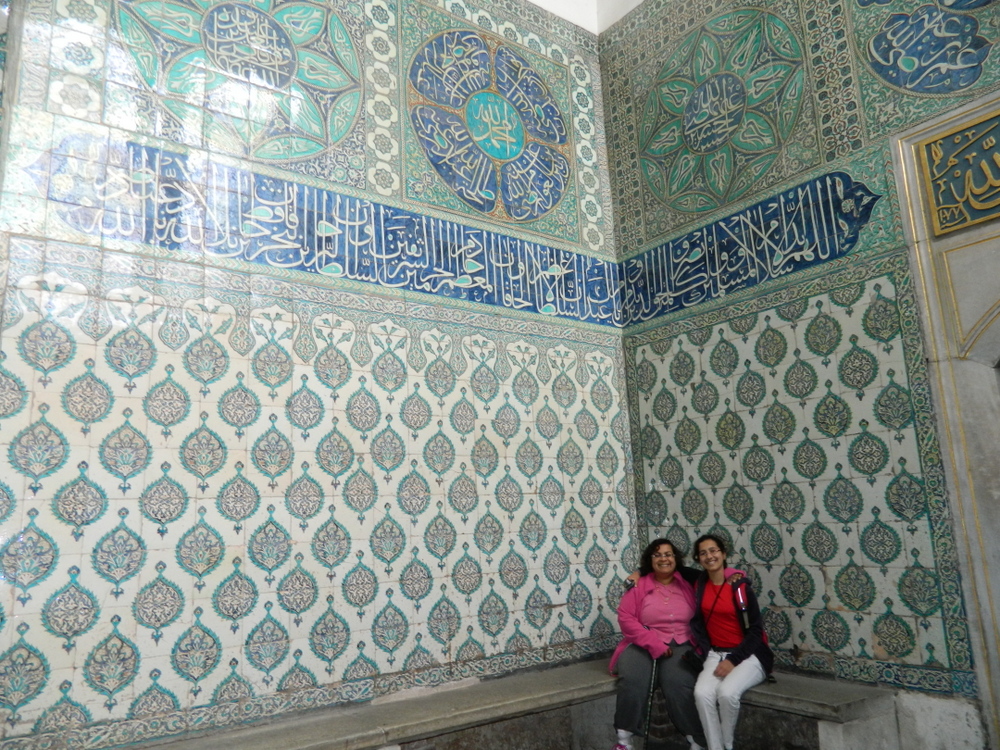
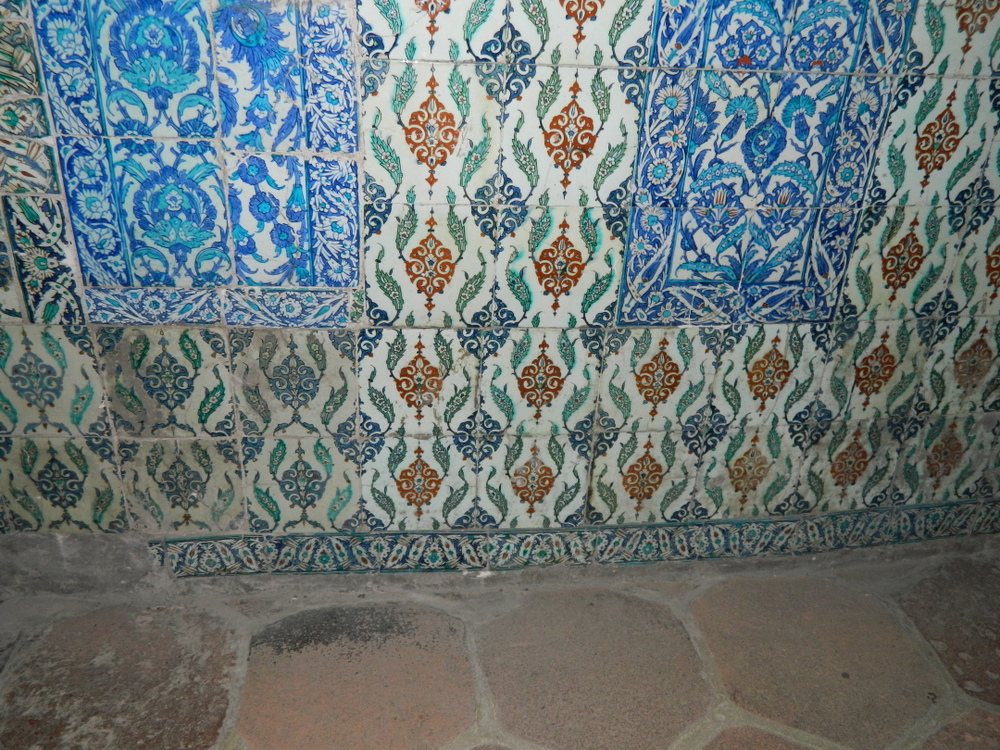
Topkapi Palace is an highlight in Istanbul. Luckily we went off season, so it was not too crowded. The former Ottoman palace is exquisitely decorated in tiles of varying hues of blue and green. I hope this post is not TMI (too many images). Any suggestions of easy ways, using GIMP or Picassa or Photoshop, to straighten pictures without losing resolution or remove glare from the flash would be appreciated.
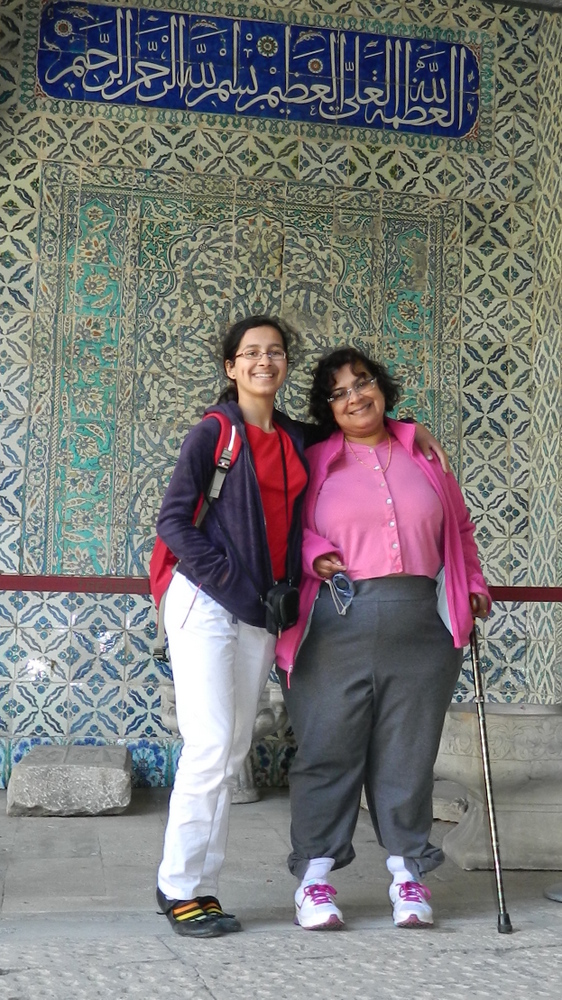 |
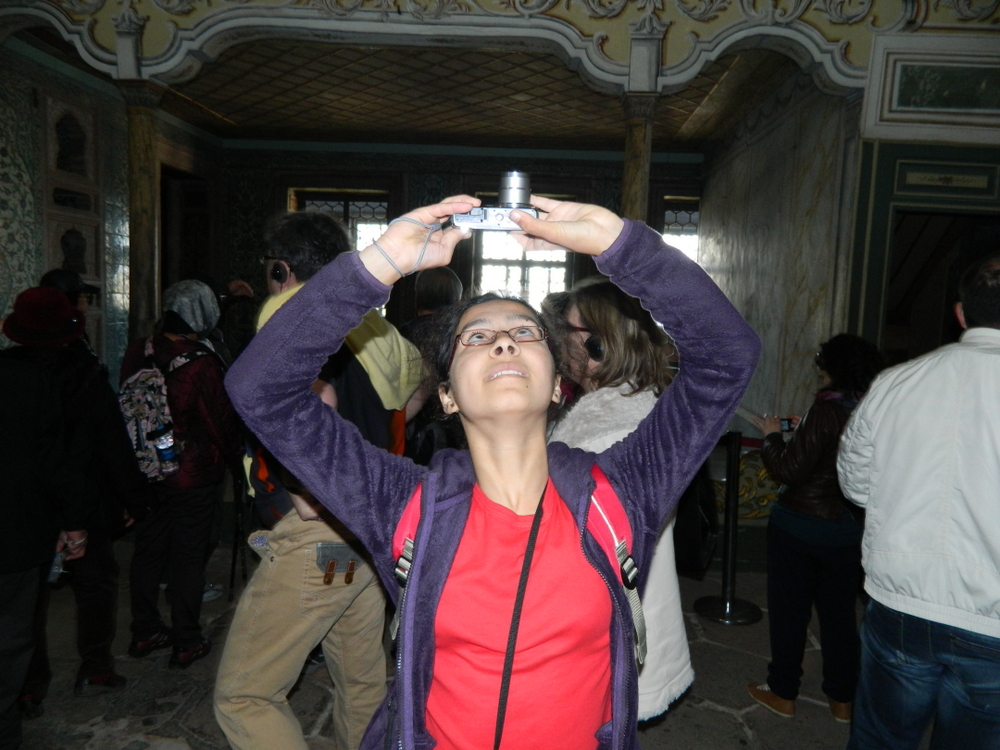
| Irene tiptoeing to be taller than her mother. |
The star attraction of Topkapi is the harem. Here is the first decorated room in the harem. Our response was “Wow, definitely worth the extra admission charge.” The self guided tour is organised so that each section is more impressive than the previous, so you are always saying “Why did we spend so log on the beginning” and never “Oh, just another room.”

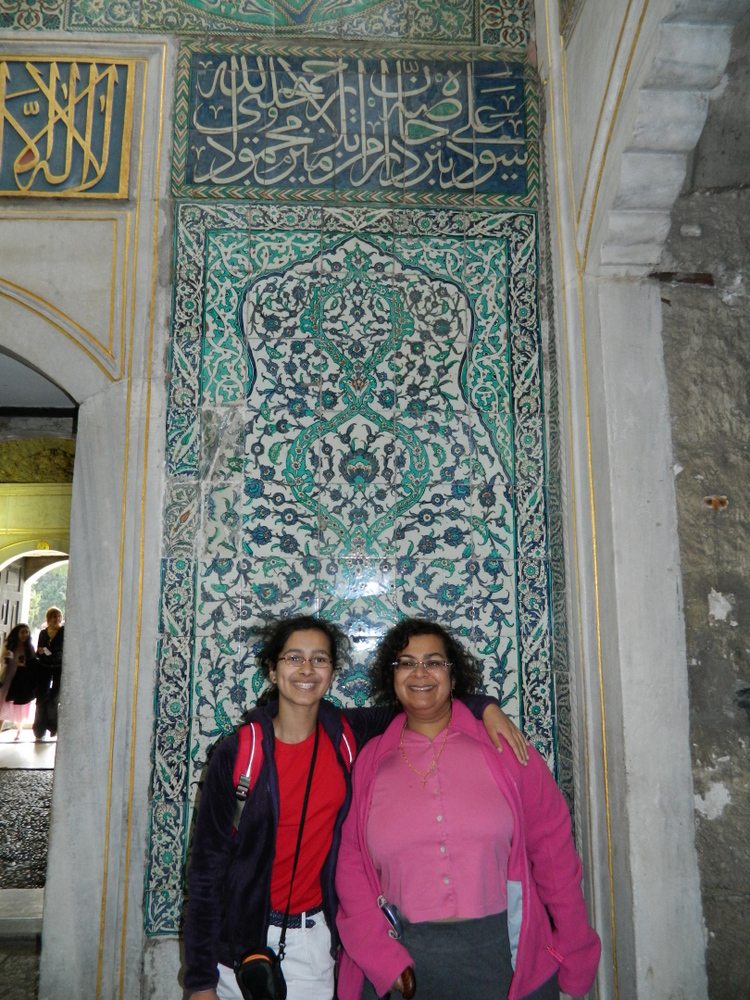
An exterior passageway

The palace was destroyed by two great fires, so perhaps it is OK to spoil a photo with a fire extinguisher.
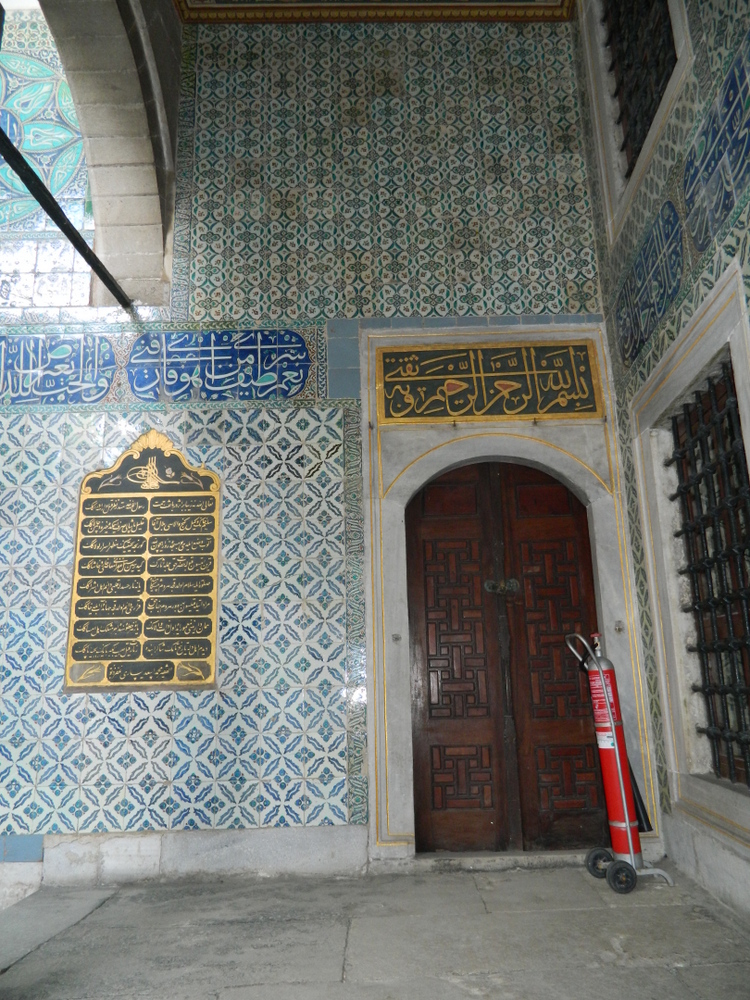
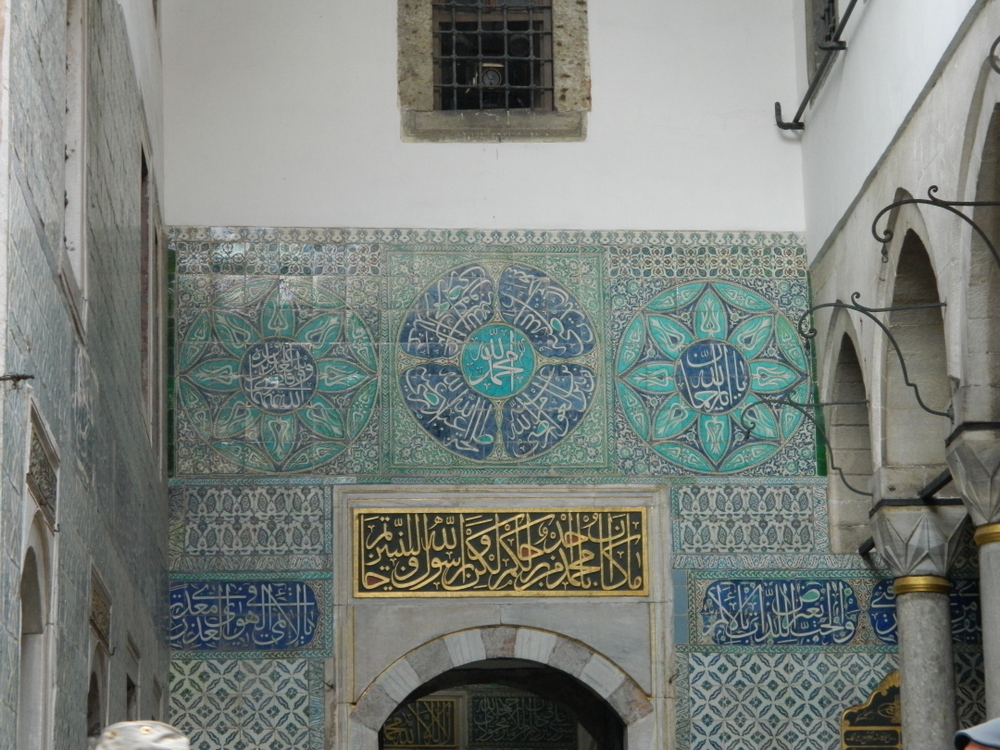
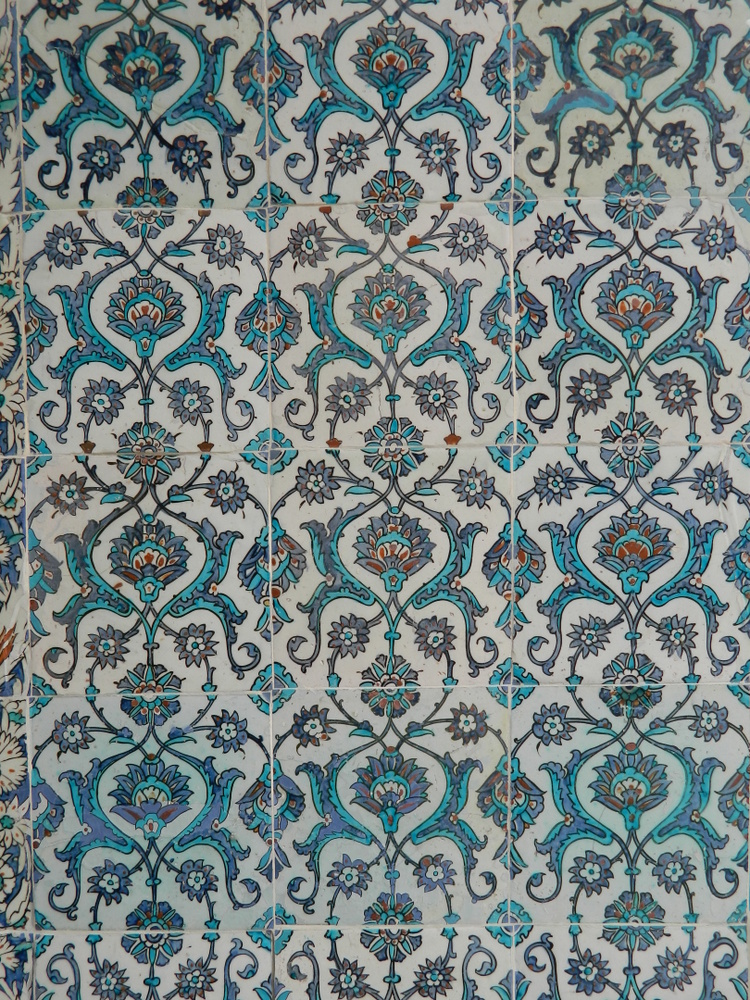
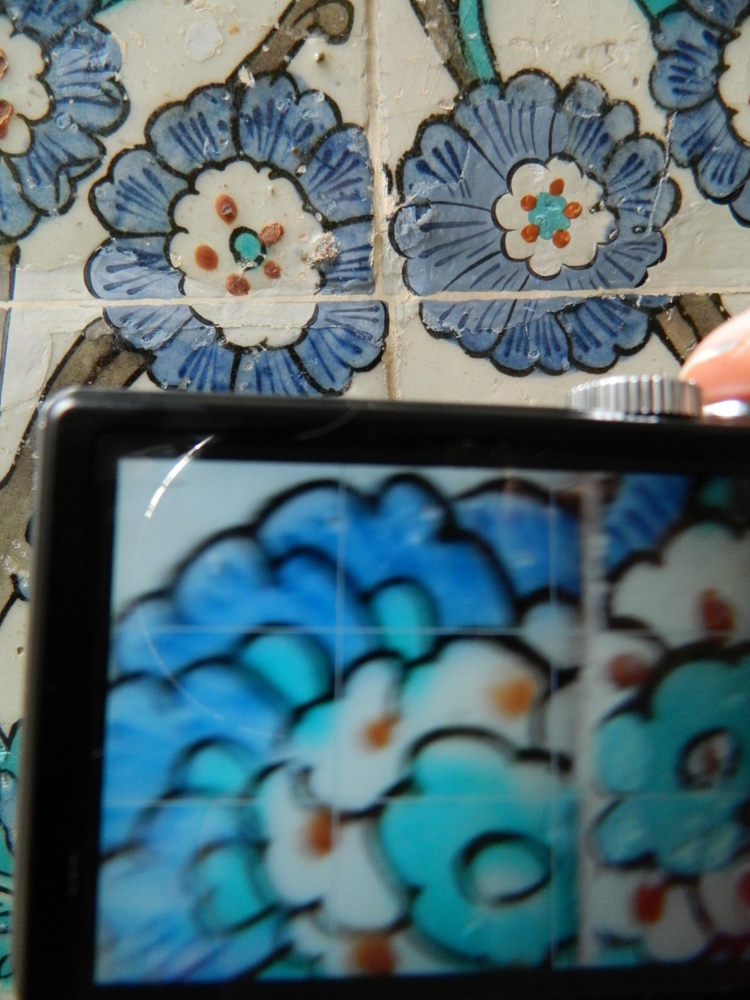
A single tile
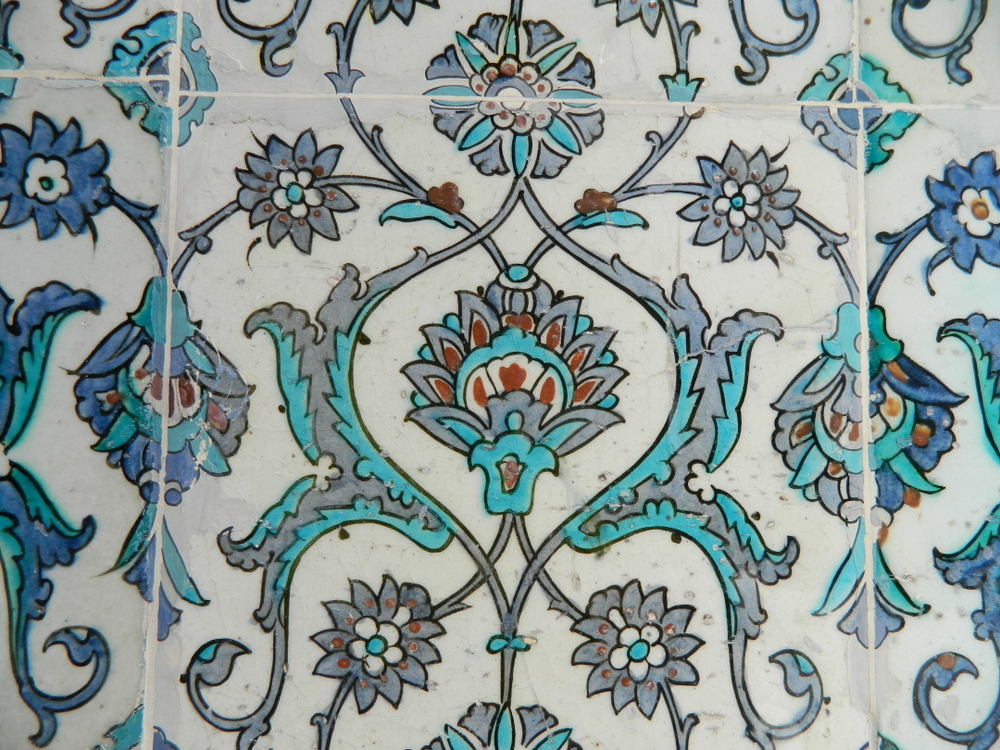

A single tile from the wall above.

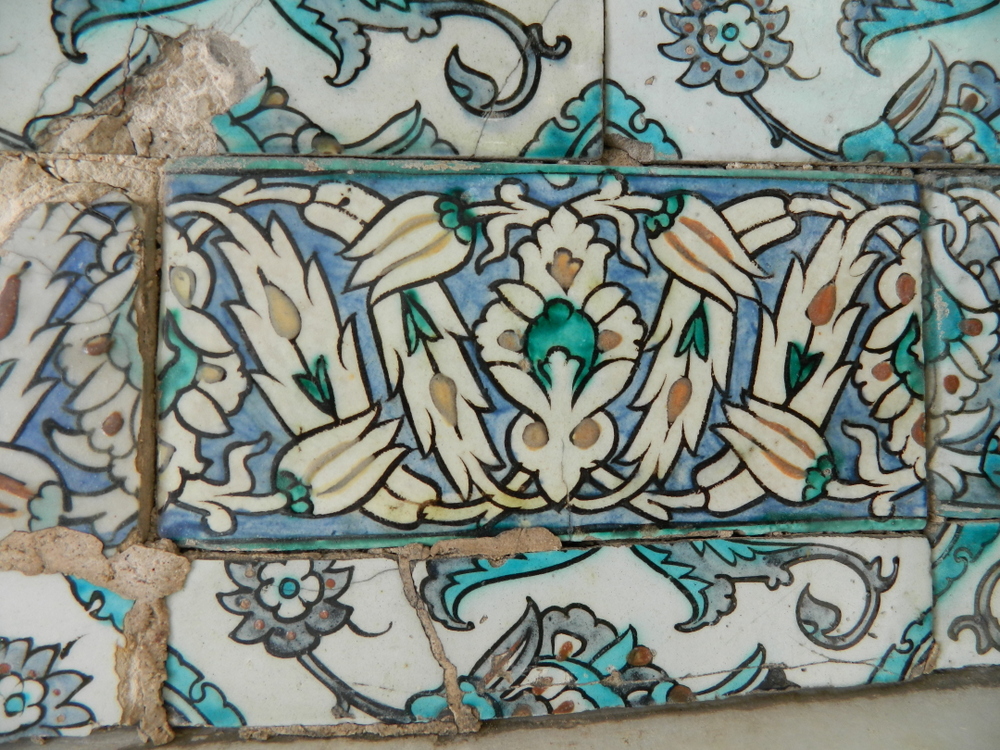
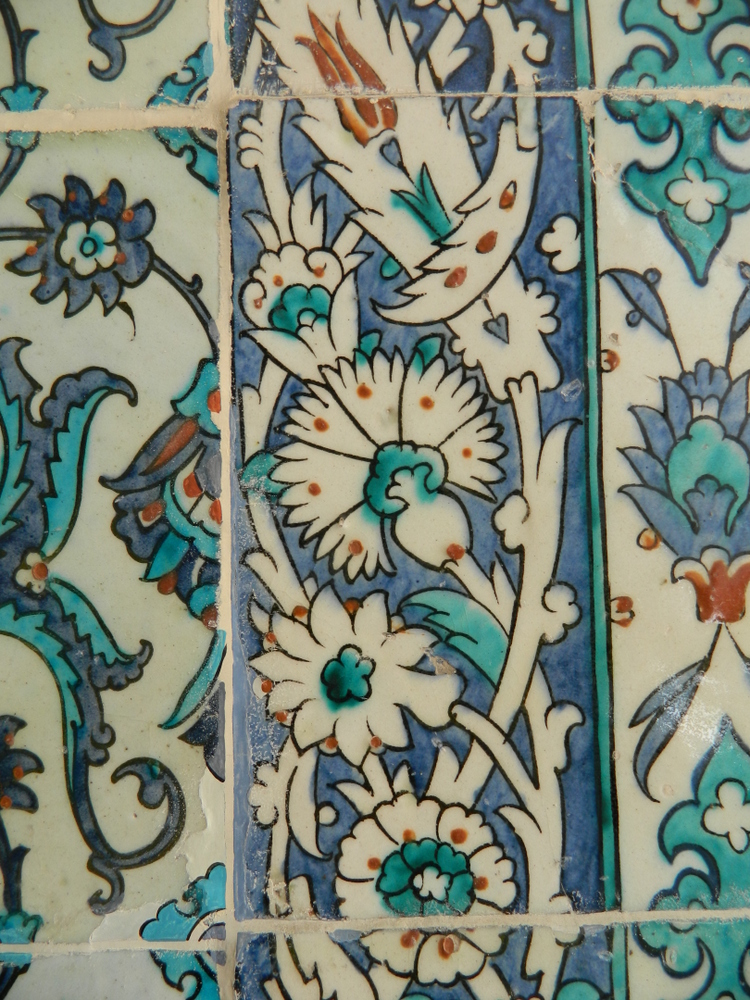
A couple of border tiles
A lovely geometric pattern on the wall

Closer sinspection reveals the details (for some reason it looks green from a ditance)
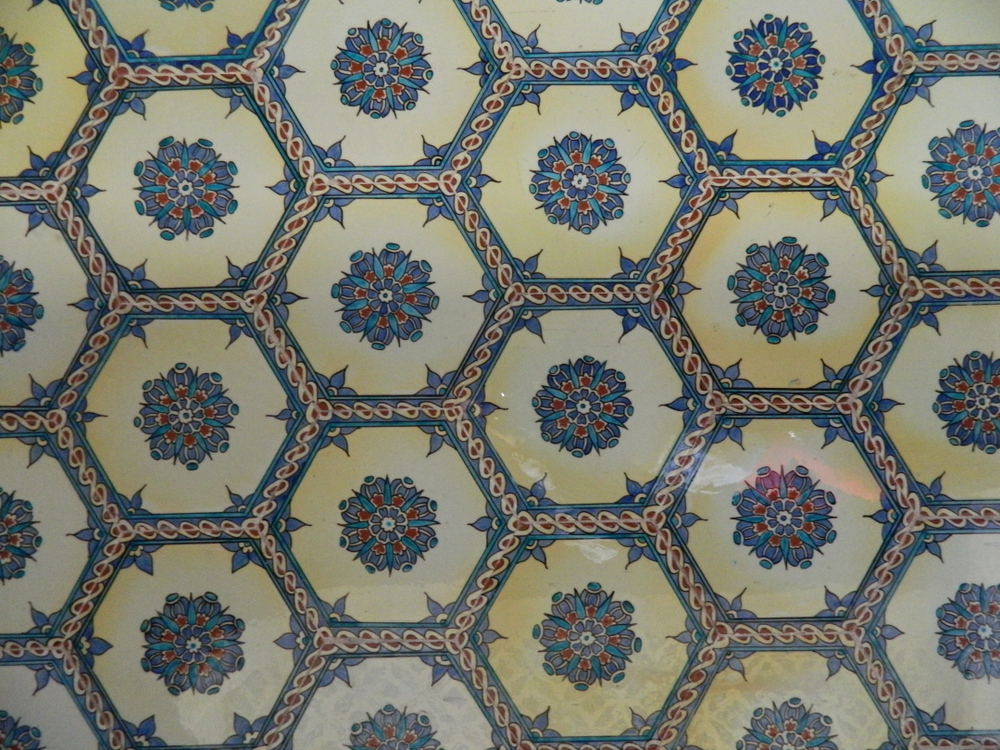
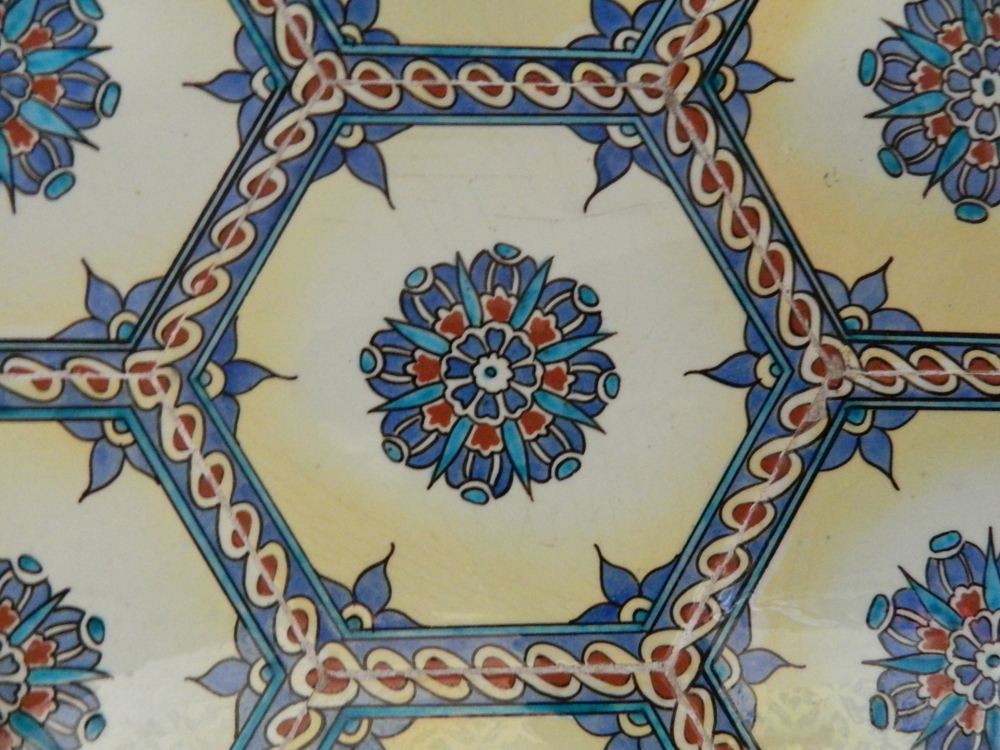
and here is a single hexagonal tile
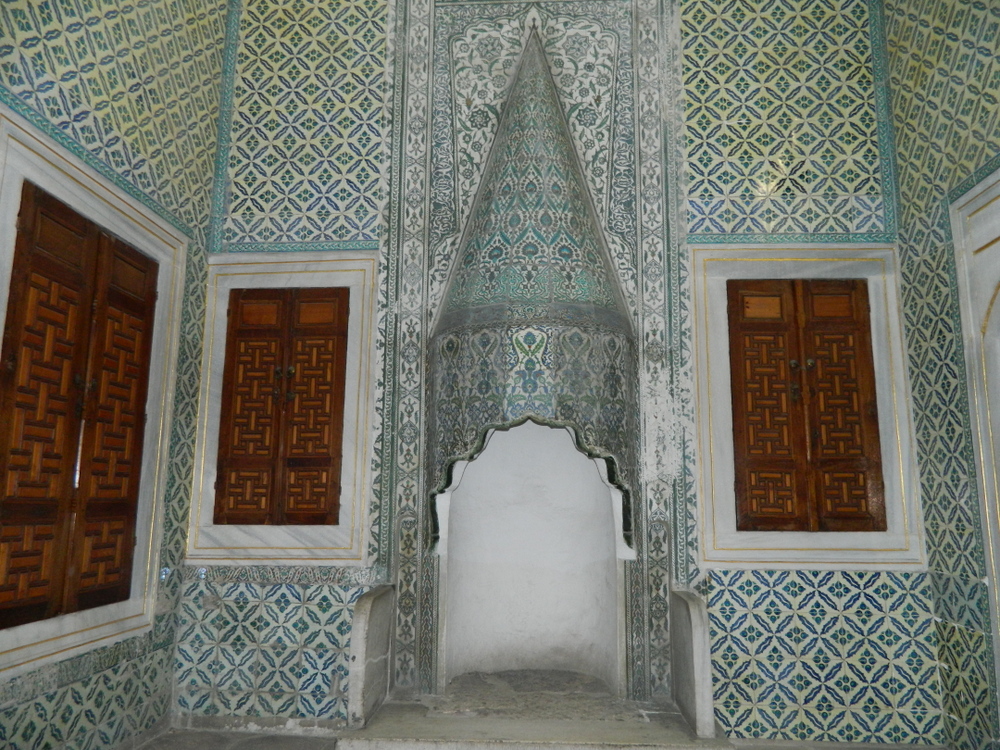
The Queen Mother’s apartment is the grandest living area in the women’s area. The room, tiles from floor to ceiling has a fireplace, and cupboards.
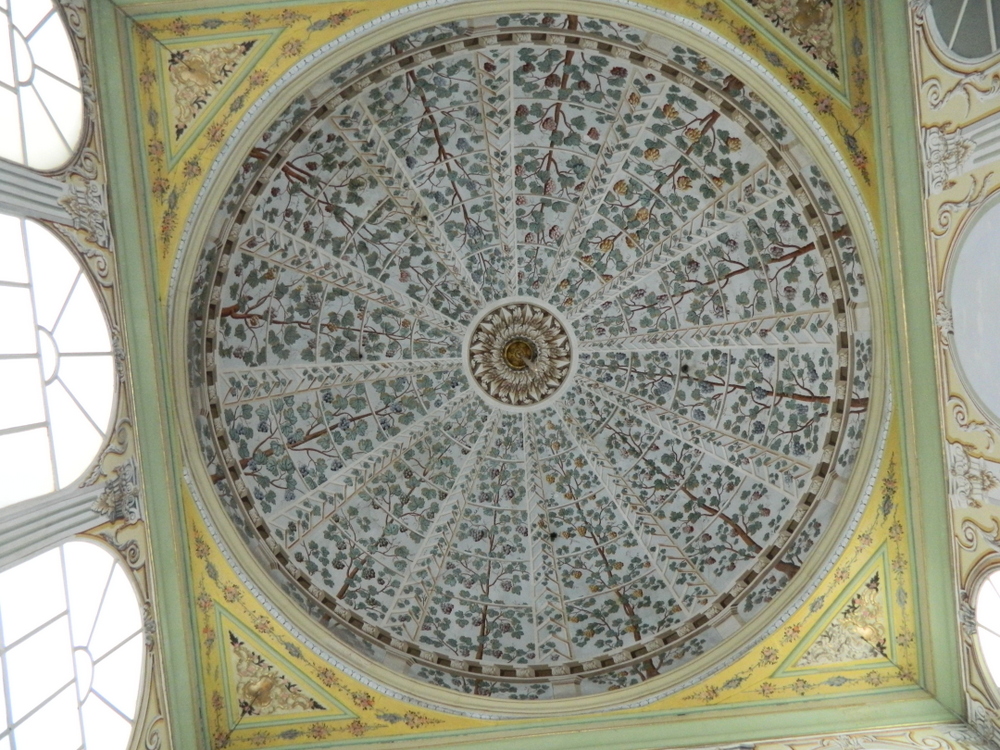
Here is the ceiling of another room in her apartement
and Irene photographing it
Inlaid mother-of-pear cabinet
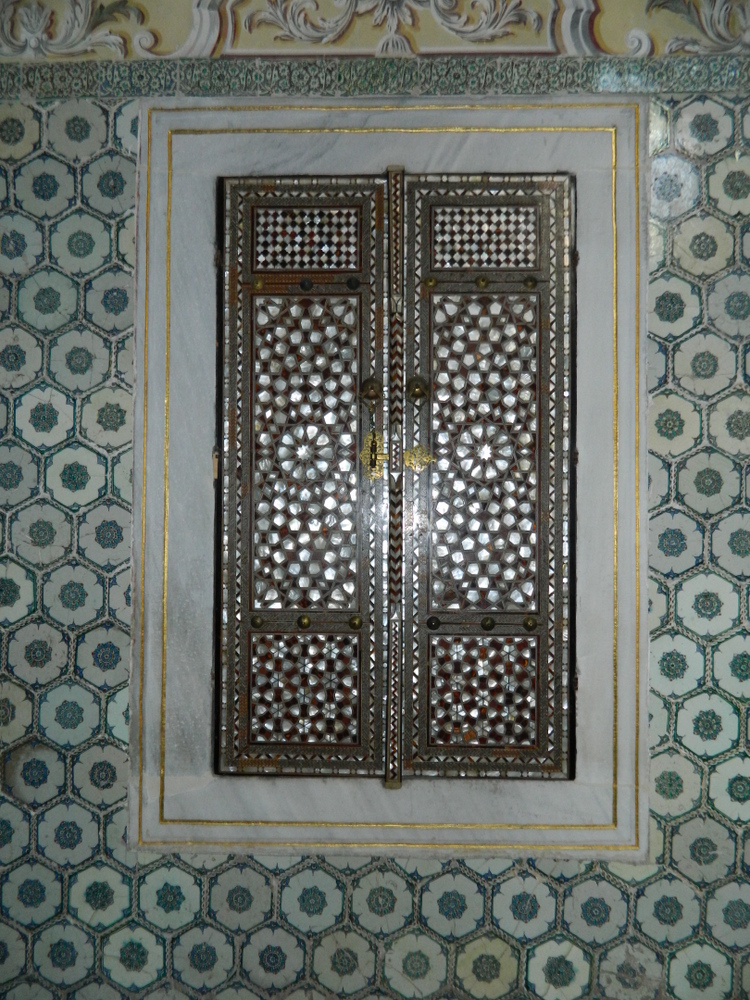
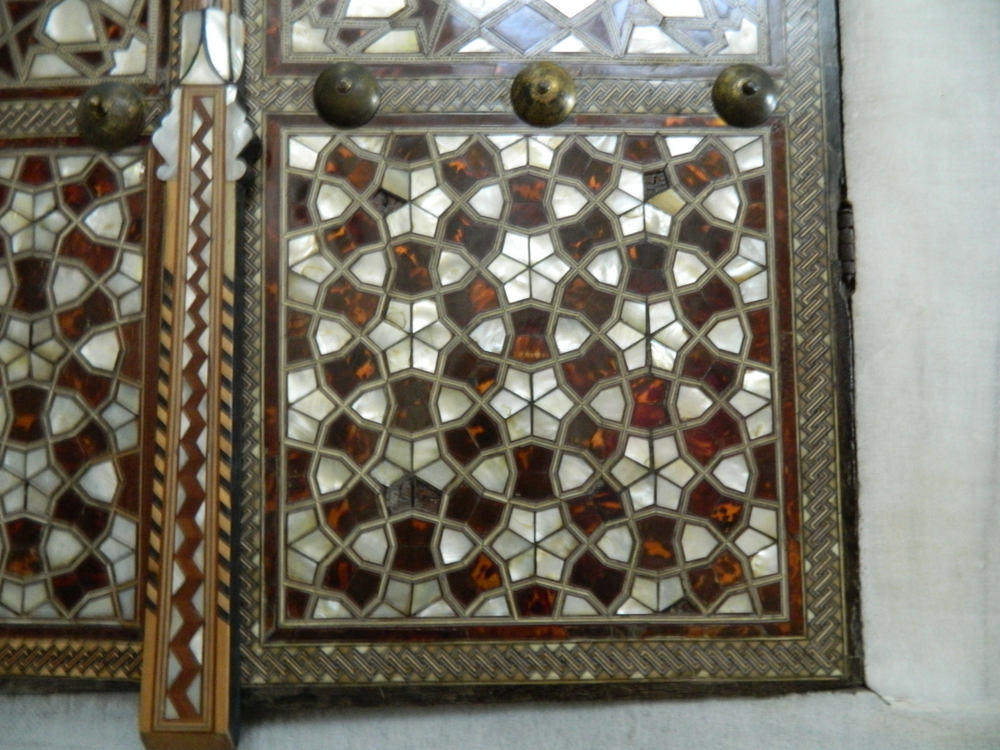 |
| detail |
A border
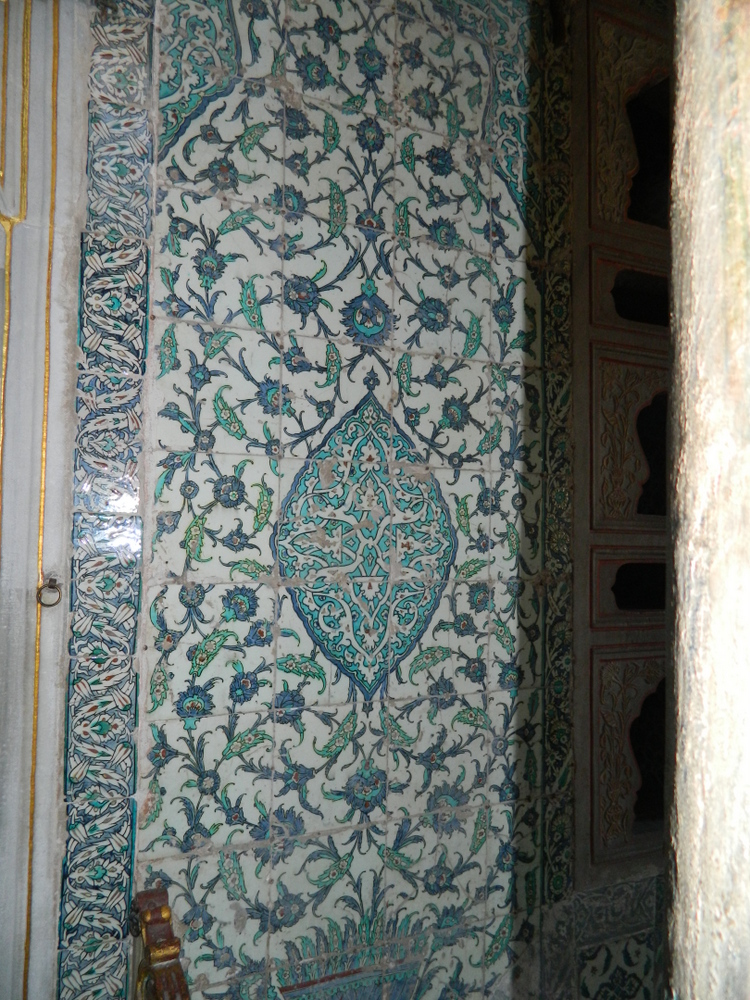
Harem comes from the Arabic (ḥaram) ‘something prohibited; sanctuary, women’. Most of the Harem is enclosed, wit few windows. We are outside again, in a courtyard.
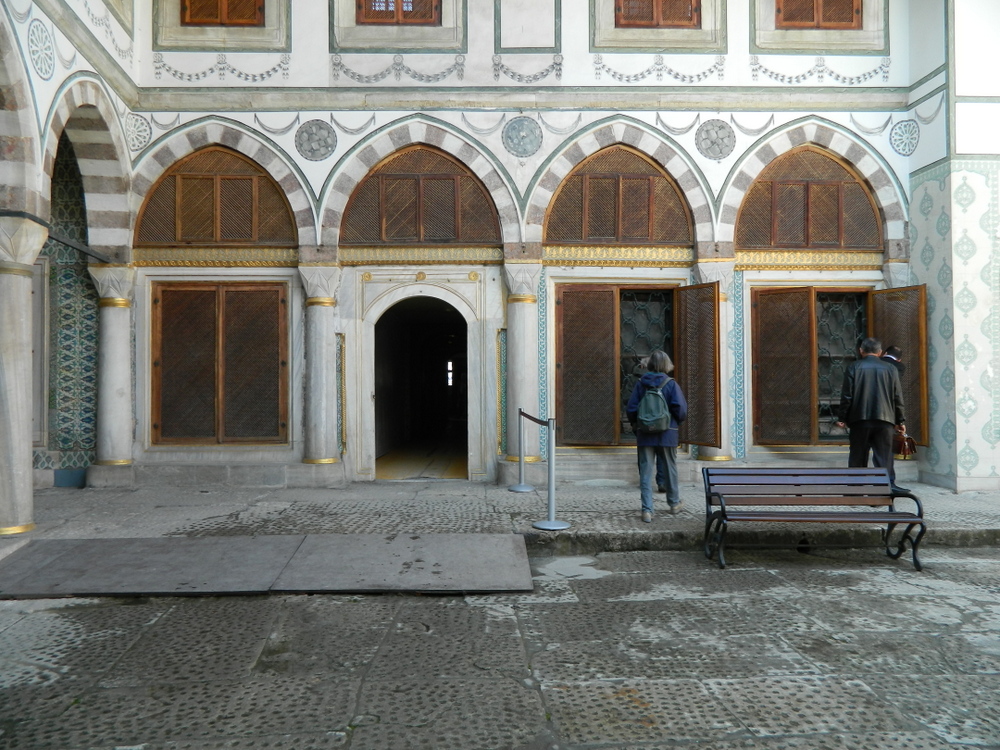
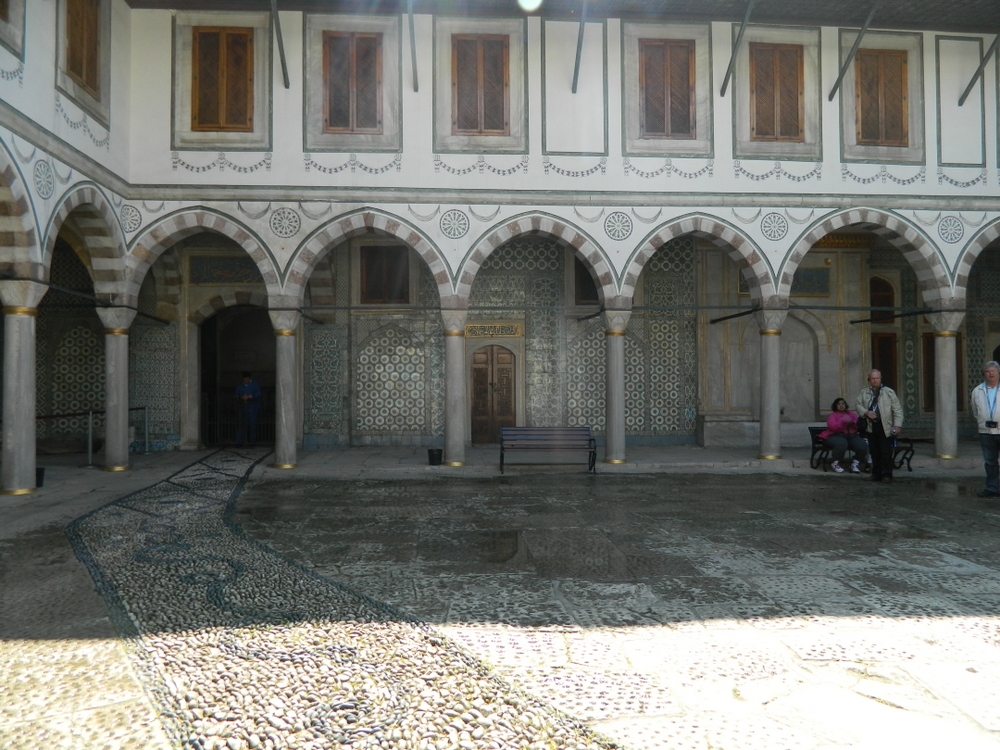
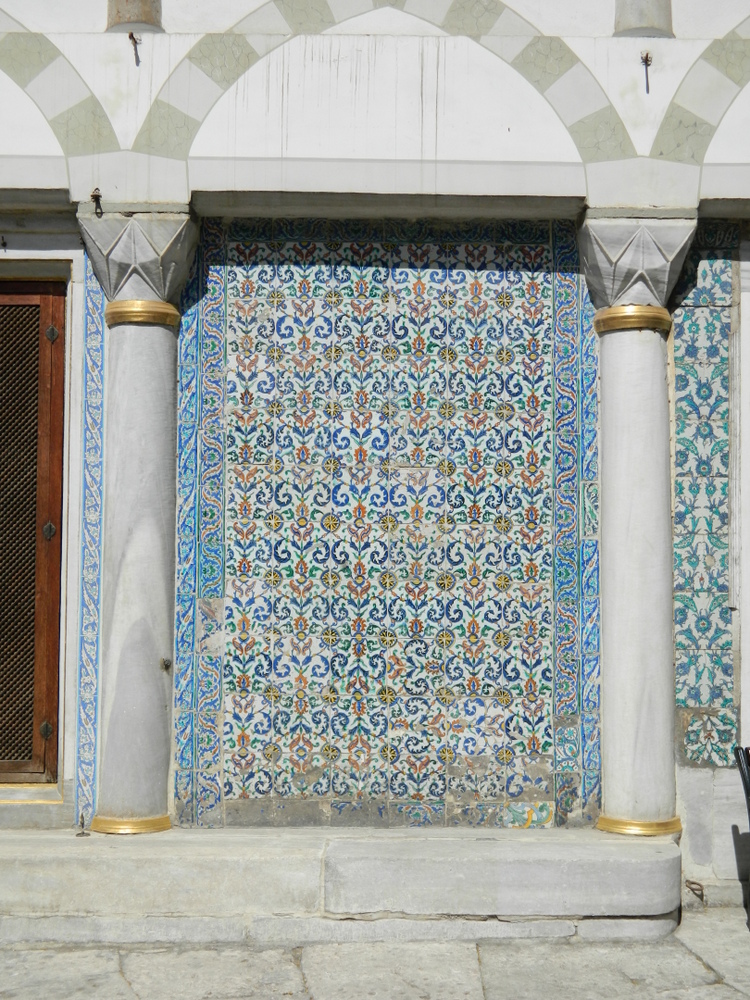
The walls under the arches are tiled
 |

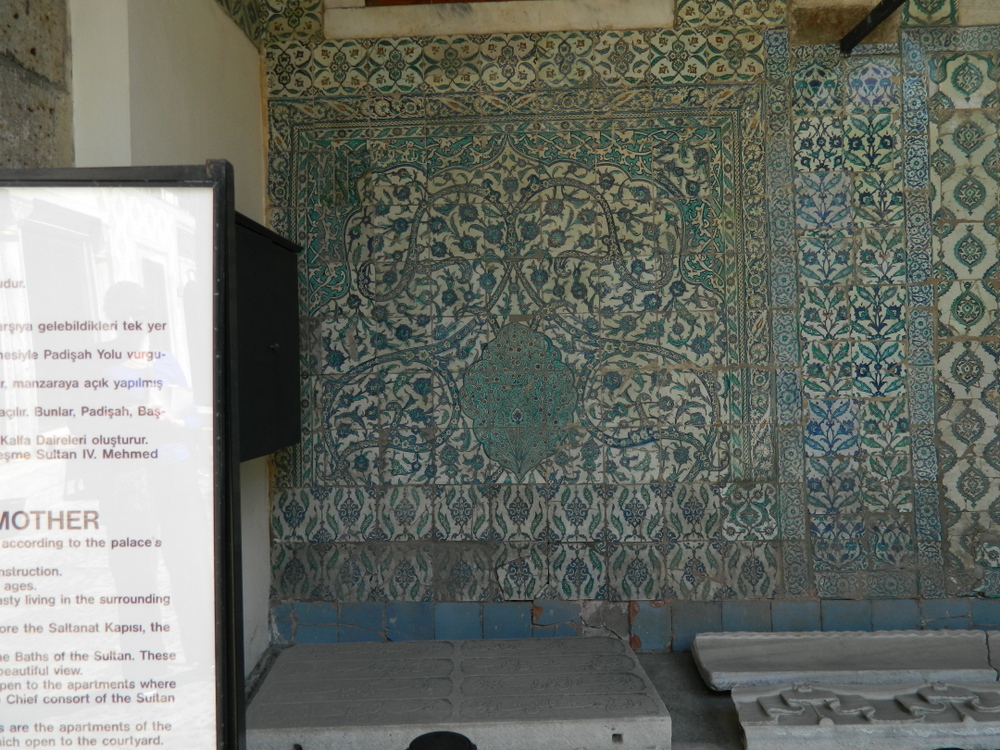
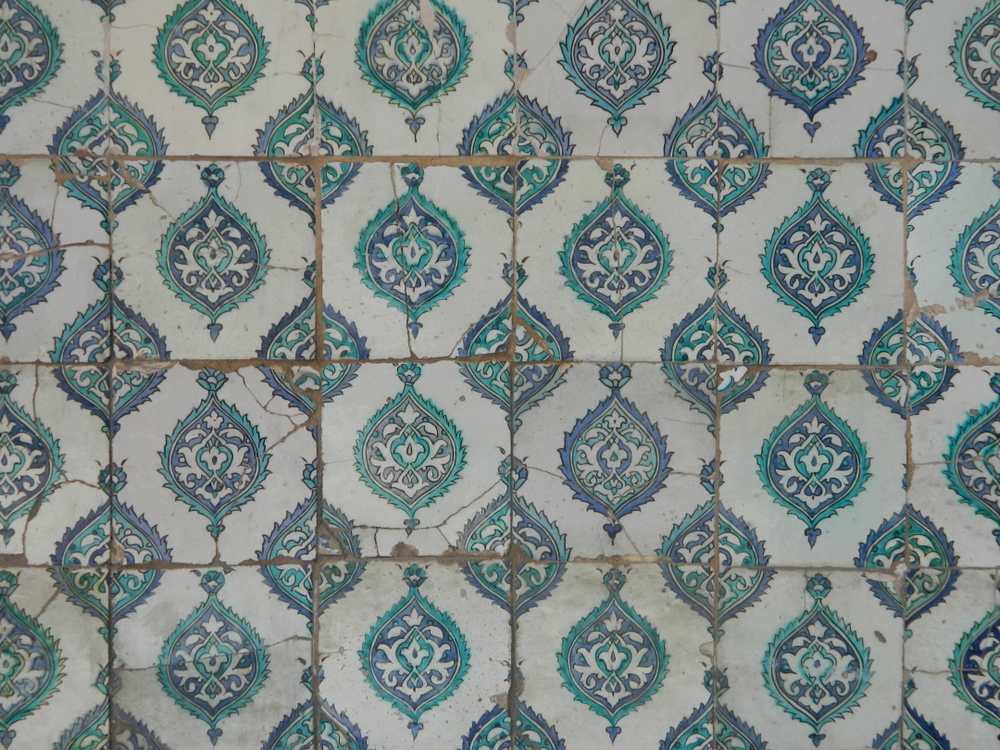
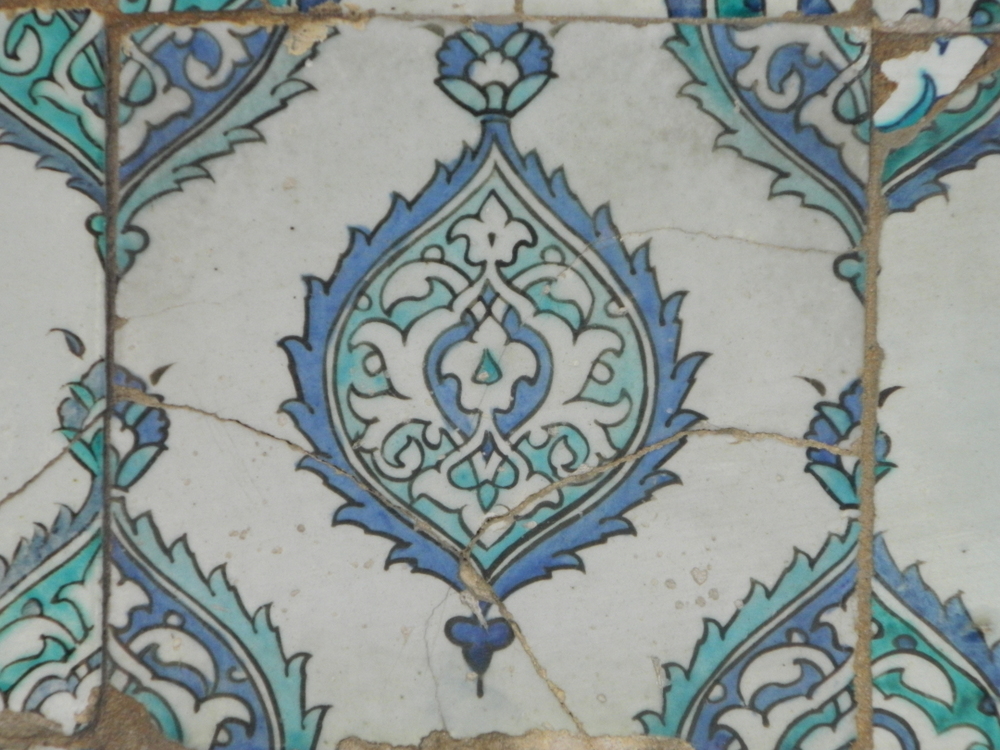

A wall by the Sultan’s chamber
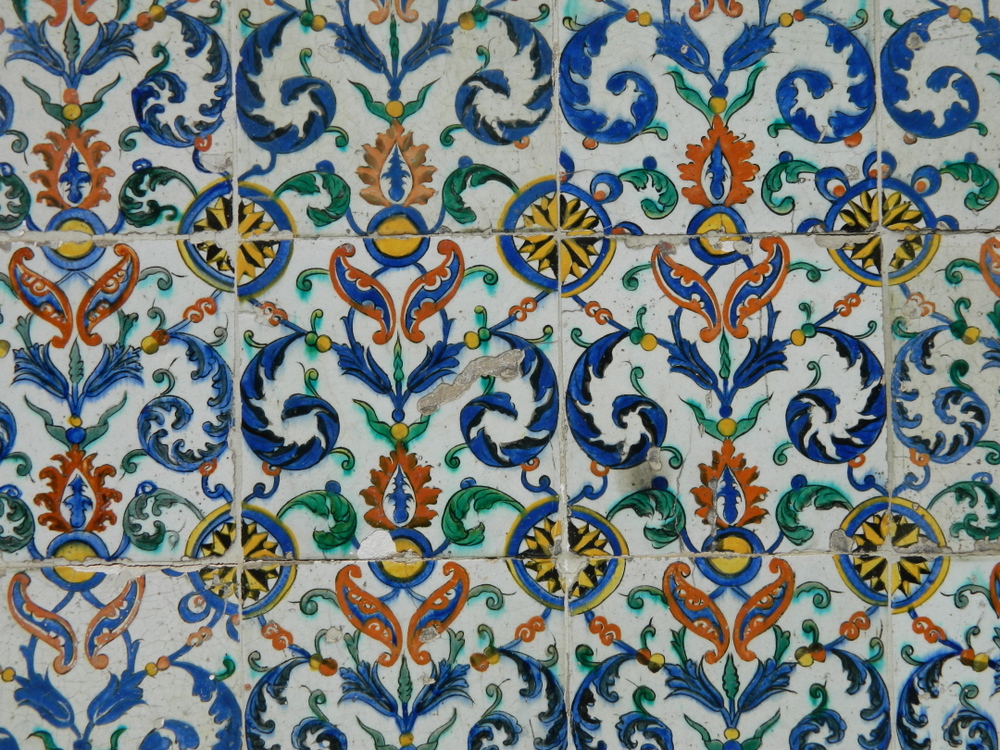
and a close up
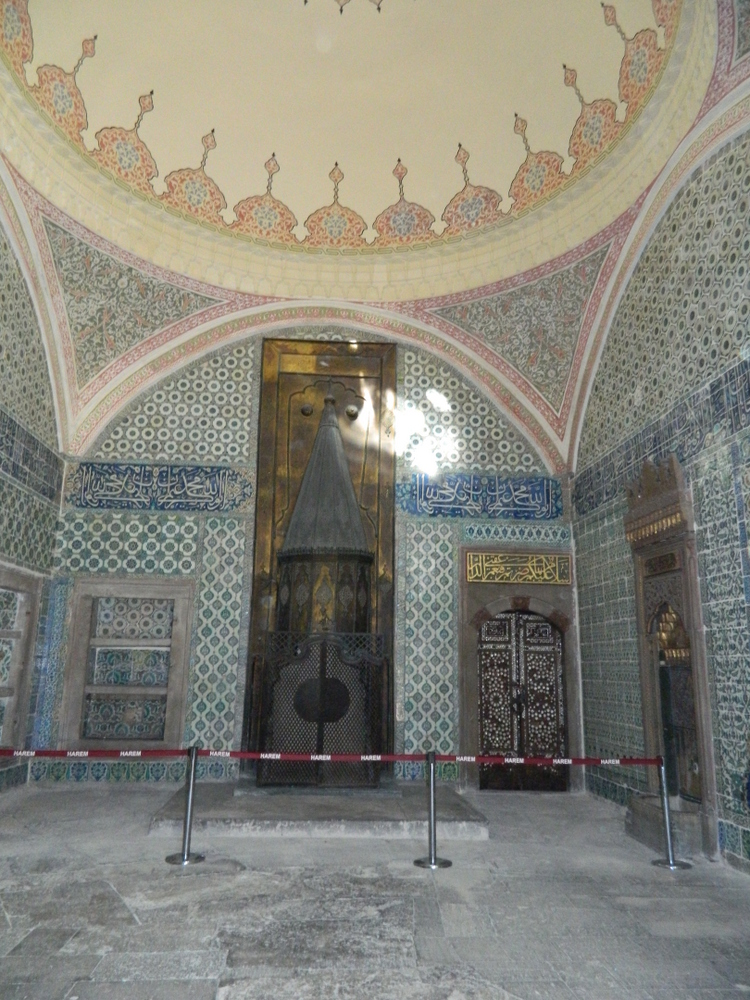
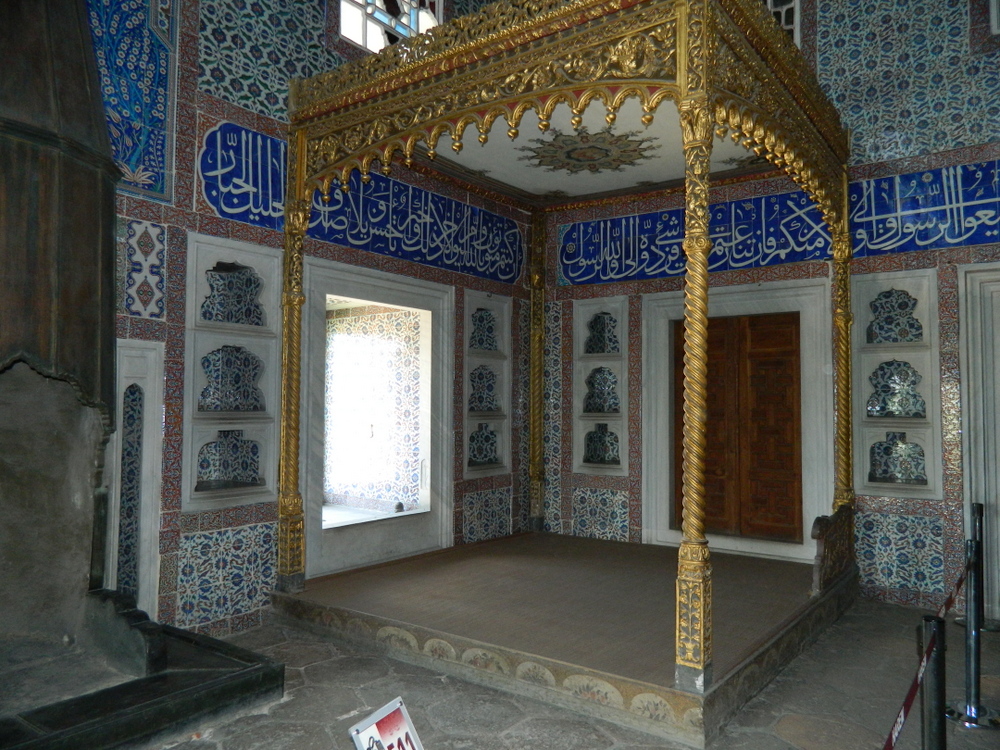
The Sultan’s chamber. Naturally the largest and grandest room, but actually, the crown prince’s rooms, being smaller have a greater intensity of decoration.
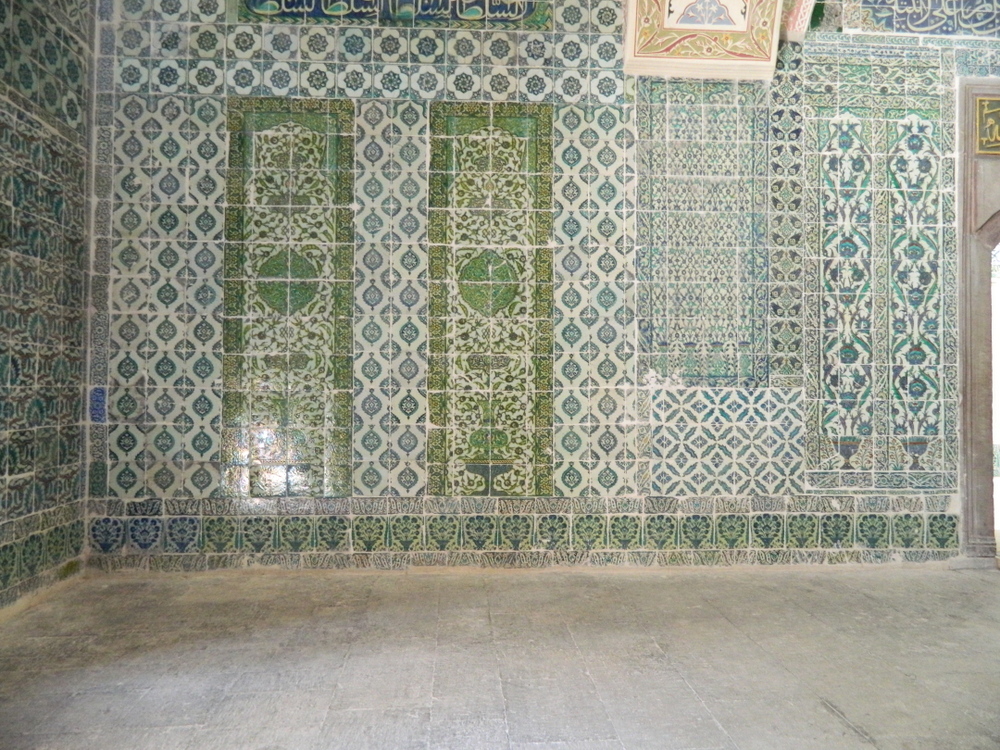
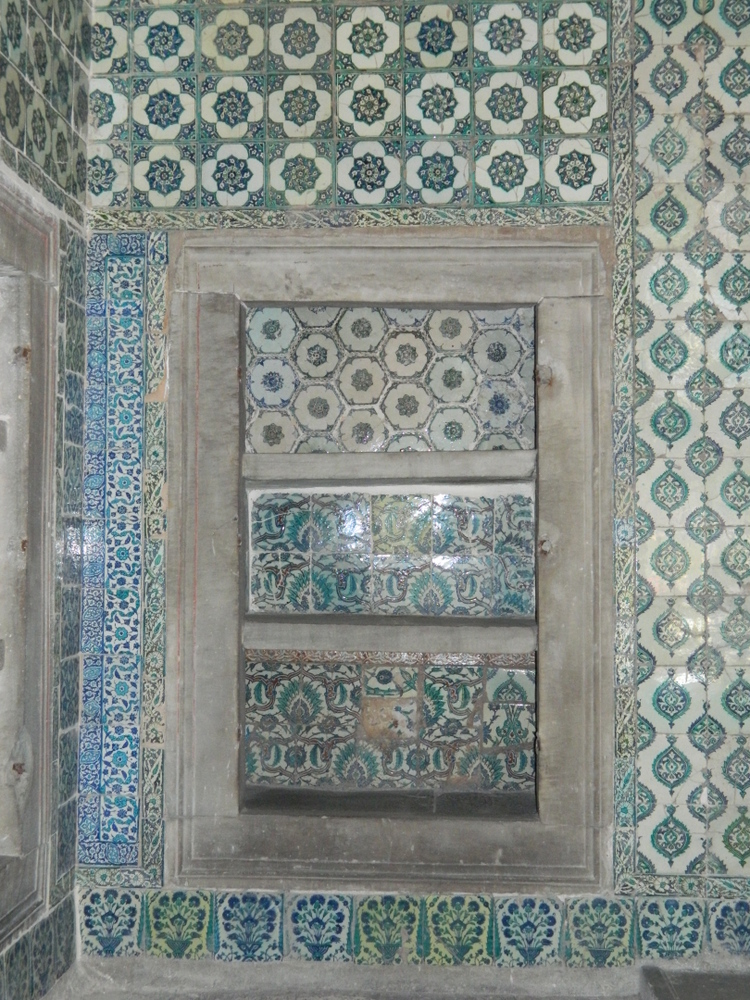
An alcove with three shelves (still in the sultan’s chamber)
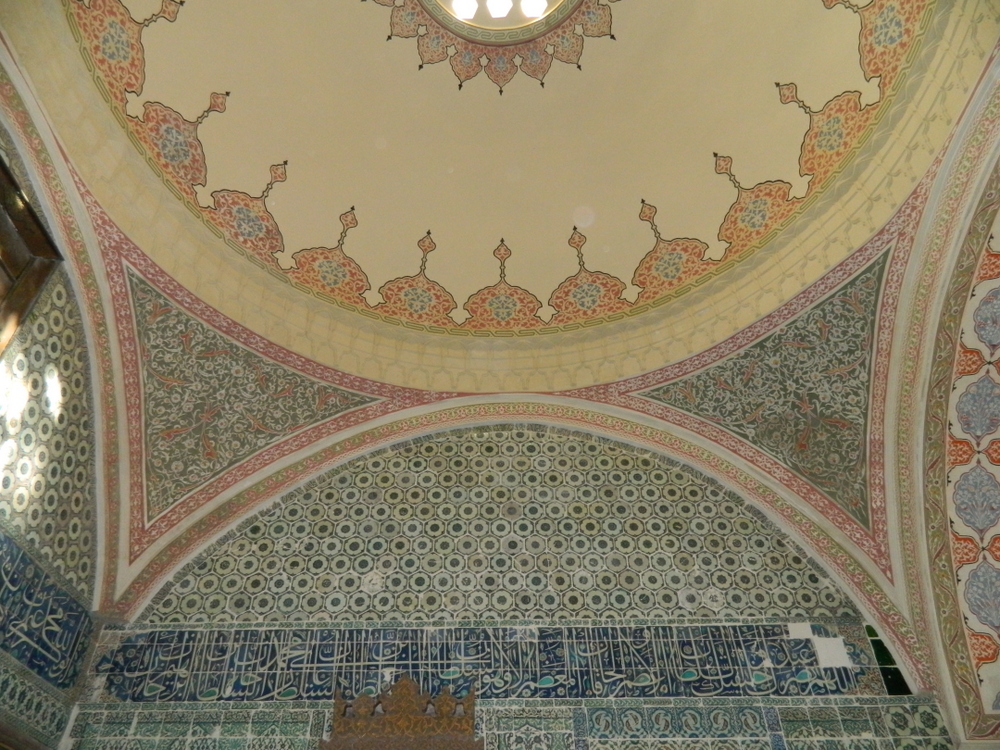
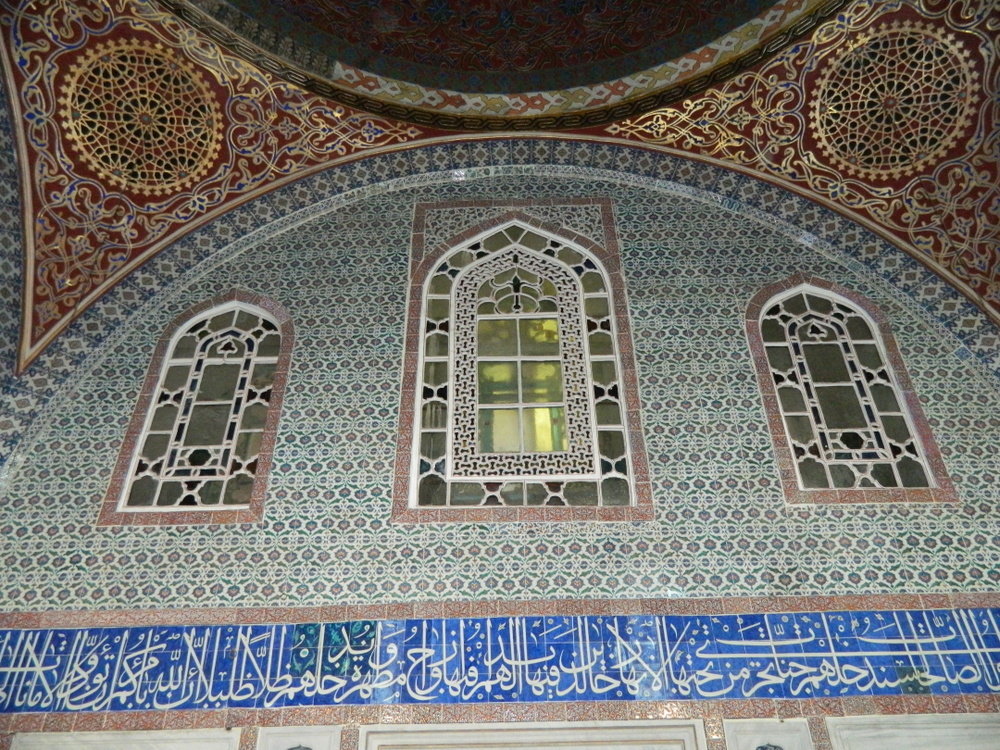
Half the ceiling and the top of a wall (sky lights in the very center)
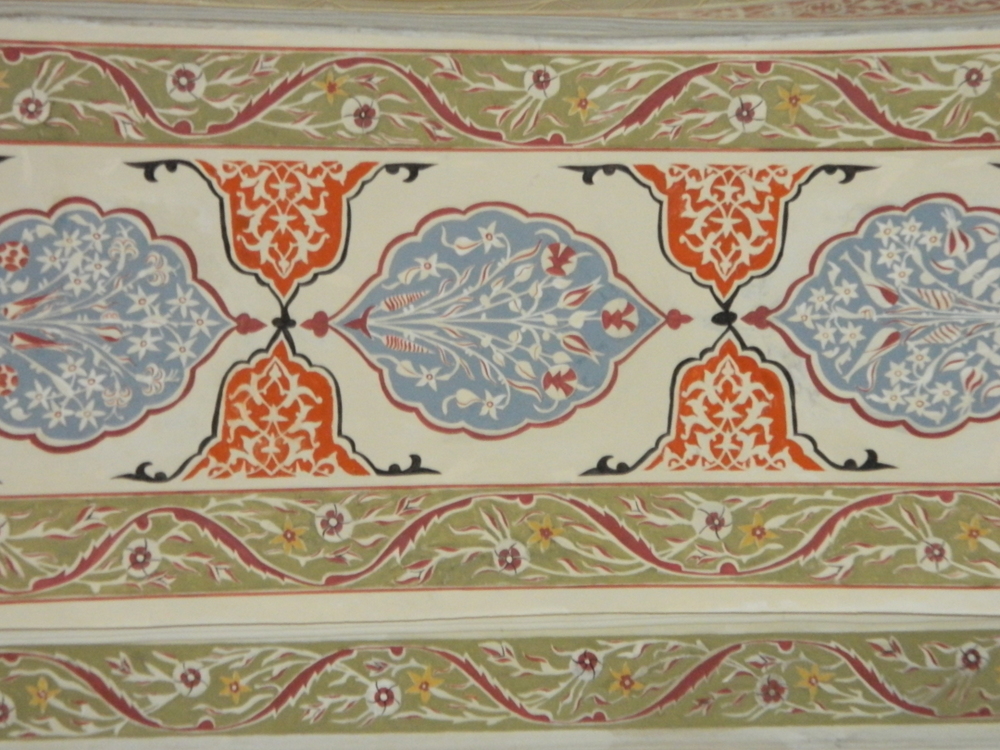
A couple of details of the painted arches

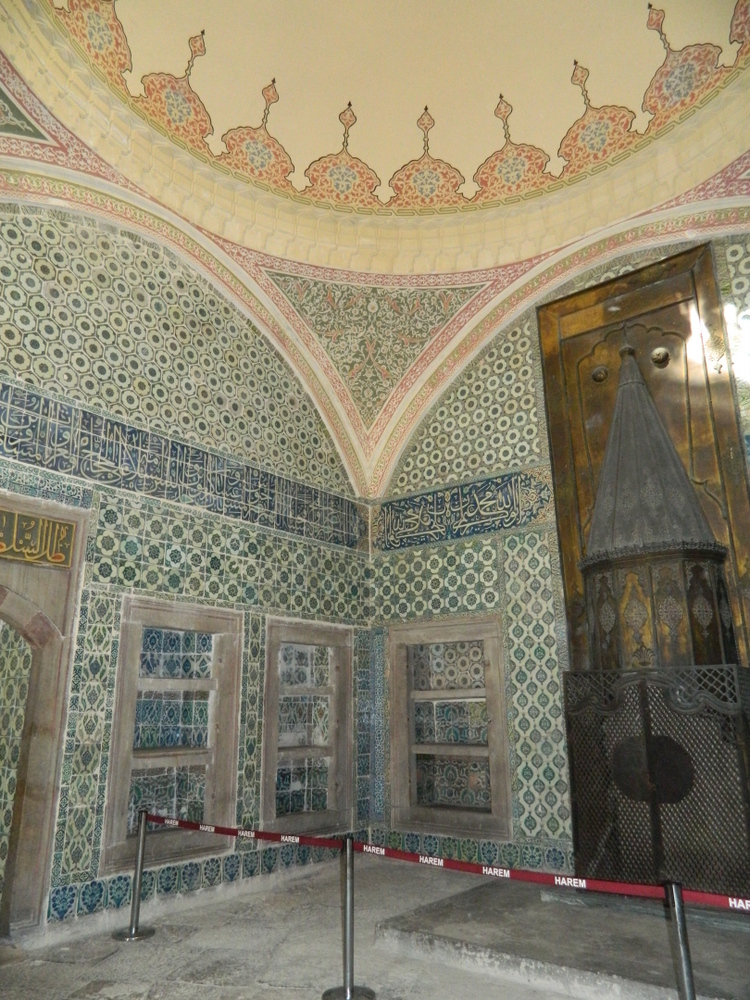
Corner of sultan’s chamber
In the next room, a water tap for ritual washing
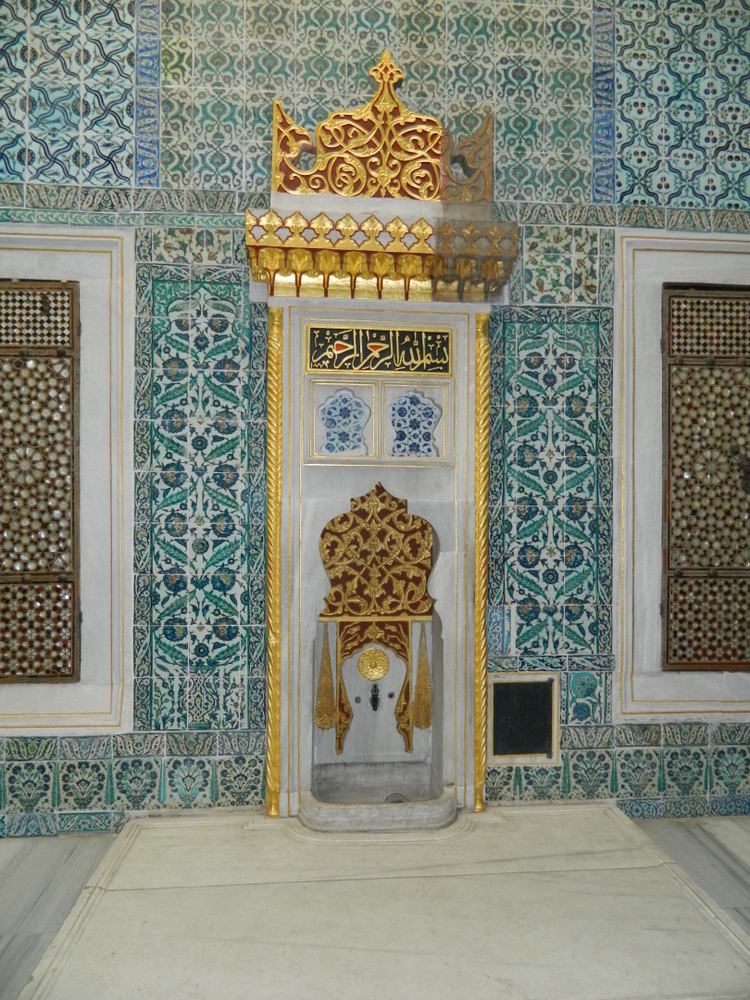
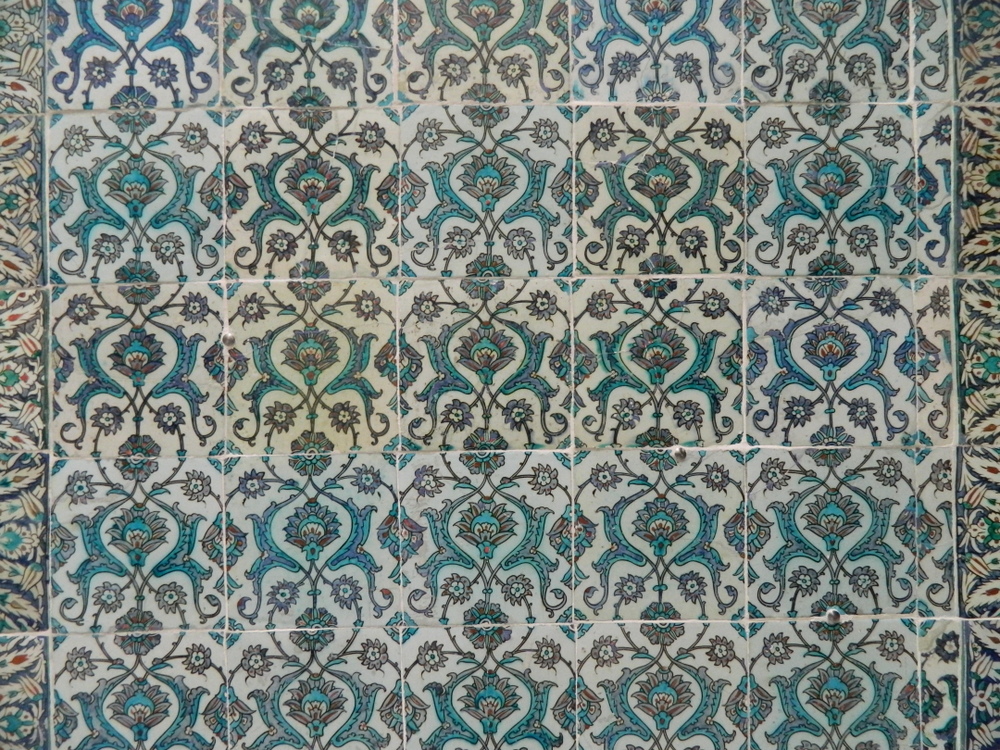
detail

More decorated alcoves
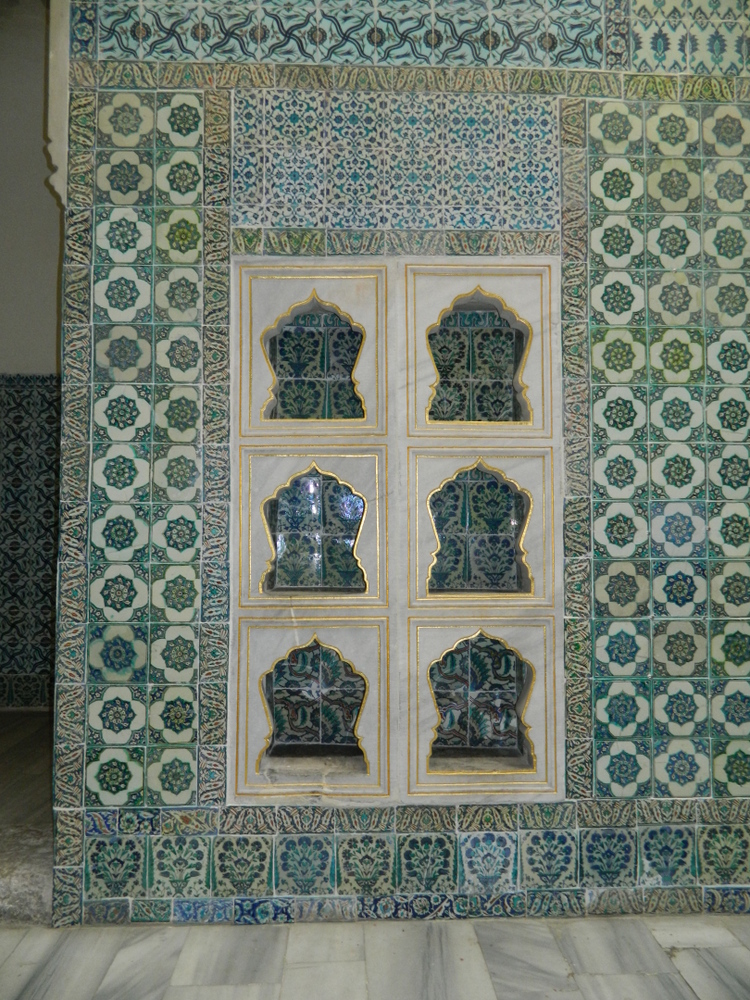
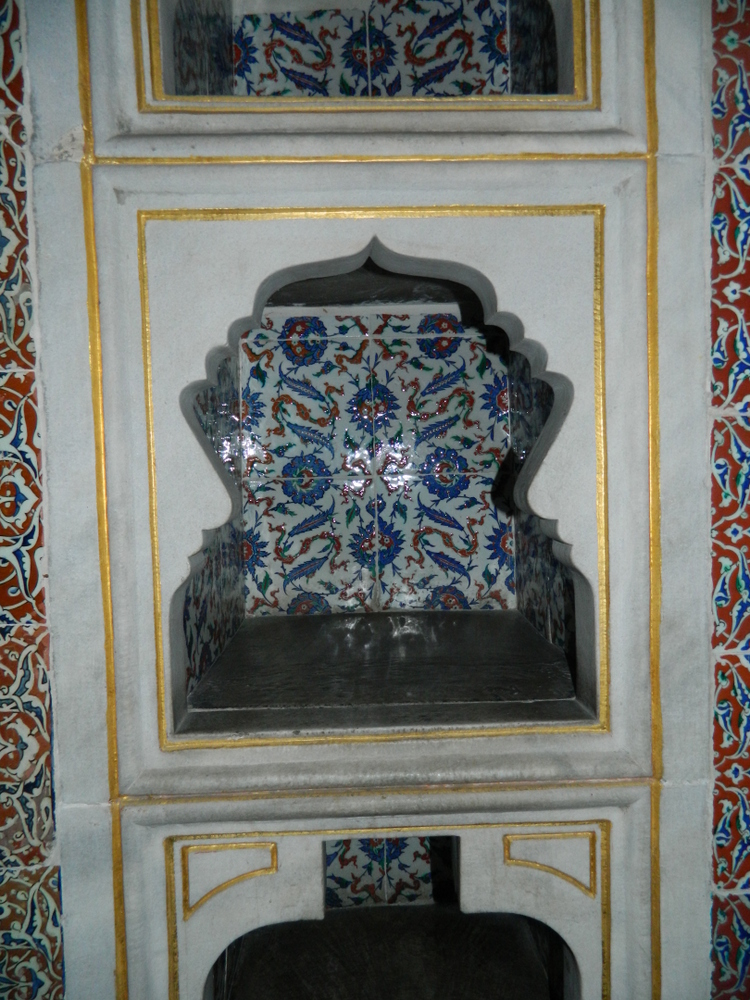
Next we move to a remarkably beautiful room, that seemd to be just the meeting place for two corridors. Ceiling and top of the walls
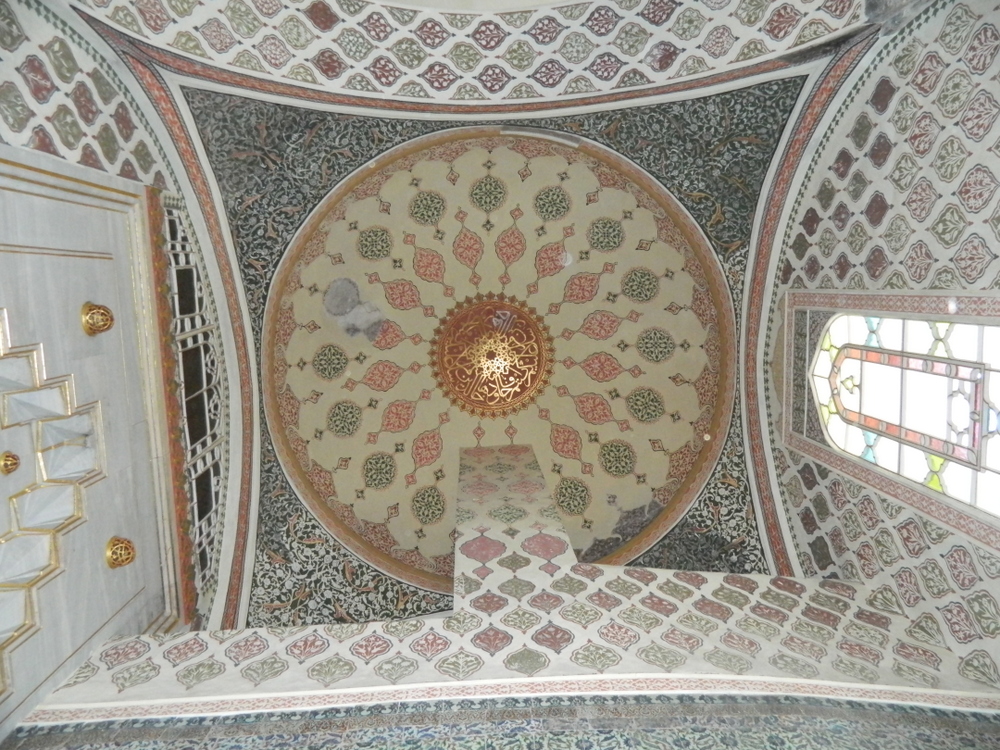
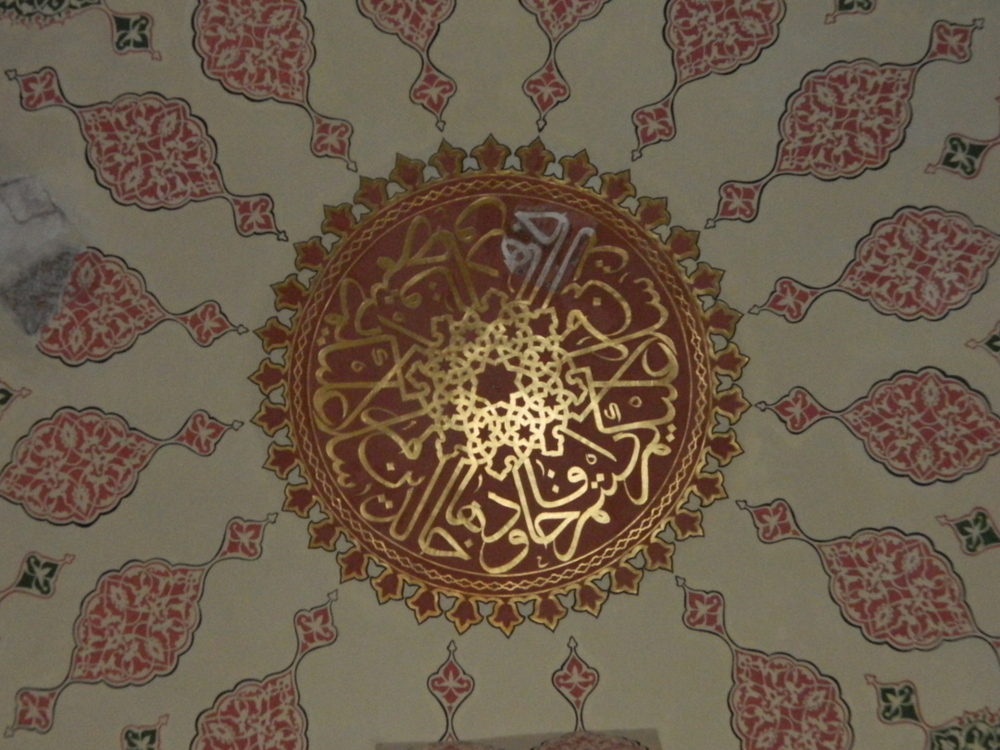
Five shots of a truly beautiful wall — I will have to find more pics of it
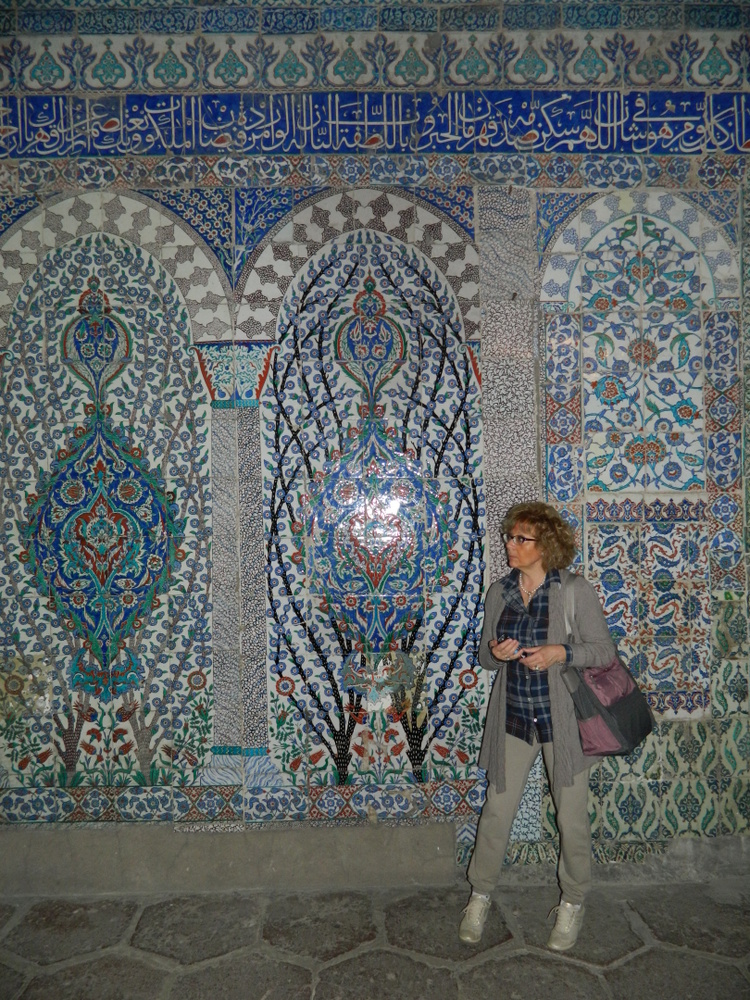
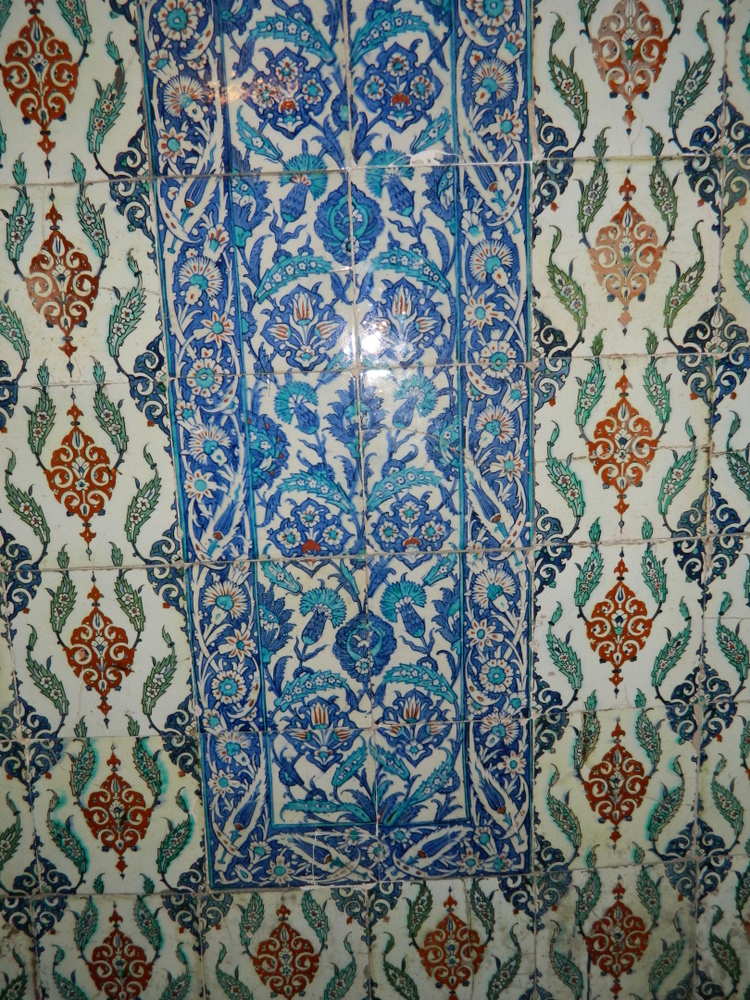

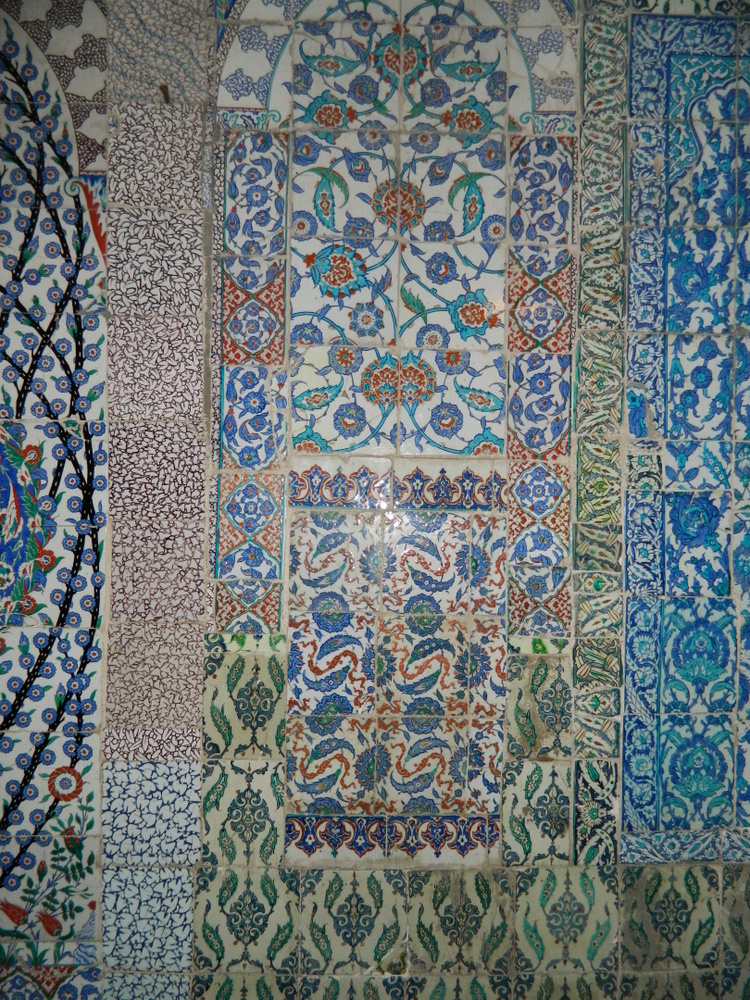
One of the two crown prince’s rooms.
Top of the wall
Detail
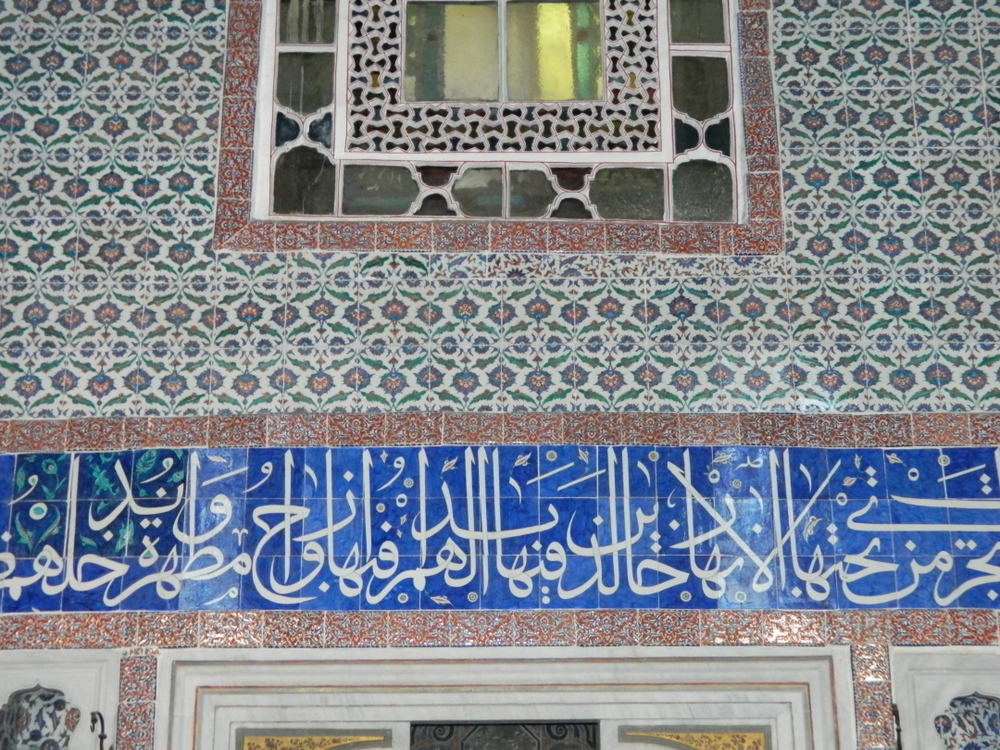
Further refined
 |
| This incredibly detailed work is about 10 feet up — well above eye level! |
The crown prince’s room was well endowed with windows, but visitors can only access part of the room, hence the angled shots.
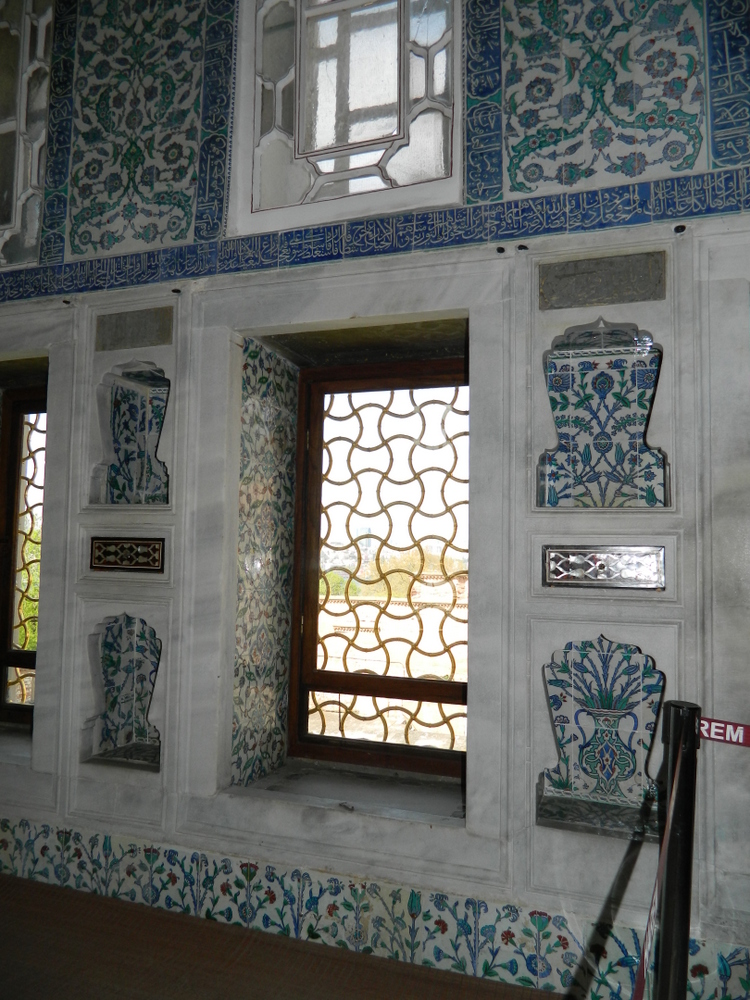
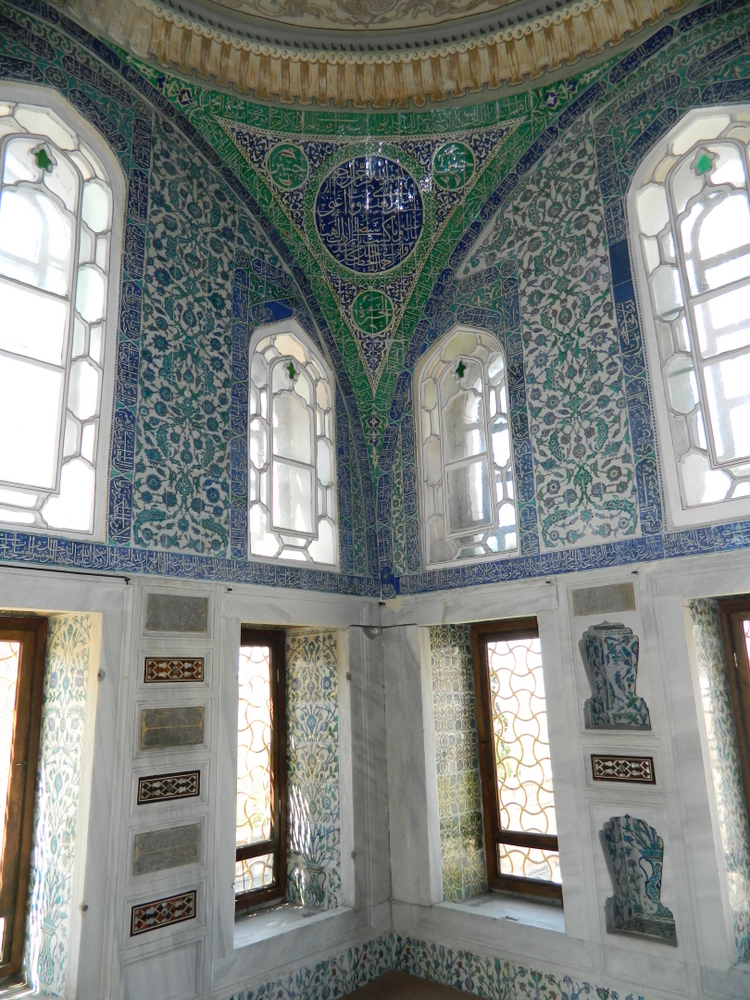
Gilded alchoves

What looks like the tree of life.
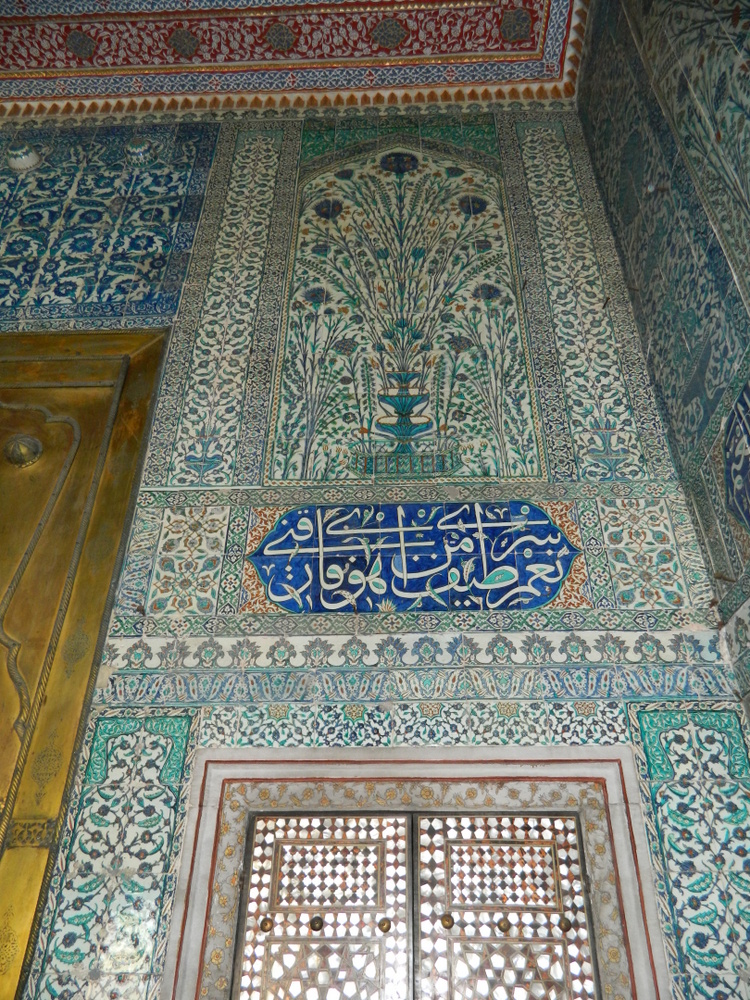
This looks like a carpet made of tiles. (This needs to be straightened, but Picassa’s straighten tool loses resolution.)
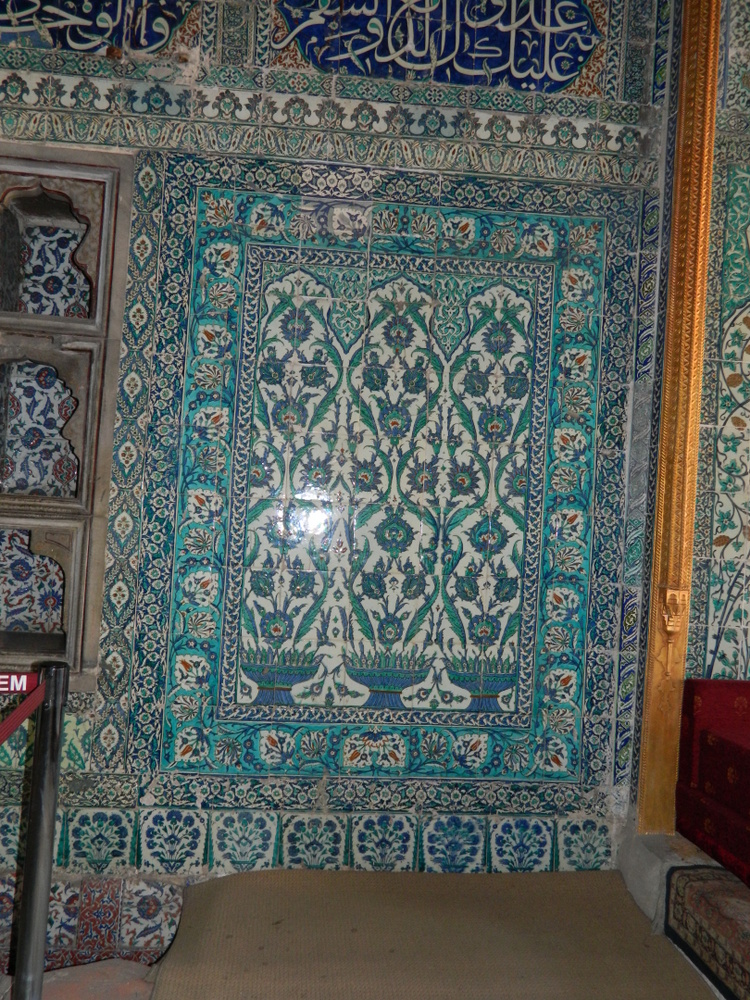
Rhe top of the wall and a little of the ceiling

The ceiling

A brillliant panel in a narrow passage bewteen two rooms
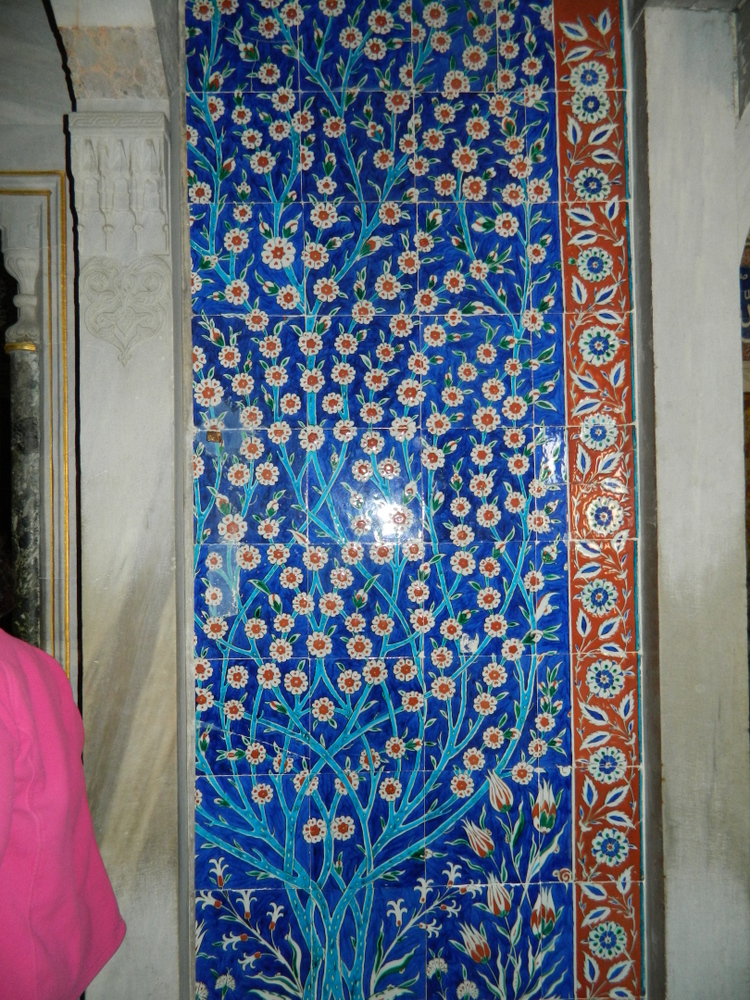
Outside, again. The outside of the crown prince’s rooms
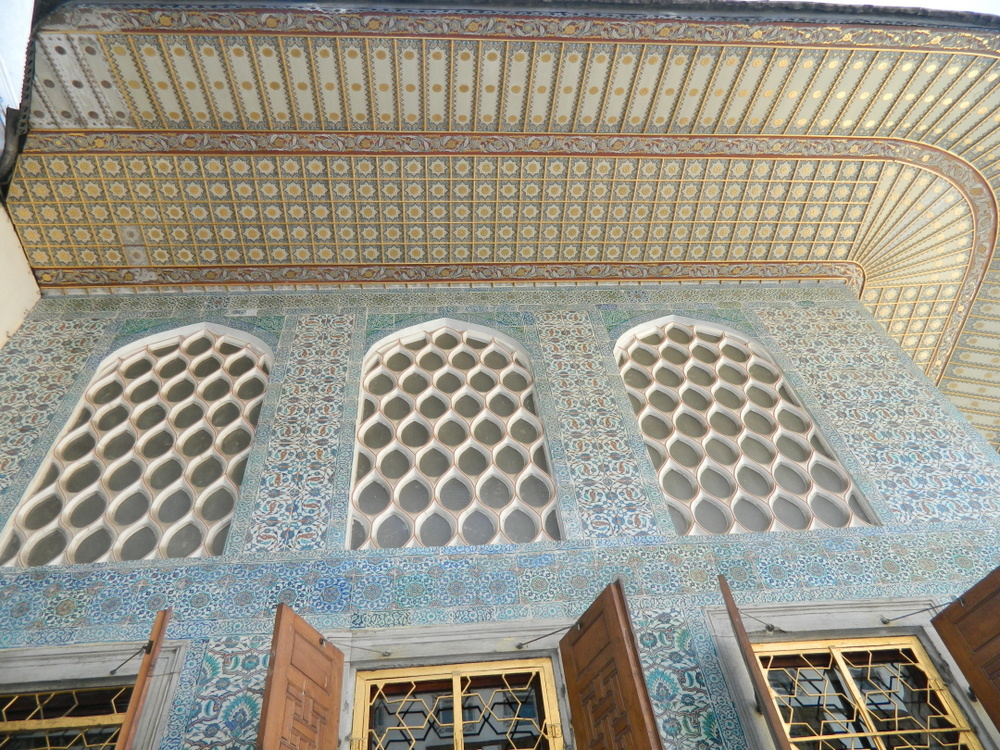
Still no expense spared. Notice the tiling between the windows, and the gilded decoration on the eaves.
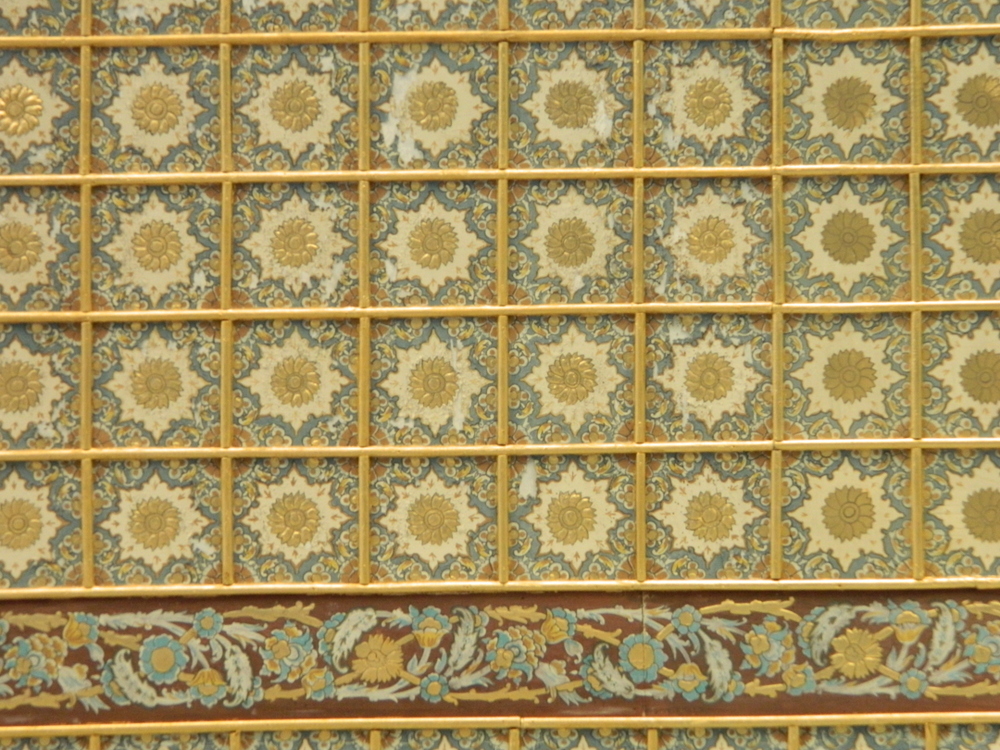 |
| Gilded decoration on the eaves |
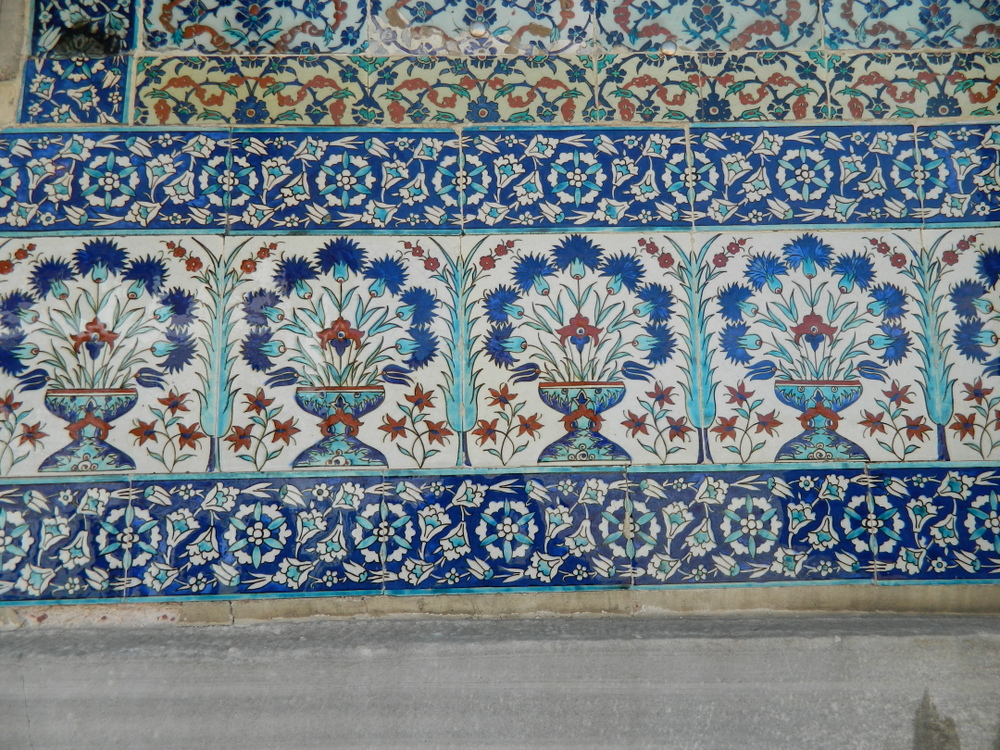 |
| Tiling at the base of the wall |
An unusual wall panel, that seems to tell a story
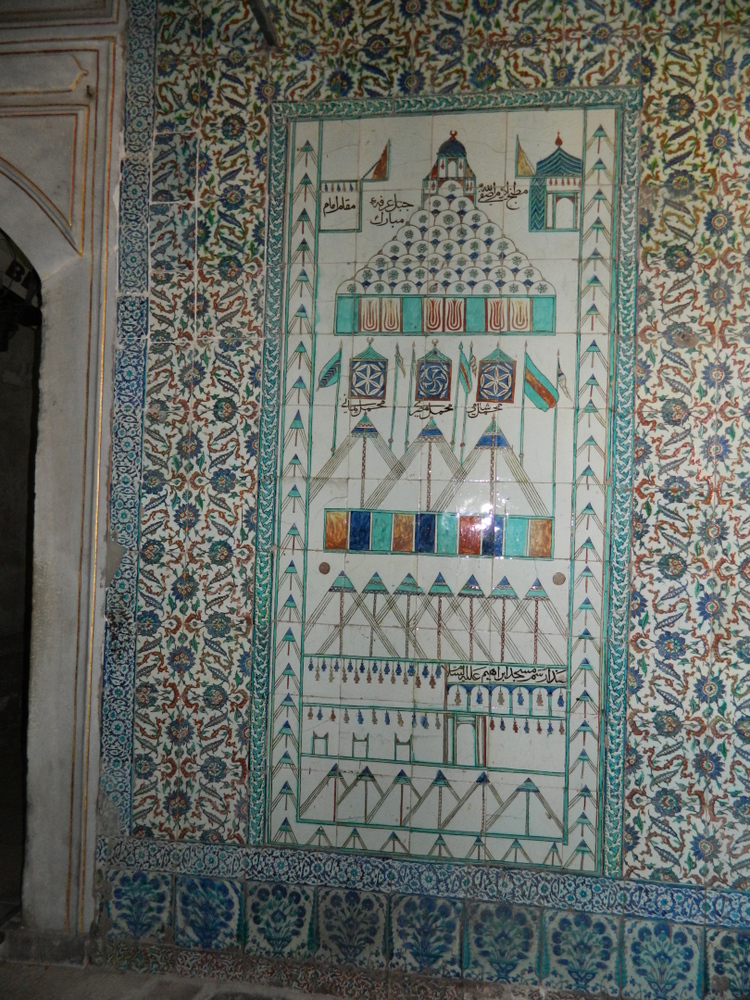
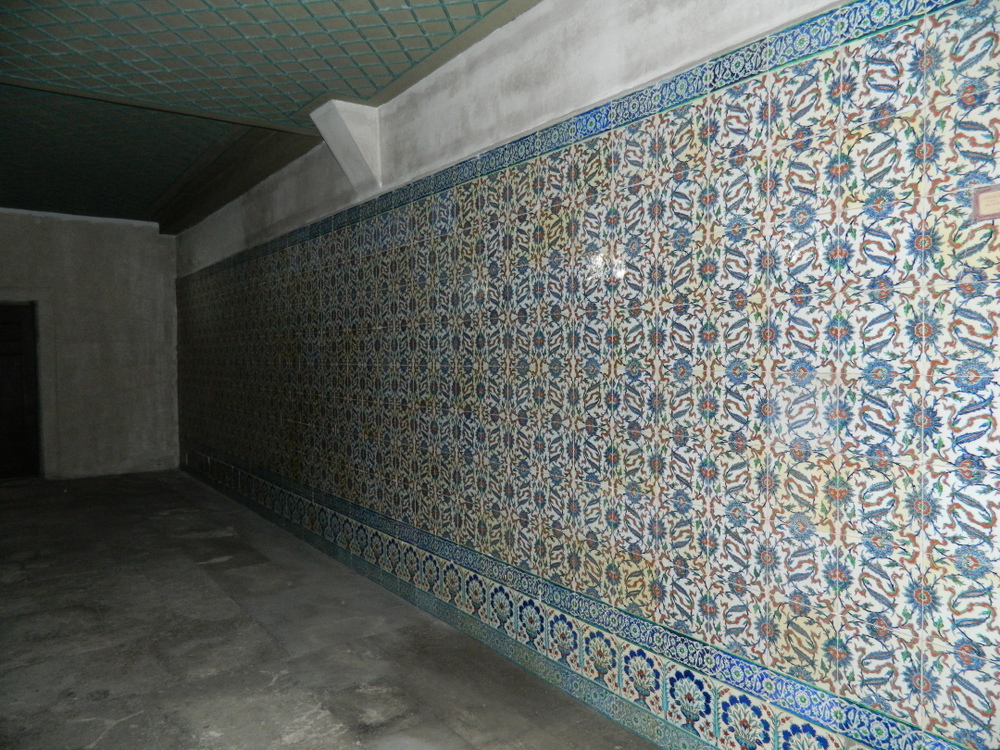
A long tiled wall
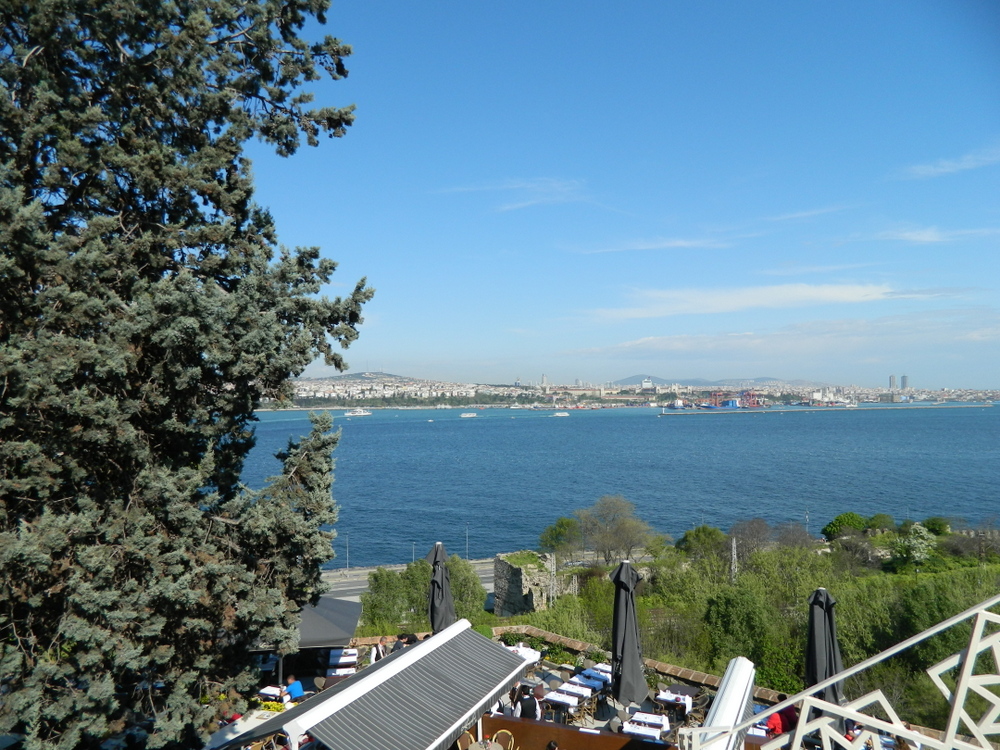
and it’s time for a very late and well deserved lunch at the restaurant overlooking the Bosphorus
There is lot more to Topkapi. Here is the Sultan’s library — a large bright airy pavilion in the gardens
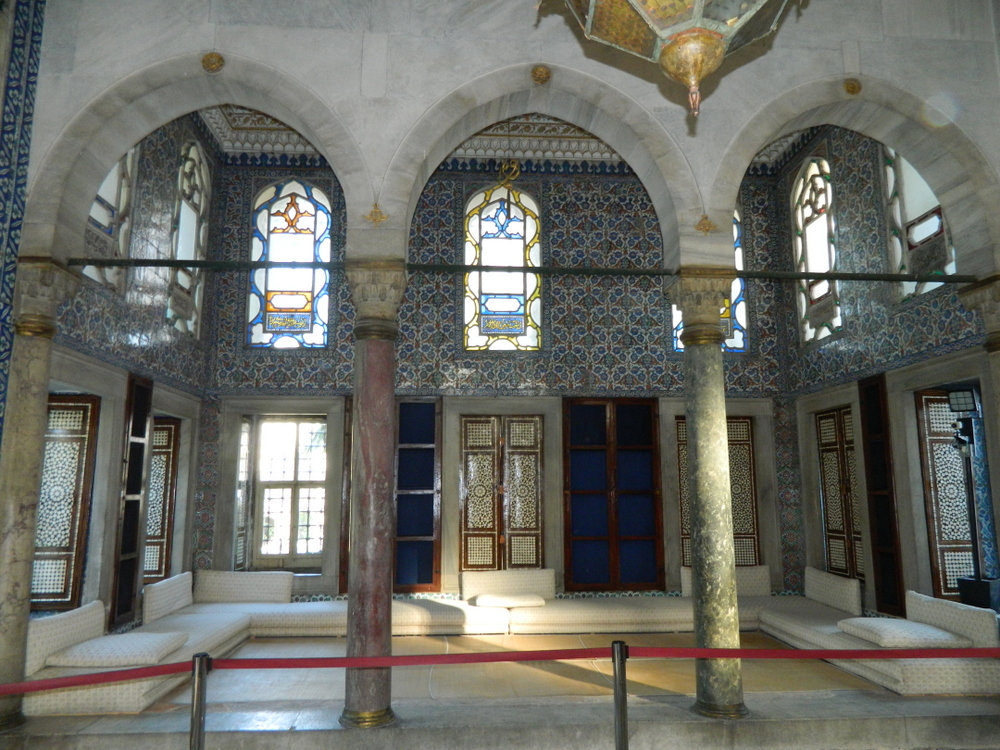
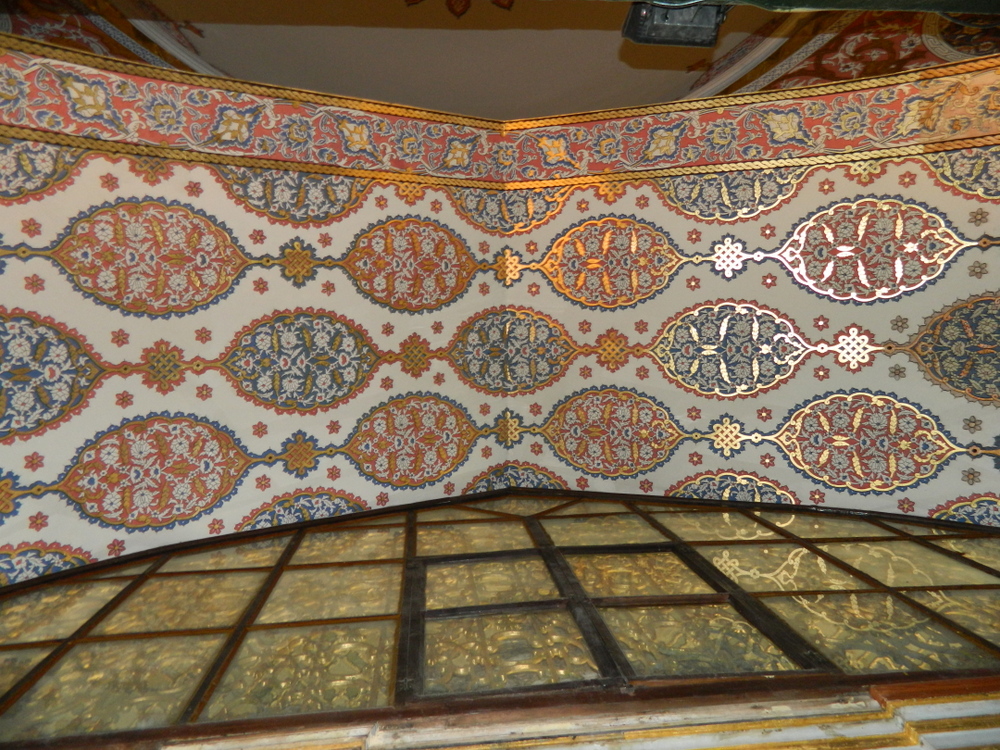
The divan and Hall of state
 |
| Entrance to hall of state |
 |
| A corner of the Hall of state |
 |
| Detail of an archway in the Hall of State |
A couple of tulips

It was a beautiful day

A final glimpse of the Blue Mosque on the way out.

Nothing is Impossible With God


John hears Jesus’s last words. He sees Jesus absolutely dead, blood and water issuing from his heart. He goes to bed, I imagine, shattered beyond grief—rent with the horror and guilt and unimaginable agony I would feel if I saw that happen to my husband or father or child. Talk of post-traumatic stress!
And then, and then–two days later, he enters the grave, and sees the burial cloth that had been around Jesus’ head folded up by itself. Neatly, orderly.
And he says simply in the third person, “He saw and believed.”
That Jesus was resurrected.
And, surely, his world exploded. Anything was possible, as Jesus had said so often. Miracles, magic. “Did I not tell you that if you believed you would see the glory of God?” Jesus had said, just a week ago!! “Everything is possible for one who believes.” (Mark 9:23).
* * *
“All things are possible if you believe.” The believing comes before the impossible becomes possible.
After years of being in and leading women’s small groups, I often wonder if we all have a compartmentalised faith—areas in which we find it easy to trust and believe God, and areas in which we find it hard.
It’s relatively easy for me to trust God with my finances; I believe he is the river of abundance, and it’s not hard for me (in general) to believe he’ll replenish my stores.
In February, I had a cancer scare, and had a biopsy. On the day I was told of the abnormal ultrasound results, fear gripped my heart: fear of chemotherapy mostly, and also of death before my children are safely grown up, or before I have fulfilled my dream of writing. “Before my pen has gleaned my teeming brain,” as John Keats said. I realised that I had a choice to trust or be afraid. I decided on faith to trust and peace possessed my heart. I basically almost forgot about the biopsy and went on writing. Just as well, as it took 4 weeks to receive the biopsy result—which was normal!!
But there are things for which I pray, and it’s just words. I have little faith in my heart that what I pray for will come to pass, though I know Jesus said, Truly I tell you, if you have faith as small as a mustard seed, you can say to this mountain, ‘Move from here to there,’ and it will move. Nothing will be impossible for you.” Matt. 17:20.
· * *
The dead Jesus walks. He has neatly folded the cloth covering his head.
All things are now possible for them for believe.
But yet not all our prayers are answered affirmatively. Sometimes the answer to prayer is No.
Jacob wrestles with God, refusing to let God go, unless he is blessed. And so God blesses him.
A limp to slow down the self-sufficient, manipulative, scheming Jacob. A child will be able to out-run him. He will tire easily. He will not be able to oversee everything himself. He will have to depend on others. And on God.
Paul is given a thorn in the flesh, so that he will have to get through his day and his life relying on God’s grace which is sufficient. On God’s power made perfect in weakness.
My limp and thorn is my rapidly declining physical fitness. My battles with weight.
And I don’t know what to do!! Should I accept it as God’s will? A thorn, a limp to keep me humble? To remind me of my sin, weakness and limitations?
Yes, my life-long habit of comfort-eating, and my life-long dislike of doing anything more active than reading or writing are thorns in the flesh. I will always need God’s help to overcome them.
But being over-weight, and, consequently, being physically weak and unfit and easily fatigued–I cannot believe that those are God’s will for me (though less energy does means more time in an armchair with my books and laptop.)
* * *
We had a charismatic pastor who used to say, “You must SEE it to RECEIVE it.” I suppose in secular terms it would be called creative visualisation.
I wonder if that is part of my struggle. That I have trouble seeing myself as fit, strong and energetic. Never really believed that I could lose weight—which I have been slowly gaining since my late teens at the rate of 3+ pounds a year… Which, well, adds up!!
So I asked God to give me an image to strengthen my faith.
And this was the image I got—myself running down a country road, tirelessly. (I love running, get high on those endorphins quickly, but am very, very slow, and easily fatigued.)
Ah, and here’s where that image is from:
29 He gives strength to the weary
and increases the power of the weak.
30 Even youths grow tired and weary,
and young men stumble and fall;
31 but those who hope in the LORD
will renew their strength.
They will soar on wings like eagles;
they will run and not grow weary,
they will walk and not be faint. (Isaiah 40)
and increases the power of the weak.
30 Even youths grow tired and weary,
and young men stumble and fall;
31 but those who hope in the LORD
will renew their strength.
They will soar on wings like eagles;
they will run and not grow weary,
they will walk and not be faint. (Isaiah 40)
What’s the key here? It’s hoping in the Lord, trusting in the Lord, waiting on the Lord.
Just hanging out with God as a branch in the vine, resting in him, being rejuvenated by his sweet sap flowing into me, his life flowing into me.
That’s where the strength comes from to change life-long habits of comfort-eating when bored or stressed or unhappy or empty. That’s where the strength comes from to eat healthily. And the strength to run and not grow bored or weary.
The secret of the vine: living in Christ, hanging out in and with Christ, relying on that other deeper, sweeter life to flow through me, to fill me, to still my restlessness, comfort my sadness, and give me the will-power and discipline to run and to walk (and, eventually, not grow weary or faint.)
In which areas do you find faith easy–or hard? What are your limps and thorns?
C. S. Lewis on Whether the Christian Life if Hard or Easy. (I love this!)

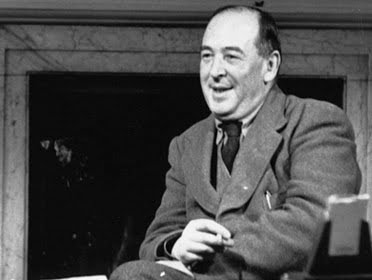
I love this passage in Mere Christianity in which Lewis talks about whether the Christian life is hard or easy.
It’s both, Lewis says. It’s hard as death in the beginning, and then as his life begins to worth within us and transform us, it is relatively easy, because he does the work of transforming us.
We are to hand ourselves over to Christ, to be ploughed up and resown. We are to have the bad tooth out, and a new tooth given us. It’s like death.
But then, He lives within us and helps us to do impossible things. In that way, it’s easy.
And–and this is the insight I love–once we surrender ourselves to Jesus, and rely on his strength within us to get through our days, it’s fine, it’s normal, if we only succeed for moments at a time. You surrender yourself to Christ, you rely on his strength. Perhaps, relying on it, you will bite back one unkind retort; silence a bit of juicy gossip; not respond to provocation; pass up the chocolate you do not need; close the laptop when you’re wasting time on the internet. And then, you might blow it.
But “from those moments of victory, a new sort of life is spreading through your system,” and that too is a way in which sanctification works.
Surrendering ourselves to Jesus for moments at a time. Relying on his strength for moments at a time. Even the weakest Christian, such as I often am, can do that? And a lifetime is made up of moments!!
Mere Christianity, Chapter 30,
Is the Christian Life Hard or Easy?
Is the Christian Life Hard or Easy?
In the previous chapter we were considering the Christian idea of ‘putting on Christ,’ or first ‘dressing up’ as a son of God in order that you may finally become a real son. What I want to make clear is that this is not one among many jobs a Christian has to do; and it is not a sort of special exercise for the top class. It is the whole of Christianity. Christianity offers nothing else at all. ’.
The Christian way is hard, and easy. Christ says `Give me All. I don’t want so much of your time and so much of your money and so much of your work: I want You. I have not come to torment your natural self, but to kill it. No half-measures are any good. I don’t want to cut off a branch here and a branch there, I want to have the whole tree down. I don’t want to drill the tooth, or crown it, or stop it, but to have it out. Hand over the whole natural self, all the desires which you think innocent as well as the ones you think wicked – the whole outfit. I will give you a new self instead. In fact, I will give you Myself: my own will shall become yours.’
Both harder and easier. You have noticed, I expect, that Christ Himself sometimes describes the Christian way as very hard, sometimes as very easy. He says, ‘Take up your Cross’- in other words, it is like going to be beaten to death in a concentration camp. Next minute he says, ‘My yoke is easy and my burden light.’ He means both. And one can just see why both are true.
Teachers will tell you that the laziest boy in the class is the one who works hardest in the end. They mean this. If you give two boys, say, a proposition in geometry to do, the one who is prepared to take trouble will try to understand it. The lazy boy will try to learn it by heart because, for the moment, that needs less effort. But six months later, when they are preparing for an exam, that lazy boy is doing hours and hours of miserable drudgery over things the other boy understands, and positively enjoys, in a few minutes. Laziness means more work in the long run. Or look at it this way. In a battle, or in mountain climbing, there is often one thing which it takes a lot of pluck to do; but it is also, in the long run, the safest things to do. If you funk it, you will find yourself, hours later, in far worse danger. The cowardly thing is also the most dangerous thing.
It is like that here. The terrible thing, the almost impossible thing, is to hand over your whole self – all your wishes and precautions – to Christ. But it is far easier than what we are all trying to do instead. For what we are trying to do is to remain what we call ‘ourselves,’ to keep personal happiness as our great aim in life, and yet at the same time be ‘good’.
We are all trying to let our mind and heart go their own way-centred on money or pleasure or ambition–and hoping, in spite of this, to behave honestly and chastely and humbly. And that is exactly what Christ warned us you could not do. As He said, a thistle cannot produce figs. If I am a field that contains nothing but grass-seed, I cannot produce wheat. Cutting the grass may keep it short: but I shall still produce grass and no wheat. If I want to produce wheat, the change must go deeper than the surface. I must be ploughed up and re-sown.
That is why the real problem of the Christian life comes where people do not usually look for it. It comes the very moment you wake up each morning. All your wishes and hopes for the day rush at you like wild animals. And the first job each morning consists simply in shoving them all back; in listening to that other voice, taking that other point of view, letting that other larger, stronger, quieter life come flowing in.And so on, all day. Standing back from all your natural fussings and frettings; coming in out of the wind.
We can only do it for moments at first. But from those moments the new sort of life will be spreading through our system: because now we are letting Him work at the right part of us. It is the difference between paint, which is merely laid on the surface, and a dye or stain which soaks right through. He never talked vague, idealistic gas. When he said, `Be perfect,’ He meant it. He meant that we must go in for the full treatment. It is hard; but the sort of compromise we are all hankering after is harder – in fact, it is impossible.
It may be hard for an egg to turn into a bird : it would be a jolly sight harder for it to learn to fly while remaining an egg. We are like eggs at present. And you cannot go on indefinitely being just an ordinary, decent egg. We must be hatched or go bad.
May I come back to what I said before? This is the whole of Christianity. There is nothing else. It is so easy to get muddled about that. It is easy to think that the Church has a lot of different objects education, building, missions, holding services. The Church exists for nothing else but to draw men into Christ, to make them little Christs. If they are not doing that, all the cathedrals, clergy, missions, sermons, even the Bible itself, are simply a waste of time. God became Man for no other purpose.
It is even doubtful, you know, whether the whole universe was created for any other purpose. It says in the Bible that the whole universe was made for Christ and that everything is to be gathered together in Him. I do not suppose any of us can understand how this will happen as regards the whole universe. We do not know what (if anything) lives in the parts of it that are millions of miles away from this Earth. Even on this Earth we do not know how it applies to things other than men. After all, that is what you would expect. We have been shown the plan only in so far as it concerns ourselves.
I sometimes like to imagine that I can just see how it might apply to other things. I think I can see how the higher animals are in a sense drawn into Man when he loves them and makes them (as he does) much more nearly human than they would otherwise be. I can even see a sense in which the dead things and plants are drawn into Man as he studies them and uses and appreciates them. And if there were intelligent creatures in other worlds they might do the same with their worlds. It might be that when intelligent creatures entered into Christ they would, in that way, bring all the other things in along with them. But I do not know: it is only a guess.
What we have been told is how we men can be drawn into Christ – can become part of that wonderful present which the young Prince of the universe wants to offer to His Father – that present which is Himself and therefore us in Him. It is the only thing we were made for. And there are strange, exciting hints in the Bible that when we I are drawn in, a great many other things in Nature will begun to come right. The bad dream will be over: it will be morning.
Images of Istanbul

(A guest post from my husband, Roy)
A roundup of a few shorter visits — The Topkapi Palace ( that was suddenly closed as we arrived because of a sudden dust storm, that also closed souvenir sellers), the Grand Bazaar, Church of SS Sergius and Bacchus (now a Mosque, and called Small Haghia Sophia), the Basilica Cistern, and sights on the street.
Topkapi Palace (Entrance Only)
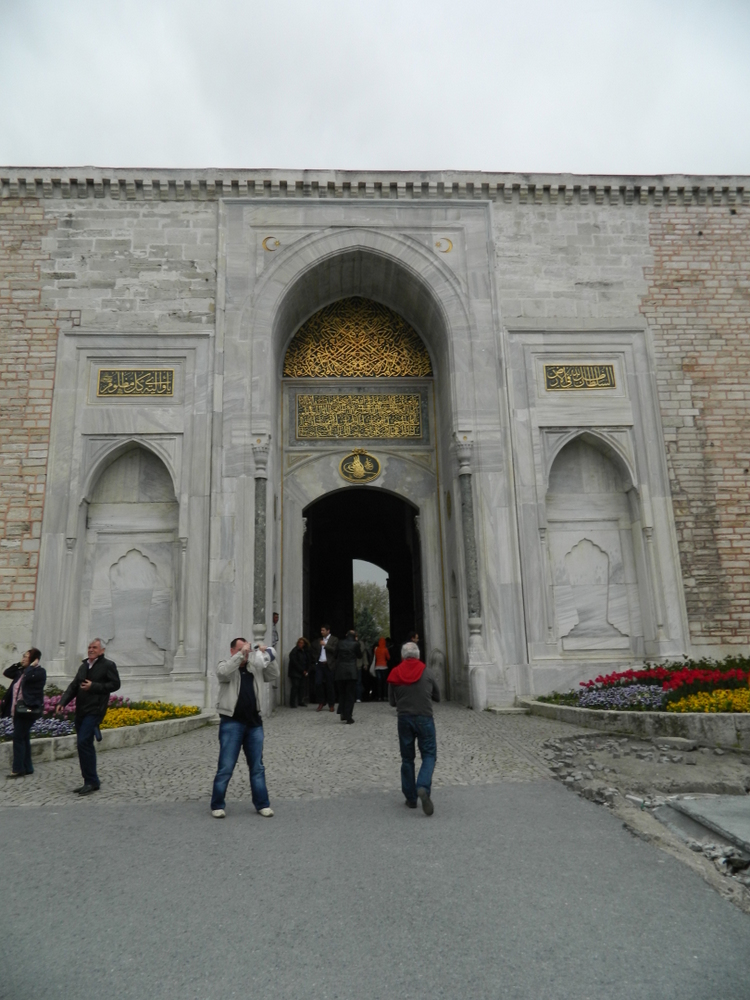 |
| Entrance to Topkapi Palace Gardens |
 |
| A row of tulips (Topkapi gardens) |
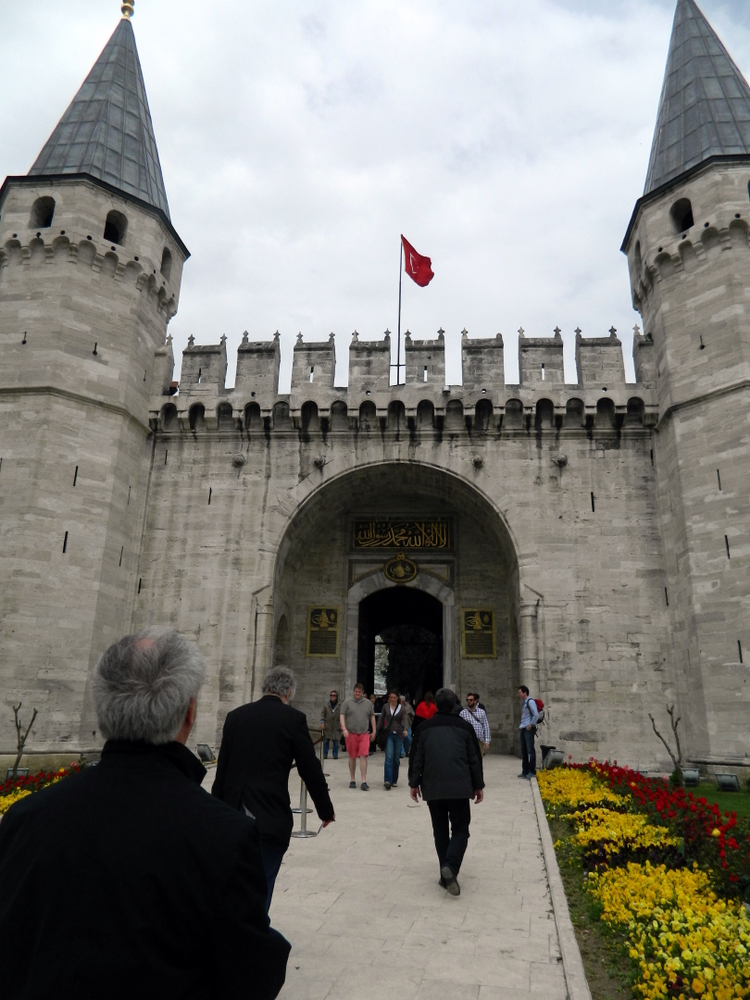 |
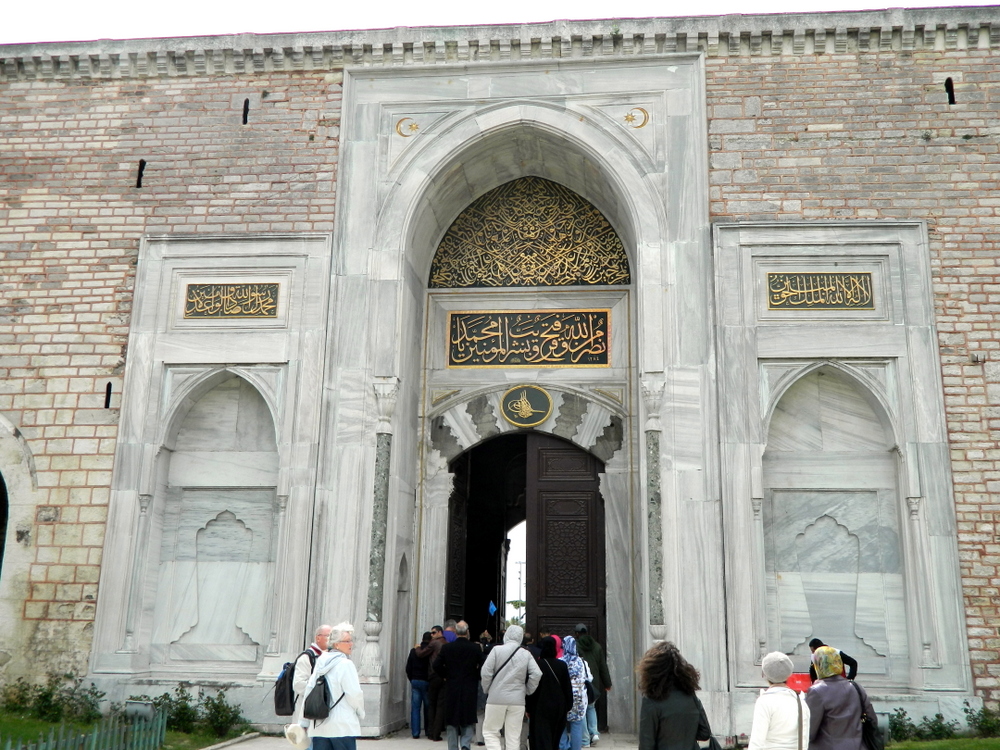
| Entrance of Topkapi Palace Enclosure (see details below) |

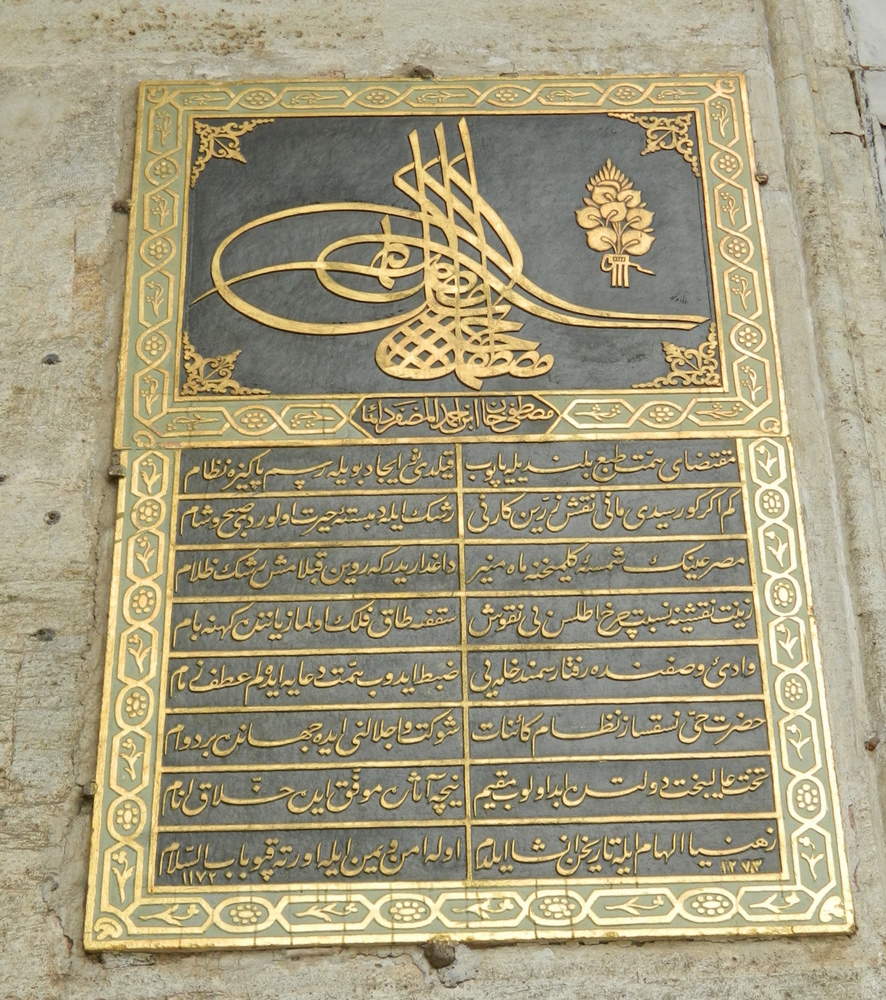
Alas we were at the exit very soon
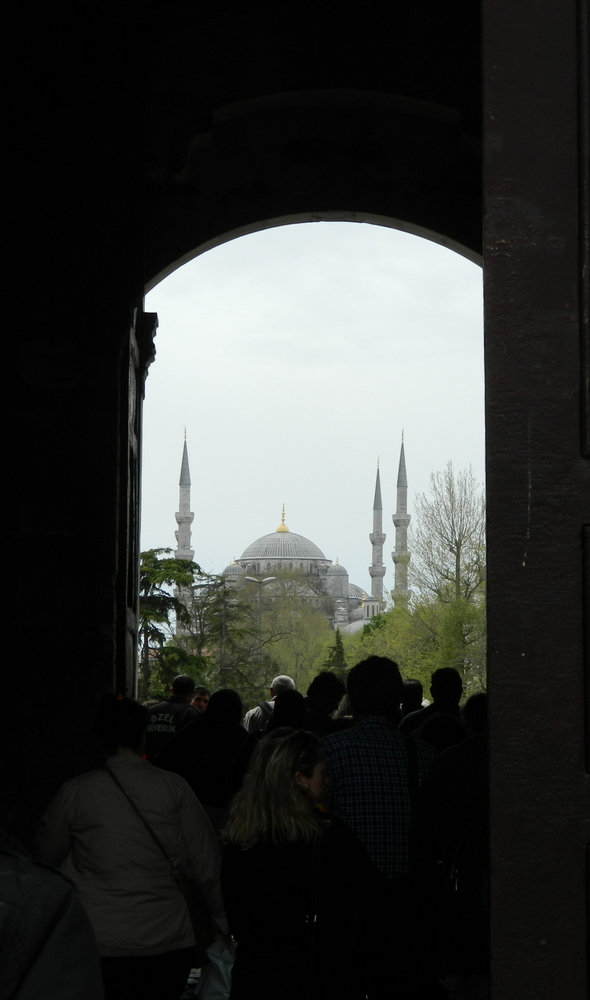 |
| Blue Mosque through the exit from Topkapi |
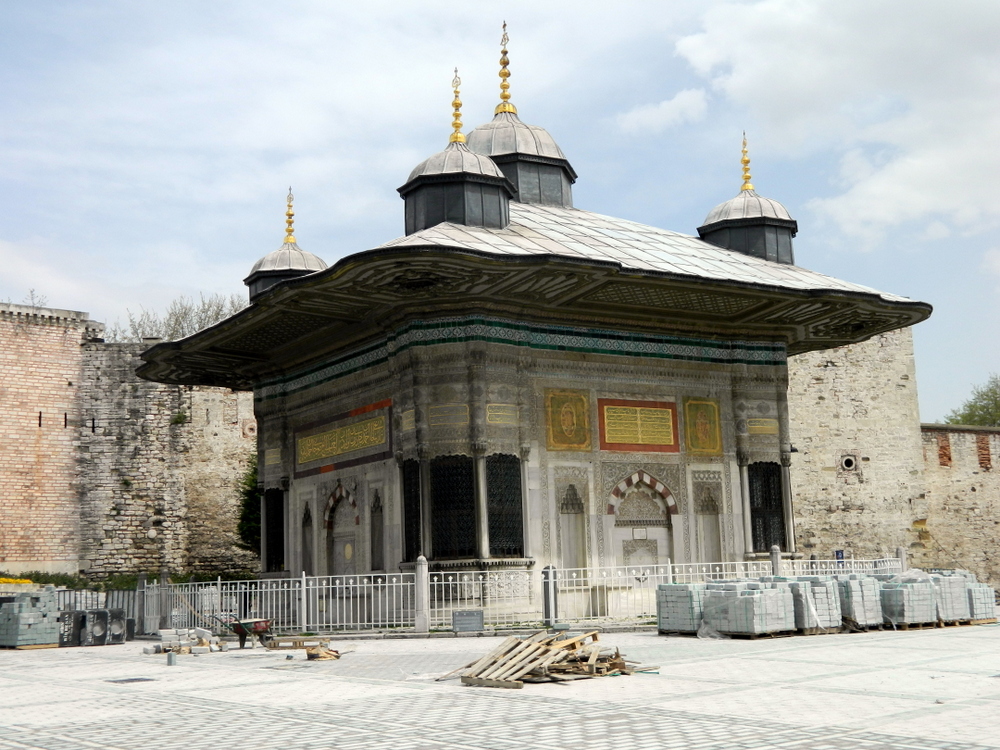 |
| An interesting building being build just outside the Palace |
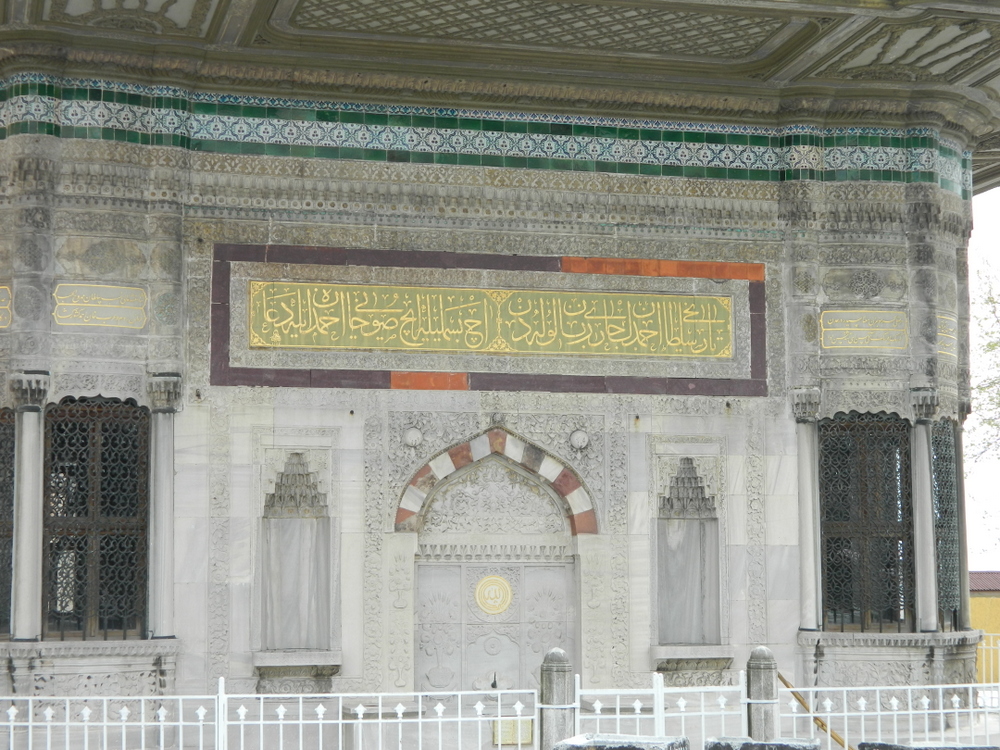 |
| detail of above |
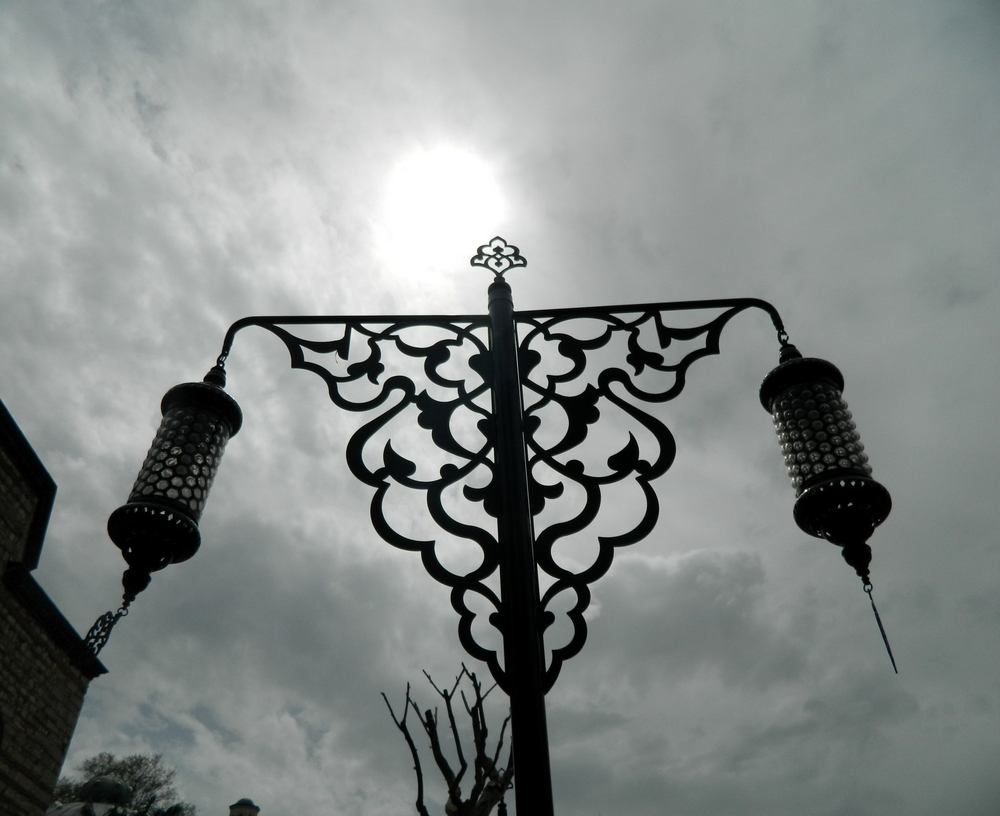 |
| Street light near the Blue Mosque |
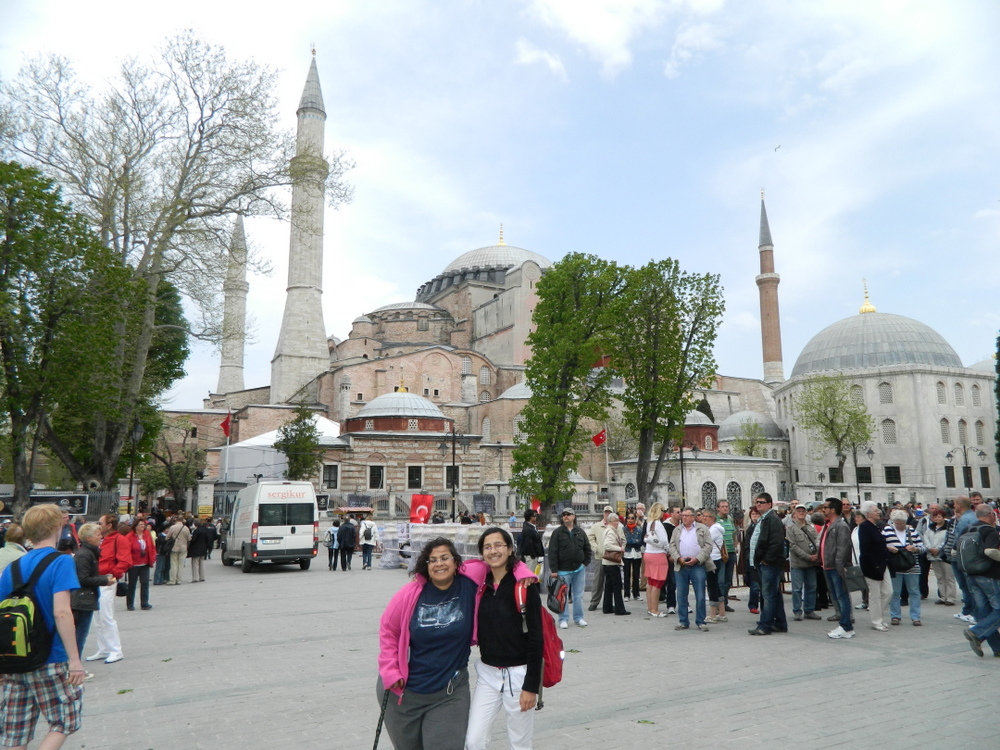 |
| Anita and Irene in front of Hagia Sophia |
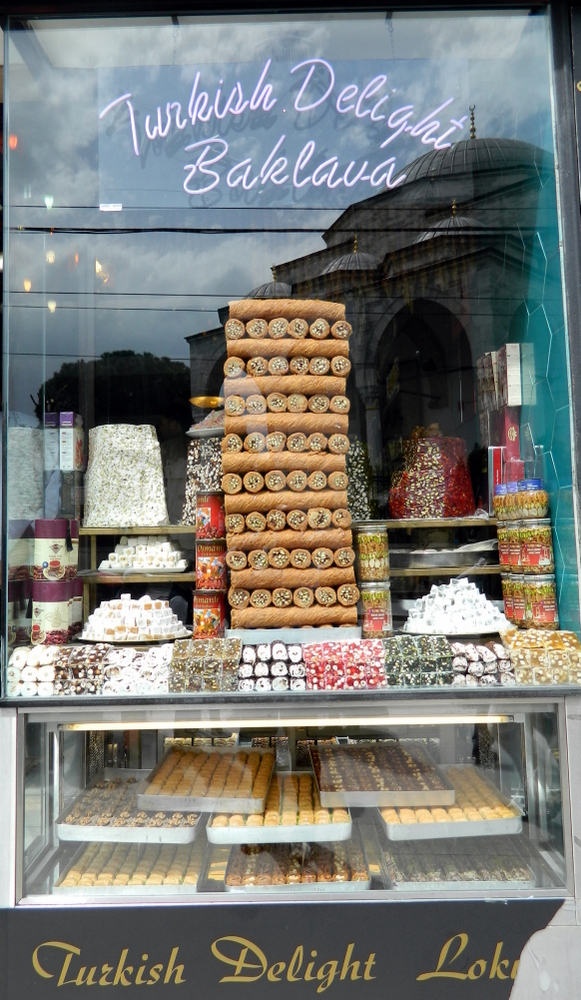
Sweet temptation
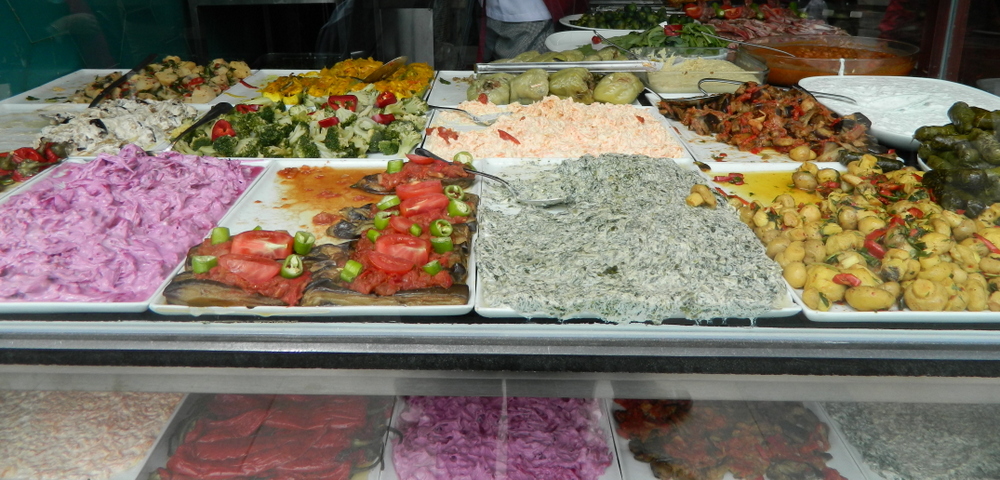
healthier temptation
The Grand Bazaar is one of the world’s oldest and largest covered markets with 61 covered streets and over 3,000 shops — we explored less than 1% before emerging with our booty. The guidebook advised us not to miss the many surrounding shops, but we had had enough. It is not a noisy Middle Eastern market with vendors hawking their wares, and is actually more peaceful than most Western shopping malls!
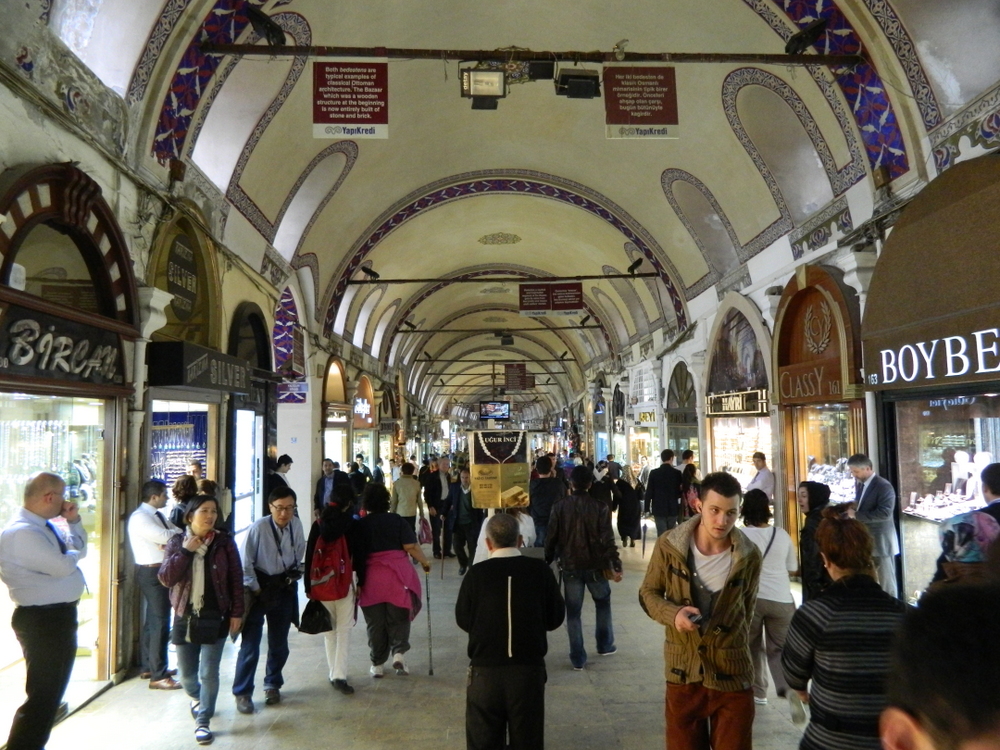 |
| Goldsmith’s street |
 |
| Souveniers |
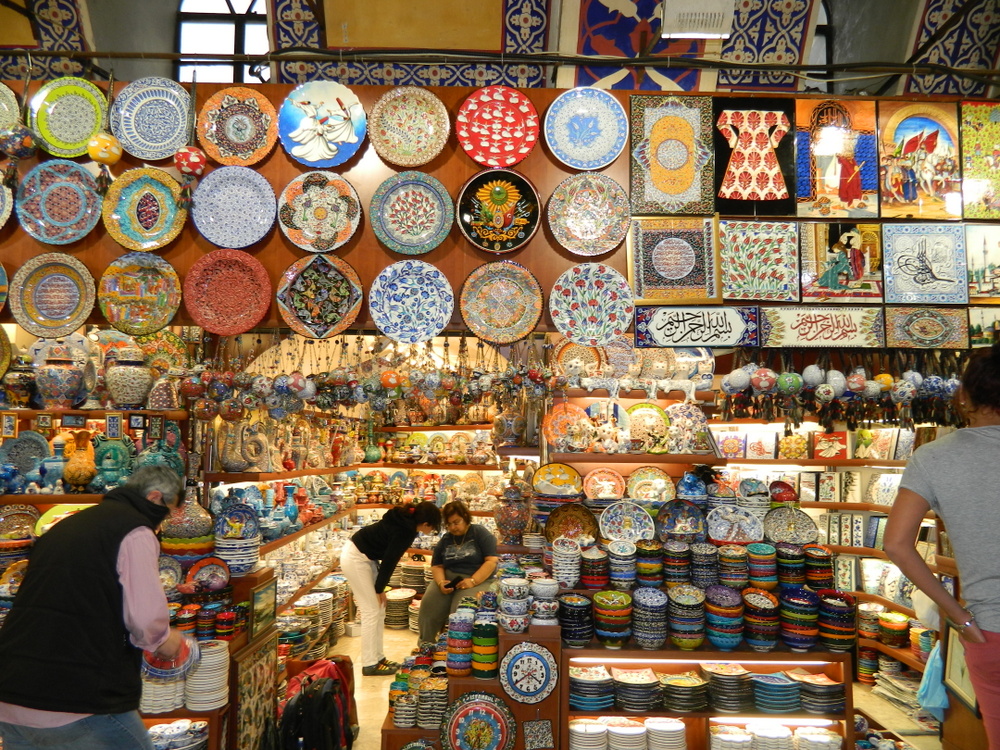 |
| Ceramics of all sorts — wall tiles, table tops, clocks, bowls, plates, vases, figurines, … All beautifully painted by hand or machine. |
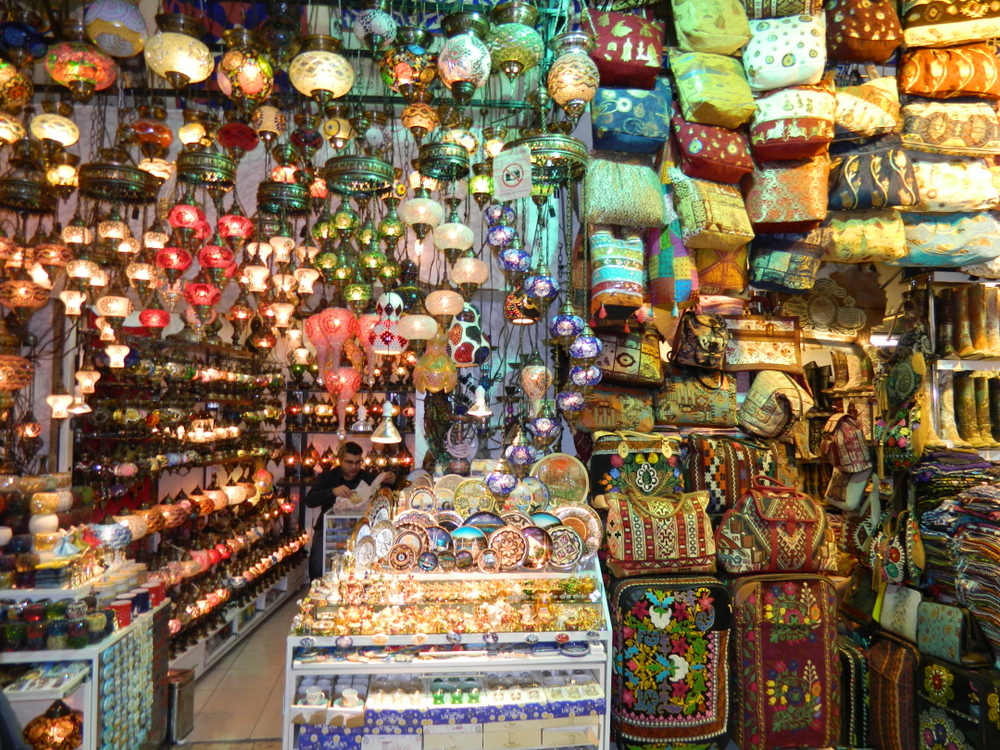 |
| Lamps and textiles |
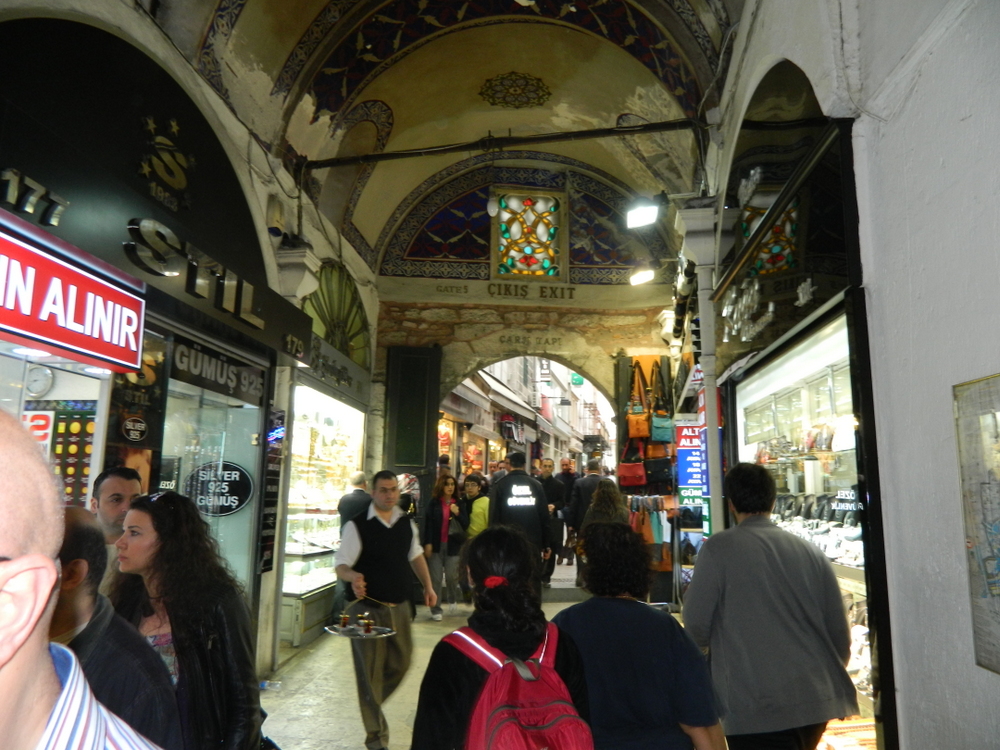 |
| The exit |
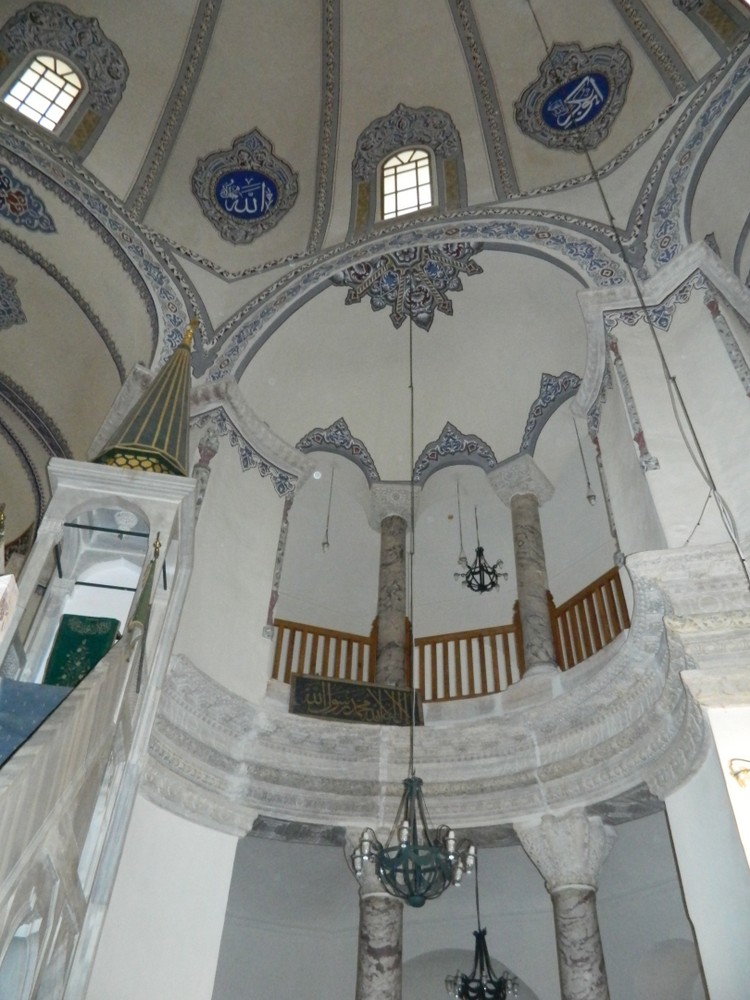
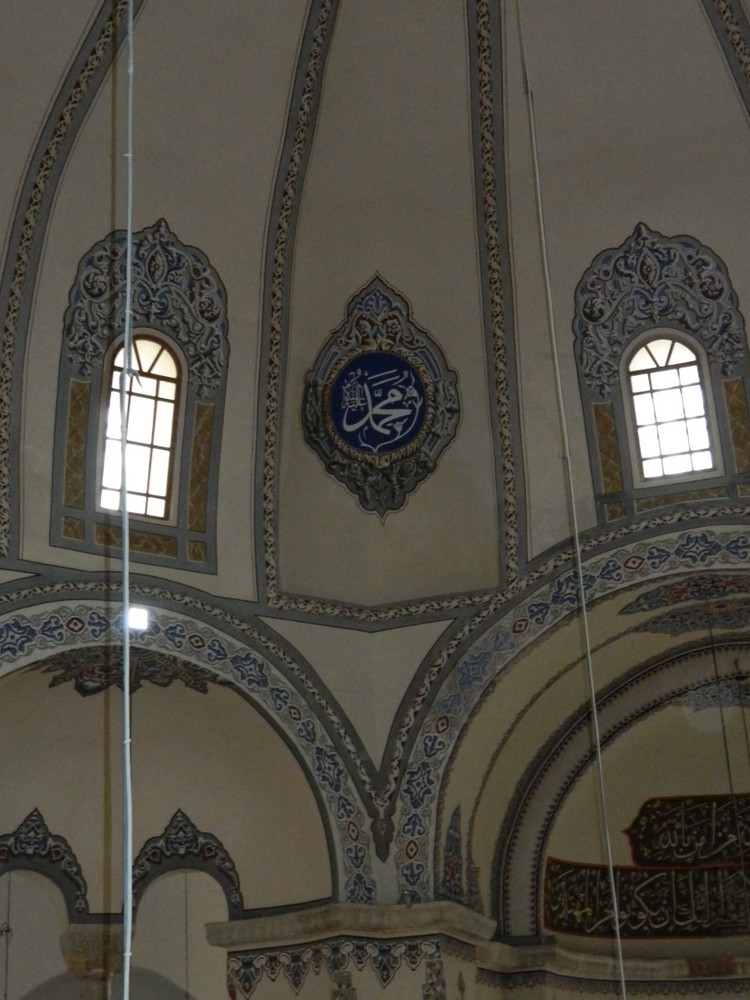
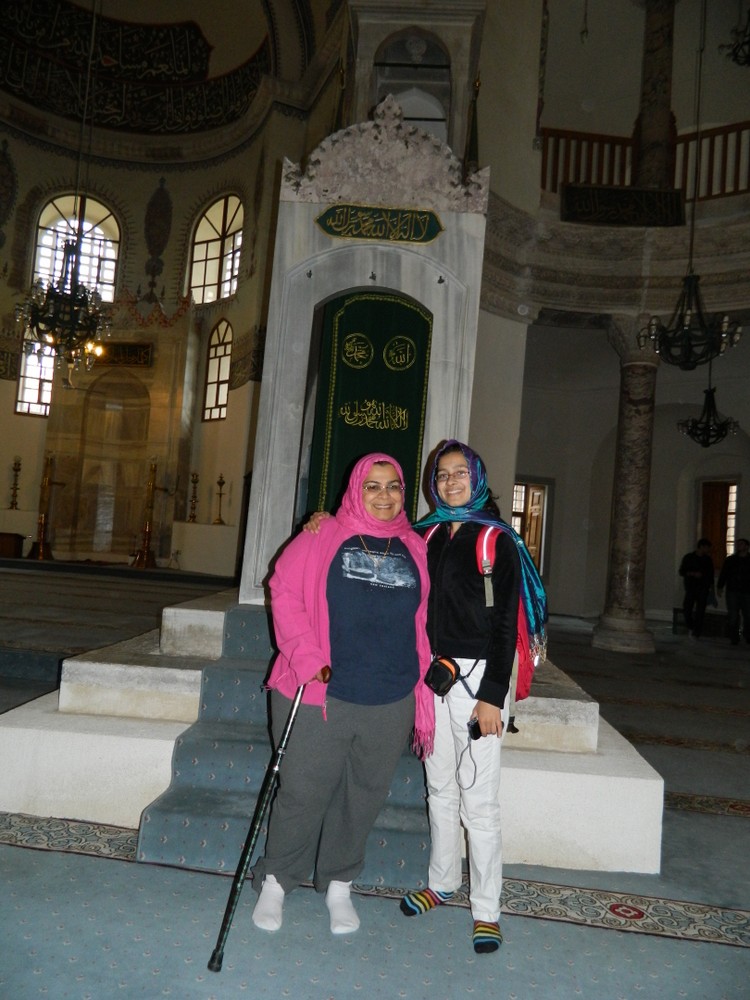
Church of SS Sergius and Bacchus built by Justinian and converted to a mosque and now known as Little Hagia Sophia Mosque (Küçuk Ayasofya Camii) is in an unpromising residential area near our hotel
It looks like a Byzantine church on the outside
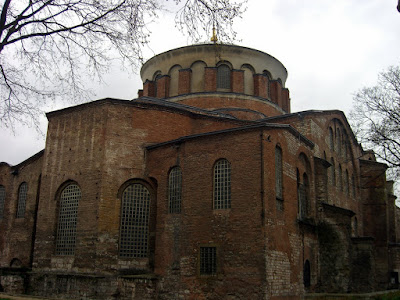 |
| image credit |
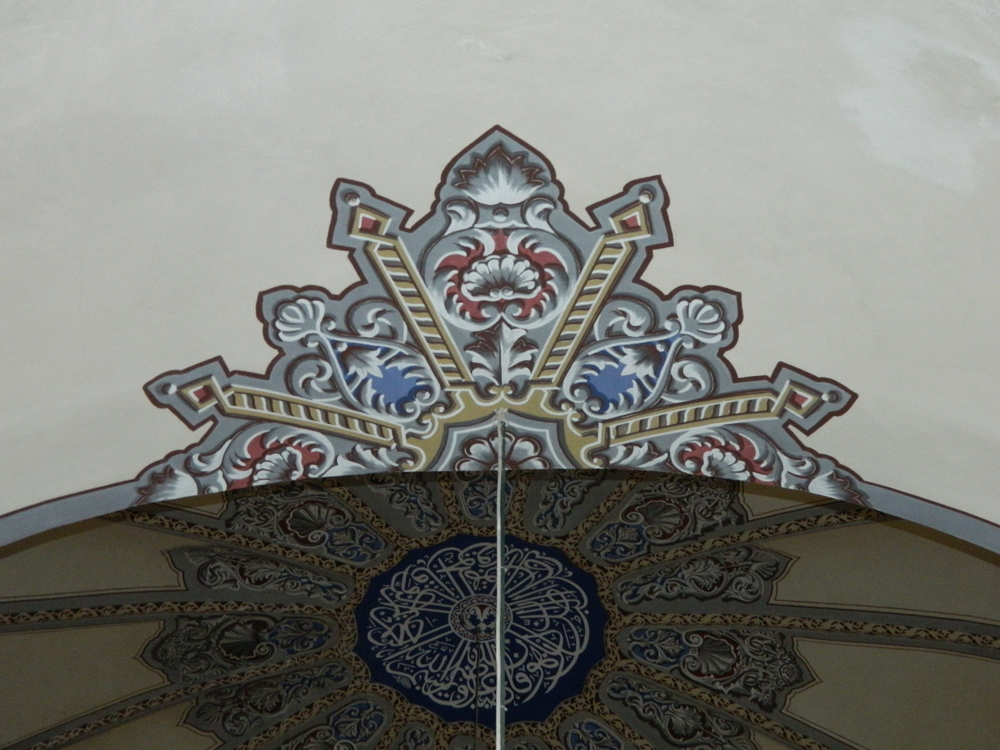
but like a mosque inside
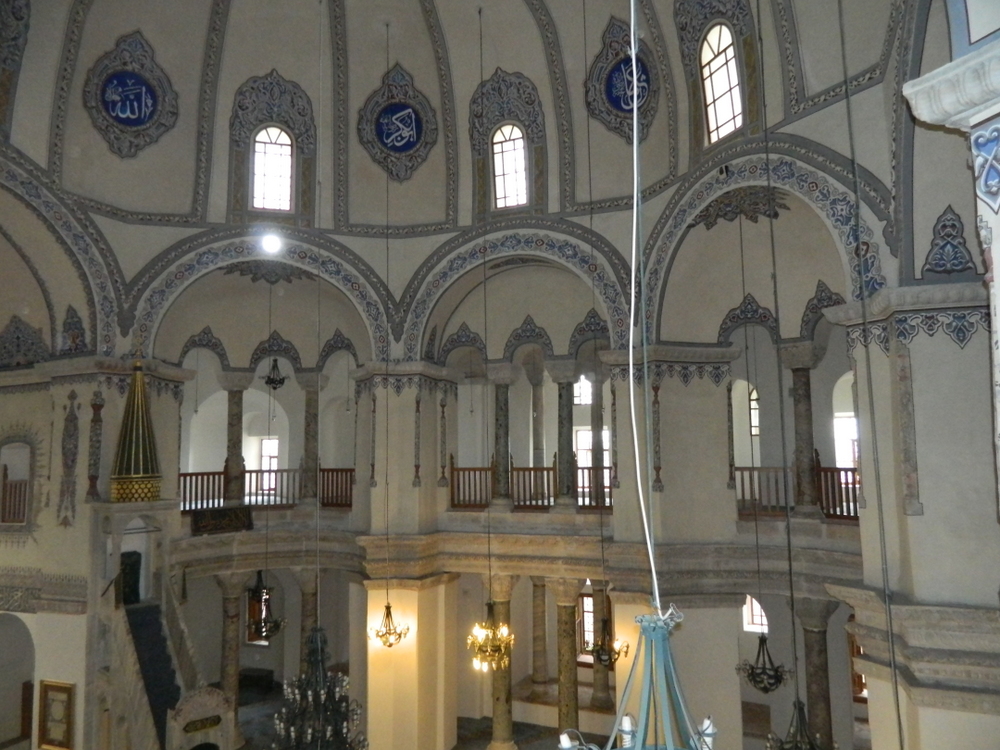

 |
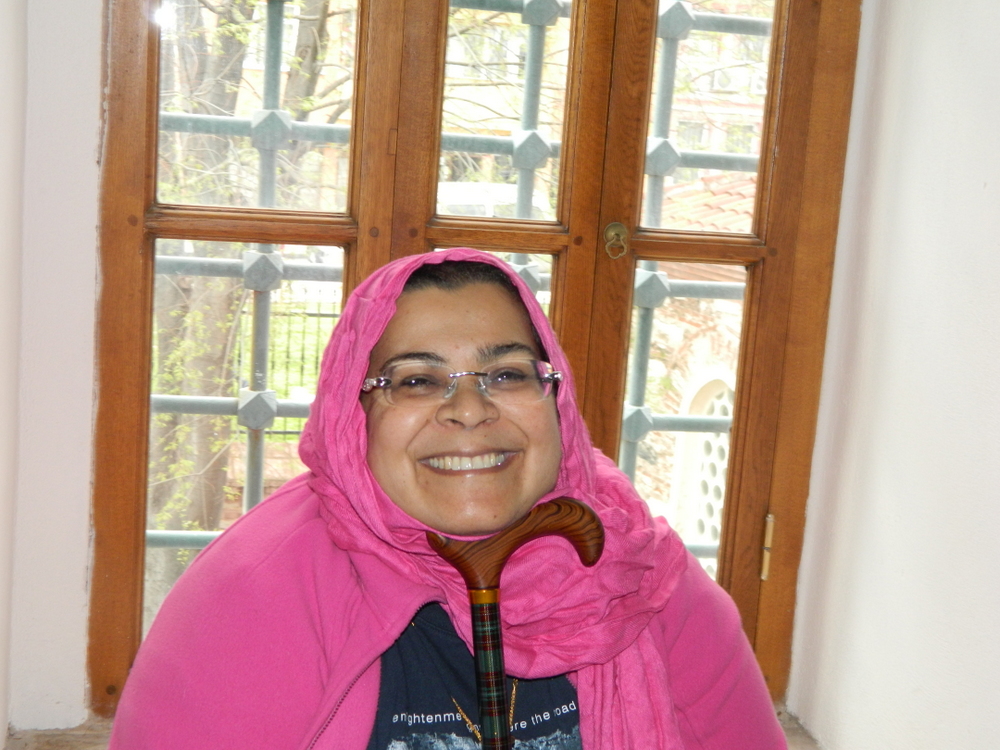
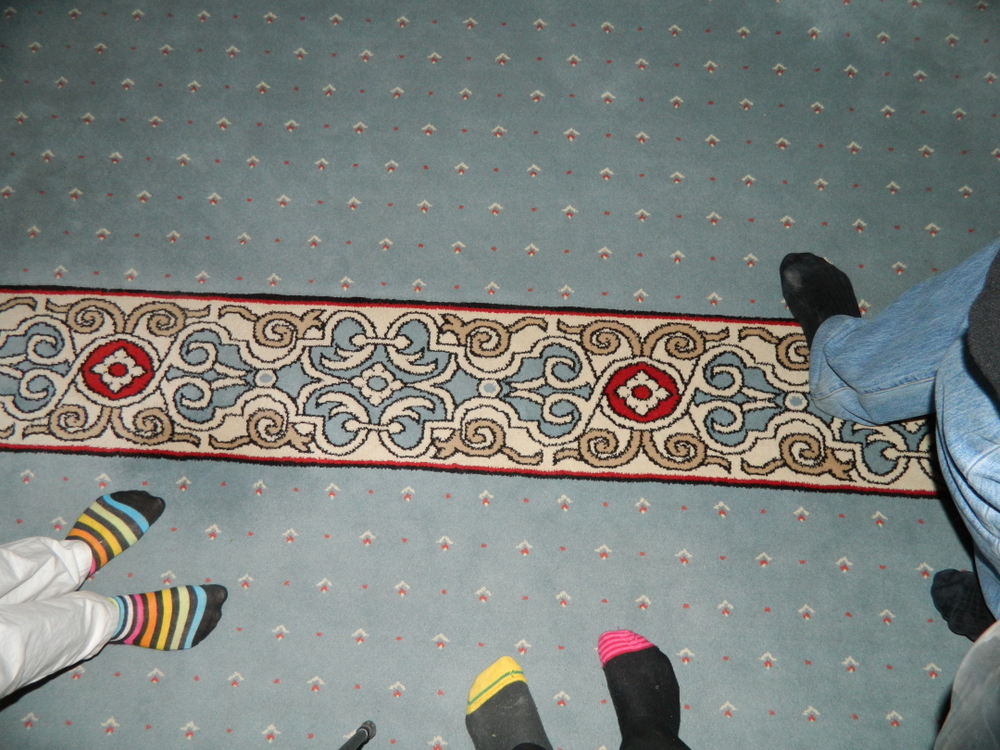 |
| Lovely soft carpet underfoot |
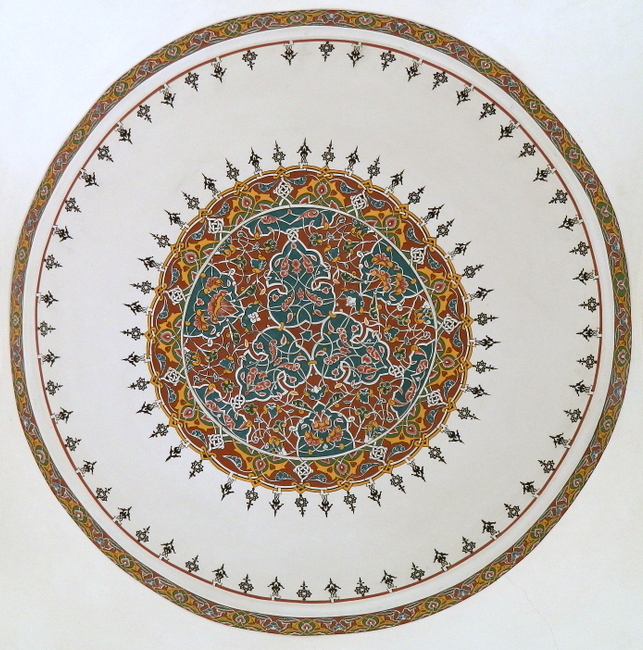 |
| A color scheme for the interior of the domes above the entrance |
The Basilica Cistern (Turkish: Yerebatan Sarayı – “Sunken Palace”, or Yerebatan Sarnıcı – “Sunken Cistern”), built by, you guessed it, Justinian. The columns are 9 meters tall, and there are over 300 of them, so it is like a massive flooded crypt. Now there are only a few feet of water, but someone has introduced goldfish.
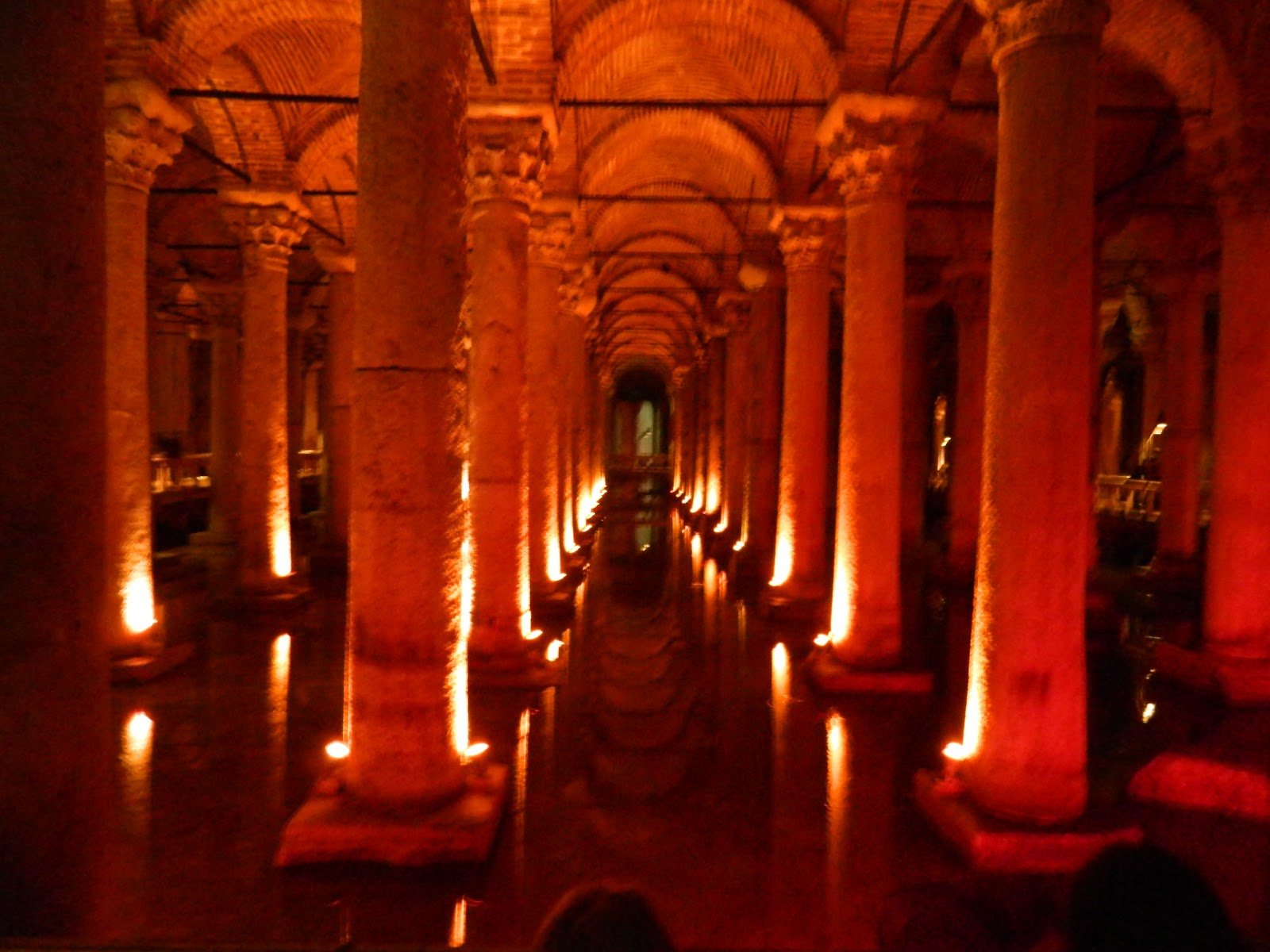
Most of the columns aresmooth with an ornate capitol. However, for reasons unknown, there are two with Medusa head bases and one carved column. Ofcourse, these columns were not desiged to be see by the publish, so they were probably just left overs, and defectives.


My Teenage Rebellion: Trying to become a Nun at Mother Teresa’s Convent!

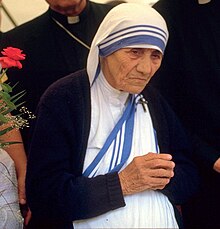
I have written about the experience here, A Teenage Atheist, and here, The Holy Ground of Kalighat.
Matt of The Church of No People recently asked me some questions about my experience, and I thought I would share them here. The questions in bold are Matt’s.
I’d like to hear what the everyday experience is like being a Christian in India, which makes someone a small minority in that society.
I left India in 1984. While I was there, Catholics were respected: because they ran good schools, colleges, hospitals, orphanages, homes for the handicapped, open to people of all creeds. However, intolerance were becoming evident with “Anti-Conversion Bills” making proselytising illegal. There is more hostility towards Christians now, and making converts (leave alone disciples!) is illegal in several states.
If you can, briefly tell us about why you joined the convent.
I was rebellious as a teenager in Catholic boarding school. During a period of “curfew” after religious riots, I found myself reading the few books in our house which I had not read—Catherine Marshall’s Beyond Ourselves and The Cross and the Switchblade.
I was attracted by the idea of a living relationship with Christ, and committed my life to Him. I simplistically thought the only way to follow him was along the lines of Matthew 25, “Whatever you do to the least of these, you do to me.”
Who did that kind of work? Mother Teresa.
I wrote to her, was accepted, and was in the convent 4 months after my conversion!!
I have written about my conversion experience for Commonweal magazine, reprinted in Phil Zaleski’s Best Spiritual Writing.
Forgive my non-Catholic vocabulary, but what your “title” there – were you a nun?
I was a postulant. Nuns go through a 6 month aspirancy, a 6 month postulancy, and a 2 year novitiate, before they take their vows for 6 years. After 9 years, they take their final vows.
Anyway, I’d love to hear just a bit about life in a convent, particularly the convent of our time’s most famous nun.
It followed the ancient Benedictine model, a mixture of work and prayer.
Since I was still in training, we spent mornings in classes on theology, Scripture and their constitution, and in prayer. We worked in Mother Teresa’s homes in the evenings– in the home for dying destitute, orphans, and the mentally. (I’ve written about my work at Kalighat, the home for dying destitute in Zaleski’s Best Spiritual Writing series.
The recitation of the Liturgy of the Hours–laud, none, vespers and compline, a melange of psalms and traditional prayers–ring-fenced the day in prayer, In addition, there was Mass; an early morning half-hour of silent meditation on scripture; an hour of “adoration,” or contemplative prayer; and a half hour of spiritual reading. A total of 3.5 hours in various spiritual activities. I did gain much familiarity with Scripture, which has been a blessing to me.
When I was there, 1979-1980, it was a young religious order, and eccentric, shaped by a visionary, who was revered, and apparently unquestioningly obeyed.
One of her dearly-held ideas was that one needed to voluntarily share the hardships of the poorest of the poor to have empathy for them.
The deliberate quest for extreme poverty meant that we were put 25 to a room, and there was a constant time-consuming shifting and re-arranging as the room became a refectory, a classroom, and a dormitory.
There was no running water which meant we spent half an hour every day in a crocodile, drawing buckets of water from the wells and transporting it to the bathrooms and kitchen. We had just 2 sets of white sarees, which meant daily hand-washing…
The food was simple, and nutritious enough, but, another peculiarity, there were large fixed quantities one had to eat, which were quite extreme: 5 chapatis for breakfast, and five ladles of rich for lunch and dinner. After a couple of her sisters caught TB on her original diet of salt and rice, rice and salt, she imposed this as a safeguard against disease.
Everything, even the pettiest details–subjects to meditate on as one dressed, mending sarees from thread unravelled from scraps– was controlled by rules. It was high-control, almost like a cult, legalistic and judgmental. After a while, it becomes easier not to think for yourself, and instead do whatever would get you praised, or avoid what would get you judged.
What went into your decision to leave the convent and your faith? How does someone walk away from such a dedicated faith life?
I saw an image of myself in a train going ever further in the wrong direction, but afraid to get off for fear of looking foolish
We slept at 10, and woke at 4.40 a.m. for church, with a half hour mid-day nap. Since I was 17 when I joined, I was perpetually tired and felt constantly sleep-deprived. Sleep deprivation (used by cults, and authoritarian systems: labour camps, prisons) makes it easy to go along with authority and not question. My first thought on waking and predominant longing was for naps and bedtime. It wasn’t sustainable.
The first three years were a kind of boot-camp, deliberately harsh. The novice-mistresses had complete power over us (one of the vows was obedience) and I struggled with perceived injustice, and the authoritarianism with no recourse of complaint.
The nervous intensity of prayer, and scripture study and meditation can ironically heighten irritability, and the rub of community life 24/7 with 25 people sharing a medium sized room.
Two people had breakdowns when I was there. One just sat and giggled helplessly. Another was sent home and attempted to jump out from the bars of the train. Leaving the convent once you join was viewed as disgraceful in Indian Catholic society.
And, in fact, my health was shattered, though no one realised this while I was in the convent. I returned home, deeply exhausted, and within the month was diagnosed with both early stage TB and hepatitis!
I was thoroughly exhausted, and in retrospect, it clearly wasn’t my vocation!
What brought you to the faith you have today? Did you have the support of Christian friends or family members?
I was a passionate, absorbed student, so faith—in particular, the liturgy, the rituals, the dogma of Catholicism–gradually went limp and lifeless for me.
I earned an undergraduate degree in English at Oxford University, and then did a master’s in Creative Writing at Ohio State University, and some of a Ph.D in Creative Writing at SUNY-Binghamton. A couple of young students on a campus mission came up to me, and asked if I knew Jesus.
My dream then was to be a successful poet. Success had evaded me. It was all very uphill–and it struck me that I wasn’t doing too well, managing life on my own. It could only be better if Christ managed it.
But faith had by then sloughed away, and a friend suggested I just do what Jesus said and see if worked. Well I did, it did; I was surrounded by little miracles, and I recommitted myself to following Jesus.
My goal now is to live as a contemplative in the world
The Christian imperatives which Jesus with his Gordian-knot-slashing directness reduced to two–to wholly love God and to love your neighbor as yourself–remain the same. There is just more distraction. Without the traditional monastic disciplines- prayer, meditation, adoration, the liturgy of the hours, and “spiritual reading– it takes ingenuity to carve for myself a circle of silence to feed on Christ and Scripture and to live contemplatively, remembering Jesus not only amid the beauty and tranquillity of my garden, my writing, and my books, but in the crucible of marriage, motherhood, domesticity, and the busyness of everyday. The demands of unselfishness remain constant, without the convent’s periodic sanctioned escape into the sacred ivory spaces of psalmody and song. In fact, I now consider domesticity, marriage, and motherhood a smithy in which the soul can be forged as painfully, as beautifully, as amid the splendid virginal solitudes of the convent.
The Bosphorus Cruise–in the narrow strait between Europe and Asia!!

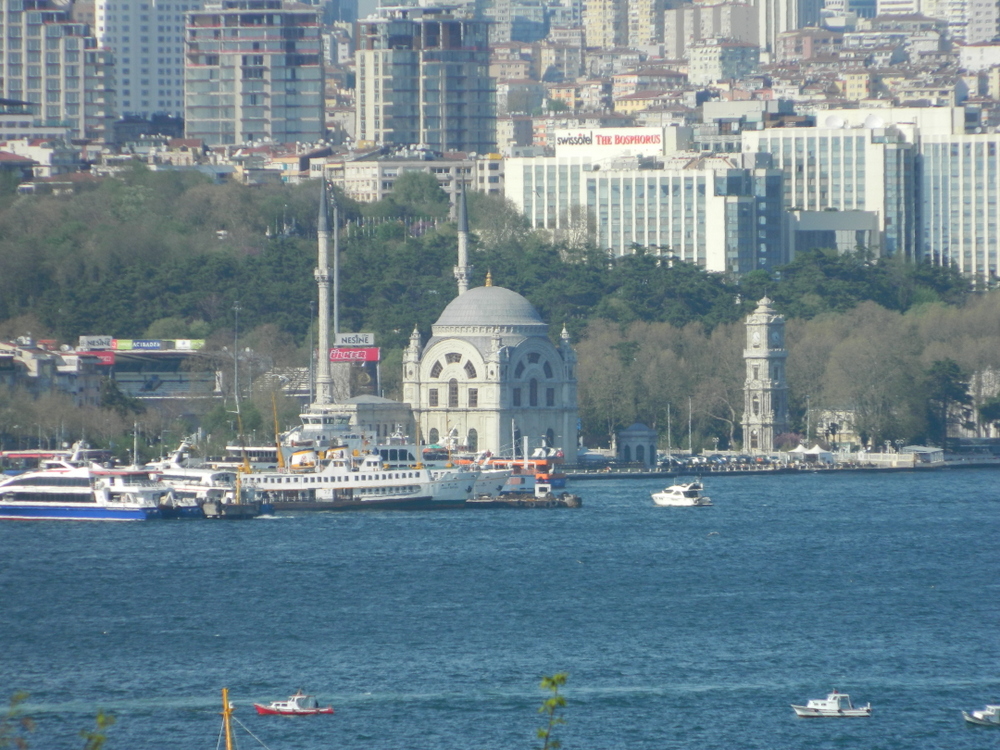
We went on one of the world’s most unique cruises today–the Bosphorus Cruise: Europe on one side of the narrow strait, Asia on the other. Seagulls haunting the strait, dolphins leaping, the Black Sea at one end, the Sea of Marmara on the other–and fantastic mosques, palaces, summer houses and churches on either side of the Bosphorus.
I loved it–it’s where I live, metaphorically, between Europe and Asia. Am totally at home in Europe after almost 3 decades in the West, and at home in Asia too (though, oddly, less so). What a fantastic, and beautiful conjunction of my two worlds!
And sitting watching the amazing, almost surreal panorama of palaces, mansions, summer houses, mosques and churches go by while seagulls wheeled and screeched–I was purely happy.
I always thought I would get bored on a cruise–that I had too active a temperament, would like to interact with streets, churches and palaces on foot.
Turned out I was wrong–I think I will enjoy a cruise–am dreaming of a Baltic cruise to Latvia, Lithuania and Estonia someday–when I am am old(er)…
And thank you to Roy for writing the rest of this post, and giving me a fighting chance of keeping up with my blog on holiday:-)
The Bosphorus Cruise begins at the Galata Bridge.
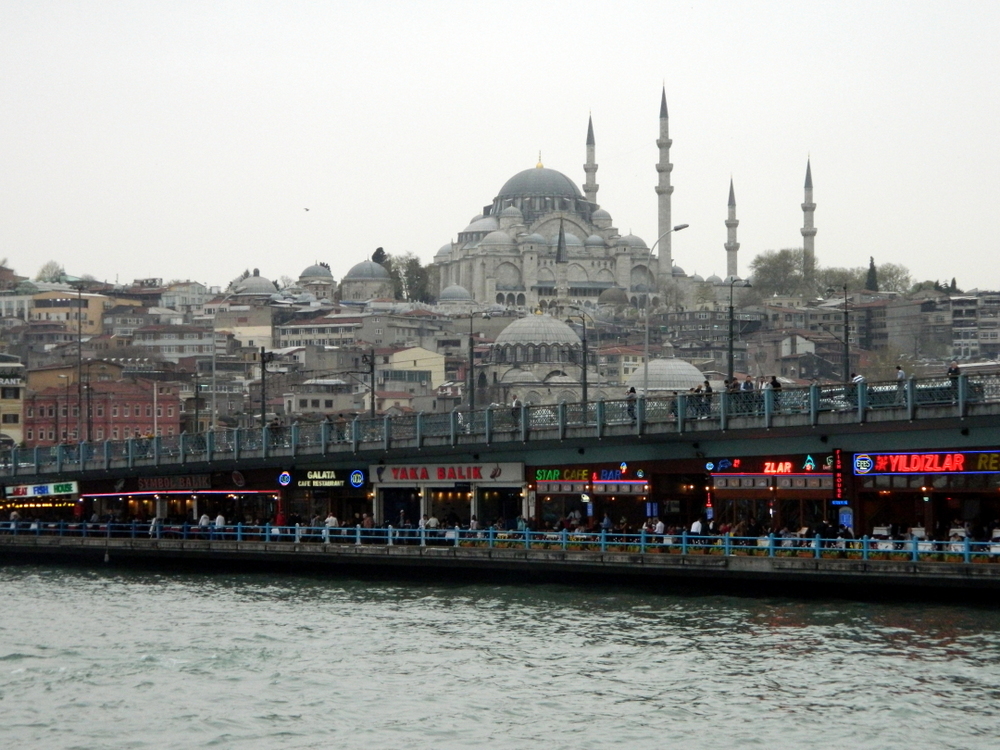 |
| Galata Bridge — showing shops below, and the New Mosque above. |
The Galata bridge features in many paintings of Istanbul. Here is one from our hotel

There are numerous palaces along either side of the Bosphorus, as well as some elegant riverside homes. Unfortunately, they tend to all blur into one another by the end of the day. Here are a few shots of palaces
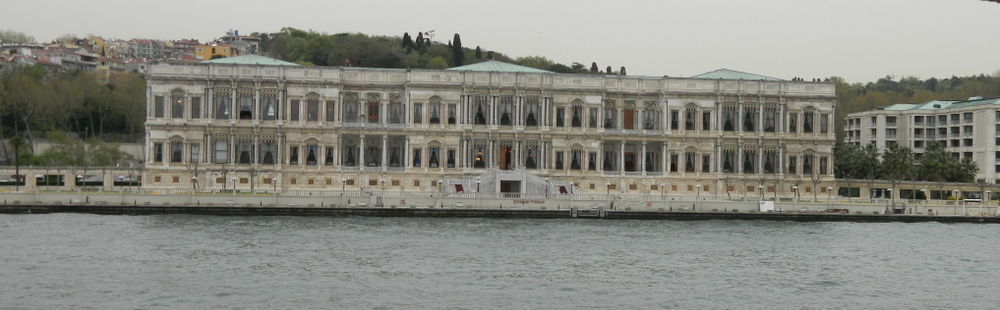
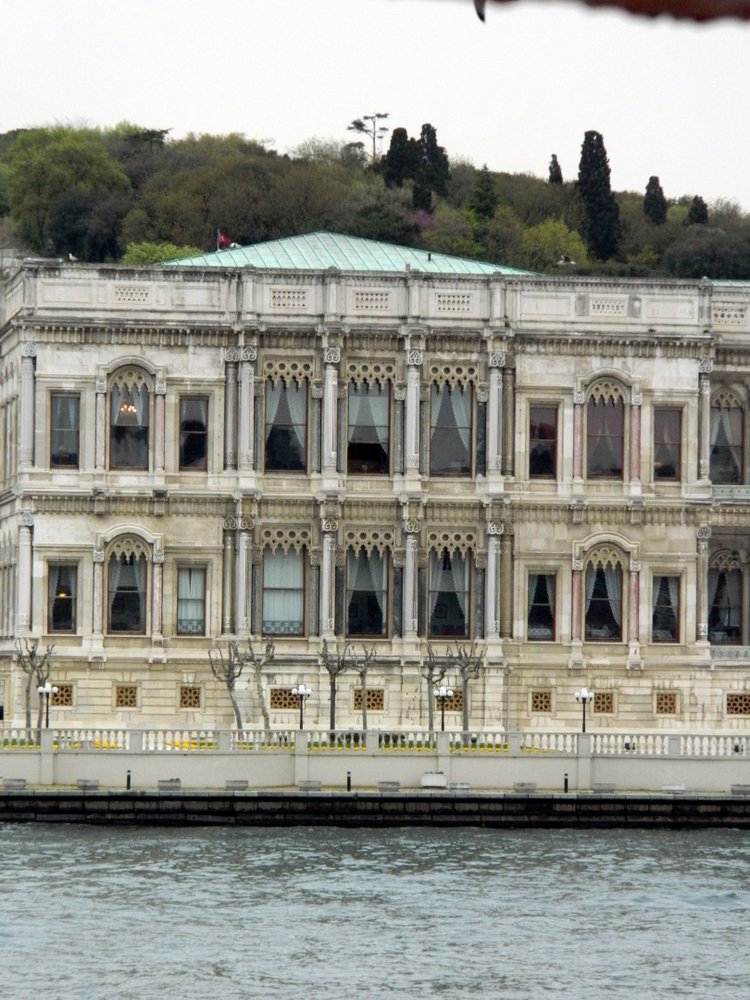
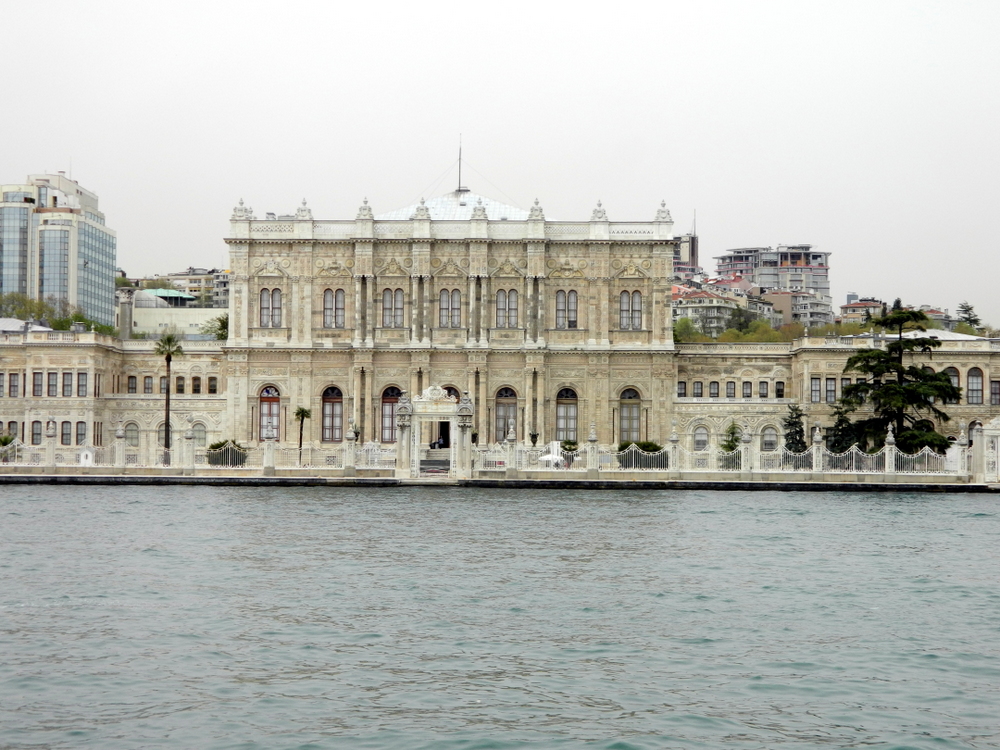

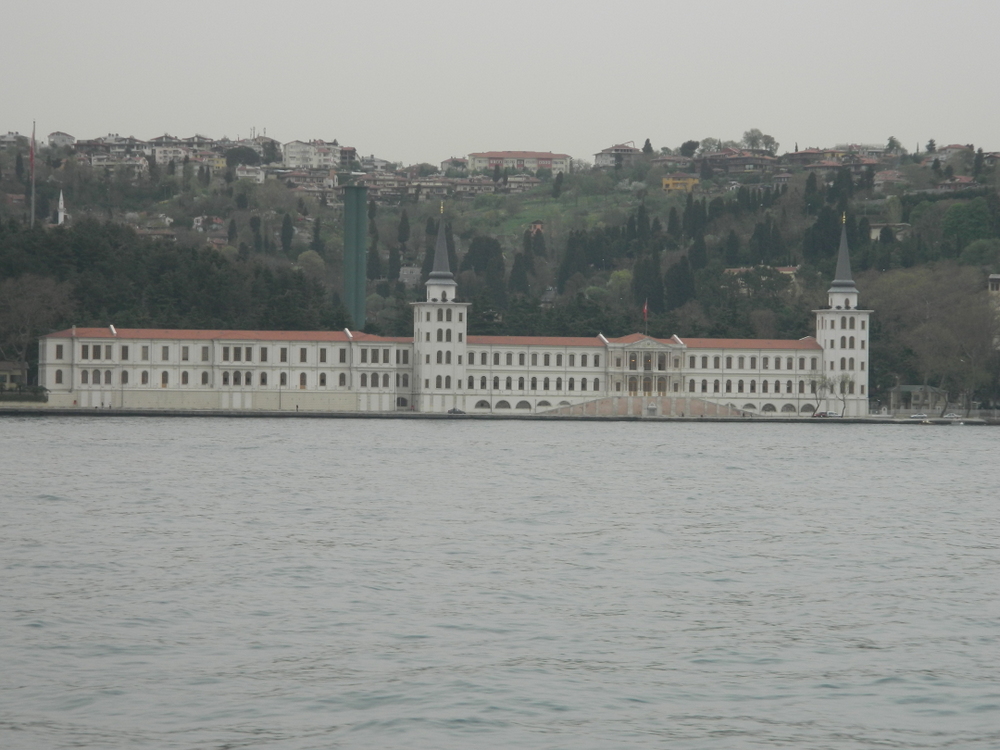
and river front homes
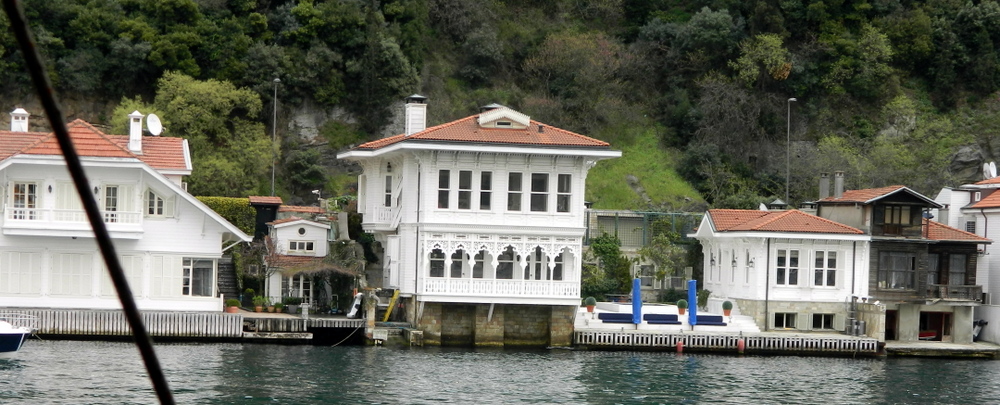

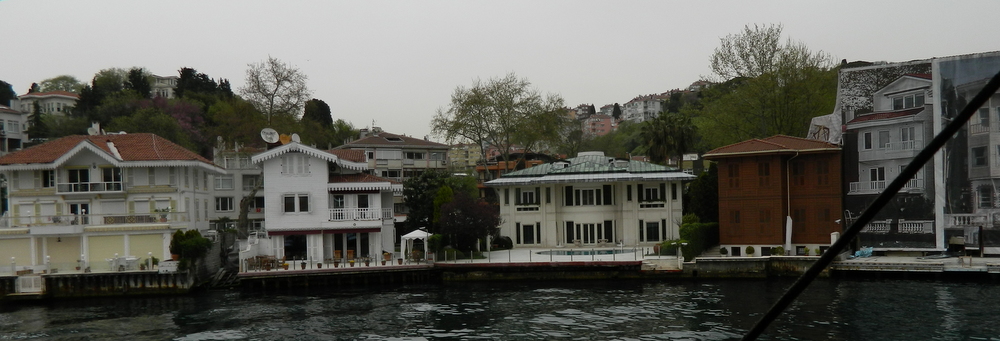
There were numerous mosques, both by the water and higher up

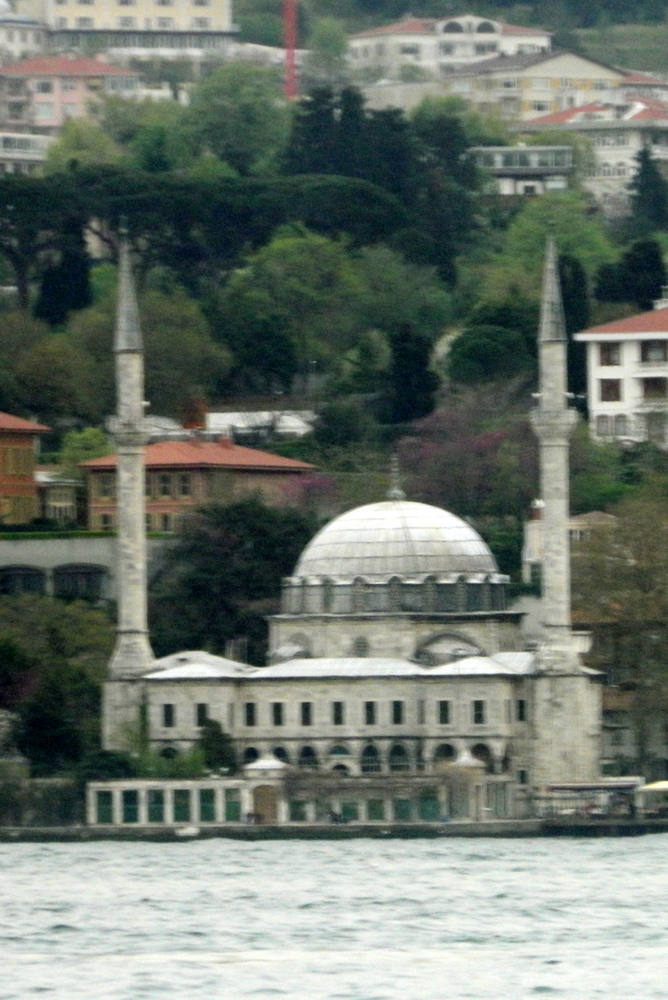
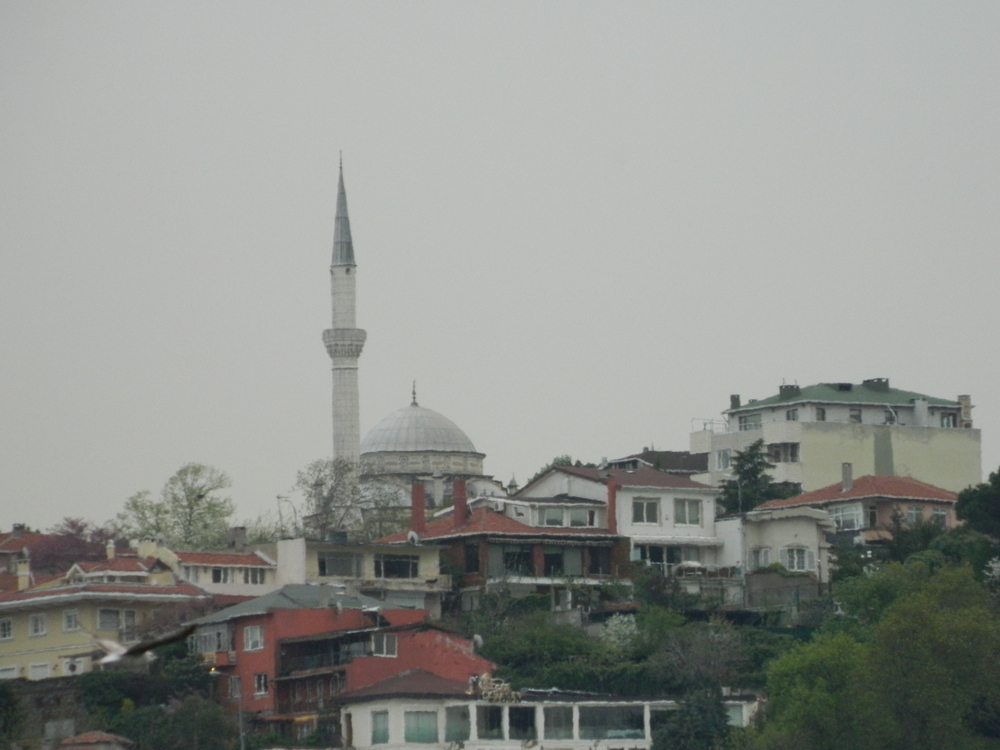

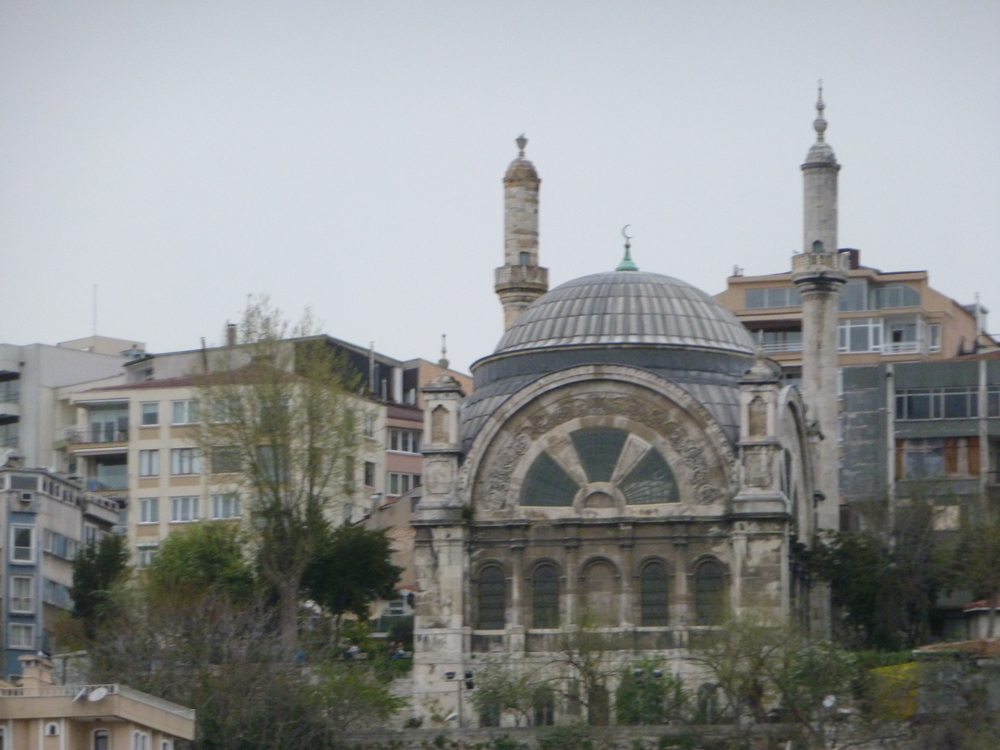
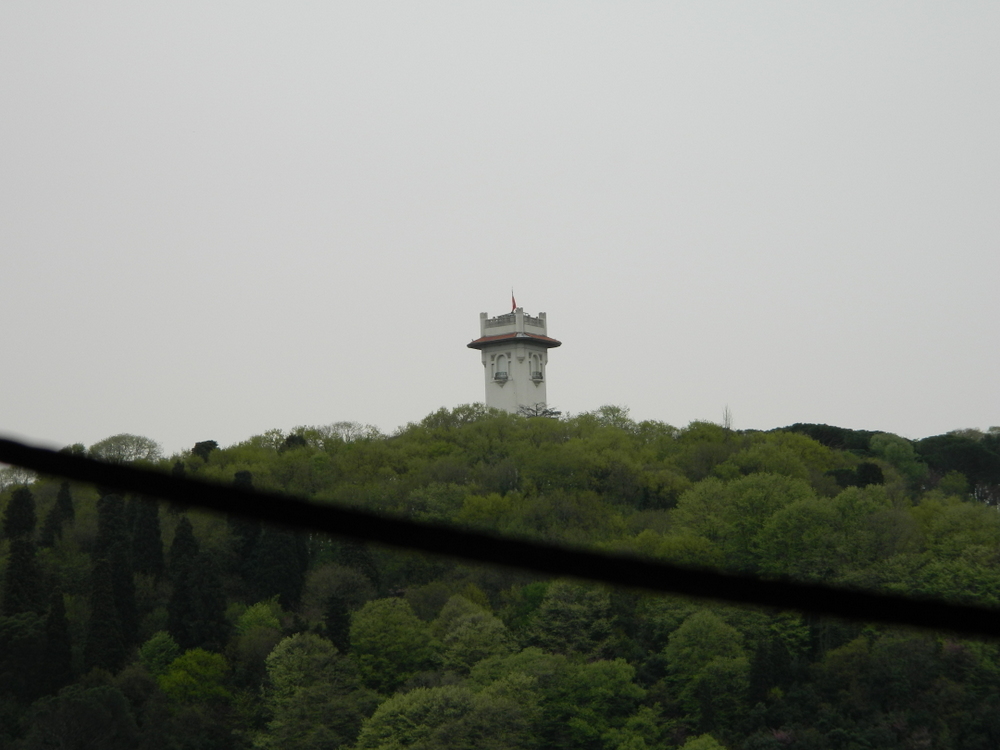
After a while one leaves Istanbul, and comes to smaller villages. Here are a couple of the stops

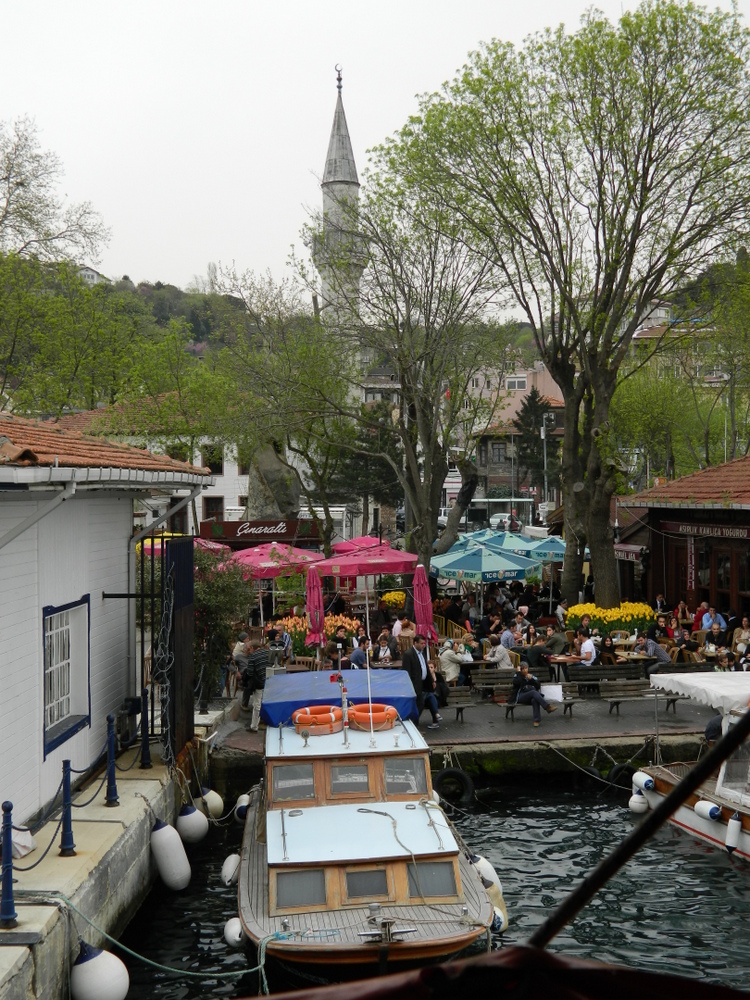

and a wooded area between them
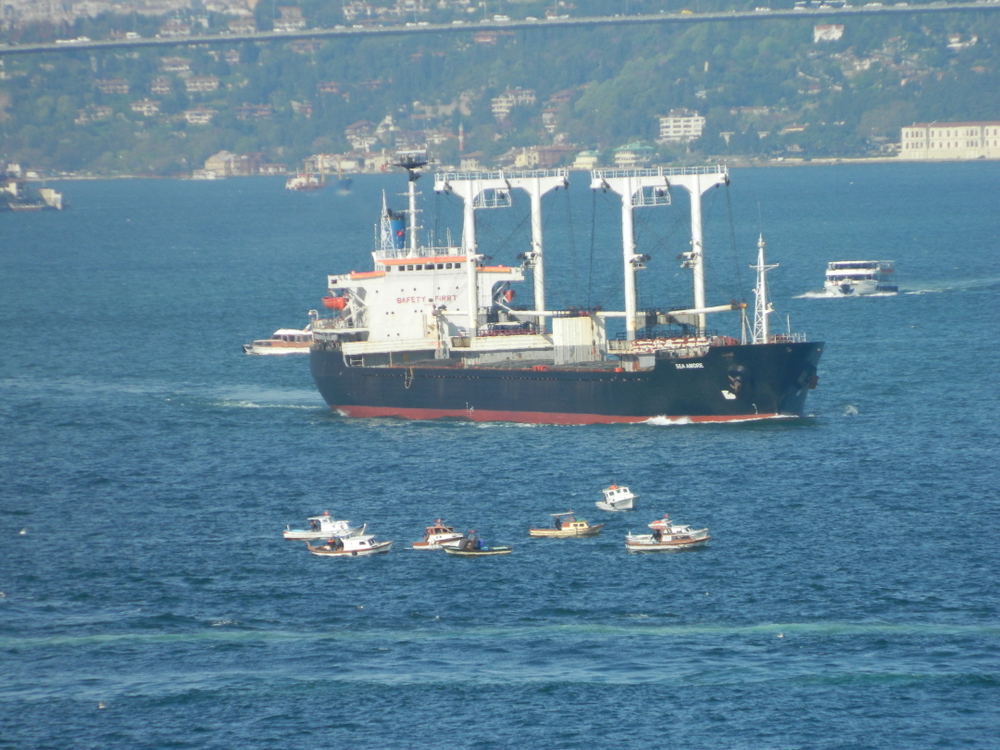
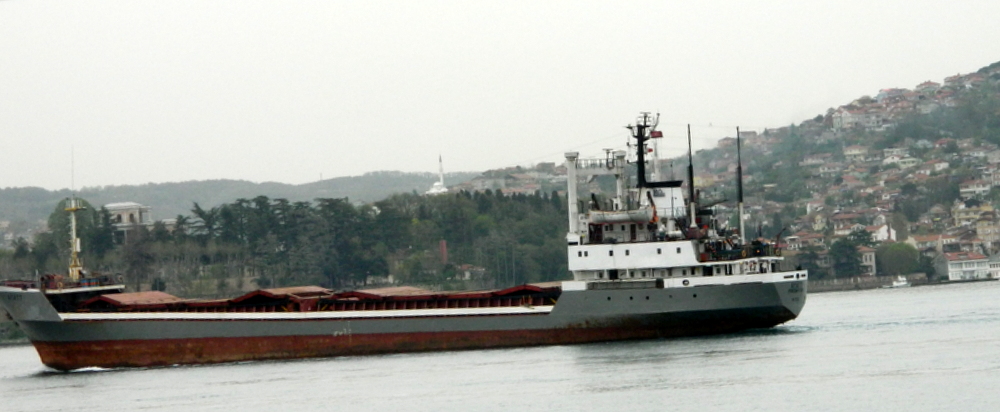
Despite the filthy water traversed by Russian oil tankers and other large rusty vessels
we saw a lot of dolphins, but were not quick enough to get a good shot

Of course there were seagulls too

At the Black Sea end the ship breaks for lunch. We had a nice fish meal at a riverside restaurant
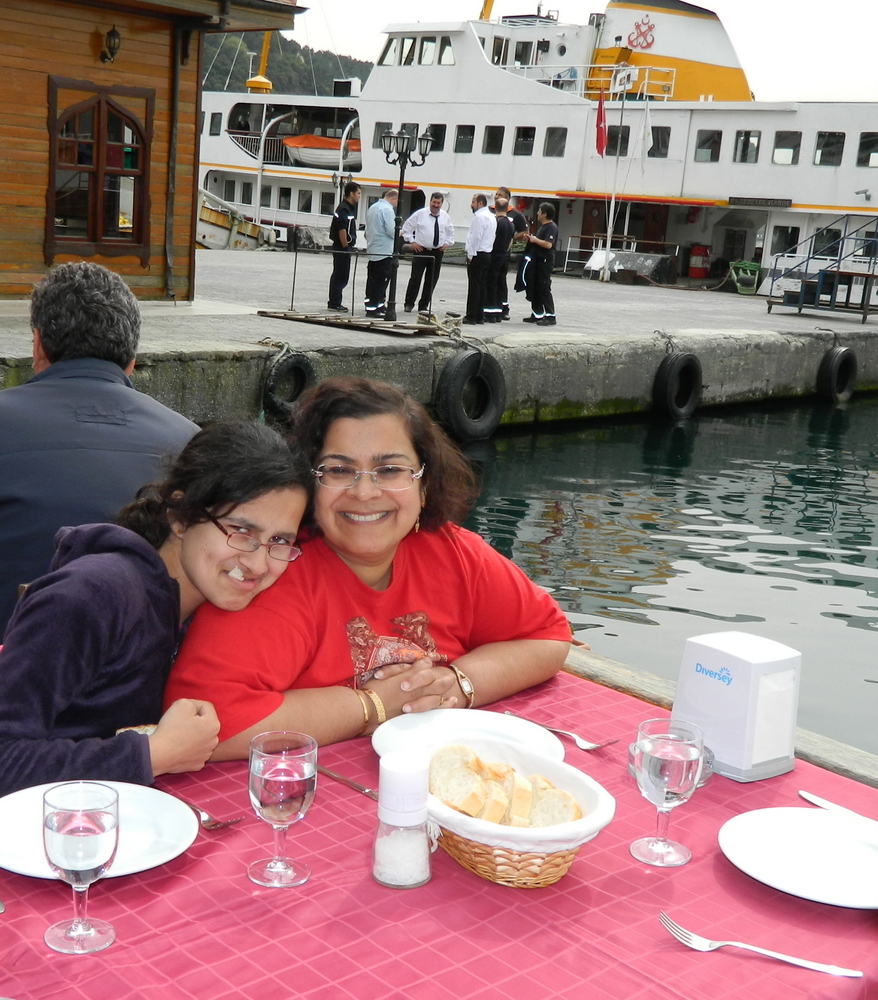
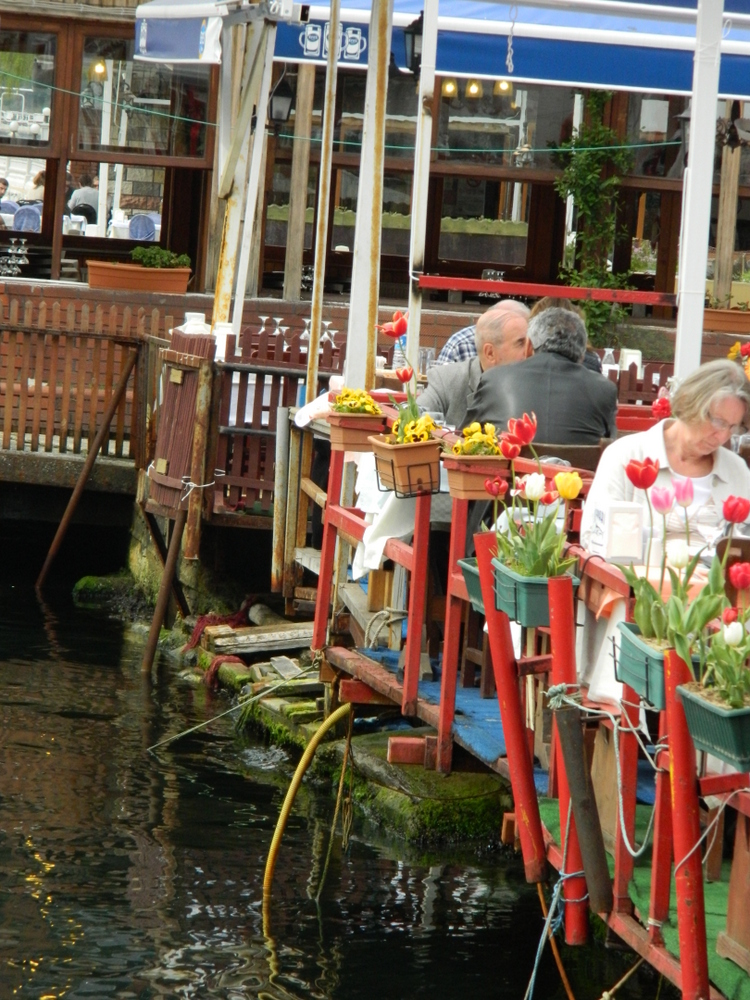
and Irene posed with the tulips

The Blue Mosque in Istanbul

The Blue Mosque in Istanbul
I visited the Blue Mosque today. Simply gorgeous. Called blue because of the Iznik tiles, but also because of the wealth of stained glass windows. Simply, mind-blowingly, mind-bogglingly gorgeous!!
And I am thankful to my husband, Roy for the photos and the commentary in the rest of this post!
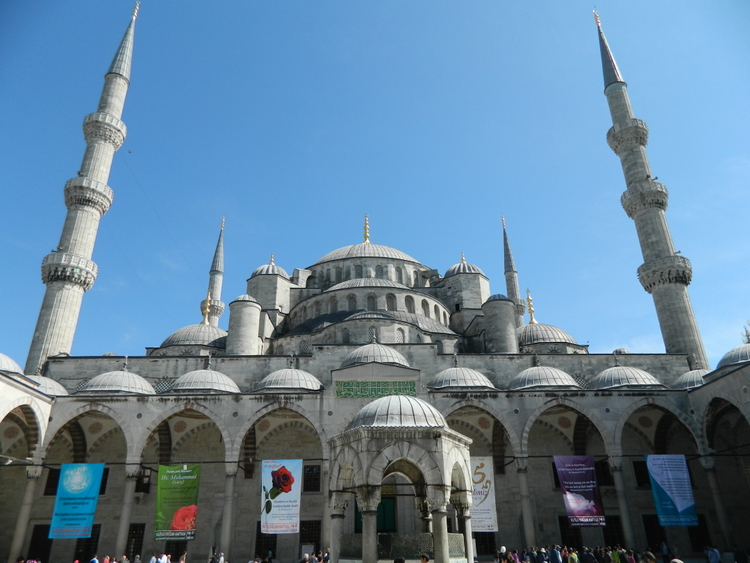 |
| View of the Blue Mosque from just inside the courtyard. The banners give extracts from the courtyard that are likely to appeal to all. e.g, Pay the worker his wage before his sweat dries |
The Blue Mosque (Sultan Ahmet Cami in Turkish) is generally regarded as the most beautiful Mosque in Istanbul, and is many tourists’ favourite sight. Here is an aerial view

showing the six minarets (four is more usual) the large courtyard, and the hilltop setting. Notice also the single large dome, smaller domes and numerous semi-domes (in this picture and the one above). The inside of each of them is decorated.
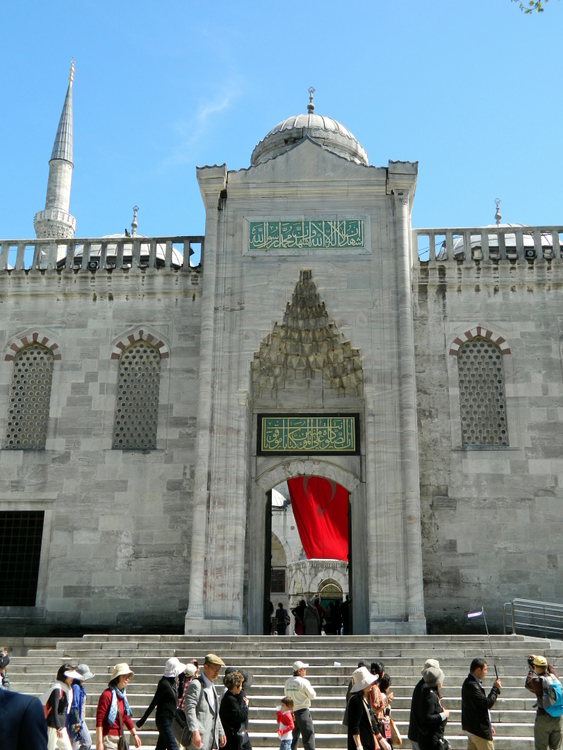 |
| Entrance to the outer courtyard |
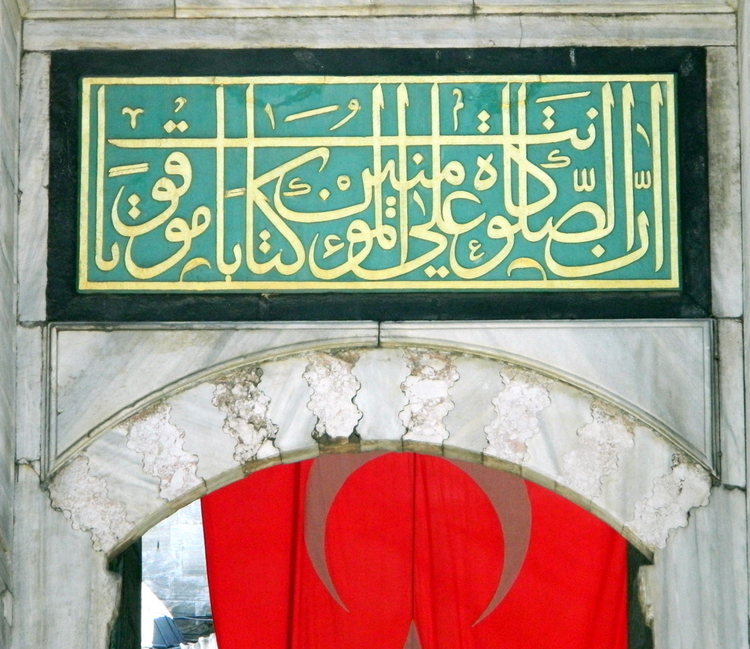 |
| detail |
Some views from inside the courtyard, which was a cool, peaceful and restful place.

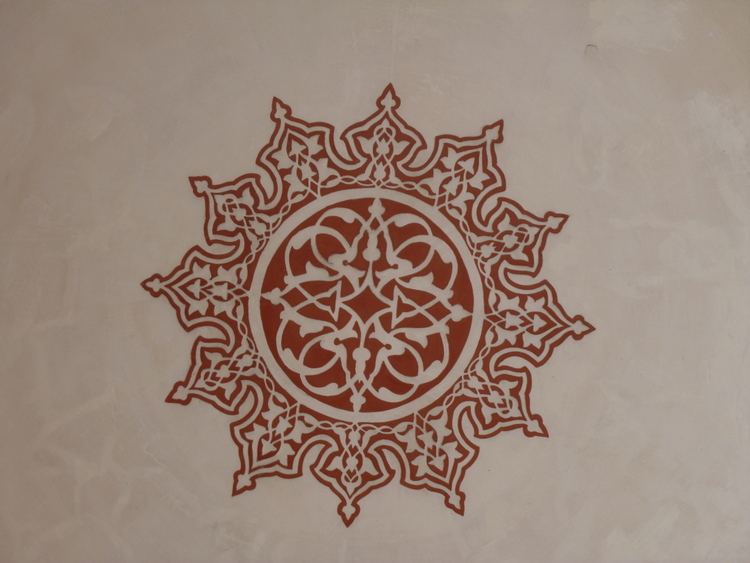 |
| Ceiling design |
 |
| Ceiling design |
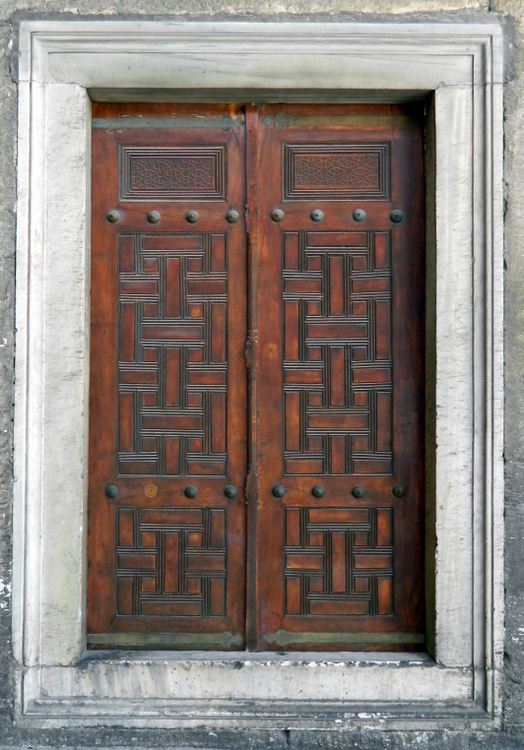
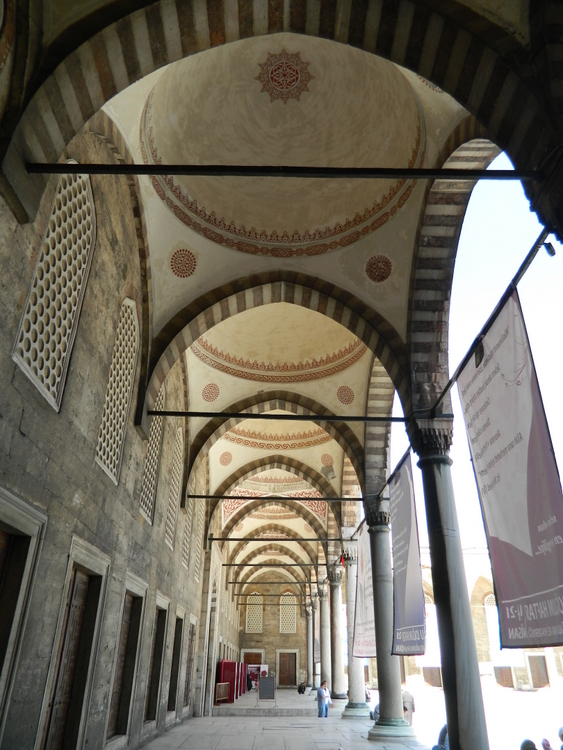 |
| Arcade along one side of the outer courtyard |
The entrance for those who wish to prayer. The honeycombing above the calligraphy is very similar to that at the Alhambra.
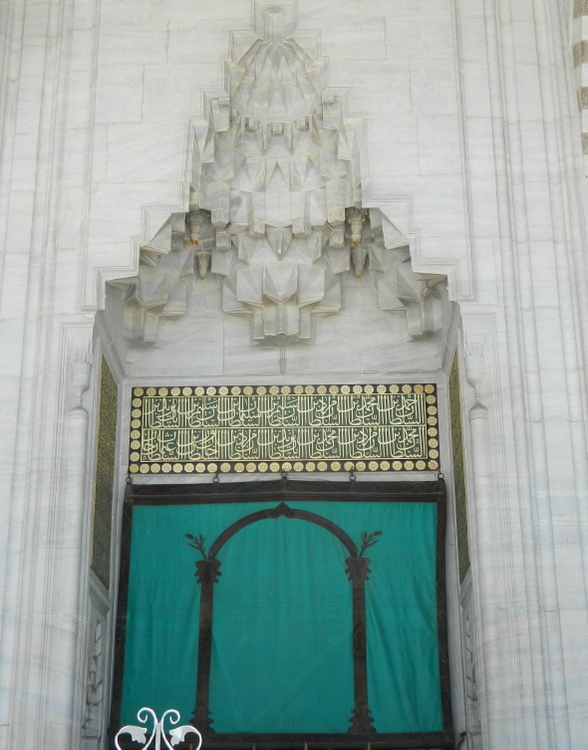
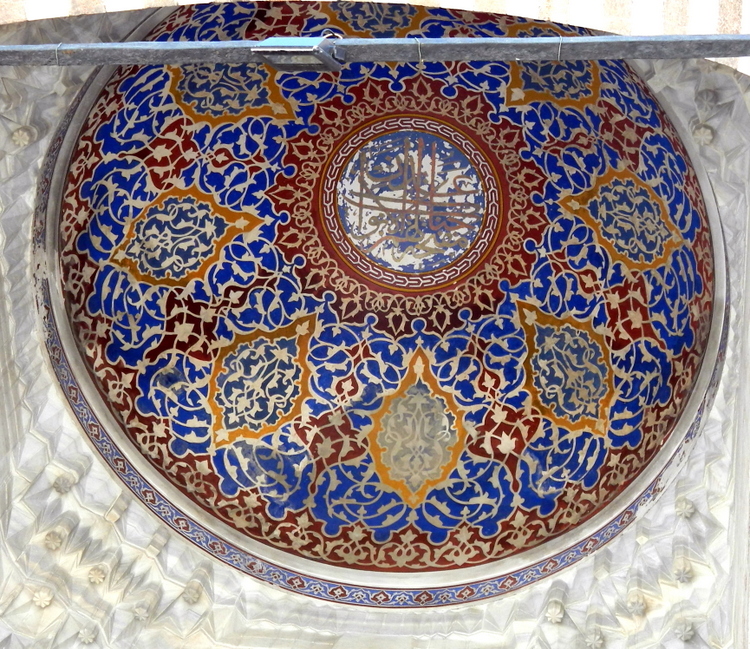
The dome above this entrance. (The first of many obstructed photos, alas.)
Here are views of the interior of the Blue Mosque. The blue dome, is the central dome. The diagonal lines (that may look like scratches on your screen, are very numerous wires that suspend the numerous chandeliers.) The central dome, is surrounded by for semi-domes, each of which is surrounded by thr ee smallersemi-domes. It is almost fractal!
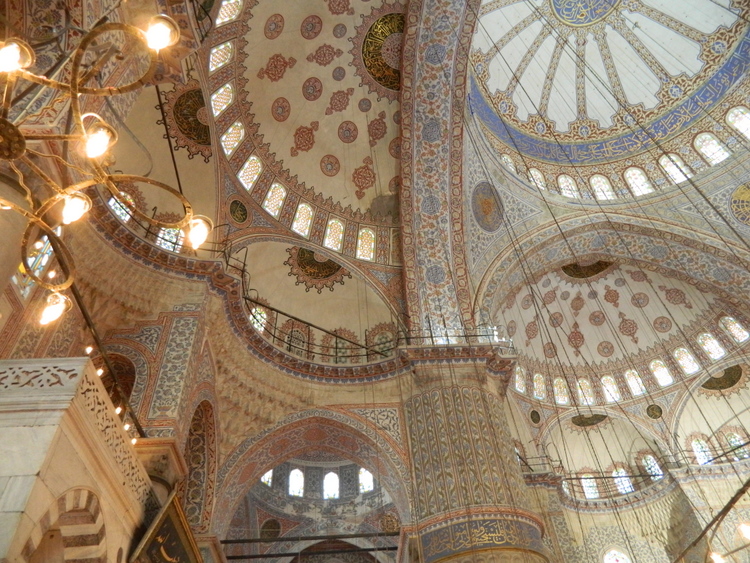

Here are a couple of slightly more detailed shots
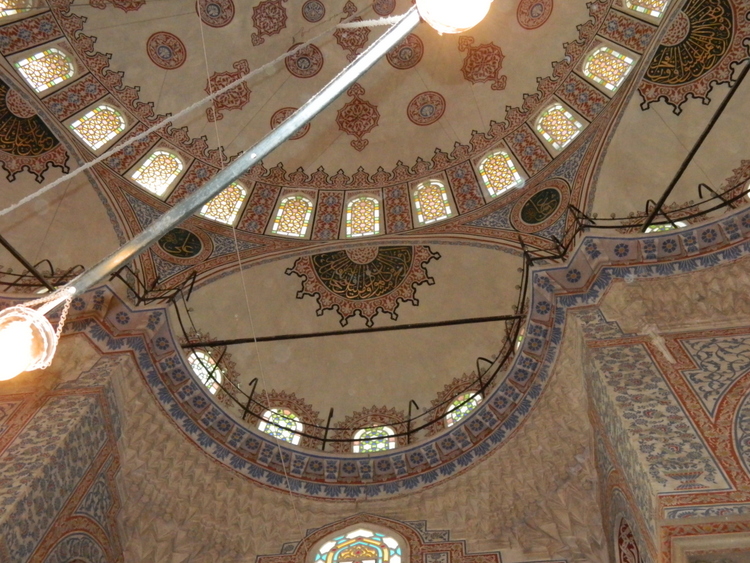
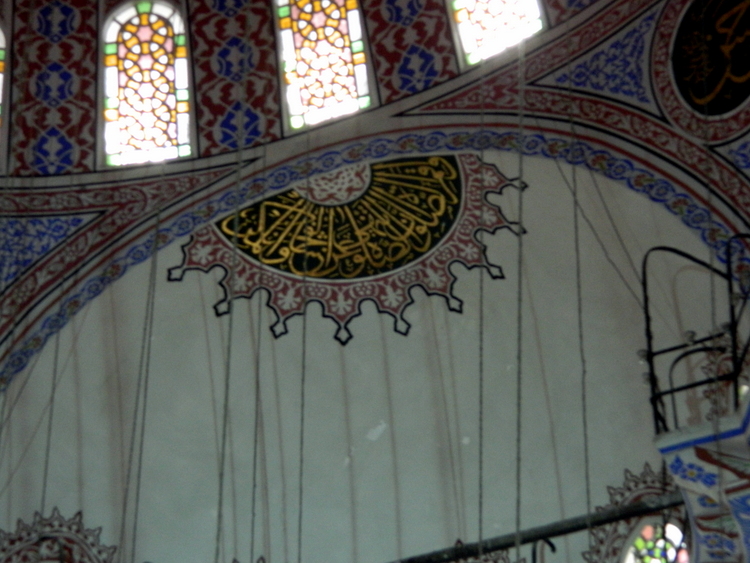
The interior is carpeted. Here is a view of the region reserved for those wishing to pray – there were mostly men in prayer, but also a couple of 4-year-old boys running a round, a man in traditional garb taking photos and a couple of women. (There was also a an area reserved for women to pray at the back, behind a lattice.)
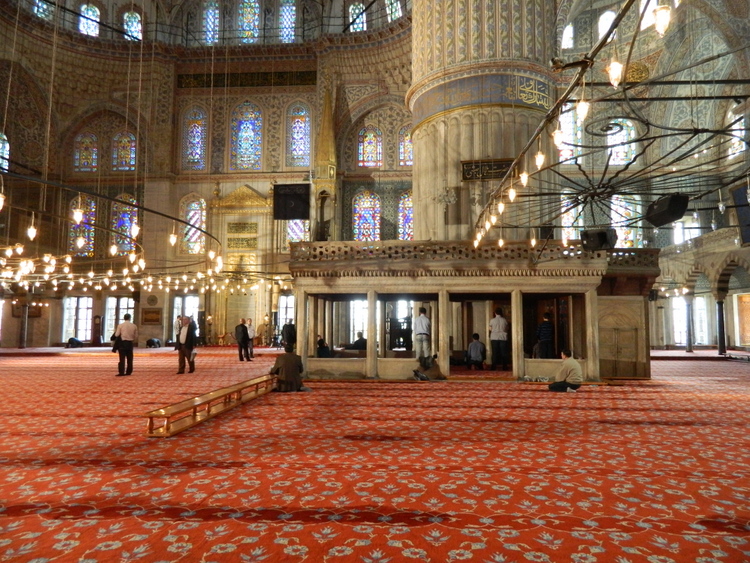 |
| Area reserved for prayer. Note chandeliers, and the pillar, which is all of 5 meters, yes 16 feet in diameter. (The pillars, lights,and suspension wires prevent enter most photos!) Note also the stained glass windows. |
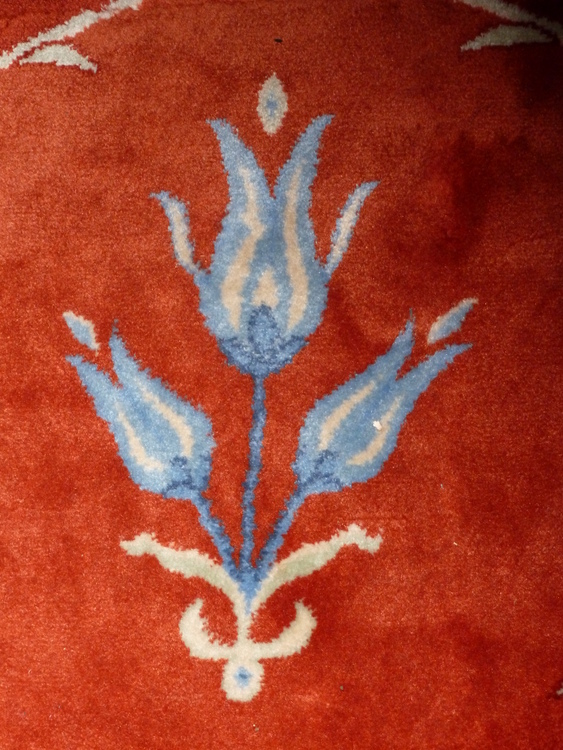 |
| The tulip did of course originate in Turkey. |
There are about 160 windows. Here are a couple of close ups.
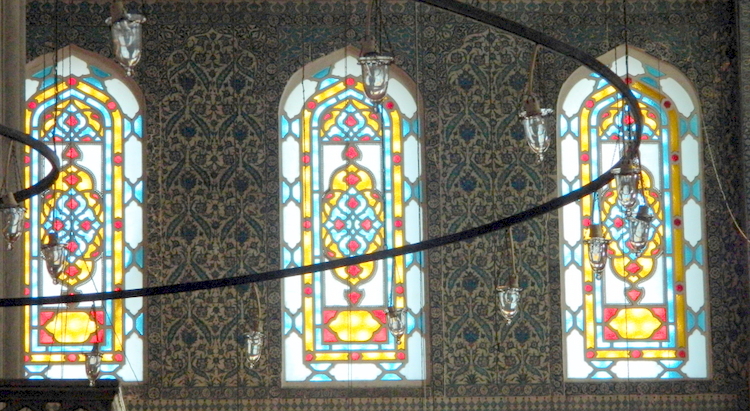
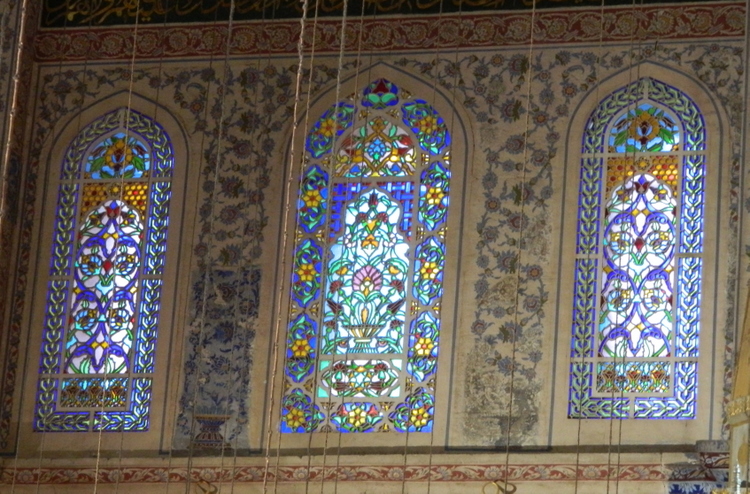
The blue tiles between the windows, and around the upper gallery, which seemed to be inaccessible, give the mosque its name. I’m sure they’d be amazing from closer.
 |
| Blue tiles on the upper gallery wall — note the carved railing. |
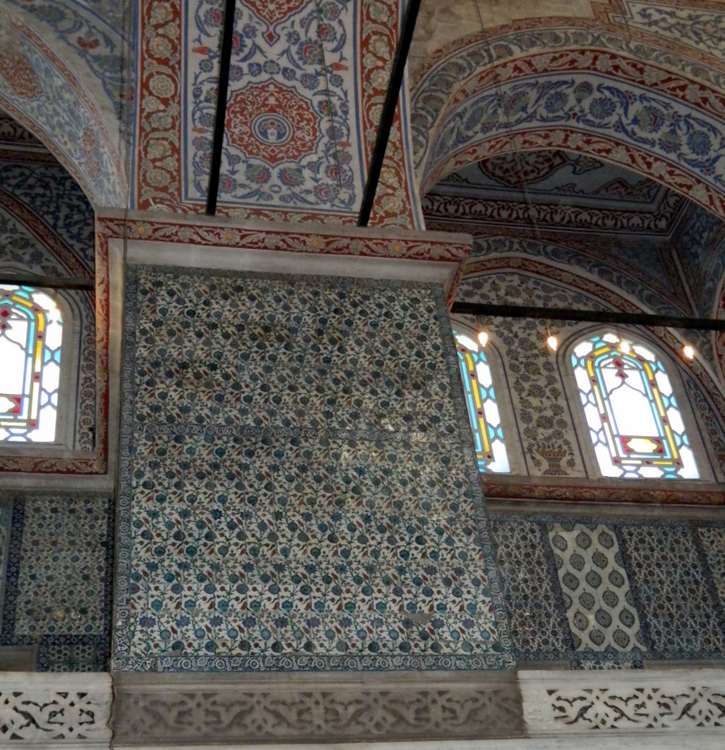 |
| Blue tiles on the top of pillar. |
Over all an amazing building — photo’s don’t do it justice. (I did find some better photos on wikipedia. I like this one showing two arcades of the outer courtyard)

Tweet
- « Previous Page
- 1
- …
- 86
- 87
- 88
- 89
- 90
- …
- 279
- Next Page »