Anita Mathias: Dreaming Beneath the Spires

Anita Mathias's Blog on Faith and Art

  • Home
  • My Books
  • Meditations
  • Essays
  • Contact
  • About Me

In Praise of Martin Luther King, Jr. by Walter Brueggemann

By Anita Mathias

Walter Brueggemann.jpg
Walter Brueggemann
 

 Martin Luther King Jr.

Some of us are old enough to remember
the balcony in Memphis,
the sanitation workers’ strike,
the shot that broke flesh,
the loss of Martin,
and then the mule-drawn wagon, and the funeral,
and the riots, the violence, the fear, and the failure.

All of us know the crowd in D.C.
and “I Have a Dream,”
the Birmingham jail,
the broad stream of violence,
and his steadfast nonviolence
in Albany and
in Skokie and
in Selma.

All of us know his awesome, daring speech,
his bravery, his hope, and his generative word.
And we know the relentlessness of our government in pursuit of him
and the endless surveillance and harassment of this drum major for justice.

At this distance, we have little access
to how it was then concerning ambiguity
and fear
and reluctance
and violence
and injustice.

We do not doubt that you have persisted
even beyond Martin’s passion,
even beyond Martin’s brilliance,
even beyond Martin’s fidelity, and his loss.

We do not doubt that through him and beyond him,
you, holy God of the prophets,
are still pledged to justice and
peace and
liberty for all.

We remember Martin in gratitude . . .
and chagrin.
And we pledge, amid our stressed ambiguities,
to dream as he did,
to walk the walk,
and to talk the talk of your coming kingdom.

We pledge, so sure that your truth
will not stop its march
until your will is done on earth as it is in heaven.

From  Prayers for a Privileged People

Filed Under: In Which I celebrate Church History and Great Christians Tagged With: Martin Luther King, theologians, Walter Brueggemann

A Rhapsody on Heidi Baker, one of the most inspiring Christians alive!

By Anita Mathias

Labels
Heidi Baker
 So I will be hearing Heidi Baker twice this month at River Camp in Gloucestershire and at Revival Alliance in Birmingham.
Heidi Baker is one of the most inspiring Christians I know, along with Dick Woodward, the quadriplegic Pastor Emeritus of our old church, Williamsburg Community Chapel, who, while confined to his bed, wrote and broadcast a survey of the Bible called the Mini Bible College, and is joyful, faith-filled and full of wisdom. People make “pilgrimages” to his bed.
Heidi Baker looks after 10,000 orphans in Mozambique, lives deep in the heart of God, attempts to live the Sermon on the Mount, and experiences miracles on a daily basis.
* * *
I love listening to her.  She is very American, very Californian, blonde, athletic, bouncy, vivacious. Entirely unself-conscious. When she prays, she doesn’t worry whether she looks too showy or devout, as I do. She just goes ahead and prays naturally, folded up on the floor in a foetal position, sometimes coming up with electrifying prayer or prophecy or an entire talk in that position of worship on the floor, holding a microphone. Yeah, a most unusual position for a preacher, but does she care?  
Heidi 53, looks gorgeous, dresses well, eye-catchingly and attractively, but simply and inexpensively (I bet), and radiates health and fitness. Ah, beauty is a gift from God, and he sometimes gives it to his special saints (I think of Beth Moore or Ann Voskamp) to significantly aid their ministries in our appearance-obsessed world.
Heidi, who is a few years older than me, is amazingly simple and joyful. She quotes her husband Rolland, “Heidi when I met you, you were five, and now you’ve become three.” I love that.  I am reminded of G.K. Chesterton’s bon mot, “Angels can fly because they take themselves lightly.” (Incidentally, my husband says I am about ten, so I sure have some growing younger to do!)
* * *
I find this disciple of Jesus very inspiring. My kids love her.
I am called to write, and live in a beautiful old rambling home with a beautiful old rambling garden (now looking a bit unkempt alas) in a country village just outside Oxford. Normally, I wouldn’t go out of my way to go to listen to someone who has adopted 10,000 children in Mozambique, because her life was too alien to mine (in a way that C.S. Lewis’s, for instance, is not).
But Heidi wears her amazing Christ-likeness lightly. She does not even think about it. She is focused on Jesus.
She reminds me of C. S. Lewis’s description of a humble person, “If you meet a really humble man, probably all you will think about him is that he seemed a cheerful, intelligent chap who took a real interest in what you said to him.  You might feel a little envious of anyone who seems to enjoy life so easily. And he will not be thinking about humility: he will not be thinking about himself at all.”
But, in fact, and this is why she has such a successful speaking ministry in the West, and why she is so inspiring, what makes Heidi Baker so special is not actually the work she does. I do not believe her joy comes from the 10,000 orphans. I believe it comes from her very close relationship to God, her surrender to him, the Yes she continually says. Listening to her talk of Jesus, it is immediately clear to me that I do not know Jesus as she does, and while that makes me cry with sadness, it also inspires me to get to know Him better.
Her love affair with Christ, her trust, her faith: These things are open to all of us, those called to write in Oxford and those called to turn Mozambique upside down. Prayer is the most equal opportunity thing there is.
* * *
Heidi lives in miracles as her native element. She was seriously dyslexic, but was healed, and eventually earned a PhD in Theology, and has written lovely, convicting books. Read There is Always Enough, and oh, you will be so inspired.
When she last came to the church I used to attend, she said that her husband Rolland Baker had cerebral malaria and suspected dementia. He could not dress himself, or cut his nails or look after himself. And a boy they had adopted, who had stolen from them, and continued relapsing into rascality, looked after him with utter devotion, protecting him, dressing him etc.
I cried as I left. I was too upset to speak. I felt like chiding God like St. Teresa of Avila, knocked off her donkey into the mud, late on a rainy night, once did, “Lord, if this is the way you treat your servants, it’s no wonder you have so few.”
I was angrier than Heidi was, but then maybe Heidi foreknew something I did not. Rolland Baker was completely cured of his “incurable” cerebral malaria and dementia in a remarkable retreat centre in Germany, called The Community Without Walls.
  
Heidi herself had a complete burnout, suffering from numerous tropical illnesses as well as chronic fatigue and returned to the States, where she was completely healed, physically and spiritually, at Toronto Catch the Fire Church (formerly the Airport Fellowship).
The one thing I do know about faith is that according to our faith it will be done to us (Matt 9:29). Heidi sees so many miracles because she believes she will.
* * *
But she has also long experience of dreams deferred. In a remarkable vision, she had heard God say that the blind would see through her prayers, but prayed over hundreds of blind people before one saw!!
I’ve heard her talk—a long rambling story which took about an hour– about her dream to reach an isolated unreached people group in Mozambique which took twenty years and involved raising money to get a boat, getting a boat which vital parts stolen or rusted, raising money again, finding people to fix the boat, but she finally does reach them, and they accept Jesus.
Sometimes God gives us glimmerings of our destiny to cheer us on and up, and in the long years of waiting for it to be fulfilled, our character forms and is toughened.
And that is as much part of the story as the longed-for conclusion which, in our naivete, we had imagined was the entire story!!

Filed Under: In Which I celebrate Church History and Great Christians

Write, first and foremost, for the joy of it: Lessons from the life of John Owen

By Anita Mathias

John Owen

A lecture in the course I just attended on Oxford’s Christian history was on John Owen, the Puritan divine who was Vice-Chancellor of Oxford University. Read John Piper’s eloquent tribute to him here.
Owen, despite ill health and personal tragedy (all his 11 children died before him, and only one survived childhood) was unbelievably disciplined and driven. Whether the drive came from the love of God or personal ambition or, most likely, a combination of the two is not clear.
From the age of 12, he disciplined himself to sleep for just 4 hours a night, staying up and studying and later writing late into the night. His health was affected, and later in life, when he was often sick, he regretted the hours of rest he had missed as a youth.
He wrote 22 books. The most famous are The Death of Death in the Death of Christ and The Mortification of Sin in all Believers.
Few read him today. His prose has become impenetrable to the modern ear, unlike his friend and contemporary, John Bunyan’s!
                                           * * *
Was it worth it? All the late nights, the ruined health, the long labours for books which are barely read today.
I personally don’t believe that Christian writing written solely to edify, preach to, or enlighten others is worth it.
Writing should be undertaken first and foremost for the joy of it. Writers should write as birds sing, for joy, and because that is how they were shaped and put together. We write as we work out our thoughts, we write to create shapely and beautiful things, and yes, if others are blessed by it, we rejoice!!
 Our writing should edify–build us up–as well as our readers. I suspect Owen was developing and working out his own theology as he wrote, and his writing probably brought peace and light to his own soul, as well as influencing many theologians, such as Jonathan Edwards, John Piper, Sinclair Fergusson, J I Packer, and Simon Vibert.  He is predominantly a theologian’s theologian!!
                                              * * *
I felt a bit melancholy listening to the lecture on John Owen, all that labour, the 22 books researched and written over 65 years of just 4 hours sleep a night, and few of them read any more.
And I just hoped he enjoyed the writing of them. Because if he did, then the labour was not entirely wasted—if he found joy in it.
Solomon, reputed to be the wisest man who ever lived, condenses wisdom partly into finding joy in one’s work. A man can do nothing better than to eat and drink and find satisfaction in his work. Ecc 2:12
So I saw that there is nothing better for a man than to enjoy his work, because that is his lot. Ecc 3:22.

If, or how long, we will be read, we cannot control. So, let’s work for the joy of it, let’s work because we are followers of Christ, and because, gloriously, mysteriously, he has called us to write, and, in peace and serenity, let’s leave the results of our work in his hands!
                                                   * * *

And here is a wonderful story, taken from John Piper’s essay on Owen.
King Charles II asked Owen one time why he bothered going to hear an uneducated Tinker like Bunyan preach. Owen replied, “Could I posses the tinker’s abilities for preaching, please your majesty, I would gladly relinquish all my learning.”
“Repeatedly when Bunyan was in prison Owen worked for his release with all the strings he could pull. But to no avail. But when John Bunyan came out in 1676 he brought with him a manuscript “the worth and importance of which can scarcely be comprehended” (see note 33). In fact Owen met with Bunyan and recommended his own publisher, Nathaniel Ponder. The partnership succeeded, and the book that has probably done more good, after the Bible, was released to the world—all because Owen failed in his good attempts to get Bunyan released, and because he succeeded in finding him a publisher. The lesson: “Judge not the Lord by feeble sense,/but trust him for his grace;/behind a frowning providence/he hides a smiling face.”

Filed Under: In Which I celebrate Church History and Great Christians

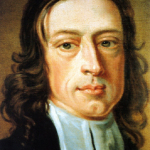
John Wesley’s Cry: Let’s Stand Apart from a Generation of Triflers

By Anita Mathias

Here is John Wesley’s scathing last sermon to the University of Oxford
“So many of you are a generation of triflers; triflers with God, with one another, and with your own souls? For, how few of you spend, from one week to another, a single hour in private prayer! How few have any thought of God in the general tenor of your conversation! Who of you is in any degree acquainted with the work of his Spirit, his supernatural work in the souls of men? Can you bear, unless now and then in a church, any talk of the Holy Ghost? Would you not take it for granted, if one began such a conversation, that it was hypocrisy? In the name of the Lord God Almighty, I ask, what religion are you of? Even the talk of Christianity, ye cannot, will not bear. O my brethren, what a Christian city is this!
I have just attended a very interesting talk on Wesley and Whitfield in a Summer School I am attending at the Wycliffe College, Oxford University, on the Christian history of Oxford.
Wesley began to be a serious Christian at the age of 22 after reading The Imitation of Christ. He writes, “I began to see that true religion was seated in the heart and that God’s law extended to all our thoughts as well as words and actions. I began to set in earnest upon a new life.
I executed a resolution which I was convinced was of the utmost importance, shaking off at once all my trifling acquaintance, I began to see more and more the value of time.I applied myself closer to study.”Similarly, when Whitfield was converted, he writes that he “put off all trifling conversation, put all trifling books away, and was determined to study to be a saint, and then to be a scholar.”
I love reading about the effects of people’s conversions, and I love the new seriousness which infected Wesley after his conversion. He shakes off all relationships which are trivial and “trifling,”-insignificant. He values his time. He applies himself to study.
It is as if in taking God seriously, he has begun to take himself seriously. In fact, beginning to read is a not infrequent effect of conversion.
Trifler is not a word one hears in England, but when I lived in the American South, older people would call a slight, trivial, unserious person, “a trifling person.” Funny how words persist across the Atlantic, which have died out here.
Wesley greatly stressed reading for Christians. Without reading, your knowledge of God, your fellow men, the spiritual life, Christian history, the Bible and theology will be limited to your own experience and conversations. If you read however, within a couple of hours you are enriched by, possibly, decades of someone else’s thinking, study and experience.
Here’s Wesley scolding a minister who would not read,
What has exceedingly hurt you in time past, nay, and I fear to this day, is want of reading.
I scarce ever knew a preacher read so little. And perhaps, by neglecting it, you have lost the taste for it. Hence your talent in preaching does not increase. It is just the same as it was seven years ago. It is lively, but not deep; there is little variety, there is no compass of thought. Reading only can supply this, with meditation and daily prayer. You wrong yourself greatly by omitting this. You can never be a deep preacher without it, any more than a thorough Christian.
O begin! Fix some part of every day for private exercises. You may acquire the taste which you have not: what is tedious at first, will afterwards be pleasant.
Whether you like it or not, read and pray daily. It is for your life; there is no other way; else you will be a trifler all your days, and a petty, superficial preacher. Do justice to your own soul; give it time and means to grow. Do not starve yourself any longer. Take up your cross and be a Christian altogether. 
·      * *
I wrote yesterday about deciding to take up my calling as a writer with new seriousness. And I guess that means saying goodbye to trifling. Goodbye to spending time on what Wesley calls “trifling acquaintance” and trifling pursuits. Instead, facing my life with a new seriousness and focus which will spring I hope from abiding in Christ.
Ah, a new gauge for whether I read a book, watch a movie, embark on this recreation or social activity. Is it “trifling?” If so, is there a better use of my time—and life?
So help me, God!!

Filed Under: In Which I celebrate Church History and Great Christians, In which I decide to follow Jesus

Some of the loveliest visions of Julianna of Norwich

By Anita Mathias

‘God, for your goodness, give me yourself. For you are enough for me and I may not ask anything that is less, that may be fully worthy of you. And if I ask any thing that is less, I am always wanting. But only in you I have all.’
· · ·
It is God’s will that we have three things in our seeking of his gift. The first is, that we seek willingly and busily without sloth, as it may be with his grace gladly and merrily, without unskilfull heaviness and vain sorrow. The second, that we abide with him steadfastly for his love, without complaining and striving against him to our lives’ end, for it shall last only a while. The third is that we trust in him mightily with a fully sure faith, for it is his will that we shall know that he will appear suddenly and blessedfully to all his lovers, for his working is secret, and it will be perceived, and his appearing shall be swift and sudden, and he will be believed, for he is very able, humble and courteous, blessed must he be.
      After this,  I saw God in a point. That is to say in my understanding. But which sight I saw that he is all things. I beheld with advisement, seeing and knowing in that sight, that he does all that is done, be it never so little. And I saw that nothing is done by chance, nor by hazard, but all by the foreseeing of God’s wisdom.
And if it be chance or fortune in the sight of man, our blindness and our lack of foresight is the cause. Therefore, well I know that in sight of our lord God, there is not chance or happenstance. And therefore it needs behoove me to grant that all things that are done, are well done, because our Lord God does all. For in this time, the working of Creation was not showed but of our lord God, in Creation, for he is in the midpoint of all things, and he does all.
 ‘See, I am God. See, I am in all things. See, I do all things. See, I never left off the works of my hand, nor ever shall, without end. See, I lead all things to the end, to which I ordained them, from without beginning, by the same power, wisdom and love, that I made them with. How should then anything be amiss?’
                                                            · · ·
And this was shown in these words, ‘Are you well paid’ . By those other words that Christ said, ‘If you are paid, I am paid’. As if he had said, ‘It is joy and liking enough to me, and I ask nothing else of you for my travail, but that I might pay you’ . And it is this he brought to my mind. The property of a glad giver: a glad giver takes but little heed of the thing that he gives, but his desire is in all his intent, to please him and solace him to whom he gives it. And if the receiver takes the gift gladly and thankfully, then the courteous giver sets at nought all his cost and all his travail for joy and delight that he has, for he has so pleased and solaced him whom he loves. Plenteously and fully was this shown.
· · ·
Also our Lord showed for prayer, in which showing I saw two conditions in our Lord’s meaning. One is right full prayer. And the other is sure trust. But yet often our trust is not full, for we are not sure that God hears us, we think, because of our unworthiness, and because of that we feel nothing. For we are as barren and as dry often after our prayer, as we were before. And thus in our feeling, our folly is the cause of our weakness. For thus I have felt in myself.
      And all this brought our Lord suddenly to my mind and showed these words and said ,’I am ground of your seeking. First it is my will that you have it, and I make you to will it. How should it then be that you should not have your seeking of it, since I make you to seek it, and you seek it’ . 
       And furthermore he wills that we know that this dear worthy soul was preciously knit to him in the making. Which knot is so subtle and so mighty, that it is oned to God, in which oneing it is made endlessly holy. Furthermore, he wills that we know and understand, that all the souls that shall be saved in heaven without end are knitted in this knot, and oned in this oneing, and made holy in this holiness. And for great endless love that God has to all mankind, he makes no departing in love between the blessed soul of Christ and the least soul that shall be saved.
Highly ought we to enjoy that our God dwells in our soul, and much more highly we ought to enjoy that our soul dwells in God. A high understanding it is inwardly to see and to know that God which is our maker, dwells in our soul. And a higher understanding it is and more inwardly to see and to know our soul that is made dwells in God in substance.

Filed Under: In Which I celebrate Church History and Great Christians Tagged With: Julianna of Norwich

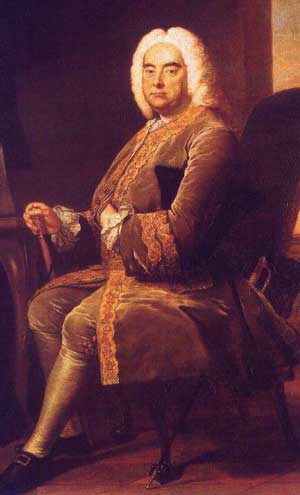
Handel’s Vision of Heaven and the Composition of the Messiah

By Anita Mathias

 My father had trained and worked as a Chartered Accountant in England in the forties and early fifties. When he returned to India, he brought with him some precious possessions—among them LPs of Beethoven, Mozart….and Handel’s Messiah, conducted by Malcolm Sargent.

He used to sit, rapt, listening to Mozart’s Fortieth Symphony or Beethoven’s Fifth. I enjoy classical music if I can do something physical while listening to it, something like housework. The Messiah, however, is different.

It has always transported me into a state of bliss. It is surely among the most beautiful pieces of art ever produced.

* * *

I decided to research its composition.

The years immediately preceding the composition and premiere of Messiah were artistically and financially disastrous for George Frederic Handel. In 1737 he suffered a stroke but eventually recovered enough so that his playing was unaffected.

However, the grandiose style of Italian opera for which Handel was best known was dwindling in popularity, so much so that after 1741 he stopped composing opera altogether. Meanwhile, he witnessed the bankruptcy and failure of two of his own opera companies in the 1730s.

Handel was a shrewd and practical composer; he saw the public’s waning interest in the musical form that had been his bread and butter for many years and started composing in a format he hoped the public would prefer, the oratorio.

He had written eight oratorios before the Messiah. Then Charles Jennens, a wealthy merchant gave Handel the libretto for a new oratorio that he fashioned from passages taken from the Old and New Testament dealing with Christ’s life on Earth and his sacrifice of his own life.

Jennens’ text caught Handel’s imagination, so he began working on it at a feverish pace, finishing it in twenty-four days. During that time, he never left his house and barely came out of his room. A servant who brought him his meals said, “He was praying, or he was weeping, or he was staring into eternity.”

Just after writing the “Hallelujah Chorus,” Handel said, “I did think I did see all Heaven before me and the great God Himself.”

The Hallelujah Chorus surely provides among the purest five minutes of pleasure that art can provide. See it burst upon tired shoppers in a random act of beauty and generosity.

http://www.youtube.com/watch?v=SXh7JR9oKVE


Sources

http://www.orsymphony.org/concerts/1011/programnotes/cl6.aspx
http://www.deseretnews.com/article/705352553/Hallelujah-Messiah-is-beloved-holiday-tradition.html?pg=2

Filed Under: In Which I celebrate Church History and Great Christians Tagged With: art proceeding from vision, Handel, Messiah

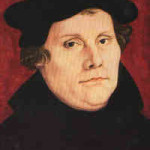
Martin Luther didn’t say that, did he? Yes, he did!

By Anita Mathias


“You have as much laughter as you have faith.”

“The dog is the most faithful of animals and would be much esteemed were it not so common. Our Lord God has made His greatest gifts the commonest.”

“Be thou comforted, little dog, Thou too in Resurrection shall have a little golden tail”

“If you want to change the world, pick up your pen and write.”

“Whenever the devil harasses you, seek the company of men or drink more, or joke and talk nonsense, or do some other merry thing. Sometimes we must drink more, sport, recreate ourselves, and even sin a little to spite the devil, so that we leave him no place for troubling our consciences with trifles. We are conquered if we try too conscientiously not to sin at all. So when the devil says to you: do not drink, answer him: I will drink, and right freely, just because you tell me not to.”

“A unjust law, is no law at all.”

 “I know not the way God leads me, but well do I know my Guide.”
Be a sinner and sin boldly, but believe and rejoice in Christ even more boldly.”
Spare the rod and spoil the child – that is true. But, beside the rod, keep an apple to give him when he has done well.” Martin Luther
Even if I knew that tomorrow the world would go to pieces, I would still plant my apple tree.
I have held many things in my hands, and I have lost them all, but whatever I have placed in God’s hands, that I still possess.
God writes the Gospel, not in the Bible alone, but also on tree, and in the flowers, and clouds, and stars.

 Work, work, from morning until late at night. In fact, I have so much to do that I shall have to spend the first three hours in prayer. – Martin Luther

Filed Under: In Which I celebrate Church History and Great Christians Tagged With: Martin Luther

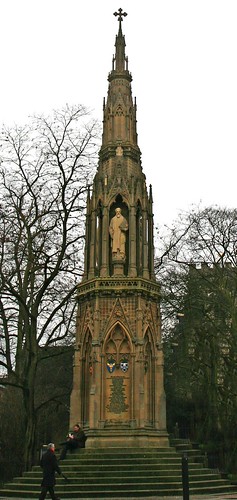
The Martyr’s Memorial to Latimer, Ridley and Cranmer, St. Giles, Oxford

By Anita Mathias

This beautiful building celebrates the 16th century Oxford Martyrs, Cranmer, Ridley and Latimer. The Victorian Gothic building resembles the spire of a sunken cathedral, doesn’t it?
At this spot, the English Reformers, Hugh Latimer and Nicholas Ridley, the great preacher and theologian of the English Reformation were burnt at the stake in the middle of cobble stoned Broad Street Oxford.
Cuthbert Bede (in his novel The Adventures of Mr Verdant Green) wrote,
“He who enters the city from the Woodstock Road, and rolls down the shady avenue of St Giles’, between St John’s College and the Taylor Buildings, and past the graceful Martyrs’ Memorial, will receive impressions such as probably no other city in the world could convey.” 
After the accession of Mary I, Cranmer boldly said, “… all the doctrine and religion, by our said sovereign lord king Edward VI is more pure and according to God’s word, than any that hath been used in England these thousand years.” Not surprisingly, the government regarded Cranmer’s declaration as tantamount to sedition. He was sent straight to the Tower to join Hugh Latimer and Nicholas Ridley, tried for treason, found guilty, and condemned to death.
Latimer famously comforted Ridley, “Be of good cheer, Master Ridley play the man. We shall this day by God’s grace light such a candle in England as shall never be put out.”
(Though I am quite content to live in 21st century Oxford, they did speak the most gorgeous English in Renaissance England, didn’t they?).
Cranmer was a serious reformer with a mild and peaceful and timid disposition. Imprisoned by Queen Mary, he signed various recantationa of his Protestant beliefs, stating his support of the Catholic Church. However, she, rightly, doubted that he really meant them.  He was told that he would be able to make a final recantation but this time in public during a service at the University Church of St. Mary the Virgin. He wrote and submitted the speech in advance. At the pulpit on the day of his execution, he opened with a prayer and an exhortation to obey the king and queen, but he ended his sermon totally unexpectedly, deviating from the prepared script.
He renounced the recantations that he had written or signed with his own hand since his degradation and imprisonment, and stated that he would punish his right hand by burning it first.
He was pulled from the pulpit and taken to where Latimer and Ridley had been burnt.  As the flames drew around him, he fulfilled his promise by placing his right hand into the heart of the fire and his dying words were, “Lord Jesus, receive my spirit… I see the heavens open and Jesus standing at the right hand of God.”
Interestingly, the same vision the first martyr Stephen saw! Men do not lie at their hour of their deaths, I believe. How wonderful to imagine Jesus standing in encouragement to receive them!!

Filed Under: In Which I celebrate Church History and Great Christians, In which I Dream Beneath the Spires of Oxford

  • « Previous Page
  • 1
  • 2
  • 3
  • 4
  • Next Page »

Sign Up and Get a Free eBook!

Sign up to be emailed my blog posts (one a week) and get the ebook of "Holy Ground," my account of working with Mother Teresa.

Join 536 Other Readers

My Books

Rosaries, Reading, Secrets: A Catholic Childhood in India

Rosaries, Reading Secrets, B&N
USA

UK

Wandering Between Two Worlds: Essays on Faith and Art

Wandering Between Two Worlds
USA

UK

Francesco, Artist of Florence: The Man Who Gave Too Much

Francesco, Artist of Florence
US

UK

The Story of Dirk Willems

The Story of Dirk Willems
US

UK

My Latest Meditation

Anita Mathias: About Me

Anita Mathias

Read my blog on Facebook

Follow me on Twitter

Follow @anitamathias1

Recent Posts

  • At the Cross, God Forgives Us Completely
  • Using God’s Gift of Our Talents: A Path to Joy and Abundance
  • The Kingdom of God is Here Already, Yet Not Yet Here
  • All Those Who Exalt Themselves Will Be Humbled & the Humble Will Be Exalted
  • Christ’s Great Golden Triad to Guide Our Actions and Decisions
  • How Jesus Dealt With Hostility and Enemies
  • Do Not Be Afraid, but Do Be Prudent
  • For Scoundrels, Scallywags, and Rascals—Christ Came
  • How to Lead an Extremely Significant Life
  • Don’t Walk Away From Jesus, but if You Do, He Still Looks at You and Loves You
Premier Digital Awards 2015 - Finalist - Blogger of the year
Runner Up Christian Media Awards 2014 - Tweeter of the year

Categories

What I’m Reading


Wolf Hall
Hilary Mantel

Wolf Hall --  Amazon.com
Amazon.com

Amazon.co.uk

Silence and Honey Cakes:
The Wisdom Of The Desert
Rowan Williams

Silence and Honey Cakes --  Amazon.com
Amazon.com

Amazon.co.uk

The Long Loneliness:
The Autobiography of the Legendary Catholic Social Activist
Dorothy Day

The Long Loneliness --  Amazon.com
Amazon.com

Amazon.co.uk

Country Girl
Edna O'Brien

Country Girl  - Amazon.com
Amazon.com

Amazon.co.uk

Archive by month

My Latest Five Podcast Meditations

INSTAGRAM

anita.mathias

My memoir: Rosaries, Reading, Secrets https://amzn.to/42xgL9t
Oxford, England. Writer, memoirist, podcaster, blogger, Biblical meditation teacher, mum

Looking at photos from our week in beautiful Sevil Looking at photos from our week in beautiful Seville and Cordoba over New Year with Irene, who had a week off.
And, ICYMI, here’s my latest meditation on the Gospel of Matthew… I’ve recorded it, should you want a few minutes of peace.
https://anitamathias.com/2026/04/29/gods-complete-forgiveness/
Hello Friends, I'm resumed recording my meditation Hello Friends, I'm resumed recording my meditations on the Gospel of Matthew. Do click on this link to listen. 
https://anitamathias.com/.../29/gods-complete-forgiveness/
Christ is the most influential figure in the history of the world, though his life ended in shame, humiliation and failure. But he so completely turned things round in his great reversal that the cross on which he died when all seemed hopeless is now the most common, and revered, symbol in history.
He emerged from and was anchored in Judaism. And as the sins of the people were laid on the scapegoat who was sent into the wilderness to perish, Christ died as the lamb of God voluntarily bearing the guilt of the wrongdoing of the whole world. He paid the price for our forgiveness with his life-blood--in accordance with the iron law of the physical and moral universe, of sowing and reaping, cause and effect. 
And so, God, who appeared as flames of fire to Moses, can now dwell within us, purifying us, whose hearts have darkness and shards of ice. 
And now that Christ was crucified, died, but rose again, His Spirit, no longer contained within his earthly body, is poured out like living water onto all humans, at our humble request. The Spirit pours the love of God into us; he reminds us of the words of Jesus and slowly writes Christ’s sweet law on our hearts. This transfusion of grace helps us do hard things we previously couldn’t do. Our dance with the Spirit gradually breaks the power of sin over us. It transforms us.
Now we, the forgiven, protected by the blood of Jesus poured out over us, and filled with His Spirit, who sings within us, Abba, Father, are adopted by God as his children in his joyful new covenant. We are cells grafted into the vine of our new family--Father, Son, Spirit—who now live in us as we live in them. As we choose by our thoughts and actions to continue living in the vine of Jesus, their energy pulsing through us makes us fruitful. And now, all our prayers which flow in the river of God’s good purposes are kindly heard. Waves of love and power flood from the cross! 
Thank you!
Well, hello friends! Breaking radio silence to let Well, hello friends! Breaking radio silence to let you know that I have taped a meditation for you on Christ’s famous Parable of the Talents in Matthew 25. https://anitamathias.com/2025/11/05/using-gods-gift-of-our-talents-a-path-to-joy-and-abundance/
Here you are, click the play button in the blog post for a brief meditation, and some moments of peace, and, perhaps, inspiration in your day 🙂
Hi Friends, I have taped a meditation; do listen a Hi Friends, I have taped a meditation; do listen at this link: https://anitamathias.com/2025/04/08/the-kingdom-of-god-is-here-already-yet-not-yet-here-2/
It’s on the Kingdom of God, of which Christ so often spoke, which is here already—a mysterious, shimmering internal palace in which, in lightning flashes, we experience peace and joy, and yet, of course, not yet fully here. We sense the rainbowed presence of Christ in the song which pulses through creation. Christ strolls into our rooms with his wisdom and guidance, and things change. Our prayers are answered; we are healed; our hearts are strangely warmed. Sometimes.
And yet, we also experience evil within & all around us. Our own sin which can shatter our peace and the trajectory of our lives. And the sins of the world—its greed, dishonesty and environmental destruction.
But in this broken world, we still experience the glory of creation; “coincidences” which accelerate once we start praying, and shalom which envelops us like sudden sunshine. The portals into this Kingdom include repentance, gratitude, meditative breathing, and absolute surrender.
The Kingdom of God is here already. We can experience its beauty, peace and joy today through the presence of the Holy Spirit. But yet, since, in the Apostle Paul’s words, we do not struggle only “against flesh and blood, but against the rulers, against the unseen powers of this dark world and against the spiritual forces of evil,” its fullness still lingers…
Our daughter Zoe was ordained into the Church of E Our daughter Zoe was ordained into the Church of England in June. I have been on a social media break… but … better late than never. Enjoy!
First picture has my sister, Shalini, who kindly flew in from the US. Our lovely cousins Anthony and Sarah flank Zoe in the next picture.
The Bishop of London, Sarah Mullaly, ordained Zoe. You can see her praying that Zoe will be filled with the Holy Spirit!!
And here’s a meditation I’ve recorded, which you might enjoy. The link is also in my profile
https://anitamathias.com/2024/11/07/all-those-who-exalt-themselves-will-be-humbled-the-humble-will-be-exalted/
I have taped a meditation on Jesus statement in Ma I have taped a meditation on Jesus statement in Matthew 23, “For those who exalt themselves will be humbled, and those who humble themselves will be exalted.”
Do listen here. https://anitamathias.com/2024/11/07/all-those-who-exalt-themselves-will-be-humbled-the-humble-will-be-exalted/
Link also in bio.
And so, Jesus states a law of life. Those who broadcast their amazingness will be humbled, since God dislikes—scorns that, as much as people do.  For to trumpet our success, wealth, brilliance, giftedness or popularity is to get distracted from our life’s purpose into worthless activity. Those who love power, who are sure they know best, and who must be the best, will eventually be humbled by God and life. For their focus has shifted from loving God, doing good work, and being a blessing to their family, friends, and the world towards impressing others, being enviable, perhaps famous. These things are houses built on sand, which will crumble when hammered by the waves of old age, infirmity or adversity. 
God resists the proud, Scripture tells us—those who crave the admiration and power which is His alone. So how do we resist pride? We slow down, so that we realise (and repent) when sheer pride sparks our allergies to people, our enmities, our determination to have our own way, or our grandiose ego-driven goals, and ambitions. Once we stop chasing limelight, a great quietness steals over our lives. We no longer need the drug of continual achievement, or to share images of glittering travel, parties, prizes or friends. We just enjoy them quietly. My life is for itself & not for a spectacle, Emerson wrote. And, as Jesus advises, we quit sharp-elbowing ourselves to sit with the shiniest people, but are content to hang out with ordinary people; and then, as Jesus said, we will inevitably, eventually, be summoned higher to the sparkling conversation we craved. 
One day, every knee will bow before the gentle lamb who was slain, now seated on the throne. We will all be silent before him. Let us live gently then, our eyes on Christ, continually asking for his power, his Spirit, and his direction, moving, dancing, in the direction that we sense him move.
Link to new podcast in Bio https://anitamathias.co Link to new podcast in Bio https://anitamathias.com/2024/02/20/how-jesus-dealt-with-hostility-and-enemies/
3 days before his death, Jesus rampages through the commercialised temple, overturning the tables of moneychangers. Who gave you the authority to do these things? his outraged adversaries ask. And Jesus shows us how to answer hostile questions. Slow down. Breathe. Quick arrow prayers!
Your enemies have no power over your life that your Father has not permitted them. Ask your Father for wisdom, remembering: Questions do not need to be answered. Are these questioners worthy of the treasures of your heart? Or would that be feeding pearls to hungry pigs, who might instead devour you?
Questions can contain pitfalls, traps, nooses. Jesus directly answered just three of the 183 questions he was asked, refusing to answer some; answering others with a good question.
But how do we get the inner calm and wisdom to recognise
and sidestep entrapping questions? Long before the day of
testing, practice slow, easy breathing, and tune in to the frequency of the Father. There’s no record of Jesus running, rushing, getting stressed, or lacking peace. He never spoke on his own, he told us, without checking in with the Father. So, no foolish, ill-judged statements. Breathing in the wisdom of the Father beside and within him, he, unintimidated, traps the trappers.
Wisdom begins with training ourselves to slow down and ask
the Father for guidance. Then our calm minds, made perceptive, will help us recognise danger and trick questions, even those coated in flattery, and sidestep them or refuse to answer.
We practice tuning in to heavenly wisdom by practising–asking God questions, and then listening for his answers about the best way to do simple things…organise a home or write. Then, we build upwards, asking for wisdom in more complex things.
Listening for the voice of God before we speak, and asking for a filling of the Spirit, which Jesus calls streams of living water within us, will give us wisdom to know what to say, which, frequently, is nothing at all. It will quieten us with the silence of God, which sings through the world, through sun and stars, sky and flowers.
Especially for @ samheckt Some very imperfect pi Especially for @ samheckt 
Some very imperfect pictures of my labradoodle Merry, and golden retriever Pippi.
And since, I’m on social media, if you are the meditating type, here’s a scriptural meditation on not being afraid, while being prudent. https://anitamathias.com/2024/01/03/do-not-be-afraid-but-do-be-prudent/
A new podcast. Link in bio https://anitamathias.c A new podcast. Link in bio
https://anitamathias.com/2024/01/03/do-not-be-afraid-but-do-be-prudent/
Do Not Be Afraid, but Do Be Prudent
“Do not be afraid,” a dream-angel tells Joseph, to marry Mary, who’s pregnant, though a virgin, for in our magical, God-invaded world, the Spirit has placed God in her. Call the baby Jesus, or The Lord saves, for he will drag people free from the chokehold of their sins.
And Joseph is not afraid. And the angel was right, for a star rose, signalling a new King of the Jews. Astrologers followed it, threatening King Herod, whose chief priests recounted Micah’s 600-year-old prophecy: the Messiah would be born in Bethlehem, as Jesus had just been, while his parents from Nazareth registered for Augustus Caesar’s census of the entire Roman world. 
The Magi worshipped the baby, offering gold. And shepherds came, told by an angel of joy: that the Messiah, a saviour from all that oppresses, had just been born.
Then, suddenly, the dream-angel warned: Flee with the child to Egypt. For Herod plans to kill this baby, forever-King.
Do not be afraid, but still flee? Become a refugee? But lightning-bolt coincidences verified the angel’s first words: The magi with gold for the flight. Shepherds
telling of angels singing of coming inner peace. Joseph flees.
What’s the difference between fear and prudence? Fear is being frozen or panicked by imaginary what-ifs. It tenses our bodies; strains health, sleep and relationships; makes us stingy with ourselves & others; leads to overwork, & time wasted doing pointless things for fear of people’s opinions.
Prudence is wisdom-using our experience & spiritual discernment as we battle the demonic forces of this dark world, in Paul’s phrase.It’s fighting with divinely powerful weapons: truth, righteousness, faith, Scripture & prayer, while surrendering our thoughts to Christ. 
So let’s act prudently, wisely & bravely, silencing fear, while remaining alert to God’s guidance, delivered through inner peace or intuitions of danger and wrongness, our spiritual senses tuned to the Spirit’s “No,” his “Slow,” his “Go,” as cautious as a serpent, protected, while being as gentle as a lamb among wolves.
Follow on Instagram

© 2026 Dreaming Beneath the Spires · All Rights Reserved. · Cookie Policy · Privacy Policy