Anita Mathias: Dreaming Beneath the Spires

Anita Mathias's Blog on Faith and Art

  • Home
  • My Books
  • Meditations
  • Essays
  • Contact
  • About Me

The Third Way

By Anita Mathias

The Third Way

I love God. I love following him, even when I get it wrong (often!!). It is absolutely the most exciting adventure of my life.

I particularly love it when he makes fun of my limited intelligence, and blows my mind open.

He does this often when I limit my alternatives to two. And wrestle, “Lord, should I do this? Or that? This? Or that?” Sometimes neither alternative feels quite right. Both leave me feeling a bit heavy-hearted. I can see scriptural justification for both, and see both good and evil in the outcomes of both courses of action.

I fell face down before God right now to seek his wisdom on a particular course of action. (I set the time for 30 minutes, because I am busy, we are soon leaving for a week in Granada. But if he had not spoken in 30 minutes, I would have lingered for 90 minutes, and continued wrestling, perhaps while organizing my house, for an hour or two more until he had spoken. If his answer was, “Wait some more until I do tell you,” that would have been fine too.)

But I have a big task to complete before I leave to Granada, a doable task, but a big one, and God mercifully spoke just before my timer went off.

God told me what to do with what I was agonizing about. A third alternative, I had not considered. But one which does fill my heart with joy and energy.

So life is never just either/or. There can be an And. When God expands our mind.

And bless and strengthen me indeed, God, and help me to continue hearing from you, and to write only what I hear the Spirit saying to the Church.  Nothing more.  And nothing less!

Filed Under: random

The Lord will Fight for you. You need Only to Stand Still Ex 14:14

By Anita Mathias


The Lord will Fight for you. You need Only to Stand Still Ex 14:14


Moses says this to the Israelites when they were pursued by the armies of Pharaoh, hemmed in between the armies and the sea. (Which, of course, ultimately parted.)


Cool! 


Does it apply at all times? When we are the righteous ones who are persecuted? Or also, when we have sinned and messed up?


Do we fight for our children only when they are in the right? I have often heard people talk despairingly of bad parents who will defend their children, whether they are in the right or wrong. But, I’m guessing, almost everyone has been that sort of bad parent.


I like this Psalm describing God delivering those who have seriously messed things up. 


10Some sat in darkness and the deepest gloom,
prisoners suffering in iron chains,
11for they had rebelled against the words of God
and despised the counsel of the Most High.
12So he subjected them to bitter labor;
they stumbled, and there was no one to help.
13Then they cried to the LORD in their trouble,
and he saved them from their distress.
14He brought them out of darkness and the deepest gloom
and broke away their chains.
15Let them give thanks to the LORD for his unfailing love
and his wonderful deeds for men,
16for he breaks down gates of bronze
and cuts through bars of iron.
17Some became fools through their rebellious ways
and suffered affliction because of their iniquities.
18They loathed all food
and drew near the gates of death.
19Then they cried to the LORD in their trouble,
and he saved them from their distress.
20He sent forth his word and healed them;
he rescued them from the grave.
21Let them give thanks to the LORD for his unfailing love
and his wonderful deeds for men.
22Let them sacrifice thank offerings
and tell of his works with songs of joy. Psalm 107.

So, when the noise of battle rolls around us, we can, unbelievably, have peace in our souls, once we have surrendered the situation into God’s hands. He will fight for us, and help us write a good story with our lives. The outcome of every battle will not go our way, but that is because God has a different plan for us, a different story, which he is writing through battles won and battles lost.

And I love him for that.  

Filed Under: random

The Mind-Expanding Prayer I am Praying Today

By Anita Mathias

I kneel before the Father,
 I pray
 that out of his glorious riches 
he may strengthen me
 with power
 through his Spirit
 in my inner being, 
 so that Christ may dwell in my heart
 through faith. 
And I pray that I, 
being rooted and established
 in love, 
 may have power,
 to grasp how wide and long and high and deep 
is the love of Christ, 
and to know this love that surpasses knowledge
—that I may be filled to the measure
 of all the fullness of God.

 20 Now to him who is able
 to do immeasurably more
 than all I ask or imagine, 
according to his power
 that is at work within me, 
to him be glory
 in the church and in Christ Jesus throughout all generations,
 for ever and ever! Amen.
Paul to the Ephesian, Chapter 3. 

Filed Under: random

There will be the Essence of Dogness in Heaven–C.S. Lewis

By Anita Mathias


Jake, my collie, in a buttercup meadow.

I would have immensely enjoyed hearing the feisty C.S. Lewis preach or lecture.

He was a slave to the dog of Mrs. Moore (the mother of the soldier-friend who died in the First World War, whom he  moved in with to “look after” as per his pact with her son.) His brother, Warnie, sardonically comments on the great things Jack might have achieved if he were not always trotting off to get meat from the butchers for the dog, or to walk him.

When a grieving dog-owner asked him if we would be re-united with our pets in heaven, Lewis did not let his lack of acquaintance with that undiscovered country prevent his  having opinions about it. “No,” he said, “not our dogs.” However, he said, there would be “the essence of dogness” in heaven.

I hope he’s right about the Platonic essence of dogness in heaven. Surely he is.

But though there is nothing in Scripture about the resurrection of the dogs, I would love to believe that my dogs past and present will be there in heaven—Rover, Brutus, Juno, Trooper and Jake. They would make my joy complete.

I love my wonderful dog, Jake, whom I got from a rescue, as I have got every dog I have ever owned as an adult. He fell fast in love with me on the day we brought him home 7 years ago, and has been my constant shadow, sleeping at the foot of our bed, following me everywhere, even to the bathroom, constantly repositioning himself to keep a vigilant eye on me. Though what an active collie and a sedentary writer could have in common is one of the mysteries of the universe!!

Filed Under: In which I play in the fields of Theology Tagged With: C. S. Lewis, Pets in Heaven, The essence of dogness

Wasting Suffering

By Anita Mathias

The Sadness of Wasting Suffering


Our pastorate (home group) is studying Romans, well more appropriately looking at the mountain peaks of Romans. I felt a bit sulky about this as I love doing things thoroughly, especially things like studying Romans. I guess I will just have to recruit a few friends to do it with me. 


I hate abridged books, and so I dislike this high points of Romans approach. However, our last meeting this week was amazing because we lingered on a few sentences in an otherwise rich and rhapsodic chapter–a crescendo which we would otherwise not have devoted enough time to.


And here is the crescendo. 
Romans 8:35:  Who shall separate us from the love of Christ? Shall trouble or hardship or persecution or famine or nakedness or danger or sword? 36 As it is written:
   “For your sake we face death all day long;
   we are considered as sheep to be slaughtered.”j]”>[j]

 37 No, in all these things we are more than conquerors through him who loved us. 38 For I am convinced that neither death nor life, neither angels nor demons,k]”>[k]neither the present nor the future, nor any powers, 39 neither height nor depth, nor anything else in all creation, will be able to separate us from the love of God that is in Christ Jesus our Lord.


I found that really moving–that the very worst life can throw at us–trouble or hardship or persecution or danger or death or demons, the past or the future–nothing can separate us from the love of God. Nothing can separate us from the dance we dance with him, while he breathes his spirit into us.


Will Donaldson, Director of Christian Leadership at Wycliffe who belongs to our pastorate, spoke about suffering being within the providential purposes of God. 
                                                                         * * *


And suddenly, I thought about an injustice I had experienced nearly three years ago which I had allowed to turn into bitterness within me. I had had trouble forgiving. This unforgiveness and bitterness blocked the flow of creativity within me until, with a herculean effort which took a while, I released the people involved and forgave them. 


And now I am back. The injustice was an injustice, and I shake my head wryly when I remember it. But am no longer angry. Without understanding what went on, I am able to cancel the debt, so to say, and to move on.


But alas, over the 2+ years I took to get to this point, I guess I wasted suffering. I stewed, fumed, asked God to vindicate me against my adversaries, wanted God to see justice done (of course, I still do, but I am willing to wait for his timing), got bitter. What a waste!


If I had accepted it as what God providentially allowed to happen to me, and tried to see his purposes and sovereign overruling in it, what sweetness of character it could have brought forth! 


Suffering is part of God’s providential purposes. It has a purpose–developing character and perseverance,  and hope. And hope does not disappoint us, as Paul says in this splendid image,  because God has poured out his love into our hearts by the Holy Spirit, whom he has given us. Romans 5:3


Consider it pure joy, my brothers, whenever you face trials of many kinds, 3because you know that the testing of your faith develops perseverance. 4Perseverance must finish its work so that you may be mature and complete, not lacking anything James 1


Wec also rejoice in our sufferings, because we know that suffering produces perseverance; 4perseverance, character; and character, hope. 5And hope does not disappoint us, because God has poured out his love into our hearts by the Holy Spirit, whom he has given us. Romans 5:3
                                                                     * * * 

Filed Under: random

Giveaway of 1 Million Free Books–World Book Night

By Anita Mathias

Here are the books.
Kate Atkinson – Case Histories 
Margaret Atwood – The Blind Assassin 
Alan Bennett – A Life Like Other People’s 
John le Carré – The Spy Who Came in From the Cold
Lee Child – Killing Floor 
Carol Ann Duffy – The World’s Wife 
Mark Haddon – The Curious Incident of the Dog in the Night-Time 
Seamus Heaney – Selected Poems 
Marian Keyes – Rachel’s Holiday 
Mohsin Hamid – The Reluctant Fundamentalist 
Ben Macintyre – Agent Zigzag 
Gabriel García Márquez – Love in the Time of Cholera 
Yann Martel – Life of Pi 
Alexander Masters – Stuart: A Life Backwards 
Rohinton Mistry – A Fine Balance 
David Mitchell – Cloud Atlas 
Toni Morrison – Beloved 
Chimamanda Ngozi Adichie – Half of a Yellow Sun 
David Nicholls – One Day 
Philip Pullman – Northern Lights
Erich Maria Remarque – All Quiet on the Western Front
CJ Sansom – Dissolution 
Nigel Slater – Toast 
Muriel Spark – The Prime of Miss Jean Brodie 
Sarah Waters – Fingersmith
Gosh, I’ve just read the 5 in bold. Lots of reading to do, Anita. And here’s the skinny on it.

World Book Night to give away 1m free books

Readers in the UK and Ireland can choose books to give away to people they think will enjoy them
    • Share397
    • Reddit
    • Buzz up
  • Comments (72)
  • Benedicte Page
  • guardian.co.uk, Thursday 2 December 2010 12.47 GMT
  • Article history
Margaret Atwood
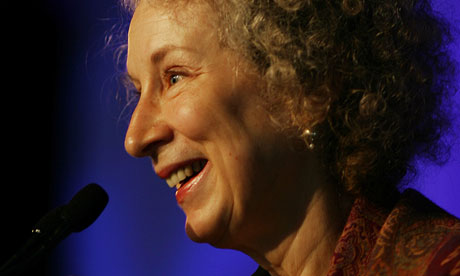
‘Amazed’ … Margaret Atwood. Photograph: Graeme Robertson for the Guardian
Night follows day with the launch of World Book Night, as publishers look to inspire adults to read by giving away 1m free books. Inspired by the success of World Book Day, which last year saw schoolchildren cash in tokens for more than 600,000 specially-published titles, this new initiative aims to put “an accessible work of enduring quality” in the hands of adult readers in the UK and Ireland on the evening of 5 March 2011.
Participating authors Margaret Atwood and John le Carré welcomed World Book Night with great enthusiasm, with Atwood saying she was “amazed by its magnitude” and Le Carré calling it “beyond his most ambitious dreams”.
Key to the event is the concept of enthusiastic readers giving away their favourite book to people they think might love it too. Anyone can apply to be one of the 20,000 givers, choosing the title they most want to give away from a list selected by a panel including booksellers, authors and librarians, including novels by Sarah Waters and David Mitchell, poetryfrom Carol Ann Duffy, and memoirs from Alan Bennett and Nigel Slater. The 20,000 chosen to give will be able to donate 48 copies of their much-loved book.
An eclectic roster of high-profile patrons have stepped forward to back the event, including writers JK Rowling, Dave Eggers and Seamus Heaney, musicians Damon Albarn and David Gilmour, actors Colin Firth and Tilda Swinton, cookery queen Nigella Lawson and sculptor Anthony Gormley. BBC creative director Alan Yentob is also a supporter, and the event will be covered on BBC2. Stephen Fry, Lemn Sissay, DBC Pierre, Kamila Shamsie and Bidisha are also on the editorial committee, chaired by broadcaster James Naughtie.
Atwood, whose novel The Blind Assassin is among those on offer for donation, said that when she first heard of the event she was “amazed not only by its magnitude but by its simplicity. The love of writing, the love of reading – these are huge gifts. To be able to give someone else a book you treasure widens the gift circle.”
Le Carré, whose The Spy Who Came in from the Cold is another book that will be given away on World Book Night, said: “No writer can ask more than this: that his book should be handed in thousands to people who might otherwise never get to read it, and who will in turn hand it to thousands more. That his book should also pass from one generation to another as a story to challenge and excite each reader in his time -that is beyond his most ambitious dreams.”
Artist Antony Gormley, who is a patron of the event, also offered a cheer, saying: “Hooray for World Book Night, a truly wonderful celebration of reading, writing, and sharing! When the joy of giving and receiving is added to the fruit of the imagination, something big, lovely and generous can happen: for a book allows us to hold the experience of another in our hands and absorb it in our minds.”
Jamie Byng, chief of publisher Canongate and the chairman of World Book Night, predicted that the event would have “an enormously positive impact on books and reading” because of the sheer power of personal recommendation. “Having 1m books given to one million different people on one night in this way is both unprecedented and hugely exciting,” he said.
While the vast majority of the books will be given away by individual members of the public, 40,000 will be distributed by WBN itself to people who might not otherwise be able to participate.
Organisers hope to extend the promotion to meet the global reach of its title in future, but for the moment it is limited to the UK and Ireland

Wikio

Delicious Bookmark this on Delicious

Filed Under: Books, books_blog

Interesting Margaret Atwood Interview

By Anita Mathias

Margaret Atwood interview: ‘Go three days without water and you don’t have any human rights. Why? Because you’re dead’

With almost 50 books to her name, the formidably intelligent Margaret Atwood is a force to be reckoned with. But one year on from the Copenhagen Summit, not even her dark imagination could have predicted the bleak situation the world now faces. Here, she talks about cowardly politicians, her love of birds and why she’s joined the Twitterati
    • Share385
    • Reddit
    • Buzz up
  • Robert McCrum
    • Robert McCrum
    • The Observer, Sunday 28 November 2010
    • Article history
margaret atwood in london
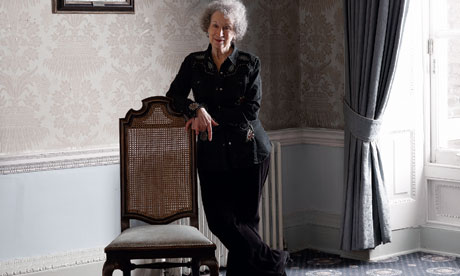
‘I don’t like being an icon’: Margaret Atwood at the Royal Over-Seas League in London earlier this month. Photograph: Henry Bourne for the Observer
It’s 25 years since the publication of The Handmaid’s Tale, her dystopic masterpiece, but Margaret Atwood firmly resists the suggestion that she might be an icon of Canadian literature. “What does that mean?” she counters in her distinctive prairie monotone, somewhere between a drone and a drawl. “I don’t like being an icon.” A thin ironic smile. “It invites iconoclasm. Canada is a balloon-puncturing country. You are not really allowed to be an icon unless you also make an idiot of yourself.”
Now no one has ever dared suggest that Margaret Atwood, a famously scary and prodigiously gifted Canadian intellectual with nearly 50 books to her name – poetry, fiction, critical essays, books for children, radio and film scripts, anthologies and collections of short stories – would ever willingly make an idiot of herself in public. But here’s the big surprise: lately she’s become game for a laugh. “If you want to see me make an idiot of myself in public,” she goes on in that inimitably dry timbre, “you can look it up. Margaret Atwood + goalie + Rick Mercer.”
It turns out Mercer is an entertainer who performed this national service when he insisted that the author of The Edible Woman, Alias Grace andThe Blind Assassin (which won the Booker Prize in 2000) should get kitted up as an ice-hockey goalie for television in an item entitled “How to Stop a Puck”. At first Ms Atwood demurred. No, said Mercer. You’ve got to be a goalie. Why, she asked. Because it will be funny, he said. Repeating this story against herself, Atwood whispers an aside: “He’s from Newfoundland”, as if this explains everything.
Mercer was right. It is funny. Not hilarious, but weird. And here’s the kicker, which seems to give Atwood a surprising amount of satisfaction. “So I was a goalie,” she concludes. “And it went viral on the internet.” Cyberspace, it seems, is where she is most at home these days.
A long time ago, in fact less than a year – “but time goes all stretchy in the Twittersphere, just as it does in those folk songs in which the hero spends a night with the queen of the faeries and then returns to find that 100 years have passed and all his friends are dead” – Atwood was advised by the people who were building the website to promote her new novel, The Year of the Flood (2009), that it should include a Twitterfeed. “‘A what?’ I said, innocent as an egg unboiled. Should I know of Twitter? I thought it was for kiddies.”
She can come across as humourless and severe, but I think her deadpan manner is just the shell with which she protects her fierce, inquisitive intelligence. “So I plunged in and set up a Twitter account.” Her first problem was that there were already two Margaret Atwoods, one of them with her picture. Eventually these impostors “disappeared”. She’s the kind of woman who you imagine generally gets her own way like that.
Next she was told she should collect “followers”. No problem. There’s something contagious about Atwood’s imagination: her tweets went viral, too. A few months back she had 33,500 followers. Now she has 97,500, a community of literati, techno geeks, greens, gawkers and thrill seekers, ie pretty much anyone who might pick up an Atwood novel. “There’s a whole world out there of which we know nothing,” she says. If ever there was an incitement to her imagination, it is the mystery of the world wide web. “You could not make it up,” she concludes.
Atwood has just turned 71. After a career that began in a university library and was then spent hunched over a keyboard, she finds the new electronic world “an odd and uncanny place”, but plainly relishes it. Just before she met the Observer in central London, she caused a momentary, quasi-literary frisson by contacting two of her followers, a clinical neurologist from Detroit and an Atlanta writer suffering from an autoimmune disease, offering to design “superhero comix costumes” for their avatar alter egos “Kidneyboy” and “Dr Snit”.
Characteristically, she was inspired by a mixture of language, science, fantasy and sheer make-believe. “I thought it would be fun,” she said. “Their names were so evocative, I asked them what magic powers they would like to have.” And then she went one better. Exploiting Twitpic, Atwood posted her designs on the internet, with cartoons of Dr Snit trampling “her arch-enemy”, the Paniac, underfoot.
If this also seems weird, in Atwood’s mind it connects directly to her childhood. “I grew up in the woods. Don’t even think rural. That implies farms. No, we’re talking” – a dramatic downshift in tone – “in the woods. A settlement of about six houses [a research station] with no access by car. No electricity. No running water.” Young Peggy put this remoteness to good use. “Reading and writing are connected,” she explains. “I learned to read very early so I could read the comics, which I then started to draw.”
Atwood breaks off here with a scholarly aside about Captain Marvel, Superman and the origin of “Shazam!” (formed from the initial letters of classical gods, as Z for Zeus etc). She and her older brother “had a whole galaxy going”, she remembers. “Our superheroes were flying rabbits. His came fully equipped with spaceships and weaponry. My rabbits were more frivolous. They were keen on balloons and did a lot of twirling about in the air. The pictures I have of them [which she’s kept] show these rather eerie smiles.”
At this point, with her own eerie smile, the childhood memories stop and we return abruptly to her work. Fiercely committed to her art, she draws a distinction between science fiction (not for her) and what she calls “speculative fiction” (The Handmaid’s Tale and its successors, Oryx and Crake and The Year of The Flood). “I don’t do flying rabbits any more. I’ve never done other planets, except as one thread in The Blind Assassin.” Still, the novel won the first Arthur C Clarke award in 1987, though she was promptly disowned by the SF community after she had disparaged “talking squids in outer space”.
Atwood’s pressing interest, as the daughter of an eminent Canadian entomologist, is our planet and its future. Nothing seems more important to her, and since this concern animates almost everything she does, her conversation segues as easily into global warming as Canadian literature: “The threat to the planet is us. It’s actually not a threat to the planet – it’s a threat to us.”
She goes on: “The planet will be OK in its own way. No matter what we do to it, we won’t eliminate every last life form from it.” As evidence of this, there’s the Canadian city of Sudbury, a favourite of Atwood’s. When she was growing up in the 1940s, the place was as “barren as the moon” through overlogging, forest fires and relentless mining. “All the rain was acid,” she says. It was so bad that “a Sudbury” became a unit of pollution. But then a volunteer programme of regeneration was launched. Earth and seeds were painstakingly stuffed into the cracks between the rocks. Now, “Sudbury has forests again, birds in the trees and fish in the streams.” For her, Sudbury, “a symbol of hope”, offers a paradigm for the planet.
And so, Atwood continues, with rather bracing realism, “some form of life will remain after us. We shouldn’t be saying ‘Save the planet’; we should be saying: ‘Save viable conditions in which people can live.’ That’s what we’re dealing with here.”
Atwood likes to tell the Amoeba’s Tale as an illustration of the “magic moment” at which planet earth now finds itself. There’s this test tube, and it’s full of amoeba food. You put one amoeba in at 12 noon. The amoeba divides in two every minute. At 12 midnight the test tube is full of amoebas – and there’s no food left. Question: at what moment in time is the tube half full? Answer: one minute to midnight. That’s where we are apparently. That’s when all the amoebas are saying: “We are fine. There’s half a tube of food left.”
“If you don’t believe me,” Atwood persists, “look at the proposed heat maps for 20, 30, 50 years from now, and see what’s drying up. Quite a lot, actually, especially in the equatorial regions and the Middle East, which will be like a raisin. It’s become a race against time and we are not doing well. The trouble with politicians [at events like the Copenhagen summit of 2009] is that no one wants to go first, go skinny dipping and take the plunge. Oh, and then you have people arguing about fatuous things like the environment and human rights. Go three days without water and you don’t have any human right. Why? Because you’re dead. Physics and chemistry are things you just can’t negotiate with. These,” she concludes with a kind of grim relish, “these are the laws of the physical world.”
Atwood’s love for, and understanding of, the world about us comes from her childhood in the woods and her lifelong passion for birdwatching(more tweets). She is the honorary president of the Rare Bird Club and when she took her novel The Year of the Flood on a book tour across the UK and Canada – a trip that was “like setting fire to myself and shooting myself out of a cannon” – it became an all-blogging multimedia green circus that was also fundraising for the RSPB, and rooted in the natural as much as the literary world. “There’s nothing,” she says, “like squelching through the drizzle after watching the release of the young white-tailed eagles that RSPB Scotland is reintroducing into their once-native territory.”
As well as raising awareness of rare-bird vulnerability, she also champions “virtuous coffee consumption”. As a result she’s had a coffee bean named after her, Balzac’s Atwood Blend, which is part of a fundraiser for the Peelee Island Trust (pibo.ca). Spend any time with Atwood and, as well as the flow of compelling, sardonic commentary on the state of the world, and any number of fictional characters from Becky Sharp to Dan Dare, you’ll be assaulted by an extraordinary number of Good Causes.
Is she, I wondered, not something of a Victorian in her prodigious output and range of interests? “Oh yes,” she replies unfazed. “Victorian literature was my subject at Harvard.” Now, finally, we are beginning to approach the origins of her best work.
The Handmaid’s Tale is the embodiment of Atwood’s aesthetic approach, in which she places “science” as much as “fiction” at the heart of an urgent creative matrix. In the first place, she does not make a fetish of literature. “Human creativity,” she instructs, “is not confined to just a few areas of life. The techno-scientific world has some of the most creative people you’ll ever meet. When I was growing up, I never saw a division. For instance, my brother [a senior neurophysiologist specialising in the synapse] and I both have the same marks in English and in the sciences.”
When Atwood slips unconsciously into the present tense it’s as if she is once again an overachieving high-school kid competing for the glittering prizes. “My brother could have gone in the writing direction. And I could have been a scientist.” It takes very little effort of the imagination to picture Atwood in a lab coat, supervising a team of cutting-edge researchers.
It’s sometimes said that Atwood started out as a poet, and there are plenty of Atwood readers in Canada who prefer her poetry (collections such as The Door and Morning in the Burned House) to her fiction. She insists that this is so only because “I got the poetry published first”. She has always been a literary polymath. “I began as all of the things that I currently do: fiction, poetry and non-fiction.”
The turning point in her creative fortunes occurred when she took a graduate course in American literature at Harvard. “I’m the only person you’ve ever met who has read Longfellow.” Her interest in the puritan prose of the pre-American revolutionary period comes from her family. Some of her ancestors “were puritan New Englanders”, and she puts The Handmaid’s Tale firmly in this context: “Nothing comes from nothing.” Long before the revolution, she goes on, “the Salem witch trials provide a template that continues to recur in America. That’s why I set The Handmaid’s Tale in Cambridge, Massachusetts” and borrowed several recognisable features of the university landscape. “Harvard was sniffy about it at first.” Another thin smile of caustic satisfaction. “But they’ve come round.”
The Handmaid’s Tale is set in the near future, in the Republic of Gilead, a country coterminous with the former USA in which a group of radical chauvinists has seized control. The story of a person named Offred (Of Fred) is the bleak tale of a woman kept as a reproductive concubine of a member of the ruling class. More Huxley than Orwell, Atwood riffs on feminist motifs with a fierce ingenuity that still seems as dateless yet topical as when it first appeared.
One strand in the evolution of her dystopic vision derives from her (unfinished) graduate thesis on the “English Metaphysical Romance”, which somehow took in the work of George MacDonald through Rider Haggard, CS Lewis and JRR Tolkien. “I was always very interested in supernatural female figures,” she says. Still, it was a long journey to the speculative vision that characterises Atwood’s work today. First of all, there was the small matter of establishing a distinctive Canadian literary voice. The making of a Canadian identity is, she says, part of all Canadians’ struggle for survival. The theme of overcoming the odds in a hostile natural world runs through many of her books.
When Atwood started to write there was virtually no Canadian literature, apart from commercial fiction such as LM Montgomery’s wildly popularAnne of Green Gables. “When they tried to put together an Oxford Book of Canadian Literary Anecdotes,” she reports with a mischievous expression, “they couldn’t do it. There were simply not enough dead people.” In 1960, for example, there were just five novels by Canadian writers published by Canadian publishers in Canada. “When you talk about my generation,” she says, “I am that generation.
“When I started in Canada it was very hard to be a writer. Very few Canadian writers were published, even in Canada. If you wrote a novel you were told that there weren’t enough readers in Canada, you must get a publisher in Britain, or the US. Then – Catch 22 – you were told your work was too Canadian.”
Perhaps only the Margaret Atwood who sees science and literature as twins, and who began to write far out “in the woods”, someone who has forged an identity for herself far from the metropolitan ivory towers of the English literary tradition, could have come up with perhaps her most innovative literary creation, the Long Pen, a remote signature device conceived to enable her to sign copies of her books for the fans without leaving home.
It was launched, disastrously, at the London Book Fair four years ago. “Now it has gone,” she says mysteriously, “in other directions, which I will be promoting in March 2011. The original idea six years ago, before the advent of ebooks, was that the publishing industry could not afford to send writers out on tour, but there was an appetite for signed books.” She drops into a characteristic moment of pedagogy: “Canada has always been interested in communications networks. Why? Because it’s so big. Alexander Graham Bell was no accident. It was not surprising, really, that we were the most wired country in the world first. We addressed the question of how to be in a place you’re not.
“So we invented a remote, web-based signature. Handwriting is complex. Now we can go to any country, and so long as they have a reasonable internet connection we can reproduce handwriting by remote signal.”
Did she have the vision of the Long Pen on her own? Not exactly. “Well, I was the one who had the initial, idiotic aperçu. Then the people with propellers on their heads developed it. Apparently we have been trying to do this since the 19th century.” Atwood’s luck was to have the idea “at the same time as the software existed. The g-forces involved in handwriting turn out to be incredibly strong. So the technology has to be durable, flexible and accurate – and now it exists.” The passion with which she discusses her invention far outruns her enthusiasm for her own work. In no time she begins to describe the non-literary applications of the Long Pen.
“There are a lot of things that cannot be verified by digital codes. Your will, for instance, has to be signed. It can’t be a copy to be legal. The point is,” she instructs, “that ‘Let’s get people to think like machines’ has evolved into ‘Let’s get machines to think like people’.” Part of her enthusiasm is commercial. Atwood has a stake in the success of the Long Pen. She will be a formidable advocate for its development, when the commercial launch occurs next year.
“Your writing is you,” she says. “Your fingerprints can be detached. I learned that from Sherlock Holmes. Holmes was my hero.” Off we go down another path. Conan Doyle turns out to be “a real model of how to kill off your main character and bring him back life”. From Conan Doyle the conversation swings through HG Wells to Huxley, to Nineteen Eighty-Four. So I wonder: does she choose Huxley or Orwell?
“We may get both at once. As William Gibson says: ‘The future is already here, but it’s unevenly distributed.’ It’s a race against time, because we’re already overloaded with nine billion people. At what point do the people with pitchforks and torches come and burn down your lab?”
She drops into a stage whisper. “Physics and chemistry. [The world] can’t be sustained. The world is this big, and we can’t make it any bigger. You can’t put any more unrenewable resources on to it. There’s a lot of hi-tech thinking going on. It’s that trend versus Famine, Flood, Drought.” Listening to Atwood’s litany of despair, it’s hard not to conclude that the future offers a bleak picture. “Well, it is…” says Atwood. Then suddenly she brightens up, like one of her cartoon characters. “And it isn’t. Let’s just say it’s… a super-challenge.”

Wikio

Delicious Bookmark this on Delicious

Filed Under: books_blog, Interviews with Writers

Prague: A magical city,

By Anita Mathias

Prague – a magical city –

Guest post by Roy Mathias


When we told our friends we were going to Prague they assured us that it would be amazing, fantastic, wonderful… and we were not disappointed.  Here are a few of the highlights from this atmospheric compact city we enjoyed exploring on foot.

The Cathedral of St. Vitus (near the Park Inn) stands on a hill across the river from the center of town.  It has a range of wonderful stained glass, including the Mucha Window from the 1930’s


(detail below)


The exterior is also very ornate.  Here is the golden gate


which is part of the south side, which is on a large square:


The East end looks quite different


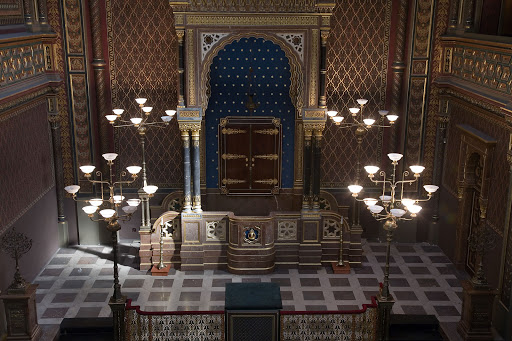
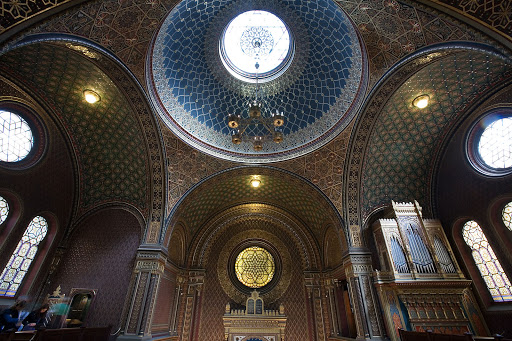
Another day, we visited the Jewish Quarter and all the Jewish sites there.  By far the best was the Spanish Synagogue —  very Islamic in style, except for the 6 pointed star everywhere.  Every square inch of wall space covered in red, green and gold ornamentation.  Ornate columns and simple striking stained glass.  Unfortunately no photos allowed.  Here are some images from the web:

Imagine being surrounded by:


and looking up


is no less gorgeous


You might think that the remaining synagogues were a disappointment, and they were quite missable.  The Old Jewish Cemetery however, was a beautiful, peaceful setting surrounded by high walls and shaded by trees losing their leaves.  Imagine your self in a wood, surrounded by old gravestones falling over each other.


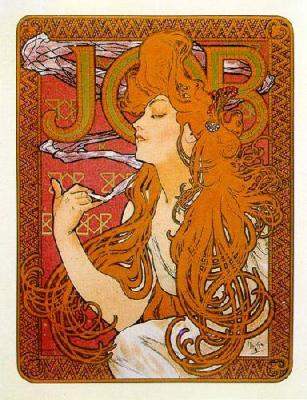
Another day we visited the Mucha Museum enjoying the work of the Art Nouveau painter and decorative artist.  Most of it commercial – posters for actress Sarah Bernhardt, the lottery supporting teaching of the Czech language, and even JOB cigarettes:


And now a word from our sponsor: Park Inn by Radisson.  You can enter a weekly drawing to win a 7 day stay at a Park Inn, and two weekly prizes ofan iPad and a £250 Radisson gift voucher, and a grand prize of a 7 day stay in a choice of 3 Park Inns. To win

1.  Play 4 Park Inn and try to get “4 in a row.” (you must be over 18 and a resident of the UK, Austria, Germany or Switzerland)

2. Whether you win or lose, you can enter your email for a chance to win.  Each time you play, you can enter. (you must be over 18 and a resident of the UK, Austria, Germany or Switzerland)  Good luck.

Play 4 Park Inn


Sponsored Post

Share hosted by Wikio

Filed Under: random

  • « Previous Page
  • 1
  • …
  • 186
  • 187
  • 188
  • 189
  • 190
  • …
  • 279
  • Next Page »

Sign Up and Get a Free eBook!

Sign up to be emailed my blog posts (one a week) and get the ebook of "Holy Ground," my account of working with Mother Teresa.

Join 536 Other Readers

My Books

Rosaries, Reading, Secrets: A Catholic Childhood in India

Rosaries, Reading Secrets, B&N
USA

UK

Wandering Between Two Worlds: Essays on Faith and Art

Wandering Between Two Worlds
USA

UK

Francesco, Artist of Florence: The Man Who Gave Too Much

Francesco, Artist of Florence
US

UK

The Story of Dirk Willems

The Story of Dirk Willems
US

UK

My Latest Meditation

Anita Mathias: About Me

Anita Mathias

Read my blog on Facebook

Follow me on Twitter

Follow @anitamathias1

Recent Posts

  • At the Cross, God Forgives Us Completely
  • Using God’s Gift of Our Talents: A Path to Joy and Abundance
  • The Kingdom of God is Here Already, Yet Not Yet Here
  • All Those Who Exalt Themselves Will Be Humbled & the Humble Will Be Exalted
  • Christ’s Great Golden Triad to Guide Our Actions and Decisions
  • How Jesus Dealt With Hostility and Enemies
  • Do Not Be Afraid, but Do Be Prudent
  • For Scoundrels, Scallywags, and Rascals—Christ Came
  • How to Lead an Extremely Significant Life
  • Don’t Walk Away From Jesus, but if You Do, He Still Looks at You and Loves You
Premier Digital Awards 2015 - Finalist - Blogger of the year
Runner Up Christian Media Awards 2014 - Tweeter of the year

Categories

What I’m Reading


Wolf Hall
Hilary Mantel

Wolf Hall --  Amazon.com
Amazon.com

Amazon.co.uk

Silence and Honey Cakes:
The Wisdom Of The Desert
Rowan Williams

Silence and Honey Cakes --  Amazon.com
Amazon.com

Amazon.co.uk

The Long Loneliness:
The Autobiography of the Legendary Catholic Social Activist
Dorothy Day

The Long Loneliness --  Amazon.com
Amazon.com

Amazon.co.uk

Country Girl
Edna O'Brien

Country Girl  - Amazon.com
Amazon.com

Amazon.co.uk

Archive by month

My Latest Five Podcast Meditations

INSTAGRAM

anita.mathias

My memoir: Rosaries, Reading, Secrets https://amzn.to/42xgL9t
Oxford, England. Writer, memoirist, podcaster, blogger, Biblical meditation teacher, mum

Looking at photos from our week in beautiful Sevil Looking at photos from our week in beautiful Seville and Cordoba over New Year with Irene, who had a week off.
And, ICYMI, here’s my latest meditation on the Gospel of Matthew… I’ve recorded it, should you want a few minutes of peace.
https://anitamathias.com/2026/04/29/gods-complete-forgiveness/
Hello Friends, I'm resumed recording my meditation Hello Friends, I'm resumed recording my meditations on the Gospel of Matthew. Do click on this link to listen. 
https://anitamathias.com/.../29/gods-complete-forgiveness/
Christ is the most influential figure in the history of the world, though his life ended in shame, humiliation and failure. But he so completely turned things round in his great reversal that the cross on which he died when all seemed hopeless is now the most common, and revered, symbol in history.
He emerged from and was anchored in Judaism. And as the sins of the people were laid on the scapegoat who was sent into the wilderness to perish, Christ died as the lamb of God voluntarily bearing the guilt of the wrongdoing of the whole world. He paid the price for our forgiveness with his life-blood--in accordance with the iron law of the physical and moral universe, of sowing and reaping, cause and effect. 
And so, God, who appeared as flames of fire to Moses, can now dwell within us, purifying us, whose hearts have darkness and shards of ice. 
And now that Christ was crucified, died, but rose again, His Spirit, no longer contained within his earthly body, is poured out like living water onto all humans, at our humble request. The Spirit pours the love of God into us; he reminds us of the words of Jesus and slowly writes Christ’s sweet law on our hearts. This transfusion of grace helps us do hard things we previously couldn’t do. Our dance with the Spirit gradually breaks the power of sin over us. It transforms us.
Now we, the forgiven, protected by the blood of Jesus poured out over us, and filled with His Spirit, who sings within us, Abba, Father, are adopted by God as his children in his joyful new covenant. We are cells grafted into the vine of our new family--Father, Son, Spirit—who now live in us as we live in them. As we choose by our thoughts and actions to continue living in the vine of Jesus, their energy pulsing through us makes us fruitful. And now, all our prayers which flow in the river of God’s good purposes are kindly heard. Waves of love and power flood from the cross! 
Thank you!
Well, hello friends! Breaking radio silence to let Well, hello friends! Breaking radio silence to let you know that I have taped a meditation for you on Christ’s famous Parable of the Talents in Matthew 25. https://anitamathias.com/2025/11/05/using-gods-gift-of-our-talents-a-path-to-joy-and-abundance/
Here you are, click the play button in the blog post for a brief meditation, and some moments of peace, and, perhaps, inspiration in your day 🙂
Hi Friends, I have taped a meditation; do listen a Hi Friends, I have taped a meditation; do listen at this link: https://anitamathias.com/2025/04/08/the-kingdom-of-god-is-here-already-yet-not-yet-here-2/
It’s on the Kingdom of God, of which Christ so often spoke, which is here already—a mysterious, shimmering internal palace in which, in lightning flashes, we experience peace and joy, and yet, of course, not yet fully here. We sense the rainbowed presence of Christ in the song which pulses through creation. Christ strolls into our rooms with his wisdom and guidance, and things change. Our prayers are answered; we are healed; our hearts are strangely warmed. Sometimes.
And yet, we also experience evil within & all around us. Our own sin which can shatter our peace and the trajectory of our lives. And the sins of the world—its greed, dishonesty and environmental destruction.
But in this broken world, we still experience the glory of creation; “coincidences” which accelerate once we start praying, and shalom which envelops us like sudden sunshine. The portals into this Kingdom include repentance, gratitude, meditative breathing, and absolute surrender.
The Kingdom of God is here already. We can experience its beauty, peace and joy today through the presence of the Holy Spirit. But yet, since, in the Apostle Paul’s words, we do not struggle only “against flesh and blood, but against the rulers, against the unseen powers of this dark world and against the spiritual forces of evil,” its fullness still lingers…
Our daughter Zoe was ordained into the Church of E Our daughter Zoe was ordained into the Church of England in June. I have been on a social media break… but … better late than never. Enjoy!
First picture has my sister, Shalini, who kindly flew in from the US. Our lovely cousins Anthony and Sarah flank Zoe in the next picture.
The Bishop of London, Sarah Mullaly, ordained Zoe. You can see her praying that Zoe will be filled with the Holy Spirit!!
And here’s a meditation I’ve recorded, which you might enjoy. The link is also in my profile
https://anitamathias.com/2024/11/07/all-those-who-exalt-themselves-will-be-humbled-the-humble-will-be-exalted/
I have taped a meditation on Jesus statement in Ma I have taped a meditation on Jesus statement in Matthew 23, “For those who exalt themselves will be humbled, and those who humble themselves will be exalted.”
Do listen here. https://anitamathias.com/2024/11/07/all-those-who-exalt-themselves-will-be-humbled-the-humble-will-be-exalted/
Link also in bio.
And so, Jesus states a law of life. Those who broadcast their amazingness will be humbled, since God dislikes—scorns that, as much as people do.  For to trumpet our success, wealth, brilliance, giftedness or popularity is to get distracted from our life’s purpose into worthless activity. Those who love power, who are sure they know best, and who must be the best, will eventually be humbled by God and life. For their focus has shifted from loving God, doing good work, and being a blessing to their family, friends, and the world towards impressing others, being enviable, perhaps famous. These things are houses built on sand, which will crumble when hammered by the waves of old age, infirmity or adversity. 
God resists the proud, Scripture tells us—those who crave the admiration and power which is His alone. So how do we resist pride? We slow down, so that we realise (and repent) when sheer pride sparks our allergies to people, our enmities, our determination to have our own way, or our grandiose ego-driven goals, and ambitions. Once we stop chasing limelight, a great quietness steals over our lives. We no longer need the drug of continual achievement, or to share images of glittering travel, parties, prizes or friends. We just enjoy them quietly. My life is for itself & not for a spectacle, Emerson wrote. And, as Jesus advises, we quit sharp-elbowing ourselves to sit with the shiniest people, but are content to hang out with ordinary people; and then, as Jesus said, we will inevitably, eventually, be summoned higher to the sparkling conversation we craved. 
One day, every knee will bow before the gentle lamb who was slain, now seated on the throne. We will all be silent before him. Let us live gently then, our eyes on Christ, continually asking for his power, his Spirit, and his direction, moving, dancing, in the direction that we sense him move.
Link to new podcast in Bio https://anitamathias.co Link to new podcast in Bio https://anitamathias.com/2024/02/20/how-jesus-dealt-with-hostility-and-enemies/
3 days before his death, Jesus rampages through the commercialised temple, overturning the tables of moneychangers. Who gave you the authority to do these things? his outraged adversaries ask. And Jesus shows us how to answer hostile questions. Slow down. Breathe. Quick arrow prayers!
Your enemies have no power over your life that your Father has not permitted them. Ask your Father for wisdom, remembering: Questions do not need to be answered. Are these questioners worthy of the treasures of your heart? Or would that be feeding pearls to hungry pigs, who might instead devour you?
Questions can contain pitfalls, traps, nooses. Jesus directly answered just three of the 183 questions he was asked, refusing to answer some; answering others with a good question.
But how do we get the inner calm and wisdom to recognise
and sidestep entrapping questions? Long before the day of
testing, practice slow, easy breathing, and tune in to the frequency of the Father. There’s no record of Jesus running, rushing, getting stressed, or lacking peace. He never spoke on his own, he told us, without checking in with the Father. So, no foolish, ill-judged statements. Breathing in the wisdom of the Father beside and within him, he, unintimidated, traps the trappers.
Wisdom begins with training ourselves to slow down and ask
the Father for guidance. Then our calm minds, made perceptive, will help us recognise danger and trick questions, even those coated in flattery, and sidestep them or refuse to answer.
We practice tuning in to heavenly wisdom by practising–asking God questions, and then listening for his answers about the best way to do simple things…organise a home or write. Then, we build upwards, asking for wisdom in more complex things.
Listening for the voice of God before we speak, and asking for a filling of the Spirit, which Jesus calls streams of living water within us, will give us wisdom to know what to say, which, frequently, is nothing at all. It will quieten us with the silence of God, which sings through the world, through sun and stars, sky and flowers.
Especially for @ samheckt Some very imperfect pi Especially for @ samheckt 
Some very imperfect pictures of my labradoodle Merry, and golden retriever Pippi.
And since, I’m on social media, if you are the meditating type, here’s a scriptural meditation on not being afraid, while being prudent. https://anitamathias.com/2024/01/03/do-not-be-afraid-but-do-be-prudent/
A new podcast. Link in bio https://anitamathias.c A new podcast. Link in bio
https://anitamathias.com/2024/01/03/do-not-be-afraid-but-do-be-prudent/
Do Not Be Afraid, but Do Be Prudent
“Do not be afraid,” a dream-angel tells Joseph, to marry Mary, who’s pregnant, though a virgin, for in our magical, God-invaded world, the Spirit has placed God in her. Call the baby Jesus, or The Lord saves, for he will drag people free from the chokehold of their sins.
And Joseph is not afraid. And the angel was right, for a star rose, signalling a new King of the Jews. Astrologers followed it, threatening King Herod, whose chief priests recounted Micah’s 600-year-old prophecy: the Messiah would be born in Bethlehem, as Jesus had just been, while his parents from Nazareth registered for Augustus Caesar’s census of the entire Roman world. 
The Magi worshipped the baby, offering gold. And shepherds came, told by an angel of joy: that the Messiah, a saviour from all that oppresses, had just been born.
Then, suddenly, the dream-angel warned: Flee with the child to Egypt. For Herod plans to kill this baby, forever-King.
Do not be afraid, but still flee? Become a refugee? But lightning-bolt coincidences verified the angel’s first words: The magi with gold for the flight. Shepherds
telling of angels singing of coming inner peace. Joseph flees.
What’s the difference between fear and prudence? Fear is being frozen or panicked by imaginary what-ifs. It tenses our bodies; strains health, sleep and relationships; makes us stingy with ourselves & others; leads to overwork, & time wasted doing pointless things for fear of people’s opinions.
Prudence is wisdom-using our experience & spiritual discernment as we battle the demonic forces of this dark world, in Paul’s phrase.It’s fighting with divinely powerful weapons: truth, righteousness, faith, Scripture & prayer, while surrendering our thoughts to Christ. 
So let’s act prudently, wisely & bravely, silencing fear, while remaining alert to God’s guidance, delivered through inner peace or intuitions of danger and wrongness, our spiritual senses tuned to the Spirit’s “No,” his “Slow,” his “Go,” as cautious as a serpent, protected, while being as gentle as a lamb among wolves.
Follow on Instagram

© 2026 Dreaming Beneath the Spires · All Rights Reserved. · Cookie Policy · Privacy Policy