Anita Mathias: Dreaming Beneath the Spires

Anita Mathias's Blog on Faith and Art

  • Home
  • My Books
  • Meditations
  • Essays
  • Contact
  • About Me

Injustice.

By Anita Mathias

Matthew 26 47-56#
Jesus Arrested
 47 While he was still speaking, Judas, one of the Twelve, arrived. With him was a large crowd armed with swords and clubs, sent from the chief priests and the elders of the people. 48 Now the betrayer had arranged a signal with them: “The one I kiss is the man; arrest him.” 49 Going at once to Jesus, Judas said, “Greetings, Rabbi!” and kissed him.

 50 Jesus replied, “Do what you came for, friend.”
Jesus at his most unfathomable–gentleness and kindness shown to the one who impelled by his own greed, doubt, and inner divisions has betrayed him (which Judas will soon regret).
Jesus has run through the gamut of human experience–the unimaginable pain of the knife twist of betrayal. The kiss, the customary way for friends in ancient and modern Israel to greet one another now becomes the means of betrayal,

Then the men stepped forward, seized Jesus and arrested him. 51 With that, one of Jesus’ companions reached for his sword, drew it out and struck the servant of the high priest, cutting off his ear.
Peter, the impulsive one

   52 “Put your sword back in its place,” Jesus said to him, “for all who draw the sword will die by the sword.
A chastening thought. Jesus does not approve of violent means to achieve our ends. Because we live in his Father’s kingdom, and his Father, in his own time, can send legions of angels to rescue us. 

53 Do you think I cannot call on my Father, and he will at once put at my disposal more than twelve legions of angels? 54 But how then would the Scriptures be fulfilled that say it must happen in this way?”
Jesus is the willing sacrifice. He suggests that if at any point, he had said, “No. I have changed my mind,” his Father would yet have rescued him.
72,000 angels. A Roman legion at full strength had 600 soldiers. 

55 In that hour Jesus said to the crowd, “Am I leading a rebellion, that you have come out with swords and clubs to capture me? Every day I sat in the temple courts teaching, and you did not arrest me. 56 But this has all taken place that the writings of the prophets might be fulfilled.” Then all the disciples deserted him and fled.

 Jesus mildly protests the manner of his arrest. The crowd sent by the Sanhedrin had come after him as if he were a dangerous criminal or insurrectionist. And then he again reiterates his surrender to his Father’s will.

 The disciple’s courage failed faced with the large crowd “armed with swords and clubs.” Death or severe injury was likely. And arrest. Who can blame them?

The great crowd consisted of a detachment of Roman soldiers, assigned by Pilate to the temple for security, who were carrying swords, and Levitical temple police and personal security of the chief priests and Sanhedrin (elders) carrying clubs. 

Filed Under: Blog Through the Bible Project., Matthew

When Prayer Costs Everything

By Anita Mathias

Jesus in Gethsemane

Matthew 26 36-46–Blog Through the Bible Project
Gethsemane
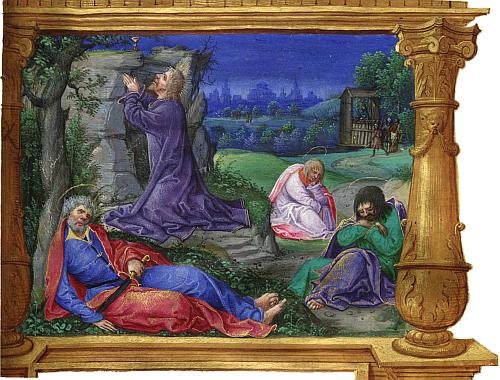
 36 Then Jesus went with his disciples to a place called Gethsemane, and he said to them, “Sit here while I go over there and pray.” 37 He took Peter and the two sons of Zebedee along with him, and he began to be sorrowful and troubled. 38 Then he said to them, “My soul is overwhelmed with sorrow to the point of death. Stay here and keep watch with me.”

I love these depictions of Jesus as fully human. Longing for friendship. Longing to lean on his friends. 

That is why Jesus is such a great friend to us, and knowing him is such a great experience. Because Jesus knows what it is to be really, really sad and to experience great sorrow.

Gethsemane means “oil press.” A garden area among the olive groves on the Mount of Olives.

 39 Going a little farther, he fell with his face to the ground and prayed, “My Father, if it is possible, may this cup be taken from me. Yet not as I will, but as you will.”
All through his life, Jesus has been modelling various types of prayer–in the prayer he taught his disciples, in his own prayers at the Last Supper, in his modelling of prayer for healing… 

Here he models prayer during an excruciatingly difficult time.

He asks his Father that if  possible, the cup of suffering may be removed from him.

But then he says that it’s okay if things happen not as he himself wishes, but as his Father wishes.  

Whereas, through God’s mercy, the cup of extreme suffering presents itself to us only rarely, every day of our Christian life requires this “death” : “Not as I will, but as you will.”

Sometimes, God calls us to small tweaks. Sometimes, what he calls us to feels like death.

Perhaps this prayer of the Lord’s should be incorporated into our daily devotions. “Lord, today, not as I will but as you will.” 

What would it involve for me? Spending more time with people rather than on work? Getting back on track a bit with my house, which tells the tale of Easter holidays? Not being so insistent on my own way in family life?

ESV Jesus falls on his face in a typical posture of abject humility in prayer and lays his life before his Father in complete honesty and surrender. Jesus faces the most agonizing struggle of his life to date at the moment when he is ready to accomplish the culmination of his life’s mission–to bear the sins of the world, which is what this cup signifies.

Jesus was the Lamb of God bearing the penalty for the sins of the entire human race. The wrath of God was turned loose upon him. This partly explains the agony of Gethsemane.

40 Then he returned to his disciples and found them sleeping. “Couldn’t you men keep watch with me for one hour?” he asked Peter. 41 “Watch and pray so that you will not fall into temptation. The spirit is willing, but the flesh is weak.”

Temptation surrounds us. Temptations to unhealthy food. To laziness. Selfishness. Untruthfulness. Bad temper. Dishonesty.

One is not to be blase about temptation, but watch and pray that one does not succumb. Because while our spirits are willing, parts of our human nature are very weak indeed. 

42 He went away a second time and prayed, “My Father, if it is not possible for this cup to be taken away unless I drink it, may your will be done.”

At first, he asks his Father to remove the cup from him, if it is possible. But then, as he hears his Father’s voice more clearly, he modulates his prayer.
 What he now says is, “If it is not possible that this suffering be taken away, may your will be done.”

 43 When he came back, he again found them sleeping, because their eyes were heavy. 44 So he left them and went away once more and prayed the third time, saying the same thing.
Even in extremis, he has compassion on his disciples. And allows them to sleep.

 45 Then he returned to the disciples and said to them, “Are you still sleeping and resting? Look, the hour has come, and the Son of Man is delivered into the hands of sinners. 46 Rise! Let us go! Here comes my betrayer!”

And he get up from his prayer, from his struggle unto death, fortified and resolved to face the bitter onrushing anguish with fortitude. 

Filed Under: Matthew

A Contemplative in the World

By Anita Mathias

Angelus, Millet

If I were to formulate my ideal for my life and spiritual life it would be to be “a Contemplative in the World.”

I want to live quietly and peacefully. Mindful of Christ. Rooted in Christ. Immersed in him. And in Scripture.
I want to remember to pray through my day. To seek God’s wisdom on my thinking and actions. Both the little and trivial, and the large

I want to lead a quiet life. To do some work with my hands in my garden as the monks of old did.

I want the words and ideas of Scripture to run through my mind through the day.
                                    * * *
Some contemplatives, for instance, the Trappists, take an additional vow of stability. Stability of place. That is, they commit themselves to live in a particular monastery until they die.
This monastic ideal is very appealing to me. I’ve moved around so much–I have lived in 13 towns in 3 countries–India, England, and America–which is less than some people, but more than most. And for me it feels like too much.
I have a longing now for rootedness. To stay in a place for a long time. To know its seasons. Its plants and trees and flowers and  wildlife. Its history. The same people over a period of years.  To settle down.
When Thoreau was asked if he had travelled much, he answered in the affirmative. “I have travelled a great deal in Concord,” he said. I want to travel a great deal in Garsington, in my garden, an acre and a half in Garsington. To really know it.
* * *

Most monastic life is based on the Rule of St. Benedict. A day held sleep, prayer and study, and manual labour in roughly equal balance.

During their waking hours, they balanced prayer, study and manual labour. It’s amazing that Benedict stumbled upon this perfect balance of mind, spirit and body.

The one weakness of monastic life is relationships–it does not allow for marital relationships, parent-child relationships or one on one friendships. I would be so lonely without these–which is why I would like to be ” a contemplative in the world.”

However the monks and nuns did live together in community, which is a stabilizing influence, and a safeguard against nuttiness, extreme selfishness or against undisciplined excesses in food, sleep, prayer or study. The anonymity of the monastic life also provided a safeguard against the drudgery of ambition.
* * *

I find I need the manual labour which was part of monasticism for mental, psychological and spiritual health, leave alone physical health and strength. It rounds out and completes what can be a very cerebral, intense, edgy and often highly-strung personality. I do my best thinking and praying while working in the garden, or pottering in the house, though I do have a cleaner, since I don’t potter particularly regularly.
* * *

I committed my life to the lovely Jesus when I was 17, and then and now being ardent, asked, “What should I do?” So momentous a decision had to express itself in action I felt.And so, being a novice Christian, and not realizing the importance of the seeking the whole counsel of God, I picked up a bit of the jigsaw.

Jesus said, “Whatever you do to the least of my brethren, you do to me.” And so I decided to serve the least of these.  I lived near Calcutta, and so at 17 and a half, went off to become a nun and work with Mother Teresa.

It was a temperamental mismatch. I had spent my childhood in an exclusive dreamy boarding school in the Himalayas, run by Irish, English and German IBMV nuns, and where I read, and read, and read. I was reading Thomas Hardy, George Eliot, Matthew Arnold, Galsworthy, Shaw, James Joyce “the Portrait,” not Ulysses), Joyce Cary…

Suddenly, I joined a community where many people were just learning English, literacy was basic , there was no reading except spiritual reading. I had been so used to living in my mind, in books, in language, and I felt bereft of that. In fact, I took an old Bible which had both Latin and English and patiently taught myself some Latin by matching the words.

The hardest part was living in community. This was community in extreme–25 women sharing a single room, which with a constant moving of furniture became a dormitory, refectory, class-room, living room. No privacy, except at times of prayer and meditation–and then, it was your mind and thoughts which were at rest, your body was with 400 others.

Phew. I loved God, loved thinking of Him, talking to Him, learning about Him. Still do. Loved Scripture. Still do. But I just needed a lot more solitude and quiet than I could get in a service-oriented community.

After 14 months there, I realized it was not for me. Mother had another order, called Sisters of the Word, devoted to a contemplative life. They spent their mornings in prayer and reading Scripture, and their afternoons in proclaiming the Word to the poor, the” spiritually poor,” on the streets, wherever. I fancied it would be just the thing for me.

Mother Teresa had her doors open all day. I asked if I could either leave and go home or if  I could transfer to her contemplative branch from her active branch. She thought I was too young–at 18–for a contemplative life which is generally considered psychologically, spiritually and emotionally more difficult than an active religious life, and asked me to apply to that order when I was 21.

When I was 21, of course, English in Oxford absorbed all my thoughts. My faith was virtually non-existent. And that was that!!
* * *

But now, in a quiet season of my life, I am getting increasingly fascinated with trying to figure out how to incorporate contemplative rhythms into my daily life.

This Saturday, Roy and I are going to a conference on incorporating monastic rhythms into daily life.

IAN ADAMS
‘CAVE, REFECTORY, ROAD – MONASTIC RHYTHMS FOR CONTEMPORARY LIVING’
SAT 30TH APRIL 2011
10AM-4PM | FRIENDS MEETING HOUSE, OXFORD
A day of teaching, stillness and contemplative practice with Ian Adams, exploring how we might incorporate the wisdom and patterns of the monastic way into everyday life 
Ian Adams is a writer, teacher and artist working with themes of spirituality, culture and community. He is a director of the Stillpoint project, nurturing spiritual practice from within the Christian contemplative-active tradition. An Anglican priest, he was the founder and abbot of the mayBe community in Oxford. He is the creator of the daily morning bell call to prayer and author of Cave Refectory Road: monastic rhythms for contemporary living [Canterbury Press 2010]. Ian is a member of the spirituality group for Greenbelt Festival. He has a particular interest in how a contemplative approach to daily living can bring about personal change, community transformation and renewal of the earth


http://www.thestillpoint.org.uk/

We are also exploring a Christian community in Oxford, http://maybe.org.uk/ which seeks to incorporate some monastic values into daily life, me with more enthusiasm, Roy, who would happily travel all day in his garden, with less. Will report on our progress.

Filed Under: random

How to Handle Argumentative People

By Anita Mathias

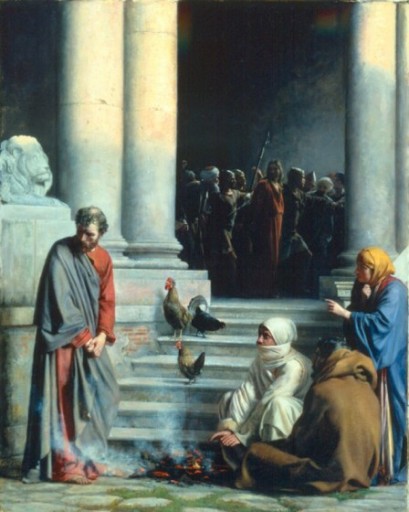
Carl Heinrick Bloch

Matthew 26 31-35

Jesus Predicts Peter’s Denial

 31 Then Jesus told them, “This very night you will all fall away on account of me, for it is written:

   “‘I will strike the shepherd,
   and the sheep of the flock will be scattered.’
32 But after I have risen, I will go ahead of you into Galilee.”
 33 Peter replied, “Even if all fall away on account of you, I never will.”
   34 “Truly I tell you,” Jesus answered, “this very night, before the rooster crows, you will disown me three times.”
 35 But Peter declared, “Even if I have to die with you, I will never disown you.” And all the other disciples said the same.

Jesus shows his gentleness in his concern for his friends even before his own hour of greatest trauma.

He assures them that he will go ahead of them to Galilee, which, of course, they all forget in the dreadful trauma of the next day. His love remains constant, despite their betrayal.

How little even the best of us know ourselves. Peter loves his sublime radiant friend and Lord, Jesus. Peter overestimates his strength of character.  He cannot imagine either himself or his friends ever leaving or disowning Jesus, even if he had to die with him. 

And yet, in the night terror of soldiers and blows, and scourging and fixed trials, he does just that. 

And Jesus lets Peter have the last word.

He says what he has to say, and leaves it.

Arguments are a waste of time. Better let the other person have the last word. 

And remember: We are never as strong as think we are. 

Filed Under: Blog Through the Bible Project., Matthew

How to Handle Argumentative People

By Anita Mathias

Carl Heinrick Bloch

Matthew 26 31-35 Blog Through the Bible Project
Jesus Predicts Peter’s Denial
 31 Then Jesus told them, “This very night you will all fall away on account of me, for it is written:
   “‘I will strike the shepherd,
   and the sheep of the flock will be scattered.’
32 But after I have risen, I will go ahead of you into Galilee.”
 33 Peter replied, “Even if all fall away on account of you, I never will.”
   34 “Truly I tell you,” Jesus answered, “this very night, before the rooster crows, you will disown me three times.”
 35 But Peter declared, “Even if I have to die with you, I will never disown you.” And all the other disciples said the same.

Jesus shows his gentleness in his concern for his friends even before his own hour of greatest trauma.

He assures them that he will go ahead of them to Galilee, which, of course, they all forget in the dreadful trauma of the next day. His love remains constant, despite their betrayal.

How little even the best of us know ourselves. Peter loves his sublime radiant friend and Lord, Jesus. Peter overestimates his strength of character.  He cannot imagine either himself or his friends ever leaving or disowning Jesus, even if he had to die with him. 

And yet, in the night terror of soldiers and blows, and scourging and fixed trials, he does just that. 

And Jesus lets Peter have the last word.

He says what he has to say, and leaves it.

Arguments are a waste of time. Better let the other person have the last word. 

And remember: We are never as strong as think we are. 

Share on site of your choice … Wikio

Filed Under: Matthew

The Forgiveness of Sins–Blog Through the Bible Project

By Anita Mathias

consecration.jpg picture by kking888
Matthew 26, Blog Through the Bible Project
The Plot Against Jesus
 1 When Jesus had finished saying all these things, he said to his disciples, 2 “As you know, the Passover is two days away—and the Son of Man will be handed over to be crucified.”

 3 Then the chief priests and the elders of the people assembled in the palace of the high priest, whose name was Caiaphas, 4 and they schemed to arrest Jesus secretly and kill him. 5 “But not during the festival,” they said, “or there may be a riot among the people.”

Jesus predicts his crucifixion for the fourth and final time. He has a foreknowledge of what is going to happen, though that does not make it less painful.

Verse 5 Hundreds of thousands of pilgrims annually made the journey to Jerusalem to celebrate Passover, and nationalistic fervour ran high as they recalled the liberation of their ancestors from bondage in Egypt. 
Popular uprisings were increasingly common during such festival periods, and so the chief priests were reluctant to arrest Jesus openly because of his popularity with the people. 

The Last Supper
 17 On the first day of the Festival of Unleavened Bread, the disciples came to Jesus and asked, “Where do you want us to make preparations for you to eat the Passover?” 18 He replied, “Go into the city to a certain man and tell him, ‘The Teacher says: My appointed time is near. I am going to celebrate the Passover with my disciples at your house.’” 19 So the disciples did as Jesus had directed them and prepared the Passover.
 20 When evening came, Jesus was reclining at the table with the Twelve. 21 And while they were eating, he said, “Truly I tell you, one of you will betray me.”
 22 They were very sad and began to say to him one after the other, “Surely you don’t mean me, Lord?”
They loved him after all. It was unthinkable.

 23 Jesus replied, “The one who has dipped his hand into the bowl with me will betray me. 24 The Son of Man will go just as it is written about him. But woe to that man who betrays the Son of Man! It would be better for him if he had not been born.”
 25 Then Judas, the one who would betray him, said, “Surely you don’t mean me, Rabbi?”
   Jesus answered, “You have said so.”

The breakdown of love and trust between Jesus and Judas was so extreme, that Judas does not heed his warning, “It would be better for him if he had not been born.” 
The height of disloyalty and betrayal was turning on someone after sharing a meal with him.
The chief priests, very savvily had prepaid him after all.
The rest of the disciples address Jesus as Lord, but Judas addresses him as Rabbi or Teacher. There is no record of Judas ever calling Jesus Lord. 
“You have said so,”–A Greek expression which deflects responsibility upon the one asking the question.

 26 While they were eating, Jesus took bread, and when he had given thanks, he broke it and gave it to his disciples, saying, “Take and eat; this is my body.”
Jesus defines, and redefines love. Love is giving yourself for those you love.
When one reads this, one feels “How can I ever love like that?”
As Jesus said, it is good for us that he had to go, because if he had not gone, the Holy Spirit, the comforter, would not have come. 
So, when we feel powerless to love, we can implore the Holy Spirit to come and help us in our weakness. 

27 Then he took a cup, and when he had given thanks, he gave it to them, saying, “Drink from it, all of you. 28 This is my blood of the covenant, which is poured out for many for the forgiveness of sins. 29 I tell you, I will not drink from this fruit of the vine from now on until that day when I drink it new with you in my Father’s kingdom.”
 30 When they had sung a hymn, they went out to the Mount of Olives.
Theologically foundational words. Jesus’s body will be the once-and-for-all reenactment of the ceremony of the Passover Lamb, as he will become the sacrificial atonement for the sins of the people.
His blood is poured out for the forgiveness of sins. God forgives those who have put their faith in Jesus, who are grafted into Jesus because Jesus died an excruciating death to pay the penalty for our sin. His blood was poured out for many so that they would not have to pay the eternal consequence of their sins.
Forgiven, reconciled, at peace with God. The enormity of it is hard to grasp.
And because Jesus did this for us, we too are called to let it all go–the offences men have committed against us, those who have lied, manipulated, schemed, abused us and hurt us.

The cup was likely the third cup drunk at the Passover, the cup of blessing or the cup of redemption corresponding to God’s third promise in Ex 6:6 “I will redeem you with an outstretched arm, and with great acts of judgment.”


The cup foreshadows the shedding of Jesus’ blood and the absorbing of God’s wrath, which opens the way for the redemption of all peoples through the new covenant relationship with God that was promised to the people of Israel.
My father’s kingdom–The Messianic Banquet.

Share on site of your choice … Wikio

Filed Under: Matthew

The Forgiveness of Sins–Blog Through the Bible Project

By Anita Mathias

consecration.jpg picture by kking888
Matthew 26
The Plot Against Jesus
 1 When Jesus had finished saying all these things, he said to his disciples, 2 “As you know, the Passover is two days away—and the Son of Man will be handed over to be crucified.”

 3 Then the chief priests and the elders of the people assembled in the palace of the high priest, whose name was Caiaphas, 4 and they schemed to arrest Jesus secretly and kill him. 5 “But not during the festival,” they said, “or there may be a riot among the people.”

Jesus predicts his crucifixion for the fourth and final time. He has a foreknowledge of what is going to happen, though that does not make it less painful.

Verse 5 Hundreds of thousands of pilgrims annually made the journey to Jerusalem to celebrate Passover, and nationalistic fervour ran high as they recalled the liberation of their ancestors from bondage in Egypt. 
Popular uprisings were increasingly common during such festival periods, and so the chief priests were reluctant to arrest Jesus openly because of his popularity with the people. 

The Last Supper
 17 On the first day of the Festival of Unleavened Bread, the disciples came to Jesus and asked, “Where do you want us to make preparations for you to eat the Passover?” 18 He replied, “Go into the city to a certain man and tell him, ‘The Teacher says: My appointed time is near. I am going to celebrate the Passover with my disciples at your house.’” 19 So the disciples did as Jesus had directed them and prepared the Passover.
 20 When evening came, Jesus was reclining at the table with the Twelve. 21 And while they were eating, he said, “Truly I tell you, one of you will betray me.”
 22 They were very sad and began to say to him one after the other, “Surely you don’t mean me, Lord?”
They loved him after all. It was unthinkable.

 23 Jesus replied, “The one who has dipped his hand into the bowl with me will betray me. 24 The Son of Man will go just as it is written about him. But woe to that man who betrays the Son of Man! It would be better for him if he had not been born.”
 25 Then Judas, the one who would betray him, said, “Surely you don’t mean me, Rabbi?”
   Jesus answered, “You have said so.”

The breakdown of love and trust between Jesus and Judas was so extreme, that Judas does not heed his warning, “It would be better for him if he had not been born.” 
The height of disloyalty and betrayal was turning on someone after sharing a meal with him.
The chief priests, very savvily had prepaid him after all.
The rest of the disciples address Jesus as Lord, but Judas addresses him as Rabbi or Teacher. There is no record of Judas ever calling Jesus Lord. 
“You have said so,”–A Greek expression which deflects responsibility upon the one asking the question.

 26 While they were eating, Jesus took bread, and when he had given thanks, he broke it and gave it to his disciples, saying, “Take and eat; this is my body.”
Jesus defines, and redefines love. Love is giving yourself for those you love.
When one reads this, one feels “How can I ever love like that?”
As Jesus said, it is good for us that he had to go, because if he had not gone, the Holy Spirit, the comforter, would not have come. 
So, when we feel powerless to love, we can implore the Holy Spirit to come and help us in our weakness. 

27 Then he took a cup, and when he had given thanks, he gave it to them, saying, “Drink from it, all of you. 28 This is my blood of the covenant, which is poured out for many for the forgiveness of sins. 29 I tell you, I will not drink from this fruit of the vine from now on until that day when I drink it new with you in my Father’s kingdom.”
 30 When they had sung a hymn, they went out to the Mount of Olives.
Theologically foundational words. Jesus’s body will be the once-and-for-all reenactment of the ceremony of the Passover Lamb, as he will become the sacrificial atonement for the sins of the people.
His blood is poured out for the forgiveness of sins. God forgives those who have put their faith in Jesus, who are grafted into Jesus because Jesus died an excruciating death to pay the penalty for our sin. His blood was poured out for many so that they would not have to pay the eternal consequence of their sins.
Forgiven, reconciled, at peace with God. The enormity of it is hard to grasp.
And because Jesus did this for us, we too are called to let it all go–the offences men have committed against us, those who have lied, manipulated, schemed, abused us and hurt us.

The cup was likely the third cup drunk at the Passover, the cup of blessing or the cup of redemption corresponding to God’s third promise in Ex 6:6 “I will redeem you with an outstretched arm, and with great acts of judgment.”


The cup foreshadows the shedding of Jesus’ blood and the absorbing of God’s wrath, which opens the way for the redemption of all peoples through the new covenant relationship with God that was promised to the people of Israel.
My father’s kingdom–The Messianic Banquet.

Filed Under: Matthew

Beauty and God

By Anita Mathias

Drawing by  Lesley Fellows
Me, original design


My opinionated daughters engaged me in a heated theological debate on beauty this week.
Irene saunters into my bedroom. Her beloved black and gold Tinker Bell pyjama top has a tear down the seam.
“Irene, throw it away,” I say.
She scrunches up her face, “NO,” she says appalled.
I hand her a needle and thread.
“Then, mend it,” I say.
“No,” she says. “It’s a pyjama top.”
I, “You are a daughter of a King. There is no need for you to wear torn clothes.”
She, appalled again, “He couldn’t care what I look like. He didn’t care what he looked like.”
Me, a bit uncertain, “You don’t think God cares what you look like?”
She, “No! He’d just look at my face.”
Me, “Oh”
* * *
Zoe, 16, agrees with her sister. She wore contact lenses for 2 days, then declared that they were too much hassle. “But, but, but…” I stammer.
My very appearance-conscious father used to joke, “Men don’t make passes at girls who wear glasses” and got both his daughters contacts in our teens, my sister’s when she was ten!!
I can hardly say that to Zoe. I am, roughly speaking, a feminist, and have tried to raise them to be independent and self-confident.
Zoe, seeing me falter, adds, for good measure. “And I have decided not to ever use make up either.” I gave her a lovely triple layer make-up kit for her 16th birthday, full of the most gorgeous gold, and bronze and silver and purples, which I would have had fun using as a teenager. “What?” I say. “Make up is fun; it’s like art; it’s like painting.” The fact that I rarely remember to use it probably undermines my words.
* * *
I thought of an argument I had with a close American friend of ours, who was a mentor to us when we lived in America around the time Irene was born. I had gained a lot of weight during that pregnancy and he—we had regular bi-weekly spiritual direction sessions over a period of 5 years– was urging me to diet and exercise.
Me, “I don’t think God cares what I look like.”
He, “Anita, when you write how you put it is as important as what you say. Your appearance is part of who you are.”
I somewhat bought his argument—though I have gained another 18 pounds since Irene was born in May 1999. Sigh!
Yes, God loves beauty, and so perhaps we should try to look as attractive as we can, given our starting point?
                                                       * * *
So how should a daughter of the King look? A story I heard the father of the friend I’ve just mentioned tell has influenced my thinking on the subject.
Jack Miller and his wife Rosemary who had founded World Harvest Mission were visiting Uganda. They come late to a meeting, and every seat was taken except the ones right in front, next to the President, Idi Amin. Rosemary nervously tells Jack, “I’ll sit on the grass.” “Jack says, “Rosemary, no! You are wearing a lovely dress. You are a daughter of the King. Be brave. We will sit in front.” And they go and sit next to Idi Amin, who is gracious to them.
This is a useful principle for me when I declutter. If something is too old, faded, stained, worn—whether an item of clothing, or furniture or household item, carpets, towels etc.—to be in the house of a daughter of the King, out it goes.
                                                            * * * 
I don’t agree with Irene. I think God cares for his “original design” in us and wants us to fit and strong, and attractive in accordance with his original design for us. As is fitting for daughters of the King.
* * *
I noticed over the 17 years I lived in America that every female Christian leader and teacher was also slim and gorgeous. She would not have had much appeal to other Christian women if she had not been so. And so would not have been able to exercise her ministry as effectively
*  * *
I have have theoretically acquiesced that my body is the temple of the Holy Spirit, and it is important to keep it fit. However, my resolutions falter on a weekly basis faced with chocolate, let’s say, or how much more magnetic my laptop is than weight-lifting. I guess the girls have picked up what I do rather than what I say.
* * *
I have two friends with the degenerative neurological disease, MND or Lou Gehrigh’s disease. They have speech and physical therapy. Their body will degenerate anyway—but fighting against it will so something to ameliorate the degeneration.
And so, if, despite trying, in fits and starts, to exercise and eat more healthily, I still gain a few pounds over a course of the year, I am trying not to be discouraged, but remember that if I did not, I could easily gain a few pounds in the course of a month—or week.
                                                               * * *
So what do you think? Does God care about what we look like? Would he like us to continue trying to look reasonably attractive—or is he mainly concerned with the beauty of our spirits?

Filed Under: random

  • « Previous Page
  • 1
  • …
  • 141
  • 142
  • 143
  • 144
  • 145
  • …
  • 279
  • Next Page »

Sign Up and Get a Free eBook!

Sign up to be emailed my blog posts (one a week) and get the ebook of "Holy Ground," my account of working with Mother Teresa.

Join 536 Other Readers

My Books

Rosaries, Reading, Secrets: A Catholic Childhood in India

Rosaries, Reading Secrets, B&N
USA

UK

Wandering Between Two Worlds: Essays on Faith and Art

Wandering Between Two Worlds
USA

UK

Francesco, Artist of Florence: The Man Who Gave Too Much

Francesco, Artist of Florence
US

UK

The Story of Dirk Willems

The Story of Dirk Willems
US

UK

My Latest Meditation

Anita Mathias: About Me

Anita Mathias

Read my blog on Facebook

Follow me on Twitter

Follow @anitamathias1

Recent Posts

  • At the Cross, God Forgives Us Completely
  • Using God’s Gift of Our Talents: A Path to Joy and Abundance
  • The Kingdom of God is Here Already, Yet Not Yet Here
  • All Those Who Exalt Themselves Will Be Humbled & the Humble Will Be Exalted
  • Christ’s Great Golden Triad to Guide Our Actions and Decisions
  • How Jesus Dealt With Hostility and Enemies
  • Do Not Be Afraid, but Do Be Prudent
  • For Scoundrels, Scallywags, and Rascals—Christ Came
  • How to Lead an Extremely Significant Life
  • Don’t Walk Away From Jesus, but if You Do, He Still Looks at You and Loves You
Premier Digital Awards 2015 - Finalist - Blogger of the year
Runner Up Christian Media Awards 2014 - Tweeter of the year

Categories

What I’m Reading


Wolf Hall
Hilary Mantel

Wolf Hall --  Amazon.com
Amazon.com

Amazon.co.uk

Silence and Honey Cakes:
The Wisdom Of The Desert
Rowan Williams

Silence and Honey Cakes --  Amazon.com
Amazon.com

Amazon.co.uk

The Long Loneliness:
The Autobiography of the Legendary Catholic Social Activist
Dorothy Day

The Long Loneliness --  Amazon.com
Amazon.com

Amazon.co.uk

Country Girl
Edna O'Brien

Country Girl  - Amazon.com
Amazon.com

Amazon.co.uk

Archive by month

My Latest Five Podcast Meditations

INSTAGRAM

anita.mathias

My memoir: Rosaries, Reading, Secrets https://amzn.to/42xgL9t
Oxford, England. Writer, memoirist, podcaster, blogger, Biblical meditation teacher, mum

Well, hello friends! Breaking radio silence to let Well, hello friends! Breaking radio silence to let you know that I have taped a meditation for you on Christ’s famous Parable of the Talents in Matthew 25. https://anitamathias.com/2025/11/05/using-gods-gift-of-our-talents-a-path-to-joy-and-abundance/
Here you are, click the play button in the blog post for a brief meditation, and some moments of peace, and, perhaps, inspiration in your day 🙂
Hi Friends, I have taped a meditation; do listen a Hi Friends, I have taped a meditation; do listen at this link: https://anitamathias.com/2025/04/08/the-kingdom-of-god-is-here-already-yet-not-yet-here-2/
It’s on the Kingdom of God, of which Christ so often spoke, which is here already—a mysterious, shimmering internal palace in which, in lightning flashes, we experience peace and joy, and yet, of course, not yet fully here. We sense the rainbowed presence of Christ in the song which pulses through creation. Christ strolls into our rooms with his wisdom and guidance, and things change. Our prayers are answered; we are healed; our hearts are strangely warmed. Sometimes.
And yet, we also experience evil within & all around us. Our own sin which can shatter our peace and the trajectory of our lives. And the sins of the world—its greed, dishonesty and environmental destruction.
But in this broken world, we still experience the glory of creation; “coincidences” which accelerate once we start praying, and shalom which envelops us like sudden sunshine. The portals into this Kingdom include repentance, gratitude, meditative breathing, and absolute surrender.
The Kingdom of God is here already. We can experience its beauty, peace and joy today through the presence of the Holy Spirit. But yet, since, in the Apostle Paul’s words, we do not struggle only “against flesh and blood, but against the rulers, against the unseen powers of this dark world and against the spiritual forces of evil,” its fullness still lingers…
Our daughter Zoe was ordained into the Church of E Our daughter Zoe was ordained into the Church of England in June. I have been on a social media break… but … better late than never. Enjoy!
First picture has my sister, Shalini, who kindly flew in from the US. Our lovely cousins Anthony and Sarah flank Zoe in the next picture.
The Bishop of London, Sarah Mullaly, ordained Zoe. You can see her praying that Zoe will be filled with the Holy Spirit!!
And here’s a meditation I’ve recorded, which you might enjoy. The link is also in my profile
https://anitamathias.com/2024/11/07/all-those-who-exalt-themselves-will-be-humbled-the-humble-will-be-exalted/
I have taped a meditation on Jesus statement in Ma I have taped a meditation on Jesus statement in Matthew 23, “For those who exalt themselves will be humbled, and those who humble themselves will be exalted.”
Do listen here. https://anitamathias.com/2024/11/07/all-those-who-exalt-themselves-will-be-humbled-the-humble-will-be-exalted/
Link also in bio.
And so, Jesus states a law of life. Those who broadcast their amazingness will be humbled, since God dislikes—scorns that, as much as people do.  For to trumpet our success, wealth, brilliance, giftedness or popularity is to get distracted from our life’s purpose into worthless activity. Those who love power, who are sure they know best, and who must be the best, will eventually be humbled by God and life. For their focus has shifted from loving God, doing good work, and being a blessing to their family, friends, and the world towards impressing others, being enviable, perhaps famous. These things are houses built on sand, which will crumble when hammered by the waves of old age, infirmity or adversity. 
God resists the proud, Scripture tells us—those who crave the admiration and power which is His alone. So how do we resist pride? We slow down, so that we realise (and repent) when sheer pride sparks our allergies to people, our enmities, our determination to have our own way, or our grandiose ego-driven goals, and ambitions. Once we stop chasing limelight, a great quietness steals over our lives. We no longer need the drug of continual achievement, or to share images of glittering travel, parties, prizes or friends. We just enjoy them quietly. My life is for itself & not for a spectacle, Emerson wrote. And, as Jesus advises, we quit sharp-elbowing ourselves to sit with the shiniest people, but are content to hang out with ordinary people; and then, as Jesus said, we will inevitably, eventually, be summoned higher to the sparkling conversation we craved. 
One day, every knee will bow before the gentle lamb who was slain, now seated on the throne. We will all be silent before him. Let us live gently then, our eyes on Christ, continually asking for his power, his Spirit, and his direction, moving, dancing, in the direction that we sense him move.
Link to new podcast in Bio https://anitamathias.co Link to new podcast in Bio https://anitamathias.com/2024/02/20/how-jesus-dealt-with-hostility-and-enemies/
3 days before his death, Jesus rampages through the commercialised temple, overturning the tables of moneychangers. Who gave you the authority to do these things? his outraged adversaries ask. And Jesus shows us how to answer hostile questions. Slow down. Breathe. Quick arrow prayers!
Your enemies have no power over your life that your Father has not permitted them. Ask your Father for wisdom, remembering: Questions do not need to be answered. Are these questioners worthy of the treasures of your heart? Or would that be feeding pearls to hungry pigs, who might instead devour you?
Questions can contain pitfalls, traps, nooses. Jesus directly answered just three of the 183 questions he was asked, refusing to answer some; answering others with a good question.
But how do we get the inner calm and wisdom to recognise
and sidestep entrapping questions? Long before the day of
testing, practice slow, easy breathing, and tune in to the frequency of the Father. There’s no record of Jesus running, rushing, getting stressed, or lacking peace. He never spoke on his own, he told us, without checking in with the Father. So, no foolish, ill-judged statements. Breathing in the wisdom of the Father beside and within him, he, unintimidated, traps the trappers.
Wisdom begins with training ourselves to slow down and ask
the Father for guidance. Then our calm minds, made perceptive, will help us recognise danger and trick questions, even those coated in flattery, and sidestep them or refuse to answer.
We practice tuning in to heavenly wisdom by practising–asking God questions, and then listening for his answers about the best way to do simple things…organise a home or write. Then, we build upwards, asking for wisdom in more complex things.
Listening for the voice of God before we speak, and asking for a filling of the Spirit, which Jesus calls streams of living water within us, will give us wisdom to know what to say, which, frequently, is nothing at all. It will quieten us with the silence of God, which sings through the world, through sun and stars, sky and flowers.
Especially for @ samheckt Some very imperfect pi Especially for @ samheckt 
Some very imperfect pictures of my labradoodle Merry, and golden retriever Pippi.
And since, I’m on social media, if you are the meditating type, here’s a scriptural meditation on not being afraid, while being prudent. https://anitamathias.com/2024/01/03/do-not-be-afraid-but-do-be-prudent/
A new podcast. Link in bio https://anitamathias.c A new podcast. Link in bio
https://anitamathias.com/2024/01/03/do-not-be-afraid-but-do-be-prudent/
Do Not Be Afraid, but Do Be Prudent
“Do not be afraid,” a dream-angel tells Joseph, to marry Mary, who’s pregnant, though a virgin, for in our magical, God-invaded world, the Spirit has placed God in her. Call the baby Jesus, or The Lord saves, for he will drag people free from the chokehold of their sins.
And Joseph is not afraid. And the angel was right, for a star rose, signalling a new King of the Jews. Astrologers followed it, threatening King Herod, whose chief priests recounted Micah’s 600-year-old prophecy: the Messiah would be born in Bethlehem, as Jesus had just been, while his parents from Nazareth registered for Augustus Caesar’s census of the entire Roman world. 
The Magi worshipped the baby, offering gold. And shepherds came, told by an angel of joy: that the Messiah, a saviour from all that oppresses, had just been born.
Then, suddenly, the dream-angel warned: Flee with the child to Egypt. For Herod plans to kill this baby, forever-King.
Do not be afraid, but still flee? Become a refugee? But lightning-bolt coincidences verified the angel’s first words: The magi with gold for the flight. Shepherds
telling of angels singing of coming inner peace. Joseph flees.
What’s the difference between fear and prudence? Fear is being frozen or panicked by imaginary what-ifs. It tenses our bodies; strains health, sleep and relationships; makes us stingy with ourselves & others; leads to overwork, & time wasted doing pointless things for fear of people’s opinions.
Prudence is wisdom-using our experience & spiritual discernment as we battle the demonic forces of this dark world, in Paul’s phrase.It’s fighting with divinely powerful weapons: truth, righteousness, faith, Scripture & prayer, while surrendering our thoughts to Christ. 
So let’s act prudently, wisely & bravely, silencing fear, while remaining alert to God’s guidance, delivered through inner peace or intuitions of danger and wrongness, our spiritual senses tuned to the Spirit’s “No,” his “Slow,” his “Go,” as cautious as a serpent, protected, while being as gentle as a lamb among wolves.
Link to post with podcast link in Bio or https://a Link to post with podcast link in Bio or https://anitamathias.com/2023/09/22/dont-walk-away-from-jesus-but-if-you-do-he-still-looks-at-you-and-loves-you/
Jesus came from a Kingdom of voluntary gentleness, in which
Christ, the Lion of Judah, stands at the centre of the throne in the guise of a lamb, looking as if it had been slain. No wonder his disciples struggled with his counter-cultural values. Oh, and we too!
The mother of the Apostles James and John, asks Jesus for a favour—that once He became King, her sons got the most important, prestigious seats at court, on his right and left. And the other ten, who would have liked the fame, glory, power,limelight and honour themselves are indignant and threatened.
Oh-oh, Jesus says. Who gets five talents, who gets one,
who gets great wealth and success, who doesn’t–that the
Father controls. Don’t waste your one precious and fleeting
life seeking to lord it over others or boss them around.
But, in his wry kindness, he offers the ambitious twelve
and us something better than the second or third place.
He tells us how to actually be the most important person to
others at work, in our friend group, social circle, or church:Use your talents, gifts, and energy to bless others.
And we instinctively know Jesus is right. The greatest people in our lives are the kind people who invested in us, guided us and whose wise, radiant words are engraved on our hearts.
Wanting to sit with the cleverest, most successful, most famous people is the path of restlessness and discontent. The competition is vast. But seek to see people, to listen intently, to be kind, to empathise, and doors fling wide open for you, you rare thing!
The greatest person is the one who serves, Jesus says. Serves by using the one, two, or five talents God has given us to bless others, by finding a place where our deep gladness and the world’s deep hunger meet. By writing which is a blessing, hospitality, walking with a sad friend, tidying a house.
And that is the only greatness worth having. That you yourself,your life and your work are a blessing to others. That the love and wisdom God pours into you lives in people’s hearts and minds, a blessing
https://anitamathias.com/.../dont-walk-away-from-j https://anitamathias.com/.../dont-walk-away-from-jesus.../
Sharing this podcast I recorded last week. LINK IN BIO
So Jesus makes a beautiful offer to the earnest, moral young man who came to him, seeking a spiritual life. Remarkably, the young man claims that he has kept all the commandments from his youth, including the command to love one’s neighbour as oneself, a statement Jesus does not challenge.
The challenge Jesus does offers him, however, the man cannot accept—to sell his vast possessions, give the money to the poor, and follow Jesus encumbered.
He leaves, grieving, and Jesus looks at him, loves him, and famously observes that it’s easier for a camel to squeeze through the eye of a needle than for a rich person to live in the world of wonders which is living under Christ’s kingship, guidance and protection. 
He reassures his dismayed disciples, however, that with God even the treasure-burdened can squeeze into God’s kingdom, “for with God, all things are possible.”
Following him would quite literally mean walking into a world of daily wonders, and immensely rich conversation, walking through Israel, Lebanon, Syria, and Jordan, quite impossible to do with suitcases and backpacks laden with treasure. 
For what would we reject God’s specific, internally heard whisper or directive, a micro-call? That is the idol which currently grips and possesses us. 
Not all of us have great riches, nor is money everyone’s greatest temptation—it can be success, fame, universal esteem, you name it…
But, since with God all things are possible, even those who waver in their pursuit of God can still experience him in fits and snatches, find our spirits singing on a walk or during worship in church, or find our hearts strangely warmed by Scripture, and, sometimes, even “see” Christ stand before us. 
For Christ looks at us, Christ loves us, and says, “With God, all things are possible,” even we, the flawed, entering his beautiful Kingdom.
Follow on Instagram

© 2026 Dreaming Beneath the Spires · All Rights Reserved. · Cookie Policy · Privacy Policy