Osama Bin Laden. RIP. Thoughts on Violence and Non-Violence

I remember watching Osama Bin Laden’s televised interview with Al-Jazeera sometime before the 2004 US presidential elections.
For the first time, he openly took responsibility for the attack on the World Trade Center.
He explained how he watched the US bomb towers in Lebanon in 1982, which then burst into flames with men, women and children in them.
And then he said, simply, that he wanted Americans to feel something of the misery and powerlessness his Arab brothers felt.
In that moment, he said, he conceived the notion of the 9/11 attacks.
***
Of course, I obviously don’t sympathize with that act of violence–which will, however, go down in history as one of the most ingenious, audacious and in a twisted way, conceptually brilliant attack by a private citizen on a powerful nation. It ranks up there in military history with the perhaps mythical account of the Trojan Horse.
With the sacrifice of 19 willing young volunteers, he threw the world’s largest economy and most powerful nation into a downward spiral from which it has not yet recovered.
* * *
I think about Osama off and on. I have several times prayed for the most hunted man in the world.
I am committed to non-violence in the way Jesus taught. I am interested in what happens if one follows non-violence in personal relationships. Sometimes, in a micro-scale, in personal relationships, when I am criticized, rightly or wrongly; when I am subjected to angry words, I just remain silent, leaving my vindication with God. No good comes out of retaliation, revenge, rage, returning anger with anger.
* * *
Osama was not a Christian. He saw towers full of Arab men, women and children burn. He wanted something to be done about it. He said, he wanted American to feel what his Arab brothers felt. As the American poet, Bob Haas might have put it, to awaken their moral imagination.
As a private citizen, not a writer, not a blogger, was there anything else he could have done to protest injustice?
His protest, however, was futile. 19 young pilots dead, 3000 American civilians dead, 250,000 civilians killed in Iraq, more Americans killed in Iraq than in the World Trade Centre, continuing devastation in Afghanistan…..
* * *
Meeting violence with violence is an intuitive, instinctive response.
Jesus tells us it does not work. I absolutely believe him.
On the face of it, violence has always seemed an effective way for private citizens to protest the injustices of the world.
However, as Gandhi said, meditating on Jesus’s words, “an eye for an eye leaves the whole world blind.”
* * *
Non-violence and gentleness works on a micro-level, in personal relationships, I believe (though I have not practised it nearly enough) because there is a factor of X, the power of God, which comes into a situation and changes it, when one is gentle, one does not defend oneself, but instead relies on God for his protection.
And how would this work on a macro-level in world politics?
Hmm. I do not know the answer?
Any thoughts?
Share on site of your choice … Wikio
Buying a Griffin
![]() |
| Griffin Outside St. Mark’s Venice |
A new pastime I’ve taken up this year is our weekly or bi-weekly plant shopping trips to Garden Centres.
Garden Centres are peculiarly English. They are almost tourist attractions, and are designated on highways with the same white on brown signs!
Many English people, those “of a certain age,”on weekdays, make a day out of it, leisurely shopping for plants, interspersed with cups of tea, lunch, and varieties of ubiquitous cakes. You see a certain kind of Englishness in action in garden centres.
Garden Centres have everything, all manner of household geegaws which, though pretty, should have “Will be decluttered soon” health warning on them.
They also have garden geegaws, to which, sadly, I am not immune. When my kids were young, they loved this stuff. Coming across smiling sun faces, green men, squirrels, foxes, cats, toads, butterfly or humming bird stakes in odd corners of the garden. I too like the whimsy.
I have an gargoyle, of surpassing ugliness, which I am rather fond of.
And, on our last trip, I almost bought an enormous griffin.
* * *
Well, it had tons of character. I had a little chat with my conscience, and decided: I would rather have that griffin than £50. But wasn’t parting with any more money for it. It was £63. Okay, then, close shave.
* * *
So we tell the girls, ” We almost bought a griffin today.”
One daughter takes this in her stride. “Oh,” she says.
(What is she meditating on? She is as abstracted as her father.)
The other daughter says, “What, where would you have put it?”
Me, frowning, “In the garden.”
She, “What would you feed it?”
What? She studies Greek, Latin, French…. But I guess in some ways, she does live in a magical world, in which parents casually buy griffins. After we moved into this house, we did buy 9 pets in a single week, after all–ducks, hens, rabbits and Jake, the Collie.
I play along.
“Raw meat.”
“Where would you put it to sleep?
Me, “It would sleep in the shed. Or in the conservatory. Or greenhouse.
“It will fly away, Mum,” she says contemptuously.
Me, “It would be like Canada Geese. They don’t leave easy food sources. We might clip its wings. At most it would perch on the willow.”
She “And how would we get it down?”
I, “You or dad would climb up and get it down.”
She, after a pause. “Are you still thinking of it?”
Me, teasing her “Yes, when I earn another 13 pounds.”
She, “And how long will that take you?”
Me, ” A day?”
I leave, inwardly chuckling to record this interchange. She herself won’t believe it a year later.
As I leave, I hear her tell her father, “Oh, it would be so like Mum to sit by the griffin with her Iphone, waiting for 13 pounds of sales to come in!”
And then off she goes to her laptop to record her close shave.
* * *
Realizing this, Roy and I simultaneously rush up, “Listen,” we say, “A griffin is a mythical beast.” Or else, she would soon have told her Facebook world that her parents are going to buy a griffin.
* * *
And so I get the story after all!!
Share on site of your choice … Wikio
Home Quiet Home
| Botanists. Please could you identify this shrub in my driveway. Is it worth saving? |
| Same mystery shrub needing identification |
We’re home for this four day weekend, having enjoyed Italy over Easter.
We had Tomasz, our Polish cleaner, house-sit for us. He winked, as I left saying, “I’ll give your house a make-over. You won’t recognize it.”
Well, he did. I had asked him to paint three rooms, but he astonished us by thoroughly arranging the girls’ room; catching up with their laundry, and even mine!!; sorting out and tidying up the greenhouse; dismantling the old shed that I’ve been wishing away forever; sweeping up and tidying the garden etc. Wow! And welcomed us back with fresh flowers and a kiss!
Sometimes God saves the best for last. I’ve got through so many cleaners and home helpers before I found someone just right for our family, who’s fond of us, and vice-versa.
* * *
We came back early for an Oxford Uni weekend course, “A Romp Through the History of Philosophy” taught by Marianne Talbot.
I love studying the history of things–Art, Literature, Christianity, and of course the history of countries, and tracking the evolution of ideas.
However, instead of a straight history of philosophy, this looked at the key thinkers in each of the four branches of philosophy–ethics, metaphysics, logic and epistemology.
She started with Socrates, whom I have always been enthralled by, and I was, predictably, enthralled.
And then jumped to Hume. What? The reasoning was abstract and irrelevant compared to Socrates’ forthright, to the point reasoning. I grew increasingly bored, and could not see myself sitting through 4 more lectures. (It was a weekend course).
I spent about 15 increasingly bored minutes, choosing between the rudeness of leaving a lecture which bored me, or staying. Left.
* * *
Zoe, for a reason I don’t get, wants to do an A level in Philosophy, in addition to Theology, English and French. (We would rather she did Psychology or Italian rather than Philosophy.)
So I called her enroute home, with the bad news that she was to go to the University, and sit out the weekend course. She went, with some grumbling.
And loved it. And still wants to do philosophy.
Better brush up my debating skills then!
Unjustly Framed. Blog Through the Bible Project
Unjust accusation
57 Those who had arrested Jesus took him to Caiaphas the high priest, where the teachers of the law and the elders had assembled. 58 But Peter followed him at a distance, right up to the courtyard of the high priest. He entered and sat down with the guards to see the outcome. 59 The chief priests and the whole Sanhedrin were looking for false evidence against Jesus so that they could put him to death. 60 But they did not find any, though many false witnesses came forward.
The Sanhedrin was the supreme ecclesiastical court of the Jews, centred in Jerusalem. The Romans were ultimately in control of all judicial proceedings, but allowed their subjects some freedom to try their own cases.
Finally two came forward 61 and declared, “This fellow said, ‘I am able to destroy the temple of God and rebuild it in three days.’”
So what had Jesus said?
John 2:19 “Destroy this temple, and I will raise it again in three days.”
20 They replied, “It has taken forty-six years to build this temple, and you are going to raise it in three days?” 21 But the temple he had spoken of was his body.
His words were misquoted, taken out of context and distorted. They led to his death.
But his Father saw to a resurrection.
Which means, one need never fear. Our father will provide a second act.
62 Then the high priest stood up and said to Jesus, “Are you not going to answer? What is this testimony that these men are bringing against you?” 63 But Jesus remained silent.
Why does he remain silent? Because he would have not been believed anyway? Because it would have been pointless.
There is great dignity in silence, and Jesus sets us an example in remaining silent when to speak would have been pointless.
Jesus’s silence fulfills Isaiah 53:7
7 He was oppressed and afflicted,
yet he did not open his mouth;
he was led like a lamb to the slaughter,
and as a sheep before its shearers is silent,
so he did not open his mouth.
The high priest said to him, “I charge you under oath by the living God: Tell us if you are the Messiah, the Son of God.”
Caiaphas wants Jesus to admit to this charge so that he can be accused of insurrection against Rome and tried before Pilate for treason.
NIV Jesus refused to answer the question of v. 62. But when the high priest used this form, Jesus was legally obliged to answer.
64 “You have said so,” Jesus replied. “But I say to all of you: From now on you will see the Son of Man sitting at the right hand of the Mighty One and coming on the clouds of heaven.”
You have said so: A Greek expression which deflects responsibility back upon the one asking the question.
Jesus declares that he is not only the human Messiah anticipated by the Jews, but also the divine Son of God, who sits at the right hand of God, and who will come on the clouds in power to reign on the earth.
65 Then the high priest tore his clothes and said, “He has spoken blasphemy! Why do we need any more witnesses? Look, now you have heard the blasphemy. 66 What do you think?”
“He is worthy of death,” they answered.
Few of us will survive life without unjust accusation. At least, the Messiah has gone before us.
ESV–If Jesus lied by claiming to be the son of God, then he deserved death from the standpoint of the Jewish law. The irony is that he will be executed for telling the truth.
67 Then they spit in his face and struck him with their fists. Others slapped him 68 and said, “Prophesy to us, Messiah. Who hit you?”
Mark and Luke record that they blindfolded Jesus, which explains their mocking question. I believe that mockery–saying something other than what you truly believe– is despicable to God, the straight-talker.
One of the traits of those who are blessed in Psalm 1 is that they do not sit in the company of mockers.
1 Blessed is the one
who does not walk in step with the wicked
or stand in the way that sinners take
or sit in the company of mockers,
Share on site of your choice … Wikio
Injustice
Injustice.
Matthew 26 47-56 Blog Through the Bible Project
Jesus Arrested
Share on site of your choice … Wikio
Unjust accusation
Matthew 26 57-67
Jesus Before the Sanhedrin
57 Those who had arrested Jesus took him to Caiaphas the high priest, where the teachers of the law and the elders had assembled. 58 But Peter followed him at a distance, right up to the courtyard of the high priest. He entered and sat down with the guards to see the outcome. 59 The chief priests and the whole Sanhedrin were looking for false evidence against Jesus so that they could put him to death. 60 But they did not find any, though many false witnesses came forward.
The Sanhedrin was the supreme ecclesiastical court of the Jews, centred in Jerusalem. The Romans were ultimately in control of all judicial proceedings, but allowed their subjects some freedom to try their own cases.
Finally two came forward 61 and declared, “This fellow said, ‘I am able to destroy the temple of God and rebuild it in three days.’”
So what had Jesus said?
John 2:19 “Destroy this temple, and I will raise it again in three days.”
20 They replied, “It has taken forty-six years to build this temple, and you are going to raise it in three days?” 21 But the temple he had spoken of was his body.
His words were misquoted, taken out of context and distorted. They led to his death.
But his Father saw to a resurrection.
Which means, one need never fear. Our father will provide a second act.
62 Then the high priest stood up and said to Jesus, “Are you not going to answer? What is this testimony that these men are bringing against you?” 63 But Jesus remained silent.
Why does he remain silent? Because he would have not been believed anyway? Because it would have been pointless.
There is great dignity in silence, and Jesus sets us an example in remaining silent when to speak would have been pointless.
Jesus’s silence fulfills Isaiah 53:7
7 He was oppressed and afflicted,
yet he did not open his mouth;
he was led like a lamb to the slaughter,
and as a sheep before its shearers is silent,
so he did not open his mouth.
The high priest said to him, “I charge you under oath by the living God: Tell us if you are the Messiah, the Son of God.”
Caiaphas wants Jesus to admit to this charge so that he can be accused of insurrection against Rome and tried before Pilate for treason.
NIV Jesus refused to answer the question of v. 62. But when the high priest used this form, Jesus was legally obliged to answer.
64 “You have said so,” Jesus replied. “But I say to all of you: From now on you will see the Son of Man sitting at the right hand of the Mighty One and coming on the clouds of heaven.”
You have said so: A Greek expression which deflects responsibility back upon the one asking the question.
Jesus declares that he is not only the human Messiah anticipated by the Jews, but also the divine Son of God, who sits at the right hand of God, and who will come on the clouds in power to reign on the earth.
65 Then the high priest tore his clothes and said, “He has spoken blasphemy! Why do we need any more witnesses? Look, now you have heard the blasphemy. 66 What do you think?”
“He is worthy of death,” they answered.
Few of us will survive life without unjust accusation. At least, the Messiah has gone before us.
ESV–If Jesus lied by claiming to be the son of God, then he deserved death from the standpoint of the Jewish law. The irony is that he will be executed for telling the truth.
67 Then they spit in his face and struck him with their fists. Others slapped him 68 and said, “Prophesy to us, Messiah. Who hit you?”
Mark and Luke record that they blindfolded Jesus, which explains their mocking question. I believe that mockery–saying something other than what you truly believe– is despicable to God, the straight-talker.
One of the traits of those who are blessed in Psalm 1 is that they do not sit in the company of mockers.
1 Blessed is the one
who does not walk in step with the wicked
or stand in the way that sinners take
or sit in the company of mockers,
When Prayer Costs Everything
![]() |
|
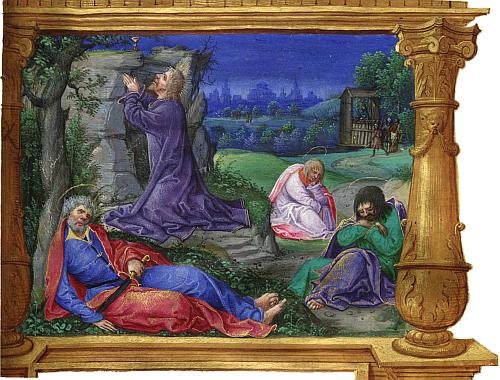
Jesus in Gethsemane
|
Matthew 26 36-46–Blog Through the Bible Project
Gethsemane
Share on site of your choice … Wikio
- « Previous Page
- 1
- …
- 140
- 141
- 142
- 143
- 144
- …
- 279
- Next Page »