Anita Mathias: Dreaming Beneath the Spires

Anita Mathias's Blog on Faith and Art

  • Home
  • My Books
  • Meditations
  • Essays
  • Contact
  • About Me

Archives for 2013

Ideas as Cats and Other Mysteries of Creativity

By Anita Mathias

 I think of creativity as God’s river or waterfall into which I step. There is a torrent of ideas out there;  I just need to slow down, and step into the deluge.

Ray Bradbury, however, in his wonderful book on writing, Zen in the Art of Writing, refers to ideas as cats.

“I am accustomed to getting up every morning, running to the typewriter,” writing a short story, “and in an hour, I’ve created a world. I don’t have to wait for anyone. I don’t have to criticize anyone. It’s done. All I need is an hour, and I’m ahead of everyone. The rest of the day I can goof off. I’ve already done a thousand words this morning, so if I want to have a two or three-hour lunch, I can have it, because I’ve already beat everyone.

I never put up with anything from my ideas. As soon as things get difficult, I walk away.

That’s the great secret of creativity.

You treat ideas like cats; you make them follow you. If you try to approach a cat and pick it up, hell, it won’t let you do it. You’ve got to say, “Well, to hell with you.”

And the cat says, “Wait a minute. He’s not behaving the way most humans do.” Then the cat follows you out of curiosity: “What’s the matter with you that you don’t love me?”

Well, that’s what an idea is. See? You just say, “Well, hell, I don’t need depression. I don’t need worry. I don’t need to push. The ideas will follow me. When they’re off-guard, and ready to be born, I’ll turn around and grab them.”

(Particularly applicable for blogs, and poems, and stories and essays…)


Filed Under: In which I explore writing and blogging and creativity, Writing and Blogging Tagged With: Creativity, Ideas as Cats, Ray Bradbury, Zen in the Art of Writing

Giving: A Counter-Intuitive Secret to “Getting Ahead”

By Anita Mathias

 Adam Grant

Adam Grant

I often think of a fascinating New York Times Magazine article “Is Giving the Secret to Getting Ahead,” I read a few months ago.

“Giving as the Secret to Getting Ahead,” profiles Adam Grant, 31, the youngest tenured professor at Wharton Business School, and author of “Give and Take: A Revolutionary Approach to Success,” who studies and practices generosity as a way of life and work. (This eccentric post is a sort of précis of the brilliant article, chock-full of direct quotes. Back to regular programming soon)

“For Adam Grant, helping is not the enemy of productivity, a time-sapping diversion from the actual work at hand; it is the mother lode, the motivator that spurs increased productivity and creativity.

“The greatest untapped source of motivation, he argues, is a sense of service to others; focusing on the contribution of our work to other people’s lives has the potential to make us more productive than thinking about helping ourselves.”

“Grant sees an in-box filled with requests not a task to be dispensed with perfunctorily (or worse, avoided); it’s an opportunity to help people, and therefore it’s an opportunity to feel good about yourself and your work.”

“The message sounds terrific: Feel good about your work, and get more of it done, and bask in the appreciation of all the people you help along the way. Nice guys can finish first! ’’ [Read more…]

Filed Under: random Tagged With: Adam Grant, generosity, Give and Take, giving

Images from our Trip to Pisa: The Leaning Tower, Duomo and Baptistery

By Anita Mathias

The world is a book, and those who do not travel read only a page, Saint Augustine.

A guest post from my husband Roy who loves the camera as much as I love words. (Though he’s done the words too, in this case:-)

The Leaning Tower of Pisa,  one of the symbols of Italy, and a much hyped attraction,  did not disappoint us.

Exterior views of  the Leaning Tower, Duomo and Baptistery

These three pristine white buildings are in the center of a large green.

Pisa, Leaning tower and Duomo.

Pisa, Leaning tower and Duomo.

Leaning Tower of Pisa.Pisa Baptistery (not actually leaning!)

Getting closer you see the exterior details:

Pisa Baptistery: Unused back door.

Pisa Baptistery: Unused back door.

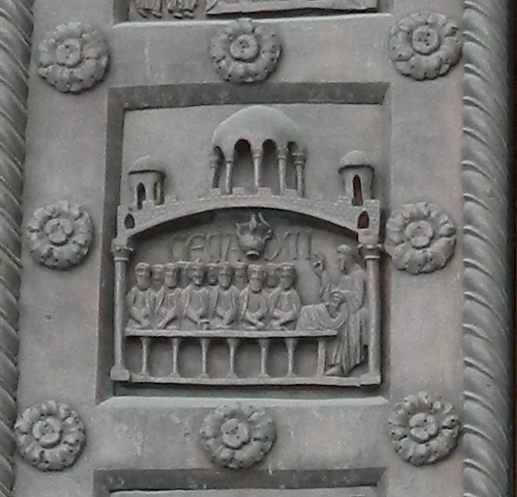
and here is a single panel

Pisa Baptistery: Unused back door. (A single panel)

Pisa Baptistery: Unused back door. (A single panel)


Mosaic of main entrance of Pisa Duomo.

Mosaic of main entrance of Pisa Duomo.

And on either side there are smaller mosaics:

10-DSCN8564

Mosaic of main entrance of Pisa Duomo.

Mosaic of main entrance of Pisa Duomo.

08-DSCN8562


Pisa Duomo: Decorated column

Pisa Duomo: Decorated column

Pisa Duomo, exterior.

An intriguing engraving, Pisa Duomo, exterior.

Interior, Duomo, Pisa

View on entering the Duomo. (Pisa)

View of the main altar,  Duomo, Pisa.

Mosaics above a side altar (Duomo, Pisa)

Mosaics above a side altar (Duomo, Pisa)

Mosaics above a side altar (Duomo, Pisa)

Mosaic above a side altar (Duomo, Pisa)

The mosaic of Christ does not have the typical austere expression:

03-DSCN8554

The columns get in the photographer’s way, but do also produce some interesting views:

31-P1030504

34-P1030573


38-P1030742_crop


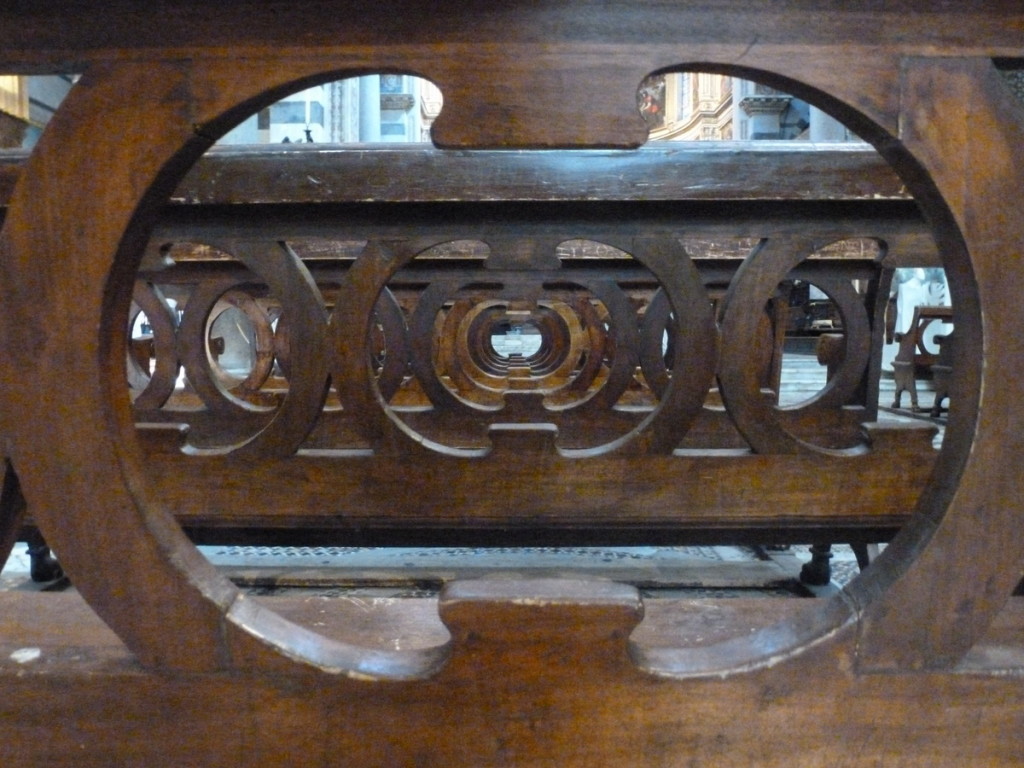
Here is a view through the backs of  the aligned pews

33-P1030568


A modern (I assume) lectern.

A modern (I assume) lectern.


Here’s Pisano’s beautiful pulpit from 1310.  It has an interesting story:

The pulpit by Giovanni Pisano was completed by 1310 and survived the Great Fire of the Cathedral of October 25, 1596 . During the restoration work, between 1599 and 1601 , the pulpit was dismantled and its pieces were placed in different places, including the Campo Santo and the warehouses of the ‘ Work of the Primate . It was not reassembled until 1926 , when it was rebuilt in a different location from the original one, and certainly not with the parties in the same order and orientation as was intended by the author, since there is no documentation of how it was the layout of the various elements, including the panels, before dismantling. I do not even know if he had or not a marble staircase.

The four columns “simple” were donated by Mussolini at the time to dictatorial power, because after the reconstruction of some parts (such as scale) were missing. To honor the Duce these columns were placed in plain view, placing the caryatids at the back, less visible, when, it is supposed, would have to be exactly the opposite.  (Google translate’s version of a wikipedi.it article)


The renaissance pulpit.

The renaissance pulpit.

A motif I have not seen before:

04-DSCN8558
Stained glass–He holds the whole world in his hands.


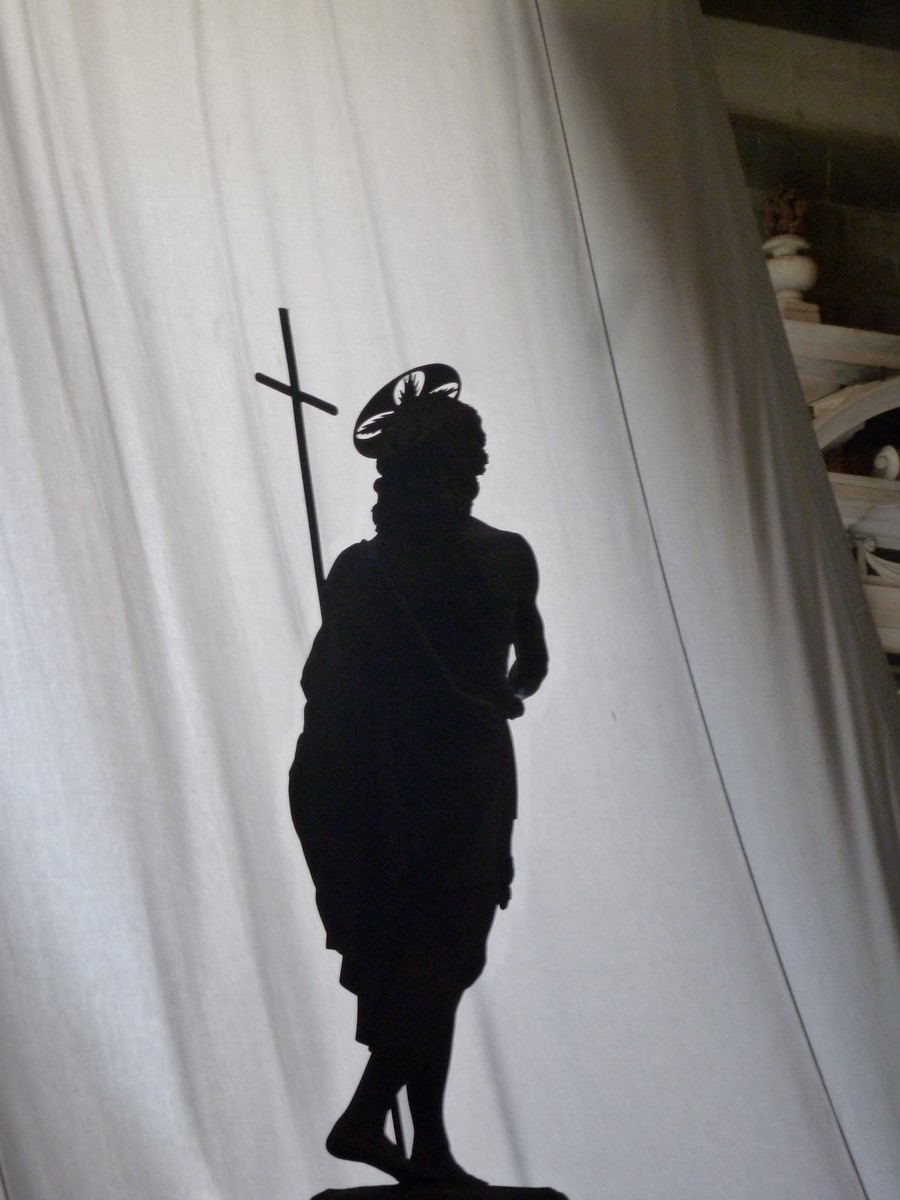
Sculpture of John the Baptist, on the way out of the Duomo.

Sculpture of John the Baptist, on the way out of the Duomo.

The Baptistery

I believe, that in the early christian era, newborns, who had not been baptised were not admitted to the church, hence the baptistery was traditionally a separate building near the church.    The Pisa Baptistery is unusual in that it is circular.  (Typically, they are octagonal.)  Anyway, onthe inside it was not as beautiful as the duomo.


Pisa, Bapistery from an upper gallery.

Pisa, Bapistery from an upper gallery.


A view of out the upper window.

A view of out the upper window.

Playing the Leaning Tower game

It was a beautiful August day and the tourists were doing the same thing

14-DSCN8572


Our daughter Irene, holding up the leaning tower, or pushing it over

27-P1030484


It just takes a finger to support it


29-P1030494or two to pick it up

Picking up the leaning tower of Pisa.

Picking up the leaning tower of Pisa.


Filed Under: In which I Travel and Dream Tagged With: Baptistery, Duomo, Italy, Pisa, tuscany

A Pruned Minimalistic Life is More Fruitful

By Anita Mathias

07-DSCN9381

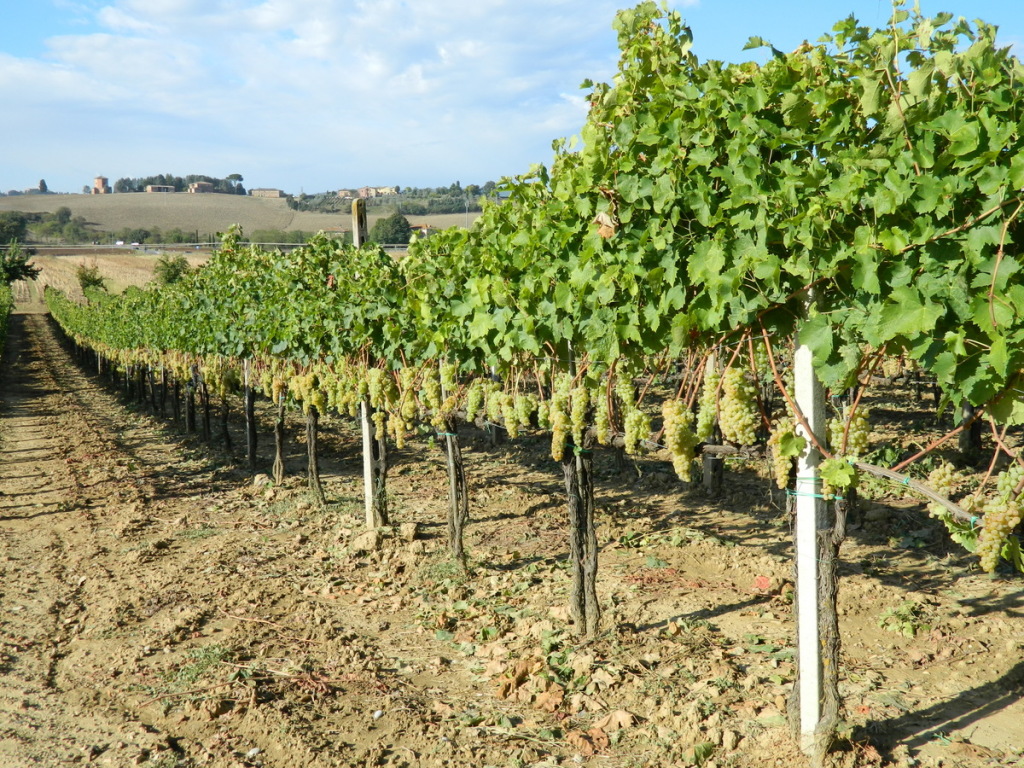
When we were in Tuscany in September, I saw grape vines pruned back drastically to about three feet, and above them, masses of plump abundant grapes, black, green, purple.

Grape vines grow as tall as you let them. We have some growing in our conservatory and the side of our barn, which are 10-15 feet.

These, however, were cut back savagely, sending all the energy upwards, and look at the fruit!

08-DSCN9387

* * *

I wish I had taken in this visual lesson earlier. How much more productive I would have been.

But I have learnt it now.

Cut back the inessentials, so that you can be fruitful in the essentials, the one thing you have been put on earth to do.

Jesus at the end of his life said, “I have done the work you have given me to do.” (John 17:4)

So cut back even the good things; the volunteerism; your social media friendships, so that the work he has given you to do, the fruit you want to produce, gleams more beautifully.

Ask yourself: Is this activity the work God has given me to do? If not, even if it is a good thing–taking a turn at leading the Bible study or serving on church teams and rotas–leave it for someone else, for whom it is perhaps the work God has given her to do.

* * *

Those vines struck me like a dart to the heart. Since then, I’ve been pruning—my possessions (getting rid of at least one thing a day) and my commitments. I have even been pruning relationships with negative friends, who drag me down and depress me, relationships I had not let go because of sentimentality and familiarity.

The fruitful vine is pruned so that it will be even more fruitful. One of those counter-intuitive truths which run like grace-notes through the Gospels.

Filed Under: In which I decide to follow Jesus Tagged With: abundance, focus, Fruitfulness, Gospel of John, minimalism, pruning, the work God has given us to do

In which Scripture is a Mountain, Not a Plateau, but It is All Treasure

By Anita Mathias

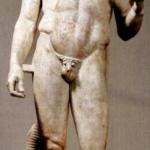
Picture  Michelangelo's David

The Greek Sculpture The Spear Bearer and Michelangelo’s David 

I read Scripture as a mountain with the thirty-nine books of the Old Testament building up to the revelation of Jesus Christ in the Gospels. Acts and the letters of Jesus’s disciples  then grapple with the seismic, big bang revelation of Jesus Christ.

And so our traditional way of reading Scripture, the traditional reading plan, which gives equal weight to every verse and chapter is, ironically, a bit lop-sided. You know…every genealogy, every law, every description of temple worship given equal weight with the Sermon on the Mount and the Upper Room discourse which contains the secrets of the universe.

* * *

However, we need a little bit of Jesus of the Gospels every day, or every week, because our eyes need His corrective vision. Without the continued brain- and heart-washing of the Gospels, we forget what He taught us about how to live.

And so in my reading of the Gospels, I come to Matthew 13, “every scribe who has been instructed about the kingdom of heaven is like the owner of a house who brings out of his storeroom new treasures as well as old.”

* * *

Jesus calls the early revelations of God which culminated in Himself treasure.  And it is treasure because the shimmering brilliance of Jesus’ teaching emerges from it.

Jesus is steeped in the Old Testament and continually quotes it, resisting the temptations of Satan with quotations from Deuteronomy, thereby validating that book. Some of his most memorable sayings, which sound startlingly original are, in fact, quotations from the Old Testament. When he reduces the Law and the Prophets to two commands, he draws on Leviticus 19:18 for “Love your neighbour as yourself” and quotes Psalm 37:11, “the meek inherit the earth”  in the Beatitudes.

* * *

Trying to understand Jesus without understanding the Old Testament is like trying to make sense of Michelangelo’s David without knowing who David the Giant-Killer was, or without knowing how Greco-Roman art inspired artists in the Renaissance (or how the Greek sculpture, “The Spear Bearer,” inspired David.)

Or admiring Raphael’s “School of Athens” without knowing that he depicted Socrates, Plato and Aristotle, Diogenes, and that the surly fellow in boots in the foreground is Michelangelo.

Or reading T.S. Eliot’s beautiful allusive “The Waste Land,” without knowing the title of the long Fire Sermon section is taken from Buddha’s eponymous sermon of the same name in which he advises his followers to give up earthly passion,  or that To Carthage then I came/Burning, burning, burning, is a reference to St. Augustine’s Confessions, when he comes to Carthage, burning with lust. The poem beats upon our pulses, speaks to our ganglia without the scholarship, but knowing its mass of literary allusion only enriches the poem for us.

So of course, the Gospels will speak to one who loves Jesus but has not taken the time to study the Old Testament so as to set him, his quotations, allusions and references in their rich context.

But the Gospels speak more richly and fully when you approach them  with a mind and heart that loves Jesus, but is also steeped in the context of the Old Testament out of which He emerged, and when you understand the 18 Old Testament books which Jesus quoted, and when you understand the old thing to which He continually contrasts the new thing He was doing.

Filed Under: Matthew Tagged With: blog through the Bible project, Matthew, Old Testament, Treasure

“Let His Love Open the Door:” a Guest Post by Mollie Lyon

By Anita Mathias


I met Mollie Lyon, a lover of Jesus from Pennsylvania, through her thoughtful blog comments a couple of years ago, and she has been a faithful and supportive blog reader and friend. I was pleased when she offered me a guest post. 

Let His Love Open the Door

I knelt in the dimly lit sanctuary of my church with my prayer group. The quiet atmosphere calms a busy soul. On Monday evenings, we gather to pray for revival in our church, our country and the world. My spirit is stilled as my mind opens to hear as well as talk to God.

A theme often emerges in our prayer time. This particular night, the love Jesus has for us flooded my soul. I kept praying for His followers to experience the love. I prayed that tasks and busyness for God’s Kingdom would take second place to welcoming Jesus’ love.

The verse from Revelation 3:20 flowed into my mind, “Behold, I stand at the door and knock.”
Jesus is talking to believers, His followers. This verse is often used in evangelism and I believe Jesus does knock at the door of every heart, but in the original text He is speaking to the church in Laodicea, the church that was neither hot nor cold, the indifferent church.

Has not the Church of today been compared to this? We are rich in the Western Church, are we not? Not just in material wealth, but in educational supplies. Go into any bookstore or online and see the riches of learning about the Christian life.

Yet, we find ourselves indifferent to Jesus Himself.
 Jesus wants to “sup” with us, the verse reveals. Do we not often say, “Let’s do lunch” as a way of securing a friendship? My sisters and I joked, after my father died, that my mother received so many lunch offers at the calling hours, that she could have been out for lunch for a year. Sadly, as is often the case, those offers never materialized because of this world’s busyness. Life gets in the way.

I prayed through this verse. And “Let My Love” that song by Peter Townshend suddenly  surfaced in my mind. Yes, a secular song infiltrated my mind during prayer time. I wanted to sing it, but that didn’t seem spiritual, but I did pray it as the timing amazed me.
 I’m sure Peter Townshend never thought his song would turn up in a Ladies Prayer for Revival hour. I love God’s sense of humor.

I felt Jesus singing to me and to His church, “Let My love open the door; let My love open the door; let My love open the door to your heart.”

As I later listened to the song on Youtube and read the words, I felt they were spoken to the hopeless, the unloved and the lost as well. When tragedy befalls you, don’t let it drag you down.

 This song could very well be sung by Jesus and I heard it that Monday night in a prayer for revival. Zephaniah 3:17 says the Lord sings over you, (and I like the Revised Standard Version) “with loud singing.” One thing that can set you free–that’s Jesus’ love.

So, let His love open the door. Open that door as His love knocks.

Mollie Lyon

Mollie Lyon

Mollie Lyon’s Bio: I love stories and I love writing, but I became a registered nurse out of high school, a dependable source of income. I have been a nurse for thirty one years, and married the same amount of time, graduating, tying the knot and moving to a new state in the same weekend. That plucky spirit of belief in my ability wouldn’t let barriers block my way.

I approach my renewed love of writing that way. I can make this happen. I study everything I can find on writing. The best thing to do, though, is pray and write.

I joke that I was born a Christian and in a cultural sense, I was. My father’s testimony thrilled me, as he lived the life of a born again Christian. I grew to realize that God does not have grandchildren; I needed my own faith. I am thankful for the strong foundation in my upbringing of Christian education, and Christian life, as well.

I have lived in western Pennsylvania for most of my life, except for the five years my husband served in the Navy, when we lived in New England. I have two adult daughters, two cats and a dog. I still practice nursing, but view writing as my vocation. I self- published a novel, Summer Triangle this summer and write a blog Miss Mollie’s Musings at missmolliesmusings.blogspot.com. I plan to publish another novel in January, Main Street.

Filed Under: In which I proudly introduce my guest posters, Writing and Blogging Tagged With: Guest Post

Carolyn Weber introduces “Holy Is the Day: Living in the Gift of the Present” (Guest Post)

By Anita Mathias

I am taking a blog break until the 2nd November, going to a beach cottage in Cornwall to do some serious writing and hiking.

For the final post before my break, I am delighted to host Carolyn Weber, author of the beautiful memoir, Surprised by Oxford. Carolyn offers us a lovely and enticing excerpt from her new book, Holy Is the Day: Living in the Gift of the Present. Welcome, Carolyn!

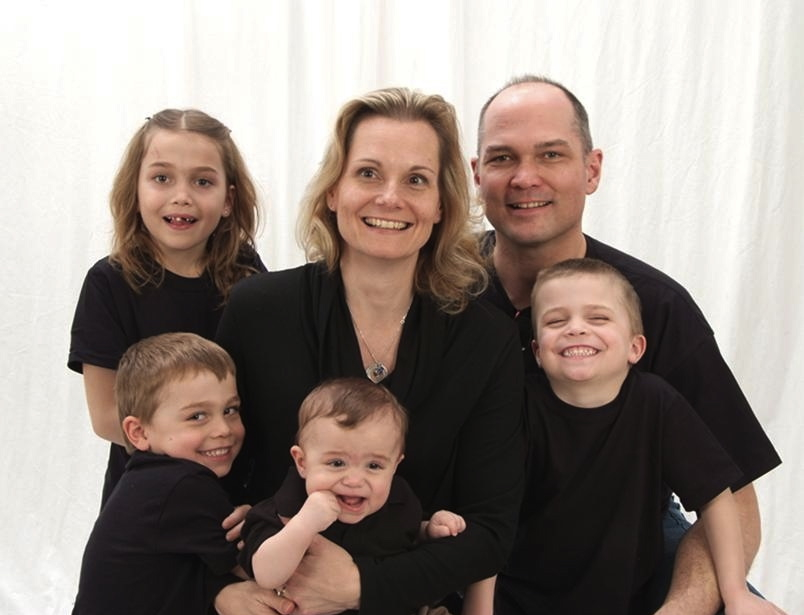
WeberFamily

Carolyn Weber and her  gorgeous family

I was so touched and honoured, and, well, just plain delighted, to be invited by Anita to share with all of you an excerpt from my new book Holy is the Day: Living in the Gift of the Present (IVP, 2013). I’m a huge fan of Anita’s wit and charm, but most of all, of her obvious heart for God. What a pleasure to be “here”!

I wrote this book as a kind of prayer walk, as a way of working through how we are called to a second, deeper calling as believers. We may start our pilgrimage with a leap of faith, but then we are called to continue through a leap with faith. I consider such challenges as career changes, moving, marriage, friendship, caring for children and for aging parents … the day-to-day things we all face and in which we all need the encouragement of fellowship. As an overarching frame to the narrative, I chronicle the trials and trust of pregnancy as a living metaphor of expectancy so central to the Christian faith.

Expectancy involves trust, anticipation, hope, and obedience. When we are born anew in Christ, adopted in Him, a life of grace becomes our birthright, a way of being. The path is bespeckled by miracles, so that even when we feel the blows and burnings of this fallen, groaning world, we yearn and know (for the two affirm each other) that all will be set right, all will be restored, beyond any present tints of human understanding.

“These things I have spoken unto you, that in Me ye might have peace. In the world ye shall have tribulation, but be of good cheer: I have overcome the world” (John 16:33, KJV).

So, for inviting me to share my words here, and for the opportunity to welcome new friends in Christ, I say to Anita and all of you dear souls across the pond, what I used to say when I lived in Britain –

Cheers!

(In every God-fulfilled sense of the term)

Carolyn

Holy_is_the_day_cover

Holy is the Day

It is okay to love deeply, the seen or the unseen. Even if this love comes with fear. For surely it will. I can’t think of a love that is worth its salt unaccompanied by any fear at all. But it is in the facing of the fear and loving still, and through it, that the loving becomes burnished to a precious sheen and transformed into an ever-present gift.

Not to love as we are called to love is like living your life on the surface only: like coasting down an unspeakably beautiful scenic road while constantly riding your screeching brakes. Fear punctuates what should be run-on; it causes the song to catch in our throat. And yet it is the really deep love—the most fearsome—that carries us through life, death and into living again.

On this Holy Saturday, as I move among the trees, the baby moves inside of me. The sudden flutter causes me to think of how John the Baptist leaped in his mother’s womb when Elizabeth met Mary, pregnant with our Lord. Is this how I meet my God—sight still unseen—from the very center of my expectancy? Is the miracle lessened at all by the threat of my worries? Or is the miracle in waiting, too—in my waiting, and in its own waiting, like a shoot coiled within the seed . . . faith meeting faith to heart-leap together?

Carolyn Weber: Author of the critically acclaimed memoir Surprised by Oxford, Carolyn Weber holds her B.A. Honours in English from Huron College at the University of Western Ontario, Canada and her M.Phil. and D. Phil. Degrees in Romantic Literature from Oxford University, England. She has been a professor at the University of San Francisco, Seattle University, Westmont College and Oxford University, where she was also the first female dean of St. Peter’s College. An author, speaker and teacher, she currently resides in Southwestern Canada, with her husband and four spirited children.

Filed Under: In which I proudly introduce my guest posters Tagged With: Carolyn Weber, Holy is the Day, Surprised by Oxford

Ora et Labora: How Physical Activity helps my Creative and Spiritual Life.

By Anita Mathias

File:JR Herbert Laborare.jpg

I recently went off routine into a funk.

This had been my schedule: Wake, pray, and then read scripture, and blog about it, or whatever the Holy Spirit is bugging me about. This took about two and a quarter hours.

After which I did some housework and decluttering for an hour. Then gardened, another hour. Then a walk for over an hour, after which I settled down to literary writing, working on my memoir and a short story, until nightfall–with breaks for meals, and to hang out with Irene and Roy.

However, with this long mid-day break, my memoir and story was getting squeezed.

So I cut the gardening, cut the housework, reduced the walk.

* * *

And my life became hugely less satisfying. Turns out I needed the time tidying my house and getting rid of everything “not beautiful or useful.” I needed the hour in the garden. I needed my long walk.

These were times when I unconsciously process and come to terms with, or find solutions for, my life’s minor frustrations, just as the unconscious mind does when we sleep. These were times when ideas come, and when I pray, and when my vision jells for the next hours, days and weeks. They can even be times of revelation, of hearing and sensing God.

So cut all those blessed times in which I was a human being, and not a human doing; in which I was a body and spirit and emotion-full being, and not just a mind; cut those times to stretch, relax and move—and what happened?

* * *

Well, for a few days, I fell apart. [Read more…]

Filed Under: In which I explore writing and blogging and creativity, In which I get serious about health and diet and fitness and exercise (really) Tagged With: balance, Benedictine Ora et Labora, Creativity, Donald MIller, exercise, Gardening, holley gerth, manual work, Prayer, Spark, writing

  • « Previous Page
  • 1
  • 2
  • 3
  • 4
  • 5
  • 6
  • …
  • 27
  • Next Page »

Sign Up and Get a Free eBook!

Sign up to be emailed my blog posts (one a week) and get the ebook of "Holy Ground," my account of working with Mother Teresa.

Join 536 Other Readers

My Books

Rosaries, Reading, Secrets: A Catholic Childhood in India

Rosaries, Reading Secrets, B&N
USA

UK

Wandering Between Two Worlds: Essays on Faith and Art

Wandering Between Two Worlds
USA

UK

Francesco, Artist of Florence: The Man Who Gave Too Much

Francesco, Artist of Florence
US

UK

The Story of Dirk Willems

The Story of Dirk Willems
US

UK

My Latest Meditation

Anita Mathias: About Me

Anita Mathias

Read my blog on Facebook

Follow me on Twitter

Follow @anitamathias1

Recent Posts

  • At the Cross, God Forgives Us Completely
  • Using God’s Gift of Our Talents: A Path to Joy and Abundance
  • The Kingdom of God is Here Already, Yet Not Yet Here
  • All Those Who Exalt Themselves Will Be Humbled & the Humble Will Be Exalted
  • Christ’s Great Golden Triad to Guide Our Actions and Decisions
  • How Jesus Dealt With Hostility and Enemies
  • Do Not Be Afraid, but Do Be Prudent
  • For Scoundrels, Scallywags, and Rascals—Christ Came
  • How to Lead an Extremely Significant Life
  • Don’t Walk Away From Jesus, but if You Do, He Still Looks at You and Loves You
Premier Digital Awards 2015 - Finalist - Blogger of the year
Runner Up Christian Media Awards 2014 - Tweeter of the year

Categories

What I’m Reading


Wolf Hall
Hilary Mantel

Wolf Hall --  Amazon.com
Amazon.com

Amazon.co.uk

Silence and Honey Cakes:
The Wisdom Of The Desert
Rowan Williams

Silence and Honey Cakes --  Amazon.com
Amazon.com

Amazon.co.uk

The Long Loneliness:
The Autobiography of the Legendary Catholic Social Activist
Dorothy Day

The Long Loneliness --  Amazon.com
Amazon.com

Amazon.co.uk

Country Girl
Edna O'Brien

Country Girl  - Amazon.com
Amazon.com

Amazon.co.uk

Archive by month

My Latest Five Podcast Meditations

INSTAGRAM

anita.mathias

My memoir: Rosaries, Reading, Secrets https://amzn.to/42xgL9t
Oxford, England. Writer, memoirist, podcaster, blogger, Biblical meditation teacher, mum

Looking at photos from our week in beautiful Sevil Looking at photos from our week in beautiful Seville and Cordoba over New Year with Irene, who had a week off.
And, ICYMI, here’s my latest meditation on the Gospel of Matthew… I’ve recorded it, should you want a few minutes of peace.
https://anitamathias.com/2026/04/29/gods-complete-forgiveness/
Hello Friends, I'm resumed recording my meditation Hello Friends, I'm resumed recording my meditations on the Gospel of Matthew. Do click on this link to listen. 
https://anitamathias.com/.../29/gods-complete-forgiveness/
Christ is the most influential figure in the history of the world, though his life ended in shame, humiliation and failure. But he so completely turned things round in his great reversal that the cross on which he died when all seemed hopeless is now the most common, and revered, symbol in history.
He emerged from and was anchored in Judaism. And as the sins of the people were laid on the scapegoat who was sent into the wilderness to perish, Christ died as the lamb of God voluntarily bearing the guilt of the wrongdoing of the whole world. He paid the price for our forgiveness with his life-blood--in accordance with the iron law of the physical and moral universe, of sowing and reaping, cause and effect. 
And so, God, who appeared as flames of fire to Moses, can now dwell within us, purifying us, whose hearts have darkness and shards of ice. 
And now that Christ was crucified, died, but rose again, His Spirit, no longer contained within his earthly body, is poured out like living water onto all humans, at our humble request. The Spirit pours the love of God into us; he reminds us of the words of Jesus and slowly writes Christ’s sweet law on our hearts. This transfusion of grace helps us do hard things we previously couldn’t do. Our dance with the Spirit gradually breaks the power of sin over us. It transforms us.
Now we, the forgiven, protected by the blood of Jesus poured out over us, and filled with His Spirit, who sings within us, Abba, Father, are adopted by God as his children in his joyful new covenant. We are cells grafted into the vine of our new family--Father, Son, Spirit—who now live in us as we live in them. As we choose by our thoughts and actions to continue living in the vine of Jesus, their energy pulsing through us makes us fruitful. And now, all our prayers which flow in the river of God’s good purposes are kindly heard. Waves of love and power flood from the cross! 
Thank you!
Well, hello friends! Breaking radio silence to let Well, hello friends! Breaking radio silence to let you know that I have taped a meditation for you on Christ’s famous Parable of the Talents in Matthew 25. https://anitamathias.com/2025/11/05/using-gods-gift-of-our-talents-a-path-to-joy-and-abundance/
Here you are, click the play button in the blog post for a brief meditation, and some moments of peace, and, perhaps, inspiration in your day 🙂
Hi Friends, I have taped a meditation; do listen a Hi Friends, I have taped a meditation; do listen at this link: https://anitamathias.com/2025/04/08/the-kingdom-of-god-is-here-already-yet-not-yet-here-2/
It’s on the Kingdom of God, of which Christ so often spoke, which is here already—a mysterious, shimmering internal palace in which, in lightning flashes, we experience peace and joy, and yet, of course, not yet fully here. We sense the rainbowed presence of Christ in the song which pulses through creation. Christ strolls into our rooms with his wisdom and guidance, and things change. Our prayers are answered; we are healed; our hearts are strangely warmed. Sometimes.
And yet, we also experience evil within & all around us. Our own sin which can shatter our peace and the trajectory of our lives. And the sins of the world—its greed, dishonesty and environmental destruction.
But in this broken world, we still experience the glory of creation; “coincidences” which accelerate once we start praying, and shalom which envelops us like sudden sunshine. The portals into this Kingdom include repentance, gratitude, meditative breathing, and absolute surrender.
The Kingdom of God is here already. We can experience its beauty, peace and joy today through the presence of the Holy Spirit. But yet, since, in the Apostle Paul’s words, we do not struggle only “against flesh and blood, but against the rulers, against the unseen powers of this dark world and against the spiritual forces of evil,” its fullness still lingers…
Our daughter Zoe was ordained into the Church of E Our daughter Zoe was ordained into the Church of England in June. I have been on a social media break… but … better late than never. Enjoy!
First picture has my sister, Shalini, who kindly flew in from the US. Our lovely cousins Anthony and Sarah flank Zoe in the next picture.
The Bishop of London, Sarah Mullaly, ordained Zoe. You can see her praying that Zoe will be filled with the Holy Spirit!!
And here’s a meditation I’ve recorded, which you might enjoy. The link is also in my profile
https://anitamathias.com/2024/11/07/all-those-who-exalt-themselves-will-be-humbled-the-humble-will-be-exalted/
I have taped a meditation on Jesus statement in Ma I have taped a meditation on Jesus statement in Matthew 23, “For those who exalt themselves will be humbled, and those who humble themselves will be exalted.”
Do listen here. https://anitamathias.com/2024/11/07/all-those-who-exalt-themselves-will-be-humbled-the-humble-will-be-exalted/
Link also in bio.
And so, Jesus states a law of life. Those who broadcast their amazingness will be humbled, since God dislikes—scorns that, as much as people do.  For to trumpet our success, wealth, brilliance, giftedness or popularity is to get distracted from our life’s purpose into worthless activity. Those who love power, who are sure they know best, and who must be the best, will eventually be humbled by God and life. For their focus has shifted from loving God, doing good work, and being a blessing to their family, friends, and the world towards impressing others, being enviable, perhaps famous. These things are houses built on sand, which will crumble when hammered by the waves of old age, infirmity or adversity. 
God resists the proud, Scripture tells us—those who crave the admiration and power which is His alone. So how do we resist pride? We slow down, so that we realise (and repent) when sheer pride sparks our allergies to people, our enmities, our determination to have our own way, or our grandiose ego-driven goals, and ambitions. Once we stop chasing limelight, a great quietness steals over our lives. We no longer need the drug of continual achievement, or to share images of glittering travel, parties, prizes or friends. We just enjoy them quietly. My life is for itself & not for a spectacle, Emerson wrote. And, as Jesus advises, we quit sharp-elbowing ourselves to sit with the shiniest people, but are content to hang out with ordinary people; and then, as Jesus said, we will inevitably, eventually, be summoned higher to the sparkling conversation we craved. 
One day, every knee will bow before the gentle lamb who was slain, now seated on the throne. We will all be silent before him. Let us live gently then, our eyes on Christ, continually asking for his power, his Spirit, and his direction, moving, dancing, in the direction that we sense him move.
Link to new podcast in Bio https://anitamathias.co Link to new podcast in Bio https://anitamathias.com/2024/02/20/how-jesus-dealt-with-hostility-and-enemies/
3 days before his death, Jesus rampages through the commercialised temple, overturning the tables of moneychangers. Who gave you the authority to do these things? his outraged adversaries ask. And Jesus shows us how to answer hostile questions. Slow down. Breathe. Quick arrow prayers!
Your enemies have no power over your life that your Father has not permitted them. Ask your Father for wisdom, remembering: Questions do not need to be answered. Are these questioners worthy of the treasures of your heart? Or would that be feeding pearls to hungry pigs, who might instead devour you?
Questions can contain pitfalls, traps, nooses. Jesus directly answered just three of the 183 questions he was asked, refusing to answer some; answering others with a good question.
But how do we get the inner calm and wisdom to recognise
and sidestep entrapping questions? Long before the day of
testing, practice slow, easy breathing, and tune in to the frequency of the Father. There’s no record of Jesus running, rushing, getting stressed, or lacking peace. He never spoke on his own, he told us, without checking in with the Father. So, no foolish, ill-judged statements. Breathing in the wisdom of the Father beside and within him, he, unintimidated, traps the trappers.
Wisdom begins with training ourselves to slow down and ask
the Father for guidance. Then our calm minds, made perceptive, will help us recognise danger and trick questions, even those coated in flattery, and sidestep them or refuse to answer.
We practice tuning in to heavenly wisdom by practising–asking God questions, and then listening for his answers about the best way to do simple things…organise a home or write. Then, we build upwards, asking for wisdom in more complex things.
Listening for the voice of God before we speak, and asking for a filling of the Spirit, which Jesus calls streams of living water within us, will give us wisdom to know what to say, which, frequently, is nothing at all. It will quieten us with the silence of God, which sings through the world, through sun and stars, sky and flowers.
Especially for @ samheckt Some very imperfect pi Especially for @ samheckt 
Some very imperfect pictures of my labradoodle Merry, and golden retriever Pippi.
And since, I’m on social media, if you are the meditating type, here’s a scriptural meditation on not being afraid, while being prudent. https://anitamathias.com/2024/01/03/do-not-be-afraid-but-do-be-prudent/
A new podcast. Link in bio https://anitamathias.c A new podcast. Link in bio
https://anitamathias.com/2024/01/03/do-not-be-afraid-but-do-be-prudent/
Do Not Be Afraid, but Do Be Prudent
“Do not be afraid,” a dream-angel tells Joseph, to marry Mary, who’s pregnant, though a virgin, for in our magical, God-invaded world, the Spirit has placed God in her. Call the baby Jesus, or The Lord saves, for he will drag people free from the chokehold of their sins.
And Joseph is not afraid. And the angel was right, for a star rose, signalling a new King of the Jews. Astrologers followed it, threatening King Herod, whose chief priests recounted Micah’s 600-year-old prophecy: the Messiah would be born in Bethlehem, as Jesus had just been, while his parents from Nazareth registered for Augustus Caesar’s census of the entire Roman world. 
The Magi worshipped the baby, offering gold. And shepherds came, told by an angel of joy: that the Messiah, a saviour from all that oppresses, had just been born.
Then, suddenly, the dream-angel warned: Flee with the child to Egypt. For Herod plans to kill this baby, forever-King.
Do not be afraid, but still flee? Become a refugee? But lightning-bolt coincidences verified the angel’s first words: The magi with gold for the flight. Shepherds
telling of angels singing of coming inner peace. Joseph flees.
What’s the difference between fear and prudence? Fear is being frozen or panicked by imaginary what-ifs. It tenses our bodies; strains health, sleep and relationships; makes us stingy with ourselves & others; leads to overwork, & time wasted doing pointless things for fear of people’s opinions.
Prudence is wisdom-using our experience & spiritual discernment as we battle the demonic forces of this dark world, in Paul’s phrase.It’s fighting with divinely powerful weapons: truth, righteousness, faith, Scripture & prayer, while surrendering our thoughts to Christ. 
So let’s act prudently, wisely & bravely, silencing fear, while remaining alert to God’s guidance, delivered through inner peace or intuitions of danger and wrongness, our spiritual senses tuned to the Spirit’s “No,” his “Slow,” his “Go,” as cautious as a serpent, protected, while being as gentle as a lamb among wolves.
Follow on Instagram

© 2026 Dreaming Beneath the Spires · All Rights Reserved. · Cookie Policy · Privacy Policy