Anita Mathias: Dreaming Beneath the Spires

Anita Mathias's Blog on Faith and Art

  • Home
  • My Books
  • Meditations
  • Essays
  • Contact
  • About Me

Archives for September 2011

9/11 and Me: How 9/11 Changed my Life

By Anita Mathias


I guess it’s become the defining moment of a generation. Where were you? people ask today on the 10th anniversary of 9/11

 I was in my bedroom, in Williamsburg, Virginia, in pjs, sipping tea, reading my Bible.  Roy who was about to enter his classroom at William and Mary to teach at 9.30, called me hurriedly on his mobile.  As he was about to enter, a Chinese colleague passed on the news in the corridor, “Palestinians have blown up the World Trade Centre.” “What?” I said, “I have to teach,” he said.
And so I logged on. The news unfolded: 2 planes, hijacked, had flown into the Twin Towers, another into the Pentagon, a fourth crashed. I walked over to visit my neighbour, a pilot. “Did the hijackers force the pilots to fly into the World Trade Centre?” “The terrorists flew the plane,” he said, disgusted. “No American pilot would fly into a building.”
The terrorists flew those planes into buildings. At the cost of their own certain deaths.
                            * * *
                                                                                                         Later that evening, I talked to my younger sister, the director of a Wall Street firm of venture capitalists. She was standing in her office, on her phone, and saw the second plane hit the World Trade Centre. She rushed out, in her heels, frantically trying to locate her husband who worked at Morgan Stanley on her mobile. They walked for hours through the streets of running, crying people, trying to get home to New Jersey. In Holmdel, the affluent commuter suburb in which they lived, many of their children’s classmates had lost parents that day. The school bus didn’t run. There would have been no one at home in too many cases. Parents had to come to school to collect their children.

                         * * *
·                                                                                 
The world changed. My world changed. Xenophobia was in the air. I am Indian. Suddenly, I seemed to be getting second looks, narrowed eyes, even in parks. I began to feel self-conscious. Did my sweet husband resemble an Islamic terrorist? Apparently, some thought so.
 
  
Williamsburg, 8 hours from New York used to be a polite place. Suddenly, it too was frayed, at least where foreigners were concerned. I absent-mindedly drove into the church parking lot, where the lines were being painted, not noticing the cones, the sort of thing that par for the course, for a dreamy woman like me.  The woman painting them swore at me. Rattled, shocked, I reversed rapidly, my new mini-van absurdly big, with poor visibility, driving over her freshly painted lines, driving into her pot of paint. She shook her fist and shrieked at me in rage.
I was so rattled.  After meeting with the pastor, Roy spoke to me in a loud, stressed voice in the lobby as we were leaving. The receptionist whom I’d never seen before was nervous, and asked us a rattled question. She offensively asked a worker we did know, “Who are they? Do you know them?” He smiled and whispered “Yes. I know them.”  Why would we not be okay?  Come on, all brown skinned people aren’t terrorists.                                                                           * * *
         
Our kids were young, 2 and 6, Roy worked intensely, and so to get away from the pressure, we used to go away on many weekends. To Virginia’s beautiful Eastern shore, Chincoteague, Assateague, Massanutten, Virginia Beach,  the Outer Banks, renting a beach house or mountain cabin, enjoying beach walks or mountain hikes.

Virginia was polite. Live and let live land.  Suddenly that changed.  We walked into a homey down-market restaurant in the Eastern Shore, where admittedly, there are few foreigners. Conversation stopped, everyone looked at us. I felt so self-conscious. Should Roy trim his fine terrorist beard? Gosh, but I am rather partial to beards. I could not imagine being married to a clean-shaven one. The beard stayed.

 Another time, when we were weekending in one of those small lily-white Virginian idyllic resorts, we ordered dinner at a restaurant. Our order was taken somewhat snootily.  Several people who came after us were served. The waitress seemed uninterested in explaining why. We got up and left, just as our order apparently was arriving.

I had lived in America for 14 years by then, and barely experienced racism. As I said, the world changed.
 * * *
We used to shop in an “Indian” grocery store, run by Afghans in Virginia Beach, 60 miles away, and chatted to the owners, got to know them. Good groceries, great sweets. When America, the richest and most powerful nation in the world unilaterally declared war on Afghanistan, among the most impoverished and resource-poor nation in the world, I got worried for them. I drove up to see if they were okay. We were relatively well-off, lived in a safe, gated community. They were not, did not. They were not there. Their shop was boarded up. No one seemed to know what had become of them.  
I began to think of the Jews in the thirties in Germany during the Third Reich. The smartest thing for them to do, of course, was to get out. Not all of them saw this, of course.  

We had been long eligible for citizenship; my husband was a tenured Professor. However, he preferred doing his research rather than applying for citizenship. We owned an expensive house. I insisted we get US citizenship just in case a wave of xenophobia became institutionalised, and we had to leave, losing our house. Memories of the Third Reich again.
                  * * *
And so we took the citizenship test, aced the written section, swotty us, failed one question in the interview. “Who had the right to declare war?” The President? I said. Nope, it was Congress. And they did. On Iraq. Despite Hussein’s repeated protests that he did not have weapons of mass destruction. The invasions of both Afghanistan and Iraq struck me as profoundly unfair. I felt incoherently angry and upset about it.
I found myself at odds with my church culture, which showed American flags in the sanctuary and tearfully sung “America the Beautiful” in church. I led Beth Moore Bible studies in church in women’s groups, and the Person of Jesus studies for mixed groups. 

Williamsburg is military country, there are army, navy, air force and a famous CIA base (Camp Perry) there or nearby. A large percentage of Christians were in the military, and supportive of Bush’s actions. Politically, ethically, I began to find myself at odds with even American Christian culture, even with my mentor, an older, saintly, wise woman, whom I met with weekly, and loved and adored, but who, though clever, was a product of her time and age, a patriotic American.

A brilliant American Christian friend of mine once told me why she could not worship in sexist churches.” I would bit my tongue so much, I would get an ulcer,” she said. Yeah, I was biting my tongue so much, I was in ulcer territory.
·                                                                                            * * *
·          
I had just one mantra then. I have to leave America. I have to leave America. I had been very happy in Oxford as an undergraduate. I wanted to return. Roy said that British academic salaries were lower than American ones, and house prices higher. Dear reader, I did not care!!

And doors opened.  He won a prize for having written the best paper in his field in the last three years. He was invited as a Distinguished Visiting Scholar to the Manchester University, then spent a year at the Mathematical Institute at Oxford University on another grant, and then was offered a Chair at the University of Birmingham. They asked what his American salary was, and topped it up by ten percent. So there, Roy Mathias, I was right.
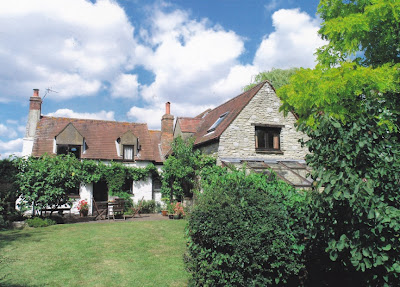
 
Sort of. Taxes are higher. Property prices are far higher, especially since I bought the house I fell in love with, a 1711 cottage with a little mother in law apartment in the garden and a acre and a half and an orchard, without really, really being able to afford it . Private schools offer SO much more than state schools  do; we put the girls in an academically selective one, where  they learn Mandarin Chinese, Greek, Latin, Philosophy.  I never needed to work in the US. Now, I had to. I am too much of a wild cat to work for someone else, and besides, I didn’t think I’d be paid enough for the school fees and part of the mortgage. 

So I founded a business, a publishing company, in which I worked for 4 years, setting my writing aside. Now however, I no longer work in it, it’s become too big and too complex, and I no longer have the firm grasp of each detail and every bit of minutiae which is necessary to run a small business successfully. Roy is no longer an academic, but runs the company.
As I said, 9/11 profoundly changed our lives in more ways than one.
                                                                                     * **
Decades and centuries later, people will look back on that surreal day, September 11, 2001. One man, Osama Bin Laden, declared war on the most powerful nation in the world. He hatched a scheme, never thought of before, meticulously planned and executed through years of preparation and training. 19 young men willingly went to their deaths, bringing down 3000 innocent men and women with them. It wasn’t as devastating as America’s atomic attacks on Japan, but those 19 lives did exact a staggering death toll.
And all for? Nothing! Two nations, not directly involved in 9/11 as far as I can tell, Afghanistan and Iraq have paid a dreadful price in human grief and misery, and suffered much economic, social and emotional devastation. Osama himself is dead, taken out by his rhyming nemesis, Obama. The world is a more suspicious place, billions spent on airport checks. It’s safe to say that the next terrorist attack will not happen in exactly the same way. But how will it happen? And where? The world is a less safe place.
·                                                                                     * * *
·          
I was praying together with a group of women this Friday. Someone mentioned 9/11 in her prayers. I thought to myself,”Come one, let’s keep this to things close to our hearts.” And then, I thought, “And isn’t it?”

And then, in that group of praying women in North Oxford, I asked myself, “Is there anyone I hate enough that I would fly American Airline Flight 11 into them at the probable cost of my own life?”

And I thought, “No. I hate no one.” And then a quizzical voice within me asked,”Is this really true, Anita. Do you really hate no one? Are you home free?”

Sigh. And then I remembered a couple of people I felt intense anger towards, enough to metaphorically fly American Airlines Flight 11 into them.
Oh dear!
* * *
It’s quiet at home these days. Irene, 12, was blissfully researching the Italian Renaissance for a school project yesterday. Zoe was reading Yeats for school. Roy was bonding with his laptop. So I locked the door, and lay down on my bed praying.

·   The anniversary of the triumph of irrational hatred, even at the cost of one’s own life, was drawing near.
I had to forgive.
I couldn’t.
I had to forgive.
But what happened to me was unfair, unjust. They were callous, uncaring.
                      * * *
There is one sure way I know to get myself over the forgiveness bridge. It was seriously praying for blessing on those people.

Praying for blessing? But you see, God, I want justice. I want you to take up my cause and punish them for what they have done to me.
Pray for blessing on them, and you will forgive. And you will be free, said an insistent voice.
                             * * *

Joseph, thrown into the pit by his brothers. Joseph, sold as a slave. Joseph, who rises to be the head of Potiphar’s house. Joseph, unjustly thrown into a dungeon. Joseph, who rises to be the head of Pharaoh’s administration. Who saves his family, including his beloved father and youngest brother.

He would have been an affluent shepherd, if not for the empty well. He would have run Potiphar’s household, if not for the dungeon. Now, he runs Egypt. He rescues his family.

God had always given him intimations of greatness. The sun and moon and 11 stars bowing to him. His brothers’ sheaves bowing to him. But the way God chose to change him from a shepherd to a prince was the way of pits, dragons and dungeons. The injustices he suffered were part of God’s plan for promotion.
He finally sees it was all God. It was part of God’s plan, God’s drama. His brothers were just bit players in it.

He turned his focus from his brothers to God. And then he was able to forgive his brothers, just bit players in God’s great plan.
·                              * * *

And so I did that. Turned my focus from those who had hurt me to God. Immense good had come to me on of the different paths I took because of the injustice I had suffered (something I have not written about yet) and the metaphorical pit I was thrown into. I was able to find my path in writing and my creative life. In business and my financial life. Was able to make real money to bless my family, and others. All because the path I had initially chosen, which I now see was not in God’s plan for me, was closed off to me by other people’s scheming, competitiveness, lies, injustice and insecurity.
I am not going to tell the story of the injustice I suffered here, because heck, this blog post is already far too long.
But stories need to be told. That is in their very nature. A story not told is like a light hidden under a bushel.
And so I will tell it, when my own wounds have totally healed and my words might bring light, rather than a sword, because using a sword is God’s prerogative, not mine, and he will use it.
                                                                                                      * * *

And I forgave. Again. And felt the familiar release of joy and creativity.  You see for me , forgiveness is intimately aligned with creativity. When I forgive, I feel joy, and creative ideas flow. When I do not, I feel blocked, creatively, and my joy is blocked.
         * * *
I have learnt another thing in my battles with forgiveness. It is two steps forward, one step backward. Two steps forward, one step backward. Slow, faltering, in zigzags.
So because I have forgiven them yesterday does not mean that the emotions of anger will not return. The sense of injustice. Of impotence and humiliation.
I have forgiven far greater wrongs that this one which is still raw. And I will forgive this. In time. With the grace of God which falls like rain on the rocky soil of our hard hearts.
Keep them soft, oh Lord. Deliver us from evil. Deliver us from all the Flights 77 and 11 which our enemies may fly into us. And, guard our hearts, oh Lord. May we never pilot them. 

Filed Under: random

When Poems are Handed to You Ready Made : The Mysteries of Inspiration

By Anita Mathias


I love “The Battle Hymn of the Republic,” by Julia Ward Howe. It has a mysterious perfection: the rhythm, the evocative words, the allusions, the beautiful language create a loveliness  greater than the sum of its parts.
Mine eyes have seen the glory of the coming of the Lord:
He is trampling out the vintage where the grapes of wrath are stored;
He hath loosed the fateful lightning of His terrible swift sword:
His truth is marching on.
(Chorus)
Glory, glory, hallelujah!
His truth is marching on.
I have seen Him in the watch-fires of a hundred circling camps,
They have builded Him an altar in the evening dews and damps;
I can read His righteous sentence by the dim and flaring lamps:
His day is marching on.
(Chorus)
I have read a fiery gospel writ in burnished rows of steel:
“As ye deal with my contemners, so with you my grace shall deal;
Let the Hero, born of woman, crush the serpent with his heel,
Since God is marching on.”
(Chorus)
He has sounded forth the trumpet that shall never call retreat;
He is sifting out the hearts of men before His judgment-seat:
Oh, be swift, my soul, to answer Him! Be jubilant, my feet!
Our God is marching on.
(Chorus)
 In the beauty of the lilies, Christ was born across the sea,
With a glory in His bosom that transfigures you and me:
As He died to make men holy, let us die to make men free,
While God is marching on.
(Chorus)
He is coming like the glory of the morning on the wave,
He is Wisdom to the mighty, He is Succour to the brave,
So the world shall be His footstool, and the soul of Time His slave,
Our God is marching on.
(Chorus)
 On the night of November 18, 1861, Julia Ward Howe awoke with the words of the song in her mind and in near darkness wrote the verses to the “Battle Hymn of the Republic.” 

Of the writing of the lyrics, Howe remembers, “I went to bed that night as usual, and slept, according to my wont, quite soundly. I awoke in the gray of the morning twilight; and as I lay waiting for the dawn, the long lines of the desired poem began to twine themselves in my mind. Having thought out all the stanzas, I said to myself, ‘I must get up and write these verses down, lest I fall asleep again and forget them.’ So, with a sudden effort, I sprang out of bed, and found in the dimness an old stump of a pen which I remembered to have used the day before. I scrawled the verses almost without looking at the paper.”
                                                      * * * 
Wow! To whom are these mysterious gifts of creativity handed out? 
Generally to those who have long trained themselves waiting for the angel. “If the angel comes, it will be because you have wooed him by your grim resolve to be always a beginner,” Rainer Maria Rilke muses. Rilke suffered for most of his life from torturing writers’ block. Beauty, images, art, ideas, poetry filled his mind; he was, however, unable to express them in poetry.
Rilke said that as he was walking, depressed, by the cliffs near Duino Castle, he heard a voice call out to him, “Wer, wenn ich schriee, hörte mich denn aus der Engel Ordnungen?” which became his famous Duino Elegy,
Who, if I cried out, would hear me among the angels’ hierarchies?
And even if one of them pressed me suddenly against his heart:
I would be consumed in that overwhelming existence.

His writers’ block was broken, and The Duino Elegies flowed forth in a torrent.
                                                        * * *
Milton claimed that he was visited nightly by an angel or muse who dictated cantos of Paradise Lost to him. In the morning, his daughters found the blind poet, already up, neatly dressed, and waiting to be “milked” of his verses, which he dictated to them.
Milton however, at the age of 14, had decided to become one of the great poets in English. His goal: “To write something which the world would not willingly let die.” He spent his youth in arduous preparation, so much so that by the time he began writing Paradise Lost at the age of 50, he was blind (the result of the years from his early teens spent reading late into the night by candlelight); had an brain incomparably stocked with poetry and learning, but had written nothing substantial.
But the angel came, and he did indeed write something that the world would not willingly let die. 

My father had memorized the opening of Paradise Lost, and I remember the opening sentence with a thrill of pleasure. It’s so beautiful, so majestic, that reading it now, after some years, I almost cry with pleasure,
    
    Of Man’s first disobedience, and the fruit
    Of that forbidden tree whose mortal taste
    Brought death into the world and all our woe,
    With loss of Eden, till one greater Man
    Restore us and regain the blissful seat,
    Sing, Heav’nly Muse, that on the secret top
    Of Oreb, or of Sinai, didst inspire
    That shepherd who first taught the chosen seed
    In the beginning how the heav’ns and earth
    Rose out of Chaos; or if Sion hill
   Delight thee more, and Siloa’s brook that flow’d
   Fast by the oracle of God, I thence
   Invoke thy aid to my advent’rous song,
   That with no middle flight intends to soar
   Above th’ Aonian mount, while it pursues
   Things unattempted yet in prose or rhyme.
   And chiefly thou, O Spirit, that dost prefer
    Before all temples th’ upright heart and pure,
  Instruct me, for thou know’st; thou from the first
  Wast present, and, with mighty wings outspread,
   Dove-like sat’st brooding on the vast Abyss
   And mad’st it pregnant: what in me is dark
   Illumine, what is low raise and support,
    That to the highth of this great argument
   I may assert Eternal Providence
    And justify the ways of God to men.
Wow! What a long amazing sentence!
Paradise Lost comes, it comes as if dictated by an angel, but it comes to the blind poet who had spent his life preparing to write it. The Duino  Elegies were “overheard” by the poet who also spent a life of sacrifice in preparation.
Poetic inspiration comes suddenly, as if the unconsciously suddenly ripens, to those who had laboured long  and hard,
 for much of their lives to receive it.
                                                   * * *
In contrast is William Blake, an untaught visionary poet 
who was more in touch with Heaven than with our world.  At
 the age of four, the young artist “saw God” when God “put
 his head to the window.”
At the age of eight or ten in Peckham, Blake claimed to have seen “a tree filled with angels, bright angelic wings bespangling every bough like stars.” Do I believe him? Yes, as it happens.
“I know that our deceased friends are more really with us than when they were apparent to our mortal part. Thirteen years ago I 
lost a brother, and with his spirit I converse daily and hourly
 in the spirit, and see him in my remembrance, in the region
 of my imagination. I hear his advice, and even now write
 from his dictate.” Blake wrote.
Blake writes “Felpham is a sweet place for Study, because it 
is more spiritual than London. Heaven opens here on all sides
 her golden Gates; her windows are not obstructed by vapours;
 voices of Celestial inhabitants are more distinctly heard, & 
their forms more distinctly seen.”
  
It was while he lived in Felpham, Sussex, that Blake wrote
 the perfect Jerusalem.

Filed Under: random

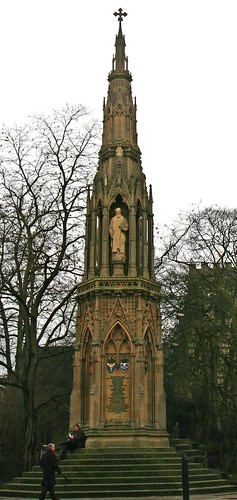
The Martyr’s Memorial to Latimer, Ridley and Cranmer, St. Giles, Oxford

By Anita Mathias

This beautiful building celebrates the 16th century Oxford Martyrs, Cranmer, Ridley and Latimer. The Victorian Gothic building resembles the spire of a sunken cathedral, doesn’t it?
At this spot, the English Reformers, Hugh Latimer and Nicholas Ridley, the great preacher and theologian of the English Reformation were burnt at the stake in the middle of cobble stoned Broad Street Oxford.
Cuthbert Bede (in his novel The Adventures of Mr Verdant Green) wrote,
“He who enters the city from the Woodstock Road, and rolls down the shady avenue of St Giles’, between St John’s College and the Taylor Buildings, and past the graceful Martyrs’ Memorial, will receive impressions such as probably no other city in the world could convey.” 
After the accession of Mary I, Cranmer boldly said, “… all the doctrine and religion, by our said sovereign lord king Edward VI is more pure and according to God’s word, than any that hath been used in England these thousand years.” Not surprisingly, the government regarded Cranmer’s declaration as tantamount to sedition. He was sent straight to the Tower to join Hugh Latimer and Nicholas Ridley, tried for treason, found guilty, and condemned to death.
Latimer famously comforted Ridley, “Be of good cheer, Master Ridley play the man. We shall this day by God’s grace light such a candle in England as shall never be put out.”
(Though I am quite content to live in 21st century Oxford, they did speak the most gorgeous English in Renaissance England, didn’t they?).
Cranmer was a serious reformer with a mild and peaceful and timid disposition. Imprisoned by Queen Mary, he signed various recantationa of his Protestant beliefs, stating his support of the Catholic Church. However, she, rightly, doubted that he really meant them.  He was told that he would be able to make a final recantation but this time in public during a service at the University Church of St. Mary the Virgin. He wrote and submitted the speech in advance. At the pulpit on the day of his execution, he opened with a prayer and an exhortation to obey the king and queen, but he ended his sermon totally unexpectedly, deviating from the prepared script.
He renounced the recantations that he had written or signed with his own hand since his degradation and imprisonment, and stated that he would punish his right hand by burning it first.
He was pulled from the pulpit and taken to where Latimer and Ridley had been burnt.  As the flames drew around him, he fulfilled his promise by placing his right hand into the heart of the fire and his dying words were, “Lord Jesus, receive my spirit… I see the heavens open and Jesus standing at the right hand of God.”
Interestingly, the same vision the first martyr Stephen saw! Men do not lie at their hour of their deaths, I believe. How wonderful to imagine Jesus standing in encouragement to receive them!!

Filed Under: In Which I celebrate Church History and Great Christians, In which I Dream Beneath the Spires of Oxford

Things are not what they seem (Thought for the Day)

By Anita Mathias


” There are many different reasons for the changes, upheavals, revolutions of history.  One of the biggest reasons is the prayers of the followers of the Lamb.  Things are not what they seem.”

Darrell Johnson’s book on Revelation.
On Pg 169 he continues

“It is just that in praying for Jesus Christ–the reigning Lamb–to fully establish His kingdom things start happening.  The kingdom breaks in, changing things, upsetting the status quo, unmasking idols, flushing out evil–and meeting resistance. (pg. 169)

Filed Under: random

Facebook, Twitter, Blogs and The Church

By Anita Mathias

 
Chris Rodkey uses the image of a rhizome  (from Greek: rhízōma “mass of roots”) the horizontal stem of a plant that is grows underground, often sending out roots and shoots from its nodes as a visual description of the relationship between churches and Facebook. “As an image of the church, it’s a shift away from church as a building or institution toward genuine community and organically connected individuals.”
I worshiped in a large evangelical Charismatic church in Oxford for the last six years (though we no longer worship there) and was facebook friends with probably over a hundred individuals from church.
Now, I love, enjoy and am interested in people. However, my personality is right on the line between extroversion and introversion in Myers-Briggs or any psychological profiling. I would find it challenging to keep in touch with more than a dozen people on a weekly, face to face basis.
Still, there was a pleasure in coming into church and spotting people who had commented on my Facebook statuses and vice-versa, in knowing what was going on in their lives, and vice-versa, in being able to speak  and hear appropriate words of encouragement, comfort, congratulations, and (I hope!) wisdom. 
This sharing of lives, even though not as deep as hours over coffee was still better than no sharing at all.
                                      * * *
                                                                                                        
Facebook, Twitter and social media can have as profound an effect in undemocratic churches as it did in the Arab Spring.

Jesus advises the one offended by his neighbour to go to him directly, and sort things out.

Painful though that is, it is, hands down, the best way.

If you are blown off, then go with a witness, then many witnesses.

Sometimes, one may feel alone in one’s conviction that there is something rotten in the State of Denmark. Or the state of your church.
The response to a facebook status, or a tweet, or a blog post, can tell you that you are not alone.

I once knew a church with distant controlling leadership, who seemed far more interested in their grandiose, self-glorifying projects than in the congregation which financed them, more interested in fleecing the sheep than in feeding the sheep, so to say.  

Years of dissatisfaction came to a head with a unjust personnel decision, the firing of a dedicated pastor.
Outrage was expressed on Facebook, twitter and blogs. The PCC organized a petition. Scores of people signed. Without social media, they would have had no idea of where to find kindred spirits whose sense of fairness and integrity had been outraged.
What became of it?

 On the face of it, not much. 
About 100 people left, many of them key givers, volunteers and lay leaders.
Many more stayed, because of social ties, and inertia, but cut back on giving and volunteering.
The church came to a crisis. Whereas formerly they kept expanding their budget of over a million pounds,  hiring layer after layer of coffee-makers and PAs (they were infected by contemporary celebrity culture: everyone hired soon lost the ability to write an email, pick up a phone or make a cup of tea), now all the talk was of money, as giving steadily declined. Special meetings called to strategize on how to increase giving. Key ministries, like youth work, collapsed for lack of volunteers. The raison d’etre changed from loving Jesus to raising money.
A downward spiral.

Individuals experience them. Churches too.
Fortunately, God has provided a way out for both.

Repentance. Prayer. Loving God. Loving Others.

And God willing, we will all return to our first love.

Filed Under: random

On the Goodness and Mercy of God. On the writing of “Isn’t He?” by John Wimber

By Anita Mathias

Here’s a wonderful story from Carol Wimber’s book, “The Way it Was.”

“Right away the Jesus Songs started coming, like a stream of sweet water. I call them airport songs because God gave them to John on his way to or from the airport. “Isn’t He?” (which keeps food on my table from the royalties) was another song written on the way to the airport on a scrap of paper.

It came the same way, all at once, words and music, but it came in a flood of gratitude for the goodness and mercy of Jesus.

John was on his way to pick up an uninvited visitor who had called the house and informed our son, Tim, that he was waiting for John to pick him up. Well, poor Tim! John was a “kill the messenger” guy. He jumped all over Tim. “Why didn’t you tell him I didn’t know he was coming?” “Because I didn’t know that, Dad,” answered a bewildered Tim. “But I’m tired, and I just got home, and it’s raining. I don’t want to go out again, Tim. Why didn’t you explain it to him?” “Dad, I just answered the phone, and said Hello. The man said you were supposed to be there to pick him up, and I said, “Oh,” and the man asked me to tell you when you came home. I said I would.”

John left for the hour and a half drive to the airport, and he felt miserable. Not about having to go out when he was tired, but because of the way he had treated Tim. He wept over it, and told Jesus how wrong, and how sorry he was, and was just planning how he would apologise to Tim, when the car was flooded with the love of God. Overwhelmed with God’s mercy, his head and heart filled with the words and music:

Isn’t he beautiful? Beautiful, isn’t he?
Prince of Peace, Son of God, isn’t he?
Isn’t he wonderful? Wonderful, isn’t he?
Counselor, Almighty God, isn’t he? Isn’t he? Isn’t he?

He taught us that sweet Jesus song the next Sunday. It is amazing how fast the Holy Spirit-given songs go around the world. They fly on the wings of the wind.”

I love this story. I love the way God sometimes responds to me with poetry and insight and blogposts when I have blown it, am feeling crushed, and full of shame. That’s when he reveals himself and his love most clearly, and blesses me with new insight into himself.
Gerard Manley Hopkins describes this
“Father and Fondler of heart thou hast wrung,
Hast thy dark descending, and most art merciful then
.”
Or as Francis Thompson puts it,
But (when so sad thou canst not sadder)
Cry–and upon thy so sore loss
Shall shine the traffic of Jacob’s ladder
Pitched betwixt Heaven and Charing Cross.
And lo, Christ walking on the water,
Not of Genesareth, but Thames!

Filed Under: In which I'm amazed by the goodness of God Tagged With: "The Way it Was" by Carol Wimber, John Wimber, Spirit-given creativity, The Mercy of God

“There is Always Enough” Heidi Baker’s Transforming Vision

By Anita Mathias

Heidi Baker

Generally, Christ gives people very specific visions and revelations to strengthen them for the next phase of their journeys.

However, Heidi Baker’s wonderful vision of Christ has been both applicable and comforting to me in a very different calling–as a businesswoman and writer.

Here it is, with some background: Heidi has a complete physical, and perhaps emotional breakdown and is “sick and exhausted” after over twenty years of 18 hour days serving the poor, in Indonesia, Hong Kong and then Mozambique.

She goes to the Toronto Airport Fellowship because Rolland has just returned from there, “full of faith and compassion,” having had “a dramatically great time with God.”

In her book, There is Always Enough, she describes being on the floor before the Lord for hours, “unable to move. His presence was so heavy upon me. He demonstrated that he is my only strength. He is my hope. I depend only on him. I can do nothing without him.”

“One night I was groaning in intercession for the children of Mozambique. There were thousands coming toward me and I was crying, “No, Lord, there are too many.”

“Then I had a dramatic, clear vision of Jesus. I was with Him, and thousands and thousands of children surrounded us. I saw his shining face and his intense, burning eyes of love. I also saw his body. It was bruised and broken, and his side was pierced.”

He said, “Look into my eyes. You give them something to eat.” Then he took a piece of his broken body and handed it to me.  It became bread in my hands, and I began to give it to the children. It multiplied in my hands.

Then again the Lord said, “Look into my eyes. You give them something to drink.” He gave me a cup of blood and water, which flowed from his side. I knew it was a cup of bitterness and joy. I drank it, and then began to give it to the children to drink. The cup did not go dry. By this point, I was crying uncontrollably. I was completely undone by his fiery eyes of love. I realized what it had cost him to provide such spiritual and physical food for us all.

The Lord spoke to my heart, and said, “There will always be enough, because I died.”

I was refreshed and ready to go back to Mozambique. I expected to see a wave of new, amazing miracles right away. Instead, all hell broke loose.”

Lol!

Filed Under: In Which I celebrate Church History and Great Christians Tagged With: Heidi Baker, THERE IS ALWAYS ENOUGH, VISION

Living the Sermon on the Mount (by Rolland Baker)

By Anita Mathias

image

I love this passage, Rolland Baker’s introduction to Heidi Baker’s book, There is Always Enough.I find it a beautiful and inspiring description of the kind of Christian life which is possible to us, if we but believe.
I (Rolland) always wanted to believe and live the Sermon on the Mount. I would read the Scriptures longingly, trying to imagine how wonderful it would be not to worry about anything, safe and secure in the presence of Jesus all the time. Miracles would be normal. Love would be natural. We could always give and never lose. We could be lied to, cheated and stolen from, and yet always come out ahead. We would never have to take advantage of anyone, or have any motive but to bless people. Rather than always making contingency plans in case Jesus didn’t do anything, we could count on him continually. We, our lives and all that we preach and provide would not be for sale, but would be given freely, just as we have received freely. Our hearts would be carefree in the love of our Father in heaven, who always knows what we need, and we could get on with the glorious business of seeking first His Kingdom, and His righteousness. There would always be enough.”

Filed Under: random

  • « Previous Page
  • 1
  • 2
  • 3
  • 4
  • Next Page »

Sign Up and Get a Free eBook!

Sign up to be emailed my blog posts (one a week) and get the ebook of "Holy Ground," my account of working with Mother Teresa.

Join 536 Other Readers

My Books

Rosaries, Reading, Secrets: A Catholic Childhood in India

Rosaries, Reading Secrets, B&N
USA

UK

Wandering Between Two Worlds: Essays on Faith and Art

Wandering Between Two Worlds
USA

UK

Francesco, Artist of Florence: The Man Who Gave Too Much

Francesco, Artist of Florence
US

UK

The Story of Dirk Willems

The Story of Dirk Willems
US

UK

My Latest Meditation

Anita Mathias: About Me

Anita Mathias

Read my blog on Facebook

Follow me on Twitter

Follow @anitamathias1

Recent Posts

  • At the Cross, God Forgives Us Completely
  • Using God’s Gift of Our Talents: A Path to Joy and Abundance
  • The Kingdom of God is Here Already, Yet Not Yet Here
  • All Those Who Exalt Themselves Will Be Humbled & the Humble Will Be Exalted
  • Christ’s Great Golden Triad to Guide Our Actions and Decisions
  • How Jesus Dealt With Hostility and Enemies
  • Do Not Be Afraid, but Do Be Prudent
  • For Scoundrels, Scallywags, and Rascals—Christ Came
  • How to Lead an Extremely Significant Life
  • Don’t Walk Away From Jesus, but if You Do, He Still Looks at You and Loves You
Premier Digital Awards 2015 - Finalist - Blogger of the year
Runner Up Christian Media Awards 2014 - Tweeter of the year

Categories

What I’m Reading


Wolf Hall
Hilary Mantel

Wolf Hall --  Amazon.com
Amazon.com

Amazon.co.uk

Silence and Honey Cakes:
The Wisdom Of The Desert
Rowan Williams

Silence and Honey Cakes --  Amazon.com
Amazon.com

Amazon.co.uk

The Long Loneliness:
The Autobiography of the Legendary Catholic Social Activist
Dorothy Day

The Long Loneliness --  Amazon.com
Amazon.com

Amazon.co.uk

Country Girl
Edna O'Brien

Country Girl  - Amazon.com
Amazon.com

Amazon.co.uk

Archive by month

My Latest Five Podcast Meditations

INSTAGRAM

anita.mathias

My memoir: Rosaries, Reading, Secrets https://amzn.to/42xgL9t
Oxford, England. Writer, memoirist, podcaster, blogger, Biblical meditation teacher, mum

Looking at photos from our week in beautiful Sevil Looking at photos from our week in beautiful Seville and Cordoba over New Year with Irene, who had a week off.
And, ICYMI, here’s my latest meditation on the Gospel of Matthew… I’ve recorded it, should you want a few minutes of peace.
https://anitamathias.com/2026/04/29/gods-complete-forgiveness/
Hello Friends, I'm resumed recording my meditation Hello Friends, I'm resumed recording my meditations on the Gospel of Matthew. Do click on this link to listen. 
https://anitamathias.com/.../29/gods-complete-forgiveness/
Christ is the most influential figure in the history of the world, though his life ended in shame, humiliation and failure. But he so completely turned things round in his great reversal that the cross on which he died when all seemed hopeless is now the most common, and revered, symbol in history.
He emerged from and was anchored in Judaism. And as the sins of the people were laid on the scapegoat who was sent into the wilderness to perish, Christ died as the lamb of God voluntarily bearing the guilt of the wrongdoing of the whole world. He paid the price for our forgiveness with his life-blood--in accordance with the iron law of the physical and moral universe, of sowing and reaping, cause and effect. 
And so, God, who appeared as flames of fire to Moses, can now dwell within us, purifying us, whose hearts have darkness and shards of ice. 
And now that Christ was crucified, died, but rose again, His Spirit, no longer contained within his earthly body, is poured out like living water onto all humans, at our humble request. The Spirit pours the love of God into us; he reminds us of the words of Jesus and slowly writes Christ’s sweet law on our hearts. This transfusion of grace helps us do hard things we previously couldn’t do. Our dance with the Spirit gradually breaks the power of sin over us. It transforms us.
Now we, the forgiven, protected by the blood of Jesus poured out over us, and filled with His Spirit, who sings within us, Abba, Father, are adopted by God as his children in his joyful new covenant. We are cells grafted into the vine of our new family--Father, Son, Spirit—who now live in us as we live in them. As we choose by our thoughts and actions to continue living in the vine of Jesus, their energy pulsing through us makes us fruitful. And now, all our prayers which flow in the river of God’s good purposes are kindly heard. Waves of love and power flood from the cross! 
Thank you!
Well, hello friends! Breaking radio silence to let Well, hello friends! Breaking radio silence to let you know that I have taped a meditation for you on Christ’s famous Parable of the Talents in Matthew 25. https://anitamathias.com/2025/11/05/using-gods-gift-of-our-talents-a-path-to-joy-and-abundance/
Here you are, click the play button in the blog post for a brief meditation, and some moments of peace, and, perhaps, inspiration in your day 🙂
Hi Friends, I have taped a meditation; do listen a Hi Friends, I have taped a meditation; do listen at this link: https://anitamathias.com/2025/04/08/the-kingdom-of-god-is-here-already-yet-not-yet-here-2/
It’s on the Kingdom of God, of which Christ so often spoke, which is here already—a mysterious, shimmering internal palace in which, in lightning flashes, we experience peace and joy, and yet, of course, not yet fully here. We sense the rainbowed presence of Christ in the song which pulses through creation. Christ strolls into our rooms with his wisdom and guidance, and things change. Our prayers are answered; we are healed; our hearts are strangely warmed. Sometimes.
And yet, we also experience evil within & all around us. Our own sin which can shatter our peace and the trajectory of our lives. And the sins of the world—its greed, dishonesty and environmental destruction.
But in this broken world, we still experience the glory of creation; “coincidences” which accelerate once we start praying, and shalom which envelops us like sudden sunshine. The portals into this Kingdom include repentance, gratitude, meditative breathing, and absolute surrender.
The Kingdom of God is here already. We can experience its beauty, peace and joy today through the presence of the Holy Spirit. But yet, since, in the Apostle Paul’s words, we do not struggle only “against flesh and blood, but against the rulers, against the unseen powers of this dark world and against the spiritual forces of evil,” its fullness still lingers…
Our daughter Zoe was ordained into the Church of E Our daughter Zoe was ordained into the Church of England in June. I have been on a social media break… but … better late than never. Enjoy!
First picture has my sister, Shalini, who kindly flew in from the US. Our lovely cousins Anthony and Sarah flank Zoe in the next picture.
The Bishop of London, Sarah Mullaly, ordained Zoe. You can see her praying that Zoe will be filled with the Holy Spirit!!
And here’s a meditation I’ve recorded, which you might enjoy. The link is also in my profile
https://anitamathias.com/2024/11/07/all-those-who-exalt-themselves-will-be-humbled-the-humble-will-be-exalted/
I have taped a meditation on Jesus statement in Ma I have taped a meditation on Jesus statement in Matthew 23, “For those who exalt themselves will be humbled, and those who humble themselves will be exalted.”
Do listen here. https://anitamathias.com/2024/11/07/all-those-who-exalt-themselves-will-be-humbled-the-humble-will-be-exalted/
Link also in bio.
And so, Jesus states a law of life. Those who broadcast their amazingness will be humbled, since God dislikes—scorns that, as much as people do.  For to trumpet our success, wealth, brilliance, giftedness or popularity is to get distracted from our life’s purpose into worthless activity. Those who love power, who are sure they know best, and who must be the best, will eventually be humbled by God and life. For their focus has shifted from loving God, doing good work, and being a blessing to their family, friends, and the world towards impressing others, being enviable, perhaps famous. These things are houses built on sand, which will crumble when hammered by the waves of old age, infirmity or adversity. 
God resists the proud, Scripture tells us—those who crave the admiration and power which is His alone. So how do we resist pride? We slow down, so that we realise (and repent) when sheer pride sparks our allergies to people, our enmities, our determination to have our own way, or our grandiose ego-driven goals, and ambitions. Once we stop chasing limelight, a great quietness steals over our lives. We no longer need the drug of continual achievement, or to share images of glittering travel, parties, prizes or friends. We just enjoy them quietly. My life is for itself & not for a spectacle, Emerson wrote. And, as Jesus advises, we quit sharp-elbowing ourselves to sit with the shiniest people, but are content to hang out with ordinary people; and then, as Jesus said, we will inevitably, eventually, be summoned higher to the sparkling conversation we craved. 
One day, every knee will bow before the gentle lamb who was slain, now seated on the throne. We will all be silent before him. Let us live gently then, our eyes on Christ, continually asking for his power, his Spirit, and his direction, moving, dancing, in the direction that we sense him move.
Link to new podcast in Bio https://anitamathias.co Link to new podcast in Bio https://anitamathias.com/2024/02/20/how-jesus-dealt-with-hostility-and-enemies/
3 days before his death, Jesus rampages through the commercialised temple, overturning the tables of moneychangers. Who gave you the authority to do these things? his outraged adversaries ask. And Jesus shows us how to answer hostile questions. Slow down. Breathe. Quick arrow prayers!
Your enemies have no power over your life that your Father has not permitted them. Ask your Father for wisdom, remembering: Questions do not need to be answered. Are these questioners worthy of the treasures of your heart? Or would that be feeding pearls to hungry pigs, who might instead devour you?
Questions can contain pitfalls, traps, nooses. Jesus directly answered just three of the 183 questions he was asked, refusing to answer some; answering others with a good question.
But how do we get the inner calm and wisdom to recognise
and sidestep entrapping questions? Long before the day of
testing, practice slow, easy breathing, and tune in to the frequency of the Father. There’s no record of Jesus running, rushing, getting stressed, or lacking peace. He never spoke on his own, he told us, without checking in with the Father. So, no foolish, ill-judged statements. Breathing in the wisdom of the Father beside and within him, he, unintimidated, traps the trappers.
Wisdom begins with training ourselves to slow down and ask
the Father for guidance. Then our calm minds, made perceptive, will help us recognise danger and trick questions, even those coated in flattery, and sidestep them or refuse to answer.
We practice tuning in to heavenly wisdom by practising–asking God questions, and then listening for his answers about the best way to do simple things…organise a home or write. Then, we build upwards, asking for wisdom in more complex things.
Listening for the voice of God before we speak, and asking for a filling of the Spirit, which Jesus calls streams of living water within us, will give us wisdom to know what to say, which, frequently, is nothing at all. It will quieten us with the silence of God, which sings through the world, through sun and stars, sky and flowers.
Especially for @ samheckt Some very imperfect pi Especially for @ samheckt 
Some very imperfect pictures of my labradoodle Merry, and golden retriever Pippi.
And since, I’m on social media, if you are the meditating type, here’s a scriptural meditation on not being afraid, while being prudent. https://anitamathias.com/2024/01/03/do-not-be-afraid-but-do-be-prudent/
A new podcast. Link in bio https://anitamathias.c A new podcast. Link in bio
https://anitamathias.com/2024/01/03/do-not-be-afraid-but-do-be-prudent/
Do Not Be Afraid, but Do Be Prudent
“Do not be afraid,” a dream-angel tells Joseph, to marry Mary, who’s pregnant, though a virgin, for in our magical, God-invaded world, the Spirit has placed God in her. Call the baby Jesus, or The Lord saves, for he will drag people free from the chokehold of their sins.
And Joseph is not afraid. And the angel was right, for a star rose, signalling a new King of the Jews. Astrologers followed it, threatening King Herod, whose chief priests recounted Micah’s 600-year-old prophecy: the Messiah would be born in Bethlehem, as Jesus had just been, while his parents from Nazareth registered for Augustus Caesar’s census of the entire Roman world. 
The Magi worshipped the baby, offering gold. And shepherds came, told by an angel of joy: that the Messiah, a saviour from all that oppresses, had just been born.
Then, suddenly, the dream-angel warned: Flee with the child to Egypt. For Herod plans to kill this baby, forever-King.
Do not be afraid, but still flee? Become a refugee? But lightning-bolt coincidences verified the angel’s first words: The magi with gold for the flight. Shepherds
telling of angels singing of coming inner peace. Joseph flees.
What’s the difference between fear and prudence? Fear is being frozen or panicked by imaginary what-ifs. It tenses our bodies; strains health, sleep and relationships; makes us stingy with ourselves & others; leads to overwork, & time wasted doing pointless things for fear of people’s opinions.
Prudence is wisdom-using our experience & spiritual discernment as we battle the demonic forces of this dark world, in Paul’s phrase.It’s fighting with divinely powerful weapons: truth, righteousness, faith, Scripture & prayer, while surrendering our thoughts to Christ. 
So let’s act prudently, wisely & bravely, silencing fear, while remaining alert to God’s guidance, delivered through inner peace or intuitions of danger and wrongness, our spiritual senses tuned to the Spirit’s “No,” his “Slow,” his “Go,” as cautious as a serpent, protected, while being as gentle as a lamb among wolves.
Follow on Instagram

© 2026 Dreaming Beneath the Spires · All Rights Reserved. · Cookie Policy · Privacy Policy