Anita Mathias: Dreaming Beneath the Spires

Anita Mathias's Blog on Faith and Art

  • Home
  • My Books
  • Meditations
  • Essays
  • Contact
  • About Me

Archives for February 2011

Quest for Joy-4. An Hour in St. Paul’s Within the Walls, Rome. Pre-Raphaelite Art

By Anita Mathias

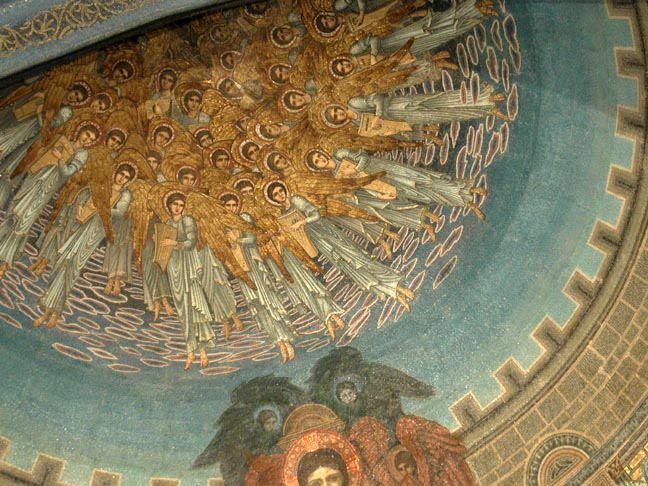
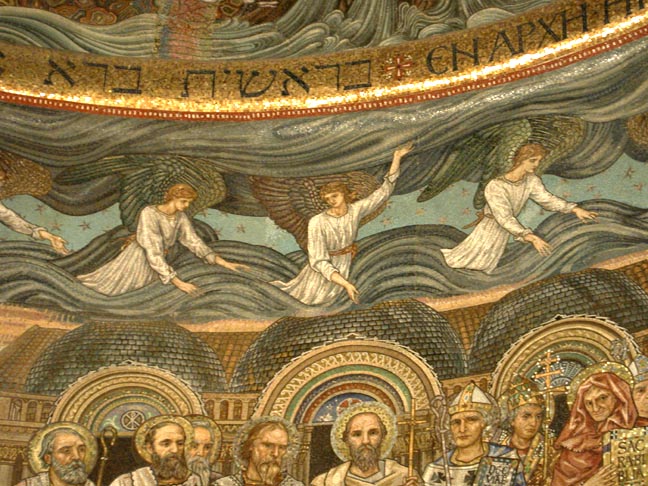
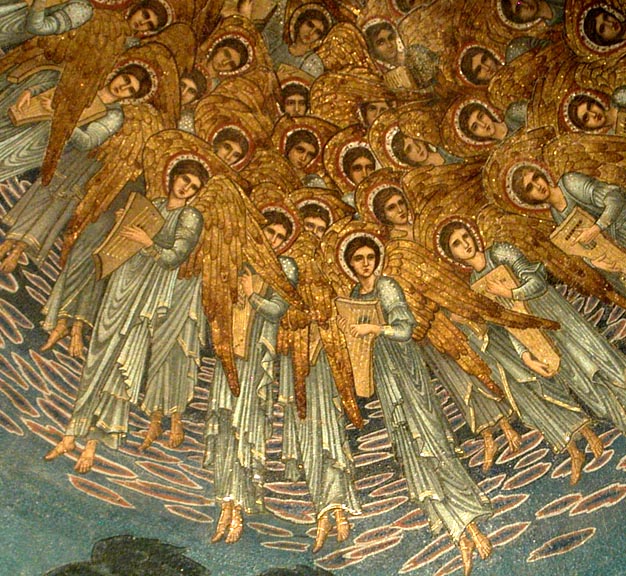
Today was a glorious day. We visited the little known but glorious American Episcopal Church, St. Paul Within the Walls, with Byzantine inspired mosaics by Burne-Jones, and tiles from William Morris. 


I first read about it in Andrew Lloyd-Webber’s introduction to the gorgeous exhibition of Pre-Raphaelite paintings from his private collection. On a school trip to Rome, he slipped away, and spent the day in this American Church, getting into trouble for returning with little knowledge of Classical Rome, but much of the Pre-Raphaelites. How English!!–and arguably, how sane!


I next saw Burne-Jones paintings from this project in a wonderful exhibition in the Ashmolean I’ve reviewed here http://wanderingbetweentwoworlds.blogspot.com/2010/11/pre-raphaelites-in-italy-ashmolean.html.


And today, I saw the real thing. Pictures from the Victorian Web. My iPhone couldn’t do justice to it. 
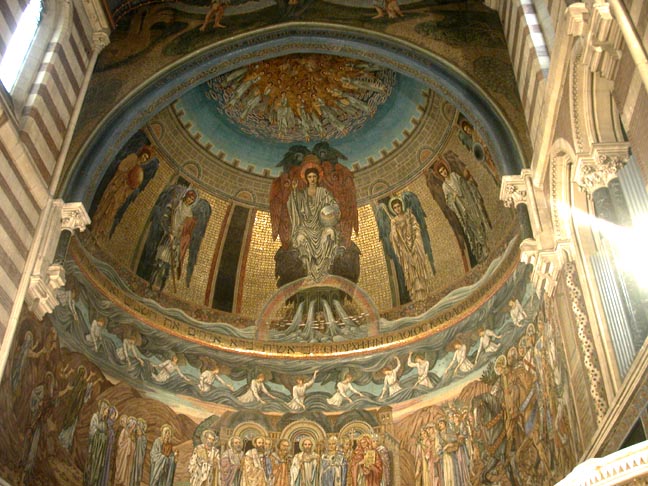

mosaic by Burne-Jones


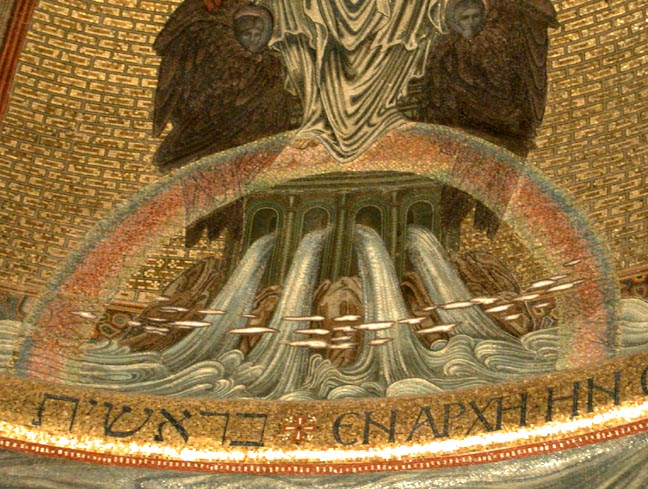
“The great mosiac of the rear wall represents Christ the Lord in glory. At the very top against the blue of the sky is glimpsed a glittering vision of angels. Below sits the majestic figure of Christ, enthroned upon the cherubim and seraphim. In Christ’s left hand he holds the orb of the earth and His right hand is upraised in blessing. From his feet issue the streams of living water and a rainbow is ’round about the Throne’ (Revelation 4).  (St. Paul’s within the Walls, pp. 2-3).
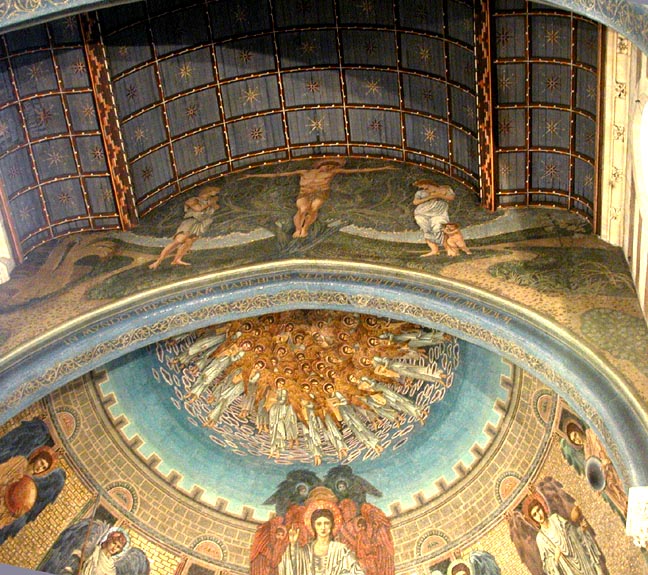
mosaic by Burne-Jones
The Tree of Forgiveness
“On the second arch over the choir, Burne-Jones has represented the Tree of Forgiveness. Christ, hands outstretched powerfully, is supended before the green-leaved Tree of Knowledge of Good and Evil. On one side stands Adam and the other Eve with her firstborn. The thistles from which spring the lily symbolize the hardness of man’s labor from which springs his divine possibilities, concretized in the story of the Annunciation. Under the scene is written in Latin: ‘In the world, ye shall have tribulation, but be of good cheer, for I have overcome the world.’ (John 16:33).” (St. Paul’s within the Walls, p. 2)


mosaic by Burne-Jones
The Heavenly Choir


mosaic by Burne-Jones
The Angels and the Waters of Life


mosaic by Burne-Jones

mosaic by Burne-Jones
Living Waters Flowing from the Throne


We had the church to ourselves, and it was glorious. What a gift. What peace and glittering beauty.


I found myself praying to have my soul flushed out and then filled with those rivers from the throne of life.


See also Quest for Joy–3 Fireflies. 


Click button to share on Facebook, Twitter, Digg, Delicious, Reddit … Wikio

Filed Under: random

Update

By Anita Mathias

Blogger on break for half-term.
Will be back to daily blogging on Sunday 27th Feb.

Filed Under: Update

A week in Rome

By Anita Mathias

We are here for the week. Zoe has worked very hard this term with her G.C.S.E’s; Irene’s worked superlatively hard in Year 7, far beyond the call of duty. Her work is mainly projects, and she produces little well-researched books on each of them. Roy worked hard clearing much of a back-log of years of procrastinated family, personal and business projects, and I over-blogged. So we thought a week away would renew our energy and zest for the next 6 week term.

“A change is as good as a rest” is one of my life-mottoes. I really believe it. It refreshes and enlarges one’s perspective as much as a beach holiday would do.

We’ve mainly come here for Renaissance art and architecture, but will see some stuff from the ancient world, of course.

So today, the Pantheon. An amazing dome, even though the bronze covering it was looted by the Byzantine emperor, and taken to Constantinople, and the interior bronze was looted, a 1000 years later by the Pope.

That lovely eye is called the oculus, and it sends an eerie shaft of sunlight into the building.

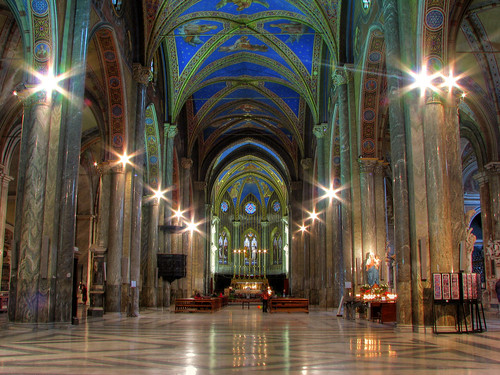
Just behind the Pantheon was the church of Santa Maria sopra Minerva, Rome’s only Gothic church, and one of the most beautiful and enchanting churches I’ve ever seen.

The ceiling was  what is called a Giotto blue, with gold stars, and lavish paintings. It was like fairyland, like an enchanted world, like Paradise.

Here are some public domain images (I just had my iPhone.)

Isn’t it lovely? Unfortunately, I made a basic travel error, and packed on preconceptions rather than weather forecasts. Rome, hot, right? Wrong!

And so I am fighting a monster cold. Prayers for health will be gratefully received.

We really enjoy travelling in Mediterranean countries. Italians, Spaniards and Greeks seem to me like Indians–with lighter skin. Voluble, excitable, loud, gregarious, fun-loving.

My French tutor, who is a real Parisian intellectual,  actor and director, and playwright who has adapted novels for the stage told me he would never go to Italy. Why? Because the manners of the Italians who come to Paris are “tres mauvaise.” Why? They talk so loudly? Is that necessarily bad-mannered, I ask shame-facedly. (Our family gets involved in animated discussions and arguments, which, yes, get loud wherever we are!) It is impolite, he says primly.

Have you been to Rome before? he asks. (Our rule is French only, and I am sure our hour of conversation amuses him). “Yes, 25 years ago.” “Oh, it must have changed a lot,” he says.

But Rome is the eternal city, and the Pantheon has not changed.

Neither I hope has the Vatican,which we will visit tomorrow, if I can shake off this monster cold.
Click button to share on Facebook, Twitter, Digg, Delicious, Reddit … Wikio

Filed Under: In which I Travel and Dream

Libya, Tunisia, Democracy, Christianity and Wealth

By Anita Mathias


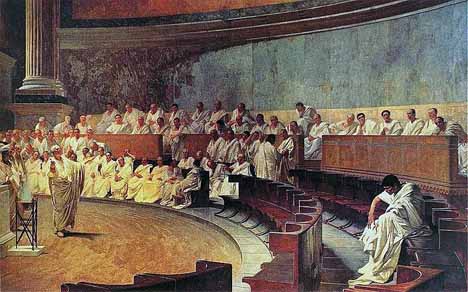
Ancient Roman Senate


I am following the Arab protests from Morocco, Algeria, Tunisia, Libya, Egypt, Syria, Jordan, Iran, Bahrain. Reading of Gaddafi firing on unarmed protesters.

http://www.guardian.co.uk/world/interactive/2011/feb/11/guardian-twitter-arab-protests-interactive


Many of the protesters want democracy. Though some can become “more equal than others,” in Orwell’s famous phrase, in democracies (or indeed in any human system where some will be born smarter, stronger, more gifted than than the others, or be born to the those who are cleverer, richer than the rest)  democracy may well be the least flawed political system there is.


                                                                         * * *


We are in Rome for the week with 4 laptops and a pile of books. We are here to see Michaelangelo, Raphael, art, architecture, and rest–a la a family of driven intellectuals. And I am on my wireless laptop, while Roy gets take-away kebabs.


I am reading about Roman democracy–the second democracy in the world, I believe (after the Greeks). 


In 509 B.C., the people of Rome rose up against the last tyrannical Etruscan monarch, Tarquin whose son raped a Roman noblewoman Lucretia, who then committed suicide. Her husband, along with Brutus led an uprising that led to the establishment of a Roman republic.


The republic was to last nearly 500 years, and was a surprisingly modern and democratic form of government. The Senate, representing the patrician families, elected two Senators from their numbers, while the people elected two tribunes, and were allowed to veto the election of senators they disapproved of. 


The city prospered.
                                                                            * * * 


When you read of Mohammed Bouazizi, the dutiful, beleagured, harassed young fruit seller, whose self-immolated triggered the current wave of Arab protests, you so want things to improve in the Arab world, perhaps through democracies led by visionary leaders


or–I am a passionate Christian, after all–


through the hope-filled joyous Gospel of Jesus Christ. 
                                                                                      * * *


John Wesley on the connections between Christianity and the wealth of nations.

Wherever true Christianity spreads, it must cause diligence and frugality, which, in the natural course of things, must beget riches!

And riches naturally beget pride, love of the world, and every temper that is destructive of Christianity. Now, if there be no way to prevent this, Christianity is inconsistent with itself and, of consequence, cannot stand, cannot continue long among any people; since, wherever it generally prevails, it saps its own foundation.

John Wesley preached this sermon in Dublin in 1789. 

Christianity does improve the living conditions of nations–though, in a typical Hegelian dialectic, wealth does threaten true Christianity.

Click button to share on Facebook, Twitter, Digg, Delicious, Reddit … Wikio
Filed Under: random

Transfiguration, Jesus Reveals his Glory, Matthew 17, Day 39, Feb 18th, Blog Through the Bible Project.

By Anita Mathias

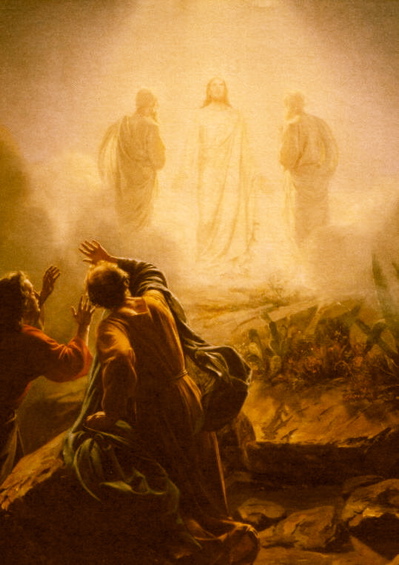
Carl Bloch, Tranfiguration

Matthew 16
Jesus Predicts His Death
 21 From that time on Jesus began to explain to his disciples that he must go to Jerusalem and suffer many things at the hands of the elders, the chief priests and the teachers of the law, and that he must be killed and on the third day be raised to life.
 22 Peter took him aside and began to rebuke him. “Never, Lord!” he said. “This shall never happen to you!”
Peter, swollen headed from his previous commendations, takes charge.
NIV notes, The beginning of a new phase in Jesus ministry. Instead of teaching the crowd in parables, he now concentrates on preparing the disciples for his coming suffering and death.
 23 Jesus turned and said to Peter, “Get behind me, Satan! You are a stumbling block to me; you do not have in mind the concerns of God, but merely human concerns.”
Lol! What is amusing is that, just in the previous paragraph, Peter had been told that the Father had revealed the truth of Jesus’ identity to him, and that he was the rock on which Jesus would build his church.
Now, he is rebuked as Satan, a stumbling block, who did not have in mind the concerns of God, but human concerns.
And that is what we humans are. At one moment, we are filled with revelation and insight, and realize we are blessed. The next moment we are impetuous and presumptuous, and have in mind human concerns, not the concerns of God, and are very like Satan in the things we prize. 
ESV notes–In the context of the Jewish master-disciple relationship, it would have been audacious for a disciple to correct his master, let alone rebuke him. Peter, like most of his fellow Jews, resisted the idea that the Messiah must suffer, even though it is found in the OT, Psalms, Isaiah, Zechariah.
Satan, a loan word from Hebrew, meaning adversary or accuser.

24 Then Jesus said to his disciples, “Whoever wants to be my disciple must deny themselves and take up their cross and follow me.
For me, the hardest sentence in Scripture.
 Saying No to self, shouldering the instrument of the death of the insistent demanding rowdy self and its desires is the only way to follow Christ.
The cross you carry is that of your own death, of doing exactly what you feel like (in terms of, let’s say, eating, control of temper, use of free time, use of money…)
This verse is one I need to be reminded of every day. 
And that is why it is good to read and study Scripture. Because, left to ourselves, we forget.
ESV notes–Satan attempts to hinder Jesus mission through Peter who does not understand that Jesus’ messianic role must include suffering and death.
25 For whoever wants to save their life will lose it, but whoever loses their life for me will find it.
Those who want to ensure the pleasantness of their lives in every detail, in fact, lose the pleasantness of it.
Those who lose their rights to the gratification of every desire for the sake of following the teachings of Jesus, in fact, find life.
ESV notes–Verses 25-27 each beginning with For (Greek Gar) provide three related reasons why a disciple must let go of his earthly life, and take up his cross. 
26 For what good will it be for someone to gain the whole world, yet forfeit their soul? Or what can anyone give in exchange for their soul?
 27 For the Son of Man is going to come in his Father’s glory with his angels, and then he will reward each person according to what they have done.
We will be rewarded or ACCORDING TO WHAT WE HAVE DONE. Or so this verse says. And so, it profits us nothing to gain everything for a finite time, and then lose our souls for eternity.

   28 “Truly I tell you, some who are standing here will not taste death before they see the Son of Man coming in his kingdom.”

Matthew 17

The Transfiguration
 1 After six days Jesus took with him Peter, James and John the brother of James, and led them up a high mountain by themselves. 2 There he was transfigured before them. His face shone like the sun, and his clothes became as white as the light.
This is the vision I would love to see. Jesus transfigured before me. His face shining like the sun. His clothes as white as the light.
Jesus, both our friend, the lamb of God, and the radiant one, whose face shines like the son, clothed in light.
His transfiguration was a reminder of the glory he had before he became man, and a preview of his future exaltation.

 3 Just then there appeared before them Moses and Elijah, talking with Jesus.
 4 Peter said to Jesus, “Lord, it is good for us to be here. If you wish, I will put up three shelters—one for you, one for Moses and one for Elijah.”
I love this–Peter is somebody who first talks, then thinks. Impulsive, impetuous, him with his foot in his mouth. His first reaction to the revelation of the glory of Christ is to say something, do something. And so, he reassures Christ that it is good that he is there to take charge at this critical juncture. And then offers to build shelters for these spiritual beings. 
ESV notes–Moses and Elijah represent the law and the prophets, which witness to Jesus as the Messaih, the one which fulfills the Old Testament.
5 While he was still speaking, a bright cloud covered them, and a voice from the cloud said, “This is my Son, whom I love; with him I am well pleased. Listen to him!”
The words which change everything. When we hear the father say, This is my daughter, whom I love. With her, I am well pleased.
And why does he say these words over us? Because we belong to Christ. We are grafted into Christ. We are in Christ, molecules in his bloodstream.
ESV notes–The bright cloud is reminscent of the cloud of God’s presence and glory in the OT, Exodus, and 1 Kings 8, 10-13
God the Father’s public endorsement of Jesus, his beloved son, echoes that given at Jesus’ baptism.
 6 When the disciples heard this, they fell facedown to the ground, terrified. 7 But Jesus came and touched them. “Get up,” he said. “Don’t be afraid.” 8 When they looked up, they saw no one except Jesus.
Terrified with a sense of awe at the presence and majesty of God.
And these are the great words which Jesus always speaks to us. Get up, don’t be afraid. 

 9 As they were coming down the mountain, Jesus instructed them, “Don’t tell anyone what you have seen, until the Son of Man has been raised from the dead.”
The Messianic secret. There is in Jesus, a continual waiting for the right time, the kairos time–the appointed moment in the purposes of God–rather than the chronos time, time as we know it. 

 10 The disciples asked him, “Why then do the teachers of the law say that Elijah must come first?”
They understand spiritual things literally, not metaphorically, a continual risk when dealing with the things of God.

 11 Jesus replied, “To be sure, Elijah comes and will restore all things. 12 But I tell you, Elijah has already come, and they did not recognize him, but have done to him everything they wished. In the same way the Son of Man is going to suffer at their hands.” 13 Then the disciples understood that he was talking to them about John the Baptist.
ESV–Understanding is a key theme of Matthew’s Gospel. 

Click button to share on Facebook, Twitter, Digg, Delicious, Reddit … Wikio

Filed Under: Matthew

Transfiguration, Jesus Reveals his Glory, Matthew 17, Day 39, Feb 18th, Blog Through the Bible Project.

By Anita Mathias

Carl Bloch, Tranfiguration
Matthew 16
Jesus Predicts His Death

 21 From that time on Jesus began to explain to his disciples that he must go to Jerusalem and suffer many things at the hands of the elders, the chief priests and the teachers of the law, and that he must be killed and on the third day be raised to life.

 22 Peter took him aside and began to rebuke him. “Never, Lord!” he said. “This shall never happen to you!”
Peter, swollen headed from his previous commendations, takes charge.
NIV notes, The beginning of a new phase in Jesus ministry. Instead of teaching the crowd in parables, he now concentrates on preparing the disciples for his coming suffering and death.
 23 Jesus turned and said to Peter, “Get behind me, Satan! You are a stumbling block to me; you do not have in mind the concerns of God, but merely human concerns.”
Lol! What is amusing is that, just in the previous paragraph, Peter had been told that the Father had revealed the truth of Jesus’ identity to him, and that he was the rock on which Jesus would build his church.
Now, he is rebuked as Satan, a stumbling block, who did not have in mind the concerns of God, but human concerns.
And that is what we humans are. At one moment, we are filled with revelation and insight, and realize we are blessed. The next moment we are impetuous and presumptuous, and have in mind human concerns, not the concerns of God, and are very like Satan in the things we prize. 
ESV notes–In the context of the Jewish master-disciple relationship, it would have been audacious for a disciple to correct his master, let alone rebuke him. Peter, like most of his fellow Jews, resisted the idea that the Messiah must suffer, even though it is found in the OT, Psalms, Isaiah, Zechariah.
Satan, a loan word from Hebrew, meaning adversary or accuser.

24 Then Jesus said to his disciples, “Whoever wants to be my disciple must deny themselves and take up their cross and follow me.
For me, the hardest sentence in Scripture.
 Saying No to self, shouldering the instrument of the death of the insistent demanding rowdy self and its desires is the only way to follow Christ.
The cross you carry is that of your own death, of doing exactly what you feel like (in terms of, let’s say, eating, control of temper, use of free time, use of money…)
This verse is one I need to be reminded of every day. 
And that is why it is good to read and study Scripture. Because, left to ourselves, we forget.
ESV notes–Satan attempts to hinder Jesus mission through Peter who does not understand that Jesus’ messianic role must include suffering and death.

25 For whoever wants to save their life will lose it, but whoever loses their life for me will find it.

Those who want to ensure the pleasantness of their lives in every detail, in fact, lose the pleasantness of it.
Those who lose their rights to the gratification of every desire for the sake of following the teachings of Jesus, in fact, find life.
ESV notes–Verses 25-27 each beginning with For (Greek Gar) provide three related reasons why a disciple must let go of his earthly life, and take up his cross. 
26 For what good will it be for someone to gain the whole world, yet forfeit their soul? Or what can anyone give in exchange for their soul?
 27 For the Son of Man is going to come in his Father’s glory with his angels, and then he will reward each person according to what they have done.
We will be rewarded or ACCORDING TO WHAT WE HAVE DONE. Or so this verse says. And so, it profits us nothing to gain everything for a finite time, and then lose our souls for eternity.

   28 “Truly I tell you, some who are standing here will not taste death before they see the Son of Man coming in his kingdom.”

Matthew 17

The Transfiguration

 1 After six days Jesus took with him Peter, James and John the brother of James, and led them up a high mountain by themselves. 2 There he was transfigured before them. His face shone like the sun, and his clothes became as white as the light.
This is the vision I would love to see. Jesus transfigured before me. His face shining like the sun. His clothes as white as the light.
Jesus, both our friend, the lamb of God, and the radiant one, whose face shines like the son, clothed in light.
His transfiguration was a reminder of the glory he had before he became man, and a preview of his future exaltation.


 3 Just then there appeared before them Moses and Elijah, talking with Jesus.

 4 Peter said to Jesus, “Lord, it is good for us to be here. If you wish, I will put up three shelters—one for you, one for Moses and one for Elijah.”
I love this–Peter is somebody who first talks, then thinks. Impulsive, impetuous, him with his foot in his mouth. His first reaction to the revelation of the glory of Christ is to say something, do something. And so, he reassures Christ that it is good that he is there to take charge at this critical juncture. And then offers to build shelters for these spiritual beings. 
ESV notes–Moses and Elijah represent the law and the prophets, which witness to Jesus as the Messaih, the one which fulfills the Old Testament.
5 While he was still speaking, a bright cloud covered them, and a voice from the cloud said, “This is my Son, whom I love; with him I am well pleased. Listen to him!”
The words which change everything. When we hear the father say, This is my daughter, whom I love. With her, I am well pleased.
And why does he say these words over us? Because we belong to Christ. We are grafted into Christ. We are in Christ, molecules in his bloodstream.
ESV notes–The bright cloud is reminscent of the cloud of God’s presence and glory in the OT, Exodus, and 1 Kings 8, 10-13
God the Father’s public endorsement of Jesus, his beloved son, echoes that given at Jesus’ baptism.
 6 When the disciples heard this, they fell facedown to the ground, terrified. 7 But Jesus came and touched them. “Get up,” he said. “Don’t be afraid.” 8 When they looked up, they saw no one except Jesus.
Terrified with a sense of awe at the presence and majesty of God.
And these are the great words which Jesus always speaks to us. Get up, don’t be afraid. 

 9 As they were coming down the mountain, Jesus instructed them, “Don’t tell anyone what you have seen, until the Son of Man has been raised from the dead.”
The Messianic secret. There is in Jesus, a continual waiting for the right time, the kairos time–the appointed moment in the purposes of God–rather than the chronos time, time as we know it. 

 10 The disciples asked him, “Why then do the teachers of the law say that Elijah must come first?”
They understand spiritual things literally, not metaphorically, a continual risk when dealing with the things of God.

 11 Jesus replied, “To be sure, Elijah comes and will restore all things. 12 But I tell you, Elijah has already come, and they did not recognize him, but have done to him everything they wished. In the same way the Son of Man is going to suffer at their hands.” 13 Then the disciples understood that he was talking to them about John the Baptist.
ESV–Understanding is a key theme of Matthew’s Gospel. 

Click button to share on Facebook, Twitter, Digg, Delicious, Reddit … Wikio

Filed Under: Matthew

Quest for Joy-3. Fireflies

By Anita Mathias


One of my fond magical, almost mystical memories of living in Williamsburg, Virginia was sitting on my porch in the evenings, watching the fireflies in the cool dusk. They are magical things, and fill me calm, joy and wonder.

John Ruskin, the amazing Victorian polymath is one of my favourite writers. He abruptly ends his autobiography, Praeterita (written against all odds, against the advice of his carers, when the synapses of his brain were not working well, and he was sinking into adrenal exhaustion, nervous collapse, and indeed the dementia which clouded his last decade) with a glorious description of fireflies.


“Fonte Branda I last saw with Charles Norton, under the same arches where Dante saw it. We drank of it together, and walked together that evening in the hills above, where the fireflies among the scented thickets shone fitfully in the still undarkened air. How they shone! moving like fine-broken starlight through the purple leaves. How they shone! through the sunset that faded into thunderous night as I entered Siena three days before, the white edges of the thunderous clouds still lighted from the west, and the openly golden sky calm behind the Gate of Siena’s heart, with its still golden words, ‘Cor magis tibi Sena pandit,’ and the fireflies everywhere in sky and cloud rising and falling, mixed with the lightning, and more intense than the stars.”


The disjointed conclusion of his beautiful, intense and revelatory book reminds one of Ruskin’s mind, “fireflies everywhere,  mixed with the lightning, and more intense than the stars.”
                                                                        * * *


Fireflies also remind me of a novel I read as a teenager The Return of the Native by Thomas Hardy.

It has a strange sequence of an all night gambling match on Egdon Heath between the Red Man, Diggory Venn and Damon Wildeeve to regain the inheritance of Thomasina whom Diggory Venn and Wildeeve has married.

When it gets too dark, Diggory grabs fireflies, puts them in a bottle, and continues gambling by their light. It is surely among the strangest scenes in fiction, the intense gambling– love and greed at stake–on a midsummer night, by the light of captured fireflies
* * *

See also, Quest for Joy 1–Glory be to God for Winged Things

Quest for Joy 2–A bluebird in every tree

And a short blog post on Ruskin’s mind http://thegoodbooksblog.blogspot.com/2010/11/john-ruskin-mind-as-bright-as-fireflies.html
Wikio


Filed Under: random

The Dream Play, August Strindberg

By Anita Mathias


Saw this this evening at the Oxford Playhouse. Well, largely because the charming young French actor and director who tutors me and Zoe in French (a whimsical endeavour at fluency on my part) was acting in it.


I love Ibsen, and have probably read all his plays one after another in my twenties. I adore Bergman’s movies too, and again have probably seen all of them. Seen some Strindberg. So I do do Scandinavian gloom!


But I detested The Dream Play. Not the acting or the production, which was ingenious, strange, beautiful, haunting, and well acted. Visually almost stunning as many recent productions I’ve seen at the Playhouse have been


I found the play itself depressing with an unnecessarily bleak view of the sadness and futility of all human endeavour. 


The Dream Play, like Ibsen’s plays (The Doll-House in particular), had some early feminist ideas, with marriage and domesticity seen as a trap in which sprightly women wilt, but which they cannot leave for fear of losing their children. 


There was an air of threat and menace. Its bleak phantasmagoric atmosphere was threatening, and I found myself longing to escape, to pray, to breathe in the reassurance of Christ, to remember the goodness of God and the joy of life, to once more soak in the stability and rootedness of faith.


The Oxford Playhouse has a mission of having at least a quarter of its productions experimental. These can be excellent–or dreadful.


We had season tickets in 2005 when the experimental plays were rather dreadful. I walked out of a ridiculous production of The Birds, dragging my family with me, asked to see the Manager and asked for a refund or exchange on our tickets–the production was that bad!!  The somewhat bemused manager acquiesced!!


Nonetheless, I am very fond of the Oxford Playhouse which is layered with memories of fab plays I saw there for the first time as an undergraduate.


It was among the reasons I wanted to return to Oxford to live here permanently. Just imagine: A small town with world-class theatre, ballet, opera, museums, libraries…within a 15 minute drive from my house.


Oxford has been a blessing to us! 


Wikio

Filed Under: random

  • « Previous Page
  • 1
  • …
  • 3
  • 4
  • 5
  • 6
  • 7
  • …
  • 12
  • Next Page »

Sign Up and Get a Free eBook!

Sign up to be emailed my blog posts (one a week) and get the ebook of "Holy Ground," my account of working with Mother Teresa.

Join 536 Other Readers

My Books

Rosaries, Reading, Secrets: A Catholic Childhood in India

Rosaries, Reading Secrets, B&N
USA

UK

Wandering Between Two Worlds: Essays on Faith and Art

Wandering Between Two Worlds
USA

UK

Francesco, Artist of Florence: The Man Who Gave Too Much

Francesco, Artist of Florence
US

UK

The Story of Dirk Willems

The Story of Dirk Willems
US

UK

My Latest Meditation

Anita Mathias: About Me

Anita Mathias

Read my blog on Facebook

Follow me on Twitter

Follow @anitamathias1

Recent Posts

  • At the Cross, God Forgives Us Completely
  • Using God’s Gift of Our Talents: A Path to Joy and Abundance
  • The Kingdom of God is Here Already, Yet Not Yet Here
  • All Those Who Exalt Themselves Will Be Humbled & the Humble Will Be Exalted
  • Christ’s Great Golden Triad to Guide Our Actions and Decisions
  • How Jesus Dealt With Hostility and Enemies
  • Do Not Be Afraid, but Do Be Prudent
  • For Scoundrels, Scallywags, and Rascals—Christ Came
  • How to Lead an Extremely Significant Life
  • Don’t Walk Away From Jesus, but if You Do, He Still Looks at You and Loves You
Premier Digital Awards 2015 - Finalist - Blogger of the year
Runner Up Christian Media Awards 2014 - Tweeter of the year

Categories

What I’m Reading


Wolf Hall
Hilary Mantel

Wolf Hall --  Amazon.com
Amazon.com

Amazon.co.uk

Silence and Honey Cakes:
The Wisdom Of The Desert
Rowan Williams

Silence and Honey Cakes --  Amazon.com
Amazon.com

Amazon.co.uk

The Long Loneliness:
The Autobiography of the Legendary Catholic Social Activist
Dorothy Day

The Long Loneliness --  Amazon.com
Amazon.com

Amazon.co.uk

Country Girl
Edna O'Brien

Country Girl  - Amazon.com
Amazon.com

Amazon.co.uk

Archive by month

My Latest Five Podcast Meditations

INSTAGRAM

anita.mathias

My memoir: Rosaries, Reading, Secrets https://amzn.to/42xgL9t
Oxford, England. Writer, memoirist, podcaster, blogger, Biblical meditation teacher, mum

Looking at photos from our week in beautiful Sevil Looking at photos from our week in beautiful Seville and Cordoba over New Year with Irene, who had a week off.
And, ICYMI, here’s my latest meditation on the Gospel of Matthew… I’ve recorded it, should you want a few minutes of peace.
https://anitamathias.com/2026/04/29/gods-complete-forgiveness/
Hello Friends, I'm resumed recording my meditation Hello Friends, I'm resumed recording my meditations on the Gospel of Matthew. Do click on this link to listen. 
https://anitamathias.com/.../29/gods-complete-forgiveness/
Christ is the most influential figure in the history of the world, though his life ended in shame, humiliation and failure. But he so completely turned things round in his great reversal that the cross on which he died when all seemed hopeless is now the most common, and revered, symbol in history.
He emerged from and was anchored in Judaism. And as the sins of the people were laid on the scapegoat who was sent into the wilderness to perish, Christ died as the lamb of God voluntarily bearing the guilt of the wrongdoing of the whole world. He paid the price for our forgiveness with his life-blood--in accordance with the iron law of the physical and moral universe, of sowing and reaping, cause and effect. 
And so, God, who appeared as flames of fire to Moses, can now dwell within us, purifying us, whose hearts have darkness and shards of ice. 
And now that Christ was crucified, died, but rose again, His Spirit, no longer contained within his earthly body, is poured out like living water onto all humans, at our humble request. The Spirit pours the love of God into us; he reminds us of the words of Jesus and slowly writes Christ’s sweet law on our hearts. This transfusion of grace helps us do hard things we previously couldn’t do. Our dance with the Spirit gradually breaks the power of sin over us. It transforms us.
Now we, the forgiven, protected by the blood of Jesus poured out over us, and filled with His Spirit, who sings within us, Abba, Father, are adopted by God as his children in his joyful new covenant. We are cells grafted into the vine of our new family--Father, Son, Spirit—who now live in us as we live in them. As we choose by our thoughts and actions to continue living in the vine of Jesus, their energy pulsing through us makes us fruitful. And now, all our prayers which flow in the river of God’s good purposes are kindly heard. Waves of love and power flood from the cross! 
Thank you!
Well, hello friends! Breaking radio silence to let Well, hello friends! Breaking radio silence to let you know that I have taped a meditation for you on Christ’s famous Parable of the Talents in Matthew 25. https://anitamathias.com/2025/11/05/using-gods-gift-of-our-talents-a-path-to-joy-and-abundance/
Here you are, click the play button in the blog post for a brief meditation, and some moments of peace, and, perhaps, inspiration in your day 🙂
Hi Friends, I have taped a meditation; do listen a Hi Friends, I have taped a meditation; do listen at this link: https://anitamathias.com/2025/04/08/the-kingdom-of-god-is-here-already-yet-not-yet-here-2/
It’s on the Kingdom of God, of which Christ so often spoke, which is here already—a mysterious, shimmering internal palace in which, in lightning flashes, we experience peace and joy, and yet, of course, not yet fully here. We sense the rainbowed presence of Christ in the song which pulses through creation. Christ strolls into our rooms with his wisdom and guidance, and things change. Our prayers are answered; we are healed; our hearts are strangely warmed. Sometimes.
And yet, we also experience evil within & all around us. Our own sin which can shatter our peace and the trajectory of our lives. And the sins of the world—its greed, dishonesty and environmental destruction.
But in this broken world, we still experience the glory of creation; “coincidences” which accelerate once we start praying, and shalom which envelops us like sudden sunshine. The portals into this Kingdom include repentance, gratitude, meditative breathing, and absolute surrender.
The Kingdom of God is here already. We can experience its beauty, peace and joy today through the presence of the Holy Spirit. But yet, since, in the Apostle Paul’s words, we do not struggle only “against flesh and blood, but against the rulers, against the unseen powers of this dark world and against the spiritual forces of evil,” its fullness still lingers…
Our daughter Zoe was ordained into the Church of E Our daughter Zoe was ordained into the Church of England in June. I have been on a social media break… but … better late than never. Enjoy!
First picture has my sister, Shalini, who kindly flew in from the US. Our lovely cousins Anthony and Sarah flank Zoe in the next picture.
The Bishop of London, Sarah Mullaly, ordained Zoe. You can see her praying that Zoe will be filled with the Holy Spirit!!
And here’s a meditation I’ve recorded, which you might enjoy. The link is also in my profile
https://anitamathias.com/2024/11/07/all-those-who-exalt-themselves-will-be-humbled-the-humble-will-be-exalted/
I have taped a meditation on Jesus statement in Ma I have taped a meditation on Jesus statement in Matthew 23, “For those who exalt themselves will be humbled, and those who humble themselves will be exalted.”
Do listen here. https://anitamathias.com/2024/11/07/all-those-who-exalt-themselves-will-be-humbled-the-humble-will-be-exalted/
Link also in bio.
And so, Jesus states a law of life. Those who broadcast their amazingness will be humbled, since God dislikes—scorns that, as much as people do.  For to trumpet our success, wealth, brilliance, giftedness or popularity is to get distracted from our life’s purpose into worthless activity. Those who love power, who are sure they know best, and who must be the best, will eventually be humbled by God and life. For their focus has shifted from loving God, doing good work, and being a blessing to their family, friends, and the world towards impressing others, being enviable, perhaps famous. These things are houses built on sand, which will crumble when hammered by the waves of old age, infirmity or adversity. 
God resists the proud, Scripture tells us—those who crave the admiration and power which is His alone. So how do we resist pride? We slow down, so that we realise (and repent) when sheer pride sparks our allergies to people, our enmities, our determination to have our own way, or our grandiose ego-driven goals, and ambitions. Once we stop chasing limelight, a great quietness steals over our lives. We no longer need the drug of continual achievement, or to share images of glittering travel, parties, prizes or friends. We just enjoy them quietly. My life is for itself & not for a spectacle, Emerson wrote. And, as Jesus advises, we quit sharp-elbowing ourselves to sit with the shiniest people, but are content to hang out with ordinary people; and then, as Jesus said, we will inevitably, eventually, be summoned higher to the sparkling conversation we craved. 
One day, every knee will bow before the gentle lamb who was slain, now seated on the throne. We will all be silent before him. Let us live gently then, our eyes on Christ, continually asking for his power, his Spirit, and his direction, moving, dancing, in the direction that we sense him move.
Link to new podcast in Bio https://anitamathias.co Link to new podcast in Bio https://anitamathias.com/2024/02/20/how-jesus-dealt-with-hostility-and-enemies/
3 days before his death, Jesus rampages through the commercialised temple, overturning the tables of moneychangers. Who gave you the authority to do these things? his outraged adversaries ask. And Jesus shows us how to answer hostile questions. Slow down. Breathe. Quick arrow prayers!
Your enemies have no power over your life that your Father has not permitted them. Ask your Father for wisdom, remembering: Questions do not need to be answered. Are these questioners worthy of the treasures of your heart? Or would that be feeding pearls to hungry pigs, who might instead devour you?
Questions can contain pitfalls, traps, nooses. Jesus directly answered just three of the 183 questions he was asked, refusing to answer some; answering others with a good question.
But how do we get the inner calm and wisdom to recognise
and sidestep entrapping questions? Long before the day of
testing, practice slow, easy breathing, and tune in to the frequency of the Father. There’s no record of Jesus running, rushing, getting stressed, or lacking peace. He never spoke on his own, he told us, without checking in with the Father. So, no foolish, ill-judged statements. Breathing in the wisdom of the Father beside and within him, he, unintimidated, traps the trappers.
Wisdom begins with training ourselves to slow down and ask
the Father for guidance. Then our calm minds, made perceptive, will help us recognise danger and trick questions, even those coated in flattery, and sidestep them or refuse to answer.
We practice tuning in to heavenly wisdom by practising–asking God questions, and then listening for his answers about the best way to do simple things…organise a home or write. Then, we build upwards, asking for wisdom in more complex things.
Listening for the voice of God before we speak, and asking for a filling of the Spirit, which Jesus calls streams of living water within us, will give us wisdom to know what to say, which, frequently, is nothing at all. It will quieten us with the silence of God, which sings through the world, through sun and stars, sky and flowers.
Especially for @ samheckt Some very imperfect pi Especially for @ samheckt 
Some very imperfect pictures of my labradoodle Merry, and golden retriever Pippi.
And since, I’m on social media, if you are the meditating type, here’s a scriptural meditation on not being afraid, while being prudent. https://anitamathias.com/2024/01/03/do-not-be-afraid-but-do-be-prudent/
A new podcast. Link in bio https://anitamathias.c A new podcast. Link in bio
https://anitamathias.com/2024/01/03/do-not-be-afraid-but-do-be-prudent/
Do Not Be Afraid, but Do Be Prudent
“Do not be afraid,” a dream-angel tells Joseph, to marry Mary, who’s pregnant, though a virgin, for in our magical, God-invaded world, the Spirit has placed God in her. Call the baby Jesus, or The Lord saves, for he will drag people free from the chokehold of their sins.
And Joseph is not afraid. And the angel was right, for a star rose, signalling a new King of the Jews. Astrologers followed it, threatening King Herod, whose chief priests recounted Micah’s 600-year-old prophecy: the Messiah would be born in Bethlehem, as Jesus had just been, while his parents from Nazareth registered for Augustus Caesar’s census of the entire Roman world. 
The Magi worshipped the baby, offering gold. And shepherds came, told by an angel of joy: that the Messiah, a saviour from all that oppresses, had just been born.
Then, suddenly, the dream-angel warned: Flee with the child to Egypt. For Herod plans to kill this baby, forever-King.
Do not be afraid, but still flee? Become a refugee? But lightning-bolt coincidences verified the angel’s first words: The magi with gold for the flight. Shepherds
telling of angels singing of coming inner peace. Joseph flees.
What’s the difference between fear and prudence? Fear is being frozen or panicked by imaginary what-ifs. It tenses our bodies; strains health, sleep and relationships; makes us stingy with ourselves & others; leads to overwork, & time wasted doing pointless things for fear of people’s opinions.
Prudence is wisdom-using our experience & spiritual discernment as we battle the demonic forces of this dark world, in Paul’s phrase.It’s fighting with divinely powerful weapons: truth, righteousness, faith, Scripture & prayer, while surrendering our thoughts to Christ. 
So let’s act prudently, wisely & bravely, silencing fear, while remaining alert to God’s guidance, delivered through inner peace or intuitions of danger and wrongness, our spiritual senses tuned to the Spirit’s “No,” his “Slow,” his “Go,” as cautious as a serpent, protected, while being as gentle as a lamb among wolves.
Follow on Instagram

© 2026 Dreaming Beneath the Spires · All Rights Reserved. · Cookie Policy · Privacy Policy