Anita Mathias: Dreaming Beneath the Spires

Anita Mathias's Blog on Faith and Art

  • Home
  • My Books
  • Meditations
  • Essays
  • Contact
  • About Me

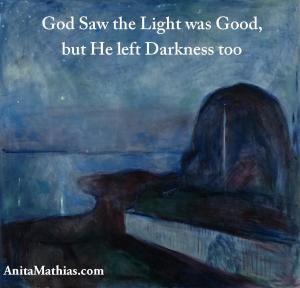
God Saw the Light was Good, but He Left Darkness Too

By Anita Mathias

Publication2In the beginning…

God’s first recorded words in the Bible are “Let there be light.” And there was light. And God saw that the light was good. (Genesis 1:4)

But he left darkness too.

And so it shall ever be. On  June 21, we have 16 hours 41 minutes of light in Oxford, England. But we also have 7 hours 19 minutes of darkness. On December 22, however, we have 16 hours 18 minutes of darkness, but we still have 7 hours 42 minutes of daylight.

Some darkness on the sunniest day; some sunshine on the darkest day.

And so it always is, throughout our lives.  Tweet: Some darkness on the sunniest day; some sunshine on the darkest day. And so it always is, throughout our lives. From @anitamathias1 http://ctt.ec/0KHpy+

John drapes himself on us, heart flooded with love. On the other side, there’s Judas, serpent-heart despite his kiss. But eleven apostles out of twelve proved true. That is life too, and life is good.

* * *

Me, I am still living in summer, tasting the goodness of the Lord in the land of the living. I am healthy enough; my family is healthy. My children are doing well, academically, socially and spiritually, and are happy. We are paying our bills to date. I am enjoying my work. I am happy. I am happy.

But I am also allowing myself to slow down, and feel the sadness that God left in the beginning.

It has been an intense month. Jake, our eleven year old border collie, had a vast growth in his abdomen, and inoperable tumours in his liver which makes it uncomfortable to eat. So he stopped. How dreadful to watch a dog waste away. Finally, he could no longer walk, and we put him to sleep yesterday. The vet said it was definitely the right thing to do.

I have been feeling tired, and my blood work showed severe anaemia. So I had a colonoscopy, which showed a polyp. I am hoping for minimal surgery…but I must walk on the waters,, holding Jesus’ hand through that.

We have lost our wonderful cleaner, which has thrown us.    He helped with everything—housesitting, chauffeuring kids, picking up purchases, garden work, painting, car cleaning, whatever needed to be done. An almost irreplaceable Man Friday.

Financially, we are still recovering from the burglary in February, of our car and electronics etc. We were underinsured, and so we have to put our nose to the grindstone to replace what we had to “borrow” from savings (earmarked for other bills) so as to replace the stolen things.

Love’s like a hurricane, and I am a tree
Bending beneath the weight of His wind and mercy,
as John Mark Macmillan writes.

Couldn’t God have prevented all these griefs and hassles? I think, crossly.

* * *

In the Old Testament Book of Job, Job lost everything– children, wealth, health and the respect of his friends.

“Does it please you to oppress me?” he asks God (Job 10:3).

His friends insist that Job must have secretly sinned to deserve so much suffering, that he was under the Almighty’s curse—our intuitive (though unspoken) response to other people’s suffering

But Job insists he is guilty of no spectacular secret sin, “Let the Almighty answer me,” he demands (Job 31:35).

And God does. In the infuriating way only the Almighty can get away with, he answers Job in a series of questions.

“Who laid the earth’s cornerstone

While the morning stars sang together

And all the angels shouted for joy?

“Have you entered the storehouses of the snow?”  

“Can you bind the beautiful Pleaides?

Can you bring forth the constellations in their seasons?

Do you give his horse his strength

Who at the blast of the trumpets snorts, “Aha.”

God has put together this vast cosmos of sea and stars and snow, of lightning and lions and leviathans, ostriches, ospreys and eagles. Job, a very minor character in the complex epic of the universe, does not have the perspective to contend with him, God suggests.

God exists on another plane altogether, able to see the end from the beginning, to contain all things in his mind, to see the whole complex canvas of human existence at a single glance, and the glorious end of each contorted plot twist in our lives. While Job sees but one page, God sees the entire plot. Tweet: While Job sees but one page, God sees the entire plot. From @AnitaMathias1 http://ctt.ec/Ehvld+

“Woe to those who quarrel with their Maker,
Does the clay say to the potter,
‘What are you making?
’ the prophet Isaiah writes.

God is God. He chooses the plot of our lives, chooses the role we are to play in the cosmic drama. It is our task to play it well.

Job repents of his turbulent questions.

“Surely I spoke of things I did not understand,

things too wonderful for me to know.

My ears had heard of you,

But now my eyes have seen you.

Therefore I repent.”

And Job’s acceptance turns things around. “The Lord made him prosperous again, and gave him twice as much as he had before.” (Job 42:10)

* * *
Publication1

Darkness, trouble, hassle is a fact of life, seven hours of darkness in our brightest day. “In this world, you will have trouble,” were among Jesus’s last words, though he goes on to say, “But be of good cheer. I have overcome the world.”

When God created a pristine world that he could have shaped any way, he deliberately left a bit of darkness too.

Why?

For the same reason a story-teller leaves a bit of darkness in his stories perhaps. It forces the story to a better, more beautiful, more interesting conclusion. Cinderella had to sleep among the cinders; Sleeping Beauty had to prick her thumb on the spindle; the shard of ice had to enter Kay’s heart for us to have a story.

Artists instinctively know that they must frame brightness with darkness. Possibly God like Van Gogh found as much beauty in a starry night as a sunrise. Tweet: Possibly God like Van Gogh found as much beauty in a starry night as a sunrise. From @AnitaMathias1 http://ctt.ec/d1m0Y+

Winter strengthens the root systems of trees, sending them delving deep for nourishment. Without it, bulbs would not burst into blossom. Eternal summer can take a toll on mental health; in Greenland suicides are more common in summer. Seasonal Affective Disorder strikes in the summer as well as in winter.

If we had eternal daylight, eternal summer, unblemished happiness, we would not value them quite as much. A period of just-enough makes us appreciate how money can cushion and enrich life; a period of loneliness makes friendship precious; a period of failure sweetens success.

***

God left darkness and winter as facts of life. So what do we do when life does not go the way we want it to?

We fling up our hands and accept it, light as well as darkness, good as well as evil, trusting the one who sends both, light that shines in winter, the selah of darkness in summer.

* * *

We accept it, with thankfulness that our world with all its darkness is still under God’s protection.

The world tilts towards good as it tilts towards the sun. Tweet: The world tilts towards good as it tilts towards the sun. From @AnitaMathias1 http://ctt.ec/v8d5o+

Because, as we are told in the second line of Genesis, while all the world was darkness, the spirit of God still hovered over the water.

And so we have hope.

I am in a situation of chaos, stress and high emotion, and over me the Spirit hovers.

My dog is dying, and I am overwhelmed with sadness watching him, and over me the spirit hovers.

I want my anaemia to go and that polyp to be benign, and over me the spirit hovers.

Life will bring me light and goodness and joy, but if it presents challenges, I know this for sure: Over me the spirit hovers, always hovers.

* * *

And so I can face the future. And so I can smile.

Because as Gerard Manley Hopkins says,

      The world is charged with the grandeur of God.
It will flame out
It gathers to a greatness, 

        Generations have trod, have trod, have trod;
And all is seared with trade; Bleared, smeared with toil;
And wears man’s smudge and shares man’s smell:  

        And for all this, nature is never spent;
There lives the dearest freshness deep down things;
Because the Holy Ghost over the bent
World broods with warm breast and with ah! bright wings.

Ah the Spirit’s warm breast, his bright wings. So much love surrounding us, whether we feel it or not. Tweet: Ah the Spirit’s warm breast, his bright wings. So much love surrounding us, whether we feel it or not. http://ctt.ec/t47Yp+

And so as John Mark Macmillan continues,

Then all of a sudden,
I am unaware of these afflictions eclipsed by glory

And I realize just how beautiful you are and how great your affections are for me.

And I really do believe, what Paul wrote to the Romans:  In all things God works for the good of those who love him (Romans 8:28) Because he is super-duper powerful and creative, and so he can. Because he is good, and so he will.

And so I say with Julian of Norwich, “All will be well, all will be well, all manner of things will be well,” because the Holy Spirit broods over us, strengthening us, filling us with joy. He swoops down in light and joy, but something has his “dark descending” as Gerard Manley Hopkins puts it, continuing, surprisingly, ‘And most is merciful then.”

~~~~

Tweetables—

God saw that light was good, but he left the darkness too. Why?  From @anitamathias1 Tweet: God saw that light was good, but he left the darkness too. Why?  From @anitamathias1 http://ctt.ec/3lB_f+

Couldn’t God have prevented all these griefs and hassles? I think, crossly. From @anitamathias1 Tweet: Couldn’t God have prevented all these griefs and hassles? I think, crossly. From @anitamathias1 http://ctt.ec/eSRUA+

Suffering can force a story to a better, more beautiful, more interesting conclusion. From @anitamathias1 Tweet: Suffering can force a story to a better, more beautiful, more interesting conclusion. From @anitamathias1 http://ctt.ec/1xHCR+

Possibly God, like Van Gogh, found as much beauty in a starry night as a sunrise. From @anitamathias1 Tweet: Possibly God, like Van Gogh, found as much beauty in a starry night as a sunrise. From @anitamathias1 http://ctt.ec/31Z94+

Over to you

Have you seen the light shine in the darkness?

Have you experienced the brooding comfort of the Holy Spirit in the midst of the darkness?

This post is kindly sponsored by How to up your health game. 

Filed Under: Field notes from the Land of Suffering, Genesis, In which I chase the wild goose of the Holy Spirit Tagged With: blog through the Bible project, Genesis, Gerard Manley Hopkins, John Mark Macmillan, Judas, Julian of Norwich, suffering, The Book of Job, theodicy, Van Gogh

Changing the Soil of My Heart, Little by Little  

By Anita Mathias

Good Seed, Good Soil, Abundant Harvest

I read the Gospels, I hear them preached, and tap, tap, tap, go my jubilant feet.

The Gospels tell me lovely things I wanted to believe but feared were not true; that fellow Christians often suggested were not true, by their deeds, if not their words; and that our world definitely believes are not true. I read the Gospels and sense everything sad coming untrue, as Sam Gamgee exclaims in his delight.

What only fools gather and heap into barns? And see here: He says, it’s safe to forgive and bless even our pesky enemies, for he has our affairs in hand. And–look, he says prayer can move mountains, lame feet, dead bodies, anything… And look, I am commanded not to worry, but to live free as a bird–commanded, I tell you.

Tap, tap, tap, my toes beat at the Gospel’s jazz rhythm of hope.

“Oh yes!” I resolve as Rilke did when faced with the sheer beauty of the Archaic Torso of Apollo, “I will revise my life.”

I have decided to follow Jesus, my heart sings. I will forever live in the waterfall, the force field of God’s power.

* * *

And then, I go out into the world, where not everyone in the stands is a cheerleader and I am sometimes cheated; where my prayers are not instantly answered and my words are plagiarized.

And something leaks out of me.

The resolve to seek comfort and joy in the filling of the Holy Spirit? Well, it becomes chocolate and the Holy Spirit. And 10,000 pedometer steps, for my body is a temple of the Holy Spirit, well…

And keeping the house orderly for God is not a God of disorder but of peace…Well. And waking very early in the morning, while it is still dark to spend time with my heavenly Father. Well…

Oh, I had wanted to speak words which  give energy and  life, but I hear myself speaking critical words which sap resolve, words which stem from tiredness and frustration, and I am filled with shame.

Oh, wretched woman that I am, who will rescue me from this body of death?

* * *

Jesus Christ will, oh yes, he will, through multiple means of grace.

And here is one, suggested by the prophet Habbakuk, 2600 years ago. I will write down the vision and make it plain that I may run when I read it…

What I resolved when I was on fire on the mountain-top, I will re-read in the damp-squibby valley.

I have a sheet of “epiphanies and resolutions” in my prayer journal. I resolutely pray through each desire of my heart, a page or so a day,  and when I come to that page, I resolve again.

And I resume revising my life.

* * *

In the long run, failure does not matter. Getting side-tracked doesn’t matter. All that matters is beginning again. And again. The simple glory of persisting.

Yes, I will eat more veggies and walk more because my body is a temple of the Holy Spirit and I want to keep it fit and strong. Yes, I will run an orderly house for the sake of my own mental health and happiness and for the peace of its inhabitants. Yes, “there is nothing but love,”–so help me God, I will remember that “all is small save love, for love is all in all.” Yes, I will wake early. And writing, oh yes, writing! I will write faithfully as a bird sings, for that is what I’ve been created to do.

“The essential thing in heaven and in earth is that there should be long obedience in the same direction. There thereby results, and has always resulted something which has made life worth living:   virtue, art, music, dancing, reason, spirituality– anything whatever that is transfiguring, refined, foolish, or divine,” Nietzche wrote in Beyond Good and Evil.

“If one advances confidently in the direction of his dreams, and endeavours to live the life which he has imagined, he will meet with a success unexpected in common hours,” Thoreau observed.

And I read my resolves, and I re-resolve, and by persisting  with the help of invisible friends—the Lord Jesus himself; God my Father; the Holy Spirit my Comforter; and the protective angelic hosts sent at my prayers — I will more than conquer those invisible enemies of my soul, the birds of distraction, the sun of discouragement, the thorns of hassles and the temptation to earn more than necessary.

And, God willing, my heart through constant amendments with the sun of grace, the water of the word and the compost of Christian community will become good soil, in which those beautiful seeds of the gospel, seeds of mercy, kindness, gentleness and love will be fruitful–ever so fruitful.

The first version of this appeared on Addie Zierman’s beautiful blog. Thank you, Addie.

Image Credit

Filed Under: Applying my heart unto wisdom, In which I Pursue Personal Transformation or Sanctification, Matthew Tagged With: Addie Zierman, blog through the Bible project, good soil, Gospel of Matthew, Gospels, Personal Change, Revising one's life, writing down the vision

The Zigzag Ways of God’s Blessing

By Anita Mathias

Zigzag

Joseph had a rarefied spiritual gift: God spoke to him through his dreams, and he could interpret the dreams of others.

In the night, which belongs to the Lord, he sees his sheaf stand upright while his brother’s sheaves bow to it. He sees the sun and moon and eleven stars bow to him.

He understands that he is destined for eminence.

* * *

 And what should the career path of one destined for eminence look like?

 Joseph is thrown into a cistern, sold into slavery. He faces humiliation and obscurity.

Was his dream delusory? Had God abandoned him?

Nope.

* * *

 “God was with Joseph,” (Gen 39:2) we are told, “and he prospered.” “The Lord was with him and gave him success in everything he did.”

The blessing on Joseph spreads outwards. “The Lord blessed the household of the Egyptian because of Joseph. The blessing of the Lord was on everything Potiphar had, both in the house and in the field.”

And so the career of Joseph progressed from strength to strength?

Nope.

* * *

 He had proved his resilience. He had proved his integrity.

He now had to be moved upwards from a comfortable small position to a position of even greater influence.

* * *

 Dick Woodward, pastor of the church I attended in Williamsburg Virginia, said that the way God moves you on is a kick from behind and a pull from in front. ( And I think it’s best to stay put where you are, whether at church or work or city or neighbourhood until you feel the kick and pull.)

Potiphar’s wife provided the kick with her false accusations.

And ironically, Joseph was kicked upstairs into the social circle of those who personally waited on Pharaoh.

If anyone had the right to indulge in self-pity, it was Joseph in the dungeon, cast there for his righteous choice.

But dungeon was his means of elevation, the pull upwards.

While Joseph was there in the prison, the Lord was with him; he showed him kindness and granted him favour in the eyes of the prison warden. So the warden put Joseph in charge of all those held in the prison and he was made responsible for all that was done there. The Lord was with Joseph and gave him success in whatever he did. (Gen 39: 21-23).

He interprets dreams in prison, but with slight cockiness. Do not interpretations belong to God? Tell me your dreams. (Gen. 40:8)

He asks the cupbearer to remember him, but with self-pity. For I was forcibly carried off from the land of the Hebrews and even here I have done nothing to deserve being put in a dungeon.

He has yet to become the steady luminous man whose eyes are on the Lord, who sees everything in life as coming to him mediated through the Lord’s hands, because the Lord permitted it; who knows that the Lord could make him fruitful in the land of his suffering (Gen. 41:52), and turn what his enemies meant for evil into good (Gen. 50:20).

+++

Another two years alone in the company of the Lord in the dungeons, and he will approach the interpretation of dreams with humility.
Pharaoh: ” I have heard it said of you that when you hear a dream you can interpret it.”
“I cannot do it,” Joseph replied to Pharaoh, “but God will give Pharaoh the answer he desires.”(Gen. 41)
His eyes now fixed on God, Joseph is able not only to use his administrative gifts wisely, but also able, remarkably, to forgive his brothers–thus helping to save many lives.

+++

I would have expected the life of someone chose, blessed and anointed by God to be marked by happiness, success, prosperity and protection.

And Joseph’s life was ultimately marked by all of these things.

But not all the time.

+++

His life teaches us:

Nothing can stop you doing the work which God has called you to do.

God may have a beautiful plan for your life, but other people may throw you into a well and sell you into slavery.

You will rise.

You may do your job brilliantly and be slandered and thrown into prison.

You will rise.

You may comfort and help people with your words, but in their season of power they may forget you until it’s convenient for them.

But still you will rise.

+++

When will you rise?

In God’s time.

When you let go of bitterness, perhaps. When you forgive. When you realize that all things come from God, your gifts, your health, your wealth, your freedom, your intellect, your very life.

Then you will indeed have grown into your destiny. You will have become worthy of it.

You will have become one who can “save many lives,” (Gen 50:20).


I am grateful to  Elizabeth Marshall who first hosted this reflection.


Filed Under: Blessing, Genesis Tagged With: blessing, blog through the Bible project, Genesis, Joseph

God Comes to Those Who Dare to be Different: Do Not Be Afraid

By Anita Mathias

Why not be totally turned to fire

And when God chose to become flesh and dwell among us, the angel wisely prefaces his glorious announcement, “You have found favour with God,” with “Do not be afraid.”

You, a “virgin,” will bear a child. Do not be afraid.

Oh, the looming scandal, what would people say?

Many might have politely rejected this “blessing,” but Mary did not baulk. She accepted the potential disgrace, the disapproval, the whispers. “I am the doulos, the servant of the Lord. Be it done to me, according to your word.”

I will not be afraid.

* * *

Potential scandal and disgrace: the price Joseph paid to live with God.

Mary, engaged, “showed.”

Joseph wanted to quietly break up, but the angel challenges him, “Do not afraid.” (Matt. 1:20).

“Your wife’s baby will come too early. She will be gossiped about. You will be gossiped about. But ‘he will save his people from their sins,’” (Matt: 1:22).

Do not be afraid.

* * *

Oh, wouldn’t we love to be grabbed by God, filled with his Spirit, to live seeing the whole earth and our whole lives filled with his glory?

To live seeing God with the eyes of faith, his joy bubbling up in our hearts.

To live in his presence, hearing his voice and brilliant guidance.

To live in the continual feast, which is worship.

* * *

Ah, guess what?  Our path into experiencing the glory and joy and presence and power of God will not differ from Mary, or Joseph or Moses (Ex 14:13) or Jeremiah (Jer 1:18).

It will come with a cost. There will be a price. And the same imperative: Do not be afraid.

* * *

“Woe to you when all men speak well of you,” Jesus says (Luke 6:26). Woe to the impressive, to you who dazzle, who have it all, do it all, are the cleverest, thinnest, richest, the best-organized, best housekeeper, best cook, highest-achiever, if what you have sacrificed for all this glory is anonymous, unrecognized, unpraised, soul-blessing, joy-giving, time-consuming communion with Him who chose the dirt and mess and downward mobility of the stable floor.

* * *

Christian, if your current life isn’t giving you joy and peace and the soul-filling presence of God, you must do things differently. You must live differently. You must make room for Him.

Do not be afraid.

When Christ, the King on the white horse, whose name is faithful and true, comes to us, as he did to Mary, prepare to be shaken up.

We may ask his help to be a little thinner, a littler richer, a bit more successful, a bit more organized, for help to get our kids as shiny as other people’s Christmas-letter kids.

To get our house and garden and car and wardrobe and grooming enviable and irreproachable so all men speak well of us.

* * *

But, odds are, he has a different agenda. These things aren’t really giving us joy, are they?

“Woe to you when all men praise you,” (Luke 6:26), Jesus said. He may help us get our acts together so all men praise us. He may not. What’s important is following where he leads, step by step.

Do not be afraid.

God, I suspect, is totally unimpressed by the American Dream permeating the world—“prosperity, success and upward social mobility achieved through hard work.”

Why? Because he can give, at the snap of his fingers, all these things the pagans run after (Matthew 6: 32-33).

* * *

 God’s dream for us is different. It does not involve the things we earn or achieve through spirit-numbing, joy-crushing, body-wearying, heart-atrophying hard work, but the things He wants to freely give.

Complete Joy (John 15:11)

Peace that the world cannot give (John 14:27)

Rest (Matthew 11: 28)

Our souls filled with a fountain of living waters. (John 4:13)

Light (John 8:12).

* * *

 Christ will never agree to be an Add-On, a Plug-In to help make a life foolishly overloaded to collapsing work a little bit better, so that we can squeeze in even more.

C. S. Lewis writes: “Christ says ‘Give me all of you! I don’t want so much of your time, so much of your talents and money, and so much of your work. I want you! All of you!

I have not come to torment or frustrate the natural man or woman, but to kill it!

 No half measures will do.

I don’t want to only prune a branch here and a branch there; rather I want the whole tree out!

 Hand it over to me, the whole outfit, all of your desires, all of your wants and wishes and dreams.

Turn them all over to me, give yourself to me and I will make of you a new self—in my image.

Give me yourself and in exchange I will give you Myself. My will, shall become your will. My heart, shall become your heart.” 

* * *

 This year, in baby steps, let’s labour for the food which endures to eternal life (John 6:27).

Let Christ be our pace-setter, and let us march to his drumbeats, no faster.

For only the champagne of his joy can fill our soul. The things of this world—we’ve tried them: there is no peace, no joy, no rest in them.

And perhaps we will be a little bit fatter, and our houses a little bit scruffier, and our gardens less perfect and we will not buy the new car, furniture, kitchen and clothes (or consume our life with shopping and earning and paying for them) and our kids will be put into fewer frazzling extra-curricular activities that they will—guaranteed!!—eventually drop. If we don’t drop before they do!

God willing, we will slow down the pace of our treadmill, one by one dropping the activities and time-and-life-sucking trivial imposed “duties” we most despise.

We will become ourselves, as star differs from star in splendour (1 Cor: 15:41).

We will slow down; we will not conform; we will dare to be different; we will slowly exchange the crazy of our lives for the King.

Do not be afraid. Revise your life until is as slow, holy, star-filled, peaceful and dreamy as your soul desires.

Do not be afraid. Why not be totally changed into fire?


Filed Under: Matthew Tagged With: blog through the Bible project, Do not be afraid, Matthew

In Which We Give All to Get All

By Anita Mathias

jacobs_ladder

(credit)

So Jacob has an amazing vision of a stairway between heaven and earth, and angels ascending and descending on it. And at the top was the Lord, who promises him the land, fruitfulness, blessing, protection, his presence and his favour.

The context?

Jacob is fleeing the brother whom he had effectively disinherited and deprived of the blessings of the first-born through deceit.

Hardly the best place to meet God and be promised his blessings, wouldn’t you say?

But God is gracious and compassionate, full of mercy and abounding in love.

* * *

So after Jacob’s sons Simeon and Levi disgrace and endanger him through slaughtering every male in Shechem and then looting it, Jacob is on the move again, back to the place of blessing.

God suggests that he returns to Bethel and settles there, building an altar.

In preparation, Jacob commands his household, “get rid of the foreign gods you have with you, and purify yourself and change your clothes(Gen 35:2).”

When they do so, and bury all the foreign Gods, and the rings they wore as amulets or charms, God gives them safe conduct. “Then they set out, and the terror of God fell upon the towns all around them so that no one pursued them.”

And at Bethel, God blesses him, and promises him fruitfulness and the land, Eretz Israel.

Getting rid of foreign gods was a precursor of protection and blessing.

* * *

 Why was this so important?

Because we can only be in one place. We are either in the waterfall of God’s goodness and favour, or we are not.

We are either relying on God, or on our own strategies for success, for wealth, or getting our own way, for example. (Nothing wrong with strategies. Strategy is fun–and strategic action is obviously more effective than random action. However, we have to continually ensure that our strategies either originate with God, or have been run by him, and have his approval.)

For the eyes of the LORD range throughout the earth to strengthen those whose hearts are fully committed to him (2 Chron. 16:9).  Somehow being wholly committed to God, wholly in the river of his love, is necessary to being able to wholly access his ideas, and his inspiration, and to experience his undeserved blessings. Selling everything to buy that pearl.

All I have is yours, and all you have is mine, Jesus says. They are correlated. Perhaps all we have needs to be His, for all He has to become ours.

Our lunch must be handed over to Jesus for 5000 men to feed on it.

* * *

How do we reach this level of surrender?

Reaching total surrender to God and totally experiencing his blessings, ideas and provision, like everything else in life, is a matter of one step at a time, one step of obedience at a time. Practice, blow it; get up, practice again.

I have not reached total surrender, alas, though I want to–because I think living in Jesus is a more exciting place to live than following my own whims and strategies.

Here are some areas I am working on: turning to Jesus rather than food when in a low mood; not worrying about my work, but entrusting it to him and asking for his ideas; doing my fair share of house-running stuff.

But the real battleground for me is within. Forgiving and praying blessing on those who injured me. Blessing those I feel envious of, and asking God to bless me indeed, instead of lingering in envy. Not dwelling in the negative, but turning my thoughts and words to the positive. Praising and thanking God when I do not feel like doing so.

Tweak, tweak, tweak, until I am aligned with Jesus, and living in Jesus, with Jesus himself living in me.


Thank you, Adriana, for your hospitality.

Filed Under: Genesis, In which I surrender all Tagged With: Absolute Surrender, blessing, blog through the Bible project, Genesis

In which Scripture is a Mountain, Not a Plateau, but It is All Treasure

By Anita Mathias

Picture  Michelangelo's David

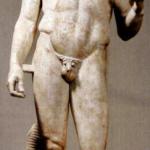
The Greek Sculpture The Spear Bearer and Michelangelo’s David 

I read Scripture as a mountain with the thirty-nine books of the Old Testament building up to the revelation of Jesus Christ in the Gospels. Acts and the letters of Jesus’s disciples  then grapple with the seismic, big bang revelation of Jesus Christ.

And so our traditional way of reading Scripture, the traditional reading plan, which gives equal weight to every verse and chapter is, ironically, a bit lop-sided. You know…every genealogy, every law, every description of temple worship given equal weight with the Sermon on the Mount and the Upper Room discourse which contains the secrets of the universe.

* * *

However, we need a little bit of Jesus of the Gospels every day, or every week, because our eyes need His corrective vision. Without the continued brain- and heart-washing of the Gospels, we forget what He taught us about how to live.

And so in my reading of the Gospels, I come to Matthew 13, “every scribe who has been instructed about the kingdom of heaven is like the owner of a house who brings out of his storeroom new treasures as well as old.”

* * *

Jesus calls the early revelations of God which culminated in Himself treasure.  And it is treasure because the shimmering brilliance of Jesus’ teaching emerges from it.

Jesus is steeped in the Old Testament and continually quotes it, resisting the temptations of Satan with quotations from Deuteronomy, thereby validating that book. Some of his most memorable sayings, which sound startlingly original are, in fact, quotations from the Old Testament. When he reduces the Law and the Prophets to two commands, he draws on Leviticus 19:18 for “Love your neighbour as yourself” and quotes Psalm 37:11, “the meek inherit the earth”  in the Beatitudes.

* * *

Trying to understand Jesus without understanding the Old Testament is like trying to make sense of Michelangelo’s David without knowing who David the Giant-Killer was, or without knowing how Greco-Roman art inspired artists in the Renaissance (or how the Greek sculpture, “The Spear Bearer,” inspired David.)

Or admiring Raphael’s “School of Athens” without knowing that he depicted Socrates, Plato and Aristotle, Diogenes, and that the surly fellow in boots in the foreground is Michelangelo.

Or reading T.S. Eliot’s beautiful allusive “The Waste Land,” without knowing the title of the long Fire Sermon section is taken from Buddha’s eponymous sermon of the same name in which he advises his followers to give up earthly passion,  or that To Carthage then I came/Burning, burning, burning, is a reference to St. Augustine’s Confessions, when he comes to Carthage, burning with lust. The poem beats upon our pulses, speaks to our ganglia without the scholarship, but knowing its mass of literary allusion only enriches the poem for us.

So of course, the Gospels will speak to one who loves Jesus but has not taken the time to study the Old Testament so as to set him, his quotations, allusions and references in their rich context.

But the Gospels speak more richly and fully when you approach them  with a mind and heart that loves Jesus, but is also steeped in the context of the Old Testament out of which He emerged, and when you understand the 18 Old Testament books which Jesus quoted, and when you understand the old thing to which He continually contrasts the new thing He was doing.

Filed Under: Matthew Tagged With: blog through the Bible project, Matthew, Old Testament, Treasure

In Which There’s Justice and There’s Mercy, and Mercy Triumphs

By Anita Mathias

September 10, 2013

Sometimes The Book of Genesis sounds both disturbing, and quite contemporary.

In Genesis 34, Jacob’s only daughter Dinah is raped. In revenge, her brothers Simeon and Levi slaughter every male in Shechem, and loot it “seizing their flocks and herds and donkeys, and carrying off all their wealth and all their women and children, taking as plunder everything in the houses.”

And what happens to them? What consequences do they suffer? Apparently none at all.

Jacob scolds them, “You have brought trouble on me by making me a stench to the Canaanites,” and moves from Shechem to Bethel.

When the powerful misbehave, they often get away with it, in the short run.

God’s justice sometimes operates at the pace of trilogies or epics, not in sentences or chapters.

* * *

So, in the short run: no consequences for Simeon or Levi. Jacob is probably a little afraid of his powerful older sons who, from this chapter onwards, increasingly take control of the family.

However, when Jacob blesses his sons on his deathbed, he essentially curses his first-born Reuben, (who raped his father’s concubine) and Simeon and Levi, his second and third-born (while passing on the Abrahamic blessing and rights of the first born to Judah, whom he lavishly blesses.)

“Simeon and Levi are brothers—

    their swords are weapons of violence.
6 Let me not enter their council,
let me not join their assembly,
for they have killed men in their anger
and hamstrung oxen as they pleased.
7 Cursed be their anger, so fierce,
and their fury, so cruel!
I will scatter them in Jacob
and disperse them in Israel.
(Gen 49)

And so, Simeon’s descendants were absorbed into the territory of Judah (Jos 19:1, 9) and Levi’s descendants were dispersed throughout the land, living in 48 towns (Nu 35:2). They did not get their own land, as the other ten tribes do.

* * *

That’s how our lives go, isn’t it? Simeon and Levi were deceitful, angry, violent, and vengeful. So, to some extent, have we all been.

And their children suffered: they were scattered, losing the tribal satisfactions of living among those who have the same background, culture, history, traditions and quirks. Both forfeited the blessings of the first-born, which would have come to them after Reuben forfeited his.

But they lived long in the land, had children, grew old, unlike those they slaughtered. And these violent men still got to be Patriarchs, fathers of two of the twelve tribes of Israel. And the priests who ministered at the temple were from the tribe of Levi!!

* * *

It is an orderly, organised universe of sowing and reaping. The evil we do has consequences, if only through the corruption of our characters which are our destiny. Through the scarring and maiming of our souls. Sooner or later, we reap what we sow.

But we do not reap exactly what we have sown. For most of us, as for Simeon and Levi, mercy triumphs.

“If you, Lord, should count our guilt, Lord, who would survive?” the Psalmist David writes plaintively.

If God were to punish us for every untrue or mean word, every act of anger or malice or  jealousy, who should stand?

But mercy triumphs, and so weeds do not choke all food plants. Neglected orchards still bear fruit, and human life continues despite our environmental outrages.

And in our lives, mercy triumphs over justice, and so, having asked God’s forgiveness, we can continue to walk  under the sun of his goodness.

Paradoxes, paradoxes. We must try to avoid all sin, for what we sow we reap. But never in full measure, never as much as we deserve, for mercy runs like a gold thread through our universe and through our lives, and it always triumphs over the strictest justice!

Filed Under: Genesis Tagged With: blog through the Bible project, Genesis, Justice, Mercy

I Will Not Let You Go Unless You Bless Me

By Anita Mathias

Sir Jacob Epstein, Jacob and the Angel by Sir Jacob Epstein, 1940–1941

Jacob and the Angel by Sir Jacob Epstein, 1940–1941

I saw you in the middle of the night,

in the middle of my failure.

For twenty years had I striven with my foes,

seven years of hard work for Rachel…

but I was deceitfully given Leah,

whom I did not want. Another seven for Rachel.

Fourteen years, with nothing to show for them,

and then, six years of success

against all odds: Laban’s cheats,

his sons’ cheats, their animosity.

A most unlikely place to make a fortune,

and yet, I did.


And I escaped,

and Laban saw that You were with me,

and let me go.

* * *

 And now my brother, my enemy, Esau,

comes against me with four hundred men.

And he has good reason.

I have provoked his anger with my trickery.

I do confess it.


On what grounds then, can I ask you to protect me?


None, really, save your goodness.

* * *

 How I have wrestled for blessing with Esau, with Laban.

But one cannot trick for blessing, exploit, extort, or manipulate.

You are the giver of blessing,

And you give it freely.


I will not let you go, unless you bless me.

I will not take no for an answer.


Bless me, bless me indeed,

for that is what I have wanted all my life,

what I have wanted above everything:

Your blessing


Then the man said, “You have struggled with God and with humans and have overcome.”


Then he blessed him there.


 So Jacob called the place Peniel saying, “It is because I saw God face to face, and yet my life was spared.” (Genesis 31) 

Filed Under: Genesis Tagged With: blessing, blog through the Bible project, Genesis, Jacob wrestling with angel

  • « Previous Page
  • 1
  • 2
  • 3
  • 4
  • Next Page »

Sign Up and Get a Free eBook!

Sign up to be emailed my blog posts (one a week) and get the ebook of "Holy Ground," my account of working with Mother Teresa.

Join 544 Other Readers

My Books

Rosaries, Reading, Secrets: A Catholic Childhood in India

Rosaries, Reading Secrets, B&N
USA

UK

Wandering Between Two Worlds: Essays on Faith and Art

Wandering Between Two Worlds
USA

UK

Francesco, Artist of Florence: The Man Who Gave Too Much

Francesco, Artist of Florence
US

UK

The Story of Dirk Willems

The Story of Dirk Willems
US

UK

My Latest Meditation

Anita Mathias: About Me

Anita Mathias

Read my blog on Facebook

Follow me on Twitter

Follow @anitamathias1

Recent Posts

  • God’s Complete Forgiveness 
  • Using God’s Gift of Our Talents: A Path to Joy and Abundance
  • The Kingdom of God is Here Already, Yet Not Yet Here
  • All Those Who Exalt Themselves Will Be Humbled & the Humble Will Be Exalted
  • Christ’s Great Golden Triad to Guide Our Actions and Decisions
  • How Jesus Dealt With Hostility and Enemies
  • Do Not Be Afraid, but Do Be Prudent
  • For Scoundrels, Scallywags, and Rascals—Christ Came
  • How to Lead an Extremely Significant Life
  • Don’t Walk Away From Jesus, but if You Do, He Still Looks at You and Loves You
Premier Digital Awards 2015 - Finalist - Blogger of the year
Runner Up Christian Media Awards 2014 - Tweeter of the year

Categories

What I’m Reading


Wolf Hall
Hilary Mantel

Wolf Hall --  Amazon.com
Amazon.com

Amazon.co.uk

Silence and Honey Cakes:
The Wisdom Of The Desert
Rowan Williams

Silence and Honey Cakes --  Amazon.com
Amazon.com

Amazon.co.uk

The Long Loneliness:
The Autobiography of the Legendary Catholic Social Activist
Dorothy Day

The Long Loneliness --  Amazon.com
Amazon.com

Amazon.co.uk

Country Girl
Edna O'Brien

Country Girl  - Amazon.com
Amazon.com

Amazon.co.uk

Archive by month

My Latest Five Podcast Meditations

INSTAGRAM

anita.mathias

My memoir: Rosaries, Reading, Secrets https://amzn.to/42xgL9t
Oxford, England. Writer, memoirist, podcaster, blogger, Biblical meditation teacher, mum

Well, hello friends! Breaking radio silence to let Well, hello friends! Breaking radio silence to let you know that I have taped a meditation for you on Christ’s famous Parable of the Talents in Matthew 25. https://anitamathias.com/2025/11/05/using-gods-gift-of-our-talents-a-path-to-joy-and-abundance/
Here you are, click the play button in the blog post for a brief meditation, and some moments of peace, and, perhaps, inspiration in your day 🙂
Hi Friends, I have taped a meditation; do listen a Hi Friends, I have taped a meditation; do listen at this link: https://anitamathias.com/2025/04/08/the-kingdom-of-god-is-here-already-yet-not-yet-here-2/
It’s on the Kingdom of God, of which Christ so often spoke, which is here already—a mysterious, shimmering internal palace in which, in lightning flashes, we experience peace and joy, and yet, of course, not yet fully here. We sense the rainbowed presence of Christ in the song which pulses through creation. Christ strolls into our rooms with his wisdom and guidance, and things change. Our prayers are answered; we are healed; our hearts are strangely warmed. Sometimes.
And yet, we also experience evil within & all around us. Our own sin which can shatter our peace and the trajectory of our lives. And the sins of the world—its greed, dishonesty and environmental destruction.
But in this broken world, we still experience the glory of creation; “coincidences” which accelerate once we start praying, and shalom which envelops us like sudden sunshine. The portals into this Kingdom include repentance, gratitude, meditative breathing, and absolute surrender.
The Kingdom of God is here already. We can experience its beauty, peace and joy today through the presence of the Holy Spirit. But yet, since, in the Apostle Paul’s words, we do not struggle only “against flesh and blood, but against the rulers, against the unseen powers of this dark world and against the spiritual forces of evil,” its fullness still lingers…
Our daughter Zoe was ordained into the Church of E Our daughter Zoe was ordained into the Church of England in June. I have been on a social media break… but … better late than never. Enjoy!
First picture has my sister, Shalini, who kindly flew in from the US. Our lovely cousins Anthony and Sarah flank Zoe in the next picture.
The Bishop of London, Sarah Mullaly, ordained Zoe. You can see her praying that Zoe will be filled with the Holy Spirit!!
And here’s a meditation I’ve recorded, which you might enjoy. The link is also in my profile
https://anitamathias.com/2024/11/07/all-those-who-exalt-themselves-will-be-humbled-the-humble-will-be-exalted/
I have taped a meditation on Jesus statement in Ma I have taped a meditation on Jesus statement in Matthew 23, “For those who exalt themselves will be humbled, and those who humble themselves will be exalted.”
Do listen here. https://anitamathias.com/2024/11/07/all-those-who-exalt-themselves-will-be-humbled-the-humble-will-be-exalted/
Link also in bio.
And so, Jesus states a law of life. Those who broadcast their amazingness will be humbled, since God dislikes—scorns that, as much as people do.  For to trumpet our success, wealth, brilliance, giftedness or popularity is to get distracted from our life’s purpose into worthless activity. Those who love power, who are sure they know best, and who must be the best, will eventually be humbled by God and life. For their focus has shifted from loving God, doing good work, and being a blessing to their family, friends, and the world towards impressing others, being enviable, perhaps famous. These things are houses built on sand, which will crumble when hammered by the waves of old age, infirmity or adversity. 
God resists the proud, Scripture tells us—those who crave the admiration and power which is His alone. So how do we resist pride? We slow down, so that we realise (and repent) when sheer pride sparks our allergies to people, our enmities, our determination to have our own way, or our grandiose ego-driven goals, and ambitions. Once we stop chasing limelight, a great quietness steals over our lives. We no longer need the drug of continual achievement, or to share images of glittering travel, parties, prizes or friends. We just enjoy them quietly. My life is for itself & not for a spectacle, Emerson wrote. And, as Jesus advises, we quit sharp-elbowing ourselves to sit with the shiniest people, but are content to hang out with ordinary people; and then, as Jesus said, we will inevitably, eventually, be summoned higher to the sparkling conversation we craved. 
One day, every knee will bow before the gentle lamb who was slain, now seated on the throne. We will all be silent before him. Let us live gently then, our eyes on Christ, continually asking for his power, his Spirit, and his direction, moving, dancing, in the direction that we sense him move.
Link to new podcast in Bio https://anitamathias.co Link to new podcast in Bio https://anitamathias.com/2024/02/20/how-jesus-dealt-with-hostility-and-enemies/
3 days before his death, Jesus rampages through the commercialised temple, overturning the tables of moneychangers. Who gave you the authority to do these things? his outraged adversaries ask. And Jesus shows us how to answer hostile questions. Slow down. Breathe. Quick arrow prayers!
Your enemies have no power over your life that your Father has not permitted them. Ask your Father for wisdom, remembering: Questions do not need to be answered. Are these questioners worthy of the treasures of your heart? Or would that be feeding pearls to hungry pigs, who might instead devour you?
Questions can contain pitfalls, traps, nooses. Jesus directly answered just three of the 183 questions he was asked, refusing to answer some; answering others with a good question.
But how do we get the inner calm and wisdom to recognise
and sidestep entrapping questions? Long before the day of
testing, practice slow, easy breathing, and tune in to the frequency of the Father. There’s no record of Jesus running, rushing, getting stressed, or lacking peace. He never spoke on his own, he told us, without checking in with the Father. So, no foolish, ill-judged statements. Breathing in the wisdom of the Father beside and within him, he, unintimidated, traps the trappers.
Wisdom begins with training ourselves to slow down and ask
the Father for guidance. Then our calm minds, made perceptive, will help us recognise danger and trick questions, even those coated in flattery, and sidestep them or refuse to answer.
We practice tuning in to heavenly wisdom by practising–asking God questions, and then listening for his answers about the best way to do simple things…organise a home or write. Then, we build upwards, asking for wisdom in more complex things.
Listening for the voice of God before we speak, and asking for a filling of the Spirit, which Jesus calls streams of living water within us, will give us wisdom to know what to say, which, frequently, is nothing at all. It will quieten us with the silence of God, which sings through the world, through sun and stars, sky and flowers.
Especially for @ samheckt Some very imperfect pi Especially for @ samheckt 
Some very imperfect pictures of my labradoodle Merry, and golden retriever Pippi.
And since, I’m on social media, if you are the meditating type, here’s a scriptural meditation on not being afraid, while being prudent. https://anitamathias.com/2024/01/03/do-not-be-afraid-but-do-be-prudent/
A new podcast. Link in bio https://anitamathias.c A new podcast. Link in bio
https://anitamathias.com/2024/01/03/do-not-be-afraid-but-do-be-prudent/
Do Not Be Afraid, but Do Be Prudent
“Do not be afraid,” a dream-angel tells Joseph, to marry Mary, who’s pregnant, though a virgin, for in our magical, God-invaded world, the Spirit has placed God in her. Call the baby Jesus, or The Lord saves, for he will drag people free from the chokehold of their sins.
And Joseph is not afraid. And the angel was right, for a star rose, signalling a new King of the Jews. Astrologers followed it, threatening King Herod, whose chief priests recounted Micah’s 600-year-old prophecy: the Messiah would be born in Bethlehem, as Jesus had just been, while his parents from Nazareth registered for Augustus Caesar’s census of the entire Roman world. 
The Magi worshipped the baby, offering gold. And shepherds came, told by an angel of joy: that the Messiah, a saviour from all that oppresses, had just been born.
Then, suddenly, the dream-angel warned: Flee with the child to Egypt. For Herod plans to kill this baby, forever-King.
Do not be afraid, but still flee? Become a refugee? But lightning-bolt coincidences verified the angel’s first words: The magi with gold for the flight. Shepherds
telling of angels singing of coming inner peace. Joseph flees.
What’s the difference between fear and prudence? Fear is being frozen or panicked by imaginary what-ifs. It tenses our bodies; strains health, sleep and relationships; makes us stingy with ourselves & others; leads to overwork, & time wasted doing pointless things for fear of people’s opinions.
Prudence is wisdom-using our experience & spiritual discernment as we battle the demonic forces of this dark world, in Paul’s phrase.It’s fighting with divinely powerful weapons: truth, righteousness, faith, Scripture & prayer, while surrendering our thoughts to Christ. 
So let’s act prudently, wisely & bravely, silencing fear, while remaining alert to God’s guidance, delivered through inner peace or intuitions of danger and wrongness, our spiritual senses tuned to the Spirit’s “No,” his “Slow,” his “Go,” as cautious as a serpent, protected, while being as gentle as a lamb among wolves.
Link to post with podcast link in Bio or https://a Link to post with podcast link in Bio or https://anitamathias.com/2023/09/22/dont-walk-away-from-jesus-but-if-you-do-he-still-looks-at-you-and-loves-you/
Jesus came from a Kingdom of voluntary gentleness, in which
Christ, the Lion of Judah, stands at the centre of the throne in the guise of a lamb, looking as if it had been slain. No wonder his disciples struggled with his counter-cultural values. Oh, and we too!
The mother of the Apostles James and John, asks Jesus for a favour—that once He became King, her sons got the most important, prestigious seats at court, on his right and left. And the other ten, who would have liked the fame, glory, power,limelight and honour themselves are indignant and threatened.
Oh-oh, Jesus says. Who gets five talents, who gets one,
who gets great wealth and success, who doesn’t–that the
Father controls. Don’t waste your one precious and fleeting
life seeking to lord it over others or boss them around.
But, in his wry kindness, he offers the ambitious twelve
and us something better than the second or third place.
He tells us how to actually be the most important person to
others at work, in our friend group, social circle, or church:Use your talents, gifts, and energy to bless others.
And we instinctively know Jesus is right. The greatest people in our lives are the kind people who invested in us, guided us and whose wise, radiant words are engraved on our hearts.
Wanting to sit with the cleverest, most successful, most famous people is the path of restlessness and discontent. The competition is vast. But seek to see people, to listen intently, to be kind, to empathise, and doors fling wide open for you, you rare thing!
The greatest person is the one who serves, Jesus says. Serves by using the one, two, or five talents God has given us to bless others, by finding a place where our deep gladness and the world’s deep hunger meet. By writing which is a blessing, hospitality, walking with a sad friend, tidying a house.
And that is the only greatness worth having. That you yourself,your life and your work are a blessing to others. That the love and wisdom God pours into you lives in people’s hearts and minds, a blessing
https://anitamathias.com/.../dont-walk-away-from-j https://anitamathias.com/.../dont-walk-away-from-jesus.../
Sharing this podcast I recorded last week. LINK IN BIO
So Jesus makes a beautiful offer to the earnest, moral young man who came to him, seeking a spiritual life. Remarkably, the young man claims that he has kept all the commandments from his youth, including the command to love one’s neighbour as oneself, a statement Jesus does not challenge.
The challenge Jesus does offers him, however, the man cannot accept—to sell his vast possessions, give the money to the poor, and follow Jesus encumbered.
He leaves, grieving, and Jesus looks at him, loves him, and famously observes that it’s easier for a camel to squeeze through the eye of a needle than for a rich person to live in the world of wonders which is living under Christ’s kingship, guidance and protection. 
He reassures his dismayed disciples, however, that with God even the treasure-burdened can squeeze into God’s kingdom, “for with God, all things are possible.”
Following him would quite literally mean walking into a world of daily wonders, and immensely rich conversation, walking through Israel, Lebanon, Syria, and Jordan, quite impossible to do with suitcases and backpacks laden with treasure. 
For what would we reject God’s specific, internally heard whisper or directive, a micro-call? That is the idol which currently grips and possesses us. 
Not all of us have great riches, nor is money everyone’s greatest temptation—it can be success, fame, universal esteem, you name it…
But, since with God all things are possible, even those who waver in their pursuit of God can still experience him in fits and snatches, find our spirits singing on a walk or during worship in church, or find our hearts strangely warmed by Scripture, and, sometimes, even “see” Christ stand before us. 
For Christ looks at us, Christ loves us, and says, “With God, all things are possible,” even we, the flawed, entering his beautiful Kingdom.
Follow on Instagram

© 2026 Dreaming Beneath the Spires · All Rights Reserved. · Cookie Policy · Privacy Policy