Anita Mathias: Dreaming Beneath the Spires

Anita Mathias's Blog on Faith and Art

  • Home
  • My Books
  • Meditations
  • Essays
  • Contact
  • About Me

The Eucharistic Nature of Creativity (Talk by Rob Bell at Greenbelt, 2011)

By Anita Mathias

The Eucharist–This is my body, broken for you. This is my blood, shed for you. 

Writing from the heart, close to the bone has these eucharistic characteristics: pouring out your life-blood.
And so, it’s no wonder that one sometimes feels depleted. Emptied. Exhausted.
Bell recommends taking a break when this is the case, coming unplugged, unwired. Going away perhaps, and waiting for the springs to refill at their own pace and time.
The results sometimes surprise one!!
He suggests balancing time spent shedding one’s creative blood with time replenishing the empty tanks, and letting God refill them with fresh wind, fresh fire.
Bell also suggests laying down your work when you are feeling burnt out, laying it down for as long as necessary, and when you come back you are renewed and refreshed and can approach your work with fresh vision, passion and perspective.
Good to hear since I work best in short, intense bursts, and regularly burn out.
                                                    * * *
90 % of the energy expended in one of his books was spent on “mind-games.” Second-guessing his work and its reception. Don’t do it. Get it out there. Leave the reception to God.
                                                     * * *
After his glorious vision of angels ascending and descending the highway, Jacob says, “Surely God was in this place and I was not aware of it.”
We live in a God-drenched world, and being out in it, experiencing it, puts us in touch with infinite springs of creativity, with God himself.
Moses in the desert saw a bush which burned and was not consumed. Bell suggested that that bush was always burning. It was just that Moses slowed down enough to notice it.
It burns for us too, eternity in blades of grass.
“My father is always at his work, to this very day, and so am I,” Jesus says. God is always at this work, creating newness, sharing his visions with us. Those who can see God always at work, in our hearts, in the hearts of people and in the world will never run out of things to write
Rob Bell seems quite relaxed, happy and confident in his own skin, apparently quite unscathed by the tsunami caused by Love Wins.

Filed Under: In which I explore writing and blogging and creativity, random

The Holy Ground of Kalighat

By Anita Mathias

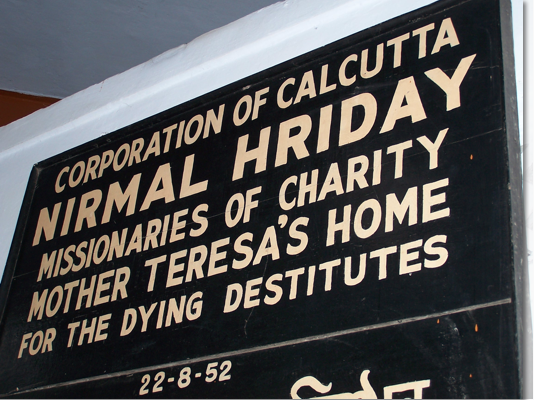
Mother-Teresa-Nirmal-Hriday-kolkata-WBnirmal hriday

My brief memoir on volunteering with Mother Teresa is including in Philip Zaleski’s Best Spiritual Writing, and is included in my book, Wandering Between Two Worlds (amazon.com) or on amazon.co.uk

Kalighat, the Home of the Dying Destitute, was the toughest assignment in the Missionaries of Charity convent, reputedly reserved for the mature. But I was greedy for challenge and kept asking for it until I got it. The place glowed in the light of literature, the poetic accounts of Malcolm Muggeridge, Desmond Doig, and Edward Le Joly; I had to work there.

We entered the quietness of Kalighat after a long Jeep trip through Calcutta’s streets, raucous with the honking of buses and cars, the blare of radios, the shouts of vendors. We recited the rosary above the din around the Jeeps as the rule decreed we should, no matter how unpropitious our surroundings. Our voices growing hoarse and our throats parched, we trolled through the fifteen mysteries of the life of Christ.

This chanting was meant to serve as a barricade against distraction and doubt. Just as well perhaps. While we hurtled through the three-wheeled autos called “bone shakers” and snaked amid stray dogs I sometimes saw get run down (willfully? out of fathomable malice?), it was not easy to clasp simple verities: There is a God and God loves me as he loves every human on this crazy street. It was easier to believe in a “watchmaker God,” who hurled the world into motion and then absconded, a notion I had heard denounced from the pulpit as atheistic absurdity.

Hail, Mary, full of grace; the Lord is with you. Blessed are you among women, and blessed is the fruit of your womb, Jesus, we chanted as our Jeep swerved through street children, trams, lorries, motorcycles, scooters, and dangerously lurching buses with youths leeching onto windows, railings, and roof. I usually kept my eyes closed. Calcutta was unnerving to a small-town girl. To open them was to contemplate the possibility that our driver would collide with rickshaws dragged by scrawny men and crammed with housewives and their purchases or hit a sacred cow or crush a child, and so cause an ugly communal riot for us to sort out. I remembered the time my father had to bail out a Jesuit professor, his colleague, who was nearly lynched when he hit a poor Hindu boy with his posh car.

Entering Kalighat is akin to entering a city church—or, for that matter, our chapel at Mother House in the center of Calcutta. You are stunned into stillness, into a guilty awareness of your racing pulse, your distracted mind. The silence shrouds you until you are aware that it is not silence, not really: There is the rustle of supplicants, the rattle of rosary beads, the breathing from bowed heads. So, in Kalighat, after your jangled spirit laps up the apparent silence, you hear soft sounds—low moaning, a tubercular cough, patients tossing in pain and restlessness.

Still, Kalighat felt like holy ground. I often sensed God in the dimness and hush of that place. Bhogobaan ekane acche, Mother Teresa whispered in Bengali as she went from bed to bed:God is here. Her creased face looked sad and sweet. This is Bhogobaan ki badi, God’s house, the sisters tell new arrivals, believing that Kalighat is sanctified in its very stones by the thousands who have died peaceful deaths there. Perhaps the light created this aura. The light spilled from high windows through a filigreed lattice, spilled into the dim room with a stippled radiance that made working there an epiphany.

In this place Malcolm Muggeridge, curmudgeonly Catholic convert, experienced what he called “the first authentic photographic miracle” as he filmed a BBC documentary on Mother Teresa in 1969. The cameraman insisted that filming was impossible inside Kalighat—dimly lit by small windows high in the walls—but reluctantly tried it. In the processed film, the shots taken inside were bathed in “a soft, exceptionally lovely light,” whereas the rest, taken in the outside courtyard as an insurance, was dim and confused. Muggeridge wrote: “I am absolutely convinced that this technically unaccountable light is Newman’s ‘Kindly Light.’ The love in Kalighat is luminous like the halos artists have seen and made visible around the heads of saints. It is not at all surprising that this exquisite luminosity should register on a photographic film.”

Perhaps Kalighat had that sense of being holy ground because it was an ancient Hindu pilgrimage site, the dormitory for pilgrims to Calcutta’s famed Kali temple. I wondered whether the devotions of generations of Hindus, no less than Catholics, had hallowed the ground. Surely, I reasoned, all kinds of God-hunger are acceptable to Christ, who chose as his symbols bread and wine, who offered his flesh to eat, his blood to drink. Perhaps what happens in a pilgrimage spot is not that God descends to earth in a shower of radiance and the earth ever after exudes his fragrance. Perhaps it is we who make spots of earth sacred when we bring our weary spirits, our thwarted hopes, the whole human freight of grief, and pray—our eyes grown wide and trusting; our being, a concentrated yearning. Perhaps that yearning, that glimpse of better things, makes the spot sacred and lingers in the earth and air and water so that future pilgrims say, “God is here.”

On our way to work, we frequently picked people off the pavements where they lay and transported them to Kalighat to die, in Mother Teresa’s phrase, “within sight of a kind face. ” “Stop,” we’d cry to the driver, who helped us carry them into the Jeep. Occasionally we picked up a drunk, who cursed us on his return to consciousness. Most people we picked up were as emaciated as famine victims; they lay limp on the pavements, a feeble hand outstretched for alms. And yet there was no famine in Calcutta; our prime minister protested that nobody, simply nobody, dies of starvation in India.

These people had probably worked all their lives. But in a land where it’s not easy to find work that pays a living wage, to survive is enough. For an illiterate worker, saving money is a nearly impossible dream. “Naked they came into the world, naked they depart,” as Job mourned. Many end their lives destitute on Calcutta’s streets. They waste away as they grow too weak or sick to scavenge for themselves or root for food in the open garbage dumps.

For these people who are kicked aside, cursed, and ignored, Kalighat is an inexplicable miracle, a last-minute respite, a stepping-stone into grace. In her speeches, Mother loved to quote the dying man she brought to Kalighat from Calcutta—”All my life I have lived like a dog, but now I die like an angel”—which was, perhaps, just what he said or, perhaps, a composite of many experiences.

Kalighat consists of two L-shaped wards accommodating about sixty men and women, with rows of low cots snuggled into every cranny. The Missionary Brothers of Charity, the male branch of the order, founded by Brother Andrew, an Australian ex-Jesuit, serve in the male ward; they sponge patients, change soiled clothes, hack off elongated and hardened toenails. When I entered the male ward to dispense medication, I would see these sweet, serious, humble, and hardworking men. Perhaps I perceived them in clichés since I never actually talked to them; a novice does not hobnob with men. We novices mainly worked in the female ward, an oblong room bathed in dim light from the beautiful white-filigreed windows.

Iris, a tubercular Anglo-Indian patient, was Kalighat’s presiding Fury. She hobbled all over the ward on her walking stick, which she thrashed around when enraged. Her puckered brown face was a maze of hate lines, and as she limped, she cursed: “Those bloody Muddses, I hate those swine…”

“What’s the matter, Iris?” people asked, mocking her—for everyone knew her story by heart and was fed up with it. And as if it were new every morning, she’d repeat her tale of the Muddses, her distant relatives who, in her old age, evicted her from her house and pushed her down the stairs, breaking her leg.

“Those bloody Muddses,” she muttered, her rosary of hate. She was fond of me and would stroke me, telling me that I was nice, her smile surprisingly sweet. Everyone had to be very good to me when Iris was around, or she would brandish her stick at them, reprimanding, “No, this is a nice sister.” Poor Iris, balladeer of old grievances, anger always at boiling point for old wrongs. Her grudges had driven her crazy, devastating her long past the original injury. I often talked to her, asking her about her childhood in pre-independence India, to try to divert her mind from the injustices over which it obsessively brooded. I realized how wise Mother Teresa was when she admonished, “Forgive. Never allow yourself to become bitter. Bitterness is like cancer; it feeds on itself. It grows and grows.”

Sadness also grew in Kalighat. One round-faced old lady, too weak to feed herself, kept pushing away my hand that waited with the next spoonful of rice. While I tried vainly to feed her, we talked. Her son had deposited her on the streets, where the sisters had eventually picked her up. “I haven’t seen my three sons in years,” she cried.

I gave up on the rice and fed her the mango. She loved that. She fixed her eyes on the diminishing fruit, then asked for more. There was no more. So I folded the skin in two and drew it between her lips, again and again, until she had sucked the last drops of juice. Suddenly, her eyes lit up with love. Tears streamed down her face. She caught me, pulled me to her, and rocked me in an embrace, crying, “Ma. Ma. Ma,” her mind reverting to childhood, her face grown baby sweet.

I hugged her back, not even trying to remember if she was tubercular, forgetting my mask and mycobacterium tuberculosis spread by the respiratory route. During that insomniac night, I thought of her. The next evening, I sneaked out a mango from the convent kitchen and concealed it in my saree. I went straight to her bed. It was covered with a white sheet. She had died in the night.

Death was a constant in Kalighat, that home in the temple of the goddess of death. Only the ostensibly dying were admitted. About half recovered with rest, medication, and nourishing food. For the rest, this was the end. When we entered the ward, stark white sheets, the color of mourning in India, covered the beds of those who had died the previous night. In the face of death, its inevitability, how trivial much of life seemed. “Teach us to number our days,” the psalmist cried, “that we may apply our hearts unto wisdom.” I realized why the novice-mistresses preached detachment to us. Guard your heart, I admonished to myself, chary of emotional involvement with one who might soon be a corpse in the morgue or burnt to ashes on the shore of the River Ganges.

In a place like Kalighat, perspective is everything. My parents, on their monthly visits, complained that it was a grim place, daunting and unpleasant—and so it is until its strange charm, its eerie radiance, works on you. I loved Kalighat for its tiny miracles. An old, almost bald woman with a shriveled face occupied a bed in a corner. When she could sit up, she’d curse all within earshot. She spat gobs of yellow phlegm all over the floor, perversely ignoring her spittoon. Once, as I tried to feed her, she lost her temper and slapped me, sending my glasses flying across the ward.

Dealing with her was not a pleasure. So the other patients had often eaten their dinners and fallen asleep before she was brought her tray of gruel and boiled vegetables. One evening, chiding myself for my fastidiousness, I braced myself and took her tray to her. As I approached, she smiled, and her face glowed. No one had ever seen her smile. I hugged the memory to myself as a shaft of grace—though perhaps it was a trick of the light.

But I remembered Gerard Manley Hopkins, my favorite poet:

Christ plays in ten thousand places,

Lovely in limbs, and lovely in eyes not his

To the Father through the features of men’s faces.

Most patients in Kalighat, too old or too weak to walk, crept around the ward or to the bathroom while squatting on their haunches, slowly moving one tired leg after the other. Since their diseases were highly infectious—cholera, typhoid, and especially tuberculosis—we had to be vigilant. Sister Luke, the stern-faced nurse who ran Kalighat, ordered us to use masks all the time we were in the ward. These we sewed ourselves, a double strip of thick cotton cloth that covered the nose and mouth. I often disobeyed orders and dispensed with my mask, partly because my smile helped in this difficult work with difficult people. (Months later at home, when I grew too weak to get out of bed and coughed blood, dread symptom, and X rays revealed a shadow on the lungs, first sign of TB, I looked back on those days of idiotic, uncalled-for faith with bemusement. I then had a sense of inviolability, common to children and puppies, a half-conscious sense that providence would protect the simple-hearted—and the foolish.)

The actual work dispelled any vestigial illusions of the glamour of being a Florence Nightingale of light and mercy. I often forced myself through the chores by sheer willpower. I reminded myself that I had decided to imitate Christ, and to be a saint in the tradition of Francis, Damien, Schweitzer, and Dooley, as I fought nausea and changed sheets fouled by the stools of those with cholera or dysentery.

Why do you do it? Monica, an intense, curly-headed, West German volunteer—an atheist—asked. No one assigned me this chore. (On the contrary, as one of the better-educated sisters, I was allotted the more “prestigious” jobs, which required some expertise: to give the patients their daily medications and injections, to set up and administer an intravenous drip when a patient was admitted delirious with typhoid or with the withered skin, sunken eyes, and icy hands of the cholera victim.) No, I chose. I was struck by the paradigm of Christ, “who, though he was rich, yet he became poor.” Born amid a stable’s dung, as literally as we cleaned feces; homeless during his ministry; dying naked on the cross. Come follow me. “One must go down, as low down as possible to find God, ” I reasoned with an eighteen-year-old’s intensity. And to what did I equate God? Joy. Certainty. Peace.

The romance of the spiritual life, its pilgrim’s progress through internal hills and valleys, shed a gleam on everyday chores—washing clothes and windows or scrubbing the stainless steel plates left pyramided on the courtyard floor after the patients’ evening meal. We hoisted up our sarees (a rare glimpse of legs) and squatted on our haunches to scrub the endless pile of plates with a piece of coconut husk and our homemade detergent, ashes and soap shavings. Western volunteers helped, professing amazement at our primitive methods of washing clothes and dishes. “Mother Teresa has been offered dishwashers and washing machines many times and has refused. Mother says that we should live just like the poorest of the poor to be able to understand them.” I’d parrot this explanation, smugly and self-righteously—repressing my annoyance at her rigidity on the many days that I was exhausted.

The new admission was brought in on a stretcher—a young girl with a prematurely haggard face, her hair an uncombed matted mass that I could see we’d have to cut off. How to unravel it? When I undressed her to bathe her, I saw that her thighs were bloodstained, her vulva a raw, feces-encrusted sore. I involuntarily moved back at the stench. A group of men had slashed her crotch with blades, she said.

“Why did they do that?” I asked, ignorant of perversion. I gathered from her faltering reply in Bengali that she had been forced into prostitution, and that there were all sorts….

“How old are you?”

“Eighteen.”

She was my age. I stood, staring at the raw flesh, wondering what to do first, when Sister Luke appeared. She pushed me aside, her long serious face grim. “Go away, child, go away,” she growled, as she bent her lank body down to the patient, sponging her down swiftly. Sister Luke later explained that the girl had venereal disease, something I’d never encountered before.

Sister Luke was good-hearted, but her volatile temper and gruff, no-nonsense manners scared patients, novices, and volunteers alike. My parents, visiting, were shocked and upset to hear her scream at the patients. Indeed, her manner was far from the ideal for workers in the Home of Dying Destitute that Mother Teresa recommended in the Constitution: We train ourselves to be extremely kind and gentle in touch of hand, tone of voice, and in our smile so as to make the mercy of God very real and to induce the dying person to turn to God with filial confidence.

Since she perceived me as responsible, Sister Luke, a trained nurse, entrusted me with deciphering the doctor’s scribbled prescriptions and doling out the evening medication. I also gave the injections and intravenous drips when I came on duty. In the absence of professionals, we picked up the elements of nursing from one another. I am sometimes appalled remembering our amateurishness, but then I recall that we looked after people we carried in from the streets, whom no one else cared about, and that we did alleviate their pain.

One evening, I balanced a tray of medicine—chloramphenicol, ampicillin, streptomycin, para-aminoslicyclic acid, isonazid—sorted out in little cups, in one hand as I rushed from the office to begin my rounds. I tripped. Hundreds of pink, white, and parti-colored pills raced over the floor. Sister Luke had locked the medicine cupboard. Too terrified to ask her for a fresh dose for the 120 patients, I began to pick the pills off the floor, intending to use them anyway. The colored or unusually shaped pills were easy to separate. I slowed down at the homogenized mass of white pills, fond hope and guesswork intermingling as I sorted, when Nemesis descended.

“What are you doing?” Sister Luke stood over me, her hands on her hips.

I told her.

“You blessed child. You stupid child,” she shrieked, throwing the tray into the trash, cups and all, tossing me her keys to get a fresh dose.

Sister Luke had probably sworn freely before she became a nun. Now, she ingeniously transmuted worldly expletives into heavenly ones. “Get the blessed bedpan to that blessed patient,” she’d scream. Sister Luke was admired, almost hero-worshiped, by all who worked in Kalighat—she was dedicated, efficient, and unpretentious—so “blessed” became a common expletive for all “Lukies.”

For the first few weeks, I scrupulously followed the doctor’s charts as I gave the patients their medication. But as the medicine and dosages grew familiar, I began to trust my memory. Teachers and friends had often commented on my “photographic memory,” and I was proud of it. I made a point of smiling at Krishna, an emaciated, pale-skinned teenager with close-cropped hair, as I gave her medicine. (“Smile five times a day at people you do not feel like smiling at. Do it for world peace, “Mother Teresa said. I’d cheat, though, selecting targets whom I liked, at least a little.)

Too frail to sit up, Krishna lay on propped-up pillows, a faint smile on her face, her eyes huge and haunted. She looked classically tubercular, like Severn’s portrait of the dying Keats.

One evening, Krishna shivered feverishly, face flushed, eyes streaming. Her forehead burned. The thermometer read 106, the highest I’d ever recorded.

I went to Sister Luke. “Sister, the girl with TB has a very high temperature.”

“Which girl?”

“Krishna.”

“Krishna!” she laughed. “You know, Krishna was severely malnourished when she was brought to us. She looked as gaunt as a TB patient. We thought she was going to die. But she is recovering nicely. I think we will be able to discharge her soon. You say she is sick?”

Malnutrition! I flushed. Krishna was not sick. She had starved. And I had given her the dosage of isoniazid for a severely tubercular patient. Sister Luke had urged restraint with these potent drugs, cautioning us of the side effects.

“Krishna is feverish,” I mumbled, and slunk away, stunned, too cowardly to tell her what I’d done. If I have to confess, I will, but please, oh, God, oh, God, heal her.

A Calcutta volunteer doctor was at work. I feigned jocularity. “So Doctor, what happens if you take drugs for TB when you don’t have TB?”

“You want to kill yourself, Sister? You could pop off. That’s potent stuff.”

I had guessed that already; why did I ask? Miserable, remorseful about my hubris, I dashed to Krishna’s bedside with paracetamol for her fever and laid my hands on the surprised girl’s head. “Now, Krishna, listen. You are not feeling well, right? I’m going to pray for you. Right now.” I prayed desperately, imploring for her life.

No result. I had other duties, but every few minutes I stole to Krishna’s bedside, praying for her, for a miracle. Gradually Krishna’s fever subsided.

I felt close to Krishna after all this. The severely malnourished girl had grown too weak to walk. And since she lay all day on her jute-strung cot, her legs atrophied. As she grew stronger, I helped her to walk again, walking beside her, her arms around my shoulders, or walking in front of her, holding her hands, until she regained balance and confidence and strength.

Krishna walked, shakily but unaided, before I left Mother Teresa’s congregation. I saw her discharged, another Lazarus restored, another woman returned to Calcutta’s Darwinian struggle for survival, but with an ounce of hope. Just one drop removed from the ocean of misery— but the ocean would be greater were it not there.

(From Notre Dame magazine; reprinted in The Best Spiritual Writing 1999, edited by Philip Zaleski. Used by arrangement with HarperSanFrancisco, a division of HarperCollins Publishers, Inc.
Copyright 1998 by Anita Mathias)

Read the rest of my autobiographical essays in Wandering Between Two Worlds (amazon.com) or on amazon.co.uk

Filed Under: In Which my Blog Morphs into Memoir and Gets Personal Tagged With: Calcutta, Kalighat, Kolkota, Missionaries of Charity, Mother Teresa, Nirmal Hriday

Forgiveness and Creativity

By Anita Mathias


I was at a really good Bible study yesterday at St. Andrew’s, Oxford–the sort of group that I would have put together if I were able to put together the ideal women’s group for me. I have been in many small groups through my two + decades as a Christian; this one is closest to the one which, rightly or wrongly, I would have chosen could I have assembled it.

Though the effect the study had on me this morning was more of a Spirit-lightning kind of thing. So mere words may not be able to convey the sort of lightning effect it had.

We looked at the parable of the unmerciful servant, reproduced below if you’d like a refresher. 
                                 * * * 

It was as if I had got it for the first time. Everything is forgiven me. And so I need to forgive.

God forgives us the mass of sins and wrongdoing we have accumulated though our life, 10,000 talents worth. Ten thousand was the highest number the Greek could count up to, and the denarius was the highest value coin they knew.

None of us, perhaps, are punished proportionately for our sins. I know I am not.

Compared to the huge stack of offences for which a just judge might need to judge us, any individual’s offence against us is small indeed. 

But not writing it off, retaining the memory of the wrong and the injustice they have done us, opens us up to judgment from God. 

Though he had not held us accountable for all our wrong-doing, in the act of refusing to waive our brother’s sin against us, we open ourselves up to judgement.

And it comes. We are handed over to the torturers until we have paid back all we owe.

I can testify from personal experience that this true.

When I have struggled to forgive, I have been re-injured by by memories of the injustice; by rage and anger at the wrong done me, by memories of my impotence to do anything about it, by the desire for justice to be meted out to those who had wronged me.

So one just has to mentally rip up the cheque of the wrongs committed us into tiny pieces, and hand it to God. He can fling it into the depths of the sea, as he does our own sins, or choose to bring judgement to those who have sinned against us.

Jesus points out the correspondence between our being forgiven and forgiving others, when he teaches his disciples to say, “Forgive us our sins, as we forgive those who sin against us.” In the proportion to the which we release the debts owed us.

Forgiveness is not a matter of the mind and will. It is a transaction of the emotions.

How do we do it? Well, we ask for God’s grace to forgive those who have sinned against us.

And the crucial thing is that we ask God to bless them. It is cognitively impossible to both ask God to bless people, and to wish them ill. So we ask that God forgives us our sins, as we forgive others, that God blesses us, as we bless others. “Love your enemies, bless those who curse you, pray for those who persecute you.”

And our souls will find rest.

And joy.

It’s funny, for me there is a link between joy, peace and creativity–and forgiveness. When I tear up the cheques of what people owe me, and pray for them to be blessed, joy and peace, creativity and good ideas flow through me again. 

And how quickly one can forget this and get mired in the marshes in which no good things grow. (Ezek:47)

P.S. Writing down my thoughts on this has a minuscle fraction of the power a good story or allegory would have had. Story is really the way to go.

Filed Under: In which I explore writing and blogging and creativity, In which I forgive Aught against Any (Sigh)

Aliens and Strangers

By Anita Mathias


Here’s an essay I wrote in 1999 in Williamsburg, Virginia, in the fortnight before Irene was born on May 5th, 1999.

When she did not arrive on her due date, after I’d stopped work and waited for her for a month, I started a new essay in despair, finishing it just before she appeared.

She’ll be 12 tomorrow.

The essay is a long meditation on rootlessness and the longing for roots–one of the abiding preoccupations of my life!!                                               
                                                
                                      “Aliens and Strangers”                                                                                                             
I have an idea that some men are born out of their due place.  Accident has cast them amid strangers in their birthplace, and the leafy lanes they may have known from childhood remain but a place of passage.  They may spend their whole lives aliens among their kindred and remain aloof among the only scenes they have ever known.  Perhaps it is this sense of strangeness that sends men far and wide in the search for something permanent to which they may attach themselves.
                 The Moon and Sixpence, W. Somerset Maugham, 1919
            Sometimes, unexpectedly, you come to a place where your spirit unfurls; it has found its natural topography.  I like Rilke’s notion of spiritual homes, “elective homelands,”–for him, Russia, Paris, Switzerland.  The Pythagorean and Hindu doctrine of metempsychosis, transmigration of the soul, tries to explain such affinities.  Twice or thrice had I loved thee/ Before I knew thy face or name, John Donne expresses this sensation.  Hindus say of a preternaturally wise child: she has an old soul.  My daughter Zoe is like that, uncannily wise.  Just two, going on three, she advised me when I was infuriated, “Just ‘nore him.  What matter what he do-es?  Jesus loves us, Jesus is everywhere, Jesus can do anything,” repeating in a childish fashion–in the reciprocal teaching that is one of the gifts of having children–the old words of Paul I had taught her, “Neither death nor life, neither angels nor demons, neither the present nor the future, nor any powers, neither height nor depth, nor anything else in all creation shall separate us from the love of God.”
            My happiest childhood experiences were in books, a contained world of peace, sweeter and more nourishing than the real life around me.  Most books I read were set in England, Enid Blyton’s Noddy and the Famous Four, and Malory Towers, and St. Clare’s–and later, the classics: The Mill on the Floss, Silas Marner, Jane Eyre, Wuthering Heights.  So when I walked down Broad Street or High Street as an undergraduate at Oxford, amid those medieval stones with their spires, dreaming, it felt strangely familiar.  I thought, with some embarrassment, of the Australians, New Zealanders, and Anglo-Indians who still call Englandhome.  For Oxford felt like the landscape of my imagination, of literature.  Architecture, majestic, yet restrained and elegant.  Air breathing history.  Hopkins’ lines swelled in memory–Ah! this air I gather and I release/He lived on; these weeds and waters, these walls are what/He haunted who of all men most sways my spirits to peace, he wrote of the medieval theologian, Duns Scotus.  How esoteric!  The people who I remembered, with a frisson of pleasure, had lived at the Oxford colleges through which I wandered, studied in the Bodleian, matriculated under the gargoyles of the Sheldonian were Gerard Manley Hopkins himself, and Matthew Arnold who first conjured the magic of Oxford for me: And that sweet city with her dreaming spires, she needs not June for beauty’s heightening.  That’s where I would have chosen to live–Englandwhere I spent three exuberant years, and, later, three dreamy, beauty-soaked vacations.  I feel more of an affinity with it than with my India, the elbowy crowds, the noise and tumult, “the huddled masses.”  Coleridge on a Scotsman: “He was geographically slandered by the place of his birth.”
            What is home?  Familiar earth?  Where you grew up?  Where people speak your native language?  Where those you love live?  And a place where you can relax?  I no longer, of course, consider my parents’ house, home.  It’s now my mother’s domain.  I feel out of my element in her home; when I am there, so does she.  India no longer feels like home.  My parents have moved from Jamshedpur where I grew up to Bangalore, a retiree hub, India’s “garden city,” and its Silicon Valley.  Bangalore is Babel: Telegu, Tamil, Kannada, Konkani, English, Hindi–and my Hindi, once fluent, after seventeen years in England and America, is fluttering away, evanescent as languages not used.  When I travel overseas, I have the sense of coming home when I reach the United States.  When I travel alone, I feel I am at home when my husband and daughters meet me at the airport.  And then, the rapture, the sheer sensuous pleasure, the sense of relaxation of inhabiting, once more, 104 Richard’s Patent, Williamsburg, Virginia, the home and garden I have worked–as leisure and money show their fleeting faces–on making beautiful, the garden singing and bright with birds at the feeders, fluttering in season with swallowtail butterflies around our butterfly puddles and sweet flowers.
            I suppose the spirit has its deepest roots in the place it returns to in dreams.  My dreams are set in two locales: the home I grew up in in Jamshedpur, India–spacious, sixteen rooms, airy, whitewashed, high-ceilinged, with a huge garden, dense with fruit trees, flowers, and vegetables; and my boarding school, St. Mary’s Convent, in Nainital in the Himalayas.  My spirit was formed there, rather than in Jamshedpur, which was not beautiful, though it had pretty parks, with lakes and islands, rose gardens, and flood-lit rainbowed fountains.  But in Nainital, I became myself, evolved–long quiet hours, much time to read and dream in that valley above the limpid Naini lake, surrounded by towering mountains.  The Himalayashave imprinted their topography on my soul.  Ever since school, I feel restless for the green sweep of mountains and the music of streams.
            Their belief in things invisible, and in a way without guaranteed tangible rewards, made the great men of faith exiles, says a New Testament writer–“aliens and strangers on earth.”  Like them, though not with a purposive displacement, I’ve always felt slightly alien, transplanted, “a minority,” a Catholic in Hindu India; an ethnic South Indian growing up in the north; and then, in a further displacement, my boarding school was in the extreme north of India, in the foothills of the Himalayas.  Strangely, I never felt at home in the North Indian town I grew up in, Jamshedpur in Bihar.  My parents were not natives.  My mother grew up in Bombay; the family of my father, the son of the first Indian Civil Surgeon in the Empire, was continually transferred all over the South.  He moved to Jamshedpur after eight years studying and working in England.  My parents looked down on the life around them: Bihari Buddus, idiots, they called the locals in a common alliterative insult (often applying the slur to me, for I was born in Bihar!)  They lived in a parallel universe, keeping meticulous notes on the four to five Western movies they watched each week in the three private clubs they belonged to, and of every book they read, English language or in translation, Gide, Camus, Woolf, Huxley, Orwell.
            Like them, I grew up with a faint sense of unlikeness, displacement, so much so that to be an amphibian now feels swimming in a native element, half in water, half in the starry air, a stranger in both worlds, never quite belonging anywhere.  I read different stuff, and more, often dreaming the day away, my soul immersed in a book, as if I were drifting in a boat in a lazy river, a sense I’ve not often had after abruptly quitting my Ph.D program for marriage and its enforced extroversion.  My mother collected fading cloth-bound books for me from well-educated old friends and extended family members who no longer read.  I read the classics, again and again, gravitating to the piles of them in the house, appealing to an aimless moment, ignorant yet of Matthew Arnold’s dictum that life is too short to read anything but the best that has been said and thought (a wise statement, though it can paralyze the joyous exploration of reading: perhaps something better has been written).  I soon had more books in my room than in the children’s bookcase of the local library, most of which I’d read–except those that seemed meant for boys: adventures around the world; up in the air; under the sea; ships, pirates, coral islands–nah!  I invited classmates on pilgrimages to my room to see my shrine of books on hand-built shelves, floor to ceiling, which I read again and again, books in a language not spoken around me in the marketplace, or street, or by the three servants in the house–Lamb’s Tales from Shakespeare, Norse mythology, Greek mythology, poetry…  “You are a square peg in a round hole,” my father shook his head. 
            I do not hear ancestral voices when I write the language I love–the native language of England imposed on Indiaby conquest.  Playing with its plasticity gives a shape and excitement to my days.  I revel in its words and their antique history as in an heirloom.  I want my daughters, Zoe and Irene, to savor its beauty and sensuous pleasure–then feel a dissonance.  Its history is barely allied with those who share my blood; it did not evolve on my native soil; .  I speak it because of a legacy of conquest and bitterness.  “The Conquistadors took our gold, but they left us their gold: they left us our words,” Carlos Fuentes shrugs.  I watched Hermione Lee of the B.B.C. interview R.K. Narayan who looked like a traditional Indian patriarch.  “Why do you write in English?” Lee asked, gently.  “Because it is the language I know best,” he said, equally simply.  “If I knew any language better, I would write in it.”      
            And, in a double displacement, I believe in a religion forced, nearly 350 years ago, on my ancestors in Mangalore, though I am no longer a Roman Catholic but a mere Christian.  All the picturesque trappings of Catholicism have sloughed away.  Transubstantiation, saints, purgatory, rosaries, novenas: they no longer figure in my spiritual life.  But I still believe in the gorgeous proposition that God entered human history in that zero year.  Christ, his teachings: that’s the zigzag that helps me make sense of the jigsaw of life, and find a tranquil joy in it.  Oh, lots of things bring me pleasure–my children, my writing, my garden, literature, paintings, film, nature,  family life, friendships, travel, thinking–but following Christ unites the disparate chords into a rich and abounding symphony that swirls in the sadness that accompanies joy as moonlight follows the brightest day. 
            In considering my life a story being written by God, I apprehend, amid the randomness and anguish, a plot.  I find in faith what Arnoldfound in love: consolation amid chaos, life’s truest meaning.  Ah, love, let us be true/ To one another! for the world, which seems/ To lie before us like a land of dreams,/ So various, so beautiful, so new,/ Hath really neither joy, nor love, nor light,/ Nor certitude, nor peace, nor help for pain, Arnold cried.  I cry, “Ah, love, let us believe, for in itself this world hath really neither joy, nor love, nor light,/ Nor certitude, nor peace, nor help for pain…” 
            I no longer base my identity on my race, or education, or profession: a writer.  I attempt to shed my old identity to graft myself into, and orient myself by the majestic, luminous figure of Christ “the radiance of God’s glory,” “in whom all things hang together.”  I now define myself by my faith :I am a mere Christian.  In the quiet steady light of Christ, I attempt to make sense the sadness of life (“the vale of soul-making,” Keats describes it) I glimpse in the destitute on the streets of Bangalore, and in the strained eyes of faculty at a college garden party in Williamsburg–what Virgil called “the tears of things.” 
            I settled down, eight years ago, in Williamsburg, Virginia, where I have no roots except–ironically, paradoxically–actual physical roots, for this is where I live.  If I were a woman of vast independent income, or an athlete, ballet dancer, ex-dictator, or high-profile victim of an ex-dictator that would enable me to take refuge anywhere I chose, I would have chosen Oxford, England–Towery city and branchy between towers; Cuckoo-echoing, bell-swarmed, lark-charmed, rook-racked, river-rounded–where I spent three of the most formative, and certainly exhilarated years of my life.  Two glorious worlds–Art and nature–within an easy bike ride.  Tidewater Virginia does not lack natural beauty, but “high art” entails a long drive.
            I feel no affinity with the slave-owning colonists who settled here in Williamsburg–land hunters, tobacco farmers, saturating the soil with blood, tears, sweat and greed, aspiring to transcend their status and become landed gentry.  Tobacco planters!  What have I in common with them? I inwardly growl.  If I had to choose a place to live in America, it might be one of those villages outside Boston with literary associations, Concordor Amherst.  I love the heady, pure wintry air of the literature of nineteenth century New England–Emerson, Thoreau, Hawthorne, Melville, Dickinson…  And I share religious roots and a sensibility with New England Puritans such as Jonathan Edwards, their fervid faith, their passionate absolutist souls, the poetic intensity with which they saw a black and white universe charged with divine meanings, liber mundi, God’s book of the world, through which He revealed himself in metaphors, spiders suggesting divine allegories. 
            I did not get to choose; life chose for me.  Lacking “five hundred pounds a year,” I could not make my home anywhere I wished, and I didn’t want to work a job–which gives you mobility (assuming you can get one).  My husband sent off applications in the scattershot fashion that computers abet.  And then because we were young–and when you are young, you are sanguine, for the future stretches infinitely in front of you, and your nerves are as elastic as your body; and the fellowship to Stanford and Cornell Roy had after he graduated from Johns Hopkins was winding down–he accepted the first job he was offered: Assistant Professor of Mathematics at the College of William and Mary, Williamsburg, Virginia.  Where was that?  My fingers traced a map.  Oh well, we could move.
            Except that in Williamsburg, willy-nilly, roots started their secret insistent work.  “Roots, roots of remembered greenery, traverse long distances by surmounting some obstacles, penetrating others, and insinuating themselves into narrow cracks,” Nabokov muses.  My psychic and emotional roots surmounted some obstacles, penetrated others, and insinuated themselves into narrow cracks.  I now feel, more or less, at home–though it’s not the place I have chosen, but the place I have accepted. 
            Friends came, more slowly than I wished, but eventually, after wrenching growth in solitude.  I can now find my friends’ houses without getting lost, a feat for me who invariably got lost, when I left my house in Minneapolis (another place in which I could have joyfully settled) driving the wrong way up a one-way street, exiting a highway at the last moment, cutting recklessly in front of trucks, the upturned wriggling fingers–and  it was the wrong exit!  I can now get to the library without horns or fingers.  Life is slow here, road rage rare.  And, gradually, we realized that we had begun to put down roots.  We are at home.  We do not plan to leave the orchard we have planted, the herb garden, the flower beds, the pond we’ve dug in the backyard which reflects the woods around it, and soothes the eyes and soul, extending an almost irresistible invitation to sit and be still.  I have another project.  If you cannot make your home in Eden–then in a kind of judo, literally “the gentle way,” turning adversity to your advantage–make your home Eden.  Once you cease rebelling against the constrictions of your life, you can use them to grow as an espaliered fruit tree uses walls.  There’s a strength in accepting defeat.  That’s that.  Now let’s see if we can rebound from it.  I think of the Greek monster, Antaeus.  Pushed to the earth, his mother, he derived strength from that low place, and rose stronger than before.
            I felt alien in Williamsburgfor a long time.  I’d pray, “Oh Lord, let me bloom where I am planted,” and then cry, for I couldn’t imagine blooming in this little town with little in the way of a literary community, theater, art.  After five years in Williamsburg, I met again a well-known essayist I had studied with in Minneapolis, a more literary city.  He read my work and said, “What’s happened to you?  Your sentences have changed.  You’ve become a writer.”  In the apparently barren years, without the distraction that so easily distracts, I began to learn, belatedly, to focus.  Winter–the lack of abundant sun and water–sends roots down, deep into the soil, seeking nourishment.  Similarly, creativity can bloom in winter if you explore the present and its tangles; and the deep past, and taste the pleasures of thinking.  Rilke counsels–Even if you found yourself in some prison, whose walls let in none of the world’s sounds–wouldn’t you still have your childhood, that jewel beyond all price, that treasure house of memories?  Turn your attention to it.  Try to raise up the sunken feeling of this enormous past; your personality will grow stronger, your solitude will expand and become a place where you can live in the twilight, where the noise of other people passes by, far in the distance.                                   
            I have begun to relish living in a place for a long time, being rooted and grounded in it, making and leaving my mark on the landscape, greeting each season with bulbs I have planted.  I love watching the natural year wheel from the picture window at which I write–the kuk-kuk-kuk of the pileated woodpecker resounding through the woods, tiger swallowtails fluttering in their mating dance, bluebirds on the purple spray of eastern redbud each spring; hummingbirds amid the trumpet vine in the summer; red-bellied woodpeckers alighting on the flaming sweetgum in the fall; the trees alive with migrant birds in the winter.  Rooted, you can begin to form long friendships.  And small towns offer a sense of community, even if it’s a pseudo-sense.  Still, even in Williamsburg, Virginia, dizzily growing, familiar groves cut down by the day for frivolous upscale stores, and gated communities of mansions for retirees, I–almost every time I leave my house to go to the library, gym, store, or to walk in that pleasing fake antique, Colonial Williamsburg–see people I know (by name, face, or intimate detail) through my writing; the college my husband, and, occasionally, I teach at; church, children, the neighborhood; and we feel nebulous goodwill as we meet.
            Being settled is a relief.  For ten years, my home address metamorphosed: Madras, India; Oxford, England; Columbus, Ohio; Binghamton, New York; Ithaca, New York; Palo Alto, California; Minneapolis, Minnesota, and then, Williamsburg, Virginia.  Before our sixth wedding anniversary–those gypsy years of post-doctoral research and early career!–my husband and I made seven homes, in four states.  The sound of the list wearies me, all those moves and UPS boxes and change of address forms.  Now I wish for us, and for our daughters, what Yeats wished for his daughter,
                                    “Oh, may she live like some green laurel,
                                    Rooted in one dear perpetual place.”
            Through luck, or grace unsought, I have quite possibly found this place, a half acre of dear land, a tapestry deep, rich, and green, I gaze at through the large windows facing the woods in the backyard,.  I enjoy returning to my home after my eccentric late night rambles to put recalcitrant babies to sleep.  It shines like a sanctuary in the woods, warm and welcoming, or conversely, makes me think of a white, airy cabin of a ship, glowing bright on the seas.    
            The boundary lines have fallen for me in pleasant places, as the Psalmist says.  After I  bought a house and planted an orchard around it, in a symbolic gesture of putting down roots, I feel quieter, settled, as if my life has put down roots in my house and garden.  Both ground me, sometimes literally.  I’ve discovered, after years of believing the fallacy of the bohemian, impulse-driven artist–what I now think of as the wasted years of indiscipline, reading till three or four a.m., waking up at noon or one–the fertility of an orderly, peaceful life, like nature, lovely, and on schedule.  The crawling of woolly bears; the migration of monarchs and snow geese; snowflakes and spring blossoms; how predictable–but how shiveringly lovely.  “It is good to be regular and orderly in your life, so that you may be violent and original in your work,” wrote Flaubert, artist of artists.  Art from the fecund soil of a disciplined life–keeping my house beautiful and orderly, tending my garden, nurturing children.  Such imperatives can function as scaffolding for the artist, roots anchoring the enormous sycamore.  They stave off depression and torpor.
            The house is ballast, an anchor.  After the intensity of writing in which you lose track of everyone and everything around you as you wrestle to the page words and their meanings, you return to the ground base of your home, puttering, cleaning, organizing, and this stabilizing manual work serves as the fixed pole of the compass, a Penelope from which your art journeys, to which it returns.  A house, clean, few things in it, everything beautiful and in its place, radiates quietness, an invitation to relax, be still, work, love, be.  The tranquil home is the wrist from which the peregrine imagination can soar to return with its prize; the axis from which productivity flows, contentment, and the making and enjoying of beauty. 
            In addition to the traditional monastic vows of poverty, chastity, and obedience, Benedictine monks made a commitment to “stability,” to stay in their chosen monastery, on their elected spot of earth, until death.  What a sane idea!  When we bought our house, we planted dozens of hostas, hundreds of bulbs and perennials, and espaliered pear trees along the walls, putting down roots with every intention of staying put.  Barring biological accidents: more children, paralysis… I cannot conceive why I would want something bigger.  Or smaller.  It’s probably easier for the spirit to stretch its wings in large airy spaces.
            The roots of a mighty oak delve into the soil.  The deeper they dive, the higher they can soar.  What does the oak sacrifice for the height to which it wanders?  Mobility.  Traveling out of Concord.  I have traded the buzz of intellectual, cultural, and aesthetic stimulation in headier places, Oxford, Cambridge, Minneapolis, Boston to live quietly, acquainting myself with the history, natural history, and joys of the land I’ve found myself in, and to enjoy the settled pleasures of rootedness.  It’s a form of scholarship, staying put, “traveling a good deal in Concord,” in Thoreau’s phrase, being a specialist rather than a generalist.  For to put down roots–to eliminate the distraction and turbulence of mobility–permits one to grow and flower; to concentrate on yielding creative and spiritual fruit. 
            A blessing granted to the righteous in the Old Testament was to be rooted “like a tree planted by streams of water, which yields its fruit in season, and whose leaf does not wither” whereas the unrighteous were like chaff that the wind blows away.  To be rootless was deemed a curse in that agrarian society.  Satan, in Job, was restless, “roaming through the earth and going back and forth in it.”  The curse on Cain: “To be a restless wanderer on the earth.”  
            Rootlessness is like a curse in modern Americawhere people move every three to four years.  The consequent uprooting and disorientation, the lack of long, deep friendships, and the loneliness, all precipitate the epidemic of depression psychologists describe.  According to psychiatrist Antonio Wood, the mobility of families, coupled with the breakdown of the nuclear family, is predisposing the entire culture to depression.  “The most important factor in the growing incidence of depression is social isolation,” Wood suggests.  “We’re really social animals.  If we are taken out of the pack, we die.” 
            To be rootless, to have no home except in my writing that travels with me wherever I go, now seems as sad to me as the curse of legend on the Wandering Jew: to roam the world until Christ’s second coming.  No, I would like, also, to be rooted in the familiar: in a beloved garden, and a beloved house, lived in, improved, made more beautiful through the years, that–like a fossil, or amber encasing dragonflies–will be a silent record of my life in it. 
            Transplantation is never an experiment without peril.  Transplants need to be performed in a beneficent season, tended carefully, given compost and extra water.  Sometimes for a few weeks or months, the tree appears to thrive, or at least survive, and then, inexplicably, the leaves yellow; the trunk browns; you scratch the bark, and nowhere does it show green, and you know it’s lost, like those survivors of the unthinkable, living testaments to the resiliency of the human spirit, who decades later, disappointing their mythologizers, kill themselves when everything is apparently at its best, a straw igniting old fires, until without warning, the spirit and nervous system snap.  
            Not all trees survive transplantation, or succeed in putting down roots in alien soil to thrive.  Immigration–a rude and global transplantation–is a stressor not to be undertaken lightly.  For there is no telling which transplants will take.
            When I study the faces of immigrants, the lostness, the strain of the attempt to sing an old song in an alien land, I wonder if it was worth it.  If immigration opens up a way to taste life in its fullness, perhaps it can be justified.  For people whose deepest satisfaction is in their work, immigration works out for good, I guess, if it offers a larger, more fulfilling arena for their lifework.  It’s a great trade-in.  You trade in your roots–landscape, possessions, family,  friends, connections, social standing, all things familiar that made up your world–to heed the siren summons to adventure in fresh woods and pastures new.  In a sense, you change your very identity.  In India, from my features, my coloring, my clothes, my accent, people could, with uncanny accuracy, surmise much of my identity, and place me as I could place them: could often tell that I was a Catholic, educated, upper-middle class, a Mangalorean or a Goan, communities that were converted to Catholicism in the mid-sixteenth century by the Portuguese, and intermarried with the colonizers.  As an immigrant, you lose your old identity. People now suspect me of being from Nicaragua, Granada, Cuba, Libya, Lebanon, Iraq, Aghanistan, whichever country Americais currently shaking its mighty finger at.
            What a mind-boggling uprooting immigration is!  Yet even as a teenager, I itched to leave India and strike out for the West.  It seemed a larger, freer world, the world of the literature I loved.  I wanted to live in England, but my visa forbade work, so to AmericaI drifted.  Englandstill seems green and pleasant in contrast to America, a land that works, often soulless in its efficiency, rushed, rushing to the bitter end.  To find poetry, mystery, and magic in America, I think one must become a naturalist.  That’s where I have found romance and delight–in thermal pools like morning glories in Yellowstone; in shaggy herds of bison shambling across the road in the Badlands; in the intertidal pools of the Fitzgerald Marine Reserve and the seal colonies of the Ano Nuevo State Reserve in the Bay Area; in Arcadia, Yellowstone, Yosemite, Mount Rainier, the Grand Tetons, and Shenandoah.  The ancient universe of nature, pristine, magical. 
            Was immigration worth it for me?  Yes.  I felt cabined, cribbed, confined in India.  My family’s litany was: “What will people think?”  “What will people say?”  I wanted to be free of that conformist society and its expectations.  I wanted to gulp experience, to explore the world like Larry of The Razor’s Edge, a teenage hero.  I enjoyed escaping from my family–a great advantage of immigration.  I wrenched up my roots for the freedom of anonymity; the latitude offered by the variety of ways to behave and be; for privacy and the quiet to work; and for the facets of Western culture that exhilarate me–art galleries, ballet, film, theater, and, of course, contemporary literature.  I am not sorry I have transplanted myself. 
            Though the perspective with which I think and feel and view the world was formed in India, and when I sit down to write–the immigrant irony!–I draw on its mountains, rivers, and winds.  For much that I absorbed as mother’s milk, embers that still glow in my imagination, is, of course, from India–the poetry of Tagore; the great epic, the Ramayana, with the lonely scrupulous figure of Ram, who set aside his blameless wife Sita, after she was abducted by the demon king, Ravana, even though she had not been ravished–an early exemplar of the morality of a society where appearance and reputation count for everything.  And the Mahabharatawith its beautiful heroine, Draupadi, common wife of the five Pandava brothers, who gambled her away to their cousins, the Kauravas; when the victors attempt to publicly strip her, Draupadi’s saree magically stretches even as it was unraveled.  Avenging her, the hero Arjuna, in a panic attack before the battle of Kurukshetra, lyrically agonizes in the Bhagvad Gita on the stern requirements of duty which required him to kill the kinsman amassed against him.  And then, the story of history–Asoka, converted to Buddhism, planting trees along the famous Grand Trunk Road; the Muslim “Slave Dynasty,” slave succeeding slave as King; the fascinating, psychologically complex Mughal Emperors, inventing religions, erecting perennially lovely buildings, the Red Fort, the Moti Masjid, and the elegant Taj Mahal, cool marble inlaid, in ornate pietra dura, with precious stones, in which once as a child, escaping from a guided tour, I got lost.  And I think of the Indian freedom movement with fascination, a triumph of character, conviction, and morality over might–or so it appears.
            Perhaps because I have mostly been a house mouse, after seventeen years the West retains an aura of strangeness.  And I would not trade this shimmering sense of “something rich and strange” to be the bored child of privilege.  Cycling on the towpaths by the Isis; walking Oxford streets at night among the Gothic spires, yearning skywards; sauntering dreamily on Addison’s Walk by the Cherwell, that trembled with daffodils: things that might seem a birthright to one more privileged, gave me the sense of living in a beneficent dream.  I needed to leave India for the experiences most branded on my memory–pattering water in Bernini’s fountain at the Spanish Steps, near the room in which Keats died, musing, All your better deeds shall lie in water writ; lapping waves near the island graveyard of San Michele, in Venice; strolling beside the canal in Kyoto, bright with cherry blossoms; Botticelli in the Uffizi.
            Given hindsight, would I leave Indiaagain?  Without a doubt, sooner than I did before.  I was chafing to escape my conventional, constrained community in which apparently innocuous words and actions fertilized gossip.  Though, of course, there is a cost, a psychic cost.  You ponder racism, ugly word; wonder if you are being treated differently because of your honeyed skin.  Are the slow waiters inefficient, lazy–or racist?  People might assume that you do not know how the system works (and you might not) so you are never sure if you are as well-served as one with whiter skin.  Strangers screw their faces in anticipation as you open your mouth.  Annoyingly, your accent is not always understood.  Your Otherness: a source of stress, and gaffes, for yourself and others.        
            But returning will be no easier.  As a bear tamed by humans cannot survive in the wild, moving back to India would be a culture shock of its own.  The skills of swiftly grabbing an empty seat, of jumping lines have faded away.  You would wait to be served, futilely, interminably, instead of hollering in the crowd thronging around the counter.  How impotent this politeness in a society where only losers stand and wait.
            Now, I really feel displaced.  I suppose immigration is a way of finding solitude, the solitude of floating away from the anchoring past.  You become an alien and a stranger on the earth, like those ancient men and women of faith.  In fact, the Biblical writers observe that we are all exiles and strangers on earth where we have no lasting city, restless until we find our rest and completion in the vast sea of God: the deep peace at the heart of the hurricane, the only lasting solace and anchor for our jumpy spirits; our true home, where alone we belong.                    
            And, I must say, exile is good for a writer.  Even as her wondering, innocent eyes survey her new land starkly, freshly, all her journeying helps her see her old land clearly, as if for the first time.  Its very contrast with the present, so efficient, so mechanized, so fast, gives memories of the past the sharpness of an etching.  Its essence is so different that biting into a similarity, a madeleine say, sparks a magic lantern show of remembrance.  Like the image that emerges as you trace over metal, the past surfaces in all its sensuousness.  In the quiet of the present exile, it floats, a remote mountain castle, brightly silhouetted against the sky.   


Share on site of your choice … Wikio

Filed Under: In which I shyly share my essays and poetry, In Which my Blog Morphs into Memoir and Gets Personal

And I will restore to you the years that the locust hath eaten, Joel 2.25

By Anita Mathias


And I will restore to you the years that the locust hath eaten, the cankerworm, and the caterpiller, and the palmerworm, my great army which I sent among you.KJV, Joel 2.25


When, oh Lord, when? When we turn to you. When we place them in your hands. When we ask you to!


I am a bit of literalist sometimes in reading scripture. When I read, “They that wait upon the Lord will renew their strength. They will mount with wings like eagles,” I ask: How does that happen?


Which is what I usually ask when I read this: And I will restore to you the years that the locust hath eaten?


I ask, How does that work out in practice?


Now, forgive me, God, and do not smile–for trying to reduce the immensity of your power to my capacity to understand it. But that is what I need to do, right now as I paddle in the shallows of your immensity
                                                                                    * * *


The phenomenon of the years the locusts have eaten being restored to us is actually not an unfamiliar one in the story of creativity.


I think of the wonderful poet Rainer Maria Rilke who gathered up strength and sweetness all his life as he struggled with a writers’ block which lasted for decades, indeed intermittently all his life. And then, in his phraseology, the angel came. And he wrote the beautiful Duino Elegies in an astonishing burst of creative power. Like Handel who wrote the Messiah in three weeks. 


Faulker wrote As I Lay Dying in six weeks working six hours a night from midnight to six a.m.  Annie Dillard comments on this, “Some people cross the Niagara Falls on a bike. Some eat cars. Who would offend the spirit who hands out such gifts?” 


Samuel Johnson wrote his classic Rasselas in a week to pay for his mother’s funeral, creativity blossoming under time pressure. Sylvia Plath wrote her astonishing Ariel poems in her life blood over a period of weeks, “The blood flow is poetry/There’s no stopping it.” 


I suppose Van Gogh experienced a similar burst of creativity before his incarceration.


The trick I suppose is to accept God’s gifts of creativity with open hands, flowing with his rhythms so that one can be creative for a long time, and not burn out like Plath or Van Gogh after their bursts of genius.  

Filed Under: In which I explore writing and blogging and creativity, In which I resolve to live by faith

For Whom Does One Blog? Thoughts for Christian Bloggers

By Anita Mathias


 Who does one blog for? Thoughts for Christian Bloggers


Who does one blog for?


Who does one run for? 
For yourself, for the joy of motion, for the wind in your hair. 


Who does one do yoga for, swim for, sing in the shower for?


Whom does a bird sing its clear insistent notes for? For whom do lambs frolic?


Themselves


For the joy of it. 


 I blog because I love it, because I have so much fun doing it.  I primarily blog for myself, for the joy in the journey, the joy of creating a shapely post in 15 minutes, not perfect, just good!!
                                                                               * * *


And as a Christian blogger, I write for one other person. God. It is a continuing love letter, a record of our relationship, sometimes stormy, sometimes pouty, sometimes distant, sometimes close enough for me to hear his softest whisper. Sometimes, I don’t hear it at all, and write something I conclude did not have the blessing in it which, in general, God wants our words to have. Sometimes, I write so quickly and easily that I feel it is being dictated to me. And perhaps it is. 
                                                                               * * * 


But there is a third person in the equation. A collective noun. The community. Tout le Monde.


My take on Christian blogging is that it is primarily a wrestling of the spirit and God, or a record of a love affair between an individual and God, or a Socratic dialogue between an individual and scripture. 


It is the overflow of the thoughts, ideas and insights an ever-giving God pours into our spirits. It is a song which must be sung.
                                                                               * * * 


And if it is heard, if it blesses people, that is all to the good.


But even if no one read it, I would journal as a record of my relationship and love affair with God. Lest I forget. Lest I forget.


But now, thanks to technology, I can record my thoughts and experiences in my blog, so that if it has the potential to bless people, it will.
                                                                               * * * 


You may also like this posty on blogging and mental health
http://theoxfordchristian.blogspot.com/2010/11/hmm-blogging-and-health.html


Wikio

Delicious Bookmark this on Delicious

Filed Under: books_blog, Writing and Blogging

Creating the Taste by Which You are Enjoyed (T.S. Eliot)

By Anita Mathias

Creating the Taste by Which You Are Enjoyed 

I love T.E. Eliot’s poetry and prose–well as much as I understand of them. He did a genuinely new thing. One of the perceptive things he said is that the original writer must create the taste by which he is enjoyed.


Blogging is such a new field. I come rather late to the party, just 6 months ago. I first started hearing about blogs about 6 years ago, and made various attempts to keep a blog. It was an uphill job: I was truly concerned about revealing my life and thoughts, and spilling my guts on the world wide web, not to mention the time it took from real writing. And at first I thought I needed to be interesting. (Now, I think I just need to be myself!!). What helped me to develop the habit of pretty much daily blogging was, oddly, monetizing my 3 blogs. Getting a little bit of income every day shortens the gap between work and payday, and helps me feel that this is not entirely a self-indulgent endeavour. 


Since blogging is a new genre, compared to say poetry which is thousands of years old, it is still very much being defined. You can do anything you like. If it takes, and you gain readers, then you are, as T.S. Eliot said all writers should, creating the taste by which you are enjoyed. The immense variety of successful blogs, the wide open field of possiblities are very exciting!!

Delicious Bookmark this on Delicious

Filed Under: books_blog, Writing and Blogging

Ole Hallesby on Prayer, and Random Thoughts on Christian Writing

By Anita Mathias


My friend Paul Miller, a Christian writer (of “Love Walked among us,” the first drafts of which I edited, “A Praying Life” etc) told me about the Norwegian pastor, Ole Hallesby’s wonderful book on prayer.

In particular, Paul pointed out a paragraph. I paraphrase: Your secret life with Christ in the secret places of prayer is a cosy, warm Norwegian cottage in a blustery winter. If you talk about your prayer life, you open the door, and cold wintry blasts enter.

I am sure Hallesby is right. The risk of talking about spiritual adventuring is putting oneself on a pedestal. Look at Paul the Apostle in this amusing passage, struggling with dual impulses,
a) to tell all–to describe his amazing spiritual experiences, probably among his most precious possessions,
b) to keep secret this sacred, precious and most dear thing.

Although there is nothing to be gained, I will go on to visions and revelations from the Lord. 2I know a man in Christ who fourteen years ago was caught up to the third heaven. Whether it was in the body or out of the body I do not know—God knows. 3And I know that this man—whether in the body or apart from the body I do not know, but God knows— 4was caught up to paradise. He heard inexpressible things, things that man is not permitted to tell. 5I will boast about a man like that, but I will not boast about myself, except about my weaknesses. 6Even if I should choose to boast, I would not be a fool, because I would be speaking the truth. But I refrain, so no one will think more of me than is warranted by what I do or say. (2 Cor. 12).

He has it both ways, doesn’t he? Both tells, and doesn’t tell. As most of us do when we war with the impulse to show off.
* * *

The spiritual life is full of highs and lows. One moment, you are with Christ on the mountain, seeing him and everything else transfigured; you behold his glory; you behold Moses and Elijah; you see reality in a different light; you are transformed.

And then you walk down the mountain, and you are now cocky and arrogant, and presume to advise Christ, and to your horror, he, who once said to you, “Blessed are you, Simon Bar-Jonah” now says, “Get behind me, Satan, for you do not have in mind the things of God, but the things of man.”

So how does a Christian writer chronicle her spiritual life without the appearance of showing off? Or without, in fact, showing off!  Is it even appropriate to write about a deep, sacred, intimate and precious relationship on the web? It would be like writing about the most private moments of marriage, which even I, who am always writing, would never dream of doing.

I don’t have an answer, but I think I might use the blessing test more severely. If what I am writing is, or might be a blessing to my readers, I’ll press, “Publish Post.” If not, it joins my multi-volume drafts folder!

* * *

If one is looking for a business niche, the best way to find it is to look for the intersection of your own deep joy (interests, abilities, talents) and the world’s deep need, to quote Frederick Buechner.

The same is true for a writer looking for a subject. Though, of course, after a certain age, one doesn’t look for subjects any more, they come up and grab your by the throat, many of them, all at once.

I have both studied and taught Creative Writing at universities. A common writing adage goes like this, “If there is a book you would like to read, and it does not exist, why then, of course, you must write it.”

If there a blog you would like to bookmark, an unfailing source of refreshment to your tired spirit, and it doesn’t exist, then, well, you will have to write it!

Filed Under: In which I explore writing and blogging and creativity, In which I play in the fields of prayer Tagged With: blogging, Christian business, Christian Writing, Frederick Buechner, Ole Hallesby, Prayer

  • « Previous Page
  • 1
  • …
  • 12
  • 13
  • 14
  • 15
  • 16
  • 17
  • Next Page »

Sign Up and Get a Free eBook!

Sign up to be emailed my blog posts (one a week) and get the ebook of "Holy Ground," my account of working with Mother Teresa.

Join 543 Other Readers

My Books

Rosaries, Reading, Secrets: A Catholic Childhood in India

Rosaries, Reading Secrets, B&N
USA

UK

Wandering Between Two Worlds: Essays on Faith and Art

Wandering Between Two Worlds
USA

UK

Francesco, Artist of Florence: The Man Who Gave Too Much

Francesco, Artist of Florence
US

UK

The Story of Dirk Willems

The Story of Dirk Willems
US

UK

My Latest Meditation

Anita Mathias: About Me

Anita Mathias

Read my blog on Facebook

Follow me on Twitter

Follow @anitamathias1

Recent Posts

  • Using God’s Gift of Our Talents: A Path to Joy and Abundance
  • The Kingdom of God is Here Already, Yet Not Yet Here
  • All Those Who Exalt Themselves Will Be Humbled & the Humble Will Be Exalted
  • Christ’s Great Golden Triad to Guide Our Actions and Decisions
  • How Jesus Dealt With Hostility and Enemies
  • Do Not Be Afraid, but Do Be Prudent
  • For Scoundrels, Scallywags, and Rascals—Christ Came
  • How to Lead an Extremely Significant Life
  • Don’t Walk Away From Jesus, but if You Do, He Still Looks at You and Loves You
  • How to Find the Freedom of Forgiveness
Premier Digital Awards 2015 - Finalist - Blogger of the year
Runner Up Christian Media Awards 2014 - Tweeter of the year

Categories

What I’m Reading


Wolf Hall
Hilary Mantel

Wolf Hall --  Amazon.com
Amazon.com

Amazon.co.uk

Silence and Honey Cakes:
The Wisdom Of The Desert
Rowan Williams

Silence and Honey Cakes --  Amazon.com
Amazon.com

Amazon.co.uk

The Long Loneliness:
The Autobiography of the Legendary Catholic Social Activist
Dorothy Day

The Long Loneliness --  Amazon.com
Amazon.com

Amazon.co.uk

Country Girl
Edna O'Brien

Country Girl  - Amazon.com
Amazon.com

Amazon.co.uk

Archive by month

My Latest Five Podcast Meditations

INSTAGRAM

anita.mathias

My memoir: Rosaries, Reading, Secrets https://amzn.to/42xgL9t
Oxford, England. Writer, memoirist, podcaster, blogger, Biblical meditation teacher, mum

Well, hello friends! Breaking radio silence to let Well, hello friends! Breaking radio silence to let you know that I have taped a meditation for you on Christ’s famous Parable of the Talents in Matthew 25. https://anitamathias.com/2025/11/05/using-gods-gift-of-our-talents-a-path-to-joy-and-abundance/
Here you are, click the play button in the blog post for a brief meditation, and some moments of peace, and, perhaps, inspiration in your day 🙂
Hi Friends, I have taped a meditation; do listen a Hi Friends, I have taped a meditation; do listen at this link: https://anitamathias.com/2025/04/08/the-kingdom-of-god-is-here-already-yet-not-yet-here-2/
It’s on the Kingdom of God, of which Christ so often spoke, which is here already—a mysterious, shimmering internal palace in which, in lightning flashes, we experience peace and joy, and yet, of course, not yet fully here. We sense the rainbowed presence of Christ in the song which pulses through creation. Christ strolls into our rooms with his wisdom and guidance, and things change. Our prayers are answered; we are healed; our hearts are strangely warmed. Sometimes.
And yet, we also experience evil within & all around us. Our own sin which can shatter our peace and the trajectory of our lives. And the sins of the world—its greed, dishonesty and environmental destruction.
But in this broken world, we still experience the glory of creation; “coincidences” which accelerate once we start praying, and shalom which envelops us like sudden sunshine. The portals into this Kingdom include repentance, gratitude, meditative breathing, and absolute surrender.
The Kingdom of God is here already. We can experience its beauty, peace and joy today through the presence of the Holy Spirit. But yet, since, in the Apostle Paul’s words, we do not struggle only “against flesh and blood, but against the rulers, against the unseen powers of this dark world and against the spiritual forces of evil,” its fullness still lingers…
Our daughter Zoe was ordained into the Church of E Our daughter Zoe was ordained into the Church of England in June. I have been on a social media break… but … better late than never. Enjoy!
First picture has my sister, Shalini, who kindly flew in from the US. Our lovely cousins Anthony and Sarah flank Zoe in the next picture.
The Bishop of London, Sarah Mullaly, ordained Zoe. You can see her praying that Zoe will be filled with the Holy Spirit!!
And here’s a meditation I’ve recorded, which you might enjoy. The link is also in my profile
https://anitamathias.com/2024/11/07/all-those-who-exalt-themselves-will-be-humbled-the-humble-will-be-exalted/
I have taped a meditation on Jesus statement in Ma I have taped a meditation on Jesus statement in Matthew 23, “For those who exalt themselves will be humbled, and those who humble themselves will be exalted.”
Do listen here. https://anitamathias.com/2024/11/07/all-those-who-exalt-themselves-will-be-humbled-the-humble-will-be-exalted/
Link also in bio.
And so, Jesus states a law of life. Those who broadcast their amazingness will be humbled, since God dislikes—scorns that, as much as people do.  For to trumpet our success, wealth, brilliance, giftedness or popularity is to get distracted from our life’s purpose into worthless activity. Those who love power, who are sure they know best, and who must be the best, will eventually be humbled by God and life. For their focus has shifted from loving God, doing good work, and being a blessing to their family, friends, and the world towards impressing others, being enviable, perhaps famous. These things are houses built on sand, which will crumble when hammered by the waves of old age, infirmity or adversity. 
God resists the proud, Scripture tells us—those who crave the admiration and power which is His alone. So how do we resist pride? We slow down, so that we realise (and repent) when sheer pride sparks our allergies to people, our enmities, our determination to have our own way, or our grandiose ego-driven goals, and ambitions. Once we stop chasing limelight, a great quietness steals over our lives. We no longer need the drug of continual achievement, or to share images of glittering travel, parties, prizes or friends. We just enjoy them quietly. My life is for itself & not for a spectacle, Emerson wrote. And, as Jesus advises, we quit sharp-elbowing ourselves to sit with the shiniest people, but are content to hang out with ordinary people; and then, as Jesus said, we will inevitably, eventually, be summoned higher to the sparkling conversation we craved. 
One day, every knee will bow before the gentle lamb who was slain, now seated on the throne. We will all be silent before him. Let us live gently then, our eyes on Christ, continually asking for his power, his Spirit, and his direction, moving, dancing, in the direction that we sense him move.
Link to new podcast in Bio https://anitamathias.co Link to new podcast in Bio https://anitamathias.com/2024/02/20/how-jesus-dealt-with-hostility-and-enemies/
3 days before his death, Jesus rampages through the commercialised temple, overturning the tables of moneychangers. Who gave you the authority to do these things? his outraged adversaries ask. And Jesus shows us how to answer hostile questions. Slow down. Breathe. Quick arrow prayers!
Your enemies have no power over your life that your Father has not permitted them. Ask your Father for wisdom, remembering: Questions do not need to be answered. Are these questioners worthy of the treasures of your heart? Or would that be feeding pearls to hungry pigs, who might instead devour you?
Questions can contain pitfalls, traps, nooses. Jesus directly answered just three of the 183 questions he was asked, refusing to answer some; answering others with a good question.
But how do we get the inner calm and wisdom to recognise
and sidestep entrapping questions? Long before the day of
testing, practice slow, easy breathing, and tune in to the frequency of the Father. There’s no record of Jesus running, rushing, getting stressed, or lacking peace. He never spoke on his own, he told us, without checking in with the Father. So, no foolish, ill-judged statements. Breathing in the wisdom of the Father beside and within him, he, unintimidated, traps the trappers.
Wisdom begins with training ourselves to slow down and ask
the Father for guidance. Then our calm minds, made perceptive, will help us recognise danger and trick questions, even those coated in flattery, and sidestep them or refuse to answer.
We practice tuning in to heavenly wisdom by practising–asking God questions, and then listening for his answers about the best way to do simple things…organise a home or write. Then, we build upwards, asking for wisdom in more complex things.
Listening for the voice of God before we speak, and asking for a filling of the Spirit, which Jesus calls streams of living water within us, will give us wisdom to know what to say, which, frequently, is nothing at all. It will quieten us with the silence of God, which sings through the world, through sun and stars, sky and flowers.
Especially for @ samheckt Some very imperfect pi Especially for @ samheckt 
Some very imperfect pictures of my labradoodle Merry, and golden retriever Pippi.
And since, I’m on social media, if you are the meditating type, here’s a scriptural meditation on not being afraid, while being prudent. https://anitamathias.com/2024/01/03/do-not-be-afraid-but-do-be-prudent/
A new podcast. Link in bio https://anitamathias.c A new podcast. Link in bio
https://anitamathias.com/2024/01/03/do-not-be-afraid-but-do-be-prudent/
Do Not Be Afraid, but Do Be Prudent
“Do not be afraid,” a dream-angel tells Joseph, to marry Mary, who’s pregnant, though a virgin, for in our magical, God-invaded world, the Spirit has placed God in her. Call the baby Jesus, or The Lord saves, for he will drag people free from the chokehold of their sins.
And Joseph is not afraid. And the angel was right, for a star rose, signalling a new King of the Jews. Astrologers followed it, threatening King Herod, whose chief priests recounted Micah’s 600-year-old prophecy: the Messiah would be born in Bethlehem, as Jesus had just been, while his parents from Nazareth registered for Augustus Caesar’s census of the entire Roman world. 
The Magi worshipped the baby, offering gold. And shepherds came, told by an angel of joy: that the Messiah, a saviour from all that oppresses, had just been born.
Then, suddenly, the dream-angel warned: Flee with the child to Egypt. For Herod plans to kill this baby, forever-King.
Do not be afraid, but still flee? Become a refugee? But lightning-bolt coincidences verified the angel’s first words: The magi with gold for the flight. Shepherds
telling of angels singing of coming inner peace. Joseph flees.
What’s the difference between fear and prudence? Fear is being frozen or panicked by imaginary what-ifs. It tenses our bodies; strains health, sleep and relationships; makes us stingy with ourselves & others; leads to overwork, & time wasted doing pointless things for fear of people’s opinions.
Prudence is wisdom-using our experience & spiritual discernment as we battle the demonic forces of this dark world, in Paul’s phrase.It’s fighting with divinely powerful weapons: truth, righteousness, faith, Scripture & prayer, while surrendering our thoughts to Christ. 
So let’s act prudently, wisely & bravely, silencing fear, while remaining alert to God’s guidance, delivered through inner peace or intuitions of danger and wrongness, our spiritual senses tuned to the Spirit’s “No,” his “Slow,” his “Go,” as cautious as a serpent, protected, while being as gentle as a lamb among wolves.
Link to post with podcast link in Bio or https://a Link to post with podcast link in Bio or https://anitamathias.com/2023/09/22/dont-walk-away-from-jesus-but-if-you-do-he-still-looks-at-you-and-loves-you/
Jesus came from a Kingdom of voluntary gentleness, in which
Christ, the Lion of Judah, stands at the centre of the throne in the guise of a lamb, looking as if it had been slain. No wonder his disciples struggled with his counter-cultural values. Oh, and we too!
The mother of the Apostles James and John, asks Jesus for a favour—that once He became King, her sons got the most important, prestigious seats at court, on his right and left. And the other ten, who would have liked the fame, glory, power,limelight and honour themselves are indignant and threatened.
Oh-oh, Jesus says. Who gets five talents, who gets one,
who gets great wealth and success, who doesn’t–that the
Father controls. Don’t waste your one precious and fleeting
life seeking to lord it over others or boss them around.
But, in his wry kindness, he offers the ambitious twelve
and us something better than the second or third place.
He tells us how to actually be the most important person to
others at work, in our friend group, social circle, or church:Use your talents, gifts, and energy to bless others.
And we instinctively know Jesus is right. The greatest people in our lives are the kind people who invested in us, guided us and whose wise, radiant words are engraved on our hearts.
Wanting to sit with the cleverest, most successful, most famous people is the path of restlessness and discontent. The competition is vast. But seek to see people, to listen intently, to be kind, to empathise, and doors fling wide open for you, you rare thing!
The greatest person is the one who serves, Jesus says. Serves by using the one, two, or five talents God has given us to bless others, by finding a place where our deep gladness and the world’s deep hunger meet. By writing which is a blessing, hospitality, walking with a sad friend, tidying a house.
And that is the only greatness worth having. That you yourself,your life and your work are a blessing to others. That the love and wisdom God pours into you lives in people’s hearts and minds, a blessing
https://anitamathias.com/.../dont-walk-away-from-j https://anitamathias.com/.../dont-walk-away-from-jesus.../
Sharing this podcast I recorded last week. LINK IN BIO
So Jesus makes a beautiful offer to the earnest, moral young man who came to him, seeking a spiritual life. Remarkably, the young man claims that he has kept all the commandments from his youth, including the command to love one’s neighbour as oneself, a statement Jesus does not challenge.
The challenge Jesus does offers him, however, the man cannot accept—to sell his vast possessions, give the money to the poor, and follow Jesus encumbered.
He leaves, grieving, and Jesus looks at him, loves him, and famously observes that it’s easier for a camel to squeeze through the eye of a needle than for a rich person to live in the world of wonders which is living under Christ’s kingship, guidance and protection. 
He reassures his dismayed disciples, however, that with God even the treasure-burdened can squeeze into God’s kingdom, “for with God, all things are possible.”
Following him would quite literally mean walking into a world of daily wonders, and immensely rich conversation, walking through Israel, Lebanon, Syria, and Jordan, quite impossible to do with suitcases and backpacks laden with treasure. 
For what would we reject God’s specific, internally heard whisper or directive, a micro-call? That is the idol which currently grips and possesses us. 
Not all of us have great riches, nor is money everyone’s greatest temptation—it can be success, fame, universal esteem, you name it…
But, since with God all things are possible, even those who waver in their pursuit of God can still experience him in fits and snatches, find our spirits singing on a walk or during worship in church, or find our hearts strangely warmed by Scripture, and, sometimes, even “see” Christ stand before us. 
For Christ looks at us, Christ loves us, and says, “With God, all things are possible,” even we, the flawed, entering his beautiful Kingdom.
Follow on Instagram

© 2025 Dreaming Beneath the Spires · All Rights Reserved. · Cookie Policy · Privacy Policy