Anita Mathias: Dreaming Beneath the Spires

Anita Mathias's Blog on Faith and Art

  • Home
  • My Books
  • Meditations
  • Essays
  • Contact
  • About Me

Resources multiplied, Matthew, Day 45, Feb 14th, Blog Through the Bible Project

By Anita Mathias

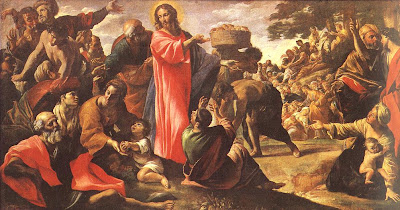
Feeding of the Four Thousand, Giovanni Lanfranco

What starts the multiplication of time, energy and resources? One thing I am convinced: Giving what you have away! Giving away some of the bread, fish, time, money, energy, ideas you have is a sure way to get more–just as releasing the seven loaves fed the four thousand.
One of the challenges in reading Scripture for me is to reconcile the majestic mighty figure of Christ, who could deal with great crowds with the friend, who is in the room with me, right now, surveying me with a slight smile.
It takes an act of imagination to see Jesus fully, as he really is.
Matthew 15
Jesus Feeds the Four Thousand

 29 Jesus left there and went along the Sea of Galilee. Then he went up on a mountainside and sat down. 30 Great crowds came to him, bringing the lame, the blind, the crippled, the mute and many others, and laid them at his feet; and he healed them.
With the power which is available to us who believe.
One of the most outstanding traits of Jesus is his kindness.


31 The people were amazed when they saw the mute speaking, the crippled made well, the lame walking and the blind seeing. And they praised the God of Israel.

 32 Jesus called his disciples to him and said, “I have compassion for these people; they have already been with me three days and have nothing to eat. I do not want to send them away hungry, or they may collapse on the way.”
He is amazing. Practicality and kindness mingled with power. (I love him!)
He is a God of compassion.
 33 His disciples answered, “Where could we get enough bread in this remote place to feed such a crowd?”
   34 “How many loaves do you have?” Jesus asked.
Again the practicality
   “Seven,” they replied, “and a few small fish.”
Small supplies are no impediment for God.
 35 He told the crowd to sit down on the ground. 36 Then he took the seven loaves and the fish, and when he had given thanks, he broke them and gave them to the disciples, and they in turn to the people. 37 They all ate and were satisfied. Afterward the disciples picked up seven basketfuls of broken pieces that were left over.38 The number of those who ate was four thousand men, besides women and children. 39 After Jesus had sent the crowd away, he got into the boat and went to the vicinity of Magadan.
That’s amazing. How does that work today? Could we feed 4000 with 7 loaves, and a few small fish?
Dunno.
However, I do know, from experience (from starting a now flourishing small business with almost no capital) that God can multiply our time, talent, energy. That everything big starts with the tiny seeds of an idea, which he gives us.
Small supplies are no impediment for God.
And later, his body will be broken to delight and thrill and feed hungry, restless hearts. 
  

Filed Under: Matthew

Resources multiplied, Matthew, Day 45, Feb 14th, Blog Through the Bible Project

By Anita Mathias

Feeding of the Four Thousand, Giovanni Lanfranco

What starts the multiplication of time, energy and resources? One thing I am convinced: Giving what you have away! Giving away some of the bread, fish, time, money, energy, ideas you have is a sure way to get more–just as releasing the seven loaves fed the four thousand.
One of the challenges in reading Scripture for me is to reconcile the majestic mighty figure of Christ, who could deal with great crowds with the friend, who is in the room with me, right now, surveying me with a slight smile.
It takes an act of imagination to see Jesus fully, as he really is.
Matthew 15
Jesus Feeds the Four Thousand

 29 Jesus left there and went along the Sea of Galilee. Then he went up on a mountainside and sat down. 30 Great crowds came to him, bringing the lame, the blind, the crippled, the mute and many others, and laid them at his feet; and he healed them.
With the power which is available to us who believe.
One of the most outstanding traits of Jesus is his kindness.


31 The people were amazed when they saw the mute speaking, the crippled made well, the lame walking and the blind seeing. And they praised the God of Israel.

 32 Jesus called his disciples to him and said, “I have compassion for these people; they have already been with me three days and have nothing to eat. I do not want to send them away hungry, or they may collapse on the way.”
He is amazing. Practicality and kindness mingled with power. (I love him!)
He is a God of compassion.
 33 His disciples answered, “Where could we get enough bread in this remote place to feed such a crowd?”
   34 “How many loaves do you have?” Jesus asked.
Again the practicality
   “Seven,” they replied, “and a few small fish.”
Small supplies are no impediment for God.
 35 He told the crowd to sit down on the ground. 36 Then he took the seven loaves and the fish, and when he had given thanks, he broke them and gave them to the disciples, and they in turn to the people. 37 They all ate and were satisfied. Afterward the disciples picked up seven basketfuls of broken pieces that were left over.38 The number of those who ate was four thousand men, besides women and children. 39 After Jesus had sent the crowd away, he got into the boat and went to the vicinity of Magadan.
That’s amazing. How does that work today? Could we feed 4000 with 7 loaves, and a few small fish?
Dunno.
However, I do know, from experience (from starting a now flourishing small business with almost no capital) that God can multiply our time, talent, energy. That everything big starts with the tiny seeds of an idea, which he gives us.
Small supplies are no impediment for God.
And later, his body will be broken to delight and thrill and feed hungry, restless hearts. 
  

Filed Under: Matthew

Faith moves Mountains. Matthew 15, Day 45, Feb 14th

By Anita Mathias

The Syro-Phoenician Woman

Matthew 15

That Which Defiles

 1 Then some Pharisees and teachers of the law came to Jesus from Jerusalem and asked, 2 “Why do your disciples break the tradition of the elders? They don’t wash their hands before they eat!”
Very interestingly Jesus engages with those who are his relentless critics. He points out their own hypocrisies.
I would have expected him to shrug his shoulders and blow them off. 

 3 Jesus replied, “And why do you break the command of God for the sake of your tradition? 4 For God said, ‘Honor your father and mother’ and ‘Anyone who curses their father or mother is to be put to death.’ 5 But you say that if anyone declares that what might have been used to help their father or mother is ‘devoted to God,’ 6 they are not to ‘honor their father or mother’ with it. Thus you nullify the word of God for the sake of your tradition.
They have allowed their traditions (excusing people from the duty of caring for their parents if they have promised to dedicate their wealth to the temple) to supersede the word of God.

7 You hypocrites! Isaiah was right when he prophesied about you:
   8 “‘These people honor me with their lips,
   but their hearts are far from me.
9 They worship me in vain;
   their teachings are merely human rules.’”
Words as relevant today as when Isaiah the Prophet spoke them. They are hypocrites because they honour God with their lips, but their hearts are far from him.

 10 Jesus called the crowd to him and said, “Listen and understand. 11 What goes into someone’s mouth does not defile them, but what comes out of their mouth, that is what defiles them.”
What you eat does not defile you. You are defiled by the content of your thoughts, expressed in words. 

 12 Then the disciples came to him and asked, “Do you know that the Pharisees were offended when they heard this?”
And what was the answer of the Lord Jesus to this? Essentially, let them be offended.

 13 He replied, “Every plant that my heavenly Father has not planted will be pulled up by the roots.
Wait. If God has not planted the Pharisees, they will be uprooted.
14 Leave them; they are blind guides. If the blind lead the blind, both will fall into a pit.”
 They are blind to God’s will, actions and character. They will destroy themselves, and those who follow them will similarly be destroyed.

 15 Peter said, “Explain the parable to us.”
   16 “Are you still so dull?” Jesus asked them. 17 “Don’t you see that whatever enters the mouth goes into the stomach and then out of the body? 18 But the things that come out of a person’s mouth come from the heart, and these defile them. 19 For out of the heart come evil thoughts—murder, adultery, sexual immorality, theft, false testimony, slander. 20 These are what defile a person; but eating with unwashed hands does not defile them.”
Nothing external can defile a person. It is what is in the heart,which will be expressed by the mouth which defiles a person, slander, lies and evil thoughts.

The Faith of a Canaanite Woman

 21 Leaving that place, Jesus withdrew to the region of Tyre and Sidon. 22 A Canaanite woman from that vicinity came to him, crying out, “Lord, Son of David, have mercy on me! My daughter is demon-possessed and suffering terribly.”

 23 Jesus did not answer a word. So his disciples came to him and urged him, “Send her away, for she keeps crying out after us.”
 24 He answered, “I was sent only to the lost sheep of Israel.”
 25 The woman came and knelt before him. “Lord, help me!” she said.

She is not going to take no for an answer. She has the persistence of the patriarch Jacob.

 26 He replied, “It is not right to take the children’s bread and toss it to the dogs.”

The covenant blessings.

 27 “Yes it is, Lord,” she said. “Even the dogs eat the crumbs that fall from their master’s table.”

She contradictions and argues with him in her desperation. In response, he essentially changes his mind, as God did in response to Abraham’s prayers. We see here the power of faith.
NIV note–Jesus was pleased with the woman’s reply. It revealed not only her wit, but also her faith and humility.

 28 Then Jesus said to her, “Woman, you have great faith! Your request is granted.” And her daughter was healed at that moment.

Jesus delays his answer three times–he first ignores her, then seems to refuse her. He is testing her faith. She persists in her prayer with a deep, prescient faith in his identity and power. Because she persists in her prayer–despite the fact that apparently it wasn’t going to be answered–her faith is rewarded.  I

t is done for her as she desires–
and her daughter is healed. 


 Faith brings about the answering of prayers.

ESV note–Though God’s plan was to bring salvation first to Israel and then to the Gentiles, Jesus responds to all who call upon him in true faith. The Gentile woman’s attitude of humble faith allowed Jesus healing ministry to operate.

Filed Under: Matthew

Faith moves Mountains. Matthew 15, Day 45, Feb 14th, Blog Through the Bible Project

By Anita Mathias

The Syro-Phoenician Woman

Matthew 15

That Which Defiles

 1 Then some Pharisees and teachers of the law came to Jesus from Jerusalem and asked, 2 “Why do your disciples break the tradition of the elders? They don’t wash their hands before they eat!”
Very interestingly Jesus engages with those who are his relentless critics. He points out their own hypocrisies.
I would have expected him to shrug his shoulders and blow them off. 

 3 Jesus replied, “And why do you break the command of God for the sake of your tradition? 4 For God said, ‘Honor your father and mother’ and ‘Anyone who curses their father or mother is to be put to death.’ 5 But you say that if anyone declares that what might have been used to help their father or mother is ‘devoted to God,’ 6 they are not to ‘honor their father or mother’ with it. Thus you nullify the word of God for the sake of your tradition.
They have allowed their traditions (excusing people from the duty of caring for their parents if they have promised to dedicate their wealth to the temple) to supersede the word of God.

7 You hypocrites! Isaiah was right when he prophesied about you:
   8 “‘These people honor me with their lips,
   but their hearts are far from me.
9 They worship me in vain;
   their teachings are merely human rules.’”
Words as relevant today as when Isaiah the Prophet spoke them. They are hypocrites because they honour God with their lips, but their hearts are far from him.

 10 Jesus called the crowd to him and said, “Listen and understand. 11 What goes into someone’s mouth does not defile them, but what comes out of their mouth, that is what defiles them.”
What you eat does not defile you. You are defiled by the content of your thoughts, expressed in words. 

 12 Then the disciples came to him and asked, “Do you know that the Pharisees were offended when they heard this?”
And what was the answer of the Lord Jesus to this? Essentially, let them be offended.

 13 He replied, “Every plant that my heavenly Father has not planted will be pulled up by the roots.
Wait. If God has not planted the Pharisees, they will be uprooted.
14 Leave them; they are blind guides. If the blind lead the blind, both will fall into a pit.”
 They are blind to God’s will, actions and character. They will destroy themselves, and those who follow them will similarly be destroyed.

 15 Peter said, “Explain the parable to us.”
   16 “Are you still so dull?” Jesus asked them. 17 “Don’t you see that whatever enters the mouth goes into the stomach and then out of the body? 18 But the things that come out of a person’s mouth come from the heart, and these defile them. 19 For out of the heart come evil thoughts—murder, adultery, sexual immorality, theft, false testimony, slander. 20 These are what defile a person; but eating with unwashed hands does not defile them.”
Nothing external can defile a person. It is what is in the heart,which will be expressed by the mouth which defiles a person, slander, lies and evil thoughts.

The Faith of a Canaanite Woman

 21 Leaving that place, Jesus withdrew to the region of Tyre and Sidon. 22 A Canaanite woman from that vicinity came to him, crying out, “Lord, Son of David, have mercy on me! My daughter is demon-possessed and suffering terribly.”

 23 Jesus did not answer a word. So his disciples came to him and urged him, “Send her away, for she keeps crying out after us.”
 24 He answered, “I was sent only to the lost sheep of Israel.”
 25 The woman came and knelt before him. “Lord, help me!” she said.

She is not going to take no for an answer. She has the persistence of the patriarch Jacob.

 26 He replied, “It is not right to take the children’s bread and toss it to the dogs.”

The covenant blessings.

 27 “Yes it is, Lord,” she said. “Even the dogs eat the crumbs that fall from their master’s table.”

She contradictions and argues with him in her desperation. In response, he essentially changes his mind, as God did in response to Abraham’s prayers. We see here the power of faith.
NIV note–Jesus was pleased with the woman’s reply. It revealed not only her wit, but also her faith and humility.

 28 Then Jesus said to her, “Woman, you have great faith! Your request is granted.” And her daughter was healed at that moment.

Jesus delays his answer three times–he first ignores her, then seems to refuse her. He is testing her faith. She persists in her prayer with a deep, prescient faith in his identity and power. Because she persists in her prayer–despite the fact that apparently it wasn’t going to be answered–her faith is rewarded.  I

t is done for her as she desires–

and her daughter is healed. 


 Faith brings about the answering of prayers.

ESV note–Though God’s plan was to bring salvation first to Israel and then to the Gentiles, Jesus responds to all who call upon him in true faith. The Gentile woman’s attitude of humble faith allowed Jesus healing ministry to operate.

Wikio

Filed Under: Matthew

It is I. Why are you Afraid. Matthew 14, Day 43, Feb 12, Blog Through the Bible Project

By Anita Mathias


Matthew 14

Prophets Without Honour: Jesus is rejected, John the Baptist is beheaded; 

1 At that time Herod the tetrarch heard the reports about Jesus, 2 and he said to his attendants, “This is John the Baptist; he has risen from the dead! That is why miraculous powers are at work in him.”

 3 Now Herod had arrested John and bound him and put him in prison because of Herodias, his brother Philip’s wife, 4 for John had been saying to him: “It is not lawful for you to have her.” 5 Herod wanted to kill John, but he was afraid of the people, because they considered John a prophet.
Truth-telling can be dangerous.

 6 On Herod’s birthday the daughter of Herodias danced for the guests and pleased Herod so much 7 that he promised with an oath to give her whatever she asked.8 Prompted by her mother, she said, “Give me here on a platter the head of John the Baptist.” 9 The king was distressed, but because of his oaths and his dinner guests, he ordered that her request be granted 10 and had John beheaded in the prison. 11 His head was brought in on a platter and given to the girl, who carried it to her mother. 12 John’s disciples came and took his body and buried it. Then they went and told Jesus.
ESV–Herodius steps in to eliminate the accusing voice of John the Baptist, a threat to her husband’s reign.
Jesus Feeds the Five Thousand
 13 When Jesus heard what had happened, he withdrew by boat privately to a solitary place.
Jesus is practicing what is called “Living with Margins.” He is taking some downtime to process this sad news.

Hearing of this, the crowds followed him on foot from the towns. 14When Jesus landed and saw a large crowd, he had compassion on them and healed their sick.
But people appear in the middle of his downtime, and he has compassion on them, and heals their sick.
 15 As evening approached, the disciples came to him and said, “This is a remote place, and it’s already getting late. Send the crowds away, so they can go to the villages and buy themselves some food.”
 16 Jesus replied, “They do not need to go away. You give them something to eat.”
He is a Can-Do Jesus. The God of Possibility.

 17 “We have here only five loaves of bread and two fish,” they answered.
   18 “Bring them here to me,” he said. 19 And he directed the people to sit down on the grass. Taking the five loaves and the two fish and looking up to heaven, he gave thanks and broke the loaves. Then he gave them to the disciples, and the disciples gave them to the people. 20 They all ate and were satisfied, and the disciples picked up twelve basketfuls of broken pieces that were left over. 21 The number of those who ate was about five thousand men, besides women and children.
Be optimistic. Act in faith. Expect miracles. Be surprised. If necessary, start small.
This is the only miracles recorded in all four Gospels. The crowd is stranded in a desolate place. This recalls God’s provision of manna in the wilderness in Exodus.

Jesus Walks on the Water
 22 Immediately Jesus made the disciples get into the boat and go on ahead of him to the other side, while he dismissed the crowd.
The majestic figure of Jesus is able to MAKE (the Greek word means compel and suggests a crisis) the disciples get into the boat, and is able to dismiss a crowd of perhaps 10,000 (including women and children.) He was a compelling, magnetic figure of great charisma and authority.

 23 After he had dismissed them, he went up on a mountainside by himself to pray.
Again we see the use of margins by Jesus, the bracketing of his life by prayer. Prayer before a demonstration of power. Prayer after it.
ESV note, In preparation for his mission into Gentile regions, and with his trials in Jerusalem impending, Jesus spends the evening and night in concentrated prayer with his Heavenly Father.

Later that night, he was there alone, 24 and the boat was already a considerable distance from land, buffeted by the waves because the wind was against it.
 25 Shortly before dawn Jesus went out to them, walking on the lake. 26 When the disciples saw him walking on the lake, they were terrified. “It’s a ghost,” they said, and cried out in fear.
 27 But Jesus immediately said to them: “Take courage! It is I. Don’t be afraid.”
And these are great words he speaks to us in our crises, “Take courage. It is I. Don’t be afraid.”
ESV note, It is I, in the Greek, Ego Eimi, I am, recalls Yahweh’s voice from the burning bush (Exodus 3;14) 

   28 “Lord, if it’s you,” Peter replied, “tell me to come to you on the water.”
   29 “Come,” he said.
Okay, we dream big. We ask God to bless our dreams. We sense he is doing so. And now what? Now, we need to step out of the boat and walk on water. Start acting on what we have prayed for.

   Then Peter got down out of the boat, walked on the water and came toward Jesus. 30 But when he saw the wind, he was afraid and, beginning to sink, cried out, “Lord, save me!”
And Peter begins stepping out in faith. But then he sees the obstacles, and realizes he is doing what, humanly speaking, is not possible. Once fear overwhelms him, he is no longer able to do what he was doing before. He begins to sink.

 31 Immediately Jesus reached out his hand and caught him. “You of little faith,” he said, “why did you doubt?”
Once he starts doubting the power of Jesus, Peter can no longer do what he did before. Jesus mercifully helps him, while rebuking him.
Oh Lord, strengthen my faith so that I may not be rebuked by you.

 32 And when they climbed into the boat, the wind died down. 33 Then those who were in the boat worshiped him, saying, “Truly you are the Son of God.”
It is hard to realize the majesty of Jesus. And now those who saw them 24/7 realized afresh exactly who it was that they were dealing with.
ESV notes–By walking on water in a furious storm, Jesus demonstrates that he indeed is the Lord over all creation, and so there is no need to be afraid,or to doubt. The only fitting response is to worship Jesus and to acknowledge that truly he is the Son of God.

34 When they had crossed over, they landed at Gennesaret. 35 And when the men of that place recognized Jesus, they sent word to all the surrounding country. People brought all their sick to him 36 and begged him to let the sick just touch the edge of his cloak, and all who touched it were healed. 
It was their faith which healed them, not the cloak, of course.  

Filed Under: Matthew

The Kingdom of Heaven, Matthew 13, Day 41, Feb 10,

By Anita Mathias

Pearls

 24 Jesus told them another parable: “The kingdom of heaven is like a man who sowed good seed in his field. 25 But while everyone was sleeping, his enemy came and sowed weeds among the wheat, and went away. 26 When the wheat sprouted and formed heads, then the weeds also appeared.

   27 “The owner’s servants came to him and said, ‘Sir, didn’t you sow good seed in your field? Where then did the weeds come from?’
   28 “‘An enemy did this,’ he replied.
   “The servants asked him, ‘Do you want us to go and pull them up?’
   29 “‘No,’ he answered, ‘because while you are pulling the weeds, you may uproot the wheat with them. 30 Let both grow together until the harvest. At that time I will tell the harvesters: First collect the weeds and tie them in bundles to be burned; then gather the wheat and bring it into my barn.’”
An illustrative parable. Wheat and weeds growing together. Let them. God will sort out the wheat, and destroy the weeds in his own time. 
Weeds, zizanion, is probably darnel, a weed that resembles wheat in its early growth, but is easily distinguished in maturity. 
The Parables of the Mustard Seed and the Yeast

 31 He told them another parable: “The kingdom of heaven is like a mustard seed, which a man took and planted in his field. 32 Though it is the smallest of all seeds, yet when it grows, it is the largest of garden plants and becomes a tree, so that the birds come and perch in its branches.”
God conquers your heart and calls you to dwell in the Kingdom of heaven, little by little. It comes into your heart like a mustard seed, but will eventually feed and shelter many. 
ESV–Israel was not prepared for the insignificant beginnings of the Kingdom of God so this image would have shocked the listeners.
The Kingdom of God would spread throughout the world, and believers from all nations would find rest in it.

 33 He told them still another parable: “The kingdom of heaven is like yeast that a woman took and mixed into about sixty pounds of flour until it worked all through the dough.”
A little bit of the yeast of Christ can change a lot in one’s life, and circumstances. 
Like yeast in bread, the conversion of an individual to a citizen of the Kingdom of Heaven, to becoming Christ’s man or woman, is active, though not fully visible at first, since it begins with an inner transformation of the heart.
NIV Yeast here is a symbol of growth. As yeast permeates dough, so the kingdom of heaven spreads through a person’s life. Or it may signify the growth of the Kingdom by the inner working of the Holy Spirit, using God’s word.

 34 Jesus spoke all these things to the crowd in parables; he did not say anything to them without using a parable. 35 So was fulfilled what was spoken through the prophet:
   “I will open my mouth in parables,
   I will utter things hidden since the creation of the world.”
Why parables? They means more. We each fill in the gaps with our own experience. They grow in richness with us.
And for Jesus, teaching to hostile crowds, parables provided safety. He wasn’t talking about the Pharisees, for heaven’s sake. He was talking about wolves in sheep’s clothing.
The Parable of the Weeds Explained

 36 Then he left the crowd and went into the house. His disciples came to him and said, “Explain to us the parable of the weeds in the field.”

 37 He answered, “The one who sowed the good seed is the Son of Man. 38 The field is the world, and the good seed stands for the people of the kingdom. The weeds are the people of the evil one, 39 and the enemy who sows them is the devil. The harvest is the end of the age, and the harvesters are angels.
   40 “As the weeds are pulled up and burned in the fire, so it will be at the end of the age. 41 The Son of Man will send out his angels, and they will weed out of his kingdom everything that causes sin and all who do evil. 42 They will throw them into the blazing furnace, where there will be weeping and gnashing of teeth. 43 Then the righteous will shine like the sun in the kingdom of their Father. Whoever has ears, let them hear.
The Parables of the Hidden Treasure and the Pearl

    44 “The kingdom of heaven is like treasure hidden in a field. When a man found it, he hid it again, and then in his joy went and sold all he had and bought that field.
ESV The Parable emphasized the supreme value of the hidden treasure.


 45 “Again, the kingdom of heaven is like a merchant looking for fine pearls. 46 When he found one of great value, he went away and sold everything he had and bought it.

The essential nature of discovering Jesus is that he becomes all in all.  He doesn’t do well as being one among a host of other Gods.
The nature of the Kingdom–of living in the world as if one is in heaven, living under the Kingship of Christ, is that one slowly “sells” more and more things for the sake of fellowship with him, to gain him, for his undisputed Lordship over one’s life.

The Parable of the Net

    47 “Once again, the kingdom of heaven is like a net that was let down into the lake and caught all kinds of fish. 48 When it was full, the fishermen pulled it up on the shore. Then they sat down and collected the good fish in baskets, but threw the bad away. 49 This is how it will be at the end of the age. The angels will come and separate the wicked from the righteous 50 and throw them into the blazing furnace, where there will be weeping and gnashing of teeth.
Good and evil live together until the time of judgement.

   51 “Have you understood all these things?” Jesus asked.
   “Yes,” they replied.
 52 He said to them, “Therefore every teacher of the law who has become a disciple in the kingdom of heaven is like the owner of a house who brings out of his storeroom new treasures as well as old.”
ESV They understand how the “new” revelation of Jesus fulfills the old promises of the Old Testament.
A Prophet Without Honor

 53 When Jesus had finished these parables, he moved on from there. 54 Coming to his hometown, he began teaching the people in their synagogue, and they were amazed. “Where did this man get this wisdom and these miraculous powers?” they asked. 55 “Isn’t this the carpenter’s son? Isn’t his mother’s name Mary, and aren’t his brothers James, Joseph, Simon and Judas? 56Aren’t all his sisters with us? Where then did this man get all these things?” 57 And they took offense at him.

   But Jesus said to them, “A prophet is not without honor except in his own town and in his own home.”
 58 And he did not do many miracles there because of their lack of faith.
They thought he was a jumped-up hometown boy. They did not see the marvelous and miraculous in and about him. And so, he did no miracles there, did not cast his pearls before swine.
Jesus aligns himself with the OT prophets who had revealed God’s will for the people of Israel but had consistently been rejected by them.
The Spirit does not force his miracles on a hostile skeptical audience.
Matthew’s gospel frequently stresses the close relationship between faith and miracles.

Filed Under: Matthew

The Parable of the Sower, Matthew 13, Read Through the Bible Project

By Anita Mathias


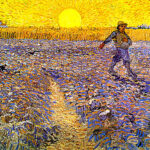
Van Gogh The Sower

There is nothing more powerful than a story–than a parable. It grows with the reader, and we continue filling in the gaps with out own life experience. 

This, one of Jesus’s five major discourses is called The Parabolic Discourse, because of its collection of parables. The English word parable comes from the Greek parabole, which means “a placing beside” and thus is a comparison or illustration. The synoptic Gospels have 30 parables, John none at all.

This is a rich and fabulous parable.

Matthew 13

 1 That same day Jesus went out of the house and sat by the lake. 2 Such large crowds gathered around him that he got into a boat and sat in it, while all the people stood on the shore.
Sitting was the normal position for teachers. His parables use a narrative analogy to teach a moral or spiritual lesson. They produce different results–hiding truth from those not eager or ready for it, communicating truth to the disciples.


 3 Then he told them many things in parables, saying: “A farmer went out to sow his seed. 4 As he was scattering the seed, some fell along the path, and the birds came and ate it up. 5 Some fell on rocky places, where it did not have much soil. It sprang up quickly, because the soil was shallow. 6But when the sun came up, the plants were scorched, and they withered because they had no root. 7 Other seed fell among thorns, which grew up and choked the plants. 8 Still other seed fell on good soil, where it produced a crop—a hundred, sixty or thirty times what was sown. 9 Whoever has ears, let them hear.”
One of Jesus’s favourite sources of parables was the natural world, which he created.


 10 The disciples came to him and asked, “Why do you speak to the people in parables?”
 11 He replied, “Because the knowledge of the secrets of the kingdom of heaven has been given to you, but not to them. 
The secrets of the Kingdom, of how to live happily, of the knowledge of God, are not squandered but given to those who are willing to seek for them, and treasure them–like the first disciples were.


12 Whoever has will be given more, and they will have an abundance. Whoever does not have, even what they have will be taken from them.
Those who have and treasure spiritual truth will receive even more. But those who do not treasure and live it–even the little truth they have will be taken from them. 
13 This is why I speak to them in parables:
   “Though seeing, they do not see;
   though hearing, they do not hear or understand.
   14 In them is fulfilled the prophecy of Isaiah:
   “‘You will be ever hearing but never understanding;
   you will be ever seeing but never perceiving.
15 For this people’s heart has become calloused;
   they hardly hear with their ears,
   and they have closed their eyes.
Otherwise they might see with their eyes,
   hear with their ears,
   understand with their hearts
and turn, and I would heal them.’ 
God will heal those who truly try to see and hear and understand spiritual truth.
A hard heart will stand in the way of seeing and understanding spiritual truth.

   16 But blessed are your eyes because they see, and your ears because they hear. 17 For truly I tell you, many prophets and righteous people longed to see what you see but did not see it, and to hear what you hear but did not hear it.
Jesus seldom interpreted his parables, but here he does so, because his disciples asked him to!! We see the power of the request again.

   18 “Listen then to what the parable of the sower means: 19 When anyone hears the message about the kingdom and does not understand it, the evil one comes and snatches away what was sown in their heart. This is the seed sown along the path.
Distraction works upon incomprehension.
 20 The seed falling on rocky ground refers to someone who hears the word and at once receives it with joy. 21 But since they have no root, they last only a short time. When trouble or persecution comes because of the word, they quickly fall away.
Shallow roots, which means the word heard with joy is forgotten in a time of persecution.

22 The seed falling among the thorns refers to someone who hears the word, but the worries of this life and the deceitfulness of wealth choke the word, making it unfruitful. 
The word choked by hassles, worries, and giving too much importance to wealth. And who would have supposed that this text is 21 centuries old!!

23 But the seed falling on good soil refers to someone who hears the word and understands it. This is the one who produces a crop, yielding a hundred, sixty or thirty times what was sown.”
But when the word is fruitful, its yield is exponential.
Typical agricultural yields were fivefold to fifteen fold, with a tenfold return considered a good yield.
 

Filed Under: Matthew

The Parable of the Sower, Matthew 13, Read Through the Bible Project

By Anita Mathias


Van Gogh The Sower

There is nothing more powerful than a story–than a parable. It grows with the reader, and we continue filling in the gaps with out own life experience. 

This, one of Jesus’s five major discourses is called The Parabolic Discourse, because of its collection of parables. The English word parable comes from the Greek parabole, which means “a placing beside” and thus is a comparison or illustration. The synoptic Gospels have 30 parables, John none at all.

This is a rich and fabulous parable.

Matthew 13

 1 That same day Jesus went out of the house and sat by the lake. 2 Such large crowds gathered around him that he got into a boat and sat in it, while all the people stood on the shore.
Sitting was the normal position for teachers. His parables use a narrative analogy to teach a moral or spiritual lesson. They produce different results–hiding truth from those not eager or ready for it, communicating truth to the disciples.


 3 Then he told them many things in parables, saying: “A farmer went out to sow his seed. 4 As he was scattering the seed, some fell along the path, and the birds came and ate it up. 5 Some fell on rocky places, where it did not have much soil. It sprang up quickly, because the soil was shallow. 6But when the sun came up, the plants were scorched, and they withered because they had no root. 7 Other seed fell among thorns, which grew up and choked the plants. 8 Still other seed fell on good soil, where it produced a crop—a hundred, sixty or thirty times what was sown. 9 Whoever has ears, let them hear.”
One of Jesus’s favourite sources of parables was the natural world, which he created.


 10 The disciples came to him and asked, “Why do you speak to the people in parables?”
 11 He replied, “Because the knowledge of the secrets of the kingdom of heaven has been given to you, but not to them. 
The secrets of the Kingdom, of how to live happily, of the knowledge of God, are not squandered but given to those who are willing to seek for them, and treasure them–like the first disciples were.


12 Whoever has will be given more, and they will have an abundance. Whoever does not have, even what they have will be taken from them.
Those who have and treasure spiritual truth will receive even more. But those who do not treasure and live it–even the little truth they have will be taken from them. 
13 This is why I speak to them in parables:
   “Though seeing, they do not see;
   though hearing, they do not hear or understand.
   14 In them is fulfilled the prophecy of Isaiah:
   “‘You will be ever hearing but never understanding;
   you will be ever seeing but never perceiving.
15 For this people’s heart has become calloused;
   they hardly hear with their ears,
   and they have closed their eyes.
Otherwise they might see with their eyes,
   hear with their ears,
   understand with their hearts
and turn, and I would heal them.’ 
God will heal those who truly try to see and hear and understand spiritual truth.
A hard heart will stand in the way of seeing and understanding spiritual truth.

   16 But blessed are your eyes because they see, and your ears because they hear. 17 For truly I tell you, many prophets and righteous people longed to see what you see but did not see it, and to hear what you hear but did not hear it.
Jesus seldom interpreted his parables, but here he does so, because his disciples asked him to!! We see the power of the request again.

   18 “Listen then to what the parable of the sower means: 19 When anyone hears the message about the kingdom and does not understand it, the evil one comes and snatches away what was sown in their heart. This is the seed sown along the path.
Distraction works upon incomprehension.
 20 The seed falling on rocky ground refers to someone who hears the word and at once receives it with joy. 21 But since they have no root, they last only a short time. When trouble or persecution comes because of the word, they quickly fall away.
Shallow roots, which means the word heard with joy is forgotten in a time of persecution.

22 The seed falling among the thorns refers to someone who hears the word, but the worries of this life and the deceitfulness of wealth choke the word, making it unfruitful. 
The word choked by hassles, worries, and giving too much importance to wealth. And who would have supposed that this text is 21 centuries old!!

23 But the seed falling on good soil refers to someone who hears the word and understands it. This is the one who produces a crop, yielding a hundred, sixty or thirty times what was sown.”
But when the word is fruitful, its yield is exponential.
Typical agricultural yields were fivefold to fifteen fold, with a tenfold return considered a good yield.
 

Filed Under: Matthew

  • « Previous Page
  • 1
  • …
  • 15
  • 16
  • 17
  • 18
  • 19
  • 20
  • Next Page »

Sign Up and Get a Free eBook!

Sign up to be emailed my blog posts (one a week) and get the ebook of "Holy Ground," my account of working with Mother Teresa.

Join 536 Other Readers

My Books

Rosaries, Reading, Secrets: A Catholic Childhood in India

Rosaries, Reading Secrets, B&N
USA

UK

Wandering Between Two Worlds: Essays on Faith and Art

Wandering Between Two Worlds
USA

UK

Francesco, Artist of Florence: The Man Who Gave Too Much

Francesco, Artist of Florence
US

UK

The Story of Dirk Willems

The Story of Dirk Willems
US

UK

My Latest Meditation

Anita Mathias: About Me

Anita Mathias

Read my blog on Facebook

Follow me on Twitter

Follow @anitamathias1

Recent Posts

  • At the Cross, God Forgives Us Completely
  • Using God’s Gift of Our Talents: A Path to Joy and Abundance
  • The Kingdom of God is Here Already, Yet Not Yet Here
  • All Those Who Exalt Themselves Will Be Humbled & the Humble Will Be Exalted
  • Christ’s Great Golden Triad to Guide Our Actions and Decisions
  • How Jesus Dealt With Hostility and Enemies
  • Do Not Be Afraid, but Do Be Prudent
  • For Scoundrels, Scallywags, and Rascals—Christ Came
  • How to Lead an Extremely Significant Life
  • Don’t Walk Away From Jesus, but if You Do, He Still Looks at You and Loves You
Premier Digital Awards 2015 - Finalist - Blogger of the year
Runner Up Christian Media Awards 2014 - Tweeter of the year

Categories

What I’m Reading


Wolf Hall
Hilary Mantel

Wolf Hall --  Amazon.com
Amazon.com

Amazon.co.uk

Silence and Honey Cakes:
The Wisdom Of The Desert
Rowan Williams

Silence and Honey Cakes --  Amazon.com
Amazon.com

Amazon.co.uk

The Long Loneliness:
The Autobiography of the Legendary Catholic Social Activist
Dorothy Day

The Long Loneliness --  Amazon.com
Amazon.com

Amazon.co.uk

Country Girl
Edna O'Brien

Country Girl  - Amazon.com
Amazon.com

Amazon.co.uk

Archive by month

My Latest Five Podcast Meditations

INSTAGRAM

anita.mathias

My memoir: Rosaries, Reading, Secrets https://amzn.to/42xgL9t
Oxford, England. Writer, memoirist, podcaster, blogger, Biblical meditation teacher, mum

Looking at photos from our week in beautiful Sevil Looking at photos from our week in beautiful Seville and Cordoba over New Year with Irene, who had a week off.
And, ICYMI, here’s my latest meditation on the Gospel of Matthew… I’ve recorded it, should you want a few minutes of peace.
https://anitamathias.com/2026/04/29/gods-complete-forgiveness/
Hello Friends, I'm resumed recording my meditation Hello Friends, I'm resumed recording my meditations on the Gospel of Matthew. Do click on this link to listen. 
https://anitamathias.com/.../29/gods-complete-forgiveness/
Christ is the most influential figure in the history of the world, though his life ended in shame, humiliation and failure. But he so completely turned things round in his great reversal that the cross on which he died when all seemed hopeless is now the most common, and revered, symbol in history.
He emerged from and was anchored in Judaism. And as the sins of the people were laid on the scapegoat who was sent into the wilderness to perish, Christ died as the lamb of God voluntarily bearing the guilt of the wrongdoing of the whole world. He paid the price for our forgiveness with his life-blood--in accordance with the iron law of the physical and moral universe, of sowing and reaping, cause and effect. 
And so, God, who appeared as flames of fire to Moses, can now dwell within us, purifying us, whose hearts have darkness and shards of ice. 
And now that Christ was crucified, died, but rose again, His Spirit, no longer contained within his earthly body, is poured out like living water onto all humans, at our humble request. The Spirit pours the love of God into us; he reminds us of the words of Jesus and slowly writes Christ’s sweet law on our hearts. This transfusion of grace helps us do hard things we previously couldn’t do. Our dance with the Spirit gradually breaks the power of sin over us. It transforms us.
Now we, the forgiven, protected by the blood of Jesus poured out over us, and filled with His Spirit, who sings within us, Abba, Father, are adopted by God as his children in his joyful new covenant. We are cells grafted into the vine of our new family--Father, Son, Spirit—who now live in us as we live in them. As we choose by our thoughts and actions to continue living in the vine of Jesus, their energy pulsing through us makes us fruitful. And now, all our prayers which flow in the river of God’s good purposes are kindly heard. Waves of love and power flood from the cross! 
Thank you!
Well, hello friends! Breaking radio silence to let Well, hello friends! Breaking radio silence to let you know that I have taped a meditation for you on Christ’s famous Parable of the Talents in Matthew 25. https://anitamathias.com/2025/11/05/using-gods-gift-of-our-talents-a-path-to-joy-and-abundance/
Here you are, click the play button in the blog post for a brief meditation, and some moments of peace, and, perhaps, inspiration in your day 🙂
Hi Friends, I have taped a meditation; do listen a Hi Friends, I have taped a meditation; do listen at this link: https://anitamathias.com/2025/04/08/the-kingdom-of-god-is-here-already-yet-not-yet-here-2/
It’s on the Kingdom of God, of which Christ so often spoke, which is here already—a mysterious, shimmering internal palace in which, in lightning flashes, we experience peace and joy, and yet, of course, not yet fully here. We sense the rainbowed presence of Christ in the song which pulses through creation. Christ strolls into our rooms with his wisdom and guidance, and things change. Our prayers are answered; we are healed; our hearts are strangely warmed. Sometimes.
And yet, we also experience evil within & all around us. Our own sin which can shatter our peace and the trajectory of our lives. And the sins of the world—its greed, dishonesty and environmental destruction.
But in this broken world, we still experience the glory of creation; “coincidences” which accelerate once we start praying, and shalom which envelops us like sudden sunshine. The portals into this Kingdom include repentance, gratitude, meditative breathing, and absolute surrender.
The Kingdom of God is here already. We can experience its beauty, peace and joy today through the presence of the Holy Spirit. But yet, since, in the Apostle Paul’s words, we do not struggle only “against flesh and blood, but against the rulers, against the unseen powers of this dark world and against the spiritual forces of evil,” its fullness still lingers…
Our daughter Zoe was ordained into the Church of E Our daughter Zoe was ordained into the Church of England in June. I have been on a social media break… but … better late than never. Enjoy!
First picture has my sister, Shalini, who kindly flew in from the US. Our lovely cousins Anthony and Sarah flank Zoe in the next picture.
The Bishop of London, Sarah Mullaly, ordained Zoe. You can see her praying that Zoe will be filled with the Holy Spirit!!
And here’s a meditation I’ve recorded, which you might enjoy. The link is also in my profile
https://anitamathias.com/2024/11/07/all-those-who-exalt-themselves-will-be-humbled-the-humble-will-be-exalted/
I have taped a meditation on Jesus statement in Ma I have taped a meditation on Jesus statement in Matthew 23, “For those who exalt themselves will be humbled, and those who humble themselves will be exalted.”
Do listen here. https://anitamathias.com/2024/11/07/all-those-who-exalt-themselves-will-be-humbled-the-humble-will-be-exalted/
Link also in bio.
And so, Jesus states a law of life. Those who broadcast their amazingness will be humbled, since God dislikes—scorns that, as much as people do.  For to trumpet our success, wealth, brilliance, giftedness or popularity is to get distracted from our life’s purpose into worthless activity. Those who love power, who are sure they know best, and who must be the best, will eventually be humbled by God and life. For their focus has shifted from loving God, doing good work, and being a blessing to their family, friends, and the world towards impressing others, being enviable, perhaps famous. These things are houses built on sand, which will crumble when hammered by the waves of old age, infirmity or adversity. 
God resists the proud, Scripture tells us—those who crave the admiration and power which is His alone. So how do we resist pride? We slow down, so that we realise (and repent) when sheer pride sparks our allergies to people, our enmities, our determination to have our own way, or our grandiose ego-driven goals, and ambitions. Once we stop chasing limelight, a great quietness steals over our lives. We no longer need the drug of continual achievement, or to share images of glittering travel, parties, prizes or friends. We just enjoy them quietly. My life is for itself & not for a spectacle, Emerson wrote. And, as Jesus advises, we quit sharp-elbowing ourselves to sit with the shiniest people, but are content to hang out with ordinary people; and then, as Jesus said, we will inevitably, eventually, be summoned higher to the sparkling conversation we craved. 
One day, every knee will bow before the gentle lamb who was slain, now seated on the throne. We will all be silent before him. Let us live gently then, our eyes on Christ, continually asking for his power, his Spirit, and his direction, moving, dancing, in the direction that we sense him move.
Link to new podcast in Bio https://anitamathias.co Link to new podcast in Bio https://anitamathias.com/2024/02/20/how-jesus-dealt-with-hostility-and-enemies/
3 days before his death, Jesus rampages through the commercialised temple, overturning the tables of moneychangers. Who gave you the authority to do these things? his outraged adversaries ask. And Jesus shows us how to answer hostile questions. Slow down. Breathe. Quick arrow prayers!
Your enemies have no power over your life that your Father has not permitted them. Ask your Father for wisdom, remembering: Questions do not need to be answered. Are these questioners worthy of the treasures of your heart? Or would that be feeding pearls to hungry pigs, who might instead devour you?
Questions can contain pitfalls, traps, nooses. Jesus directly answered just three of the 183 questions he was asked, refusing to answer some; answering others with a good question.
But how do we get the inner calm and wisdom to recognise
and sidestep entrapping questions? Long before the day of
testing, practice slow, easy breathing, and tune in to the frequency of the Father. There’s no record of Jesus running, rushing, getting stressed, or lacking peace. He never spoke on his own, he told us, without checking in with the Father. So, no foolish, ill-judged statements. Breathing in the wisdom of the Father beside and within him, he, unintimidated, traps the trappers.
Wisdom begins with training ourselves to slow down and ask
the Father for guidance. Then our calm minds, made perceptive, will help us recognise danger and trick questions, even those coated in flattery, and sidestep them or refuse to answer.
We practice tuning in to heavenly wisdom by practising–asking God questions, and then listening for his answers about the best way to do simple things…organise a home or write. Then, we build upwards, asking for wisdom in more complex things.
Listening for the voice of God before we speak, and asking for a filling of the Spirit, which Jesus calls streams of living water within us, will give us wisdom to know what to say, which, frequently, is nothing at all. It will quieten us with the silence of God, which sings through the world, through sun and stars, sky and flowers.
Especially for @ samheckt Some very imperfect pi Especially for @ samheckt 
Some very imperfect pictures of my labradoodle Merry, and golden retriever Pippi.
And since, I’m on social media, if you are the meditating type, here’s a scriptural meditation on not being afraid, while being prudent. https://anitamathias.com/2024/01/03/do-not-be-afraid-but-do-be-prudent/
A new podcast. Link in bio https://anitamathias.c A new podcast. Link in bio
https://anitamathias.com/2024/01/03/do-not-be-afraid-but-do-be-prudent/
Do Not Be Afraid, but Do Be Prudent
“Do not be afraid,” a dream-angel tells Joseph, to marry Mary, who’s pregnant, though a virgin, for in our magical, God-invaded world, the Spirit has placed God in her. Call the baby Jesus, or The Lord saves, for he will drag people free from the chokehold of their sins.
And Joseph is not afraid. And the angel was right, for a star rose, signalling a new King of the Jews. Astrologers followed it, threatening King Herod, whose chief priests recounted Micah’s 600-year-old prophecy: the Messiah would be born in Bethlehem, as Jesus had just been, while his parents from Nazareth registered for Augustus Caesar’s census of the entire Roman world. 
The Magi worshipped the baby, offering gold. And shepherds came, told by an angel of joy: that the Messiah, a saviour from all that oppresses, had just been born.
Then, suddenly, the dream-angel warned: Flee with the child to Egypt. For Herod plans to kill this baby, forever-King.
Do not be afraid, but still flee? Become a refugee? But lightning-bolt coincidences verified the angel’s first words: The magi with gold for the flight. Shepherds
telling of angels singing of coming inner peace. Joseph flees.
What’s the difference between fear and prudence? Fear is being frozen or panicked by imaginary what-ifs. It tenses our bodies; strains health, sleep and relationships; makes us stingy with ourselves & others; leads to overwork, & time wasted doing pointless things for fear of people’s opinions.
Prudence is wisdom-using our experience & spiritual discernment as we battle the demonic forces of this dark world, in Paul’s phrase.It’s fighting with divinely powerful weapons: truth, righteousness, faith, Scripture & prayer, while surrendering our thoughts to Christ. 
So let’s act prudently, wisely & bravely, silencing fear, while remaining alert to God’s guidance, delivered through inner peace or intuitions of danger and wrongness, our spiritual senses tuned to the Spirit’s “No,” his “Slow,” his “Go,” as cautious as a serpent, protected, while being as gentle as a lamb among wolves.
Follow on Instagram

© 2026 Dreaming Beneath the Spires · All Rights Reserved. · Cookie Policy · Privacy Policy