Anita Mathias: Dreaming Beneath the Spires

Anita Mathias's Blog on Faith and Art

  • Home
  • My Books
  • Meditations
  • Essays
  • Contact
  • About Me

Should Christians Pay Taxes? And how to Evade a Trap

By Anita Mathias

A Denaarius Coin at the time of Tiberius

Matthew 22 15-22
 15 Then the Pharisees went out and laid plans to trap him in his words. 
The easiest way to get trapped: By one’s words If one has reason to be suspicious of someone’s intent, it is best to say as little as possible. And, if possible, to avoid the meeting. A mentor of mine used to say that 90 percent of wisdom lies in remaining silent and not saying more than is necessary.


16 They sent their disciples to him along with the Herodians. “Teacher,” they said, “we know that you are a man of integrity and that you teach the way of God in accordance with the truth. You aren’t swayed by others, because you pay no attention to who they are. 

Brilliant strategy of the Herodians. What they said was absolutely true. And their “true flattery” could literally have disarmed Jesus.

However, their intent was to trap Jesus, which was why they praised him with absolute truth.

If you reason to believe that someone may be adversarial towards you, be careful of their praise. Beware of enemies bearing gifts. 

The evil which people are capable of!! Most people would have soften towards anyone who praised them so fulsomely–and truthfully. However, their intent in doing so was to have him incriminate himself–so that they could turn him over to the Romans for execution. Wow!


17 Tell us then, what is your opinion? Is it right to pay the imperial tax to Caesar or not?”
In trouble with the nationalistic Jews if he advised it; in trouble with the Romans if he did not.

ESV–Taxes were a volatile issue in Israel. All Rome’s subjects laboured under the empire’s heavy taxation. Some Jews believed that paying any tax to pagan people contradicted God’s lordship over his people.


 18 But Jesus, knowing their evil intent, said, “You hypocrites, why are you trying to trap me?
If seems clear that people are trying to trap you, don’t hesitate to “call” them. Calling a spade a spade clears the air. 

If Jesus said it was right to pay taxes, he would lose favour with a tax-burdened people. If he said it was wrong, they could accuse him of insurrection. 
19 Show me the coin used for paying the tax.” They brought him a denarius, 20 and he asked them, “Whose image is this? And whose inscription?”
 21 “Caesar’s,” they replied.
   Then he said to them, “So give back to Caesar what is Caesar’s, and to God what is God’s.”
 22 When they heard this, they were amazed. So they left him and went away.

Note the brilliance and strategy of Jesus. Not every question needs to be answered. A hostile question does not need to be answered. Or it can be answered by a counter-question.

We live in the secular realm, and are subject to the rulers of the secular realm. So pay them what they demand. And pay God what is rightfully his. 

I used to despair in the past, reading of the poise and sang-froid and quick, calm thinking of Jesus. Would I ever have the calm, and presence of mind to come up with these brilliant, inspired answers if put on the spot?

However, Jesus does leave us advice for what to do when we are in these situations. Don’t worry too much about what you are going to say. The Holy Spirit will guide you. God can give one wisdom to amaze one’s enemies.

 And last year, when I unexpectedly found myself embroiled in a very fraught situation by standing up (in now deleted blog posts) for someone who was wronged, and, it seemed, abusively treated , I was surprised to find myself calm, canny, careful, guarded and almost inspired in meetings with people who were trying to manipulate me and trap me in my words. So as Jesus promised, wisdom and guidance is given to us when we need it. 

Is this a proof-text for the separation of church and state?? 


Filed Under: Matthew

Should Christians Pay Taxes? And how to Evade a Trap

By Anita Mathias

Matthew 22 15-22
 15 Then the Pharisees went out and laid plans to trap him in his words.
The easiest way to get trapped: By one’s words If one has reason to be suspicious of someone’s intent, it is best to say as little as possible. And, if possible, to avoid the meeting. A mentor of mine used to say that 90 percent of wisdom lies in remaining silent and not saying more than is necessary.


16 They sent their disciples to him along with the Herodians. “Teacher,” they said, “we know that you are a man of integrity and that you teach the way of God in accordance with the truth. You aren’t swayed by others, because you pay no attention to who they are.
Brilliant strategy of the Herodians. What they said was absolutely true. And their “true flattery” could literally have disarmed Jesus.

However, their intent was to trap Jesus, which was why they praised him with absolute truth.
 
If you reason to believe that someone may be adversarial towards you, be careful of their praise. Beware of enemies bearing gifts. 
 
The evil which people are capable of!! Most people would have soften towards anyone who praised them so fulsomely–and truthfully. However, their intent in doing so was to have him incriminate himself–so that they could turn him over to the Romans for execution. Wow!


17 Tell us then, what is your opinion? Is it right to pay the imperial tax to Caesar or not?”
In trouble with the nationalistic Jews if he advised it; in trouble with the Romans if he did not.

ESV–Taxes were a volatile issue in Israel. All Rome’s subjects laboured under the empire’s heavy taxation. Some Jews believed that paying any tax to pagan people contradicted God’s lordship over his people.
 
 18 But Jesus, knowing their evil intent, said, “You hypocrites, why are you trying to trap me?
If seems clear that people are trying to trap you, don’t hesitate to “call” them. Calling a spade a spade clears the air. 

If Jesus said it was right to pay taxes, he would lose favour with a tax-burdened people. If he said it was wrong, they could accuse him of insurrection. 
19 Show me the coin used for paying the tax.” They brought him a denarius, 20 and he asked them, “Whose image is this? And whose inscription?”
 21 “Caesar’s,” they replied.
   Then he said to them, “So give back to Caesar what is Caesar’s, and to God what is God’s.”
 22 When they heard this, they were amazed. So they left him and went away.
 
Note the brilliance and strategy of Jesus. Not every question needs to be answered. A hostile question does not need to be answered. Or it can be answered by a counter-question.
 
We live in the secular realm, and are subject to the rulers of the secular realm. So pay them what they demand. And pay God what is rightfully his. 
 
I used to despair in the past, reading of the poise and sang-froid and quick, calm thinking of Jesus. Would I ever have the calm, and presence of mind to come up with these brilliant, inspired answers if put on the spot?
 
However, Jesus does leave us advice for what to do when we are in these situations. Don’t worry too much about what you are going to say. The Holy Spirit will guide you. God can give one wisdom to amaze one’s enemies.
 
 And last year, when I unexpectedly found myself embroiled in a very fraught situation by standing up (in now deleted blog posts) for someone who was wronged, and, it seemed, abusively treated , I was surprised to find myself calm, canny, careful, guarded and almost inspired in meetings with people who were trying to manipulate me and trap me in my words. So as Jesus promised, wisdom and guidance is given to us when we need it. 
 
Is this a proof-text for the separation of church and state?? 

Filed Under: Matthew

Too Busy for Happiness. The Saddest Parable Jesus Told.

By Anita Mathias


To celebrate life together, to be together in community, to simply enjoy the beauty of creation,the love of people, and the goodness of God—these seem faraway ideals.There seem to be a mountain of obstacles preventing people from being where their hearts want to be. It is so painful to watch and experience. The astonishing thing is that the battle for survival has become so “normal” that few people really believe it can be different.”
                                                                                                              Henri Nouwen, Seeds of Hope


This is the saddest parable Jesus ever told. We are invited to a banquet. Our soul will be fed with the richest of food. There will be steak, and sirloin, wine, and bread, and honey. And great joy. 


Do we have time for all this bliss?


Nope. Too busy with business and making money to spend time with someone who wants our presence at a banquet, and asks for nothing in return. 


And so the invitation, having been turned down by the obvious suspects is now extended to the to the “the bad as well as the good.” 
And they come. “And the wedding hall was filled with guests.”


However, to accept the hospitality while refusing to respect the host by wearing the wedding garment he has provided is as bad as rejecting it in the first place. That man is banished from the banquet. 


The invitation to enjoy God, and to feast on his spiritual riches is open to everyone. However, few bother to attempt to take God up on it, and fewer to respect and value the privilege as they should. 


Many are called; but few choose to be chosen.


Matthew 22


 1 Jesus spoke to them again in parables, saying: 2 “The kingdom of heaven is like a king who prepared a wedding banquet for his son. 3 He sent his servants to those who had been invited to the banquet to tell them to come, but they refused to come.   4 “Then he sent some more servants and said, ‘Tell those who have been invited that I have prepared my dinner: My oxen and fattened cattle have been butchered, and everything is ready. Come to the wedding banquet.’

   5 “But they paid no attention and went off—one to his field, another to his business. 6 The rest seized his servants, mistreated them and killed them. 7 The king was enraged. He sent his army and destroyed those murderers and burned their city.


   8 “Then he said to his servants, ‘The wedding banquet is ready, but those I invited did not deserve to come. 9 So go to the street corners and invite to the banquet anyone you find.’ 10 So the servants went out into the streets and gathered all the people they could find, the bad as well as the good, and the wedding hall was filled with guests.


   11 “But when the king came in to see the guests, he noticed a man there who was not wearing wedding clothes. 12 He asked, ‘How did you get in here without wedding clothes, friend?’ The man was speechless.


   13 “Then the king told the attendants, ‘Tie him hand and foot, and throw him outside, into the darkness, where there will be weeping and gnashing of teeth.’


   14 “For many are invited, but few are chosen.”

Filed Under: Blog Through the Bible Project., Matthew

The Parable of Those who Reject Multiple Chances. Blog Through the Bible Project

By Anita Mathias

Matthew
The Pharisees believed that he told this story about them, but it wasn’t just about them, it was also about us. 
 God gives us chance, after chance, after chance. Paul asks, Or do you show contempt for the riches of his kindness, forbearance and patience, not realizing that God’s kindness is intended to lead you to repentance? (Romans 2:4).  But ultimately judgement comes. I have seen this in other people’s lives. And in my own.

What is the  sin or patten of sin in our lives of which we most need to repent?

Because God is kind, he gives us chance, after chance, seventy times seven, sometimes. 

Ultimately, if we continue in entrenched sin, plagues pile up, like the plagues of Egypt. And the, judgment comes–often in this life. 
Matthew 21
33 “Listen to another parable: There was a landowner who planted a vineyard. He put a wall around it, dug a winepress in it and built a watchtower. Then he rented the vineyard to some farmers and moved to another place. 34 When the harvest time approached, he sent his servants to the tenants to collect his fruit.
   35 “The tenants seized his servants; they beat one, killed another, and stoned a third. 36 Then he sent other servants to them, more than the first time, and the tenants treated them the same way. 
The treatment of the servants mirrors what God’s prophets had experienced throughout OT history.

37 Last of all, he sent his son to them. ‘They will respect my son,’ he said.
   38 “But when the tenants saw the son, they said to each other, ‘This is the heir. Come, let’s kill him and take his inheritance.’ 39 So they took him and threw him out of the vineyard and killed him.
   40 “Therefore, when the owner of the vineyard comes, what will he do to those tenants?”
 41 “He will bring those wretches to a wretched end,” they replied, “and he will rent the vineyard to other tenants, who will give him his share of the crop at harvest time.”
Gentiles, to whom Paul turned when the Jews for the most part rejected the Gospel. By the second century, the church was composed mainly of Gentiles. 

 42 Jesus said to them, “Have you never read in the Scriptures:
   “‘The stone the builders rejected
   has become the cornerstone;
the Lord has done this,
   and it is marvelous in our eyes’h]”>[h]?
The rejected son will receive the position of ultimate prominence and importance.
A theme throughout Scripture. God exalts the rejected–like David, or Leah, or Jesus.


   43 “Therefore I tell you that the kingdom of God will be taken away from you and given to a people who will produce its fruit.
The parable of the wicked tenants continues the vineyard metaphor to show that God is taking away the kingdom from Israel. 

 44 Anyone who falls on this stone will be broken to pieces; anyone on whom it falls will be crushed.”i]”>[i]
 45 When the chief priests and the Pharisees heard Jesus’ parables, they knew he was talking about them. 46 They looked for a way to arrest him, but they were afraid of the crowd because the people held that he was a prophet.
The gut wisdom of the people was deeper than the paranoid, power-hungry, threatened judgment of those with power.

Share on site of your choice … Wikio

Filed Under: Matthew

The Parable of Those who Reject Multiple Chances. Blog Through the Bible Project

By Anita Mathias

Matthew
The Pharisees believed that he told this story about them, but it wasn’t just about them, it was also about us. 
 God gives us chance, after chance, after chance. Paul asks, Or do you show contempt for the riches of his kindness, forbearance and patience, not realizing that God’s kindness is intended to lead you to repentance? (Romans 2:4).  But ultimately judgement comes. I have seen this in other people’s lives. And in my own.

What is the  sin or patten of sin in our lives of which we most need to repent?

Because God is kind, he gives us chance, after chance, seventy times seven, sometimes. 


Ultimately, if we continue in entrenched sin, plagues pile up, like the plagues of Egypt. And the, judgment comes–often in this life. 
Matthew 21
33 “Listen to another parable: There was a landowner who planted a vineyard. He put a wall around it, dug a winepress in it and built a watchtower. Then he rented the vineyard to some farmers and moved to another place. 34 When the harvest time approached, he sent his servants to the tenants to collect his fruit.
   35 “The tenants seized his servants; they beat one, killed another, and stoned a third. 36 Then he sent other servants to them, more than the first time, and the tenants treated them the same way. 
The treatment of the servants mirrors what God’s prophets had experienced throughout OT history.


37 Last of all, he sent his son to them. ‘They will respect my son,’ he said.
   38 “But when the tenants saw the son, they said to each other, ‘This is the heir. Come, let’s kill him and take his inheritance.’ 39 So they took him and threw him out of the vineyard and killed him.
   40 “Therefore, when the owner of the vineyard comes, what will he do to those tenants?”
 41 “He will bring those wretches to a wretched end,” they replied, “and he will rent the vineyard to other tenants, who will give him his share of the crop at harvest time.”
Gentiles, to whom Paul turned when the Jews for the most part rejected the Gospel. By the second century, the church was composed mainly of Gentiles. 

 42 Jesus said to them, “Have you never read in the Scriptures:
   “‘The stone the builders rejected
   has become the cornerstone;
the Lord has done this,
   and it is marvelous in our eyes’[h]?
The rejected son will receive the position of ultimate prominence and importance.
A theme throughout Scripture. God exalts the rejected–like David, or Leah, or Jesus.


   43 “Therefore I tell you that the kingdom of God will be taken away from you and given to a people who will produce its fruit.

The parable of the wicked tenants continues the vineyard metaphor to show that God is taking away the kingdom from Israel. 


 44 Anyone who falls on this stone will be broken to pieces; anyone on whom it falls will be crushed.”[i]

 45 When the chief priests and the Pharisees heard Jesus’ parables, they knew he was talking about them. 46 They looked for a way to arrest him, but they were afraid of the crowd because the people held that he was a prophet.
The gut wisdom of the people was deeper than the paranoid, power-hungry, threatened judgment of those with power.


Filed Under: Matthew

How to Deal with Hostile Questions; and The Spiritually In and Out. Some Surprises

By Anita Mathias


Matthew 21
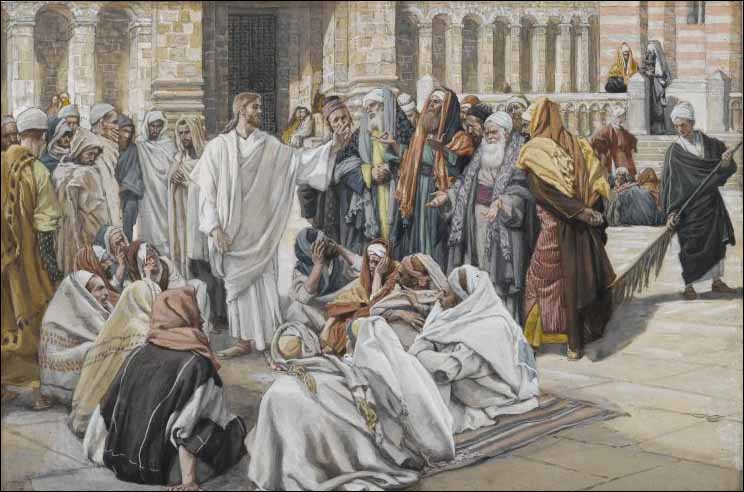
 23 Jesus entered the temple courts, and, while he was teaching, the chief priests and the elders of the people came to him. “By what authority are you doing these things?” they asked. “And who gave you this authority?”
Do you think they truly wanted to know. Or was this a hostile question?
Of late, I do not answer hostile, rhetorical questions.
And here, neither does Jesus. 

And so how does he deal with them? Sometimes, he refuses to answer. Sometimes, he answers a question with a question, “a unique cultural predisposition” of Jewish people, according to the website Stuff Jewish People Like.
What were these things? Cleansing the temple, for one! Healing and teaching in the temple, because he is neither a scribe, nor a priest.

 24 Jesus replied, “I will also ask you one question. If you answer me, I will tell you by what authority I am doing these things. 25 John’s baptism—where did it come from? Was it from heaven, or of human origin?”
   They discussed it among themselves and said, “If we say, ‘From heaven,’ he will ask, ‘Then why didn’t you believe him?’ 26 But if we say, ‘Of human origin’—we are afraid of the people, for they all hold that John was a prophet.”
 27 So they answered Jesus, “We don’t know.”
Canniness meets the creator of human intelligence.
Jesus counter-traps them. If they do not know whether John was from God, how can they judge if Jesus is?

   Then he said, “Neither will I tell you by what authority I am doing these things.”
He calmly and quietly refused to answer their hostile tricky question. 

I am increasingly refusing to engage when it is clear that the intent of the questioner is hostile. 


Jesus “self-destructing.” Telling the truth regardless of the consequences.


 28 “What do you think? There was a man who had two sons. He went to the first and said, ‘Son, go and work today in the vineyard.’


   29 “‘I will not,’ he answered, but later he changed his mind and went.    


30 “Then the father went to the other son and said the same thing. He answered, ‘I will, sir,’ but he did not go.
  
  31 “Which of the two did what his father wanted?”    “The first,” they answered.    
Jesus said to them, “Truly I tell you, the tax collectors and the prostitutes are entering the kingdom of God ahead of you. 32 For John came to you to show you the way of righteousness, and you did not believe him, but the tax collectors and the prostitutes did. And even after you saw this, you did not repent and believe him. 

One son was outwardly acquiescent to his father, and in agreement what the father wanted.  However, in reality, he did what he pleased.

The other son engaged with what his father wanted, and initially refused to obey him, though he ultimately came around and did it.  And so he actually did what his father wanted.

So the ones whom the religious establishment considered as sinners, the prostitutes and tax collectors, initially said No, later repented, and so entered the Kingdom of Heaven. Whereas the outwardly righteous might have have their hearts far from God. 

We may be the son who says Yes, when outwardly we are good church-goers, and clean livers. Inwardly, we might be full of malice, envy, worry, anxiety, and hatred.


On the other hand, we might be judged and criticized by others. Inwardly however, we have repented and turned to God and asked him for the grace to do better.  And our hearts are filled with his joy.
The one who is honest about his failures, turns and does God’s will would be the one who enters the Kingdom of God.

The Greek for repent is μετανοέω, metanoeo, to completely change one’s mind, to radically change direction. 


What is the Kingdom of God? Many things. To me, is the rest and freedom and joy of surrender, when God is your king, and in charge of your life–and in charge of your worries!!

You might also like:


Share on site of your choice … Wikio

Filed Under: Matthew

How to Deal with Hostile Questions.

By Anita Mathias

Matthew 21

 23 Jesus entered the temple courts, and, while he was teaching, the chief priests and the elders of the people came to him. “By what authority are you doing these things?” they asked. “And who gave you this authority?”
Do you think they truly wanted to know. Or was this a hostile question?
Of late, I do not answer hostile, rhetorical questions.
And here, neither does Jesus. 


And so how does he deal with them? Sometimes, he refuses to answer. Sometimes, he answers a question with a question, “a unique cultural predisposition” of Jewish people, according to the website Stuff Jewish People Like.
What were these things? Cleansing the temple, for one! Healing and teaching in the temple, because he is neither a scribe, nor a priest.

 24 Jesus replied, “I will also ask you one question. If you answer me, I will tell you by what authority I am doing these things. 25 John’s baptism—where did it come from? Was it from heaven, or of human origin?”
   They discussed it among themselves and said, “If we say, ‘From heaven,’ he will ask, ‘Then why didn’t you believe him?’ 26 But if we say, ‘Of human origin’—we are afraid of the people, for they all hold that John was a prophet.”
 27 So they answered Jesus, “We don’t know.”
Canniness meets the creator of human intelligence.
Jesus counter-traps them. If they do not know whether John was from God, how can they judge if Jesus is?

   Then he said, “Neither will I tell you by what authority I am doing these things.”
He calmly and quietly refused to answer their hostile tricky question. 


I am increasingly refusing to engage when it is clear that the intent of the questioner is hostile. 

Filed Under: Matthew

Why did you cleanse the temple?

By Anita Mathias


Why did you cleanse the temple?
It would have been so much easier 
to pray in solitude for the filling of the Holy Spirit,
to think of God’s love for you,
to contemplate God,
to love your friends,
to think of all things that were 
noble, right, pure, lovely, and admirable.
Cleansing the temple would mean 
facing the rage and fury of those
whose cattle, sheep and doves you released
whose coins you scattered. 
Within the week, you would be dead.

You cleansed the temple because
what they did was wrong.
It prevented prayer.

It cheated those who came to worship.
It filled the sanctuary set apart
for the Gentiles with noise.
It rewarded greed

You were there.
The rascals were there.
What they did was wrong.
And you could do something about it.
And so you did.

You made a whip of cords,

and you cleansed the temple
                    * * *

Matthew 21:12

 12 Jesus entered the temple courts and drove out all who were buying and selling there. He overturned the tables of the money changers and the benches of those selling doves. 13 “It is written,” he said to them, “‘My house will be called a house of prayer,’e]”>[e] but you are making it ‘a den of robbers.’”


Share on site of your choice … Wikio

Filed Under: Matthew

  • « Previous Page
  • 1
  • …
  • 9
  • 10
  • 11
  • 12
  • 13
  • …
  • 20
  • Next Page »

Sign Up and Get a Free eBook!

Sign up to be emailed my blog posts (one a week) and get the ebook of "Holy Ground," my account of working with Mother Teresa.

Join 536 Other Readers

My Books

Rosaries, Reading, Secrets: A Catholic Childhood in India

Rosaries, Reading Secrets, B&N
USA

UK

Wandering Between Two Worlds: Essays on Faith and Art

Wandering Between Two Worlds
USA

UK

Francesco, Artist of Florence: The Man Who Gave Too Much

Francesco, Artist of Florence
US

UK

The Story of Dirk Willems

The Story of Dirk Willems
US

UK

My Latest Meditation

Anita Mathias: About Me

Anita Mathias

Read my blog on Facebook

Follow me on Twitter

Follow @anitamathias1

Recent Posts

  • At the Cross, God Forgives Us Completely
  • Using God’s Gift of Our Talents: A Path to Joy and Abundance
  • The Kingdom of God is Here Already, Yet Not Yet Here
  • All Those Who Exalt Themselves Will Be Humbled & the Humble Will Be Exalted
  • Christ’s Great Golden Triad to Guide Our Actions and Decisions
  • How Jesus Dealt With Hostility and Enemies
  • Do Not Be Afraid, but Do Be Prudent
  • For Scoundrels, Scallywags, and Rascals—Christ Came
  • How to Lead an Extremely Significant Life
  • Don’t Walk Away From Jesus, but if You Do, He Still Looks at You and Loves You
Premier Digital Awards 2015 - Finalist - Blogger of the year
Runner Up Christian Media Awards 2014 - Tweeter of the year

Categories

What I’m Reading


Wolf Hall
Hilary Mantel

Wolf Hall --  Amazon.com
Amazon.com

Amazon.co.uk

Silence and Honey Cakes:
The Wisdom Of The Desert
Rowan Williams

Silence and Honey Cakes --  Amazon.com
Amazon.com

Amazon.co.uk

The Long Loneliness:
The Autobiography of the Legendary Catholic Social Activist
Dorothy Day

The Long Loneliness --  Amazon.com
Amazon.com

Amazon.co.uk

Country Girl
Edna O'Brien

Country Girl  - Amazon.com
Amazon.com

Amazon.co.uk

Archive by month

My Latest Five Podcast Meditations

INSTAGRAM

anita.mathias

My memoir: Rosaries, Reading, Secrets https://amzn.to/42xgL9t
Oxford, England. Writer, memoirist, podcaster, blogger, Biblical meditation teacher, mum

Looking at photos from our week in beautiful Sevil Looking at photos from our week in beautiful Seville and Cordoba over New Year with Irene, who had a week off.
And, ICYMI, here’s my latest meditation on the Gospel of Matthew… I’ve recorded it, should you want a few minutes of peace.
https://anitamathias.com/2026/04/29/gods-complete-forgiveness/
Hello Friends, I'm resumed recording my meditation Hello Friends, I'm resumed recording my meditations on the Gospel of Matthew. Do click on this link to listen. 
https://anitamathias.com/.../29/gods-complete-forgiveness/
Christ is the most influential figure in the history of the world, though his life ended in shame, humiliation and failure. But he so completely turned things round in his great reversal that the cross on which he died when all seemed hopeless is now the most common, and revered, symbol in history.
He emerged from and was anchored in Judaism. And as the sins of the people were laid on the scapegoat who was sent into the wilderness to perish, Christ died as the lamb of God voluntarily bearing the guilt of the wrongdoing of the whole world. He paid the price for our forgiveness with his life-blood--in accordance with the iron law of the physical and moral universe, of sowing and reaping, cause and effect. 
And so, God, who appeared as flames of fire to Moses, can now dwell within us, purifying us, whose hearts have darkness and shards of ice. 
And now that Christ was crucified, died, but rose again, His Spirit, no longer contained within his earthly body, is poured out like living water onto all humans, at our humble request. The Spirit pours the love of God into us; he reminds us of the words of Jesus and slowly writes Christ’s sweet law on our hearts. This transfusion of grace helps us do hard things we previously couldn’t do. Our dance with the Spirit gradually breaks the power of sin over us. It transforms us.
Now we, the forgiven, protected by the blood of Jesus poured out over us, and filled with His Spirit, who sings within us, Abba, Father, are adopted by God as his children in his joyful new covenant. We are cells grafted into the vine of our new family--Father, Son, Spirit—who now live in us as we live in them. As we choose by our thoughts and actions to continue living in the vine of Jesus, their energy pulsing through us makes us fruitful. And now, all our prayers which flow in the river of God’s good purposes are kindly heard. Waves of love and power flood from the cross! 
Thank you!
Well, hello friends! Breaking radio silence to let Well, hello friends! Breaking radio silence to let you know that I have taped a meditation for you on Christ’s famous Parable of the Talents in Matthew 25. https://anitamathias.com/2025/11/05/using-gods-gift-of-our-talents-a-path-to-joy-and-abundance/
Here you are, click the play button in the blog post for a brief meditation, and some moments of peace, and, perhaps, inspiration in your day 🙂
Hi Friends, I have taped a meditation; do listen a Hi Friends, I have taped a meditation; do listen at this link: https://anitamathias.com/2025/04/08/the-kingdom-of-god-is-here-already-yet-not-yet-here-2/
It’s on the Kingdom of God, of which Christ so often spoke, which is here already—a mysterious, shimmering internal palace in which, in lightning flashes, we experience peace and joy, and yet, of course, not yet fully here. We sense the rainbowed presence of Christ in the song which pulses through creation. Christ strolls into our rooms with his wisdom and guidance, and things change. Our prayers are answered; we are healed; our hearts are strangely warmed. Sometimes.
And yet, we also experience evil within & all around us. Our own sin which can shatter our peace and the trajectory of our lives. And the sins of the world—its greed, dishonesty and environmental destruction.
But in this broken world, we still experience the glory of creation; “coincidences” which accelerate once we start praying, and shalom which envelops us like sudden sunshine. The portals into this Kingdom include repentance, gratitude, meditative breathing, and absolute surrender.
The Kingdom of God is here already. We can experience its beauty, peace and joy today through the presence of the Holy Spirit. But yet, since, in the Apostle Paul’s words, we do not struggle only “against flesh and blood, but against the rulers, against the unseen powers of this dark world and against the spiritual forces of evil,” its fullness still lingers…
Our daughter Zoe was ordained into the Church of E Our daughter Zoe was ordained into the Church of England in June. I have been on a social media break… but … better late than never. Enjoy!
First picture has my sister, Shalini, who kindly flew in from the US. Our lovely cousins Anthony and Sarah flank Zoe in the next picture.
The Bishop of London, Sarah Mullaly, ordained Zoe. You can see her praying that Zoe will be filled with the Holy Spirit!!
And here’s a meditation I’ve recorded, which you might enjoy. The link is also in my profile
https://anitamathias.com/2024/11/07/all-those-who-exalt-themselves-will-be-humbled-the-humble-will-be-exalted/
I have taped a meditation on Jesus statement in Ma I have taped a meditation on Jesus statement in Matthew 23, “For those who exalt themselves will be humbled, and those who humble themselves will be exalted.”
Do listen here. https://anitamathias.com/2024/11/07/all-those-who-exalt-themselves-will-be-humbled-the-humble-will-be-exalted/
Link also in bio.
And so, Jesus states a law of life. Those who broadcast their amazingness will be humbled, since God dislikes—scorns that, as much as people do.  For to trumpet our success, wealth, brilliance, giftedness or popularity is to get distracted from our life’s purpose into worthless activity. Those who love power, who are sure they know best, and who must be the best, will eventually be humbled by God and life. For their focus has shifted from loving God, doing good work, and being a blessing to their family, friends, and the world towards impressing others, being enviable, perhaps famous. These things are houses built on sand, which will crumble when hammered by the waves of old age, infirmity or adversity. 
God resists the proud, Scripture tells us—those who crave the admiration and power which is His alone. So how do we resist pride? We slow down, so that we realise (and repent) when sheer pride sparks our allergies to people, our enmities, our determination to have our own way, or our grandiose ego-driven goals, and ambitions. Once we stop chasing limelight, a great quietness steals over our lives. We no longer need the drug of continual achievement, or to share images of glittering travel, parties, prizes or friends. We just enjoy them quietly. My life is for itself & not for a spectacle, Emerson wrote. And, as Jesus advises, we quit sharp-elbowing ourselves to sit with the shiniest people, but are content to hang out with ordinary people; and then, as Jesus said, we will inevitably, eventually, be summoned higher to the sparkling conversation we craved. 
One day, every knee will bow before the gentle lamb who was slain, now seated on the throne. We will all be silent before him. Let us live gently then, our eyes on Christ, continually asking for his power, his Spirit, and his direction, moving, dancing, in the direction that we sense him move.
Link to new podcast in Bio https://anitamathias.co Link to new podcast in Bio https://anitamathias.com/2024/02/20/how-jesus-dealt-with-hostility-and-enemies/
3 days before his death, Jesus rampages through the commercialised temple, overturning the tables of moneychangers. Who gave you the authority to do these things? his outraged adversaries ask. And Jesus shows us how to answer hostile questions. Slow down. Breathe. Quick arrow prayers!
Your enemies have no power over your life that your Father has not permitted them. Ask your Father for wisdom, remembering: Questions do not need to be answered. Are these questioners worthy of the treasures of your heart? Or would that be feeding pearls to hungry pigs, who might instead devour you?
Questions can contain pitfalls, traps, nooses. Jesus directly answered just three of the 183 questions he was asked, refusing to answer some; answering others with a good question.
But how do we get the inner calm and wisdom to recognise
and sidestep entrapping questions? Long before the day of
testing, practice slow, easy breathing, and tune in to the frequency of the Father. There’s no record of Jesus running, rushing, getting stressed, or lacking peace. He never spoke on his own, he told us, without checking in with the Father. So, no foolish, ill-judged statements. Breathing in the wisdom of the Father beside and within him, he, unintimidated, traps the trappers.
Wisdom begins with training ourselves to slow down and ask
the Father for guidance. Then our calm minds, made perceptive, will help us recognise danger and trick questions, even those coated in flattery, and sidestep them or refuse to answer.
We practice tuning in to heavenly wisdom by practising–asking God questions, and then listening for his answers about the best way to do simple things…organise a home or write. Then, we build upwards, asking for wisdom in more complex things.
Listening for the voice of God before we speak, and asking for a filling of the Spirit, which Jesus calls streams of living water within us, will give us wisdom to know what to say, which, frequently, is nothing at all. It will quieten us with the silence of God, which sings through the world, through sun and stars, sky and flowers.
Especially for @ samheckt Some very imperfect pi Especially for @ samheckt 
Some very imperfect pictures of my labradoodle Merry, and golden retriever Pippi.
And since, I’m on social media, if you are the meditating type, here’s a scriptural meditation on not being afraid, while being prudent. https://anitamathias.com/2024/01/03/do-not-be-afraid-but-do-be-prudent/
A new podcast. Link in bio https://anitamathias.c A new podcast. Link in bio
https://anitamathias.com/2024/01/03/do-not-be-afraid-but-do-be-prudent/
Do Not Be Afraid, but Do Be Prudent
“Do not be afraid,” a dream-angel tells Joseph, to marry Mary, who’s pregnant, though a virgin, for in our magical, God-invaded world, the Spirit has placed God in her. Call the baby Jesus, or The Lord saves, for he will drag people free from the chokehold of their sins.
And Joseph is not afraid. And the angel was right, for a star rose, signalling a new King of the Jews. Astrologers followed it, threatening King Herod, whose chief priests recounted Micah’s 600-year-old prophecy: the Messiah would be born in Bethlehem, as Jesus had just been, while his parents from Nazareth registered for Augustus Caesar’s census of the entire Roman world. 
The Magi worshipped the baby, offering gold. And shepherds came, told by an angel of joy: that the Messiah, a saviour from all that oppresses, had just been born.
Then, suddenly, the dream-angel warned: Flee with the child to Egypt. For Herod plans to kill this baby, forever-King.
Do not be afraid, but still flee? Become a refugee? But lightning-bolt coincidences verified the angel’s first words: The magi with gold for the flight. Shepherds
telling of angels singing of coming inner peace. Joseph flees.
What’s the difference between fear and prudence? Fear is being frozen or panicked by imaginary what-ifs. It tenses our bodies; strains health, sleep and relationships; makes us stingy with ourselves & others; leads to overwork, & time wasted doing pointless things for fear of people’s opinions.
Prudence is wisdom-using our experience & spiritual discernment as we battle the demonic forces of this dark world, in Paul’s phrase.It’s fighting with divinely powerful weapons: truth, righteousness, faith, Scripture & prayer, while surrendering our thoughts to Christ. 
So let’s act prudently, wisely & bravely, silencing fear, while remaining alert to God’s guidance, delivered through inner peace or intuitions of danger and wrongness, our spiritual senses tuned to the Spirit’s “No,” his “Slow,” his “Go,” as cautious as a serpent, protected, while being as gentle as a lamb among wolves.
Follow on Instagram

© 2026 Dreaming Beneath the Spires · All Rights Reserved. · Cookie Policy · Privacy Policy