Anita Mathias: Dreaming Beneath the Spires

Anita Mathias's Blog on Faith and Art

  • Home
  • My Books
  • Meditations
  • Essays
  • Contact
  • About Me

A Stairway to Heaven, Genesis 28-29, Day 25, Jan 25

By Anita Mathias

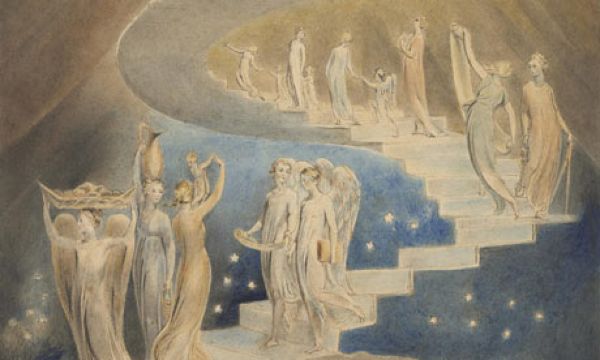
William Blake, Stairway to Heaven

Genesis 28

 1 So Isaac called for Jacob and blessed him. Then he commanded him: “Do not marry a Canaanite woman. 2 Go at once to Paddan Aram, to the house of your mother’s father Bethuel. Take a wife for yourself there, from among the daughters of Laban, your mother’s brother. 3 May God Almighty bless you and make you fruitful and increase your numbers until you become a community of peoples. 4 May he give you and your descendants the blessing given to Abraham, so that you may take possession of the land where you now reside as a foreigner, the land God gave to Abraham.” 5 Then Isaac sent Jacob on his way, and he went to Paddan Aram, to Laban son of Bethuel the Aramean, the brother of Rebekah, who was the mother of Jacob and Esau.
The power of these Old Testament blessings–and traditional and contemporary Jewish paternal blessings, perhaps–is that they were addressed to God in prayer. They were prayers spoken aloud, destiny-inducing prayers.

 6 Now Esau learned that Isaac had blessed Jacob and had sent him to Paddan Aram to take a wife from there, and that when he blessed him he commanded him, “Do not marry a Canaanite woman,” 7 and that Jacob had obeyed his father and mother and had gone to Paddan Aram. 8 Esau then realized how displeasing the Canaanite women were to his father Isaac; 9 so he went to Ishmael and married Mahalath, the sister of Nebaioth and daughter of Ishmael son of Abraham, in addition to the wives he already had.
Jacob’s Dream at Bethel

 10 Jacob left Beersheba and set out for Harran. 11 When he reached a certain place, he stopped for the night because the sun had set. Taking one of the stones there, he put it under his head and lay down to sleep. 12 He had a dream in which he saw a stairway resting on the earth, with its top reaching to heaven, and the angels of God were ascending and descending on it. 
I love this. Prayer is the stairway to heaven. Heaven opens to us anywhere, and at any time, we sit down and send up the magic staircase.
A ladder between heaven and earth. God now dwells as much on earth as in heaven.
The only pre-conditions I think for setting up and anchoring this staircase are a repentant heart. A pure heart, preferably, and if not, a heart that by repentance is purified. 


13 There above it stood the LORD, and he said: “I am the LORD, the God of your father Abraham and the God of Isaac. I will give you and your descendants the land on which you are lying. 
A free gift given to the schemer. 


14 Your descendants will be like the dust of the earth, and you will spread out to the west and to the east, to the north and to the south. All peoples on earth will be blessed through you and your offspring. 15 I am with you and will watch over you wherever you go,
Sweet words of promise repeated by Christ


and I will bring you back to this land. I will not leave you until I have done what I have promised you.”
Again, sweet words to strengthen Jacob through many years of travail.

 16 When Jacob awoke from his sleep, he thought, “Surely the LORD is in this place, and I was not aware of it.” 

How many times in my life has the Lord been in a place of disappointment, in a place of injustice, in a place of failure, in a place of glacial slowness, and I was not aware of it. 
I feel sorry now for the time I spent in bitterness and resentment. The Lord was in that place, and I was not aware of it. 

17 He was afraid and said, “How awesome is this place! This is none other than the house of God; this is the gate of heaven.”
Not just Bethel, but the gates which slide open to us when we pray. 
NIV–Jesus himself is the bridge between heaven and earth
Brilliant!! A stairway between heaven and earth, and God himself at the top of the stairway speaking words of reassurance, comfort and prophecy. 
And why does he give Jacob this vision, after Jacob’s lies, deception and hard-balled manipulation?
Because of his great mercy.

 18 Early the next morning Jacob took the stone he had placed under his head and set it up as a pillar and poured oil on top of it. 19 He called that place Bethel, though the city used to be called Luz.
 20 Then Jacob made a vow, saying, “If God will be with me and will watch over me on this journey I am taking and will give me food to eat and clothes to wear 21so that I return safely to my father’s household, then the LORD will be my God 22 and this stone that I have set up as a pillar will be God’s house, and of all that you give me I will give you a tenth.”

A tenth was a King’s share. Jacob thereby will acknowledges God as his Lord and King.
He is not yet fully committed to the Lord. It is a conditional vow. 


Genesis 29

Jacob Arrives in Paddan Aram

 1 Then Jacob continued on his journey and came to the land of the eastern peoples. 2 There he saw a well in the open country, with three flocks of sheep lying near it because the flocks were watered from that well. The stone over the mouth of the well was large. 3 When all the flocks were gathered there, the shepherds would roll the stone away from the well’s mouth and water the sheep. Then they would return the stone to its place over the mouth of the well.

 4 Jacob asked the shepherds, “My brothers, where are you from?”
   “We’re from Harran,” they replied.
 5 He said to them, “Do you know Laban, Nahor’s grandson?”
   “Yes, we know him,” they answered.
 6 Then Jacob asked them, “Is he well?”
   “Yes, he is,” they said, “and here comes his daughter Rachel with the sheep.”
 7 “Look,” he said, “the sun is still high; it is not time for the flocks to be gathered. Water the sheep and take them back to pasture.”
 8 “We can’t,” they replied, “until all the flocks are gathered and the stone has been rolled away from the mouth of the well. Then we will water the sheep.”
 9 While he was still talking with them, Rachel came with her father’s sheep, for she was a shepherd. 10 When Jacob saw Rachel daughter of his uncle Laban, and Laban’s sheep, he went over and rolled the stone away from the mouth of the well and watered his uncle’s sheep. 11 Then Jacob kissed Rachel and began to weep aloud. 12 He had told Rachel that he was a relative of her father and a son of Rebekah. So she ran and told her father.
 13 As soon as Laban heard the news about Jacob, his sister’s son, he hurried to meet him. He embraced him and kissed him and brought him to his home, and there Jacob told him all these things. 14 Then Laban said to him, “You are my own flesh and blood.”
Jacob Marries Leah and Rachel

    After Jacob had stayed with him for a whole month, 15 Laban said to him, “Just because you are a relative of mine, should you work for me for nothing? Tell me what your wages should be.”

 16 Now Laban had two daughters; the name of the older was Leah, and the name of the younger was Rachel. 17 Leah had weak[a] eyes, but Rachel had a lovely figure and was beautiful. 18 Jacob was in love with Rachel and said, “I’ll work for you seven years in return for your younger daughter Rachel.”
 19 Laban said, “It’s better that I give her to you than to some other man. Stay here with me.” 20 So Jacob served seven years to get Rachel, but they seemed like only a few days to him because of his love for her.
 21 Then Jacob said to Laban, “Give me my wife. My time is completed, and I want to make love to her.”
 22 So Laban brought together all the people of the place and gave a feast. 23 But when evening came, he took his daughter Leah and brought her to Jacob, and Jacob made love to her. 24 And Laban gave his servant Zilpah to his daughter as her attendant.
 25 When morning came, there was Leah! So Jacob said to Laban, “What is this you have done to me? I served you for Rachel, didn’t I? Why have you deceived me?”
 26 Laban replied, “It is not our custom here to give the younger daughter in marriage before the older one. 27 Finish this daughter’s bridal week; then we will give you the younger one also, in return for another seven years of work.”
The deceiver is deceived. He reaps what he sows. And so it works with grinding inevitability.
NIV, Jacob, deceiver in name as well as in behaviour has himself been deceived. The one who tried everything to obtain the benefits of the firstborn has now, against his will, received the first born.
As he manipulated away his brother’s birthright, so he too has been cruelly deceived into working seven years for a wife he does not particularly love.


28 And Jacob did so. He finished the week with Leah, and then Laban gave him his daughter Rachel to be his wife. 29 Laban gave his servant Bilhah to his daughter Rachel as her attendant. 30 Jacob made love to Rachel also, and his love for Rachel was greater than his love for Leah. And he worked for Laban another seven years.

Jacob’s Children


 31 When the LORD saw that Leah was not loved, he enabled her to conceive, but Rachel remained childless. 
God in his own way is just.  “Righteous art thou, O Lord, when I complain to thee,/ Yet I would plead my case before thee.” Jeremiah 12.
32 Leah became pregnant and gave birth to a son. She named him Reuben, for she said, “It is because the LORD has seen my misery. Surely my husband will love me now.”

 33 She conceived again, and when she gave birth to a son she said, “Because the LORD heard that I am not loved, he gave me this one too.” So she named him Simeon.
 34 Again she conceived, and when she gave birth to a son she said, “Now at last my husband will become attached to me, because I have borne him three sons.” So he was named Levi.
 35 She conceived again, and when she gave birth to a son she said, “This time I will praise the LORD.” So she named him Judah. Then she stopped having children.

Interestingly, the one for whom she praised God, rather than used as a sure basis for gaining the love of Jacob, proved the ancestor of Jesus. 


“The heart has its reasons of which reason never dreams,” Blaise Pascal. If love does not come freely, it is near impossible for it to be “earned,” as Leah sadly discovers. 


Filed Under: Genesis

Jacob, the Deceiver, is blessed Gen 26-27.Day 23, Jan 23

By Anita Mathias


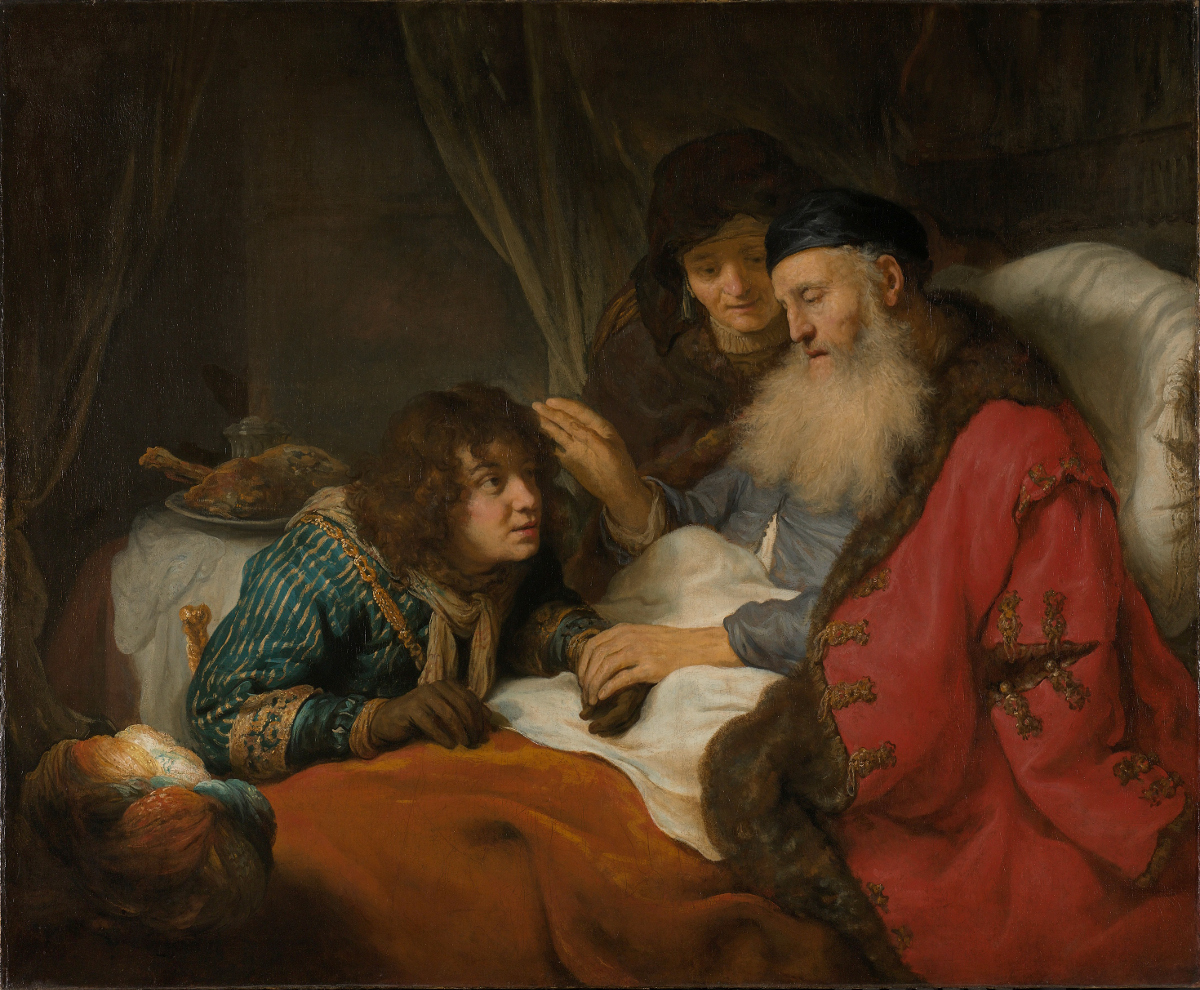
Isaac blesses Jacob, Govert Flink


Genesis 26
 12 Isaac planted crops in that land and the same year reaped a hundredfold, because the LORD blessed him. 13 The man became rich, and his wealth continued to grow until he became very wealthy. 14 He had so many flocks and herds and servants that the Philistines envied him. 15 So all the wells that his father’s servants had dug in the time of his father Abraham, the Philistines stopped up, filling them with earth.

 16 Then Abimelek said to Isaac, “Move away from us; you have become too powerful for us.”

17 So Isaac moved away from there and encamped in the Valley of Gerar, where he settled. 18 Isaac reopened the wells that had been dug in the time of his father Abraham, which the Philistines had stopped up after Abraham died, and he gave them the same names his father had given them.
 19 Isaac’s servants dug in the valley and discovered a well of fresh water there. 20 But the herders of Gerar quarreled with those of Isaac and said, “The water is ours!” So he named the well Esek,[c] because they disputed with him. 21 Then they dug another well, but they quarreled over that one also; so he named it Sitnah.[d] 22 He moved on from there and dug another well, and no one quarreled over it. He named it Rehoboth,[e] saying, “Now the LORD has given us room and we will flourish in the land.”


Isaac is irenic, and attempts to live at peace with his neighbours. He redigs his fathers well, and discovers and digs new wells. The Philistines claim them, so he moves on until he finds a well which no one quarrels over. God’s blessing is over him, and he increases in wealth, though he makes every attempt to live at peace with his neightburs.

 23 From there he went up to Beersheba. 24 That night the LORD appeared to him and said, “I am the God of your father Abraham. Do not be afraid, for I am with you; I will bless you and will increase the number of your descendants for the sake of my servant Abraham.”


And God rewards him for his peaceful, faith-filled stance. God appears to Isaac and tells him not to be afraid, because God is with him, and is blessing him.

 25 Isaac built an altar there and called on the name of the LORD. There he pitched his tent, and there his servants dug a well.
 26 Meanwhile, Abimelek had come to him from Gerar, with Ahuzzath his personal adviser and Phicol the commander of his forces. 27 Isaac asked them, “Why have you come to me, since you were hostile to me and sent me away?”
 28 They answered, “We saw clearly that the LORD was with you; so we said, ‘There ought to be a sworn agreement between us’—between us and you. Let us make a treaty with you 29 that you will do us no harm, just as we did not harm you but always treated you well and sent you away peacefully. And now you are blessed by the LORD.”
 30 Isaac then made a feast for them, and they ate and drank. 31 Early the next morning the men swore an oath to each other. Then Isaac sent them on their way, and they went away peacefully.

When a man’s ways are pleasing to the LORD, he makes even his enemies live at peace with him. (Proverbs 16:7).

 32 That day Isaac’s servants came and told him about the well they had dug. They said, “We’ve found water!” 33 He called it Shibah,[f] and to this day the name of the town has been Beersheba.[g]


34 When Esau was forty years old, he married Judith daughter of Beeri the Hittite, and also Basemath daughter of Elon the Hittite. 35 They were a source of grief to Isaac and Rebekah.
A less than complimentary picture is being painted of Esau, and his judgment.

Genesis 27

Jacob lies, deceives, tricks, manipulates, and is lavishly blessed by God. Why? Among other things because he desperately wanted God’s blessing more than anything else.
 1 When Isaac was old and his eyes were so weak that he could no longer see, he called for Esau his older son and said to him, “My son.”
   “Here I am,” he answered.
 2 Isaac said, “I am now an old man and don’t know the day of my death. 3 Now then, get your equipment—your quiver and bow—and go out to the open country to hunt some wild game for me. 4 Prepare me the kind of tasty food I like and bring it to me to eat, so that I may give you my blessing before I die.”

ESV–Such blessings were very important because as prayers addressed to God, they were viewed as shaping the future of those blessed.

 5 Now Rebekah was listening as Isaac spoke to his son Esau. When Esau left for the open country to hunt game and bring it back, 6 Rebekah said to her son Jacob, “Look, I overheard your father say to your brother Esau, 7 ‘Bring me some game and prepare me some tasty food to eat, so that I may give you my blessing in the presence of the LORD before I die.’ 8 Now, my son, listen carefully and do what I tell you: 9 Go out to the flock and bring me two choice young goats, so I can prepare some tasty food for your father, just the way he likes it. 10 Then take it to your father to eat, so that he may give you his blessing before he dies.”
The incredible unfairness and trickery. 
NIV–Rebekah proves as deceitful as Jacob, whose very name signifies deceit.

 11 Jacob said to Rebekah his mother, “But my brother Esau is a hairy man while I have smooth skin. 12 What if my father touches me? I would appear to be tricking him and would bring down a curse on myself rather than a blessing.”
It was not the rightness or wrongness that troubled Jacob, just the danger of failure.

 13 His mother said to him, “My son, let the curse fall on me. 
And later it does.
Just do what I say; go and get them for me.”

 14 So he went and got them and brought them to his mother, and she prepared some tasty food, just the way his father liked it. 15 Then Rebekah took the best clothes of Esau her older son, which she had in the house, and put them on her younger son Jacob. 16 She also covered his hands and the smooth part of his neck with the goatskins.  17 Then she handed to her son Jacob the tasty food and the bread she had made.


 18 He went to his father and said, “My father.”


   “Yes, my son,” he answered. “Who is it?”


 19 Jacob said to his father, “I am Esau your firstborn. I have done as you told me. Please sit up and eat some of my game, so that you may give me your blessing.”


 20 Isaac asked his son, “How did you find it so quickly, my son?”


   “The LORD your God gave me success,” he replied.


 21 Then Isaac said to Jacob, “Come near so I can touch you, my son, to know whether you really are my son Esau or not.”


 22 Jacob went close to his father Isaac, who touched him and said, “The voice is the voice of Jacob, but the hands are the hands of Esau.” 23 He did not recognize him, for his hands were hairy like those of his brother Esau; so he proceeded to bless him. 24 “Are you really my son Esau?” he asked.


   “I am,” he replied.


 25 Then he said, “My son, bring me some of your game to eat, so that I may give you my blessing.”


   Jacob brought it to him and he ate; and he brought some wine and he drank. 26 Then his father Isaac said to him, “Come here, my son, and kiss me.”


 27 So he went to him and kissed him. When Isaac caught the smell of his clothes, he blessed him and said,
   “Ah, the smell of my son
   is like the smell of a field
   that the LORD has blessed.
28 May God give you heaven’s dew
   and earth’s richness—
   an abundance of grain and new wine.
29 May nations serve you
   and peoples bow down to you.
Be lord over your brothers,
   and may the sons of your mother bow down to you.
May those who curse you be cursed
   and those who bless you be blessed.”

The blessing promised to Abraham, which those of us who are children of Abraham by faith inherit too.
And should Jacob have been blessed with this blessing after his incredible trickery? No.
Was he? Yes. 
God has mercy on whom he will have mercy. 
How rich and many-sided those OT blessings were.


God in his sovereignty uses both good and evil actions to bring about what he has purposed. 


 30 After Isaac finished blessing him, and Jacob had scarcely left his father’s presence, his brother Esau came in from hunting. 31 He too prepared some tasty food and brought it to his father. Then he said to him, “My father, please sit up and eat some of my game, so that you may give me your blessing.”


 32 His father Isaac asked him, “Who are you?”


   “I am your son,” he answered, “your firstborn, Esau.”


 33 Isaac trembled violently and said, “Who was it, then, that hunted game and brought it to me? I ate it just before you came and I blessed him—and indeed he will be blessed!”


 34 When Esau heard his father’s words, he burst out with a loud and bitter cry and said to his father, “Bless me—me too, my father!”


 35 But he said, “Your brother came deceitfully and took your blessing.”


 36 Esau said, “Isn’t he rightly named Jacob[a]? This is the second time he has taken advantage of me: He took my birthright, and now he’s taken my blessing!” Then he asked, “Haven’t you reserved any blessing for me?”


 37 Isaac answered Esau, “I have made him lord over you and have made all his relatives his servants, and I have sustained him with grain and new wine. So what can I possibly do for you, my son?”


 38 Esau said to his father, “Do you have only one blessing, my father? Bless me too, my father!” Then Esau wept aloud.
It is incredibly poignant.


 39 His father Isaac answered him,
   “Your dwelling will be
   away from the earth’s richness,
   away from the dew of heaven above.
40 You will live by the sword
   and you will serve your brother.
But when you grow restless,
   you will throw his yoke
   from off your neck.”


Because Jacob was blessed with primacy over Esau, Esau’s blessing is almost a curse, except for the last assurance, which echoes the secondary blessing given to Ishmael.


 41 Esau held a grudge against Jacob because of the blessing his father had given him. He said to himself, “The days of mourning for my father are near; then I will kill my brother Jacob.”


 42 When Rebekah was told what her older son Esau had said, she sent for her younger son Jacob and said to him, “Your brother Esau is planning to avenge himself by killing you. 43 Now then, my son, do what I say: Flee at once to my brother Laban in Harran. 44 Stay with him for a while until your brother’s fury subsides. 45 When your brother is no longer angry with you and forgets what you did to him, I’ll send word for you to come back from there. Why should I lose both of you in one day?”
She loses the one she loves, and keeps the one she does not. Rebekah eats the fruit of her trickery, as Jacob shall too.
Jacob stays away for 20 years. Rebekah never sees him again.


 46 Then Rebekah said to Isaac, “I’m disgusted with living because of these Hittite women. If Jacob takes a wife from among the women of this land, from Hittite women like these, my life will not be worth living.”

Filed Under: Genesis

The Triumph of the Schemer, Genesis 24-26, Day 21, Jan 21

By Anita Mathias


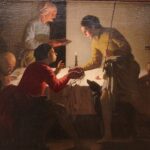
Esau sells his Birthright
 Hendrick ter Brugghen, 1528 – 1629,

Genesis 24
When Abraham’s servant heard what they said, he bowed down to the ground before the LORD. 53 Then the servant brought out gold and silver jewelry and articles of clothing and gave them to Rebekah; he also gave costly gifts to her brother and to her mother. 54 Then he and the men who were with him ate and drank and spent the night there.

   When they got up the next morning, he said, “Send me on my way to my master.”

 55 But her brother and her mother replied, “Let the young woman remain with us ten days or so; then you may go.”

 56 But he said to them, “Do not detain me, now that the LORD has granted success to my journey. Send me on my way so I may go to my master.”
 57 Then they said, “Let’s call the young woman and ask her about it.” 58 So they called Rebekah and asked her, “Will you go with this man?”
   “I will go,” she said.
 59 So they sent their sister Rebekah on her way, along with her nurse and Abraham’s servant and his men. 60 And they blessed Rebekah and said to her,
   “Our sister, may you increase
   to thousands upon thousands;
may your offspring possess
   the cities of their enemies.”
Echoes of God’s promise to Abraham.
 61 Then Rebekah and her attendants got ready and mounted the camels and went back with the man. So the servant took Rebekah and left.
 62 Now Isaac had come from Beer Lahai Roi, for he was living in the Negev. 63 He went out to the field one evening to meditate, and as he looked up, he saw camels approaching. 64Rebekah also looked up and saw Isaac. She got down from her camel 65 and asked the servant, “Who is that man in the field coming to meet us?”
   “He is my master,” the servant answered. So she took her veil and covered herself.
 66 Then the servant told Isaac all he had done. 67 Isaac brought her into the tent of his mother Sarah, and he married Rebekah. So she became his wife, and he loved her; and Isaac was comforted after his mother’s death.

An arranged marriage and apparently, a happy one. 


Genesis 25

The Death of Abraham

 1 Abraham had taken another wife, whose name was Keturah. 2 She bore him Zimran, Jokshan, Medan, Midian, Ishbak and Shuah. 3 Jokshan was the father of Sheba and Dedan; the descendants of Dedan were the Ashurites, the Letushites and the Leummites. 4 The sons of Midian were Ephah, Epher, Hanok, Abida and Eldaah. All these were descendants of Keturah.

 5 Abraham left everything he owned to Isaac. 6 But while he was still living, he gave gifts to the sons of his concubines and sent them away from his son Isaac to the land of the east.

 7 Abraham lived a hundred and seventy-five years. 8 Then Abraham breathed his last and died at a good old age, an old man and full of years; and he was gathered to his people. 9 His sons Isaac and Ishmael buried him in the cave of Machpelah near Mamre, in the field of Ephron son of Zohar the Hittite, 10 the field Abraham had bought from the Hittites. There Abraham was buried with his wife Sarah. 11 After Abraham’s death, God blessed his son Isaac, who then lived near Beer Lahai Roi.

Ishmael’s Sons

 12 This is the account of the family line of Abraham’s son Ishmael, whom Sarah’s slave, Hagar the Egyptian, bore to Abraham.

 13 These are the names of the sons of Ishmael, listed in the order of their birth: Nebaioth the firstborn of Ishmael, Kedar, Adbeel, Mibsam, 14 Mishma, Dumah, Massa, 15 Hadad, Tema, Jetur, Naphish and Kedemah. 16 These were the sons of Ishmael, and these are the names of the twelve tribal rulers according to their settlements and camps. 17 Ishmael lived a hundred and thirty-seven years. He breathed his last and died, and he was gathered to his people. 18 His descendants settled in the area from Havilah to Shur, near the eastern border of Egypt, as you go toward Ashur. And they lived in hostility toward all the tribes related to them.
Jacob and Esau

 19 This is the account of the family line of Abraham’s son Isaac.   Abraham became the father of Isaac, 20 and Isaac was forty years old when he married Rebekah daughter of Bethuel the Aramean from Paddan Aram and sister of Laban the Aramean.

 21 Isaac prayed to the LORD on behalf of his wife, because she was childless. The LORD answered his prayer, and his wife Rebekah became pregnant. 22 The babies jostled each other within her, and she said, “Why is this happening to me?” So she went to inquire of the LORD.
 23 The LORD said to her,
   “Two nations are in your womb,
   and two peoples from within you will be separated;
one people will be stronger than the other,
   and the older will serve the younger.”

Why? A fact of life which we just have to come to terms with, the sooner the better. God’s gifts are not equal. He gives different people different gifts of wealth, intelligence, beauty,health, physique, temperament, luck, destiny, families, according to his plans for them. It is our job then to do the best with the hand of cards which we’ve been dealt. 

 24 When the time came for her to give birth, there were twin boys in her womb. 25 The first to come out was red, and his whole body was like a hairy garment; so they named him Esau. 26 After this, his brother came out, with his hand grasping Esau’s heel; so he was named Jacob.
Jacob means He grasps the heel, an idiom for He deceives.
Isaac was sixty years old when Rebekah gave birth to them.

 27 The boys grew up, and Esau became a skillful hunter, a man of the open country, while Jacob was content to stay at home among the tents. 28 Isaac, who had a taste for wild game, loved Esau, but Rebekah loved Jacob.
 29 Once when Jacob was cooking some stew, Esau came in from the open country, famished. 30 He said to Jacob, “Quick, let me have some of that red stew! I’m famished!” (That is why he was also called Edom.)
 31 Jacob replied, “First sell me your birthright.”
Jacob was blessed, but he also valued blessing greatly. Is that a trait of those God blesses? That they greatly value his blessing?

The birthright included the inheritance rights of the first-born. Jacob was the schemer, seeking any means to gain an advantage. 
 32 “Look, I am about to die,” Esau said. “What good is the birthright to me?”
The impulsive Esau possibly did not have the character to be the Patriarch of God’s Chosen People. 
 33 But Jacob said, “Swear to me first.” So he swore an oath to him, selling his birthright to Jacob.
 34 Then Jacob gave Esau some bread and some lentil stew. He ate and drank, and then got up and left.
   So Esau despised his birthright.
And included in the birthright, were the covenant promises that Isaac inherited from Abraham–God’s plan of redemption for the whole world.

Isaac and Abimelek

 1 Now there was a famine in the land—besides the previous famine in Abraham’s time—and Isaac went to Abimelek king of the Philistines in Gerar. 2 The LORD appeared to Isaac and said, “Do not go down to Egypt; live in the land where I tell you to live. 3 Stay in this land for a while, and I will be with you and will bless you. For to you and your descendants I will give all these lands and will confirm the oath I swore to your father Abraham. 4 I will make your descendants as numerous as the stars in the sky and will give them all these lands, and through your offspring[a] all nations on earth will be blessed,[b] 5 because Abraham obeyed me and did everything I required of him, keeping my commands, my decrees and my instructions.” 6 So Isaac stayed in Gerar.

 7 When the men of that place asked him about his wife, he said, “She is my sister,” because he was afraid to say, “She is my wife.” He thought, “The men of this place might kill me on account of Rebekah, because she is beautiful.”
 8 When Isaac had been there a long time, Abimelek king of the Philistines looked down from a window and saw Isaac caressing his wife Rebekah. 9 So Abimelek summoned Isaac and said, “She is really your wife! Why did you say, ‘She is my sister’?”
   Isaac answered him, “Because I thought I might lose my life on account of her.”
 10 Then Abimelek said, “What is this you have done to us? One of the men might well have slept with your wife, and you would have brought guilt upon us.”
 11 So Abimelek gave orders to all the people: “Anyone who harms this man or his wife shall surely be put to death.”
Gosh, how does this work. Did he hear of Abraham’s strategies, or was it a genetic predisposition to cowardice and deceit. 
And both men were protected by God.
 12 Isaac planted crops in that land and the same year reaped a hundredfold, because the LORD blessed him. 
The hundredfold return on labour–a mark of the blessing of God.
ESV note–Blessing is always an indication of the divine favour.
13 The man became rich, and his wealth continued to grow until he became very wealthy. 14 He had so many flocks and herds and servants 
marks of the blessing of God
that the Philistines envied him.
Sadly this accompanies blessing.
 15 So all the wells that his father’s servants had dug in the time of his father Abraham, the Philistines stopped up, filling them with earth.
 16 Then Abimelek said to Isaac, “Move away from us; you have become too powerful for us.”

Filed Under: Genesis

God’s Providence, Genesis 23/24, Day 19, Jan 19

By Anita Mathias

Genesis 23

The Death of Sarah

 1 Sarah lived to be a hundred and twenty-seven years old. 2 She died at Kiriath Arba (that is, Hebron) in the land of Canaan, and Abraham went to mourn for Sarah and to weep over her.

 3 Then Abraham rose from beside his dead wife and spoke to the Hittites. He said, 4 “I am a foreigner and stranger among you. Sell me some property for a burial site here so I can bury my dead.”
 5 The Hittites replied to Abraham, 6 “Sir, listen to us. You are a prince of God among us. Bury your dead in the choicest of our tombs. None of us will refuse you his tomb for burying your dead.”
(The Hittites recognize Abraham’s special status.)
 7 Then Abraham rose and bowed down before the people of the land, the Hittites. 8 He said to them, “If you are willing to let me bury my dead, then listen to me and intercede with Ephron son of Zohar on my behalf 9 so he will sell me the cave of Machpelah, which belongs to him and is at the end of his field. Ask him to sell it to me for the full price as a burial site among you.”
 10 Ephron the Hittite was sitting among his people and he replied to Abraham in the hearing of all the Hittites who had come to the gate of his city. 11 “No, my lord,” he said. “Listen to me; I give you the field, and I give you the cave that is in it. I give it to you in the presence of my people. Bury your dead.”
 12 Again Abraham bowed down before the people of the land 13 and he said to Ephron in their hearing, “Listen to me, if you will. I will pay the price of the field. Accept it from me so I can bury my dead there.”
 14 Ephron answered Abraham, 15 “Listen to me, my lord; the land is worth four hundred shekels of silver, but what is that between you and me? Bury your dead.”
 16 Abraham agreed to Ephron’s terms and weighed out for him the price he had named in the hearing of the Hittites: four hundred shekels of silver, according to the weight current among the merchants.
 17 So Ephron’s field in Machpelah near Mamre—both the field and the cave in it, and all the trees within the borders of the field—was deeded 18 to Abraham as his property in the presence of all the Hittites who had come to the gate of the city. 19 Afterward Abraham buried his wife Sarah in the cave in the field of Machpelah near Mamre (which is at Hebron) in the land of Canaan. 20 So the field and the cave in it were deeded to Abraham by the Hittites as a burial site.
We visited the Cave of the Machpelah (prophets) in Hebron about 20 years ago, so it has special meaning for us.  It’s sacred to three religions.
Abraham stakes a claim in the land of Canaan.

Genesis 24

 1 Abraham was now very old, and the LORD had blessed him in every way. 2 He said to the senior servant in his household, the one in charge of all that he had, “Put your hand under my thigh. 3 I want you to swear by the LORD, the God of heaven and the God of earth, that you will not get a wife for my son from the daughters of the Canaanites, among whom I am living, 4 but will go to my country and my own relatives and get a wife for my son Isaac.”
 5 The servant asked him, “What if the woman is unwilling to come back with me to this land? Shall I then take your son back to the country you came from?”
 6 “Make sure that you do not take my son back there,” Abraham said. 7 “The LORD, the God of heaven, who brought me out of my father’s household and my native land and who spoke to me and promised me on oath, saying, ‘To your offspring I will give this land’—he will send his angel before you so that you can get a wife for my son from there. 8 If the woman is unwilling to come back with you, then you will be released from this oath of mine. Only do not take my son back there.” 9So the servant put his hand under the thigh of his master Abraham and swore an oath to him concerning this matter.
 10 Then the servant left, taking with him ten of his master’s camels loaded with all kinds of good things from his master. He set out for Aram Naharaim and made his way to the town of Nahor. 11 He had the camels kneel down near the well outside the town; it was toward evening, the time the women go out to draw water.
 12 Then he prayed, “LORD, God of my master Abraham, make me successful today, and show kindness to my master Abraham. 13 See, I am standing beside this spring, and the daughters of the townspeople are coming out to draw water. 14 May it be that when I say to a young woman, ‘Please let down your jar that I may have a drink,’ and she says, ‘Drink, and I’ll water your camels too’—let her be the one you have chosen for your servant Isaac. By this I will know that you have shown kindness to my master.”
A Gideon’s fleece. Partly chance, and he is partly looking for a generous and kind character.
 15 Before he had finished praying, Rebekah came out with her jar on her shoulder.

God orchestrates events.

 She was the daughter of Bethuel son of Milkah, who was the wife of Abraham’s brother Nahor. 16 The woman was very beautiful, a virgin; no man had ever slept with her. She went down to the spring, filled her jar and came up again.
 17 The servant hurried to meet her and said, “Please give me a little water from your jar.”
 18 “Drink, my lord,” she said, and quickly lowered the jar to her hands and gave him a drink.
 19 After she had given him a drink, she said, “I’ll draw water for your camels too, until they have had enough to drink.” 20 So she quickly emptied her jar into the trough, ran back to the well to draw more water, and drew enough for all his camels. 21 Without saying a word, the man watched her closely to learn whether or not the LORD had made his journey successful.
Rebekah’s gratuitious graciousness and kindness to a stranger influenced her destiny. 
 22 When the camels had finished drinking, the man took out a gold nose ring weighing a beka and two gold bracelets weighing ten shekels. 23 Then he asked, “Whose daughter are you? Please tell me, is there room in your father’s house for us to spend the night?”
 24 She answered him, “I am the daughter of Bethuel, the son that Milkah bore to Nahor.” 25 And she added, “We have plenty of straw and fodder, as well as room for you to spend the night.”
 26 Then the man bowed down and worshiped the LORD, 27 saying, “Praise be to the LORD, the God of my master Abraham, who has not abandoned his kindness and faithfulness to my master. As for me, the LORD has led me on the journey to the house of my master’s relatives.”
 28 The young woman ran and told her mother’s household about these things. 29 Now Rebekah had a brother named Laban, and he hurried out to the man at the spring. 30 As soon as he had seen the nose ring, and the bracelets on his sister’s arms, and had heard Rebekah tell what the man said to her, he went out to the man and found him standing by the camels near the spring. 31 “Come, you who are blessed by the LORD,” he said. “Why are you standing out here? I have prepared the house and a place for the camels.”
Laban’s mercenary nature!!
 32 So the man went to the house, and the camels were unloaded. Straw and fodder were brought for the camels, and water for him and his men to wash their feet.33 Then food was set before him, but he said, “I will not eat until I have told you what I have to say.”
   “Then tell us,” Laban said.
 34 So he said, “I am Abraham’s servant. 35 The LORD has blessed my master abundantly, and he has become wealthy. He has given him sheep and cattle, silver and gold, male and female servants, and camels and donkeys. 36 My master’s wife Sarah has borne him a son in her old age, and he has given him everything he owns. 37 And my master made me swear an oath, and said, ‘You must not get a wife for my son from the daughters of the Canaanites, in whose land I live, 38 but go to my father’s family and to my own clan, and get a wife for my son.’
 39 “Then I asked my master, ‘What if the woman will not come back with me?’
 40 “He replied, ‘The LORD, before whom I have walked faithfully, will send his angel with you and make your journey a success, so that you can get a wife for my son from my own clan and from my father’s family. 41 You will be released from my oath if, when you go to my clan, they refuse to give her to you—then you will be released from my oath.’
 42 “When I came to the spring today, I said, ‘LORD, God of my master Abraham, if you will, please grant success to the journey on which I have come. 43 See, I am standing beside this spring. If a young woman comes out to draw water and I say to her, “Please let me drink a little water from your jar,” 44 and if she says to me, “Drink, and I’ll draw water for your camels too,” let her be the one the LORD has chosen for my master’s son.’
 45 “Before I finished praying in my heart, Rebekah came out, with her jar on her shoulder. She went down to the spring and drew water, and I said to her, ‘Please give me a drink.’
 46 “She quickly lowered her jar from her shoulder and said, ‘Drink, and I’ll water your camels too.’ So I drank, and she watered the camels also.
 47 “I asked her, ‘Whose daughter are you?’
   “She said, ‘The daughter of Bethuel son of Nahor, whom Milkah bore to him.’
   “Then I put the ring in her nose and the bracelets on her arms, 48 and I bowed down and worshiped the LORD. I praised the LORD, the God of my master Abraham, who had led me on the right road to get the granddaughter of my master’s brother for his son. 49 Now if you will show kindness and faithfulness to my master, tell me; and if not, tell me, so I may know which way to turn.”
 50 Laban and Bethuel answered, “This is from the LORD; we can say nothing to you one way or the other. 51 Here is Rebekah; take her and go, and let her become the wife of your master’s son, as the LORD has directed.”
God’s providence extends to Abraham’s descendants.


See too the reading for Jan 18th from Matthew 7.
http://readthroughthebiblewithanita.blogspot.com/2011/01/how-to-know-wolf-before-he-whistles.html

Filed Under: Genesis

God Will Provide, Genesis 20-22, Day 17, Jan 17

By Anita Mathias

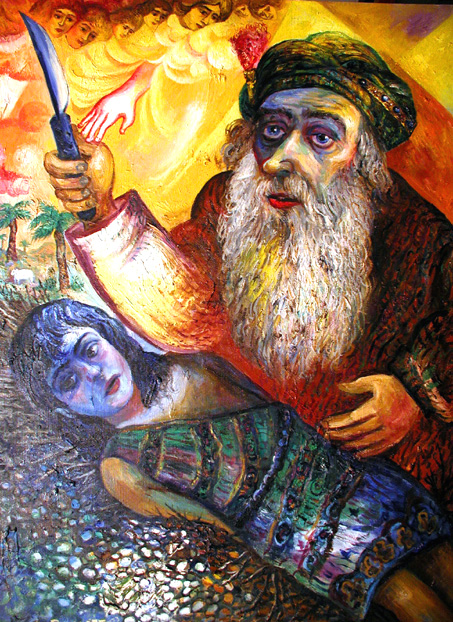
Abraham sacrifices Isaac. Roussimoff.com


Genesis 20

 1 Now Abraham moved on from there into the region of the Negev and lived between Kadesh and Shur. For a while he stayed in Gerar, 2 and there Abraham said of his wife Sarah, “She is my sister.” Then Abimelek king of Gerar sent for Sarah and took her.
Oh Abraham!! The strength of our default habit patterns and means of coping. Abraham got away with this means of self-protection once, and so does it again.
That is why it is good to confront those we care about (and those do not necessarily personally care about, but who may have spiritual or actual power over us–in church, abusive situations in work etc) lest a panicked default reaction becomes an engrained habit pattern.

 3 But God came to Abimelek in a dream one night and said to him, “You are as good as dead because of the woman you have taken; she is a married woman.”
 4 Now Abimelek had not gone near her, so he said, “Lord, will you destroy an innocent nation? 5 Did he not say to me, ‘She is my sister,’ and didn’t she also say, ‘He is my brother’? I have done this with a clear conscience and clean hands.”
 6 Then God said to him in the dream, “Yes, I know you did this with a clear conscience, and so I have kept you from sinning against me. That is why I did not let you touch her. 7 Now return the man’s wife, for he is a prophet, and he will pray for you and you will live. But if you do not return her, you may be sure that you and all who belong to you will die.”
God has mercy on whom he has mercy.  Abraham has the anointing of God on him, and a God-given destiny and God-given power which survives even his own sin. He was under God’s protection because of his anointing.
Roy and have often experienced that sort of protection, that hedge around us, something like the blessing promised to Abraham, “Those who bless you, I will bless, and those who curse you, I will curse.”
I was once gearing up to publicly oppose someone who in the past and until recently has clearly had the marks of God’s anointing and blessing on his life. Roy, my husband said, “Be careful. You’ve always said that he is one of God’s favourites. If he is, then, “Those who bless you, I will bless. Those who curse you, I will curse.” I met with this individual, could clearly see God’s hands on him (for God’s own obscure reasons) in the smart (inspired!) way he handled the meeting, and we left in peace.
ESV—Abraham is called a prophet for the first time. God mentions his ability to intercede for others, one of the marks of a great prophet.

 8 Early the next morning Abimelek summoned all his officials, and when he told them all that had happened, they were very much afraid. 9 Then Abimelek called Abraham in and said, “What have you done to us? How have I wronged you that you have brought such great guilt upon me and my kingdom? You have done things to me that should never be done.” 10 And Abimelek asked Abraham, “What was your reason for doing this?”
 11 Abraham replied, “I said to myself, ‘There is surely no fear of God in this place, and they will kill me because of my wife.’ 12 Besides, she really is my sister, the daughter of my father though not of my mother; and she became my wife. 13 And when God had me wander from my father’s household, I said to her, ‘This is how you can show your love to me: Everywhere we go, say of me, “He is my brother.”’”
Amusingly, Abraham did the very thing he suspected Abimelek of. He showed no fear of God.
And here we have the enigma of human beings. The same person can show immense faith, and irrational fear (Sarah was how old by now?).
We all have our areas of faith, in which we have experienced God’s power, and areas in which we have not yet experienced his power and deliverance, and we are fearful in those areas. Or one might even say, we have not experienced God’s power and deliverance in those areas because we are fearful, rather than faith-filled.

 14 Then Abimelek brought sheep and cattle and male and female slaves and gave them to Abraham, and he returned Sarah his wife to him. 15 And Abimelek said, “My land is before you; live wherever you like.”
 16 To Sarah he said, “I am giving your brother a thousand shekels of silver. This is to cover the offense against you before all who are with you; you are completely vindicated.”
 17 Then Abraham prayed to God, and God healed Abimelek, his wife and his female slaves so they could have children again, 18 for the LORD had kept all the women in Abimelek’s household from conceiving because of Abraham’s wife Sarah.
Our prayers being answered is an aspect of God’s blessing on us.

Genesis 21
 1 Now the LORD was gracious to Sarah as he had said, and the LORD did for Sarah what he had promised. 2 Sarah became pregnant and bore a son to Abraham in his old age, at the very time God had promised him. 
Never underestimate the mercy of God. Sarah conceives at last, after Abraham’s massive failure of faith!!

3 Abraham gave the name Isaac[a] to the son Sarah bore him. 4 When his son Isaac was eight days old, Abraham circumcised him, as God commanded him. 5 Abraham was a hundred years old when his son Isaac was born to him.
 6 Sarah said, “God has brought me laughter, and everyone who hears about this will laugh with me.” 7 And she added, “Who would have said to Abraham that Sarah would nurse children? Yet I have borne him a son in his old age.”
Nothing is impossible with God.

 8 The child grew and was weaned, and on the day Isaac was weaned Abraham held a great feast. 9 But Sarah saw that the son whom Hagar the Egyptian had borne to Abraham was mocking, 10 and she said to Abraham, “Get rid of that slave woman and her son, for that woman’s son will never share in the inheritance with my son Isaac.”
 11 The matter distressed Abraham greatly because it concerned his son. 12 But God said to him, “Do not be so distressed about the boy and your slave woman. Listen to whatever Sarah tells you, because it is through Isaac that your offspring will be reckoned. 13 I will make the son of the slave into a nation also, because he is your offspring.”
God’s blessing on his friends is extended to their children.

 14 Early the next morning Abraham took some food and a skin of water and gave them to Hagar. He set them on her shoulders and then sent her off with the boy. She went on her way and wandered in the Desert of Beersheba.
Abraham knows the Hagar is under God’s protection. Hagar herself does not!

 15 When the water in the skin was gone, she put the boy under one of the bushes. 16 Then she went off and sat down about a bowshot away, for she thought, “I cannot watch the boy die.” And as she sat there, she[c] began to sob.
 17 God heard the boy crying, and the angel of God called to Hagar from heaven and said to her, “What is the matter, Hagar? Do not be afraid; God has heard the boy crying as he lies there. 18 Lift the boy up and take him by the hand, for I will make him into a great nation.”
God sees and hears the outcast cry in the desert! He comforts those who have no apparent means of comfort, as when Stephen saw the heavens opened, and the glory of God revealed.

 19 Then God opened her eyes and she saw a well of water.
I love this. God does not create a well in the desert. He opens her eyes so that she could see it.
There are always wells (the means to stay physically, emotionally, spiritually, and creatively alive) in our deserts for our allotted life-span.
It is good to ask God to open our eyes to see them. To open our eyes to see in which direction we are to cast our nets.

 So she went and filled the skin with water and gave the boy a drink.
 20 God was with the boy as he grew up. He lived in the desert and became an archer. 21 While he was living in the Desert of Paran, his mother got a wife for him from Egypt.
 God was with Ishmael as he grew, though his destiny was never to be as favoured as Isaac. You might see someone apparently more favoured by God than you are; however, that does not mean that God is not with you.
God is with believers and non-believers alike, because he created both of them, and loves both of them.

 22 At that time Abimelek and Phicol the commander of his forces said to Abraham, “God is with you in everything you do. 23 Now swear to me here before God that you will not deal falsely with me or my children or my descendants. Show to me and the country where you now reside as a foreigner the same kindness I have shown to you.”
 24 Abraham said, “I swear it.”
This was a smart move on Abimelek’s part. Do you find God with you in everything you do? Do you see God’s hand on someone you know in everything they do?

 25 Then Abraham complained to Abimelek about a well of water that Abimelek’s servants had seized. 26 But Abimelek said, “I don’t know who has done this. You did not tell me, and I heard about it only today.”
 27 So Abraham brought sheep and cattle and gave them to Abimelek, and the two men made a treaty. 28 Abraham set apart seven ewe lambs from the flock, 29 and Abimelek asked Abraham, “What is the meaning of these seven ewe lambs you have set apart by themselves?”
 30 He replied, “Accept these seven lambs from my hand as a witness that I dug this well.”
 31 So that place was called Beersheba,[d] because the two men swore an oath there.
 32 After the treaty had been made at Beersheba, Abimelek and Phicol the commander of his forces returned to the land of the Philistines. 33 Abraham planted a tamarisk tree in Beersheba, and there he called on the name of the LORD, the Eternal God. 34 And Abraham stayed in the land of the Philistines for a long time.

Genesis 22
Abraham Tested
 1 Some time later God tested Abraham. He said to him, “Abraham!”
   “Here I am,” he replied.
 2 Then God said, “Take your son, your only son, whom you love—Isaac—and go to the region of Moriah. Sacrifice him there as a burnt offering on a mountain I will show you.”
This is an essential question that will appear again and again in our life of faith. Do we love God more than our most precious thing/person/dream/desire? Will we sacrifice them if God asks us to?
Very, very hard. The death of Isaac would seem to negate everything God promised. Dear Lord, preserve us from the day of testing. Please. And if you test us, may our answer be the same as Abraham’s.
2 Chron 3:1 identifies the area as the temple mount in Jerusalem, site of today’s beautiful Dome of the Rock.

  3 Early the next morning Abraham got up and loaded his donkey. He took with him two of his servants and his son Isaac. When he had cut enough wood for the burnt offering, he set out for the place God had told him about. 4 On the third day Abraham looked up and saw the place in the distance. 5 He said to his servants, “Stay here with the donkey while I and the boy go over there. We will worship and then we will come back to you.”
Both obeying, and yet hoping that God might change his mind. “We will worship and then we will come back to you.”
He still believed that God would fulfil his promises, if necessary by raising Isaac from the dead.

 6 Abraham took the wood for the burnt offering and placed it on his son Isaac, and he himself carried the fire and the knife. As the two of them went on together, 7Isaac spoke up and said to his father Abraham, “Father?”
   “Yes, my son?” Abraham replied.
   “The fire and wood are here,” Isaac said, “but where is the lamb for the burnt offering?”
 8 Abraham answered, “God himself will provide the lamb for the burnt offering, my son.” And the two of them went on together.
Abraham’s heart-breaking and steely resolve is impressive.
A beautiful and life-changing statement of faith, “God himself will provide.”
GOD HIMSELF WILL PROVIDE.
The Hebrew for God will Provide is literally, God will see to it. Lovely!!

 9 When they reached the place God had told him about, Abraham built an altar there and arranged the wood on it. He bound his son Isaac and laid him on the altar, on top of the wood. 10 Then he reached out his hand and took the knife to slay his son. 11 But the angel of the LORD called out to him from heaven, “Abraham! Abraham!”
   “Here I am,” he replied.
 12 “Do not lay a hand on the boy,” he said. “Do not do anything to him. Now I know that you fear God, because you have not withheld from me your son, your only son.”
God did not want Isaac. Isaac was the promised child. God just wanted to know if Abraham’s heart and loyalty lay with Isaac, or with the one who gave him Isaac. He is satisfied with the answer.

 13 Abraham looked up and there in a thicket he saw a ram caught by its horns. He went over and took the ram and sacrificed it as a burnt offering instead of his son. 14 So Abraham called that place The LORD Will Provide. And to this day it is said, “On the mountain of the LORD it will be provided.”
And God provided.
ON THE MOUNTAIN OF THE LORD, IT WILL BE PROVIDED.
And the principle of substitutionary sacrificial atonement is introduced. Christ later will be “the Lamb of God would takes away the sin of the world.”
NIV-Substitutionary sacrifice of one life for another is mentioned here for the first time. As the ram died in Isaac’s place, Jesus gave his life as a ransom for many.

 15 The angel of the LORD called to Abraham from heaven a second time 16 and said, “I swear by myself, declares the LORD, that because you have done this and have not withheld your son, your only son, 17 I will surely bless you and make your descendants as numerous as the stars in the sky and as the sand on the seashore. Your descendants will take possession of the cities of their enemies, 18 and through your offspring all nations on earth will be blessed, because you have obeyed me.”
 19 Then Abraham returned to his servants, and they set off together for Beersheba. And Abraham stayed in Beersheba.
 20 Some time later Abraham was told, “Milkah is also a mother; she has borne sons to your brother Nahor: 21 Uz the firstborn, Buz his brother, Kemuel (the father of Aram), 22 Kesed, Hazo, Pildash, Jidlaph and Bethuel.” 23 Bethuel became the father of Rebekah. Milkah bore these eight sons to Abraham’s brother Nahor. 24 His concubine, whose name was Reumah, also had sons: Tebah, Gaham, Tahash and Maakah.

Filed Under: Genesis

The Powerful Intercession of the Friend of God, Gen 19-19,

By Anita Mathias

ABRAHAM INTERCEDES FOR SODOM

Genesis 18
16 When the men got up to leave, they looked down toward Sodom, and Abraham walked along with them to see them on their way. 17 Then the LORD said, “Shall I hide from Abraham what I am about to do? 

I love this verse. First of all, it shows God as human. As a good friend.
And then it reveals the prophetic insight God gives his friends.


18 Abraham will surely become a great and powerful nation, and all nations on earth will be blessed through him. 19 For I have chosen him, so that he will direct his children and his household after him to keep the way of the LORD by doing what is right and just, so that the LORD will bring about for Abraham what he has promised him.”

It was partly a conditional covenant.

 20 Then the LORD said, “The outcry against Sodom and Gomorrah is so great and their sin so grievous 21 that I will go down and see if what they have done is as bad as the outcry that has reached me. If not, I will know.”
 22 The men turned away and went toward Sodom, but Abraham remained standing before the LORD.
 23 Then Abraham approached him and said: “Will you sweep away the righteous with the wicked? 24 What if there are fifty righteous people in the city? Will you really sweep it away and not spare the place for the sake of the fifty righteous people in it? 25 Far be it from you to do such a thing—to kill the righteous with the wicked, treating the righteous and the wicked alike. Far be it from you! Will not the Judge of all the earth do right?”

The traits of the ones the Lord blesses. Note Abraham’s concern for Lot, his selfish young nephew.


 26 The LORD said, “If I find fifty righteous people in the city of Sodom, I will spare the whole place for their sake.”
 27 Then Abraham spoke up again: “Now that I have been so bold as to speak to the Lord, though I am nothing but dust and ashes, 28 what if the number of the righteous is five less than fifty? Will you destroy the whole city for lack of five people?”
   “If I find forty-five there,” he said, “I will not destroy it.”
 29 Once again he spoke to him, “What if only forty are found there?”
   He said, “For the sake of forty, I will not do it.”
 30 Then he said, “May the Lord not be angry, but let me speak. What if only thirty can be found there?”
   He answered, “I will not do it if I find thirty there.”
 31 Abraham said, “Now that I have been so bold as to speak to the Lord, what if only twenty can be found there?”
   He said, “For the sake of twenty, I will not destroy it.”
 32 Then he said, “May the Lord not be angry, but let me speak just once more. What if only ten can be found there?”
   He answered, “For the sake of ten, I will not destroy it.”
 33 When the LORD had finished speaking with Abraham, he left, and Abraham returned home.

I adore this. What is the point of prayer one might say? We see here two things
1)     The power of prayer to persuade God to relent and change his mind. The city would have been destroyed, but God promises not to do so if ten righteous people could be found.
2)     One praying person, and ten righteous people can save a city. 
NIV Study Bible, “Abraham was God’s friend, and because he was now God’s covenant friend, God convened his heavenly council at Abraham’s tent. He gave Abraham the opportunity to speak in his court and to intercede for the righteous in Sodom and Gomorrah. God reveals his purposes to his covenant friends, and allows their voices to be heard in intercession in the court of heaven itself.
Genesis 19
 1 The two angels arrived at Sodom in the evening, and Lot was sitting in the gateway of the city. When he saw them, he got up to meet them and bowed down with his face to the ground. 2 “My lords,” he said, “please turn aside to your servant’s house. You can wash your feet and spend the night and then go on your way early in the morning.”
   “No,” they answered, “we will spend the night in the square.”
3 But he insisted so strongly that they did go with him and entered his house. He prepared a meal for them, baking bread without yeast, and they ate. 4 Before they had gone to bed, all the men from every part of the city of Sodom—both young and old—surrounded the house. 5 They called to Lot, “Where are the men who came to you tonight? Bring them out to us so that we can have sex with them.”
 6 Lot went outside to meet them and shut the door behind him 7 and said, “No, my friends. Don’t do this wicked thing. 8 Look, I have two daughters who have never slept with a man. Let me bring them out to you, and you can do what you like with them. But don’t do anything to these men, for they have come under the protection of my roof.”
 9 “Get out of our way,” they replied. “This fellow came here as a foreigner, and now he wants to play the judge! We’ll treat you worse than them.” They kept bringing pressure on Lot and moved forward to break down the door.

The immense, but impalpable blessings of hospitality. Lot’s hospitality probably played a role in his protection.

10 But the men inside reached out and pulled Lot back into the house and shut the door. 11 Then they struck the men who were at the door of the house, young and old, with blindness so that they could not find the door.
 12 The two men said to Lot, “Do you have anyone else here—sons-in-law, sons or daughters, or anyone else in the city who belongs to you? Get them out of here,  because we are going to destroy this place. The outcry to the LORD against its people is so great that he has sent us to destroy it.”
 14 So Lot went out and spoke to his sons-in-law, who were pledged to marry his daughters. He said, “Hurry and get out of this place, because the LORD is about to destroy the city!” But his sons-in-law thought he was joking.

Faith is never easy. In this case, their scepticism cost them their lives.

 15 With the coming of dawn, the angels urged Lot, saying, “Hurry! Take your wife and your two daughters who are here, or you will be swept away when the city is punished.”
 16 When he hesitated, the men grasped his hand and the hands of his wife and of his two daughters and led them safely out of the city, for the LORD was merciful to them. 17 As soon as they had brought them out, one of them said, “Flee for your lives! Don’t look back, and don’t stop anywhere in the plain! Flee to the mountains or you will be swept away!”
 18 But Lot said to them, “No, my lords, please! 19 Your servant has found favor in your eyes, and you have shown great kindness to me in sparing my life. But I can’t flee to the mountains; this disaster will overtake me, and I’ll die. 20 Look, here is a town near enough to run to, and it is small. Let me flee to it—it is very small, isn’t it? Then my life will be spared.”

The power of prayer in changing one’s destiny—and changing the—what appears inexorable—course of events.

 21 He said to him, “Very well, I will grant this request too; I will not overthrow the town you speak of. 22 But flee there quickly, because I cannot do anything until you reach it.” (That is why the town was called Zoar.
 23 By the time Lot reached Zoar, the sun had risen over the land. 24 Then the LORD rained down burning sulfur on Sodom and Gomorrah—from the LORD out of the heavens. 25 Thus he overthrew those cities and the entire plain, destroying all those living in the cities—and also the vegetation in the land. 26 But Lot’s wife looked back, and she became a pillar of salt.
 27 Early the next morning Abraham got up and returned to the place where he had stood before the LORD. 28 He looked down toward Sodom and Gomorrah, toward all the land of the plain, and he saw dense smoke rising from the land, like smoke from a furnace.
 29 So when God destroyed the cities of the plain, he remembered Abraham, and he brought Lot out of the catastrophe that overthrew the cities where Lot had lived.
 30 Lot and his two daughters left Zoar and settled in the mountains, for he was afraid to stay in Zoar. He and his two daughters lived in a cave. 31 One day the older daughter said to the younger, “Our father is old, and there is no man around here to give us children—as is the custom all over the earth. 32 Let’s get our father to drink wine and then sleep with him and preserve our family line through our father.”
 33 That night they got their father to drink wine, and the older daughter went in and slept with him. He was not aware of it when she lay down or when she got up.
 34 The next day the older daughter said to the younger, “Last night I slept with my father. Let’s get him to drink wine again tonight, and you go in and sleep with him so we can preserve our family line through our father.” 35 So they got their father to drink wine that night also, and the younger daughter went in and slept with him. Again he was not aware of it when she lay down or when she got up.
 36 So both of Lot’s daughters became pregnant by their father. 37 The older daughter had a son, and she named him Moab[g]; he is the father of the Moabites of today. 38 The younger daughter also had a son, and she named him Ben-Ammi; he is the father of the Ammonites of today.

The danger of chosing one’s own solutions rather than being patient, and godly and waiting for God’s solutions.

And so were conceived two more nations, that like Ismael’s descendants would be bitter enemies of Abraham’s descendants. 
It’s worth stopping and thinking of what problems, and difficulties you might be trying to solve by your own human efforts, rather than asking God for his solution, and waiting for his deliverance.
Or, you might ask God to bring such areas to your attention. 

Filed Under: Genesis

Angels in the Wilderness, The lingering promise. Genesis 16-18

By Anita Mathias

Carel Fabritis, Hagar and the Angel


Genesis 16
 1 Now Sarai, Abram’s wife, had borne him no children. But she had an Egyptian slave named Hagar; 2 so she said to Abram, “The LORD has kept me from having children. Go, sleep with my slave; perhaps I can build a family through her.”
Attempts to take your destiny into your own hands without checking with God are very likely to be disastrous.
But what a hard counsel “Wait and be patient” is.
Oh, this sounds eerily and scarily familiar. Sarah getting impatient. Taking matters into her own hands.
When one has heard from God, the challenge is then to do what you hear him say. Even if all that you can do is wait. And pray.
“They also serve who only stand and wait.” John Milton.   

   Abram agreed to what Sarai said.
An impatient, dominant female, a pliant male. Patriarchs and matriarchs of the faith. Hope for us all!!

 3 So after Abram had been living in Canaan ten years, Sarai his wife took her Egyptian slave Hagar and gave her to her husband to be his wife. 4 He slept with Hagar, and she conceived.
   When she knew she was pregnant, she began to despise her mistress.
A woman’s worth equated with her sexuality, fertility (and age?) There is nothing new under the sun.
The human solution to Sarah’s barrenness creates new problems.

 5 Then Sarai said to Abram, “You are responsible for the wrong I am suffering. I put my slave in your arms, and now that she knows she is pregnant, she despises me. May the LORD judge between you and me.”
 6 “Your slave is in your hands,” Abram said. “Do with her whatever you think best.” Then Sarai mistreated Hagar; so she fled from her.
The weak male, the vengeful female. A mess! A not infrequent state of affairs.
Hagar, both sinner and sinned against. As Sarah was in this case. Be careful before you take sides.

 7 The angel of the LORD found Hagar near a spring in the desert; it was the spring that is beside the road to Shur. 8 And he said, “Hagar, slave of Sarai, where have you come from, and where are you going?”
   “I’m running away from my mistress Sarai,” she answered.
 9 Then the angel of the LORD told her, “Go back to your mistress and submit to her.” 10 The angel added, “I will increase your descendants so much that they will be too numerous to count.”
Take a deep breath, Hagar. You too are under God’s protection and blessing.
The goodness of God is part of his very nature.
A theophany. NIV: “Traditional Christian interpretation has held that this “angel” was a preincarnate manifestation of Christ as God’s messenger-servant.

 11 The angel of the LORD also said to her:
   “You are now pregnant
   and you will give birth to a son.
You shall name him Ishmael,
   for the LORD has heard of your misery. 
Ishmael means God hears. God has observed Sarah’s harsh treatment of Hagar.

12 He will be a wild donkey of a man; 
God’s promise. Ishmael will be strongly independent. He will not need to submit to masters.

   his hand will be against everyone
   and everyone’s hand against him,
and he will live in hostility
   toward all his brothers.”
 13 She gave this name to the LORD who spoke to her: “You are the God who sees me,” for she said, “I have now seen the One who sees me.” 14 That is why the well was called Beer Lahai Roi; it is still there, between Kadesh and Bered.
The Lord hears. The Lord sees.
There is a lot of comfort in this. The Lord sees, the Lord hears.
Do not be afraid of the desert. You are more likely than not to encounter angels there.

 15 So Hagar bore Abram a son, and Abram gave the name Ishmael to the son she had borne. 16 Abram was eighty-six years old when Hagar bore him Ishmael.
Genesis 17
 1 When Abram was ninety-nine years old, the LORD appeared to him and said, “I am God Almighty;
The Hebrew is El-Shaddai, God the Mountain One. The name emphasized God’s power which will enable Sarah to conceive Isaac.

walk before me faithfully and be blameless. 2 Then I will make my covenant between me and you and will greatly increase your numbers.”
The language echoes what was promised to Adam and Noah. God’s original design for humanity will be achieved through Abraham.
The delayed promise. This is such sad and heartbreaking reading, yet who of us has not experienced it.  God promises, and promises, and promises, and you know in your heart that his promises are true, but you do not see it with your eyes.
Lifting weights increases one’s strength. Exercising faith increases one’s faith. Faith was Abraham’s instinctive spiritual gift, but this long wait in faith strengthens it.

 3 Abram fell facedown,
in reverence

and God said to him, 4 “As for me, this is my covenant with you: You will be the father of many nations. 5 No longer will you be called Abram; your name will be Abraham, for I have made you a father of many nations. 6 I will make you very fruitful; I will make nations of you, and kings will come from you. 7 I will establish my covenant as an everlasting covenant between me and you and your descendants after you for the generations to come, to be your God and the God of your descendants after you. 8 The whole land of Canaan, where you now reside as a foreigner, I will give as an everlasting possession to you and your descendants after you; and I will be their God.”
Brilliant words. Though to a man of lesser faith, they could have seemed mockery. You, the father of no legitimate child, will be the father of many nations. You will be very fruitful.
Fruitfulness. That’s another of the blessings of Abraham, that we, children of Abraham because of our faith, can claim. And I do. Bless me with the fruitfulness which is part of your nature, Lord, and part of the nature of the world which you have created.
A new destiny, and a new name marking his new identity as a servant of God. Abraham means father of a multitude.

 9 Then God said to Abraham, “As for you, you must keep my covenant, you and your descendants after you for the generations to come. 10 This is my covenant with you and your descendants after you, the covenant you are to keep: Every male among you shall be circumcised. 11 You are to undergo circumcision, and it will be the sign of the covenant between me and you. 12 For the generations to come every male among you who is eight days old must be circumcised, including those born in your household or bought with money from a foreigner—those who are not your offspring. 13 Whether born in your household or bought with your money, they must be circumcised. My covenant in your flesh is to be an everlasting covenant. 14 Any uncircumcised male, who has not been circumcised in the flesh, will be cut off from his people; he has broken my covenant.”
God is preparing the ground for the fulfilment of his promise.
Almost a unilateral covenant with just one requirement—that of circumcision.

 15 God also said to Abraham, “As for Sarai your wife, you are no longer to call her Sarai; her name will be Sarah. 16 I will bless her and will surely give you a son by her. I will bless her so that she will be the mother of nations; kings of peoples will come from her.”
 17 Abraham fell facedown; he laughed and said to himself, “Will a son be born to a man a hundred years old? Will Sarah bear a child at the age of ninety?” 18 And Abraham said to God, “If only Ishmael might live under your blessing!”
Abraham loves God, but he is finding it increasingly hard to believe him. He is offering him an alternative, almost saving God’s face.

 19 Then God said, “Yes, but your wife Sarah will bear you a son, and you will call him Isaac. I will establish my covenant with him as an everlasting covenant for his descendants after him. 
Let no one accuse God of not having a sense of humour. God hears Abraham’s laughter, and promises him a son called Isaac, “He laughs!”
God’s blessing of fruitfulness.

20 And as for Ishmael, I have heard you: I will surely bless him; I will make him fruitful and will greatly increase his numbers. He will be the father of twelve rulers, and I will make him into a great nation. 
Why did God bless Ishmael? Partly because Abraham asked him to. Never estimate the enormous power of praying for our children.

21 But my covenant I will establish with Isaac, whom Sarah will bear to you by this time next year.” 22 When he had finished speaking with Abraham, God went up from him.
And what has Isaac, who is yet unborn, done to merit the covenant which will be established with him, rather than with his brother? Precisely nothing!!
Romans 9:15 “I will have mercy on whom I have mercy, and I will have compassion on whom I have compassion.”

 23 On that very day Abraham took his son Ishmael and all those born in his household or bought with his money, every male in his household, and circumcised them, as God told him. 24 Abraham was ninety-nine years old when he was circumcised, 25 and his son Ishmael was thirteen; 26 Abraham and his son Ishmael were both circumcised on that very day. 27 And every male in Abraham’s household, including those born in his household or bought from a foreigner, was circumcised with him.
Quick obedience characterizes the heroes of the faith. Indeed, the demands of faith are often costly, so if you do not obey promptly, you risk not obeying at all.

Genesis 18
 1 The LORD appeared to Abraham near the great trees of Mamre while he was sitting at the entrance to his tent in the heat of the day. 
One of the great theophanies of the New Testament.

2 Abraham looked up and saw three men standing nearby. When he saw them, he hurried from the entrance of his tent to meet them and bowed low to the ground.
 3 He said, “If I have found favour in your eyes, my lord, do not pass your servant by. 4 Let a little water be brought, and then you may all wash your feet and rest under this tree. 5 Let me get you something to eat, so you can be refreshed and then go on your way—now that you have come to your servant.”
   “Very well,” they answered, “do as you say.”
 6 So Abraham hurried into the tent to Sarah. “Quick,” he said, “get three seahs of the finest flour and knead it and bake some bread.”
 7 Then he ran to the herd and selected a choice, tender calf and gave it to a servant, who hurried to prepare it. 8 He then brought some curds and milk and the calf that had been prepared, and set these before them. While they ate, he stood near them under a tree.
Generous lavish hospitality—a trait of the one God blessed. It is instructive to see how those God blesses, who live under his favour, behave.

 9 “Where is your wife Sarah?” they asked him.
   “There, in the tent,” he said.
 10 Then one of them said, “I will surely return to you about this time next year, and Sarah your wife will have a son.”
   Now Sarah was listening at the entrance to the tent, which was behind him. 11 Abraham and Sarah were already very old, and Sarah was past the age of childbearing. 12 So Sarah laughed to herself as she thought, “After I am worn out and my lord is old, will I now have this pleasure?”
 13 Then the LORD said to Abraham, “Why did Sarah laugh and say, ‘Will I really have a child, now that I am old?’ 14 Is anything too hard for the LORD? I will return to you at the appointed time next year, and Sarah will have a son.”
 15 Sarah was afraid, so she lied and said, “I did not laugh.”
   But he said, “Yes, you did laugh.”
Sarah did not believe. However, in the Lord’s goodness, she was punished neither for her disbelief not for her lie.
Instead, she received a wonderful, further revelation of the nature of God.
God asks her. IS ANYTHING TOO HARD FOR THE LORD?
And this, thank God, is a rhetorical question.
NOTHING IS TOO HARD FOR THE LORD.
Stop now and contemplate your life, and its perceived impossibilities.
 Nothing is too hard for the Lord.

Filed Under: Genesis

Angels in the Wilderness, The lingering promise. Genesis 16-18

By Anita Mathias

Carel Fabritis, Hagar and the Angel


Genesis 16

 1 Now Sarai, Abram’s wife, had borne him no children. But she had an Egyptian slave named Hagar; 2 so she said to Abram, “The LORD has kept me from having children. Go, sleep with my slave; perhaps I can build a family through her.”

Attempts to take your destiny into your own hands without checking with God are very likely to be disastrous.

But what a hard counsel “Wait and be patient” is.

Oh, this sounds eerily and scarily familiar. Sarah getting impatient. Taking matters into her own hands.

When one has heard from God, the challenge is then to do what you hear him say. Even if all that you can do is wait. And pray.

“They also serve who only stand and wait.” John Milton.   


   Abram agreed to what Sarai said.

An impatient, dominant female, a pliant male. Patriarchs and matriarchs of the faith. Hope for us all!!


 3 So after Abram had been living in Canaan ten years, Sarai his wife took her Egyptian slave Hagar and gave her to her husband to be his wife. 4 He slept with Hagar, and she conceived.

   When she knew she was pregnant, she began to despise her mistress.

A woman’s worth equated with her sexuality, fertility (and age?) There is nothing new under the sun.

The human solution to Sarah’s barrenness creates new problems.


 5 Then Sarai said to Abram, “You are responsible for the wrong I am suffering. I put my slave in your arms, and now that she knows she is pregnant, she despises me. May the LORD judge between you and me.”

 6 “Your slave is in your hands,” Abram said. “Do with her whatever you think best.” Then Sarai mistreated Hagar; so she fled from her.

The weak male, the vengeful female. A mess! A not infrequent state of affairs.

Hagar, both sinner and sinned against. As Sarah was in this case. Be careful before you take sides.

 7 The angel of the LORD found Hagar near a spring in the desert; it was the spring that is beside the road to Shur. 8 And he said, “Hagar, slave of Sarai, where have you come from, and where are you going?”

   “I’m running away from my mistress Sarai,” she answered.

 9 Then the angel of the LORD told her, “Go back to your mistress and submit to her.” 10 The angel added, “I will increase your descendants so much that they will be too numerous to count.”

Take a deep breath, Hagar. You too are under God’s protection and blessing.

The goodness of God is part of his very nature.

A theophany. NIV: “Traditional Christian interpretation has held that this “angel” was a preincarnate manifestation of Christ as God’s messenger-servant.


 11 The angel of the LORD also said to her:

   “You are now pregnant
   and you will give birth to a son.
You shall name him Ishmael,
   for the LORD has heard of your misery. 

Ishmael means God hears. God has observed Sarah’s harsh treatment of Hagar.


12 He will be a wild donkey of a man; 

God’s promise. Ishmael will be strongly independent. He will not need to submit to masters.

   his hand will be against everyone
   and everyone’s hand against him,
and he will live in hostility
   toward all his brothers.”

 13 She gave this name to the LORD who spoke to her: “You are the God who sees me,” for she said, “I have now seen the One who sees me.” 14 That is why the well was called Beer Lahai Roi; it is still there, between Kadesh and Bered.

The Lord hears. The Lord sees.

There is a lot of comfort in this. The Lord sees, the Lord hears.

Do not be afraid of the desert. You are more likely than not to encounter angels there.


 15 So Hagar bore Abram a son, and Abram gave the name Ishmael to the son she had borne. 16 Abram was eighty-six years old when Hagar bore him Ishmael.

Genesis 17

 1 When Abram was ninety-nine years old, the LORD appeared to him and said, “I am God Almighty;

The Hebrew is El-Shaddai, God the Mountain One. The name emphasized God’s power which will enable Sarah to conceive Isaac.


walk before me faithfully and be blameless. 2 Then I will make my covenant between me and you and will greatly increase your numbers.”

The language echoes what was promised to Adam and Noah. God’s original design for humanity will be achieved through Abraham.

The delayed promise. This is such sad and heartbreaking reading, yet who of us has not experienced it.  God promises, and promises, and promises, and you know in your heart that his promises are true, but you do not see it with your eyes.

Lifting weights increases one’s strength. Exercising faith increases one’s faith. Faith was Abraham’s instinctive spiritual gift, but this long wait in faith strengthens it.


 3 Abram fell facedown,

in reverence


and God said to him, 4 “As for me, this is my covenant with you: You will be the father of many nations. 5 No longer will you be called Abram; your name will be Abraham, for I have made you a father of many nations. 6 I will make you very fruitful; I will make nations of you, and kings will come from you. 7 I will establish my covenant as an everlasting covenant between me and you and your descendants after you for the generations to come, to be your God and the God of your descendants after you. 8 The whole land of Canaan, where you now reside as a foreigner, I will give as an everlasting possession to you and your descendants after you; and I will be their God.”

Brilliant words. Though to a man of lesser faith, they could have seemed mockery. You, the father of no legitimate child, will be the father of many nations. You will be very fruitful.

Fruitfulness. That’s another of the blessings of Abraham, that we, children of Abraham because of our faith, can claim. And I do. Bless me with the fruitfulness which is part of your nature, Lord, and part of the nature of the world which you have created.

A new destiny, and a new name marking his new identity as a servant of God. Abraham means father of a multitude.


 9 Then God said to Abraham, “As for you, you must keep my covenant, you and your descendants after you for the generations to come. 10 This is my covenant with you and your descendants after you, the covenant you are to keep: Every male among you shall be circumcised. 11 You are to undergo circumcision, and it will be the sign of the covenant between me and you. 12 For the generations to come every male among you who is eight days old must be circumcised, including those born in your household or bought with money from a foreigner—those who are not your offspring. 13 Whether born in your household or bought with your money, they must be circumcised. My covenant in your flesh is to be an everlasting covenant. 14 Any uncircumcised male, who has not been circumcised in the flesh, will be cut off from his people; he has broken my covenant.”

God is preparing the ground for the fulfilment of his promise.

Almost a unilateral covenant with just one requirement—that of circumcision.


 15 God also said to Abraham, “As for Sarai your wife, you are no longer to call her Sarai; her name will be Sarah. 16 I will bless her and will surely give you a son by her. I will bless her so that she will be the mother of nations; kings of peoples will come from her.”

 17 Abraham fell facedown; he laughed and said to himself, “Will a son be born to a man a hundred years old? Will Sarah bear a child at the age of ninety?” 18 And Abraham said to God, “If only Ishmael might live under your blessing!”

Abraham loves God, but he is finding it increasingly hard to believe him. He is offering him an alternative, almost saving God’s face.


 19 Then God said, “Yes, but your wife Sarah will bear you a son, and you will call him Isaac. I will establish my covenant with him as an everlasting covenant for his descendants after him. 

Let no one accuse God of not having a sense of humour. God hears Abraham’s laughter, and promises him a son called Isaac, “He laughs!”

God’s blessing of fruitfulness.


20 And as for Ishmael, I have heard you: I will surely bless him; I will make him fruitful and will greatly increase his numbers. He will be the father of twelve rulers, and I will make him into a great nation. 

Why did God bless Ishmael? Partly because Abraham asked him to. Never estimate the enormous power of praying for our children.


21 But my covenant I will establish with Isaac, whom Sarah will bear to you by this time next year.” 22 When he had finished speaking with Abraham, God went up from him.

And what has Isaac, who is yet unborn, done to merit the covenant which will be established with him, rather than with his brother? Precisely nothing!!

Romans 9:15 “I will have mercy on whom I have mercy, and I will have compassion on whom I have compassion.”


 23 On that very day Abraham took his son Ishmael and all those born in his household or bought with his money, every male in his household, and circumcised them, as God told him. 24 Abraham was ninety-nine years old when he was circumcised, 25 and his son Ishmael was thirteen; 26 Abraham and his son Ishmael were both circumcised on that very day. 27 And every male in Abraham’s household, including those born in his household or bought from a foreigner, was circumcised with him.

Quick obedience characterizes the heroes of the faith. Indeed, the demands of faith are often costly, so if you do not obey promptly, you risk not obeying at all.


Genesis 18

 1 The LORD appeared to Abraham near the great trees of Mamre while he was sitting at the entrance to his tent in the heat of the day. 

One of the great theophanies of the New Testament.


2 Abraham looked up and saw three men standing nearby. When he saw them, he hurried from the entrance of his tent to meet them and bowed low to the ground.

 3 He said, “If I have found favour in your eyes, my lord,do not pass your servant by. 4 Let a little water be brought, and then you may all wash your feet and rest under this tree. 5 Let me get you something to eat, so you can be refreshed and then go on your way—now that you have come to your servant.”

   “Very well,” they answered, “do as you say.”

 6 So Abraham hurried into the tent to Sarah. “Quick,” he said, “get three seahs of the finest flour and knead it and bake some bread.”

 7 Then he ran to the herd and selected a choice, tender calf and gave it to a servant, who hurried to prepare it. 8 He then brought some curds and milk and the calf that had been prepared, and set these before them. While they ate, he stood near them under a tree.

Generous lavish hospitality—a trait of the one God blessed. It is instructive to see how those God blesses, who live under his favour, behave.


 9 “Where is your wife Sarah?” they asked him.

   “There, in the tent,” he said.

 10 Then one of them said, “I will surely return to you about this time next year, and Sarah your wife will have a son.”

   Now Sarah was listening at the entrance to the tent, which was behind him. 11 Abraham and Sarah were already very old, and Sarah was past the age of childbearing. 12 So Sarah laughed to herself as she thought, “After I am worn out and my lord is old, will I now have this pleasure?”

 13 Then the LORD said to Abraham, “Why did Sarah laugh and say, ‘Will I really have a child, now that I am old?’ 14 Is anything too hard for the LORD? I will return to you at the appointed time next year, and Sarah will have a son.”

 15 Sarah was afraid, so she lied and said, “I did not laugh.”

   But he said, “Yes, you did laugh.”

Sarah did not believe. However, in the Lord’s goodness, she was punished neither for her disbelief not for her lie.

Instead, she received a wonderful, further revelation of the nature of God.

God asks her. IS ANYTHING TOO HARD FOR THE LORD?

And this, thank God, is a rhetorical question.

NOTHING IS TOO HARD FOR THE LORD.

Stop now and contemplate your life, and its perceived impossibilities.

 Nothing is too hard for the Lord.

Filed Under: Genesis

  • « Previous Page
  • 1
  • …
  • 6
  • 7
  • 8
  • 9
  • 10
  • Next Page »

Sign Up and Get a Free eBook!

Sign up to be emailed my blog posts (one a week) and get the ebook of "Holy Ground," my account of working with Mother Teresa.

Join 544 Other Readers

My Books

Rosaries, Reading, Secrets: A Catholic Childhood in India

Rosaries, Reading Secrets, B&N
USA

UK

Wandering Between Two Worlds: Essays on Faith and Art

Wandering Between Two Worlds
USA

UK

Francesco, Artist of Florence: The Man Who Gave Too Much

Francesco, Artist of Florence
US

UK

The Story of Dirk Willems

The Story of Dirk Willems
US

UK

My Latest Meditation

Anita Mathias: About Me

Anita Mathias

Read my blog on Facebook

Follow me on Twitter

Follow @anitamathias1

Recent Posts

  • God’s Complete Forgiveness 
  • Using God’s Gift of Our Talents: A Path to Joy and Abundance
  • The Kingdom of God is Here Already, Yet Not Yet Here
  • All Those Who Exalt Themselves Will Be Humbled & the Humble Will Be Exalted
  • Christ’s Great Golden Triad to Guide Our Actions and Decisions
  • How Jesus Dealt With Hostility and Enemies
  • Do Not Be Afraid, but Do Be Prudent
  • For Scoundrels, Scallywags, and Rascals—Christ Came
  • How to Lead an Extremely Significant Life
  • Don’t Walk Away From Jesus, but if You Do, He Still Looks at You and Loves You
Premier Digital Awards 2015 - Finalist - Blogger of the year
Runner Up Christian Media Awards 2014 - Tweeter of the year

Categories

What I’m Reading


Wolf Hall
Hilary Mantel

Wolf Hall --  Amazon.com
Amazon.com

Amazon.co.uk

Silence and Honey Cakes:
The Wisdom Of The Desert
Rowan Williams

Silence and Honey Cakes --  Amazon.com
Amazon.com

Amazon.co.uk

The Long Loneliness:
The Autobiography of the Legendary Catholic Social Activist
Dorothy Day

The Long Loneliness --  Amazon.com
Amazon.com

Amazon.co.uk

Country Girl
Edna O'Brien

Country Girl  - Amazon.com
Amazon.com

Amazon.co.uk

Archive by month

My Latest Five Podcast Meditations

INSTAGRAM

anita.mathias

My memoir: Rosaries, Reading, Secrets https://amzn.to/42xgL9t
Oxford, England. Writer, memoirist, podcaster, blogger, Biblical meditation teacher, mum

Well, hello friends! Breaking radio silence to let Well, hello friends! Breaking radio silence to let you know that I have taped a meditation for you on Christ’s famous Parable of the Talents in Matthew 25. https://anitamathias.com/2025/11/05/using-gods-gift-of-our-talents-a-path-to-joy-and-abundance/
Here you are, click the play button in the blog post for a brief meditation, and some moments of peace, and, perhaps, inspiration in your day 🙂
Hi Friends, I have taped a meditation; do listen a Hi Friends, I have taped a meditation; do listen at this link: https://anitamathias.com/2025/04/08/the-kingdom-of-god-is-here-already-yet-not-yet-here-2/
It’s on the Kingdom of God, of which Christ so often spoke, which is here already—a mysterious, shimmering internal palace in which, in lightning flashes, we experience peace and joy, and yet, of course, not yet fully here. We sense the rainbowed presence of Christ in the song which pulses through creation. Christ strolls into our rooms with his wisdom and guidance, and things change. Our prayers are answered; we are healed; our hearts are strangely warmed. Sometimes.
And yet, we also experience evil within & all around us. Our own sin which can shatter our peace and the trajectory of our lives. And the sins of the world—its greed, dishonesty and environmental destruction.
But in this broken world, we still experience the glory of creation; “coincidences” which accelerate once we start praying, and shalom which envelops us like sudden sunshine. The portals into this Kingdom include repentance, gratitude, meditative breathing, and absolute surrender.
The Kingdom of God is here already. We can experience its beauty, peace and joy today through the presence of the Holy Spirit. But yet, since, in the Apostle Paul’s words, we do not struggle only “against flesh and blood, but against the rulers, against the unseen powers of this dark world and against the spiritual forces of evil,” its fullness still lingers…
Our daughter Zoe was ordained into the Church of E Our daughter Zoe was ordained into the Church of England in June. I have been on a social media break… but … better late than never. Enjoy!
First picture has my sister, Shalini, who kindly flew in from the US. Our lovely cousins Anthony and Sarah flank Zoe in the next picture.
The Bishop of London, Sarah Mullaly, ordained Zoe. You can see her praying that Zoe will be filled with the Holy Spirit!!
And here’s a meditation I’ve recorded, which you might enjoy. The link is also in my profile
https://anitamathias.com/2024/11/07/all-those-who-exalt-themselves-will-be-humbled-the-humble-will-be-exalted/
I have taped a meditation on Jesus statement in Ma I have taped a meditation on Jesus statement in Matthew 23, “For those who exalt themselves will be humbled, and those who humble themselves will be exalted.”
Do listen here. https://anitamathias.com/2024/11/07/all-those-who-exalt-themselves-will-be-humbled-the-humble-will-be-exalted/
Link also in bio.
And so, Jesus states a law of life. Those who broadcast their amazingness will be humbled, since God dislikes—scorns that, as much as people do.  For to trumpet our success, wealth, brilliance, giftedness or popularity is to get distracted from our life’s purpose into worthless activity. Those who love power, who are sure they know best, and who must be the best, will eventually be humbled by God and life. For their focus has shifted from loving God, doing good work, and being a blessing to their family, friends, and the world towards impressing others, being enviable, perhaps famous. These things are houses built on sand, which will crumble when hammered by the waves of old age, infirmity or adversity. 
God resists the proud, Scripture tells us—those who crave the admiration and power which is His alone. So how do we resist pride? We slow down, so that we realise (and repent) when sheer pride sparks our allergies to people, our enmities, our determination to have our own way, or our grandiose ego-driven goals, and ambitions. Once we stop chasing limelight, a great quietness steals over our lives. We no longer need the drug of continual achievement, or to share images of glittering travel, parties, prizes or friends. We just enjoy them quietly. My life is for itself & not for a spectacle, Emerson wrote. And, as Jesus advises, we quit sharp-elbowing ourselves to sit with the shiniest people, but are content to hang out with ordinary people; and then, as Jesus said, we will inevitably, eventually, be summoned higher to the sparkling conversation we craved. 
One day, every knee will bow before the gentle lamb who was slain, now seated on the throne. We will all be silent before him. Let us live gently then, our eyes on Christ, continually asking for his power, his Spirit, and his direction, moving, dancing, in the direction that we sense him move.
Link to new podcast in Bio https://anitamathias.co Link to new podcast in Bio https://anitamathias.com/2024/02/20/how-jesus-dealt-with-hostility-and-enemies/
3 days before his death, Jesus rampages through the commercialised temple, overturning the tables of moneychangers. Who gave you the authority to do these things? his outraged adversaries ask. And Jesus shows us how to answer hostile questions. Slow down. Breathe. Quick arrow prayers!
Your enemies have no power over your life that your Father has not permitted them. Ask your Father for wisdom, remembering: Questions do not need to be answered. Are these questioners worthy of the treasures of your heart? Or would that be feeding pearls to hungry pigs, who might instead devour you?
Questions can contain pitfalls, traps, nooses. Jesus directly answered just three of the 183 questions he was asked, refusing to answer some; answering others with a good question.
But how do we get the inner calm and wisdom to recognise
and sidestep entrapping questions? Long before the day of
testing, practice slow, easy breathing, and tune in to the frequency of the Father. There’s no record of Jesus running, rushing, getting stressed, or lacking peace. He never spoke on his own, he told us, without checking in with the Father. So, no foolish, ill-judged statements. Breathing in the wisdom of the Father beside and within him, he, unintimidated, traps the trappers.
Wisdom begins with training ourselves to slow down and ask
the Father for guidance. Then our calm minds, made perceptive, will help us recognise danger and trick questions, even those coated in flattery, and sidestep them or refuse to answer.
We practice tuning in to heavenly wisdom by practising–asking God questions, and then listening for his answers about the best way to do simple things…organise a home or write. Then, we build upwards, asking for wisdom in more complex things.
Listening for the voice of God before we speak, and asking for a filling of the Spirit, which Jesus calls streams of living water within us, will give us wisdom to know what to say, which, frequently, is nothing at all. It will quieten us with the silence of God, which sings through the world, through sun and stars, sky and flowers.
Especially for @ samheckt Some very imperfect pi Especially for @ samheckt 
Some very imperfect pictures of my labradoodle Merry, and golden retriever Pippi.
And since, I’m on social media, if you are the meditating type, here’s a scriptural meditation on not being afraid, while being prudent. https://anitamathias.com/2024/01/03/do-not-be-afraid-but-do-be-prudent/
A new podcast. Link in bio https://anitamathias.c A new podcast. Link in bio
https://anitamathias.com/2024/01/03/do-not-be-afraid-but-do-be-prudent/
Do Not Be Afraid, but Do Be Prudent
“Do not be afraid,” a dream-angel tells Joseph, to marry Mary, who’s pregnant, though a virgin, for in our magical, God-invaded world, the Spirit has placed God in her. Call the baby Jesus, or The Lord saves, for he will drag people free from the chokehold of their sins.
And Joseph is not afraid. And the angel was right, for a star rose, signalling a new King of the Jews. Astrologers followed it, threatening King Herod, whose chief priests recounted Micah’s 600-year-old prophecy: the Messiah would be born in Bethlehem, as Jesus had just been, while his parents from Nazareth registered for Augustus Caesar’s census of the entire Roman world. 
The Magi worshipped the baby, offering gold. And shepherds came, told by an angel of joy: that the Messiah, a saviour from all that oppresses, had just been born.
Then, suddenly, the dream-angel warned: Flee with the child to Egypt. For Herod plans to kill this baby, forever-King.
Do not be afraid, but still flee? Become a refugee? But lightning-bolt coincidences verified the angel’s first words: The magi with gold for the flight. Shepherds
telling of angels singing of coming inner peace. Joseph flees.
What’s the difference between fear and prudence? Fear is being frozen or panicked by imaginary what-ifs. It tenses our bodies; strains health, sleep and relationships; makes us stingy with ourselves & others; leads to overwork, & time wasted doing pointless things for fear of people’s opinions.
Prudence is wisdom-using our experience & spiritual discernment as we battle the demonic forces of this dark world, in Paul’s phrase.It’s fighting with divinely powerful weapons: truth, righteousness, faith, Scripture & prayer, while surrendering our thoughts to Christ. 
So let’s act prudently, wisely & bravely, silencing fear, while remaining alert to God’s guidance, delivered through inner peace or intuitions of danger and wrongness, our spiritual senses tuned to the Spirit’s “No,” his “Slow,” his “Go,” as cautious as a serpent, protected, while being as gentle as a lamb among wolves.
Link to post with podcast link in Bio or https://a Link to post with podcast link in Bio or https://anitamathias.com/2023/09/22/dont-walk-away-from-jesus-but-if-you-do-he-still-looks-at-you-and-loves-you/
Jesus came from a Kingdom of voluntary gentleness, in which
Christ, the Lion of Judah, stands at the centre of the throne in the guise of a lamb, looking as if it had been slain. No wonder his disciples struggled with his counter-cultural values. Oh, and we too!
The mother of the Apostles James and John, asks Jesus for a favour—that once He became King, her sons got the most important, prestigious seats at court, on his right and left. And the other ten, who would have liked the fame, glory, power,limelight and honour themselves are indignant and threatened.
Oh-oh, Jesus says. Who gets five talents, who gets one,
who gets great wealth and success, who doesn’t–that the
Father controls. Don’t waste your one precious and fleeting
life seeking to lord it over others or boss them around.
But, in his wry kindness, he offers the ambitious twelve
and us something better than the second or third place.
He tells us how to actually be the most important person to
others at work, in our friend group, social circle, or church:Use your talents, gifts, and energy to bless others.
And we instinctively know Jesus is right. The greatest people in our lives are the kind people who invested in us, guided us and whose wise, radiant words are engraved on our hearts.
Wanting to sit with the cleverest, most successful, most famous people is the path of restlessness and discontent. The competition is vast. But seek to see people, to listen intently, to be kind, to empathise, and doors fling wide open for you, you rare thing!
The greatest person is the one who serves, Jesus says. Serves by using the one, two, or five talents God has given us to bless others, by finding a place where our deep gladness and the world’s deep hunger meet. By writing which is a blessing, hospitality, walking with a sad friend, tidying a house.
And that is the only greatness worth having. That you yourself,your life and your work are a blessing to others. That the love and wisdom God pours into you lives in people’s hearts and minds, a blessing
https://anitamathias.com/.../dont-walk-away-from-j https://anitamathias.com/.../dont-walk-away-from-jesus.../
Sharing this podcast I recorded last week. LINK IN BIO
So Jesus makes a beautiful offer to the earnest, moral young man who came to him, seeking a spiritual life. Remarkably, the young man claims that he has kept all the commandments from his youth, including the command to love one’s neighbour as oneself, a statement Jesus does not challenge.
The challenge Jesus does offers him, however, the man cannot accept—to sell his vast possessions, give the money to the poor, and follow Jesus encumbered.
He leaves, grieving, and Jesus looks at him, loves him, and famously observes that it’s easier for a camel to squeeze through the eye of a needle than for a rich person to live in the world of wonders which is living under Christ’s kingship, guidance and protection. 
He reassures his dismayed disciples, however, that with God even the treasure-burdened can squeeze into God’s kingdom, “for with God, all things are possible.”
Following him would quite literally mean walking into a world of daily wonders, and immensely rich conversation, walking through Israel, Lebanon, Syria, and Jordan, quite impossible to do with suitcases and backpacks laden with treasure. 
For what would we reject God’s specific, internally heard whisper or directive, a micro-call? That is the idol which currently grips and possesses us. 
Not all of us have great riches, nor is money everyone’s greatest temptation—it can be success, fame, universal esteem, you name it…
But, since with God all things are possible, even those who waver in their pursuit of God can still experience him in fits and snatches, find our spirits singing on a walk or during worship in church, or find our hearts strangely warmed by Scripture, and, sometimes, even “see” Christ stand before us. 
For Christ looks at us, Christ loves us, and says, “With God, all things are possible,” even we, the flawed, entering his beautiful Kingdom.
Follow on Instagram

© 2026 Dreaming Beneath the Spires · All Rights Reserved. · Cookie Policy · Privacy Policy