Anita Mathias: Dreaming Beneath the Spires

Anita Mathias's Blog on Faith and Art

  • Home
  • My Books
  • Meditations
  • Essays
  • Contact
  • About Me

The strange fulfillment of dreams, Genesis 37, 38. Day 37, Feb 6th

By Anita Mathias

. Speculum Humanae Salvationis,Flemish,15th.MS 139. fol.29 recto:Joseph thrown into the well;Jonah cast into the sea and the maw of the whale.  

NIV Notes–Jacob represented Israel–as a people who struggled with both God and human beings and overcame, and as a source of blessing to the nations.

Genesis 37

Joseph’s Dreams
 1 Jacob lived in the land where his father had stayed, the land of Canaan.

 2 This is the account of Jacob’s family line.
   Joseph, a young man of seventeen, was tending the flocks with his brothers, the sons of Bilhah and the sons of Zilpah, his father’s wives, and he brought their father a bad report about them.
Though Joseph generally seemed the sinned-against one, this is the first indication of why he might have been disliked.
Joseph’s action implies that his behaviour is more righteous than theirs, something largely borne out by future events.
 3 Now Israel loved Joseph more than any of his other sons, because he had been born to him in his old age; and he made an ornate robe for him. 4 When his brothers saw that their father loved him more than any of them, they hated him and could not speak a kind word to him.
Parental favouritism sadly sows the seeds of wrath. Joseph is Jacob’s second youngest son. But his father bestows on him privileges normally reserved for the first-born. His royal dreams further infuriate his brothers who cannot accept that he will reign over them.
5 Joseph had a dream, and when he told it to his brothers, they hated him all the more. 6 He said to them, “Listen to this dream I had: 7 We were binding sheaves of grain out in the field when suddenly my sheaf rose and stood upright, while your sheaves gathered around mine and bowed down to it.”
 8 His brothers said to him, “Do you intend to reign over us? Will you actually rule us?” And they hated him all the more because of his dream and what he had said.
ESV Joseph’s brothers intuitively interpret Joseph’s first dream as indicating that he will reign over them, later fulfilled.

9 Then he had another dream, and he told it to his brothers. “Listen,” he said, “I had another dream, and this time the sun and moon and eleven stars were bowing down to me.”
 10 When he told his father as well as his brothers, his father rebuked him and said, “What is this dream you had? Will your mother and I and your brothers actually come and bow down to the ground before you?” 11 His brothers were jealous of him, but his father kept the matter in mind.
In Genesis, dreams are normally associated with divine revelations.
Joseph has an authentic gift–hearing from God in dreaming. This later develops into the gift of interpreting dreams. His gift is spot-on–however, there is no point in sharing it with his brothers. Sharing such a thing is not likely to make him popular with them. But does Joseph care?

Joseph Sold by His Brothers
Their jealousy turns deadly.

12 Now his brothers had gone to graze their father’s flocks near Shechem, 13 and Israel said to Joseph, “As you know, your brothers are grazing the flocks near Shechem. Come, I am going to send you to them.”

“Very well,” he replied.
 14 So he said to him, “Go and see if all is well with your brothers and with the flocks, and bring word back to me.” Then he sent him off from the Valley of Hebron.
   When Joseph arrived at Shechem, 15 a man found him wandering around in the fields and asked him, “What are you looking for?”
 16 He replied, “I’m looking for my brothers. Can you tell me where they are grazing their flocks?”
 17 “They have moved on from here,” the man answered. “I heard them say, ‘Let’s go to Dothan.’”
   So Joseph went after his brothers and found them near Dothan. 18 But they saw him in the distance, and before he reached them, they plotted to kill him.
 19 “Here comes that dreamer!” they said to each other. 20 “Come now, let’s kill him and throw him into one of these cisterns and say that a ferocious animal devoured him. Then we’ll see what comes of his dreams.”
 21 When Reuben heard this, he tried to rescue him from their hands. “Let’s not take his life,” he said. 22 “Don’t shed any blood. Throw him into this cistern here in the wilderness, but don’t lay a hand on him.” Reuben said this to rescue him from them and take him back to his father.
 23 So when Joseph came to his brothers, they stripped him of his robe—the ornate robe he was wearing— 24 and they took him and threw him into the cistern. The cistern was empty; there was no water in it.
 25 As they sat down to eat their meal, they looked up and saw a caravan of Ishmaelites coming from Gilead. Their camels were loaded with spices, balm and myrrh, and they were on their way to take them down to Egypt.
 26 Judah said to his brothers, “What will we gain if we kill our brother and cover up his blood? 27 Come, let’s sell him to the Ishmaelites and not lay our hands on him; after all, he is our brother, our own flesh and blood.” His brothers agreed.
Judah tries to save his brother’s life, and thereby becomes the one in the line of Abraham, Isaac and Jacob–an ancestor of the Messiah.
 28 So when the Midianite merchants came by, his brothers pulled Joseph up out of the cistern and sold him for twenty shekels[b] of silver to the Ishmaelites, who took him to Egypt.
 29 When Reuben returned to the cistern and saw that Joseph was not there, he tore his clothes. 30 He went back to his brothers and said, “The boy isn’t there! Where can I turn now?”
 31 Then they got Joseph’s robe, slaughtered a goat and dipped the robe in the blood. 32 They took the ornate robe back to their father and said, “We found this. Examine it to see whether it is your son’s robe.”
As Jacob deceived his father with a slaughtered goat, so too he is deceived.
The brothers careless and callous cruelty involves them in a web of lies.
 33 He recognized it and said, “It is my son’s robe! Some ferocious animal has devoured him. Joseph has surely been torn to pieces.”
The deception of Jacob by his sons, using Joseph’s coat and a slaughtered goat, mirrors his own deception of Isaac, using Esau’s clock and two goatskins.
 34 Then Jacob tore his clothes, put on sackcloth and mourned for his son many days. 35 All his sons and daughters came to comfort him, but he refused to be comforted. “No,” he said, “I will continue to mourn until I join my son in the grave.” So his father wept for him.
 36 Meanwhile, the Midianites[c] sold Joseph in Egypt to Potiphar, one of Pharaoh’s officials, the captain of the guard.

Genesis 38
Judah and Tamar
 1 At that time, Judah left his brothers and went down to stay with a man of Adullam named Hirah. 2 There Judah met the daughter of a Canaanite man named Shua. He married her and made love to her; 3 she became pregnant and gave birth to a son, who was named Er. 4 She conceived again and gave birth to a son and named him Onan. 5 She gave birth to still another son and named him Shelah. It was at Kezib that she gave birth to him. 6 Judah got a wife for Er, his firstborn, and her name was Tamar. 7 But Er, Judah’s firstborn, was wicked in the LORD’s sight; so the LORD put him to death.
 8 Then Judah said to Onan, “Sleep with your brother’s wife and fulfill your duty to her as a brother-in-law to raise up offspring for your brother.” 9 But Onan knew that the child would not be his; so whenever he slept with his brother’s wife, he spilled his semen on the ground to keep from providing offspring for his brother. 10What he did was wicked in the LORD’s sight; so the LORD put him to death also.
His son would have been considered his brother’s son and heir, and would have had equal inheritance rights with himself.
 11 Judah then said to his daughter-in-law Tamar, “Live as a widow in your father’s household until my son Shelah grows up.” For he thought, “He may die too, just like his brothers.” So Tamar went to live in her father’s household.
 12 After a long time Judah’s wife, the daughter of Shua, died. When Judah had recovered from his grief, he went up to Timnah, to the men who were shearing his sheep, and his friend Hirah the Adullamite went with him.
 13 When Tamar was told, “Your father-in-law is on his way to Timnah to shear his sheep,” 14 she took off her widow’s clothes, covered herself with a veil to disguise herself, and then sat down at the entrance to Enaim, which is on the road to Timnah. For she saw that, though Shelah had now grown up, she had not been given to him as his wife.
 15 When Judah saw her, he thought she was a prostitute, for she had covered her face. 16 Not realizing that she was his daughter-in-law, he went over to her by the roadside and said, “Come now, let me sleep with you.”
   “And what will you give me to sleep with you?” she asked.
 17 “I’ll send you a young goat from my flock,” he said.
   “Will you give me something as a pledge until you send it?” she asked.
 18 He said, “What pledge should I give you?”
   “Your seal and its cord, and the staff in your hand,” she answered. So he gave them to her and slept with her, and she became pregnant by him. 19 After she left, she took off her veil and put on her widow’s clothes again.
 20 Meanwhile Judah sent the young goat by his friend the Adullamite in order to get his pledge back from the woman, but he did not find her. 21 He asked the men who lived there, “Where is the shrine prostitute who was beside the road at Enaim?”
   “There hasn’t been any shrine prostitute here,” they said.
 22 So he went back to Judah and said, “I didn’t find her. Besides, the men who lived there said, ‘There hasn’t been any shrine prostitute here.’”
 23 Then Judah said, “Let her keep what she has, or we will become a laughingstock. After all, I did send her this young goat, but you didn’t find her.”
 24 About three months later Judah was told, “Your daughter-in-law Tamar is guilty of prostitution, and as a result she is now pregnant.”
   Judah said, “Bring her out and have her burned to death!”
 25 As she was being brought out, she sent a message to her father-in-law. “I am pregnant by the man who owns these,” she said. And she added, “See if you recognize whose seal and cord and staff these are.”
 26 Judah recognized them and said, “She is more righteous than I, since I wouldn’t give her to my son Shelah.” And he did not sleep with her again.
This acknowledgement that Tamar was more righteous marks a turning point for Judah, and accounts for a remarkable transformation in his life which comes through in the remaining episodes of the Joseph story. 
 27 When the time came for her to give birth, there were twin boys in her womb. 28 As she was giving birth, one of them put out his hand; so the midwife took a scarlet thread and tied it on his wrist and said, “This one came out first.” 29 But when he drew back his hand, his brother came out, and she said, “So this is how you have broken out!” And he was named Perez.[a] 30 Then his brother, who had the scarlet thread on his wrist, came out. And he was named Zerah. 
And Perez, in keeping with the preference in Genesis for younger sons, will one day be the ancestor of Jesus.
Filed Under: Genesis

El Shaddai, Genesis 35, Day 35, Feb 4th, Read Through the Bible Project

By Anita Mathias

El Shaddai, Genesis 35, Day 35, Feb 4th, Read Through the Bible Project

Genesis 35

ESV notes–Transformed by the experiences at Bethel and Peniel, Jacob now begins to assume the mantle of his father as the one through whom the divine promises to Abraham will be continued.

Jacob Returns to Bethel

 1 Then God said to Jacob, “Go up to Bethel and settle there, and build an altar there to God, who appeared to you when you were fleeing from your brother Esau.”
Jacob had settled at Shechem without any direction from God, and disaster followed–from which God preserved him. Now God gives him specific directions to go to Bethel where he had had his first experience of God.
He fulfils the promise he had earlier made to God at Bethel, and acknowledges that God has been faithful to him.

 2 So Jacob said to his household and to all who were with him, “Get rid of the foreign gods you have with you, and purify yourselves and change your clothes. 3Then come, let us go up to Bethel, where I will build an altar to God, who answered me in the day of my distress and who has been with me wherever I have gone.”
ESV–The present tense answers suggests that God has consistently responded to Jacob in every time of trouble.


4 So they gave Jacob all the foreign gods they had and the rings in their ears, and Jacob buried them under the oak at Shechem. 5 Then they set out, and the terror of God fell on the towns all around them so that no one pursued them.

An act of consecration. They get rid of their idols and reconsecrated themselves. And God protects Jacob and his family on their way to Bethel, despite the execrable actions of his sons.

 6 Jacob and all the people with him came to Luz (that is, Bethel) in the land of Canaan. 7 There he built an altar, and he called the place El Bethel, because it was there that God revealed himself to him when he was fleeing from his brother.
 8 Now Deborah, Rebekah’s nurse, died and was buried under the oak outside Bethel. So it was named Allon Bakuth.
 9 After Jacob returned from Paddan Aram, God appeared to him again and blessed him. 10 God said to him, “Your name is Jacob, but you will no longer be called Jacob; your name will be Israel.” So he named him Israel.
 11 And God said to him, “I am God Almighty; be fruitful and increase in number. A nation and a community of nations will come from you, and kings will be among your descendants. 12 The land I gave to Abraham and Isaac I also give to you, and I will give this land to your descendants after you.” 13 Then God went up from him at the place where he had talked with him.
God identifies himself to Jacob here as El-Shaddai (God Almighty). His words echo the original benediction pronounced on mankind in the beginning, and renewed after the flood.
14 Jacob set up a stone pillar at the place where God had talked with him, and he poured out a drink offering on it; he also poured oil on it. 15 Jacob called the place where God had talked with him Bethel.
The Deaths of Rachel and Isaac

 16 Then they moved on from Bethel. While they were still some distance from Ephrath, Rachel began to give birth and had great difficulty. 17 And as she was having great difficulty in childbirth, the midwife said to her, “Don’t despair, for you have another son.” 18 As she breathed her last—for she was dying—she named her son Ben-Oni. But his father named him Benjamin.
Rachel in sadness and bitterness calls Benjamin son of my trouble. Jacob however changes his name to son of my right hand.


 19 So Rachel died and was buried on the way to Ephrath (that is, Bethlehem). 20 Over her tomb Jacob set up a pillar, and to this day that pillar marks Rachel’s tomb.
 21 Israel moved on again and pitched his tent beyond Migdal Eder. 22 While Israel was living in that region, Reuben went in and slept with his father’s concubine Bilhah, and Israel heard of it.
His sons acted deceitfully towards him as he had acted deceitfully towards his father.
   Jacob had twelve sons:
 23 The sons of Leah:
   Reuben the firstborn of Jacob,
   Simeon, Levi, Judah, Issachar and Zebulun.
 24 The sons of Rachel:
   Joseph and Benjamin.
 25 The sons of Rachel’s servant Bilhah:
   Dan and Naphtali.
 26 The sons of Leah’s servant Zilpah:
   Gad and Asher.
   These were the sons of Jacob, who were born to him in Paddan Aram.
 27 Jacob came home to his father Isaac in Mamre, near Kiriath Arba (that is, Hebron), where Abraham and Isaac had stayed. 28 Isaac lived a hundred and eighty years. 29 Then he breathed his last and died and was gathered to his people, old and full of years. And his sons Esau and Jacob buried him. 

Filed Under: Genesis

El Shaddai, Genesis 35, Day 35, Feb 4th, Read Through the Bible Project

By Anita Mathias

El Shaddai, Genesis 35, Day 35, Feb 4th, Read Through the Bible Project

Genesis 35

ESV notes–Transformed by the experiences at Bethel and Peniel, Jacob now begins to assume the mantle of his father as the one through whom the divine promises to Abraham will be continued.

Jacob Returns to Bethel

 1 Then God said to Jacob, “Go up to Bethel and settle there, and build an altar there to God, who appeared to you when you were fleeing from your brother Esau.”
Jacob had settled at Shechem without any direction from God, and disaster followed–from which God preserved him. Now God gives him specific directions to go to Bethel where he had had his first experience of God.
He fulfils the promise he had earlier made to God at Bethel, and acknowledges that God has been faithful to him.

 2 So Jacob said to his household and to all who were with him, “Get rid of the foreign gods you have with you, and purify yourselves and change your clothes. 3Then come, let us go up to Bethel, where I will build an altar to God, who answered me in the day of my distress and who has been with me wherever I have gone.”
ESV–The present tense answers suggests that God has consistently responded to Jacob in every time of trouble.


4 So they gave Jacob all the foreign gods they had and the rings in their ears, and Jacob buried them under the oak at Shechem. 5 Then they set out, and the terror of God fell on the towns all around them so that no one pursued them.

An act of consecration. They get rid of their idols and reconsecrated themselves. And God protects Jacob and his family on their way to Bethel, despite the execrable actions of his sons.

 6 Jacob and all the people with him came to Luz (that is, Bethel) in the land of Canaan. 7 There he built an altar, and he called the place El Bethel, because it was there that God revealed himself to him when he was fleeing from his brother.
 8 Now Deborah, Rebekah’s nurse, died and was buried under the oak outside Bethel. So it was named Allon Bakuth.
 9 After Jacob returned from Paddan Aram, God appeared to him again and blessed him. 10 God said to him, “Your name is Jacob, but you will no longer be called Jacob; your name will be Israel.” So he named him Israel.
 11 And God said to him, “I am God Almighty; be fruitful and increase in number. A nation and a community of nations will come from you, and kings will be among your descendants. 12 The land I gave to Abraham and Isaac I also give to you, and I will give this land to your descendants after you.” 13 Then God went up from him at the place where he had talked with him.
God identifies himself to Jacob here as El-Shaddai (God Almighty). His words echo the original benediction pronounced on mankind in the beginning, and renewed after the flood.
14 Jacob set up a stone pillar at the place where God had talked with him, and he poured out a drink offering on it; he also poured oil on it. 15 Jacob called the place where God had talked with him Bethel.
The Deaths of Rachel and Isaac

 16 Then they moved on from Bethel. While they were still some distance from Ephrath, Rachel began to give birth and had great difficulty. 17 And as she was having great difficulty in childbirth, the midwife said to her, “Don’t despair, for you have another son.” 18 As she breathed her last—for she was dying—she named her son Ben-Oni. But his father named him Benjamin.
Rachel in sadness and bitterness calls Benjamin son of my trouble. Jacob however changes his name to son of my right hand.


 19 So Rachel died and was buried on the way to Ephrath (that is, Bethlehem). 20 Over her tomb Jacob set up a pillar, and to this day that pillar marks Rachel’s tomb.
 21 Israel moved on again and pitched his tent beyond Migdal Eder. 22 While Israel was living in that region, Reuben went in and slept with his father’s concubine Bilhah, and Israel heard of it.
His sons acted deceitfully towards him as he had acted deceitfully towards his father.
   Jacob had twelve sons:
 23 The sons of Leah:
   Reuben the firstborn of Jacob,
   Simeon, Levi, Judah, Issachar and Zebulun.
 24 The sons of Rachel:
   Joseph and Benjamin.
 25 The sons of Rachel’s servant Bilhah:
   Dan and Naphtali.
 26 The sons of Leah’s servant Zilpah:
   Gad and Asher.
   These were the sons of Jacob, who were born to him in Paddan Aram.
 27 Jacob came home to his father Isaac in Mamre, near Kiriath Arba (that is, Hebron), where Abraham and Isaac had stayed. 28 Isaac lived a hundred and eighty years. 29 Then he breathed his last and died and was gathered to his people, old and full of years. And his sons Esau and Jacob buried him. 

Filed Under: Genesis

The Blessing works out in mysterious ways, Gen 33-34 Day 32, Feb 1st

By Anita Mathias

Jacob meets Esau, Andrea Pozzo

Genesis 33

Jacob Meets Esau

 1 Jacob looked up and there was Esau, coming with his four hundred men; so he divided the children among Leah, Rachel and the two female servants. 2 He put the female servants and their children in front, Leah and her children next, and Rachel and Joseph in the rear. 3 He himself went on ahead and bowed down to the ground seven times as he approached his brother.
Jacob puts his favourite child and favourite wife at the back. His favouritism of Joseph will sow the seeds of future misery–for both himself and Joseph.

 4 But Esau ran to meet Jacob and embraced him; he threw his arms around his neck and kissed him. And they wept. 
And inexplicably God softens the heart of Esau, the wronged brother. Esau apparently forgives Jacob.
Jesus perhaps recalls this incident when he describes the father running to meet the Prodigal Son.
Impulsive Esau ever wears his heart on his sleeve, unlike the more careful and scheming Jacob.


5 Then Esau looked up and saw the women and children. “Who are these with you?” he asked.
   Jacob answered, “They are the children God has graciously given your servant.”
 6 Then the female servants and their children approached and bowed down. 7 Next, Leah and her children came and bowed down. Last of all came Joseph and Rachel, and they too bowed down.
 8 Esau asked, “What’s the meaning of all these flocks and herds I met?”
   “To find favor in your eyes, my lord,” he said.
 9 But Esau said, “I already have plenty, my brother. Keep what you have for yourself.”
God had been at work and had so blessed Esau that he no longer held a grudge against Jacob.


 10 “No, please!” said Jacob. “If I have found favor in your eyes, accept this gift from me. For to see your face is like seeing the face of God, now that you have received me favorably. 
ESV Jacob draws a remarkable parallel between his earlier encounter with God and his meeting with Esau. Esau, like God, shows him unmerited favour.


11 Please accept the present that was brought to you, for God has been gracious to me and I have all I need.” And because Jacob insisted, Esau accepted it.
In a sense, Jacob has repaid Esau for the birthright and blessing he stole from him. Though he cannot restore that blessing, he blesses Esau from the blessing God has blessed him with. And God has not turned away his face from Esau who now has plenty.

 12 Then Esau said, “Let us be on our way; I’ll accompany you.”
 13 But Jacob said to him, “My lord knows that the children are tender and that I must care for the ewes and cows that are nursing their young. If they are driven hard just one day, all the animals will die. 14 So let my lord go on ahead of his servant, while I move along slowly at the pace of the flocks and herds before me and the pace of the children, until I come to my lord in Seir.”
 15 Esau said, “Then let me leave some of my men with you.”
   “But why do that?” Jacob asked. “Just let me find favor in the eyes of my lord.”
Jacob is not confident that Esau will not change his mind, once removed from the emotion of the moment.

 16 So that day Esau started on his way back to Seir. 17 Jacob, however, went to Sukkoth, where he built a place for himself and made shelters for his livestock. That is why the place is called Sukkoth.[a]
 18 After Jacob came from Paddan Aram,[b] he arrived safely at the city of Shechem in Canaan and camped within sight of the city. 19 For a hundred pieces of silver,[c]he bought from the sons of Hamor, the father of Shechem, the plot of ground where he pitched his tent. 20 There he set up an altar and called it El Elohe Israel.[d
El Elohe Israel means Mighty is the God of Israel.God has been with him, and blessed him just as he promised. ESV–Jacob formally acknowledges the God of his fathers as his God also. He identifies the God worshiped at this altar as the One whom he had encountered at Peniel, and who had changed his name.

Genesis 34 

 1 Now Dinah, the daughter Leah had borne to Jacob, went out to visit the women of the land. 2 When Shechem son of Hamor the Hivite, the ruler of that area, saw her, he took her and raped her. 3 His heart was drawn to Dinah daughter of Jacob; he loved the young woman and spoke tenderly to her. 4 And Shechem said to his father Hamor, “Get me this girl as my wife.” 5 When Jacob heard that his daughter Dinah had been defiled, his sons were in the fields with his livestock; so he did nothing about it until they came home.


 6 Then Shechem’s father Hamor went out to talk with Jacob. 7 Meanwhile, Jacob’s sons had come in from the fields as soon as they heard what had happened. They were shocked and furious, because Shechem had done an outrageous thing in[a] Israel by sleeping with Jacob’s daughter—a thing that should not be done.
 8 But Hamor said to them, “My son Shechem has his heart set on your daughter. Please give her to him as his wife. 9 Intermarry with us; give us your daughters and take our daughters for yourselves. 10 You can settle among us; the land is open to you. Live in it, trade[b] in it, and acquire property in it.”
 11 Then Shechem said to Dinah’s father and brothers, “Let me find favor in your eyes, and I will give you whatever you ask. 12 Make the price for the bride and the gift I am to bring as great as you like, and I’ll pay whatever you ask me. Only give me the young woman as my wife.”


 13 Because their sister Dinah had been defiled, Jacob’s sons replied deceitfully as they spoke to Shechem and his father Hamor. 14 They said to them, “We can’t do such a thing; we can’t give our sister to a man who is not circumcised. That would be a disgrace to us. 15 We will enter into an agreement with you on one condition only: that you become like us by circumcising all your males. 16 Then we will give you our daughters and take your daughters for ourselves. We’ll settle among you and become one people with you. 17 But if you will not agree to be circumcised, we’ll take our sister and go.”
Ancestral sins modelled for children can become default ways of reacting. Under stress, Abraham and Isaac lied, Jacob did so to gain personal advantage, Jacob’s sons do it to gain revenge.


 18 Their proposal seemed good to Hamor and his son Shechem. 19 The young man, who was the most honored of all his father’s family, lost no time in doing what they said, because he was delighted with Jacob’s daughter. 20 So Hamor and his son Shechem went to the gate of their city to speak to the men of their city. 21“These men are friendly toward us,” they said. “Let them live in our land and trade in it; the land has plenty of room for them. We can marry their daughters and they can marry ours. 22 But the men will agree to live with us as one people only on the condition that our males be circumcised, as they themselves are. 23 Won’t their livestock, their property and all their other animals become ours? So let us agree to their terms, and they will settle among us.”
 24 All the men who went out of the city gate agreed with Hamor and his son Shechem, and every male in the city was circumcised.
The people of Schehem agree to the circumcision, partly because of the hope of financial gain.


 25 Three days later, while all of them were still in pain, two of Jacob’s sons, Simeon and Levi, Dinah’s brothers, took their swords and attacked the unsuspecting city, killing every male. 26 They put Hamor and his son Shechem to the sword and took Dinah from Shechem’s house and left. 27 The sons of Jacob came upon the dead bodies and looted the city where[c] their sister had been defiled. 28 They seized their flocks and herds and donkeys and everything else of theirs in the city and out in the fields. 29 They carried off all their wealth and all their women and children, taking as plunder everything in the houses.
Though Jacob’s sons resemble Jacob whose name means “he deceives,” they go beyond anything he has done.
 30 Then Jacob said to Simeon and Levi, “You have brought trouble on me by making me obnoxious to the Canaanites and Perizzites, the people living in this land. We are few in number, and if they join forces against me and attack me, I and my household will be destroyed.”
 31 But they replied, “Should he have treated our sister like a prostitute?”


Because of God’s protection on Jacob, the consequences of this despicable action are not visited on his sons. 


See Charles Spurgeon’s comment on this chapter http://theoxfordchristian.blogspot.com/2011/01/god-will-silence-your-enemies-ch.html


Filed Under: Genesis

Wresting a Blessing, Genesis 31, Day 29, Jan 29,

By Anita Mathias

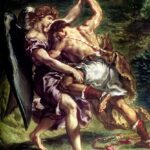
Jacob Wrestling with the Angel

 Genesis 31

Jacob also went on his way, and the angels of God met him. 2 When Jacob saw them, he said, “This is the camp of God!” So he named that place Mahanaim.
Jacob had left the territory of the hostile Laban and was about to enter the territory of the hostile Esau. He sees the angelic encampment as a divine assurance that God’s host had come to safely escort him to Canaan.

 3 Jacob sent messengers ahead of him to his brother Esau in the land of Seir, the country of Edom. 4 He instructed them: “This is what you are to say to my lord Esau: ‘Your servant Jacob says, @I have been staying with Laban and have remained there till now. 5 I have cattle and donkeys, sheep and goats, male and female servants. Now I am sending this message to my lord, that I may find favor in your eyes.’”
 6 When the messengers returned to Jacob, they said, “We went to your brother Esau, and now he is coming to meet you, and four hundred men are with him.”
The 400 men suggests the Esau is going to attack Jacob. Esau has lived by the sword, as in Isaac’s “blessing,” while Jacob has lived the peaceful life of a shepherd.

 7 In great fear and distress Jacob divided the people who were with him into two groups, and the flocks and herds and camels as well. 8 He thought, “If Esau comes and attacks one group, the group that is left may escape.”
 9 Then Jacob prayed, “O God of my father Abraham, God of my father Isaac, LORD, you who said to me, ‘Go back to your country and your relatives, and I will make you prosper,’ 10 I am unworthy of all the kindness and faithfulness you have shown your servant. I had only my staff when I crossed this Jordan, but now I have become two camps.
A typical immigrant success story. Jacob’s prayer expresses his increasing dependence on God.
11 Save me, I pray, from the hand of my brother Esau, for I am afraid he will come and attack me, and also the mothers with their children. 12But you have said, ‘I will surely make you prosper and will make your descendants like the sand of the sea, which cannot be counted.’”
 13 He spent the night there, and from what he had with him he selected a gift for his brother Esau: 14 two hundred female goats and twenty male goats, two hundred ewes and twenty rams, 15 thirty female camels with their young, forty cows and ten bulls, and twenty female donkeys and ten male donkeys. 16 He put them in the care of his servants, each herd by itself, and said to his servants, “Go ahead of me, and keep some space between the herds.”
 17 He instructed the one in the lead: “When my brother Esau meets you and asks, ‘Who do you belong to, and where are you going, and who owns all these animals in front of you?’ 18 then you are to say, ‘They belong to your servant Jacob. They are a gift sent to my lord Esau, and he is coming behind us.’”
 19 He also instructed the second, the third and all the others who followed the herds: “You are to say the same thing to Esau when you meet him. 20 And be sure to say, ‘Your servant Jacob is coming behind us.’” For he thought, “I will pacify him with these gifts I am sending on ahead; later, when I see him, perhaps he will receive me.” 21 So Jacob’s gifts went on ahead of him, but he himself spent the night in the camp.
 However, his two camps and  false humility stratagem suggests that he is also relying on his own resources.

 22 That night Jacob got up and took his two wives, his two female servants and his eleven sons and crossed the ford of the Jabbok. 23 After he had sent them across the stream, he sent over all his possessions. 24 So Jacob was left alone, and a man wrestled with him till daybreak. 25 When the man saw that he could not overpower him, he touched the socket of Jacob’s hip so that his hip was wrenched as he wrestled with the man. 26 Then the man said, “Let me go, for it is daybreak.”
   But Jacob replied, “I will not let you go unless you bless me.”
Determined to win, Jacob does not release his opponent even though his hip has been dislocated.
His persistence is rewarded as he finally accepts that all blessing comes from God. 
 27 The man asked him, “What is your name?”
   “Jacob,” he answered.
 28 Then the man said, “Your name will no longer be Jacob, but Israel, because you have struggled with God and with humans and have overcome.”
 29 Jacob said, “Please tell me your name.”
Now that Jacob accepts that all blessing comes from God, God accepts him as his servant by changing his name. 

   But he replied, “Why do you ask my name?” Then he blessed him there.
 30 So Jacob called the place Peniel,[g] saying, “It is because I saw God face to face, and yet my life was spared.”
His life was spared as he wrestled with God suggesting that his life will be spared as he wrestles with Esau. 

 31 The sun rose above him as he passed Peniel, and he was limping because of his hip. 32 Therefore to this day the Israelites do not eat the tendon attached to the socket of the hip, because the socket of Jacob’s hip was touched near the tendon.
A new day dawns in Jacob’s life.
Brilliant. A theophany. God comes in human form, with a human’s strength. He could not overpower Jacob, and then uses divine power to end the game.

He blesses Jacob because what Jacob wanted–for his entire life–even more than he wanted wealth or success, was God’s blessing. He tried to get it by manipulating a hungry Esau, by tricking a blind Isaac, but using tricky breeding practices, by a midnight escape.

And now he gets it just because he asked!! Wow!

ESV The renaming of Jacob brings to a climax a lifetime of struggling with others. Jacob has changed through the events of the preceding years. 
He has finally come to covet God’s free blessing rather than wresting it from others. 

 NIV Jacob has wrestled all his life, first with Esau then with Laban. Now, as he is about to re-enter Canaan, he is shown that it is with God he must wrestle, and not with any human being. 

Filed Under: Genesis

Jacob, the Deceiver is Blessed. Genesis 29-30, Day 27, Jan 27

By Anita Mathias

Genesis 30

 1 When Rachel saw that she was not bearing Jacob any children, she became jealous of her sister. So she said to Jacob, “Give me children, or I’ll die!”
 2 Jacob became angry with her and said, “Am I in the place of God, who has kept you from having children?”
Jacob recognized there are limits to his powers to manipulate.
He was always trying to wrest blessing by his own efforts. Here he acknowledges that blessing can only come from God.
 3 Then she said, “Here is Bilhah, my servant. Sleep with her so that she can bear children for me and I too can build a family through her.”
Ancient familial ways of coping  become our default reaction. Rachel takes matters into her own hands as Sarah did.
4 So she gave him her servant Bilhah as a wife. Jacob slept with her, 5 and she became pregnant and bore him a son. 6 Then Rachel said, “God has vindicated me; he has listened to my plea and given me a son.” Because of this she named him Dan.
 7 Rachel’s servant Bilhah conceived again and bore Jacob a second son. 8 Then Rachel said, “I have had a great struggle with my sister, and I have won.” So she named him Naphtali.
 9 When Leah saw that she had stopped having children, she took her servant Zilpah and gave her to Jacob as a wife. 10 Leah’s servant Zilpah bore Jacob a son. 11 Then Leah said, “What good fortune!” So she named him Gad.
 12 Leah’s servant Zilpah bore Jacob a second son. 13 Then Leah said, “How happy I am! The women will call me happy.” So she named him Asher.
 14 During wheat harvest, Reuben went out into the fields and found some mandrake plants, which he brought to his mother Leah. Rachel said to Leah, “Please give me some of your son’s mandrakes.”
 15 But she said to her, “Wasn’t it enough that you took away my husband? Will you take my son’s mandrakes too?”
   “Very well,” Rachel said, “he can sleep with you tonight in return for your son’s mandrakes.”
 16 So when Jacob came in from the fields that evening, Leah went out to meet him. “You must sleep with me,” she said. “I have hired you with my son’s mandrakes.” So he slept with her that night.
 17 God listened to Leah, and she became pregnant and bore Jacob a fifth son. 18 Then Leah said, “God has rewarded me for giving my servant to my husband.” So she named him Issachar.
 19 Leah conceived again and bore Jacob a sixth son. 20 Then Leah said, “God has presented me with a precious gift. This time my husband will treat me with honor, because I have borne him six sons.” So she named him Zebulun.
 21 Some time later she gave birth to a daughter and named her Dinah.
 22 Then God remembered Rachel; he listened to her and enabled her to conceive. 23 She became pregnant and gave birth to a son and said, “God has taken away my disgrace.” 24 She named him Joseph, and said, “May the LORD add to me another son.”

Jacob’s Flocks Increase

 25 After Rachel gave birth to Joseph, Jacob said to Laban, “Send me on my way so I can go back to my own homeland. 26 Give me my wives and children, for whom I have served you, and I will be on my way. You know how much work I’ve done for you.”  27 But Laban said to him, “If I have found favor in your eyes, please stay. I have learned by divination that the LORD has blessed me because of you.” 28 He added, “Name your wages, and I will pay them.”
 29 Jacob said to him, “You know how I have worked for you and how your livestock has fared under my care. 30 The little you had before I came has increased greatly, and the LORD has blessed you wherever I have been. But now, when may I do something for my own household?”
God’s inalienable blessing because of his great mercy–unlinked to Jacob’s deserving.
 31 “What shall I give you?” he asked.
   “Don’t give me anything,” Jacob replied. “But if you will do this one thing for me, I will go on tending your flocks and watching over them: 32 Let me go through all your flocks today and remove from them every speckled or spotted sheep, every dark-colored lamb and every spotted or speckled goat. They will be my wages. 33 And my honesty will testify for me in the future, whenever you check on the wages you have paid me. Any goat in my possession that is not speckled or spotted, or any lamb that is not dark-colored, will be considered stolen.”
Most commonly the sheep were all white, and the goats all black. So on the face of it, this was a very modest request.
 34 “Agreed,” said Laban. “Let it be as you have said.” 35 That same day he removed all the male goats that were streaked or spotted, and all the speckled or spotted female goats (all that had white on them) and all the dark-colored lambs, and he placed them in the care of his sons. 36 Then he put a three-day journey between himself and Jacob, while Jacob continued to tend the rest of Laban’s flocks.
A shocking deception. Though Jacob is under God’s protection and blessing, he is still reaping what he has sown. 
 37 Jacob, however, took fresh-cut branches from poplar, almond and plane trees and made white stripes on them by peeling the bark and exposing the white inner wood of the branches. 38 Then he placed the peeled branches in all the watering troughs, so that they would be directly in front of the flocks when they came to drink. When the flocks were in heat and came to drink, 39 they mated in front of the branches. And they bore young that were streaked or speckled or spotted. 40 Jacob set apart the young of the flock by themselves, but made the rest face the streaked and dark-colored animals that belonged to Laban. Thus he made separate flocks for himself and did not put them with Laban’s animals. 41 Whenever the stronger females were in heat, Jacob would place the branches in the troughs in front of the animals so they would mate near the branches, 42 but if the animals were weak, he would not place them there. So the weak animals went to Laban and the strong ones to Jacob. 43 In this way the man grew exceedingly prosperous and came to own large flocks, and female and male servants, and camels and donkeys.
Like Laban, Jacob uses deception of his own. And the scheme worked, but only because of God’s intervention, not because of Jacob’s attempts at genetics!!


Genesis 31

 1 Jacob heard that Laban’s sons were saying, “Jacob has taken everything our father owned and has gained all this wealth from what belonged to our father.” 2 And Jacob noticed that Laban’s attitude toward him was not what it had been. 3 Then the LORD said to Jacob, “Go back to the land of your fathers and to your relatives, and I will be with you.”
Every signal–from God, Laban, Laban’s son, and his own wives warned Jacob that it was now time to return to Canaan.

 4 So Jacob sent word to Rachel and Leah to come out to the fields where his flocks were. 5 He said to them, “I see that your father’s attitude toward me is not what it was before, but the God of my father has been with me. 6 You know that I’ve worked for your father with all my strength, 7 yet your father has cheated me by changing my wages ten times. However, God has not allowed him to harm me. 8 If he said, ‘The speckled ones will be your wages,’ then all the flocks gave birth to speckled young; and if he said, ‘The streaked ones will be your wages,’ then all the flocks bore streaked young. 9 So God has taken away your father’s livestock and has given them to me.
God’s inalienable blessing.
 10 “In breeding season I once had a dream in which I looked up and saw that the male goats mating with the flock were streaked, speckled or spotted. 11 The angel of God said to me in the dream, ‘Jacob.’ I answered, ‘Here I am.’ 12 And he said, ‘Look up and see that all the male goats mating with the flock are streaked, speckled or spotted, for I have seen all that Laban has been doing to you. 13 I am the God of Bethel, where you anointed a pillar and where you made a vow to me. Now leave this land at once and go back to your native land.’”

While Laban has exploited Jacob for his own advantage, God has consistently worked against Laban’s schemes.
 14 Then Rachel and Leah replied, “Do we still have any share in the inheritance of our father’s estate? 15 Does he not regard us as foreigners? Not only has he sold us, but he has used up what was paid for us. 16 Surely all the wealth that God took away from our father belongs to us and our children. So do whatever God has told you.”
 17 Then Jacob put his children and his wives on camels, 18 and he drove all his livestock ahead of him, along with all the goods he had accumulated in Paddan Aram,
 to go to his father Isaac in the land of Canaan.
 19 When Laban had gone to shear his sheep, Rachel stole her father’s household gods. 20 Moreover, Jacob deceived Laban the Aramean by not telling him he was running away. 21 So he fled with all he had, crossed the Euphrates River, and headed for the hill country of Gilead.

NIV–As he had to flee from Esau earlier. Jacob’s devious dealings produced only hostility from which he had to flee.
Devious dealings can get your own way in the short run, and the unremitting hostility of those you have deceived in the long run. 

Laban Pursues Jacob

 22 On the third day Laban was told that Jacob had fled. 23 Taking his relatives with him, he pursued Jacob for seven days and caught up with him in the hill country of Gilead. 24 Then God came to Laban the Aramean in a dream at night and said to him, “Be careful not to say anything to Jacob, either good or bad.” 

God intervenes with warnings, speaking even to people who were not yet his covenant people.

25 Jacob had pitched his tent in the hill country of Gilead when Laban overtook him, and Laban and his relatives camped there too. 26 Then Laban said to Jacob, “What have you done? You’ve deceived me, and you’ve carried off my daughters like captives in war. 27 Why did you run off secretly and deceive me?
Jacob’s character, reflected in his name, the deceiver, is emphasized again and again.
 Why didn’t you tell me, so I could send you away with joy and singing to the music of timbrels and harps? 28 You didn’t even let me kiss my grandchildren and my daughters goodbye. You have done a foolish thing. 29 I have the power to harm you; but last night the God of your father said to me, ‘Be careful not to say anything to Jacob, either good or bad.’ 30 Now you have gone off because you longed to return to your father’s household. But why did you steal my gods?”
 31 Jacob answered Laban, “I was afraid, because I thought you would take your daughters away from me by force. 32 But if you find anyone who has your gods, that person shall not live. In the presence of our relatives, see for yourself whether there is anything of yours here with me; and if so, take it.” Now Jacob did not know that Rachel had stolen the gods.
Jacob, the deceiver was deceived even by his beloved wife.
A rash vow, which contributed to Rachel’s early death, perhaps.
 
33 So Laban went into Jacob’s tent and into Leah’s tent and into the tent of the two female servants, but he found nothing. After he came out of Leah’s tent, he entered Rachel’s tent. 34 Now Rachel had taken the household gods and put them inside her camel’s saddle and was sitting on them. Laban searched through everything in the tent but found nothing.
 35 Rachel said to her father, “Don’t be angry, my lord, that I cannot stand up in your presence; I’m having my period.” So he searched but could not find the household gods.
 36 Jacob was angry and took Laban to task. “What is my crime?” he asked Laban. “How have I wronged you that you hunt me down? 37 Now that you have searched through all my goods, what have you found that belongs to your household? Put it here in front of your relatives and mine, and let them judge between the two of us.
 38 “I have been with you for twenty years now. Your sheep and goats have not miscarried, nor have I eaten rams from your flocks. 39 I did not bring you animals torn by wild beasts; I bore the loss myself. And you demanded payment from me for whatever was stolen by day or night. 40 This was my situation: The heat consumed me in the daytime and the cold at night, and sleep fled from my eyes. 41 It was like this for the twenty years I was in your household. I worked for you fourteen years for your two daughters and six years for your flocks, and you changed my wages ten times. 42 If the God of my father, the God of Abraham and the Fear of Isaac, had not been with me, you would surely have sent me away empty-handed. But God has seen my hardship and the toil of my hands, and last night he rebuked you.”
 43 Laban answered Jacob, “The women are my daughters, the children are my children, and the flocks are my flocks. All you see is mine. Yet what can I do today about these daughters of mine, or about the children they have borne? 44 Come now, let’s make a covenant, you and I, and let it serve as a witness between us.”
 45 So Jacob took a stone and set it up as a pillar. 46 He said to his relatives, “Gather some stones.” So they took stones and piled them in a heap, and they ate there by the heap. 47 Laban called it Jegar Sahadutha, and Jacob called it Galeed.[b]
 48 Laban said, “This heap is a witness between you and me today.” That is why it was called Galeed. 49 It was also called Mizpah,[c] because he said, “May the LORD keep watch between you and me when we are away from each other. 50 If you mistreat my daughters or if you take any wives besides my daughters, even though no one is with us, remember that God is a witness between you and me.”
 51 Laban also said to Jacob, “Here is this heap, and here is this pillar I have set up between you and me. 52 This heap is a witness, and this pillar is a witness, that I will not go past this heap to your side to harm you and that you will not go past this heap and pillar to my side to harm me. 53 May the God of Abraham and the God of Nahor, the God of their father, judge between us.”
   So Jacob took an oath in the name of the Fear of his father Isaac. 54 He offered a sacrifice there in the hill country and invited his relatives to a meal. After they had eaten, they spent the night there.
 55 Early the next morning Laban kissed his grandchildren and his daughters and blessed them. Then he left and returned home.
God intervenes to secure Jacob from Laban’s designs to keep Jacob’s family under his control.


Filed Under: Genesis

Blessing and Protection, Psalm 11, Genesis 30-31, Day 27, Jan 27

By Anita Mathias

Relax, The Lord is in his Temple. Psalm 11, Day 26, Jan 26

The light of God surrounds me,
The love of God enfolds me,
The power of God protects me,
The presence of God watches over me.
Wherever I am God is
And all is well.


One of the unexpected side-effects of blogging through the Bible is that it calms me down. Especially when I attempt to blog a Psalm.


The message of this Psalm is Relax. God is in charge, and he has got it all under control.

Psalm 11

 1 In the LORD I take refuge. 

Just the very words are calming.

   How then can you say to me: 
   “Flee like a bird to your mountain. 
2 For look, the wicked bend their bows; 
   they set their arrows against the strings 
to shoot from the shadows 
   at the upright in heart. 

When he considers the might of the opposition, everything seems hopeless. However, we are always under God’s protection, and no arrows can reach us unless he decides to let them reach us.

Hannah Whitall Smith’s “The Christian’s Secret of a Happy Life.”


Chapter Twelve: “Is God in Everything?”

“All things work together for the good of them that love the Lord.”


 I learned this lesson practically and experimentally long years before I knew the scriptural truth concerning it. I was attending a prayer-meeting held in the interests of the life of faith, when a strange lady rose to speak, and I looked at her, wondering who

Filed Under: Genesis, Psalms

Jacob, the Deceiver is Blessed. Genesis 29-30, Day 27, Jan 27

By Anita Mathias

Genesis 30

 1 When Rachel saw that she was not bearing Jacob any children, she became jealous of her sister. So she said to Jacob, “Give me children, or I’ll die!”
 2 Jacob became angry with her and said, “Am I in the place of God, who has kept you from having children?”
Jacob recognized there are limits to his powers to manipulate.
He was always trying to wrest blessing by his own efforts. Here he acknowledges that blessing can only come from God.
 3 Then she said, “Here is Bilhah, my servant. Sleep with her so that she can bear children for me and I too can build a family through her.”
Ancient familial ways of coping  become our default reaction. Rachel takes matters into her own hands as Sarah did.
4 So she gave him her servant Bilhah as a wife. Jacob slept with her, 5 and she became pregnant and bore him a son. 6 Then Rachel said, “God has vindicated me; he has listened to my plea and given me a son.” Because of this she named him Dan.
 7 Rachel’s servant Bilhah conceived again and bore Jacob a second son. 8 Then Rachel said, “I have had a great struggle with my sister, and I have won.” So she named him Naphtali.
 9 When Leah saw that she had stopped having children, she took her servant Zilpah and gave her to Jacob as a wife. 10 Leah’s servant Zilpah bore Jacob a son. 11 Then Leah said, “What good fortune!” So she named him Gad.
 12 Leah’s servant Zilpah bore Jacob a second son. 13 Then Leah said, “How happy I am! The women will call me happy.” So she named him Asher.
 14 During wheat harvest, Reuben went out into the fields and found some mandrake plants, which he brought to his mother Leah. Rachel said to Leah, “Please give me some of your son’s mandrakes.”
 15 But she said to her, “Wasn’t it enough that you took away my husband? Will you take my son’s mandrakes too?”
   “Very well,” Rachel said, “he can sleep with you tonight in return for your son’s mandrakes.”
 16 So when Jacob came in from the fields that evening, Leah went out to meet him. “You must sleep with me,” she said. “I have hired you with my son’s mandrakes.” So he slept with her that night.
 17 God listened to Leah, and she became pregnant and bore Jacob a fifth son. 18 Then Leah said, “God has rewarded me for giving my servant to my husband.” So she named him Issachar.
 19 Leah conceived again and bore Jacob a sixth son. 20 Then Leah said, “God has presented me with a precious gift. This time my husband will treat me with honor, because I have borne him six sons.” So she named him Zebulun.
 21 Some time later she gave birth to a daughter and named her Dinah.
 22 Then God remembered Rachel; he listened to her and enabled her to conceive. 23 She became pregnant and gave birth to a son and said, “God has taken away my disgrace.” 24 She named him Joseph, and said, “May the LORD add to me another son.”

Jacob’s Flocks Increase

 25 After Rachel gave birth to Joseph, Jacob said to Laban, “Send me on my way so I can go back to my own homeland. 26 Give me my wives and children, for whom I have served you, and I will be on my way. You know how much work I’ve done for you.”  27 But Laban said to him, “If I have found favor in your eyes, please stay. I have learned by divination that the LORD has blessed me because of you.” 28 He added, “Name your wages, and I will pay them.”
 29 Jacob said to him, “You know how I have worked for you and how your livestock has fared under my care. 30 The little you had before I came has increased greatly, and the LORD has blessed you wherever I have been. But now, when may I do something for my own household?”
God’s inalienable blessing because of his great mercy–unlinked to Jacob’s deserving.
 31 “What shall I give you?” he asked.
   “Don’t give me anything,” Jacob replied. “But if you will do this one thing for me, I will go on tending your flocks and watching over them: 32 Let me go through all your flocks today and remove from them every speckled or spotted sheep, every dark-colored lamb and every spotted or speckled goat. They will be my wages. 33 And my honesty will testify for me in the future, whenever you check on the wages you have paid me. Any goat in my possession that is not speckled or spotted, or any lamb that is not dark-colored, will be considered stolen.”
Most commonly the sheep were all white, and the goats all black. So on the face of it, this was a very modest request.
 34 “Agreed,” said Laban. “Let it be as you have said.” 35 That same day he removed all the male goats that were streaked or spotted, and all the speckled or spotted female goats (all that had white on them) and all the dark-colored lambs, and he placed them in the care of his sons. 36 Then he put a three-day journey between himself and Jacob, while Jacob continued to tend the rest of Laban’s flocks.
A shocking deception. Though Jacob is under God’s protection and blessing, he is still reaping what he has sown. 
 37 Jacob, however, took fresh-cut branches from poplar, almond and plane trees and made white stripes on them by peeling the bark and exposing the white inner wood of the branches. 38 Then he placed the peeled branches in all the watering troughs, so that they would be directly in front of the flocks when they came to drink. When the flocks were in heat and came to drink, 39 they mated in front of the branches. And they bore young that were streaked or speckled or spotted. 40 Jacob set apart the young of the flock by themselves, but made the rest face the streaked and dark-colored animals that belonged to Laban. Thus he made separate flocks for himself and did not put them with Laban’s animals. 41 Whenever the stronger females were in heat, Jacob would place the branches in the troughs in front of the animals so they would mate near the branches, 42 but if the animals were weak, he would not place them there. So the weak animals went to Laban and the strong ones to Jacob. 43 In this way the man grew exceedingly prosperous and came to own large flocks, and female and male servants, and camels and donkeys.
Like Laban, Jacob uses deception of his own. And the scheme worked, but only because of God’s intervention, not because of Jacob’s attempts at genetics!!


Genesis 31

 1 Jacob heard that Laban’s sons were saying, “Jacob has taken everything our father owned and has gained all this wealth from what belonged to our father.” 2 And Jacob noticed that Laban’s attitude toward him was not what it had been. 3 Then the LORD said to Jacob, “Go back to the land of your fathers and to your relatives, and I will be with you.”
Every signal–from God, Laban, Laban’s son, and his own wives warned Jacob that it was now time to return to Canaan.

 4 So Jacob sent word to Rachel and Leah to come out to the fields where his flocks were. 5 He said to them, “I see that your father’s attitude toward me is not what it was before, but the God of my father has been with me. 6 You know that I’ve worked for your father with all my strength, 7 yet your father has cheated me by changing my wages ten times. However, God has not allowed him to harm me. 8 If he said, ‘The speckled ones will be your wages,’ then all the flocks gave birth to speckled young; and if he said, ‘The streaked ones will be your wages,’ then all the flocks bore streaked young. 9 So God has taken away your father’s livestock and has given them to me.
God’s inalienable blessing.
 10 “In breeding season I once had a dream in which I looked up and saw that the male goats mating with the flock were streaked, speckled or spotted. 11 The angel of God said to me in the dream, ‘Jacob.’ I answered, ‘Here I am.’ 12 And he said, ‘Look up and see that all the male goats mating with the flock are streaked, speckled or spotted, for I have seen all that Laban has been doing to you. 13 I am the God of Bethel, where you anointed a pillar and where you made a vow to me. Now leave this land at once and go back to your native land.’”

While Laban has exploited Jacob for his own advantage, God has consistently worked against Laban’s schemes.
 14 Then Rachel and Leah replied, “Do we still have any share in the inheritance of our father’s estate? 15 Does he not regard us as foreigners? Not only has he sold us, but he has used up what was paid for us. 16 Surely all the wealth that God took away from our father belongs to us and our children. So do whatever God has told you.”
 17 Then Jacob put his children and his wives on camels, 18 and he drove all his livestock ahead of him, along with all the goods he had accumulated in Paddan Aram,
 to go to his father Isaac in the land of Canaan.
 19 When Laban had gone to shear his sheep, Rachel stole her father’s household gods. 20 Moreover, Jacob deceived Laban the Aramean by not telling him he was running away. 21 So he fled with all he had, crossed the Euphrates River, and headed for the hill country of Gilead.

NIV–As he had to flee from Esau earlier. Jacob’s devious dealings produced only hostility from which he had to flee.
Devious dealings can get your own way in the short run, and the unremitting hostility of those you have deceived in the long run. 

Laban Pursues Jacob

 22 On the third day Laban was told that Jacob had fled. 23 Taking his relatives with him, he pursued Jacob for seven days and caught up with him in the hill country of Gilead. 24 Then God came to Laban the Aramean in a dream at night and said to him, “Be careful not to say anything to Jacob, either good or bad.” 

God intervenes with warnings, speaking even to people who were not yet his covenant people.

25 Jacob had pitched his tent in the hill country of Gilead when Laban overtook him, and Laban and his relatives camped there too. 26 Then Laban said to Jacob, “What have you done? You’ve deceived me, and you’ve carried off my daughters like captives in war. 27 Why did you run off secretly and deceive me?
Jacob’s character, reflected in his name, the deceiver, is emphasized again and again.
 Why didn’t you tell me, so I could send you away with joy and singing to the music of timbrels and harps? 28 You didn’t even let me kiss my grandchildren and my daughters goodbye. You have done a foolish thing. 29 I have the power to harm you; but last night the God of your father said to me, ‘Be careful not to say anything to Jacob, either good or bad.’ 30 Now you have gone off because you longed to return to your father’s household. But why did you steal my gods?”
 31 Jacob answered Laban, “I was afraid, because I thought you would take your daughters away from me by force. 32 But if you find anyone who has your gods, that person shall not live. In the presence of our relatives, see for yourself whether there is anything of yours here with me; and if so, take it.” Now Jacob did not know that Rachel had stolen the gods.
Jacob, the deceiver was deceived even by his beloved wife.
A rash vow, which contributed to Rachel’s early death, perhaps.
 
33 So Laban went into Jacob’s tent and into Leah’s tent and into the tent of the two female servants, but he found nothing. After he came out of Leah’s tent, he entered Rachel’s tent. 34 Now Rachel had taken the household gods and put them inside her camel’s saddle and was sitting on them. Laban searched through everything in the tent but found nothing.
 35 Rachel said to her father, “Don’t be angry, my lord, that I cannot stand up in your presence; I’m having my period.” So he searched but could not find the household gods.
 36 Jacob was angry and took Laban to task. “What is my crime?” he asked Laban. “How have I wronged you that you hunt me down? 37 Now that you have searched through all my goods, what have you found that belongs to your household? Put it here in front of your relatives and mine, and let them judge between the two of us.
 38 “I have been with you for twenty years now. Your sheep and goats have not miscarried, nor have I eaten rams from your flocks. 39 I did not bring you animals torn by wild beasts; I bore the loss myself. And you demanded payment from me for whatever was stolen by day or night. 40 This was my situation: The heat consumed me in the daytime and the cold at night, and sleep fled from my eyes. 41 It was like this for the twenty years I was in your household. I worked for you fourteen years for your two daughters and six years for your flocks, and you changed my wages ten times. 42 If the God of my father, the God of Abraham and the Fear of Isaac, had not been with me, you would surely have sent me away empty-handed. But God has seen my hardship and the toil of my hands, and last night he rebuked you.”
 43 Laban answered Jacob, “The women are my daughters, the children are my children, and the flocks are my flocks. All you see is mine. Yet what can I do today about these daughters of mine, or about the children they have borne? 44 Come now, let’s make a covenant, you and I, and let it serve as a witness between us.”
 45 So Jacob took a stone and set it up as a pillar. 46 He said to his relatives, “Gather some stones.” So they took stones and piled them in a heap, and they ate there by the heap. 47 Laban called it Jegar Sahadutha, and Jacob called it Galeed.c]’>[c] because he said, “May the LORD keep watch between you and me when we are away from each other. 50 If you mistreat my daughters or if you take any wives besides my daughters, even though no one is with us, remember that God is a witness between you and me.”
 51 Laban also said to Jacob, “Here is this heap, and here is this pillar I have set up between you and me. 52 This heap is a witness, and this pillar is a witness, that I will not go past this heap to your side to harm you and that you will not go past this heap and pillar to my side to harm me. 53 May the God of Abraham and the God of Nahor, the God of their father, judge between us.”
   So Jacob took an oath in the name of the Fear of his father Isaac. 54 He offered a sacrifice there in the hill country and invited his relatives to a meal. After they had eaten, they spent the night there.
 55 Early the next morning Laban kissed his grandchildren and his daughters and blessed them. Then he left and returned home.
God intervenes to secure Jacob from Laban’s designs to keep Jacob’s family under his control.


Filed Under: Genesis

  • « Previous Page
  • 1
  • …
  • 5
  • 6
  • 7
  • 8
  • 9
  • 10
  • Next Page »

Sign Up and Get a Free eBook!

Sign up to be emailed my blog posts (one a week) and get the ebook of "Holy Ground," my account of working with Mother Teresa.

Join 544 Other Readers

My Books

Rosaries, Reading, Secrets: A Catholic Childhood in India

Rosaries, Reading Secrets, B&N
USA

UK

Wandering Between Two Worlds: Essays on Faith and Art

Wandering Between Two Worlds
USA

UK

Francesco, Artist of Florence: The Man Who Gave Too Much

Francesco, Artist of Florence
US

UK

The Story of Dirk Willems

The Story of Dirk Willems
US

UK

My Latest Meditation

Anita Mathias: About Me

Anita Mathias

Read my blog on Facebook

Follow me on Twitter

Follow @anitamathias1

Recent Posts

  • God’s Complete Forgiveness 
  • Using God’s Gift of Our Talents: A Path to Joy and Abundance
  • The Kingdom of God is Here Already, Yet Not Yet Here
  • All Those Who Exalt Themselves Will Be Humbled & the Humble Will Be Exalted
  • Christ’s Great Golden Triad to Guide Our Actions and Decisions
  • How Jesus Dealt With Hostility and Enemies
  • Do Not Be Afraid, but Do Be Prudent
  • For Scoundrels, Scallywags, and Rascals—Christ Came
  • How to Lead an Extremely Significant Life
  • Don’t Walk Away From Jesus, but if You Do, He Still Looks at You and Loves You
Premier Digital Awards 2015 - Finalist - Blogger of the year
Runner Up Christian Media Awards 2014 - Tweeter of the year

Categories

What I’m Reading


Wolf Hall
Hilary Mantel

Wolf Hall --  Amazon.com
Amazon.com

Amazon.co.uk

Silence and Honey Cakes:
The Wisdom Of The Desert
Rowan Williams

Silence and Honey Cakes --  Amazon.com
Amazon.com

Amazon.co.uk

The Long Loneliness:
The Autobiography of the Legendary Catholic Social Activist
Dorothy Day

The Long Loneliness --  Amazon.com
Amazon.com

Amazon.co.uk

Country Girl
Edna O'Brien

Country Girl  - Amazon.com
Amazon.com

Amazon.co.uk

Archive by month

My Latest Five Podcast Meditations

INSTAGRAM

anita.mathias

My memoir: Rosaries, Reading, Secrets https://amzn.to/42xgL9t
Oxford, England. Writer, memoirist, podcaster, blogger, Biblical meditation teacher, mum

Well, hello friends! Breaking radio silence to let Well, hello friends! Breaking radio silence to let you know that I have taped a meditation for you on Christ’s famous Parable of the Talents in Matthew 25. https://anitamathias.com/2025/11/05/using-gods-gift-of-our-talents-a-path-to-joy-and-abundance/
Here you are, click the play button in the blog post for a brief meditation, and some moments of peace, and, perhaps, inspiration in your day 🙂
Hi Friends, I have taped a meditation; do listen a Hi Friends, I have taped a meditation; do listen at this link: https://anitamathias.com/2025/04/08/the-kingdom-of-god-is-here-already-yet-not-yet-here-2/
It’s on the Kingdom of God, of which Christ so often spoke, which is here already—a mysterious, shimmering internal palace in which, in lightning flashes, we experience peace and joy, and yet, of course, not yet fully here. We sense the rainbowed presence of Christ in the song which pulses through creation. Christ strolls into our rooms with his wisdom and guidance, and things change. Our prayers are answered; we are healed; our hearts are strangely warmed. Sometimes.
And yet, we also experience evil within & all around us. Our own sin which can shatter our peace and the trajectory of our lives. And the sins of the world—its greed, dishonesty and environmental destruction.
But in this broken world, we still experience the glory of creation; “coincidences” which accelerate once we start praying, and shalom which envelops us like sudden sunshine. The portals into this Kingdom include repentance, gratitude, meditative breathing, and absolute surrender.
The Kingdom of God is here already. We can experience its beauty, peace and joy today through the presence of the Holy Spirit. But yet, since, in the Apostle Paul’s words, we do not struggle only “against flesh and blood, but against the rulers, against the unseen powers of this dark world and against the spiritual forces of evil,” its fullness still lingers…
Our daughter Zoe was ordained into the Church of E Our daughter Zoe was ordained into the Church of England in June. I have been on a social media break… but … better late than never. Enjoy!
First picture has my sister, Shalini, who kindly flew in from the US. Our lovely cousins Anthony and Sarah flank Zoe in the next picture.
The Bishop of London, Sarah Mullaly, ordained Zoe. You can see her praying that Zoe will be filled with the Holy Spirit!!
And here’s a meditation I’ve recorded, which you might enjoy. The link is also in my profile
https://anitamathias.com/2024/11/07/all-those-who-exalt-themselves-will-be-humbled-the-humble-will-be-exalted/
I have taped a meditation on Jesus statement in Ma I have taped a meditation on Jesus statement in Matthew 23, “For those who exalt themselves will be humbled, and those who humble themselves will be exalted.”
Do listen here. https://anitamathias.com/2024/11/07/all-those-who-exalt-themselves-will-be-humbled-the-humble-will-be-exalted/
Link also in bio.
And so, Jesus states a law of life. Those who broadcast their amazingness will be humbled, since God dislikes—scorns that, as much as people do.  For to trumpet our success, wealth, brilliance, giftedness or popularity is to get distracted from our life’s purpose into worthless activity. Those who love power, who are sure they know best, and who must be the best, will eventually be humbled by God and life. For their focus has shifted from loving God, doing good work, and being a blessing to their family, friends, and the world towards impressing others, being enviable, perhaps famous. These things are houses built on sand, which will crumble when hammered by the waves of old age, infirmity or adversity. 
God resists the proud, Scripture tells us—those who crave the admiration and power which is His alone. So how do we resist pride? We slow down, so that we realise (and repent) when sheer pride sparks our allergies to people, our enmities, our determination to have our own way, or our grandiose ego-driven goals, and ambitions. Once we stop chasing limelight, a great quietness steals over our lives. We no longer need the drug of continual achievement, or to share images of glittering travel, parties, prizes or friends. We just enjoy them quietly. My life is for itself & not for a spectacle, Emerson wrote. And, as Jesus advises, we quit sharp-elbowing ourselves to sit with the shiniest people, but are content to hang out with ordinary people; and then, as Jesus said, we will inevitably, eventually, be summoned higher to the sparkling conversation we craved. 
One day, every knee will bow before the gentle lamb who was slain, now seated on the throne. We will all be silent before him. Let us live gently then, our eyes on Christ, continually asking for his power, his Spirit, and his direction, moving, dancing, in the direction that we sense him move.
Link to new podcast in Bio https://anitamathias.co Link to new podcast in Bio https://anitamathias.com/2024/02/20/how-jesus-dealt-with-hostility-and-enemies/
3 days before his death, Jesus rampages through the commercialised temple, overturning the tables of moneychangers. Who gave you the authority to do these things? his outraged adversaries ask. And Jesus shows us how to answer hostile questions. Slow down. Breathe. Quick arrow prayers!
Your enemies have no power over your life that your Father has not permitted them. Ask your Father for wisdom, remembering: Questions do not need to be answered. Are these questioners worthy of the treasures of your heart? Or would that be feeding pearls to hungry pigs, who might instead devour you?
Questions can contain pitfalls, traps, nooses. Jesus directly answered just three of the 183 questions he was asked, refusing to answer some; answering others with a good question.
But how do we get the inner calm and wisdom to recognise
and sidestep entrapping questions? Long before the day of
testing, practice slow, easy breathing, and tune in to the frequency of the Father. There’s no record of Jesus running, rushing, getting stressed, or lacking peace. He never spoke on his own, he told us, without checking in with the Father. So, no foolish, ill-judged statements. Breathing in the wisdom of the Father beside and within him, he, unintimidated, traps the trappers.
Wisdom begins with training ourselves to slow down and ask
the Father for guidance. Then our calm minds, made perceptive, will help us recognise danger and trick questions, even those coated in flattery, and sidestep them or refuse to answer.
We practice tuning in to heavenly wisdom by practising–asking God questions, and then listening for his answers about the best way to do simple things…organise a home or write. Then, we build upwards, asking for wisdom in more complex things.
Listening for the voice of God before we speak, and asking for a filling of the Spirit, which Jesus calls streams of living water within us, will give us wisdom to know what to say, which, frequently, is nothing at all. It will quieten us with the silence of God, which sings through the world, through sun and stars, sky and flowers.
Especially for @ samheckt Some very imperfect pi Especially for @ samheckt 
Some very imperfect pictures of my labradoodle Merry, and golden retriever Pippi.
And since, I’m on social media, if you are the meditating type, here’s a scriptural meditation on not being afraid, while being prudent. https://anitamathias.com/2024/01/03/do-not-be-afraid-but-do-be-prudent/
A new podcast. Link in bio https://anitamathias.c A new podcast. Link in bio
https://anitamathias.com/2024/01/03/do-not-be-afraid-but-do-be-prudent/
Do Not Be Afraid, but Do Be Prudent
“Do not be afraid,” a dream-angel tells Joseph, to marry Mary, who’s pregnant, though a virgin, for in our magical, God-invaded world, the Spirit has placed God in her. Call the baby Jesus, or The Lord saves, for he will drag people free from the chokehold of their sins.
And Joseph is not afraid. And the angel was right, for a star rose, signalling a new King of the Jews. Astrologers followed it, threatening King Herod, whose chief priests recounted Micah’s 600-year-old prophecy: the Messiah would be born in Bethlehem, as Jesus had just been, while his parents from Nazareth registered for Augustus Caesar’s census of the entire Roman world. 
The Magi worshipped the baby, offering gold. And shepherds came, told by an angel of joy: that the Messiah, a saviour from all that oppresses, had just been born.
Then, suddenly, the dream-angel warned: Flee with the child to Egypt. For Herod plans to kill this baby, forever-King.
Do not be afraid, but still flee? Become a refugee? But lightning-bolt coincidences verified the angel’s first words: The magi with gold for the flight. Shepherds
telling of angels singing of coming inner peace. Joseph flees.
What’s the difference between fear and prudence? Fear is being frozen or panicked by imaginary what-ifs. It tenses our bodies; strains health, sleep and relationships; makes us stingy with ourselves & others; leads to overwork, & time wasted doing pointless things for fear of people’s opinions.
Prudence is wisdom-using our experience & spiritual discernment as we battle the demonic forces of this dark world, in Paul’s phrase.It’s fighting with divinely powerful weapons: truth, righteousness, faith, Scripture & prayer, while surrendering our thoughts to Christ. 
So let’s act prudently, wisely & bravely, silencing fear, while remaining alert to God’s guidance, delivered through inner peace or intuitions of danger and wrongness, our spiritual senses tuned to the Spirit’s “No,” his “Slow,” his “Go,” as cautious as a serpent, protected, while being as gentle as a lamb among wolves.
Link to post with podcast link in Bio or https://a Link to post with podcast link in Bio or https://anitamathias.com/2023/09/22/dont-walk-away-from-jesus-but-if-you-do-he-still-looks-at-you-and-loves-you/
Jesus came from a Kingdom of voluntary gentleness, in which
Christ, the Lion of Judah, stands at the centre of the throne in the guise of a lamb, looking as if it had been slain. No wonder his disciples struggled with his counter-cultural values. Oh, and we too!
The mother of the Apostles James and John, asks Jesus for a favour—that once He became King, her sons got the most important, prestigious seats at court, on his right and left. And the other ten, who would have liked the fame, glory, power,limelight and honour themselves are indignant and threatened.
Oh-oh, Jesus says. Who gets five talents, who gets one,
who gets great wealth and success, who doesn’t–that the
Father controls. Don’t waste your one precious and fleeting
life seeking to lord it over others or boss them around.
But, in his wry kindness, he offers the ambitious twelve
and us something better than the second or third place.
He tells us how to actually be the most important person to
others at work, in our friend group, social circle, or church:Use your talents, gifts, and energy to bless others.
And we instinctively know Jesus is right. The greatest people in our lives are the kind people who invested in us, guided us and whose wise, radiant words are engraved on our hearts.
Wanting to sit with the cleverest, most successful, most famous people is the path of restlessness and discontent. The competition is vast. But seek to see people, to listen intently, to be kind, to empathise, and doors fling wide open for you, you rare thing!
The greatest person is the one who serves, Jesus says. Serves by using the one, two, or five talents God has given us to bless others, by finding a place where our deep gladness and the world’s deep hunger meet. By writing which is a blessing, hospitality, walking with a sad friend, tidying a house.
And that is the only greatness worth having. That you yourself,your life and your work are a blessing to others. That the love and wisdom God pours into you lives in people’s hearts and minds, a blessing
https://anitamathias.com/.../dont-walk-away-from-j https://anitamathias.com/.../dont-walk-away-from-jesus.../
Sharing this podcast I recorded last week. LINK IN BIO
So Jesus makes a beautiful offer to the earnest, moral young man who came to him, seeking a spiritual life. Remarkably, the young man claims that he has kept all the commandments from his youth, including the command to love one’s neighbour as oneself, a statement Jesus does not challenge.
The challenge Jesus does offers him, however, the man cannot accept—to sell his vast possessions, give the money to the poor, and follow Jesus encumbered.
He leaves, grieving, and Jesus looks at him, loves him, and famously observes that it’s easier for a camel to squeeze through the eye of a needle than for a rich person to live in the world of wonders which is living under Christ’s kingship, guidance and protection. 
He reassures his dismayed disciples, however, that with God even the treasure-burdened can squeeze into God’s kingdom, “for with God, all things are possible.”
Following him would quite literally mean walking into a world of daily wonders, and immensely rich conversation, walking through Israel, Lebanon, Syria, and Jordan, quite impossible to do with suitcases and backpacks laden with treasure. 
For what would we reject God’s specific, internally heard whisper or directive, a micro-call? That is the idol which currently grips and possesses us. 
Not all of us have great riches, nor is money everyone’s greatest temptation—it can be success, fame, universal esteem, you name it…
But, since with God all things are possible, even those who waver in their pursuit of God can still experience him in fits and snatches, find our spirits singing on a walk or during worship in church, or find our hearts strangely warmed by Scripture, and, sometimes, even “see” Christ stand before us. 
For Christ looks at us, Christ loves us, and says, “With God, all things are possible,” even we, the flawed, entering his beautiful Kingdom.
Follow on Instagram

© 2026 Dreaming Beneath the Spires · All Rights Reserved. · Cookie Policy · Privacy Policy