Anita Mathias: Dreaming Beneath the Spires

Anita Mathias's Blog on Faith and Art

  • Home
  • My Books
  • Meditations
  • Essays
  • Contact
  • About Me

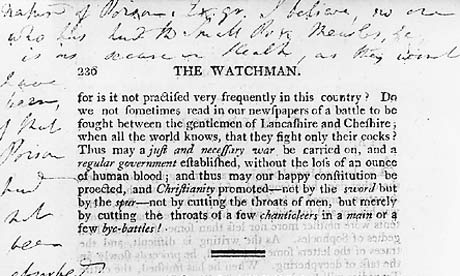
Marginalia imbues a book with your own memories.
By Anita Mathias

Marginalia imbues a book with your own memories.

The Watchman

Marginalia imbues a book with your own memories. Nice piece by Toby Lichtig.

Defacing books: the effluence of engagement

I’m not just talking about ‘marginalia’. My passion for defacing books includes doodles, addresses, recipes, and they all remind me of where I was – and who I was – when I read the work
Toby Lichtig

Mark Twain loved it, Virginia Woolf despised it and Barbara Kingsolver feels so strongly about the subject that she won’t do it to her own. Henry VIII deemed it a vital part of the experience (but, then, he could get away it), while Joe Orton and Kenneth Halliwell were once arrested for it.
I am, of course, talking about defacing books – a much maligned practice of which I am a passionate disciple. My flirtation with textual mutilation started off at school with primly creased corners and pencilled underlinings, but I soon progressed to cocksure highlighting and full-blown ink-on-paper action – the effluence of engagement, the living, livid trace of dialogue. If, as the poststructuralists have suggested, the act of reading is an act of violence, then scrawling across the page in cheap biro must be its logical corollary.
I’m not just talking about highbrow jottings: notes and queries, references and witticisms, the literary art of “marginalia” (a term coined in 1832 by that keenest of annotators, Samuel Taylor Coleridge). No, in my library anything goes: doodles, numbers, addresses, lists, recipes and the ensuing food stains. Personalising my books is an intrinsic part of the interaction (which is why I tend to be neurotic about holding on to what I’ve read). Perhaps it’s the fault of my somewhat sluggish memory: the marks and scrawls help me to recall the text – and, crucially, the person I was when reading it: how I was feeling, where I was sitting, whom I was with. The smears on my copy of The Scarlet and the Black (coffee certainly; jam I think) take me back to the cafe in Rovereto in northern Italy, where I read it over the course of a week in 2002. When I look at my edition of Dracula, with half of its cover torn away, I’m reminded of that night at university when we ran out of Rizla packets and were too lazy to look for more orthodox material.
Then there are the intrigues. A passage of particularly illegible scribbling might indicate I was reading while standing up on the tube, but how to explain the frantic-looking “phone Luca!!” on page108 of Samuel Beckett’s Trilogy? I no longer even know who Luca is, let alone what possibilities his being contacted might have brought. Such randomness adds heft and colour to the afterlife of my relationship with a given tome. A drawing by an old friend lies in my copy of The Great Gatsby – and for that reason I will always associate it with him. The Age of Extremes is in my mind an even fatter book than Eric Hobsbawm intended, thanks to the time I dropped it in the bath.
“I’m afraid I could never trust someone who would make irremovable marks in a library book,” says Desmond Bates in David Lodge’s novel,Deaf Sentence. But while I wouldn’t advocate defacing books that aren’t your own (like all violation, textual disfigurement should be by invitation only), there’s a prudishness to our reverence that I cannot get along with. Marking books is not heresy because literature does not happen in a vacuum. So you can keep your priggish white spaces, your stiff spines and spotless jackets. I prefer my pages with a little knowledge and experience; books with a back story, some miles on the clock. 
 
And perhaps this is why I just can’t get excited about recent technological developments in the way we approach, and respond to, literature. While corporate giants clash over the pricing of ebooks, and readers of the world go delirious at the thought of accessing the sum total of history’s writing via their Kindle, nook or iPad, I intend to carry on reading as I always have: with an object I can physically alter; something I can damage with impunity. Ever-primed for action, my pen hovers restlessly just above the page.

Filed Under: Books, books_blog

A Child’s Christmas in Wales by Dylan Thomas

By Anita Mathias

Here’s one of my favourite pieces of prose.

A CHILD’S CHRISTMAS IN WALES

by Dylan Thomas
One Christmas was so much like another, in those years around the sea-town corner now and out of all sound except the distant speaking of the voices I sometimes hear a moment before sleep, that I can never remember whether it snowed for six days and six nights when I was twelve or whether it snowed for twelve days and twelve nights when I was six.


All the Christmases roll down toward the two-tongued sea, like a cold and headlong moon bundling down the sky that was our street; and they stop at the rim of the ice-edged fish-freezing waves, and I plunge my hands in the snow and bring out whatever I can find. In goes my hand into that wool-white bell-tongued ball of holidays resting at the rim of the carol-singing sea, and out come Mrs. Prothero and the firemen.

It was on the afternoon of the Christmas Eve, and I was in Mrs. Prothero’s garden, waiting for cats, with her son Jim. It was snowing. It was always snowing at Christmas. December, in my memory, is white as Lapland, though there were no reindeers. But there were cats. Patient, cold and callous, our hands wrapped in socks, we waited to snowball the cats. Sleek and long as jaguars and horrible-whiskered, spitting and snarling, they would slink and sidle over the white back-garden walls, and the lynx-eyed hunters, Jim and I, fur-capped and moccasined trappers from Hudson Bay, off Mumbles Road, would hurl our deadly snowballs at the green of their eyes. The wise cats never appeared.

We were so still, Eskimo-footed arctic marksmen in the muffling silence of the eternal snows – eternal, ever since Wednesday – that we never heard Mrs. Prothero’s first cry from her igloo at the bottom of the garden. Or, if we heard it at all, it was, to us, like the far-off challenge of our enemy and prey, the neighbor’s polar cat. But soon the voice grew louder.
“Fire!” cried Mrs. Prothero, and she beat the dinner-gong.

And we ran down the garden, with the snowballs in our arms, toward the house; and smoke, indeed, was pouring out of the dining-room, and the gong was bombilating, and Mrs. Prothero was announcing ruin like a town crier in Pompeii. This was better than all the cats in Wales standing on the wall in a row. We bounded into the house, laden with snowballs, and stopped at the open door of the smoke-filled room.

Something was burning all right; perhaps it was Mr. Prothero, who always slept there after midday dinner with a newspaper over his face. But he was standing in the middle of the room, saying, “A fine Christmas!” and smacking at the smoke with a slipper.

“Call the fire brigade,” cried Mrs. Prothero as she beat the gong.
“There won’t be there,” said Mr. Prothero, “it’s Christmas.”
There was no fire to be seen, only clouds of smoke and Mr. Prothero standing in the middle of them, waving his slipper as though he were conducting.
“Do something,” he said. And we threw all our snowballs into the smoke – I think we missed Mr. Prothero – and ran out of the house to the telephone box.
“Let’s call the police as well,” Jim said. “And the ambulance.” “And Ernie Jenkins, he likes fires.”

But we only called the fire brigade, and soon the fire engine came and three tall men in helmets brought a hose into the house and Mr. Prothero got out just in time before they turned it on. Nobody could have had a noisier Christmas Eve. And when the firemen turned off the hose and were standing in the wet, smoky room, Jim’s Aunt, Miss. Prothero, came downstairs and peered in at them. Jim and I waited, very quietly, to hear what she would say to them. She said the right thing, always. She looked at the three tall firemen in their shining helmets, standing among the smoke and cinders and dissolving snowballs, and she said, “Would you like anything to read?”

Years and years ago, when I was a boy, when there were wolves in Wales, and birds the color of red-flannel petticoats whisked past the harp-shaped hills, when we sang and wallowed all night and day in caves that smelt like Sunday afternoons in damp front farmhouse parlors, and we chased, with the jawbones of deacons, the English and the bears, before the motor car, before the wheel, before the duchess-faced horse, when we rode the daft and happy hills bareback, it snowed and it snowed. But here a small boy says: “It snowed last year, too. I made a snowman and my brother knocked it down and I knocked my brother down and then we had tea.”

“But that was not the same snow,” I say. “Our snow was not only shaken from white wash buckets down the sky, it came shawling out of the ground and swam and drifted out of the arms and hands and bodies of the trees; snow grew overnight on the roofs of the houses like a pure and grandfather moss, minutely -ivied the walls and settled on the postman, opening the gate, like a dumb, numb thunder-storm of white, torn Christmas cards.”

“Were there postmen then, too?”
“With sprinkling eyes and wind-cherried noses, on spread, frozen feet they crunched up to the doors and mittened on them manfully. But all that the children could hear was a ringing of bells.”
“You mean that the postman went rat-a-tat-tat and the doors rang?”
“I mean that the bells the children could hear were inside them.”
“I only hear thunder sometimes, never bells.”
“There were church bells, too.”
“Inside them?”
“No, no, no, in the bat-black, snow-white belfries, tugged by bishops and storks. And they rang their tidings over the bandaged town, over the frozen foam of the powder and ice-cream hills, over the crackling sea. It seemed that all the churches boomed for joy under my window; and the weathercocks crew for Christmas, on our fence.”

“Get back to the postmen”
“They were just ordinary postmen, found of walking and dogs and Christmas and the snow. They knocked on the doors with blue knuckles ….”
“Ours has got a black knocker….”
“And then they stood on the white Welcome mat in the little, drifted porches and huffed and puffed, making ghosts with their breath, and jogged from foot to foot like small boys wanting to go out.”
“And then the presents?”
“And then the Presents, after the Christmas box. And the cold postman, with a rose on his button-nose, tingled down the tea-tray-slithered run of the chilly glinting hill. He went in his ice-bound boots like a man on fishmonger’s slabs.
“He wagged his bag like a frozen camel’s hump, dizzily turned the corner on one foot, and, by God, he was gone.”

“Get back to the Presents.”
“There were the Useful Presents: engulfing mufflers of the old coach days, and mittens made for giant sloths; zebra scarfs of a substance like silky gum that could be tug-o’-warred down to the galoshes; blinding tam-o’-shanters like patchwork tea cozies and bunny-suited busbies and balaclavas for victims of head-shrinking tribes; from aunts who always wore wool next to the skin there were mustached and rasping vests that made you wonder why the aunts had any skin left at all; and once I had a little crocheted nose bag from an aunt now, alas, no longer whinnying with us. And pictureless books in which small boys, though warned with quotations not to, would skate on Farmer Giles’ pond and did and drowned; and books that told me everything about the wasp, except why.”

“Go on the Useless Presents.”
“Bags of moist and many-colored jelly babies and a folded flag and a false nose and a tram-conductor’s cap and a machine that punched tickets and rang a bell; never a catapult; once, by mistake that no one could explain, a little hatchet; and a celluloid duck that made, when you pressed it, a most unducklike sound, a mewing moo that an ambitious cat might make who wished to be a cow; and a painting book in which I could make the grass, the trees, the sea and the animals any colour I pleased, and still the dazzling sky-blue sheep are grazing in the red field under the rainbow-billed and pea-green birds. Hardboileds, toffee, fudge and allsorts, crunches, cracknels, humbugs, glaciers, marzipan, and butterwelsh for the Welsh. And troops of bright tin soldiers who, if they could not fight, could always run. And Snakes-and-Families and Happy Ladders. And Easy Hobbi-Games for Little Engineers, complete with instructions. Oh, easy for Leonardo! And a whistle to make the dogs bark to wake up the old man next door to make him beat on the wall with his stick to shake our picture off the wall. And a packet of cigarettes: you put one in your mouth and you stood at the corner of the street and you waited for hours, in vain, for an old lady to scold you for smoking a cigarette, and then with a smirk you ate it. And then it was breakfast under the balloons.”

“Were there Uncles like in our house?”
“There are always Uncles at Christmas. The same Uncles. And on Christmas morning, with dog-disturbing whistle and sugar fags, I would scour the swatched town for the news of the little world, and find always a dead bird by the Post Office or by the white deserted swings; perhaps a robin, all but one of his fires out. Men and women wading or scooping back from chapel, with taproom noses and wind-bussed cheeks, all albinos, huddles their stiff black jarring feathers against the irreligious snow. Mistletoe hung from the gas brackets in all the front parlors; there was sherry and walnuts and bottled beer and crackers by the dessertspoons; and cats in their fur-abouts watched the fires; and the high-heaped fire spat, all ready for the chestnuts and the mulling pokers. Some few large men sat in the front parlors, without their collars, Uncles almost certainly, trying their new cigars, holding them out judiciously at arms’ length, returning them to their mouths, coughing, then holding them out again as though waiting for the explosion; and some few small aunts, not wanted in the kitchen, nor anywhere else for that matter, sat on the very edge of their chairs, poised and brittle, afraid to break, like faded cups and saucers.”

Not many those mornings trod the piling streets: an old man always, fawn-bowlered, yellow-gloved and, at this time of year, with spats of snow, would take his constitutional to the white bowling green and back, as he would take it wet or fire on Christmas Day or Doomsday; sometimes two hale young men, with big pipes blazing, no overcoats and wind blown scarfs, would trudge, unspeaking, down to the forlorn sea, to work up an appetite, to blow away the fumes, who knows, to walk into the waves until nothing of them was left but the two furling smoke clouds of their inextinguishable briars. Then I would be slap-dashing home, the gravy smell of the dinners of others, the bird smell, the brandy, the pudding and mince, coiling up to my nostrils, when out of a snow-clogged side lane would come a boy the spit of myself, with a pink-tipped cigarette and the violet past of a black eye, cocky as a bullfinch, leering all to himself.

I hated him on sight and sound, and would be about to put my dog whistle to my lips and blow him off the face of Christmas when suddenly he, with a violet wink, put his whistle to his lips and blew so stridently, so high, so exquisitely loud, that gobbling faces, their cheeks bulged with goose, would press against their tinsled windows, the whole length of the white echoing street. For dinner we had turkey and blazing pudding, and after dinner the Uncles sat in front of the fire, loosened all buttons, put their large moist hands over their watch chains, groaned a little and slept. Mothers, aunts and sisters scuttled to and fro, bearing tureens. Auntie Bessie, who had already been frightened, twice, by a clock-work mouse, whimpered at the sideboard and had some elderberry wine. The dog was sick. Auntie Dosie had to have three aspirins, but Auntie Hannah, who liked port, stood in the middle of the snowbound back yard, singing like a big-bosomed thrush. I would blow up balloons to see how big they would blow up to; and, when they burst, which they all did, the Uncles jumped and rumbled. In the rich and heavy afternoon, the Uncles breathing like dolphins and the snow descending, I would sit among festoons and Chinese lanterns and nibble dates and try to make a model man-o’-war, following the Instructions for Little Engineers, and produce what might be mistaken for a sea-going tramcar.

Or I would go out, my bright new boots squeaking, into the white world, on to the seaward hill, to call on Jim and Dan and Jack and to pad through the still streets, leaving huge footprints on the hidden pavements.
“I bet people will think there’s been hippos.”
“What would you do if you saw a hippo coming down our street?”
“I’d go like this, bang! I’d throw him over the railings and roll him down the hill and then I’d tickle him under the ear and he’d wag his tail.”
“What would you do if you saw two hippos?”

Iron-flanked and bellowing he-hippos clanked and battered through the scudding snow toward us as we passed Mr. Daniel’s house.
“Let’s post Mr. Daniel a snow-ball through his letter box.”
“Let’s write things in the snow.”
“Let’s write, ‘Mr. Daniel looks like a spaniel’ all over his lawn.”
Or we walked on the white shore. “Can the fishes see it’s snowing?”

The silent one-clouded heavens drifted on to the sea. Now we were snow-blind travelers lost on the north hills, and vast dewlapped dogs, with flasks round their necks, ambled and shambled up to us, baying “Excelsior.” We returned home through the poor streets where only a few children fumbled with bare red fingers in the wheel-rutted snow and cat-called after us, their voices fading away, as we trudged uphill, into the cries of the dock birds and the hooting of ships out in the whirling bay. And then, at tea the recovered Uncles would be jolly; and the ice cake loomed in the center of the table like a marble grave. Auntie Hannah laced her tea with rum, because it was only once a year.

Bring out the tall tales now that we told by the fire as the gaslight bubbled like a diver. Ghosts whooed like owls in the long nights when I dared not look over my shoulder; animals lurked in the cubbyhole under the stairs and the gas meter ticked. And I remember that we went singing carols once, when there wasn’t the shaving of a moon to light the flying streets. At the end of a long road was a drive that led to a large house, and we stumbled up the darkness of the drive that night, each one of us afraid, each one holding a stone in his hand in case, and all of us too brave to say a word. The wind through the trees made noises as of old and unpleasant and maybe webfooted men wheezing in caves. We reached the black bulk of the house. “What shall we give them? Hark the Herald?”
“No,” Jack said, “Good King Wencelas. I’ll count three.” One, two three, and we began to sing, our voices high and seemingly distant in the snow-felted darkness round the house that was occupied by nobody we knew. We stood close together, near the dark door. Good King Wencelas looked out On the Feast of Stephen … And then a small, dry voice, like the voice of someone who has not spoken for a long time, joined our singing: a small, dry, eggshell voice from the other side of the door: a small dry voice through the keyhole. And when we stopped running we were outside our house; the front room was lovely; balloons floated under the hot-water-bottle-gulping gas; everything was good again and shone over the town.
“Perhaps it was a ghost,” Jim said. “
Perhaps it was trolls,” Dan said, who was always reading.
“Let’s go in and see if there’s any jelly left,” Jack said. And we did that.

Always on Christmas night there was music. An uncle played the fiddle, a cousin sang “Cherry Ripe,” and another uncle sang “Drake’s Drum.” It was very warm in the little house. Auntie Hannah, who had got on to the parsnip wine, sang a song about Bleeding Hearts and Death, and then another in which she said her heart was like a Bird’s Nest; and then everybody laughed again; and then I went to bed. Looking through my bedroom window, out into the moonlight and the unending smoke-colored snow, I could see the lights in the windows of all the other houses on our hill and hear the music rising from them up the long, steady falling night. I turned the gas down, I got into bed. I said some words to the close and holy darkness, and then I slept.

http://www.bfsmedia.com/MAS/Dylan/Christmas.html


Filed Under: books_blog, Lovely prose

Parties–and the Writers’ Life

By Anita Mathias

I’ve got several parties lined up, among them one today at my old college, Somerville College, Oxford, and a Society of Authors party on Thursday.

Part of me is longing to settle down to long hours of serious writing, and wishing I had not committed to go to these winy, distracting events.

On the other hand, after about three long days of intense writing, I am tired, and badly need social life, metaphorical fresh air, a short break. I often invite a friend to lunch after a few days of work.

And so a party for an intense woman like me functions like a complete break. I clear my head, and come back energized (am more an extrovert than an introvert in that way.)

Though when I just getting into a piece of writing, the break is disastrous, and I lose the thread of what I was doing. On the other hand, after a few days of work, it is invigorating.

I haven’t worked much for the last few days though, what with a friend for lunch yesterday, the weekly clean-up and organization for the cleaner etc.

Oh well, the other things with parties is that they happen when they happen, and cannot be scheduled to optimally fit into your writing routines (other people’s parties, that is.)

And I do enjoy them, mostly.

A writing life is partly a matter of managing yourself for optimal productivity, like a football manager manages his team.

Filed Under: books_blog

Max Beerbohm–Going Out for a Walk. I particularly like his introduction

By Anita Mathias

Max Beerbohm–Going out for a Walk

It is a fact that not once in all my life have I gone out for a walk. I have been taken out for walks; but that is another matter. Even while I trotted prattling by my nurse’s side I regretted the good old days when I had, and wasn’t, a perambulator. When I grew up it seemed to me that the one advantage of living in London was that nobody ever wanted me to come out for a walk. London’s very drawbacks–its endless noise and hustle, its smoky air, the squalor ambushed everywhere in it–assured this one immunity. Whenever I was with friends in the country, I knew that at any moment, unless rain were actually falling, some man might suddenly say “Come out for a walk!” in that sharp imperative tone which he would not dream of using in any other connexion. People seem to think there is something inherently noble and virtuous in the desire to go for a walk. Any one thus desirous feels that he has a right to impose his will on whomever he sees comfortably settled in an arm-chair, reading. It is easy to say simply “No” to an old friend. In the case of a mere acquaintance one wants some excuse. “I wish I could, but”–nothing ever occurs to me except “I have some letters to write.” This formula is unsatisfactory in three ways. (1) It isn’t believed. (2) It compels you to rise from your chair, go to the writing-table, and sit improvising a letter to somebody until the walkmonger (just not daring to call you liar and hypocrite) shall have lumbered out of the room. (3) It won’t operate on Sunday mornings. “There’s no post out till this evening” clinches the matter; and you may as well go quietly.
Walking for walking’s sake may be as highly laudable and exemplary a thing as it is held to be by those who practise it. My objection to it is that it stops the brain. Many a man has professed to me that his brain never works so well as when he is swinging along the high road or over hill and dale. This boast is not confirmed by my memory of anybody who on a Sunday morning has forced me to partake of his adventure. Experience teaches me that whatever a fellow-guest may have of power to instruct or to amuse when he is sitting on a chair, or standing on a hearth-rug, quickly leaves him when he takes one out for a walk. The ideas that came so thick and fast to him in any room, where are they now? where that encyclopaedic knowledge which he bore so lightly? where the kindling fancy that played like summer lightning over any topic that was started? The man’s face that was so mobile is set now; gone is the light from his fine eyes. He says that A. (our host) is a thoroughly good fellow. Fifty yards further on, he adds that A. is one of the best fellows he has ever met. We tramp another furlong or so, and he says that Mrs. A. is a charming woman. Presently he adds that she is one of the most charming women he has ever known. We pass an inn. He reads vapidly aloud to me: “The King’s Arms. Licensed to sell Ales and Spirits.” I foresee that during the rest of the walk he will read aloud any inscription that occurs. We pass a milestone. He points at it with his stick, and says “Uxminster. 11 Miles.” We turn a sharp corner at the foot of a hill. He points at the wall, and says “Drive Slowly.” I see far ahead, on the other side of the hedge bordering the high road, a small notice-board. He sees it too. He keeps his eye on it. And in due course “Trespassers,” he says, “Will Be Prosecuted.” Poor man!–mentally a wreck.
Luncheon at the A.s, however, salves him and floats him in full sail. Behold him once more the life and soul of the party. Surely he will never, after the bitter lesson of this morning, go out for another walk. An hour later, I see him striding forth, with a new companion. I watch him out of sight. I know what he is saying. He is saying that I am rather a dull man to go a walk with. He will presently add that I am one of the dullest men he ever went a walk with. Then he will devote himself to reading out the inscriptions.
How comes it, this immediate deterioration in those who go walking for walking’s sake? Just what happens? I take it that not by his reasoning faculties is a man urged to this enterprise. He is urged, evidently, by something in him that transcends reason; by his soul, I presume. Yes, it must be the soul that raps out the “Quick march!” to the body.–“Halt! Stand at ease!” interposes the brain, and “To what destination,” it suavely asks the soul, “and on what errand, are you sending the body?”–“On no errand whatsoever,” the soul makes answer, “and to no destination at all. It is just like you to be always on the look-out for some subtle ulterior motive. The body is going out because the mere fact of its doing so is a sure indication of nobility, probity, and rugged grandeur of character.”–“Very well, Vagula, have your own wayula! But I,” says the brain, “flatly refuse to be mixed up in this tomfoolery. I shall go to sleep till it is over.” The brain then wraps itself up in its own convolutions, and falls into a dreamless slumber from which nothing can rouse it till the body has been safely deposited indoors again.
Even if you go to some definite place, for some definite purpose, the brain would rather you took a vehicle; but it does not make a point of this; it will serve you well enough unless you are going out for a walk. It won’t, while your legs are vying with each other, do any deep thinking for you, nor even any close thinking; but it will do any number of small odd jobs for you willingly–provided that your legs, also, are making themselves useful, not merely bandying you about to gratify the pride of the soul. Such as it is, this essay was composed in the course of a walk, this morning. I am not one of those extremists who must have a vehicle to every destination. I never go out of my way, as it were, to avoid exercise. I take it as it comes, and take it in good part. That valetudinarians are always chattering about it, and indulging in it to excess, is no reason for despising it. I am inclined to think that in moderation it is rather good for one, physically. But, pending a time when no people wish me to go and see them, and I have no wish to go and see any one, and there is nothing whatever for me to do off my own premises, I never will go out for a walk.

Filed Under: books_blog, Essays

Poets and Bloggers

By Anita Mathias

“Poets are no different from other people, except in their training themselves to notice all their own sensations.” I found this quote in my journal. Unattributed. Grr. Comment: Very similar to bloggers and journal-ers

Filed Under: books_blog, Poetry and blogging

Where to being a piece? Where do I end it?

By Anita Mathias

Robert Creeley, “I begin where I can, and I end when I see the whole thing returning.”

Filed Under: books_blog

Richard Rodriguez, Hunger of Memory–a classic description of writers’ block.

By Anita Mathias

Writer’s block develops through perfectionism, through not letting go of a piece of work when it is very good, rather than perfect, through viewing your work through the eyes of a imaginary critic.
Rodriguez describes the sterility as he tried to finish his Ph.D.

He wrote “sentences that were overly cautious, timid, strained brittle under the heavy weight of quaifications.  I seemed unable to dare a passionate statement.  I felt drawn to the edge of sterility, capable of no more than pedantic, lifeless, unassailable prose.”
 “I grew to hate the growing pages of my dissertion on genre and Renaissance literature.”
Not surprising.
Writing that nourishes the heart and whole being, flows from the heart and whole being, not solely the head.

Filed Under: books_blog

Favourite passages from Shakespeare

By Anita Mathias

For Shakespeare who wrote
Where the bee sucks, there suck I;
In a cowslip’s bell I lie;
There I couch when owls do cry.
On the bat’s back I do fly
After summer merrily.
Merrily, merrily shall I live now
Under the blossom that hangs on the bough.
Full fathom five thy father lies;
Of his bones are coral made;
Those are pearls that were his eyes:
Nothing of him that doth fade
But doth suffer a sea-change
Into something rich and strange.
daffodils,
That come before the swallow dares, and take
The winds of March with beauty; 
What more can I say?

Filed Under: books_blog, Poetry

  • « Previous Page
  • 1
  • …
  • 19
  • 20
  • 21
  • 22
  • Next Page »

Sign Up and Get a Free eBook!

Sign up to be emailed my blog posts (one a week) and get the ebook of "Holy Ground," my account of working with Mother Teresa.

Join 536 Other Readers

My Books

Rosaries, Reading, Secrets: A Catholic Childhood in India

Rosaries, Reading Secrets, B&N
USA

UK

Wandering Between Two Worlds: Essays on Faith and Art

Wandering Between Two Worlds
USA

UK

Francesco, Artist of Florence: The Man Who Gave Too Much

Francesco, Artist of Florence
US

UK

The Story of Dirk Willems

The Story of Dirk Willems
US

UK

My Latest Meditation

Anita Mathias: About Me

Anita Mathias

Read my blog on Facebook

Follow me on Twitter

Follow @anitamathias1

Recent Posts

  • At the Cross, God Forgives Us Completely
  • Using God’s Gift of Our Talents: A Path to Joy and Abundance
  • The Kingdom of God is Here Already, Yet Not Yet Here
  • All Those Who Exalt Themselves Will Be Humbled & the Humble Will Be Exalted
  • Christ’s Great Golden Triad to Guide Our Actions and Decisions
  • How Jesus Dealt With Hostility and Enemies
  • Do Not Be Afraid, but Do Be Prudent
  • For Scoundrels, Scallywags, and Rascals—Christ Came
  • How to Lead an Extremely Significant Life
  • Don’t Walk Away From Jesus, but if You Do, He Still Looks at You and Loves You
Premier Digital Awards 2015 - Finalist - Blogger of the year
Runner Up Christian Media Awards 2014 - Tweeter of the year

Categories

What I’m Reading


Wolf Hall
Hilary Mantel

Wolf Hall --  Amazon.com
Amazon.com

Amazon.co.uk

Silence and Honey Cakes:
The Wisdom Of The Desert
Rowan Williams

Silence and Honey Cakes --  Amazon.com
Amazon.com

Amazon.co.uk

The Long Loneliness:
The Autobiography of the Legendary Catholic Social Activist
Dorothy Day

The Long Loneliness --  Amazon.com
Amazon.com

Amazon.co.uk

Country Girl
Edna O'Brien

Country Girl  - Amazon.com
Amazon.com

Amazon.co.uk

Archive by month

My Latest Five Podcast Meditations

INSTAGRAM

anita.mathias

My memoir: Rosaries, Reading, Secrets https://amzn.to/42xgL9t
Oxford, England. Writer, memoirist, podcaster, blogger, Biblical meditation teacher, mum

Looking at photos from our week in beautiful Sevil Looking at photos from our week in beautiful Seville and Cordoba over New Year with Irene, who had a week off.
And, ICYMI, here’s my latest meditation on the Gospel of Matthew… I’ve recorded it, should you want a few minutes of peace.
https://anitamathias.com/2026/04/29/gods-complete-forgiveness/
Hello Friends, I'm resumed recording my meditation Hello Friends, I'm resumed recording my meditations on the Gospel of Matthew. Do click on this link to listen. 
https://anitamathias.com/.../29/gods-complete-forgiveness/
Christ is the most influential figure in the history of the world, though his life ended in shame, humiliation and failure. But he so completely turned things round in his great reversal that the cross on which he died when all seemed hopeless is now the most common, and revered, symbol in history.
He emerged from and was anchored in Judaism. And as the sins of the people were laid on the scapegoat who was sent into the wilderness to perish, Christ died as the lamb of God voluntarily bearing the guilt of the wrongdoing of the whole world. He paid the price for our forgiveness with his life-blood--in accordance with the iron law of the physical and moral universe, of sowing and reaping, cause and effect. 
And so, God, who appeared as flames of fire to Moses, can now dwell within us, purifying us, whose hearts have darkness and shards of ice. 
And now that Christ was crucified, died, but rose again, His Spirit, no longer contained within his earthly body, is poured out like living water onto all humans, at our humble request. The Spirit pours the love of God into us; he reminds us of the words of Jesus and slowly writes Christ’s sweet law on our hearts. This transfusion of grace helps us do hard things we previously couldn’t do. Our dance with the Spirit gradually breaks the power of sin over us. It transforms us.
Now we, the forgiven, protected by the blood of Jesus poured out over us, and filled with His Spirit, who sings within us, Abba, Father, are adopted by God as his children in his joyful new covenant. We are cells grafted into the vine of our new family--Father, Son, Spirit—who now live in us as we live in them. As we choose by our thoughts and actions to continue living in the vine of Jesus, their energy pulsing through us makes us fruitful. And now, all our prayers which flow in the river of God’s good purposes are kindly heard. Waves of love and power flood from the cross! 
Thank you!
Well, hello friends! Breaking radio silence to let Well, hello friends! Breaking radio silence to let you know that I have taped a meditation for you on Christ’s famous Parable of the Talents in Matthew 25. https://anitamathias.com/2025/11/05/using-gods-gift-of-our-talents-a-path-to-joy-and-abundance/
Here you are, click the play button in the blog post for a brief meditation, and some moments of peace, and, perhaps, inspiration in your day 🙂
Hi Friends, I have taped a meditation; do listen a Hi Friends, I have taped a meditation; do listen at this link: https://anitamathias.com/2025/04/08/the-kingdom-of-god-is-here-already-yet-not-yet-here-2/
It’s on the Kingdom of God, of which Christ so often spoke, which is here already—a mysterious, shimmering internal palace in which, in lightning flashes, we experience peace and joy, and yet, of course, not yet fully here. We sense the rainbowed presence of Christ in the song which pulses through creation. Christ strolls into our rooms with his wisdom and guidance, and things change. Our prayers are answered; we are healed; our hearts are strangely warmed. Sometimes.
And yet, we also experience evil within & all around us. Our own sin which can shatter our peace and the trajectory of our lives. And the sins of the world—its greed, dishonesty and environmental destruction.
But in this broken world, we still experience the glory of creation; “coincidences” which accelerate once we start praying, and shalom which envelops us like sudden sunshine. The portals into this Kingdom include repentance, gratitude, meditative breathing, and absolute surrender.
The Kingdom of God is here already. We can experience its beauty, peace and joy today through the presence of the Holy Spirit. But yet, since, in the Apostle Paul’s words, we do not struggle only “against flesh and blood, but against the rulers, against the unseen powers of this dark world and against the spiritual forces of evil,” its fullness still lingers…
Our daughter Zoe was ordained into the Church of E Our daughter Zoe was ordained into the Church of England in June. I have been on a social media break… but … better late than never. Enjoy!
First picture has my sister, Shalini, who kindly flew in from the US. Our lovely cousins Anthony and Sarah flank Zoe in the next picture.
The Bishop of London, Sarah Mullaly, ordained Zoe. You can see her praying that Zoe will be filled with the Holy Spirit!!
And here’s a meditation I’ve recorded, which you might enjoy. The link is also in my profile
https://anitamathias.com/2024/11/07/all-those-who-exalt-themselves-will-be-humbled-the-humble-will-be-exalted/
I have taped a meditation on Jesus statement in Ma I have taped a meditation on Jesus statement in Matthew 23, “For those who exalt themselves will be humbled, and those who humble themselves will be exalted.”
Do listen here. https://anitamathias.com/2024/11/07/all-those-who-exalt-themselves-will-be-humbled-the-humble-will-be-exalted/
Link also in bio.
And so, Jesus states a law of life. Those who broadcast their amazingness will be humbled, since God dislikes—scorns that, as much as people do.  For to trumpet our success, wealth, brilliance, giftedness or popularity is to get distracted from our life’s purpose into worthless activity. Those who love power, who are sure they know best, and who must be the best, will eventually be humbled by God and life. For their focus has shifted from loving God, doing good work, and being a blessing to their family, friends, and the world towards impressing others, being enviable, perhaps famous. These things are houses built on sand, which will crumble when hammered by the waves of old age, infirmity or adversity. 
God resists the proud, Scripture tells us—those who crave the admiration and power which is His alone. So how do we resist pride? We slow down, so that we realise (and repent) when sheer pride sparks our allergies to people, our enmities, our determination to have our own way, or our grandiose ego-driven goals, and ambitions. Once we stop chasing limelight, a great quietness steals over our lives. We no longer need the drug of continual achievement, or to share images of glittering travel, parties, prizes or friends. We just enjoy them quietly. My life is for itself & not for a spectacle, Emerson wrote. And, as Jesus advises, we quit sharp-elbowing ourselves to sit with the shiniest people, but are content to hang out with ordinary people; and then, as Jesus said, we will inevitably, eventually, be summoned higher to the sparkling conversation we craved. 
One day, every knee will bow before the gentle lamb who was slain, now seated on the throne. We will all be silent before him. Let us live gently then, our eyes on Christ, continually asking for his power, his Spirit, and his direction, moving, dancing, in the direction that we sense him move.
Link to new podcast in Bio https://anitamathias.co Link to new podcast in Bio https://anitamathias.com/2024/02/20/how-jesus-dealt-with-hostility-and-enemies/
3 days before his death, Jesus rampages through the commercialised temple, overturning the tables of moneychangers. Who gave you the authority to do these things? his outraged adversaries ask. And Jesus shows us how to answer hostile questions. Slow down. Breathe. Quick arrow prayers!
Your enemies have no power over your life that your Father has not permitted them. Ask your Father for wisdom, remembering: Questions do not need to be answered. Are these questioners worthy of the treasures of your heart? Or would that be feeding pearls to hungry pigs, who might instead devour you?
Questions can contain pitfalls, traps, nooses. Jesus directly answered just three of the 183 questions he was asked, refusing to answer some; answering others with a good question.
But how do we get the inner calm and wisdom to recognise
and sidestep entrapping questions? Long before the day of
testing, practice slow, easy breathing, and tune in to the frequency of the Father. There’s no record of Jesus running, rushing, getting stressed, or lacking peace. He never spoke on his own, he told us, without checking in with the Father. So, no foolish, ill-judged statements. Breathing in the wisdom of the Father beside and within him, he, unintimidated, traps the trappers.
Wisdom begins with training ourselves to slow down and ask
the Father for guidance. Then our calm minds, made perceptive, will help us recognise danger and trick questions, even those coated in flattery, and sidestep them or refuse to answer.
We practice tuning in to heavenly wisdom by practising–asking God questions, and then listening for his answers about the best way to do simple things…organise a home or write. Then, we build upwards, asking for wisdom in more complex things.
Listening for the voice of God before we speak, and asking for a filling of the Spirit, which Jesus calls streams of living water within us, will give us wisdom to know what to say, which, frequently, is nothing at all. It will quieten us with the silence of God, which sings through the world, through sun and stars, sky and flowers.
Especially for @ samheckt Some very imperfect pi Especially for @ samheckt 
Some very imperfect pictures of my labradoodle Merry, and golden retriever Pippi.
And since, I’m on social media, if you are the meditating type, here’s a scriptural meditation on not being afraid, while being prudent. https://anitamathias.com/2024/01/03/do-not-be-afraid-but-do-be-prudent/
A new podcast. Link in bio https://anitamathias.c A new podcast. Link in bio
https://anitamathias.com/2024/01/03/do-not-be-afraid-but-do-be-prudent/
Do Not Be Afraid, but Do Be Prudent
“Do not be afraid,” a dream-angel tells Joseph, to marry Mary, who’s pregnant, though a virgin, for in our magical, God-invaded world, the Spirit has placed God in her. Call the baby Jesus, or The Lord saves, for he will drag people free from the chokehold of their sins.
And Joseph is not afraid. And the angel was right, for a star rose, signalling a new King of the Jews. Astrologers followed it, threatening King Herod, whose chief priests recounted Micah’s 600-year-old prophecy: the Messiah would be born in Bethlehem, as Jesus had just been, while his parents from Nazareth registered for Augustus Caesar’s census of the entire Roman world. 
The Magi worshipped the baby, offering gold. And shepherds came, told by an angel of joy: that the Messiah, a saviour from all that oppresses, had just been born.
Then, suddenly, the dream-angel warned: Flee with the child to Egypt. For Herod plans to kill this baby, forever-King.
Do not be afraid, but still flee? Become a refugee? But lightning-bolt coincidences verified the angel’s first words: The magi with gold for the flight. Shepherds
telling of angels singing of coming inner peace. Joseph flees.
What’s the difference between fear and prudence? Fear is being frozen or panicked by imaginary what-ifs. It tenses our bodies; strains health, sleep and relationships; makes us stingy with ourselves & others; leads to overwork, & time wasted doing pointless things for fear of people’s opinions.
Prudence is wisdom-using our experience & spiritual discernment as we battle the demonic forces of this dark world, in Paul’s phrase.It’s fighting with divinely powerful weapons: truth, righteousness, faith, Scripture & prayer, while surrendering our thoughts to Christ. 
So let’s act prudently, wisely & bravely, silencing fear, while remaining alert to God’s guidance, delivered through inner peace or intuitions of danger and wrongness, our spiritual senses tuned to the Spirit’s “No,” his “Slow,” his “Go,” as cautious as a serpent, protected, while being as gentle as a lamb among wolves.
Follow on Instagram

© 2026 Dreaming Beneath the Spires · All Rights Reserved. · Cookie Policy · Privacy Policy