Anita Mathias: Dreaming Beneath the Spires

Anita Mathias's Blog on Faith and Art

  • Home
  • My Books
  • Meditations
  • Essays
  • Contact
  • About Me

Drowning my Sorrows in Art—but is it Idolatry?

By Anita Mathias

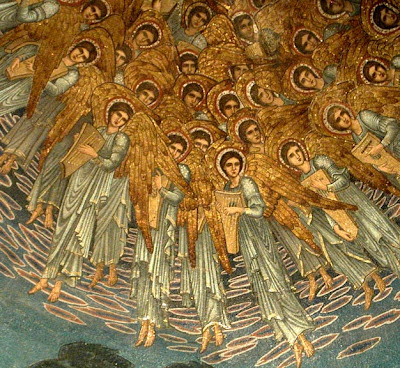
Angelic Choir, Burne-Jones, St. Paul Within the Walls, Rome

For decades now, when I have felt bored or sad or troubled or angry, when I have any sense, I pray…but also I read a book, or listen to it as I walk. I watch a movie. I try to get to an art gallery. And in the book, or the film, or the paintings, I forget my troubles.

Is this idolatry? I know Christ is the ultimate answer, that God is the sea in which the river of my life will find rest.

But just as YES is a great theological word, the word in which all God’s promises end in Christ, so too is AND.

Yes, Jesus is balm and the panacea for our spirits.

But Art too is a staff that helps us bear the ills of life


Art is the spark

From stoniest flint

That sings

“In the dark

And cold,

I’m light.”

Filed Under: random Tagged With: Art

“How is it possible to be a Christian and an Alcoholic?” (From Brennan Manning’s “Ragamuffin Gospel)”

By Anita Mathias


Image Credit

“Often I have been asked, “Brennan, how is it possible that you became an alcoholic after you got saved?”

“It is possible because I got battered and bruised by loneliness and failure, because I got discouraged, uncertain, guilt-ridden, and took my eyes off Jesus. Because the Christ-encounter did not transfigure me into an angel.

There is a myth flourishing in the church today that has caused incalculable harm—once converted, fully converted. In other words, once I accept Jesus Christ as my Lord and Saviour, an irreversible, sinless future beckons. Discipleship will be an untarnished success story; life will be an unbroken spiral towards holiness. Tell that to poor Peter who, after three times professing his love for Jesus on the beach, and after receiving the fullness of the Spirit at Pentecost, was still jealous of Paul’s apostolic success.”

Filed Under: random Tagged With: brokenness, eyes on Jesus, failure

The Best Two Word Definition of Love

By Anita Mathias


There was a prophetically poignant moment in the otherwise fairytale romance of Prince Charles and Lady Diana.

Interviewer: Are you in love?

Diana, instantly, “Of course.”

Charles, qualifying, “Whatever in love means.”

Probably every marriage goes through “Do you love each other?” “Of course.” “Whatever love means…” seasons.

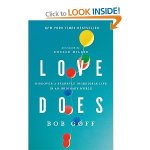
And then it helps to remember the best definition of love I know: Love Does. It is not just a feeling, an abstract noun, but a verb.

So, this Valentine’s Day week, I have been considering what Love Does, and how to make tiny changes in my relationship with Roy.

Well, a walking date together each week, and I will help clear the dishes after meals. Normally, he has been doing that while I deal with the email, tweets, Facebook messages and blog comments which have invariably accumulated during the meal. Yeah, social media is time-consuming!! And so is love!

Filed Under: random Tagged With: Love, love does, marriage

Moses and the Uses of Failure and Brokenness

By Anita Mathias

Moses  and  the Burning Bush, Pluchart, wikipedia

Moses and the Burning Bush, Pluchart, wikipedia

Moses was remarkable. Brought up at court as Pharaoh’s grandson, he had the confidence, courage, boldness and the physical strength to kill an Egyptian he saw oppressing his countrymen (Ex 2:11), sort out two Hebrews fighting with each other, (Ex 2:13) and chase away the shepherds bullying Midian’s daughters.

But his privileged upbringing in Pharaoh’s court and his own giftedness brought him a desert exile of 40 years.

He has failed. He became a nobody.  His self-confidence vanished.

However, the desert was the right place at the right time. To see the bush which burned and was not consumed. To ask the right question when given a stupendous commission.

 “Who am I?” (Exodus 3:11)

God replies, “I will be with you.” And that is enough.

God’s answer essentially is: “Who you are does not matter. What matters is that you learn to listen, learn to lean, learn to rely on my strength.”

* * *

God commands Moses to command Pharaoh to let the entire work force of Egypt go into the desert to worship God.

“I will be with you,” is the only guarantee of safe-conduct Moses gets when commissioned to confront the Pharaoh from whom he had fled–with this preposterous demand.

Moses pleads, “I have never been eloquent, neither in the past nor since you have spoken to your servant. I am slow of speech and tongue.”

But God tells him, “Do not rely on yourself. Rely on me.” “Who gave human beings their mouths? Who makes them deaf or mute? Who gives them sight or makes them blind? Is it not I, the Lord? 12 Now go; I will help you speak and will teach you what to say.” (Ex 4 11-12).

* * *

In his great poem, “The Hound of Heaven,” Francis Thompson bitterly asks

Ah! must —

Designer Infinite —

Ah! must thou char the wood ‘ere thou canst limn with it ?

Brokenness reveals beauty. A principle encoded in creation. The green inedible rind of watermelon–who would suspect it conceals red sweet lusciousness? Or guess at the chewy flesh and honeyed water inside a coconut? Or the succulent sweetness inside a leechi or a custard apple?

The fruits themselves, were they sentient, might not suspect it.

They must be broken, smashed, cracked open to reveal their true selves, their sweetness and usefulness.

So too, after a long experience of being baffled, bewildered, broken, discover in ourselves a sweetness we had not suspected. And, as we learn to lean, we discover in ourselves gifts, abilities and strengths which surprise us.

And God recasts the talent which he has broken into something more beautiful than before. Think of a mosaic; think of a stained glass window.

* * *

Moses had all the traits of a natural leader. He was self-confident, quick-thinking, decisive, dominant. He naturally took charge. But he needed to be broken to learn to rely on God, so that he could lead his people into bigger adventures that he would ever have dreamed of.

Once we have surrendered our lives to God, even unpromising “plodders” like William Carey can do staggering things. An old man, hiding out as a shepherd for forty years, can unleash plagues against a great empire and almost single-handedly persuade them to emancipate their slaves.

Relying on oneself, on the other hand, leads to fear, anxiety and second-guessing which saps our strength far more than work. However, figuring out God’s unique mandate for us and obeying it, while relying on him, sets us free because we know he has our back.

* * *

For myself, writing was my forte. It took a long period of failure, exhaustion and incomplete projects for me to learn  to lean on God, to try to catch his whispers, his words, his ideas, his feelings, and the music of his voice. “I will help you speak and will teach you what to say.”

And writing is becoming so much easier, reaches more people and takes a fraction of the time.

* * *

 Listen, Christian, if life is grinding you down, driving you into the desert, be of good cheer.

The fire which burns and is not consumed cannot be seen amid “the bright lights, big city.”

It cannot be seen if you are rushing around the King’s court or slaying Egyptians.

Do not resist the period of obscurity and silence in which you learn to see the burning bush, and hear the one who assures you, “I am with you.”

For once you have learnt to lean, and learnt to hear, your words won’t be just words, but will have a power beyond themselves. For the Lord may help you speak and teach you what to say.

Filed Under: random

Thinking About Darwin, and What he Lost as He Moved from Theism to Agnosticism

By Anita Mathias

File:Darwins tree of life 1859.gif

The Tree of Life in Darwin’s 1859 Origin of Species

I loved Mr Darwin’s Tree, a one act play by Murray Watts, a sort of “memoir” of Darwin–much of it quoted from Darwin’s own letters, journals and books–verbally lovely, rich and bursting with energy, poetic and full of pathos.

Darwin introduced a Copernican revolution into the all-or-nothing theological thinking of the age, which still prevails today in America’s Bible Belt, and among some evangelicals: Scripture is either all true, every word of it, or not true at all. If species gradually evolved, then the account of a six day creation was not true. Ergo, Scripture was not true. This crumbling of ancient foundations caused much anguish to Christian Victorians—and throbs through the poetry of Matthew Arnold and Tennyson, for instance.

But for me, the fact that God made the world in six aeons, that the finches and giant tortoises of the Galapagos evolved in response to environmental pressures rather than being created “as is” does not detract from the moral beauty and sublimity of the message of Jesus. One cannot sit and read or listen to the Gospels for hour  after hour, and not feel convinced that Jesus is more than human, has wisdom beyond ours.

* * *

 Darwin’s theory of evolution in a nutshell is: There is competition for limited resources. Better adapted individuals (the “fit enough”) within each species have heritable traits—which can be passed on to their offspring—which make them better adapted to survive and reproduce, passing on their genes to the next generations. Species whose individuals are best adapted to their environment survive; others become extinct.

Over aeons, the adaption of species amounts to a new species being created. In Darwin’s words, “being well prepared to appreciate the struggle for existence which everywhere goes on from long-continued observation of the habits of animals and plants, it at once struck me that under these circumstances favourable variations would tend to be preserved, and unfavourable ones to be destroyed. The result of this would be the formation of new species.” 

* * *

 Darwin’s wife, Emma Wedgwood Darwin was a faithful evangelical Christian, and it was partly in deference to her that he delayed publishing the Origin of Species. With his Cambridge theology degree, he foresaw how going public with his ideas would cause great upset. “It is like confessing a murder,” he wrote.

And cause upset it did. Edmund Gosse’s heartbreakingly beautiful memoir, Father and Son, describes how his father, the naturalist Philip Gosse was thrilled when Darwin published The Origin of Species. His intellect and careful studies told him that it was true. Then he realized that it conflicted with Scripture which was true, so it could not be true. Gosse published Omphalos, a fanciful attempt to reconcile geological discoveries with Genesis (postulating that God instantly formed the fossil record at the moment of creation) which made him the laughing stock of the scientific community.

* * *

 Darwin’s wife, Emma, loved Christ, and talked to him as a friend, writing to Charles, “Will you do me a favour?  It is to read our Saviour’s farewell discourse to his disciples which begins at the end of the 13th Chap of John. It is so full of love to them & devotion & every beautiful feeling.”

But this did not convert Charles. Sadly, “the ways he evaluated evidence led him to exclude God and religion because he could only accept what could be proved in a laboratory and scientifically demonstrated.”

In 1876 Darwin described his agnosticism: “Formerly I was led… to the firm conviction of the existence of God and the immortality of the soul. In my Journal I wrote that whilst standing in the midst of the grandeur of a Brazilian forest, ‘it is not possible to give an adequate idea of the higher feelings of wonder, admiration, and devotion, which fill and elevate the mind.’ I well remember my conviction that there is more in man than the mere breath of his body. But now the grandest scenes would not cause any such convictions and feelings to rise in my mind.”

He lost faith in a beneficent creator. “I own that I cannot see as plainly as others do, and as I should wish to do, evidence of design and beneficence on all sides of us. There seems to me too much misery in the world. I cannot persuade myself that a beneficent and omnipotent God would have designedly created the Ichneumonidae with the express intention of their feeding within the living bodies of Caterpillars, or that a cat should play with mice.”

(Well, wasps control pests. Nearly every pest insect on Earth is preyed upon by a wasp species, either for food or as a host for its parasitic larvae.

However, whenever I try to teach myself about the natural world—the size of the universe, the expanding universe, the big bang theory, the theory of relativity, the mysteries of the tides—my mind boggles. I realize I am but a child at the shore of the wide world, and why should I hope to understand it all?  I believe God is good because Jesus says he was, and what Jesus says, I believe.

* * *

 Losing faith in God—losing faith in a good universe, governed by a good omnipotent Creator, brings other losses with it. In his Autobiography, Darwin plaintively spells these out.

In one respect my mind has changed during the last twenty or thirty years. Up to the age of thirty, or beyond it, poetry of many kinds, such as the works of Milton, Gray, Byron, Wordsworth, Coleridge, and Shelley, gave me great pleasure, and even as a schoolboy I took intense delight in Shakespeare, especially in the historical plays.

I have also said that formerly pictures gave me considerable, and music very great delight. But now for many years I cannot endure to read a line of poetry: I have tried lately to read Shakespeare, and found it so intolerably dull that it nauseated me.

I have also almost lost my taste for pictures or music. Music generally sets me thinking too energetically on what I have been at work on, instead of giving me pleasure. I retain some taste for fine scenery, but it does not cause me the exquisite delight which it formerly did.  

This curious and lamentable loss of the higher æsthetic tastes is all the odder, as books on history, biographies, and travels (independently of any scientific facts which they may contain), and essays on all sorts of subjects interest me as much as ever they did.

My mind seems to have become a kind of machine for grinding general laws out of large collections of facts, but why this should have caused the atrophy of that part of the brain alone, on which the higher tastes depend, I cannot conceive.

If I had to live my life again, I would have made a rule to read some poetry and listen to some music at least once every week; for perhaps the parts of my brain now atrophied would thus have been kept active through use. The loss of these tastes is a loss of happiness, and may possibly be injurious to the intellect, and more probably to the moral character, by enfeebling the emotional part of our nature.

* * *

Despite the challenge by the evangelicals of his day, such as at the 1860 Oxford Evolution Debate, Darwin’s ideas gradually gained acceptability, and he received a hero’s burial in Westminster Abbey.

Catch “Mr. Darwin’s Tree” if you can. It’s wonderful.


Filed Under: random Tagged With: Darwin, evolution, loss of faith

The Pomodoro Technique, Decluttering, and Progress on New Year’s Goals, Week #5

By Anita Mathias

Looking across the Avon from the RSC, Stratfrord.

Looking across the Avon from the RSC, Stratfrord.

Holy Trinity Church, Stratford  Upon Avon

Holy Trinity Church, Stratford Upon Avon

Swans on the Avon

Swans on the Avon

Amaryllis

Amaryllis in bloom

I’ve experimented with the Pomodoro technique, and think it, more or less. suits me. It’s a way of keeping focused and averting distraction by working in an absolutely focused way for 25 minutes, and then taking a 5 minute break (to tidy, do weights, stretch or do yoga etc.) After 4 pomodoros, you take a twenty minute break.

It works well for me, because I got to garden during my 20 minute breaks for the first time this year, and also because the rooms I work in became incrementally tidier because I tidy up during my 5 minute break. Also, I get perspective on what I am writing, and feel fitter and more oxygenated. And one’s metabolism improves.

I hope to build in weights and yoga during my 5 minute breaks.

A major negative is that it introduces a distraction every 5 minutes, but one hopes an oxygenated, stretched body will be able to concentrate for longer.

* * *

I do a weekly blog-post on how I am doing with my New Year’s Goals, largely to keep myself accountable.

The nature of the beast, is that there will be spectacular weeks and ho-hum, failure-ish weeks. This was the latter.

Accountability on a blog is a powerful thing, what blogger Tim Challies calls Accountability Through Visibility. And for accountability to inspire you, and, well, keep you accountable, you have to be honest about your failures—and successes.

Bad weeks are par for the course. Here’s an early Christian story

A monk looking for some guidance and encouragement goes to Abba Sisoius and asks:
“What am I to do since I have fallen?”
The Abba replies: “Get up.”
“I did get up, but I fell again.”
“Get up again.”
“I did, but I must admit that I fell once again. So what should I do?”
“Do not fall down without getting back up.”

Anyway, here goes.

1 First Things First

Roy and I had got out of the habit of date nights or focused talk, so we had a very focused talk last evening on contentious topics. So contentious that we often had to follow the rule each person gets 2 minutes on a timer with no interruptions!! But we worked out an excellent, viable schedule for Roy, and cleared the air!

And had a couple of gorgeous family dates—watching Murray Watts ‎“Mr. Darwin’s Tree,” acted by Andrew Harrison–a sort of memoir of Darwin, in the form of a monologue. Verbally rich, poetic, bursting with energy, brilliantly acted. Loved it!

And a day at Stratford-on-Avon watching The Winter’s Tale, that bitter-sweet story of jealousy, madness and restoration. Loved the walk by the river Avon afterwards, looking at the crimson skies.

And spent a few hours over lunch with Reverend Lesley and Alan at their spacious Vicarage.

So not stacks of writing done.

2 Writing

Finished a little book I am planning to self-publish after an additional four revisions. And blogged.

“I still don’t get why people are so surprised that the turtle beat the rabbit over the long run. Consistent effort, no matter how small, sparks magic, fills sails, butters bread, turns tides, instills faith, summons friends, improves health, burns calories, creates abundance, yields clarity, builds courage, spins planets, and rewrites destinies.”


Time/week
Dec. avg. Goal: Jan 28 Achieved Goal: Feb 4 Goal – year end
Writing 7h 10 min  10 hours  7 hrs 40 m  9 hrs 35h
Social media 11h 17 min  3 hrs30 min  5 hours 30  3 hours 30 3h 30min
News, Blogs, Magazines 5h 21 min  3 hours30 min  4 hrs 13  3 hours 30  3 hours

And here’s how I felt this week

Spiritual Gimmes: The Prayer of Bankruptcy

And

R.I.P. Buttercup Duck and Accepting Your Actual Life

And here’s what inspired me

Les Miserables: The Film Akin to a Spiritual Experience

3 Fitness and Weight


I have learned, that if one advances confidently in the direction of his dreams, and endeavors to live the life he has imagined, he will meet with a success unexpected in common hours.
Henry David Thoreau

Got back into walking after a slowdown caused by two weeks of ice and snow.

Week of Goal Actually done
(km) (km)
Jan-07 29.6
Jan-14 33.6 Ice 13.6
Jan-21 14.96 snow 16.4
Jan-28 19.69        23.36
Feb-4        25.69

Weight—A week in which I slipped up, dealing with stress with chocolate, cheesecake, icecream and crisps instead of prayer and exercise. Sorry, Jesus!

But now it’s a new week—and with God’s grace, I will rely on God’s power more, and lean more, and abide more.

A cumulative loss of 5 pounds this year.

 4 Domestic Order

Some before pictures of bookshelves to work on this week, and my closet

1-DSCN6115_cropped


2-DSCN6132Well, thanks to walking was able to fit into some cords and jeans just when I was about to give them away. Tidied two dressers and one tallboy. Gave away some books, and gave or threw away 3 pairs of sweats and trousers!

Sorting out my clothes took a while, and I may or may not recover the time. However, it will be easier to find matching clothes when I go out, and so perhaps I will find it easier to be on time. And every area of your house you tidy sort of makes it easier to keep the rest tidy—less of the broken window effect.

I have decided to be minimalist and only wear my favourite colours–red, purple (and colours in between such as cranberry, crimson and burgundy) and peacock blue and stop buying and get rid of other colours. So with some wardrobe staples of black and white cords, turtlenecks and blue jeans matching will no longer be a problem, and I will also get by with fewer clothes.

 And here’s the result of a hard day’s work organizing my dressers and an empty bookshelf


BEFORE- some empty

BEFORE- some empty


AFTER


Before pictures of my clothes drawers

04-DSCN6073_edited 02-DSCN6071_edited 01-DSCN6070-edit 11-DSCN6080_edited 10-DSCN6079_edited 09-DSCN6078_edited 08-DSCN6077_edited 06-DSCN6075_edited 05-DSCN6074_edited

03-DSCN6072_edited07-DSCN6076_edited

AFTER reorganizing and giving away some:

DSCN6133_cropped DSCN6136_cropped DSCN6135_cropped DSCN6134_cropped 14-DSCN6131 13-DSCN6130 12-DSCN6129 05-DSCN6122 08-DSCN6125 06-DSCN6123

Filed Under: random

Minimalism and Simplicity

By Anita Mathias

I love Joshua Becker’s blog Becoming Minimalist and the idea of Minimalism.

The only thing is– minimalism is not particularly a Biblical idea (not opposed to Biblical ideas or values, just not one of them). Abundance is more of a Biblical idea.

And I am too old and too tired to commit passion to something which was not one of Jesus’s values.

Simplicity, on the other hand, simplicity IS a Biblical value.

So I am going to pursue simplicity in all things–and blog about my pursuit as I get deeper into it.

Joshua persuasively describes some of the benefits of minimalism.

Are any of you pursuing either minimalism or simplicity? Tell me about it, please.

Filed Under: random Tagged With: Joshua Becker, minimalism, Simplicity

In which a Single Tweet–140 characters–can make things happen

By Anita Mathias


   Poetry makes nothing happen, Auden wrote despairingly. And can tweets, 140 curt characters, make anything happen?

Yes, they can.

* * *

The precious jewels I hold in my heart, which change the way I see and think and live, are all tweetable.

If one advances confidently in the direction of his dreams, he will meet with a success unexpected in common hours. Thoreau, Walden (134 characters).

Whatever you can do or dream you can, begin it. Boldness has genius, power, and magic in it. Begin it now.  Johann Wolfgang von Goethe (135 characters).

Joy, joy, joy, tears of joy. Blaise Pascal sums up his deepest spiritual experience (31 characters).

An eye for an eye makes the whole world blind. Gandhi, (55 characters).

Or Ann Voskamp writing of Hagar, dying of thirst within a bowshot of a well, There is always a well. All is well. (38 characters).

Nothing that you have not given away will be really yours. C.S. Lewis (66 characters)

“Safe?” said Mr. Beaver.”Who said anything about safe? ‘Course he isn’t safe. But he’s good. He’s the King, I tell you.” C. S. Lewis. 132 characters

* * *

And the ideas of the said King which mean the most to me, and are most life-changing are eminently tweetable.

Anyone who does not take his cross and follow me is not worthy of me. 63 characters.

He who seeks to save his life will lose it, and he who loses his life for my sake and for the gospel will find it. 114 characters.

Give, and it will be given to you. A good measure, pressed down, shaken together and running over, will be measured to you. 125 characters.

Yet to all who received him, who believed in his name, he gave the right to become children of God. 96 characters.

Unless a kernel of wheat falls to the ground and dies, it remains only a single seed. But if it dies, it produces many seeds. 125 characters.

Do not let your hearts be troubled, neither let them be afraid. Trust in the Father, trust also in me. 101 characters.

* * *

Once we have done the hard work of thinking, our brain instinctively sums it up in a memorable “tweet,” I believe. Mottoes, goals, eureka moments, epiphanies: we unconsciously summarize these in epigrams. Short and sweet. Less is more. Brevity is the soul of wit.

Good politicians instinctively realize that “tweets,” aphorisms are the most effective and best-remembered part of speeches.

I have nothing to offer but blood, toil, tears and sweat. Churchill, 61 characters. (I guess that’s what George Osborne’s offering us!)

We shall not flag or fail. We shall go on to the end. We shall fight on the beaches, we shall fight in the hills; we shall never surrender. (140 characters) Churchill, 3rd June, 1940.

And across the pond:

The world will little note, nor long remember what we say here, but it can never forget what they did here. 110 characters Abraham Lincoln, Gettyburg Address

Ask not what your country can do for you – ask what you can do for your country. J.F. Kennedy, Inaugural Addess, 82 characters

Read my lips: no new taxes.  George Bush, 24 characters

Yes, we did. Preisdent Obama, 10 characters

* * *

And today’s tweets? Do they make a difference?

It depends on who you follow. But, I am guessing that a steady drip of tweets of wisdom, encouragement, and a Godward gaze from @nickygumbel, @johnpiper, @annvoskamp, @rickwarren, @maxlucado (to name some prominent tweeters) surely makes a difference to their readers. Or those of @richardrohrofm, whose most recent tweet is

When younger, I praised God as a worthy exercise and song. Now there is a kind of praising that instead–sings me and sings through me.  Wow!

* * *

All these are largely positive tweeters. I wouldn’t long follow a largely negative tweeter: I can generate quite enough negativity for myself, thank you. The thought-provoking, true, optimistic, God-saturated, blood-rosy vision, is just as true as the half-empty glass, so why not contemplate that!

* * *

Our words count. Thinking hard to condense complex thoughts in a couple of sentences is work–and work worthwhile.

Tweeting is good practice for writers. It is training in Orwell’s maxims for good writing:

If it is possible to cut a word out, always cut it out. Never use a long word where a short one will do. (104 characters) and in Virginia Woolf’s

Write in the fewest possible words, as clearly as possible, exactly what one means (83 characters).

It’s encouraging, isn’t it?  We can express substantive thoughts, capable of changing the way we (and perhaps our regular readers) see and live and rejoice and trust and love in two or three sentences of 140 characters! In a tweet!

(Edited archive post)

Filed Under: random Tagged With: brevity, editing, famous speeches, writing

  • « Previous Page
  • 1
  • …
  • 7
  • 8
  • 9
  • 10
  • 11
  • …
  • 121
  • Next Page »

Sign Up and Get a Free eBook!

Sign up to be emailed my blog posts (one a week) and get the ebook of "Holy Ground," my account of working with Mother Teresa.

Join 543 Other Readers

My Books

Rosaries, Reading, Secrets: A Catholic Childhood in India

Rosaries, Reading Secrets, B&N
USA

UK

Wandering Between Two Worlds: Essays on Faith and Art

Wandering Between Two Worlds
USA

UK

Francesco, Artist of Florence: The Man Who Gave Too Much

Francesco, Artist of Florence
US

UK

The Story of Dirk Willems

The Story of Dirk Willems
US

UK

My Latest Meditation

Anita Mathias: About Me

Anita Mathias

Read my blog on Facebook

Follow me on Twitter

Follow @anitamathias1

Recent Posts

  • Using God’s Gift of Our Talents: A Path to Joy and Abundance
  • The Kingdom of God is Here Already, Yet Not Yet Here
  • All Those Who Exalt Themselves Will Be Humbled & the Humble Will Be Exalted
  • Christ’s Great Golden Triad to Guide Our Actions and Decisions
  • How Jesus Dealt With Hostility and Enemies
  • Do Not Be Afraid, but Do Be Prudent
  • For Scoundrels, Scallywags, and Rascals—Christ Came
  • How to Lead an Extremely Significant Life
  • Don’t Walk Away From Jesus, but if You Do, He Still Looks at You and Loves You
  • How to Find the Freedom of Forgiveness
Premier Digital Awards 2015 - Finalist - Blogger of the year
Runner Up Christian Media Awards 2014 - Tweeter of the year

Categories

What I’m Reading


Wolf Hall
Hilary Mantel

Wolf Hall --  Amazon.com
Amazon.com

Amazon.co.uk

Silence and Honey Cakes:
The Wisdom Of The Desert
Rowan Williams

Silence and Honey Cakes --  Amazon.com
Amazon.com

Amazon.co.uk

The Long Loneliness:
The Autobiography of the Legendary Catholic Social Activist
Dorothy Day

The Long Loneliness --  Amazon.com
Amazon.com

Amazon.co.uk

Country Girl
Edna O'Brien

Country Girl  - Amazon.com
Amazon.com

Amazon.co.uk

Archive by month

My Latest Five Podcast Meditations

INSTAGRAM

anita.mathias

My memoir: Rosaries, Reading, Secrets https://amzn.to/42xgL9t
Oxford, England. Writer, memoirist, podcaster, blogger, Biblical meditation teacher, mum

Well, hello friends! Breaking radio silence to let Well, hello friends! Breaking radio silence to let you know that I have taped a meditation for you on Christ’s famous Parable of the Talents in Matthew 25. https://anitamathias.com/2025/11/05/using-gods-gift-of-our-talents-a-path-to-joy-and-abundance/
Here you are, click the play button in the blog post for a brief meditation, and some moments of peace, and, perhaps, inspiration in your day 🙂
Hi Friends, I have taped a meditation; do listen a Hi Friends, I have taped a meditation; do listen at this link: https://anitamathias.com/2025/04/08/the-kingdom-of-god-is-here-already-yet-not-yet-here-2/
It’s on the Kingdom of God, of which Christ so often spoke, which is here already—a mysterious, shimmering internal palace in which, in lightning flashes, we experience peace and joy, and yet, of course, not yet fully here. We sense the rainbowed presence of Christ in the song which pulses through creation. Christ strolls into our rooms with his wisdom and guidance, and things change. Our prayers are answered; we are healed; our hearts are strangely warmed. Sometimes.
And yet, we also experience evil within & all around us. Our own sin which can shatter our peace and the trajectory of our lives. And the sins of the world—its greed, dishonesty and environmental destruction.
But in this broken world, we still experience the glory of creation; “coincidences” which accelerate once we start praying, and shalom which envelops us like sudden sunshine. The portals into this Kingdom include repentance, gratitude, meditative breathing, and absolute surrender.
The Kingdom of God is here already. We can experience its beauty, peace and joy today through the presence of the Holy Spirit. But yet, since, in the Apostle Paul’s words, we do not struggle only “against flesh and blood, but against the rulers, against the unseen powers of this dark world and against the spiritual forces of evil,” its fullness still lingers…
Our daughter Zoe was ordained into the Church of E Our daughter Zoe was ordained into the Church of England in June. I have been on a social media break… but … better late than never. Enjoy!
First picture has my sister, Shalini, who kindly flew in from the US. Our lovely cousins Anthony and Sarah flank Zoe in the next picture.
The Bishop of London, Sarah Mullaly, ordained Zoe. You can see her praying that Zoe will be filled with the Holy Spirit!!
And here’s a meditation I’ve recorded, which you might enjoy. The link is also in my profile
https://anitamathias.com/2024/11/07/all-those-who-exalt-themselves-will-be-humbled-the-humble-will-be-exalted/
I have taped a meditation on Jesus statement in Ma I have taped a meditation on Jesus statement in Matthew 23, “For those who exalt themselves will be humbled, and those who humble themselves will be exalted.”
Do listen here. https://anitamathias.com/2024/11/07/all-those-who-exalt-themselves-will-be-humbled-the-humble-will-be-exalted/
Link also in bio.
And so, Jesus states a law of life. Those who broadcast their amazingness will be humbled, since God dislikes—scorns that, as much as people do.  For to trumpet our success, wealth, brilliance, giftedness or popularity is to get distracted from our life’s purpose into worthless activity. Those who love power, who are sure they know best, and who must be the best, will eventually be humbled by God and life. For their focus has shifted from loving God, doing good work, and being a blessing to their family, friends, and the world towards impressing others, being enviable, perhaps famous. These things are houses built on sand, which will crumble when hammered by the waves of old age, infirmity or adversity. 
God resists the proud, Scripture tells us—those who crave the admiration and power which is His alone. So how do we resist pride? We slow down, so that we realise (and repent) when sheer pride sparks our allergies to people, our enmities, our determination to have our own way, or our grandiose ego-driven goals, and ambitions. Once we stop chasing limelight, a great quietness steals over our lives. We no longer need the drug of continual achievement, or to share images of glittering travel, parties, prizes or friends. We just enjoy them quietly. My life is for itself & not for a spectacle, Emerson wrote. And, as Jesus advises, we quit sharp-elbowing ourselves to sit with the shiniest people, but are content to hang out with ordinary people; and then, as Jesus said, we will inevitably, eventually, be summoned higher to the sparkling conversation we craved. 
One day, every knee will bow before the gentle lamb who was slain, now seated on the throne. We will all be silent before him. Let us live gently then, our eyes on Christ, continually asking for his power, his Spirit, and his direction, moving, dancing, in the direction that we sense him move.
Link to new podcast in Bio https://anitamathias.co Link to new podcast in Bio https://anitamathias.com/2024/02/20/how-jesus-dealt-with-hostility-and-enemies/
3 days before his death, Jesus rampages through the commercialised temple, overturning the tables of moneychangers. Who gave you the authority to do these things? his outraged adversaries ask. And Jesus shows us how to answer hostile questions. Slow down. Breathe. Quick arrow prayers!
Your enemies have no power over your life that your Father has not permitted them. Ask your Father for wisdom, remembering: Questions do not need to be answered. Are these questioners worthy of the treasures of your heart? Or would that be feeding pearls to hungry pigs, who might instead devour you?
Questions can contain pitfalls, traps, nooses. Jesus directly answered just three of the 183 questions he was asked, refusing to answer some; answering others with a good question.
But how do we get the inner calm and wisdom to recognise
and sidestep entrapping questions? Long before the day of
testing, practice slow, easy breathing, and tune in to the frequency of the Father. There’s no record of Jesus running, rushing, getting stressed, or lacking peace. He never spoke on his own, he told us, without checking in with the Father. So, no foolish, ill-judged statements. Breathing in the wisdom of the Father beside and within him, he, unintimidated, traps the trappers.
Wisdom begins with training ourselves to slow down and ask
the Father for guidance. Then our calm minds, made perceptive, will help us recognise danger and trick questions, even those coated in flattery, and sidestep them or refuse to answer.
We practice tuning in to heavenly wisdom by practising–asking God questions, and then listening for his answers about the best way to do simple things…organise a home or write. Then, we build upwards, asking for wisdom in more complex things.
Listening for the voice of God before we speak, and asking for a filling of the Spirit, which Jesus calls streams of living water within us, will give us wisdom to know what to say, which, frequently, is nothing at all. It will quieten us with the silence of God, which sings through the world, through sun and stars, sky and flowers.
Especially for @ samheckt Some very imperfect pi Especially for @ samheckt 
Some very imperfect pictures of my labradoodle Merry, and golden retriever Pippi.
And since, I’m on social media, if you are the meditating type, here’s a scriptural meditation on not being afraid, while being prudent. https://anitamathias.com/2024/01/03/do-not-be-afraid-but-do-be-prudent/
A new podcast. Link in bio https://anitamathias.c A new podcast. Link in bio
https://anitamathias.com/2024/01/03/do-not-be-afraid-but-do-be-prudent/
Do Not Be Afraid, but Do Be Prudent
“Do not be afraid,” a dream-angel tells Joseph, to marry Mary, who’s pregnant, though a virgin, for in our magical, God-invaded world, the Spirit has placed God in her. Call the baby Jesus, or The Lord saves, for he will drag people free from the chokehold of their sins.
And Joseph is not afraid. And the angel was right, for a star rose, signalling a new King of the Jews. Astrologers followed it, threatening King Herod, whose chief priests recounted Micah’s 600-year-old prophecy: the Messiah would be born in Bethlehem, as Jesus had just been, while his parents from Nazareth registered for Augustus Caesar’s census of the entire Roman world. 
The Magi worshipped the baby, offering gold. And shepherds came, told by an angel of joy: that the Messiah, a saviour from all that oppresses, had just been born.
Then, suddenly, the dream-angel warned: Flee with the child to Egypt. For Herod plans to kill this baby, forever-King.
Do not be afraid, but still flee? Become a refugee? But lightning-bolt coincidences verified the angel’s first words: The magi with gold for the flight. Shepherds
telling of angels singing of coming inner peace. Joseph flees.
What’s the difference between fear and prudence? Fear is being frozen or panicked by imaginary what-ifs. It tenses our bodies; strains health, sleep and relationships; makes us stingy with ourselves & others; leads to overwork, & time wasted doing pointless things for fear of people’s opinions.
Prudence is wisdom-using our experience & spiritual discernment as we battle the demonic forces of this dark world, in Paul’s phrase.It’s fighting with divinely powerful weapons: truth, righteousness, faith, Scripture & prayer, while surrendering our thoughts to Christ. 
So let’s act prudently, wisely & bravely, silencing fear, while remaining alert to God’s guidance, delivered through inner peace or intuitions of danger and wrongness, our spiritual senses tuned to the Spirit’s “No,” his “Slow,” his “Go,” as cautious as a serpent, protected, while being as gentle as a lamb among wolves.
Link to post with podcast link in Bio or https://a Link to post with podcast link in Bio or https://anitamathias.com/2023/09/22/dont-walk-away-from-jesus-but-if-you-do-he-still-looks-at-you-and-loves-you/
Jesus came from a Kingdom of voluntary gentleness, in which
Christ, the Lion of Judah, stands at the centre of the throne in the guise of a lamb, looking as if it had been slain. No wonder his disciples struggled with his counter-cultural values. Oh, and we too!
The mother of the Apostles James and John, asks Jesus for a favour—that once He became King, her sons got the most important, prestigious seats at court, on his right and left. And the other ten, who would have liked the fame, glory, power,limelight and honour themselves are indignant and threatened.
Oh-oh, Jesus says. Who gets five talents, who gets one,
who gets great wealth and success, who doesn’t–that the
Father controls. Don’t waste your one precious and fleeting
life seeking to lord it over others or boss them around.
But, in his wry kindness, he offers the ambitious twelve
and us something better than the second or third place.
He tells us how to actually be the most important person to
others at work, in our friend group, social circle, or church:Use your talents, gifts, and energy to bless others.
And we instinctively know Jesus is right. The greatest people in our lives are the kind people who invested in us, guided us and whose wise, radiant words are engraved on our hearts.
Wanting to sit with the cleverest, most successful, most famous people is the path of restlessness and discontent. The competition is vast. But seek to see people, to listen intently, to be kind, to empathise, and doors fling wide open for you, you rare thing!
The greatest person is the one who serves, Jesus says. Serves by using the one, two, or five talents God has given us to bless others, by finding a place where our deep gladness and the world’s deep hunger meet. By writing which is a blessing, hospitality, walking with a sad friend, tidying a house.
And that is the only greatness worth having. That you yourself,your life and your work are a blessing to others. That the love and wisdom God pours into you lives in people’s hearts and minds, a blessing
https://anitamathias.com/.../dont-walk-away-from-j https://anitamathias.com/.../dont-walk-away-from-jesus.../
Sharing this podcast I recorded last week. LINK IN BIO
So Jesus makes a beautiful offer to the earnest, moral young man who came to him, seeking a spiritual life. Remarkably, the young man claims that he has kept all the commandments from his youth, including the command to love one’s neighbour as oneself, a statement Jesus does not challenge.
The challenge Jesus does offers him, however, the man cannot accept—to sell his vast possessions, give the money to the poor, and follow Jesus encumbered.
He leaves, grieving, and Jesus looks at him, loves him, and famously observes that it’s easier for a camel to squeeze through the eye of a needle than for a rich person to live in the world of wonders which is living under Christ’s kingship, guidance and protection. 
He reassures his dismayed disciples, however, that with God even the treasure-burdened can squeeze into God’s kingdom, “for with God, all things are possible.”
Following him would quite literally mean walking into a world of daily wonders, and immensely rich conversation, walking through Israel, Lebanon, Syria, and Jordan, quite impossible to do with suitcases and backpacks laden with treasure. 
For what would we reject God’s specific, internally heard whisper or directive, a micro-call? That is the idol which currently grips and possesses us. 
Not all of us have great riches, nor is money everyone’s greatest temptation—it can be success, fame, universal esteem, you name it…
But, since with God all things are possible, even those who waver in their pursuit of God can still experience him in fits and snatches, find our spirits singing on a walk or during worship in church, or find our hearts strangely warmed by Scripture, and, sometimes, even “see” Christ stand before us. 
For Christ looks at us, Christ loves us, and says, “With God, all things are possible,” even we, the flawed, entering his beautiful Kingdom.
Follow on Instagram

© 2025 Dreaming Beneath the Spires · All Rights Reserved. · Cookie Policy · Privacy Policy