Anita Mathias: Dreaming Beneath the Spires

Anita Mathias's Blog on Faith and Art

  • Home
  • My Books
  • Meditations
  • Essays
  • Contact
  • About Me

Wealth and the Spiritual Life, Matthew 19 16-30

By Anita Mathias

Matthew 19 16-30
The Rich and the Kingdom of God

 16 Just then a man came up to Jesus and asked, “Teacher, what good thing must I do to get eternal life?”

He has the longing for spiritual things that many good people have.

   17 “Why do you ask me about what is good?” Jesus replied. “There is only One who is good. If you want to enter life, keep the commandments.”
 18 “Which ones?” he inquired.
   Jesus replied, “‘You shall not murder, you shall not commit adultery, you shall not steal, you shall not give false testimony, 19 honor your father and mother,’[c] and ‘love your neighbor as yourself.’”
For starters, the moral code of basic decency with the addition of Love Your Neighbour as yourself, an obscure directive from Lev 19:18.
 20 “All these I have kept,” the young man said. “What do I still lack?”
 21 Jesus answered, “If you want to be perfect, go, sell your possessions and give to the poor, and you will have treasure in heaven. Then come, follow me.”

An idol is something which, in practice, means more to us that God does. Though we may not realize that we love it more, in effect it absorbs our thoughts and our attention more than God does. And how does one deal with this?

Sometimes, surgery, giving it up all together. God may take the idol from us in mercy, or we may give it up.

At other times, we need to constantly repent and surrender the idol to God, and make sure that we are doing it in God’s way. (That, for instance, is what I need to do with my blog.)

Jesus did not ask everyone to sell their possessions and give them to the poor. However, his diagnosis of this young man’s heart was correct, because that was the one thing he could not do.

He could not deal with the resultant transformation of identity if he lost his possessions. He could not part with something he had probably nurtured and brooded over over many hours and years.


 22 When the young man heard this, he went away sad, because he had great wealth.
And this is what happens when we say No to God. We go away sad.

 23 Then Jesus said to his disciples, “Truly I tell you, it is hard for someone who is rich to enter the kingdom of heaven. 24 Again I tell you, it is easier for a camel to go through the eye of a needle than for someone who is rich to enter the kingdom of God.”
Wealth brings with it a sense of security, prestige, power, an easier life, the respect of men, “friends” some of whom might become real friends, social acceptance, the power to fulfill fantasies, to gratify desire, to affect the lives of your children, family, and friends in positive ways. “Men praise you when you prosper.” Psalm 49:18.
It is not therefore surprising that it could easily become an idol to us, something which takes the place of God in our thoughts.

The general attributes of the rich are the opposite to those of the child, (Matthew 19 13-15) when it comes to the Kingdom of Heaven.

 25 When the disciples heard this, they were greatly astonished
Because wealth was equated with God’s blessing and favour.
 and asked, “Who then can be saved?”
 26 Jesus looked at them and said, “With man this is impossible, but with God all things are possible.”
Even rich men and rich women can be saved!! For “with God, all things are possible.”

 27 Peter answered him, “We have left everything to follow you! What then will there be for us?”
No wonder Jesus loved Peter. He who said what he thought as he thought it. Him with his foot in his mouth.
 28 Jesus said to them, “Truly I tell you, at the renewal of all things, when the Son of Man sits on his glorious throne, you who have followed me will also sit on twelve thrones, judging the twelve tribes of Israel. 29 And everyone who has left houses or brothers or sisters or father or mother or wife[e] or children or fields for my sake will receive a hundred times as much and will inherit eternal life.
What have you done for the sake of Jesus?
Think about it.
You will receive a hundred times as much, in this life, some of the Gospels, specify. And eternal life. 
Receiving a hundred times as much for the little I have done for the love of Christ in this life–that I can testify from personal experience is true!!

30 But many who are first will be last, and many who are last will be first.
A repeated theme in the Gospels. Those who are prominent here, may be the least prominent in paradise, and those who are the least prominent here may be the closest to God here, and in paradise.
The day of judgment will bring many surprises.

What is the one thing in your life which might take the place of God? Think about it? What would it take for you to either let it go, or to do it in God’s way?

Filed Under: Matthew

A Fresh Way of Presenting the Gospel

By Anita Mathias

Mark 2:17  On hearing this, Jesus said to them, “It is not the healthy who need a doctor, but the sick. I have not come to call the righteous, but sinners”.

 Hat-tip, Stuart at echurchblog

Share to site of your choice … Wikio

Filed Under: random

Divorce and little children. Matthew 19

By Anita Mathias

The great Galilean ministry has now ended, and Jesus and his followers begin the momentous journey towards Jerusalem. 

Matthew 19

Divorce

 1 When Jesus had finished saying these things, he left Galilee and went into the region of Judea to the other side of the Jordan. 2 Large crowds followed him, and he healed them there.
His fame quickly spread because of his healing ministry in Galilee.

 3 Some Pharisees came to him to test him.
They attempted to get Jesus to incriminate himself through misinterpreting the law.
I am amazed he answered, but he did, and as in the Sermon on the Mount, his standards were more exacting than those of Moses

 They asked, “Is it lawful for a man to divorce his wife for any and every reason?”

   4 “Haven’t you read,” he replied, “that at the beginning the Creator ‘made them male and female,’[a] 5 and said, ‘For this reason a man will leave his father and mother and be united to his wife, and the two will become one flesh’[b]? 6 So they are no longer two, but one flesh. Therefore what God has joined together, let no one separate.”
 7 “Why then,” they asked, “did Moses command that a man give his wife a certificate of divorce and send her away?”
 8 Jesus replied, “Moses permitted you to divorce your wives because your hearts were hard. But it was not this way from the beginning. 9 I tell you that anyone who divorces his wife, except for sexual immorality, and marries another woman commits adultery.”
Marriage is a physical and emotional knitting, a knitting of spirits, not to casually unraveled.
People change, marriages change. Many marriages go through unhappy patches, but over time, hearts change, love grows, and one may land up not wanting to trade that once-annoying (perhaps still annoying!) spouse for the world.
Because of Christ’s release of the Holy Spirit, we need despair of no man or woman. And because divorce is generally a traumatic unravelling of what has been knit together, it should be a last resort. 
Scripture does provides grounds for divorce. Violence is mentioned in Malachi.”I hate divorce,” says the Lord, “and I hate a man covering his wife with violence.”

 10 The disciples said to him, “If this is the situation between a husband and wife, it is better not to marry.”
Rather than have a life-long unhappy marriage. 

 11 Jesus replied, “Not everyone can accept this word, but only those to whom it has been given. 12 For there are eunuchs who were born that way, and there are eunuchs who have been made eunuchs by others—and there are those who choose to live like eunuchs for the sake of the kingdom of heaven. 
Those who have voluntarily accepted celibacy to give themselves more fully to God’s work. 

The one who can accept this should accept it.”
The Little Children and Jesus

 13 Then people brought little children to Jesus for him to place his hands on them and pray for them. But the disciples rebuked them. 14 Jesus said, “Let the little children come to me, and do not hinder them, for the kingdom of heaven belongs to such as these.” 15 When he had placed his hands on them, he went on from there. 

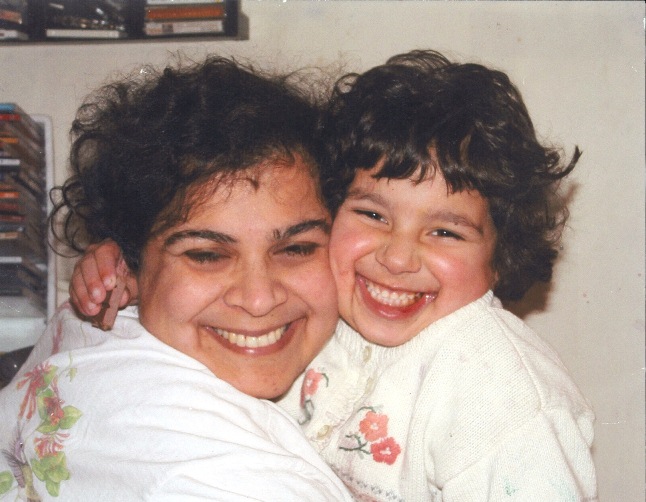
My daughter Irene, aged 3. Notice a secret to Irene’s happiness in her fat paw: chocolate!

The Kingdom of Heaven belongs to such as 

these.

Instructions on becoming like little children.


Learn to let your face show what you really feel.
Do not contort it into a smile
When you see your enemy pass,
And inwardly you shrink.

Smile at those you like,
otherwise, nod.

Be honest. 
If you had a dreadful Christmas,
a dud holiday,
say so.

Be honest.
Say what you really think.

If you see injustice,
say “It is not fair.”
Do not let fear constrain you. 

Slow down.
See the full moon yellow in the sky,
the orange gerbera,
the variations of pebbles.

Whatever you do, 
do it with all your heart.

Never rush.
If adults say “Hurry up”
Say, “Wait.”

Delight again
in a bar of chocolate,
bubbles sparkling iridescent.

Grin when you are happy,
Cry when you are sad,
And forgive those who have made you sad. 

Keep short accounts.

Time is for having fun.

Enjoy motion,
Running, swimming, splashing.

Don’t worry too much about saving.
Your Daddy will give you more.

Remember to thank God who made everything,
and gave you, 
as much goodness
as your little hands 
can grasp.  


Filed Under: Matthew

Divorce and little children. Matthew 19 Blog through the Bible Project

By Anita Mathias

The great Galilean ministry has now ended, and Jesus and his followers begin the momentous journey towards Jerusalem.

Matthew 19

Divorce

1 When Jesus had finished saying these things, he left Galilee and went into the region of Judea to the other side of the Jordan. 2 Large crowds followed him, and he healed them there.
His fame quickly spread because of his healing ministry in Galilee.

 3 Some Pharisees came to him to test him.
They attempted to get Jesus to incriminate himself through misinterpreting the law.
I am amazed he answered, but he did, and as in the Sermon on the Mount, his standards were more exacting than those of Moses

They asked, “Is it lawful for a man to divorce his wife for any and every reason?”

   4 “Haven’t you read,” he replied, “that at the beginning the Creator ‘made them male and female,’a]”>[a] 5 and said, ‘For this reason a man will leave his father and mother and be united to his wife, and the two will become one flesh’b]”>[b]? 6 So they are no longer two, but one flesh. Therefore what God has joined together, let no one separate.”
 7 “Why then,” they asked, “did Moses command that a man give his wife a certificate of divorce and send her away?”
 8 Jesus replied, “Moses permitted you to divorce your wives because your hearts were hard. But it was not this way from the beginning. 9 I tell you that anyone who divorces his wife, except for sexual immorality, and marries another woman commits adultery.”
Marriage is a physical and emotional knitting, a knitting of spirits, not to casually unraveled.
People change, marriages change. Many marriages go through unhappy patches, but over time, hearts change, love grows, and one may land up not wanting to trade that once-annoying (perhaps still annoying!) spouse for the world.
Because of Christ’s release of the Holy Spirit, we need despair of no man or woman. And because divorce is generally a traumatic unravelling of what has been knit together, it should be a last resort. 
Scripture does provides grounds for divorce. Violence is mentioned in Malachi.”I hate divorce,” says the Lord, “and I hate a man covering his wife with violence.”

 10 The disciples said to him, “If this is the situation between a husband and wife, it is better not to marry.”
Rather than have a life-long unhappy marriage. 

 11 Jesus replied, “Not everyone can accept this word, but only those to whom it has been given. 12 For there are eunuchs who were born that way, and there are eunuchs who have been made eunuchs by others—and there are those who choose to live like eunuchs for the sake of the kingdom of heaven.
Those who have voluntarily accepted celibacy to give themselves more fully to God’s work. 

The one who can accept this should accept it.”
The Little Children and Jesus

13 Then people brought little children to Jesus for him to place his hands on them and pray for them. But the disciples rebuked them. 14 Jesus said, “Let the little children come to me, and do not hinder them, for the kingdom of heaven belongs to such as these.” 15 When he had placed his hands on them, he went on from there.

My daughter Irene, aged 3. Notice a secret to Irene’s happiness in her fat paw: chocolate!

The Kingdom of Heaven belongs to such as 

these.

Instructions on becoming like little children.


Learn to let your face show what you really feel.
Do not contort it into a smile
When you see your enemy pass,
And inwardly you shrink.

Smile at those you like,
otherwise, nod.

Be honest. 
If you had a dreadful Christmas,
a dud holiday,
say so.

Be honest.
Say what you really think.

If you see injustice,
say “It is not fair.”
Do not let fear constrain you. 

Slow down.
See the full moon yellow in the sky,
the orange gerbera,
the variations of pebbles.

Whatever you do, 
do it with all your heart.

Never rush.
If adults say “Hurry up”
Say, “Wait.”

Delight again
in a bar of chocolate,
bubbles sparkling iridescent.

Grin when you are happy,
Cry when you are sad,
And forgive those who have made you sad. 

Keep short accounts.

Time is for having fun.

Enjoy motion,
Running, swimming, splashing.

Don’t worry too much about saving.
Your Daddy will give you more.

Remember to thank God who made everything,
and gave you, 
as much goodness
as your little hands 
can grasp.   

Share on multiple social sites … Wikio

Filed Under: Matthew

Feel-good foods, a guest post by Roy Mathias

By Anita Mathias

Guest post by Roy Mathias

Perhaps in Lent I should not be writing about the different ways food can make us feel good.  So let me start with

Fasting.   It can make you feel terrific after a couple of days, but I’m sure can have too much of good thing.  Fasting is also the body’s natural response to some illnesses.

Comfort food.    This is usually a childhood favourite, warm, hearty, rich, simple, and usually inexpensive;  spaghetti and meatballs, Irish stew, fish and chips, pizza (my favourite), chicken tikka masala, bangers and mash, or a full English breakfast, followed apple crumble topped with ice cream if more comfort is needed .

Organic food.  Of course, for most of human history,all food was of  necessity organic.   The industrial revolution brought chemical fertilisers and pesticides and greatly increased harvests.  Organic agriculture ha recently become fashionable, but Sir Albert Howard, writing in the 1940, based on experiments started in 1910 says

“This law is true for soil, plant, animal, and man: the health of these four is one connected chain.  Any weakness or defect in the health of any earlier link in the chain is carried on to the next and succeeding links, until it reaches the last, namely, man.  The widespread vegetable and animal pests and diseases, which are such a bane to modern agriculture, are evidence of a great failure of health in the second (plant) and third (animal) links of the chain.  The impaired health of human populations (the fourth link) in modern civilised countries is a consequence of this failure in the second and third links. This general failure in the last three links is to be attributed to failure in the first link, the soil: the undernourishment of the soil is at the root of all.”

In “Farming and Gardening for Health or Disease” he presents the remarkable example of his uninoculated oxen, fed  purely organic high quality feed  living on his organic farm in Pusa, Bihar (India), resisting resisting infection with foot-and-mouth disease from the cattle in neighbouring farms with which they mingled.

Surely eating organic makes us feel better?

Home grown.  Our first home grown tomato of the season is ceremonially quartered and shared by the family.  The taste is nothing special, but there’s pride and pleasure in the plucking.

Fair trade.  Buying and eating fair trade makes us feel good as the pounds we are spend are doing good to a few farmers and are not  encouraging ruthless bottom-line economics.  COOP,  established by the Rochdale Pioneers in 1844 (based on the Rochdale Principles that are used in different forms by co-operatives worldwide), is  well known for its ethical trading and leadership in fairtrade.  In a major initiative they supported over 10,000 smallholder tea farmers organise into co-operatives, and so get fair trade status and power to negotiate higher prices.  Here’s a picture of a Kenyan tea plantation where some of the COOP tea comes from. In fact, you can join the revolution that was started over 150 years ago, and help out your local area and further afield.


Filed Under: random

The Relentless Evolution of Language

By Anita Mathias


British LibraryBritish Library

Nothing stays constant, not even words. Their means slips, slides, changes.


In church, children sing, “Our God is an awesome God.” Awesome now means an all-round cool guy, a marvellous person. It used to mean that which inspires awe and reverence.


Our semi-slang term “cool,”  a few decades old, borrows meaning from the French sang-froid,, literally cold-blood, or calm and  composure.


“Neat” no longer means tidy but cool.


“Nice” is probably the one word which has evolved the most.  It meant  “foolish, stupid, senseless,” in the late 13 century derived from the Latin nescius “ignorant,” from ne- “not” + stem of scire “to know.” The sense development has been extraordinary, even for an adjective moving from “timid” (pre-1300); to “fussy, fastidious” (late 14c.); to “dainty, delicate” (c.1400); to “precise, careful” (1500s, preserved in such terms as a nice distinction and nice and early) to “agreeable, delightful” (1769); to “kind, thoughtful” (1830). By 1926, it was pronounced by Fowler to be “too great a favourite with the ladies, who have charmed out of it all its individuality and converted it into a mere diffuser of vague and mild agreeableness.”
“I am sure,” cried Catherine, “I did not mean to say anything wrong; but it is a nice book, and why should I not call it so?” “Very true,” said Henry, “and this is a very nice day, and we are taking a very nice walk; and you are two very nice young ladies. Oh! It is a very nice word indeed! It does for everything.” [Jane Austen, “Northanger Abbey”]

Sometimes, the evolution of language makes it hard for us to read a piece as the author intended it. W.B. Yeats in his great poem “Lapis Lazuli” writes
All perform their tragic play,

There struts Hamlet, there is Lear,

That’s Ophelia, that Cordelia;

Yet they, should the last scene be there,

The great stage curtain about to drop,

If worthy their prominent part in the play,

Do not break up their lines to weep.

They know that Hamlet and Lear are gay;

Gaiety transfiguring all that dread.
Yeats meant gallantly and inexorably cheerful when he wrote “gay.” Today, the words would be read in a very different sense. 

Nowadays much of the evolution of English is in the direction of the watering down of language. People use the noun “epic” as an adjective–“an epic fail,” and words like immense or massive, when they mean “not too bad.” This is now even apparent in Britain where understatement has traditionally been the norm, and people describe their well-being by the phrase, “not too bad,” whether they have just won the lottery, or lost their wallet. 

The exhibition, Evolving English: One Language, Many Voices (www.bl.uk/evolvingenglish) is now on at the British Library but only until April 3, 2011. (Free)

Experience some of it without leaving your computer.  Try  the Quiz http://www.bl.uk/evolvingenglish/quiz.html,  (I got 6/6 on the medium level, and 5/6 on the egghead level.)
Record your voice to add to the collection of English being gathered from across the globe. (http://www.bl.uk/evolvingeenglish/maplisten.html).  
  Listen to English as it is spoken around the world.
Tweet your comments, or quiz results,  using #evolvingenglish (link the #tag to http://bit.ly/dmIoPm)
Enjoy!

Sponsored Post

Click button to share on Facebook, Twitter, Digg, Delicious, Reddit … Wikio

Filed Under: random

Marlowe’s Doctor Faustus

By Anita Mathias

Christopher Marlowe


We saw the Creation Theatre’s production of Marlowe’s Dr. Faustus at Blackwell’s on Friday. Amazing to watch it surrounded by books in the Norrington Room.

I was amazed to realize how much of that sheer poetry I remembered from my undergraduate days–I have only seen Faust once since then.


Mephistopheles was a low-key demon who plaintively explains

Why this is hell, nor am I out of it.

Think’st thou that I who saw the face of God,

        75

And tasted the eternal joys of Heaven,

Am not tormented with ten thousand hells,

In being depriv’d of everlasting bliss?


As a century later Milton’s Satan would say, “Which way I fly is Hell; myself am Hell…” 

There was splendid poetry such as Faustus’s tribute to Helen of Troy

Was this the face that launch’d a thousand ships,
And burnt the topless towers of Ilium?
Sweet Helen, make me immortal with a kiss.
Her lips suck forth my soul: see where it flies!
Come, Helen, come, give me my soul again.
Here will I dwell, for heaven is in these lips,
And all is dross that is not Helena.


And then his anguished cries as the midnight nears,

O I’ll leap up to my God! Who pulls me down?
See, see where Christ’s blood streams in the firmament!
One drop would save my soul, half a drop: ah my Christ—
Ah, rend not my heart for naming of my Christ;

And the horror of eternity strikes him
O, if  my soul must suffer for my sin,
Impose some end to my incessant pain;
Let Faustus live in hell a thousand years,
A hundred thousand, and at last be sav’d!

It was an amazing play, very dramatic, and played in an understated way.
On the face of it, Faustus made a sensible bargain. He did not believe in hell–or didn’t want to think of it–so for wealth, fame, success, sex, he bargains away his soul. Of course, as the hour of death neared, he had second thoughts….

Temptation was presented beautifully, with both the kindly and menacing angels speaking persuasively to Faustus’s shattered, tormented soul…
* * *

We had a fab and most stimulating weekend, though we were so shattered by Sunday that we did not go to church, which caused some guilt and sadness in me–not so much that I did not go to church, as because I did not take the girls, and that Roy would have profited, as would I.

Oh well, we had the plumber in during the morning for a leak, had a visitor whose visit spilled over the evening service, and felt so physically uncomfortable as I hadn’t exercised, that I chose the gym instead of church, and felt a whole lot better for it (probably).

When I am physically uncomfortable and haven’t exercised, I find it hard to pray. And a comfortable, well-exercised body does wonders for the soul.

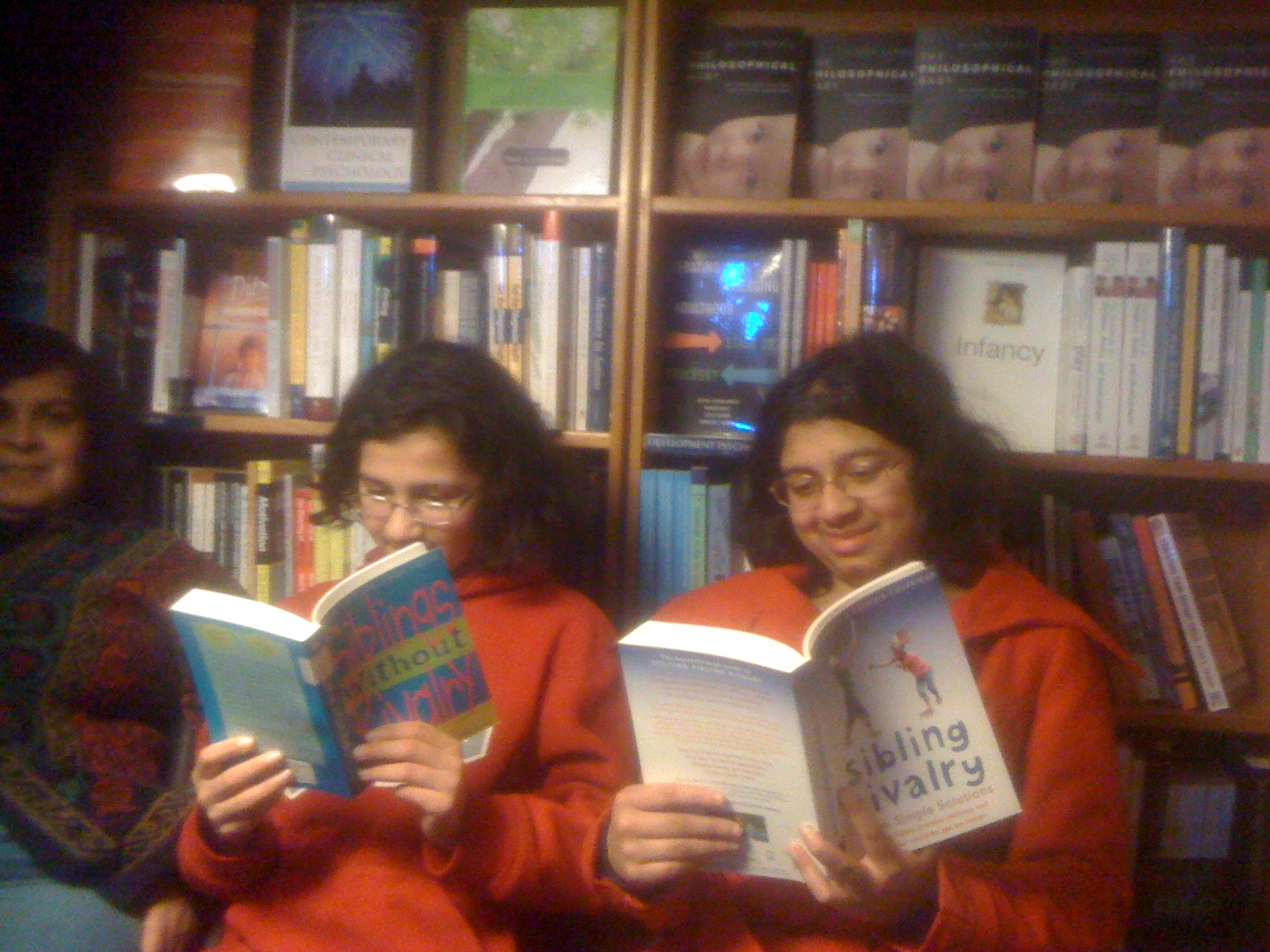
And here are Zoe and Irene in the Norrington Room at Blackwells.  Each of them, true bookworms, grabbed a book in the interval. Note what they grabbed


Filed Under: random

Jacob is reunited with Joseph, Genesis 46

By Anita Mathias

Genesis 46

Jacob Goes to Egypt

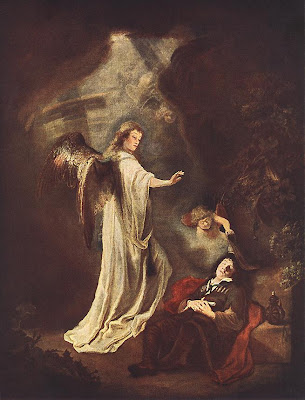
 1 So Israel set out with all that was his, and when he reached Beersheba, he offered sacrifices to the God of his father Isaac.

 2 And God spoke to Israel in a vision at night and said, “Jacob! Jacob!”
   “Here I am,” he replied.
 3 “I am God, the God of your father,” he said. “Do not be afraid to go down to Egypt, for I will make you into a great nation there. 4 I will go down to Egypt with you, and I will surely bring you back again. And Joseph’s own hand will close your eyes.”
The Lord speaks to Jacob with his trademark greeting, “Do not be afraid.”
His ability to hear God’s voice–even in the middle of his own sin and scheming–was one of Jacob’s greatest gifts–and this he retains through life.
And God’s kindness to Jacob remains throughout his long life.  

At Beersheba, where Abraham and Isaac had also worshiped the Lord, the Lord reiterates his covenant promises.
God would be with Jacob when he went south to Egypt, as he was with him when he went north to Haran.

 5 Then Jacob left Beersheba, and Israel’s sons took their father Jacob and their children and their wives in the carts that Pharaoh had sent to transport him. 6 So Jacob and all his offspring went to Egypt, taking with them their livestock and the possessions they had acquired in Canaan. 7 Jacob brought with him to Egypt his sons and grandsons and his daughters and granddaughters—all his offspring.
 8 These are the names of the sons of Israel (Jacob and his descendants) who went to Egypt:
   Reuben the firstborn of Jacob.
 9 The sons of Reuben:
   Hanok, Pallu, Hezron and Karmi.
 10 The sons of Simeon:
   Jemuel, Jamin, Ohad, Jakin, Zohar and Shaul the son of a Canaanite woman.
 11 The sons of Levi:
   Gershon, Kohath and Merari.
 12 The sons of Judah:
   Er, Onan, Shelah, Perez and Zerah (but Er and Onan had died in the land of Canaan).
   The sons of Perez:
   Hezron and Hamul.
 13 The sons of Issachar:
   Tola, Puah,[a] Jashub[b] and Shimron.
 14 The sons of Zebulun:
   Sered, Elon and Jahleel.
 15 These were the sons Leah bore to Jacob in Paddan Aram,[c] besides his daughter Dinah. These sons and daughters of his were thirty-three in all.
 16 The sons of Gad:
   Zephon,[d] Haggi, Shuni, Ezbon, Eri, Arodi and Areli.
 17 The sons of Asher:
   Imnah, Ishvah, Ishvi and Beriah.
   Their sister was Serah.
   The sons of Beriah:
   Heber and Malkiel.
 18 These were the children born to Jacob by Zilpah, whom Laban had given to his daughter Leah—sixteen in all.
 19 The sons of Jacob’s wife Rachel:
   Joseph and Benjamin. 20 In Egypt, Manasseh and Ephraim were born to Joseph by Asenath daughter of Potiphera, priest of On.[e]
 21 The sons of Benjamin:
   Bela, Beker, Ashbel, Gera, Naaman, Ehi, Rosh, Muppim, Huppim and Ard.
 22 These were the sons of Rachel who were born to Jacob—fourteen in all.
 23 The son of Dan:
   Hushim.
 24 The sons of Naphtali:
   Jahziel, Guni, Jezer and Shillem.
 25 These were the sons born to Jacob by Bilhah, whom Laban had given to his daughter Rachel—seven in all.
 26 All those who went to Egypt with Jacob—those who were his direct descendants, not counting his sons’ wives—numbered sixty-six persons. 27 With the two sons[f] who had been born to Joseph in Egypt, the members of Jacob’s family, which went to Egypt, were seventy[g] in all.
 28 Now Jacob sent Judah ahead of him to Joseph to get directions to Goshen. When they arrived in the region of Goshen, 29 Joseph had his chariot made ready and went to Goshen to meet his father Israel. As soon as Joseph appeared before him, he threw his arms around his father[h] and wept for a long time.
Joseph, the great and soft of heart.
 30 Israel said to Joseph, “Now I am ready to die, since I have seen for myself that you are still alive.”
 31 Then Joseph said to his brothers and to his father’s household, “I will go up and speak to Pharaoh and will say to him, ‘My brothers and my father’s household, who were living in the land of Canaan, have come to me. 32 The men are shepherds; they tend livestock, and they have brought along their flocks and herds and everything they own.’ 33 When Pharaoh calls you in and asks, ‘What is your occupation?’ 34 you should answer, ‘Your servants have tended livestock from our boyhood on, just as our fathers did.’ Then you will be allowed to settle in the region of Goshen, for all shepherds are detestable to the Egyptians.”
Joseph uses his God-given administrative skills to ensure that his family settles safely in Egypt. He decides that Goshen would be the best location for them (thus preventing them assimilating into Egyptian society) and through skilful preparation and diplomacy, he ensures that Pharaoh confirms this choice of territory.

Filed Under: Genesis

  • « Previous Page
  • 1
  • …
  • 156
  • 157
  • 158
  • 159
  • 160
  • …
  • 279
  • Next Page »

Sign Up and Get a Free eBook!

Sign up to be emailed my blog posts (one a week) and get the ebook of "Holy Ground," my account of working with Mother Teresa.

Join 536 Other Readers

My Books

Rosaries, Reading, Secrets: A Catholic Childhood in India

Rosaries, Reading Secrets, B&N
USA

UK

Wandering Between Two Worlds: Essays on Faith and Art

Wandering Between Two Worlds
USA

UK

Francesco, Artist of Florence: The Man Who Gave Too Much

Francesco, Artist of Florence
US

UK

The Story of Dirk Willems

The Story of Dirk Willems
US

UK

My Latest Meditation

Anita Mathias: About Me

Anita Mathias

Read my blog on Facebook

Follow me on Twitter

Follow @anitamathias1

Recent Posts

  • At the Cross, God Forgives Us Completely
  • Using God’s Gift of Our Talents: A Path to Joy and Abundance
  • The Kingdom of God is Here Already, Yet Not Yet Here
  • All Those Who Exalt Themselves Will Be Humbled & the Humble Will Be Exalted
  • Christ’s Great Golden Triad to Guide Our Actions and Decisions
  • How Jesus Dealt With Hostility and Enemies
  • Do Not Be Afraid, but Do Be Prudent
  • For Scoundrels, Scallywags, and Rascals—Christ Came
  • How to Lead an Extremely Significant Life
  • Don’t Walk Away From Jesus, but if You Do, He Still Looks at You and Loves You
Premier Digital Awards 2015 - Finalist - Blogger of the year
Runner Up Christian Media Awards 2014 - Tweeter of the year

Categories

What I’m Reading


Wolf Hall
Hilary Mantel

Wolf Hall --  Amazon.com
Amazon.com

Amazon.co.uk

Silence and Honey Cakes:
The Wisdom Of The Desert
Rowan Williams

Silence and Honey Cakes --  Amazon.com
Amazon.com

Amazon.co.uk

The Long Loneliness:
The Autobiography of the Legendary Catholic Social Activist
Dorothy Day

The Long Loneliness --  Amazon.com
Amazon.com

Amazon.co.uk

Country Girl
Edna O'Brien

Country Girl  - Amazon.com
Amazon.com

Amazon.co.uk

Archive by month

My Latest Five Podcast Meditations

INSTAGRAM

anita.mathias

My memoir: Rosaries, Reading, Secrets https://amzn.to/42xgL9t
Oxford, England. Writer, memoirist, podcaster, blogger, Biblical meditation teacher, mum

Looking at photos from our week in beautiful Sevil Looking at photos from our week in beautiful Seville and Cordoba over New Year with Irene, who had a week off.
And, ICYMI, here’s my latest meditation on the Gospel of Matthew… I’ve recorded it, should you want a few minutes of peace.
https://anitamathias.com/2026/04/29/gods-complete-forgiveness/
Hello Friends, I'm resumed recording my meditation Hello Friends, I'm resumed recording my meditations on the Gospel of Matthew. Do click on this link to listen. 
https://anitamathias.com/.../29/gods-complete-forgiveness/
Christ is the most influential figure in the history of the world, though his life ended in shame, humiliation and failure. But he so completely turned things round in his great reversal that the cross on which he died when all seemed hopeless is now the most common, and revered, symbol in history.
He emerged from and was anchored in Judaism. And as the sins of the people were laid on the scapegoat who was sent into the wilderness to perish, Christ died as the lamb of God voluntarily bearing the guilt of the wrongdoing of the whole world. He paid the price for our forgiveness with his life-blood--in accordance with the iron law of the physical and moral universe, of sowing and reaping, cause and effect. 
And so, God, who appeared as flames of fire to Moses, can now dwell within us, purifying us, whose hearts have darkness and shards of ice. 
And now that Christ was crucified, died, but rose again, His Spirit, no longer contained within his earthly body, is poured out like living water onto all humans, at our humble request. The Spirit pours the love of God into us; he reminds us of the words of Jesus and slowly writes Christ’s sweet law on our hearts. This transfusion of grace helps us do hard things we previously couldn’t do. Our dance with the Spirit gradually breaks the power of sin over us. It transforms us.
Now we, the forgiven, protected by the blood of Jesus poured out over us, and filled with His Spirit, who sings within us, Abba, Father, are adopted by God as his children in his joyful new covenant. We are cells grafted into the vine of our new family--Father, Son, Spirit—who now live in us as we live in them. As we choose by our thoughts and actions to continue living in the vine of Jesus, their energy pulsing through us makes us fruitful. And now, all our prayers which flow in the river of God’s good purposes are kindly heard. Waves of love and power flood from the cross! 
Thank you!
Well, hello friends! Breaking radio silence to let Well, hello friends! Breaking radio silence to let you know that I have taped a meditation for you on Christ’s famous Parable of the Talents in Matthew 25. https://anitamathias.com/2025/11/05/using-gods-gift-of-our-talents-a-path-to-joy-and-abundance/
Here you are, click the play button in the blog post for a brief meditation, and some moments of peace, and, perhaps, inspiration in your day 🙂
Hi Friends, I have taped a meditation; do listen a Hi Friends, I have taped a meditation; do listen at this link: https://anitamathias.com/2025/04/08/the-kingdom-of-god-is-here-already-yet-not-yet-here-2/
It’s on the Kingdom of God, of which Christ so often spoke, which is here already—a mysterious, shimmering internal palace in which, in lightning flashes, we experience peace and joy, and yet, of course, not yet fully here. We sense the rainbowed presence of Christ in the song which pulses through creation. Christ strolls into our rooms with his wisdom and guidance, and things change. Our prayers are answered; we are healed; our hearts are strangely warmed. Sometimes.
And yet, we also experience evil within & all around us. Our own sin which can shatter our peace and the trajectory of our lives. And the sins of the world—its greed, dishonesty and environmental destruction.
But in this broken world, we still experience the glory of creation; “coincidences” which accelerate once we start praying, and shalom which envelops us like sudden sunshine. The portals into this Kingdom include repentance, gratitude, meditative breathing, and absolute surrender.
The Kingdom of God is here already. We can experience its beauty, peace and joy today through the presence of the Holy Spirit. But yet, since, in the Apostle Paul’s words, we do not struggle only “against flesh and blood, but against the rulers, against the unseen powers of this dark world and against the spiritual forces of evil,” its fullness still lingers…
Our daughter Zoe was ordained into the Church of E Our daughter Zoe was ordained into the Church of England in June. I have been on a social media break… but … better late than never. Enjoy!
First picture has my sister, Shalini, who kindly flew in from the US. Our lovely cousins Anthony and Sarah flank Zoe in the next picture.
The Bishop of London, Sarah Mullaly, ordained Zoe. You can see her praying that Zoe will be filled with the Holy Spirit!!
And here’s a meditation I’ve recorded, which you might enjoy. The link is also in my profile
https://anitamathias.com/2024/11/07/all-those-who-exalt-themselves-will-be-humbled-the-humble-will-be-exalted/
I have taped a meditation on Jesus statement in Ma I have taped a meditation on Jesus statement in Matthew 23, “For those who exalt themselves will be humbled, and those who humble themselves will be exalted.”
Do listen here. https://anitamathias.com/2024/11/07/all-those-who-exalt-themselves-will-be-humbled-the-humble-will-be-exalted/
Link also in bio.
And so, Jesus states a law of life. Those who broadcast their amazingness will be humbled, since God dislikes—scorns that, as much as people do.  For to trumpet our success, wealth, brilliance, giftedness or popularity is to get distracted from our life’s purpose into worthless activity. Those who love power, who are sure they know best, and who must be the best, will eventually be humbled by God and life. For their focus has shifted from loving God, doing good work, and being a blessing to their family, friends, and the world towards impressing others, being enviable, perhaps famous. These things are houses built on sand, which will crumble when hammered by the waves of old age, infirmity or adversity. 
God resists the proud, Scripture tells us—those who crave the admiration and power which is His alone. So how do we resist pride? We slow down, so that we realise (and repent) when sheer pride sparks our allergies to people, our enmities, our determination to have our own way, or our grandiose ego-driven goals, and ambitions. Once we stop chasing limelight, a great quietness steals over our lives. We no longer need the drug of continual achievement, or to share images of glittering travel, parties, prizes or friends. We just enjoy them quietly. My life is for itself & not for a spectacle, Emerson wrote. And, as Jesus advises, we quit sharp-elbowing ourselves to sit with the shiniest people, but are content to hang out with ordinary people; and then, as Jesus said, we will inevitably, eventually, be summoned higher to the sparkling conversation we craved. 
One day, every knee will bow before the gentle lamb who was slain, now seated on the throne. We will all be silent before him. Let us live gently then, our eyes on Christ, continually asking for his power, his Spirit, and his direction, moving, dancing, in the direction that we sense him move.
Link to new podcast in Bio https://anitamathias.co Link to new podcast in Bio https://anitamathias.com/2024/02/20/how-jesus-dealt-with-hostility-and-enemies/
3 days before his death, Jesus rampages through the commercialised temple, overturning the tables of moneychangers. Who gave you the authority to do these things? his outraged adversaries ask. And Jesus shows us how to answer hostile questions. Slow down. Breathe. Quick arrow prayers!
Your enemies have no power over your life that your Father has not permitted them. Ask your Father for wisdom, remembering: Questions do not need to be answered. Are these questioners worthy of the treasures of your heart? Or would that be feeding pearls to hungry pigs, who might instead devour you?
Questions can contain pitfalls, traps, nooses. Jesus directly answered just three of the 183 questions he was asked, refusing to answer some; answering others with a good question.
But how do we get the inner calm and wisdom to recognise
and sidestep entrapping questions? Long before the day of
testing, practice slow, easy breathing, and tune in to the frequency of the Father. There’s no record of Jesus running, rushing, getting stressed, or lacking peace. He never spoke on his own, he told us, without checking in with the Father. So, no foolish, ill-judged statements. Breathing in the wisdom of the Father beside and within him, he, unintimidated, traps the trappers.
Wisdom begins with training ourselves to slow down and ask
the Father for guidance. Then our calm minds, made perceptive, will help us recognise danger and trick questions, even those coated in flattery, and sidestep them or refuse to answer.
We practice tuning in to heavenly wisdom by practising–asking God questions, and then listening for his answers about the best way to do simple things…organise a home or write. Then, we build upwards, asking for wisdom in more complex things.
Listening for the voice of God before we speak, and asking for a filling of the Spirit, which Jesus calls streams of living water within us, will give us wisdom to know what to say, which, frequently, is nothing at all. It will quieten us with the silence of God, which sings through the world, through sun and stars, sky and flowers.
Especially for @ samheckt Some very imperfect pi Especially for @ samheckt 
Some very imperfect pictures of my labradoodle Merry, and golden retriever Pippi.
And since, I’m on social media, if you are the meditating type, here’s a scriptural meditation on not being afraid, while being prudent. https://anitamathias.com/2024/01/03/do-not-be-afraid-but-do-be-prudent/
A new podcast. Link in bio https://anitamathias.c A new podcast. Link in bio
https://anitamathias.com/2024/01/03/do-not-be-afraid-but-do-be-prudent/
Do Not Be Afraid, but Do Be Prudent
“Do not be afraid,” a dream-angel tells Joseph, to marry Mary, who’s pregnant, though a virgin, for in our magical, God-invaded world, the Spirit has placed God in her. Call the baby Jesus, or The Lord saves, for he will drag people free from the chokehold of their sins.
And Joseph is not afraid. And the angel was right, for a star rose, signalling a new King of the Jews. Astrologers followed it, threatening King Herod, whose chief priests recounted Micah’s 600-year-old prophecy: the Messiah would be born in Bethlehem, as Jesus had just been, while his parents from Nazareth registered for Augustus Caesar’s census of the entire Roman world. 
The Magi worshipped the baby, offering gold. And shepherds came, told by an angel of joy: that the Messiah, a saviour from all that oppresses, had just been born.
Then, suddenly, the dream-angel warned: Flee with the child to Egypt. For Herod plans to kill this baby, forever-King.
Do not be afraid, but still flee? Become a refugee? But lightning-bolt coincidences verified the angel’s first words: The magi with gold for the flight. Shepherds
telling of angels singing of coming inner peace. Joseph flees.
What’s the difference between fear and prudence? Fear is being frozen or panicked by imaginary what-ifs. It tenses our bodies; strains health, sleep and relationships; makes us stingy with ourselves & others; leads to overwork, & time wasted doing pointless things for fear of people’s opinions.
Prudence is wisdom-using our experience & spiritual discernment as we battle the demonic forces of this dark world, in Paul’s phrase.It’s fighting with divinely powerful weapons: truth, righteousness, faith, Scripture & prayer, while surrendering our thoughts to Christ. 
So let’s act prudently, wisely & bravely, silencing fear, while remaining alert to God’s guidance, delivered through inner peace or intuitions of danger and wrongness, our spiritual senses tuned to the Spirit’s “No,” his “Slow,” his “Go,” as cautious as a serpent, protected, while being as gentle as a lamb among wolves.
Follow on Instagram

© 2026 Dreaming Beneath the Spires · All Rights Reserved. · Cookie Policy · Privacy Policy