Anita Mathias: Dreaming Beneath the Spires

Anita Mathias's Blog on Faith and Art

  • Home
  • My Books
  • Meditations
  • Essays
  • Contact
  • About Me

Grace and Peace, Paul’s Letter to the Romans

By Anita Mathias

Romans Word Cloud

  In most of the New Testament letters,  rather than the typical Greco-Roman greeting chaire,          literally joy, one finds the formula “grace and peace” (charis kai eirene).

The typical Jewish greeting is shalom, which the Greek Old Testament usually translates eirene. “For the Hebrews and the people of the New Testament peace was not so much the absence of war or strife as the presence of positive blessing” (Wright, 53). 

Thus Paul incorporates a variation of the usual Greek greeting and the usual Jewish greeting into the blessing that he offers these Roman Christians–Grace and Peace. 

Grace (charis) is central to the Book of Romans.   

Christ encompasses both worlds, the Greek and the Jews. He offers unmerited free grace, and peace for the soul.

Immense concepts worth lingering and praying over.

Paul wrote immensely long sentences. Some of his sentences are the longest in the entire Bible, particularly those in Ephesians. It sometimes helps one to grasp his thought better if we split them up, almost as if they were a poem.

And so–deep breath– I embark on the Book of Romans. 

Romans 1

 1 Paul, a servant of Christ Jesus,
called to be an apostle
and set apart for the gospel of God—
2 the gospel he promised beforehand
 through his prophets in the Holy Scriptures
3 regarding his Son,
 who as to his earthly life was a descendant of David,
4 and who through the Spirit of holiness
 was appointed the Son of God in power
 by his resurrection from the dead:
Jesus Christ our Lord.
5 Through him we received grace and apostleship
to call all the Gentiles to the obedience
 that comes from faith
 for his name’s sake.
 6 And you also are among those Gentiles
 who are called to belong to Jesus Christ.
 7 To all in Rome
who are loved by God and called to be his holy people:
   Grace and peace to you from God our Father and from the Lord Jesus Christ. 

Click button to share on Facebook, Twitter, Digg, Delicious, Reddit … Wikio
Filed Under: random

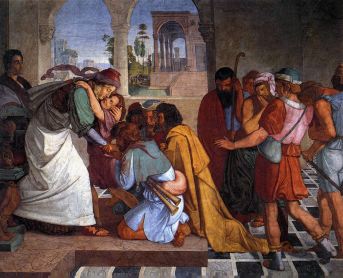
Joseph forgives. Reconciliation. Gen 45 and 46. Blog Through the Bible Project

By Anita Mathias

Genesis 45

Joseph Makes Himself Known
 1 Then Joseph could no longer control himself before all his attendants, and he cried out, “Have everyone leave my presence!” So there was no one with Joseph when he made himself known to his brothers. 2 And he wept so loudly that the Egyptians heard him, and Pharaoh’s household heard about it.
 3 Joseph said to his brothers, “I am Joseph! Is my father still living?” But his brothers were not able to answer him, because they were terrified at his presence.
Joseph is a wonderful person–affectionate, caring and loving. He wears his heart on his sleeve, and it is a warm, loving, heart.
 4 Then Joseph said to his brothers, “Come close to me.” When they had done so, he said, “I am your brother Joseph, the one you sold into Egypt! 5 And now, do not be distressed and do not be angry with yourselves for selling me here,
Inexplicable kindness. God has changed his heart in his years of suffering, and his years of exaltation.
because it was to save lives that God sent me ahead of you. 6 For two years now there has been famine in the land, and for the next five years there will be no plowing and reaping. 7 But God sent me ahead of you to preserve for you a remnant on earth and to save your lives by a great deliverance.
Forgiveness is somewhat easier when you can see how God has worked out all things for good.

8 “So then, it was not you who sent me here, but God.
NIV notes–God had a purpose to work through the brother’s jealous and cruel act.
” He made me father to Pharaoh, lord of his entire household and ruler of all Egypt. 9 Now hurry back to my father and say to him, ‘This is what your son Joseph says: God has made me lord of all Egypt. Come down to me; don’t delay. 10 You shall live in the region of Goshen and be near me—you, your children and grandchildren, your flocks and herds, and all you have. 11 I will provide for you there, because five years of famine are still to come. Otherwise you and your household and all who belong to you will become destitute.’
 12 “You can see for yourselves, and so can my brother Benjamin, that it is really I who am speaking to you. 13 Tell my father about all the honor accorded me in Egypt and about everything you have seen. And bring my father down here quickly.”
The love between father and son is mutual.
 14 Then he threw his arms around his brother Benjamin and wept, and Benjamin embraced him, weeping. 15 And he kissed all his brothers and wept over them. Afterward his brothers talked with him.
In the previous chapter, the brothers have acknowledged their guilt regarding Joseph, and have expressed concern for their father and younger brother. This enables the reconciliation between them and Joseph.
Joseph’s forgiveness still has something of the miraculous about it–and was only possible because God had changed his heart.
 16 When the news reached Pharaoh’s palace that Joseph’s brothers had come, Pharaoh and all his officials were pleased. 17 Pharaoh said to Joseph, “Tell your brothers, ‘Do this: Load your animals and return to the land of Canaan, 18 and bring your father and your families back to me. I will give you the best of the land of Egypt and you can enjoy the fat of the land.’
 19 “You are also directed to tell them, ‘Do this: Take some carts from Egypt for your children and your wives, and get your father and come. 20 Never mind about your belongings, because the best of all Egypt will be yours.’”
 21 So the sons of Israel did this. Joseph gave them carts, as Pharaoh had commanded, and he also gave them provisions for their journey. 22 To each of them he gave new clothing, but to Benjamin he gave three hundred shekelsb]”>[b] of silver and five sets of clothes. 
Joseph had been sold into slavery for twenty shekhels of silver.
23 And this is what he sent to his father: ten donkeys loaded with the best things of Egypt, and ten female donkeys loaded with grain and bread and other provisions for his journey. 24 Then he sent his brothers away, and as they were leaving he said to them, “Don’t quarrel on the way!”
How well he knew them! He wanted them to avoid mutual accusation and recrimination about the past.
 25 So they went up out of Egypt and came to their father Jacob in the land of Canaan. 26 They told him, “Joseph is still alive! In fact, he is ruler of all Egypt.” Jacob was stunned; he did not believe them. 27 But when they told him everything Joseph had said to them, and when he saw the carts Joseph had sent to carry him back, the spirit of their father Jacob revived. 28 And Israel said, “I’m convinced! My son Joseph is still alive. I will go and see him before I die.”
Miracles do happen

Genesis 46

Jacob Goes to Egypt
 1 So Israel set out with all that was his, and when he reached Beersheba, he offered sacrifices to the God of his father Isaac.
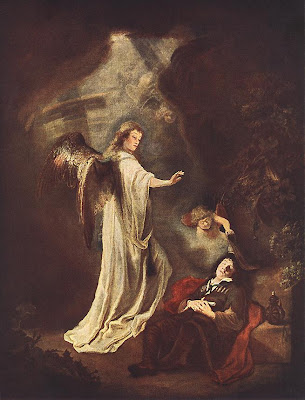
 2 And God spoke to Israel in a vision at night and said, “Jacob! Jacob!”
   “Here I am,” he replied.
 3 “I am God, the God of your father,” he said. “Do not be afraid to go down to Egypt, for I will make you into a great nation there. 4 I will go down to Egypt with you, and I will surely bring you back again. And Joseph’s own hand will close your eyes.”
The Lord speaks to Jacob with his trademark greeting, “Do not be afraid.”
His ability to hear God’s voice–even in the middle of his own sin and scheming–was one of Jacob’s greatest gifts–and this he retains through life.
And God’s kindness to Jacob remains throughout his long life.  
At Beersheba, where Abraham and Isaac had also worshiped the Lord, the Lord reiterates his covenant promises.
God would be with Jacob when he went south to Egypt, as he was with him when he went north to Haran.

 5 Then Jacob left Beersheba, and Israel’s sons took their father Jacob and their children and their wives in the carts that Pharaoh had sent to transport him. 6 So Jacob and all his offspring went to Egypt, taking with them their livestock and the possessions they had acquired in Canaan. 7 Jacob brought with him to Egypt his sons and grandsons and his daughters and granddaughters—all his offspring.
 8 These are the names of the sons of Israel (Jacob and his descendants) who went to Egypt:
   Reuben the firstborn of Jacob.
 9 The sons of Reuben:
   Hanok, Pallu, Hezron and Karmi.
 10 The sons of Simeon:
   Jemuel, Jamin, Ohad, Jakin, Zohar and Shaul the son of a Canaanite woman.
 11 The sons of Levi:
   Gershon, Kohath and Merari.
 12 The sons of Judah:
   Er, Onan, Shelah, Perez and Zerah (but Er and Onan had died in the land of Canaan).
   The sons of Perez:
   Hezron and Hamul.
 13 The sons of Issachar:
   Tola, Puah,a]”>[a] Jashubb]”>[b] and Shimron.
 14 The sons of Zebulun:
   Sered, Elon and Jahleel.
 15 These were the sons Leah bore to Jacob in Paddan Aram,c]”>[c] besides his daughter Dinah. These sons and daughters of his were thirty-three in all.
 16 The sons of Gad:
   Zephon,d]”>[d] Haggi, Shuni, Ezbon, Eri, Arodi and Areli.
 17 The sons of Asher:
   Imnah, Ishvah, Ishvi and Beriah.
   Their sister was Serah.
   The sons of Beriah:
   Heber and Malkiel.
 18 These were the children born to Jacob by Zilpah, whom Laban had given to his daughter Leah—sixteen in all.
 19 The sons of Jacob’s wife Rachel:
   Joseph and Benjamin. 20 In Egypt, Manasseh and Ephraim were born to Joseph by Asenath daughter of Potiphera, priest of On.e]”>[e]
 21 The sons of Benjamin:
   Bela, Beker, Ashbel, Gera, Naaman, Ehi, Rosh, Muppim, Huppim and Ard.
 22 These were the sons of Rachel who were born to Jacob—fourteen in all.
 23 The son of Dan:
   Hushim.
 24 The sons of Naphtali:
   Jahziel, Guni, Jezer and Shillem.
 25 These were the sons born to Jacob by Bilhah, whom Laban had given to his daughter Rachel—seven in all.
 26 All those who went to Egypt with Jacob—those who were his direct descendants, not counting his sons’ wives—numbered sixty-six persons. 27 With the two sonsf]”>[f] who had been born to Joseph in Egypt, the members of Jacob’s family, which went to Egypt, were seventyg]”>[g] in all.
 28 Now Jacob sent Judah ahead of him to Joseph to get directions to Goshen. When they arrived in the region of Goshen, 29 Joseph had his chariot made ready and went to Goshen to meet his father Israel. As soon as Joseph appeared before him, he threw his arms around his fatherh]”>[h] and wept for a long time.
Joseph, the great and soft of heart.
 30 Israel said to Joseph, “Now I am ready to die, since I have seen for myself that you are still alive.”
 31 Then Joseph said to his brothers and to his father’s household, “I will go up and speak to Pharaoh and will say to him, ‘My brothers and my father’s household, who were living in the land of Canaan, have come to me. 32 The men are shepherds; they tend livestock, and they have brought along their flocks and herds and everything they own.’ 33 When Pharaoh calls you in and asks, ‘What is your occupation?’ 34 you should answer, ‘Your servants have tended livestock from our boyhood on, just as our fathers did.’ Then you will be allowed to settle in the region of Goshen, for all shepherds are detestable to the Egyptians.”
Joseph uses his God-given administrative skills to ensure that his family settles safely in Egypt. He decides that Goshen would be the best location for them (thus preventing them assimilating into Egyptian society) and through skilful preparation and diplomacy, he ensures that Pharaoh confirms this choice of territory.

Click button to share on Facebook, Twitter, Digg, Delicious, Reddit … Wikio
Filed Under: Genesis

Jacob is reunited with Joseph, Genesis 46

By Anita Mathias

Genesis 46

Jacob Goes to Egypt

 1 So Israel set out with all that was his, and when he reached Beersheba, he offered sacrifices to the God of his father Isaac.

 2 And God spoke to Israel in a vision at night and said, “Jacob! Jacob!”
   “Here I am,” he replied.
 3 “I am God, the God of your father,” he said. “Do not be afraid to go down to Egypt, for I will make you into a great nation there. 4 I will go down to Egypt with you, and I will surely bring you back again. And Joseph’s own hand will close your eyes.”
The Lord speaks to Jacob with his trademark greeting, “Do not be afraid.”
His ability to hear God’s voice–even in the middle of his own sin and scheming–was one of Jacob’s greatest gifts–and this he retains through life.
And God’s kindness to Jacob remains throughout his long life.  

At Beersheba, where Abraham and Isaac had also worshiped the Lord, the Lord reiterates his covenant promises.
God would be with Jacob when he went south to Egypt, as he was with him when he went north to Haran.

 5 Then Jacob left Beersheba, and Israel’s sons took their father Jacob and their children and their wives in the carts that Pharaoh had sent to transport him. 6 So Jacob and all his offspring went to Egypt, taking with them their livestock and the possessions they had acquired in Canaan. 7 Jacob brought with him to Egypt his sons and grandsons and his daughters and granddaughters—all his offspring.
 8 These are the names of the sons of Israel (Jacob and his descendants) who went to Egypt:
   Reuben the firstborn of Jacob.
 9 The sons of Reuben:
   Hanok, Pallu, Hezron and Karmi.
 10 The sons of Simeon:
   Jemuel, Jamin, Ohad, Jakin, Zohar and Shaul the son of a Canaanite woman.
 11 The sons of Levi:
   Gershon, Kohath and Merari.
 12 The sons of Judah:
   Er, Onan, Shelah, Perez and Zerah (but Er and Onan had died in the land of Canaan).
   The sons of Perez:
   Hezron and Hamul.
 13 The sons of Issachar:
   Tola, Puah,b]’>[b] and Shimron.
 14 The sons of Zebulun:
   Sered, Elon and Jahleel.
 15 These were the sons Leah bore to Jacob in Paddan Aram,d]’>[d] Haggi, Shuni, Ezbon, Eri, Arodi and Areli.
 17 The sons of Asher:
   Imnah, Ishvah, Ishvi and Beriah.
   Their sister was Serah.
   The sons of Beriah:
   Heber and Malkiel.
 18 These were the children born to Jacob by Zilpah, whom Laban had given to his daughter Leah—sixteen in all.
 19 The sons of Jacob’s wife Rachel:
   Joseph and Benjamin. 20 In Egypt, Manasseh and Ephraim were born to Joseph by Asenath daughter of Potiphera, priest of On.f]’>[f] who had been born to Joseph in Egypt, the members of Jacob’s family, which went to Egypt, were seventyh]’>[h] and wept for a long time.
Joseph, the great and soft of heart.
 30 Israel said to Joseph, “Now I am ready to die, since I have seen for myself that you are still alive.”
 31 Then Joseph said to his brothers and to his father’s household, “I will go up and speak to Pharaoh and will say to him, ‘My brothers and my father’s household, who were living in the land of Canaan, have come to me. 32 The men are shepherds; they tend livestock, and they have brought along their flocks and herds and everything they own.’ 33 When Pharaoh calls you in and asks, ‘What is your occupation?’ 34 you should answer, ‘Your servants have tended livestock from our boyhood on, just as our fathers did.’ Then you will be allowed to settle in the region of Goshen, for all shepherds are detestable to the Egyptians.”
Joseph uses his God-given administrative skills to ensure that his family settles safely in Egypt. He decides that Goshen would be the best location for them (thus preventing them assimilating into Egyptian society) and through skilful preparation and diplomacy, he ensures that Pharaoh confirms this choice of territory.

Filed Under: Genesis

What I am Giving up for Lent: Internet Addiction

By Anita Mathias

Image–Neurocritic


No, I am not giving up anything to make there be less of me. I have had such a fraught relationship with food for many years that I now think of food more in terms of health, and life-long dietary modification rather than a short-term abstinence (with a longer term rebound, perhaps).


No, I am going to give up a minor addiction. I have broken a serious coffee addiction, and milder addictions to chocolate and sugar, and thought I was addiction free, but no.


The mild addiction I have, which I hadn’t realized was one until recently, is a mild internet addiction. 


Quaerentia, (which is the fanciful blog name of a priest called Mark Meynell who writes a very interesting literary/Christian blog) has an article called Webwise.


In it, he talks of 
“ADDICTIONS – Surfing is addictive: like a infinitely-channelled TV where you keep flicking over in the vain hope that there may be something more interesting to look at. Furthermore, you can get sucked into thinking that just because information is available, it is necessarily important or useful. [NB Wurman’s Information Anxiety (Indianapolis: QUE 2001):  I haven’t even mentioned the more obvious porn or gambling addictions that the internet can feed. I’m just talking about plain old surfing.”


I co-own a small publishing company with my husband, I am an active blogger on lightly monetized blogs, I keep in touch with many people. So, much that is interesting to me comes via the internet–business news, money earned, blog comments, emails.


And when there is nothing of interest–which is, of course, the case for more minutes than not?


I surf. Click to the New York Times for something fascinating, to the Guardian, to Christianity Today, to my own blog, to Lesley’s blog, other friends’ blogs, blogs on my blog roll, to Facebook, to my personal email, to our business email.  A little internet fox’s trail. All this will yield something of interest probably.  And then, when it is time to get up, exercise, do some housework, stretch and do some real writing, I can repeat the little fox’s trail. Find something else of interest or distraction. And then do a last email check before I get up. Some has come in, deal with it. And then….


I do most things with a timer on, count up or count down, and when I look at the timer, I am frequently baffled. Did I really need to read the New York Times article on the 87 year old billionaire planning his 125 birthday, or the global cash flow from immigrant women in domestic work abroad (half the GDP of the Philippines, incidentally, 35% of Tajikistan) or how men’s sexual prospects are increasing even as their job prospects diminish?  http://www.slate.com/id/2286240// Apparently, I thought so at the time.
                                                                        * * *


Now, if I am to be a writer as well as a blogger–and write more books rather than just blogs–I obviously need to break this time-consuming addiction.


And I now think that with soul perturbations as with bodily dysfunctions, much time can be saved by getting a correct diagnosis. 


Jesus had one in John 6, Unless you eat my flesh, and drink my blood, you have no life in you. As the living Father sent me, and I live because of the Father, so he who feeds on me will live because of me.


So, this is temporary emptiness of soul. I am trying to fill it with blogs, and newspapers, and magazines, and news, and twitter and facebook checks and rubbish.


Will it work? Will it fill my soul? No. I hope not. It cannot. 
                                                                              * * * 


So since the lights came on after reading Quaerentia’s article, I close my laptop when I notice I am aimlessly surfing, and pray for the Holy Spirit. 


I often think of a lecture illustration I once saw. A woman filled a goblet with car keys, and house keys medals and coins and notes and necklaces and rings and bling and there was still room. Still emptiness.


She then poured water–and every atom of space was filled.


So that is what I need–not distraction, not surfing, but the water of the Holy Spirit filling my restless soul.


And fortunately, Jesus promises that his Father WILL give the Holy Spirit to anyone who asks for it.


And I know that is true because I have asked many times. And received.


As I will do again and again when I find myself aimlessly surfing on dry ground, with a laptop on my lap.


Share on your favourite sites… Wikio

Filed Under: random

Proverbs 5

By Anita Mathias

Proverbs 5

Warning Against Adultery

 1 My son, pay attention to my wisdom, 
   turn your ear to my words of insight, 
2 that you may maintain discretion 
   and your lips may preserve knowledge. 
3 For the lips of the adulterous woman drip honey, 
   and her speech is smoother than oil; 
4 but in the end she is bitter as gall, 
   sharp as a double-edged sword. 
5 Her feet go down to death; 
   her steps lead straight to the grave. 
6 She gives no thought to the way of life; 
   her paths wander aimlessly, but she does not know it.

A woman or man who can seduce a partner from their first love is honeyed at first, but in the end there is bitterness in the new relationship. It starts sweetly, but ends bitterly–because of the guilt involved.
Adultery with its promise of newness is always tempting, but needs to be rigorously avoided–starting with the first temptations to it, which originate in the mind.

 7 Now then, my sons, listen to me;
   do not turn aside from what I say.
8 Keep to a path far from her,
   do not go near the door of her house,
9 lest you lose your honor to others
   and your dignity to one who is cruel,
10 lest strangers feast on your wealth
   and your toil enrich the house of another.
Don’t take on responsibilities not your own.


11 At the end of your life you will groan,
   when your flesh and body are spent.
12 You will say, “How I hated discipline!
   How my heart spurned correction!
13 I would not obey my teachers
   or turn my ear to my instructors.
14 And I was soon in serious trouble
   in the assembly of God’s people.”

 15 Drink water from your own cistern,
   running water from your own well.
16 Should your springs overflow in the streets,
   your streams of water in the public squares?
17 Let them be yours alone,
   never to be shared with strangers.
18 May your fountain be blessed,
   and may you rejoice in the wife of your youth.
19 A loving doe, a graceful deer—
   may her breasts satisfy you always,
   may you ever be intoxicated with her love.
20 Why, my son, be intoxicated with another man’s wife?
   Why embrace the bosom of a wayward woman?
A poignant appeal to marital faithfulness.

 21 For your ways are in full view of the LORD,
   and he examines all your paths.
22 The evil deeds of the wicked ensnare them;
   the cords of their sins hold them fast.
23 For lack of discipline they will die,
   led astray by their own great folly.

Filed Under: random

Grace and Peace, Paul’s Letter to the Romans

By Anita Mathias

Romans Word Cloud


In most of the New Testament letters,  rather than the typical Greco-Roman greeting chaire,   literally joy, one finds the formula “grace and peace” (charis kai eirene).


The typical Jewish greeting is shalom, which the Greek Old Testament usually translates eirene. “For the Hebrews and the people of the New Testament peace was not so much the absence of war or strife as the presence of positive blessing” (Wright, 53). 

Thus Paul incorporates a variation of the usual Greek greeting and the usual Jewish greeting into the blessing that he offers these Roman Christians–Grace and Peace. 


Grace (charis) is central to the Book of Romans.   

Christ encompasses both worlds, the Greek and the Jews. He offers unmerited free grace, and peace for the soul.

Immense concepts worth lingering and praying over.

Paul wrote immensely long sentences. Some of his sentences are the longest in the entire Bible, particularly those in Ephesians. It sometimes helps one to grasp his thought better if we split them up, almost as if they were a poem.

And so–deep breath– I embark on the Book of Romans. 

Romans 1

 1 Paul, a servant of Christ Jesus,
called to be an apostle
and set apart for the gospel of God—
2 the gospel he promised beforehand
 through his prophets in the Holy Scriptures
3 regarding his Son,
 who as to his earthly life was a descendant of David,
4 and who through the Spirit of holiness
 was appointed the Son of God in power
 by his resurrection from the dead:
Jesus Christ our Lord.

5 Through him we received grace and apostleship
to call all the Gentiles to the obedience
 that comes from faith
 for his name’s sake.
 6 And you also are among those Gentiles
 who are called to belong to Jesus Christ.

 7 To all in Rome
who are loved by God and called to be his holy people:
   Grace and peace to you from God our Father and from the Lord Jesus Christ.

Filed Under: Romans

Why is Forgiveness so Difficult?

By Anita Mathias

 What’s so hard about forgiveness? Partly, that it is an offence against justice. Someone has wronged us, someone owes us, and we simply have to let it go.

Not a good business practice. And on the face of it, a risky relational practice.
Not let it go once, but seventy times seven. Seventy times seven.
Sheer madness.
Like, like,  um… um…
Giving money generously when you still have a mortgage to pay, children to educate, an old age without adequate stock and shares to see you through? That dream holiday which may never become a reality.
And more, you give it to faceless people you will never see, this side of eternity.
Why?
Compassion. And….When I force myself to be generous to those in greater need,  with money I should rationally keep for myself, I remind myself that someone sees. An mighty, magnificent audience. Of One.

Who sees what I have done in secret.And in my time of need will give me what I need, full measure, pressed down, flowing over.

How do I know this?
Two ways. Because Jesus says so, and I believe what Jesus says by faith. Everything he says which I have tested empirically has been true, so I also believe what I haven’t had empirical evidence of. (Like, um… hell!)
The other way is I know it’s true is that in my own experience, I have received what I have given many times over. Not necessarily from those I have given to, in fact, generally not. Someone was watching; someone was keeping track, that someone gave me what I needed when I needed it, many times over, that Someone is good and I trust him.
                                                                              * * *
One of the hardest things about forgiveness sometimes is our sense that if we are silent, no one will ever know how we were wronged.
And if the injury or abuse happens in a church context, that the perpetrators will continue to sport burnished haloes in front of the church, while we, well, we know that inside they are “full of dead men’s bones and wickedness.”
It hurts when people have got away with sinning against us. When everyone thinks they are very fine people indeed, while we, we know otherwise.
That’s where faith comes in, and the connection between giving and forgiving. Just as we are content to give knowing that no one will ever know but Christ alone, so too we forgive knowing that God saw everything, he observed it, and it is in his hands. And he will see justice done.So we are releasing the debt owed us, the sins against us into the hands of a powerful God. He will deal with them with the same combination of justice and mercy as he deals with us.

We can forgive, partly because we are transferring our case to a higher court. And the verdict is up to it.

The Father saw, the Father knows, the Father will deal with it as he thinks best. And that is enough.

This is Stage 1 of forgiveness. Stage 2 is to love your enemies. I haven’t reached there. And the parable which I am considering in my Blog Through the Bible Project merely considers Stage 1.

The Parable of the Unmerciful Servant
 Matthew 18
21 Then Peter came to Jesus and asked, “Lord, how many times shall I forgive my brother or sister who sins against me? Up to seven times?”
Yeah, he’s showing off. Showing off his magnanimity. Hasn’t got it. ESV note: Within Judaism, 3 times was enough to show a forgiving spirit. 

 22 Jesus answered, “I tell you, not seven times, but seventy-seven times.
Don’t keep track. Keeping track reveals that you might not have really got the heart of forgiveness, which is letting go of wrongs in mercy, as God lets go of your offences
Love means losing track. Love means a lifestyle of forgiving. Letting offences go almost as soon as they occur. Which is the royal road to happiness. 

23 “Therefore, the kingdom of heaven is like a king who wanted to settle accounts with his servants. 24 As he began the settlement, a man who owed him ten thousand bags of gold was brought to him. 25 Since he was not able to pay, the master ordered that he and his wife and his children and all that he had be sold to repay the debt.
A talent was worth about 20 years of a day laborer’s wages.

   26 “At this the servant fell on his knees before him. ‘Be patient with me,’ he begged, ‘and I will pay back everything.’ 27 The servant’s master took pity on him, canceled the debt and let him go.


I grow more aware of cancelled debts as I grow older. I am amazed at the things God hasn’t punished me for, which he overlooked, which I appear to have got away with it. At his loving kindness, mercy and forgiveness of me, despite the many wrong things I have done.
   28 “But when that servant went out, he found one of his fellow servants who owed him a hundred silver coins.i]”>[
A denarius was the usual daily wage of a day laborer
He grabbed him and began to choke him. ‘Pay back what you owe me!’ he demanded.

29 “His fellow servant fell to his knees and begged him, ‘Be patient with me, and I will pay it back.’
   30 “But he refused. Instead, he went off and had the man thrown into prison until he could pay the debt. 31 When the other servants saw what had happened, they were outraged and went and told their master everything that had happened.
   32 “Then the master called the servant in. ‘You wicked servant,’ he said, ‘I canceled all that debt of yours because you begged me to. 33 Shouldn’t you have had mercy on your fellow servant just as I had on you?’
That is the motivation for forgiveness which Christ offers us. That God has had mercy on us. That we haven’t had to pay up for all our sins and offences. So we just have to let some things go, into oblivion, or into God’s hands. 

34 In anger his master handed him over to the jailers to be tortured, until he should pay back all he owed.
   35 “This is how my heavenly Father will treat each of you unless you forgive your brother or sister from your heart.”
v.34 is almost literally true. We do live in a kind of torture, until we have forgiven those who have sinned against us. 
Wherever we go, if the offence comes to memory, it brings pain with it, and we re-injure ourselves.
As long as the memory of something makes you really angry, you have not totally forgiven–and are therefore liable to re-injury from the memory of the old offence. 
                                                                       * * * 
Forgiveness is ultimately a miracle. We can only do it if God gives us the grace to be able to. If God changes our hearts.Change my heart, oh Lord. Give me some of your grace and graciousness.


Share on your favourite site… Wikio

Filed Under: random

What do a medieval church in Oxford and an Indian orphanage have in common?

By Anita Mathias


I read a chapter from my first book, Wandering Between Two Worlds at St. Nicholas Church, Oxford, last Saturday at a benefit reading for Divya Shanti, an orphanage in Bangalore.


One gets spoiled in Oxford, as events are rarely mediocre. My fellow readers included the poet, professor and editor, Jon Stallworthy– I owned anthologies of his when an undergraduate!–the novelist, Lorna Fergusson; a GP who writes about snails, and an American poet and playwright. And a minor bonus is that my book is now in the top 60 in the Religion section in Amazon. Not bad for a book published 4 years ago!!


Another way one is spoiled in Oxford is the wealth of history. St. Nicholas is a pre-medieval church, granted in 1122 to the canons of St. Frideswide’s Priory by Henry I. It has the oldest continuously used chalice in Britain, I was told–continuously used from the middle ages.


Since, for now, we go to an enormous church, 1200 or so regular attenders, we have had no experience of small Anglican parish churches. This congregation seemed lovely, warm, and supportive, and I was really impressed that they have adopted Divya Shanti, an Indian orphanage which they support regularly. It must be easier to get things done in a small church. They seemed cheery and good-natured, and worked together happily.


The reading raising over £1000 for a library for the school and orphanage.  It illustrates Mother Teresa’s axiom that perhaps all we can do is remove drops from the ocean of misery–but the ocean would be greater were they there. 


I thought too of Loren Eiseley’s starfish story.


Loren Eiseley, while writing his book The Unexpected Universe, was walking along the ocean in Costabel early one morning. It was shortly after a storm had subsided and as he continued walking, he noticed that thousands of starfish had been washed up on the beach. Ahead of him was a gigantic rainbow of incredible perfection shimmering into existence. At the base of the rainbow stooped a little boy, gazing fixedly at an object in the sand. Eventually, he flung the object far beyond the breaking surf.

Eiseley went up to him and asked, “Son, what are you doing?” The little boy answered, “I’m throwing starfish back into the sea because if I don’t they’re going to die.” “But there are thousands of starfish. In the larger scheme of things you’re not going to make much of a difference to all these starfish.”

 The little boy looked up at him, stooped down again to pick up another starfish and, gently but quickly, flung it back into the ocean. “It’s going to make a big difference to that one” he replied.

Eiseley was embarrassed, uncomfortable with the contrast of the little boy’s youthful, innocent love for the living with his own hardened, “mature” indifference to death. He had nothing to say and left, continuing to walk on the beach but unable to get the picture of the little boy out of his mind. It was a moment of truth for Eiseley, of deep soul searching and self-confrontation. In time, he returned to the star thrower, silently picked up a starfish and spun it far out into the waves. “I understand.” he said quietly. “Call me another thrower.” Together, still under the hues of the rainbow, they spent hours throwing starfish back into the ocean.
http://www.adifference.com/starfish-story.htm


  Here’s a couple of links to Divya Shanti, the orphanage the church supports.


http://www.divyashanthi.org/Educational%20Programme.php 

Share… Wikio

Filed Under: random

  • « Previous Page
  • 1
  • …
  • 157
  • 158
  • 159
  • 160
  • 161
  • …
  • 279
  • Next Page »

Sign Up and Get a Free eBook!

Sign up to be emailed my blog posts (one a week) and get the ebook of "Holy Ground," my account of working with Mother Teresa.

Join 536 Other Readers

My Books

Rosaries, Reading, Secrets: A Catholic Childhood in India

Rosaries, Reading Secrets, B&N
USA

UK

Wandering Between Two Worlds: Essays on Faith and Art

Wandering Between Two Worlds
USA

UK

Francesco, Artist of Florence: The Man Who Gave Too Much

Francesco, Artist of Florence
US

UK

The Story of Dirk Willems

The Story of Dirk Willems
US

UK

My Latest Meditation

Anita Mathias: About Me

Anita Mathias

Read my blog on Facebook

Follow me on Twitter

Follow @anitamathias1

Recent Posts

  • At the Cross, God Forgives Us Completely
  • Using God’s Gift of Our Talents: A Path to Joy and Abundance
  • The Kingdom of God is Here Already, Yet Not Yet Here
  • All Those Who Exalt Themselves Will Be Humbled & the Humble Will Be Exalted
  • Christ’s Great Golden Triad to Guide Our Actions and Decisions
  • How Jesus Dealt With Hostility and Enemies
  • Do Not Be Afraid, but Do Be Prudent
  • For Scoundrels, Scallywags, and Rascals—Christ Came
  • How to Lead an Extremely Significant Life
  • Don’t Walk Away From Jesus, but if You Do, He Still Looks at You and Loves You
Premier Digital Awards 2015 - Finalist - Blogger of the year
Runner Up Christian Media Awards 2014 - Tweeter of the year

Categories

What I’m Reading


Wolf Hall
Hilary Mantel

Wolf Hall --  Amazon.com
Amazon.com

Amazon.co.uk

Silence and Honey Cakes:
The Wisdom Of The Desert
Rowan Williams

Silence and Honey Cakes --  Amazon.com
Amazon.com

Amazon.co.uk

The Long Loneliness:
The Autobiography of the Legendary Catholic Social Activist
Dorothy Day

The Long Loneliness --  Amazon.com
Amazon.com

Amazon.co.uk

Country Girl
Edna O'Brien

Country Girl  - Amazon.com
Amazon.com

Amazon.co.uk

Archive by month

My Latest Five Podcast Meditations

INSTAGRAM

anita.mathias

My memoir: Rosaries, Reading, Secrets https://amzn.to/42xgL9t
Oxford, England. Writer, memoirist, podcaster, blogger, Biblical meditation teacher, mum

Looking at photos from our week in beautiful Sevil Looking at photos from our week in beautiful Seville and Cordoba over New Year with Irene, who had a week off.
And, ICYMI, here’s my latest meditation on the Gospel of Matthew… I’ve recorded it, should you want a few minutes of peace.
https://anitamathias.com/2026/04/29/gods-complete-forgiveness/
Hello Friends, I'm resumed recording my meditation Hello Friends, I'm resumed recording my meditations on the Gospel of Matthew. Do click on this link to listen. 
https://anitamathias.com/.../29/gods-complete-forgiveness/
Christ is the most influential figure in the history of the world, though his life ended in shame, humiliation and failure. But he so completely turned things round in his great reversal that the cross on which he died when all seemed hopeless is now the most common, and revered, symbol in history.
He emerged from and was anchored in Judaism. And as the sins of the people were laid on the scapegoat who was sent into the wilderness to perish, Christ died as the lamb of God voluntarily bearing the guilt of the wrongdoing of the whole world. He paid the price for our forgiveness with his life-blood--in accordance with the iron law of the physical and moral universe, of sowing and reaping, cause and effect. 
And so, God, who appeared as flames of fire to Moses, can now dwell within us, purifying us, whose hearts have darkness and shards of ice. 
And now that Christ was crucified, died, but rose again, His Spirit, no longer contained within his earthly body, is poured out like living water onto all humans, at our humble request. The Spirit pours the love of God into us; he reminds us of the words of Jesus and slowly writes Christ’s sweet law on our hearts. This transfusion of grace helps us do hard things we previously couldn’t do. Our dance with the Spirit gradually breaks the power of sin over us. It transforms us.
Now we, the forgiven, protected by the blood of Jesus poured out over us, and filled with His Spirit, who sings within us, Abba, Father, are adopted by God as his children in his joyful new covenant. We are cells grafted into the vine of our new family--Father, Son, Spirit—who now live in us as we live in them. As we choose by our thoughts and actions to continue living in the vine of Jesus, their energy pulsing through us makes us fruitful. And now, all our prayers which flow in the river of God’s good purposes are kindly heard. Waves of love and power flood from the cross! 
Thank you!
Well, hello friends! Breaking radio silence to let Well, hello friends! Breaking radio silence to let you know that I have taped a meditation for you on Christ’s famous Parable of the Talents in Matthew 25. https://anitamathias.com/2025/11/05/using-gods-gift-of-our-talents-a-path-to-joy-and-abundance/
Here you are, click the play button in the blog post for a brief meditation, and some moments of peace, and, perhaps, inspiration in your day 🙂
Hi Friends, I have taped a meditation; do listen a Hi Friends, I have taped a meditation; do listen at this link: https://anitamathias.com/2025/04/08/the-kingdom-of-god-is-here-already-yet-not-yet-here-2/
It’s on the Kingdom of God, of which Christ so often spoke, which is here already—a mysterious, shimmering internal palace in which, in lightning flashes, we experience peace and joy, and yet, of course, not yet fully here. We sense the rainbowed presence of Christ in the song which pulses through creation. Christ strolls into our rooms with his wisdom and guidance, and things change. Our prayers are answered; we are healed; our hearts are strangely warmed. Sometimes.
And yet, we also experience evil within & all around us. Our own sin which can shatter our peace and the trajectory of our lives. And the sins of the world—its greed, dishonesty and environmental destruction.
But in this broken world, we still experience the glory of creation; “coincidences” which accelerate once we start praying, and shalom which envelops us like sudden sunshine. The portals into this Kingdom include repentance, gratitude, meditative breathing, and absolute surrender.
The Kingdom of God is here already. We can experience its beauty, peace and joy today through the presence of the Holy Spirit. But yet, since, in the Apostle Paul’s words, we do not struggle only “against flesh and blood, but against the rulers, against the unseen powers of this dark world and against the spiritual forces of evil,” its fullness still lingers…
Our daughter Zoe was ordained into the Church of E Our daughter Zoe was ordained into the Church of England in June. I have been on a social media break… but … better late than never. Enjoy!
First picture has my sister, Shalini, who kindly flew in from the US. Our lovely cousins Anthony and Sarah flank Zoe in the next picture.
The Bishop of London, Sarah Mullaly, ordained Zoe. You can see her praying that Zoe will be filled with the Holy Spirit!!
And here’s a meditation I’ve recorded, which you might enjoy. The link is also in my profile
https://anitamathias.com/2024/11/07/all-those-who-exalt-themselves-will-be-humbled-the-humble-will-be-exalted/
I have taped a meditation on Jesus statement in Ma I have taped a meditation on Jesus statement in Matthew 23, “For those who exalt themselves will be humbled, and those who humble themselves will be exalted.”
Do listen here. https://anitamathias.com/2024/11/07/all-those-who-exalt-themselves-will-be-humbled-the-humble-will-be-exalted/
Link also in bio.
And so, Jesus states a law of life. Those who broadcast their amazingness will be humbled, since God dislikes—scorns that, as much as people do.  For to trumpet our success, wealth, brilliance, giftedness or popularity is to get distracted from our life’s purpose into worthless activity. Those who love power, who are sure they know best, and who must be the best, will eventually be humbled by God and life. For their focus has shifted from loving God, doing good work, and being a blessing to their family, friends, and the world towards impressing others, being enviable, perhaps famous. These things are houses built on sand, which will crumble when hammered by the waves of old age, infirmity or adversity. 
God resists the proud, Scripture tells us—those who crave the admiration and power which is His alone. So how do we resist pride? We slow down, so that we realise (and repent) when sheer pride sparks our allergies to people, our enmities, our determination to have our own way, or our grandiose ego-driven goals, and ambitions. Once we stop chasing limelight, a great quietness steals over our lives. We no longer need the drug of continual achievement, or to share images of glittering travel, parties, prizes or friends. We just enjoy them quietly. My life is for itself & not for a spectacle, Emerson wrote. And, as Jesus advises, we quit sharp-elbowing ourselves to sit with the shiniest people, but are content to hang out with ordinary people; and then, as Jesus said, we will inevitably, eventually, be summoned higher to the sparkling conversation we craved. 
One day, every knee will bow before the gentle lamb who was slain, now seated on the throne. We will all be silent before him. Let us live gently then, our eyes on Christ, continually asking for his power, his Spirit, and his direction, moving, dancing, in the direction that we sense him move.
Link to new podcast in Bio https://anitamathias.co Link to new podcast in Bio https://anitamathias.com/2024/02/20/how-jesus-dealt-with-hostility-and-enemies/
3 days before his death, Jesus rampages through the commercialised temple, overturning the tables of moneychangers. Who gave you the authority to do these things? his outraged adversaries ask. And Jesus shows us how to answer hostile questions. Slow down. Breathe. Quick arrow prayers!
Your enemies have no power over your life that your Father has not permitted them. Ask your Father for wisdom, remembering: Questions do not need to be answered. Are these questioners worthy of the treasures of your heart? Or would that be feeding pearls to hungry pigs, who might instead devour you?
Questions can contain pitfalls, traps, nooses. Jesus directly answered just three of the 183 questions he was asked, refusing to answer some; answering others with a good question.
But how do we get the inner calm and wisdom to recognise
and sidestep entrapping questions? Long before the day of
testing, practice slow, easy breathing, and tune in to the frequency of the Father. There’s no record of Jesus running, rushing, getting stressed, or lacking peace. He never spoke on his own, he told us, without checking in with the Father. So, no foolish, ill-judged statements. Breathing in the wisdom of the Father beside and within him, he, unintimidated, traps the trappers.
Wisdom begins with training ourselves to slow down and ask
the Father for guidance. Then our calm minds, made perceptive, will help us recognise danger and trick questions, even those coated in flattery, and sidestep them or refuse to answer.
We practice tuning in to heavenly wisdom by practising–asking God questions, and then listening for his answers about the best way to do simple things…organise a home or write. Then, we build upwards, asking for wisdom in more complex things.
Listening for the voice of God before we speak, and asking for a filling of the Spirit, which Jesus calls streams of living water within us, will give us wisdom to know what to say, which, frequently, is nothing at all. It will quieten us with the silence of God, which sings through the world, through sun and stars, sky and flowers.
Especially for @ samheckt Some very imperfect pi Especially for @ samheckt 
Some very imperfect pictures of my labradoodle Merry, and golden retriever Pippi.
And since, I’m on social media, if you are the meditating type, here’s a scriptural meditation on not being afraid, while being prudent. https://anitamathias.com/2024/01/03/do-not-be-afraid-but-do-be-prudent/
A new podcast. Link in bio https://anitamathias.c A new podcast. Link in bio
https://anitamathias.com/2024/01/03/do-not-be-afraid-but-do-be-prudent/
Do Not Be Afraid, but Do Be Prudent
“Do not be afraid,” a dream-angel tells Joseph, to marry Mary, who’s pregnant, though a virgin, for in our magical, God-invaded world, the Spirit has placed God in her. Call the baby Jesus, or The Lord saves, for he will drag people free from the chokehold of their sins.
And Joseph is not afraid. And the angel was right, for a star rose, signalling a new King of the Jews. Astrologers followed it, threatening King Herod, whose chief priests recounted Micah’s 600-year-old prophecy: the Messiah would be born in Bethlehem, as Jesus had just been, while his parents from Nazareth registered for Augustus Caesar’s census of the entire Roman world. 
The Magi worshipped the baby, offering gold. And shepherds came, told by an angel of joy: that the Messiah, a saviour from all that oppresses, had just been born.
Then, suddenly, the dream-angel warned: Flee with the child to Egypt. For Herod plans to kill this baby, forever-King.
Do not be afraid, but still flee? Become a refugee? But lightning-bolt coincidences verified the angel’s first words: The magi with gold for the flight. Shepherds
telling of angels singing of coming inner peace. Joseph flees.
What’s the difference between fear and prudence? Fear is being frozen or panicked by imaginary what-ifs. It tenses our bodies; strains health, sleep and relationships; makes us stingy with ourselves & others; leads to overwork, & time wasted doing pointless things for fear of people’s opinions.
Prudence is wisdom-using our experience & spiritual discernment as we battle the demonic forces of this dark world, in Paul’s phrase.It’s fighting with divinely powerful weapons: truth, righteousness, faith, Scripture & prayer, while surrendering our thoughts to Christ. 
So let’s act prudently, wisely & bravely, silencing fear, while remaining alert to God’s guidance, delivered through inner peace or intuitions of danger and wrongness, our spiritual senses tuned to the Spirit’s “No,” his “Slow,” his “Go,” as cautious as a serpent, protected, while being as gentle as a lamb among wolves.
Follow on Instagram

© 2026 Dreaming Beneath the Spires · All Rights Reserved. · Cookie Policy · Privacy Policy