
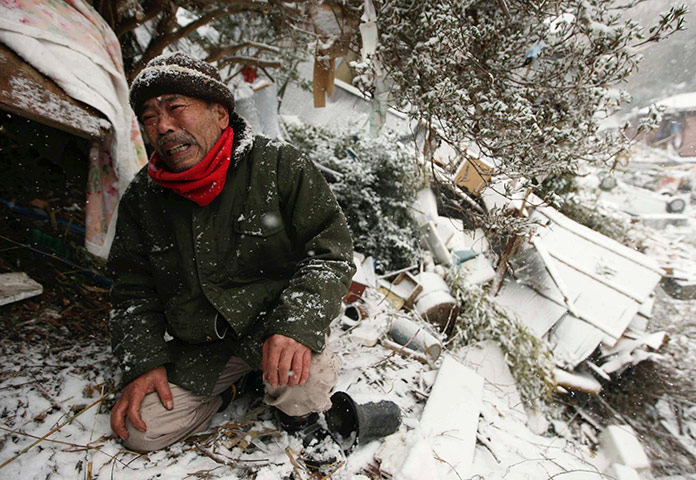
A man cries next to his destroyed house in Onagawa, where his mother is still buried in the rubble h/t The Guardian
Sometimes, a picture gets you more than a thousand words.
Looking at this Japanese man in the snow, crying for his mother, his destroyed house and his lost life,
you cannot help echoing one of the ancient primal cries of all creation,
“Why?”
* * *
On other days, however, in other circumstances, Creation, of course, sings a different song, no less ancient, no less primal. And the refrain of that song is just as mysterious:
“Glory.”
I Arise Today–The Prayer of St. Patrick

I arise today
Through the strength of heaven;
Light of the sun,
Splendor of fire,
Speed of lightning,
Swiftness of the wind,
Depth of the sea,
Stability of the earth,
Firmness of the rock.
Through the strength of heaven;
Light of the sun,
Splendor of fire,
Speed of lightning,
Swiftness of the wind,
Depth of the sea,
Stability of the earth,
Firmness of the rock.
I arise today
Through God’s strength to pilot me;
God’s might to uphold me,
God’s wisdom to guide me,
God’s eye to look before me,
God’s ear to hear me,
God’s word to speak for me,
God’s hand to guard me,
God’s way to lie before me,
God’s shield to protect me,
God’s hosts to save me
Afar and anear,
Alone or in a mulitude.
Through God’s strength to pilot me;
God’s might to uphold me,
God’s wisdom to guide me,
God’s eye to look before me,
God’s ear to hear me,
God’s word to speak for me,
God’s hand to guard me,
God’s way to lie before me,
God’s shield to protect me,
God’s hosts to save me
Afar and anear,
Alone or in a mulitude.
Christ shield me today
Against wounding
Christ with me, Christ before me, Christ behind me,
Christ in me, Christ beneath me, Christ above me,
Christ on my right, Christ on my left,
Christ when I lie down, Christ when I sit down,
Christ in the heart of everyone who thinks of me,
Christ in the mouth of everyone who speaks of me,
Christ in the eye that sees me,
Christ in the ear that hears me.
Against wounding
Christ with me, Christ before me, Christ behind me,
Christ in me, Christ beneath me, Christ above me,
Christ on my right, Christ on my left,
Christ when I lie down, Christ when I sit down,
Christ in the heart of everyone who thinks of me,
Christ in the mouth of everyone who speaks of me,
Christ in the eye that sees me,
Christ in the ear that hears me.
I arise today
Through the mighty strength
Of the Lord of creation
Through the mighty strength
Of the Lord of creation
The Magic Kingdom II–Art and Nature


This is a longer essay I wrote a few years ago, which I am posting in installments
Part I The Magic Kingdom I–The Varieties of Magic
The secret life within paintings brought me back to life when I was depressed that so little writing got done in the maelstrom of life with my exuberant children who, with their toys and friends, daily whirled through the house, disorder in their wake, and considered bedtime a signal for the party to begin. Whenever we had frequent flier miles or my husband an invitation to speak at conferences near them, we visited great museums. In those magic kingdoms–cool shadowy galleries full of pure, concentrated loveliness: the Louvre, Prado, Uffizi , Vatican
Each exhibition, a bottle from an ancient shore, bore a scrolled message: comfort or hope, inspiration or joy. The Monet retrospective at the Art Institute at Chicago: the romance of the artist, persisting, developing his craft–over seventy working years–from the undistinguished paintings of his twenties to these rooms full of the colors of magic, white and silver light, bright greens and blues, lilies in shimmering water, and, everywhere, the quiet glory of flowers. Miro painted the gay, faux naif paintings in the retrospective at the Met until he died at 90, still fresh and green, still bearing fruit. Art as a staff, adding happiness and excitement to life despite its tumults, and helping you forget them. The startling, eccentric sculptures in alabaster or veined marble in the Brancusi retrospective at the Philadelphia Museum of Art created right into old age by a man who joyfully woke at 5 a.m. to start creating reminded me of the pleasure and great good fortune it is to make beautiful things. And the paintings in the rare Vermeer retrospective at the National Gallery breathed peace, the deep peace possible as one goes about the domestic chores that harassed me .
In intense, blissful concentration at those galleries, I shed myself, becoming “only an eye” (as Cezanne disparagingly said of Monet) and shed time, losing track of it, as when I read, write, hike, garden, pray, study scripture, walk by the sea; (if it helps me lose track of time, it’s probably worth doing!) I felt again the joy of beauty; I longed to get back home and get writing.
My older daughter, Zoe, who, from infancy, ensconced in a backpack, stared at art over her father’s shoulder, responded to it early. She startled us by laughing and clapping at bright paintings when she was seven months old, and reaching out, with delight, to sculpture, especially of children, as a toddler (and has since won several art prizes!) Every time my youngest daughter Irene entered an art gallery, however, she howled. Those intense vacations amid the museums, romanesque monasteries, Gothic spires and ancient gardens of France , Italy , Spain , and Holland
And the natural world–with its starbursts of serendipity–is where I increasingly found magic: wonder, awe, astonishment and sheer beauty. We walked one hot summer day on Jekyll Island off the Georgia
As I drive to the beach, watching the sky slowly flush pink and peach, and then walk there amid the immensity of the sky, the immensity of the sea, and its ceaseless murmur, I sense this world is indeed God-veined, and throbs with the glory of Him “whose dwelling is the light of setting suns, and the round ocean, and the living air, and the blue sky” and the hills alive with invisible horses and chariots of fire.
The Ones He Chose, Matthew 20 20-28

A Mother’s Request
20 Then the mother of Zebedee’s sons came to Jesus with her sons and, kneeling down, asked a favor of him.
21 “What is it you want?” he asked.
Salome was one of the women who stayed with Jesus at the cross, and later witnessed the empty tomb.
Do me a favour, she asks, not specifying. Jesus smartly does not say Yes, but what do you want?
Salome was one of the women who stayed with Jesus at the cross, and later witnessed the empty tomb.
Do me a favour, she asks, not specifying. Jesus smartly does not say Yes, but what do you want?
She said, “Grant that one of these two sons of mine may sit at your right and the other at your left in your kingdom.”
The human quest for fame, attention, significance, importance, power and approval is played out here in this little family tableau.
22 “You don’t know what you are asking,” Jesus said to them. “Can you drink the cup I am going to drink?”
“We can,” they answered.
23 Jesus said to them, “You will indeed drink from my cup, but to sit at my right or left is not for me to grant. These places belong to those for whom they have been prepared by my Father.”
Not a yes, not a no. A perhaps. They have passed the same hurdle. But they must submit to the Father’s will just as Jesus does.
Not a yes, not a no. A perhaps. They have passed the same hurdle. But they must submit to the Father’s will just as Jesus does.
24 When the ten heard about this, they were indignant with the two brothers.
They felt that James and John preempted them in asking for what all of them also wanted–and manipulated Jesus by bringing their mother into it.
They felt that James and John preempted them in asking for what all of them also wanted–and manipulated Jesus by bringing their mother into it.
25 Jesus called them together and said, “You know that the rulers of the Gentiles lord it over them, and their high officials exercise authority over them. 26 Not so with you. Instead, whoever wants to become great among you must be your servant, 27and whoever wants to be first must be your slave—
Greatness comes in God’s eyes comes from serving. Those who can serve others will be great in the eyes of God.
And the one who serves the most is the greatest in God’s eyes.
An always challenging thought.
Lord, open my eyes to opportunities for service at home, first and foremost.
28 just as the Son of Man did not come to be served, but to serve, and to give his life as a ransom for many.”
Just as Christ came to serve many, and to offer his life in their stead.
Christ paid the ransom of his own life to free us from the slavery to sin, and to release the Holy Spirit to help us lead better lives.
A servant was a hired worker, and a slave, one forced into service. These were two of the lowest position in Jewish society, yet Jesus says that true greatness in his kingdom belongs to those who can serve others.
This is a challenging statement for me, Lord, and I am far from understanding or living it. Lord, have mercy.
The Ones He Chooses
In moments of total surrender and loving trust, I have decided to follow Jesus 100%. And between commitments, how much has my commitment actually grown? A percentage point, perhaps more, if it was a major renunciation. How disastrous in the world’s eyes! I see these cruel graphs in stores–Employee goals: a minimum of a hundred percent efficiency and I think of the ones he chose: Peter who declared, “I will go to the death with you” and believed it too, but who, in the darkness, by a coal fire, in a chiaroscuro scene that Rembrandt and Caravaggio loved, “never knew” the Jesus being degraded by his enemies–but whose bitter tears led to a bitter-sweet reconciliation at dawn, by another coal fire. The Lord of Glory accepts us just as we are, even as he molds us into what he (and between gasps, we) wants us to be.Magic Kingdom Portofino
[1] “The Dissatisfaction of Francis Schaeffer, Christianity Today, March 3rd, 1997
[1] “The Dissatisfaction of Francis Schaeffer, Christianity Today, March 3rd, 1997
The Magic Kingdom–I
 |
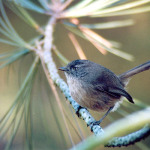
| Wren-tit |
Hello readers, I had written a long essay called The Magic Kingdom in 2003, and then we moved from the US to the UK, and I never did anything with it. Perhaps I will expand it. Anyway, I am going to post it here over a few days in blog sized bites in the hope that you might fit it interesting.
Comments welcomed
THE MAGIC KINGDOM
In No Strange Land
O world invisible, we view thee,
O world intangible, we touch thee,
O world unknowable, we know thee,
Inapprehensible, we clutch thee.
Does the fish soar to find the ocean,
The eagle plunge to find the air–
That we ask of the stars in motion
If they have rumor of thee there?
Not where the wheeling systems darken,
And our benumbed conceiving soars!–
The drift of pinions, would we hearken,
Beats at our own clay-shuttered doors.
The angels keep their ancient places;
Turn but a stone, and start a wing!
‘Tis ye, tis your estranged faces,
That miss the many-splendored thing.
But, when so sad thou canst not sadder,
Cry;–and upon thy so sore loss
Shall shine the traffic of Jacob’s lader
Pitched between Heaven and Charing Cross .
Yea, in the night, my Soul, my daughter,
Cry,–clinging Heaven by the hems;
And lo, Christ walking on the water
Not of Gennesareth, but Thames . Francis Thompson
“I’m the President of the Soviet Union, but I cannot enjoy the birthright of every American child; I cannot go to Disneyland ,” Michal Gorbachev lamented in Time. When, by virtue of geographical accident, my husband Roy and I produced little Americans, we reluctantly, foolishly, felt we should give them a shot at this birthright.
It’s the happiest place on earth: the theme song bounced through the Magic Kingdom
Walt Disney coined the phrase “amusement park,” literally, a place without musing, without thought, an escape from one’s life into hyper-reality, a third degree of separation, riding rides based on movies, based on books. And, everywhere, contrasts: the determined hilarity of the M.B.A.’s and the strained faces rushing to see it all, which insidiously becomes the objective rather than enjoying each other in/and the Magic Kingdom. Exasperated at their kids for not being happy despite the piratical tickets, parents growl; overwhelmed little ones burst into tears. People line up two hours early for a parade in honor of Mickey Mouse! I ruefully thought of Arnold’s plaint a century ago, “the strange disease of modern life, which, though it gives no peace, yet spoils for rest.”
The next day, to recover from that wearing magic, we hiked in the Topanga Canyon State Park outside Los Angeles
The Ones He Chose, Matthew 20 20-28
A Mother’s Request
20 Then the mother of Zebedee’s sons came to Jesus with her sons and, kneeling down, asked a favor of him.
21 “What is it you want?” he asked.
Salome was one of the women who stayed with Jesus at the cross, and later witnessed the empty tomb.
Do me a favour, she asks, not specifying. Jesus smartly does not say Yes, but what do you want?
Salome was one of the women who stayed with Jesus at the cross, and later witnessed the empty tomb.
Do me a favour, she asks, not specifying. Jesus smartly does not say Yes, but what do you want?
She said, “Grant that one of these two sons of mine may sit at your right and the other at your left in your kingdom.”
The human quest for fame, attention, significance, importance, power and approval is played out here in this little family tableau.
22 “You don’t know what you are asking,” Jesus said to them. “Can you drink the cup I am going to drink?”
“We can,” they answered.
23 Jesus said to them, “You will indeed drink from my cup, but to sit at my right or left is not for me to grant. These places belong to those for whom they have been prepared by my Father.”
Not a yes, not a no. A perhaps. They have passed the same hurdle. But they must submit to the Father’s will just as Jesus does.
Not a yes, not a no. A perhaps. They have passed the same hurdle. But they must submit to the Father’s will just as Jesus does.
24 When the ten heard about this, they were indignant with the two brothers.
They felt that James and John preempted them in asking for what all of them also wanted–and manipulated Jesus by bringing their mother into it.
They felt that James and John preempted them in asking for what all of them also wanted–and manipulated Jesus by bringing their mother into it.
25 Jesus called them together and said, “You know that the rulers of the Gentiles lord it over them, and their high officials exercise authority over them. 26 Not so with you. Instead, whoever wants to become great among you must be your servant, 27and whoever wants to be first must be your slave—
Greatness comes in God’s eyes comes from serving. Those who can serve others will be great in the eyes of God.
And the one who serves the most is the greatest in God’s eyes.
An always challenging thought.
Lord, open my eyes to opportunities for service at home, first and foremost.
28 just as the Son of Man did not come to be served, but to serve, and to give his life as a ransom for many.”
Just as Christ came to serve many, and to offer his life in their stead.
Christ paid the ransom of his own life to free us from the slavery to sin, and to release the Holy Spirit to help us lead better lives.
A servant was a hired worker, and a slave, one forced into service. These were two of the lowest position in Jewish society, yet Jesus says that true greatness in his kingdom belongs to those who can serve others.
This is a challenging statement for me, Lord, and I am far from understanding or living it. Lord, have mercy.
The Ones He Chooses
And when the King, the Lord of glory, came to dwell among us, who was counted worthy to follow him, to be the first Christians?
* he who, with the insight God lavishes on the unworthy, early recognized the Messiah, dominant, cocksure Peter of erratic insight, whom Jesus fiercely rebuked when he recoiled at his friend becoming a paradoxical suffering King whose magic kingdom was not of this world, who was draped in royal robes with mockery and great laughter, whose crown was of thorns, whose throne was the cross, and whose insignia was his nail-scarred hands.
* those who were fiercely competitive in the noble enterprise of establishing the kingdom of whose nature they were uncertain; always enviously trying to identify the favorite, the greatest.
* Those who continually forgot his vivid miracles, and were continually rebuked for their lack of faith. But though they disapproved of his approach to money, power, or people, they loved him. “Let us also go that we may die with him,” Thomas says, though in the hour of terror, not one of them dared to, not yet.
To these men he walked up, looked into their eyes, and said, “Follow me,” and they rose, leaving nets and tax booth, and walked behind him–becoming, by that act, Christians. And he comes up to us, people indubitably in process, amid the muck and misery and marvel of life, looks at us, and says, “Come, follow me.” And as, with an ardent, “Oh yes!” we make our first changes, we become Christians. And are we, by those words, instantly transformed, utterly transfigured? No more than they were, though they were with him all day, all night, loving him despite their ambition, pride, doubt, and impatience. The long years it takes to become a writer, a mathematician, but in the wideness of God’s mercy, all it takes to bear the tremendous badge of a Christian is our “yes,” our tottering steps. And though we may trip and stumble and stray, he steadies us, and leads us on, transforming us by the slow-release seed of his life within us, as potent and generative as that seed too small to be seen by the naked eye, shed in an ecstatic night we cannot identify, that made the children we adore.
In moments of total surrender and loving trust, I have decided to follow Jesus 100%. And between commitments, how much has my commitment actually grown? A percentage point, perhaps more, if it was a major renunciation. How disastrous in the world’s eyes! I see these cruel graphs in stores–Employee goals: a minimum of a hundred percent efficiency and I think of the ones he chose: Peter who declared, “I will go to the death with you” and believed it too, but who, in the darkness, by a coal fire, in a chiaroscuro scene that Rembrandt and Caravaggio loved, “never knew” the Jesus being degraded by his enemies–but whose bitter tears led to a bitter-sweet reconciliation at dawn, by another coal fire. The Lord of Glory accepts us just as we are, even as he molds us into what he (and between gasps, we) wants us to be.
I read of Francis Schaeffer’s “plant-throwing, pot-smashing temper” in a profile in Christianity Today.[1] And he was one of the most influential Christians of the twentieth century. Had he crossed over into Christ’s magic Kingdom? I don’t doubt it–for that is the magic of the Magic Kingdom Portofino
[1] “The Dissatisfaction of Francis Schaeffer, Christianity Today, March 3rd, 1997
[1] “The Dissatisfaction of Francis Schaeffer, Christianity Today, March 3rd, 1997
Tell me, what is it you plan to do with your one wild and precious life?


The Summer Day
Who made the world?
Who made the swan, and the black bear?
Who made the grasshopper?
This grasshopper, I mean –
the one who has flung herself out of the grass,
the one who is eating sugar out of my hand,
who is moving her jaws back and forth instead of up and down –
who is gazing around with her enormous and complicated eyes.
Now she lifts her pale forearms and thoroughly washes her face.
Now she snaps her wings open, and floats away.
I don’t know exactly what a prayer is.
I do know how to pay attention, how to fall down
into the grass, how to kneel down in the grass,
how to be idle and blessed, how to stroll through the fields,
which is what I have been doing all day.
Tell me, what else should I have done?
Doesn’t everything die at last, and too soon?
Tell me, what is it you plan to do
with your one wild and precious life?
Mary Oliver
A Ring of Endless Light

By Madeleine L’Engle
“The earth will never be the same again,
Rock, water, tree, iron share this grief
As distant stars participate in pain.
A candle snuffed, a falling star or leaf,
A dolphin death, O this particular loss
Is heaven-mourned; for if no angel cried,
If this small one was tossed away as dross,
The very galaxies then would have lied.
How shall we sing our love’s song now
In this strange land where all are born to die?
Each tree and leaf and star show how
The universe is part of this one cry,
That every life is noted and is cherished
And nothing loved is ever lost or perished.”
- « Previous Page
- 1
- …
- 153
- 154
- 155
- 156
- 157
- …
- 279
- Next Page »