Mary McCarthy, Memories of a Catholic Girlhood
I really enjoyed the spare elegance of this memoir. It is a New Yorker style memoir, much like Nabokov’s “Speak Memory,” and I must say there are worse things than New Yorker style memoirs.
Each chapter was originally a self-contained (and well-paid) essay published in the New Yorker. Together they tell the story of McCarthy’s life. She was orphaned early, and brought up by her mother’s uncles and aunts. They were odd, abusive, particularly disliking the articulate Mary. She describes being framed by an sadistic and weird Uncle, and then being strapped by him.
Finally, a “health and safety issue” leads her Seattle grandparents to rescue her, and she moved from a claustrophobic, loveless controlling world in Minneapolis to an elegant, affluent home in Seattle. Love is still missing; however, she goes on to an elite boarding school she finds stimulating, and where she comes to life.
Mary McCarthy is a brilliant woman (Randall Jarrell’s totally hilarious portrait of Gertrude from Pictures from an Institution is based on Mary McCarthy) and this memoir is probably her best work.Clear, elegant writing, like a well-sanded bit of wood, an unself-pitying story-telling style, lots of telling detail, well-honed sentences which make you sigh, they are so perfect. A lovely glimpse into a vanished world
 Bookmark this on Delicious
O. Hallesby on Prayer, and Random Thoughts on Christian Writing
O. Hallesby on Prayer, and Other Thoughts on Christian Writing
He has it both ways, doesn’t he? Both tells, and doesn’t tell. As most of us do when we war with the impulse to show off.
* * *
My friend Paul Miller, also a Christian writer (“Love Walked among us,” the first drafts of which I edited, “A Praying Life” etc) told me about the Norwegian pastor, O. Hallesby’s wonderful book on prayer.
In particular, Paul pointed out a paragraph. I paraphrase–Your secret life with Christ in the secret places of prayer is a cosy, warm Norwegian cottage in a blustery winter. If you talk about your prayer life, you open the door, and cold wintry blasts enter.
I am sure Hallesby is right. Also, one cannot talk about spiritual adventuring without some degree of showing-off or putting oneself on a pedestal. Look at Paul the Apostle in this amusing passage, struggling with dual impulses,
a) to tell all–to describe his amazing spiritual experiences, probably among his most precious possessions,
b) to keep secret this sacred, precious and most dear thing.
Although there is nothing to be gained, I will go on to visions and revelations from the Lord. 2I know a man in Christ who fourteen years ago was caught up to the third heaven. Whether it was in the body or out of the body I do not know—God knows. 3And I know that this man—whether in the body or apart from the body I do not know, but God knows— 4was caught up to paradise. He heard inexpressible things, things that man is not permitted to tell. 5I will boast about a man like that, but I will not boast about myself, except about my weaknesses. 6Even if I should choose to boast, I would not be a fool, because I would be speaking the truth. But I refrain, so no one will think more of me than is warranted by what I do or say.
He has it both ways, doesn’t he? Both tells, and doesn’t tell. As most of us do when we war with the impulse to show off.
* * *
I have written, in another context, that if one is looking for a business niche, the best way to find it is to look for the intersection of your own deep joy (interests, abilities, talents) and the world’s deep need, to quote Frederick Buechner.
http://theoxfordchristian.blogspot.com/2010/08/amazing-business-success-story-story-of.html http://theoxfordchristian.blogspot.com/2010/08/christian-in-business-further-thoughts.htmlThe same is true for a writer looking for a subject. Though, of course, after a certain age, one doesn’t look for subjects any more, they come up and grab your by the throat, many of them, all at once.
I have both studied and taught Creative Writing at universities. A common writing adage goes like this, “If there is a book you would like to read, and it does not exist, why then, of course, you must write it.”
There is a blog or website I would love to bookmark, but I haven’t yet quite found it. I spend many hours at my laptop to which, I openly confess, I am somewhat addicted. I help run our family’s publishing company, Benediction Classics, I write. And blog. All of which add up to much screen time.
“Much study is a weariness to the flesh, and of making books there is no end. ” In these times of weariness, I have often wished for a spiritual pick-me-up, an equivalent of a cappuccino and chocolate bar, to encourage and refill a weary and empty soul, something more modern than Habakkuk or Isaiah, someone wrestling with my dilemmas, but handling them better.
And since, I didn’t find a blog updated daily, an evolving diary of a soul, something like a spiritual multi-vitamin, I thought I might try to write one.
That would be a blessing to my readers.
But I have not found the answer to many of my wonderings. The spiritual life is full of highs and lows. One moment, you are with Christ on the mountain, seeing him and everything else transfigured, you behold his glory, you behold Moses and Elijah, you see reality in a different light, you are transformed.
And then you walk down the mountain, and you are now cocky and arrogant, and presume to advise Christ, and to your horror, he, who once said to you, “Blessed are you, Simon Bar-Jonah” now says, “Get behind me, Satan, for you do not have in mind the things of God, but the things of man.”
So how does a Christian writer chronicle her spiritual life without the appearance of showing off? Or without, in fact, showing off! Is it even appropriate to write about a deep, sacred, intimate and precious relationship on the web? It would be like writing about the most private moments of marriage, which even I, who am always writing, would never dream of doing.
I don’t have an answer, but I think I might use the blessing test more severely. If what I am writing is, or might be a blessing to my readers, I’ll press, “Publish Post.” If not, it joins my multi-volume drafts folder!
THE BLUE BEDSPREAD by RAJ KAMAL JHA
THE BLUE BEDSPREAD by RAJ KAMAL JHA
A very quick read, in an experimental minimalist style, mining the territory opened up by Arundhati Roy–incest and familial sexual abuse. Do these things really happen in India? I remember the shock I felt as an 18 year old when a maid working for one of the leading and pious Catholic families in town, told me her employer regularly pawed and propositioned her. What? How could it be? I thought in shock and revulsion.
“The Blue Bedspread” is a self-conscious novel, of course, though written in the clear, transparent style that conceals art. The story is told in a series of Faulknerian flashbacks. The tension and sadness build relentlessly. I read it quickly, and it maintained my interest throughout. If you are interested in style, and experimentation with it, and in unusual novels, which are, nevertheless, a quick read, this slim novel will probably be worth your while.
Bookmark this on Delicious
PARTIE DE CAMPAGNE by JEAN RENOIR
PARTIE DE CAMPAGNE by JEAN RENOIR
I did enjoy this charming film by Jean Renoir (who also acted in it, a good deal changed from the adorable little boy, subject of paintings and photographs in Les Collettes, August Renoir’s farmhouse in the South of France, which we visited this spring.
It is a close and faithful rendition of Maupassant short story Une Partie de Campagne, available online in English translation, though not without typos, alas.
Though it is the tale of a lyrical, country interlude, it is also heartbreaking. A working class 18 year old Parisian, Henriette, spends a day in the country. Two youngsters, of a higher social class, see her and her mother, and decide to seduce them.
Henri seduces Henriette, they have a sweet, intense sexual encounter. And part.
Henriette married a slow lout.”Years passed with Sundays as bleak as Mondays. Anatole married Henriette.” I think of Yeats’ line on Helen of Troy “Helen being chosen found life flat and dull. And later had much trouble from a fool.”
One Sunday, a couple of years later, Henriette takes Anatole to the bower where she had her sweet, secret encounter with Henri. Henri goes there too, coincidentally. He tells her that he has never forgotten that afternoon. It was the happiest day of his life. She says that she thinks of it every night.
So, in the characteristic Maupassant twist, the tragic seduction of an innocent young girl ends up having unexpected emotional repercussions for the seducer as well.
The film also reminded me of Chekhov’s “The Seagull”, which I have seen several times, but which is so sad that I doubt I will ever see it again. Nina, loved by clever Konstantin whom she has no romantic feelings for, falls in love with a famous though mediocre writer.
He sees a plot for a short story. “ “A young girl lives all her life on the shore of a lake. She loves the lake, like a seagull, and she’s happy and free, like a seagull. But a man arrives by chance, and when he sees her, he destroys her, out of sheer boredom.” Meanwhile, Nina, in an excess of young devotion, tells him in chilling words, ““If you should ever need my life, come and take it.”
He does. He tires of her, discards her, her life is ruined. She no longer feels worthy of a good man’s love.
The foreknowledge of this fate hanging over Henriette spoilt the otherwise charming and idyllic film for me. It’s wonderful to be young–but, fortunately, one is only young and innocent once. It’s safer not to so.
Bookmark this on Delicious
The Glass Palace by Amitav Ghosh
The Glass Palace by Amitav Ghosh
An old-fashioned, multi-generational novel, it tells a story, as E.M. Forster tiredly remarked. Oh yes, it tells a story.
The story is set in Burma, around the time the British ruthlessly conquered it, sending the Royal Family into exile in India. A new breed of Indian entrepreneurs flooded Burma, making fortunes in a the dazzling new world of the gentle Burmese.
The central romance of the novel is the story of a self-made entrepreneurial Indian who become a millionaire in the rapidly changing Burma–teak!! rubber!!–and a gentle Burmese girl, essentially a mystic, who rather reluctantly, becomes his wife, though she ultimately gratefully escapes into a Buddhist monastery.
The novel spans a century, through the Second World War and the brutal Japanese invasion of Burma, ending with the equally brutal and mindless coming to the power of the current junta, and a cameo of the gentle Aung San Suu Kyi.
It’s fun, it’s relaxing, you learn an enormous amount. If you have nothing better to do, forget everything and curl up with this well-spun and well-written tale–when you have a couple of days free!!
BOOK GIVEAWAY: Simon Acland’s “The Waste Land: An Entertainment”

BOOK GIVEAWAY: Simon Acland’s “The Waste Land: An Entertainment”
Simon Acland has very kindly offered readers of this blog a copy of his intriguing new novel. If you would like to be included in the drawing, do leave your name in the comments section, and either some way for me to contact you if you are the winner, or check back on Wednesday, 22nd September when I will hold the drawing.

Here’s some more information about this intriguing novel:
The Waste Land chronicles the adventures of Hugh de Verdon, monk turned knight, during the extraordinary historical events of the First Crusade. He journeys from the great Benedictine Monastery of Cluny to Constantinople, Antioch and Jerusalem. He encounters the Assassins, endures a personal epiphany and discovers the truth behind the Holy Grail.
Hugh de Verdon’s tale is retold by a group of desperate Oxford Professors, who discover his autobiographical manuscript in their College library. Their humorous – and murderous – story also provides a commentary on the Eleventh Century events and shows that they are perhaps not all they seem.
And excerpts from a few reviews,
” It is exciting and thrilling and Simon Acland is steeped in this period of history and really knows his stuff. Hugely enjoyable, engrossing and engaging from start to finish. I loved this book and it will be going on my list of Best Reads of 2010.”
Random Jottings 7th July 2010
“To produce a good piece of historical fiction requirs a delicate balancing act between credible period colour and going gloriously over the top. In The Waste Land, Simon Acland pulls this off brilliantly.”
Pursewarden 29th May 2010
“Whether in the depiction of Hugh’s loneliness at Cluny, or the gory battle scenes of the First Crusade, Mr. Acland excels at showing Hugh’s development. Each scene and location is remarkably detailed, and the historical figures are equally fascinating.”
Historical Novel Review 12th July 2010
“This first installment is terrific and we eagerly await the follow-up.”
Brother Judd 24th July 2010
And here is Simon Acland’s engaging account of the genesis of his novel
“The Waste Land brings together a number of obsessions of mine – or perhaps obsessions is not quite the right word. A better way of putting it would be to say that various bits of reading seemed to coalesce when I was thinking about writing the book.
The first ingredient is the Grail. Like the Best-Selling Author in The Waste Land, I was a bad student at Oxford, but one term I did work hard and became enthused by my subject. That was when I was studying the French grail romances of the 12th and 13th Centuries, and Chretien de Troyes in particular. Later, I watched and read with interest and enjoyment the popular Grail books as they emerged – The Holy Blood and the Holy Grail by Leigh, Baigent and Lincoln, Dan Brown’s Da Vinci Code, Kate Mosse’s Labyrinth and so on. But it seemed to me that there was something missing – a link back to the original medieval poems. I thought that it would be fun to write a Grail tale that tried to make the connection.
One of the things which obsesses Grail scholars is how the legends originated. Many of the myths that emerge at different times in different cultures have the same roots. After dinner one night I found myself reading The Waste Land out loud to my children – the realWaste Land, the great Waste Land, that is, T.S. Eliot’s, not mine. The blend of Grail imagery with other myths, and with Ovid in particular, drove me back to re-read Jesse Weston’s From Ritual to Romance, and to Sir James Frazer’s The Golden Bough, and then to Metamorphoses itself. Somehow this resulted in the idea of tying the Grail legend together with Ovid in a story set in the First Crusade. Using the same title for my book, and allusions to it in my chapter titles, and in various places in the text, is really a homage to the great poem, as well as adding a little literary joke to the novel. (There are 23 allusions to the poem in the text if you are looking for them).
I wanted the First Crusade tale to read a little like the adventure stories that I was brought up on and still re-read often – Anthony Hope’s The Prisoner of Zenda, John Buchan’s Greenmantle, Henry Rider Haggard’s King Solomon’s Mines, for example. If you know those books you may recognise genuflections to each of them in my story. To please my children I also promised them a reference toMonty Python and the Holy Grail. But medieval French is less well known and I did not want to lose the connections to the Grail legends.
That’s why I came up with the device of the Dons’ story. Some of the friends who read the book before I published it liked the Dons. Some did not. If you don’t, just ignore the Saint Lazarus’s College sections and read Hugh’s story. It stands by itself. But I decided to leave the Dons in, because for me they add another dimension. I thought that if they were commenting on some of the literary origins of the story they could talk a little about the history behind it. I have read many historical novels where I have asked myself part way through ‘did it really happen like that?’. Some of the events of the First Crusade are so extraordinary that they are hard to believe and I wanted the Dons to point up some of the background. I also wanted them to inject a bit of humour into the story and dilute some of the blood and battles. In part some of the parallels with Hugh’s story poke gentle fun at the ‘time slip’ novel genre. And in part they are meant to confirm that Hugh’s story should not be taken too seriously.”
If you would like to be included in the drawing, do leave your name in the comments section, and either some way for me to contact you if you are the winner or check back on Wednesday, 22nd September when I will hold the drawing.
If you would like to be included in the drawing, do leave your name in the comments section, and either some way for me to contact you if you are the winner or check back on Wednesday, 22nd September when I will hold the drawing.

Captain Corelli’s Mandolin
Captain Corelli’s Mandolin
It’s so much easier and quicker to watch the movie than read the book I land up watching the film version of many books I have wanted to read. I enjoyed Captain Corelli’s Mandolin, the movie. I knew nothing of the German massacre of the Italian troops, or the Italian occupation of Greece (It’s been decades since A level history!) so I spent an enjoyable half hour on the net afterwards filling in my historical gaps.
The novel sounds really interesting. I love polyphonic novels, likeSound and Fury and piecing together a complete picture from the fragments of things people say, a bit like listening to gossip. I look forward to reading it. Here’s a tantalizing review.
The different sounds of the mandolin
John Mullan on the ironies imbued in the polyphonic voices of Captain Corelli’s Mandolin by Louis de Bernières
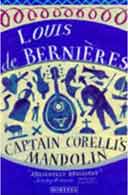
On the feast day of St Gerasimos, patron saint of the Greek island of Cephalonia, the mummified remains of the holy man are paraded and the islanders become “outlandishly drunk”. (The first detail from Louis de Bernières’s Captain Corelli’s Mandolin is confirmed by the Greek tourist board; the latter is the novelist’s embellishment.) In the novel, troupes from different towns loudly strike up rival songs, some fishermen from Panago-poula miraculously managing, over the chatter of the crowd and the crashing of a cannon, to weave “a harmony intricate and polyphonic”. “The brotherhood of the sea,” declares the narrator, in imitation of the fishermen’s bibulous self-congratulation, has produced “conclusive proof of their metaphysical unity”.
It is also comically analogous to the novel’s narrative method. Its 73 short chapters move rapidly between different characters, historical as well as invented. Dr Iannis, his daughter Pelagia, and Captain Corelli, the Italian soldier billeted in their house during the wartime occupation, may be the central characters, but we hear many different narrative voices, some first-person and some third-person. The former include a chapter of dramatic monologue given to Mussolini, posing in front of a mirror; the interior monologues of Pelagia; and Mandras, the fisherman who is courting her; and chapters headed “L’Omosessuale”, narrated by the secretly homosexual Italian soldier, Carloi Guercio. “Thank God no one reads my mind,” says Pelagia silently, as she reviews her own “sluttish thoughts”. But we do.
Different voices find many forms. There are letters; there are political diatribes; there are speeches and sermons. Equally, the chapters of third-person narrative reflect many different viewpoints. Most often we see events through the eyes of Iannis, or Pelagia, or Corelli, but free indirect style gives us the thoughts of many others, from Mina, the mad girl who is to be “cured” by Saint Gerasimos, to Lieutenant Weber, the “good Nazi”, confused by the habits of his Italian allies. The collection of narratives is made to enact an understanding of human variety.
It is a novel not just of different narrative voices and points of view, but also of different languages. It uses fragments of Italian, French, German (and transliterated Greek), but mostly it has to represent the different languages, and the mutual misunderstandings, of the characters in a language that none of them are using: English. (Though if Iannis and his daughter were not fluent in Italian, a language for which the doctor has always had an inflated regard, and therefore able to have all their disputes with Corelli, the novel would not have been possible.) Incomprehension is invariably comical. An Eton-educated British agent is introduced to Iannis and made to speak a Chaucerian English that is the novel’s equivalent of the classical Greek he employs. “Sire, of youre gentillesse, by the leve of yow wol I speke in pryvetee of certeyn thyng,” is his opening gambit. “What?” replies the bewildered doctor, speaking in a fluent, colloquial English which is the novel’s equivalent of modern Greek. When he and the Englishman agree to converse in English, Iannis’s speech becomes broken and ungrammatical: “You accent terrible-terrible. Not to talk, understand?”
The book’s ebullient varieties of speech and narrative make it tempting to call it a “polyphonic novel”. The term was invented by the Russian literary theorist Mikhail Bakhtin in the 1920s to describe Dostoevsky’s fiction. Bakhtin praised Dostoevsky for rendering “a plurality of unmerged voices and consciousnesses”. He had in mind the novelist’s willingness to allow his characters’ words and attitudes to predominate over any authorial insights. (Would Captain Corelli’s Mandolin always qualify by this test? De Bernières’s novel includes passages where a narrator tells us things -such as future events – that none of his characters can know.) Bakhtin initially claimed that Dostoevsky had originated “a fundamentally new novelistic genre”, before later deciding that he had instead perfected what had always been a subversive inclination of most interesting fiction.
Bakhtin valued “polyphony” because it seemed a rebellion against the narrative habits of 19th-century fiction (and implicitly the strictures of the socialist realism being recommended in the Soviet Union). Now it hardly seems revolutionary. Indeed, the opening of a single novel to multiple narrators and viewpoints has become relatively common in recent fiction, and “polyphonic” has become a frequent description. The literary novel that narrates in the singular, reliable “voice” of its author (which Bakhtin would have called “monologic”) is nowadays a much rarer thing. Some, like David Lodge, have argued that this reflects the contemporary novel’s lack of trust in its ability to understand the world. Yet the success of De Bernières’s novel is to find in narrative variety not confusion, but comedy and consolation.
“The Precious Garden of my Home needs Tending”
“The Precious Garden of my Home needs Tending”
I have reluctantly decided to no longer blog daily– for a season. In the words of the uncompromising John Piper, in whose church we worshipped when we lived in Minneapolis “the precious garden of my home needs tending.” When I have tended it, I will return to daily blogging. Till then, I will blog in windows of time.
Here is John Piper’s beautifully worded announcement,
“As I have stood back in recent months and looked at my own soul—my own sanctification, my own measures self-denial or self-serving—and my marriage and family and ministry patterns, I have felt an increasing need for a serious assessment—a kind of reality check in the light of God’s word. Am I living in the mindset and the pattern of life that Jesus calls for here in Mark 8:31–38, especially in relation to those I love most?
On the one hand, I love my Lord, Jesus; I love my wife and my five children and their families. These are the supreme treasures of my life—my Lord, my wife, my children. And I love my work of preaching and writing and leading Bethlehem. Indeed, I hope that the Lord gives me at least five more years as the pastor for preaching and vision at Bethlehem. That’s my dream. And that’s my plan, if God wills.
But on the other hand, I see several species of pride in my soul that, even though they may not rise to the level of disqualifying me for ministry, grieve me, and have taken a toll on my relationship with Noël and others who are dear to me. Noël and I are rock solid in our commitment to each other, and there is no whiff of unfaithfulness on either side. But, as I told the elders, “rock solid” is not always an emotionally satisfying metaphor, especially to a woman. A rock is not the best image of a woman’s tender companion.
In other words, the precious garden of my home needs tending. I want to say to Noël that she is precious to me. And I believe that at this point in our 41-year pilgrimage together the best way to say it is by stepping back for a season from virtually all public commitments.
What I have asked for is something very different from a sabbatical or a writing leave. In 30 years, I have never let go—not on writing leaves or on sabbatical or on vacations—of the passion for public productivity—writing and preaching. In this leave, I intend to let go of all of it. No book-writing. No sermon preparation. No preaching. No blogging. No Twitter. No articles. No reports. No papers. And no speaking engagements.
You could view this as a kind of fasting from public ministry. One of the goals in this kind of fasting is to discern levels of addiction. Or, as Paul Tripp or Tim Keller might say, levels of idolatry. The reality check is: What will happen in my soul and in my marriage when, to use the phrase of one precious brother on staff, there will be no “prideful sipping from the poisonous cup of international fame and notoriety”?
You may think: My, a leave of absence is a pretty drastic step in the war against pride and idolatry. That’s true. It is. But I’m not the only one affected. And I hope that you will trust me and the elders that it will be good for my soul, good for my marriage and family, and good for you and for the next five or six years of ministry together, if the Lord wills.”
By the grace of God, “the poisonous cup of international fame” has not offered itself to my lips. However, daily blogging is at the moment, not consistent with tending the precious garden of my home. So I am going to blog sporadically until I have tended this precious garden.
And here is Christianity Today’s good article on Piper’s brave decision.
The Toll of Our Toiling
John Piper takes an eight-month leave of absence.
Collin Hansen | posted 3/30/2010 09:18AM
 1 of 2
Surprise and admiration have characterized the response so far to news that Bethlehem Baptist Church pastor John Piper will take an eight-month leave of absence from public ministry between May 1 and December 31, 2010. Explaining the move to his Minneapolis congregation, Piper said his soul, marriage, family, and ministry pattern “need a reality check from the Holy Spirit.” Piper, widely known for his prodigious book output and intense speaking schedule, will abstain from all such activity during this unexpected sabbatical.
“I see several species of pride in my soul that, while they may not rise to the level of disqualifying me for ministry, grieve me, and have taken a toll on my relationship with [my wife] Noël and others who are dear to me,” Piper wrote. “How do I apologize to you, not for a specific deed, but for ongoing character flaws, and their effects on everybody? I’ll say it now, and no doubt will say it again, I’m sorry. Since I don’t have just one deed to point to, I simply ask for a spirit of forgiveness; and I give you as much assurance as I can that I am not making peace, but war, with my own sins.”
Thousands of ministers who have learned from Piper through his books, sermons, and conference talks will now have opportunity to learn from his silence. Pastors, even if they do not aspire to Piper’s level of influence, easily fall into exhausting patterns of study, counseling, meetings, and visitation that jeopardize time alone with God and with their families. A 2008 Lifeway survey found that 65 percent of pastors work 50 or more hours per week, including 8 percent who work 70 or more hours. E-mail and meetings cut into time for visiting church and family members. Congregational emergencies cut short precious vacations. As soon as one crisis dissipates with the evening mist, another looms over the morning horizon.
But local church ministry is hardly the only vocation prone to overwork. Teachers, farmers, doctors, lawyers, small business owners, and middle managers alike feel the strains of labor that threaten family and spiritual life. Still, the threat becomes that much more dangerous when we work unto the Lord in taxing jobs where the cause seemingly justifies the means. Who has time to read the Bible, pray, listen to our friends, and care for our children when there’s kingdom work to be done?
Billy Graham might be the most recent patron saint of evangelical exhaustion. His preaching schedule kept him away from his family for much of every year for decades. Due to work, Graham missed the birth of his first child, daughter Gigi, in 1945. Meanwhile, his celebrity status grew so intense that his family sometimes crawled around their home in Montreat, North Carolina, just to avoid the curious gaze of tourists who visited by the busload.
“This is a difficult subject for me to write about, but over the years, the [Billy Graham Evangelistic Association] and the Team became my second family without my realizing it,” Graham recalled in his autobiography, Just As I Am. “Ruth says those of us who were off traveling missed the best part of our lives—enjoying the children as they grew. She is probably right. I was too busy preaching all over the world.
“Only Ruth and the children can tell what those extended times of separation meant to them. For myself, as I look back, I now know that I came through all those years much the poorer both psychologically and emotionally. I missed so much by not being home to see the children grow and develop. The children must carry scars of those separations too.”
Graham hoped that the proliferation of Christian evangelists and media would relieve the burden from any one subsequent minister. No particular leader would need to travel without ceasing. But now it seems as though conferences and the internet have spawned a thousand Grahams. Piper alluded to the endless opportunities and demands when he explained that he planned to abstain from book writing, sermon preparation, blogging, Twitter, articles, reports, papers, and speaking engagements. Even ministers without Piper’s prestige and experience may become engrossed in a pattern of overwork, starting at a young age, because new media offers everyone a platform.
The temptation was bad enough when a relative few media gatekeepers controlled the major means of evangelical influence. Christianity Today‘s first editor, Carl Henry, worked 15-hour days for seven years. During a visit to Mayo Clinic in 1959, doctors advised him to lighten an untenable workload that led to migraines and vertigo. But he continued to work full days even as he endured physical exhaustion. Before Henry finally took a sabbatical, CT board chairman Harold John Ockenga encouraged him to find a relaxing place to rest for three months. Instead, Henry and his wife traveled around the world for speaking engagements as he continued to write. An intense work regimen was ingrained in several evangelical leaders of the post-war era. Henry’s colleague and Graham’s father-in-law, L. Nelson Bell, suffered stress-related pain, too. But according to Henry, Bell declined to visit a cardiologist for fear of landing in the hospital.
Evangelical leaders serve out of their personal relationship with Christ, modeling the life of faith for others. Yet it is exceedingly difficult to tend to this most important relationship, not to mention our friends and family, when work consumes every day. To be sure, we’re called to toil for Christ, “struggling with all his energy that he powerfully works” within us (Col. 1:29). Even during the busyness of this Lenten season, though, we might follow Piper’s example and pause to examine the toll of our toiling and the state of our souls. Does our work truly point others to the power of Christ? If not, it may draw attention to the one who plants and waters, not the God who gives the growth (1 Cor. 3:7). Ministers who lose this perspective are in danger of losing their congregations, not to mention their families.
Instead, let us live up to our belief in the God who holds out the promise of Sabbath rest for his people. If God rested from his works, so can we (Heb. 4:9-10)”
- « Previous Page
- 1
- …
- 7
- 8
- 9
- 10
- 11
- …
- 22
- Next Page »