The Sadness of Wasting Suffering
Our pastorate (home group) is studying Romans, well more appropriately looking at the mountain peaks of Romans. I felt a bit sulky about this as I love doing things thoroughly, especially things like studying Romans. I guess I will just have to recruit a few friends to do it with me.
I hate abridged books, and so I dislike this high points of Romans approach. However, our last meeting this week was amazing because we lingered on a few sentences in an otherwise rich and rhapsodic chapter–a crescendo which we would otherwise not have devoted enough time to.
And here is the crescendo.
Romans 8:35: Who shall separate us from the love of Christ? Shall trouble or hardship or persecution or famine or nakedness or danger or sword? 36 As it is written:
“For your sake we face death all day long;
we are considered as sheep to be slaughtered.”j]”>[j]
37 No, in all these things we are more than conquerors through him who loved us. 38 For I am convinced that neither death nor life, neither angels nor demons,k]”>[k]neither the present nor the future, nor any powers, 39 neither height nor depth, nor anything else in all creation, will be able to separate us from the love of God that is in Christ Jesus our Lord.
I found that really moving–that the very worst life can throw at us–trouble or hardship or persecution or danger or death or demons, the past or the future–nothing can separate us from the love of God. Nothing can separate us from the dance we dance with him, while he breathes his spirit into us.
Will Donaldson, Director of Christian Leadership at Wycliffe who belongs to our pastorate, spoke about suffering being within the providential purposes of God.
* * *
And suddenly, I thought about an injustice I had experienced nearly three years ago which I had allowed to turn into bitterness within me. I had had trouble forgiving. This unforgiveness and bitterness blocked the flow of creativity within me until, with a herculean effort which took a while, I released the people involved and forgave them.
And now I am back. The injustice was an injustice, and I shake my head wryly when I remember it. But am no longer angry. Without understanding what went on, I am able to cancel the debt, so to say, and to move on.
But alas, over the 2+ years I took to get to this point, I guess I wasted suffering. I stewed, fumed, asked God to vindicate me against my adversaries, wanted God to see justice done (of course, I still do, but I am willing to wait for his timing), got bitter. What a waste!
If I had accepted it as what God providentially allowed to happen to me, and tried to see his purposes and sovereign overruling in it, what sweetness of character it could have brought forth!
Suffering is part of God’s providential purposes. It has a purpose–developing character and perseverance, and hope. And hope does not disappoint us, as Paul says in this splendid image, because God has poured out his love into our hearts by the Holy Spirit, whom he has given us. Romans 5:3
Consider it pure joy, my brothers, whenever you face trials of many kinds, 3because you know that the testing of your faith develops perseverance. 4Perseverance must finish its work so that you may be mature and complete, not lacking anything James 1
Wec also rejoice in our sufferings, because we know that suffering produces perseverance; 4perseverance, character; and character, hope. 5And hope does not disappoint us, because God has poured out his love into our hearts by the Holy Spirit, whom he has given us. Romans 5:3
* * *
Prague: A magical city,

Prague – a magical city –
Guest post by Roy Mathias
When we told our friends we were going to Prague they assured us that it would be amazing, fantastic, wonderful… and we were not disappointed. Here are a few of the highlights from this atmospheric compact city we enjoyed exploring on foot.
The Cathedral of St. Vitus (near the Park Inn) stands on a hill across the river from the center of town. It has a range of wonderful stained glass, including the Mucha Window from the 1930’s

(detail below)

The exterior is also very ornate. Here is the golden gate
which is part of the south side, which is on a large square:
The East end looks quite different
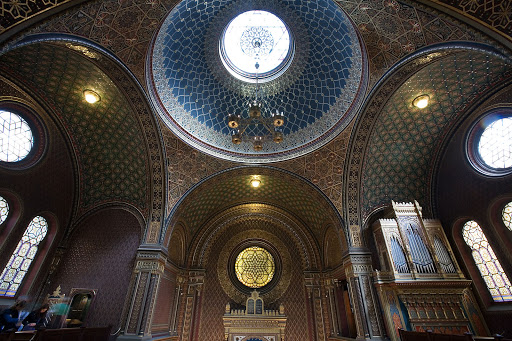
Another day, we visited the Jewish Quarter and all the Jewish sites there. By far the best was the Spanish Synagogue — very Islamic in style, except for the 6 pointed star everywhere. Every square inch of wall space covered in red, green and gold ornamentation. Ornate columns and simple striking stained glass. Unfortunately no photos allowed. Here are some images from the web:
Imagine being surrounded by:


and looking up

is no less gorgeous
You might think that the remaining synagogues were a disappointment, and they were quite missable. The Old Jewish Cemetery however, was a beautiful, peaceful setting surrounded by high walls and shaded by trees losing their leaves. Imagine your self in a wood, surrounded by old gravestones falling over each other.


Another day we visited the Mucha Museum enjoying the work of the Art Nouveau painter and decorative artist. Most of it commercial – posters for actress Sarah Bernhardt, the lottery supporting teaching of the Czech language, and even JOB cigarettes:


And now a word from our sponsor: Park Inn by Radisson. You can enter a weekly drawing to win a 7 day stay at a Park Inn, and two weekly prizes ofan iPad and a £250 Radisson gift voucher, and a grand prize of a 7 day stay in a choice of 3 Park Inns. To win
1. Play 4 Park Inn and try to get “4 in a row.” (you must be over 18 and a resident of the UK, Austria, Germany or Switzerland)
2. Whether you win or lose, you can enter your email for a chance to win. Each time you play, you can enter. (you must be over 18 and a resident of the UK, Austria, Germany or Switzerland) Good luck.

For the Fallen–Laurence Binyon
For The Fallen
Laurence Binyon
With proud thanksgiving, a mother for her children,
England mourns for her dead across the sea.
Flesh of her flesh they were, spirit of her spirit,
Fallen in the cause of the free.Solemn the drums thrill; Death august and royal
Sings sorrow up into immortal spheres,
There is music in the midst of desolation
And a glory that shines upon our tears.They went with songs to the battle, they were young,
Straight of limb, true of eye, steady and aglow.
They were staunch to the end against odds uncounted;
They fell with their faces to the foe.They shall grow not old, as we that are left grow old:
Age shall not weary them, nor the years contemn.
At the going down of the sun and in the morning
We will remember them.They mingle not with their laughing comrades again;
They sit no more at familiar tables of home;
They have no lot in our labour of the day-time;
They sleep beyond England’s foam.But where our desires are and our hopes profound,
Felt as a well-spring that is hidden from sight,
To the innermost heart of their own land they are known
As the stars are known to the Night;As the stars that shall be bright when we are dust,
Moving in marches upon the heavenly plain;
As the stars that are starry in the time of our darkness,
To the end, to the end, they remain.
Laurence Binyon, 1869-1943, is mainly known for the fourth stanza of this poem, engraved in graveyards throughout England.
They shall grow not old, as we that are left grow old:
Age shall not weary them, nor the years contemn.
At the going down of the sun and in the morning
We will remember them.
Why? Comparing this stanza with the rest can teach us much about good writing–look at its simplicity, its repetition, the parallelism, (age shall not weary them, nor the years contemn/at the going down of the son and in the morning) and the simplicity of the vocabulary.
The rest does not read so easily, it does not so easily cross the word/understanding/emotion barrier.
Why Should I Doubt the Justice of God?
Total Forgiveness
Here’s one of my favourite stories. The novelist Nathaniel Hawthorne’s daughter Una is sick and is expected to die that night. He paces near her bed as her fever climbs, and she grows weaker and weaker. She is the brightest, his dearest child, who most resembles him. She CANNOT die.
In the middle of the night, he says to himself, “Why should I doubt the goodness of God?” He relaxes. He breathes deeply. He leaves Una and her fate in the hands of a good God.
And goes to sleep.
His wife Sophia related that at that moment Una’s fever began to subside. She recovered.
Why should I doubt the goodness of God? Hawthorne asked
And why should I doubt the justice of God? I ask.
* * *
I’ve waged a spiritual battle this year, with an opponent who like Antaeus no sooner hit the ground than he rose again, invigorated!
It was the battle of forgiveness. Against someone who destroyed an important friendship to me by misrepresentation, slander and lies. Who with similar lies damaged– and then took over!!– a ministry I was involved in, and was gifted in. (I don’t mean to dramatize things; I have been a Christian for 21 years, and these petty intrigues and scrabbles for small prizes are par for the course. Because Christians are in the already/ not yet stages of becoming a New Creation).
And I need to let it go. And I have done so. Many times. And then the sense of injured pride comes back. And outrage–because, again as happens among Christians, the person involved greets everyone with an outsized smile, and is considered a good Christian. I know this person lied about me, as they do–but no one else really does. And it would take too much emotional energy, and would be beneath me to tell.
So that’s the hardest part of letting things go. That no one will know about these behind-the-scenes manoeuvring and slander and lies. Except me and the individual involved.
And God.
And God.
* * *
Jesus tells us that one day, everything hidden will be revealed, and what we have whispered in secret will be shouted from the rooftops.
With today’s internet culture, more and more people are “outed” in this life-time.
But of course, we all bank on it being much later. If not, who would lie to or slander another?
So that is what I need to do: Just leave things to the justice of God. And leave it to him when what is hidden shall be revealed. In this act, or the last act.
(That it might be in this act would not surprise me. Jung, in Memories, Dreams and Reflections, talks about the weight of hidden guilt, that eventually drives people–and even animals–from the one who has a guilty conscience and lives in fear of discovery or “outing”.)
That everyone sows what they reap is a law of life. It is an inexorable law of life. That is why one need never doubt the justice of God. Some people, like the pastors caught out in sexual or financial wrong-doing reap what they have sown in mortifying ways right here.
But others do bear the burden of not being what they seem, of being afraid of being caught out, of the slow and secret corruption of the character which sin brings, of being cut off from the joy and peace of God, and the overflow of the Holy Spirit because of their sin.
As Hawthorne shows in his brilliant The Scarlet Letter, secret sin is also a burden. You know you are not what people think you are. So you are condemned to act a role, pretending, pretending, always in fear, “honouring God with your lips, while your heart is far from Him.” WHAT a waste of a life!
* * *
The Alpha and the Omega. The word which was from the beginning and will be in the end. Will alone endure in the end. The words of Jesus. When I let Jesus have the last word in any of the mental essays I write, or the mental debates I have with myself, I feel more convinced that I might be on the right track.
However, early this year, I became convinced that cutting the chains of “You Owe Me,” and “I want to see Justice Done” that bound me to these people, (and there were 3 involved because of course seeds of bitterness defile many.(Heb 12:15)) was of crucial importance to my own creativity.
What Jesus says wrings the soul. It gets you. It is “living and active. Sharper than any double-edged sword, it penetrates even to dividing soul and spirit, joints and marrow; it judges the thoughts and attitudes of the heart.” (Heb 4:12) Not a very comfortable sword, that one.
* * *
Look at the extreme words he speaks on dealing with enemies.
Love your enemies
, do good to those who hate you,
bless those who curse you,
pray for those who mistreat you. (Luke 6:28)
It’s almost the only way out of the maze, isn’t it? And it hurts like hell. Doing good to the undeserving. Blessing those you wish you ill. Praying for blessing for those who have injured you.
It just smacks of the nature of God, doesn’t it? Who cannot help but do good. Cannot help but bless. Cannot help but pour goodness because He IS goodness. As Jesus says, If we do these things, our reward will be great, and we will be sons of the Most High, because he is kind to the ungrateful and wicked. True sons, in the Father’s house, partaking of the abundance of his household, drinking from his streams of rejoicing, not prodigal sons, who sons though they may be, are eating the food of pigs and are hungry and thirsty through their own bad choices.
* * *
When forgiveness seems like the other side of a bank, and between you and total forgiveness rushes the river of anger and the craving for justice here, there are bridges.
One is just this. Force yourself to do good to the enemy. Pray for blessing for those who hate you. If your heart cannot just stretch to asking for full abundant blessing for your enemies (and to be honest, I haven’t reached there) then ask, as I do, that they may be spiritually blessed and do great things for Christ’s Kingdom, that most dear, invisible place.
And maybe as one’s heart changes, one can pray more generously.
* * *
What I need to forgive is GRACE. Grace to provide a bridge between my wounded heart and the other side of the river which is the land of full, generous forgiveness, which is how God forgives us, because that is his nature. He cannot help but do it.
Grace, honey to heal the wounded heart. Grace to get us across the river of the things we cannot do in our own strength.
The Cross provided a bridge between God and man. And we need the power of the Cross, the Holy Spirit, and massive grace to provide a bridge from where we stand shivering in our limitedness and the land of joy and abundance where one forgives one’s enemies, and is forgiven by an immense God.
You forgive me fully and easily, God. Give me that magnanimous spirit to forgive those who have injured me. For my own sake. And yours.
* * *
Parenting: Rowing in the middle of a stormy sea
Parenting: Rowing in the Middle of a Stormy Sea
A bit dramatic? Nah, I didn’t say: Cast adrift without oars or Mars Bars in the middle of a dark, stormy sea. Which is what parenting teenagers feels like.
I grew up in a boarding school where I did not see my parents from March 1 to November 30th. So, I managed my own time, made my own decisions, my own mistakes, and took the consequences. As I have done ever since school.
So I don’t really have much precedent for parenting someone through a year of important exams, which is also the year in which they decide to have fun. And more fun. Actually, truth be told, I don’t particularly care about the examination results, which my daughter divines. I am more concerned with the impact on her self-esteem, and of course, on university admissions, because I take the view that if you have to go to university, you might as well go to a good one.
So now, I am truly middle-aged, truly a parent. I remember refusing to study hard for my first public exams, saying that the results were a lottery. I feel so old when I advise my kids to study for anything other than the joy of it. And there are A level choices. Should they do made for the joy the subject gives you, or for uni/career? Again, I only chose subjects for the joy they gave me–but now I am a parent. Sigh.
So, in fact all I can do is pray for wisdom. Which is a very good thing to pray for.
Oh, and massive aerial support.
And slowing down. Listening. Looking. Basic relational skills, and not easy ones!
Sign on Irene’s Door Tonight
"My Grandmothers and I"– the charming memoir of Diana Holman-Hunt
Diana Holman-Hunt’s “My grandmothers and I” is a unique and thoroughly enjoyable memoir.
As her name suggests, she is the grand-daughter of William Holman-Hunt who has given us iconic and beloved images like Light of the World. She was also, on her mother’s side, the great-niece of Millais.

Nothing guarantees happiness, of course, not even the most exalted Pre-Raphaelite lineage.
Diana’s father is young, adolescent and absent, in India. She is farmed out between two families–her very wealthy, self-absorbed, coddled, absent-minded maternal grandmother who lived a life of Edwardian privilege in what sounds like the most amazing, romantic and dreamy country house, and her equally wealthy but psychotically stingy paternal grandmother, Mrs. Holman-Hunt.
Mrs Holman-Hunt was a character. She was the painter’s second wife, and bitterly jealous of his first. When things are demanded of her, survival money for instance, she gets tearful thinking of her husband cavorting in heaven with her sister, who again got him first!! Her life is dominated by clever and ingenious shrifts to save money.
Mrs. Holman-Hunt suffers from the mental illness of extreme parsimony, which particularly inflicts the old. (This is perhaps not a well-recognized or diagnosed mental illness, but it should be!!). Her house is full of priceless paintings and precious treasures, all unguarded. Meanwhile, she shepherds her considerable wealth, crying if Diana requires pocket money from her.
Diana invents a style of her own in narrating this charming memoir. First person, present-tense, novelistic techniques (techniques which are commonplace in our generation, of course.)
It reads well, is absolutely winsome and charming, partly because she narrates her poor little rich girl story dispassionately, without self-pity but which much humour.
Visitors on Horseback
Roy and girls back from spending a day with their Uncle Jeph in London. Jeph and his wife Kaaren Mathias are missionary doctors in India; their 4 kids are along for the ride.
Jeph informs us that he is going to visit us again in 2012. By way of Central Asia, and on horseback. They are against large carbon footprints and unnecessary fossil fuel consumption.
Is being eccentric a genetic trait of Mathiases? Roy now wonders.
- « Previous Page
- 1
- …
- 73
- 74
- 75
- 76
- 77
- …
- 121
- Next Page »