Mark 2:17 On hearing this, Jesus said to them, “It is not the healthy who need a doctor, but the sick. I have not come to call the righteous, but sinners”.
Hat-tip, Stuart at echurchblog
Share to site of your choice … Wikio
Anita Mathias: Dreaming Beneath the Spires
Anita Mathias's Blog on Faith and Art

Mark 2:17 On hearing this, Jesus said to them, “It is not the healthy who need a doctor, but the sick. I have not come to call the righteous, but sinners”.
Hat-tip, Stuart at echurchblog
Share to site of your choice … Wikio


Guest post by Roy Mathias
Perhaps in Lent I should not be writing about the different ways food can make us feel good. So let me start with
Fasting. It can make you feel terrific after a couple of days, but I’m sure can have too much of good thing. Fasting is also the body’s natural response to some illnesses.
Comfort food. This is usually a childhood favourite, warm, hearty, rich, simple, and usually inexpensive; spaghetti and meatballs, Irish stew, fish and chips, pizza (my favourite), chicken tikka masala, bangers and mash, or a full English breakfast, followed apple crumble topped with ice cream if more comfort is needed .
Organic food. Of course, for most of human history,all food was of necessity organic. The industrial revolution brought chemical fertilisers and pesticides and greatly increased harvests. Organic agriculture ha recently become fashionable, but Sir Albert Howard, writing in the 1940, based on experiments started in 1910 says
“This law is true for soil, plant, animal, and man: the health of these four is one connected chain. Any weakness or defect in the health of any earlier link in the chain is carried on to the next and succeeding links, until it reaches the last, namely, man. The widespread vegetable and animal pests and diseases, which are such a bane to modern agriculture, are evidence of a great failure of health in the second (plant) and third (animal) links of the chain. The impaired health of human populations (the fourth link) in modern civilised countries is a consequence of this failure in the second and third links. This general failure in the last three links is to be attributed to failure in the first link, the soil: the undernourishment of the soil is at the root of all.”
In “Farming and Gardening for Health or Disease” he presents the remarkable example of his uninoculated oxen, fed purely organic high quality feed living on his organic farm in Pusa, Bihar (India), resisting resisting infection with foot-and-mouth disease from the cattle in neighbouring farms with which they mingled.
Surely eating organic makes us feel better?
Home grown. Our first home grown tomato of the season is ceremonially quartered and shared by the family. The taste is nothing special, but there’s pride and pleasure in the plucking.
Fair trade. Buying and eating fair trade makes us feel good as the pounds we are spend are doing good to a few farmers and are not encouraging ruthless bottom-line economics. COOP, established by the Rochdale Pioneers in 1844 (based on the Rochdale Principles that are used in different forms by co-operatives worldwide), is well known for its ethical trading and leadership in fairtrade. In a major initiative they supported over 10,000 smallholder tea farmers organise into co-operatives, and so get fair trade status and power to negotiate higher prices. Here’s a picture of a Kenyan tea plantation where some of the COOP tea comes from. In fact, you can join the revolution that was started over 150 years ago, and help out your local area and further afield.

Nothing stays constant, not even words. Their means slips, slides, changes.
In church, children sing, “Our God is an awesome God.” Awesome now means an all-round cool guy, a marvellous person. It used to mean that which inspires awe and reverence.
Our semi-slang term “cool,” a few decades old, borrows meaning from the French sang-froid,, literally cold-blood, or calm and composure.
“Neat” no longer means tidy but cool.
“Nice” is probably the one word which has evolved the most. It meant “foolish, stupid, senseless,” in the late 13 century derived from the Latin nescius “ignorant,” from ne- “not” + stem of scire “to know.” The sense development has been extraordinary, even for an adjective moving from “timid” (pre-1300); to “fussy, fastidious” (late 14c.); to “dainty, delicate” (c.1400); to “precise, careful” (1500s, preserved in such terms as a nice distinction and nice and early) to “agreeable, delightful” (1769); to “kind, thoughtful” (1830). By 1926, it was pronounced by Fowler to be “too great a favourite with the ladies, who have charmed out of it all its individuality and converted it into a mere diffuser of vague and mild agreeableness.”
“I am sure,” cried Catherine, “I did not mean to say anything wrong; but it is a nice book, and why should I not call it so?” “Very true,” said Henry, “and this is a very nice day, and we are taking a very nice walk; and you are two very nice young ladies. Oh! It is a very nice word indeed! It does for everything.” [Jane Austen, “Northanger Abbey”]
Sometimes, the evolution of language makes it hard for us to read a piece as the author intended it. W.B. Yeats in his great poem “Lapis Lazuli” writes
All perform their tragic play,
There struts Hamlet, there is Lear,
That’s Ophelia, that Cordelia;
Yet they, should the last scene be there,
The great stage curtain about to drop,
If worthy their prominent part in the play,
Do not break up their lines to weep.
They know that Hamlet and Lear are gay;
Gaiety transfiguring all that dread.
Yeats meant gallantly and inexorably cheerful when he wrote “gay.” Today, the words would be read in a very different sense.
Nowadays much of the evolution of English is in the direction of the watering down of language. People use the noun “epic” as an adjective–“an epic fail,” and words like immense or massive, when they mean “not too bad.” This is now even apparent in Britain where understatement has traditionally been the norm, and people describe their well-being by the phrase, “not too bad,” whether they have just won the lottery, or lost their wallet.
The exhibition, Evolving English: One Language, Many Voices (www.bl.uk/evolvingenglish) is now on at the British Library but only until April 3, 2011. (Free)
Experience some of it without leaving your computer. Try the Quiz http://www.bl.uk/evolvingenglish/quiz.html, (I got 6/6 on the medium level, and 5/6 on the egghead level.)
Record your voice to add to the collection of English being gathered from across the globe. (http://www.bl.uk/evolvingeenglish/maplisten.html).
Listen to English as it is spoken around the world.
Tweet your comments, or quiz results, using #evolvingenglish (link the #tag to http://bit.ly/dmIoPm)
Enjoy!
Click button to share on Facebook, Twitter, Digg, Delicious, Reddit … Wikio

![]() |
| Christopher Marlowe |
We saw the Creation Theatre’s production of Marlowe’s Dr. Faustus at Blackwell’s on Friday. Amazing to watch it surrounded by books in the Norrington Room.
I was amazed to realize how much of that sheer poetry I remembered from my undergraduate days–I have only seen Faust once since then.
Mephistopheles was a low-key demon who plaintively explains
|
Why this is hell, nor am I out of it. |
|
|
Think’st thou that I who saw the face of God, |
75 |
|
And tasted the eternal joys of Heaven, |
|
|
Am not tormented with ten thousand hells, |
|
|
In being depriv’d of everlasting bliss? |
As a century later Milton’s Satan would say, “Which way I fly is Hell; myself am Hell…”
There was splendid poetry such as Faustus’s tribute to Helen of Troy
Was this the face that launch’d a thousand ships,
And burnt the topless towers of Ilium?
Sweet Helen, make me immortal with a kiss.
Her lips suck forth my soul: see where it flies!
Come, Helen, come, give me my soul again.
Here will I dwell, for heaven is in these lips,
And all is dross that is not Helena.
And then his anguished cries as the midnight nears,
O I’ll leap up to my God! Who pulls me down?
See, see where Christ’s blood streams in the firmament!
One drop would save my soul, half a drop: ah my Christ—
Ah, rend not my heart for naming of my Christ;
And the horror of eternity strikes him
O, if my soul must suffer for my sin,
Impose some end to my incessant pain;
Let Faustus live in hell a thousand years,
A hundred thousand, and at last be sav’d!
It was an amazing play, very dramatic, and played in an understated way.
On the face of it, Faustus made a sensible bargain. He did not believe in hell–or didn’t want to think of it–so for wealth, fame, success, sex, he bargains away his soul. Of course, as the hour of death neared, he had second thoughts….
Temptation was presented beautifully, with both the kindly and menacing angels speaking persuasively to Faustus’s shattered, tormented soul…
* * *
We had a fab and most stimulating weekend, though we were so shattered by Sunday that we did not go to church, which caused some guilt and sadness in me–not so much that I did not go to church, as because I did not take the girls, and that Roy would have profited, as would I.
Oh well, we had the plumber in during the morning for a leak, had a visitor whose visit spilled over the evening service, and felt so physically uncomfortable as I hadn’t exercised, that I chose the gym instead of church, and felt a whole lot better for it (probably).
When I am physically uncomfortable and haven’t exercised, I find it hard to pray. And a comfortable, well-exercised body does wonders for the soul.
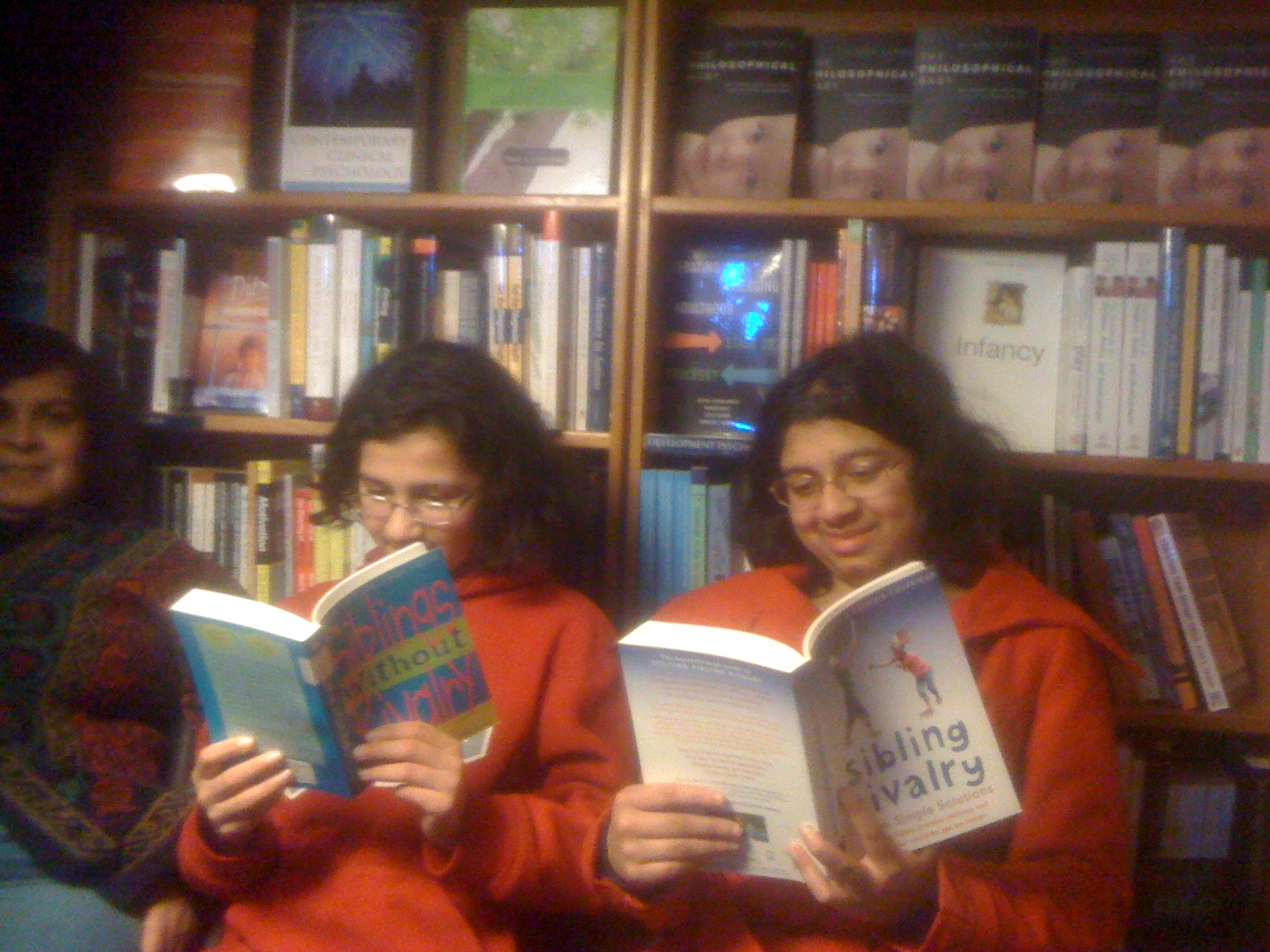
And here are Zoe and Irene in the Norrington Room at Blackwells. Each of them, true bookworms, grabbed a book in the interval. Note what they grabbed
![]() |
|
Romans Word Cloud
|
Click button to share on Facebook, Twitter, Digg, Delicious, Reddit … Wikio

![]() |
| Image–Neurocritic |
No, I am not giving up anything to make there be less of me. I have had such a fraught relationship with food for many years that I now think of food more in terms of health, and life-long dietary modification rather than a short-term abstinence (with a longer term rebound, perhaps).
No, I am going to give up a minor addiction. I have broken a serious coffee addiction, and milder addictions to chocolate and sugar, and thought I was addiction free, but no.
The mild addiction I have, which I hadn’t realized was one until recently, is a mild internet addiction.
Quaerentia, (which is the fanciful blog name of a priest called Mark Meynell who writes a very interesting literary/Christian blog) has an article called Webwise.
In it, he talks of
“ADDICTIONS – Surfing is addictive: like a infinitely-channelled TV where you keep flicking over in the vain hope that there may be something more interesting to look at. Furthermore, you can get sucked into thinking that just because information is available, it is necessarily important or useful. [NB Wurman’s Information Anxiety (Indianapolis: QUE 2001): I haven’t even mentioned the more obvious porn or gambling addictions that the internet can feed. I’m just talking about plain old surfing.”
I co-own a small publishing company with my husband, I am an active blogger on lightly monetized blogs, I keep in touch with many people. So, much that is interesting to me comes via the internet–business news, money earned, blog comments, emails.
And when there is nothing of interest–which is, of course, the case for more minutes than not?
I surf. Click to the New York Times for something fascinating, to the Guardian, to Christianity Today, to my own blog, to Lesley’s blog, other friends’ blogs, blogs on my blog roll, to Facebook, to my personal email, to our business email. A little internet fox’s trail. All this will yield something of interest probably. And then, when it is time to get up, exercise, do some housework, stretch and do some real writing, I can repeat the little fox’s trail. Find something else of interest or distraction. And then do a last email check before I get up. Some has come in, deal with it. And then….
I do most things with a timer on, count up or count down, and when I look at the timer, I am frequently baffled. Did I really need to read the New York Times article on the 87 year old billionaire planning his 125 birthday, or the global cash flow from immigrant women in domestic work abroad (half the GDP of the Philippines, incidentally, 35% of Tajikistan) or how men’s sexual prospects are increasing even as their job prospects diminish? http://www.slate.com/id/2286240// Apparently, I thought so at the time.
* * *
Now, if I am to be a writer as well as a blogger–and write more books rather than just blogs–I obviously need to break this time-consuming addiction.
And I now think that with soul perturbations as with bodily dysfunctions, much time can be saved by getting a correct diagnosis.
Jesus had one in John 6, Unless you eat my flesh, and drink my blood, you have no life in you. As the living Father sent me, and I live because of the Father, so he who feeds on me will live because of me.
So, this is temporary emptiness of soul. I am trying to fill it with blogs, and newspapers, and magazines, and news, and twitter and facebook checks and rubbish.
Will it work? Will it fill my soul? No. I hope not. It cannot.
* * *
So since the lights came on after reading Quaerentia’s article, I close my laptop when I notice I am aimlessly surfing, and pray for the Holy Spirit.
I often think of a lecture illustration I once saw. A woman filled a goblet with car keys, and house keys medals and coins and notes and necklaces and rings and bling and there was still room. Still emptiness.
She then poured water–and every atom of space was filled.
So that is what I need–not distraction, not surfing, but the water of the Holy Spirit filling my restless soul.
And fortunately, Jesus promises that his Father WILL give the Holy Spirit to anyone who asks for it.
And I know that is true because I have asked many times. And received.
As I will do again and again when I find myself aimlessly surfing on dry ground, with a laptop on my lap.
Share on your favourite sites… Wikio
1 My son, pay attention to my wisdom,
turn your ear to my words of insight,
2 that you may maintain discretion
and your lips may preserve knowledge.
3 For the lips of the adulterous woman drip honey,
and her speech is smoother than oil;
4 but in the end she is bitter as gall,
sharp as a double-edged sword.
5 Her feet go down to death;
her steps lead straight to the grave.
6 She gives no thought to the way of life;
her paths wander aimlessly, but she does not know it.
A woman or man who can seduce a partner from their first love is honeyed at first, but in the end there is bitterness in the new relationship. It starts sweetly, but ends bitterly–because of the guilt involved.
Adultery with its promise of newness is always tempting, but needs to be rigorously avoided–starting with the first temptations to it, which originate in the mind.
We can forgive, partly because we are transferring our case to a higher court. And the verdict is up to it.
The Father saw, the Father knows, the Father will deal with it as he thinks best. And that is enough.
This is Stage 1 of forgiveness. Stage 2 is to love your enemies. I haven’t reached there. And the parable which I am considering in my Blog Through the Bible Project merely considers Stage 1.
Share on your favourite site… Wikio