Anita Mathias: Dreaming Beneath the Spires

Anita Mathias's Blog on Faith and Art

  • Home
  • My Books
  • Meditations
  • Essays
  • Contact
  • About Me

When Great Poets Encounter the Angel of Writing

By Anita Mathias


I love “The Battle Hymn of the Republic,” by Julia Ward Howe. It has a mysterious perfection: the rhythm, the evocative words, the allusions, the beautiful language create a loveliness  greater than the sum of its parts.

Mine eyes have seen the glory of the coming of the Lord:

He is trampling out the vintage where the grapes of wrath are stored;

He hath loosed the fateful lightning of His terrible swift sword:

His truth is marching on.

Glory, glory, hallelujah!

His truth is marching on.


I have seen Him in the watch-fires of a hundred circling camps,

They have builded Him an altar in the evening dews and damps;

I can read His righteous sentence by the dim and flaring lamps:

His day is marching on.

(Chorus)

I have read a fiery gospel writ in burnished rows of steel:

“As ye deal with my contemners, so with you my grace shall deal;

Let the Hero, born of woman, crush the serpent with his heel,

Since God is marching on.”

(Chorus)

He has sounded forth the trumpet that shall never call retreat;

He is sifting out the hearts of men before His judgment-seat:

Oh, be swift, my soul, to answer Him! Be jubilant, my feet!

Our God is marching on.

(Chorus)

 In the beauty of the lilies, Christ was born across the sea,

With a glory in His bosom that transfigures you and me:

As He died to make men holy, let us die to make men free,

While God is marching on.

(Chorus)

He is coming like the glory of the morning on the wave,

He is Wisdom to the mighty, He is Succour to the brave,

So the world shall be His footstool, and the soul of Time His slave,

Our God is marching on.

(Chorus)

On the night of November 18, 1861, Julia Ward Howe awoke with the words of the song in her mind and in near darkness wrote the verses to the “Battle Hymn of the Republic.”

Of the writing of the lyrics, Howe remembers, “I went to bed that night as usual, and slept, according to my wont, quite soundly. I awoke in the gray of the morning twilight; and as I lay waiting for the dawn, the long lines of the desired poem began to twine themselves in my mind. Having thought out all the stanzas, I said to myself, ‘I must get up and write these verses down, lest I fall asleep again and forget them.’ So, with a sudden effort, I sprang out of bed, and found in the dimness an old stump of a pen which I remembered to have used the day before. I scrawled the verses almost without looking at the paper.”

                                                      * * * 

Wow! To whom are these mysterious gifts of creativity handed out?

Generally to those who have long trained themselves waiting for the angel. “If the angel comes, it will be because you have wooed him by your grim resolve to be always a beginner,” Rainer Maria Rilke muses. Rilke suffered for most of his life from torturing writers’ block. Beauty, images, art, ideas, poetry filled his mind; he was, however, unable to express them in poetry.

Rilke said that as he was walking, depressed, by the cliffs near Duino Castle, he heard a voice call out to him, “Wer, wenn ich schriee, hörte mich denn aus der Engel Ordnungen?” which became his famous Duino Elegy,

Who, if I cried out, would hear me among the angels’ hierarchies?

And even if one of them pressed me suddenly against his heart:
I would be consumed in that overwhelming existence.

His writers’ block was broken, and The Duino Elegies flowed forth in a torrent.

* * *

Milton claimed that he was visited nightly by an angel or muse who dictated cantos of Paradise Lost to him. In the morning, his daughters found the blind poet, already up, neatly dressed, and waiting to be “milked” of his verses, which he dictated to them.

Milton however, at the age of 14, had decided to become one of the great poets in English. His goal: “To write something which the world would not willingly let die.” He spent his youth in arduous preparation, so much so that by the time he began writing Paradise Lost at the age of 50, he was blind (the result of the years from his early teens spent reading late into the night by candlelight); had an brain incomparably stocked with poetry and learning, but had written nothing substantial.

But the angel came, and he did indeed write something that the world would not willingly let die.

My father had memorized the opening of Paradise Lost, and I remember the opening sentence with a thrill of pleasure. It’s so beautiful, so majestic, that reading it now, after some years, I almost cry with pleasure,

Of Man’s first disobedience, and the fruit

    Of that forbidden tree whose mortal taste

    Brought death into the world and all our woe,

    With loss of Eden, till one greater Man

    Restore us and regain the blissful seat,

    Sing, Heav’nly Muse, that on the secret top

    Of Oreb, or of Sinai, didst inspire

    That shepherd who first taught the chosen seed

    In the beginning how the heav’ns and earth

    Rose out of Chaos; or if Sion hill

   Delight thee more, and Siloa’s brook that flow’d

   Fast by the oracle of God, I thence

   Invoke thy aid to my advent’rous song,

   That with no middle flight intends to soar

   Above th’ Aonian mount, while it pursues

   Things unattempted yet in prose or rhyme.

   And chiefly thou, O Spirit, that dost prefer

    Before all temples th’ upright heart and pure,

  Instruct me, for thou know’st; thou from the first

  Wast present, and, with mighty wings outspread,

   Dove-like sat’st brooding on the vast Abyss

   And mad’st it pregnant: what in me is dark

   Illumine, what is low raise and support,

    That to the highth of this great argument

   I may assert Eternal Providence

    And justify the ways of God to men.

Wow! What a long amazing sentence!

Paradise Lost comes, it comes as if dictated by an angel, but it comes to the blind poet who had spent his life preparing to write it. The Duino  Elegies were “overheard” by the poet who also spent a life of sacrifice in preparation.

Poetic inspiration comes suddenly, as if the unconsciously suddenly ripens, to those who had laboured long  and hard, for much of their lives to receive it.

* * *

In contrast is William Blake, an untaught visionary poet who was more in touch with Heaven than with our world.  At the age of four, the young artist “saw God” when God “put his head to the window.”

At the age of eight or ten in Peckham, Blake claimed to have seen “a tree filled with angels, bright angelic wings bespangling every bough like stars.”

Do I believe him?  Actually, yes!

“I know that our deceased friends are more really with us than when they were apparent to our mortal part. Thirteen years ago I

lost a brother, and with his spirit I converse daily and hourly in the spirit, and see him in my remembrance, in the region of my imagination. I hear his advice, and even now write from his dictate,” Blake wrote.

Blake continues, “Felpham is a sweet place for Study, because it

is more spiritual than London. Heaven opens here on all sides

her golden Gates; her windows are not obstructed by vapours;

voices of Celestial inhabitants are more distinctly heard, &  their forms more distinctly seen.”

It was while he lived in Felpham, Sussex, that Blake wrote
the perfect Jerusalem.


Filed Under: In which I play in the fields of poetry

In which God forgives us, we forgive ourselves, and we are freed from paralysis

By Anita Mathias


jesus paralytic 150x150 Jesus Heals Paralytic Man | Mark 2:1 12

 I am re-reading Mark. John’s my favourite gospel guy, followed by Luke, but the immediacy of Mark, our immediate immersion in a fast-moving scenario of accelerating success grabs me every time.
Jesus issues his great call to repent and believe the good news.
He heals most everyone, dramatically, and so “news about him spread quickly over the whole region of Galilee.” He became the Obama or Daniel Radcliffe of his day, “As a result, Jesus could no longer enter a town openly, but stayed outside in lonely places. Still, people came to him from everywhere.”
                                                      * * *
And then in Mark 2 1-12, so many gather to hear him preach the word that there was no room left, not even outside the door.
(I have just been to hear some amazing speakers and miracles workers, and I can testify there is the same spiritual hunger and over-crowding today.)
And though it seems unfair, the pushy, the hungry, the desperate are often rewarded. That’s one of Jesus’s puzzling sayings, “The Kingdom of Heaven has been forcefully advancing, and forceful men lay hold of it.” Matt 11:12.
So instead of being polite, waiting their turn, which surely seems to be the right thing to do, his friends cheekily dig though the roof, and lower him in.
And, remarkably, and encouragingly for all those who pray for their families, or do prayer ministry, Jesus heals him because of the faith of his friends.
And—whoa!!—what interesting words of healing
“Son, your sins are forgiven.”
And those words, the forgiveness of sins, heals the man’s paralysis.
                                                   * * *
A river is a consistent Biblical metaphor for God—leaping, rushing, dancing, forceful, iridescent, full of energy.
Never stagnant. Never “paralysed.”
Mental and emotional paralysis, or paralysis in any area of one’s life, does not comes from God, in my opinion. The first chapters of Genesis give us an insight into God’s nature—imaginative, fun, creative, thinking, making, shaping, active—then punctuating six days of activity with a day of complete rest, when “he rested from all this making.”
No paralysis there!!
                                                    * * *
When my daughter Zoe was born, I often wheeled her around in her stroller to put her to sleep. (We never let our children cry themselves to sleep—I considered that unthinkable—which, of course, meant hours of walking or driving or holding them to sleep, or sleeping with them. Or vice-versa. Very undisciplined.)
I had four major areas of need or “paralysis” which I used to ask for God’s help with as I pushed Zoe in her pram.
1)   My writing, in which I was paralysed and perfectionistic, and worked with much painful second-guessing and perfectionism, and without significant output.
2)   Housekeeping. My house was messy, and disorganized, and this upset me.
3)   I was a night owl, and so woke late, and this is not the most efficient thing.
4)   I was overweight.
                                                                                                                                       * * *
Over the last 18 years of following Christ with wobbles and falls backwards, I am glad to report that my writing is flowing freely. The house is no longer embarrassing. It’s not immaculate, but not messy either. We tidy every room at least once a week (well, Roy does.)
I don’t wake early, but not ridiculously late either.
But weight! Alas, I am at my heaviest ever. I am failing.
And I don’t believe God intends this paralysis or failure.
                                                * * *
And Jesus, mysteriously, heals the man’s physical paralysis, by forgiving his sin, and he walks.
Is this a key?  Repentance and receiving forgiveness to break paralysis in any area of our lives. Paralysis like Paul describes in Romans 7 when one knows and loves and desires what is good, but does not have the power to pursue it.
                                                 * * *
Obviously, being overweight is not a sin, any more than being paralysed is.
But, in my case, sin has led to it.
1) Using food as an all-purpose anaesthetic, when sad, angry, stressed, depressed, low-energy, listless, bored, or fed-up.
2) Eating because I enjoyed the taste of good food, even when not hungry.  Eating foods not good for my body.
3) Putting off exercise because reading and writing were more interesting.
And, so I spent some time today repenting of these weaknesses, and asking for the blood of Christ to wash these sins away, and to filled again with the spirit of Jesus, so that I remember to turn to him instead of chocolate when sad, stressed, angry, bored etc.
That I remember to respect my body and not give it excessive yummy stuff that is not good for it.
And the empowering of the spirit that I will make myself exercise even when the laptop and books are more tempting.
Jesus, heal this paralysis.
                                                      * * *
I am reading The Anointing by R.T. Kendall. The Anointing (among other things) is a divine enablement which makes the difficult easy. Kendall stresses the need of getting a fresh anointing every day, so that we do not continue using powerful spiritual gifts (preaching, let’s say, or writing) in our own strength.
I think it’s the same when breaking free from an area of paralysis in one’s life. You repent; God forgives you; gives you his Holy Spirit on request, (Luke 11:13). But you are not yet home free. You need to continue asking for fresh grace, fresh strength and enablement.
I have read testimonies of alcoholics and drug addicts or heavy smokers who have been instantaneously healed from their addiction. I myself have experienced a grace-enabled kicking of a coffee addiction.
Perhaps healing from something which has put tentacles into the very way you function, such as emotional eating or using food as an all-purpose anaesthetic can come all at once.
Or perhaps, step by step as the powerful waterfall of the Holy Spirit and God’s grace breaks down the last filaments of bad habits. Perhaps, it’s a daily process—just as acquiring knowledge or physical fitness or a godly character is a long process. You sometimes tire, sometimes rest, but you keep rowing.
But slow, or fast, Lord, heal me. Let there be no little strongholds or holdouts to your full reign in me, body, mind, soul and spirit!

Filed Under: In which I explore Living as a Christian, Mark

In which I am surprised by Christopher Columbus

By Anita Mathias

“Christopher Columbus,” Jo March of Little Women cried whenever she was astonished.
Well, he’s surprised me.
                                             * * *
I first pondered Columbus in 1992, five hundred years after he sailed the ocean blue. Visited a few quincentennial exhibitions, especially one in Minneapolis, which was chiefly focused on the noxious effects of the Columbian Exchange particularly on native peoples.
More recently, in reading Mark Batterson’s Wild Goose Chase, I learned that Columbus was a man of faith.
Most experts believed that finding a westward route to the Indies was impossible. But Columbus challenged the assumption.
He later said that it wasn’t intelligence, mathematics or maps that made his voyage a success. He credited the Holy Spirit with the idea.
Columbus wrote, “It was the Lord who put it in my mind, (I could feel his hand upon me) the fact that it would be possible to sail from here to the Indies. All who heard of my project rejected it with laughter, ridiculing me. There is no question that the inspiration was from the Holy Spirit, because He comforted me with rays of marvellous inspiration from the Holy Scriptures.” (Peter Marshall and David Manuel, The Light and the Glory).
And Columbus sailed with a crew not one of whom had ever been more than three hundred miles offshore.
* * * 
Columbus was honoured by King Ferdinand which aroused some jealousy. His rivals murmured that anyone could have sailed there, and discovered a New World.
Columbus called for some hard-boiled eggs. “Can you make them stand up on end?” he asked his critics at court.
“Of course,” they said, but failed.
He slammed an egg down on the table, and it stood up on its flat, broken end.
“We could do that,” the nobles muttered.
“But you didn’t think of it,” said Columbus. You could have taken my route—but you didn’t think of it. I “thought” of it first.”
* * * 
When I wander around modern art galleries, I frequently hear one matron say to another, “My child could have done that.”
Ah, but did they think of it?
Genius thinks of what no one else has before, and makes it appear simple.
And the Holy Spirit gives us ideas no one has had before, and makes them appear elegant and natural.

Filed Under: random

Three Brilliant Insights on Happiness from Gretchen Rubin’s The Happiness Project

By Anita Mathias


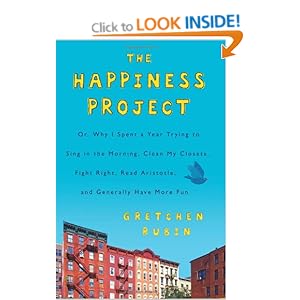
The Happiness Project: Why I Spent a Year Trying to Sing in the Morning, Clean My Closets, Fight Right, Read Aristotle, and Generally Have More Fun
Well, I am only on month three of Gretchen Rubin’s extensively researched The Happiness Project, and love many of her insights.
Here are three which I particularly enjoyed:
1) W. B. Yeats writes, “Happiness is neither virtue, nor pleasure, nor this thing, nor that, but simply growth. We are happy when we are growing.
She goes on to point out that the process of striving after goals—growth—brings more happiness than achieving them.
As we become wealthier or successful, we become used to new comforts, privileges, achievements and respect. It’s “the hedonic treadmill.” You get used to what you have, and want more.
An “atmosphere of growth” on the other hand, provides a more abiding satisfaction. “Tending your garden will give you fresh joy and surprise every spring.” Like the process of writing and thinking, and striving towards excellence in one’s creative work.
·      * *
In my daughters’ school, Oxford High School, they are given only one yardstick for which subjects to choose—what most interests them, what they love best. This can be annoying for parents who want them to pick subjects which will be of the most use to them.
Gretchen shows us why the school’s policy is sensible.  As Malcolm Gladwell points out in Outliers, the most important element in mastery is the 10,000 hours of practice.


So, to quote Rubin, “Enthusiasm is more important to mastery than innate ability, because the single most important element in developing an expertise is your willingness to practice. Therefore, you are better off pursuing a profession that comes easily and that you love, because that’s where you’ll be more eager to practice. Passion is a critical factor in professional success. People who love their work bring an intensity and enthusiasm that’s impossible to match through sheer diligence.”
3) And then, there’s this paragraph which is particularly brilliant and useful. And interesting. Not sure I knew it.
She writes: “I’d always followed the adage, “Don’t let the sun do down on your anger,” which meant, in practical terms, that I scrupulously aired every annoyance as soon as possible to make sure I had my chance to vent my bad feelings before bedtime.
I was surprised to learn from my research, however that the well-known notion of anger catharsis is poppycock. There is no evidence for the belief that “letting off steam” is healthy or constructive. In fact, studies show that aggressively expressing anger doesn’t relieve anger, but amplifies it. On the other hand, not expressing anger often allows it to disappear without leaving ugly traces.”
It’s a very interesting book—well-researched, compendious, but written in an very easy, readable style.


Filed Under: In which I pursue happiness and the bluebird of joy

In Which I am a Single Issue Voter

By Anita Mathias

File:UK-US flag.png

I was brought up Catholic, but made a real commitment to Christ when I was 17. Since then, as a Christian woman, I have been a citizen of three countries—of India, of the US (a citizenship I retain) and of the United Kingdom—we were sworn in last month, and are now dual citizens of the US and the UK. That’s appropriate—my thinking is mid-Atlantic; the English I write is mid-Atlantic; and the English I speak, oops, is a melange of words, usages, expressions and pronunciations I’ve picked up from both nations I retain citizenship of.
This is pathetically simplistic perhaps, but I have always supported political parties on one basis—and that is not gay rights or abortion rights.
The question I ask is: Whose policies will be best for the poor? The poor of their own nation, and the global poor, for as Christians, we do have to realize that we are on this earth for a few decades more at best, and then will, we hope, gain citizenship in heaven with those of every race, and tongue and people and language, and so must begin acting as citizens of that everlasting kingdom.
How have we treated the least of these?: That is the great question we will be asked on the last day (Matt 25:31-46).
And that should surely be a major issue as we gather to bestow earthly political power.
Politics, like sex or money, is, of course, an intensely personal matter. In England, in particular, it is impolite to mention them socially, leave alone in a blog!!
But, how about you? Are you a single-issue voter? Does your faith affect your voting practices? Should it?If so, what do you look for in a politician or political party?


Filed Under: random

“The Anointing,” Imitation and The Ridiculous

By Anita Mathias


I am really enjoying reading R. T. Kendall’s brilliant book, The Anointing.
He points out that Christian preachers attempt to imitate famous ones. But, he says, “when I try to imitate someone else, I never capture their real genius, but their eccentricity. It is a fact that what is most easily copied in any man or woman is their odd manner, even their weakness.”
He mentions the Professor of Preaching at Southwestern Baptist Theological Seminary in Forth Worth, Texas, who had an eccentric habit of cupping his left hand over his ear when he began to soar in his preaching. Young ministers all over Texas and Oklahoma cupped their ear with their left hand when they thought they were soaring on the wings of eloquence. They thought they had the anointing. One could always tell his students, Kendall says.
R.T. Kendall later asks one of the preacher’s colleagues why he did that. “Because he was slightly deaf. He did it to hear his own voice better.”
                                                          § § §
Kendall goes on to write, “When anybody begins to imitate another who happens to have a great anointing, the person will end up aping his eccentricity. Martyn Lloyd-Jones told me of a man in Wales who had the habit of shaking his head back to keep hair from falling over his eyes. Sure enough, there were young men all over Wales who would shake their heads as they preached! One was even bald-headed.”
                                                        § § §
I saw this recently. Heidi Baker has a highly original preaching style, original to the point of extreme eccentricity (see here). She bends sideways as she preaches, as if pushed, says things like Shika Baba or Shazaam. Apparently, she is being overwhelmed by the power of the Spirit (and the words are glossolalia or an African dialect).
Well, I would never second-guess the wonderful Heidi who I have deep respect and affection for. But at this Revival Alliance conference I went to last week at which famous charismatic leaders spoke (John Arnott, Bill Johnson, Randy Clark, Che Ahn etc.) I saw two women imitate that mannerism—the swaying sideways as if pushed by the spirit, the breaking into prayer and praise in the midst of preaching.
Most annoyingly, the adult child of one of the speakers did it during announcements. “Whoa,” she said, and bent sideways, as if overwhelmed by the Spirit, while making quite pedestrian announcements. Would the Spirit really manifest in the same way to all these women? Who knows?
                                                      * * *
I taught my children to pray at a time when my own life was very difficult. My husband was consumed by his mathematical research; we had babies; things were volatile. So, when I came to pray, I first sighed deeply, exhaling the sadness, the stress, the tiredness, and the helplessness.
And then when it was the turn of little Zoe and Irene to pray—they couldn’t have been more than 3 or 4—they would first sigh, deeply and exaggeratedly, and then pray.
They obviously thought that that was how one prayed—you sighed deeply, you exhaled!! You said, “Oh Lord,” in an exhalation of exhaustion!!
Well, perhaps we were being theologically correct. Romans 8: 26 In the same way, the Spirit helps us in our weakness. We do not know what we ought to pray for, but the Spirit himself intercedes for us with sighs and groans that words cannot express. 27 And he who searches our hearts knows the mind of the Spirit.
                                                      § § §
 I see that in the blogosphere. Ann Voskamp has a highly original style, with much contortion of grammar. Since she is an original, a stylist, an accomplished writer with the ear of a poet, her stylistic contortions are not jarring.
What is irritating is when bloggers who lack her stylistic flair imitate her ungrammatical contortions and her style. Since it doesn’t fit into the texture of their pieces, it merely seems odd.
There are lots of original bloggers—Sarah Bessey, let’s say or Rachel Held Evans. But sometimes, when I read through the blogs of those I follow on Facebook, I am amazed by how many are similar in style, subject matter and preoccupations.
Imitation brings quicker success because we are working in a popular vein. It however militates against long-term success because we never discover our unique voice, style and preoccupations.
                                                      § § §
I love this passage from Thomas Merton:
Many poets are not poets for the same reason that many religious men are not saints: they never succeed in being themselves. They never get around to being the particular poet or the particular monk they are intended to be by God. They never become the man or the artist who is called for by all the circumstances of their individual lives.

They waste their years in vain efforts to be some other poet, some other saint.  

 They wear out their bodies and minds in a hopeless endeavour to have somebody else’s experiences, or write somebody else’s poems, or possess somebody else’s spirituality. 
There can be an intense egoism in following everybody else.  People are in a hurry to magnify themselves by imitating what is popular—and too lazy to think of anything better.
Hurry ruins saints as well as artists.  They want quick success and they are in such haste to get it that they cannot take time to be true to themselves.
                         ( Thomas Merton, Integrity, New Seeds of Contemplation).


Filed Under: random

Mike Rizzo of IHOP (International House of Prayer), Kansas, guest-posts on Smuggling Eden into Marriages

By Anita Mathias


Mike Rizzo introduces Longing for Eden  


Over the last thirty plus years of pastoral ministry, I can’t remember a single instance of a husband and wife being in severe conflict (talking divorce) while at the same time being spiritually vibrant. The disconnect between husband and wife is always a manifestation of a “God disconnect.” In other words, every marriage problem is ultimately a God problem. 

Naturally, we will have minor differences to iron out, stemming from personality differences, cultural backgrounds, and personal preferences, etc… But if we have agreement on in our core values and vision, and consistent renewal in the Spirit, then our one flesh covenant union should never be broken.
My wife and I pray that “Longing for Eden” will renew a fresh vision in both singles, engaged, and married couples. The fourteen chapters are roughly divided into three parts: having a vision in marriage, the importance of healing the heart, and the eternal vision that should be in the crosshairs of every Christian. Please enjoy the excerpt below: Chapter Thirteen.
 “Partners in Longing”
Marriage is the most affirming relationship on the planet. Just to think that someone loves me to the extent that they want to spend the rest of their earthly life with me, is overwhelming. This is a glorious shadow, cast by the greatest affirmation of all. Jesus has chosen me to do the same, not only in this age but for all eternity.

The longing to be enjoyed by God is a chip implanted in every human soul. He already enjoys me; I need to learn how to live with this reality. It must go from head to heart in understanding. This is the longing that the devil exploits every which way he can to divert attention away from the Son of God. Even within Christian marriage we must be vigilant to keep Jesus as our primary passion. Like Joseph’s dream, all the sheaves must bow.  
Married life is good when we’re both sitting at the King’s table. Connecting with God’s enjoyment of us releases a joy into our friendship. Another foundational desire that we have is the longing to be fascinated.
“One thing have I desired of the LORD, that will I seek after; that I may dwell in the house of the LORD all the days of my life, to behold the beauty of the LORD, and to enquire in his temple.”  Psalms 27:4
My wife and I have prayed that our partnership would be a marriage of “one thing.” The beauty of the Lord is absolutely transforming. Even “seeing through a glass darkly” has made us different people. (1Cor.13:12) Over the course of his life King David studied the personality and emotions of God. This great warrior and worship leader was caught up with the beauty of God. He also knew the diabolical power of being caught up with the forbidden beauty of another man’s wife. Like Adam he ate of a forbidden fruit. Like that which they sought at Babel, David had already made a name for himself and he wielded that kingly power to meet his dark longings. That’s why the “one thing” must be the one thing. Dark fascination has the same bulls’ eye as godly fascination – the center of our hearts. Its power is derived from spiritual stagnation, boredom, and unbridled lust. A fascinated man does not need pornography; a fascinated woman doesn’t need to escape into romance novels.
If fascination came easy to the average believer, our churches could not contain the masses wanting to get in, as they recognized the abiding joy we manifested. As I look back over the landscape of battles I’ve fought in, one that comes to mind is depression. I’m not speaking of major depression (requiring medication) but of what is called “low grade depression.” Because the symptoms are considered mild, most people don’t seek help; they just plod on through it. That was me over a period of years. I remember looking forward to the end of the day so that I could escape into sleep.
I fought against hopelessness and low motivation. By God’s grace I was able to continue in my duties as husband, father, and pastor. But it was wearing me down. A major factor in the breakthrough I experienced was the revelation of two things: the beauty of God, and the promise of the age to come. Beyond some ethereal world, life after death became revealed to me as a continuation of partnering in ministry with Jesus. My hope-less became hope-full. These concepts made the trek from my head to the center of my heart. The enemy’s attack was fierce, trying to convince me that I would still be sad even in heaven! He’s quite brash isn’t he? Praise God, truth prevailed and the dark clouds parted. In the meantime, I “borrowed” from my wife’s joy.
God unveils his beauty to the hungry heart. His hiding of the deep things is for our protection and humility. The process of unveiling creates ownership on our part and rehabs our damaged emotions in the process. I focused more and more on the personality of God and meditated on portions of scripture that spoke of His attributes and revealed His glory. (E.G. Revelation, chapters 4 & 5, Ezekiel ch.1) The divine treasure chest is unlocked as we seek and search. When I’m filled to overflowing my marriage gets the spillover.  The more beautiful God looks to me, the more beautiful my wife looks to me.
God’s beauty is a powerful force that empowers the heart of a husband and wife to love one another. A spouse that strays into adultery has ceased to be fascinated not only with their marriage partner, but also with God. Think back to what originally attracted you to your spouse. You may or may not have known that it was the beauty of God reflected like light through a prism that fascinated your heart to want that “one” for life. The beauty you saw, the force that fascinated, was a longing being fulfilled. I encourage you to sign up again to be “partners in longing.”
“Longing for Eden: Embracing God’s vision in your marriage” by Mike Rizzo with Anne Rizzo, is a newly released inspirational book that will challenge couples and inspire singles, to more clearly see God’s intent for marriage. The authors write from thirty years of pastoral experience, much of which has been in the realm of marital and pre-marital counseling. Their passion is to see husbands and wives dwell together as “married disciples.” Small Group Study Guide (covers all 14 chapters) is included in the book. Over 170 questions, designed for individual couples or small groups to study together. Author info: http://mikerizzo.wordpress.com/ )


Mike Rizzo
Mike and Anne Rizzo
Mike and Anne say

Our current ministry assignment is two-fold: 1) To dedicate our lives to the prayer movement (at the International House of Prayer, Kansas City); to see kings and priests take their rightful place before the Throne in intercession. 2) To work with married and pre-marital couples; to see the prophetic picture of Christ and the church reflected in every marriage. 

Filed Under: random

In which Christ says, “Come, dance,” and this time, I hear The Lord of the Dance

By Anita Mathias


This may make some of you laugh, but all through my thirties, on New Year’s Day, and many, many times throughout the year, I used to pray, “Lord, by the end of the year, let me be twice as close to you as I am now.”
Oh gosh, was it my Catholic upbringing, bad counselling, or just native stupidity??  I was visualizing the Christian life as a ladder.
If I prayed more, read my Bible more, did the laundry more, served my family more, loved more, da-da-da, I would be closer to Jesus.
While all the while–I could cry to think of it–he stood there, arms open wide, saying, “Come, dance?”
And all I had to do to be closer to him was just step into the waltz, stand close, very close, and let him lead me, deeper and deeper into the dance.  Now faster and faster, now slow and intimate. Now into service, now into intimacy, and now, into rest. 


Filed Under: In which I explore Living as a Christian

  • « Previous Page
  • 1
  • …
  • 67
  • 68
  • 69
  • 70
  • 71
  • …
  • 279
  • Next Page »

Sign Up and Get a Free eBook!

Sign up to be emailed my blog posts (one a week) and get the ebook of "Holy Ground," my account of working with Mother Teresa.

Join 536 Other Readers

My Books

Rosaries, Reading, Secrets: A Catholic Childhood in India

Rosaries, Reading Secrets, B&N
USA

UK

Wandering Between Two Worlds: Essays on Faith and Art

Wandering Between Two Worlds
USA

UK

Francesco, Artist of Florence: The Man Who Gave Too Much

Francesco, Artist of Florence
US

UK

The Story of Dirk Willems

The Story of Dirk Willems
US

UK

My Latest Meditation

Anita Mathias: About Me

Anita Mathias

Read my blog on Facebook

Follow me on Twitter

Follow @anitamathias1

Recent Posts

  • At the Cross, God Forgives Us Completely
  • Using God’s Gift of Our Talents: A Path to Joy and Abundance
  • The Kingdom of God is Here Already, Yet Not Yet Here
  • All Those Who Exalt Themselves Will Be Humbled & the Humble Will Be Exalted
  • Christ’s Great Golden Triad to Guide Our Actions and Decisions
  • How Jesus Dealt With Hostility and Enemies
  • Do Not Be Afraid, but Do Be Prudent
  • For Scoundrels, Scallywags, and Rascals—Christ Came
  • How to Lead an Extremely Significant Life
  • Don’t Walk Away From Jesus, but if You Do, He Still Looks at You and Loves You
Premier Digital Awards 2015 - Finalist - Blogger of the year
Runner Up Christian Media Awards 2014 - Tweeter of the year

Categories

What I’m Reading


Wolf Hall
Hilary Mantel

Wolf Hall --  Amazon.com
Amazon.com

Amazon.co.uk

Silence and Honey Cakes:
The Wisdom Of The Desert
Rowan Williams

Silence and Honey Cakes --  Amazon.com
Amazon.com

Amazon.co.uk

The Long Loneliness:
The Autobiography of the Legendary Catholic Social Activist
Dorothy Day

The Long Loneliness --  Amazon.com
Amazon.com

Amazon.co.uk

Country Girl
Edna O'Brien

Country Girl  - Amazon.com
Amazon.com

Amazon.co.uk

Archive by month

My Latest Five Podcast Meditations

INSTAGRAM

anita.mathias

My memoir: Rosaries, Reading, Secrets https://amzn.to/42xgL9t
Oxford, England. Writer, memoirist, podcaster, blogger, Biblical meditation teacher, mum

Well, hello friends! Breaking radio silence to let Well, hello friends! Breaking radio silence to let you know that I have taped a meditation for you on Christ’s famous Parable of the Talents in Matthew 25. https://anitamathias.com/2025/11/05/using-gods-gift-of-our-talents-a-path-to-joy-and-abundance/
Here you are, click the play button in the blog post for a brief meditation, and some moments of peace, and, perhaps, inspiration in your day 🙂
Hi Friends, I have taped a meditation; do listen a Hi Friends, I have taped a meditation; do listen at this link: https://anitamathias.com/2025/04/08/the-kingdom-of-god-is-here-already-yet-not-yet-here-2/
It’s on the Kingdom of God, of which Christ so often spoke, which is here already—a mysterious, shimmering internal palace in which, in lightning flashes, we experience peace and joy, and yet, of course, not yet fully here. We sense the rainbowed presence of Christ in the song which pulses through creation. Christ strolls into our rooms with his wisdom and guidance, and things change. Our prayers are answered; we are healed; our hearts are strangely warmed. Sometimes.
And yet, we also experience evil within & all around us. Our own sin which can shatter our peace and the trajectory of our lives. And the sins of the world—its greed, dishonesty and environmental destruction.
But in this broken world, we still experience the glory of creation; “coincidences” which accelerate once we start praying, and shalom which envelops us like sudden sunshine. The portals into this Kingdom include repentance, gratitude, meditative breathing, and absolute surrender.
The Kingdom of God is here already. We can experience its beauty, peace and joy today through the presence of the Holy Spirit. But yet, since, in the Apostle Paul’s words, we do not struggle only “against flesh and blood, but against the rulers, against the unseen powers of this dark world and against the spiritual forces of evil,” its fullness still lingers…
Our daughter Zoe was ordained into the Church of E Our daughter Zoe was ordained into the Church of England in June. I have been on a social media break… but … better late than never. Enjoy!
First picture has my sister, Shalini, who kindly flew in from the US. Our lovely cousins Anthony and Sarah flank Zoe in the next picture.
The Bishop of London, Sarah Mullaly, ordained Zoe. You can see her praying that Zoe will be filled with the Holy Spirit!!
And here’s a meditation I’ve recorded, which you might enjoy. The link is also in my profile
https://anitamathias.com/2024/11/07/all-those-who-exalt-themselves-will-be-humbled-the-humble-will-be-exalted/
I have taped a meditation on Jesus statement in Ma I have taped a meditation on Jesus statement in Matthew 23, “For those who exalt themselves will be humbled, and those who humble themselves will be exalted.”
Do listen here. https://anitamathias.com/2024/11/07/all-those-who-exalt-themselves-will-be-humbled-the-humble-will-be-exalted/
Link also in bio.
And so, Jesus states a law of life. Those who broadcast their amazingness will be humbled, since God dislikes—scorns that, as much as people do.  For to trumpet our success, wealth, brilliance, giftedness or popularity is to get distracted from our life’s purpose into worthless activity. Those who love power, who are sure they know best, and who must be the best, will eventually be humbled by God and life. For their focus has shifted from loving God, doing good work, and being a blessing to their family, friends, and the world towards impressing others, being enviable, perhaps famous. These things are houses built on sand, which will crumble when hammered by the waves of old age, infirmity or adversity. 
God resists the proud, Scripture tells us—those who crave the admiration and power which is His alone. So how do we resist pride? We slow down, so that we realise (and repent) when sheer pride sparks our allergies to people, our enmities, our determination to have our own way, or our grandiose ego-driven goals, and ambitions. Once we stop chasing limelight, a great quietness steals over our lives. We no longer need the drug of continual achievement, or to share images of glittering travel, parties, prizes or friends. We just enjoy them quietly. My life is for itself & not for a spectacle, Emerson wrote. And, as Jesus advises, we quit sharp-elbowing ourselves to sit with the shiniest people, but are content to hang out with ordinary people; and then, as Jesus said, we will inevitably, eventually, be summoned higher to the sparkling conversation we craved. 
One day, every knee will bow before the gentle lamb who was slain, now seated on the throne. We will all be silent before him. Let us live gently then, our eyes on Christ, continually asking for his power, his Spirit, and his direction, moving, dancing, in the direction that we sense him move.
Link to new podcast in Bio https://anitamathias.co Link to new podcast in Bio https://anitamathias.com/2024/02/20/how-jesus-dealt-with-hostility-and-enemies/
3 days before his death, Jesus rampages through the commercialised temple, overturning the tables of moneychangers. Who gave you the authority to do these things? his outraged adversaries ask. And Jesus shows us how to answer hostile questions. Slow down. Breathe. Quick arrow prayers!
Your enemies have no power over your life that your Father has not permitted them. Ask your Father for wisdom, remembering: Questions do not need to be answered. Are these questioners worthy of the treasures of your heart? Or would that be feeding pearls to hungry pigs, who might instead devour you?
Questions can contain pitfalls, traps, nooses. Jesus directly answered just three of the 183 questions he was asked, refusing to answer some; answering others with a good question.
But how do we get the inner calm and wisdom to recognise
and sidestep entrapping questions? Long before the day of
testing, practice slow, easy breathing, and tune in to the frequency of the Father. There’s no record of Jesus running, rushing, getting stressed, or lacking peace. He never spoke on his own, he told us, without checking in with the Father. So, no foolish, ill-judged statements. Breathing in the wisdom of the Father beside and within him, he, unintimidated, traps the trappers.
Wisdom begins with training ourselves to slow down and ask
the Father for guidance. Then our calm minds, made perceptive, will help us recognise danger and trick questions, even those coated in flattery, and sidestep them or refuse to answer.
We practice tuning in to heavenly wisdom by practising–asking God questions, and then listening for his answers about the best way to do simple things…organise a home or write. Then, we build upwards, asking for wisdom in more complex things.
Listening for the voice of God before we speak, and asking for a filling of the Spirit, which Jesus calls streams of living water within us, will give us wisdom to know what to say, which, frequently, is nothing at all. It will quieten us with the silence of God, which sings through the world, through sun and stars, sky and flowers.
Especially for @ samheckt Some very imperfect pi Especially for @ samheckt 
Some very imperfect pictures of my labradoodle Merry, and golden retriever Pippi.
And since, I’m on social media, if you are the meditating type, here’s a scriptural meditation on not being afraid, while being prudent. https://anitamathias.com/2024/01/03/do-not-be-afraid-but-do-be-prudent/
A new podcast. Link in bio https://anitamathias.c A new podcast. Link in bio
https://anitamathias.com/2024/01/03/do-not-be-afraid-but-do-be-prudent/
Do Not Be Afraid, but Do Be Prudent
“Do not be afraid,” a dream-angel tells Joseph, to marry Mary, who’s pregnant, though a virgin, for in our magical, God-invaded world, the Spirit has placed God in her. Call the baby Jesus, or The Lord saves, for he will drag people free from the chokehold of their sins.
And Joseph is not afraid. And the angel was right, for a star rose, signalling a new King of the Jews. Astrologers followed it, threatening King Herod, whose chief priests recounted Micah’s 600-year-old prophecy: the Messiah would be born in Bethlehem, as Jesus had just been, while his parents from Nazareth registered for Augustus Caesar’s census of the entire Roman world. 
The Magi worshipped the baby, offering gold. And shepherds came, told by an angel of joy: that the Messiah, a saviour from all that oppresses, had just been born.
Then, suddenly, the dream-angel warned: Flee with the child to Egypt. For Herod plans to kill this baby, forever-King.
Do not be afraid, but still flee? Become a refugee? But lightning-bolt coincidences verified the angel’s first words: The magi with gold for the flight. Shepherds
telling of angels singing of coming inner peace. Joseph flees.
What’s the difference between fear and prudence? Fear is being frozen or panicked by imaginary what-ifs. It tenses our bodies; strains health, sleep and relationships; makes us stingy with ourselves & others; leads to overwork, & time wasted doing pointless things for fear of people’s opinions.
Prudence is wisdom-using our experience & spiritual discernment as we battle the demonic forces of this dark world, in Paul’s phrase.It’s fighting with divinely powerful weapons: truth, righteousness, faith, Scripture & prayer, while surrendering our thoughts to Christ. 
So let’s act prudently, wisely & bravely, silencing fear, while remaining alert to God’s guidance, delivered through inner peace or intuitions of danger and wrongness, our spiritual senses tuned to the Spirit’s “No,” his “Slow,” his “Go,” as cautious as a serpent, protected, while being as gentle as a lamb among wolves.
Link to post with podcast link in Bio or https://a Link to post with podcast link in Bio or https://anitamathias.com/2023/09/22/dont-walk-away-from-jesus-but-if-you-do-he-still-looks-at-you-and-loves-you/
Jesus came from a Kingdom of voluntary gentleness, in which
Christ, the Lion of Judah, stands at the centre of the throne in the guise of a lamb, looking as if it had been slain. No wonder his disciples struggled with his counter-cultural values. Oh, and we too!
The mother of the Apostles James and John, asks Jesus for a favour—that once He became King, her sons got the most important, prestigious seats at court, on his right and left. And the other ten, who would have liked the fame, glory, power,limelight and honour themselves are indignant and threatened.
Oh-oh, Jesus says. Who gets five talents, who gets one,
who gets great wealth and success, who doesn’t–that the
Father controls. Don’t waste your one precious and fleeting
life seeking to lord it over others or boss them around.
But, in his wry kindness, he offers the ambitious twelve
and us something better than the second or third place.
He tells us how to actually be the most important person to
others at work, in our friend group, social circle, or church:Use your talents, gifts, and energy to bless others.
And we instinctively know Jesus is right. The greatest people in our lives are the kind people who invested in us, guided us and whose wise, radiant words are engraved on our hearts.
Wanting to sit with the cleverest, most successful, most famous people is the path of restlessness and discontent. The competition is vast. But seek to see people, to listen intently, to be kind, to empathise, and doors fling wide open for you, you rare thing!
The greatest person is the one who serves, Jesus says. Serves by using the one, two, or five talents God has given us to bless others, by finding a place where our deep gladness and the world’s deep hunger meet. By writing which is a blessing, hospitality, walking with a sad friend, tidying a house.
And that is the only greatness worth having. That you yourself,your life and your work are a blessing to others. That the love and wisdom God pours into you lives in people’s hearts and minds, a blessing
https://anitamathias.com/.../dont-walk-away-from-j https://anitamathias.com/.../dont-walk-away-from-jesus.../
Sharing this podcast I recorded last week. LINK IN BIO
So Jesus makes a beautiful offer to the earnest, moral young man who came to him, seeking a spiritual life. Remarkably, the young man claims that he has kept all the commandments from his youth, including the command to love one’s neighbour as oneself, a statement Jesus does not challenge.
The challenge Jesus does offers him, however, the man cannot accept—to sell his vast possessions, give the money to the poor, and follow Jesus encumbered.
He leaves, grieving, and Jesus looks at him, loves him, and famously observes that it’s easier for a camel to squeeze through the eye of a needle than for a rich person to live in the world of wonders which is living under Christ’s kingship, guidance and protection. 
He reassures his dismayed disciples, however, that with God even the treasure-burdened can squeeze into God’s kingdom, “for with God, all things are possible.”
Following him would quite literally mean walking into a world of daily wonders, and immensely rich conversation, walking through Israel, Lebanon, Syria, and Jordan, quite impossible to do with suitcases and backpacks laden with treasure. 
For what would we reject God’s specific, internally heard whisper or directive, a micro-call? That is the idol which currently grips and possesses us. 
Not all of us have great riches, nor is money everyone’s greatest temptation—it can be success, fame, universal esteem, you name it…
But, since with God all things are possible, even those who waver in their pursuit of God can still experience him in fits and snatches, find our spirits singing on a walk or during worship in church, or find our hearts strangely warmed by Scripture, and, sometimes, even “see” Christ stand before us. 
For Christ looks at us, Christ loves us, and says, “With God, all things are possible,” even we, the flawed, entering his beautiful Kingdom.
Follow on Instagram

© 2026 Dreaming Beneath the Spires · All Rights Reserved. · Cookie Policy · Privacy Policy