Anita Mathias: Dreaming Beneath the Spires

Anita Mathias's Blog on Faith and Art

  • Home
  • My Books
  • Meditations
  • Essays
  • Contact
  • About Me

My Son, in Whom I am Well-Pleased, Matthew 3, 4, Day 6. Jan 6.

By Anita Mathias


Matthew 3
 7 But when he saw many of the Pharisees and Sadducees coming to where he was baptizing, he said to them: “You brood of vipers! Who warned you to flee from the coming wrath? 

LOL! Now, I am not sure if that is an appropriate Biblical comment, but really LOL! Would you want to be the one to so address the religious establishment of your day, “You brood of vipers.” A hissing nest of people, whose very nature is to sting.

One of the first imperatives of every institution is to guarantee its preservation and continuance. One of the urgent imperatives of those with an unconverted or partially-converted heart who have power, civil or religious, is to hold on to that power. Preserve the status quo.

So, do we address them as a “brood of vipers,” and have our heads presented to Salome on a platter?

The prophetic calling—truth-telling– is both a gift and a burden. Truth-telling needs to be tempered by hearing God’s directive to tell the truth. Because not every truth needs to be told.

Telling truth is a double-edged sword. The Pharisees would gladly have had his head on a platter. But the people loved him.

8 Produce fruit in keeping with repentance. 

Repentance is the key to entering the Kingdom. Not just when we are first converted, but it is indeed the key to keep stepping into the Kingdom of God—the Kingdom of peace and joy–on a daily basis.

Daily repentance whether dramatic 180 shifts in direction, or tiny tweaks of mind and heart.  

9 And do not think you can say to yourselves, ‘We have Abraham as our father.’ I tell you that out of these stones God can raise up children for Abraham. 

And he does. All those who have entered God’s kingdom by faith are children of Abraham who entered that Kingdom by faith, as Paul explains.

10 The axe is already at the root of the trees, and every tree that does not produce good fruit will be cut down and thrown into the fire.
 11 “I baptize you with water for repentance. But after me comes one who is more powerful than I, whose sandals I am not worthy to carry. He will baptize you with the Holy Spirit and fire.

The continuing Baptism in the Holy Spirit is the greatest transformer of personality that I know.

If you have not known it, or known it in its fullness, seek it, and keep seeking it.

I have had an early experience of the Baptism of the Spirit, accompanied by the gift of tongues in my teens. But there is so, so much more I long to know and discover of the fullness of the Spirit.
To have more of God’s spirit fill me is, in fact, my most urgent felt need.

According to the ESV Study Bible, the Baptism of Fire is the experience of purifying fire all Christians have to go through. No kidding!

 12 His winnowing fork is in his hand, and he will clear his threshing floor, gathering his wheat into the barn and burning up the chaff with unquenchable fire.”

 13 Then Jesus came from Galilee to the Jordan to be baptized by John. 

This is what I so, so love about Jesus—his total freedom from concern about status, position, and importance. He is “tomorrow’s man” in R.T. Kendall’s phrase; his ministry is going to exponentially surpass John’s and everyone else’s.  And he knows it!

 Why does he ask John to baptize him? Among other things, he is endorsing John’s ministry, message and mission.

And what about highlighting the importance of your own precious, beautiful ministry, Jesus? 

He leaves that to his Heavenly Father. 

14 But John tried to deter him, saying, “I need to be baptized by you, and do you come to me?”

 15 Jesus replied, “Let it be so now; it is proper for us to do this to fulfill all righteousness.” Then John consented.

 16 As soon as Jesus was baptized, he went up out of the water. At that moment heaven was opened, and he saw the Spirit of God descending like a dove and alighting on him. 17 And a voice from heaven said, “This is my Son, whom I love; with him I am well pleased.”

And here is a beautiful mountain-top experience. Heaven opens. The spirit of God descends.

And God says, I love you. I am well pleased with you.

As believers in Jesus, this is our reality. We are God’s children. He loves us. He is well pleased with us, as we are in our infants and toddlers, no matter the mess, and tears and sleepless nights and wrecked interiors.

Enter this reality in your times with God.

Heaven opens over you.

The Spirit of God descends and alights on you.

And a voice from heaven says, This is my child, whom I love.
I am well pleased with her.

It takes a while for our hearts to really get it, doesn’t it? For it to become our reality!


Matthew 4
  1 Then Jesus was led by the Spirit into the wilderness to be tempted by the devil. 
And that is exactly how the Spirit deals with us today. 

Moments of exaltation, of high spiritual experience and excitation are followed, almost predictably, by the wilderness, by temptation.
So it is wise to be prepared for temptation after sweet and intense experiences with and of God.

On a psychological level, it could be seen as a natural reaction of over-excited, over-stretched nerves.

However, this is a continual pattern in Scripture. The strengthening and insight and joy of mountain-top experiences are followed by tough wilderness experiences, when temptation comes straight at us, leaping at our throats.

2 After fasting forty days and forty nights, he was hungry. 
Forty days, the Biblical period of spiritual transformation.

3 The tempter came to him and said, “If you are the Son of God, tell these stones to become bread.”
Use your spiritual power to meet your own needs exclusively, without reference to your heavenly Father.

 4 Jesus answered, “It is written: ‘Man shall not live on bread alone, but on every word that comes from the mouth of God.”

Jesus fights temptation with quoting Scripture (Deuteronomy each time). How intimately he knew it.

And it is true, of course. Bread, physical nourishment, the things of this earth, simply do not keep us alive and happy. And perhaps it takes having everything you need and want to know this is absolutely true.

So what is food for our hungry, thirsty, restless spirits?

The word of God.

I am going to feast on it over the next few years, because I have a hungry, thirsty, restless spirit, which can no longer live on just bread, or the good things of this earth.

 5 Then the devil took him to the holy city and had him stand on the highest point of the temple. 6 “If you are the Son of God,” he said, “throw yourself down. For it is written:
   “‘He will command his angels concerning you,
   and they will lift you up in their hands,
   so that you will not strike your foot against a stone.’”

Another temptation. To show off.  

Show off your spiritual powers, abilities and specialness.

If Satan judged this to be a strong enough temptation to entice the Son of God, how much more will he tempt us to show off and posturize.

How will this temptation strike us? It will probably be in line with our own spiritual gifts. Prophets will show off their ability to hear the word of God; teachers will be tempted to teach more to show off their cleverness than for any good it might do; leaders will be tempted to created big flashy programs to make people admire and envy them rather than to serve people. And writers and bloggers??

 7 Jesus answered him, “It is also written: ‘Do not put the Lord your God to the test.’”

Do not deliberately do foolish things, relying on God’s protection.

 8 Again, the devil took him to a very high mountain and showed him all the kingdoms of the world and their splendour. 

Wow, who could resist this one? The Son of God could!

9 “All this I will give you,” he said, “if you will bow down and worship me.”

Satan speaks to us and tempts us through our own minds. He is described as a liar, and the father of lies (John 8:44).  As the ESV Study Bible notes, Satan did not, in fact, have the power to give Jesus all the kingdoms of the world, and their splendour.

The persuasive logic with which our temptations comes us, with their false promises of happiness are almost always false. False—and illusions from a liar, and the Father of lies.

10 Jesus said to him, “Away from me, Satan! For it is written: ‘Worship the Lord your God, and serve him only.’”

And this is indeed the great battle for a Christian.

To love God, and serve him with our whole hearts.

Our idolatrous hearts, which can be described as idol-factories, rapidly making idols of money, success, sex, pleasure, travel, praise, social position, reputation, our houses, our appearance, you name it….

 11 Then the devil left him, and angels came and attended him.

There is an end, there is an end to periods of temptation, the divided mind, the struggling vacillating soul. And when we come through on the other side, bruised but triumphant, God frequently sends angels to comfort us.

As they comforted the sweet triumphant son of God.
Filed Under: random

Proverbs 1, 10-19, Day 6, Jan 6

By Anita Mathias

10 My son, if sinful men entice you,
   do not give in to them.
11 If they say, “Come along with us;
   let’s lie in wait for innocent blood,
   let’s ambush some harmless soul;
12 let’s swallow them alive, like the grave,
   and whole, like those who go down to the pit;
13 we will get all sorts of valuable things
   and fill our houses with plunder;
14 cast lots with us;
   we will all share the loot”—
15 my son, do not go along with them,
   do not set foot on their paths;
16 for their feet rush into evil,
   they are swift to shed blood.
17 How useless to spread a net
   where every bird can see it!
18 These men lie in wait for their own blood;
   they ambush only themselves!
19 Such are the paths of all who go after ill-gotten gain;
   it takes away the life of those who get it.

Do not harm an innocent person for any gain to yourself, whether in status, position, or wealth.


Though you may get away with it in the short run, in the long run, you only ambush yourself. What you have gained unrighteously will harm you.


How will this work out? Because, contrary to appearances sometimes, this world is in the hands of a just Judge, who loves justice, and who, as Paul says in Galatians, will ensure that men reap what they sow. 

Filed Under: random

My Son, in Whom I am Well-Pleased, Matthew 3, 4, Day 6. Jan 6.

By Anita Mathias


Matthew 3

 7 But when he saw many of the Pharisees and Sadducees coming to where he was baptizing, he said to them: “You brood of vipers! Who warned you to flee from the coming wrath? 


LOL! Now, I am not sure if that is an appropriate Biblical comment, but really LOL! Would you want to be the one to so address the religious establishment of your day, “You brood of vipers.” A hissing nest of people, whose very nature is to sting.


One of the first imperatives of every institution is to guarantee its preservation and continuance. One of the urgent imperatives of those with an unconverted or partially-converted heart who have power, civil or religious, is to hold on to that power. Preserve the status quo.


So, do we address them as a “brood of vipers,” and have our heads presented to Salome on a platter?


The prophetic calling—truth-telling– is both a gift and a burden. Truth-telling needs to be tempered by hearing God’s directive to tell the truth. Because not every truth needs to be told.


Telling truth is a double-edged sword. The Pharisees would gladly have had his head on a platter. But the people loved him.


8 Produce fruit in keeping with repentance. 


Repentance is the key to entering the Kingdom. Not just when we are first converted, but it is indeed the key to keep stepping into the Kingdom of God—the Kingdom of peace and joy–on a daily basis.

Daily repentance whether dramatic 180 shifts in direction, or tiny tweaks of mind and heart.  


9 And do not think you can say to yourselves, ‘We have Abraham as our father.’ I tell you that out of these stones God can raise up children for Abraham. 


And he does. All those who have entered God’s kingdom by faith are children of Abraham who entered that Kingdom by faith, as Paul explains.


10 The axe is already at the root of the trees, and every tree that does not produce good fruit will be cut down and thrown into the fire.

 11 “I baptize you withwater for repentance. But after me comes one who is more powerful than I, whose sandals I am not worthy to carry. He will baptize you with the Holy Spirit and fire.


The continuing Baptism in the Holy Spirit is the greatest transformer of personality that I know.


If you have not known it, or known it in its fullness, seek it, and keep seeking it.


I have had an early experience of the Baptism of the Spirit, accompanied by the gift of tongues in my teens. But there is so, so much more I long to know and discover of the fullness of the Spirit.
To have more of God’s spirit fill me is, in fact, my most urgent felt need.


According to the ESV Study Bible, the Baptism of Fire is the experience of purifying fire all Christians have to go through. No kidding!


 12 His winnowing fork is in his hand, and he will clear his threshing floor, gathering his wheat into the barn and burning up the chaff with unquenchable fire.”


 13 Then Jesus came from Galilee to the Jordan to be baptized by John. 


This is what I so, so love about Jesus—his total freedom from concern about status, position, and importance. He is “tomorrow’s man” in R.T. Kendall’s phrase; his ministry is going to exponentially surpass John’s and everyone else’s.  And he knows it!


 Why does he ask John to baptize him? Among other things, he is endorsing John’s ministry, message and mission.


And what about highlighting the importance of your own precious, beautiful ministry, Jesus? 

He leaves that to his Heavenly Father. 


14 But John tried to deter him, saying, “I need to be baptized by you, and do you come to me?”


 15 Jesus replied, “Let it be so now; it is proper for us to do this to fulfill all righteousness.” Then John consented.


 16 As soon as Jesus was baptized, he went up out of the water. At that moment heaven was opened, and he saw the Spirit of God descending like a dove and alighting on him. 17 And a voice from heaven said, “This is my Son, whom I love; with him I am well pleased.”


And here is a beautiful mountain-top experience. Heaven opens. The spirit of God descends.


And God says, I love you. I am well pleased with you.


As believers in Jesus, this is our reality. We are God’s children. He loves us. He is well pleased with us, as we are in our infants and toddlers, no matter the mess, and tears and sleepless nights and wrecked interiors.


Enter this reality in your times with God.


Heaven opens over you.


The Spirit of God descends and alights on you.


And a voice from heaven says, This is my child, whom I love.

I am well pleased with her.


It takes a while for our hearts to really get it, doesn’t it? For it to become our reality!


Matthew 4

  1 Then Jesus was led by the Spirit into the wilderness to be temptedby the devil. 

And that is exactly how the Spirit deals with us today. 

Moments of exaltation, of high spiritual experience and excitation are followed, almost predictably, by the wilderness, by temptation.

So it is wise to be prepared for temptation after sweet and intense experiences with and of God.


On a psychological level, it could be seen as a natural reaction of over-excited, over-stretched nerves.


However, this is a continual pattern in Scripture. The strengthening and insight and joy of mountain-top experiences are followed by tough wilderness experiences, when temptation comes straight at us, leaping at our throats.


2 After fasting forty days and forty nights, he was hungry. 

Forty days, the Biblical period of spiritual transformation.


3 The tempter came to him and said, “If you are the Son of God, tell these stones to become bread.”

Use your spiritual power to meet your own needs exclusively, without reference to your heavenly Father.


 4 Jesus answered, “It is written: ‘Man shall not live on bread alone, but on every word that comes from the mouth of God.”


Jesus fights temptation with quoting Scripture (Deuteronomy each time). How intimately he knew it.


And it is true, of course. Bread, physical nourishment, the things of this earth, simply do not keep us alive and happy. And perhaps it takes having everything you need and want to know this is absolutely true.


So what is food for our hungry, thirsty, restless spirits?


The word of God.


I am going to feast on it over the next few years, because I have a hungry, thirsty, restless spirit, which can no longer live on just bread, or the good things of this earth.


 5 Then the devil took him to the holy city and had him stand on the highest point of the temple. 6 “If you are the Son of God,” he said, “throw yourself down. For it is written:

   “‘He will command his angels concerning you,
   and they will lift you up in their hands,
   so that you will not strike your foot against a stone.’”


Another temptation. To show off.  


Show off your spiritual powers, abilities and specialness.


If Satan judged this to be a strong enough temptation to entice the Son of God, how much more will he tempt us to show off and posturize.


How will this temptation strike us? It will probably be in line with our own spiritual gifts. Prophets will show off their ability to hear the word of God; teachers will be tempted to teach more to show off their cleverness than for any good it might do; leaders will be tempted to created big flashy programs to make people admire and envy them rather than to serve people. And writers and bloggers??


 7 Jesus answered him, “It is also written: ‘Do not put the Lord your God to the test.’”


Do not deliberately do foolish things, relying on God’s protection.


 8 Again, the devil took him to a very high mountain and showed him all the kingdoms of the world and their splendour. 


Wow, who could resist this one? The Son of God could!


9 “All this I will give you,” he said, “if you will bow down and worship me.”


Satan speaks to us and tempts us through our own minds. He is described as a liar, and the father of lies (John 8:44).  As the ESV Study Bible notes, Satan did not, in fact, have the power to give Jesus all the kingdoms of the world, and their splendour.


The persuasive logic with which our temptations comes us, with their false promises of happiness are almost always false. False—and illusions from a liar, and the Father of lies.


10 Jesus said to him, “Away from me, Satan! For it is written: ‘Worship the Lord your God, and serve him only.’”


And this is indeed the great battle for a Christian.


To love God, and serve him with our whole hearts.


Our idolatrous hearts, which can be described as idol-factories, rapidly making idols of money, success, sex, pleasure, travel, praise, social position, reputation, our houses, our appearance, you name it….


 11 Then the devil left him, and angels came and attended him.


There is an end, there is an end to periods of temptation, the divided mind, the struggling vacillating soul. And when we come through on the other side, bruised but triumphant, God frequently sends angels to comfort us.


As they comforted the sweet triumphant son of God.

Filed Under: random

The Best Books about Books–if such stuff interests you.

By Anita Mathias

John Sutherland’s top 10 books about books

From Aristotle to Roland Barthes, the author and commentator gives his analysis of the critics who find the hard answers to simple questions, and offers some improving ideas for new year’s reading
    • Share237
    • Reddit
    • Buzz up
  • Comments (37)
  • John Sutherland
    • John Sutherland
    • guardian.co.uk, Thursday 30 December 2010 10.36 GMT
    • Article history
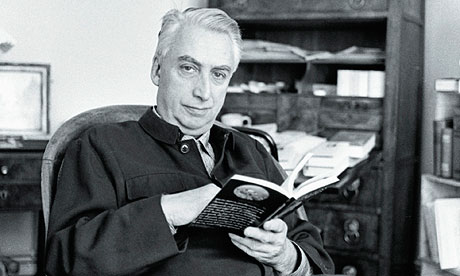
French Philosopher Roland Barthes
Roland Barthes in 1979. Photograph: Fabian Cevallos/Corbis
John Sutherland staggers under the title Lord Northcliffe professor emeritus of Modern English Literature at UCL. He has written numerous books on literature and a couple on himself (notably a drunkalog, Last Drink to LA). He has taught, principally, in the UK and America. His next book (out in a week or so) has the self-explanatory title: 50 Literature Ideas You Really Need to Know. Roll over Dr Johnson.
  1. 50 Literature Ideas You Really Need to Know
  2. by John Sutherland
  3. Buy it from the Guardian bookshop

Buy 50 Literature Ideas You Really Need to Know at the Guardian bookshop
“There are only a handful of grand-master literary critics in action at any one time in the English-speaking world. We lost one of our greatest literary critics, Frank Kermode, a few months ago. That leaves, by my count, Christopher Ricks, Terry Eagleton, and Elaine Showalter. Others will have a different pantheon – but if they’re honest it will be highly select.
“The hardest lit-crit is that which asks the simplest questions. What’s the difference between a ‘story’ by Ian McEwan and a ‘story’ on the front page of the Guardian? What precisely, is ‘lost’ in translation? Literature ‘means’ something. But is that meaning located in the author’s mind, on the page, or in the reader’s mind? Why does literature (unlike, say, the discourses of law or science) cultivate ‘ambiguity’ – saying many things at the same time?”

1. Aristotle, The Poetics (Ingram Bywater translation)

The still-most-relevant work of literary criticism, given (as a lecture, probably) around the fourth century BC. Aristotle takes on the biggest/simplest questions of all. How can we “enjoy” a performance of Oedipus Rex in which the hero blinds himself with his wife-mother’s brooch pins? Was Plato right to say the poet belongs outside, not inside, any ideal society? How can fiction be “true”? Even, as Aristotle argues, truer than history.

2. Susan Sontag, Against Interpretation (1966)

Full blooded assault on “professionalised” academic criticism and its preoccupation with “meanings”. As Sontag saw it: “In place of hermeneutics we need an erotics of art.” Politically Sontag was de-institutionalising literary criticism – tearing it away from the campus. Her thesis is, essentially, a version of Lawrence’s dictum that if you try and nail something down in the novel you either kill the novel or the novel gets up and walks away with the nail. Don’t interpret it, make love to it. Enjoy.

3. Stanley Fish, Is there a Text in this Class? (1980)

Winner of the wittiest title ever coined for a book on lit-crit (the question was initially asked by an artless student in his seminar). Fish’s simple/hard questions: what’s the difference between a “text” and a “work of literature”? How, when the best seminars tend to finish with more disagreement than they started with, do we reach a consensus reading of any text? Is there any such thing?

4. Elaine Showalter, A Literature of their Own (1978)

Showalter was the critic who realised that after the breakthroughs of the women’s movement in the 1960s a new map of literature was required. More particularly some mapping out of the zone in which women talk to women. Why does Jane Eyre mean more to a woman reader than a man? Or does it? Essentially, Showalter takes Virginia Woolf’s “room of one’s own” thesis and applies it to fiction. In her career she went on to help frame a whole new syllabus area.

5. Roland Barthes, S/Z (1977: Richard Miller translation)

The sage of poststructuralism extracts meaning from a short story by Balzac with the care of someone removing kipper bones from their teeth. Is reading a story the second time round (when, for example, we know the butler did it) a richer, or poorer literary experience? Why do we read Jane Austen every year, then, when we know Elizabeth will marry Darcy? How do a few hundred thousand black marks on a white surface become Pride and Prejudice—a “world” with people, places, and events? What “structuration” is at work when that happens?

6. Frank Kermode, The Sense of an Ending (revised edition, 2000)

Why do we crave “closure” in our fictions – “the end”? Why do our brains insist on hearing tick-tock when, acoustically, the clock goes “tick-tick”. What’s the connection between the last chapter of Middlemarch and the Final Judgement in the Bible? Why does modernist literature (specifically) eschew traditional literature’s endings, or play with them mischievously (think, for example, of the three endings on offer in John Fowles’s French Lieutenant’s Woman)?

7. Terry Eagleton, Marxism and Literary Criticism (1976)

This small book – a perennial lit-crit bestseller for 35 years – made the discipline “big”. Literature is not a peripheral thing but infrastructural. Literature matters, Eagleton believes, as much as War, Darwinism, Religion, or Revolution matter. The current government has foolishly forgotten the fact. He has reminded them in the Guardian.

8. Stephen Greenblatt, Renaissance Self-Fashioning (1980)

Pioneering monograph by the high priest of New Historicism. You have this time machine and you want to use it to find out what Hamlet really means. Do you put it into reverse and go back to the Globe, 1601: or do you put the machine into forward gear and zoom at warp-speed aeons in the future when the last critics have had their final say? Put another way, can we ever know as much about Elizabethan literature as the Elizabethans knew about their literature? What, then, was the peculiar quality of their knowledge?

9. Christopher Ricks, Milton’s Grand Style (1963)

Literature is all about how to read, and Ricks is the smartest reader we have. His Milton book, one of his earliest, ponders the problem: does the poet have to create his/her own language? Could Milton have done Paradise Lost in a more common tongue? Ricks picks up a bone much chewed over, by TS Eliot and FR Leavis who could never quite make their minds up about Milton and his wholly idiosyncratic diction. Did he build a “Chinese Wall” round literature, or raise the English language where it could most effectively handle literature?

10. Henry Louis Gates Jr, The Signifying Monkey (1988)

The doyen of African-American literary critics, Gates has undertaken the pioneer task of fusing ethnic elements (previously thought wholly sub-literary) with cutting-edge theory – “semiology”, for example, as the word “signifying” indicates. In so doing Gates has defined a discipline within the discipline. More importantly he has widened the definition of what we classify as “literary”. Are rap lyrics literature? Gates, like Showalter, has drawn new maps of literary criticism.

Wikio

Delicious Bookmark this on Delicious

Filed Under: Books, books_blog

You, Lord, are a Shield. Day 5. Psalm 3, Jan 5th

By Anita Mathias


Psalm 3
    A Psalm of David. When he fled from his son Absalom.
 1 LORD, how many are my foes!
   How many rise up against me!
2 Many are saying of me,
   “God will not deliver him.”
And did God deliver David? He most certainly did.
Do not worry about what other people say. They are like you and me, people of limited intelligence and vision.
Do not fear evil words and evil predictions. God holds our future in his hands.  God is a shield around us. These words have no power to hurt us.
Put your faith in the omnipotent one.

 3 But you, LORD, are a shield around me,
   my glory, the One who lifts my head high.
4 I call out to the LORD,
   and he answers me from his holy mountain.
God is a shield not just in front of David, but all around him.
A shield all around us who fly to the shelter of his strong tower. To the shelter of his arms.
He bids us lift our heads high—and look upwards—no matter what our circumstances.
We call out to him in our despair, and he answers us.

 5 I lie down and sleep;
   I wake again, because the LORD sustains me. 
6 I will not fear though tens of thousands
   assail me on every side.
Cast your cares on God, and sleep. He is stronger and more powerful than tens of thousands of enemies, and his plans for your destiny WILL NOT be thwarted.

 7 Arise, LORD!
   Deliver me, my God!
Strike all my enemies on the jaw;
   break the teeth of the wicked.
My goodness, is it okay to pray like this? I have no idea, but I do know that David was a man after God’s own heart. I do know that all human beings have a craving for justice implanted in their hearts. I do know that justice is done, frequently on this earth, always in heaven.
I do sometimes pray, “Vindicate me against my adversary,” Luke 18, because that it is a prayer Jesus said neither the unrighteous judge nor God can resist. Still this prayer is just a way-station in the stages of forgiveness.
As my spirit is purified, I hope to pray like Jesus, “Father forgive them, for they know not what they do.”
But we need to be honest, as we go through the stages of forgiveness. I think I am at, “I forgive you myself, and I am so grateful that there is a just and righteous Judge into whose hands I can commit my cause.”

 8 From the LORD comes  deliverance. 
May your blessing be on your people.
I breathe deeply, my tensed shoulders relax at these words. May your blessing be on your people indeed, Lord.
    

Filed Under: Psalms

Sin, Destruction, Mercy, Genesis 5,6,7. DAY 5. Jan 5th.

By Anita Mathias

 
Genesis 5
 This is the written account of Adam’s family line.
   When God created mankind, he made them in the likeness of God. 2 He created them male and female and blessed them. And he named them “Mankind”[a] when they were created.
 3 When Adam had lived 130 years, he had a son in his own likeness, in his own image; and he named him Seth. 4 After Seth was born, Adam lived 800 years and had other sons and daughters. 5 Altogether, Adam lived a total of 930 years, and then he died.
 6 When Seth had lived 105 years, he became the father[b] of Enosh. 7 After he became the father of Enosh, Seth lived 807 years and had other sons and daughters.8 Altogether, Seth lived a total of 912 years, and then he died.
 9 When Enosh had lived 90 years, he became the father of Kenan. 10 After he became the father of Kenan, Enosh lived 815 years and had other sons and daughters. 11 Altogether, Enosh lived a total of 905 years, and then he died.
 12 When Kenan had lived 70 years, he became the father of Mahalalel. 13 After he became the father of Mahalalel, Kenan lived 840 years and had other sons and daughters. 14 Altogether, Kenan lived a total of 910 years, and then he died.
 15 When Mahalalel had lived 65 years, he became the father of Jared. 16 After he became the father of Jared, Mahalalel lived 830 years and had other sons and daughters. 17 Altogether, Mahalalel lived a total of 895 years, and then he died.
 18 When Jared had lived 162 years, he became the father of Enoch. 19 After he became the father of Enoch, Jared lived 800 years and had other sons and daughters. 20 Altogether, Jared lived a total of 962 years, and then he died.
 21 When Enoch had lived 65 years, he became the father of Methuselah. 22 After he became the father of Methuselah, Enoch walked faithfully with God 300 years and had other sons and daughters. 23 Altogether, Enoch lived a total of 365 years. 24 Enoch walked faithfully with God; then he was no more, because God took him away.
 25 When Methuselah had lived 187 years, he became the father of Lamech. 26 After he became the father of Lamech, Methuselah lived 782 years and had other sons and daughters. 27 Altogether, Methuselah lived a total of 969 years, and then he died.
 28 When Lamech had lived 182 years, he had a son. 29 He named him Noah[c] and said, “He will comfort us in the labour and painful toil of our hands caused by the ground the LORD has cursed.” 30 After Noah was born, Lamech lived 595 years and had other sons and daughters. 31 Altogether, Lamech lived a total of 777 years, and then he died.
 32 After Noah was 500 years old, he became the father of Shem, Ham and Japheth.
Genesis 6
 1 When human beings began to increase in number on the earth and daughters were born to them, 2 the sons of God saw that the daughters of humans were beautiful, and they married any of them they chose. 3 Then the LORD said, “My Spirit will not contend with humans forever, for they are mortal; their days will be a hundred and twenty years.”
 4 The Nephilim were on the earth in those days—and also afterward—when the sons of God went to the daughters of humans and had children by them. They were the heroes of old, men of renown.
 5 The LORD saw how great the wickedness of the human race had become on the earth, and that every inclination of the thoughts of the human heart was only evil all the time. 6 The LORD regretted that he had made human beings on the earth, and his heart was deeply troubled. 
I love this anthropomorphic description of God, as full-bodied and full-emotioned as Christ was. He temporarily regrets his loving actions. His heart is troubled by what man is doing.

7So the LORD said, “I will wipe from the face of the earth the human race I have created—and with them the animals, the birds and the creatures that move along the ground—for I regret that I have made them.” 
Does this happen? No. Reading Genesis shows us the point of prayer—the many times God changes his mind about what he is going to do, what is inexorably going to happen, because he finds a good man, and often, because that good man prays (as we see when Abraham intercedes for the wicked cities a little later).

8 But Noah found favour in the eyes of the LORD.
 9 This is the account of Noah and his family.
   Noah was a righteous man, blameless among the people of his time, and he walked faithfully with God. 10 Noah had three sons: Shem, Ham and Japheth.
 11 Now the earth was corrupt in God’s sight and was full of violence. 12 God saw how corrupt the earth had become, for all the people on earth had corrupted their ways. 13 So God said to Noah, “I am going to put an end to all people, for the earth is filled with violence because of them. I am surely going to destroy both them and the earth. 
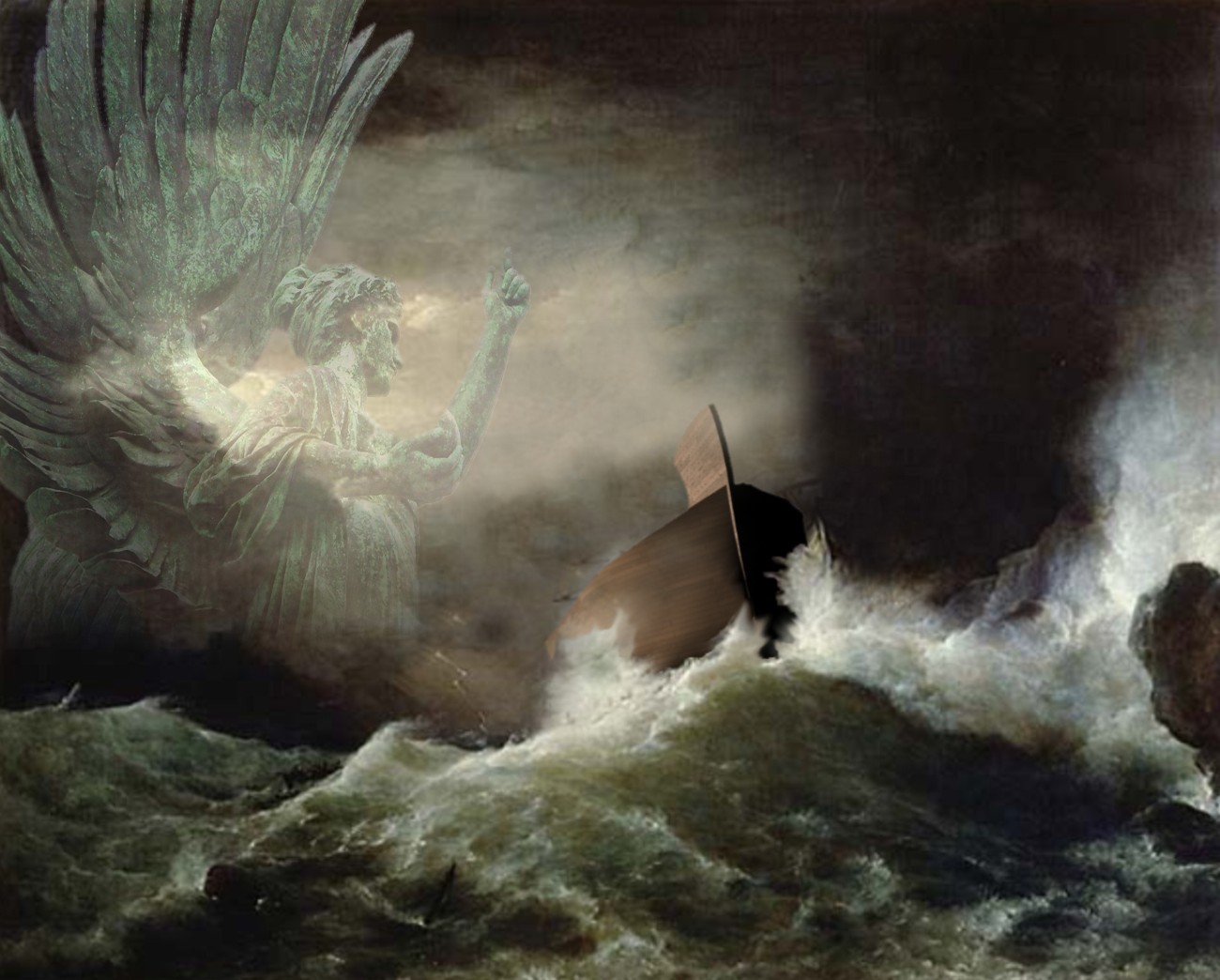
Amos 3:7 says, “Surely the Sovereign LORD does nothing without revealing his plan to his servants the prophets.” Prophets often have the certain foreknowledge of what is going to happen. But there is a cost and burden to the prophetic gift. Read on. Noah is told to build a SHIP. Inland. In a DESERT land. What do you think the neighbours thought?

14 So make yourself an ark of cypress[ wood; make rooms in it and coat it with pitch inside and out. 15 This is how you are to build it: The ark is to be three hundred cubits long, fifty cubits wide and thirty cubits high. 16 Make a roof for it, leaving below the roof an opening one cubit high all around. Put a door in the side of the ark and make lower, middle and upper decks. 
I like this. This is the methodical, logical, techy God we serve. I was touched by the methodical and systematic way he set about Creation in Genesis 1. First light, then green plants to grow in the light. Then animals to keep the plants in check. Then man, who will soon eat those plants (and then animals).
Bill Johnson in Dreaming with God has numerous examples of God giving similarly detailed directives to young inventors and entrepreneurs. Mark Virkler in Spirit-born Creativity has examples of hearing God’s directives in stock-picking (which have worked for me. Not that we follow Christ for help in shrewd investing. Far from it! But he is our friend, and so it is okay to rely on his wisdom when we need it).
As an entrepreneur myself and a hopelessly impractical person, I have learnt to rely on hearing God’s voice in business, in buying stocks, in housekeeping, in hiring people, in writing. Not all the time, of course (anyone who takes the time to hear God’s voice before he acts would be the smartest and most blessed person on earth, I reckon) but when I remember, and am smart enough to slow down and listen.
So Noah tells the carpenters, “This is the design God gave me.” And they say, “Yeah. Right!!” There is a price to hearing and obeying God’s voice. You might very likely look and sound very foolish. You have to stick to your guns when voices around you say, “Did God really say?”

17 I am going to bring floodwaters on the earth to destroy all life under the heavens, every creature that has the breath of life in it. Everything on earth will perish. 
Again we see, the moving and extraordinary friendship God feels for the righteous. He confides in Noah, as he later will in Abraham, musing, “Then the LORD said, “Shall I hide from Abraham what I am about to do?” Genesis 18:17.

18 But I will establish my covenant with you, and you will enter the ark—you and your sons and your wife and your sons’ wives with you. 19 You are to bring into the ark two of all living creatures, male and female, to keep them alive with you. 20 Two of every kind of bird, of every kind of animal and of every kind of creature that moves along the ground will come to you to be kept alive. 21 You are to take every kind of food that is to be eaten and store it away as food for you and for them.”
Blessed words, I will establish my covenant. An unconditional covenant because God was good and because he loved Abraham. Loving our children, whatever, just because, is perhaps our closest experience of this kind of love, and covenant.

 22 Noah did everything just as God commanded him.
A little glimpse of both the righteousness of Noah, and why God chose him and could trust him. He was asked to do something costly, time-consuming, exhausting and ostensibly foolish. To build a ship in summer, in a desert. All he had to strengthen him during the ardours of the building was knowing that he definitely had heard the word of God.
I would have found it so hard.
Building that ark was financially costly, costly in lost time and income, costly in loss of face and prestige.
Obeying God has HUGE costs.
And HUGE rewards.

Genesis 7
 1 The LORD then said to Noah, “Go into the ark, you and your whole family, because I have found you righteous in this generation. 2 Take with you seven pairs of every kind of clean animal, a male and its mate, and one pair of every kind of unclean animal, a male and its mate, 3 and also seven pairs of every kind of bird, male and female, to keep their various kinds alive throughout the earth. 4 Seven days from now I will send rain on the earth for forty days and forty nights, and I will wipe from the face of the earth every living creature I have made.”
Every living creature I have made. Imagine that. Imagine destroying all your children. Or poems. Or paintings. Or your life’s work. God’s judgement of sin is not without personal cost. His wrath is intensified by his love, just as we are far more upset by the betrayal of a friend, than the betrayal of a stranger.
Forty, by the way, is frequently the Biblical number of days for change, purification and spiritual transformation. Moses stayed 40 days on the mountain, twice. And then his face was radiant. Both Elijah and Jesus fasted for 40 days.

 5 And Noah did all that the LORD commanded him.
Noah was trustworthy in God’s sight. God could tell him his secrets, and trust him with them. He could trust him to do what he told him to do.
Lord, let me be trustworthy in your eyes. Tell me your secrets. Tell me your deep things. Tell me what is on your heart and mind. Teach me how you think.
And when you give me a commission, please help me to faithful in executing it.

 6 Noah was six hundred years old when the floodwaters came on the earth. 7 And Noah and his sons and his wife and his sons’ wives entered the ark to escape the waters of the flood. 8 Pairs of clean and unclean animals, of birds and of all creatures that move along the ground, 9 male and female, came to Noah and entered the ark, as God had commanded Noah. 10 And after the seven days the floodwaters came on the earth.
 11 In the six hundredth year of Noah’s life, on the seventeenth day of the second month—on that day all the springs of the great deep burst forth, and the floodgates of the heavens were opened. 12 And rain fell on the earth forty days and forty nights.
 13 On that very day Noah and his sons, Shem, Ham and Japheth, together with his wife and the wives of his three sons, entered the ark. 
And if Noah had not obeyed God, he could have been killed.
I think again of what Moses said to this people as they were about to enter the Promised Land, “They are not just idle words for you–they are your life. By them you will long in the Land you are about to enter.” Deut 32:47.
14 They had with them every wild animal according to its kind, all livestock according to their kinds, every creature that moves along the ground according to its kind and every bird according to its kind, everything with wings. 15 Pairs of all creatures that have the breath of life in them came to Noah and entered the ark. 16 The animals going in were male and female of every living thing, as God had commanded Noah. Then the LORD shut him in.
This is fascinating. Moses is about to embark on a great destiny. He will be a new Adam, a prototype of Jesus.
And what is his preparation for his destiny as the new Father of the human race?
GOD SHUTS HIM IN.
WHAT? Yes.
Many times in my life, despite much manoeuvring, and prayers, and strategy and manipulation, and effort and tears, I have experienced this. A sense of being shut in, set apart to listen, hear, grow in solitude, away from approbation, affirmation, attention, praise, buzz, all these addictive things that are poison to the growth of the spirit. These are classroom experiences, in preparation for the next little task God gives me. And God keeps one in the classroom until one has mastered that lesson.
I know many people who feel shut in. In fact, I myself feel called by God at the moment for a season of silence, much solitude, repentance, spiritual growth, and quiet happiness with God. And I am not going to amputate this season, but will happily go through it, until God reveals the next chapter of my life to me.
You can be shut in for a season, and feel like your life is going nowhere, and that you are a failure. However, if you are a child of God, and submitted to him, this is merely a season of preparation for your destiny.

 17 For forty days the flood kept coming on the earth, and as the waters increased they lifted the ark high above the earth. 18 The waters rose and increased greatly on the earth, and the ark floated on the surface of the water. 19 They rose greatly on the earth, and all the high mountains under the entire heavens were covered.20 The waters rose and covered the mountains to a depth of more than fifteen cubits.[ 21 Every living thing that moved on land perished—birds, livestock, wild animals, all the creatures that swarm over the earth, and all mankind. 22 Everything on dry land that had the breath of life in its nostrils died. 23 Every living thing on the face of the earth was wiped out; people and animals and the creatures that move along the ground and the birds were wiped from the earth. Only Noah was left, and those with him in the ark.
Being able to hear the word of God, the voice of God, and the directives of God can keep you alive, even thriving through the bleakest, most cataclysmic season.

 24 The waters flooded the earth for a hundred and fifty days.

Filed Under: Genesis

Pascal’s Memorial–His Experience of God and “Joy, Joy, Joy, Tears of Joy.”

By Anita Mathias


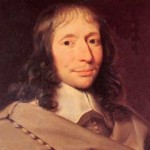
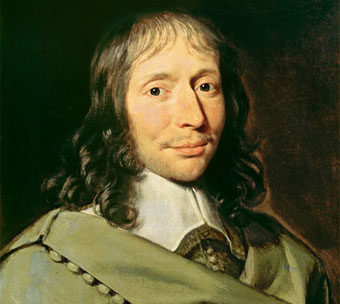
Blaise Pascal

 I love Pascal’s Memorial. I particularly love how words and sequential thought fail this brilliant, cerebral, verbal man. He is describing something from a different world–a world beyond words and logic.

What a joy to so lose oneself in God!!

I have dipped my toes into these waters.

Pascal’s  experience, however, led to a profound and unshakeable conversion; he could not bear to speak about it, and never did (his account of it was found sewn in the lining of his cloak upon his death).

It’s exciting to read of the joy in store for us in the secret places of God.

The year of grace 1654,

Monday, 23 November, feast of St. Clement, pope and martyr, and others in the martyrology.
Vigil of St. Chrysogonus, martyr, and others.
From about half past ten at night until about half past midnight,
FIRE.
GOD of Abraham, GOD of Isaac, GOD of Jacob
not of the philosophers and of the learned.
Certitude. Certitude. Feeling. Joy. Peace.
GOD of Jesus Christ.
My God and your God.
Your GOD will be my God.
Forgetfulness of the world and of everything, except GOD.
He is only found by the ways taught in the Gospel.
Grandeur of the human soul.
Righteous Father, the world has not known you, but I have known you.
Joy, joy, joy, tears of joy.
I have departed from him:
They have forsaken me, the fount of living water.
My God, will you leave me?
Let me not be separated from him forever.
This is eternal life, that they know you, the one true God, and the one that you sent, Jesus Christ.
Jesus Christ.
Jesus Christ.
I left him; I fled him, renounced, crucified.
Let me never be separated from him.
He is only kept securely by the ways taught in the Gospel:
Renunciation, total and sweet.
Complete submission to Jesus Christ.
Eternally in joy for a day’s exercise on the earth.
May I not forget your words. Amen.
And here, the actual words he wrote:
L’an de grâce 1654,
Lundi, 23 novembre, jour de saint Clément, pape et martyr, et autres au martyrologe.
Veille de saint Chrysogone, martyr, et autres,
Depuis environ dix heures et demie du soir jusques environ minuit et demi,
FEU.
« DIEU d’Abraham, DIEU d’Isaac, DIEU de Jacob »
non des philosophes et des savants.
Certitude. Certitude. Sentiment. Joie. Paix.
DIEU de Jésus-Christ.
Deum meum et Deum vestrum.
« Ton DIEU sera mon Dieu. »
Oubli du monde et de tout, hormis DIEU.
Il ne se trouve que par les voies enseignées dans l’Évangile.
Grandeur de l’âme humaine.
« Père juste, le monde ne t’a point connu, mais je t’ai connu. »
Joie, joie, joie, pleurs de joie.
Je m’en suis séparé:
Dereliquerunt me fontem aquae vivae.
« Mon Dieu, me quitterez-vous ? »
Que je n’en sois pas séparé éternellement.
« Cette est la vie éternelle, qu’ils te connaissent seul vrai Dieu, et celui que tu as envoyé, Jésus-Christ. »
Jésus-Christ.
Jésus-Christ.
Je m’en suis séparé; je l’ai fui, renoncé, crucifié.
Que je n’en sois jamais séparé.
Il ne se conserve que par les voies enseignées dans l’Évangile:
Renonciation totale et douce.
Soumission totale à Jésus-Christ et à mon directeur.
Éternellement en joie pour un jour d’exercice sur la terre.
Non obliviscar sermones tuos. Amen.


Filed Under: In Which I celebrate Church History and Great Christians, In which I pursue happiness and the bluebird of joy Tagged With: Church History, Pascal

A Song on the End of the World–Czeslaw Milosz

By Anita Mathias

Wikio

Delicious Bookmark this on Delicious

Filed Under: books_blog, Poetry

  • « Previous Page
  • 1
  • …
  • 180
  • 181
  • 182
  • 183
  • 184
  • …
  • 279
  • Next Page »

Sign Up and Get a Free eBook!

Sign up to be emailed my blog posts (one a week) and get the ebook of "Holy Ground," my account of working with Mother Teresa.

Join 536 Other Readers

My Books

Rosaries, Reading, Secrets: A Catholic Childhood in India

Rosaries, Reading Secrets, B&N
USA

UK

Wandering Between Two Worlds: Essays on Faith and Art

Wandering Between Two Worlds
USA

UK

Francesco, Artist of Florence: The Man Who Gave Too Much

Francesco, Artist of Florence
US

UK

The Story of Dirk Willems

The Story of Dirk Willems
US

UK

My Latest Meditation

Anita Mathias: About Me

Anita Mathias

Read my blog on Facebook

Follow me on Twitter

Follow @anitamathias1

Recent Posts

  • At the Cross, God Forgives Us Completely
  • Using God’s Gift of Our Talents: A Path to Joy and Abundance
  • The Kingdom of God is Here Already, Yet Not Yet Here
  • All Those Who Exalt Themselves Will Be Humbled & the Humble Will Be Exalted
  • Christ’s Great Golden Triad to Guide Our Actions and Decisions
  • How Jesus Dealt With Hostility and Enemies
  • Do Not Be Afraid, but Do Be Prudent
  • For Scoundrels, Scallywags, and Rascals—Christ Came
  • How to Lead an Extremely Significant Life
  • Don’t Walk Away From Jesus, but if You Do, He Still Looks at You and Loves You
Premier Digital Awards 2015 - Finalist - Blogger of the year
Runner Up Christian Media Awards 2014 - Tweeter of the year

Categories

What I’m Reading


Wolf Hall
Hilary Mantel

Wolf Hall --  Amazon.com
Amazon.com

Amazon.co.uk

Silence and Honey Cakes:
The Wisdom Of The Desert
Rowan Williams

Silence and Honey Cakes --  Amazon.com
Amazon.com

Amazon.co.uk

The Long Loneliness:
The Autobiography of the Legendary Catholic Social Activist
Dorothy Day

The Long Loneliness --  Amazon.com
Amazon.com

Amazon.co.uk

Country Girl
Edna O'Brien

Country Girl  - Amazon.com
Amazon.com

Amazon.co.uk

Archive by month

My Latest Five Podcast Meditations

INSTAGRAM

anita.mathias

My memoir: Rosaries, Reading, Secrets https://amzn.to/42xgL9t
Oxford, England. Writer, memoirist, podcaster, blogger, Biblical meditation teacher, mum

Looking at photos from our week in beautiful Sevil Looking at photos from our week in beautiful Seville and Cordoba over New Year with Irene, who had a week off.
And, ICYMI, here’s my latest meditation on the Gospel of Matthew… I’ve recorded it, should you want a few minutes of peace.
https://anitamathias.com/2026/04/29/gods-complete-forgiveness/
Hello Friends, I'm resumed recording my meditation Hello Friends, I'm resumed recording my meditations on the Gospel of Matthew. Do click on this link to listen. 
https://anitamathias.com/.../29/gods-complete-forgiveness/
Christ is the most influential figure in the history of the world, though his life ended in shame, humiliation and failure. But he so completely turned things round in his great reversal that the cross on which he died when all seemed hopeless is now the most common, and revered, symbol in history.
He emerged from and was anchored in Judaism. And as the sins of the people were laid on the scapegoat who was sent into the wilderness to perish, Christ died as the lamb of God voluntarily bearing the guilt of the wrongdoing of the whole world. He paid the price for our forgiveness with his life-blood--in accordance with the iron law of the physical and moral universe, of sowing and reaping, cause and effect. 
And so, God, who appeared as flames of fire to Moses, can now dwell within us, purifying us, whose hearts have darkness and shards of ice. 
And now that Christ was crucified, died, but rose again, His Spirit, no longer contained within his earthly body, is poured out like living water onto all humans, at our humble request. The Spirit pours the love of God into us; he reminds us of the words of Jesus and slowly writes Christ’s sweet law on our hearts. This transfusion of grace helps us do hard things we previously couldn’t do. Our dance with the Spirit gradually breaks the power of sin over us. It transforms us.
Now we, the forgiven, protected by the blood of Jesus poured out over us, and filled with His Spirit, who sings within us, Abba, Father, are adopted by God as his children in his joyful new covenant. We are cells grafted into the vine of our new family--Father, Son, Spirit—who now live in us as we live in them. As we choose by our thoughts and actions to continue living in the vine of Jesus, their energy pulsing through us makes us fruitful. And now, all our prayers which flow in the river of God’s good purposes are kindly heard. Waves of love and power flood from the cross! 
Thank you!
Well, hello friends! Breaking radio silence to let Well, hello friends! Breaking radio silence to let you know that I have taped a meditation for you on Christ’s famous Parable of the Talents in Matthew 25. https://anitamathias.com/2025/11/05/using-gods-gift-of-our-talents-a-path-to-joy-and-abundance/
Here you are, click the play button in the blog post for a brief meditation, and some moments of peace, and, perhaps, inspiration in your day 🙂
Hi Friends, I have taped a meditation; do listen a Hi Friends, I have taped a meditation; do listen at this link: https://anitamathias.com/2025/04/08/the-kingdom-of-god-is-here-already-yet-not-yet-here-2/
It’s on the Kingdom of God, of which Christ so often spoke, which is here already—a mysterious, shimmering internal palace in which, in lightning flashes, we experience peace and joy, and yet, of course, not yet fully here. We sense the rainbowed presence of Christ in the song which pulses through creation. Christ strolls into our rooms with his wisdom and guidance, and things change. Our prayers are answered; we are healed; our hearts are strangely warmed. Sometimes.
And yet, we also experience evil within & all around us. Our own sin which can shatter our peace and the trajectory of our lives. And the sins of the world—its greed, dishonesty and environmental destruction.
But in this broken world, we still experience the glory of creation; “coincidences” which accelerate once we start praying, and shalom which envelops us like sudden sunshine. The portals into this Kingdom include repentance, gratitude, meditative breathing, and absolute surrender.
The Kingdom of God is here already. We can experience its beauty, peace and joy today through the presence of the Holy Spirit. But yet, since, in the Apostle Paul’s words, we do not struggle only “against flesh and blood, but against the rulers, against the unseen powers of this dark world and against the spiritual forces of evil,” its fullness still lingers…
Our daughter Zoe was ordained into the Church of E Our daughter Zoe was ordained into the Church of England in June. I have been on a social media break… but … better late than never. Enjoy!
First picture has my sister, Shalini, who kindly flew in from the US. Our lovely cousins Anthony and Sarah flank Zoe in the next picture.
The Bishop of London, Sarah Mullaly, ordained Zoe. You can see her praying that Zoe will be filled with the Holy Spirit!!
And here’s a meditation I’ve recorded, which you might enjoy. The link is also in my profile
https://anitamathias.com/2024/11/07/all-those-who-exalt-themselves-will-be-humbled-the-humble-will-be-exalted/
I have taped a meditation on Jesus statement in Ma I have taped a meditation on Jesus statement in Matthew 23, “For those who exalt themselves will be humbled, and those who humble themselves will be exalted.”
Do listen here. https://anitamathias.com/2024/11/07/all-those-who-exalt-themselves-will-be-humbled-the-humble-will-be-exalted/
Link also in bio.
And so, Jesus states a law of life. Those who broadcast their amazingness will be humbled, since God dislikes—scorns that, as much as people do.  For to trumpet our success, wealth, brilliance, giftedness or popularity is to get distracted from our life’s purpose into worthless activity. Those who love power, who are sure they know best, and who must be the best, will eventually be humbled by God and life. For their focus has shifted from loving God, doing good work, and being a blessing to their family, friends, and the world towards impressing others, being enviable, perhaps famous. These things are houses built on sand, which will crumble when hammered by the waves of old age, infirmity or adversity. 
God resists the proud, Scripture tells us—those who crave the admiration and power which is His alone. So how do we resist pride? We slow down, so that we realise (and repent) when sheer pride sparks our allergies to people, our enmities, our determination to have our own way, or our grandiose ego-driven goals, and ambitions. Once we stop chasing limelight, a great quietness steals over our lives. We no longer need the drug of continual achievement, or to share images of glittering travel, parties, prizes or friends. We just enjoy them quietly. My life is for itself & not for a spectacle, Emerson wrote. And, as Jesus advises, we quit sharp-elbowing ourselves to sit with the shiniest people, but are content to hang out with ordinary people; and then, as Jesus said, we will inevitably, eventually, be summoned higher to the sparkling conversation we craved. 
One day, every knee will bow before the gentle lamb who was slain, now seated on the throne. We will all be silent before him. Let us live gently then, our eyes on Christ, continually asking for his power, his Spirit, and his direction, moving, dancing, in the direction that we sense him move.
Link to new podcast in Bio https://anitamathias.co Link to new podcast in Bio https://anitamathias.com/2024/02/20/how-jesus-dealt-with-hostility-and-enemies/
3 days before his death, Jesus rampages through the commercialised temple, overturning the tables of moneychangers. Who gave you the authority to do these things? his outraged adversaries ask. And Jesus shows us how to answer hostile questions. Slow down. Breathe. Quick arrow prayers!
Your enemies have no power over your life that your Father has not permitted them. Ask your Father for wisdom, remembering: Questions do not need to be answered. Are these questioners worthy of the treasures of your heart? Or would that be feeding pearls to hungry pigs, who might instead devour you?
Questions can contain pitfalls, traps, nooses. Jesus directly answered just three of the 183 questions he was asked, refusing to answer some; answering others with a good question.
But how do we get the inner calm and wisdom to recognise
and sidestep entrapping questions? Long before the day of
testing, practice slow, easy breathing, and tune in to the frequency of the Father. There’s no record of Jesus running, rushing, getting stressed, or lacking peace. He never spoke on his own, he told us, without checking in with the Father. So, no foolish, ill-judged statements. Breathing in the wisdom of the Father beside and within him, he, unintimidated, traps the trappers.
Wisdom begins with training ourselves to slow down and ask
the Father for guidance. Then our calm minds, made perceptive, will help us recognise danger and trick questions, even those coated in flattery, and sidestep them or refuse to answer.
We practice tuning in to heavenly wisdom by practising–asking God questions, and then listening for his answers about the best way to do simple things…organise a home or write. Then, we build upwards, asking for wisdom in more complex things.
Listening for the voice of God before we speak, and asking for a filling of the Spirit, which Jesus calls streams of living water within us, will give us wisdom to know what to say, which, frequently, is nothing at all. It will quieten us with the silence of God, which sings through the world, through sun and stars, sky and flowers.
Especially for @ samheckt Some very imperfect pi Especially for @ samheckt 
Some very imperfect pictures of my labradoodle Merry, and golden retriever Pippi.
And since, I’m on social media, if you are the meditating type, here’s a scriptural meditation on not being afraid, while being prudent. https://anitamathias.com/2024/01/03/do-not-be-afraid-but-do-be-prudent/
A new podcast. Link in bio https://anitamathias.c A new podcast. Link in bio
https://anitamathias.com/2024/01/03/do-not-be-afraid-but-do-be-prudent/
Do Not Be Afraid, but Do Be Prudent
“Do not be afraid,” a dream-angel tells Joseph, to marry Mary, who’s pregnant, though a virgin, for in our magical, God-invaded world, the Spirit has placed God in her. Call the baby Jesus, or The Lord saves, for he will drag people free from the chokehold of their sins.
And Joseph is not afraid. And the angel was right, for a star rose, signalling a new King of the Jews. Astrologers followed it, threatening King Herod, whose chief priests recounted Micah’s 600-year-old prophecy: the Messiah would be born in Bethlehem, as Jesus had just been, while his parents from Nazareth registered for Augustus Caesar’s census of the entire Roman world. 
The Magi worshipped the baby, offering gold. And shepherds came, told by an angel of joy: that the Messiah, a saviour from all that oppresses, had just been born.
Then, suddenly, the dream-angel warned: Flee with the child to Egypt. For Herod plans to kill this baby, forever-King.
Do not be afraid, but still flee? Become a refugee? But lightning-bolt coincidences verified the angel’s first words: The magi with gold for the flight. Shepherds
telling of angels singing of coming inner peace. Joseph flees.
What’s the difference between fear and prudence? Fear is being frozen or panicked by imaginary what-ifs. It tenses our bodies; strains health, sleep and relationships; makes us stingy with ourselves & others; leads to overwork, & time wasted doing pointless things for fear of people’s opinions.
Prudence is wisdom-using our experience & spiritual discernment as we battle the demonic forces of this dark world, in Paul’s phrase.It’s fighting with divinely powerful weapons: truth, righteousness, faith, Scripture & prayer, while surrendering our thoughts to Christ. 
So let’s act prudently, wisely & bravely, silencing fear, while remaining alert to God’s guidance, delivered through inner peace or intuitions of danger and wrongness, our spiritual senses tuned to the Spirit’s “No,” his “Slow,” his “Go,” as cautious as a serpent, protected, while being as gentle as a lamb among wolves.
Follow on Instagram

© 2026 Dreaming Beneath the Spires · All Rights Reserved. · Cookie Policy · Privacy Policy