Anita Mathias: Dreaming Beneath the Spires

Anita Mathias's Blog on Faith and Art

  • Home
  • My Books
  • Meditations
  • Essays
  • Contact
  • About Me

Martin Luther: A Psychological Profile

By Anita Mathias

Martin Luther

Last night, Roy and I watched a PBS DVD on Martin Luther. Excellent.
I don’t know when we have last had to pause a documentary because we were laughing so hard. We found the comments of the scholars hilarious.
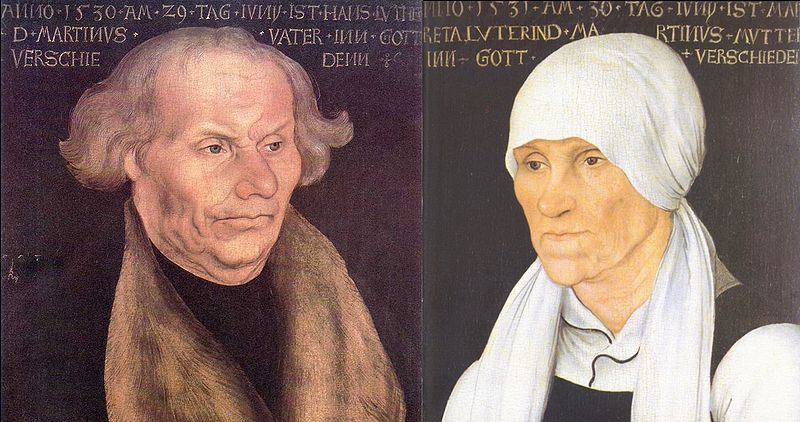
The documentary goes through Luther’s childhood with unloving, lower middle class, but ambitious upwardly mobile parents who wanted him to become a lawyer to fulfil their dreams for him.
File:Hans and Margarethe Luther, by Lucas Cranach the Elder.jpg
Portrait of Martin Luther’s parents of Lucas Cranach
After a dramatic conversion, during a lightning storm, he commits his life to God. (Good move!) “My father raged and acted like a fool. How was he to know that one monk in the family would bring him more fame and shame than a thousand advocates.” Luther writes.
 Luther then joins one of the strictest monastic orders in Europe, the Eremite Augustinians of Strict Observance.
 Luther did whatever he did 110%. (That must be the secret of the people who accomplish several lifetimes’ work in one.)
And so he throws himself in a regimen of praying, fasting, confessions, whippings, watchings. He says, “If ever a man could be saved by monkery, it would have been I.  If I had continued any longer, I would have killed myself” He later blamed his ascetic practices for permanently ruining his health.
He is disgusted by the worldliness, extravagance and cynicism, he sees on a trip to Rome as a young monk, and for the first time starts doubting Catholic teachings–in particular, the buying of indulgences to rescue a soul from purgatory.
The floodgates of doubt open. “Who knows if it is really so,” he wonders.
* * *
Excessive introspection and obsession with his own sinfulness was ruining his mental, spiritual and physical health. He heart-breakingly writes,  “I lost touch with Christ the Savior and Comforter, and made of him the jailor and hangman of my poor soul.”
Luther went to confession to his superior, Von Staupitz as many as twenty times a day, spending up to six hours a day on the practice. He wrote, “I was myself more than once driven to the very depths of despair so that I wished I had never been created. Love God? I hated him!”
Von Staupitz appointed the young monk Professor of Bible Studies in the new university of Wittenberg, hoping it would provide a distraction from Luther’s recurrent theological brooding and devastating introspection.
Johann Von Staupitz
Luther horrified declared that so much work would kill him. To which Von Staupitz replied, “Quite all right, God has plenty of work for clever men in heaven.”
Von Staupitz’s plan, modern scholars say, was that Luther would be so shattered that he would no more time for guilt and introspected, and would collapse and sleep soundly.
Work always operated on Luther as Prozac.
In this case, studying scripture shows Luther that the Catholic church taught much that simply wasn’t so.
                                                                        * * *
He realized: This whole thing is not about you and the church. It’s about you and God.

Salvation is a gift from God, a gift received through faith. The church has no right to intervene or interfere.

To receive salvation, you simply put out your empty, open hands and receive this gift which God wants you to receive. 

Once Luther realized that the spiritual life and salvation is a matter between God and the individual he said, “I felt myself to have been born again, and to have passed through open doors to heaven already.”
We all need to come to this realization, and when we come to it, there is a great revitalization of our spiritual lives, and fresh joy and peace.
The church should never take the place of Christ as the protagonist of the central drama of our spiritual lives. If/when it does, our faith is fair on the way to becoming toxic.
                                                                         * * *

And so, in accessible language, Luther writes the 95 Theses, the blog posts of the day. He attacks the Church’s excesses, in particular, its greed in the sale of indulgences.
If he had attacked their theology, they may well have ignored him. But he got them where it hurt–he encouraged people not to give it their money.
Big business! A typical market day scene in Germany before the Reformation.
Big Business–The Catholic Church of Luther’s Day.
Rome, predictably, was infuriated.

“I never thought that such a story would rise from Rome over one little scrap of paper! ” Luther wrote.
* * *
For Martin Luther, the mounting fury of the Catholic church inspired not doubt and fear, but an extraordinary courage that would only grow stronger with every attack he faced.
He had the strong idea that if the Christian life was lived authentically, then you must expect to suffer.
Luther seized the criticism of him almost as a confirmation of his vocation as a reformer. The more the church tried to silence Luther, the more he became convinced that he had a vocation which needed to be seen through.

Despite the Papal Bull of excommunication, despite the fact that his life would be in danger if he fell into the hands of the Catholic Church, Luther continued with his attacks on it.

“I decided to believe freely and to slave to the authority of no one , whether council, university or pope. I was bound not only to assert the truth but to defend it with my blood and death,” he wrote.

He had an extraordinary combination of  high idealism, resolve in the single-minded pursuit of an ideal, and naivete!!
* * *
Luther squared up to the church with a style of opposition it had never encountered before, a surprisingly modern style of opposition.

He discovered a new and powerful weapon on his side–the printing press.  For movements to spead, their ideas needed to spread.

The printing press invented in Germany by Gutenberg 30 years before the birth of Luther was to Luther’s day what the internet is to our day. It meant that ideas could travel. They could not be stopped.

As the presses spread his 95 Theses throughout Germany, Luther watched and realized that they could provide him with a vast new audience.
He next wrote, “An Address to the Christian Nobility of the German Nation,” a devastating attack on the  pope and the church.

“German money in violation of nature flies across the Alps.”

He attacked the number of secretaries the pope had provided by German tithes (a criticism which could be levelled at some of the princelings of our modern churches).
Luther wrote, “I was not trying to get praise and fame through my writings and little books for almost everyone I knew condemned my harsh and stinging tone.”
                                                                                           * * * 
Alistair Macgrath—”He wrote very well, he wrote very wittily, he wrote very rudely.  Many people found themselves fascinated with this man who would use such crude language when arguing with the Pope and with the church.
Luther says, “If Rome is not a brothel above all brothels one can imagine, then I do not know what brothel  means.”
“The pope should stand up like the stinking sinner he is.”
“The pope should restrain himself and get his fingers out of the pie.”
The scholars on the programme comment “He’s savvy; he’s grown up among books and writing from a young age; he’s good at instinctively sensing what words and arguments will work best for whom.”
“He is an incredible writer.  He uses earthy ordinary language; he’s just fun to read out loud; he’s sarcastic, he’s witty, he’s profound.  If you get attacked by Luther, you are just torn up one side, and down the other.”
Luther next writes, “On the Babylonian Captivity of the Church,” an attack on Catholic sacraments. If you are going to build, you sometimes have to demolish and this was a work of considerable destructive harshnbess
Luther started something that snowballed throughout Germany.
* * *

Luther was summoned before the Holy Roman Emperor, Charles V at the famous Diet of Worms. Cardinal Aleander, representing the Pope, showed Luther a pile of his books, and asked him if he wrote them, and was willing to recant. Interestingly, for he was just a human being after all, and one potentially facing death at the hands of an unjust institution, he asks for 24 hours to consider his response. Which is famous.

Luther at the Diet of Worms


“I do not accept the authority of Popes and councils for they have often erred and contradicted themselves. I am bound by the Scriptures I have quoted and my conscience is captive only to the Word of God. I cannot and will not recant anything for to go against my conscience is neither right nor safe. Here I stand. I can do no other. God help me.  Amen.”

One of history’s greatest declarations of exhausted defiance!!

Luther’s statement marks the dawn of a new era, the ordinary person standing up against authority.

It’s a grand moment when an individual ends up standing for something much larger than himself.

He fully expects that the Church will sentence him to death as a heretic, as it did the Czech reformer, Jan Hus (who also appeared at a Council under a guarantee of safe conduct). However, the vote is inconclusive. Luther is free, though his life is in danger from the Catholic church, which combined spiritual, administrative and judicial authority (a dangerous situation).

* * *


Wartburg-Castle

Wartburg Castle


Luther’s patron, Elector Friedrich the Wise now “kidnaps” Luther–using masked horseman– and spirits him away to Wartburg Castle, where he lives anonymously and quietly, hidden away from the world.

Going from the peaks of glory, attention and notoriety to anonymity and invisibility is a frequent Christian experience.

So Luther goes from the drama and intense experience, the elation and energy of the Diet of Worms to a solitary existence hidden in the Wartburg Castle. He regresses into depression, despair and anguish,  introspection and melancholy, and had a strong sense that the devil was tormenting him.

And yet again, he snapped out of depression by using the Prozac which had worked in the past: Work.

He threw himself into one of his greatest enterprises yet–a translation of the Bible into German, thus making scripture accessible to the common man.
* * *

And while he was in the Wartburg, Germany’s Peasant Revolts commenced, sparked by Luther’s ideas and writings. Luther was horrified as he saw the destruction the reformation entailed. His ideas turned out to be more radical than he had realized.

Disappointly, he does not support the revolting peasants, but attacks them in vicious prose.

“I simply taught, preached and wrote God’s word. I opposed indulgences and papists, but never with force,” he wrote.
* * *

Concluding comments from the scholars on the program:

Luther’s story reminds us of the power of individual charisma, charisma which can travel on the written page.
Luther is an elementary force, embodied in language, offering a vision of salvation which is liberating, which resonates, which seems real to so many people. Once you see it that way, you can’t see the world differently.
Luther is irrepressible, he is outrageous, he is witty, and very funny.
He held onto his sense of rage, and his ear for a good phrase. He remained devoted to his principles, and to speaking out.

“When I die, I want to be a ghost, so that I continue to pester the bishops, priests and godless monks so that they can have more trouble with a dead Luther than they had before with a thousand living ones,”  Luther wrote.

Click button to share on Facebook, Twitter, Digg, Delicious, Reddit … Wikio

Filed Under: In Which I celebrate Church History and Great Christians

Biblical Principles for Confrontation and Social Media. Matthew 18

By Anita Mathias

Matthew 18

    15 “If your brother or sister sins, go and point out their fault, just between the two of you. 
If they listen to you, you have won them over.
 16 But if they will not listen, take one or two others along, so that ‘every matter may be established by the testimony of two or three witnesses.’
17 If they still refuse to listen, tell it to the church; and if they refuse to listen even to the church, treat them as you would a pagan or a tax collector.

   
Jesus here spells out the process of confrontation. The Greek for brother or sister is adelphos, fellow disciple. 
First, confront the individual directly. This is not something I am good at, but it is necessary for the heart–both for your heart, because feelings repressed fester, and for your sister’s heart, because she may be quite unaware of the offence she has caused. 
The individual may see what she has done and repent.
If you are blown off, try again with witnesses.
Then try in the presence of church authorities.
If they refuse to change, ignore them.
This outlines the process of confrontation when a brother or sister–someone you are in relationship with–sins against you. 
It is often misused by authoritarian or insecure leaders who are criticized. I have been asked myself by a church leader about a critical blog post I wrote about a church matter which affected many people, “Why didn’t you tell me directly?” His supporters asked, “Did you follow the principles of Matthew 18?”
I did not, because he was not my brother, nor was the issue a personal one. Because an individual would have been blown off. Because the  perceived “sin” wasn’t against me, but against many. Because social media is the best way for those with little power to confront those with much power. Because a blog post read by 1500 people, most of whom agreed with it, is not as easily blown off as one woman’s remonstrations. 
In the Christian controversy du jour, John Piper tweeted a dismissive, offensive and angry-making comment, “Farewell, Rob Bell,” linking to a review Justin Taylor rashly wrote of a book he had not yet read!!
Some people, somewhat preposterously, said Taylor and Piper should have spoken to Bell privately. If they knew Bell, this would have been the most respectful course, of course.
Taylor today links to a commonsensical post by Kevin DeYoung on the brouhaha.

It needs to be stated again that this is not a Matthew 18 issue.  Jesus said, “If your brother sins against you, go and tell him his fault, between you and him alone” (Matt. 18:15). Rob Bell has not sinned against Justin Taylor or John Piper. This is not a personal offense or an interpersonal squabble that should have been left in private. The general rule of thumb, supported by Matthew 18 and sanctified common sense, is we should not make a matter more public than it has to be. But by definition, YouTube videos and Vimeo clips and books and blogs are meant to be public. That’s the whole point. The Love Wins trailer was not a private email correspondence intercepted by the Reformed Gestapo. It was deliberately made public and can be commented on in public.


Public figures– church leaders, politicians, even authors of successful blogs– I believe, can be confronted publicly. The principles of Matthew 18 do not apply in these instances. 


What do you think?

Filed Under: Blog Through the Bible Project., Matthew

Biblical Principles for Confrontation and Social Media. Matthew 18

By Anita Mathias

Rob Bell

John Piper
Matthew 18

    15 “If your brother or sister sins, go and point out their fault, just between the two of you. 
If they listen to you, you have won them over.
 16 But if they will not listen, take one or two others along, so that ‘every matter may be established by the testimony of two or three witnesses.’
17 If they still refuse to listen, tell it to the church; and if they refuse to listen even to the church, treat them as you would a pagan or a tax collector.

   
Jesus here spells out the process of confrontation. The Greek for brother or sister is adelphos, fellow disciple. 
First, confront the individual directly. This is not something I am good at, but it is necessary for the heart–both for your heart, because feelings repressed fester, and for your sister’s heart, because she may be quite unaware of the offence she has caused. 
The individual may see what she has done and repent.
If you are blown off, try again with witnesses.
Then try in the presence of church authorities.
If they refuse to change, ignore them.
This outlines the process of confrontation when a brother or sister–someone you are in relationship with–sins against you. 
It is often misused by authoritarian or insecure leaders who are criticized. I have been asked myself by a church leader about a critical blog post I wrote about a church matter which affected many people, “Why didn’t you tell me directly?” His supporters asked, “Did you follow the principles of Matthew 18?”
I did not, because he was not my brother, nor was the issue a personal one. Because an individual would have been blown off. Because the  perceived “sin” wasn’t against me, but against many. Because social media is the best way for those with little power to confront those with much power. Because a blog post read by 1500 people, most of whom agreed with it, is not as easily blown off as one woman’s remonstrations. 
In the Christian controversy du jour, John Piper tweeted a dismissive, offensive and angry-making comment, “Farewell, Rob Bell,” linking to a review Justin Taylor rashly wrote of a book he had not yet read!!
Some people, somewhat preposterously, said Taylor and Piper should have spoken to Bell privately. If they knew Bell, this would have been the most respectful course, of course.
Taylor today links to a commonsensical post by Kevin DeYoung on the brouhaha.

It needs to be stated again that this is not a Matthew 18 issue.  Jesus said, “If your brother sins against you, go and tell him his fault, between you and him alone” (Matt. 18:15). Rob Bell has not sinned against Justin Taylor or John Piper. This is not a personal offense or an interpersonal squabble that should have been left in private. The general rule of thumb, supported by Matthew 18 and sanctified common sense, is we should not make a matter more public than it has to be. But by definition, YouTube videos and Vimeo clips and books and blogs are meant to be public. That’s the whole point. The Love Wins trailer was not a private email correspondence intercepted by the Reformed Gestapo. It was deliberately made public and can be commented on in public.


Public figures– church leaders, politicians, even authors of successful blogs– I believe, can be confronted publicly. The principles of Matthew 18 do not apply in these instances. 


What do you think?


18 “Truly I tell you, whatever you bind on earth will be[e] bound in heaven, and whatever you loose on earth will be[f] loosed in heaven.

   19 “Again, truly I tell you that if two of you on earth agree about anything they ask for, it will be done for them by my Father in heaven. 20 For where two or three gather in my name, there am I with them.”
Christ’s beautiful promise of his presence to those who gather in his name. 

Filed Under: Blog Through the Bible Project., Matthew

Biblical Principles for Confrontation and Social Media. Matthew 18

By Anita Mathias

Rob Bell

John Piper
Matthew 18

    15 “If your brother or sister sins, go and point out their fault, just between the two of you. 
If they listen to you, you have won them over.
 16 But if they will not listen, take one or two others along, so that ‘every matter may be established by the testimony of two or three witnesses.’
17 If they still refuse to listen, tell it to the church; and if they refuse to listen even to the church, treat them as you would a pagan or a tax collector.

   
Jesus here spells out the process of confrontation. The Greek for brother or sister is adelphos, fellow disciple. 
First, confront the individual directly. This is not something I am good at, but it is necessary for the heart–both for your heart, because feelings repressed fester, and for your sister’s heart, because she may be quite unaware of the offence she has caused. 
The individual may see what she has done and repent.
If you are blown off, try again with witnesses.
Then try in the presence of church authorities.
If they refuse to change, ignore them.
This outlines the process of confrontation when a brother or sister–someone you are in relationship with–sins against you. 
It is often misused by authoritarian or insecure leaders who are criticized. I have been asked myself by a church leader about a critical blog post I wrote about a church matter which affected many people, “Why didn’t you tell me directly?” His supporters asked, “Did you follow the principles of Matthew 18?”
I did not, because he was not my brother, nor was the issue a personal one. Because an individual would have been blown off. Because the  perceived “sin” wasn’t against me, but against many. Because social media is the best way for those with little power to confront those with much power. Because a blog post read by 1500 people, most of whom agreed with it, is not as easily blown off as one woman’s remonstrations. 
In the Christian controversy du jour, John Piper tweeted a dismissive, offensive and angry-making comment, “Farewell, Rob Bell,” linking to a review Justin Taylor rashly wrote of a book he had not yet read!!
Some people, somewhat preposterously, said Taylor and Piper should have spoken to Bell privately. If they knew Bell, this would have been the most respectful course, of course.
Taylor today links to a commonsensical post by Kevin DeYoung on the brouhaha.

It needs to be stated again that this is not a Matthew 18 issue.  Jesus said, “If your brother sins against you, go and tell him his fault, between you and him alone” (Matt. 18:15). Rob Bell has not sinned against Justin Taylor or John Piper. This is not a personal offense or an interpersonal squabble that should have been left in private. The general rule of thumb, supported by Matthew 18 and sanctified common sense, is we should not make a matter more public than it has to be. But by definition, YouTube videos and Vimeo clips and books and blogs are meant to be public. That’s the whole point. The Love Wins trailer was not a private email correspondence intercepted by the Reformed Gestapo. It was deliberately made public and can be commented on in public.


Public figures– church leaders, politicians, even authors of successful blogs– I believe, can be confronted publicly. The principles of Matthew 18 do not apply in these instances. 


What do you think?


18 “Truly I tell you, whatever you bind on earth will bef]’>[f] loosed in heaven.

   19 “Again, truly I tell you that if two of you on earth agree about anything they ask for, it will be done for them by my Father in heaven. 20 For where two or three gather in my name, there am I with them.”
Christ’s beautiful promise of his presence to those who gather in his name. 

Filed Under: Matthew

Holy Love Wins

By Anita Mathias

The love that wins is a holy love.
The love that won on the cross and wins the world is a love that is driven, determined, and defined by holiness.
It is a love that flows out of the heart of a God who is transcendent, majestic, infinite in righteousness, who loves justice as much as he does mercy; who hates wickedness as much as he loves goodness; who blazes with a fiery, passionate love for himself above all things.
He is Creator, Sustainer, Beginning and End.
He is robed in a splendor and eternal purity that is blinding.
He rules, he reigns, he rages and roars, then bends down to whisper love songs to his creatures.
His love is vast and irresistible.
It is also terrifying, and it will spare no expense to give everything away in order to free us from the bondage of sin, purifying for himself a people who are devoted to his glory, a people who have “no ambition except to do good”.
So he crushes his precious Son in order to rescue and restore mankind along with his entire creation.
He unleashes perfect judgment on the perfectly obedient sacrifice and then pulls him up out of the grave in a smashing and utter victory.
He is a God who triumphs . . .
He is a burning cyclone of passionate love.
Holy love wins.
Timothy Stoner’s The God Who Smokes: Scandalous Meditation on Faith (p. 30)
Hat-tip–http://thegospelcoalition.org/blogs/justintaylor/2011/02/28/holy-love-wins/

Click button to share on Facebook, Twitter, Digg, Delicious, Reddit … Wikio

Filed Under: random

God’s Concern for the Individual, Matthew 18, Blog Through the Bible Project

By Anita Mathias

Matthew 18

The Parable of the Wandering Sheep

    10 “See that you do not despise one of these little ones. For I tell you that their angels in heaven always see the face of my Father in heaven. [11] [a
]

   12 “What do you think? If a man owns a hundred sheep, and one of them wanders away, will he not leave the ninety-nine on the hills and go to look for the one that wandered off? 13 And if he finds it, truly I tell you, he is happier about that one sheep than about the ninety-nine that did not wander off. 14 In the same way your Father in heaven is not willing that any of these little ones should perish.

I haven’t had sheep, but we do have rabbits( as pets) four of them. And when one runs away, we do leave the rest of the animals (we’ve had 9 pets at one time) and go out at night, with torches, looking for the wandering bunny. 
And Jesus says, that he has the same concern for each human being
Bangladeshi workers watched Chinese nationals board a ship bound for Greece in the Benghazi port

for the migrant workers– from Vietnam and Thailand, Bangladesh and Ghana —stranded by war in Libya, and, in some cases, forsaken by their employers, Turkish construction companies whose managers  quickly left Libya, sometimes without returning the workers’ passports.
http://www.nytimes.com/2011/02/27/world/africa/27migrants.html

or the Africans there

New York Times, same article. “There seemed to be little assistance available for black African workers, including many from Ghana, Nigeria, Mali and Burkina Faso. Libya has become a dangerous place to be a black man, after Col. Muammar el-Qaddafi used African mercenaries to kill opponents of his government. Now the workers, some of whom  have seen colleagues killed, are kept under armed guard and moved from place to place because residents have objected to their presence.”  

Filed Under: Matthew

God’s Concern for the Individual, Matthew 18, Blog Through the Bible Project

By Anita Mathias

The Parable of the Wandering Sheep

    10 “See that you do not despise one of these little ones. For I tell you that their angels in heaven always see the face of my Father in heaven. [11] a]”>[a
a]”>]

   12 “What do you think? If a man owns a hundred sheep, and one of them wanders away, will he not leave the ninety-nine on the hills and go to look for the one that wandered off? 13 And if he finds it, truly I tell you, he is happier about that one sheep than about the ninety-nine that did not wander off. 14 In the same way your Father in heaven is not willing that any of these little ones should perish.

I haven’t had sheep, but we do have rabbits( as pets) four of them. And when one runs away, we do leave the rest of the animals (we’ve had 9 pets at one time) and go out at night, with torches, looking for the wandering bunny. 
And Jesus says, that he has the same concern for each human being
Bangladeshi workers watched Chinese nationals board a ship bound for Greece in the Benghazi port

for the migrant workers– from Vietnam and Thailand, Bangladesh and Ghana —stranded by war in Libya, and, in some cases, forsaken by their employers, Turkish construction companies whose managers  quickly left Libya, sometimes without returning the workers’ passports.
http://www.nytimes.com/2011/02/27/world/africa/27migrants.html

or the Africans there

New York Times, same article. “There seemed to be little assistance available for black African workers, including many from Ghana, Nigeria, Mali and Burkina Faso. Libya has become a dangerous place to be a black man, after Col. Muammar el-Qaddafi used African mercenaries to kill opponents of his government. Now the workers, some of whom  have seen colleagues killed, are kept under armed guard and moved from place to place because residents have objected to their presence.”  


Click button to share on Facebook, Twitter, Digg, Delicious, Reddit … Wikio

Filed Under: Matthew

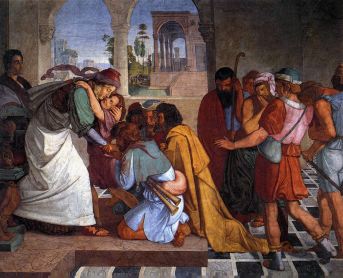
Joseph’s Miraculous Forgiveness of his Brothers, Genesis 45

By Anita Mathias

Genesis 45

Joseph Makes Himself Known

 1 Then Joseph could no longer control himself before all his attendants, and he cried out, “Have everyone leave my presence!” So there was no one with Joseph when he made himself known to his brothers. 2 And he wept so loudly that the Egyptians heard him, and Pharaoh’s household heard about it.

 3 Joseph said to his brothers, “I am Joseph! Is my father still living?” But his brothers were not able to answer him, because they were terrified at his presence.
Joseph is a wonderful person–affectionate, caring and loving. He wears his heart on his sleeve, and it is a warm, loving, heart.
 4 Then Joseph said to his brothers, “Come close to me.” When they had done so, he said, “I am your brother Joseph, the one you sold into Egypt! 5 And now, do not be distressed and do not be angry with yourselves for selling me here,
Inexplicable kindness. God has changed his heart in his years of suffering, and his years of exaltation.
because it was to save lives that God sent me ahead of you. 6 For two years now there has been famine in the land, and for the next five years there will be no plowing and reaping. 7 But God sent me ahead of you to preserve for you a remnant on earth and to save your lives by a great deliverance.
Forgiveness is somewhat easier when you can see how God has worked out all things for good.

8 “So then, it was not you who sent me here, but God.
NIV notes–God had a purpose to work through the brother’s jealous and cruel act.
” He made me father to Pharaoh, lord of his entire household and ruler of all Egypt. 9 Now hurry back to my father and say to him, ‘This is what your son Joseph says: God has made me lord of all Egypt. Come down to me; don’t delay. 10 You shall live in the region of Goshen and be near me—you, your children and grandchildren, your flocks and herds, and all you have. 11 I will provide for you there, because five years of famine are still to come. Otherwise you and your household and all who belong to you will become destitute.’
 12 “You can see for yourselves, and so can my brother Benjamin, that it is really I who am speaking to you. 13 Tell my father about all the honor accorded me in Egypt and about everything you have seen. And bring my father down here quickly.”
The love between father and son is mutual.
 14 Then he threw his arms around his brother Benjamin and wept, and Benjamin embraced him, weeping. 15 And he kissed all his brothers and wept over them. Afterward his brothers talked with him.
In the previous chapter, the brothers have acknowledged their guilt regarding Joseph, and have expressed concern for their father and younger brother. This enables the reconciliation between them and Joseph.
Joseph’s forgiveness still has something of the miraculous about it–and was only possible because God had changed his heart.
 16 When the news reached Pharaoh’s palace that Joseph’s brothers had come, Pharaoh and all his officials were pleased. 17 Pharaoh said to Joseph, “Tell your brothers, ‘Do this: Load your animals and return to the land of Canaan, 18 and bring your father and your families back to me. I will give you the best of the land of Egypt and you can enjoy the fat of the land.’
 19 “You are also directed to tell them, ‘Do this: Take some carts from Egypt for your children and your wives, and get your father and come. 20 Never mind about your belongings, because the best of all Egypt will be yours.’”
 21 So the sons of Israel did this. Joseph gave them carts, as Pharaoh had commanded, and he also gave them provisions for their journey. 22 To each of them he gave new clothing, but to Benjamin he gave three hundred shekels[b] of silver and five sets of clothes. 
Joseph had been sold into slavery for twenty shekhels of silver.
23 And this is what he sent to his father: ten donkeys loaded with the best things of Egypt, and ten female donkeys loaded with grain and bread and other provisions for his journey. 24 Then he sent his brothers away, and as they were leaving he said to them, “Don’t quarrel on the way!”
How well he knew them! He wanted them to avoid mutual accusation and recrimination about the past.
 25 So they went up out of Egypt and came to their father Jacob in the land of Canaan. 26 They told him, “Joseph is still alive! In fact, he is ruler of all Egypt.” Jacob was stunned; he did not believe them. 27 But when they told him everything Joseph had said to them, and when he saw the carts Joseph had sent to carry him back, the spirit of their father Jacob revived. 28 And Israel said, “I’m convinced! My son Joseph is still alive. I will go and see him before I die.”
Miracles do happen

Filed Under: Genesis

  • « Previous Page
  • 1
  • …
  • 159
  • 160
  • 161
  • 162
  • 163
  • …
  • 279
  • Next Page »

Sign Up and Get a Free eBook!

Sign up to be emailed my blog posts (one a week) and get the ebook of "Holy Ground," my account of working with Mother Teresa.

Join 536 Other Readers

My Books

Rosaries, Reading, Secrets: A Catholic Childhood in India

Rosaries, Reading Secrets, B&N
USA

UK

Wandering Between Two Worlds: Essays on Faith and Art

Wandering Between Two Worlds
USA

UK

Francesco, Artist of Florence: The Man Who Gave Too Much

Francesco, Artist of Florence
US

UK

The Story of Dirk Willems

The Story of Dirk Willems
US

UK

My Latest Meditation

Anita Mathias: About Me

Anita Mathias

Read my blog on Facebook

Follow me on Twitter

Follow @anitamathias1

Recent Posts

  • At the Cross, God Forgives Us Completely
  • Using God’s Gift of Our Talents: A Path to Joy and Abundance
  • The Kingdom of God is Here Already, Yet Not Yet Here
  • All Those Who Exalt Themselves Will Be Humbled & the Humble Will Be Exalted
  • Christ’s Great Golden Triad to Guide Our Actions and Decisions
  • How Jesus Dealt With Hostility and Enemies
  • Do Not Be Afraid, but Do Be Prudent
  • For Scoundrels, Scallywags, and Rascals—Christ Came
  • How to Lead an Extremely Significant Life
  • Don’t Walk Away From Jesus, but if You Do, He Still Looks at You and Loves You
Premier Digital Awards 2015 - Finalist - Blogger of the year
Runner Up Christian Media Awards 2014 - Tweeter of the year

Categories

What I’m Reading


Wolf Hall
Hilary Mantel

Wolf Hall --  Amazon.com
Amazon.com

Amazon.co.uk

Silence and Honey Cakes:
The Wisdom Of The Desert
Rowan Williams

Silence and Honey Cakes --  Amazon.com
Amazon.com

Amazon.co.uk

The Long Loneliness:
The Autobiography of the Legendary Catholic Social Activist
Dorothy Day

The Long Loneliness --  Amazon.com
Amazon.com

Amazon.co.uk

Country Girl
Edna O'Brien

Country Girl  - Amazon.com
Amazon.com

Amazon.co.uk

Archive by month

My Latest Five Podcast Meditations

INSTAGRAM

anita.mathias

My memoir: Rosaries, Reading, Secrets https://amzn.to/42xgL9t
Oxford, England. Writer, memoirist, podcaster, blogger, Biblical meditation teacher, mum

Looking at photos from our week in beautiful Sevil Looking at photos from our week in beautiful Seville and Cordoba over New Year with Irene, who had a week off.
And, ICYMI, here’s my latest meditation on the Gospel of Matthew… I’ve recorded it, should you want a few minutes of peace.
https://anitamathias.com/2026/04/29/gods-complete-forgiveness/
Hello Friends, I'm resumed recording my meditation Hello Friends, I'm resumed recording my meditations on the Gospel of Matthew. Do click on this link to listen. 
https://anitamathias.com/.../29/gods-complete-forgiveness/
Christ is the most influential figure in the history of the world, though his life ended in shame, humiliation and failure. But he so completely turned things round in his great reversal that the cross on which he died when all seemed hopeless is now the most common, and revered, symbol in history.
He emerged from and was anchored in Judaism. And as the sins of the people were laid on the scapegoat who was sent into the wilderness to perish, Christ died as the lamb of God voluntarily bearing the guilt of the wrongdoing of the whole world. He paid the price for our forgiveness with his life-blood--in accordance with the iron law of the physical and moral universe, of sowing and reaping, cause and effect. 
And so, God, who appeared as flames of fire to Moses, can now dwell within us, purifying us, whose hearts have darkness and shards of ice. 
And now that Christ was crucified, died, but rose again, His Spirit, no longer contained within his earthly body, is poured out like living water onto all humans, at our humble request. The Spirit pours the love of God into us; he reminds us of the words of Jesus and slowly writes Christ’s sweet law on our hearts. This transfusion of grace helps us do hard things we previously couldn’t do. Our dance with the Spirit gradually breaks the power of sin over us. It transforms us.
Now we, the forgiven, protected by the blood of Jesus poured out over us, and filled with His Spirit, who sings within us, Abba, Father, are adopted by God as his children in his joyful new covenant. We are cells grafted into the vine of our new family--Father, Son, Spirit—who now live in us as we live in them. As we choose by our thoughts and actions to continue living in the vine of Jesus, their energy pulsing through us makes us fruitful. And now, all our prayers which flow in the river of God’s good purposes are kindly heard. Waves of love and power flood from the cross! 
Thank you!
Well, hello friends! Breaking radio silence to let Well, hello friends! Breaking radio silence to let you know that I have taped a meditation for you on Christ’s famous Parable of the Talents in Matthew 25. https://anitamathias.com/2025/11/05/using-gods-gift-of-our-talents-a-path-to-joy-and-abundance/
Here you are, click the play button in the blog post for a brief meditation, and some moments of peace, and, perhaps, inspiration in your day 🙂
Hi Friends, I have taped a meditation; do listen a Hi Friends, I have taped a meditation; do listen at this link: https://anitamathias.com/2025/04/08/the-kingdom-of-god-is-here-already-yet-not-yet-here-2/
It’s on the Kingdom of God, of which Christ so often spoke, which is here already—a mysterious, shimmering internal palace in which, in lightning flashes, we experience peace and joy, and yet, of course, not yet fully here. We sense the rainbowed presence of Christ in the song which pulses through creation. Christ strolls into our rooms with his wisdom and guidance, and things change. Our prayers are answered; we are healed; our hearts are strangely warmed. Sometimes.
And yet, we also experience evil within & all around us. Our own sin which can shatter our peace and the trajectory of our lives. And the sins of the world—its greed, dishonesty and environmental destruction.
But in this broken world, we still experience the glory of creation; “coincidences” which accelerate once we start praying, and shalom which envelops us like sudden sunshine. The portals into this Kingdom include repentance, gratitude, meditative breathing, and absolute surrender.
The Kingdom of God is here already. We can experience its beauty, peace and joy today through the presence of the Holy Spirit. But yet, since, in the Apostle Paul’s words, we do not struggle only “against flesh and blood, but against the rulers, against the unseen powers of this dark world and against the spiritual forces of evil,” its fullness still lingers…
Our daughter Zoe was ordained into the Church of E Our daughter Zoe was ordained into the Church of England in June. I have been on a social media break… but … better late than never. Enjoy!
First picture has my sister, Shalini, who kindly flew in from the US. Our lovely cousins Anthony and Sarah flank Zoe in the next picture.
The Bishop of London, Sarah Mullaly, ordained Zoe. You can see her praying that Zoe will be filled with the Holy Spirit!!
And here’s a meditation I’ve recorded, which you might enjoy. The link is also in my profile
https://anitamathias.com/2024/11/07/all-those-who-exalt-themselves-will-be-humbled-the-humble-will-be-exalted/
I have taped a meditation on Jesus statement in Ma I have taped a meditation on Jesus statement in Matthew 23, “For those who exalt themselves will be humbled, and those who humble themselves will be exalted.”
Do listen here. https://anitamathias.com/2024/11/07/all-those-who-exalt-themselves-will-be-humbled-the-humble-will-be-exalted/
Link also in bio.
And so, Jesus states a law of life. Those who broadcast their amazingness will be humbled, since God dislikes—scorns that, as much as people do.  For to trumpet our success, wealth, brilliance, giftedness or popularity is to get distracted from our life’s purpose into worthless activity. Those who love power, who are sure they know best, and who must be the best, will eventually be humbled by God and life. For their focus has shifted from loving God, doing good work, and being a blessing to their family, friends, and the world towards impressing others, being enviable, perhaps famous. These things are houses built on sand, which will crumble when hammered by the waves of old age, infirmity or adversity. 
God resists the proud, Scripture tells us—those who crave the admiration and power which is His alone. So how do we resist pride? We slow down, so that we realise (and repent) when sheer pride sparks our allergies to people, our enmities, our determination to have our own way, or our grandiose ego-driven goals, and ambitions. Once we stop chasing limelight, a great quietness steals over our lives. We no longer need the drug of continual achievement, or to share images of glittering travel, parties, prizes or friends. We just enjoy them quietly. My life is for itself & not for a spectacle, Emerson wrote. And, as Jesus advises, we quit sharp-elbowing ourselves to sit with the shiniest people, but are content to hang out with ordinary people; and then, as Jesus said, we will inevitably, eventually, be summoned higher to the sparkling conversation we craved. 
One day, every knee will bow before the gentle lamb who was slain, now seated on the throne. We will all be silent before him. Let us live gently then, our eyes on Christ, continually asking for his power, his Spirit, and his direction, moving, dancing, in the direction that we sense him move.
Link to new podcast in Bio https://anitamathias.co Link to new podcast in Bio https://anitamathias.com/2024/02/20/how-jesus-dealt-with-hostility-and-enemies/
3 days before his death, Jesus rampages through the commercialised temple, overturning the tables of moneychangers. Who gave you the authority to do these things? his outraged adversaries ask. And Jesus shows us how to answer hostile questions. Slow down. Breathe. Quick arrow prayers!
Your enemies have no power over your life that your Father has not permitted them. Ask your Father for wisdom, remembering: Questions do not need to be answered. Are these questioners worthy of the treasures of your heart? Or would that be feeding pearls to hungry pigs, who might instead devour you?
Questions can contain pitfalls, traps, nooses. Jesus directly answered just three of the 183 questions he was asked, refusing to answer some; answering others with a good question.
But how do we get the inner calm and wisdom to recognise
and sidestep entrapping questions? Long before the day of
testing, practice slow, easy breathing, and tune in to the frequency of the Father. There’s no record of Jesus running, rushing, getting stressed, or lacking peace. He never spoke on his own, he told us, without checking in with the Father. So, no foolish, ill-judged statements. Breathing in the wisdom of the Father beside and within him, he, unintimidated, traps the trappers.
Wisdom begins with training ourselves to slow down and ask
the Father for guidance. Then our calm minds, made perceptive, will help us recognise danger and trick questions, even those coated in flattery, and sidestep them or refuse to answer.
We practice tuning in to heavenly wisdom by practising–asking God questions, and then listening for his answers about the best way to do simple things…organise a home or write. Then, we build upwards, asking for wisdom in more complex things.
Listening for the voice of God before we speak, and asking for a filling of the Spirit, which Jesus calls streams of living water within us, will give us wisdom to know what to say, which, frequently, is nothing at all. It will quieten us with the silence of God, which sings through the world, through sun and stars, sky and flowers.
Especially for @ samheckt Some very imperfect pi Especially for @ samheckt 
Some very imperfect pictures of my labradoodle Merry, and golden retriever Pippi.
And since, I’m on social media, if you are the meditating type, here’s a scriptural meditation on not being afraid, while being prudent. https://anitamathias.com/2024/01/03/do-not-be-afraid-but-do-be-prudent/
A new podcast. Link in bio https://anitamathias.c A new podcast. Link in bio
https://anitamathias.com/2024/01/03/do-not-be-afraid-but-do-be-prudent/
Do Not Be Afraid, but Do Be Prudent
“Do not be afraid,” a dream-angel tells Joseph, to marry Mary, who’s pregnant, though a virgin, for in our magical, God-invaded world, the Spirit has placed God in her. Call the baby Jesus, or The Lord saves, for he will drag people free from the chokehold of their sins.
And Joseph is not afraid. And the angel was right, for a star rose, signalling a new King of the Jews. Astrologers followed it, threatening King Herod, whose chief priests recounted Micah’s 600-year-old prophecy: the Messiah would be born in Bethlehem, as Jesus had just been, while his parents from Nazareth registered for Augustus Caesar’s census of the entire Roman world. 
The Magi worshipped the baby, offering gold. And shepherds came, told by an angel of joy: that the Messiah, a saviour from all that oppresses, had just been born.
Then, suddenly, the dream-angel warned: Flee with the child to Egypt. For Herod plans to kill this baby, forever-King.
Do not be afraid, but still flee? Become a refugee? But lightning-bolt coincidences verified the angel’s first words: The magi with gold for the flight. Shepherds
telling of angels singing of coming inner peace. Joseph flees.
What’s the difference between fear and prudence? Fear is being frozen or panicked by imaginary what-ifs. It tenses our bodies; strains health, sleep and relationships; makes us stingy with ourselves & others; leads to overwork, & time wasted doing pointless things for fear of people’s opinions.
Prudence is wisdom-using our experience & spiritual discernment as we battle the demonic forces of this dark world, in Paul’s phrase.It’s fighting with divinely powerful weapons: truth, righteousness, faith, Scripture & prayer, while surrendering our thoughts to Christ. 
So let’s act prudently, wisely & bravely, silencing fear, while remaining alert to God’s guidance, delivered through inner peace or intuitions of danger and wrongness, our spiritual senses tuned to the Spirit’s “No,” his “Slow,” his “Go,” as cautious as a serpent, protected, while being as gentle as a lamb among wolves.
Follow on Instagram

© 2026 Dreaming Beneath the Spires · All Rights Reserved. · Cookie Policy · Privacy Policy