Anita Mathias: Dreaming Beneath the Spires

Anita Mathias's Blog on Faith and Art

  • Home
  • My Books
  • Meditations
  • Essays
  • Contact
  • About Me

Blogging Will Bring You A Bigger Audience Than Writing

By Anita Mathias

Image
 My blog is relatively small but rapidly growing. 12105 page views last month according to blogger stats, about 400 a day.

Which is not a lot compared to the top bloggers in my category. But it is perhaps a whole lot more daily readers than writers who stick to print have.
Laura Miller mourns the decline of reading in her Salon article. It is not true, however, that people are reading less. They are reading more. However what they are reading has changed. They read on their laptops, and largely read things produced for people who read in that medium–blogs, online newspapers and journals, Facebook, Twitter.
Here are some excerpts from Laura’s piece on NaNoWriMo, National Novel Writing Month:
NaNoWriMo is an event geared entirely toward writers, which means it’s largely unnecessary. It was yet another depressing sign that the cultural spaces once dedicated to the selfless art of reading are being taken over by the narcissistic commerce of writing.
I say “commerce” because far more money can be made out of people who want to write novels than out of people who want to read them. And an astonishing number of individuals who want to do the former will confess to never doing the latter. “People would come up to me at parties,” author Ann Bauer recently told me, “and say, ‘I’ve been thinking of writing a book. Tell me what you think of this …’ And I’d (eventually) divert the conversation by asking what they read … Now, the ‘What do you read?’ question is inevitably answered, ‘Oh, I don’t have time to read. I’m just concentrating on my writing.’”
Yet while there’s no shortage of good novels out there, there is a shortage of readers for these books. Even authors who achieve what probably seems like Nirvana to the average NaNoWriMo participant — publication by a major house — will, for the most part, soon learn this dispiriting truth: Hardly anyone will read their books and next to no one will buy them.


So I’m not worried about all the books that won’t get written if a hundred thousand people with a nagging but unfulfilled ambition to Be a Writer lack the necessary motivation to get the job done. I see no reason to cheer them on. t’s the readers who are fragile, a truly endangered species. They don’t make a big stink about how underappreciated they are; like Tinkerbell or any other disbelieved-in fairy, they just fade away.
Rather than squandering our applause on writers — who, let’s face it, will keep on pounding the keyboards whether we support them or not — why not direct more attention, more pep talks, more nonprofit booster groups, more benefit galas and more huzzahs to readers? Why not celebrate them more heartily? They are the bedrock on which any literary culture must be built. After all, there’s not much glory in finally writing that novel if it turns out there’s no one left to read it.
Consider turning away from the self-aggrandizing frenzy of NaNoWriMo and embracing the quieter triumph of Kalen Landow and Melissa Klug’s “10/10/10″ challenge: These two women read 10 books in 10 categories between Jan. 1 and Oct. 10, focusing on genres outside their habitual favorites. In her victory-lap blog post, Klug writes of discovering new favorite authors she might otherwise never have encountered, and of her sadness on being reminded that “most Americans don’t read ANY books in a given year, or just one or two.” Instead of locking herself up in a room to crank out 50,000 words of crap, she learned new things and “expanded my reading world.” So let me be the first to say it: Melissa and Kalen, you are the heroes.
* * *
Many bloggers have a holy grail–publishing a book.
However, online is where our readers are, and online is where we are likely to find our biggest readership and influence.


Filed Under: random

The Differences Between Religion and Spirituality

By Anita Mathias

Image

Stuart asked me, “Do religion and spirituality mean the same thing?” Here’s my response:
To me, spirituality is our sense of God, of infinity and immensity. Every society we know of has been spiritual in some way. There are no entirely atheistic societies that I know of. Faced with the vastness, beauty and brilliance of creation, and our own smallness, most people instinctively sense a God behind it all.
When I consider the heavens the works of your hand,
The moon and the stars which you have made (Psalm 8)
this sense of wonder is not confined to religious people. The created world tells us much about God, since what may be known about God is plain , because God has made it plain. 20 For since the creation of the world God’s invisible qualities—his eternal power and divine nature—have been clearly seen, being understood from what has been made, (Romans 1:20).
Wordsworth expresses this pantheistic  areligious spirituality,
And I have felt
A presence that disturbs me with the joy
Of elevated thoughts; a sense sublime
Of something far more deeply interfused,
Whose dwelling is the light of setting suns,
And the round ocean and the living air,
And the blue sky, and in the mind of man;      
A motion and a spirit, that
rolls through all things. Therefore am I still
A lover of the meadows and the woods,
And mountains; and of all that we behold
From this green earth; 
Spirituality is a kind of DIY religion. Spiritual people can meditate, though the objects of their meditation can vary immensely. They may (or may not) believe in God, but this God is generally fashioned in the image of what their day and age believes a good human being should be.
I once met Iris Murdoch at a garden party at Somerville, when I was a student there. She said she meditated, but did not believe in God. A perfect example of a person being interested in things of the spirit, and even spiritual practices, without any religion at all.
All these can be part of non-religious spiritual experience: prayer, meditation, visions, dreams, revelations, ecstasy. And they can also be part of religious experience, in which case they add depth, joy and sweetness to it.
Religion, (in contrast to spirituality, which can vary in beliefs and experience so much so that one man’s spirituality can be unrecognisable to another) is a revealed set of beliefs, and most religions insist that their set of beliefs is right, and everyone else’s wrong. Mary McCarthy in her memoir, Memories of a Catholic Girlhood writes, “Religion is only good for good people.” The sense of being in on ultimate truth can bring out people’s pride, dogmatism and intolerance, and in that sense religion is far more dangerous than spirituality.
However, while most religions are based on revealed and written truths, spirituality can be a sort of jigsaw, patchwork, guesswork religion, each spiritual person piecing together a pastiche of what he or she believes.
I much prefer religion, well to be honest, the religion I believe in, Christianity. Essentially, because of the beautiful, breathtaking, brilliant figure of Christ.
And to a lesser extent, because of its beautiful, noble theological system, which makes sense to me, and satisfies my moral and aesthetic sense, and as my irritable cravings for logic and for the ineffable to make sense. I love reading the theology expressed in Paul’s writings. Just reading them expands my mind and spirit.
So while spirituality is an apprehension of the sublime and the divine, religion is a detailed description of the grounds of worship.
One can be spiritual without being religious. And people, sadly, have managed to be religious without being spiritual. They have understood the grammar without the poetry of the spiritual life, the letter without the spirit. These can make people arrogant, narrow-minded, dogmatic and judgmental. These people have been a menace to their churches and the societies in which they live, and as far as possible, I intend to steer clear of them!

Filed Under: random

Jonah Moments : When You Grudge God’s Mercy Towards Others

By Anita Mathias

Jonah is among the Old Testament’s fully rounded and very believable characters! He is commissioned to warn Nineveh of impending judgment.

Trouble is, Jonah thinks the judgment is richly deserved, and so flees–ending up in the belly of a great whale.
And there, he praises God, and God turns his destiny around from death to life.
Though Nineveh still remains in his destiny, and to Nineveh he goes. And, as he feared, Nineveh repents and God forgives.
Jonah is furious. He tells God off in the familiar tones of one speaking to an intimate, ” “Isn’t this what I said, LORD, when I was still at home? That is what I tried to forestall by fleeing to Tarshish. I knew that you are a gracious and compassionate God, slow to anger and abounding in love, a God who relents from sending calamity.”
But God cannot but show mercy. That is his nature.
And should I not have concern for the great city of Nineveh, in which there are more than a hundred and twenty thousand people who cannot tell their right hand from their left—and also many animals?”
* * *
I think we all have Jonah moments when we ask the age-old question, “Why do the wicked prosper?
When we feel (other) people should reap what they sow. When we are chagrined to see people who have sinned against us, and sinned against others, blessed.
The fact is God cannot but bless. It is his very nature and character. The Blesser could be one of his names, if I knew how to cast it in Hebrew. The One who Blesses. He makes the sun shine and the rain fall and gives his good gifts to righteous and unrighteous alike, because Giver is his name and nature.
Richard Rohr writes, “God’s forgiveness is like breathing. Forgiveness is not something God does; it is who God is. God can do no other.”
Do we forgive our babies and toddlers who wake up crying, and worse, wake us up by crying, spit up on us, refuse to eat the careful meals we prepare, and generally cause havoc and devastation in our hitherto orderly homes and lives? Of course. Wouldn’t occur to us not to.
Motherhood and mother love gave me a bit of a window in God’s heart.
* * *
I guess I am having a Jonah moment myself as I think of a couple who have hurt a lot of people, myself included. Will they be blessed anyway?
And so I need to do two things. Ask God to continue softening my heart so that I can thoroughly forgive. Ask God to expand my heart so I feel and think as he did.
And remember Jesus getting a bit snappish with Peter, when he wanted to know how much John would be blessed. “If I want him to remain until I return, what is that to you? YOU follow me.”
So let me not be the grudging Jonah, Lord, cross when you bless Ninevahites who don’t deserve it. Instead, change my heart till it is a heart of kindness and blessing like yours.
Let me turn my eyes on you, and follow you.

Filed Under: random

A Fresh Look At Martin Luther

By Anita Mathias


Martin Luther


Last night, Roy and I watched a PBS DVD on Martin Luther. Excellent.

I don’t know when we have last had to pause a documentary because we were laughing so hard. We found the comments of the scholars hilarious.

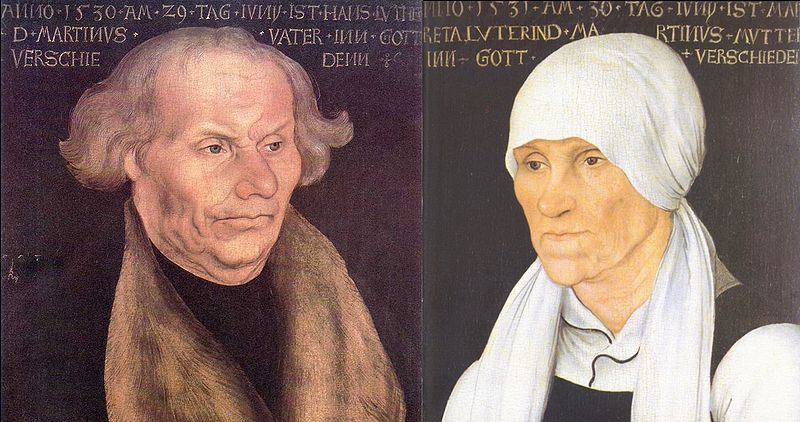
The documentary goes through Luther’s childhood with unloving, lower middle class, but ambitious upwardly mobile parents who wanted him to become a lawyer to fulfil their dreams for him.
File:Hans and Margarethe Luther, by Lucas Cranach the Elder.jpg
Portrait of Martin Luther’s parents of Lucas Cranach

After a dramatic conversion, during a lightning storm, he commits his life to God. (Good move!) “My father raged and acted like a fool. How was he to know that one monk in the family would bring him more fame and shame than a thousand advocates.” Luther writes.

Luther then joins one of the strictest monastic orders in Europe, the Eremite Augustinians of Strict Observance

Luther did whatever he did 110%. (That must be the secret of the people who accomplish several lifetimes’ work in one.)
And so he throws himself in a regimen of praying, fasting, confessions, whippings, watchings. He says, “If ever a man could be saved by monkery, it would have been I. If I had continued any longer, I would have killed myself” He later blamed his ascetic practices for permanently ruining his health.

He is disgusted by the worldliness, extravagance and cynicism, he sees on a trip to Rome as a young monk, and for the first time starts doubting Catholic teachings–in particular, the buying of indulgences to rescue a soul from purgatory.

The floodgates of doubt open. “Who knows if it is really so,” he wonders.
* * *

Excessive introspection and obsession with his own sinfulness was ruining his mental, spiritual and physical health. He heart-breakingly writes, “I lost touch with Christ the Savior and Comforter, and made of him the jailor and hangman of my poor soul.”

Luther went to confession to his superior, Von Staupitz as many as twenty times a day, spending up to six hours a day on the practice. He wrote, “I was myself more than once driven to the very depths of despair so that I wished I had never been created. Love God? I hated him!”

Von Staupitz appointed the young monk Professor of Bible Studies in the new university of Wittenberg, hoping it would provide a distraction from Luther’s recurrent theological brooding and devastating introspection.
Johann Von Staupitz
Luther horrified declared that so much work would kill him. To which Von Staupitz replied, “Quite all right, God has plenty of work for clever men in heaven.”

Von Staupitz’s plan, modern scholars say, was that Luther would be so shattered that he would no more time for guilt and introspected, and would collapse and sleep soundly.

Work always operated on Luther as Prozac.

In this case, studying scripture shows Luther that the Catholic church taught much that simply wasn’t so.
* * *

He realized: This whole thing is not about you and the church. It’s about you and God.

Salvation is a gift from God, a gift received through faith. The church has no right to intervene or interfere.

To receive salvation, you simply put out your empty, open hands and receive this gift which God wants you to receive.


Once Luther realized that the spiritual life and salvation is a matter between God and the individual he said, “I felt myself to have been born again, and to have passed through open doors to heaven already.”

We all need to come to this realization, and when we come to it, there is a great revitalization of our spiritual lives, and fresh joy and peace.

The church should never take the place of Christ as the protagonist of the central drama of our spiritual lives. If/when it does, our faith is fair on the way to becoming toxic.
* * *

And so, in accessible language, Luther writes the 95 Theses, the blog posts of the day. He attacks the Church’s excesses, in particular, its greed in the sale of indulgences.

If he had attacked their theology, they may well have ignored him. But he got them where it hurt–he encouraged people not to give it their money.
Big business! A typical market day scene in Germany before the Reformation.
Big Business–The Catholic Church of Luther’s Day.
Rome, predictably, was infuriated.

“I never thought that such a story would rise from Rome over one little scrap of paper! ” Luther wrote.
* * *

For Martin Luther, the mounting fury of the Catholic church inspired not doubt and fear, but an extraordinary courage that would only grow stronger with every attack he faced.

He had the strong idea that if the Christian life was lived authentically, then you must expect to suffer.

Luther seized the criticism of him almost as a confirmation of his vocation as a reformer. The more the church tried to silence Luther, the more he became convinced that he had a vocation which needed to be seen through.

Despite the Papal Bull of excommunication, despite the fact that his life would be in danger if he fell into the hands of the Catholic Church, Luther continued with his attacks on it.

“I decided to believe freely and to slave to the authority of no one , whether council, university or pope. I was bound not only to assert the truth but to defend it with my blood and death,” he wrote.

He had an extraordinary combination of high idealism, resolve in the single-minded pursuit of an ideal, and naivete!!
* * *

Luther squared up to the church with a style of opposition it had never encountered before, a surprisingly modern style of opposition.

He discovered a new and powerful weapon on his side–the printing press. For movements to spead, their ideas needed to spread.

The printing press invented in Germany by Gutenberg 30 years before the birth of Luther was to Luther’s day what the internet is to our day. It meant that ideas could travel. They could not be stopped.

As the presses spread his 95 Theses throughout Germany, Luther watched and realized that they could provide him with a vast new audience.

He next wrote, “An Address to the Christian Nobility of the German Nation,” a devastating attack on the pope and the church.

“German money in violation of nature flies across the Alps.”

He attacked the number of secretaries the pope had provided by German tithes (a criticism which could be levelled at some of the princelings of our modern churches).

Luther wrote, “I was not trying to get praise and fame through my writings and little books for almost everyone I knew condemned my harsh and stinging tone.”
* * *

Alistair Macgrath—”He wrote very well, he wrote very wittily, he wrote very rudely. Many people found themselves fascinated with this man who would use such crude language when arguing with the Pope and with the church.

Luther says, “If Rome is not a brothel above all brothels one can imagine, then I do not know what brothel means.”

“The pope should stand up like the stinking sinner he is.”

“The pope should restrain himself and get his fingers out of the pie.”

The scholars on the programme comment “He’s savvy; he’s grown up among books and writing from a young age; he’s good at instinctively sensing what words and arguments will work best for whom.”

“He is an incredible writer. He uses earthy ordinary language; he’s just fun to read out loud; he’s sarcastic, he’s witty, he’s profound. If you get attacked by Luther, you are just torn up one side, and down the other.”

Luther next writes, “On the Babylonian Captivity of the Church,” an attack on Catholic sacraments. If you are going to build, you sometimes have to demolish and this was a work of considerable destructive harshnbess

Luther started something that snowballed throughout Germany.
* * *

Luther was summoned before the Holy Roman Emperor, Charles V at the famous Diet of Worms. Cardinal Aleander, representing the Pope, showed Luther a pile of his books, and asked him if he wrote them, and was willing to recant. Interestingly, for he was just a human being after all, and one potentially facing death at the hands of an unjust institution, he asks for 24 hours to consider his response. Which is famous.

Luther at the Diet of Worms

“I do not accept the authority of Popes and councils for they have often erred and contradicted themselves. I am bound by the Scriptures I have quoted and my conscience is captive only to the Word of God. I cannot and will not recant anything for to go against my conscience is neither right nor safe. Here I stand. I can do no other. God help me. Amen.”

One of history’s greatest declarations of exhausted defiance!!

Luther’s statement marks the dawn of a new era, the ordinary person standing up against authority.

It’s a grand moment when an individual ends up standing for something much larger than himself.

He fully expects that the Church will sentence him to death as a heretic, as it did the Czech reformer, Jan Hus (who also appeared at a Council under a guarantee of safe conduct). However, the vote is inconclusive. Luther is free, though his life is in danger from the Catholic church, which combined spiritual, administrative and judicial authority (a dangerous situation).

Luther’s patron, Elector Friedrich the Wise now “kidnaps” Luther–using masked horseman– and spirits him away to Wartburg Castle, where he lives anonymously and quietly, hidden away from the world.

Going from the peaks of glory, attention and notoriety to anonymity and invisibility is a frequent Christian experience.

So Luther goes from the drama and intense experience, the elation and energy of the Diet of Worms to a solitary existence hidden in the Wartburg Castle. He regresses into depression, despair and anguish, introspection and melancholy, and had a strong sense that the devil was tormenting him.


And yet again, he snapped out of depression by using the Prozac which had worked in the past: Work.

He threw himself into one of his greatest enterprises yet–a translation of the Bible into German, thus making scripture accessible to the common man.
* * *

And while he was in the Wartburg, Germany’s Peasant Revolts commenced, sparked by Luther’s ideas and writings. Luther was horrified as he saw the destruction the reformation entailed. His ideas turned out to be more radical than he had realized.

Disappointly, he does not support the revolting peasants, but attacks them in vicious prose.

“I simply taught, preached and wrote God’s word. I opposed indulgences and papists, but never with force,” he wrote.
* * *

Concluding comments from the scholars on the program:

Luther’s story reminds us of the power of individual charisma, charisma which can travel on the written page.

Luther is an elementary force, embodied in language, offering a vision of salvation which is liberating, which resonates, which seems real to so many people. Once you see it that way, you can’t see the world differently.

Luther is irrepressible, he is outrageous, he is witty, and very funny.

He held onto his sense of rage, and his ear for a good phrase. He remained devoted to his principles, and to speaking out.

“When I die, I want to be a ghost, so that I continue to pester the bishops, priests and godless monks so that they can have more trouble with a dead Luther than they had before with a thousand living ones,” Luther wrote.

(An archive post)

Filed Under: random

Training for a race. The Paradox Project #3

By Anita Mathias

Image

 Okay, I had decided to get fit, and then relaxed on holiday, and was ill with a bad cough all week.
I think I need an inciting event, in Don Miller’s language to keep focused on strength and fitness, so have decided to sign up for a run with my family.
And I am doing the Couch to 5K program, and Roy has decided to run with me.
We are using this iPhone app http://splendid-things.co.uk/getrunning/.
Today was our first run, and, actually, it was strenuous for me, and easy-peasy for Roy.
The next run is on Sunday, and we are going to run as a family.
I actually love running, once I get going, as I love swimming, tennis, yoga, dance,and weight-lifting.
The operative word is get going. I prefer lolling around and thinking, reading or writing to be honest!
But running should help me build some muscle which will be great!!

Filed Under: random

The Very Worst Part of Christian or Spiritual Blogging

By Anita Mathias

 The Very Worst Part of Christian or Spiritual Blogging

It’s when you mess up in real life. And you’re cross with your husband. And you feel you should be doing something about your 12 year old’s room. Though she is 12. And your 17 year old’s room, and her maelstrom of barely made or just missed deadlines. And the house…the house could always do with more sorting and decluttering, and other holy but actually mind-numbing, spirit-crushing activity. At least that what those things feel like today.
·      * *
·     
Okay, duties, responsibilities. And what are you going to do about them?
You are going to fulfil commitment to blog daily?
Really, oh Christian mum?
* * *
And you feel a failure as a Christian, and you are going to write your Christian blog? Really?
* * *
So what am I to write about, when I acutely feel the gap between what I should be, and what I am?
* * *
Grace, that is all I can write about.
That God loves me anyway. That this love is not dependent on the unfolded clothes (which I had Roy dump off the armchair onto the rug so that I could not see them as I type). It’s not dependent on being a sweet mama or a lunch fixing mama, though there is nothing wrong with those either.
It’s a love whose hugeness and enormity I am just realizing. And when I do, it staggers me.
A just-because love.
Just because I make him smile.
Just because he likes me.
Just because I love him. Though he loved me before I did, and loves me on the days when I run on my own little Triple A batteries, rather than on the nuclear energy of his power.
God smiles when he sees me, and that makes me smile too.
God loves me.
That is all when can write about on how can a wretch like me blog? days.
* * *
And here’s a little vignette from my day. I get the girls to school, less motivated than they are because their school starts at 8.40, and my Bible study, on the same road as their school, is at 9 a.m.
“We’re going to be late,” the younger one chirps up, predictably, every five minutes. And then we near Oxford High School, where the girls, even in uniform, dress like models. Long, loose, silky, beautifully styled hair, which tells of lengthy encounters with blowdriers, mousse, sprays.
And my girls? Well, they are tomboys, as I was. They read or are on the computer until Roy says, “Girls, to the car.” They begin to comb their short hair when school is in sight.
I glance back. Sure enough, neither girl has begun to comb her hair.
“Children,” I say, “Look at all these beautifully and immaculately presented girls. It makes me sad that you never comb your hair until you’re at the school gates.”
And we see super-mums lean out of their super-vans, and hand super lunches to their super kids.
“Mum,” says Zoe, 17. “It makes me sad that you never pack my lunch.”
Lunch? Lunch? “What have you taken, Zoe?”
She shows us two gigantic carrots, one tub of hummus, and two apples.
“That’s not enough, Zoe.” We pass her money. “Why didn’t you take more?”
“Couldn’t be bothered,” she says.
* * *
So my mind plays on that over the Bible study. Have we been well and truly negligent? Was there really no food in the refrigerator?
I come back and look. We’d had a bunch of Zoe’s classmates over for dinner on Sunday, had over-catered. Roy had frozen the food, and now it was all defrosted and ready for a second banquet. Pullao rice, and naan bread, and chicken tikka masala, and chicken korma, and lamb pasanda and beef balti and a chickpea curry.
And yet, even with a microwave in her sixth form common-room, she chose to go to school with two large carrots, 2 apples and a tub of hummus.
·      * *
·     
There’s a moral in there, somewhere… It’s not just that I am letting myself off the hook of bad mother guilt.
Isaiah 55: 1Ho, every one that thirsteth,
come ye to the waters,
and he that hath no money;
come ye, buy, and eat;
yea, come, buy wine and milk
without money and without price.
Why spend money on what is not bread,
and your labor on what does not satisfy?
Listen, listen to me, and eat what is good,
and your soul will delight in the richest of fare.


or “My people have committed two sins: They have forsaken me, the spring of living water, and have dug their own cisterns, broken cisterns that cannot hold water.” Jeremiah 2:13.
Spring of living water. That’s indeed what my thirsty soul wants. Free, and for the asking. Thank you!

Filed Under: random

The Most Important Insight of the Most Important Theologian of the Twentieth Century

By Anita Mathias

When Karl Barth visited America for the first and only time in 1962, he was asked how he would summarise the millions of words he had published. He thought for a moment, and replied, “Jesus loves me, this I know. For the Bible tells me so.”
                                                                                     * * *

More on Karl Barth from Christian History

“The gospel is not a truth among other truths. Rather, it sets a question mark against all truths.” Karl Barth.

Barth, dismayed with the moral weakness of liberal theology, plunged into a study of the Bible, especially Paul’s Epistle to the Romans. He also visited Moravian preacher Christoph Frederick Blumhardt and came away with an overwhelming conviction about the victorious reality of Christ’s resurrection—which deeply influenced his theology.

Out of this emerged his Commentary on the Epistle to the Romans (1919). He sounded themes that had been muted in liberal theology. Liberal theology had domesticated God into the patron saint of human institutions and values. Instead, Barth wrote of the “crisis,” that is, God’s judgment under which all the world stood; he pounded on the theme of God’s absolute sovereignty, of his complete freedom in initiating his revelation in Jesus Christ.

The first of six heavily revised editions followed in 1922. It rocked the theological community. Barth later wrote, “As I look back upon my course, I seem to myself as one who, ascending the dark staircase of a church tower and trying to steady himself, reached for the banister, but got hold of the bell rope instead. To his horror he had then to listen to what the great bell had sounded over him and not over him alone.

In 1931 he began the first book of his massive Church Dogmatics. It grew year by year out of his class lectures; though incomplete, it eventually filled four volumes in 12 parts, printed with 500 to 700 pages each. Many pastors in the 1930s, ’40s, and ’50s, desperate for an antidote to liberalism, eagerly awaited the publication of each book.

Though Barth made it possible for theologians again to take the Bible seriously, American evangelicals have been skeptical of Barth because he refused to consider the written Word “infallible” (he believed only Jesus was). Nonetheless, he remains the most important theologian of the twentieth century.

Filed Under: random

Streams of Living Water

By Anita Mathias

Image

I read this in the blog of a new blogger yesterday, who has two blog followers, one of whom is me.
“I also received an image of the floodgates being opened and an outpouring of waters. A really big outpouring of water, almost a welling up of water . I have never had an image before. I hope to offer it to those for whom it may have meaning.”
And, as this was what I was praying for in Devon, guess whom I thought it was meant for?
Sorry, will try not to go all mystical on you, but this morning, this lovely passage from Scripture came to me. I knew it by heart, having memorised it as a novice at Mother Teresa’s Convent when I was 17.
1Ho, every one that thirsteth,
come ye to the waters,
and he that hath no money;
come ye, buy, and eat;
yea, come, buy wine and milk
without money and without price.
Why spend money on what is not bread,
and your labor on what does not satisfy?
Listen, listen to me, and eat what is good,
and your soul will delight in the richest of fare.

I meditating on this passage this morning, and then looked at my watch and was horrified. I had been doing so for 2 hours and 15 minutes! Very happy hours and minutes, but it just did not feel that long. And it was like an encounter with an old friend, as I felt waves of the Holy Spirit filling me again, making me laugh with joy.
And why did God pour out his goodness today? For no reason, just as the passage said. Just because. Just because I came. And he gave a sense of joy and waves of his Spirit, indeed “delighting my soul as with the richest of fare.” So much so that I could just laugh with happiness, and did (since I was alone).
I love these metaphors of streams of living water in Scripture, and I guess they had even more meaning to those who dwelt in a hot and thirsty land.
And here are a few of my favourite passages which have the same metaphor, and I joyously meditated on some of them this morning.
Ezekiel 47 Where the water from the sanctuary ” enters the Dead Sea, the salty water there becomes fresh. 9 Swarms of living creatures will live wherever the river flows. There will be large numbers of fish.12 Fruit trees of all kinds will grow on both banks of the river. Their leaves will not wither, nor will their fruit fail. Every month they will bear fruit, because the water from the sanctuary flows to them. Their fruit will serve for food and their leaves for healing.”
John 4 3 Jesus answered, “Everyone who drinks this water will be thirsty again, 14 but whoever drinks the water I give them will never thirst. Indeed, the water I give them will become in them a spring of water welling up to eternal life.”
Isn’t that a lovely, lovely image?
John 7: 37 On the last and greatest day of the festival, Jesus stood and said in a loud voice, “Let anyone who is thirsty come to me and drink. 38 Whoever believes in me, as Scripture has said, rivers of living water will flow from within them.”
Or this
John 6 :5 Then Jesus declared, “I am the bread of life. Whoever comes to me will never go hungry, and whoever believes in me will never be thirsty. 56 Whoever eats my flesh and drinks my blood remains in me, and I in them.
And finally
7 “But blessed is the one who trusts in the LORD,
whose confidence is in him.
8 They will be like a tree planted by the water
that sends out its roots by the stream.
It does not fear when heat comes;
its leaves are always green.
It has no worries in a year of drought
and never fails to bear fruit.”
I really truly believe that our deepest, realest joy is found in God. It’s odd isn’t it that we go to him so infrequently to drink deep of these streams of living water.
Closing with two songs which I have been singing today.

(Sorry, this comes with a 30 sec ad. added by its creator, not me.) 


ortega_music” target=”_blank”>Give Me Jesus by Fernando Ortega by Elqayam
Ho, Everyone that thirsteth.


I hope to offer it to those for whom it may have meaning.

Filed Under: random

  • « Previous Page
  • 1
  • …
  • 115
  • 116
  • 117
  • 118
  • 119
  • …
  • 279
  • Next Page »

Sign Up and Get a Free eBook!

Sign up to be emailed my blog posts (one a week) and get the ebook of "Holy Ground," my account of working with Mother Teresa.

Join 536 Other Readers

My Books

Rosaries, Reading, Secrets: A Catholic Childhood in India

Rosaries, Reading Secrets, B&N
USA

UK

Wandering Between Two Worlds: Essays on Faith and Art

Wandering Between Two Worlds
USA

UK

Francesco, Artist of Florence: The Man Who Gave Too Much

Francesco, Artist of Florence
US

UK

The Story of Dirk Willems

The Story of Dirk Willems
US

UK

My Latest Meditation

Anita Mathias: About Me

Anita Mathias

Read my blog on Facebook

Follow me on Twitter

Follow @anitamathias1

Recent Posts

  • At the Cross, God Forgives Us Completely
  • Using God’s Gift of Our Talents: A Path to Joy and Abundance
  • The Kingdom of God is Here Already, Yet Not Yet Here
  • All Those Who Exalt Themselves Will Be Humbled & the Humble Will Be Exalted
  • Christ’s Great Golden Triad to Guide Our Actions and Decisions
  • How Jesus Dealt With Hostility and Enemies
  • Do Not Be Afraid, but Do Be Prudent
  • For Scoundrels, Scallywags, and Rascals—Christ Came
  • How to Lead an Extremely Significant Life
  • Don’t Walk Away From Jesus, but if You Do, He Still Looks at You and Loves You
Premier Digital Awards 2015 - Finalist - Blogger of the year
Runner Up Christian Media Awards 2014 - Tweeter of the year

Categories

What I’m Reading


Wolf Hall
Hilary Mantel

Wolf Hall --  Amazon.com
Amazon.com

Amazon.co.uk

Silence and Honey Cakes:
The Wisdom Of The Desert
Rowan Williams

Silence and Honey Cakes --  Amazon.com
Amazon.com

Amazon.co.uk

The Long Loneliness:
The Autobiography of the Legendary Catholic Social Activist
Dorothy Day

The Long Loneliness --  Amazon.com
Amazon.com

Amazon.co.uk

Country Girl
Edna O'Brien

Country Girl  - Amazon.com
Amazon.com

Amazon.co.uk

Archive by month

My Latest Five Podcast Meditations

INSTAGRAM

anita.mathias

My memoir: Rosaries, Reading, Secrets https://amzn.to/42xgL9t
Oxford, England. Writer, memoirist, podcaster, blogger, Biblical meditation teacher, mum

Well, hello friends! Breaking radio silence to let Well, hello friends! Breaking radio silence to let you know that I have taped a meditation for you on Christ’s famous Parable of the Talents in Matthew 25. https://anitamathias.com/2025/11/05/using-gods-gift-of-our-talents-a-path-to-joy-and-abundance/
Here you are, click the play button in the blog post for a brief meditation, and some moments of peace, and, perhaps, inspiration in your day 🙂
Hi Friends, I have taped a meditation; do listen a Hi Friends, I have taped a meditation; do listen at this link: https://anitamathias.com/2025/04/08/the-kingdom-of-god-is-here-already-yet-not-yet-here-2/
It’s on the Kingdom of God, of which Christ so often spoke, which is here already—a mysterious, shimmering internal palace in which, in lightning flashes, we experience peace and joy, and yet, of course, not yet fully here. We sense the rainbowed presence of Christ in the song which pulses through creation. Christ strolls into our rooms with his wisdom and guidance, and things change. Our prayers are answered; we are healed; our hearts are strangely warmed. Sometimes.
And yet, we also experience evil within & all around us. Our own sin which can shatter our peace and the trajectory of our lives. And the sins of the world—its greed, dishonesty and environmental destruction.
But in this broken world, we still experience the glory of creation; “coincidences” which accelerate once we start praying, and shalom which envelops us like sudden sunshine. The portals into this Kingdom include repentance, gratitude, meditative breathing, and absolute surrender.
The Kingdom of God is here already. We can experience its beauty, peace and joy today through the presence of the Holy Spirit. But yet, since, in the Apostle Paul’s words, we do not struggle only “against flesh and blood, but against the rulers, against the unseen powers of this dark world and against the spiritual forces of evil,” its fullness still lingers…
Our daughter Zoe was ordained into the Church of E Our daughter Zoe was ordained into the Church of England in June. I have been on a social media break… but … better late than never. Enjoy!
First picture has my sister, Shalini, who kindly flew in from the US. Our lovely cousins Anthony and Sarah flank Zoe in the next picture.
The Bishop of London, Sarah Mullaly, ordained Zoe. You can see her praying that Zoe will be filled with the Holy Spirit!!
And here’s a meditation I’ve recorded, which you might enjoy. The link is also in my profile
https://anitamathias.com/2024/11/07/all-those-who-exalt-themselves-will-be-humbled-the-humble-will-be-exalted/
I have taped a meditation on Jesus statement in Ma I have taped a meditation on Jesus statement in Matthew 23, “For those who exalt themselves will be humbled, and those who humble themselves will be exalted.”
Do listen here. https://anitamathias.com/2024/11/07/all-those-who-exalt-themselves-will-be-humbled-the-humble-will-be-exalted/
Link also in bio.
And so, Jesus states a law of life. Those who broadcast their amazingness will be humbled, since God dislikes—scorns that, as much as people do.  For to trumpet our success, wealth, brilliance, giftedness or popularity is to get distracted from our life’s purpose into worthless activity. Those who love power, who are sure they know best, and who must be the best, will eventually be humbled by God and life. For their focus has shifted from loving God, doing good work, and being a blessing to their family, friends, and the world towards impressing others, being enviable, perhaps famous. These things are houses built on sand, which will crumble when hammered by the waves of old age, infirmity or adversity. 
God resists the proud, Scripture tells us—those who crave the admiration and power which is His alone. So how do we resist pride? We slow down, so that we realise (and repent) when sheer pride sparks our allergies to people, our enmities, our determination to have our own way, or our grandiose ego-driven goals, and ambitions. Once we stop chasing limelight, a great quietness steals over our lives. We no longer need the drug of continual achievement, or to share images of glittering travel, parties, prizes or friends. We just enjoy them quietly. My life is for itself & not for a spectacle, Emerson wrote. And, as Jesus advises, we quit sharp-elbowing ourselves to sit with the shiniest people, but are content to hang out with ordinary people; and then, as Jesus said, we will inevitably, eventually, be summoned higher to the sparkling conversation we craved. 
One day, every knee will bow before the gentle lamb who was slain, now seated on the throne. We will all be silent before him. Let us live gently then, our eyes on Christ, continually asking for his power, his Spirit, and his direction, moving, dancing, in the direction that we sense him move.
Link to new podcast in Bio https://anitamathias.co Link to new podcast in Bio https://anitamathias.com/2024/02/20/how-jesus-dealt-with-hostility-and-enemies/
3 days before his death, Jesus rampages through the commercialised temple, overturning the tables of moneychangers. Who gave you the authority to do these things? his outraged adversaries ask. And Jesus shows us how to answer hostile questions. Slow down. Breathe. Quick arrow prayers!
Your enemies have no power over your life that your Father has not permitted them. Ask your Father for wisdom, remembering: Questions do not need to be answered. Are these questioners worthy of the treasures of your heart? Or would that be feeding pearls to hungry pigs, who might instead devour you?
Questions can contain pitfalls, traps, nooses. Jesus directly answered just three of the 183 questions he was asked, refusing to answer some; answering others with a good question.
But how do we get the inner calm and wisdom to recognise
and sidestep entrapping questions? Long before the day of
testing, practice slow, easy breathing, and tune in to the frequency of the Father. There’s no record of Jesus running, rushing, getting stressed, or lacking peace. He never spoke on his own, he told us, without checking in with the Father. So, no foolish, ill-judged statements. Breathing in the wisdom of the Father beside and within him, he, unintimidated, traps the trappers.
Wisdom begins with training ourselves to slow down and ask
the Father for guidance. Then our calm minds, made perceptive, will help us recognise danger and trick questions, even those coated in flattery, and sidestep them or refuse to answer.
We practice tuning in to heavenly wisdom by practising–asking God questions, and then listening for his answers about the best way to do simple things…organise a home or write. Then, we build upwards, asking for wisdom in more complex things.
Listening for the voice of God before we speak, and asking for a filling of the Spirit, which Jesus calls streams of living water within us, will give us wisdom to know what to say, which, frequently, is nothing at all. It will quieten us with the silence of God, which sings through the world, through sun and stars, sky and flowers.
Especially for @ samheckt Some very imperfect pi Especially for @ samheckt 
Some very imperfect pictures of my labradoodle Merry, and golden retriever Pippi.
And since, I’m on social media, if you are the meditating type, here’s a scriptural meditation on not being afraid, while being prudent. https://anitamathias.com/2024/01/03/do-not-be-afraid-but-do-be-prudent/
A new podcast. Link in bio https://anitamathias.c A new podcast. Link in bio
https://anitamathias.com/2024/01/03/do-not-be-afraid-but-do-be-prudent/
Do Not Be Afraid, but Do Be Prudent
“Do not be afraid,” a dream-angel tells Joseph, to marry Mary, who’s pregnant, though a virgin, for in our magical, God-invaded world, the Spirit has placed God in her. Call the baby Jesus, or The Lord saves, for he will drag people free from the chokehold of their sins.
And Joseph is not afraid. And the angel was right, for a star rose, signalling a new King of the Jews. Astrologers followed it, threatening King Herod, whose chief priests recounted Micah’s 600-year-old prophecy: the Messiah would be born in Bethlehem, as Jesus had just been, while his parents from Nazareth registered for Augustus Caesar’s census of the entire Roman world. 
The Magi worshipped the baby, offering gold. And shepherds came, told by an angel of joy: that the Messiah, a saviour from all that oppresses, had just been born.
Then, suddenly, the dream-angel warned: Flee with the child to Egypt. For Herod plans to kill this baby, forever-King.
Do not be afraid, but still flee? Become a refugee? But lightning-bolt coincidences verified the angel’s first words: The magi with gold for the flight. Shepherds
telling of angels singing of coming inner peace. Joseph flees.
What’s the difference between fear and prudence? Fear is being frozen or panicked by imaginary what-ifs. It tenses our bodies; strains health, sleep and relationships; makes us stingy with ourselves & others; leads to overwork, & time wasted doing pointless things for fear of people’s opinions.
Prudence is wisdom-using our experience & spiritual discernment as we battle the demonic forces of this dark world, in Paul’s phrase.It’s fighting with divinely powerful weapons: truth, righteousness, faith, Scripture & prayer, while surrendering our thoughts to Christ. 
So let’s act prudently, wisely & bravely, silencing fear, while remaining alert to God’s guidance, delivered through inner peace or intuitions of danger and wrongness, our spiritual senses tuned to the Spirit’s “No,” his “Slow,” his “Go,” as cautious as a serpent, protected, while being as gentle as a lamb among wolves.
Link to post with podcast link in Bio or https://a Link to post with podcast link in Bio or https://anitamathias.com/2023/09/22/dont-walk-away-from-jesus-but-if-you-do-he-still-looks-at-you-and-loves-you/
Jesus came from a Kingdom of voluntary gentleness, in which
Christ, the Lion of Judah, stands at the centre of the throne in the guise of a lamb, looking as if it had been slain. No wonder his disciples struggled with his counter-cultural values. Oh, and we too!
The mother of the Apostles James and John, asks Jesus for a favour—that once He became King, her sons got the most important, prestigious seats at court, on his right and left. And the other ten, who would have liked the fame, glory, power,limelight and honour themselves are indignant and threatened.
Oh-oh, Jesus says. Who gets five talents, who gets one,
who gets great wealth and success, who doesn’t–that the
Father controls. Don’t waste your one precious and fleeting
life seeking to lord it over others or boss them around.
But, in his wry kindness, he offers the ambitious twelve
and us something better than the second or third place.
He tells us how to actually be the most important person to
others at work, in our friend group, social circle, or church:Use your talents, gifts, and energy to bless others.
And we instinctively know Jesus is right. The greatest people in our lives are the kind people who invested in us, guided us and whose wise, radiant words are engraved on our hearts.
Wanting to sit with the cleverest, most successful, most famous people is the path of restlessness and discontent. The competition is vast. But seek to see people, to listen intently, to be kind, to empathise, and doors fling wide open for you, you rare thing!
The greatest person is the one who serves, Jesus says. Serves by using the one, two, or five talents God has given us to bless others, by finding a place where our deep gladness and the world’s deep hunger meet. By writing which is a blessing, hospitality, walking with a sad friend, tidying a house.
And that is the only greatness worth having. That you yourself,your life and your work are a blessing to others. That the love and wisdom God pours into you lives in people’s hearts and minds, a blessing
https://anitamathias.com/.../dont-walk-away-from-j https://anitamathias.com/.../dont-walk-away-from-jesus.../
Sharing this podcast I recorded last week. LINK IN BIO
So Jesus makes a beautiful offer to the earnest, moral young man who came to him, seeking a spiritual life. Remarkably, the young man claims that he has kept all the commandments from his youth, including the command to love one’s neighbour as oneself, a statement Jesus does not challenge.
The challenge Jesus does offers him, however, the man cannot accept—to sell his vast possessions, give the money to the poor, and follow Jesus encumbered.
He leaves, grieving, and Jesus looks at him, loves him, and famously observes that it’s easier for a camel to squeeze through the eye of a needle than for a rich person to live in the world of wonders which is living under Christ’s kingship, guidance and protection. 
He reassures his dismayed disciples, however, that with God even the treasure-burdened can squeeze into God’s kingdom, “for with God, all things are possible.”
Following him would quite literally mean walking into a world of daily wonders, and immensely rich conversation, walking through Israel, Lebanon, Syria, and Jordan, quite impossible to do with suitcases and backpacks laden with treasure. 
For what would we reject God’s specific, internally heard whisper or directive, a micro-call? That is the idol which currently grips and possesses us. 
Not all of us have great riches, nor is money everyone’s greatest temptation—it can be success, fame, universal esteem, you name it…
But, since with God all things are possible, even those who waver in their pursuit of God can still experience him in fits and snatches, find our spirits singing on a walk or during worship in church, or find our hearts strangely warmed by Scripture, and, sometimes, even “see” Christ stand before us. 
For Christ looks at us, Christ loves us, and says, “With God, all things are possible,” even we, the flawed, entering his beautiful Kingdom.
Follow on Instagram

© 2026 Dreaming Beneath the Spires · All Rights Reserved. · Cookie Policy · Privacy Policy