Anita Mathias: Dreaming Beneath the Spires

Anita Mathias's Blog on Faith and Art

  • Home
  • My Books
  • Meditations
  • Essays
  • Contact
  • About Me

Archives for 2010

Ole Hallesby on Prayer, and Random Thoughts on Christian Writing

By Anita Mathias


My friend Paul Miller, a Christian writer (of “Love Walked among us,” the first drafts of which I edited, “A Praying Life” etc) told me about the Norwegian pastor, Ole Hallesby’s wonderful book on prayer.

In particular, Paul pointed out a paragraph. I paraphrase: Your secret life with Christ in the secret places of prayer is a cosy, warm Norwegian cottage in a blustery winter. If you talk about your prayer life, you open the door, and cold wintry blasts enter.

I am sure Hallesby is right. The risk of talking about spiritual adventuring is putting oneself on a pedestal. Look at Paul the Apostle in this amusing passage, struggling with dual impulses,
a) to tell all–to describe his amazing spiritual experiences, probably among his most precious possessions,
b) to keep secret this sacred, precious and most dear thing.

Although there is nothing to be gained, I will go on to visions and revelations from the Lord. 2I know a man in Christ who fourteen years ago was caught up to the third heaven. Whether it was in the body or out of the body I do not know—God knows. 3And I know that this man—whether in the body or apart from the body I do not know, but God knows— 4was caught up to paradise. He heard inexpressible things, things that man is not permitted to tell. 5I will boast about a man like that, but I will not boast about myself, except about my weaknesses. 6Even if I should choose to boast, I would not be a fool, because I would be speaking the truth. But I refrain, so no one will think more of me than is warranted by what I do or say. (2 Cor. 12).

He has it both ways, doesn’t he? Both tells, and doesn’t tell. As most of us do when we war with the impulse to show off.
* * *

The spiritual life is full of highs and lows. One moment, you are with Christ on the mountain, seeing him and everything else transfigured; you behold his glory; you behold Moses and Elijah; you see reality in a different light; you are transformed.

And then you walk down the mountain, and you are now cocky and arrogant, and presume to advise Christ, and to your horror, he, who once said to you, “Blessed are you, Simon Bar-Jonah” now says, “Get behind me, Satan, for you do not have in mind the things of God, but the things of man.”

So how does a Christian writer chronicle her spiritual life without the appearance of showing off? Or without, in fact, showing off!  Is it even appropriate to write about a deep, sacred, intimate and precious relationship on the web? It would be like writing about the most private moments of marriage, which even I, who am always writing, would never dream of doing.

I don’t have an answer, but I think I might use the blessing test more severely. If what I am writing is, or might be a blessing to my readers, I’ll press, “Publish Post.” If not, it joins my multi-volume drafts folder!

* * *

If one is looking for a business niche, the best way to find it is to look for the intersection of your own deep joy (interests, abilities, talents) and the world’s deep need, to quote Frederick Buechner.

The same is true for a writer looking for a subject. Though, of course, after a certain age, one doesn’t look for subjects any more, they come up and grab your by the throat, many of them, all at once.

I have both studied and taught Creative Writing at universities. A common writing adage goes like this, “If there is a book you would like to read, and it does not exist, why then, of course, you must write it.”

If there a blog you would like to bookmark, an unfailing source of refreshment to your tired spirit, and it doesn’t exist, then, well, you will have to write it!

Filed Under: In which I explore writing and blogging and creativity, In which I play in the fields of prayer Tagged With: blogging, Christian business, Christian Writing, Frederick Buechner, Ole Hallesby, Prayer

PARTIE DE CAMPAGNE by JEAN RENOIR

By Anita Mathias

PARTIE DE CAMPAGNE by JEAN RENOIR


I did enjoy this charming film by Jean Renoir (who also acted in it, a good deal changed from the adorable little boy, subject of paintings and photographs in Les Collettes, August Renoir’s farmhouse in the South of France, which we visited this spring.


It is a close and faithful rendition of Maupassant short story Une Partie de Campagne, available online in English translation, though not without typos, alas.


Though it is the tale of a lyrical, country interlude, it is also heartbreaking. A working class 18 year old Parisian, Henriette, spends a day in the country. Two youngsters, of a higher social class, see her and her mother, and decide to seduce them. 


Henri seduces Henriette, they have a sweet, intense sexual encounter. And part. 


Henriette married a slow lout.”Years passed with Sundays as bleak as Mondays. Anatole married Henriette.” I think of Yeats’ line on Helen of Troy  “Helen being chosen found life flat and dull. And later had much trouble from a fool.”


One Sunday, a couple of years later, Henriette takes Anatole to the bower where she had her sweet, secret encounter with Henri. Henri goes there too, coincidentally. He tells her that he has never forgotten that afternoon. It was the happiest day of his life. She says that she thinks of it every night.


So, in the characteristic Maupassant twist, the tragic seduction of an innocent young girl ends up having unexpected emotional repercussions for the seducer as well. 


The film also reminded me of Chekhov’s “The Seagull”, which I have seen several times, but which is so sad that I doubt I will ever see it again. Nina, loved by clever Konstantin whom she has no romantic feelings for, falls in love with a famous though mediocre writer.


He sees a plot for a short story. “ “A young girl lives all her life on the shore of a lake. She loves the lake, like a seagull, and she’s happy and free, like a seagull. But a man arrives by chance, and when he sees her, he destroys her, out of sheer boredom.” Meanwhile, Nina, in an excess of young devotion, tells him in chilling words, ““If you should ever need my life, come and take it.” 


He does. He tires of her, discards her, her life is ruined. She no longer feels worthy of a good man’s love.


The foreknowledge of this fate hanging over Henriette spoilt the otherwise charming and idyllic film for me. It’s wonderful to be young–but, fortunately, one is only young and innocent once. It’s safer not to so. 


Delicious Bookmark this on Delicious

Filed Under: books_blog, Drama

The Glass Palace by Amitav Ghosh

By Anita Mathias

The Glass Palace by Amitav Ghosh


An old-fashioned, multi-generational novel, it tells a story, as E.M. Forster tiredly remarked. Oh yes, it tells a story.


The story is set in Burma, around the time the British ruthlessly conquered it, sending the Royal Family into exile in India. A new breed of Indian entrepreneurs flooded Burma, making fortunes in a the dazzling new world of the gentle Burmese.


The central romance of the novel is the story of a self-made entrepreneurial Indian who become a millionaire in the rapidly changing Burma–teak!!  rubber!!–and a gentle Burmese girl, essentially a mystic, who rather reluctantly, becomes his wife, though she ultimately gratefully escapes into a Buddhist monastery.


The novel spans a century, through the Second World War and the brutal Japanese invasion of Burma, ending with the equally brutal and mindless coming to the power of the current junta, and a cameo of the gentle Aung San Suu Kyi.


It’s fun, it’s relaxing, you learn an enormous amount.  If you have nothing better to do,  forget everything and curl up with this well-spun and well-written tale–when you have a couple of days free!!


Delicious Bookmark this on Delicious

Filed Under: Book Reviews, books_blog, Christian Fiction, Indian writing

"SIN BOLDLY" –MARTIN LUTHER

By Anita Mathias

“SIN BOLDLY” –MARTIN LUTHER


The fascinating, complex German reformer Martin Luther was many things. One of them was quotable!


 Luther’s views were condemned as heretical by Pope Leo X in the bull Exsurge Domine in 1520. He was, consequently, summoned to either renounce or reaffirm them at the Diet of Worms on 17 April 1521. When he appeared before the assembly, Johann von Eck, acting as spokesman for Emperor Charles the Fifth, showed Luther a table filled with copies of his writing. Eck asked if he still believed what these works taught. Luther requested time to think about his answer. Granted an extension, he prayed, consulted with friends and mediators, and presented himself before the Diet the next day.


The counselor put the same question to Luther. Here is Luther’s famous answer, “Unless I am convinced by proofs from Scriptures or by plain and clear reasons and arguments, I can and will not retract, for it is neither safe nor wise to do anything against conscience. Here I stand. I can do no other. God help me. Amen.“


On May 25, the Emperor issued his Edict of Worms, declaring Martin Luther an outlaw.


And here is Luther’s famous statement to Philipp Melanchton: “If you are a preacher of mercy, do not preach an imaginary but the true mercy. If the mercy is true, you must therefore bear the true, not an imaginary sin. God does not save those who are only imaginary sinners. Be a sinner, sin boldly, and let your sins be strong, but let your trust in Christ be stronger, and rejoice in Christ who is the victor over sin, death, and the world. We will commit sins while we are here, for this life is not a place where justice resides. We, however, says Peter (2. Peter 3:13) are looking forward to a new heaven and a new earth where justice will reign.” [Letter 99.13, To Philipp Melanchthon, 1 August 1521.]


Filed Under: random

Jake and Us

By Anita Mathias

Roy, I & Jake just went for a lovely moonlight 9 p.m. run down our dirt country lane–access only, no cars.

He says I am just like Jake the Collie, in that I love to curl up all day, and pretend I like runs.

I said HE was like Jake the Collie, in that he loves to curl up all day, the only difference being that Jake loves runs, & Roy loves tea.

Having agreed on this, we both petted Jake, who happily wagged his tail!


Filed Under: random

BOOK GIVEAWAY: Simon Acland’s “The Waste Land: An Entertainment”

By Anita Mathias


BOOK GIVEAWAY: Simon Acland’s “The Waste Land: An Entertainment”


Simon Acland has very kindly offered readers of this blog a copy of his intriguing new novel. If you would like to be included in the drawing, do leave your name in the comments section, and  either some way for me to contact you if you are the winner, or check back on Wednesday, 22nd September when I will hold the drawing.


Here’s some more information about this intriguing novel:


The Waste Land chronicles the adventures of Hugh de Verdon, monk turned knight, during the extraordinary historical events of the First Crusade. He journeys from the great Benedictine Monastery of Cluny to Constantinople, Antioch and Jerusalem. He encounters the Assassins, endures a personal epiphany and discovers the truth behind the Holy Grail.
Hugh de Verdon’s tale is retold by a group of desperate Oxford Professors, who discover his autobiographical manuscript in their College library. Their humorous – and murderous – story also provides a commentary on the Eleventh Century events and shows that they are perhaps not all they seem. 


And excerpts from a few reviews,

” It is exciting and thrilling and Simon Acland is steeped in this period of history and really knows his stuff. Hugely enjoyable, engrossing and engaging from start to finish. I loved this book and it will be going on my list of Best Reads of 2010.”
Random Jottings 7th July 2010


“To produce a good piece of historical fiction requirs a delicate balancing act between credible period colour and going gloriously over the top. In The Waste Land, Simon Acland pulls this off brilliantly.”
Pursewarden 29th May 2010


“Whether in the depiction of Hugh’s loneliness at Cluny, or the gory battle scenes of the First Crusade, Mr. Acland excels at showing Hugh’s development. Each scene and location is remarkably detailed, and the historical figures are equally fascinating.”
Historical Novel Review 12th July 2010

“This first installment is terrific and we eagerly await the follow-up.”
Brother Judd 24th July 2010


And here is Simon  Acland’s engaging account of the genesis of his novel

“The Waste Land brings together a number of obsessions of mine – or perhaps obsessions is not quite the right  word. A better way of putting it would be to say that various bits of reading seemed to coalesce when I was thinking about writing the book.


The first ingredient is the Grail. Like the Best-Selling Author in The Waste Land, I was a bad student at Oxford, but one term I did work hard and became enthused by my subject. That was when I was studying the French grail romances of the 12th and 13th Centuries, and Chretien de Troyes in particular. Later, I watched and read with interest and enjoyment the popular Grail books as they emerged – The Holy Blood and the Holy Grail by Leigh, Baigent and Lincoln, Dan Brown’s Da Vinci Code, Kate Mosse’s Labyrinth and so on. But it seemed to me that there was something missing – a link back to the original medieval poems. I thought that it would be fun to write a Grail tale that tried to make the connection.

One of the things which obsesses Grail scholars is how the legends originated. Many of the myths that emerge at different times in different cultures have the same roots. After dinner one night I found myself reading The Waste Land out loud to my children – the realWaste Land, the great Waste Land, that is, T.S. Eliot’s, not mine. The blend of Grail imagery with other myths, and with Ovid in particular, drove me back to re-read Jesse Weston’s From Ritual to Romance, and to Sir James Frazer’s The Golden Bough, and then to Metamorphoses itself. Somehow this resulted in the idea of tying the Grail legend together with Ovid in a story set in the First Crusade. Using the same title for my book, and allusions to it in my chapter titles, and in various places in the text, is really a homage to the great poem, as well as adding a little literary joke to the novel. (There are 23 allusions to the poem in the text if you are looking for them).

I wanted the First Crusade tale to read a little like the adventure stories that I was brought up on and still re-read often – Anthony Hope’s The Prisoner of Zenda, John Buchan’s Greenmantle, Henry Rider Haggard’s King Solomon’s Mines, for example. If you know those books you may recognise genuflections to each of them in my story. To please my children I also promised them a reference toMonty Python and the Holy Grail. But medieval French is less well known and I did not want to lose the connections to the Grail legends.

That’s why I came up with the device of the Dons’ story. Some of the friends who read the book before I published it liked the Dons. Some did not. If you don’t, just ignore the Saint Lazarus’s College sections and read Hugh’s story. It stands by itself. But I decided to leave the Dons in, because for me they add another dimension. I thought that if they were commenting on some of the literary origins of the story they could talk a little about the history behind it. I have read many historical novels where I have asked myself part way through ‘did it really happen like that?’. Some of the events of the First Crusade are so extraordinary that they are hard to believe and I wanted the Dons to point up some of the background. I also wanted them to inject a bit of humour into the story and dilute some of the blood and battles. In part some of the parallels with Hugh’s story poke gentle fun at the ‘time slip’ novel genre. And in part they are meant to confirm that Hugh’s story should not be taken too seriously.”


If you would like to be included in the drawing, do leave your name in the comments section, and either some way for me to contact you if you are the winner or check back on Wednesday, 22nd September when I will hold the drawing. 

Delicious Bookmark this on Delicious


Filed Under: Book Giveaway, books_blog

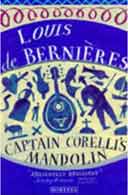
Captain Corelli’s Mandolin

By Anita Mathias

Captain Corelli’s Mandolin


It’s so much easier and quicker to watch the movie than read the book I land up watching the film version of many books I have wanted to read. I enjoyed Captain Corelli’s Mandolin, the movie. I knew nothing of the German massacre of the Italian troops, or the Italian occupation of Greece (It’s been decades since A level history!) so I spent an enjoyable half hour on the net afterwards filling in my historical gaps.  

The novel sounds really interesting. I love polyphonic novels, likeSound and Fury and piecing together a complete picture from the fragments of things people say, a bit like listening to gossip. I look forward to reading it. Here’s a tantalizing review.

The different sounds of the mandolin

John Mullan on the ironies imbued in the polyphonic voices of Captain Corelli’s Mandolin by Louis de Bernières
  • John Mullan
    • John Mullan
    • The Guardian, Saturday 25 August 2007
    • Article history
Captain Corelli's Mandolin by Louis de Bernieres
Buy Captain Corelli’s Mandolin at the Guardian bookshop
On the feast day of St Gerasimos, patron saint of the Greek island of Cephalonia, the mummified remains of the holy man are paraded and the islanders become “outlandishly drunk”. (The first detail from Louis de Bernières’s Captain Corelli’s Mandolin is confirmed by the Greek tourist board; the latter is the novelist’s embellishment.) In the novel, troupes from different towns loudly strike up rival songs, some fishermen from Panago-poula miraculously managing, over the chatter of the crowd and the crashing of a cannon, to weave “a harmony intricate and polyphonic”. “The brotherhood of the sea,” declares the narrator, in imitation of the fishermen’s bibulous self-congratulation, has produced “conclusive proof of their metaphysical unity”.
It is also comically analogous to the novel’s narrative method. Its 73 short chapters move rapidly between different characters, historical as well as invented. Dr Iannis, his daughter Pelagia, and Captain Corelli, the Italian soldier billeted in their house during the wartime occupation, may be the central characters, but we hear many different narrative voices, some first-person and some third-person. The former include a chapter of dramatic monologue given to Mussolini, posing in front of a mirror; the interior monologues of Pelagia; and Mandras, the fisherman who is courting her; and chapters headed “L’Omosessuale”, narrated by the secretly homosexual Italian soldier, Carloi Guercio. “Thank God no one reads my mind,” says Pelagia silently, as she reviews her own “sluttish thoughts”. But we do.
Different voices find many forms. There are letters; there are political diatribes; there are speeches and sermons. Equally, the chapters of third-person narrative reflect many different viewpoints. Most often we see events through the eyes of Iannis, or Pelagia, or Corelli, but free indirect style gives us the thoughts of many others, from Mina, the mad girl who is to be “cured” by Saint Gerasimos, to Lieutenant Weber, the “good Nazi”, confused by the habits of his Italian allies. The collection of narratives is made to enact an understanding of human variety.
It is a novel not just of different narrative voices and points of view, but also of different languages. It uses fragments of Italian, French, German (and transliterated Greek), but mostly it has to represent the different languages, and the mutual misunderstandings, of the characters in a language that none of them are using: English. (Though if Iannis and his daughter were not fluent in Italian, a language for which the doctor has always had an inflated regard, and therefore able to have all their disputes with Corelli, the novel would not have been possible.) Incomprehension is invariably comical. An Eton-educated British agent is introduced to Iannis and made to speak a Chaucerian English that is the novel’s equivalent of the classical Greek he employs. “Sire, of youre gentillesse, by the leve of yow wol I speke in pryvetee of certeyn thyng,” is his opening gambit. “What?” replies the bewildered doctor, speaking in a fluent, colloquial English which is the novel’s equivalent of modern Greek. When he and the Englishman agree to converse in English, Iannis’s speech becomes broken and ungrammatical: “You accent terrible-terrible. Not to talk, understand?”
The book’s ebullient varieties of speech and narrative make it tempting to call it a “polyphonic novel”. The term was invented by the Russian literary theorist Mikhail Bakhtin in the 1920s to describe Dostoevsky’s fiction. Bakhtin praised Dostoevsky for rendering “a plurality of unmerged voices and consciousnesses”. He had in mind the novelist’s willingness to allow his characters’ words and attitudes to predominate over any authorial insights. (Would Captain Corelli’s Mandolin always qualify by this test? De Bernières’s novel includes passages where a narrator tells us things -such as future events – that none of his characters can know.) Bakhtin initially claimed that Dostoevsky had originated “a fundamentally new novelistic genre”, before later deciding that he had instead perfected what had always been a subversive inclination of most interesting fiction.
Bakhtin valued “polyphony” because it seemed a rebellion against the narrative habits of 19th-century fiction (and implicitly the strictures of the socialist realism being recommended in the Soviet Union). Now it hardly seems revolutionary. Indeed, the opening of a single novel to multiple narrators and viewpoints has become relatively common in recent fiction, and “polyphonic” has become a frequent description. The literary novel that narrates in the singular, reliable “voice” of its author (which Bakhtin would have called “monologic”) is nowadays a much rarer thing. Some, like David Lodge, have argued that this reflects the contemporary novel’s lack of trust in its ability to understand the world. Yet the success of De Bernières’s novel is to find in narrative variety not confusion, but comedy and consolation.


Delicious Bookmark this on Delicious

Filed Under: books_blog, Fiction

Theophanies: St John at Patmos, A Sermon at St. Aldate’s

By Anita Mathias

St John at Patmos,

John’s vision of Patmos (a vision rather than a theophany, incidentally!)

Among the lampstands was someone “like a son of man,” dressed in a robe reaching down to his feet and with a golden sash around his chest.14His head and hair were white like wool, as white as snow, and his eyes were like blazing fire. 15His feet were like bronze glowing in a furnace, and his voice was like the sound of rushing waters. 16In his right hand he held seven stars, and out of his mouth came a sharp double-edged sword. His face was like the sun shining in all its brilliance.
 17When I saw him, I fell at his feet as though dead. Then he placed his right hand on me and said: “Do not be afraid. I am the First and the Last. 18I am the Living One; I was dead, and behold I am alive for ever and ever! And I hold the keys of death and Hades.

John was exiled to Patmos. Ostensibly, the end of influence, the end of his ministry, the end of his life. His life had ended. (I have so often felt like that, that my life as I had envisioned it has come to to a dead end, and failed!).

Yet, because of the word of God, which can be spoken even in the absence of the written Scripture, when you think your influence and ministry is over, it can be the strongest. (Another example is the wonderful, soul-nourishing letters Paul wrote in the desert of prison.)

(Patmos was hot and barren, incidentally. It informed John’ss vision of heaven–Never again will they hunger;
never again will they thirst.
The sun will not beat upon them,
nor any scorching heat.
For the Lamb at the center of the throne will be their shepherd;
he will lead them to springs of living water.
And God will wipe away every tear from their eyes.”)

And in this desert place, in this wilderness season, he received a vision of God, and it made everything different. He saw Christ--pure, passionate, powerful, eternal, beautiful.

And with the the Revelation, the despised, forgotten, powerless prisoner becomes a prophet and a pastor, a pastor for the ages, as the best spiritual writers are.

The most important things happen on the inside.Our spiritual life is the most important dimension of our lives–not the intellectual, not the physical, not even love and friendship.

And these are the words Christ said to John which changed everything
“Do not be afraid.
I am the Alpha and the Omega. I encompass everything.
The alphabet, all human learning, everything that happened, is happening, can happen, and will happen, is in my hands.
I am the Living One.
And I see you. I control your life, and I will control your death.”

John gains strength. The powerless prisoner becomes a writer and a prophet with a gift for 21 centuries.

And everything can change in the desert, for there you have the best possible conditions for seeing God.

Filed Under: random

  • « Previous Page
  • 1
  • …
  • 13
  • 14
  • 15
  • 16
  • 17
  • …
  • 89
  • Next Page »

Sign Up and Get a Free eBook!

Sign up to be emailed my blog posts (one a week) and get the ebook of "Holy Ground," my account of working with Mother Teresa.

Join 536 Other Readers

My Books

Rosaries, Reading, Secrets: A Catholic Childhood in India

Rosaries, Reading Secrets, B&N
USA

UK

Wandering Between Two Worlds: Essays on Faith and Art

Wandering Between Two Worlds
USA

UK

Francesco, Artist of Florence: The Man Who Gave Too Much

Francesco, Artist of Florence
US

UK

The Story of Dirk Willems

The Story of Dirk Willems
US

UK

My Latest Meditation

Anita Mathias: About Me

Anita Mathias

Read my blog on Facebook

Follow me on Twitter

Follow @anitamathias1

Recent Posts

  • At the Cross, God Forgives Us Completely
  • Using God’s Gift of Our Talents: A Path to Joy and Abundance
  • The Kingdom of God is Here Already, Yet Not Yet Here
  • All Those Who Exalt Themselves Will Be Humbled & the Humble Will Be Exalted
  • Christ’s Great Golden Triad to Guide Our Actions and Decisions
  • How Jesus Dealt With Hostility and Enemies
  • Do Not Be Afraid, but Do Be Prudent
  • For Scoundrels, Scallywags, and Rascals—Christ Came
  • How to Lead an Extremely Significant Life
  • Don’t Walk Away From Jesus, but if You Do, He Still Looks at You and Loves You
Premier Digital Awards 2015 - Finalist - Blogger of the year
Runner Up Christian Media Awards 2014 - Tweeter of the year

Categories

What I’m Reading


Wolf Hall
Hilary Mantel

Wolf Hall --  Amazon.com
Amazon.com

Amazon.co.uk

Silence and Honey Cakes:
The Wisdom Of The Desert
Rowan Williams

Silence and Honey Cakes --  Amazon.com
Amazon.com

Amazon.co.uk

The Long Loneliness:
The Autobiography of the Legendary Catholic Social Activist
Dorothy Day

The Long Loneliness --  Amazon.com
Amazon.com

Amazon.co.uk

Country Girl
Edna O'Brien

Country Girl  - Amazon.com
Amazon.com

Amazon.co.uk

Archive by month

My Latest Five Podcast Meditations

INSTAGRAM

anita.mathias

My memoir: Rosaries, Reading, Secrets https://amzn.to/42xgL9t
Oxford, England. Writer, memoirist, podcaster, blogger, Biblical meditation teacher, mum

Looking at photos from our week in beautiful Sevil Looking at photos from our week in beautiful Seville and Cordoba over New Year with Irene, who had a week off.
And, ICYMI, here’s my latest meditation on the Gospel of Matthew… I’ve recorded it, should you want a few minutes of peace.
https://anitamathias.com/2026/04/29/gods-complete-forgiveness/
Hello Friends, I'm resumed recording my meditation Hello Friends, I'm resumed recording my meditations on the Gospel of Matthew. Do click on this link to listen. 
https://anitamathias.com/.../29/gods-complete-forgiveness/
Christ is the most influential figure in the history of the world, though his life ended in shame, humiliation and failure. But he so completely turned things round in his great reversal that the cross on which he died when all seemed hopeless is now the most common, and revered, symbol in history.
He emerged from and was anchored in Judaism. And as the sins of the people were laid on the scapegoat who was sent into the wilderness to perish, Christ died as the lamb of God voluntarily bearing the guilt of the wrongdoing of the whole world. He paid the price for our forgiveness with his life-blood--in accordance with the iron law of the physical and moral universe, of sowing and reaping, cause and effect. 
And so, God, who appeared as flames of fire to Moses, can now dwell within us, purifying us, whose hearts have darkness and shards of ice. 
And now that Christ was crucified, died, but rose again, His Spirit, no longer contained within his earthly body, is poured out like living water onto all humans, at our humble request. The Spirit pours the love of God into us; he reminds us of the words of Jesus and slowly writes Christ’s sweet law on our hearts. This transfusion of grace helps us do hard things we previously couldn’t do. Our dance with the Spirit gradually breaks the power of sin over us. It transforms us.
Now we, the forgiven, protected by the blood of Jesus poured out over us, and filled with His Spirit, who sings within us, Abba, Father, are adopted by God as his children in his joyful new covenant. We are cells grafted into the vine of our new family--Father, Son, Spirit—who now live in us as we live in them. As we choose by our thoughts and actions to continue living in the vine of Jesus, their energy pulsing through us makes us fruitful. And now, all our prayers which flow in the river of God’s good purposes are kindly heard. Waves of love and power flood from the cross! 
Thank you!
Well, hello friends! Breaking radio silence to let Well, hello friends! Breaking radio silence to let you know that I have taped a meditation for you on Christ’s famous Parable of the Talents in Matthew 25. https://anitamathias.com/2025/11/05/using-gods-gift-of-our-talents-a-path-to-joy-and-abundance/
Here you are, click the play button in the blog post for a brief meditation, and some moments of peace, and, perhaps, inspiration in your day 🙂
Hi Friends, I have taped a meditation; do listen a Hi Friends, I have taped a meditation; do listen at this link: https://anitamathias.com/2025/04/08/the-kingdom-of-god-is-here-already-yet-not-yet-here-2/
It’s on the Kingdom of God, of which Christ so often spoke, which is here already—a mysterious, shimmering internal palace in which, in lightning flashes, we experience peace and joy, and yet, of course, not yet fully here. We sense the rainbowed presence of Christ in the song which pulses through creation. Christ strolls into our rooms with his wisdom and guidance, and things change. Our prayers are answered; we are healed; our hearts are strangely warmed. Sometimes.
And yet, we also experience evil within & all around us. Our own sin which can shatter our peace and the trajectory of our lives. And the sins of the world—its greed, dishonesty and environmental destruction.
But in this broken world, we still experience the glory of creation; “coincidences” which accelerate once we start praying, and shalom which envelops us like sudden sunshine. The portals into this Kingdom include repentance, gratitude, meditative breathing, and absolute surrender.
The Kingdom of God is here already. We can experience its beauty, peace and joy today through the presence of the Holy Spirit. But yet, since, in the Apostle Paul’s words, we do not struggle only “against flesh and blood, but against the rulers, against the unseen powers of this dark world and against the spiritual forces of evil,” its fullness still lingers…
Our daughter Zoe was ordained into the Church of E Our daughter Zoe was ordained into the Church of England in June. I have been on a social media break… but … better late than never. Enjoy!
First picture has my sister, Shalini, who kindly flew in from the US. Our lovely cousins Anthony and Sarah flank Zoe in the next picture.
The Bishop of London, Sarah Mullaly, ordained Zoe. You can see her praying that Zoe will be filled with the Holy Spirit!!
And here’s a meditation I’ve recorded, which you might enjoy. The link is also in my profile
https://anitamathias.com/2024/11/07/all-those-who-exalt-themselves-will-be-humbled-the-humble-will-be-exalted/
I have taped a meditation on Jesus statement in Ma I have taped a meditation on Jesus statement in Matthew 23, “For those who exalt themselves will be humbled, and those who humble themselves will be exalted.”
Do listen here. https://anitamathias.com/2024/11/07/all-those-who-exalt-themselves-will-be-humbled-the-humble-will-be-exalted/
Link also in bio.
And so, Jesus states a law of life. Those who broadcast their amazingness will be humbled, since God dislikes—scorns that, as much as people do.  For to trumpet our success, wealth, brilliance, giftedness or popularity is to get distracted from our life’s purpose into worthless activity. Those who love power, who are sure they know best, and who must be the best, will eventually be humbled by God and life. For their focus has shifted from loving God, doing good work, and being a blessing to their family, friends, and the world towards impressing others, being enviable, perhaps famous. These things are houses built on sand, which will crumble when hammered by the waves of old age, infirmity or adversity. 
God resists the proud, Scripture tells us—those who crave the admiration and power which is His alone. So how do we resist pride? We slow down, so that we realise (and repent) when sheer pride sparks our allergies to people, our enmities, our determination to have our own way, or our grandiose ego-driven goals, and ambitions. Once we stop chasing limelight, a great quietness steals over our lives. We no longer need the drug of continual achievement, or to share images of glittering travel, parties, prizes or friends. We just enjoy them quietly. My life is for itself & not for a spectacle, Emerson wrote. And, as Jesus advises, we quit sharp-elbowing ourselves to sit with the shiniest people, but are content to hang out with ordinary people; and then, as Jesus said, we will inevitably, eventually, be summoned higher to the sparkling conversation we craved. 
One day, every knee will bow before the gentle lamb who was slain, now seated on the throne. We will all be silent before him. Let us live gently then, our eyes on Christ, continually asking for his power, his Spirit, and his direction, moving, dancing, in the direction that we sense him move.
Link to new podcast in Bio https://anitamathias.co Link to new podcast in Bio https://anitamathias.com/2024/02/20/how-jesus-dealt-with-hostility-and-enemies/
3 days before his death, Jesus rampages through the commercialised temple, overturning the tables of moneychangers. Who gave you the authority to do these things? his outraged adversaries ask. And Jesus shows us how to answer hostile questions. Slow down. Breathe. Quick arrow prayers!
Your enemies have no power over your life that your Father has not permitted them. Ask your Father for wisdom, remembering: Questions do not need to be answered. Are these questioners worthy of the treasures of your heart? Or would that be feeding pearls to hungry pigs, who might instead devour you?
Questions can contain pitfalls, traps, nooses. Jesus directly answered just three of the 183 questions he was asked, refusing to answer some; answering others with a good question.
But how do we get the inner calm and wisdom to recognise
and sidestep entrapping questions? Long before the day of
testing, practice slow, easy breathing, and tune in to the frequency of the Father. There’s no record of Jesus running, rushing, getting stressed, or lacking peace. He never spoke on his own, he told us, without checking in with the Father. So, no foolish, ill-judged statements. Breathing in the wisdom of the Father beside and within him, he, unintimidated, traps the trappers.
Wisdom begins with training ourselves to slow down and ask
the Father for guidance. Then our calm minds, made perceptive, will help us recognise danger and trick questions, even those coated in flattery, and sidestep them or refuse to answer.
We practice tuning in to heavenly wisdom by practising–asking God questions, and then listening for his answers about the best way to do simple things…organise a home or write. Then, we build upwards, asking for wisdom in more complex things.
Listening for the voice of God before we speak, and asking for a filling of the Spirit, which Jesus calls streams of living water within us, will give us wisdom to know what to say, which, frequently, is nothing at all. It will quieten us with the silence of God, which sings through the world, through sun and stars, sky and flowers.
Especially for @ samheckt Some very imperfect pi Especially for @ samheckt 
Some very imperfect pictures of my labradoodle Merry, and golden retriever Pippi.
And since, I’m on social media, if you are the meditating type, here’s a scriptural meditation on not being afraid, while being prudent. https://anitamathias.com/2024/01/03/do-not-be-afraid-but-do-be-prudent/
A new podcast. Link in bio https://anitamathias.c A new podcast. Link in bio
https://anitamathias.com/2024/01/03/do-not-be-afraid-but-do-be-prudent/
Do Not Be Afraid, but Do Be Prudent
“Do not be afraid,” a dream-angel tells Joseph, to marry Mary, who’s pregnant, though a virgin, for in our magical, God-invaded world, the Spirit has placed God in her. Call the baby Jesus, or The Lord saves, for he will drag people free from the chokehold of their sins.
And Joseph is not afraid. And the angel was right, for a star rose, signalling a new King of the Jews. Astrologers followed it, threatening King Herod, whose chief priests recounted Micah’s 600-year-old prophecy: the Messiah would be born in Bethlehem, as Jesus had just been, while his parents from Nazareth registered for Augustus Caesar’s census of the entire Roman world. 
The Magi worshipped the baby, offering gold. And shepherds came, told by an angel of joy: that the Messiah, a saviour from all that oppresses, had just been born.
Then, suddenly, the dream-angel warned: Flee with the child to Egypt. For Herod plans to kill this baby, forever-King.
Do not be afraid, but still flee? Become a refugee? But lightning-bolt coincidences verified the angel’s first words: The magi with gold for the flight. Shepherds
telling of angels singing of coming inner peace. Joseph flees.
What’s the difference between fear and prudence? Fear is being frozen or panicked by imaginary what-ifs. It tenses our bodies; strains health, sleep and relationships; makes us stingy with ourselves & others; leads to overwork, & time wasted doing pointless things for fear of people’s opinions.
Prudence is wisdom-using our experience & spiritual discernment as we battle the demonic forces of this dark world, in Paul’s phrase.It’s fighting with divinely powerful weapons: truth, righteousness, faith, Scripture & prayer, while surrendering our thoughts to Christ. 
So let’s act prudently, wisely & bravely, silencing fear, while remaining alert to God’s guidance, delivered through inner peace or intuitions of danger and wrongness, our spiritual senses tuned to the Spirit’s “No,” his “Slow,” his “Go,” as cautious as a serpent, protected, while being as gentle as a lamb among wolves.
Follow on Instagram

© 2026 Dreaming Beneath the Spires · All Rights Reserved. · Cookie Policy · Privacy Policy