THE BLUE BEDSPREAD by RAJ KAMAL JHA
A very quick read, in an experimental minimalist style, mining the territory opened up by Arundhati Roy–incest and familial sexual abuse. Do these things really happen in India? I remember the shock I felt as an 18 year old when a maid working for one of the leading and pious Catholic families in town, told me her employer regularly pawed and propositioned her. What? How could it be? I thought in shock and revulsion.
“The Blue Bedspread” is a self-conscious novel, of course, though written in the clear, transparent style that conceals art. The story is told in a series of Faulknerian flashbacks. The tension and sadness build relentlessly. I read it quickly, and it maintained my interest throughout. If you are interested in style, and experimentation with it, and in unusual novels, which are, nevertheless, a quick read, this slim novel will probably be worth your while.
 Bookmark this on Delicious
The Glass Palace by Amitav Ghosh
The Glass Palace by Amitav Ghosh
An old-fashioned, multi-generational novel, it tells a story, as E.M. Forster tiredly remarked. Oh yes, it tells a story.
The story is set in Burma, around the time the British ruthlessly conquered it, sending the Royal Family into exile in India. A new breed of Indian entrepreneurs flooded Burma, making fortunes in a the dazzling new world of the gentle Burmese.
The central romance of the novel is the story of a self-made entrepreneurial Indian who become a millionaire in the rapidly changing Burma–teak!! rubber!!–and a gentle Burmese girl, essentially a mystic, who rather reluctantly, becomes his wife, though she ultimately gratefully escapes into a Buddhist monastery.
The novel spans a century, through the Second World War and the brutal Japanese invasion of Burma, ending with the equally brutal and mindless coming to the power of the current junta, and a cameo of the gentle Aung San Suu Kyi.
It’s fun, it’s relaxing, you learn an enormous amount. If you have nothing better to do, forget everything and curl up with this well-spun and well-written tale–when you have a couple of days free!!
The White Darkness by Geraldine McCaughrean
The White Darkness by Geraldine McCaughrean
We listened to this on CD during our holiday in France recently. We were mesmerized initially but the tale of misadventure and extreme polar suffering did pall eventually.
Splendid description of Antarctica. I met Geraldine McCaughrean at a Writers in Oxford/Society of Authors party in Oxford a couple of months ago, and asked her if she had been to Antarctica. “No,” she said, laughing and shaking her head, as if the suggestion were ridiculous.
That’s encouraging to me–that one can write such a vivid novel, based on research and imagination.
She is evidently steeped in the literature of polar exploration –Scott, Shackleton, Apsley Cherry-Garrard, Amundsen, Mawson. (Incidentally, all these five authors have been republished by the publishing company my husband and I own, Benediction Classics). I loved the seamless way she links this zany, doomed expedition with those of Scott, Cherry-Garrard, Amundsen and Shackleton. I particularly loved Shackleton’s quote in a letter to his wife when he turned back 97 miles from the Pole, “I thought you would rather have a live donkey than a dead lion!!”
All in all, a gripping thrilling young adult novel
“The God of Small Things” by Arundhati Roy
Hmm. I admire this book. It is exquisitely well-constructed. It is original. I love the way Roy plays with language and creates a language of her own. I love her vivid descriptions, and the exactitude and verisimilitude of her childhood memories. I can relate to what she mentions–the Indian childhood; the passion for “The Sound of Music;” the mean, very mean female relatives whose greed and pettiness eventually drove them crazy; the casual, mean and cruel bullying of children, especially free spirits; the repressive and pervasive smallness of mind that can drive free spirits crazy; the favouring of males. Oh overall, the sadness of it, the waste through repression and conformity of what might have been.
Having mentioned these things, it is not surprising that I found it very painful to read. The casual sacrifice and brutalizing of the lower-caste lover was unbearably painful, and then the subsequent ostracism of Ammu herself, which drove her to her early death; traumatized her son, so that he parted with his sanity; and left her daughter barely functioning, though traumatized. And then, the stereotypical vicious unmarried aunt, the villianness of the piece, who inherits all the gold–and wears it all at once, driven to a kind of craziness by her unrestrained greed.
I do recommend it, but will probably not read it again myself. It rouses a flood of anger and inchoate memories in me, all of it painful!
A River Runs Through it by Norman Maclean
A River Runs Through it by Norman Maclean.
I first heard about this book from the legendary editor Ted Solotaroff whom I met at the Squaw Valley Writers Conference, California
“Not many,” Ted replied, but then mentioned Norman Maclean, his teacher at the University of Chicago
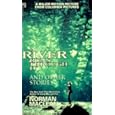 And what a book! It was as if Maclean was storing up the strength and sweetness of a life-time. I love its smooth, lyrical surface, its elegiac tone, its pitch-perfect writing, its old world Scottish restraint, its depiction of the unbreakable bonds of family love in a family with very different characters.
The central character is Maclean’s troubled younger brother Paul who breaks his family’s hearts and his own heart and life—all without severing the basic bonds of family love. And a River Runs Through It—fly-fishing, Montana
It is a short book, a novella, really, and a rich, rewarding, sad and beautiful one.
Anita Mathias
Cider with Rosie–A Perfectly Constructed and Exquisitely Written Memoir
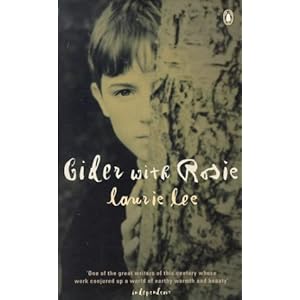 Cider with Rosie–A Perfectly Constructed and Exquisitely Written Memoir
Cider with Rosie by Laurie Lee
I am in the second or third draft of my own memoir, and have finally solved the problem of structure, I believe.
However, when you come across a memoir whose structure is sheer genius what can your jaw do but drop?
I have loved Cider with Rosie for well over a decade. Laurie Lee’s writing in patches is so exquisite, so perfect, it almost makes me want to cry with pleasure. He writes of his mother, of her invincible childlike gaiety and good nature, a kind, noble soul, betrayed and abandoned by the husband who was the love of her life, whose sudden death tilted her over into dementia, “Her flowers and songs, her unshaken fidelities, her attempts at order, her relapses into squalor, her near madness, her crying for light, her almost daily weeping for her dead child-daughter, her frisks and gaieties, her fits of screams, her love of man, her hysterical rages, her justice towards each of us children – all these rode my Mother and sat on her shoulders like a roosting of ravens and doves.”
Rilke writes to a young poet, “If your daily life seems poor, do not blame it; blame yourself, tell yourself that you are not poet enough to call forth its riches; for to the creator there is no poverty and no poor indifferent place.” Lee’s childhood was provincial, disadvantaged, poor. There was no Eton-Oxford hothouse, no indication that he should or would become a writer. Yet become one he did.
His childhood was lacking in the events which might provide a biographer’s chapters, unlike say Thomas Merton’s or Vladimir Nabokov’s, (two writers I’ve reviewed on this blog.) He therefore constructs his memoir as self-contained essays. “First Light,” setting the scene in his cottage in Gloucestershire, “First Names,” describing his family, and the characters of his village; “The Kitchen,” “Village School,” very mediocre at best, full of eccentric teachers; “Public Death, Private Murder,” of a murder of a bragging Kiwi, over which the entire village was complicit, and silent; Seasons, Relatives, Sex.
All the staples of memoir–but irradiated and backlit by prose which, as Walter Pater says is true of all art, “aspires to the condition of poetry”. Never to be forgotten, that first long secret drink of golden fire, juice of those valleys and of that time, wine of wild orchards, of russet summer, of plump red apples, and Rosie’s burning cheeks. Never to be forgotten, or ever tasted again… The old people in his village are “ – white-whiskered, gaitered, booted and bonneted, ancient-tongued last of their world, who thee’d and thou’d both man and beast, called young girls ‘damsels’, young boys ‘squires’, old men ‘masters’, the Squire himself ‘He’ and who remembered the Birdlip stagecoach, Kicker Harris the old coachman…”
I have read it a couple of times, and listened to it read by Laurie Lee himself a couple of times. I would highly recommend the audio version. What Laurie heard in his head as he wrote Cider was music, the music spoken with a soft Gloucestershire burr, and the listening to the roll of his sonorous cadences is a delightful and memorable experience.
http://thegoodbooksblog.blogspot.com/2010/08/speak-memory-by-vladimir-nabokov.html
http://thegoodbooksblog.blogspot.com/2010/07/seven-storey-mountain-by-thomas-merton.html
Jan Morris on Travels in Arabia Deserta by Charles M Doughty
Jan Morris on Travels in
This is a book I intend to read soon.
“Not many books can claim to be entirely unique, but one of them is undoubtedly Charles Montague Doughty’s Travels in Arabia Deserta, which he wrote in 1888 when he was 45 years old. It is unique in its subject matter – the first book to be written, in any language, about wide tracts of the
Except, perhaps, in parody, for Doughty’s literary style was itself a sort of inspired pastiche of far older forms. He believed that, by his time, the English language had become decadent, and he was dedicated to restoring its ancient glories. Chaucer and Spenser were his inspirations, and his own interpretation of their splendours was lyrical, high-flown and stately. He had already spent 10 years writing an enormous blank-verse epic about the origins of
Some readers find his convoluted cadences and idioms too demanding. Others, like me, have learnt over the years to think of it as music, grandly lyrical and rhythmic. And such is the extraordinary nature of the book that others have found its style perfectly redolent of its subject – the magnificent mysteries of the empty desert. TE Lawrence, Lawrence of Arabia, declared that the book would always remain peerless as “the indispensable foundation of all true understanding of the desert”.
So, whether for the strange beauty of its language, its record of a tremendous adventure, or its accurate evocation of a landscape and a civilisation, Arabia Deserta is truly one of a kind. For a long answer to that old friend’s question, expressed in a prose that is one of the esoteric glories of English literature, read the book, dear reader, read the book.”
“Speak Memory” by Vladimir Nabokov
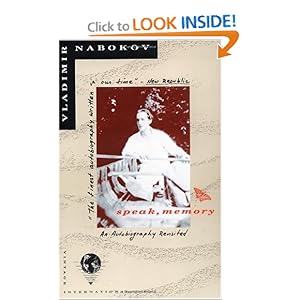 Speak Memory, by Vladimir Nabokov
“Speak Memory” by Vladimir Nabokov is perhaps the most elegant memoir ever written. It is also my favourite memoir,and one of my favourite books.
Nabokov’s prose is so beautiful, that all one can do is sigh. My copy has vanished somewhere in my piles of books in the course of many moves, but when I find it, I will type some sentences out.
Nabokov wrote his book in English, of course, but he was trilingual (Russian, French and English) from an early age, and his English has the sort of contorted, pretzel-like strangeness one frequently finds in the (perfectly correct) English prose of the bi-lingual–I think of the prose of Sara Suleri and Salman Rushdie and Arundhati Roy.
Nabokov describes, as one of his chapter titles puts it, a “Past Perfect,” a happy Russian boyhood, with books, and governesses, and wealth, and adoration, and time to pursue his many interests–butterflies, chess, books.
He was brilliant, and more importantly, blessed with a relatively easy-going temperament that enabled him to take the massive reverses of the Russian Revolution in his stride without bitterness, but with a philosophic, even amused, equanimity. That same essential stability of temperament enabled a happy and nourishing marriage amid all the vicissitudes of the emigre’s life.
If anything, being forced to produce literature to keep afloat sharpened the saw, but to his credit, did not blunt the oddness in him that gave him the courage to produce that most odd but stylistically and linguistically beautiful and heartbreaking book, “Lolita.”
A wonderful portrait of a vanished world! Full of sunlight and butterfly filled fields, and books and love!
And here, across the Atlantic is a similar childhood, Thomas Merton’s in The Seven Storey Mountain!
http://wanderingbetweentwoworlds.blogspot.com/2010/07/seven-storey-mountain-by-thomas-merton_16.html