Anita Mathias: Dreaming Beneath the Spires

Anita Mathias's Blog on Faith and Art

  • Home
  • My Books
  • Meditations
  • Essays
  • Contact
  • About Me

What do I really want?

By Anita Mathias

Image credit

“Do I really want to?” I was mentored by a wonderful woman, Lolly,who had the age of 80 started asking herself this question.
She had been to Bible College, and became a minister’s wife at 22. So all her life, she would think, “Should I? Ought I? Is it my duty? Would God want me to? Would people expect me to? Would people be hurt if I didn’t? Would people be happy if I did? Can I encourage someone?”
When she was 80, she was invited to a big happening event in Williamsburg, Virginia. One of the richest families had adopted a child, and had a christening in the poshest hotel in town. It was going to be very posh, very exclusive, money was going to flow. The pastor of our church was invited, and was going happily. He was appalled when he found out that Lolly had been invited too, and declined, though she was also mentoring the adoptive mother.
“Why did you decline?” I asked. This was ten years ago, and I am ashamed to say I used to go to events like this, fund-raising dinners at $1000 a plate, if invited (and paid for!) for silly reasons like the prestige, the cachet, the name-dropping later, being “in.”
“Oh, I couldn’t be bothered,” she said. “I’d rather stay in and read. I am 80 years old. I have done what other people have wanted for most of my life. It’s high time I start asking myself what I really want to do.”
* * *
What do I really want to do? Well, what I really want to do most of the time is read and write and think and pray. I am turning down more and more social invitations, party invitations to do just this after slowing down and asking myself “What do I reallywant to do?”
Isn’t it surprising that so many of us live life on auto-pilot, do what’s expected, fall in with other people’s plans, desires and expectations without asking ourselves what we really want to do?
That’s not to say we shouldn’t do ministry. My first spiritual director suggested that I always have at least one person in my life to whom I give, spend time with, serve, without getting anything in return. He never said why, but I think it’s a good discipline if your work and ministry are visible, as mine are, and give you lots of feedback, attention, affirmation and praise! It keeps you real and humble. I have been given someone to whom I can be a blessing, and I am excited about it. (Of course, it’s someone who will be a blessing to me in turn….but God’s good like that!).
* * *
Where is my heart? What do I really want to do? What am I really excited about? Where are my passions?
Funny how people stop asking these questions.
To celebrate life together, to be together in community, to simply enjoy the beauty of creation, the love of people, and the goodness of God—these seem faraway ideals. There seem to be a mountain of obstacles preventing people from being where their hearts want to be. It is so painful to watch and experience. The astonishing thing is that the battle for survival has become so “normal” that few people really believe it can be different.”
                                                                      Henri Nouwen, Seeds of Hope
Why do we do this to ourselves? Why do we constantly say No to our hearts, defer gratification? Why choose duty, and the unimportant shoulds over joy?
Too long a sacrifice
Can make a stone of the heart. W. B. Yeats
                                                                  * * *
 I am listening to The Sacred Romance by John Eldredge (which was recommended, incidentally by Lolly, who loved it) on my iPhone, in little scraps of time, here and there, as I do housework.
Somewhere along the way, we have lost heart. We do things without much enthusiasm, without much joy, in a half-souled way. We become dominated by Shoulds and Oughts, Eldredge said.
 If I am doing things listlessly, mechanically, going through the motions, without much joy, I wonder if I am either not doing what God intended, or I am, but I have lost the way.
For instance, I am called to blog, but when blogging becomes a burden, a heaviness, it interesting to ask why. It’s almost always because I am not following my heart. My real interests may lie in little, short, not terribly significant posts like this one. But fear may say, “No. That’s boring!!  Write something interesting, significant, ninja-like, meaty, on an important subject.” Say this too often, and you begin to develop blogger’s block, or blogger’s dreariness. Deny your impulses, the little 250 word posts you really want to write, and blogging becomes a burden, a duty, work, rather than joy.
It’s the same with anything. Our hearts give us a clue to who we really are, what we really enjoy doing, what makes us come alive. And yet how often people deny themselves their heart’s desire, stifle it, ignore it, until they get out of the habit of asking themselves what they really like doing, what really makes them come alive.
Two last thoughts, both true (up to a point).
“Don’t ask yourself what the world needs, ask yourself what makes you come alive. And then go and do that. Because what the world needs is people who are alive.” – Howard Thurman
“The vocation God calls you to is the place where your deep gladness and the world’s deep hunger meet.” ― Frederick Buechner, Wishful Thinking: A Theological ABC


Filed Under: random

Is it more important for Christian bloggers to be nice or to be real (if they can’t be both)?

By Anita Mathias

I read Ann Voskamp a few times a month. What impresses me is that she is so unremittingly inspiring, so high-minded, so noble.
Hmm.  When I began to write a Christian blog, my goal was that every post of mine would be a blessing to my readers. My strapline said something like that.
Within a few months, there was a damaging and public case of spiritual abuse in the Charismatic church I was attending. I satirized this abuse of power and their neurotic high-control strategies in a series of blog-posts called, “The Screwtape Lectures.” The Rector visited, and asked me to take them down. The Warden called and asked me, “How can these posts be a blessing?”
So I was faced with a serious writing question. Should I only write “what is helpful for building people up so that it may edify those who read?” Do I myself want to read a blog written purely to edify me? Well, if it’s John Piper (well, the majority of his posts) okay.  But on the whole, I would avoid such a blog. What I am interested in, you see, is the truth and the whole truth.
I changed my strapline. I don’t want to promise my reader that every post will be a blessing (though that would be nice) but that every post will be honest and truthful (insofar as I can discern truth).
* * *
 I’ve lived in England for 11 years now, and it seems every Christian’s mum used to tell them variations of “If you can’t say something nice, then don’t say anything at all.” Or “Is it kind, is it necessary, is it true?”
Well, take it from me, people who follow this rule may be very nice people, indeed, but it’s unlikely that they are going be very interesting and gripping bloggers.
Why? Well, if I were only to share my inspiring thoughts in my blog, and not my questions; only my heights of faith, and not my fears; only my joys and not my sorrows; only the times when I love church, not the times I am stricken and wounded by it; only the times when I am wide-eyed and optimistic and full of wonder about the nobility and loveliness of Christians, and not the times when I feel very sceptical and cynical indeed—well, that would be like skipping every third or fourth page of the story of my life.
That would make for annoying reading, wouldn’t it? I cannot read blogs which do this. Where everything is upbeat, everything is edifying and preachy, everything has a neat lesson. I feel they are concealing something: the truth.
The truth of what is really like to be them. To be human. To love. But to struggle to forgive hateful behaviour. To love the church, but to be back-stabbed, slandered and betrayed by members of your church. To love Scripture, but struggle with its elementary precepts like love and forgiveness.
As a Christian blogger, we have two gifts to offer people—our real selves, mess and all, and Christ. If you really trust someone, you will follow his treasure map to the buried treasure in Himalayas. If not, not. By being honest about ourselves, our readers grow to trust us.
Yes, one can be unpleasant and use strong, cutting language and yet be a true Christian.  See Paul: Watch out for those dogs, those evildoers, those mutilators of the flesh. Phil 3:2  As for those agitators, I wish they would go the whole way and emasculate themselves! (Gal 5:12)
In fact, one can be unpleasant and use strong, vivid, biting, cutting language, and be Christ.  Matt 12: 34 You brood of vipers, how can you who are evil say anything good? Matthew 23:27 Woe to you, teachers of the law and Pharisees, you hypocrites! You are like whitewashed tombs, which look beautiful on the outside but on the inside are full of dead men’s bones and everything unclean.
Jesus and Paul. They didn’t have anything nice to say, or anything kind to say, but they had something necessary to say, and they said it.
If no one speaks out about spiritual abuse, it will continue. If no one speaks out against people who “fleece” God’s sheep for financial gain, that too will continue. Things change because people speak.
I wondered if yesterday’s post was too snarky, and then I thought, “Why should I impose this burden on myself that I be always nice?”  Why, Paul was not always nice, and he was a Christian. And Jesus, our beloved Jesus, was certainly not always nice, and he was, well he was Christ.

Filed Under: random

In Praise of Freecycle: The Kindness of Strangers

By Anita Mathias

A corner of my study. As you can see, I have kept too many books!!

In 2006, when I was establishing our publishing business, I decided not to buy ANYTHING if I could get it on Freecycle. And so, we partly moved out of the cash economy for a while. Here is my account of our adventures.


                                                         The Kindness of Strangers

The words flashed greenly.
Free Yamaha PSR. An electric keyboard which simulates a harp…  “Let’s get it,” I say.
“The kids aren’t musical,” my true love says to me.
“They might be,” I say.  “And it’s free.”
Fatal words.
“I love music,” our seven year old adds brightly.
It’s our first day on Freecycle.org, founded in Tuscon in May 2003 by Deron Beal. However, since it’s slightly déclassé, like E-bay, money, underwear, those on it never mention it.  Three years later, three million people are. After some dithering, I join them.  
The dithering was prescient. Freecycle feels like a barking carnival, a literal free-for-all.  Through the day,  e-mails: Offered, going, GONE, and raucous WANTEDS.  Whoosh. “Freecycle!” the children say, excitedly, resignedly. 
We are offered a pair of seventeen foot kayaks. The idea of young girls handling those monstrosities appealed.  We’ve now to get life jackets and paddles—but, hey, it was free.  
                                                                               * * *
A poet’s widow offers bookcases on Freecycle. I describe my plight, boxes of Freecycle books, impulsively garnered, poetry, novels, gardening, chess, art, cookbooks, children’s books, clogging the arteries of our home. Books, books, everywhere, and not a minute to read.
She asks archly, “Do you need more books? Geoffrey left fifty thousand.”  Does one need heroin?
My heroine. What books!!  Rare first editions, many signed, furred with dust, in every nook of a four storey house.  “He didn’t know when to stop,” she explains. “When he wanted me to build an arch over our bed for books, it was a health and safety issue.  ‘It’s the books or me,’ I said.”
Three times we fill our people carrier with the fruits of his choice, then stop, weariness prevailing where good sense does not.  I think superstitiously of the Hope diamond and heartbreak. Besides, our house is beginning to resemble hers.  
                                                                                   * * *

In Sissinghurst, Vita Sackville-West’s romantic English garden, everyone lived and wrote in a house or outbuilding of their own. (Hers was a tower!)  That’s what each of us need, we concurred. A house of our own.
Freecycle gave it to us. A garden shed with huge picture windows; a twelve foot conservatory; a hexagonal greenhouse. 
Can an acre and a half become cluttered?  If one is not careful!  If one becomes The Fool who Built Bigger Barns.
We get Duke on Freecycle, “an Alsatian, handsome, good with kids, great guard dog.”  Too good to be true?  Unfortunately!  Handsome, yes, in a wolfish way; his alert eyes and shaggy mane beguile us while his ears jaggedly clipped by his abusive first owners prick up as we are lectured on his neuroses. Once home, he demonstrates them. The tyrant dog rounds up every ball he finds, glaring at us though his sharp aristocratic eyes, and nipping us with his sharp aristocratic teeth if we approach them or him.  Back he goes. The kids cry.
                                                                                       * * *
Autumn is the season of mists and rabbits. We acquire timid, sweet-faced Freecycled baby Twilight, who eats and eats and becomes a massive armful of Giant European hare; chipmunk-faced Chippy, a Netherlandish Dwarf; and Starlight, a dull thrice-rescued rabbit. 
 Freecycle provides hutches and runs for the rabbits, and the Freecycle ducklings and hens.  A hermit, courting frugality, once got a free cat to kill the mice, and then a cow for free milk for the cat , and then a field for free green grass for the cow… 
                                                                                          * * *
Having just moved from the US, we found ourselves, in mid-life without anything electrical that worked! From those migrating across the ponds, we, perhaps foolishly, acquire booty: a wide-screen TV/VCR, all-region DVD player, a fridge, freezer, dishwasher, vacuum cleaner–stop-gaps until time and money abound. We accept an unwanted inherited Mitsubishi, so no longer have to maneuver our people carrier “the wrong way” on Oxford’s narrow streets. A handmade Edwardian tallboy in beautiful woods. Massive cherry bookcases. Chinese lamps.
Organizing our loot frazzles us.
Freecycle. The potlatch of the affluent society. A giving to strangers unprecedented in the history of the world? The kids love it, Christmas through the year. A ten foot trampoline, instant rejuvenation. A portable swimming pool.  An ice-cream maker.  An astronomical telescope.  A microscope.  The dreamy musings of a summer’s day become reality like the three wishes of fairy tale (with their secret caveat: Be careful what you wish for.)
  It’s the biggest, weirdest, funnest catalogue in the world.  You didn’t know these things existed; you didn’t know you needed them; and now, you have to have them!! 
And, in this case, ultimate lure–
It’s Free.
A free lunch, you drive to, store, care for, and maintain. 
                                                                                      * * *
 
If you wants to be busy, it’s just the thing.  Honey Do lists grow. Chandeliers, mirrors, wall-mounted shoe boxes–projects–pile up in the utility room.  Inanimate objects, like living things, demand attention: dusting, straightening…  If they don’t get it, they too, in code, scream.
My jealously guarded in-box fills. The administrative challenge of pick-ups and deliveries mounts.  Distraction!  “S.T.U.F.F.–Something That Undermines Family Fun.”
You read your e-mail incredulously. All these people going though their houses, getting rid of all this stuff, and all these people gazing at their computer screens, acquiring this stuff, propelled by the dangerous, contra-spiritual force of greed.
“Things are in the saddle and ride mankind,” Emerson wrote.  Still are, still do.
“I was a mathematician,” my husband says wistfully.  “I wrote,” I say.
The tenses tense us. 
“A good story,” he says, hopefully, “has a beginning, middle, and an end.” 
“It used to,” I say.
Ours does. I survive seven weeks on the Freecycle list, seven weeks of details of stuff 15,000 people in Oxford want to (or have) acquired or shed.  Too much of good things can also be toxic. Too much water can poison.
Enough! I succumb to quieter lures.  A life free from greed.  Simple living, high thinking, in the way of ancient sages–or a rough approximation of both.
I now recycle. 

Filed Under: random

Why I Wake Early by Mary Oliver

By Anita Mathias

Sunrise in our Garden (taken by Roy Mathias)

Why I Wake Early

Hello, sun in my face.

Hello, you who made the morning

and spread it over the fields

and into the faces of the tulips

and the nodding morning glories,

and into the windows of, even, the

miserable and the crotchety –

best preacher that ever was,

dear star, that just happens

to be where you are in the universe

to keep us from ever-darkness,

to ease us with warm touching,

to hold us in the great hands of light –

good morning, good morning, good morning.

Watch, now, how I start the day

in happiness, in kindness.

~ Mary Oliver ~

Filed Under: random

Farewell, Rowan, Great Archbishop of Canterbury!

By Anita Mathias

Archbishop Rowan with Bishop Lee

I heard of the resignation of the Archbishop of Canterbury with very real sadness.  A scholar, a poet, a fine, humble human being.
 I feel rather cross with those who made his tenure a cross.
However, the only purpose for this brilliant, imaginative, godly man to remain as Archbishop would be the platform it provides for a public demonstration of how a real Christian should live and behave.
His most lasting contribution to the world no doubt will be through the written word, hopefully through poetry.
 * * *
Institutions. They suck your life-blood and spit you out! No institution is worth one’s loyalty, one’s energy, one’s life-blood.
Why? Because they are transient. In heaven, there will be no Anglicans, only Christians. No Anglican Communion, no Anglican Covenant.
Is the Anglican Church worth expending one’s life, time, love, loyalty on?
No, of course not. Only Jesus Christ is worthy of one’s love, loyalty and life-blood. Jesus, and the people we love.
In fact, in my view, even strengthening the local church by working in its power structures, as a member of a PCC, a Warden, a major donor, is a poor investment of time.  Leave such things to those who love power and significance, and there will be many. But thou, oh man of God, flee these things.
Investing in individuals– simply, humbly, over cups of tea; simple humble one-on-one ministry—that IS worth it. This will endure; we will meet these people in heaven, when abominations like our church politics and 3 hour PCC meetings are long forgotten!
               * * *
The campaigners against the Anglican Covenant, an abstruse, recondite (and I am told boring and unreadable) document which I am not clever enough or interested enough to understand have certainly shortened Rowan’s tenure, for it was his brain and heart child. One needs “the constitution of an ox, and the skin of a rhino” to be the Archbishop of Canterbury, he said on the day he resigned. Ultimately, he had neither.
“What’s so bad about the Anglican Covenant?” I asked a strident campaigner, an older lady. “It puts Englishness at risk,” she said.
Well, if it does, so be it. Englishness is at risk, anyway. It is definitely dated. It dies when the trumpet will sound, and we shall be changed, in an instant, in the twinkling of an eye.
  * * *
And we shall enter a new heaven and a new earth, and that, to judge by accounts of visionaries who’ve seen it, will be most Unenglish.
It will be crowded:  Then I looked and heard the voice of many angels, numbering thousands upon thousands, and ten thousand times ten thousand. 
Emotional, noisy and demonstrative, and all this in public
In a loud voice they were saying:
   “Worthy is the Lamb, who was slain, 
   to receive power and wealth and wisdom and strength 
   and honor and glory and praise!”
And they sang a new song, saying:
   “You are worthy to take the scroll 
   and to open its seals, 
because you were slain, 
   and with your blood you purchased for God 
   persons from every tribe and language and people and nation. 
10 You have made them to be a kingdom and priests to serve our God, 
   and they will reign
 
on the earth.”


Undecorous. Unliturgical, uncontrolled. All sorts of people and animals in the wrong place.
Then I heard every creature in heaven and on earth and under the earth and on the sea, and all that is in them, saying:
   “To him who sits on the throne and to the Lamb 
   be praise and honor and glory and power, 
for ever and ever!”


And most of all, so very, so very unEnglish
 a great multitude that no one could count, from every nation, tribe, people and language, standing before the throne and before the Lamb. They were wearing white robes and were holding palm branches in their hands. 10 And they cried out in a loud voice:
   “Salvation belongs to our God,
who sits on the throne,
and to the Lamb.” (Rev. 7:9).


Did he perhaps visualize his Anglican Covenant as paving the way for this great day?

Filed Under: random

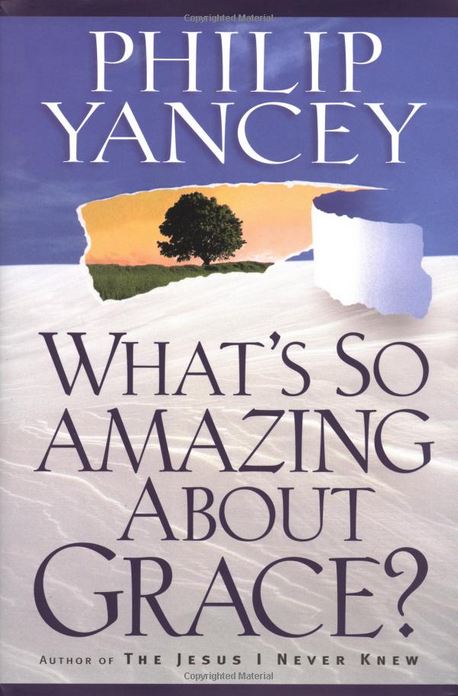
“What’s so Amazing About Grace?” by Philip Yancey (A guestpost by Brian Johnson)

By Anita Mathias

What’s So Amazing About Grace?

“Grace means there is nothing we can do to make God love us more. And grace means there is nothing we can do to make God love us less.”
So no amount of religious knowledge or dedication will make one jot of difference to how God loves us; no amount of sin will make a difference either. This is, of course, completely at odds with how the world behaves and how, mostly, we are raised to think. This is also the starting point of Philip Yancey’s book, “What’s So Amazing About Grace?”
As Leslie Keeney said previously, books need to be in the right place at the right time. I was given “What’s So Amazing About Grace?” as a fledgling Christian struggling with my preconceptions (and misconceptions) of faith, and this quote (and the book) dealt with a lot of the baggage I had carried for so long.
Philip Yancey sets out by illustrating many examples of grace at work through history, in the Bible and in the present day. Equally, he cites examples of what he terms “ungrace” – mankind’s natural tendency to choose the path lacking grace.
The examples of both ungrace and grace are meaningful and, again in both cases, often harrowing. We are continually challenged in these examples to consider whether we can rise to the level of unconditional forgiveness displayed in the anecdotes and stories.
Yancey goes on to explain than we are grounded in ungrace almost from birth – and that this is reinforced throughout childhood and on into the world of work and elsewhere. We are told by society that we have to do something in order to be accepted; to be wanted; to be loved. We are also told that if we do not do these things, we deserve nothing and should expect punishment.
This ungrace can, and does, perpetuate itself and Yancey gives us several examples of the consequences.
He also takes aim at ungrace within the Christian church itself (quoting Bill Clinton: “Why do Christians hate so much?”) and at the wholesale ungrace between peoples and nations. He is careful to draw parallels between the events described in the gospels and more recent times – and, although written in 1997, the examples of these will be familiar to any casual reader of current affairs.
Grace, Yancey says, is fundamentally unfair, which is why so many of us struggle with it. We are conditioned to seeing rewards matching efforts and punishments fitting the crime. When we are then presented with Jesus’ teachings such as that of the Prodigal Son, our minds struggle.
That parable, and some others, are paraphrased and brought into the modern day brilliantly by the author and make excellent reading material on their own.
Yancey believes that true grace is an all-or-nothing thing: you cannot have half-grace or be partly sympathetic to the idea. Grace is ultimately about forgiving the inexcusable.
He also highlights how the concept of grace defines Christianity from other religions. God’s love, he says, does not have to be earned. We do not have to gain approval in order to receive it: “Only Christianity dares to make God’s love unconditional.”
The books rounds off by coming back to its own title and a stunning example of John Newton’s hymn in action.
Theologians (and I am not one) can and do take issue with some of the stories and examples given in this book – indeed, there are so many varied examples given that it would be surprising if no-one disagreed with at least one. This is also very much a book describing and explaining grace by example, rather than theory,so scholars may well be disappointed by it.
However, for me, Yancey’s triumph with “What’s So Amazing About Grace?” was to take on some of the misconceptions about God’s completely unconditional love for us all, regardless of what we have done.
Helping us on the way to accepting that unconditional love, or grace, is what this book does well – and that to me is what it’s all about. Because while none of us deserve it, we all desperately need it. What’s truly amazing is that we can receive it anyway.
———————-

Brian Johnson is a relatively recent returnee to the faith, a musician and general creative person. Unashamedly a non-theologian; married; two children; one cat. Catch up at @MustardSeedUK.

Tweet

Filed Under: random

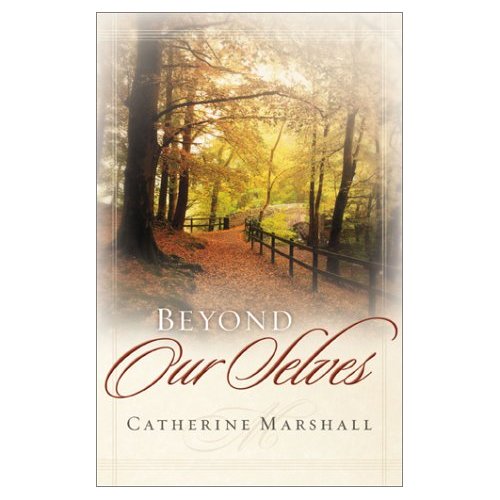
Beyond Ourselves by Catherine Marshall (A Guest Post by Alice Allsworth)

By Anita Mathias

(Interestingly, I became a Christian while reading this very book in 1979, Anita http://www.anitamathias.com/teenage-atheist.html)

So many things change our lives: circumstances, the family we’re born into, where we went to school, what career we chose, what jobs we did, how our parents behaved, what heartaches and heartbreaks we’ve faced, sickness, poverty, wealth. The list is endless but books can change our lives too: sometimes, a deep and powerful impact that changes us forever.

Aside from the Bible one of the books I credit for changing my life as is “Beyond Ourselves” by the renowned American author Catherine Marshall. Her inspirational writing has touched the lives of millions and continues to do so even now, although she died in 1983.

As a very new Christian, I was thankfully led to read this book when I needed feeding all the time. I was reading the Word but I needed something that related to everyday life and situations. This was where this book had such an impact. I hadn’t read much Christian literature at that time but was so thirsty to know more about this new life I had chosen. I remember feeling like a sponge, just soaking everything in, the good, the bad and the mediocre.

I needed to see how you could live your life as a Christian and what it actually meant to face the challenges life threw at you. Probably one of the most profound topics was that of forgiveness. Catherine gave such personal testimony of how she had been enabled to forgive and I was very quickly convicted that I needed to forgive someone who had hurt me very deeply.

So strong was this conviction that I didn’t wait long to obey the inner nudges, or shoves. The person I was struggling to forgive had caused me to lose my job and had taken my role on when I left. That event had caused chaos in my life.  As a newly single parent unemployment was the last thing I needed. Encouraged by Catherine’s book I came before the Lord and made my peace with Him and released my forgiveness towards this lady.

Sometimes God wants to check we’ve done it for real, meant what we said. Only a few weeks later I found myself sitting behind this lady at a seminar. Had I not forgiven her she would probably have withered under the force of my feelings. But the Lord wasn’t done with me; He convicted me again that I should speak to her and apologise for my part in what had gone on. That was hard. I was shaking but knew I couldn’t duck this one.

As I spoke to her I could feel the grace and peace of the Lord flood through me and although our paths were unlikely to cross again, I knew I could face her any time. The real blessing was that she apologised too. Light as air and free as a bird at that moment, I left knowing that something very powerful had taken place. The Divine exchange.

I read as many of Catherine Marshall’s books as I could; they were sustenance and I devoured them all. She was so honest and real about the life situations that she encountered and didn’t shirk away from the tough stuff like suffering and healing. You almost feel like you really know her by the time you finish.

So often we’re afraid to be real with each other, wear a mask and smile hoping no one will find out what’s going on inside. But the shallowness brings no relief and until we face up to our truth we cannot know peace, healing, forgiveness and grace.

It’s more than twenty years since I first read this book and I was inspired to read it again. Unable to find my copy, which I probably lent to someone else who’d just entered the Kingdom, I have purchased another copy and am savouring it all over again.

My life has had many twists and turns over these last twenty four years, some of which I would never have wanted to experience but the simple message and power of encouraging and inspirational writers like Catherine Marshall gave me hope, increased my faith and afforded me the courage to be real about my life.

I love the way she never thought too highly of herself, asked the difficult questions of God and praised Him for the answers. Amply demonstrating that nothing is wasted in the divine economy, she found a new purpose after the devastating,untimely death of her husband. She poured out her pain through her pen and allowed the Lord to turn her sorrow into joy, helping us all to realise that there is always hope.

I will still happily place this book in the hands of a new believer as a guide and help. I have always aspired to write and offer something meaningful. Catherine’s writing and her journey as a writer were a touchstone for the journals I have kept for more than two decades and the literary journey I am on now. I do wonder what she would have made of blogging. I’m sure she’d have been out there with the others offering her warmth, wisdom and intimate insights of the Lord to the 21st century.

*******
Alice Allsworth

Alice Allsworth (alicesapplesofgold.wordpress.com)


Alice’s Bio: I’m a mother of two beautiful daughters and a grandmother to three enchanting grandchildren. I live in one of the most beautiful places in the country, Cornwall. Fortunate enough to live by the sea, I never want to be too far away from its sight and sound.


I love music, words, painting, life, my family, my friends and most of all my faith. I live on the same roller coaster as everyone else but love to encourage others, support them when they’re struggling and most of all want to have made a difference to the world by the time I leave it.


I believe faith is an intimate part of everyday life and seek to relate the ordinary to the divine. It is the encouragement of others and the amazing love and grace of God that has brought me to this point.


Filed Under: random

Teresa of Avila–“Laughter came from every brick”

By Anita Mathias

Just these two words He spoke
changed my life,
“Enjoy me.”

What a burden I thought I was to carry–
a crucifix, as did He.

Love once said me, “I know a song,
would you like to hear it?”

And laughter came from every brick in the street
and from every pore
in the sky.

After a night of prayer, He
changed my life when
He sang,
“Enjoy me.”

Filed Under: random

  • « Previous Page
  • 1
  • …
  • 23
  • 24
  • 25
  • 26
  • 27
  • …
  • 121
  • Next Page »

Sign Up and Get a Free eBook!

Sign up to be emailed my blog posts (one a week) and get the ebook of "Holy Ground," my account of working with Mother Teresa.

Join 543 Other Readers

My Books

Rosaries, Reading, Secrets: A Catholic Childhood in India

Rosaries, Reading Secrets, B&N
USA

UK

Wandering Between Two Worlds: Essays on Faith and Art

Wandering Between Two Worlds
USA

UK

Francesco, Artist of Florence: The Man Who Gave Too Much

Francesco, Artist of Florence
US

UK

The Story of Dirk Willems

The Story of Dirk Willems
US

UK

My Latest Meditation

Anita Mathias: About Me

Anita Mathias

Read my blog on Facebook

Follow me on Twitter

Follow @anitamathias1

Recent Posts

  • Using God’s Gift of Our Talents: A Path to Joy and Abundance
  • The Kingdom of God is Here Already, Yet Not Yet Here
  • All Those Who Exalt Themselves Will Be Humbled & the Humble Will Be Exalted
  • Christ’s Great Golden Triad to Guide Our Actions and Decisions
  • How Jesus Dealt With Hostility and Enemies
  • Do Not Be Afraid, but Do Be Prudent
  • For Scoundrels, Scallywags, and Rascals—Christ Came
  • How to Lead an Extremely Significant Life
  • Don’t Walk Away From Jesus, but if You Do, He Still Looks at You and Loves You
  • How to Find the Freedom of Forgiveness
Premier Digital Awards 2015 - Finalist - Blogger of the year
Runner Up Christian Media Awards 2014 - Tweeter of the year

Categories

What I’m Reading


Wolf Hall
Hilary Mantel

Wolf Hall --  Amazon.com
Amazon.com

Amazon.co.uk

Silence and Honey Cakes:
The Wisdom Of The Desert
Rowan Williams

Silence and Honey Cakes --  Amazon.com
Amazon.com

Amazon.co.uk

The Long Loneliness:
The Autobiography of the Legendary Catholic Social Activist
Dorothy Day

The Long Loneliness --  Amazon.com
Amazon.com

Amazon.co.uk

Country Girl
Edna O'Brien

Country Girl  - Amazon.com
Amazon.com

Amazon.co.uk

Archive by month

My Latest Five Podcast Meditations

INSTAGRAM

anita.mathias

My memoir: Rosaries, Reading, Secrets https://amzn.to/42xgL9t
Oxford, England. Writer, memoirist, podcaster, blogger, Biblical meditation teacher, mum

Well, hello friends! Breaking radio silence to let Well, hello friends! Breaking radio silence to let you know that I have taped a meditation for you on Christ’s famous Parable of the Talents in Matthew 25. https://anitamathias.com/2025/11/05/using-gods-gift-of-our-talents-a-path-to-joy-and-abundance/
Here you are, click the play button in the blog post for a brief meditation, and some moments of peace, and, perhaps, inspiration in your day 🙂
Hi Friends, I have taped a meditation; do listen a Hi Friends, I have taped a meditation; do listen at this link: https://anitamathias.com/2025/04/08/the-kingdom-of-god-is-here-already-yet-not-yet-here-2/
It’s on the Kingdom of God, of which Christ so often spoke, which is here already—a mysterious, shimmering internal palace in which, in lightning flashes, we experience peace and joy, and yet, of course, not yet fully here. We sense the rainbowed presence of Christ in the song which pulses through creation. Christ strolls into our rooms with his wisdom and guidance, and things change. Our prayers are answered; we are healed; our hearts are strangely warmed. Sometimes.
And yet, we also experience evil within & all around us. Our own sin which can shatter our peace and the trajectory of our lives. And the sins of the world—its greed, dishonesty and environmental destruction.
But in this broken world, we still experience the glory of creation; “coincidences” which accelerate once we start praying, and shalom which envelops us like sudden sunshine. The portals into this Kingdom include repentance, gratitude, meditative breathing, and absolute surrender.
The Kingdom of God is here already. We can experience its beauty, peace and joy today through the presence of the Holy Spirit. But yet, since, in the Apostle Paul’s words, we do not struggle only “against flesh and blood, but against the rulers, against the unseen powers of this dark world and against the spiritual forces of evil,” its fullness still lingers…
Our daughter Zoe was ordained into the Church of E Our daughter Zoe was ordained into the Church of England in June. I have been on a social media break… but … better late than never. Enjoy!
First picture has my sister, Shalini, who kindly flew in from the US. Our lovely cousins Anthony and Sarah flank Zoe in the next picture.
The Bishop of London, Sarah Mullaly, ordained Zoe. You can see her praying that Zoe will be filled with the Holy Spirit!!
And here’s a meditation I’ve recorded, which you might enjoy. The link is also in my profile
https://anitamathias.com/2024/11/07/all-those-who-exalt-themselves-will-be-humbled-the-humble-will-be-exalted/
I have taped a meditation on Jesus statement in Ma I have taped a meditation on Jesus statement in Matthew 23, “For those who exalt themselves will be humbled, and those who humble themselves will be exalted.”
Do listen here. https://anitamathias.com/2024/11/07/all-those-who-exalt-themselves-will-be-humbled-the-humble-will-be-exalted/
Link also in bio.
And so, Jesus states a law of life. Those who broadcast their amazingness will be humbled, since God dislikes—scorns that, as much as people do.  For to trumpet our success, wealth, brilliance, giftedness or popularity is to get distracted from our life’s purpose into worthless activity. Those who love power, who are sure they know best, and who must be the best, will eventually be humbled by God and life. For their focus has shifted from loving God, doing good work, and being a blessing to their family, friends, and the world towards impressing others, being enviable, perhaps famous. These things are houses built on sand, which will crumble when hammered by the waves of old age, infirmity or adversity. 
God resists the proud, Scripture tells us—those who crave the admiration and power which is His alone. So how do we resist pride? We slow down, so that we realise (and repent) when sheer pride sparks our allergies to people, our enmities, our determination to have our own way, or our grandiose ego-driven goals, and ambitions. Once we stop chasing limelight, a great quietness steals over our lives. We no longer need the drug of continual achievement, or to share images of glittering travel, parties, prizes or friends. We just enjoy them quietly. My life is for itself & not for a spectacle, Emerson wrote. And, as Jesus advises, we quit sharp-elbowing ourselves to sit with the shiniest people, but are content to hang out with ordinary people; and then, as Jesus said, we will inevitably, eventually, be summoned higher to the sparkling conversation we craved. 
One day, every knee will bow before the gentle lamb who was slain, now seated on the throne. We will all be silent before him. Let us live gently then, our eyes on Christ, continually asking for his power, his Spirit, and his direction, moving, dancing, in the direction that we sense him move.
Link to new podcast in Bio https://anitamathias.co Link to new podcast in Bio https://anitamathias.com/2024/02/20/how-jesus-dealt-with-hostility-and-enemies/
3 days before his death, Jesus rampages through the commercialised temple, overturning the tables of moneychangers. Who gave you the authority to do these things? his outraged adversaries ask. And Jesus shows us how to answer hostile questions. Slow down. Breathe. Quick arrow prayers!
Your enemies have no power over your life that your Father has not permitted them. Ask your Father for wisdom, remembering: Questions do not need to be answered. Are these questioners worthy of the treasures of your heart? Or would that be feeding pearls to hungry pigs, who might instead devour you?
Questions can contain pitfalls, traps, nooses. Jesus directly answered just three of the 183 questions he was asked, refusing to answer some; answering others with a good question.
But how do we get the inner calm and wisdom to recognise
and sidestep entrapping questions? Long before the day of
testing, practice slow, easy breathing, and tune in to the frequency of the Father. There’s no record of Jesus running, rushing, getting stressed, or lacking peace. He never spoke on his own, he told us, without checking in with the Father. So, no foolish, ill-judged statements. Breathing in the wisdom of the Father beside and within him, he, unintimidated, traps the trappers.
Wisdom begins with training ourselves to slow down and ask
the Father for guidance. Then our calm minds, made perceptive, will help us recognise danger and trick questions, even those coated in flattery, and sidestep them or refuse to answer.
We practice tuning in to heavenly wisdom by practising–asking God questions, and then listening for his answers about the best way to do simple things…organise a home or write. Then, we build upwards, asking for wisdom in more complex things.
Listening for the voice of God before we speak, and asking for a filling of the Spirit, which Jesus calls streams of living water within us, will give us wisdom to know what to say, which, frequently, is nothing at all. It will quieten us with the silence of God, which sings through the world, through sun and stars, sky and flowers.
Especially for @ samheckt Some very imperfect pi Especially for @ samheckt 
Some very imperfect pictures of my labradoodle Merry, and golden retriever Pippi.
And since, I’m on social media, if you are the meditating type, here’s a scriptural meditation on not being afraid, while being prudent. https://anitamathias.com/2024/01/03/do-not-be-afraid-but-do-be-prudent/
A new podcast. Link in bio https://anitamathias.c A new podcast. Link in bio
https://anitamathias.com/2024/01/03/do-not-be-afraid-but-do-be-prudent/
Do Not Be Afraid, but Do Be Prudent
“Do not be afraid,” a dream-angel tells Joseph, to marry Mary, who’s pregnant, though a virgin, for in our magical, God-invaded world, the Spirit has placed God in her. Call the baby Jesus, or The Lord saves, for he will drag people free from the chokehold of their sins.
And Joseph is not afraid. And the angel was right, for a star rose, signalling a new King of the Jews. Astrologers followed it, threatening King Herod, whose chief priests recounted Micah’s 600-year-old prophecy: the Messiah would be born in Bethlehem, as Jesus had just been, while his parents from Nazareth registered for Augustus Caesar’s census of the entire Roman world. 
The Magi worshipped the baby, offering gold. And shepherds came, told by an angel of joy: that the Messiah, a saviour from all that oppresses, had just been born.
Then, suddenly, the dream-angel warned: Flee with the child to Egypt. For Herod plans to kill this baby, forever-King.
Do not be afraid, but still flee? Become a refugee? But lightning-bolt coincidences verified the angel’s first words: The magi with gold for the flight. Shepherds
telling of angels singing of coming inner peace. Joseph flees.
What’s the difference between fear and prudence? Fear is being frozen or panicked by imaginary what-ifs. It tenses our bodies; strains health, sleep and relationships; makes us stingy with ourselves & others; leads to overwork, & time wasted doing pointless things for fear of people’s opinions.
Prudence is wisdom-using our experience & spiritual discernment as we battle the demonic forces of this dark world, in Paul’s phrase.It’s fighting with divinely powerful weapons: truth, righteousness, faith, Scripture & prayer, while surrendering our thoughts to Christ. 
So let’s act prudently, wisely & bravely, silencing fear, while remaining alert to God’s guidance, delivered through inner peace or intuitions of danger and wrongness, our spiritual senses tuned to the Spirit’s “No,” his “Slow,” his “Go,” as cautious as a serpent, protected, while being as gentle as a lamb among wolves.
Link to post with podcast link in Bio or https://a Link to post with podcast link in Bio or https://anitamathias.com/2023/09/22/dont-walk-away-from-jesus-but-if-you-do-he-still-looks-at-you-and-loves-you/
Jesus came from a Kingdom of voluntary gentleness, in which
Christ, the Lion of Judah, stands at the centre of the throne in the guise of a lamb, looking as if it had been slain. No wonder his disciples struggled with his counter-cultural values. Oh, and we too!
The mother of the Apostles James and John, asks Jesus for a favour—that once He became King, her sons got the most important, prestigious seats at court, on his right and left. And the other ten, who would have liked the fame, glory, power,limelight and honour themselves are indignant and threatened.
Oh-oh, Jesus says. Who gets five talents, who gets one,
who gets great wealth and success, who doesn’t–that the
Father controls. Don’t waste your one precious and fleeting
life seeking to lord it over others or boss them around.
But, in his wry kindness, he offers the ambitious twelve
and us something better than the second or third place.
He tells us how to actually be the most important person to
others at work, in our friend group, social circle, or church:Use your talents, gifts, and energy to bless others.
And we instinctively know Jesus is right. The greatest people in our lives are the kind people who invested in us, guided us and whose wise, radiant words are engraved on our hearts.
Wanting to sit with the cleverest, most successful, most famous people is the path of restlessness and discontent. The competition is vast. But seek to see people, to listen intently, to be kind, to empathise, and doors fling wide open for you, you rare thing!
The greatest person is the one who serves, Jesus says. Serves by using the one, two, or five talents God has given us to bless others, by finding a place where our deep gladness and the world’s deep hunger meet. By writing which is a blessing, hospitality, walking with a sad friend, tidying a house.
And that is the only greatness worth having. That you yourself,your life and your work are a blessing to others. That the love and wisdom God pours into you lives in people’s hearts and minds, a blessing
https://anitamathias.com/.../dont-walk-away-from-j https://anitamathias.com/.../dont-walk-away-from-jesus.../
Sharing this podcast I recorded last week. LINK IN BIO
So Jesus makes a beautiful offer to the earnest, moral young man who came to him, seeking a spiritual life. Remarkably, the young man claims that he has kept all the commandments from his youth, including the command to love one’s neighbour as oneself, a statement Jesus does not challenge.
The challenge Jesus does offers him, however, the man cannot accept—to sell his vast possessions, give the money to the poor, and follow Jesus encumbered.
He leaves, grieving, and Jesus looks at him, loves him, and famously observes that it’s easier for a camel to squeeze through the eye of a needle than for a rich person to live in the world of wonders which is living under Christ’s kingship, guidance and protection. 
He reassures his dismayed disciples, however, that with God even the treasure-burdened can squeeze into God’s kingdom, “for with God, all things are possible.”
Following him would quite literally mean walking into a world of daily wonders, and immensely rich conversation, walking through Israel, Lebanon, Syria, and Jordan, quite impossible to do with suitcases and backpacks laden with treasure. 
For what would we reject God’s specific, internally heard whisper or directive, a micro-call? That is the idol which currently grips and possesses us. 
Not all of us have great riches, nor is money everyone’s greatest temptation—it can be success, fame, universal esteem, you name it…
But, since with God all things are possible, even those who waver in their pursuit of God can still experience him in fits and snatches, find our spirits singing on a walk or during worship in church, or find our hearts strangely warmed by Scripture, and, sometimes, even “see” Christ stand before us. 
For Christ looks at us, Christ loves us, and says, “With God, all things are possible,” even we, the flawed, entering his beautiful Kingdom.
Follow on Instagram

© 2025 Dreaming Beneath the Spires · All Rights Reserved. · Cookie Policy · Privacy Policy