 |
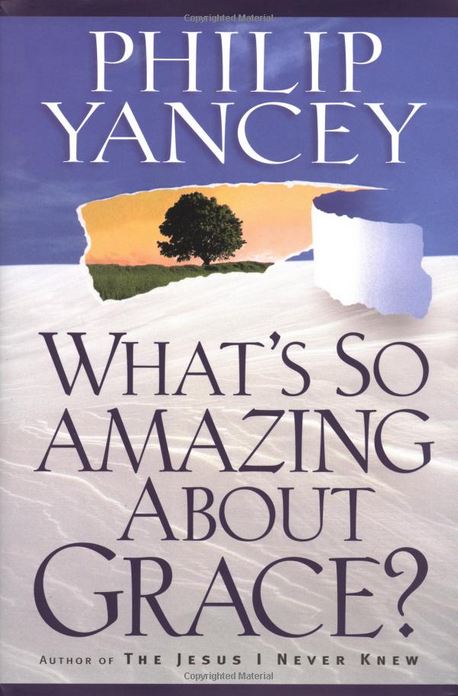
What’s So Amazing About Grace? |
“Grace means there is nothing we can do to make God love us more. And grace means there is nothing we can do to make God love us less.”
So no amount of religious knowledge or dedication will make one jot of difference to how God loves us; no amount of sin will make a difference either. This is, of course, completely at odds with how the world behaves and how, mostly, we are raised to think. This is also the starting point of Philip Yancey’s book, “What’s So Amazing About Grace?”
As Leslie Keeney said previously, books need to be in the right place at the right time. I was given “What’s So Amazing About Grace?” as a fledgling Christian struggling with my preconceptions (and misconceptions) of faith, and this quote (and the book) dealt with a lot of the baggage I had carried for so long.
Philip Yancey sets out by illustrating many examples of grace at work through history, in the Bible and in the present day. Equally, he cites examples of what he terms “ungrace” – mankind’s natural tendency to choose the path lacking grace.
The examples of both ungrace and grace are meaningful and, again in both cases, often harrowing. We are continually challenged in these examples to consider whether we can rise to the level of unconditional forgiveness displayed in the anecdotes and stories.
Yancey goes on to explain than we are grounded in ungrace almost from birth – and that this is reinforced throughout childhood and on into the world of work and elsewhere. We are told by society that we have to do something in order to be accepted; to be wanted; to be loved. We are also told that if we do not do these things, we deserve nothing and should expect punishment.
This ungrace can, and does, perpetuate itself and Yancey gives us several examples of the consequences.
He also takes aim at ungrace within the Christian church itself (quoting Bill Clinton: “Why do Christians hate so much?”) and at the wholesale ungrace between peoples and nations. He is careful to draw parallels between the events described in the gospels and more recent times – and, although written in 1997, the examples of these will be familiar to any casual reader of current affairs.
Grace, Yancey says, is fundamentally unfair, which is why so many of us struggle with it. We are conditioned to seeing rewards matching efforts and punishments fitting the crime. When we are then presented with Jesus’ teachings such as that of the Prodigal Son, our minds struggle.
That parable, and some others, are paraphrased and brought into the modern day brilliantly by the author and make excellent reading material on their own.
Yancey believes that true grace is an all-or-nothing thing: you cannot have half-grace or be partly sympathetic to the idea. Grace is ultimately about forgiving the inexcusable.
He also highlights how the concept of grace defines Christianity from other religions. God’s love, he says, does not have to be earned. We do not have to gain approval in order to receive it: “Only Christianity dares to make God’s love unconditional.”
The books rounds off by coming back to its own title and a stunning example of John Newton’s hymn in action.
Theologians (and I am not one) can and do take issue with some of the stories and examples given in this book – indeed, there are so many varied examples given that it would be surprising if no-one disagreed with at least one. This is also very much a book describing and explaining grace by example, rather than theory,so scholars may well be disappointed by it.
However, for me, Yancey’s triumph with “What’s So Amazing About Grace?” was to take on some of the misconceptions about God’s completely unconditional love for us all, regardless of what we have done.
Helping us on the way to accepting that unconditional love, or grace, is what this book does well – and that to me is what it’s all about. Because while none of us deserve it, we all desperately need it. What’s truly amazing is that we can receive it anyway.
———————-
Brian Johnson is a relatively recent returnee to the faith, a musician and general creative person. Unashamedly a non-theologian; married; two children; one cat. Catch up at @MustardSeedUK.
Read my new memoir: Rosaries, Reading, Secrets: A Catholic Childhood in India (US) or UK.
Connect on Facebook: https://www.facebook.com/anitamathiaswriter/
Instagram: https://www.instagram.com/anita.mathias/
Twitter: https://twitter.com/AnitaMathias1
My book of essays: Wandering Between Two Worlds (US) or UK