Anita Mathias: Dreaming Beneath the Spires

Anita Mathias's Blog on Faith and Art

  • Home
  • My Books
  • Meditations
  • Essays
  • Contact
  • About Me

The Lord does See. Psalm 10, Day 24, Jan 24th

By Anita Mathias

Kumah Adoni, Arise, Oh Lord.
Do you know anyone like “the wicked man” described here? I am afraid I do. 
The wicked man you know may well be “a Christian.” Even “a Christian leader.”

Are you like the wicked man described here in any way? Read it and see and examine yourself. 
If so, repent.

God is patient. The aim of his patience is to bring us to repentance.

He waits until his cup of wrath is full. Then he pours it on the wicked. 

The Psalm may be centuries old, but it describes the schemes of the manipulative, as they seek to get their way.
Psalm 10

 1 Why, LORD, do you stand far off? 
   Why do you hide yourself in times of trouble?

 2 In his arrogance the wicked man hunts down the weak,
   who are caught in the schemes he devises.
3 He boasts about the cravings of his heart;
   he blesses the greedy and reviles the LORD.
4 In his pride the wicked man does not seek him;
   in all his thoughts there is no room for God.
5 His ways are always prosperous;
   your laws are rejected by[b] him;
   he sneers at all his enemies.
6 He says to himself, “Nothing will ever shake me.”
   He swears, “No one will ever do me harm.”
 7 His mouth is full of lies and threats;
   trouble and evil are under his tongue.
8 He lies in wait near the villages;
   from ambush he murders the innocent.
His eyes watch in secret for his victims;
 9 like a lion in cover he lies in wait.
He lies in wait to catch the helpless;
   he catches the helpless and drags them off in his net.
10 His victims are crushed, they collapse;
   they fall under his strength.
11 He says to himself, “God will never notice;
   he covers his face and never sees.”
 12 Arise, LORD! Lift up your hand, O God.
   Do not forget the helpless.
13 Why does the wicked man revile God?
   Why does he say to himself,
   “He won’t call me to account”?
14 But you, God, see the trouble of the afflicted;
   you consider their grief and take it in hand.
The victims commit themselves to you;
   you are the helper of the fatherless.
15 Break the arm of the wicked man;
   call the evildoer to account for his wickedness
   that would not otherwise be found out.
 16 The LORD is King for ever and ever;
   the nations will perish from his land.
17 You, LORD, hear the desire of the afflicted;
   you encourage them, and you listen to their cry,
18 defending the fatherless and the oppressed,
   so that mere earthly mortals
   will never again strike terror.


Contrary to appearances, God does hear our cries for justice.
Filed Under: Psalms

The Lord does See. Psalm 10, Day 24, Jan 24th

By Anita Mathias

Kumah Adoni, Arise, Oh Lord.
Do you know anyone like “the wicked man” described here? I am afraid I do. 
The wicked man you know may well be “a Christian.” Even “a Christian leader.”

Are you like the wicked man described here in any way? Read it and see and examine yourself. 
If so, repent.

God is patient. The aim of his patience is to bring us to repentance.

He waits until his cup of wrath is full. Then he pours it on the wicked. 

The Psalm may be centuries old, but it describes the schemes of the manipulative, as they seek to get their way.
Psalm 10

 1 Why, LORD, do you stand far off? 
   Why do you hide yourself in times of trouble?

 2 In his arrogance the wicked man hunts down the weak,
   who are caught in the schemes he devises.
3 He boasts about the cravings of his heart;
   he blesses the greedy and reviles the LORD.
4 In his pride the wicked man does not seek him;
   in all his thoughts there is no room for God.
5 His ways are always prosperous;
   your laws are rejected byGosh, I am so enjoying reading Matthew. Once, at a difficult time in my life, I read and played the Gospels over and over again (while trying to deal with domesticity and housework) until I knew them almost by heart. 

John, I adored, the poet, the mystic, the philosopher, the tender-hearted intuitive understander of Jesus. Luke, a tender-hearted poet too. Mark, full of drama, passion and brevity. Matthew, to me, was the dullest of the lot,  the tendentious Jewish rabbi who goes on entirely too long in his later chapters, but who one has to get through to get to the rest, if one has scholarly habits of mind, as I have. In traditional iconography, John is the eagle, Mark is the lion, Matthew is human. Yeah!

Well, blogging through the Bible is a different ball game to reading through the Bible. You cannot read through familiar passages at the speed of light.You do have to stop and look and ask, “What is the Spirit saying to me through this passage?”

And through this exercise, I am again encountering the magic of majestic Jesus walking through his days, seeing people, touching, healing, loving, teaching. Sometimes, it’s as if he walks into my room, and I see him afresh.

It is an encounter with a unique being. His habits of mind are unique, he sees things differently, he says things differently. He has amazing power. It is possible, however, that is not the accounts of his power which touch our hearts twenty-one centuries later (for they could have been invented, as myths were) but what he said, how he thought, how he saw reality. 

The way he suggests we should live, in the Sermon on the Mount, for instance, in profoundly counter-intuitive. It would never have occurred to us. Does it make sense? I guess we have to try it and see. 

He stretches our mind to a new dimension, and challenges us not to let it return to what it was before. 

 Matthew 9

1 Jesus stepped into a boat, crossed over and came to his own town. 2 Some men brought to him a paralyzed man, lying on a mat. When Jesus saw their faith, he said to the man, “Take heart, son; your sins are forgiven.”
A connection between sin and paralysis, physical, emotional or spiritual appears to established
 3 At this, some of the teachers of the law said to themselves, “This fellow is blaspheming!”
 4 Knowing their thoughts, Jesus said, “Why do you entertain evil thoughts in your hearts? 
The mark of the Pharisee, he is silent, but thinks evil thoughts in his heart.

5 Which is easier: to say, ‘Your sins are forgiven,’ or to say, ‘Get up and walk’? 6 But I want you to know that the Son of Man has authority on earth to forgive sins.” 
To wipe them away as if they never existed. 
Wow. Which sin of yours would you most like wiped away?
Ask him to, right now.

So he said to the paralysed man, “Get up, take your mat and go home.”7 Then the man got up and went home. 8 When the crowd saw this, they were filled with awe; and they praised God, who had given such authority to man.

The Calling of Matthew

 9 As Jesus went on from there, he saw a man named Matthew sitting at the tax collector’s booth. “Follow me,” he told him, and Matthew got up and followed him.
Obedience not rendered immediately is often not rendered at all, because you see, Jesus moves on.

 10 While Jesus was having dinner at Matthew’s house, many tax collectors and sinners came and ate with him and his disciples. 11 When the Pharisees saw this, they asked his disciples, “Why does your teacher eat with tax collectors and sinners?”
This habit of Jesus’s is one of his most refreshing–and not highlighted often enough. Who did he choose to associate with? Sinners. Those beyond the pale. What fresh air!!
 12 On hearing this, Jesus said, “It is not the healthy who need a doctor, but the sick. 13 But go and learn what this means: ‘I desire mercy, not sacrifice.’[a] For I have not come to call the righteous, but sinners.”
He associated with those who needed a doctor. With those who desired mercy.  Not with the righteous, but with sinners.
Jesus Questioned About Fasting

 14 Then John’s disciples came and asked him, “How is it that we and the Pharisees fast often, but your disciples do not fast?”

 15 Jesus answered, “How can the guests of the bridegroom mourn while he is with them? The time will come when the bridegroom will be taken from them; then they will fast.
Sigh. Fasting does appear to be a Christian duty.

   16 “No one sews a patch of unshrunk cloth on an old garment, for the patch will pull away from the garment, making the tear worse. 17 Neither do people pour new wine into old wineskins. If they do, the skins will burst; the wine will run out and the wineskins will be ruined. No, they pour new wine into new wineskins, and both are preserved.”


Jesus is not putting a patch on an old wine skin. He is bringing something entirely new which will need new forms of expression. 

Filed Under: Matthew

By Anita Mathias

<iframe title=”YouTube video player” class=”youtube-player” type=”text/html” width=”480″ height=”390″ src=”http://www.youtube.com/embed/Cbk980jV7Ao?rel=0″ frameborder=”0″ allowFullScreen></iframe>

https://anitamathias.com/2011/01/22/67732/

Filed Under: random

Jacob, the Deceiver, is blessed Gen 26-27.Day 23, Jan 23

By Anita Mathias


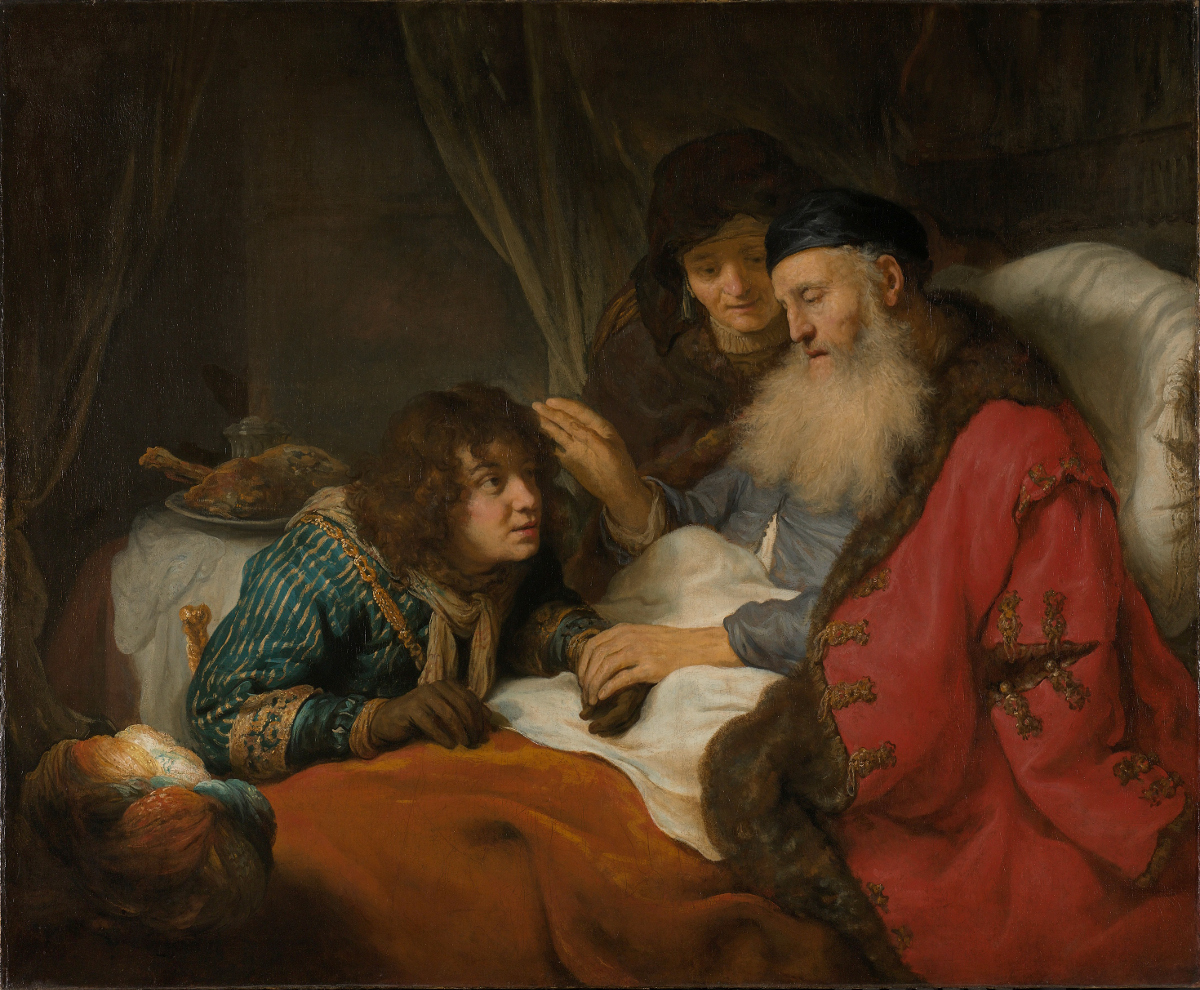
Isaac blesses Jacob, Govert Flink


Genesis 26
 12 Isaac planted crops in that land and the same year reaped a hundredfold, because the LORD blessed him. 13 The man became rich, and his wealth continued to grow until he became very wealthy. 14 He had so many flocks and herds and servants that the Philistines envied him. 15 So all the wells that his father’s servants had dug in the time of his father Abraham, the Philistines stopped up, filling them with earth.

 16 Then Abimelek said to Isaac, “Move away from us; you have become too powerful for us.”

17 So Isaac moved away from there and encamped in the Valley of Gerar, where he settled. 18 Isaac reopened the wells that had been dug in the time of his father Abraham, which the Philistines had stopped up after Abraham died, and he gave them the same names his father had given them.
 19 Isaac’s servants dug in the valley and discovered a well of fresh water there. 20 But the herders of Gerar quarreled with those of Isaac and said, “The water is ours!” So he named the well Esek,[c] because they disputed with him. 21 Then they dug another well, but they quarreled over that one also; so he named it Sitnah.[d] 22 He moved on from there and dug another well, and no one quarreled over it. He named it Rehoboth,[e] saying, “Now the LORD has given us room and we will flourish in the land.”


Isaac is irenic, and attempts to live at peace with his neighbours. He redigs his fathers well, and discovers and digs new wells. The Philistines claim them, so he moves on until he finds a well which no one quarrels over. God’s blessing is over him, and he increases in wealth, though he makes every attempt to live at peace with his neightburs.

 23 From there he went up to Beersheba. 24 That night the LORD appeared to him and said, “I am the God of your father Abraham. Do not be afraid, for I am with you; I will bless you and will increase the number of your descendants for the sake of my servant Abraham.”


And God rewards him for his peaceful, faith-filled stance. God appears to Isaac and tells him not to be afraid, because God is with him, and is blessing him.

 25 Isaac built an altar there and called on the name of the LORD. There he pitched his tent, and there his servants dug a well.
 26 Meanwhile, Abimelek had come to him from Gerar, with Ahuzzath his personal adviser and Phicol the commander of his forces. 27 Isaac asked them, “Why have you come to me, since you were hostile to me and sent me away?”
 28 They answered, “We saw clearly that the LORD was with you; so we said, ‘There ought to be a sworn agreement between us’—between us and you. Let us make a treaty with you 29 that you will do us no harm, just as we did not harm you but always treated you well and sent you away peacefully. And now you are blessed by the LORD.”
 30 Isaac then made a feast for them, and they ate and drank. 31 Early the next morning the men swore an oath to each other. Then Isaac sent them on their way, and they went away peacefully.

When a man’s ways are pleasing to the LORD, he makes even his enemies live at peace with him. (Proverbs 16:7).

 32 That day Isaac’s servants came and told him about the well they had dug. They said, “We’ve found water!” 33 He called it Shibah,[f] and to this day the name of the town has been Beersheba.[g]


34 When Esau was forty years old, he married Judith daughter of Beeri the Hittite, and also Basemath daughter of Elon the Hittite. 35 They were a source of grief to Isaac and Rebekah.
A less than complimentary picture is being painted of Esau, and his judgment.

Genesis 27

Jacob lies, deceives, tricks, manipulates, and is lavishly blessed by God. Why? Among other things because he desperately wanted God’s blessing more than anything else.
 1 When Isaac was old and his eyes were so weak that he could no longer see, he called for Esau his older son and said to him, “My son.”
   “Here I am,” he answered.
 2 Isaac said, “I am now an old man and don’t know the day of my death. 3 Now then, get your equipment—your quiver and bow—and go out to the open country to hunt some wild game for me. 4 Prepare me the kind of tasty food I like and bring it to me to eat, so that I may give you my blessing before I die.”

ESV–Such blessings were very important because as prayers addressed to God, they were viewed as shaping the future of those blessed.

 5 Now Rebekah was listening as Isaac spoke to his son Esau. When Esau left for the open country to hunt game and bring it back, 6 Rebekah said to her son Jacob, “Look, I overheard your father say to your brother Esau, 7 ‘Bring me some game and prepare me some tasty food to eat, so that I may give you my blessing in the presence of the LORD before I die.’ 8 Now, my son, listen carefully and do what I tell you: 9 Go out to the flock and bring me two choice young goats, so I can prepare some tasty food for your father, just the way he likes it. 10 Then take it to your father to eat, so that he may give you his blessing before he dies.”
The incredible unfairness and trickery. 
NIV–Rebekah proves as deceitful as Jacob, whose very name signifies deceit.

 11 Jacob said to Rebekah his mother, “But my brother Esau is a hairy man while I have smooth skin. 12 What if my father touches me? I would appear to be tricking him and would bring down a curse on myself rather than a blessing.”
It was not the rightness or wrongness that troubled Jacob, just the danger of failure.

 13 His mother said to him, “My son, let the curse fall on me. 
And later it does.
Just do what I say; go and get them for me.”

 14 So he went and got them and brought them to his mother, and she prepared some tasty food, just the way his father liked it. 15 Then Rebekah took the best clothes of Esau her older son, which she had in the house, and put them on her younger son Jacob. 16 She also covered his hands and the smooth part of his neck with the goatskins.  17 Then she handed to her son Jacob the tasty food and the bread she had made.


 18 He went to his father and said, “My father.”


   “Yes, my son,” he answered. “Who is it?”


 19 Jacob said to his father, “I am Esau your firstborn. I have done as you told me. Please sit up and eat some of my game, so that you may give me your blessing.”


 20 Isaac asked his son, “How did you find it so quickly, my son?”


   “The LORD your God gave me success,” he replied.


 21 Then Isaac said to Jacob, “Come near so I can touch you, my son, to know whether you really are my son Esau or not.”


 22 Jacob went close to his father Isaac, who touched him and said, “The voice is the voice of Jacob, but the hands are the hands of Esau.” 23 He did not recognize him, for his hands were hairy like those of his brother Esau; so he proceeded to bless him. 24 “Are you really my son Esau?” he asked.


   “I am,” he replied.


 25 Then he said, “My son, bring me some of your game to eat, so that I may give you my blessing.”


   Jacob brought it to him and he ate; and he brought some wine and he drank. 26 Then his father Isaac said to him, “Come here, my son, and kiss me.”


 27 So he went to him and kissed him. When Isaac caught the smell of his clothes, he blessed him and said,
   “Ah, the smell of my son
   is like the smell of a field
   that the LORD has blessed.
28 May God give you heaven’s dew
   and earth’s richness—
   an abundance of grain and new wine.
29 May nations serve you
   and peoples bow down to you.
Be lord over your brothers,
   and may the sons of your mother bow down to you.
May those who curse you be cursed
   and those who bless you be blessed.”

The blessing promised to Abraham, which those of us who are children of Abraham by faith inherit too.
And should Jacob have been blessed with this blessing after his incredible trickery? No.
Was he? Yes. 
God has mercy on whom he will have mercy. 
How rich and many-sided those OT blessings were.


God in his sovereignty uses both good and evil actions to bring about what he has purposed. 


 30 After Isaac finished blessing him, and Jacob had scarcely left his father’s presence, his brother Esau came in from hunting. 31 He too prepared some tasty food and brought it to his father. Then he said to him, “My father, please sit up and eat some of my game, so that you may give me your blessing.”


 32 His father Isaac asked him, “Who are you?”


   “I am your son,” he answered, “your firstborn, Esau.”


 33 Isaac trembled violently and said, “Who was it, then, that hunted game and brought it to me? I ate it just before you came and I blessed him—and indeed he will be blessed!”


 34 When Esau heard his father’s words, he burst out with a loud and bitter cry and said to his father, “Bless me—me too, my father!”


 35 But he said, “Your brother came deceitfully and took your blessing.”


 36 Esau said, “Isn’t he rightly named Jacob[a]? This is the second time he has taken advantage of me: He took my birthright, and now he’s taken my blessing!” Then he asked, “Haven’t you reserved any blessing for me?”


 37 Isaac answered Esau, “I have made him lord over you and have made all his relatives his servants, and I have sustained him with grain and new wine. So what can I possibly do for you, my son?”


 38 Esau said to his father, “Do you have only one blessing, my father? Bless me too, my father!” Then Esau wept aloud.
It is incredibly poignant.


 39 His father Isaac answered him,
   “Your dwelling will be
   away from the earth’s richness,
   away from the dew of heaven above.
40 You will live by the sword
   and you will serve your brother.
But when you grow restless,
   you will throw his yoke
   from off your neck.”


Because Jacob was blessed with primacy over Esau, Esau’s blessing is almost a curse, except for the last assurance, which echoes the secondary blessing given to Ishmael.


 41 Esau held a grudge against Jacob because of the blessing his father had given him. He said to himself, “The days of mourning for my father are near; then I will kill my brother Jacob.”


 42 When Rebekah was told what her older son Esau had said, she sent for her younger son Jacob and said to him, “Your brother Esau is planning to avenge himself by killing you. 43 Now then, my son, do what I say: Flee at once to my brother Laban in Harran. 44 Stay with him for a while until your brother’s fury subsides. 45 When your brother is no longer angry with you and forgets what you did to him, I’ll send word for you to come back from there. Why should I lose both of you in one day?”
She loses the one she loves, and keeps the one she does not. Rebekah eats the fruit of her trickery, as Jacob shall too.
Jacob stays away for 20 years. Rebekah never sees him again.


 46 Then Rebekah said to Isaac, “I’m disgusted with living because of these Hittite women. If Jacob takes a wife from among the women of this land, from Hittite women like these, my life will not be worth living.”

Filed Under: Genesis

Oh You of Little Faith. Why are you Afraid? Matthew 8, Day 22, Jan 22

By Anita Mathias

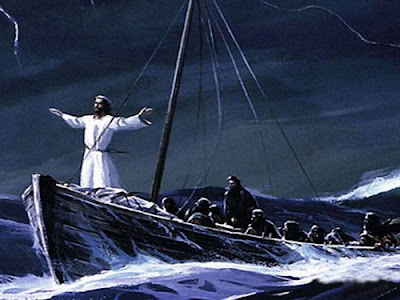
Peace, Be Still


I love these chapters. They have a dynamic, cinematic quality. We watch the man Jesus, a man with authority, walk through this day, dealing with people with kindness, brevity and authority. 


Matthew 8


 18 When Jesus saw the crowd around him, he gave orders to cross to the other side of the lake. 19 Then a teacher of the law came to him and said, “Teacher, I will follow you wherever you go.”

 20 Jesus replied, “Foxes have dens and birds have nests, but the Son of Man has no place to lay his head.”
 21 Another disciple said to him, “Lord, first let me go and bury my father.”
 22 But Jesus told him, “Follow me, and let the dead bury their own dead.”


This is an absolutely vital element of discipleship. Obey what you hear God say when you hear him say it. “Later” too often becomes never. 


I rapidly read the autobiography of David Pytches a few years ago. He had saved money for university, and then, as a young man in the army was lovingly mentored and discipled by a older couple who lived in an abandoned railway carriage, and poured themselves into the young servicemen. He hears God tell him to give all the money he had saved to the older Christian. He does so, potentially giving up his opportunity to go to university.


Wow, I thought. How scary. What if he had refused? What if he had procrastinated? What if he let himself believe he had imagined it? Then the next time he heard God speak, he could again have told himself that he imagined it, dreamed it, that obeying God in such things was something impulsive hotheads did. 
He would have left sad so many times that he would no longer know God’s voice and accent, no longer be able to pick up the still whisper from the noise around him. 

 23 Then he got into the boat and his disciples followed him. 24 Suddenly a furious storm came up on the lake, so that the waves swept over the boat. But Jesus was sleeping. 25 The disciples went and woke him, saying, “Lord, save us! We’re going to drown!”

 26 He replied, “You of little faith, why are you so afraid?” Then he got up and rebuked the winds and the waves, and it was completely calm.
 27 The men were amazed and asked, “What kind of man is this? Even the winds and the waves obey him!”


So a furious storm arises, waves sweep over the boat. Experienced professional fisherman believe that they are going to drown.


Where is the Lord? Asleep.


What does he say? “Oh you of little faith. Oligopistos. Why are you afraid?”
(ESV, Oligopistos, does not mean no faith, which is apistos, but ineffective, defective or deficient faith.)


And when we go through turbulence, and there is a furious storm around us, and the waves sweep over our boat, and it appears as if we are going to drown, he says to us, “You, of little faith. Why are you so afraid?”


And at his word, it is completely calm.


In future, Lord, in the time of furious storms, help us to remember that you are in our boat, and that when you chose to rebuke the winds and waves, it will be completely calm. 


Jesus controls the wind and the waves. And the thing which most troubles us now. What is that for you?

 28 When he arrived at the other side in the region of the Gadarenes, two demon-possessed men coming from the tombs met him. They were so violent that no one could pass that way. 29 “What do you want with us, Son of God?” they shouted. “Have you come here to torture us before the appointed time?”

 30 Some distance from them a large herd of pigs was feeding. 31 The demons begged Jesus, “If you drive us out, send us into the herd of pigs.”

 32 He said to them, “Go!” So they came out and went into the pigs, and the whole herd rushed down the steep bank into the lake and died in the water. 33 Those tending the pigs ran off, went into the town and reported all this, including what had happened to the demon-possessed men. 34 Then the whole town went out to meet Jesus. And when they saw him, they pleaded with him to leave their region.


Wow! This is an astonishing passage. The way I’ve read it to my children is that it shows what Dallas Willard calls, “the power of the request.” The request of the demons not to be tormented. Jesus granted that request. How much more….
Interestingly, the Gadarenes, pleaded with Jesus to leave. They put their economic well-being, and the status quo above their desire for a divine encounter.

Filed Under: Matthew

Proverbs 2-3, Day 22, Jan 22

By Anita Mathias


Intercessory Prayer by Ruth Palmer


Proverbs 2 


16   Wisdom will save you also from the adulterous woman, 
   from the wayward woman with her seductive words,
17 who has left the partner of her youth
   and ignored the covenant she made before God.
18 Surely her house leads down to death
   and her paths to the spirits of the dead.
19 None who go to her return
   or attain the paths of life.

 20 Thus you will walk in the ways of the good
   and keep to the paths of the righteous.
21 For the upright will live in the land,
   and the blameless will remain in it;
22 but the wicked will be cut off from the land,
   and the unfaithful will be torn from it.

Wisdom saves from sexual temptation–and from seductive words which might lure you into other temptations too.


Proverbs 3
1 My son, do not forget my teaching,
   but keep my commands in your heart,

2 for they will prolong your life many years
   and bring you peace and prosperity.

Wisdom, under normal circumstances, prolongs life, and brings peace, and, under normal circumstances again, wealth.
3 Let love and faithfulness never leave you;
   bind them around your neck,
   write them on the tablet of your heart.
4 Then you will win favor and a good name
   in the sight of God and man.

 5 Trust in the LORD with all your heart 
ESV: Not just intellectual assent, but a deep reliance on the Lord, a settled confidence in his care, and his faithfulness

   and lean not on your own understanding; 
Trust in God like you trust in a mountain guide, or in an airline pilot. Implicitly.  In calm and turbulence. Trust him even when the way he is working out your life seems senseless to you.
Subordinating your understanding to God is in line with a major thesis of Proverbs, that the fear of the Lord is the beginning of wisdom.
6 in all your ways submit to him,
   and he will make your paths straight.

He does sort out one’s destiny, step by step, as one obeys him–in the darkness sometimes!!
7 Do not be wise in your own eyes;
   fear the LORD and shun evil.
8 This will bring health to your body
   and nourishment to your bones.

This is an amazing observation. Shunning evil will bring health to your body, and nourishment to your bones. 

For me,  involvement even in low-level “evil,” –serious conflict, sniping, anger, unforgiveness can bring on colds, digestive problems, trouble sleeping–and these are just short term manifestations!!

Is it true that shunning evil will bring us physical health? Well, we lose nothing by trying it!!


Filed Under: Proverbs

The Triumph of the Schemer, Genesis 24-26, Day 21, Jan 21

By Anita Mathias


Esau sells his Birthright
 Hendrick ter Brugghen, 1528 – 1629,

Genesis 24
When Abraham’s servant heard what they said, he bowed down to the ground before the LORD. 53 Then the servant brought out gold and silver jewelry and articles of clothing and gave them to Rebekah; he also gave costly gifts to her brother and to her mother. 54 Then he and the men who were with him ate and drank and spent the night there.

   When they got up the next morning, he said, “Send me on my way to my master.”

 55 But her brother and her mother replied, “Let the young woman remain with us ten days or so; then you may go.”

 56 But he said to them, “Do not detain me, now that the LORD has granted success to my journey. Send me on my way so I may go to my master.”
 57 Then they said, “Let’s call the young woman and ask her about it.” 58 So they called Rebekah and asked her, “Will you go with this man?”
   “I will go,” she said.
 59 So they sent their sister Rebekah on her way, along with her nurse and Abraham’s servant and his men. 60 And they blessed Rebekah and said to her,
   “Our sister, may you increase
   to thousands upon thousands;
may your offspring possess
   the cities of their enemies.”
Echoes of God’s promise to Abraham.
 61 Then Rebekah and her attendants got ready and mounted the camels and went back with the man. So the servant took Rebekah and left.
 62 Now Isaac had come from Beer Lahai Roi, for he was living in the Negev. 63 He went out to the field one evening to meditate, and as he looked up, he saw camels approaching. 64Rebekah also looked up and saw Isaac. She got down from her camel 65 and asked the servant, “Who is that man in the field coming to meet us?”
   “He is my master,” the servant answered. So she took her veil and covered herself.
 66 Then the servant told Isaac all he had done. 67 Isaac brought her into the tent of his mother Sarah, and he married Rebekah. So she became his wife, and he loved her; and Isaac was comforted after his mother’s death.

An arranged marriage and apparently, a happy one. 


Genesis 25

The Death of Abraham

 1 Abraham had taken another wife, whose name was Keturah. 2 She bore him Zimran, Jokshan, Medan, Midian, Ishbak and Shuah. 3 Jokshan was the father of Sheba and Dedan; the descendants of Dedan were the Ashurites, the Letushites and the Leummites. 4 The sons of Midian were Ephah, Epher, Hanok, Abida and Eldaah. All these were descendants of Keturah.

 5 Abraham left everything he owned to Isaac. 6 But while he was still living, he gave gifts to the sons of his concubines and sent them away from his son Isaac to the land of the east.

 7 Abraham lived a hundred and seventy-five years. 8 Then Abraham breathed his last and died at a good old age, an old man and full of years; and he was gathered to his people. 9 His sons Isaac and Ishmael buried him in the cave of Machpelah near Mamre, in the field of Ephron son of Zohar the Hittite, 10 the field Abraham had bought from the Hittites. There Abraham was buried with his wife Sarah. 11 After Abraham’s death, God blessed his son Isaac, who then lived near Beer Lahai Roi.

Ishmael’s Sons

 12 This is the account of the family line of Abraham’s son Ishmael, whom Sarah’s slave, Hagar the Egyptian, bore to Abraham.

 13 These are the names of the sons of Ishmael, listed in the order of their birth: Nebaioth the firstborn of Ishmael, Kedar, Adbeel, Mibsam, 14 Mishma, Dumah, Massa, 15 Hadad, Tema, Jetur, Naphish and Kedemah. 16 These were the sons of Ishmael, and these are the names of the twelve tribal rulers according to their settlements and camps. 17 Ishmael lived a hundred and thirty-seven years. He breathed his last and died, and he was gathered to his people. 18 His descendants settled in the area from Havilah to Shur, near the eastern border of Egypt, as you go toward Ashur. And they lived in hostility toward all the tribes related to them.
Jacob and Esau

 19 This is the account of the family line of Abraham’s son Isaac.   Abraham became the father of Isaac, 20 and Isaac was forty years old when he married Rebekah daughter of Bethuel the Aramean from Paddan Aram and sister of Laban the Aramean.

 21 Isaac prayed to the LORD on behalf of his wife, because she was childless. The LORD answered his prayer, and his wife Rebekah became pregnant. 22 The babies jostled each other within her, and she said, “Why is this happening to me?” So she went to inquire of the LORD.
 23 The LORD said to her,
   “Two nations are in your womb,
   and two peoples from within you will be separated;
one people will be stronger than the other,
   and the older will serve the younger.”

Why? A fact of life which we just have to come to terms with, the sooner the better. God’s gifts are not equal. He gives different people different gifts of wealth, intelligence, beauty,health, physique, temperament, luck, destiny, families, according to his plans for them. It is our job then to do the best with the hand of cards which we’ve been dealt. 

 24 When the time came for her to give birth, there were twin boys in her womb. 25 The first to come out was red, and his whole body was like a hairy garment; so they named him Esau. 26 After this, his brother came out, with his hand grasping Esau’s heel; so he was named Jacob.
Jacob means He grasps the heel, an idiom for He deceives.
Isaac was sixty years old when Rebekah gave birth to them.

 27 The boys grew up, and Esau became a skillful hunter, a man of the open country, while Jacob was content to stay at home among the tents. 28 Isaac, who had a taste for wild game, loved Esau, but Rebekah loved Jacob.
 29 Once when Jacob was cooking some stew, Esau came in from the open country, famished. 30 He said to Jacob, “Quick, let me have some of that red stew! I’m famished!” (That is why he was also called Edom.)
 31 Jacob replied, “First sell me your birthright.”
Jacob was blessed, but he also valued blessing greatly. Is that a trait of those God blesses? That they greatly value his blessing?

The birthright included the inheritance rights of the first-born. Jacob was the schemer, seeking any means to gain an advantage. 
 32 “Look, I am about to die,” Esau said. “What good is the birthright to me?”
The impulsive Esau possibly did not have the character to be the Patriarch of God’s Chosen People. 
 33 But Jacob said, “Swear to me first.” So he swore an oath to him, selling his birthright to Jacob.
 34 Then Jacob gave Esau some bread and some lentil stew. He ate and drank, and then got up and left.
   So Esau despised his birthright.
And included in the birthright, were the covenant promises that Isaac inherited from Abraham–God’s plan of redemption for the whole world.

Isaac and Abimelek

 1 Now there was a famine in the land—besides the previous famine in Abraham’s time—and Isaac went to Abimelek king of the Philistines in Gerar. 2 The LORD appeared to Isaac and said, “Do not go down to Egypt; live in the land where I tell you to live. 3 Stay in this land for a while, and I will be with you and will bless you. For to you and your descendants I will give all these lands and will confirm the oath I swore to your father Abraham. 4 I will make your descendants as numerous as the stars in the sky and will give them all these lands, and through your offspring[a] all nations on earth will be blessed,[b] 5 because Abraham obeyed me and did everything I required of him, keeping my commands, my decrees and my instructions.” 6 So Isaac stayed in Gerar.

 7 When the men of that place asked him about his wife, he said, “She is my sister,” because he was afraid to say, “She is my wife.” He thought, “The men of this place might kill me on account of Rebekah, because she is beautiful.”
 8 When Isaac had been there a long time, Abimelek king of the Philistines looked down from a window and saw Isaac caressing his wife Rebekah. 9 So Abimelek summoned Isaac and said, “She is really your wife! Why did you say, ‘She is my sister’?”
   Isaac answered him, “Because I thought I might lose my life on account of her.”
 10 Then Abimelek said, “What is this you have done to us? One of the men might well have slept with your wife, and you would have brought guilt upon us.”
 11 So Abimelek gave orders to all the people: “Anyone who harms this man or his wife shall surely be put to death.”
Gosh, how does this work. Did he hear of Abraham’s strategies, or was it a genetic predisposition to cowardice and deceit. 
And both men were protected by God.
 12 Isaac planted crops in that land and the same year reaped a hundredfold, because the LORD blessed him. 
The hundredfold return on labour–a mark of the blessing of God.
ESV note–Blessing is always an indication of the divine favour.
13 The man became rich, and his wealth continued to grow until he became very wealthy. 14 He had so many flocks and herds and servants 
marks of the blessing of God
that the Philistines envied him.
Sadly this accompanies blessing.
 15 So all the wells that his father’s servants had dug in the time of his father Abraham, the Philistines stopped up, filling them with earth.
 16 Then Abimelek said to Isaac, “Move away from us; you have become too powerful for us.”

Filed Under: Genesis

  • « Previous Page
  • 1
  • …
  • 173
  • 174
  • 175
  • 176
  • 177
  • …
  • 279
  • Next Page »

Sign Up and Get a Free eBook!

Sign up to be emailed my blog posts (one a week) and get the ebook of "Holy Ground," my account of working with Mother Teresa.

Join 536 Other Readers

My Books

Rosaries, Reading, Secrets: A Catholic Childhood in India

Rosaries, Reading Secrets, B&N
USA

UK

Wandering Between Two Worlds: Essays on Faith and Art

Wandering Between Two Worlds
USA

UK

Francesco, Artist of Florence: The Man Who Gave Too Much

Francesco, Artist of Florence
US

UK

The Story of Dirk Willems

The Story of Dirk Willems
US

UK

My Latest Meditation

Anita Mathias: About Me

Anita Mathias

Read my blog on Facebook

Follow me on Twitter

Follow @anitamathias1

Recent Posts

  • At the Cross, God Forgives Us Completely
  • Using God’s Gift of Our Talents: A Path to Joy and Abundance
  • The Kingdom of God is Here Already, Yet Not Yet Here
  • All Those Who Exalt Themselves Will Be Humbled & the Humble Will Be Exalted
  • Christ’s Great Golden Triad to Guide Our Actions and Decisions
  • How Jesus Dealt With Hostility and Enemies
  • Do Not Be Afraid, but Do Be Prudent
  • For Scoundrels, Scallywags, and Rascals—Christ Came
  • How to Lead an Extremely Significant Life
  • Don’t Walk Away From Jesus, but if You Do, He Still Looks at You and Loves You
Premier Digital Awards 2015 - Finalist - Blogger of the year
Runner Up Christian Media Awards 2014 - Tweeter of the year

Categories

What I’m Reading


Wolf Hall
Hilary Mantel

Wolf Hall --  Amazon.com
Amazon.com

Amazon.co.uk

Silence and Honey Cakes:
The Wisdom Of The Desert
Rowan Williams

Silence and Honey Cakes --  Amazon.com
Amazon.com

Amazon.co.uk

The Long Loneliness:
The Autobiography of the Legendary Catholic Social Activist
Dorothy Day

The Long Loneliness --  Amazon.com
Amazon.com

Amazon.co.uk

Country Girl
Edna O'Brien

Country Girl  - Amazon.com
Amazon.com

Amazon.co.uk

Archive by month

My Latest Five Podcast Meditations

INSTAGRAM

anita.mathias

My memoir: Rosaries, Reading, Secrets https://amzn.to/42xgL9t
Oxford, England. Writer, memoirist, podcaster, blogger, Biblical meditation teacher, mum

Looking at photos from our week in beautiful Sevil Looking at photos from our week in beautiful Seville and Cordoba over New Year with Irene, who had a week off.
And, ICYMI, here’s my latest meditation on the Gospel of Matthew… I’ve recorded it, should you want a few minutes of peace.
https://anitamathias.com/2026/04/29/gods-complete-forgiveness/
Hello Friends, I'm resumed recording my meditation Hello Friends, I'm resumed recording my meditations on the Gospel of Matthew. Do click on this link to listen. 
https://anitamathias.com/.../29/gods-complete-forgiveness/
Christ is the most influential figure in the history of the world, though his life ended in shame, humiliation and failure. But he so completely turned things round in his great reversal that the cross on which he died when all seemed hopeless is now the most common, and revered, symbol in history.
He emerged from and was anchored in Judaism. And as the sins of the people were laid on the scapegoat who was sent into the wilderness to perish, Christ died as the lamb of God voluntarily bearing the guilt of the wrongdoing of the whole world. He paid the price for our forgiveness with his life-blood--in accordance with the iron law of the physical and moral universe, of sowing and reaping, cause and effect. 
And so, God, who appeared as flames of fire to Moses, can now dwell within us, purifying us, whose hearts have darkness and shards of ice. 
And now that Christ was crucified, died, but rose again, His Spirit, no longer contained within his earthly body, is poured out like living water onto all humans, at our humble request. The Spirit pours the love of God into us; he reminds us of the words of Jesus and slowly writes Christ’s sweet law on our hearts. This transfusion of grace helps us do hard things we previously couldn’t do. Our dance with the Spirit gradually breaks the power of sin over us. It transforms us.
Now we, the forgiven, protected by the blood of Jesus poured out over us, and filled with His Spirit, who sings within us, Abba, Father, are adopted by God as his children in his joyful new covenant. We are cells grafted into the vine of our new family--Father, Son, Spirit—who now live in us as we live in them. As we choose by our thoughts and actions to continue living in the vine of Jesus, their energy pulsing through us makes us fruitful. And now, all our prayers which flow in the river of God’s good purposes are kindly heard. Waves of love and power flood from the cross! 
Thank you!
Well, hello friends! Breaking radio silence to let Well, hello friends! Breaking radio silence to let you know that I have taped a meditation for you on Christ’s famous Parable of the Talents in Matthew 25. https://anitamathias.com/2025/11/05/using-gods-gift-of-our-talents-a-path-to-joy-and-abundance/
Here you are, click the play button in the blog post for a brief meditation, and some moments of peace, and, perhaps, inspiration in your day 🙂
Hi Friends, I have taped a meditation; do listen a Hi Friends, I have taped a meditation; do listen at this link: https://anitamathias.com/2025/04/08/the-kingdom-of-god-is-here-already-yet-not-yet-here-2/
It’s on the Kingdom of God, of which Christ so often spoke, which is here already—a mysterious, shimmering internal palace in which, in lightning flashes, we experience peace and joy, and yet, of course, not yet fully here. We sense the rainbowed presence of Christ in the song which pulses through creation. Christ strolls into our rooms with his wisdom and guidance, and things change. Our prayers are answered; we are healed; our hearts are strangely warmed. Sometimes.
And yet, we also experience evil within & all around us. Our own sin which can shatter our peace and the trajectory of our lives. And the sins of the world—its greed, dishonesty and environmental destruction.
But in this broken world, we still experience the glory of creation; “coincidences” which accelerate once we start praying, and shalom which envelops us like sudden sunshine. The portals into this Kingdom include repentance, gratitude, meditative breathing, and absolute surrender.
The Kingdom of God is here already. We can experience its beauty, peace and joy today through the presence of the Holy Spirit. But yet, since, in the Apostle Paul’s words, we do not struggle only “against flesh and blood, but against the rulers, against the unseen powers of this dark world and against the spiritual forces of evil,” its fullness still lingers…
Our daughter Zoe was ordained into the Church of E Our daughter Zoe was ordained into the Church of England in June. I have been on a social media break… but … better late than never. Enjoy!
First picture has my sister, Shalini, who kindly flew in from the US. Our lovely cousins Anthony and Sarah flank Zoe in the next picture.
The Bishop of London, Sarah Mullaly, ordained Zoe. You can see her praying that Zoe will be filled with the Holy Spirit!!
And here’s a meditation I’ve recorded, which you might enjoy. The link is also in my profile
https://anitamathias.com/2024/11/07/all-those-who-exalt-themselves-will-be-humbled-the-humble-will-be-exalted/
I have taped a meditation on Jesus statement in Ma I have taped a meditation on Jesus statement in Matthew 23, “For those who exalt themselves will be humbled, and those who humble themselves will be exalted.”
Do listen here. https://anitamathias.com/2024/11/07/all-those-who-exalt-themselves-will-be-humbled-the-humble-will-be-exalted/
Link also in bio.
And so, Jesus states a law of life. Those who broadcast their amazingness will be humbled, since God dislikes—scorns that, as much as people do.  For to trumpet our success, wealth, brilliance, giftedness or popularity is to get distracted from our life’s purpose into worthless activity. Those who love power, who are sure they know best, and who must be the best, will eventually be humbled by God and life. For their focus has shifted from loving God, doing good work, and being a blessing to their family, friends, and the world towards impressing others, being enviable, perhaps famous. These things are houses built on sand, which will crumble when hammered by the waves of old age, infirmity or adversity. 
God resists the proud, Scripture tells us—those who crave the admiration and power which is His alone. So how do we resist pride? We slow down, so that we realise (and repent) when sheer pride sparks our allergies to people, our enmities, our determination to have our own way, or our grandiose ego-driven goals, and ambitions. Once we stop chasing limelight, a great quietness steals over our lives. We no longer need the drug of continual achievement, or to share images of glittering travel, parties, prizes or friends. We just enjoy them quietly. My life is for itself & not for a spectacle, Emerson wrote. And, as Jesus advises, we quit sharp-elbowing ourselves to sit with the shiniest people, but are content to hang out with ordinary people; and then, as Jesus said, we will inevitably, eventually, be summoned higher to the sparkling conversation we craved. 
One day, every knee will bow before the gentle lamb who was slain, now seated on the throne. We will all be silent before him. Let us live gently then, our eyes on Christ, continually asking for his power, his Spirit, and his direction, moving, dancing, in the direction that we sense him move.
Link to new podcast in Bio https://anitamathias.co Link to new podcast in Bio https://anitamathias.com/2024/02/20/how-jesus-dealt-with-hostility-and-enemies/
3 days before his death, Jesus rampages through the commercialised temple, overturning the tables of moneychangers. Who gave you the authority to do these things? his outraged adversaries ask. And Jesus shows us how to answer hostile questions. Slow down. Breathe. Quick arrow prayers!
Your enemies have no power over your life that your Father has not permitted them. Ask your Father for wisdom, remembering: Questions do not need to be answered. Are these questioners worthy of the treasures of your heart? Or would that be feeding pearls to hungry pigs, who might instead devour you?
Questions can contain pitfalls, traps, nooses. Jesus directly answered just three of the 183 questions he was asked, refusing to answer some; answering others with a good question.
But how do we get the inner calm and wisdom to recognise
and sidestep entrapping questions? Long before the day of
testing, practice slow, easy breathing, and tune in to the frequency of the Father. There’s no record of Jesus running, rushing, getting stressed, or lacking peace. He never spoke on his own, he told us, without checking in with the Father. So, no foolish, ill-judged statements. Breathing in the wisdom of the Father beside and within him, he, unintimidated, traps the trappers.
Wisdom begins with training ourselves to slow down and ask
the Father for guidance. Then our calm minds, made perceptive, will help us recognise danger and trick questions, even those coated in flattery, and sidestep them or refuse to answer.
We practice tuning in to heavenly wisdom by practising–asking God questions, and then listening for his answers about the best way to do simple things…organise a home or write. Then, we build upwards, asking for wisdom in more complex things.
Listening for the voice of God before we speak, and asking for a filling of the Spirit, which Jesus calls streams of living water within us, will give us wisdom to know what to say, which, frequently, is nothing at all. It will quieten us with the silence of God, which sings through the world, through sun and stars, sky and flowers.
Especially for @ samheckt Some very imperfect pi Especially for @ samheckt 
Some very imperfect pictures of my labradoodle Merry, and golden retriever Pippi.
And since, I’m on social media, if you are the meditating type, here’s a scriptural meditation on not being afraid, while being prudent. https://anitamathias.com/2024/01/03/do-not-be-afraid-but-do-be-prudent/
A new podcast. Link in bio https://anitamathias.c A new podcast. Link in bio
https://anitamathias.com/2024/01/03/do-not-be-afraid-but-do-be-prudent/
Do Not Be Afraid, but Do Be Prudent
“Do not be afraid,” a dream-angel tells Joseph, to marry Mary, who’s pregnant, though a virgin, for in our magical, God-invaded world, the Spirit has placed God in her. Call the baby Jesus, or The Lord saves, for he will drag people free from the chokehold of their sins.
And Joseph is not afraid. And the angel was right, for a star rose, signalling a new King of the Jews. Astrologers followed it, threatening King Herod, whose chief priests recounted Micah’s 600-year-old prophecy: the Messiah would be born in Bethlehem, as Jesus had just been, while his parents from Nazareth registered for Augustus Caesar’s census of the entire Roman world. 
The Magi worshipped the baby, offering gold. And shepherds came, told by an angel of joy: that the Messiah, a saviour from all that oppresses, had just been born.
Then, suddenly, the dream-angel warned: Flee with the child to Egypt. For Herod plans to kill this baby, forever-King.
Do not be afraid, but still flee? Become a refugee? But lightning-bolt coincidences verified the angel’s first words: The magi with gold for the flight. Shepherds
telling of angels singing of coming inner peace. Joseph flees.
What’s the difference between fear and prudence? Fear is being frozen or panicked by imaginary what-ifs. It tenses our bodies; strains health, sleep and relationships; makes us stingy with ourselves & others; leads to overwork, & time wasted doing pointless things for fear of people’s opinions.
Prudence is wisdom-using our experience & spiritual discernment as we battle the demonic forces of this dark world, in Paul’s phrase.It’s fighting with divinely powerful weapons: truth, righteousness, faith, Scripture & prayer, while surrendering our thoughts to Christ. 
So let’s act prudently, wisely & bravely, silencing fear, while remaining alert to God’s guidance, delivered through inner peace or intuitions of danger and wrongness, our spiritual senses tuned to the Spirit’s “No,” his “Slow,” his “Go,” as cautious as a serpent, protected, while being as gentle as a lamb among wolves.
Follow on Instagram

© 2026 Dreaming Beneath the Spires · All Rights Reserved. · Cookie Policy · Privacy Policy