
Ann Voskamp found her life changed by trying to count 1000 things she was grateful for. Well, whose wouldn’t be?
About three and a half years ago, I was in a painful, toxic situation in the church I attended. Probably won’t tell that story on this blog, though for me, telling my story is a way to understanding, acceptance and healing. But do I need to tell it on a public blog where it might hurt people? Especially because try as I might to see things whole and accurately, I will not be able to know the secrets of people’s hearts, and why evil happens; some of these things only God knows.
~ ~ ~
In retrospect, I should have fled immediately, but for various reasons, I did not. For one, it was a very large, charismatic church, and I erroneously assumed it was the only act in town. It was the church I used to drop into as an undergraduate at Oxford Uni, wistfully wishing I could just simply believe. How easy life would then be, I’d think.
For another, right until the very end, I experienced the Holy Spirit in the services, even amid the toxicity.
I have, for years, deeply believed in not running away when one has messed up. I read The Imitation of Christ as a teenager, and this statement—among many others–imprinted itself on my heart: Don’t be in a hurry to change your situation when you find it difficult, for wherever you go you will take yourself, and there you will find yourself.
So, I believe, if you find yourself in a painful place, and have contributed to the pain, it’s important to repent and change and learn from your mistakes before running to a new place. For if you run before repentance and healing has taken place, you will not only repeat the sad story of the past in the new place, you will repeat the mistakes of the past.
Stay past the shame, if you have messed up; stay past the pain if you have been unfairly treated; stay till you have learnt the lessons that being in the Wrong place in the Right time can teach you: the pain of gifts not used, the Joseph experience of pits, dungeons and snakes before ladders, the Patmos experience of John, so that in silence you hear the one whose eyes are like a flame of fire, and whose voice is like the sound of many waters.
And then leave with a heart full of love and joy and a desire to bless–healed, having forgiven, and, if possible, having been forgiven. Do your healing in the place of pain, and go and be a blessing in the new place; don’t drag your pain and the sorry story of it like an ancient mariner to the new place.
Where I haven’t told that story of injustice, sadness, and toxicity.
Why? Because I no longer need to. It’s more or less over, done and dusted, and I am so enjoying living in the sunshine of God’s love.
* * *
This spring, it became clear to me (well, and to about 100-150 others who also left, for varying but similar reasons) that it was time to move.
* * *
I tried 1 church and 2 communities in Oxford, all Anglican. I have become rather fond of Anglicanism, one legacy from those 6.5 years in that Anglican charismatic church. One of them, MayBe was lovely, a place of real healing, acceptance and fun. But not right for me.
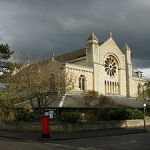
Then, out of the blue, as I had coffee with a friend, an escapee from my old church, who had been treated cruelly, she mentioned a North Oxford church she had visited. “You would fit right in,” she said. “It’s perfect for you. It’s so you.”
I sighed. Like many people who have moved a lot–I’ve lived for a decade or more in 3 continents, and probably 20 cities. Moves, changes, make me sigh, even when it is clear that it’s time. But she repeated her advice, quite emphatically.
So I checked out the church, and she was right. It was the clearly the right place for us. (And that underscores the importance of friendship. Once we moved, everyone said it was the natural, right choice for us; yet, somehow, it had never made it to my short-list.)
~ ~ ~
How gracious God was to offer a second chance–to not repeat of the mistakes of the past, to start again, sadder and wiser, to quietly bless and be blessed.
One blessing of passivity (of the eagle who waits at the edge of its nest for the winds of the storm to take it in the right direction) is the direction provided by the winds of the Holy Spirit–especially useful when one has no idea what to do.
* * *
Both have been great blessings to us. The group we go to is full of wise experienced Christians, large numbers of whom are in ministry. Oddly, we are the youngest couple, something we didn’t really expect in mid-life, and our children are younger than the others’ kids, which means we can learn from their experiences.
And I love my women’s group. A warm accepting kindly group, again many of whom have children who are a little older than mine, a year ahead or at uni. It’s a blessing in practical as well as spiritual ways to hear from those further along the path.
As I get older, that’s the human quality I appreciate most: kindness.
* * *
In the case of the church I finally left, I reached synthesis, three and a half years after anti-thesis, and decided to leave.
But I am rooted in Oxford, which I have loved since I was an undergraduate here, and there are a limited number of churches which are a theological fit for me. I am an evangelical, I love and respect scripture, and I am mildly charismatic, ever since I was baptised in the Holy Spirit in my teens, over three decades ago now, and received the gift of tongues, and the gift of prophecy, both of which have lingered from my teens to my forties.
Amen. May it be so!