A Fine Balance by Rohinton Mistry
Well, I have finished this gargantuan novel, and I must admit that I wish I had not embarked on it. It made me sad.
A Fine Balance is the story of four unlikely intertwined lives in Bombay. There’s Dina, a Parsee lady whose doting father dies, leaving her at the mercy of her brother, Nusswan, who get the house, money and power. There are suggestions of sexual abuse. Dina makes an unlikely “love marriage” which gives her the few happy years of her life. Her husband dies while crossing the road to buy icecream for Nusswan’s visiting children
Her school friend entrusts her beloved son Manceck to Dina, while he is in college in Bombay. Meanwhile, two “untouchable” tailors escape the violence and bullying of their village, the casual and traumatic murders of those who do not vote as the landlords tell them to, by coming to Bombay. There their hope drains away. They are evicted, the slums they sheltered in are destroyed.
Dina attempts to keep afloat in her rent-controlled apartment by signing up to produce clothes for a school friend who has an import-export business. She hires these tailors. When their houses are destroyed, they stay permanently. However, on a late evening trip, they are rounded up by the police and forcibly sterilized to keep to official quotas set by Indira Gandhi who attempted to foist Chinese style population control on India’s unruly population with results that are still the stuff of nightmare.
They return to Dina who has now lost her contract. Her lodger’s friend, Avinash who attempted to rally college students against police repressions is arrested and dies in custody. The four of them hole up together for a while. Dina’s landlord attempts to evict her, and with the help of “goondas” (India’s equivalent of the mafia) succeeds.
The novel ends with Maneck returning from the Gulf. He visits Dina who lives with her brother. She is nearly blind and is pretty much their servant. Her sister-in-law gallivants around town, while Dina does the housework. “Since you are here, why keep a servant?” her brother asks. Dina escapes from her grief in mindless domestic work for her brother. The tailors are now beggars. Avinash’s family is crushed, living with regrets,
Dina gently reproaches him for not having written. Crushed by all the sadness he sees, he steps into the path of a train.
I suppose it is a story of the invincible human spirit surviving against all odds, but I find it very sad and depressing. Life is about so much more than survival.
I long for some redeeming vision, some faith, some sense of purpose, some vision of life beyond survival. It is a very sad and depressing novel. It does paint an accurate picture of an era in India’s history which I remember well, though I was a teenager at the time. However, it was a sad and tragic era–like this book
 Bookmark this on Delicious
Archives for 2010
Annie Dillard–An American Childhood
Annie Dillard–An American Childhood
A magical moment in a writer’s life is when you read a book–and realize the similarities between the writers’ subject matter, and your own raw material. You think, Hmm, I could do this. Then you look at the writer’s structure. Simple, huh? And think, I could do this. And so on. And then you try…
Patricia Hampl’s A Romantic Education was one of the books which got me started on writing memoir. Another was, oddly, Midnight’s Children–with the idea of doing with non-fiction what Rushdie did with fiction. Yet, another on these books which functioned for me like golden keys was
Annie Dillard’s An American Childhood.
Annie grew up in Pittsburgh, and I grew up in Jamshedpur, India. Both of them were steel towns. Both childhoods were intense, though she had a broader canvas and more outlets for her intensities–all the books she could read, microscopes to examine pond life etc. What struck me about Dillard’s book was how she creates a memoir out of the relatively ordinary childhood of a gifted, intense, extraordinary girl.
Short chapter after chapter describes the blisses of her childhood–books, of course; childhood friendships, stamps, rocks, nature, writing poetry, struggles with doubt, eschewing Christianity.
Hmm. Hers was one of the first memoirs I read (as opposed to autobiography) and I still love its structure. So, a memoir can be constructed like this—each chapter of roughly 3 pages devoted to an intense experience or passion–celebrating what Wordsworth called “spots of time.”
In which Celebrate Jan Hus, The Czech Republic’s Heroic, Naive and Tragic “John Wycliffe”


Jan Hus is an iconic figure in Prague. He was peasant born, but a follower of the John Wycliffe, the English reformer. He preached in the language of the masses (Czech) against the wealth, corruption and hierarchical tendencies within the church. Though a devout, mild-mannered man himself, he become embroiled in the disputes between the conservative clergy backed by the pope and the Wycliffian Czechs at the University of Prague.
King Vaclav IV supported Hus (who was the confessor to his wife, Sophie). However, when Hus broadened his attack on the Church to attack the sale of indulgences to fund the inter-papal wars, he incurred the enmity of the King (who received a percentage of the sales.) In 1412, Hus and his followers were expelled from the University of Prague, excommunicated and banished from Prague. They travelled throughout Bohemia, spreading the ideas of Wycliffe and the reformers.
Hus naively attended the Council of Constance in 1415, believing in the guarantee of safe conduct from the Emperor Sigismund. He was there denounced as a heretic, and, refusing to renounce his ideas, was burnt at the stake in 1415.
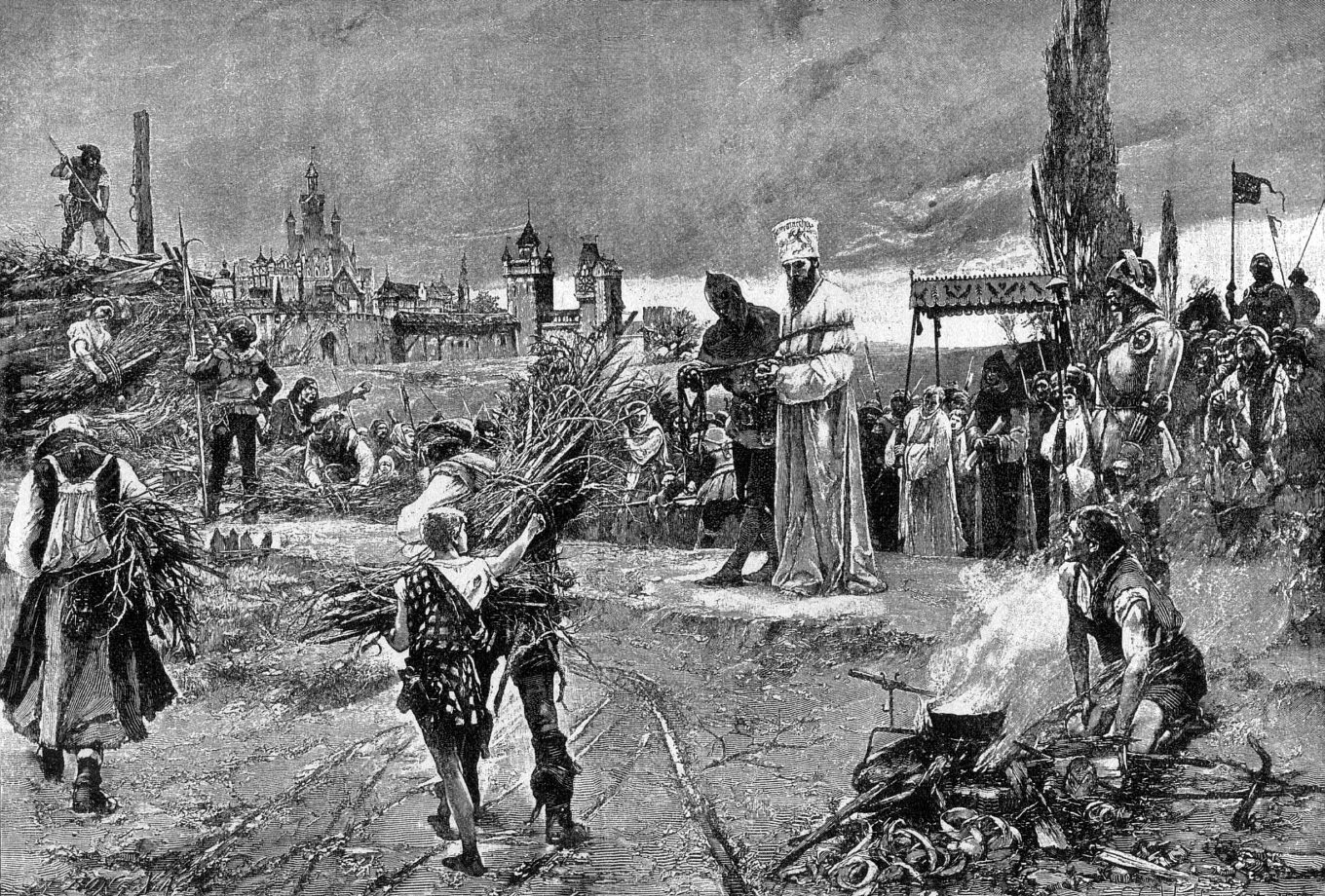
The anniversary of his death is now a national holiday.
Religious disputes, when mixed up with money and power, as, in the last analysis, they often are, can be deadly.
Hus’s most famous dictum was Pravda Vitezi –Truth Prevails–which has been the motto of every Czech revolution since his time. And in the long run, I believe it does!
Patricia Hampl–A Romantic Education.
Patricia Hampl–A Romantic Education
One of the magical moments in a writer’s life is the moment when you read something with a sense of recognition--I can do that too!! Seamus Heaney describes his unpleasant adventures with frog spawn and tadpoles in a poem called “The Death of a Naturalist.” –the naturalist he now knows he will never be.
However, the converse is also true. Anne Sexton writes about how she heard John Berryman read his poems aloud when she was 28, and how she realized in that moment that she was a writer. Marc Chagall tells how he discovered his artistic vocation while watching a fellow student draw. “How do you do that? ” he asked.” It’s easy, you blockhead,” the student replied. (Chagall, a working-class Jew, studied in a school for Russian children because his mother had bribed the headmaster). “Get a book from the library, and copy the pictures.” The library? Chagall persevered, and, well, became Marc Chagall.
One of my own moments of recognition–of reading something which came very close to my own experience, and what I thought were my abilities to render it happened when I read A Romantic Education by Patrica Hampl. The Catholic family united around enormous meals, with food a shorthand for love, power, competition… The childish sense of snugness in such a family. I still remember phrases several years later, “Come Eat,” the cri du couer of middle Europe. Falling asleep watching the talismanic figure of a wizard on a coffee tin.
Trish describes her Catholic upbringing in a convent school, her love of beauty, her attempts at writing poetry, and then a trip to Czechoslakia, where her grandmother, who worked in Minneapolis as a housekeeper was originally from. She renders golden Praha beautifully– I made a mental note to go there one day, and well, I am writing this from Prague.
However, the Iron Curtain has blown away since she wrote her book, and it is a different, plusher Prague. Poverty is not good for the human spirit, and I am glad the genteel older man who picked us up at the airport and drove us to our hotel no longer suffers from it. The Prague Trish describes with women offering to exchange rings with her as a token of friendship–exchanging worthless trash for her grandmother’s garnet ring; women squeezing favours out of her in exchange for promised sausage (which never appears)– has apparently gone with the wind, and good riddance.
Prague–The Fruits of Peace
Prague: The Fruits of Peace
Prague is gorgeous–largely because it escaped bombing in the second world war!
Roy and I are taking a course in Medieval Continental Cathedrals at Oxford University this term. The lecturer, Hubert Pragnell, showed us some absolutely beautiful medieval stained glass windows in French cathedrals, and said it was one of the few instances of medieval stained glass which survived the devastation of the two World Wars.
That’s all that war and conflict does: destroys. And that is, sadly, the work of Satan–pulling down, destroying, undoing.
Creativity and beauty flourish in times of peace. In peace, humans can display some of God’s endless creativity.
War and conflict just leave wreckage–emotional, spiritual, and physical. The winners often are left with a hollow victory, and the losers lose, but get the best poetry and stories!!
What about righteous conflict? Is it an oxymoron? Of course not, because we live in a fallen world–of sin, greed and unrighteousness.
It is probably only to be embarked on when all else has failed, if mediation through righteous channels has not worked. I guess one needs patience and determination if one is to righteously challenge unrighteousness. And, thank goodness, not everyone is called to do this, all the time. I guess now and again, one has a Joan of Arc moment–when one has to confront what is wrong, as cannily as one can. But for the most part, God spreads the burden of seeing justice done around–so that generally one just has one Ahab or Pharaoh to confront in a lifetime–unless you are the wonderful Baroness Caroline Cox!
The Village of Ewelme, Oxfordshire

The Village of Ewelme, Oxfordshire
The Village of Ewelme, Oxfordshire
We had an idyllic wander last weekend, though Ewelme, Oxfordshire, which must be one of the world's most beautiful villages, though not as celebrated as Bruges and Ghent, for instance.
There was a charming medieval church, unchanged since it was reordered in 1437. We are taking a course in Medieval cathedrals at Oxford University and have learnt that the reason there are relatively few medieval cathedrals in England, (as opposed to Europe) was because they built in wood. It was a late medieval church, and pretty much changed since it was reordered in 1436, by Alice de la Pole, granddaughter of Geoffrey Chaucer!!
I loved the massive East stained glass window, a Crucifixion, with the bystanders wearing doublet and hose, bright red and bright green. An amusing failure of the historic imagination, but it certainly helped ours, as we tried to imagine the late medieval men and women who had built this church.
There was an impressive eagle pulpit and brass lectern.
I love wandering around graveyards, and have done so since I was a child. This was a particularly interesting one. We met a middle-aged sprightly villager, with bright blue eyes, and a cheerful birdlike manner, who escorted us to Jerome K. Jerome's grave and said "Do you know what K. stands for? You will never guess. Let me show you," and then, triumphantly, showing us "Klapka." Goodness! We photographed the grave near him, that of a "Seller of Books, Soldier, Actor, and Sportman." Goodness again–the English sure are a nation of charming and self-confident dilettantes!!
We snooped around the school, founded in 1437, as a free grammar school, and which is the oldest continuously operating free school in England, probably in the world!! Mullioned windows, massive roof beams, very picturesque. Hard to imagine ICT being taught in this medieval building.
Between the church and school were cloisters, originally almhouses for poor men. The foundation still has money, and so they house 12 men and women of reduced means for a pittance. What lovely surroundings to live in if you are of reduced means!!


Ewelme also has medieval scholarships for clever children, one of which my daughter holds–which is why we were particularly interested in exploring the village.
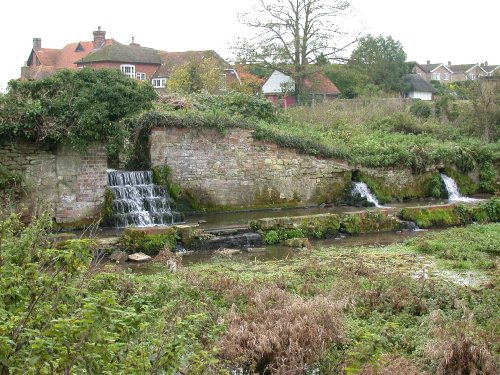
The other curiosity of this charming medieval village– a charming willow-draped duck pond, and water-cress beds, 6 acres of them running the length of the village. I wanted to take a handful for our salad, but was dissuaded since it is now a nature reserve.
After a day exploring on foot we asked "Where Pizza Hut?" to enjoy the Kids eat free deal

This offer has been extended until Jan 9, 2011. The details are: For every adult main course or adult lunchtime buffet purchased, an accompanying child can choose from either a FREE 2 course kids meal (includes a drink) or a FREE kids lunchtime buffet (includes pizza, pasta and salad). For more information see

John McPhee on Writing Creative Nonfiction
John McPhee, The Art of Nonfiction No. 3
Paris Review Interviews
Interviewed by Peter Hessler
John Angus Mcphee was born in Princeton, New Jersey, in 1931, attended college in his hometown, and still lives there today. He tells stories when he drives through town; memories shadow him everywhere he goes. (“I grew up all over campus,” he says. “I knew the location of every urinal and every pool table.”) McPhee’s childhood home—white-railed porch, narrow garage—still stands at 21 Maple Street. (“They haven’t changed a thing.”) A few blocks away is the gray stone building where he attended elementary school. It’s now the university’s Lewis Center for the Arts, home to the creative-writing program. (“I flunked kindergarten in the basement of that building.”) McPhee’s father worked for thirty-six years as a university physician in the McCosh Health Center. Directly next door is Guyot Hall, where John McPhee currently has his own office. It’s the same building where he worked part-time in the mid-1940s, as a teenage assistant to biologists. (“My job was killing fruit flies after they finished experiments.”)
Naturally enough, McPhee’s career as an author began with a Princeton subject. In 1965 he published A Sense of Where You Are, a book about Bill Bradley, the college basketball star and future senator. But that first book seemed to free McPhee, and after its publication, even as he continued to live in his hometown, his research took him all around the world. He’s written about Alaska (Coming into the Country), the Swiss Army (La Place de la Concorde Suisse), and an island in Scotland’s Inner Hebrides (The Crofter and the Laird). His subjects have included the atomic bomb, the environmental movement, the U.S. Merchant Marine, Russian art, and fishing. Four books on geology. Three on transport. Two on sports. One book entirely about oranges.
McPhee has now published more than thirty books, work that first appeared in the pages of The New Yorker, where he has been a staff writer since 1963. He has received an Academy Award in Literature from the American Academy of Arts and Letters, and he won the Pulitzer Prize for Annals of the Former World, his comprehensive survey of North American geology. His work has inspired generations of nonfiction writers, and he has distinguished himself especially as a teacher of literary journalism. Since 1975 he’s taught a course in nonfiction writing at Princeton and roughly half of his students—a group that includes Richard Preston, David Remnick, Eric Schlosser, and Robert Wright—have gone on to careers in writing or publishing. In his campus office, a set of shelves contains two hundred fifteen books written by former students. “That’s probably about half of the total number,” he says.
McPhee’s office was the site for most of our conversations, which were held over several days. Six decades after killing fruit flies in the basement of Guyot Hall, he’s reached the top—a turret on the fifth floor, beyond the reach of the elevator, in a room formerly used as a paint closet. The windows are Gothic-style arrow slits. Maps cover the walls, and more than twenty dictionaries line the shelves: French, German, Welsh, Icelandic, Italian. There are texts about geology, physics, medicine, chemistry, animal tracks, and edible wild plants. There are no other writers in this part of Guyot, which is home to the biology and geology departments. Years ago, McPhee was moved here temporarily, while the humanities building was being renovated, and he liked it so much that he stayed.
In A Sense of Where You Are, McPhee describes Bradley playing basketball “according to the foundation pattern of the game.” Despite possessing an amazingly accurate shot, the athlete distinguished himself primarily through attention to footwork, passing, and strategy. In a sense, McPhee writes the same way. He rarely draws attention to himself, but his sense of structure, detail, and language is so refined that his presence is felt on every page. For profile subjects he gravitates toward craftsmen of a similar stripe. He writes best about intense and often solitary individuals, ranging from the brilliant tennis star Arthur Ashe to the reclusive canoe maker Henri Vaillancourt.
McPhee has sharp blue eyes, thinning gray hair, and the full beard of a shy man. He seldom grants interviews, and his photograph has never appeared on a book jacket. He speaks slowly and precisely, pausing to savor a word or a term that he clearly enjoys:phraseology, abecedarian, consolidated sand. At the age of seventy-nine he has no plans to retire from writing or teaching, and he still adheres to a strict exercise routine. On each day of our conversation, he went for a seven-mile bike ride along the towpath of the Delaware and Raritan Canal. In Princeton he lives with Yolanda Whitman, his wife of thirty-eight years. He has four daughters from his first marriage: Jenny and Martha are novelists, Laura is a photographer, and Sarah is a professor of architecture. McPhee has always protected his privacy, and over the course of his career he has written little about himself and his family. But beneath his reserve he is a person of deep warmth and humor, and he knows what it means to struggle with an artistic endeavor. On one day of our conversation, we were interrupted by a telephone call from Martha, who told her father that she had just finished her fourth novel, after years of work. “Bravissima!” McPhee exclaimed. “Fantastic, that’s so wonderful! I am so glad! Now you can pay some attention to my problems.”
INTERVIEWER
Is there something about solitude in a subject that attracts you?
JOHN MCPHEE
I certainly don’t go around looking for loners, but I guess I am interested in people who are expert at something, because they’re going to lead me into some field, teach it to me, and then in turn I’m going to tell others about it. The ideal situation is to be watching somebody do their thing, and they don’t give a damn about you because they’re so absorbed. They’re confident about what they’re doing, and they’re not at all consumed with self-consciousness. Those people tend to be loners, I guess.
INTERVIEWER
When did you first start to think about devoting yourself to writing?
MCPHEE
There weren’t any very early signs. My biggest preoccupation in childhood was sports, mostly sports you could play with a ball. My father was a doctor of sports medicine, and Princeton was his employer. As I was growing up, we lived very close to the campus, and in the afternoons I would go with him to the university sports practices—football, basketball, baseball. I hung around a lot of football players who were ten or fifteen years older than I was. After a while they made a Princeton shirt for me with orange and black stripes on it, just like the big guys had. I was number thirty-three.
INTERVIEWER
Who made the shirt for you?
MCPHEE
The same company that made the shirts for the varsity football team. It was presented to me when I was eight, and I wore it for a few seasons. When a football game started, I would run onto the field with the team. I was on the sidelines during these games. Away games too. When Princeton scored a touchdown, I went behind the goalpost and caught the extra point.
One miserable November day I was down there on the sideline, wet, cold. And I looked up to the top of the stadium, and there was the press box. Shelter! I knew they had heaters in there with them, and these people were sitting there in complete comfort while we’re miserable down here on the field. They’re writing, they’re typing, and they’re warm. Then and there I decided to become a writer.
Now that story, which I have often told, is about three to five percent apocryphal. The rest of it is absolutely true.
INTERVIEWER
Was your father interested in writing?
MCPHEE
He published articles in medical journals, but he had no interest in being a writer. But from the earliest time I can remember, I would hear him, especially when he was driving, kind of speaking to himself and mumbling words that he obviously thought were appealing. He liked the rhythm. He said words over and over to himself, half aloud. And I heard him doing this and completely understood what he was doing: my dad was full of affection for words, and it showed in these little quiet ways.
I picked up the same tendency. If some word appealed to me, I’d say it over and over again. It would go around in my head the way the snatches of a song would.
INTERVIEWER
Did you have any teachers who encouraged you to write?
MCPHEE
At Princeton High School I had the same English teacher for the first three years. Her name was Olive McKee. She put a great deal of emphasis on writing. In the average week, she would have us do three compositions. We could write anything we wanted to—poetry, fiction, or a story about a real person. But what it had to have, even if it was a poem, was a diagram of some kind that showed the structure of what we had done. You had to turn that in with your piece.
That high-school English class was much more influential for me than working on any publication, which I didn’t do. At Princeton High School, the top students were streamed into what was called the academic division, and then there were the commercial and general arts courses. Kids were triaged at a really young age. I was in the academic group. The commercial group put out the school newspaper. So I was ineligible to write for it. As a student I didn’t have one word in the school newspaper.
INTERVIEWER
Really?
MCPHEE
It wasn’t considered curricular for those of us in the academic division. So I did all my writing in Olive McKee’s class. She was also the drama coach, and she carried this into the classroom in the form of having the kids read to the other kids. We’d get up and read our work, and the other kids were absolutely unbridled in their reactions. They wadded up pieces of paper and threw them at you while you were reading, they booed, they clapped. We had a lot of fun in that English class—and believe me, if something wasn’t working, you heard about it.
INTERVIEWER
Is reading your work aloud still important?
MCPHEE
Certainly the aural part of writing is a big, big thing to me. I can’t stand a sentence until it sounds right, and I’ll go over it again and again. Once the sentence rolls along in a certain way, that’s sentence A. Sentence B may work out well, but then its effect on sentence A may spoil the rhythm of the two together. One of the long-term things about knitting a piece of writing together is making all this stuff fit.
I always read the second draft aloud, as a way of moving forward. I read primarily to my wife, Yolanda, and I also have a friend whom I read to. I read aloud so I can hear if it’s fitting together or not. It’s just as much a part of the composition as going out and buying a ream of paper.
INTERVIEWER
Why don’t you read aloud to yourself?
MCPHEE
I think because it strikes me as insane. I have to have somebody listening, and the somebody listening can be helpful with comments. But mostly the person is just listening. Yolanda doesn’t challenge me very much. The one stricture she set down was that she would only take ten minutes of geology at a time.
INTERVIEWER
Has her reaction ever caused you to make a major change to a piece of writing?
MCPHEE
With Coming into the Country, there was a whole section about the upper Yukon River, and Yolanda said, That’s not of a piece with the rest of this stuff, there’s something wrong there. I was irritated because I was tired, and it was toward the end of this composition. It had taken me several years. But she was dead right. What I was doing was letting other people’s language, their quotations, do my writing for me. I was just heaving in hunks of dialogue from my notes, and it was easier to do that than write. So I went back and did the whole section over again, leaning far less on the quotes.
INTERVIEWER
Who is the friend you read to?
MCPHEE
Gordon Gund. Gordon is blind. He lost his sight in his thirties. Before that, he had been an ice-hockey player at Harvard and later a pilot. He also owned the Cleveland Cavaliers and signed LeBron James. He’s so proud of LeBron.
I came to know him through fishing, and he happens to live in Princeton, and he is a spectacular listener. He has an amazing memory. It’s the usual thing: if you lose one sense, the others become sharper.
One of the things that gave me this idea was that when I was in high school, because my name was McPhee, I sat next to a guy named Muller, and he was blind, and we got to know each other. And as I got to know him, I took to reading to him. His family had a summer home on Lake Champlain, and for a number of years I went to visit them there. I would sit there on the dock all day long reading to him. I read him The Scarlet Letter, I read him who knows what.
INTERVIEWER
Were there any writers you read in school who influenced you?
MCPHEE
I have a general thought about that, which is that everything contributes. There’s a whole spectrum between stuff that’s utterly unappealing and stuff you really admire. It’s all going to influence you, because a negative influence is as significant as a positive one. And so when the question comes up—who do you model yourself after?—I don’t really have an answer.
INTERVIEWER
What have been some of the negative influences?
MCPHEE
They’re too small and too numerous. It’s when you read something that makes your lips curl, something that’s hokey, something that’s too much of an O. Henry ending. Hot-dog stuff, you know. Where you can watch the writer painting his own makeup on as he writes.
INTERVIEWER
Which writers have you liked?
MCPHEE
There was a time when I was drunk on Hemingway. I was particularly struck by the long rolling sentences of Joseph Conrad. Fitzgerald. I was a sophomore at Princeton lying under a tree in the spring reading This Side of Paradise—that’s an actual scene.
I remember another thing: my friend John Graham, who was precocious in many ways, used to read The New Yorker. He used to talk about it, and so I started looking at it too, at a kind of a young age. Liebling. Thurber. E. J. Kahn Jr.
Alva Johnston. Wolcott Gibbs—I loved reading Wolcott Gibbs. He was acerbic. And E. B. White, of course.
INTERVIEWER
What kind of writing did you do in college?
MCPHEE
The single most important thing was writing a regular column in the alumni magazine. It was called “On the Campus.” In those days, there was a competition among juniors who wanted this job, which was actually paid. Today, various kids write short essays for that column, but all I was doing was summarizing college news, writing about campus events—bonfires or whatever. But I still had to run the words through my typewriter and publish for an audience.
INTERVIEWER
You wrote a novel for your thesis. Was that unusual for the time?
MCPHEE
It was among the first the university had ever had. There was a great fight in the English department over whether I would be allowed to do it. They finally decided I could go ahead, but there was opposition. A professor of mine stopped me in the library and said, Well, Johnny, good luck with your—with that thing. I hope you make a lot of money. But I’d never give you a degree for it. And then he goes on down the corridor.
They asked me to show up on the first day of senior year with thirty thousand words. So I spent the summer in Firestone Library, working in the English grad-study room, writing longhand on yellow pads. I had a real good time in there, working alongside these English grad students, all in various stages of suffering. I got my thirty thousand words done, and then I finished the thing over Christmas. It had a really good structure and was technically fine. But it had no life in it at all. One person wrote a note on it that said, You demonstrated you know how to saddle a horse. Now go find the horse.
But writing teaches writing. And I’ll tell you this, that summer in Firestone Library, I felt myself palpably growing as a writer. You just don’t sit there and write thirty thousand words without learning something.
I also wrote a fair amount of poetry in college. It was really, really bad. I mean, bad. And that’s how I found out—by doing it. The form of writing that I gravitated to was factual writing. I have no retroactive thoughts about other genres. I’m in the right place and I love being there. But you find out what sort of writer you’ll be by banging around from one form to the next when you’re younger.
INTERVIEWER
And yet you still worked in fiction for some time after college.
MCPHEE
Yes, my first endeavor as a professional writer was writing plays for a show on NBC called Robert Montgomery Presents. It was the golden age of television and the networks had maybe a dozen of these playhouses. Each play was fifty minutes long. They built sets at a big studio in Rockefeller Center: one of mine cost a hundred thousand dollars, a lot of money in 1955. It was for one night’s performance, and then it was destroyed and they were into the one for the next week. It was not a series, and it was broadcast live, so if an actor stumbled over a part or the set crashed onto the floor, and somebody cursed, it went out on the air.
In ’55 and ’56 I wrote five of these hour-long plays, three were originals and two were adaptations of short stories in The New Yorker by Robert Coates. Only two of them were produced. It was a remarkable experience for someone just out of college, but it was a form I didn’t want to continue in. Once you’ve done a script, a whole great team of people—the casting director, the director, the actors—all come in and take over. I had this great sense of the whole business slipping away. I wanted to make the whole shoe.
I decided that I would work in the big world by day and learn about how it worked, and then write about it at night. So I took a job at a firm called W. R. Grace & Co. that was into dozens of miscellaneous businesses all conglomerated together. It became a major American chemical company, but at that time they were only beginning to get into that. They had an airline, and the Grace Line ships. They made paper out of sugarcane. They made a candy, they made paint—I could keep going. And what appealed to me was this incredible array of stuff they did.
INTERVIEWER
What did you do there?
MCPHEE
I wrote articles during the day for the company magazine, but I couldn’t make myself write at night, so after a couple of months it became clear to me it wasn’t working out. All the time I was trying to sell stuff to The New Yorker.
INTERVIEWER
Were you always hoping to write for The New Yorker?
MCPHEE
The thing about writers is that, with very few exceptions, they grow slowly—very slowly. A John Updike comes along, he’s an anomaly. That’s no model, that’s a phenomenon. I sent stuff to The New Yorker when I was in college and then for ten years thereafter before they accepted something. I used to paper my wall with their rejection slips. And they were notmaking a mistake. Writers develop slowly. That’s what I want to say to you: don’t look at my career through the wrong end of a telescope. This is terribly important to me as a teacher of writers, of kids who want to write.
INTERVIEWER
You spent seven years at Time before you started at The New Yorker. What was useful about that experience for you?
MCPHEE
Time was where I was trained. I spent five of my seven years there in the show-business section, and the show-business writer did a lot more of his own interviewing than some of the others at the magazine did. Cover stories on Jackie Gleason, Richard Burton—I did all the reporting. Jack Benny comes to New York and I get into a taxicab with him and conduct an interview. Whereas if you were writing in the foreign-affairs section, as it was called then, you’d be writing out of files that people sent in from foreign bureaus. The sheer business of turning out five structured stories, however short they were, every week, was excellent training for me.
Now, throughout that period I was in dialogue with The New Yorker. I even sold a brief reminiscence piece to them, but spoke with an editor only over the phone, and did not advance one cubit toward a future there—I had written the piece for another magazine, and it found its way into this one kind of by accident. But there was a guy there named Leo Hofeller, who was reputed to spend a good bit of his time at Belmont Park. And Leo Hofeller, like almost no one else there, had a title. He was the executive editor, and his job was to talk to people off the street. He was William Shawn’s screen—his office was right next to Shawn’s. Leo Hofeller said he wanted to give me a little tryout. Would I think up six Talk of the Town ideas? I wrote these sample pieces, and I sent them there.
INTERVIEWER
Do you remember what they were?
MCPHEE
One was about somebody growing corn on the Lower East Side. But there was no discussion about any of them going into the actual magazine. Then, Leo Hofeller called me up and said he wanted me to come in. This is old Leo Hofeller of Belmont Park. This is nowhere near William Shawn—you don’t see William Shawn, who’s right through the wall. I went there, all excited, and he sits down and says, These pieces are pretty good. And then he turns around and says, I said pretty good, not very good! I’m sitting there shaking like an aspen leaf. Then he said he wanted me to think up three ideas for somewhat longer pieces. And then he said, And don’t come in here with that basketball player! We just did a basketball player.
INTERVIEWER
Bill Bradley was already playing?
MCPHEE
Bradley was playing at Princeton at this point. I was so caught up with him—not just that he could hit a jump shot, but that his story was so interesting. I had soaked up Bill’s story for a couple of years around Princeton, with my father being the doctor of the team. So I sat down and I wrote a five-thousand-word letter to Leo Hofeller. A lot of that letter is in A Sense of Where You Are. I mean it was seventeen thousand words in The New Yorker, and the letter was five thousand words long, and I probably used three thousand words from the letter. And what I said was, I’m so caught up with this subject that I’m going to write this piece on a freelance basis for somebody and then I’ll come back to you with some other idea. But then I just babbled on about Bradley.
I get this back from him: Despite what we said, we would be interested. But he told me that there were no guarantees, of course. I wrote the story and sent it in, and then Leo Hofeller called me to say that they were going to buy it. I showed up at his office, and he said something like, You will never speak to me again. From now on, you will speak to Mr. Shawn, and you’ll forget about me. Forget anything I ever told you, forget everything. It’s a blank slate. Then he leads me eight feet around the corner. And it’s, Hello, hello, Mr. McPhee. And that was the beginning with Shawn.
INTERVIEWER
What were your first impressions?
MCPHEE
He spoke so softly. I was awestruck: the guy’s the editor of The New Yorker and he’s this mysterious person. It was the most transforming event of my writing existence, meeting him, and you could take a hundred years to try to get to know him, and this was just the first day. But he was a really encouraging editor. Shawn always functioned as the editor of new writers, so he edited the Bradley thing. So I spent a lot of time in his office, talking commas. He explained everything with absolute patience, going through seventeen thousand words, a comma at a time, bringing in stuff from the grammarians and the readers’ proofs. He talked about each and every one of these items with the author. These were long sessions. At one point I said, Mr. Shawn, you have this whole enterprise going, a magazine is printing this weekend, and you’re the editor of it, and you sit here talking about these commas and semicolons with me—how can you possibly do it?
And he said, It takes as long as it takes. A great line, and it’s so true of writing. It takes as long as it takes.
INTERVIEWER
Did he offer you a job after the Bill Bradley story?
MCPHEE
After the last proof had gone to press, before I was leaving, I told him that I wanted to join The New Yorker staff. Ooh! The tone changed. Shawn turned from this wonderful and benevolent editor of words into a tough customer. He said, Oh, how could he encourage that? How could he know this wasn’t a one-shot deal where somebody produces something good because of their intense commitment to it? And furthermore, I had four children. How on earth could he encourage me to give up a job with a salary and benefits? He said, Morally I can’t do that. He was guiding the conversation toward a real flat dead end.
I said, Having had this experience—publishing these seventeen thousand words, with the spirit of it that the writer be satisfied—how can I go back to writing shorter pieces at Time? And I said, If I can’t work on staff here, I think I’ll go work for a bank or something, and try to write pieces independently for The New Yorker.
And Shawn goes, Oh. Oh, oh. I see. Well, then you might as well join the staff. And that was it. I walked out. That was the very beginning of ’65 and that was the moment I became a staff writer.
INTERVIEWER
Was it hard to come up with things to write about?
MCPHEE
I was really quite at sea about that. Let’s say I wanted to write about clams. I’d go to Shawn with that idea, and he would say, Oh no, no. That’s reserved in a general way for another writer. That’s reserved in a general way. Isn’t that amazing? Shawn never mentioned one writer to another. Shawn operated at the hub of an old-fashioned wheel, with the spokes going out all over the place, and the spokes were the writers and no one ever touched another. He kept this amazing thing going. He had thought beforehand about an amazing number of subjects, so the odds were if you brought something up, Shawn had pondered it in some context before. He always knew what he thought immediately. Sometimes he said that it was reserved for another writer, and sometimes he just wasn’t interested. If that was the case, he’d say, Oh no, that’s not for us.
At any rate, that first month, January of 1965, I go in there and we’re having this conversation—Oh no, that’s not for us. Again and again. And then finally I said, Well I have another idea. It’s a piece about oranges. That’s all I said—oranges. I didn’t mention juice, I didn’t mention trees, I didn’t mention the tropics. Just—oranges.
Oh yes! Oh yes! he says. That’s very good. The next thing I knew I was in Florida talking to orange growers.
INTERVIEWER
Where did you find your subjects?
MCPHEE
When I was starting out, I said to friends, I’m looking for ideas. And a high-school friend named Bob VanDeventer said, Why don’t you write about the Pine Barrens? And I said, The what? I was born and raised in New Jersey, but I’d never heard of them. So VanDeventer starts telling me about the pines, and how there were holes in the ground that had no bottom. And that the people who lived there were odd, to put it mildly. He had a whole lot of things that he had learned somewhere about the Pine Barrens, and with respect for my good friend Bob, all of these things were wrong. But what he did was light the spark. It was in New Jersey, and it related to the woods, two things that I was interested in.
There are zillions of ideas out there—they stream by like neutrons. What makes somebody pluck forth one thing—a thing you’re going to be spending as much as three years with? If I went down a list of all the pieces I ever had in The New Yorker, upward of ninety percent would relate to things I did when I was a kid. I’ve written about three sports—I played all of them in high school. I’ve written a great deal about the environment, about the outdoors —that’s from thirteen years at Keewaydin, in Vermont, where I went to camp every summer, first as a camper and then as a counselor. I’d go on canoe trips, backpacking trips, out in the woods all summer, sleeping on the ground.
INTERVIEWER
Are there other friends who gave you ideas for stories and books?
MCPHEE
I wrote Coming into the Country because of the influence of John Kauffmann. John is really significant in the germination of numerous pieces of mine. We taught school together here in Princeton, at the Hun School, in 1955. John had a canoe; he had grown up in canoes in northern New Hampshire. On weekends we’d go someplace way up the Delaware River, and we’d just sleep on the riverbank. We made trips of forty, fifty miles.
John eventually worked for the National Park Service. In 1971 he put in for a transfer to Alaska, where he became a park planner. This was seven or eight years before Jimmy Carter more than doubled the national park system. John’s interest was Arctic Alaska, in the central Brooks Range. He was the person who tramped this place and studied it summer after summer. The result of John’s work is Gates of the Arctic National Park and Preserve, almost nine million acres. John’s final recommendation for what the park service should do there, in terms of developing the park, was nothing. And so far that’s essentially what has happened.
He’d come and visit when he was home, and he would tell stories about Alaska, and I thought, God help me, I would love to go there. And so I go to Shawn and ask him if I can go to Alaska. Oh no, he said, that’s not for us.
I discovered later that the reason it was not for us was because it’s cold there. It wasn’t reserved for another writer in a general way, it was reserved for no writer in a specific way, because it’s cold there. He didn’t want to read about cold places. Another time I tried to get him to agree that I write about Newfoundland. And he said, right back, Is it cold there?
Anyway, I couldn’t go to Alaska, but I tried again. No. And I tried again, and I think he got impatient with me. But then this thing occurred: he was trying to figure out the matter of succession. Fundamentally Shawn did not want a successor, but he had to pretend that he did, so he had a series of dauphins. He had everybody from Bill McKibben to Jonathan Schell to Robert Bingham. Shawn called me up one day and said, We’re going to do something a little new here. From now on I’d like you to turn in your ideas for pieces to Mr. Bingham, and Mr. Bingham will decide.
I went straight to Mr. Bingham and I said, I want to go to Alaska. And I was in Alaska very shortly thereafter.
INTERVIEWER
“The Encircled River,” the first part of Coming into the Country, has a particularly interesting structure. It starts in the middle of your canoe trip down the Salmon River in the Brooks Range, and the writing is in the present tense. Then you come to the end of the journey—but at that point the writing flashes back to the beginning of the trip. After that, it’s in the past tense, and the piece of writing ends with you in the canoe, somewhere relatively early in the journey, seeing a grizzly bear. It makes a circle, like the title of the section. How did you come up with that structure?
MCPHEE
Structure is not a template. It’s not a cookie cutter. It’s something that arises organically from the material once you have it. In “The Encircled River” I go to Alaska, and make that trip, and soak up that world. And when you’re up there, the most impressive thing is the cycles of that world. There aren’t any people up there in that Salmon River valley, not even Eskimos. Cycles of one year, five years, a thousand years: all these different cycles spinning around. The cycles of the wildlife, the different species and how they come and go. This sort of gets into your head and keeps going on and on.
But once I started writing, I had to tell a story. It’s the story of a journey. Within that journey certain things happened, such as an encounter with a big grizzly. That grizzly encounter was a pretty exciting thing, and it happened near the beginning of the trip. That was somewhat inconvenient structurally, because it’s such a climactic event. But you can’t move that bear, because this is a piece of nonfiction writing.
But what if you started telling the piece of writing further down the river, I wondered. That way, when you get to the end of the trip, you’re really only halfway through the story. What you do then is switch to the past tense, creating a flashback, and you back up and start your trip over again. By the time you get to that bear, that bear is at the perfect place for a climax. That’s what’s exciting about nonfiction writing. In this case it’s a simple flashback, but it also echoes all these cycles of the present and the past.
INTERVIEWER
You’ve mentioned that after writing for The New Yorker for a while, you wanted to write a different type of profile. Why?
MCPHEE
I’d started with single profiles, and when I’d done enough of them, I began to want to do a double profile. Two people at once, with the idea that one plus one might equal more than two. Who would it be? A great example for a project like that would be Frank Gehry and Peter Lewis. This Peter Lewis is some character—a one-legged insurance billionaire who lives much of the year on one of the largest yachts in the world and was once caught carrying pot into New Zealand. And he donated the sixty million bucks to build the new library here on campus. And Frank Gehry is Frank Gehry. These two guys have to know each other—that library’s built here because Peter Lewis gave the money and said that Frank Gehry would be the architect. If you did a profile of Frank Gehry and a profile of Peter Lewis, and you put them in the same piece of writing, one plus one would add up to three point six.
That’s what I was looking for. An architect and his client—that exact thing occurred to me back then. A dancer and a choreographer—less appropriate for me because I don’t know anything about the subject. A baseball manager and a pitcher. You could keep going. At any rate, I was looking for a pair. And one day in 1968 I was watching CBS, and there were Clark Graebner and Arthur Ashe playing in the semifinals of the first U.S. Open Tennis Championships. They were the same age—they had both been born in 1943—and they would have known each other since they were eleven years old. One of them’s black, one of them’s white. One of them is this middle-class guy, a dentist’s son from Shaker Heights, and Arthur Ashe is the son of a playground director in Richmond.
So I go to Shawn and I say that I would like to do that. And I said, But I can’t do it without the match—and the match is on tape at CBS and, if they can make us a copy, will you pay for it? All right, he says. And so I called CBS, and this is several weeks after the match. In those days there were things known as kinescopes, films made from a television monitor. A really lousy film. And CBS said, you didn’t call a minute too soon because that tape is scheduled for erasure this afternoon. This piece was written about a match where you go stroke by stroke, and through all the interviewing the guys were looking at the film—and I was dead if that didn’t happen. But it worked out.
And then, having done that double profile, I got ambitious. I decided to escalate, and I had the idea of writing a triple profile—a three-part piece in which three people would be separately profiled as they related to a fourth person, whose story would develop over the course of the entire composition. So I wrote on my wall: ABC over D. I stuck it on a three-by-five card, in big letters. ABC over D. That’s all I knew.
INTERVIEWER
You were still trying to figure out who to write about?
MCPHEE
Trying to figure out who A, B, C, and D were. This was 1968 when this thing goes up on the wall. I started to think, What would this story be about? Who would the A, B, C, and D be? The environmental movement was just becoming such—converting itself from contour plowing to what we know as ecology. And given all those years at Keewaydin, I decided to do it about the environmental movement, and I went to Washington and stayed with my park-service friend, John Kauffmann. We spent ten days just talking about this thing. D could have been Aldo Leopold, the Wisconsin conservationist who wrote A Sand County Almanac. But the absolute feistiest environmentalist was the executive director of the Sierra Club, David Brower. He was an early preacher of the environmental movement, and he was the right choice.
Now, who were going to be the three others? They should be people on the opposite side of the argument from Brower. John and I and various other people in Washington got together a list of seventeen possibilities. I mean, there were all kinds of people who could be on the opposite side of the fence. I narrowed it down until I got to Charles Fraser, a developer in the South, Floyd Dominy, the U.S. Commissioner of Reclamation and the builder of huge federal dams, and Charles Park, a career USGS guy.
That became Encounters with the Archdruid. It was an odd piece, a piece where the journalist creates the milieu—I invited Floyd Dominy to go with Dave Brower on a raft down the Colorado River. And The New Yorker is supporting all this. Instead of going out and covering something, I invited these people to go to these different places.
INTERVIEWER
Did you ever have another project that started off on a theoretical, abstract level like that?
MCPHEE
No.
INTERVIEWER
After you’ve done your reporting, how do you proceed with a piece?
MCPHEE
First thing I do is transcribe my notes. This is not an altogether mindless process. You’re copying your notes, and you get ideas. You get ideas for structure. You get ideas for wording, phraseologies. As I’m typing, if something crosses my mind I flip it in there. When I’m done, certain ideas have accrued and have been added to it, like iron filings drawn to a magnet.
And so now you’ve got piles of stuff on the table, unlike a fiction writer. A fiction writer doesn’t have this at all. A fiction writer is feeling her way, feeling her way—it’s much more of a trial-and-error, exploratory thing. With nonfiction, you’ve got your material, and what you’re trying to do is tell it as a story in a way that doesn’t violate fact, but at the same time is structured and presented in a way that makes it interesting to read.
I always say to my classes that it’s analogous to cooking a dinner. You go to the store and you buy a lot of things. You bring them home and you put them on the kitchen counter, and that’s what you’re going to make your dinner out of. If you’ve got a red pepper over here—it’s not a tomato. You’ve got to deal with what you’ve got. You don’t have an ideal collection of material every time out.
INTERVIEWER
What happens next?
MCPHEE
You write a lead. You sit down and think, Where do I want this piece to begin? What makes sense? It can’t be meretricious. It’s got to deliver on what you promise. It should shine like a flashlight down through the piece. So you write a beginning. Then you go back to your notes and start looking for an overall structure. It’s three times as easy if you’ve got that lead.
Once I’ve written the lead, I read the notes and then I read them again. I read them until they’re coming out my ears. Ideas occur, but what I’m doing, basically, is looking for logical ways in which to subdivide the material. I’m looking for things that fit together, things that relate. For each of these components, I create a code—it’s like an airport code. If a topic is upstate New York, I’ll write UNY or something in the margin. When I get done, the mass of notes has some tiny code beside each note. And I write each code on an index card.
INTERVIEWER
How many components go into a piece like Encounters with the Archdruid?
MCPHEE
The whole book had thirty-six components. What I ended up with was thirty-six three-by-five cards, each with a code word. Some of these things are absolutely dictated by the story of the journey down the Colorado River. But the choices are interesting where it’s not dictated, like the facts of David Brower’s life.
I knew where I was going to start, but I didn’t know the body of the thing. I went into a seminar room here at the university, and I laid the thirty-six cards out on the table. I just looked and looked at them. After a while I was looking at two cards: Upset Rapid, which is a big-time rapid in the Colorado River, and Alpinist. In Upset Rapid, Brower doesn’t ride the rapid. Why doesn’t he ride the rapid? His answer to Floyd Dominy is, “Because I’m chicken.” That’s a pretty strong scene. What next? Well, there are more than seventy peaks in the Sierra Nevada that were first ascended by David Brower, hanging by his fingernails on some cliff. “Because I’m chicken”? This juxtaposition is just loaded with irony, and by putting the Alpinist right after Upset Rapid, in the white space between those two sections there’s a hell of a lot of stuff that I don’t have to say. It’s told by the structure. It’s all crackling along between those two things. So I put those two cards side by side. Now there are thirty-four other parts there on the table.
INTERVIEWER
How do you approach transitions between these various sections?
MCPHEE
You look for good juxtapositions. If you’ve got good juxtapositions, you don’t have to worry about what I regard as idiotic things, like a composed transition. If your structure really makes sense, you can make some jumps and your reader is going to go right with you. You don’t need to build all these bridges and ropes between the two parts.
INTERVIEWER
Where did this method come from?
MCPHEE
It goes back to Olive McKee at Princeton High School, and the structural outline that we had to have before doing any piece of writing. It came up again when I worked at Time. My first cover story just floored me. It was five thousand words, and I really struggled with the mass of material. I was pretty unhappy. It was just a mess—a mess of paper, I didn’t know where anything was. So I went back to Olive McKee and the outline, sorting through this matrix of material, separating it into components and dealing with one component at a time.
INTERVIEWER
Is there ever a risk of it becoming too mechanical?
MCPHEE
It sounds very mechanical, but the effect is the exact opposite. What it does is free you to write. It liberates you to write. You’ve got all the notes there; you come in in the morning and you read through what you’re going to try to write, and there’s not that much to read. You’re not worried about the other ninety-five percent, it’s off in a folder somewhere. It’s you and the keyboard. You get away from the mechanics through this mechanical means. The spontaneity comes in the writing, the phraseology, the telling of the story—after you’ve put all this stuff aside. You can read through those relevant notes in a relatively short period of time, and you know that’s what you want to be covering. But then you spend the rest of your day hoping spontaneous things will occur.
It may sound like I’ve got some sort of formula by which I write. Hell, no! You’re out there completely on your own—all you’ve got to do is write. OK, it’s nine in the morning. All I’ve got to do is write. But I go hours before I’m able to write a word. I make tea. I mean, I used to make tea all day long. And exercise, I do that every other day. I sharpened pencils in the old days when pencils were sharpened. I just ran pencils down. Ten, eleven, twelve, one, two, three, four—this is every day. This is damn near every day. It’s four-thirty and I’m beginning to panic. It’s like a coiling spring. I’m really unhappy. I mean, you’re going to lose the day if you keep this up long enough. Five: I start to write. Seven: I go home. That happens over and over and over again. So why don’t I work at a bank and then come in at five and start writing? Because I need those seven hours of gonging around. I’m just not that disciplined. I don’t write in the morning—I just try to write.
INTERVIEWER
You were writing in the sixties and seventies, when there was a lot of talk about New Journalism. What was your attitude toward that? Did you feel that something different was happening in nonfiction writing?
MCPHEE
Well, something was happening in the Sunday magazine of The New York Herald Tribune. It’s often described as some kind of revolution, but I never really understood that. Nonfiction writing didn’t begin in 1960. Going back, there were so many nonfiction writers—what about Liebling? Walter Lord, James Agee, Alva Johnston, Joseph Mitchell—these are people who had prepared the way, and, more than that, had written many better things than these so-called New Journalists would ever do. Henry David Thoreau, for all that, was a New Journalist of his time, as were Dorothy Day, Ida Tarbell, Willa Cather between the ages of twenty and forty at McClure’s Magazine, John Lloyd Stephens, Richard Henry Dana Jr., and on back to Thomas Browne, Robert Burton, Francis Bacon, James Boswell, and Daniel Defoe. You get the point.
New Journalism sounded like labeling for labeling’s sake. Some of the things were really interesting to read, but there was too much precedent challenging the word new. Anytime I was called a New Journalist I winced a little with embarrassment.
Tom Wolfe helped bring a certain amount of attention to this kind of writing. But he’s just Tom Wolfe. It didn’t happen because one person did it. It happened because a whole bunch of people across a lot of time were interested in making pieces of writing out of factual material that would stand up on their own. They were not just writing articles telling you how to recover from hypothermia.
INTERVIEWER
Was there any significant change in terms of interest, or in the way that people viewed nonfiction writing?
MCPHEE
The only significant change is that, in a general way, nonfiction writing began to be regarded as more than something for wrapping fish. It acquired various forms of respectability. When I was in college, no teacher taught anything that was like the stuff that I write. The subject was beneath the consideration of the academic apparatus.
Sometime during the eighties I was invited to do a reading at the University of Utah, and I accepted. And several weeks later, the person who approached me got back in touch and said he was really embarrassed and sorry. While he had wanted me to come to Utah and do a reading and talk to students, his colleagues did not. They didn’t approve of the genre I write in. I wrote back to him and said that I really appreciated his wanting me to be there. And certainly I didn’t feel anything toward him but gratitude, but as for his colleagues—when they come into the twentieth century I’ll be standing under a lamp looking at my watch.
INTERVIEWER
What do you call the type of writing you do? Your course at Princeton has sometimes been called The Literature of Fact and sometimes Creative Nonfiction.
MCPHEE
I prefer to call it factual writing. Those other titles all have flaws. But so does fiction.Fiction is a weird name to use. It doesn’t mean anything—it just means “made” or “to make.”Facere is the root. There’s no real way to lay brackets around something and say, This is what it is. The novelists that write terrible, trashy, horrible stuff; the people that write things that change the world by their loftiness: fiction. Well, it’s a name, and it means “to make.” Since you can’t define it in a single word, why not use a word that’s as simple as that?
Whereas nonfiction—what the hell, that just says, this is nongrapefruit we’re having this morning. It doesn’t mean anything. You had nongrapefruit for breakfast; think how much you know about that breakfast. I don’t object to any of these things because it’s so hard to pick—it’s like naming your kid. You know, the child carries that label all through life.
INTERVIEWER
Memoir has also become popular, but you’ve never written much about yourself. Why not?
MCPHEE
I never had any interest in writing about myself, or, Lord knows, in inserting myself between the reader and the material. But if the writer belongs in the piece, and needs to be there, he ought to be there. A New York Times reporter will get into a rubber raft somewhere and later write, A visitor stepped into the raft. Well, shoot. You’re in the piece if you have to be.
Here’s an example: in The Deltoid Pumpkin Seed, a story of endless flight tests, there was no need to announce myself. I was obviously there, listening to it, scribbling it down—there’s no mention of me. And then we get all the way through sixty thousand words, nearly to the end, and that’s where the climax happened—this thing actually flew, at long last. And a guy named Everett Linkenhoker jumped in a Piper Cherokee to go up with it, to fly around, and I jumped in the plane beside him! And off we went. Now, I submit, who got in the plane? A visitor? So I said, “I went with him.” I turned in a sixty-thousand-word essay, and that was the only I in it. Robert Bingham, my editor at The New Yorker, couldn’t stand this. His nerves couldn’t handle the single pronoun. He said, That’s the only one. And I said, Look, Bobby, it’s the only one that belongs in the piece. He said, You’ve got to add another one. I said, Look, there’s no need of one anywhere. And he said, You’ve got to; it’s wrong; you just can’t have this thing over there. And I said, OK. So there was a scene, in a gas station, a garage where a mechanic was working on something—a gas station in Neshaminy, Pennsylvania. I thought, well, I could say that I watched him do that. So I put an I in there and maybe one other place and Bingham went home happy.
INTERVIEWER
You’ve mentioned Shawn and Bingham, two of your editors at The New Yorker. What was their role in your writing?
MCPHEE
Bingham had been a writer-reporter at The Reporter magazine. So he comes to work atThe New Yorker, to be a fact editor. Within the first two years there, he goes out to lunch with his old high-school friend Gore Vidal. And Gore says, What are you doing as an editor, Bobby? What happened to Bob Bingham the writer? And Bingham says, Well, I decided that I would rather be a first-rate editor than a second-rate writer. And Gore Vidal draws himself up and says, And what is wrong with a second-rate writer? Bingham liked to tell that story. He was my principal editor for sixteen years until he died of brain cancer in 1982.
An editor provides a dialogue with the writer before he’s written anything, and while he’s writing. Bingham wasn’t saying, This sentence doesn’t work. But he was talking to me as I was going along. And I was a very nervous writer about my own work, and am to this day. I never have any confidence when I start out on a story. I gain confidence after the first draft is written. But before the first draft is written, I’m almost as lacking in confidence now as I was back then. Conversation with him would help that. I would also read him sentences. How does that sound? Does that sound like a good lead for a piece in the magazine? And he didn’t uniformly say yes just to say yes. The point is that dialogue was happening.
Then it hit a bizarre moment. I went through a terrible period of life when I got divorced. And if I had no confidence before that, during that period I had negative confidence. I was trying to keep a book going, I had children to support, and I was a total mess. I called Bingham up and I say, Does this sound like it will work as the lead? And then I call him up and say, Well, you know, after that there’s—And I proceeded to read to that man, on the telephone, sixty thousand words. Can you believe it? Not in one session but over a period of time. I was so lacking in confidence that I needed to have somebody say, Yeah, yeah, go ahead. And he said, Yeah, yeah, go ahead. The result is Encounters with the Archdruid.
INTERVIEWER
You read him the whole book on the phone?
MCPHEE
A hundred percent. That didn’t repeat itself; that wasn’t our normal relationship. But I was a basket case, and I had absolutely no confidence that I could put my left foot forward and then the right one after that. He was patient.
I remember there was one piece we were working on that had this weird pun in it. And Bingham said, You know that pun there? That’s terrible, that’s really bad. And I said, I want it to stay there. I like that. And he says, Well, you’re the writer; I just work here. And then we go on talking about other things and everything else. Twenty-four hours go by, we’re back at his desk, he says, You know that line there? Um, it’s really bad, you should think about it again. I said, Bobby, we talked about that. I like that line. And then he mentioned it a third time and I said something similar. Another day went by, and I walked into his office, first thing I say, Bob, you know that pun there? Take it out, OK? It’s no good.
Not a smile, nothing. He showed nothing on his face. He was totally aware during this entire sequence, of course. He was tremendous. And he was just a very, very, very good friend.
INTERVIEWER
Was there anything else that helped you get through that difficult period?
MCPHEE
No, I just got through it. Stories are always really, really hard. I think it’s totally rational for a writer, no matter how much experience he has, to go right down in confidence to almost zero when you sit down to start something. Why not? Your last piece is never going to write your next one for you.
When I wrote Coming into the Country, I was sitting up in an office I used to have on Nassau Street, this little room on the second floor, and I stewed like hell. My walls were covered in bulletin boards with three-by-five cards and maps of Alaska and everything else. And I’d go in there and try to advance this piece. So I started thinking, if I ever finish this piece I am not going to write another word!
In those years I used to play tennis with Peter Benchley. We went out to Princeton Junction to this tennis court once a week. One day I got into his car and I was just sputtering. Writing sucks! Writing stinks! I’m never gonna write again, goddamn it! And Peter listens to all that and just drove to Princeton Junction.
About two weeks later he comes by again, exact same situation, and I’m not irrational at this moment. He starts to drive and then he says, You remember two weeks ago when you were yelling and saying, Writing sucks! Do you recall that? I said, Peter, yes, I do recall that. And he said, Well, tell me something. If you wrote something and you made so much money that you would never need to write again, would you write again? And I said, Peter, that isyour problem. That is so far beyond my horizon that there’s nothing I can say that’s useful about it.
He had just written Jaws, and the thing I was so awed by and so admired about Peter was that he never stopped. Peter wrote and wrote and wrote. He wrote books, he wrote screenplays, he wrote National Geographic pieces, he got expeditions going about all kinds of oceanographic things, he got into the biology of fishes—he never stopped, he just kept it up. The fact that he made all this money—life was about something else. And this was the lovely thing; Peter Benchley was one of the nicest people that will ever walk the earth.
INTERVIEWER
Occasionally reviewers have said that you should be more forthcoming with your own opinions. Do you have strong political feelings on the need to protect the environment?
MCPHEE
Only in the sense that I subscribe to the idea of doing something about it, and if you’re doing something, it’s political. Once I started writing books like Encounters with the Archdruid, people like David Brower wanted me to join various environmental organizations. And I wouldn’t do it. Because I’m a writer, a journalist, and I want to be believed. I’m trying to show both sides of an issue. As a reporter, my vote is less important than my laying the whole deal out in front of people. It was really important because I got this label as an environmental writer, and I wanted to preserve the independence and relative objectivity of the journalist.
INTERVIEWER
Did that label make you uncomfortable?
MCPHEE
All these labels—I’ve been called an agricultural writer, an outdoor writer, an environmental writer, a sportswriter, a science writer. And so you just grin. I’m a writer who writes about real people in real places. End of story.
I suppose it is a little hard to hide your biases, though. It shows through the cracks, you can’t help it. If somebody thinks that my bias is toward what’s known as the environmental movement, they’re right. But as a writer I’m struggling to present both sides. There’s the section in Coming into the Country where Ed Gelvin and his son Stanley have run this Caterpillar bulldozer up into the mountains. They’ve dragged it over incredibly rugged terrain, a place without any roads, all fifty-five tons. They’ve taken it apart and put it back together, and they’ve gotten it to work. This is a family that has invested everything trying to get gold, and they’re tearing up a beautiful stream. The passage says, “Am I disgusted? Manifestly not. Not from here, from now, from this perspective. I am too warmly, too subjectively caught up in what the Gelvins are doing. In the ecomilitia, bust me to private.”
I’m for these guys. In this time and this place—don’t hold me to this forever—I’m for these guys. But some people think I should be writing with my cudgel. They think that I don’t have the temerity to express these opinions. That’s just the exact reverse of what’s going on. I’m trying to lay this thing out for the reader. Not to take the reader and rub his nose in it, and say, This is how you should think. I want the reader to do his own thinking. And why do I do that? Because I think it’s a higher form of writing.
INTERVIEWER
Why have you avoided specializing in one field?
MCPHEE
I’ve always thought that the thing I bring to my subjects—one thing—is a fresh eye. And the fresh eye is important, because you’re learning. Certain pieces you can only do once. You can only introduce lacrosse once. The fresh eye is a distinct asset.
I’m not an expert in anything, true enough. But how about twenty years in geology? Did that come about because I decided to spend twenty years in geology? Never. I had an interest in geology from high-school days, and when I stepped into geology I thought I was in it for a short period of time.
When I proposed writing about geology to Shawn, he was very sober about it. Well, he said, go ahead. Go ahead. Readers will rebel. But you go ahead; you’ll figure out a way—but readers will rebel.
He was right. I’ve never had an experience like that. Readers strongly support it and strongly rebel, and seem to be split in camps.
INTERVIEWER
Why do you think that is?
MCPHEE
Two cultures. There are some people whose cast of mind admits that sort of stuff, and there are others who are just paralyzed by it at the outset, no matter how crafty the writing might be. A really nice thing that happens is when people say, I never thought I’d be interested in that subject until I read your piece. These letters come about geology too, but there are some people who just aren’t going to read it at all. Some lawyer in Boston sent me a letter—this man, this adult, had gone to the trouble to write in great big letters: stop writing about geology. And it’s on the letterhead of a law firm in Boston. I did not write back and say, One thing this country could very much use is one less lawyer. Why don’t you stop doing law?
INTERVIEWER
How did the geology project get started?
MCPHEE
After Coming into the Country I had the idea of doing a Talk of the Town piece about a rock outcrop in New York City. I would tell about that rock outcrop, and how old it was, and in what events it formed. And shut up and go home—a Talk piece. And I called Ken Deffeyes in the geology department at Princeton and said, If I did that, would you go with me? Yes, he said, he would. But my mind kept going around, and so I called him back and I said, What if I did a longer piece? Instead of just one outcrop, what if we went from outcrop to outcrop and told a bigger story? For example, go up the Adirondack Northway, one of the most beautiful roads in America—there are spectacular outcrops all along that road.
And Deffeyes says, Not on this continent. That’s exactly what he said. He said, If you want to do something like that on this continent, go across the structure. Because the way North America is put together, if you go east–west you’re going from one physiographic province to another. If you go north–south, odds are you’re going to stay in a single physiographic province. The next thing I know he has drawn up a chart, an amazing chart of the United States, and it shows the whole country and the ages of the rock across the fortieth parallel. And then he made the fundamental point that New Jersey and Nevada are geologically related, in that the same thing is going on in Nevada now that went on in New Jersey two hundred million years ago. Thanksgiving break in 1978, Deffeyes and I spend a weekend in Nevada. Basin and Range got started that way. And then Deffeyes, thinking his way through the country, thought Dave Love would be the best guy for the Rockies, Eldridge Moores for California, Anita Harris with her paleontology for the Appalachians.
And that’s how it started. I was going to do it all in a lump, but it turned out to be such a huge thing. I realized I couldn’t write it all at once, so I broke it down naturally—into Basin and Range, In Suspect Terrain, Rising from the Plains, and Assembling California.
INTERVIEWER
You said you didn’t know what you were getting into. At what point did the size of the project become clear?
MCPHEE
Two or three years later. I just kept getting in deeper and deeper. I had a terrible time. When I wrote The Curve of Binding Energy, Ted Taylor and others could lead me through a little corner of physics and could make certain things clear to me. Whereas in this thing, every time you turn up one thing you get to another. Stratigraphy, structure, tectonics, brrrrr! And if you’re going to do that trip across the country, you can’t ignore any of it! So I was really scrambling. When I went with Anita to the Delaware Water Gap, I was scribbling notes, and she was talking. We spent hours there—all day I scribbled. I did not understand anything that I was writing down. And the interesting thing was that about two and a half years later, when I wrote In Suspect Terrain, by that time I could read that stuff. I understood what it said. And I hadn’t understood it when I made the notes.
That first year it sank in how far over my head I was. The next two years were ’79 and ’80, and I really was unhappy. I thought I was in a cave and I couldn’t get out. It was just too big a thing.
INTERVIEWER
Did you ever think about abandoning it?
MCPHEE
The funny thing is that you get to a certain point and you can’t quit. Because I always worried: if you quit, you’ll quit again. The only way out was to go forward, to learn your way and write your way out of it.
Gradually I felt better about it, because I kept learning. But it was really difficult all the way. Assembling California, my God! I kept telling Yolanda, This thing I’m working on is stillborn. It’s no good, it’s not working, it’s flat, it’s dead. It took two years to write the first draft—how would you like to be married to somebody who says that every day? Poor Yolanda! That’s what I did. Eight hours a day I’m feeling this way. And then there came a day when I wrote a note on her desk and I said, I’ve just learned it’s on the New York Timesbest-seller list.
To have gone into one subject for twenty years, and to communicate what was interesting about that science to other people like myself, nonscientists, and to have pulled together a single thing that monolithically sticks out among my books—that big fat thing that belongs holding a door open—I’m really glad I had that experience. I wouldn’t start it over again, though, because of the terrific strained depression.
INTERVIEWER
In Annals of the Former World, you mention how geologists have an unusual sense of time—one of them describes it as “schizophrenic.” Did that project affect your own concept of time?
MCPHEE
There’s a line in the book: “If you free yourself from the conventional reaction to a quantity like a million years, you free yourself a bit from the boundaries of human time. And then in a way you do not live at all, but in another way you live forever.” And I certainly developed this sense of time. I was fascinated by the intersection of human time and geologic time. You know, people just go along and build houses, they do this and that, they get married, one thing or another—and then an earthquake strikes where they happen to live. That earthquake was in the making all along, but nobody knows this! Human time is so different. The earth is sitting there, it’s just there, bobbing, and now—human time and geologic time, bang, hairs crossed! The hairs crossed when gold was discovered in the American River and Sutter’s Mill, and they cross in any earthquake.
The geologists all say a million years is the smallest unit they can really think in, and you come to understand what that means.
INTERVIEWER
Did it change the way you thought about your own writing?
MCPHEE
Not really. Writing is a sustaining thing. I decided when I was young that I wanted to write, so that’s what I do. If I didn’t do it, I wouldn’t know what to do. Without it I’d probably croak.
The fact is that everything I’ve written is very soon going to be absolutely nothing—and I mean nothing. It’s not about whether little kids are reading your work when you’re a hundred years dead or something, that’s ridiculous! What’s a hundred years? Nothing. And everything, it doesn’t evanesce, it disappears. And time goes on, and the planet does what it’s going to do. It makes you think that you’re living in your own time all right. It makes the idea of some kind of heritage seem touching, seem odd.
But I’ll tell you one thing, after Basin and Range I got a number of letters from cancer patients—spontaneous, out of the blue—about the essay on time that’s in that book. People say, I’m a cancer patient and I read that essay on time. They say that the perspective of deep time was helpful to them. And of course they could have learned that anywhere, but they happened to learn it from my essay.
INTERVIEWER
You’ve ended up, now, in the place where you were born and grew up. Does it ever surprise you that you’ve spent so much time in Princeton?
MCPHEE
I don’t know. I lived in New York for five years, until 1962, and then came down here to build this house, because my kids were getting older. And the real reason I came to Princeton, rather than anywhere else, was not because it was my hometown. Firestone was the magnet.
INTERVIEWER
The library?
MCPHEE
The library. I was still at Time, but I wanted someplace where I could do research. I was looking ahead. I wanted to write longer pieces and books, which would require research.
I probably would have wanted to move if my work hadn’t taken me everywhere from Cyprus to Nome. I’ve likened it in the past to having a fixed foot, like a compass. Princeton is a terrific place to come home to. I spend ten days here working on something for every one day I’m out in the field. I computed that one time. So I come back here, and I type up all those notes and everything else—I can’t think of a better place to do that than right here.
INTERVIEWER
How did you start teaching?
MCPHEE
A call came from the university, in the week between Christmas and New Year’s in 1974. They had hired Larry L. King, the coauthor of The Best Little Whorehouse in Texas, to teach for four consecutive semesters. If you hire a journalist in his forties for four consecutive semesters, it’s a little hard for him to keep going as a journalist. Larry King imploded, exploded, and everything else at Christmastime, and he quit. I was right across the street and they called me up and said, Would you do this? And I said yes, immediately, without doing my usual thing—Oh well, I have to think about that, can I have a week? A couple years earlier I would never have done it. This was the end of ’74, and I started writing for The New Yorker full-time in ’65. This is retroactive thinking, but having written one piece after another with never a break, a break was a good idea.
One of my dear friends, an English teacher at Deerfield, told me: Do not do this. He said, Teachers are a dime a dozen—writers aren’t. But my guess is that I’ve been more productive as a writer since I started teaching than I would have been if I hadn’t taught. In the overall crop rotation, it’s a complementary job: I’m looking at other people’s writing, and the pressure’s not on me to do it myself. But then I go back quite fresh. My schedule is that I teach six months out of thirty-six, and good Lord, that leaves a lot of time for writing, right?
INTERVIEWER
Apart from giving you a rest, does the teaching serve any other purpose for your writing?
MCPHEE
I had no idea when I started that I would keep on teaching. I didn’t know that I would be teaching more than those first three months. But I also had no idea of the extent to which I would stay in touch with former students over time. That’s been a great part of life. I mean, last year I had the first kid in my class whose father had been my student.
But above all, interacting with my students—it’s a tonic thing. Now I’m in my seventies and these kids really keep me alive. To talk to a nineteen-year-old who’s really a good writer, and he’s sitting in here interested in talking to me about the subject—that’s a marvelous thing, and that’s why I don’t want to stop.
But I have certainly written enough. You shouldn’t write too much. I’m telling you the truth.
INTERVIEWER
What do you mean by that?
MCPHEE
I don’t think somebody should write a huge number of books. I have no ambition in that regard. Or I don’t think it necessarily adds up to anything, although I’m a great admirer of Lope de Vega, who is the all-time-forever champion in this department. He is said to have written more than fifteen hundred plays.
INTERVIEWER
Given your years of teaching, obviously you have faith that important things about nonfiction writing can be taught. Is there anything that can’t be taught?
MCPHEE
The fundamental thing is that writing teaches writing. And you always get this question from people, and they say some version of the idea that writing can’t be taught. And the thing is, yeah, you can’t throw a firecracker on the ground and up comes a writer. But you can teach writing in the same way that you can coach swimming. When I was a swimming instructor at Keewaydin, all the kids I taught could already swim. Every single one of them was a swimmer. But as they moved through the water they had different levels of efficiency. You can talk to them about breathing and their rhythm and their arms and legs.
A teacher of writing can do that—as long as the teacher always bears in mind that writers are all unique. It seems a pointless exercise if you’re trying to teach somebody to write the way you do. You just comment on what they’re doing, and I think there’s a net utility in it.
INTERVIEWER
I suppose one of the hard things for a young writer is to learn that there’s no obvious path.
MCPHEE
There is no path. If you go to dental school, you’re a dentist when you’re done. For the young writer, it’s like seeing islands in a river and there’s all this stuff you can get into—where do you go? It can be a mistake to get too great a job at first; that can turn around and stultify you. At the age of, say, twenty-one, you’re in a very good position to make mistakes. Twenty-two, twenty-three, twenty-four—each time the mistakes become a little more costly. You don’t want to be making these mistakes when you’re forty-five. But the thing is, in steering around all those islands, and finding currents to go around them, they’re all relevant.
INTERVIEWER
Do you worry about outlets diminishing for writers?
MCPHEE
I’m really concerned about it. And nobody knows where it’s going—particularly in terms of the relationship of the Internet to the print media. But writing isn’t going to go away. There’s a big shake-up—the thing that comes to mind is that it’s like in a basketball game or a lacrosse game when the ball changes possession and the whole situation is unstable. But there’s a lot of opportunities in the unstable zone. We’re in that kind of zone with the Internet.
But it’s just unimaginable to me that writing itself would die out. OK, so where is it going to go? It’s a fluid force: it’ll come up through cracks, it’ll go around corners, it’ll pour down from the ceiling. And I would have counseled anybody ten, twenty, and thirty years ago the same thing I’m saying right now, which is, as a young writer, you should think about writing a book. I don’t think books are going to go away.
INTERVIEWER
With your own writing projects, you said that you sense you’ll be doing fewer projects that are heavy on reporting. Why is that?
MCPHEE
Oh, probably just energy—going out and sleeping in some motel and spending a week or two in some place. The thing is, I want to find things to write about, so that troubles me. The last time I went out and did a piece of reporting of any substance was four years ago. If I were going to go out and do a thing on the Uncompahgre Plateau, and have to be by myself for three or four weeks—I’d be less motivated to do that now.
INTERVIEWER
But the writing itself hasn’t gotten any easier?
MCPHEE
No, it hasn’t. Where getting older and having experience kicks in is after you have a first draft. Then a big change goes on in me. I’m much more relaxed, instead of feeling what Joan Didion calls “low dread”—a perfect phrase. Didion talks about being in her living room, and looking at the door to her study—just looking at that door gives her low dread. That’s there every single day, in the day of a writer.
My writing methods changed in a different way. I used to write and write. I didn’t want to stop because I had broken through all these dreads. I would go on into the night, maybe even to three a.m. But what I gradually discerned was that it was quite inefficient, because the next time I’d be able to do some writing would be two and a half days later or something. At the end of the month, you’d have more done if you quit at seven. So I quit at seven. If I am in the middle of a sentence, and I’m all excited and it’s really going well, at seven o’clock I get up and go home.
INTERVIEWER
So that’s a strict rule.
MCPHEE
The routine produces. But each day, nevertheless, when you try to get started you have to transmogrify, transpose yourself; you have to go through some kind of change from being a normal human being, into becoming some kind of slave.
I simply don’t want to break through that membrane. I’d do anything to avoid it. You have to get there and you don’t want to go there because there’s so much pressure and so much strain and you just want to stay on the outside and be yourself. And so the day is a constant struggle to get going.
And if somebody says to me, You’re a prolific writer—it seems so odd. It’s like the difference between geological time and human time. On a certain scale, it does look like I do a lot. But that’s my day, all day long, sitting there wondering when I’m going to be able to get started. And the routine of doing this six days a week puts a little drop in a bucket each day, and that’s the key. Because if you put a drop in a bucket every day, after three hundred and sixty-five days, the bucket’s going to have some water in it.
Creating the Taste by Which You are Enjoyed (T.S. Eliot)
Creating the Taste by Which You Are Enjoyed
I love T.E. Eliot’s poetry and prose–well as much as I understand of them. He did a genuinely new thing. One of the perceptive things he said is that the original writer must create the taste by which he is enjoyed.
Blogging is such a new field. I come rather late to the party, just 6 months ago. I first started hearing about blogs about 6 years ago, and made various attempts to keep a blog. It was an uphill job: I was truly concerned about revealing my life and thoughts, and spilling my guts on the world wide web, not to mention the time it took from real writing. And at first I thought I needed to be interesting. (Now, I think I just need to be myself!!). What helped me to develop the habit of pretty much daily blogging was, oddly, monetizing my 3 blogs. Getting a little bit of income every day shortens the gap between work and payday, and helps me feel that this is not entirely a self-indulgent endeavour.
Since blogging is a new genre, compared to say poetry which is thousands of years old, it is still very much being defined. You can do anything you like. If it takes, and you gain readers, then you are, as T.S. Eliot said all writers should, creating the taste by which you are enjoyed. The immense variety of successful blogs, the wide open field of possiblities are very exciting!!
- « Previous Page
- 1
- …
- 10
- 11
- 12
- 13
- 14
- …
- 89
- Next Page »